Begin
14 pages · ~28 min
Gas Laws: Pressure, Volume, and Temperature
This training covers the gas laws relating pressure, volume, and temperature, helping learners understand and apply these core concepts to real-world scenarios.
A digital instructor presents all 14 pages. Hold “Ask” at any point and ask out loud — the answer comes from this course. No sign-up needed.
What you’ll learn
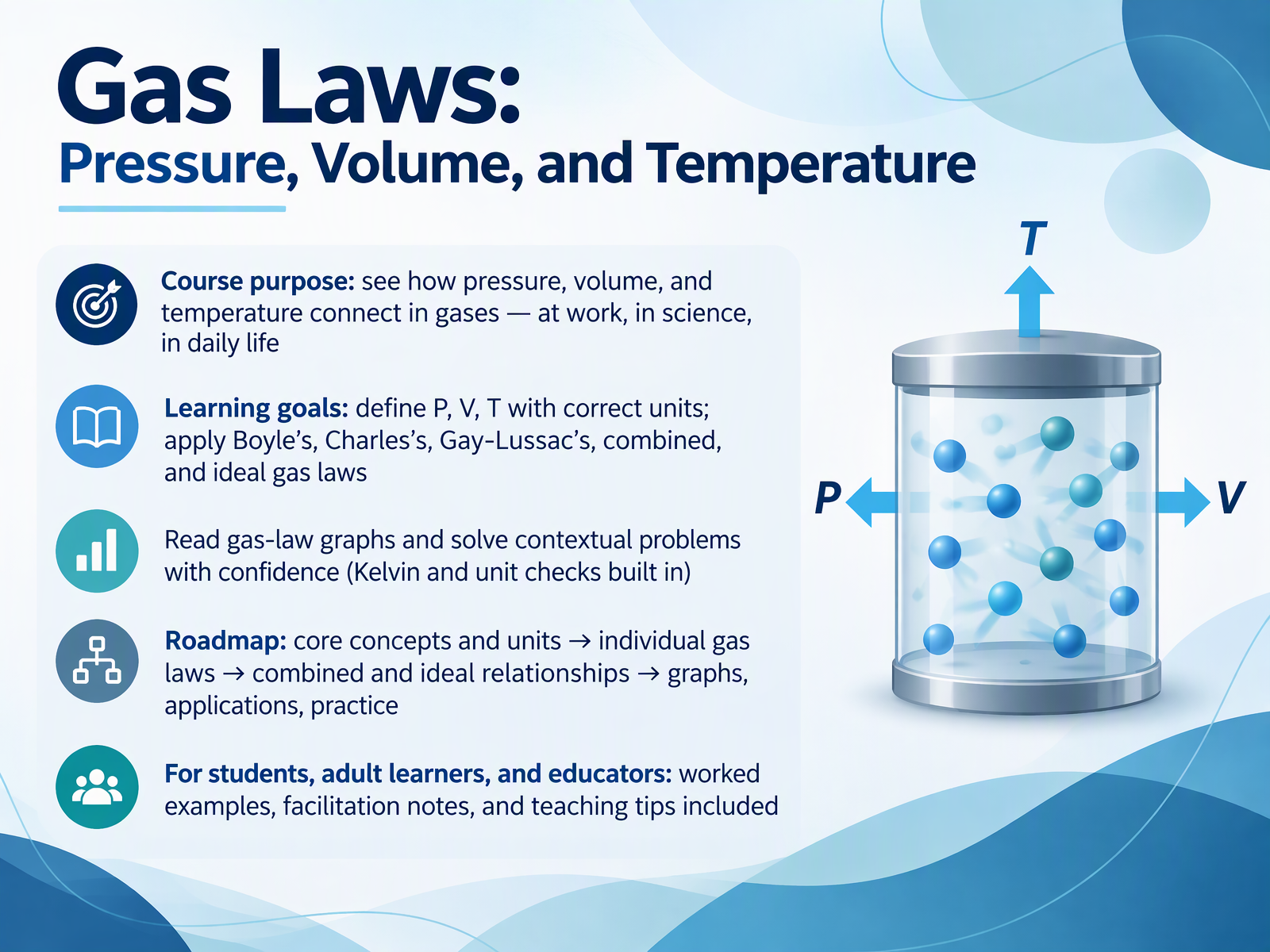
- 01Gas Laws: Pressure, Volume, and TemperatureWelcome. I'm glad you're here. In this course, we'll explore how pressure, volume, and temperature connect in gases, and why that matters at work, in science, and in everyday life. By the end, you will be able to define pressure, volume, and temperature with the correct units. You will also apply Boyle's law, Charles's law, Gay-Lussac's law, the combined gas law, and the ideal gas law. Along the way, you'll learn to read gas-law graphs and solve real problems with confidence, using Kelvin and checking your units. Here's the roadmap. We start with core concepts and units. Then we move through each gas law. Next, we connect them with the combined and ideal gas relationships. Finally, we look at graphs, applications, and practice. Whether you're a student, an adult learner, or an educator, you'll find worked examples, facilitation notes, and teaching tips included. Let's begin with core concepts, and why gases behave the way they do.iupac.orgen.wikipedia.orggoldbook.iupac.org+22 min
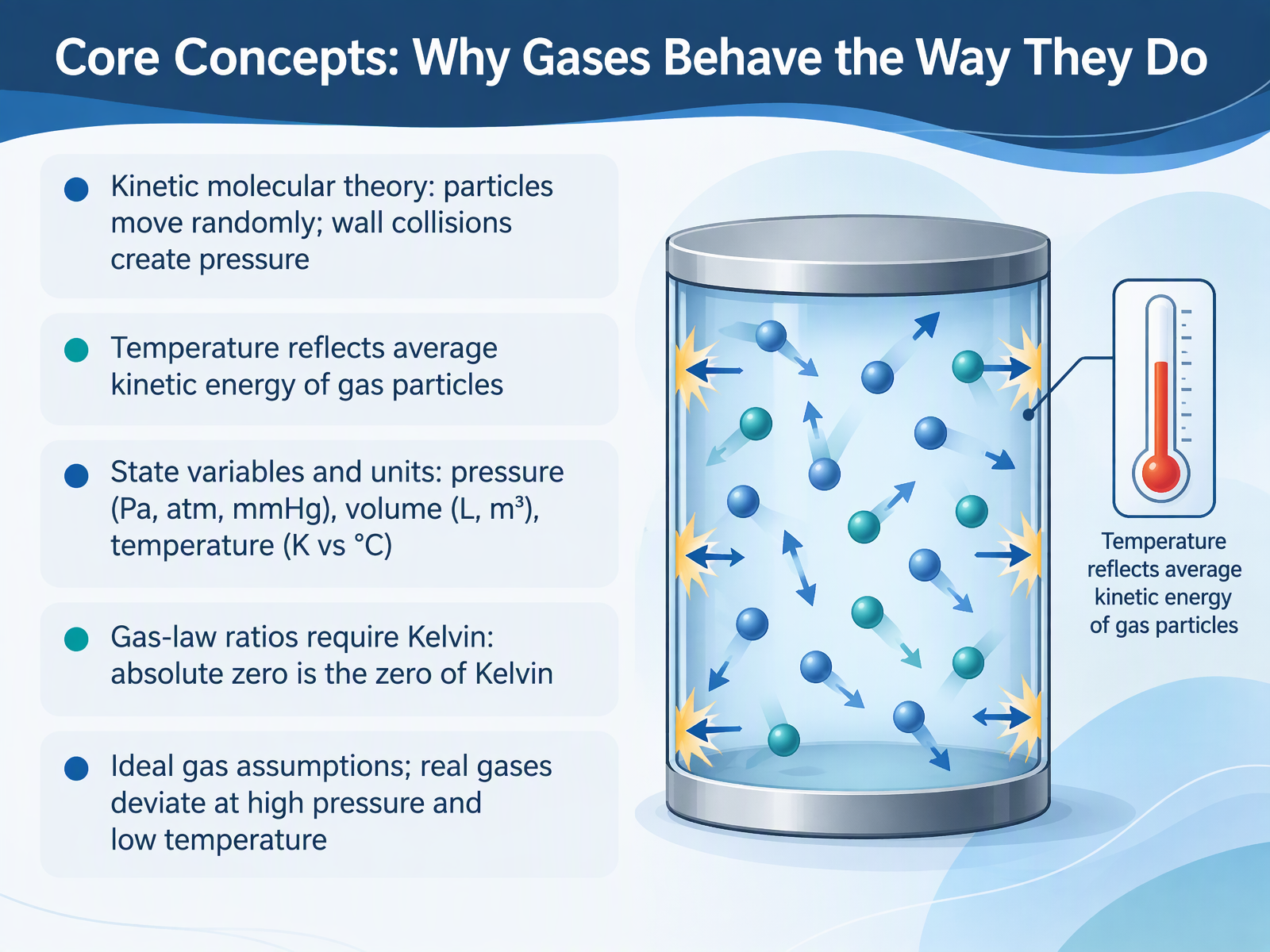
- 02Core Concepts: Why Gases Behave the Way They DoLet's move on to the core concepts that explain why gases behave the way they do. Start with kinetic molecular theory. Gas particles move randomly, and when they hit the container walls, those collisions create pressure. Temperature is not a separate thing. It reflects the average kinetic energy of the gas particles, so warmer gas means faster particles on average. Next, state variables and their units. Pressure can be measured in pascals, atmospheres, or millimeters of mercury. Volume can be in liters or cubic meters. Temperature is measured in kelvin or degrees Celsius. Here is a key point. Gas-law ratios require Kelvin, because absolute zero is the zero of the Kelvin scale. Finally, the ideal gas model assumes particles are tiny and do not attract each other. Real gases deviate at high pressure and low temperature. Remember this takeaway. Kinetic theory links particles, collisions, and temperature. Next, we will look at units, conversions, and standard conditions.
 iupac.orgen.wikipedia.orggoldbook.iupac.org+22 min
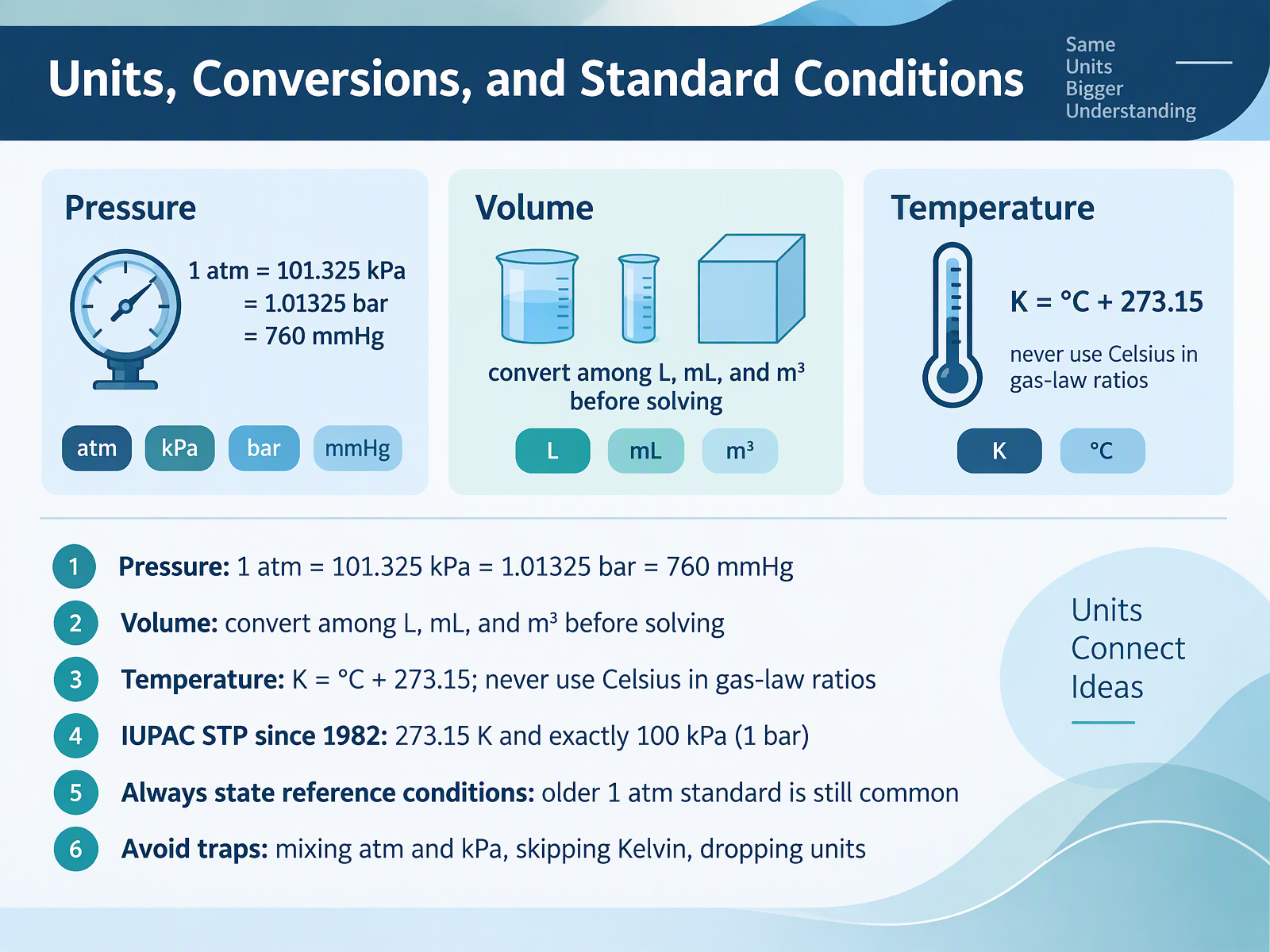
- 03Units, Conversions, and Standard ConditionsBefore we work any gas law problem, we need our units in order. Start with pressure. One atmosphere equals one hundred one point three two five kilopascals, which is also one point zero one three two five bar, or seven hundred sixty millimeters of mercury. For volume, convert among liters, milliliters, and cubic meters before you solve, so every number in your formula uses the same unit. Temperature is the one that catches people. Kelvin equals degrees Celsius plus two hundred seventy three point one five. Never put Celsius into a gas law ratio, always convert to Kelvin first. Now, standard conditions. Since nineteen eighty two, IUPAC defines standard temperature and pressure as two hundred seventy three point one five Kelvin and exactly one hundred kilopascals, that is one bar. But the older standard of one atmosphere is still common, so always state which reference conditions you are using. And watch for the classic traps: mixing atmospheres with kilopascals, skipping the Kelvin conversion, or dropping units partway through. Next, we will see how pressure and volume relate in Boyle's Law.
 iupac.orgen.wikipedia.orggoldbook.iupac.org+22 min
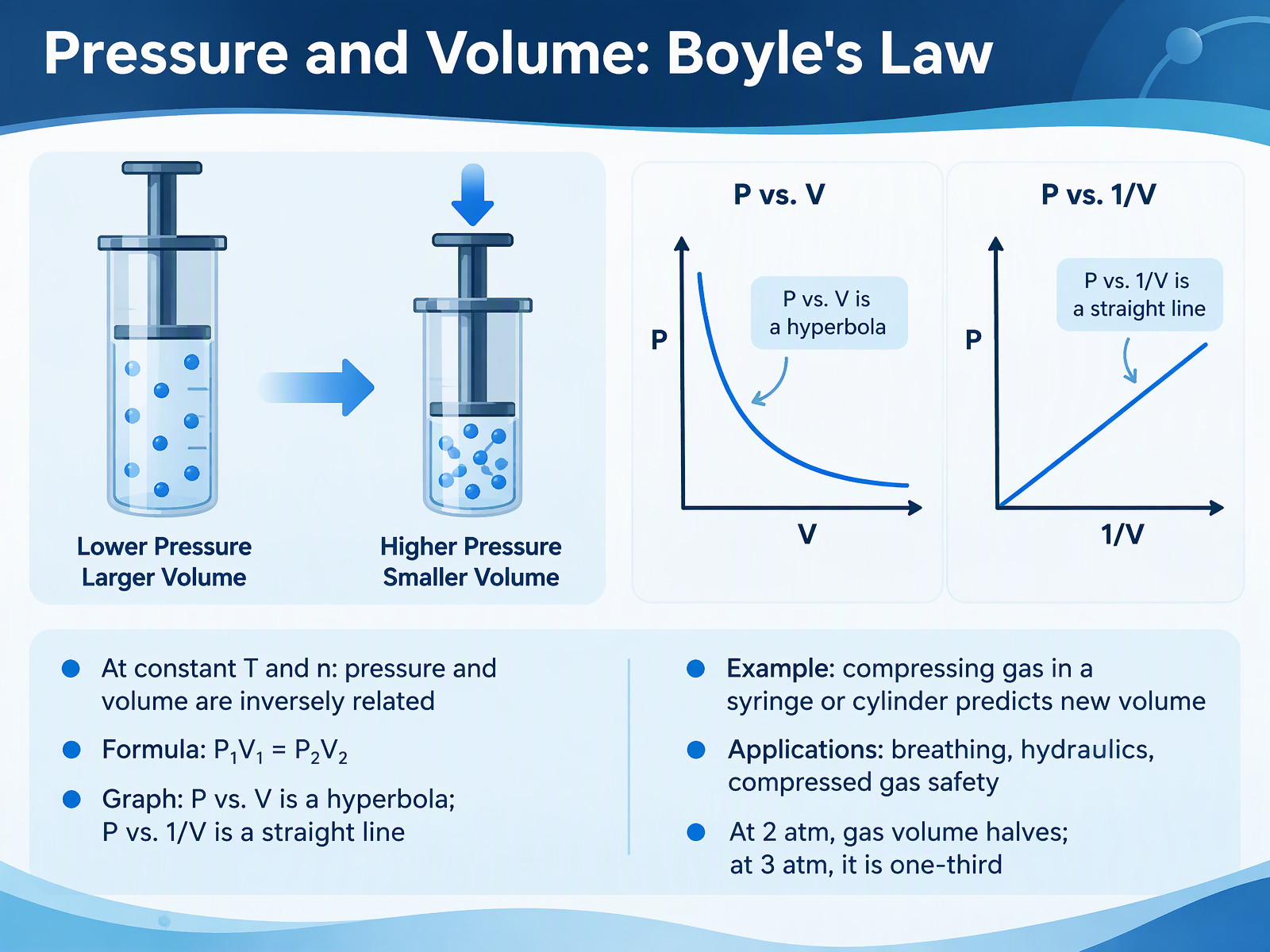
- 04Pressure and Volume: Boyle's LawNow let's look at how pressure and volume are connected. This relationship is called Boyle's Law. When temperature and the amount of gas stay constant, pressure and volume are inversely related. That means when one goes up, the other goes down. We can write this as P one times V one equals P two times V two. If you graph pressure against volume, you get a curve called a hyperbola. But if you graph pressure against one divided by volume, you get a straight line. Here is a concrete example. Suppose you compress gas in a syringe. At two atmospheres, the volume halves. At three atmospheres, it drops to one third. You see this in breathing, in hydraulics, and in compressed gas safety. That is Boyle's Law in action. Next, we turn to how volume and temperature are related, as we explore Charles's Law.
 openstax.orgehs.ucsb.eduomao.noaa.gov+21 min
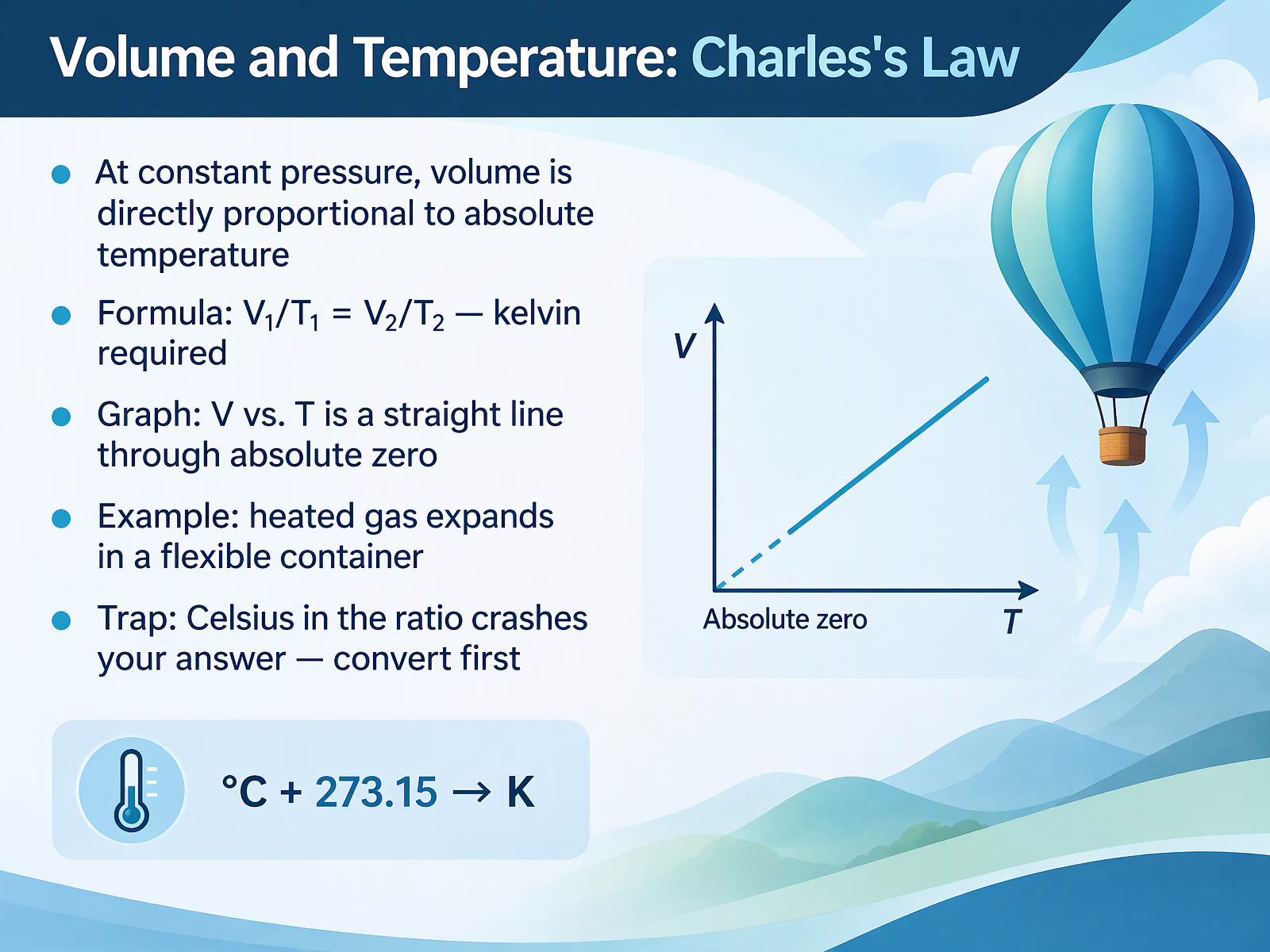
- 05Volume and Temperature: Charles's LawNow let's look at Charles's Law, which connects volume and temperature. At constant pressure, the volume of a gas is directly proportional to its absolute temperature. The formula is V one divided by T one equals V two divided by T two, and both temperatures must be in kelvin. Here's why. If you plot volume against temperature, you get a straight line that points toward absolute zero, the point where volume would shrink to nothing. That only works on the kelvin scale. Think of a gas in a flexible container, like a balloon. Heat it, and it expands. Cool it, and it shrinks. One common trap is using Celsius in the ratio. That crashes your answer, because Celsius doesn't start at absolute zero. So always convert first, then calculate. Coming up next, we'll look at pressure and temperature in Gay-Lussac's Law, also called Amontons's Law.
 openstax.orgehs.ucsb.eduomao.noaa.gov+21 min
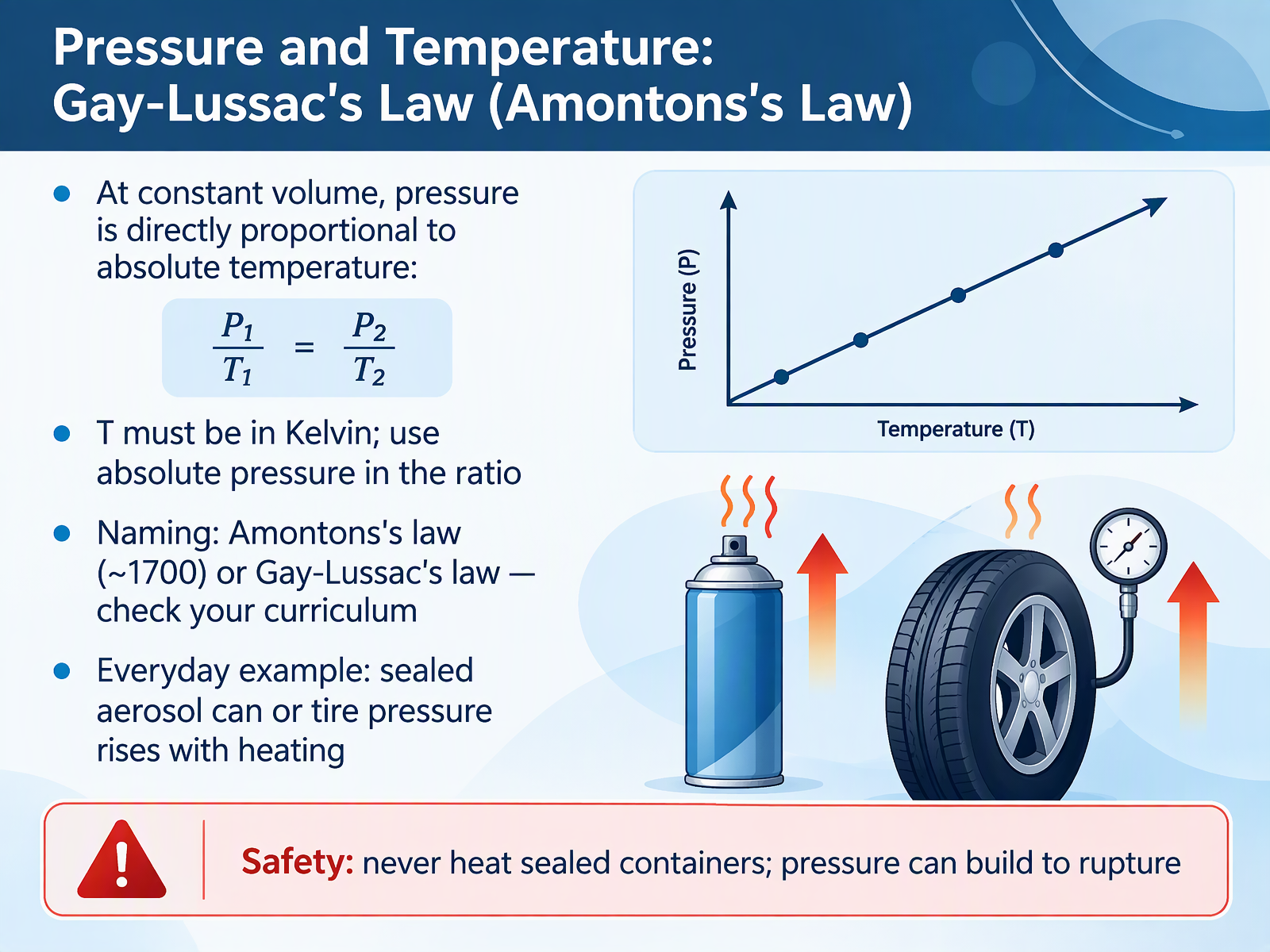
- 06Pressure and Temperature: Gay-Lussac's Law (Amontons's Law)Now let's look at pressure and temperature when volume stays fixed. This is called Gay-Lussac's law, or Amontons's law. The rule is simple. At constant volume, pressure is directly proportional to absolute temperature. So pressure one divided by temperature one equals pressure two divided by temperature two. Here is one thing to watch. Temperatures must be in kelvin, because that scale starts at absolute zero. Also, use absolute pressure in the ratio. About the name, Guillaume Amontons first established this relationship around seventeen hundred, and Gay-Lussac measured it more precisely around eighteen hundred. So check which name your curriculum uses. A familiar example is a sealed aerosol can or a tire. As it heats up, the pressure inside rises. And that brings an important safety point. Never heat sealed containers, because the pressure can build until the container ruptures. Next, we'll combine these gas laws in the combined gas law.
 pubs.aip.orgopenstax.orgdoi.org+21 min
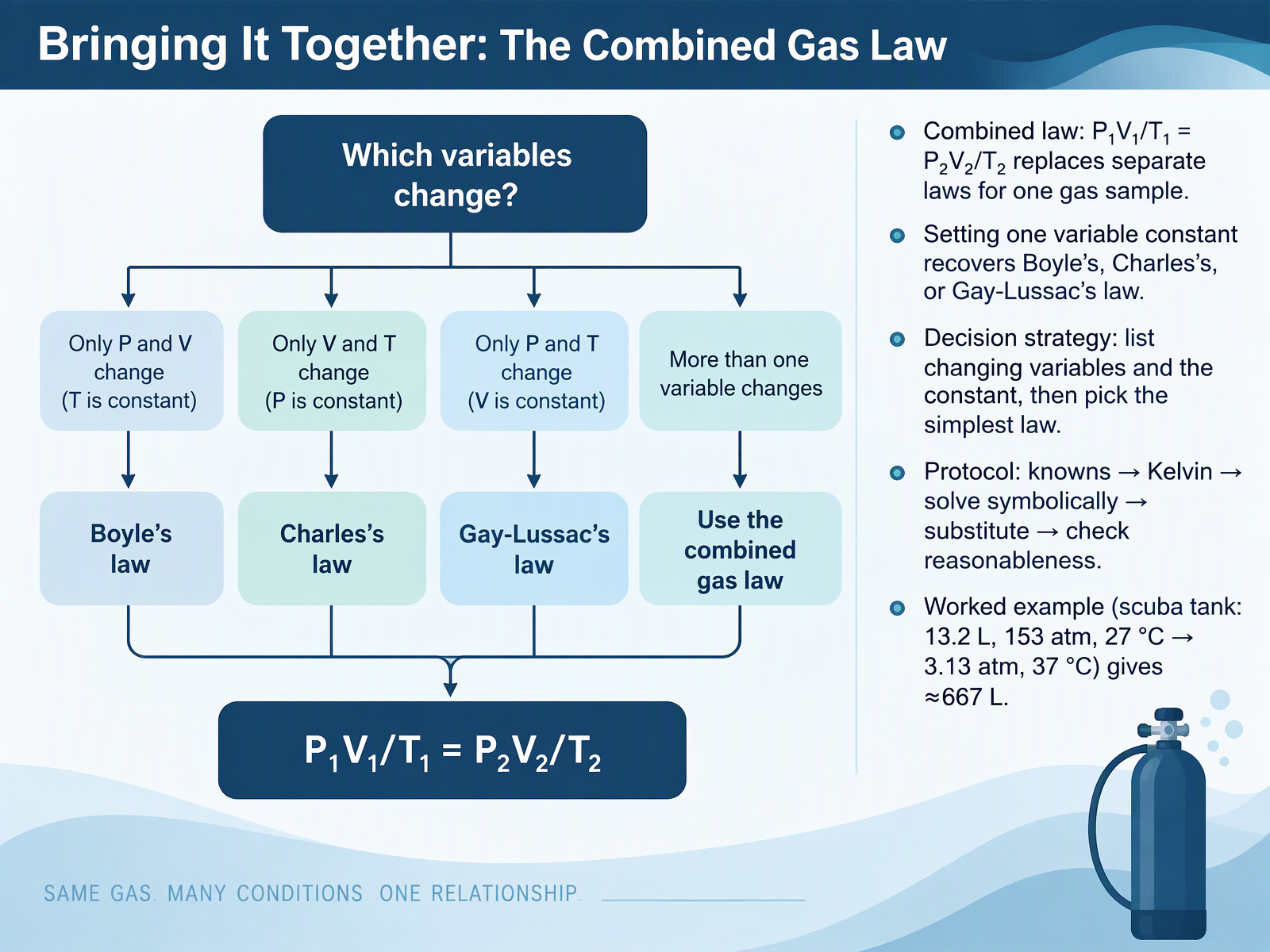
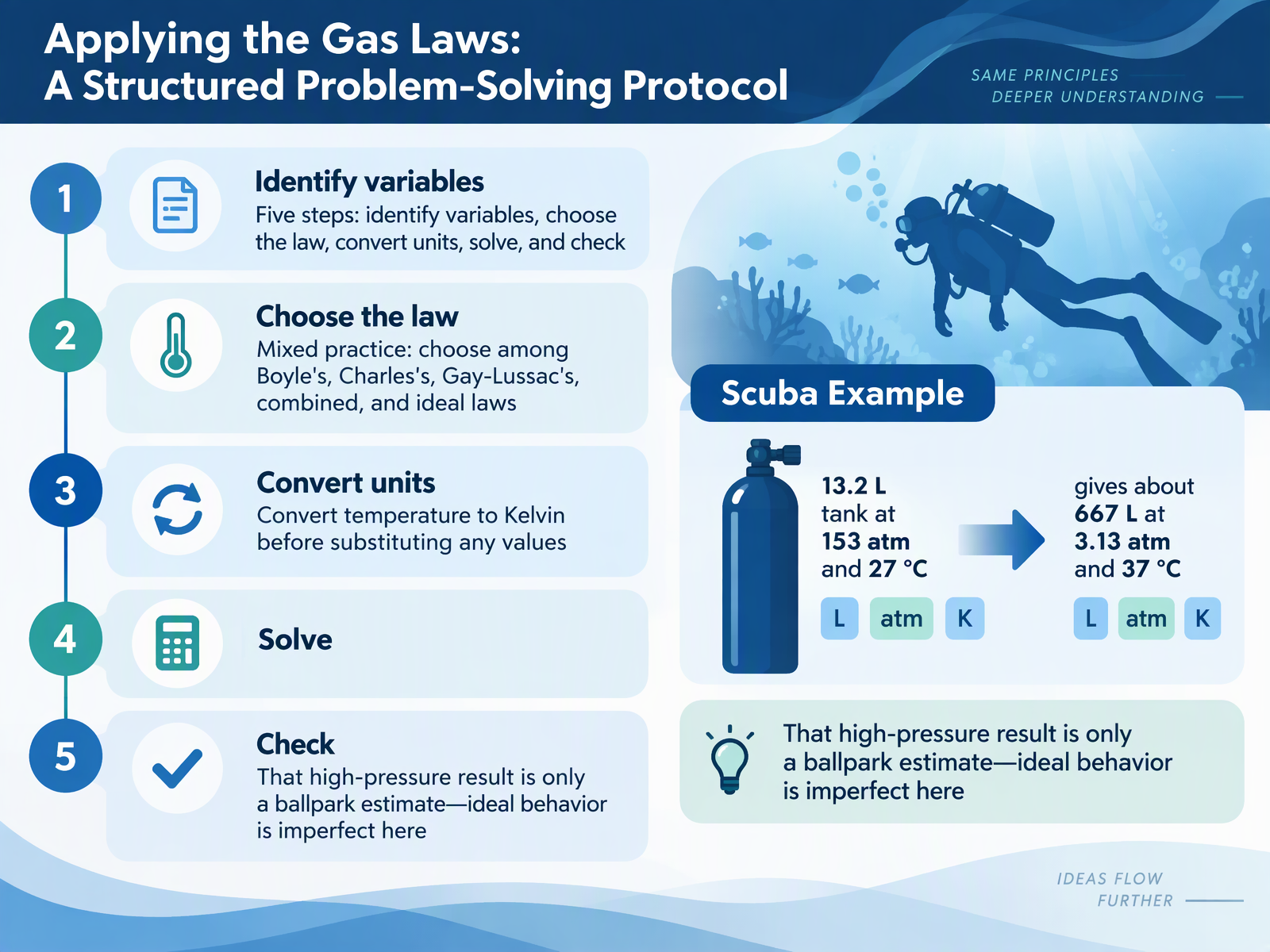
- 07Bringing It Together: The Combined Gas LawNow let's bring the individual gas laws together. The combined gas law says that pressure one times volume one, divided by temperature one, equals pressure two times volume two, divided by temperature two. This one equation replaces the separate laws when you're tracking a single gas sample. If you hold one variable constant, it collapses back into Boyle's law, Charles's law, or Gay-Lussac's law. So here's a simple decision strategy. List which variables actually change, note the one that stays constant, then choose the simplest law that fits. Then follow a steady protocol. Write down your knowns, convert all temperatures to Kelvin, solve symbolically for the unknown, substitute the numbers, and check whether the answer is reasonable. For example, a scuba tank holds thirteen point two liters at one hundred fifty three atmospheres and twenty seven degrees Celsius. In the lungs, at three point one three atmospheres and thirty seven degrees Celsius, that air expands to approximately six hundred sixty seven liters. Next, we'll look at the ideal gas law and its uses.
 openstax.orgehs.ucsb.eduomao.noaa.gov+22 min
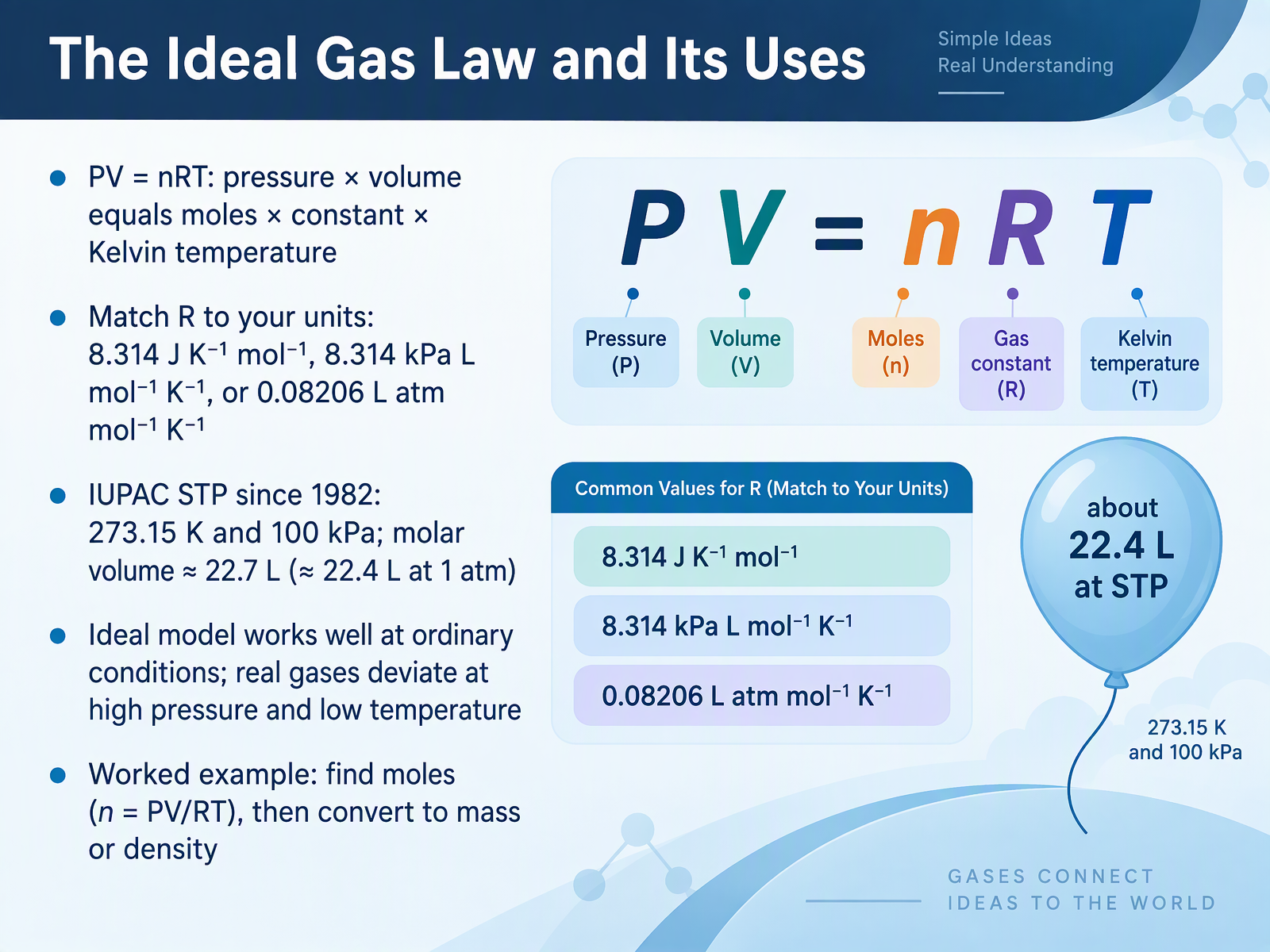
- 08The Ideal Gas Law and Its UsesNow let's put the gas laws together into one equation: the ideal gas law. It reads, pressure times volume equals moles times the gas constant times temperature in kelvin. Before you calculate, match the gas constant to your units. Use 8.314 with joules, 8.314 with kilopascals and liters, or 0.08206 with liters and atmospheres. Also check your standard conditions. Since 1982, IUPAC defines standard temperature and pressure as 273.15 kelvin and 100 kilopascals, where one mole of gas occupies about 22.7 liters. The older value of 22.4 liters applied at one atmosphere. Keep in mind the ideal model works well at ordinary conditions, but real gases deviate at high pressure and low temperature. In a worked example, rearrange the law to find moles as pressure times volume divided by the gas constant times temperature, then convert moles to mass or density. Next, we'll look at reading and creating gas law graphs.
 iupac.orgen.wikipedia.orggoldbook.iupac.org+22 min
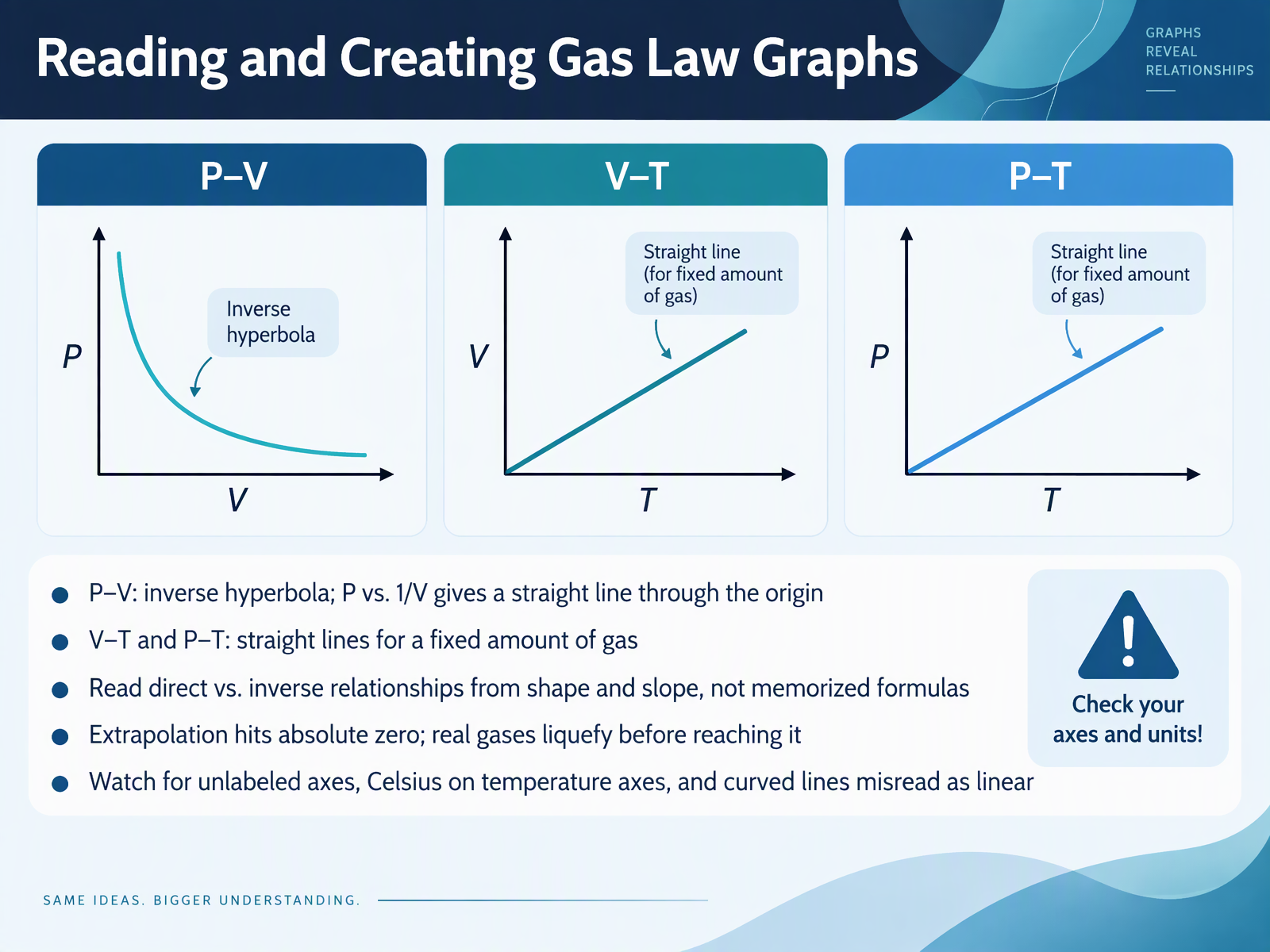
- 09Reading and Creating Gas Law GraphsNow let's look at reading and creating gas law graphs. Start with pressure versus volume. That curve is an inverse hyperbola. But if you plot pressure against one divided by volume, you get a straight line through the origin. With volume versus temperature, and pressure versus temperature, you get straight lines for a fixed amount of gas. Here's the key habit. Read direct and inverse relationships from the shape and slope of the graph, not from memorized formulas. A line that rises means a direct relationship. A curve that falls steeply means an inverse one. Also notice the temperature axis. Extrapolating a line back hits absolute zero, but real gases liquefy before they ever reach it. Finally, watch for common traps. Unlabeled axes, Celsius instead of kelvin on the temperature axis, and curved lines that get mistaken for straight ones. Next, we'll connect all of this to real life in Real World Applications: Diving, Balloons, Tires, and HVAC.
 openstax.orgehs.ucsb.eduomao.noaa.gov+21 min
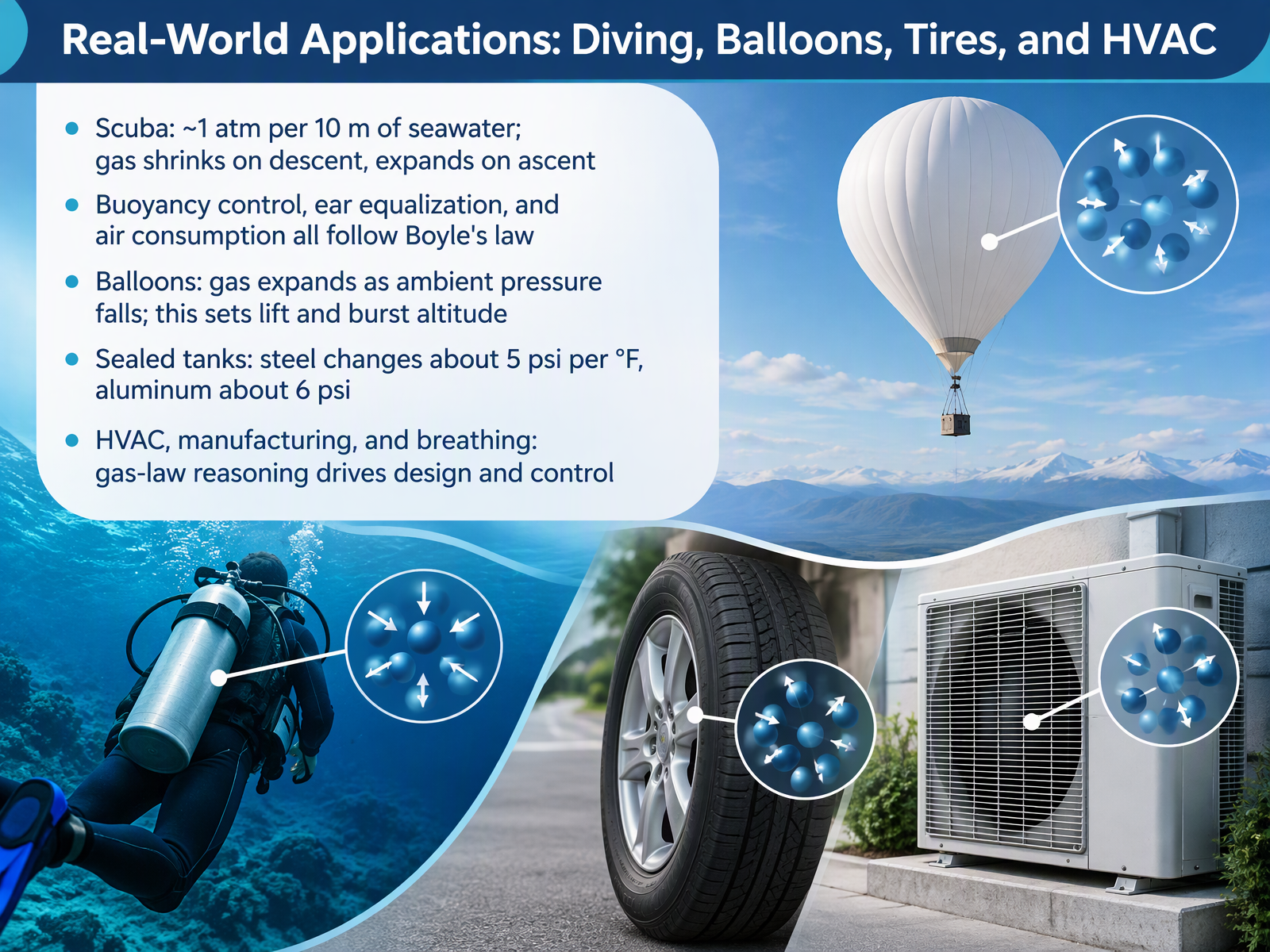
- 10Real-World Applications: Diving, Balloons, Tires, and HVACLet's connect these laws to situations you can actually see. In scuba diving, pressure rises by about one atmosphere for every ten meters of seawater. So gas in your body and gear shrinks on the descent and expands on the ascent. Buoyancy control, ear equalization, and air consumption all follow Boyle's law. Weather balloons behave the same way in reverse. As the balloon rises, ambient pressure falls, the gas expands, and that expansion sets its lift and burst altitude. In sealed tanks, temperature matters. Steel scuba tanks change about five psi per degree Fahrenheit, and aluminum about six. That is why tanks are filled and checked with temperature in mind. HVAC systems, manufacturing, and even normal breathing all rely on gas law reasoning to guide design and control. So remember, these laws are not just equations. They explain how pressure, volume, and temperature shape everyday tools and safety decisions. Next, we will turn this understanding into action with a structured way to solve gas law problems, in Applying the Gas Laws: A Structured Problem-Solving Protocol.
 openstax.orgehs.ucsb.eduomao.noaa.gov+21 min
- 11Applying the Gas Laws: A Structured Problem-Solving ProtocolNow let's put the gas laws to work with a structured problem-solving protocol. Every gas problem follows the same five steps. First, identify your variables. Second, choose the law that matches them. Third, convert your units. Fourth, solve. And fifth, check whether your answer makes sense. Here's the one step people forget. Always convert temperature to Kelvin before you substitute any values. Add 273 to the Celsius reading, and you're ready to go. In mixed practice, you'll decide among Boyle's law, Charles's law, Gay-Lussac's law, the combined gas law, and the ideal gas law. The key question is simply which variables are changing and which stay constant. Here's a real example. A scuba tank holds 13.2 liters at 153 atmospheres and 27 degrees Celsius. At 3.13 atmospheres and 37 degrees Celsius, the combined gas law gives about 667 liters. That's a huge expansion, and it's only a ballpark estimate, because at such high pressure, the gas doesn't behave perfectly ideally. Treat the number as a reasonable guide, not an exact answer. Next, we'll look at correcting common misconceptions.
 openstax.orgehs.ucsb.eduomao.noaa.gov+22 min
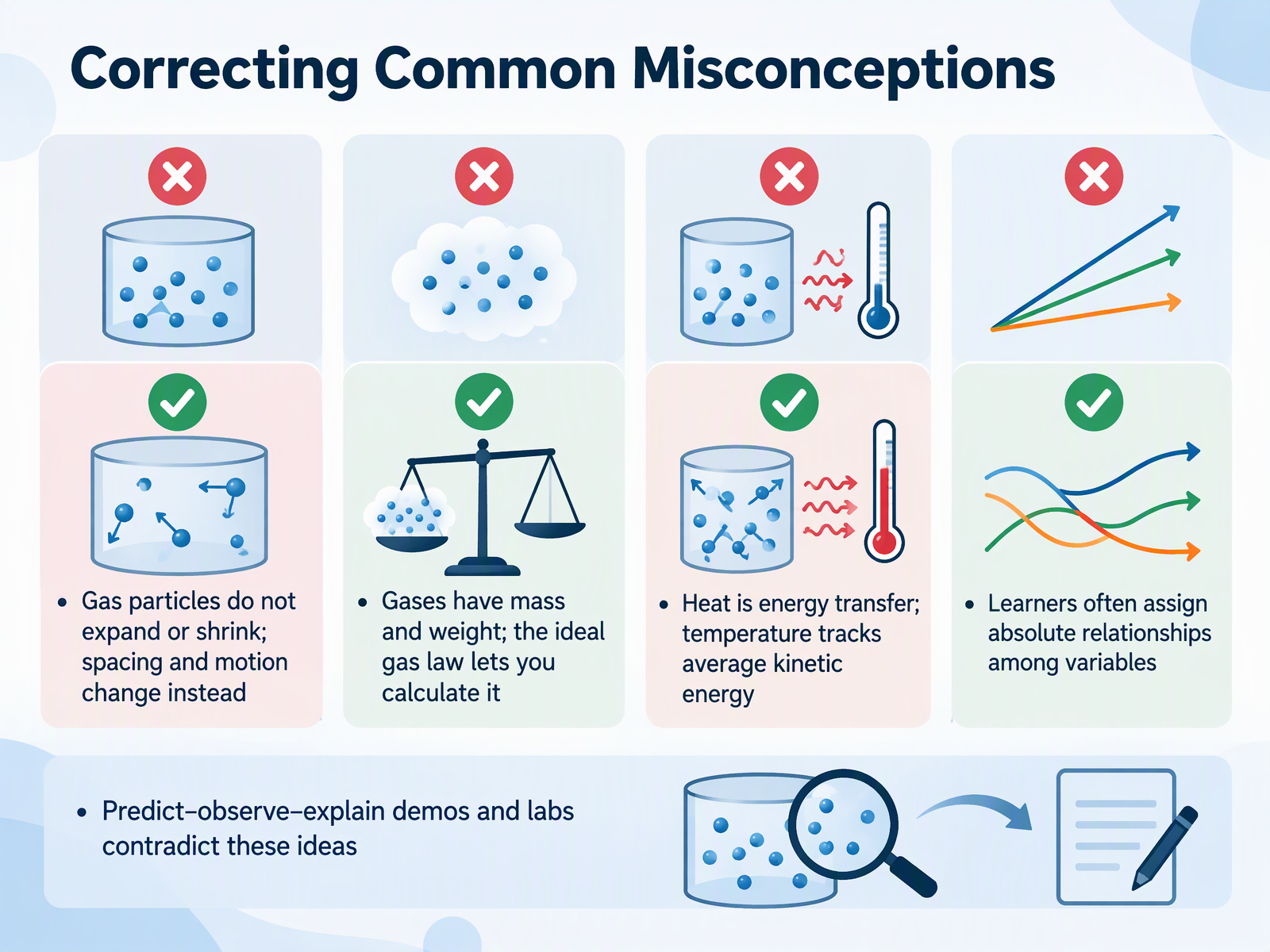
- 12Correcting Common MisconceptionsLet's talk about some common misconceptions you may run into with gases. First, gas particles do not expand or shrink. When a gas heats up or cools down, the particles stay the same size. What changes is the spacing between them and how fast they move. Second, gases do have mass and weight, even though they are invisible. You can calculate that mass using the ideal gas law. Third, keep heat and temperature separate. Heat is energy transfer. Temperature tracks the average kinetic energy of the particles. Another common habit is assigning absolute relationships among variables, such as assuming that if pressure doubles, volume must double too. But gas laws often involve inverse or proportional relationships, not absolute ones. Finally, predict, observe, and explain demonstrations and labs are powerful tools. They let you see results that contradict these mistaken ideas. So when a gas seems to disappear, remember the particles are still there, just spread out. Coming up next, we'll look at teaching strategies and formative checks.
 pubs.acs.orgpubs.aip.orgdoi.org+22 min
- 13Teaching Strategies and Formative ChecksNow let's talk about how to teach these ideas and check that they land. Start with demos and analogies that make particle motion and pressure intuitive, like a balloon shrinking in cold water. Then use quick formative checks: conceptual questions, short calculations, graph reading, and misconception probes. Build durable understanding with retrieval practice, faded worked examples, and peer explanation. Multiple representations and clear unit conventions help students with diverse prior knowledge. And aim your probes at known misconceptions, such as gases having no weight, heat and temperature being the same, and relationships being absolute rather than proportional. If your students can explain a demo in plain language, you know the idea is sticking. Let's bring this together in the wrap-up on key takeaways and next steps.
 pubs.acs.orgpubs.aip.orgdoi.org+21 min
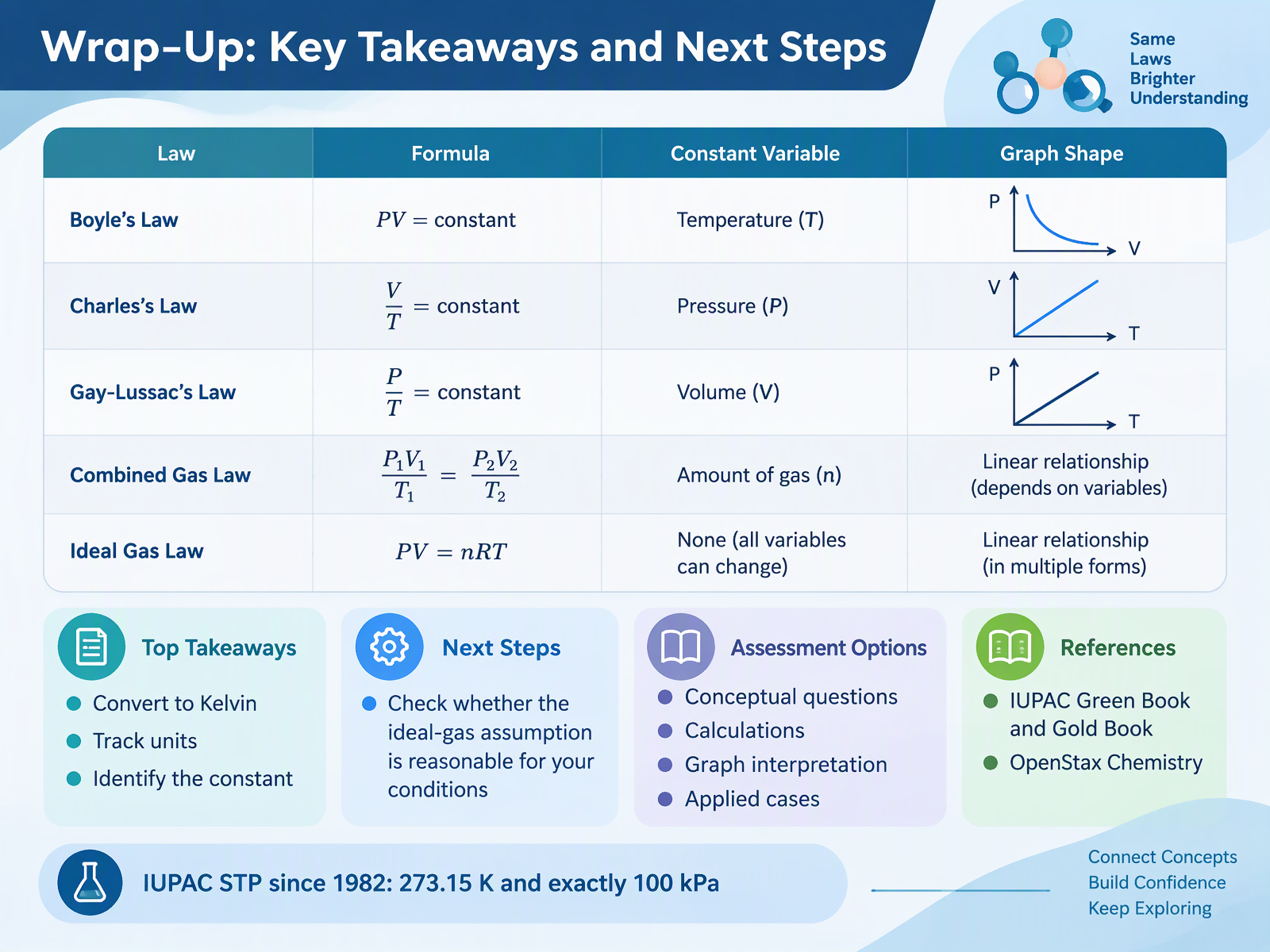
- 14Wrap-Up: Key Takeaways and Next StepsLet's bring it all together. This summary table lines up each gas law with its formula, the variable held constant, and the shape of its graph. Keep three habits in mind. Convert temperatures to Kelvin first. Track your units carefully. And identify which quantity stays constant before you calculate. Also, pause and ask whether the ideal gas assumption is reasonable for your conditions. It works best at low pressure and moderate temperature. For assessment, you can use conceptual questions, calculations, graph interpretation, and applied cases like scuba tanks and weather balloons. For references, see the IUPAC Green Book and Gold Book, and OpenStax Chemistry. And remember, IUPAC has defined standard temperature and pressure since 1982 as 273.15 Kelvin and exactly 100 kilopascals. Thank you for joining me. Keep practicing, stay curious, and you'll handle these gas problems with confidence.
 iupac.orgen.wikipedia.orggoldbook.iupac.org+22 min
Take the deck with you
Download this course as a file — free, no sign-up needed.
- PDF handoutEvery slide page, ready to print or share.15 pages · 3.5 MBDownload
- Narrated PowerPointThe deck that presents itself — every slide carries the digital human's narration video.15 pages · 15.5 MBDownload
- PowerPoint slidesThe full deck as a .pptx — open it in PowerPoint, Keynote, or Google Slides.15 pages · 3.4 MBDownload
Free to use in your own training — please keep the PersonWise credit page at the end.
Have your own deck? Turn it into a course
Sources consulted
Web sources consulted while building this course.
- Quantities, Units and Symbols in Physical Chemistry, 4th Edition, Abridged Version — iupac.org
- Standard temperature and pressure — en.wikipedia.org
- IUPAC - standard conditions for gases (S05910) — goldbook.iupac.org
- https://goldbook.iupac.org/terms/ris/S05910 — goldbook.iupac.org
- https://pdg.lbl.gov/2024/AtomicNuclearProperties/explain_gas.html — pdg.lbl.gov
- 9.2 Relating Pressure, Volume, Amount, and Temperature: The Ideal Gas Law - Chemistry 2e | OpenStax — openstax.org
- Chapter 2 - Physics of Diving — ehs.ucsb.edu
- Presented by the NOAA Diving Center Seattle, Washington — omao.noaa.gov
- Gas Laws & Weather Balloons | learn.concord.org — learn.concord.org
- Boyle's law, Charles's law, and the Gas laws — johnelfick.github.io
- What Gay-Lussac didn’t tell us | American Journal of Physics | AIP Publishing — pubs.aip.org
- THE HISTORIC RE-THINKING OF THE CHARLES'S LAW AND GAY-LUSSAC'S LAW — doi.org
- La Ley de Amontons y las indagaciones sobre el aire en la Academia de Ciencias de París (1699-1710) — doi.org
- Kaasulakien nimeäminen - LUMA-keskus Suomi — luma.fi
- Addressing Students' Misconceptions about Gases, Mass, and ... — pubs.acs.org
- Student understanding of the ideal gas law, Part II: A microscopic perspective | American Journal of Physics | AIP Publishing — pubs.aip.org
- Development of the kinetic molecular theory of gases concept inventory: Preliminary results on university students’ misconceptions — doi.org
- Exploring university students’ misconceptions of the kinetic molecular theory of gases: A study from Kazakhstan — doi.org
- Identifying the challenging characteristics of systems thinking encountered by undergraduate students in chemistry problem-solving of gas laws - Chemistry Education Research and Practice (RSC Publishing) DOI:10.1039/C9RP00070D — pubs.rsc.org