Begin
13 pages · ~26 min
Selecting Generative User Research Tools
A concise course for UX researchers on selecting generative AI tools and designing effective research workflows.
A digital instructor presents all 13 pages. Hold “Ask” at any point and ask out loud — the answer comes from this course. No sign-up needed.
What you’ll learn
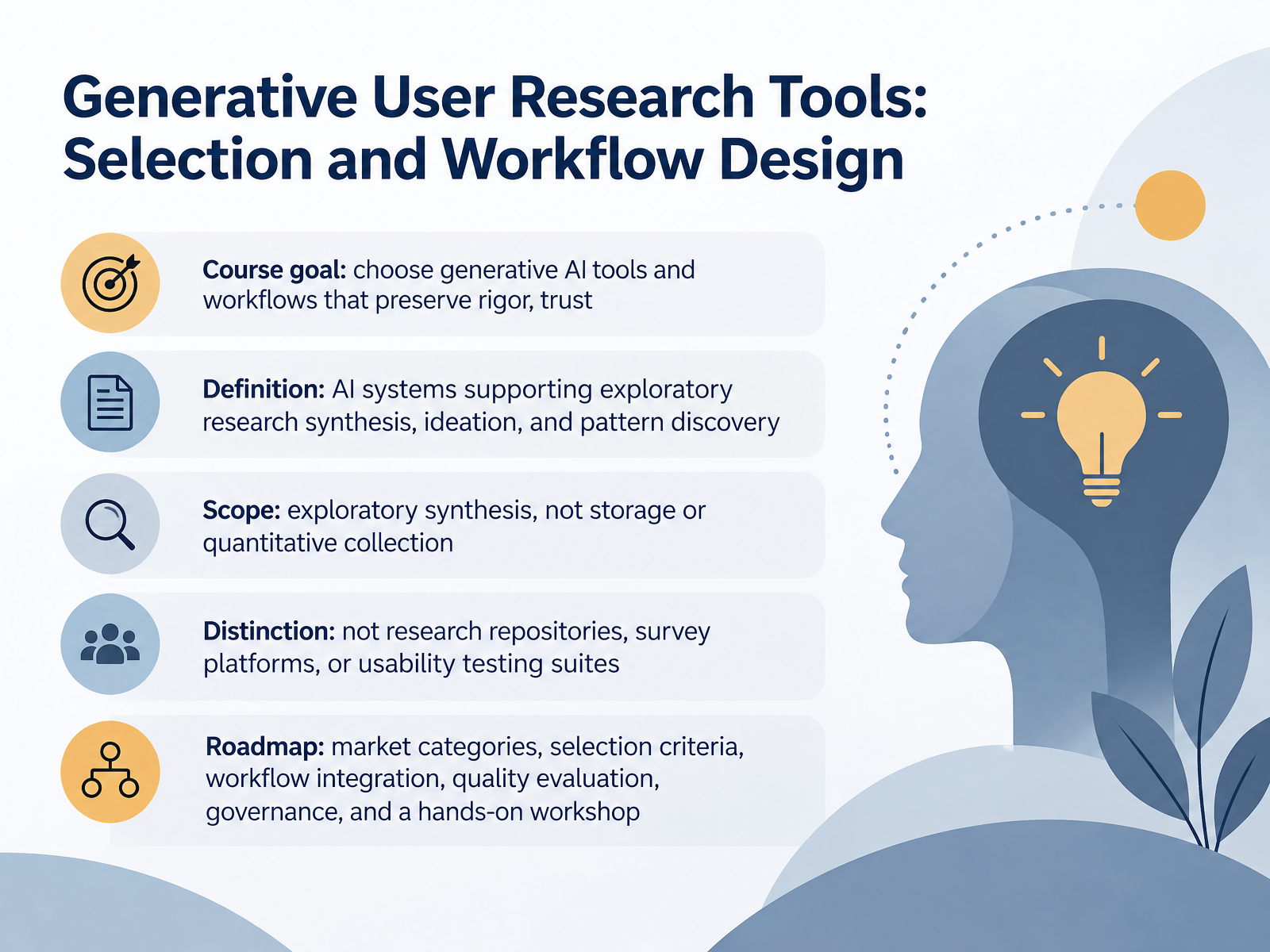
- 01Generative User Research Tools: Selection and Workflow DesignWelcome. Over the next hour, we are going to pick tools you can actually defend. Not the flashiest ones. The ones that hold up when a stakeholder asks how you know. Here is the goal. Choose generative AI tools and workflows that preserve rigor and trust. So what counts as a generative research tool? Broadly, an AI system that supports exploratory synthesis, ideation, and pattern discovery. Two boundaries keep this manageable. First, scope. We cover exploratory synthesis, not storage, and not quantitative collection. Second, the distinction. These are not research repositories, survey platforms, or usability testing suites. Dovetail stores what you already have. Qualtrics runs your surveys. Maze tests your prototype. None of them do the job we are here for. One practical note before we start. The market moves fast. Vendors get acquired, prices change, and capabilities shift quarter to quarter. Treat any specific tool name in this course as a starting point for your own shortlist, not a final answer. We will work through market categories, selection criteria, workflow integration, quality evaluation, governance, and close with a hands-on workshop. Start with the categories unless your team already has a tool in mind. Then use the criteria to pressure-test it. Next, we look at why this matters right now.conveo.aifish.dogfish.dog+22 min
- 02Why Generative Tools Matter NowLet's look at why generative tools matter right now.
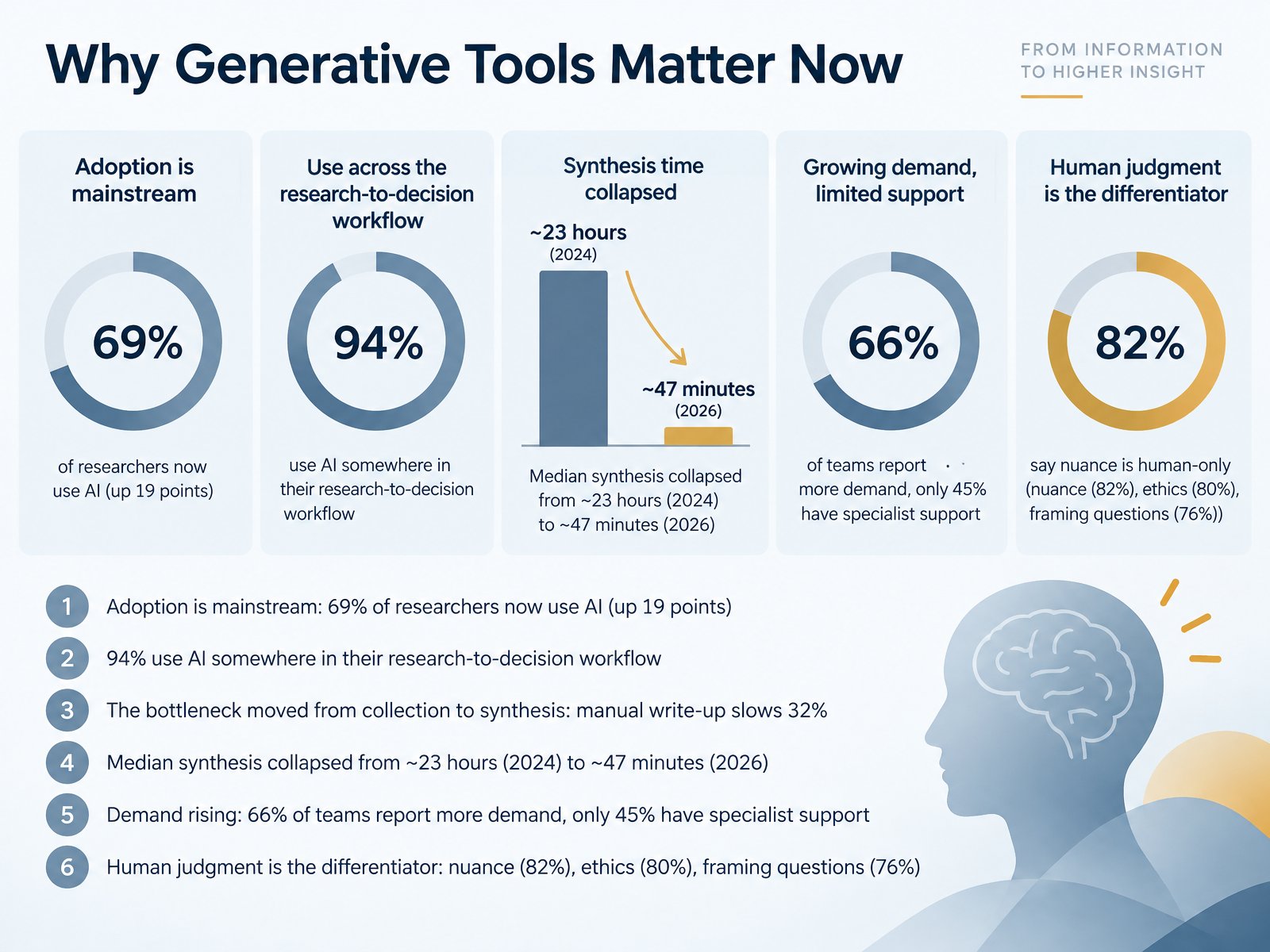
Adoption is no longer the question. Sixty-nine percent of researchers now use AI, up nineteen points in a single year. And ninety-four percent use it somewhere in their research-to-decision workflow.
So the bottleneck moved. It's no longer collection. It's synthesis. Manual write-up slows teams down thirty-two percent. And the payoff for fixing that is real. Median synthesis collapsed from about twenty-three hours in two thousand twenty-four to forty-seven minutes in two thousand twenty-six.
But here's the tension. Sixty-six percent of teams report rising demand, while only forty-five percent have dedicated specialist support.
That's why human judgment is your differentiator. Researchers name nuance at eighty-two percent, ethics at eighty percent, and framing questions at seventy-six percent as work AI can't replicate.
Start with synthesis first, unless your team already has that solved. That's where the time is.
Next, we'll map the market landscape, covering tool categories and capabilities.
 foundationcapital.commaze.colyssna.com+22 min
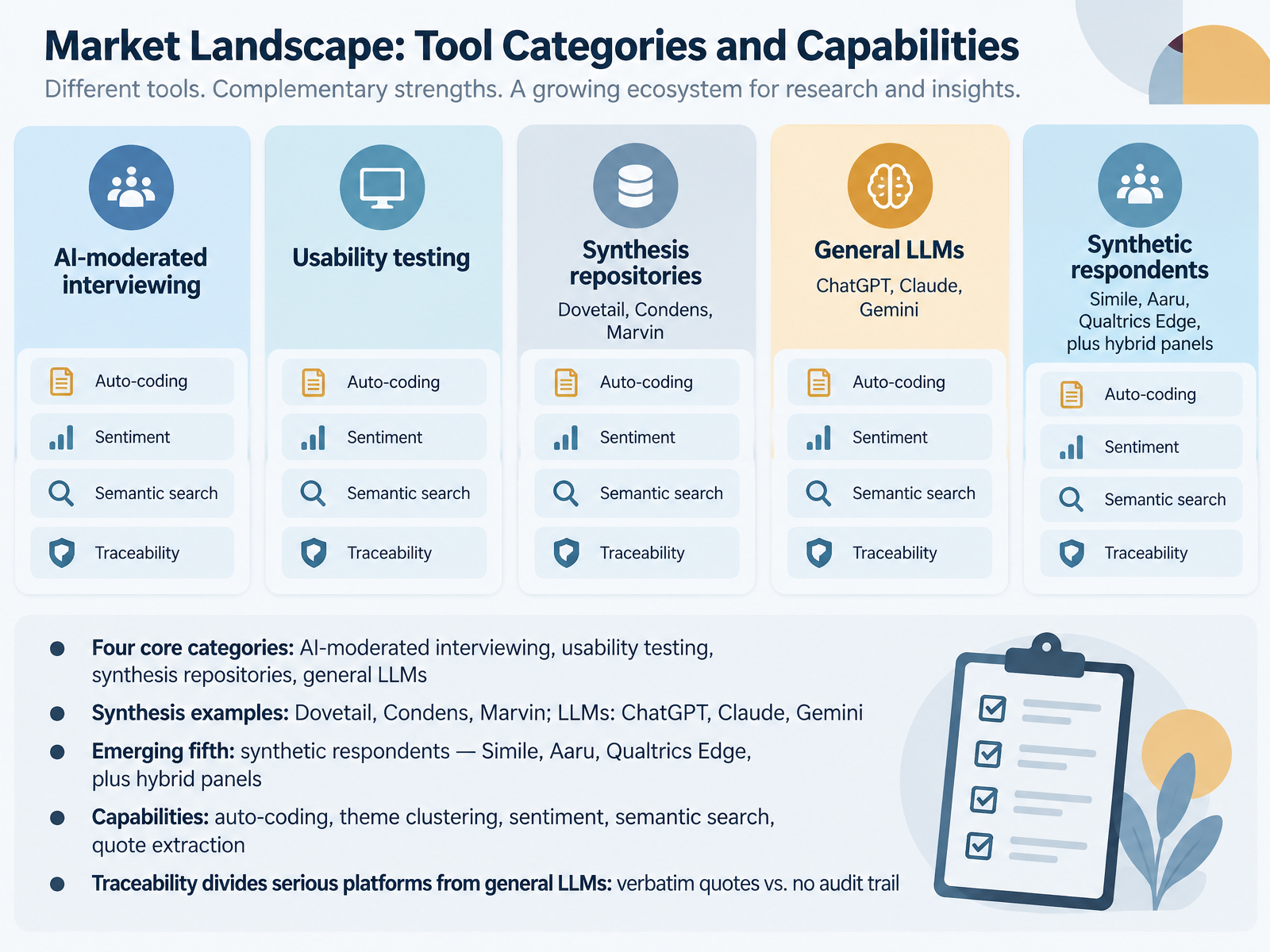
 - 03Market Landscape: Tool Categories and CapabilitiesLet's map the market you're actually shopping in. Four core categories cover most of it: A I moderated interviewing, usability testing, synthesis repositories, and general large language models. Tools in the first two categories run studies for you. Synthesizers like Dovetail, Condens, and Marvin work on data you already have. General L L Ms like ChatGPT, Claude, or Gemini help with planning, not decision-grade findings.
A fifth category is forming quickly: synthetic respondents. Simile, Aaru, Qualtrics Edge, and hybrid panels blend simulated participants with real ones. Useful for hypothesis testing. Risky for launch decisions, because simulated answers can sound confident and still be wrong.
Underneath, capabilities look similar across platforms: auto-coding, theme clustering, sentiment, semantic search, quote extraction. The real divider is traceability. A serious platform links every theme back to a verbatim quote and a timestamped clip, so you can audit it. General L L Ms give you no audit trail at all.
So the default: start with a synthesis or interviewing tool unless your team only needs quick planning help. Next, we separate real-participant tools from synthetic respondents.
 conveo.aifish.dogfish.dog+22 min
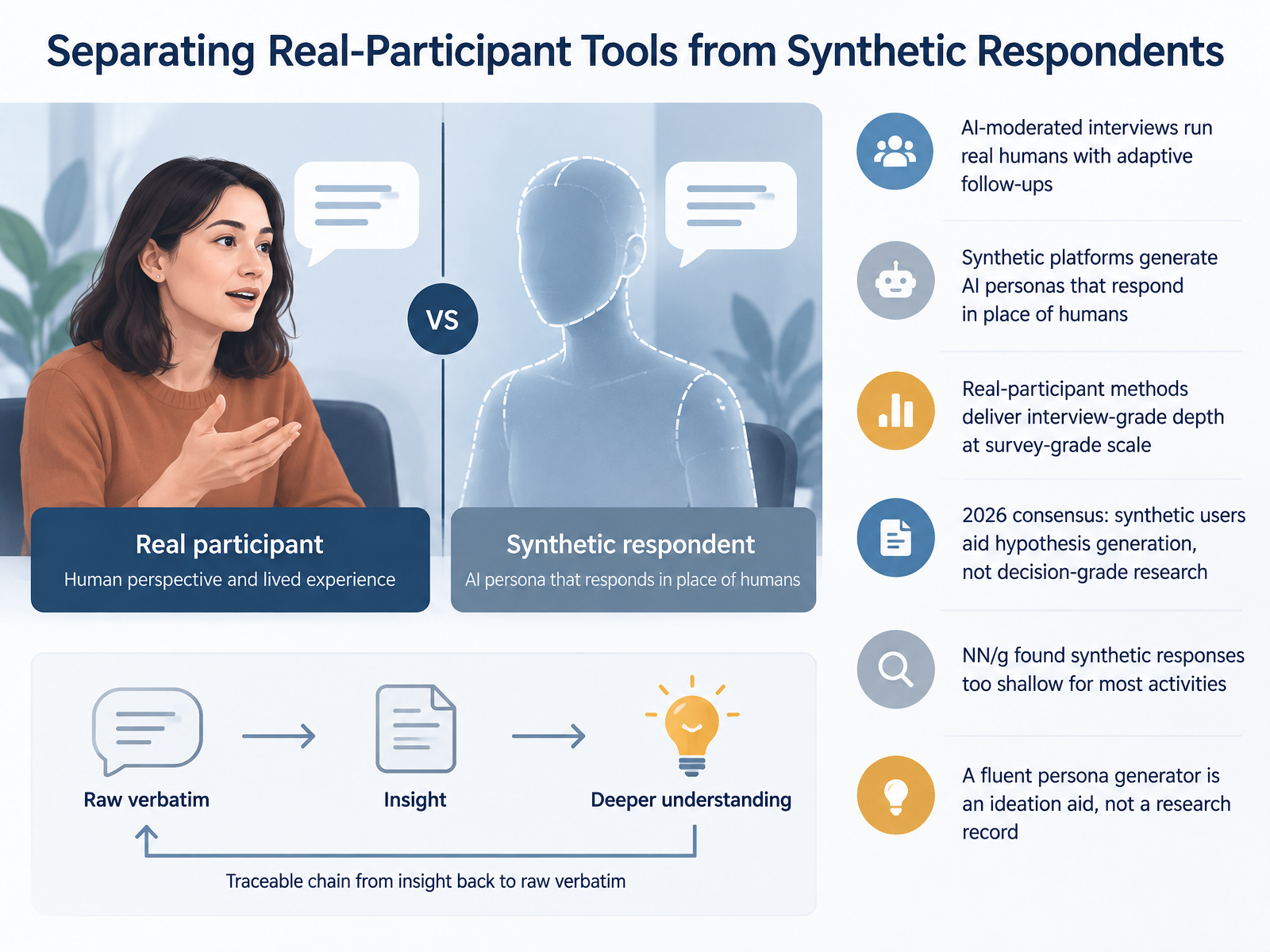
 - 04Separating Real-Participant Tools from Synthetic RespondentsLet's separate two things that get blurred together. AI-moderated interviews run real humans, with adaptive follow-ups. Synthetic platforms generate AI personas that respond in place of humans. That distinction matters more than any feature list. Real-participant methods now deliver interview-grade depth at survey-grade scale. Synthetic tools can now aid hypothesis generation, but not decision-grade research. The Nielsen Norman Group found synthetic responses too shallow for most activities. So here is your default. Use synthetic respondents to sharpen your questions and seed hypotheses. Do not use them as a stand-in for real participants in a decision. A fluent persona generator is an ideation aid, not a research record. Next, we will look at selection criteria you can reuse: a durable evaluation framework.
 conveo.aifish.dogfish.dog+21 min
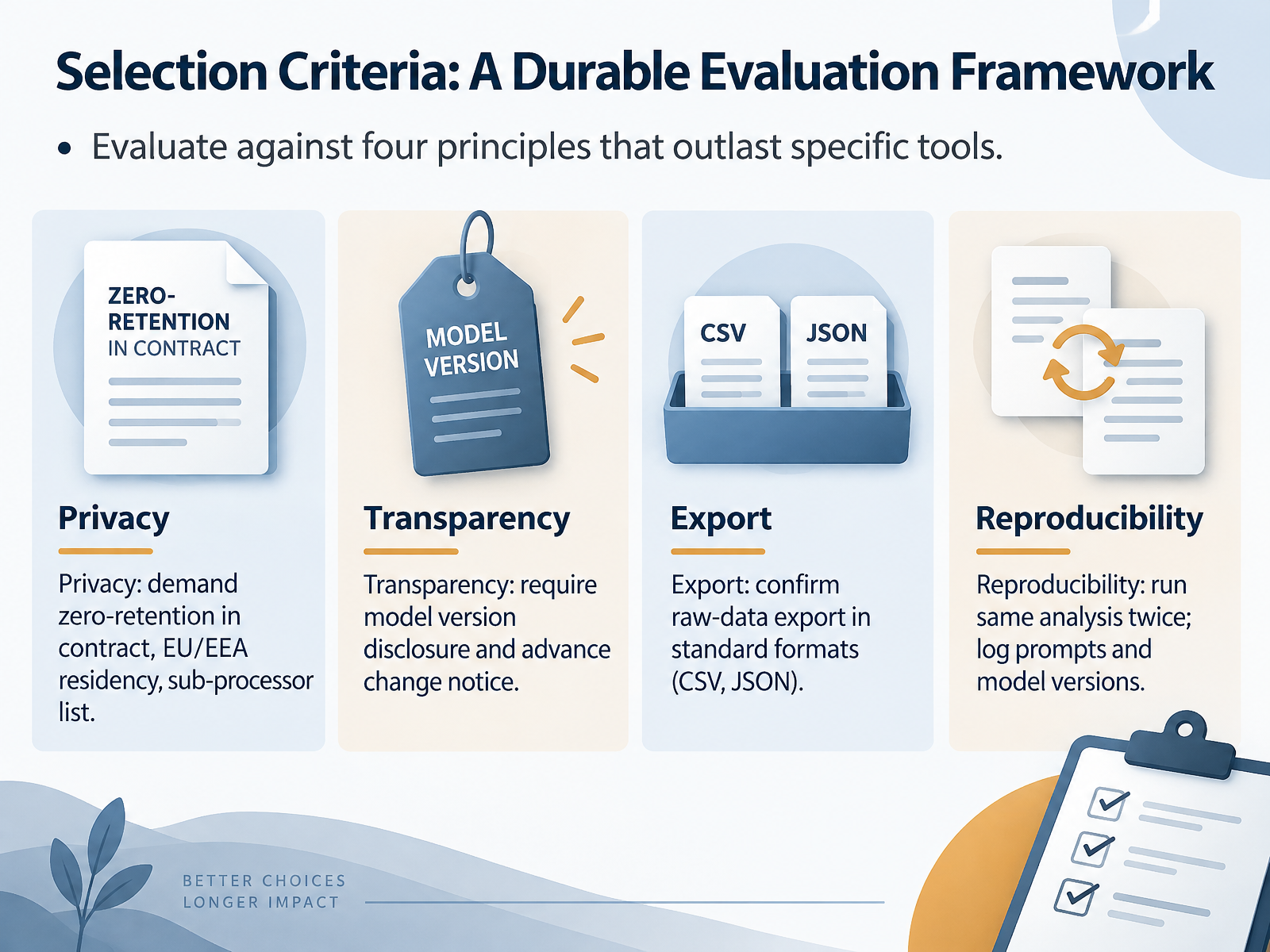
 - 05Selection Criteria: A Durable Evaluation FrameworkNow, how do you choose between tools? Use a framework that outlasts them. Four principles: privacy, transparency, export, and reproducibility. Start with privacy. Demand a zero-retention clause in the contract, not on the marketing page. Ask for EU or EEA data residency, and a current sub-processor list. If the vendor trains on your interview data, you have a GDPR incident waiting to happen. Next, transparency. Require the specific model version, and advance notice before any model change. If the answer is just "our proprietary AI," walk away. Then, export. Confirm you can pull raw transcripts out in standard formats like CSV or JSON. If you can only export AI summaries, your data is not really yours. Finally, reproducibility. Run the same analysis twice. Do you get the same result? Log your prompts and model versions so you can defend a finding six months later. Write these four into your procurement checklist. Any single failure is a reason to stop. Next, we'll score vendors on governance risk before you sign.
 getperspective.aibusch-labs.atkoji.so+22 min
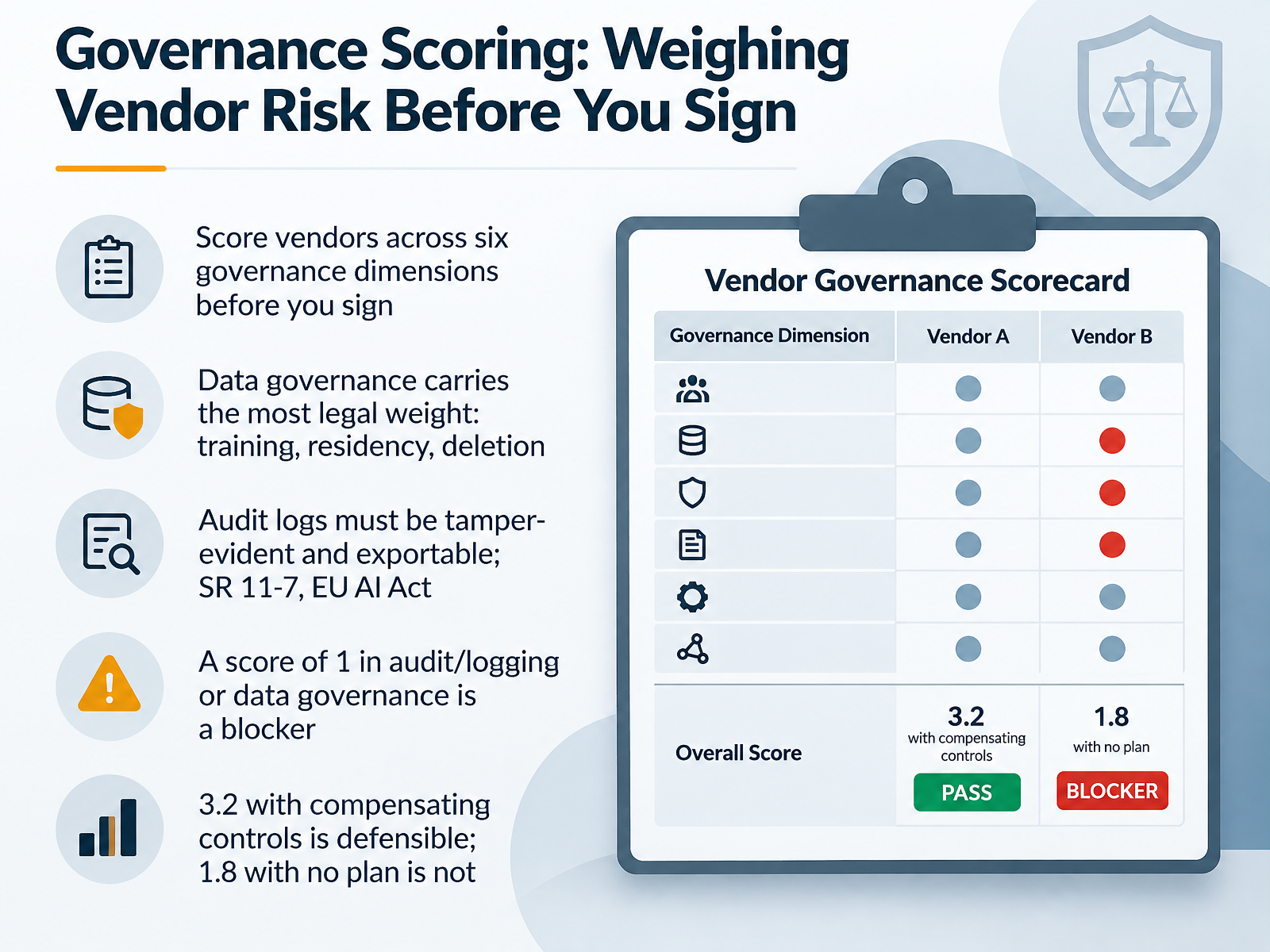
 - 06Governance Scoring: Weighing Vendor Risk Before You SignBefore you sign anything, score the vendor on governance. Not on capability. Governance is what makes the relationship defensible a year from now. Use six dimensions, and rate each one from one to five. Two of them carry the most weight. Data governance is the big one, because it carries the most legal weight. That means training, residency, and deletion. Ask three questions. Does the vendor train on your participant data? Where is that data stored and processed? And can they delete it on request, in writing? Get a clear answer. If the answer is vague, treat it as a no. Audit and logging is the second one. Logs must be tamper-evident and exportable. That is what SR 11-7 and the EU AI Act both expect for consequential decisions. A score of one in either data governance or audit and logging is a blocker, no matter how good the total looks. Now, here is the part people get wrong. A three point two with compensating controls is a defensible procurement decision. You documented your own logging, you negotiated a data processing addendum, you have a mitigation plan. A one point eight with no plan is not defensible. A score alone is not the answer. The documentation behind it is. So score the vendor, write down your reasoning, and note the compensating controls before you sign. Next, let us look at mapping the workflow, from data to insight.
 getperspective.aibusch-labs.atkoji.so+22 min
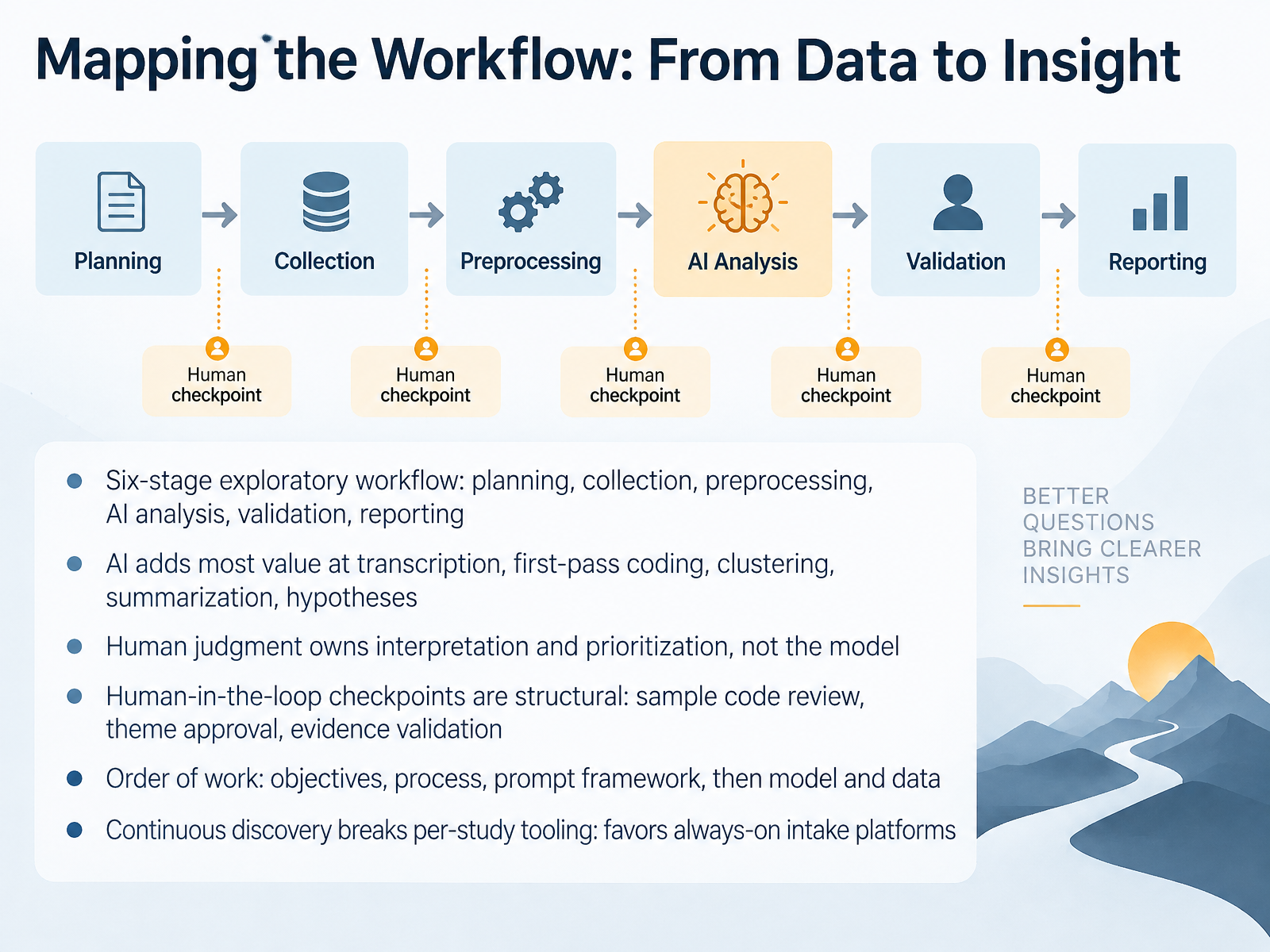
 - 07Mapping the Workflow: From Data to InsightLet's map the workflow. Think of exploratory research as six stages: planning, collection, preprocessing, A I analysis, validation, and reporting. That's the spine you build every tool decision on. A I earns its keep at specific points. Transcription. First-pass coding. Clustering. Summarization. And generating hypotheses. Start there unless your team needs raw fidelity on a sensitive topic. Interpretation and prioritization stay human. That's not a limitation, it's the design. Build in checkpoints that are structural, not optional: sample code review, theme approval, and evidence validation. Then pick your order of work. Objectives first. Then process. Then your prompt framework. Only then do you choose the model and the data. If your team runs continuous discovery, resist per-study tooling. It breaks every cycle. Favor always-on intake platforms instead. Next, let's look at human-in-the-loop design patterns that hold up.
 repository.isls.orgdl.acm.orgaclanthology.org+22 min
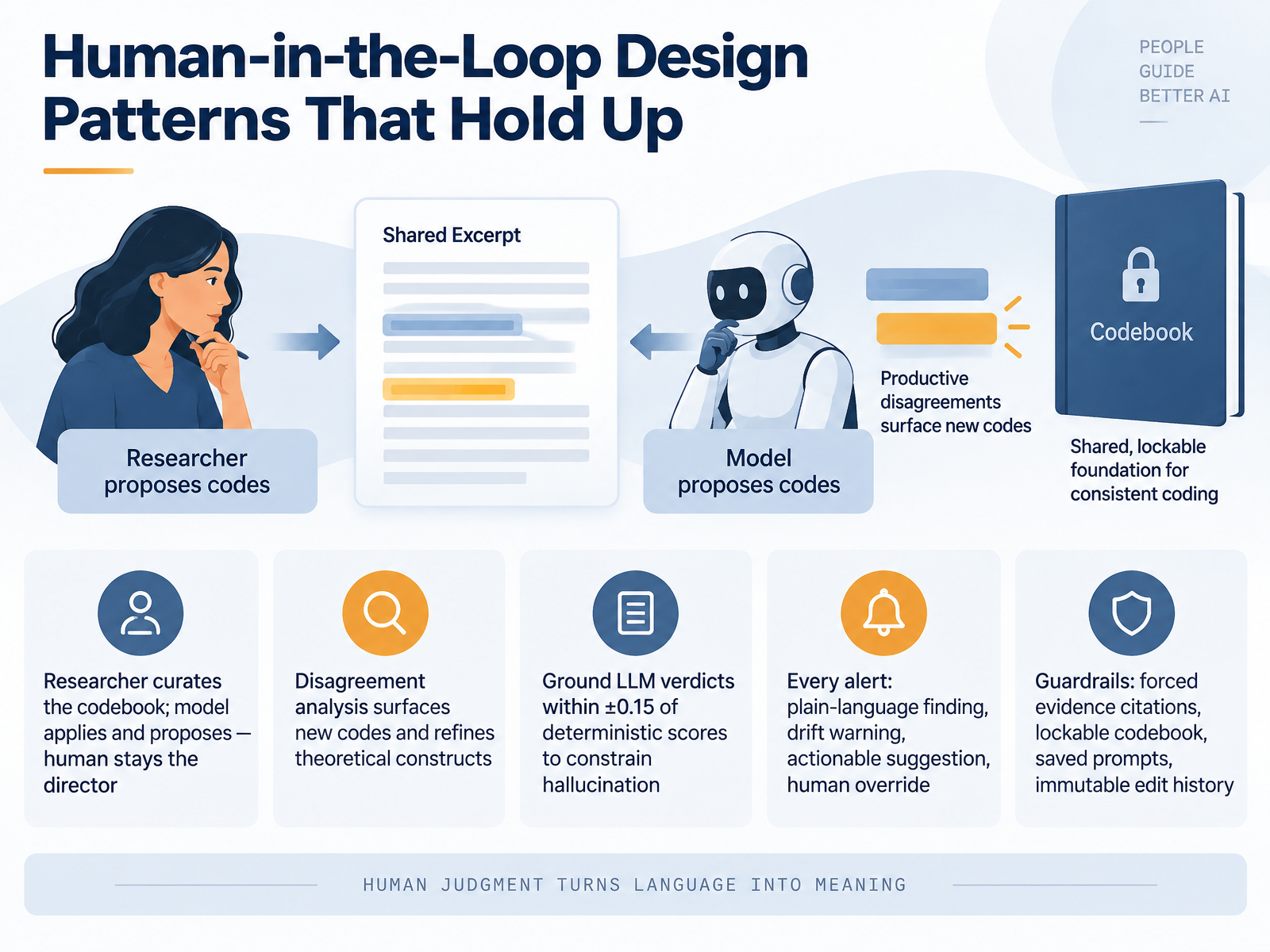
 - 08Human-in-the-Loop Design Patterns That Hold UpNow let us look at the human-in-the-loop patterns that actually hold up in practice. The first pattern is role clarity. The researcher curates the codebook. The model applies codes and proposes new ones. The human stays the director, not the reviewer of finished work. Second, treat disagreement as data. When the model and a human diverge, analyze it. That analysis often surfaces new codes and sharpens your theoretical constructs. Start with disagreement analysis unless your codes are already well-specified and stable. Third, ground the model. Constrain any LLM verdict to within zero point one five of a deterministic score. That single constraint sharply limits hallucination. Fourth, every alert should carry four things: a plain-language finding, a drift warning, an actionable suggestion, and a human override. If an alert lacks any of those, it will erode trust. Finally, guardrails. Force evidence citations. Make the codebook lockable. Save your prompts. Keep an immutable edit history. These are defaults, not absolutes. If your team needs speed, you can loosen the citation requirement, but never the edit history. Next, we look at evaluating output quality, metrics and failure modes.
 repository.isls.orgdl.acm.orgaclanthology.org+22 min
 - 09Evaluating Output Quality: Metrics and Failure ModesLet's talk about how to judge output quality, and where tools quietly fail. Track five metrics: accuracy, coverage, coherence, actionability, and agreement with human coders, measured with Cohen's kappa. Aim for kappa around zero point seven on well-specified codes. Now the failures you will actually see: hallucinated sources, overgeneralization, missing nuance, and training-data bias. Here is the trap. Fluent output can be flat wrong. In one clinical review, automated judges approved up to forty-seven point nine percent of verified failures. So never trust one judge alone. Design choices matter too. Model identity dominates the variance, and changing your rating scale alone shifted bias by up to zero point nine three points. Start with triangulation, expert review of a sample, and a continuous feedback loop, unless your codes are highly subjective, in which case raise your human review share. That leads into governance, ethics, and compliance obligations.
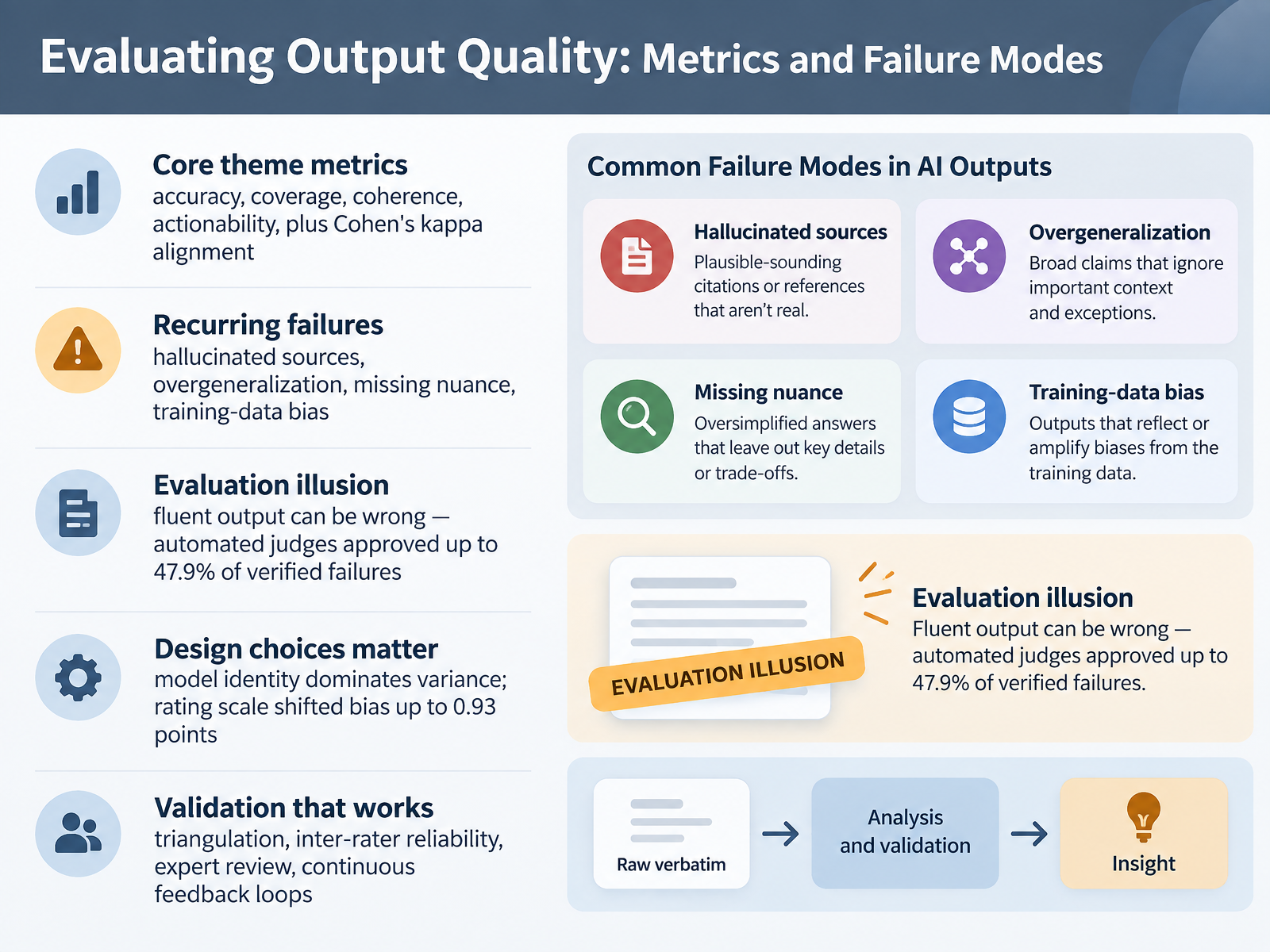 repository.isls.orgdl.acm.orgaclanthology.org+22 min
 - 10Governance, Ethics, and Compliance ObligationsNow let's talk about governance, ethics, and compliance. Start with consent. Your consent form must name AI processing and any third-party systems, unless your legal team has already approved a standing clause. A generic consent form does not cover this. Next, de-identify participant data before it touches any AI model, and verify that the vendor supports deletion on request. Ask for it in writing. On regulation, EU AI Act Article 50 requires you to disclose AI before the first question. That obligation goes live on the second of August, 2026, and the recent delays did not postpone it. Watch emotion inference closely. If a tool infers emotion from voice or face, that triggers separate disclosure duties, and in workplace or education settings it is prohibited outright. For employee research, default to aggregate reporting only. No per-person scores that feed personnel decisions. And label synthetic data as synthetic everywhere it appears. Treat these as defaults, not suggestions. Next, we will walk through the implementation roadmap for research ops.
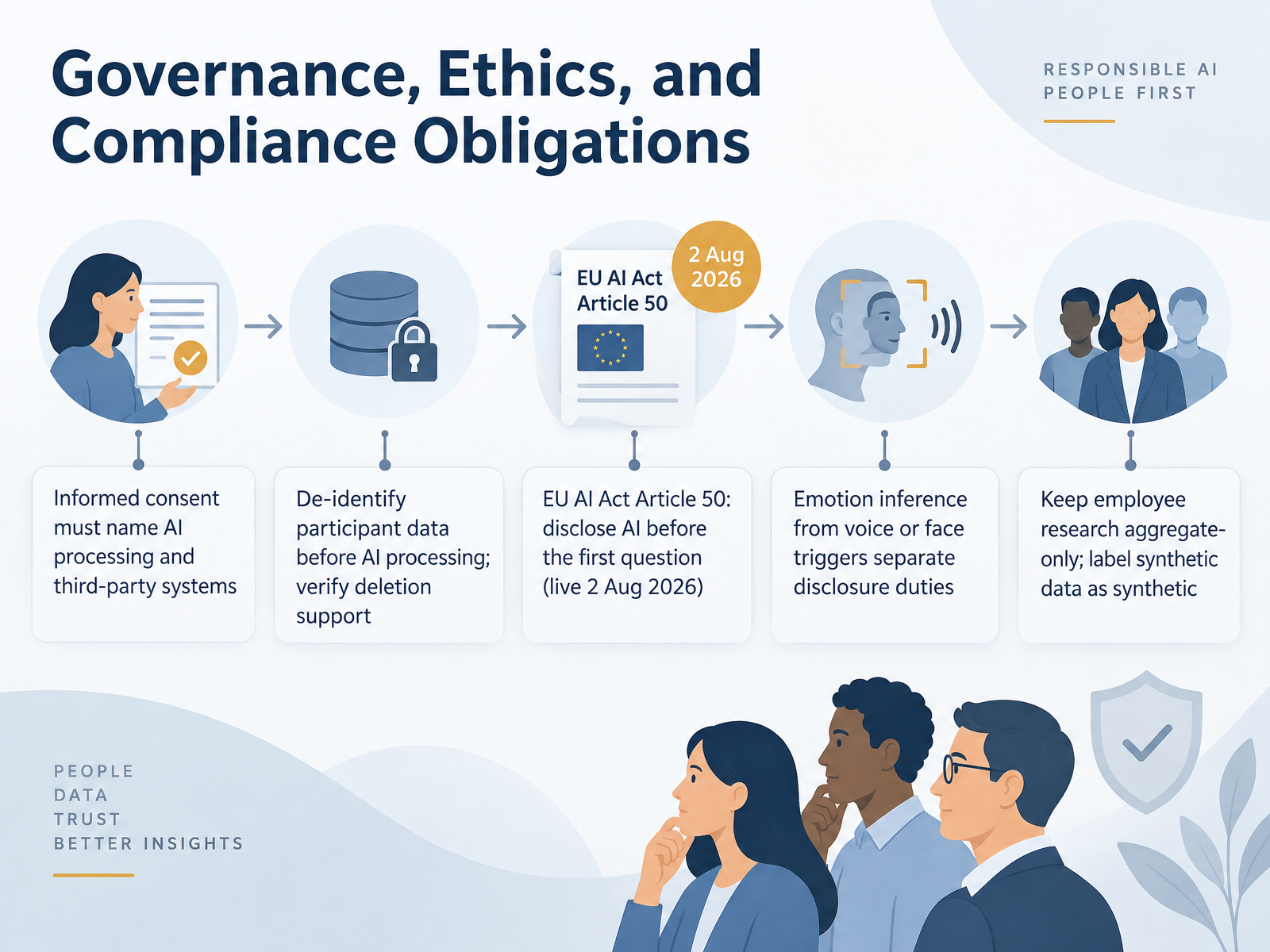 getperspective.aibusch-labs.atkoji.so+22 min
 - 11Implementation Roadmap for Research OpsLet's talk about the implementation roadmap for research ops. Start by assessing readiness before you buy anything. Look at four things: your data maturity, your team's skills, your infrastructure, and your governance. If those are weak, no tool will fix them. Next, standardize one workflow first. Recruitment and scheduling is the usual starting point, because it's bounded and low risk. Then expand from there. Once that holds, pilot one bounded case through the full research to decision cycle. Pick something real but contained. Before the pilot starts, define your acceptance criteria. How many citations must a finding have? What format do reviewers need? What's the maximum escalation time for a flagged issue? Write those down first, not after. Be honest with yourself here: change management is the main work. That means training, a clear AI data-use policy, and reassurance for people worried about their roles. Finally, measure the right things. Track cycle time, synthesis hours saved, and insight reuse. Do not track seat counts. Seats tell you what you bought, not what changed. Shifting Skills and the Future of the Researcher Role.
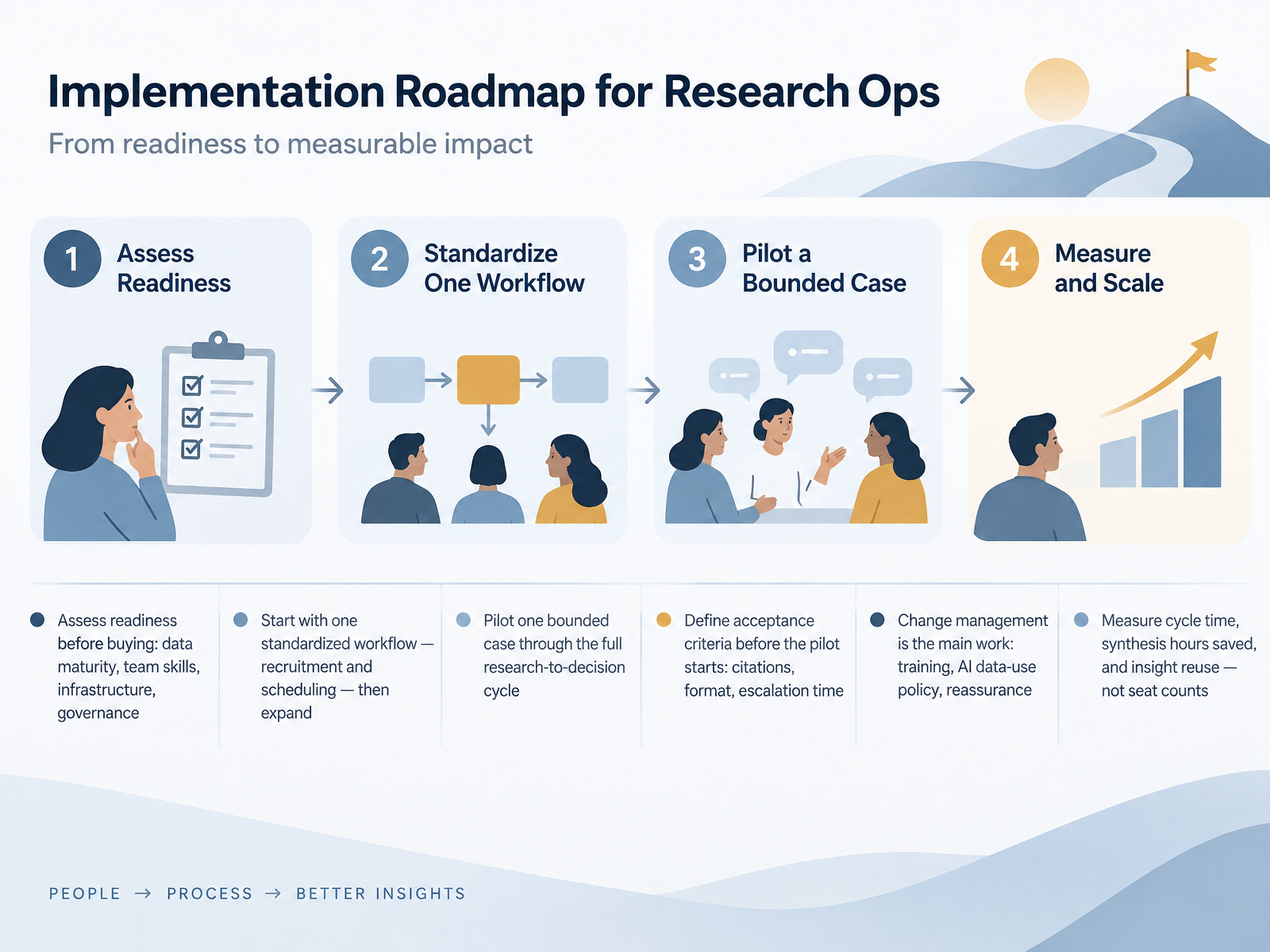 getperspective.aibusch-labs.atkoji.so+22 min
 - 12Shifting Skills and the Future of the Researcher RoleLet's talk about where your role is heading. The short version: you're shifting from insight producer to strategic business partner. Thirty-five percent of researchers say the role is becoming more strategic, and thirty-three percent see it blending across product and market research. So which skills compound? Four. Prompting, output auditing, evidence hygiene, and data ethics. Here's a practice worth starting this week. Write your judgment down. When you document how you weigh evidence, you make your tacit quality standards explicit, and suddenly a model can follow them. A quick reality check. Eighty-seven percent of teams use AI, saving about eleven hours a week, but only thirteen percent report real organizational gains. The hours are real. The impact isn't automatic. When adoption outpaces systems and standards, you don't get better decisions. You get noise. So start with evidence hygiene and review workflows unless your team already has those in place. And keep watching multimodal analysis, real-time synthesis, and agentic research assistants. Next, we put this into practice in the workshop, Selecting a Tool and Designing a Workflow.
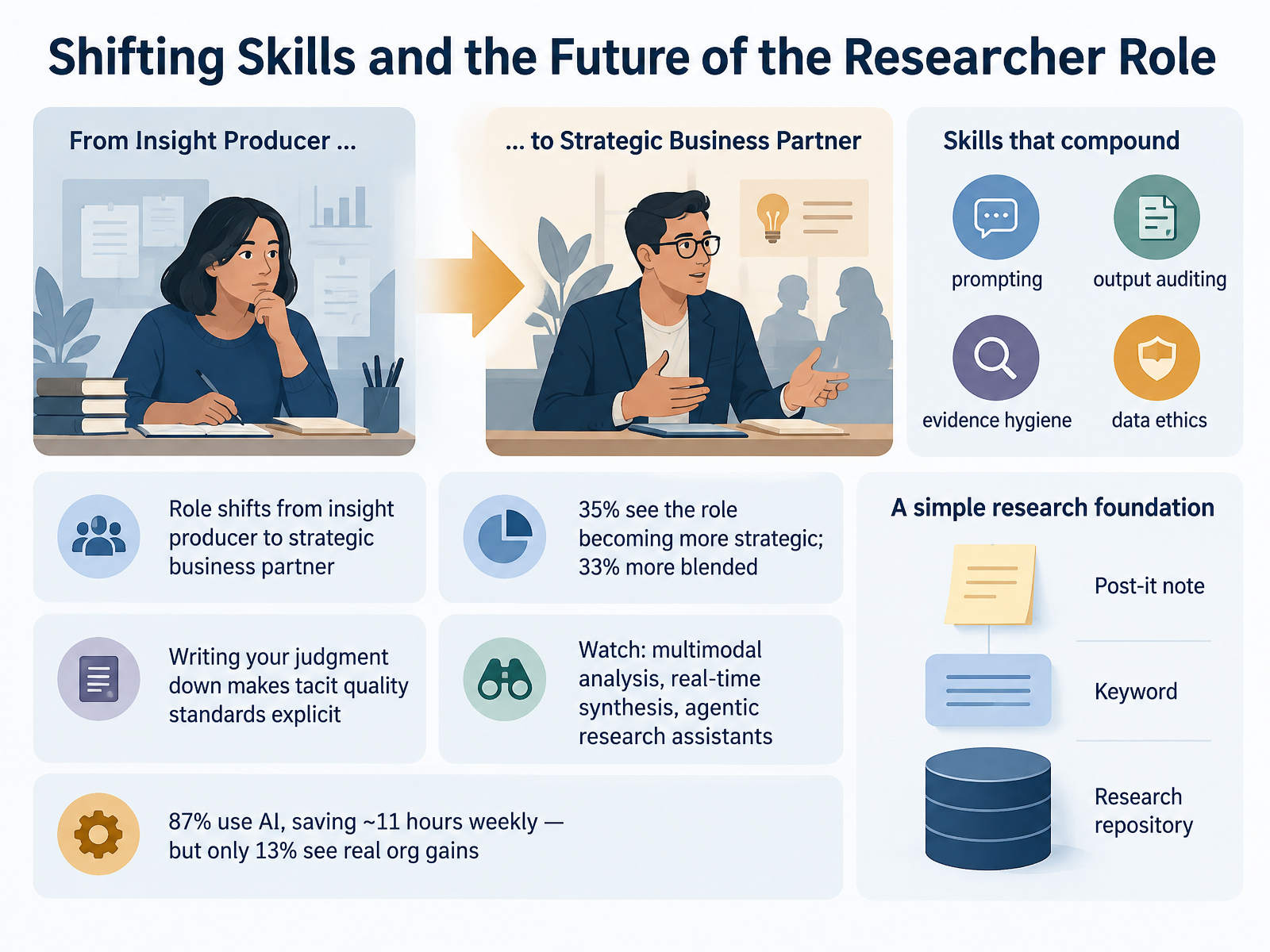 2 min
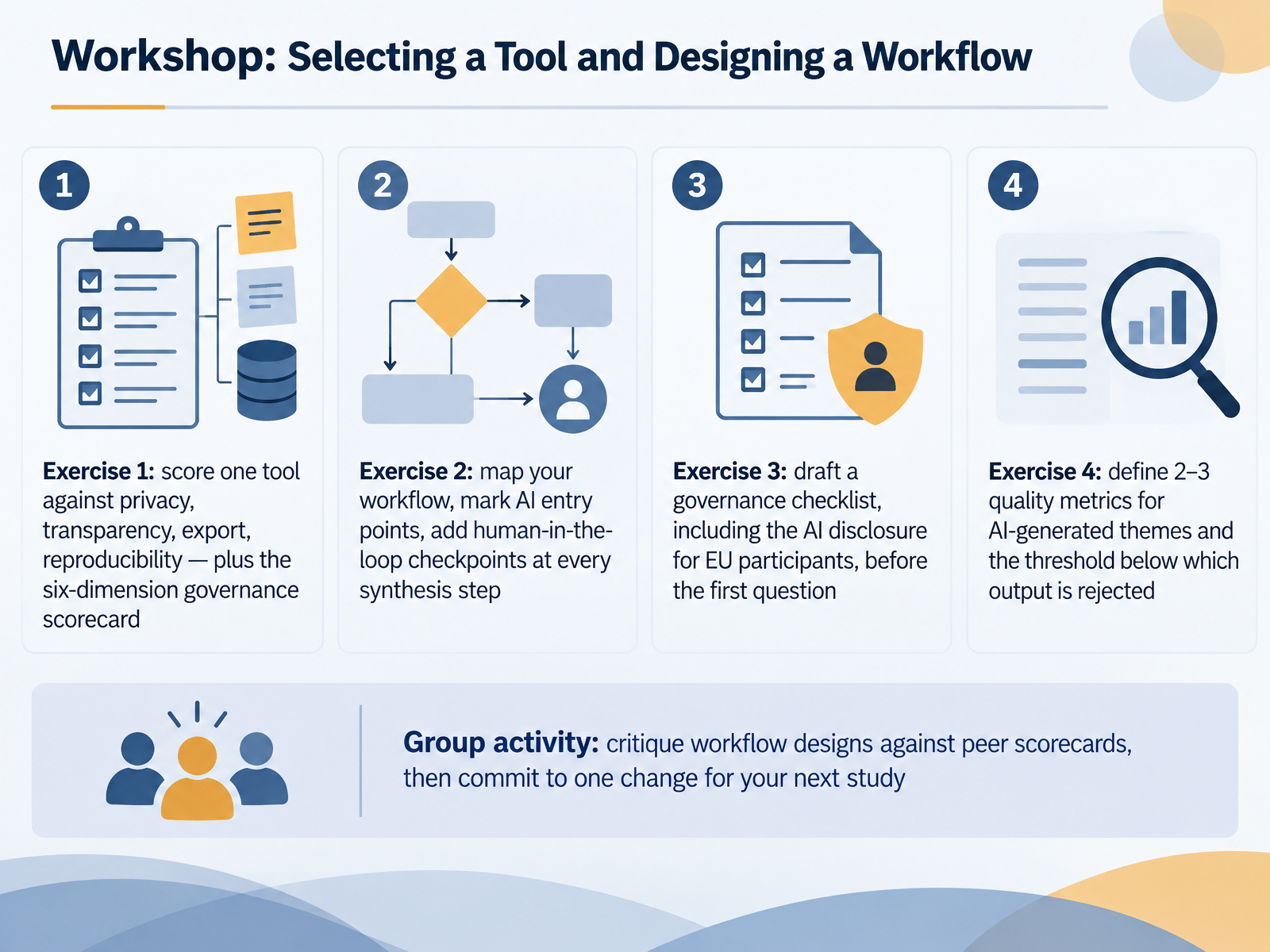
2 min - 13Workshop: Selecting a Tool and Designing a WorkflowLet's close by putting all of this into practice. Four exercises, then a group critique. For Exercise one, score a single tool against four things: privacy, transparency, export, and reproducibility. Add the six-dimension governance scorecard. Anything below a three is a mitigation plan, not an approval. Exercise two, map your workflow and mark every AI entry point. Then add a human checkpoint at every synthesis step. Start there unless your team already has one and it is documented. For Exercise three, draft your governance checklist before the first question, including the AI disclosure for EU participants. That obligation has applied since August 2026. Under Article fifty, you tell people they are talking to an AI at the first interaction, in their language. A line in a privacy policy does not count. Exercise four, define two or three quality metrics for AI-generated themes, and the threshold below which you reject the output. A defensible default is inter-coder agreement, around zero point seven. Then the group activity. Critique each other's workflows against peer scorecards, and commit to one change for your next study. One change, written down, owned. Thank you for working through this with me. Pick one tool, one workflow, one checkpoint, and run it on your next study. You now have the framework to make that call defensibly.
 getperspective.aibusch-labs.atkoji.so+22 min
Take the deck with you
Download this course as a file — free, no sign-up needed.
- PDF handoutEvery slide page, ready to print or share.14 pages · 3.2 MBDownload
- Narrated PowerPointThe deck that presents itself — every slide carries the digital human's narration video.14 pages · 14.3 MBDownload
- PowerPoint slidesThe full deck as a .pptx — open it in PowerPoint, Keynote, or Google Slides.14 pages · 3.1 MBDownload
Free to use in your own training — please keep the PersonWise credit page at the end.
Have your own deck? Turn it into a course
Sources consulted
Web sources consulted while building this course.
- Generative User Research Tools: 2026 Platform Comparison | Conveo — conveo.ai
- Synthetic Research Platforms: The 2026 Market Map | FishDog — fish.dog
- Synthetic Research Vendors 2026: Market Map & Comparison | FishDog — fish.dog
- Best synthetic user research tools (2026): 24 platforms compared — runcandor.com
- Best AI UX Research Tools in 2026, Ranked by Research Stage | Blog | Perspective AI — getperspective.ai
- https://foundationcapital.com/ideas/how-ai-is-reshaping-design-in-tech — foundationcapital.com
- The Future of User Research Report 2026 — maze.co
- How product teams are using AI for research in 2026 | Lyssna — lyssna.com
- Blucher Design Proceedings — proceedings.blucher.com.br
- State of AI-Native UX Research 2026: How 300 Research Teams Replaced the Discovery Survey | Blog | Perspective AI — getperspective.ai
- Best AI Tools for Research Ops in 2026: 10 Platforms to Scale the Research Function | Blog | Perspective AI — getperspective.ai
- Evaluating AI Research Tools: A Durable Framework | Busch Labs — busch-labs.at
- ResearchOps in 2026: The Complete Guide to Building (or Rebuilding) a Research Operations Function — koji.so
- 2026 Guide: Research AI Software for Compliance Teams — grep.ai
- AI vendor due diligence checklist — privian.io
- Qualitative Research in the Age of LLMs: A Human-in-the-Loop Approach to Hybrid Thematic Analysis — repository.isls.org
- Qualitative Coding Analysis through Open-Source Large Language Models: A User Study and Design Recommendations — dl.acm.org
- Development and Benchmarking of a Blended Human-AI Qualitative Research Assistant — aclanthology.org
- AI4Qual: A Comprehensive Field Guide to LLM-Supported Qualitative Research (Tutorial) — exa.ai
- Exploring the Human-LLM Synergy in Advancing Theory-driven Qualitative Analysis | ACM Transactions on Computer-Human Interaction — dl.acm.org