Museum Object Storytelling
Begin
14 pages · ~28 min
Museum Object Storytelling
Learn how museums craft narratives through objects, exploring techniques for selecting, displaying, and interpreting artifacts to engage audiences in meaningful storytelling.
What you’ll learn
- 01Introduction to How Museums Tell Stories with ObjectsWelcome. Today, we are going to explore a fascinating question together: how do museums tell stories with objects? As we walk through this course, think of me as your personal docent. We are not just looking at old things behind glass; we are discovering how every item, label, and shadow in the room builds a narrative that shapes our understanding of the past. We will start by breaking this down into three storytelling layers. First, the object itself, carrying its own material truth. Then, the label, which directs our gaze. And finally, the setting, the context that whispers to us without a single word. We will journey from interpreting a single artifact to understanding a complete exhibition. You will see this in action through stories from places like the Smithsonian and the British Museum, where narratives literally frame public memory for millions of people. By the end, you will see a gallery not as a warehouse of things, but as a carefully composed book. Let us begin by looking at the foundations of these spaces, and how we moved from curiosity cabinets to the narrative exhibitions we walk through today.washingtonian.comaam-us.orgamericanhistory.si.edu+22 min
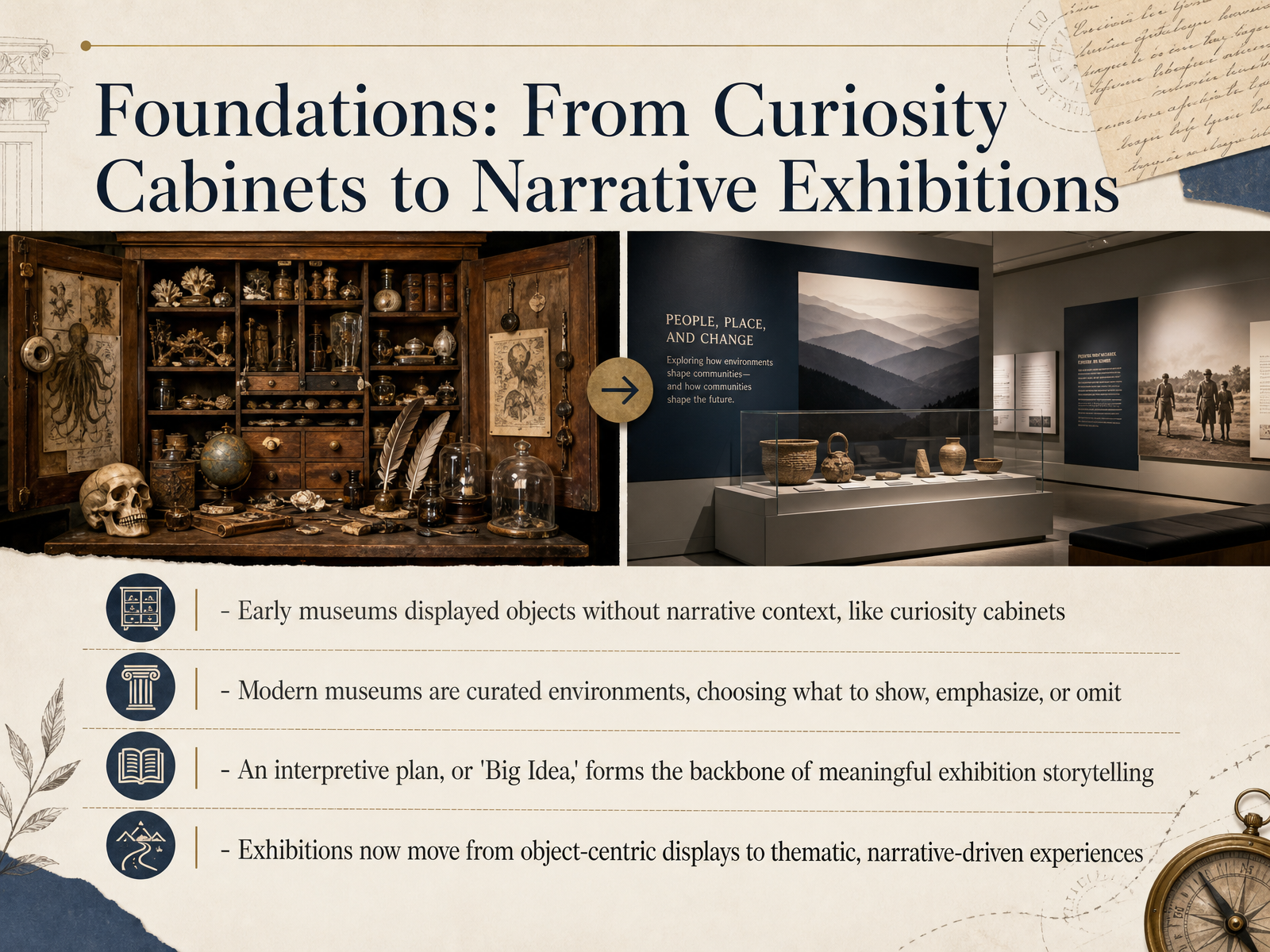
- 02Foundations: From Curiosity Cabinets to Narrative ExhibitionsThink about the last time you walked into a museum. What guided your journey through the objects? Today, we often move through carefully designed stories. But museums haven't always worked this way. Early collections, known as curiosity cabinets, displayed objects without much context. A seashell might sit next to a scientific instrument, valued for being rare or beautiful, but not for telling a connected story. Over time, museums shifted from these object-centric displays to curated environments. Curators now make deliberate choices about what to show, what to emphasize, and even what to omit. The backbone of this modern approach is an interpretive plan, often built around a single 'Big Idea' that unifies the experience. This transforms exhibitions into thematic, narrative-driven journeys. We're not just seeing things anymore; we're following a line of thought, walking into a story someone chose to tell. Next, we'll take a closer look at one of the earliest tools in that story: 'The Object as Primary Source and Evidence'.
 washingtonian.comaam-us.orgamericanhistory.si.edu+22 min
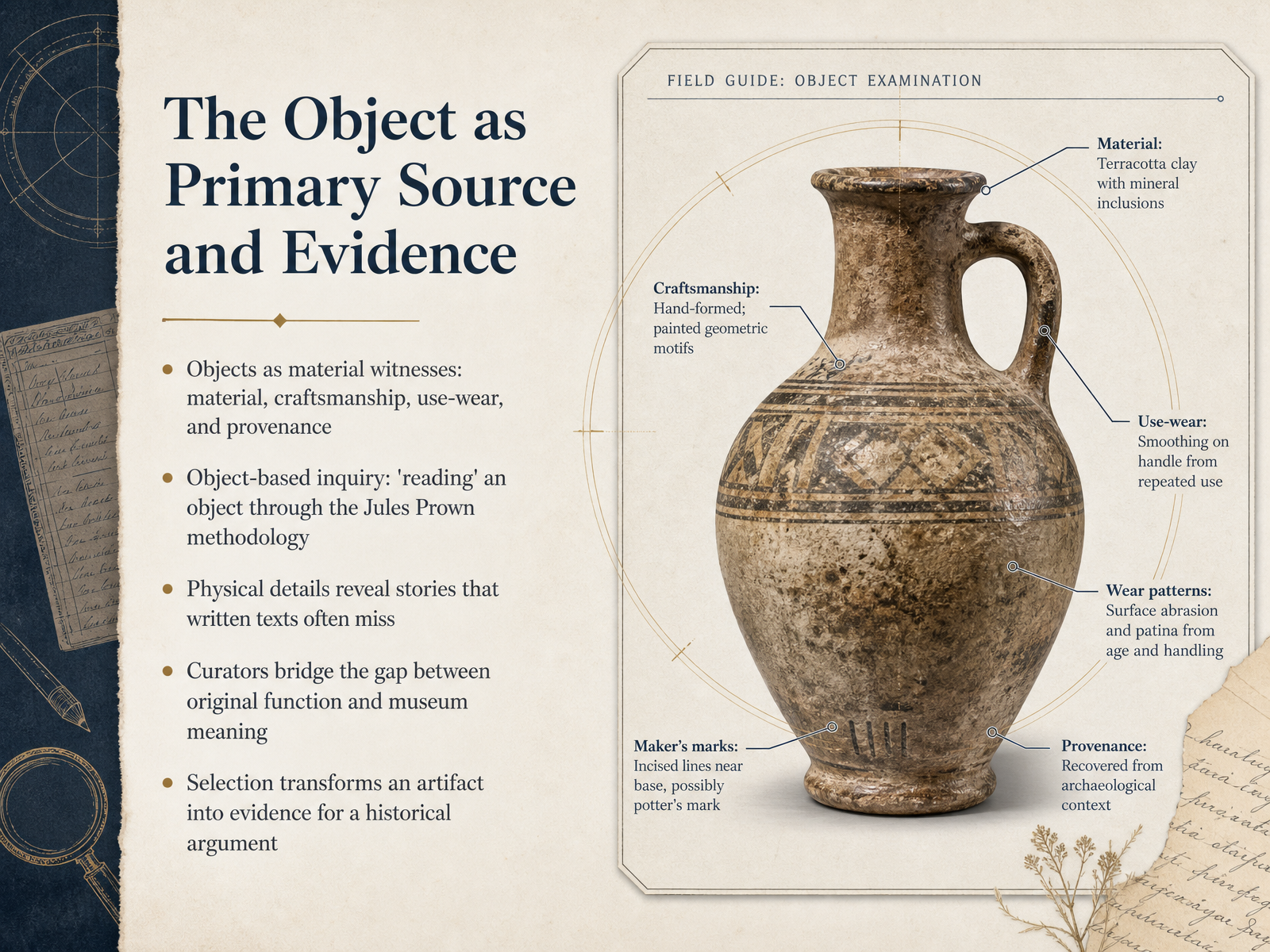
 - 03The Object as Primary Source and EvidenceNow, let’s consider the object itself—not just as a thing to look at, but as a primary source, a piece of evidence that carries its own history. Think of an object as a material witness. Its material, the marks of its craftsmanship, the wear on its surface, and its provenance—the story of where it’s been and who has held it—all offer testimony. To read this testimony, curators often use a close-looking approach, sometimes called the Jules Prown methodology. It’s a process of moving from detailed physical description to deduction and then to deeper interpretation. The fascinating part is that physical details often reveal stories that written texts completely miss—like a worn handle showing repeated use in a ritual, or an unexpected material suggesting a distant trade route. This is where the curator’s role becomes essential. They bridge the gap between an object’s original function, perhaps in a temple or a workshop, and its new meaning inside the museum. Every object in a case is a choice. That act of selection transforms an artifact into evidence for a specific historical argument. Next, let’s see this process in action with a dedicated case study about reinterpreting a single object.
 journals.le.ac.ukshop.mkb.chbuilding-design.world+22 min
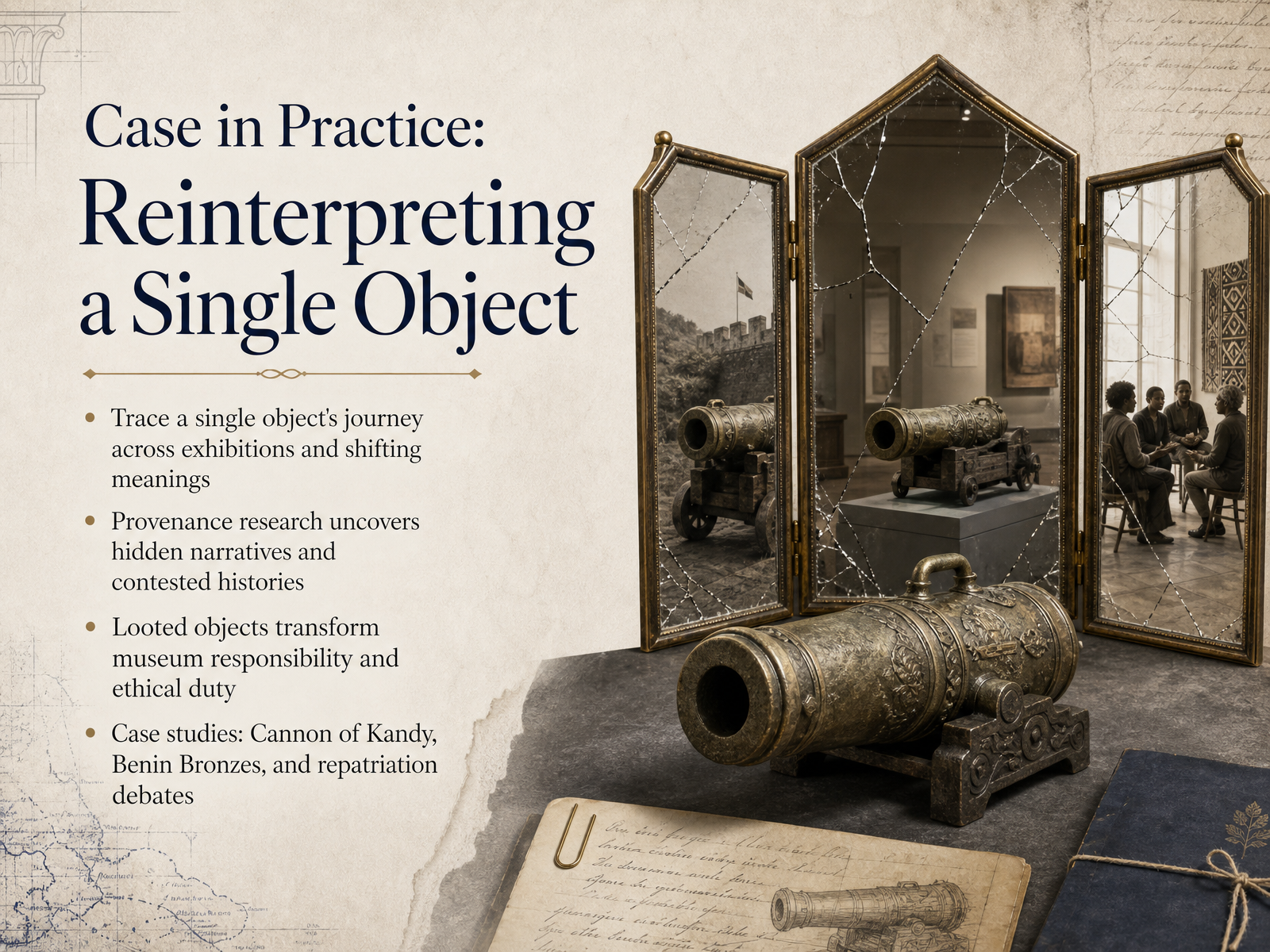
 - 04Case in Practice: Reinterpreting a Single ObjectNow, let's trace what happens when a single object journeys through different exhibitions, and how its meaning shifts each time. Think of an object as carrying many layers of story. Provenance research — the work of tracking an object's history — often uncovers hidden narratives. Sometimes, it reveals contested histories that challenge what we thought we knew. For example, when an object was looted, its presence in a museum transforms from a simple display into a question of ethical duty and responsibility. We see this powerfully in case studies like the Cannon of Kandy, which was returned to Sri Lanka, and the ongoing debates around the Benin Bronzes, where museums worldwide are rethinking ownership and collaborating with communities of origin. These stories show that a museum is not just a keeper of objects, but a place where we can actively reconsider what is just. In the next part, we will explore the power, but also the limits, of the museum label.
 journals.le.ac.ukshop.mkb.chbuilding-design.world+22 min
 - 05The Power and Limits of the Museum LabelNow let's turn to one of the most intimate forms of communication in any museum—the object label. For a long time, the label was the primary curatorial voice. It named the object, gave its date, and offered an authoritative interpretation. But here's the thing: every word on that tiny card is a choice. What's included, and just as importantly, what's left out, quietly shapes the story you take away. Today, many museums are moving away from that single, authoritative voice. Instead, you might see labels written in a more conversational tone, or even labels that include multiple perspectives. This shift is about inclusive practices—things like collaborative writing with communities, using frameworks focused on belonging, and actively questioning old biases. The goal is to transform the label from a monologue, or what some call a 'cultural stop sign,' into a genuine invitation for dialogue. It's no longer just telling you what to think; it's asking you to join the conversation. Let's carry this idea of 'dialogue over monologue' into our next section, where we'll rethink labels through the lens of inclusion, authority, and voice.
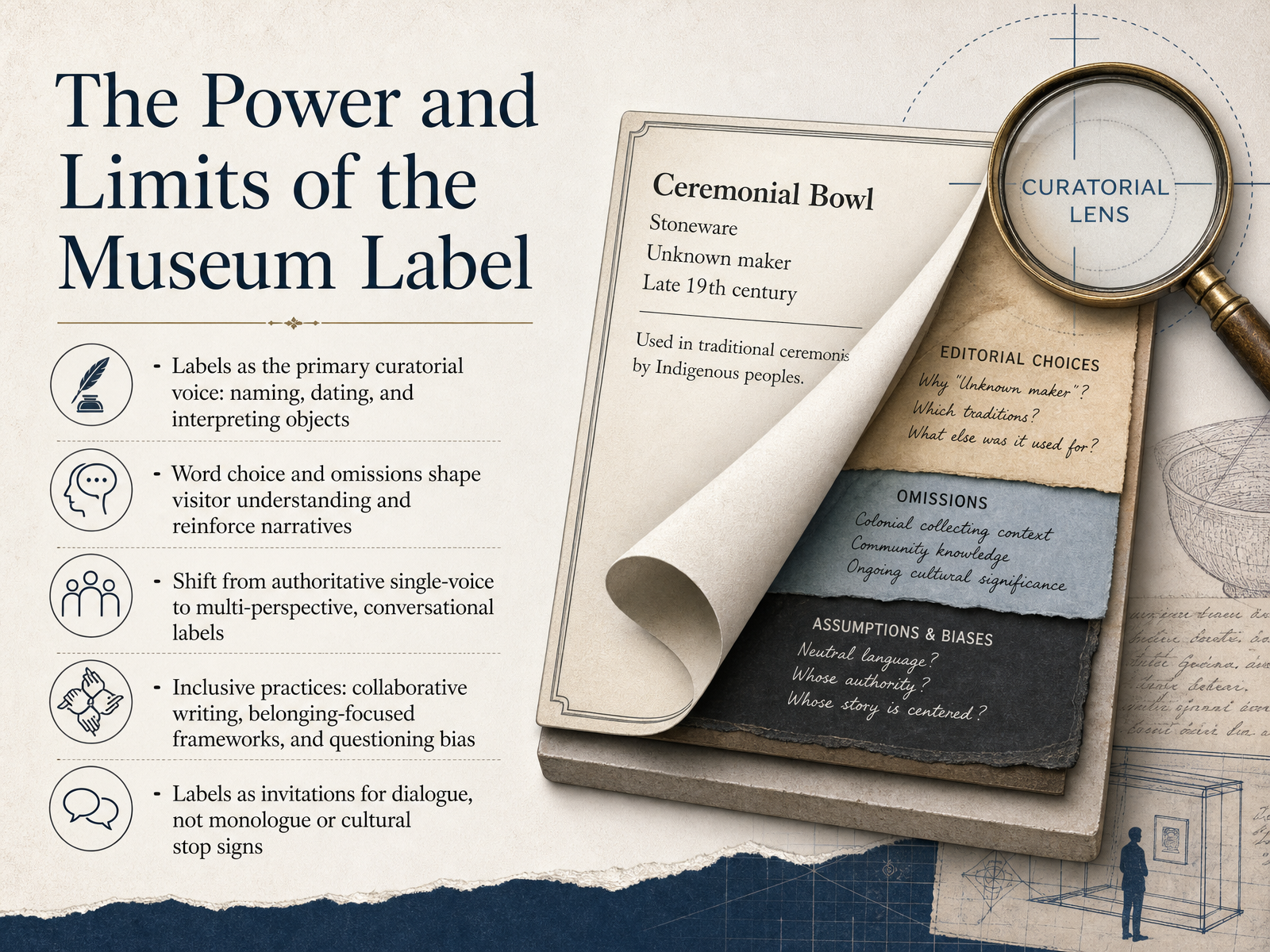 artmuseuminterp.orgstedelijkstudies.comdigital.lib.washington.edu+22 min
 - 06Rethinking Labels: Inclusion, Authority, and VoiceNow let's explore how labels themselves are being rethought. Take a look at two versions of the same label side by side. What subtle biases do you notice? One might rely on jargon that gently pushes certain people away, while the other sounds more like a human invitation. Museums today actively debate whether mentioning an artist's nationality always adds context or sometimes quietly feeds a stereotype. It is a shift from a single authoritative voice that tells you what to know, to a dialogue that invites you to wonder. The Art Institute of Chicago now uses collaborative reviews and writing workshops, where colleagues from different departments read the text aloud together, listening for phrases that might unintentionally exclude someone. They ask: Who is speaking here? What remains unsaid? Whose perspective is still missing? When a label acknowledges its own gaps, it fosters a genuine sense of belonging rather than hiding behind a monologue. These reflective questions transform a simple label into an open conversation between the institution, the object, and you. Next, we will move to a related layer of curatorial thinking by looking at Choosing What to Show: The Art of Selection and Omission.
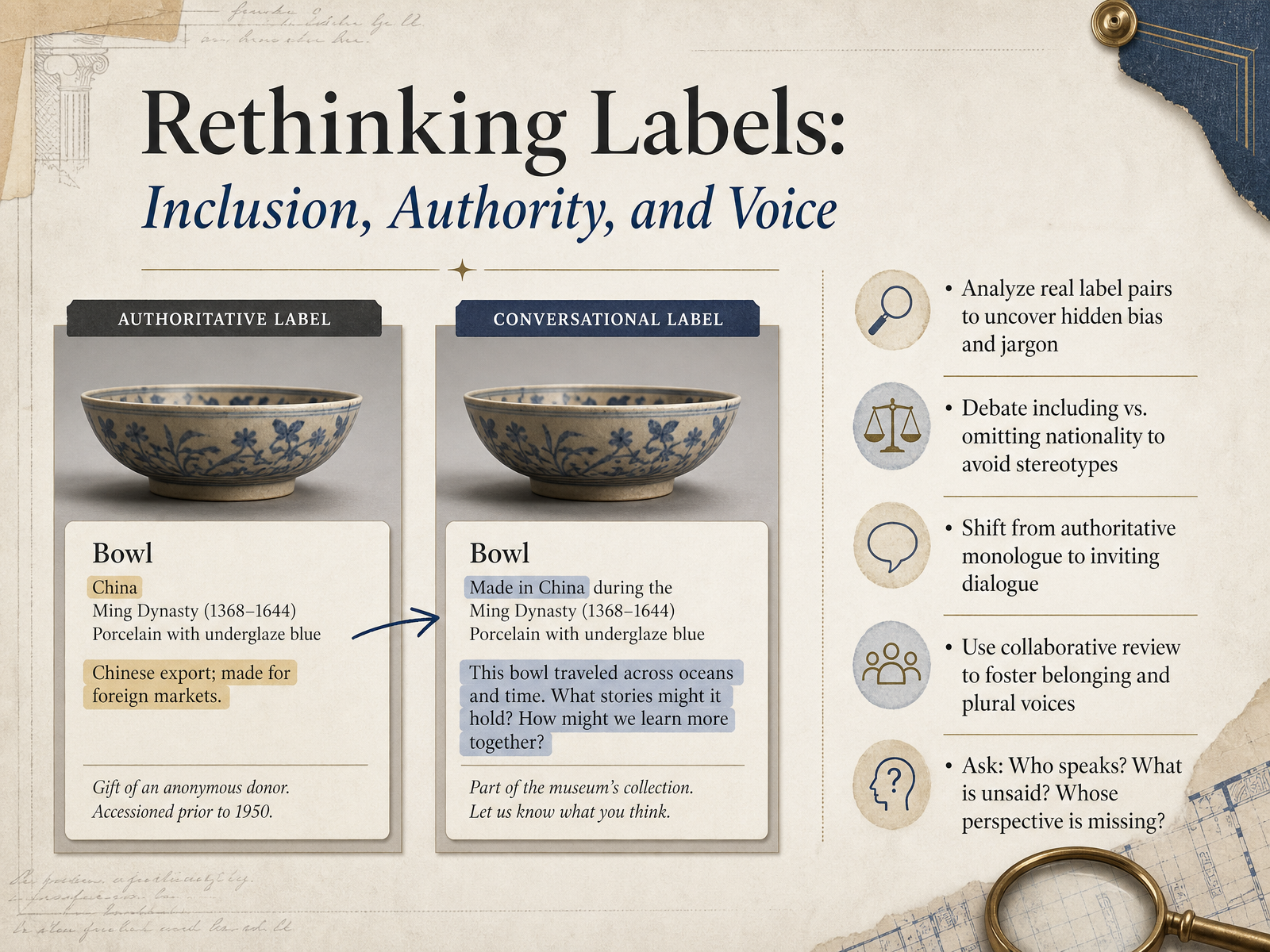 artmuseuminterp.orgstedelijkstudies.comdigital.lib.washington.edu+22 min
 - 07Choosing What to Show: The Art of Selection and OmissionNow let's turn to one of the most powerful parts of curatorial work: choosing what to show, and what not to show. Every object on display is the result of a decision, but those decisions are never neutral. Museum collections are shaped by history itself—by the tastes of past collectors, by systems of power, and sometimes by sheer chance. Think about what stays in storage. Those stored objects aren't just off-site; they are a silent part of the narrative, because their absence on the gallery floor shapes the story just as much as anything on a pedestal. Curatorial selection is an act of power. Inclusion and exclusion define which histories are centered and which are marginalized. We can see this tension clearly in the Benin Bronzes controversy. These masterful sculptures were looted by British forces in 1897. For decades they sat in Western museums as treasures, while their origins were quietly noted or even ignored. Today, they are at the heart of urgent ethical debates about repatriation. Museums like the Museum of Fine Arts in Boston have navigated this by negotiating with the Kingdom of Benin, sometimes returning ownership, sometimes losing promised gifts when donors reclaimed them. These moments remind us that a gallery isn't just a neutral space; it’s a field where history, morality, and power are actively negotiated. Next, we'll step even closer and explore what happens when those chosen objects meet their physical home, in 'Context Creates Meaning: Spatial and Sensory Design.'
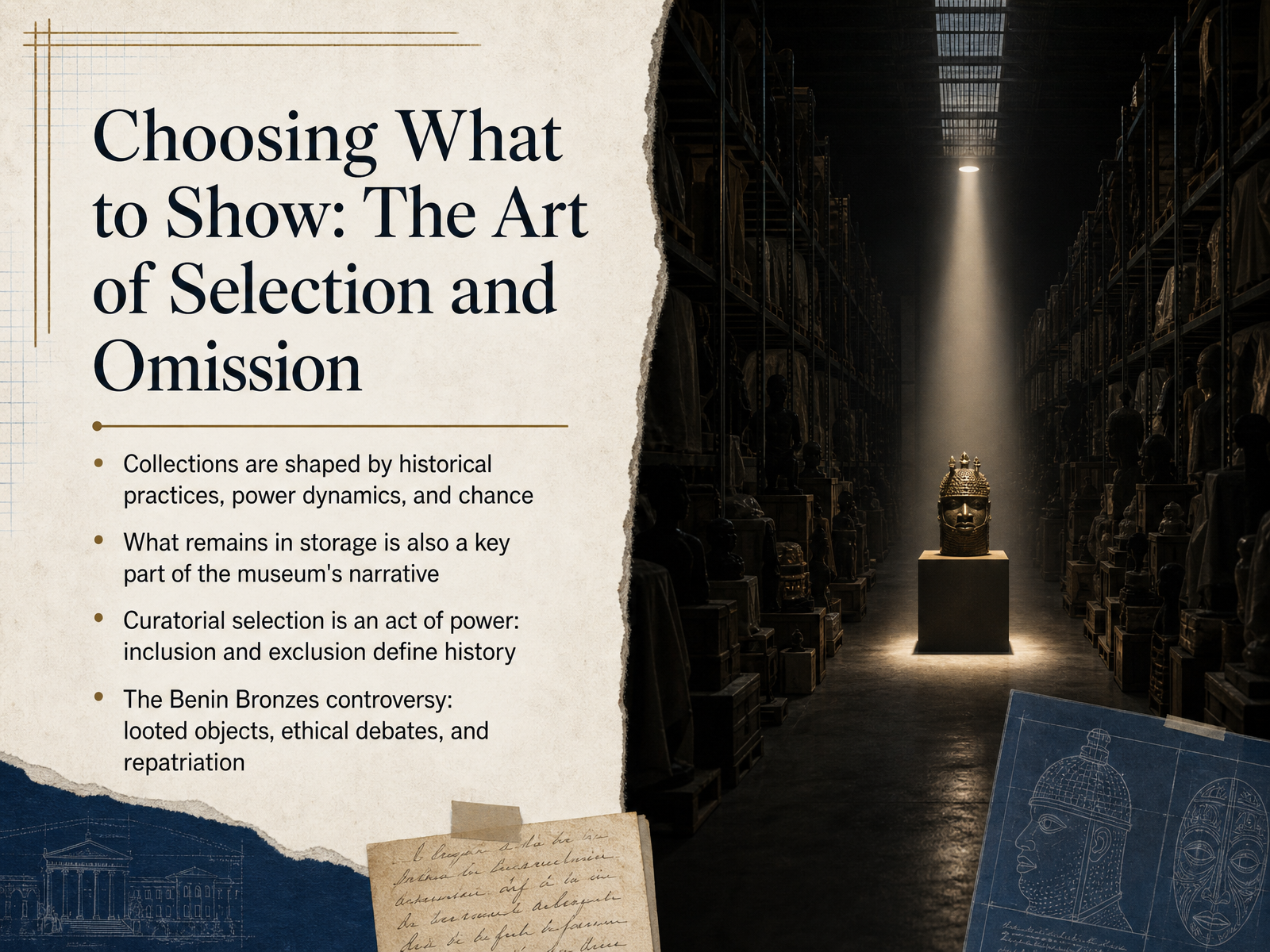 nytimes.comdw.combbc.co.uk+22 min
 - 08Context Creates Meaning: Spatial and Sensory DesignNow, let's turn to something you feel before you fully see it: the spatial and sensory design of an exhibition. Think of lighting, color, and enclosure as a curatorial toolkit. A warm, focused spotlight doesn't just illuminate an artifact—it directs your emotion and signals importance. A darker, intimate room slows your movement and invites quiet reflection. Color temperature, wall height, and even the soundscape all work together to guide where you look and how you feel. Context also lives in juxtaposition. Placing two objects side by side can create a visual dialogue, a quiet tension, or a surprising parallel. Suddenly, neither object stands alone; together they tell a more complex story. And when you step into an immersive period room or a theatrical setting, the perceived value of an everyday object can transform entirely. Finally, all of this unfolds along a psychological sequence mapped to your journey. Researchers have identified four key spatial moments: the Threshold, where you first orient yourself; the Transition, where pacing adjusts your attention; the Narrative Focus, where design encourages deep engagement; and the Closure, where you process and reflect. In short, spatial design isn't just a container for objects. It is a silent, powerful narrator that shapes your entire experience. Let's carry that idea forward as we examine exhibition design through the lens of visitor psychology.
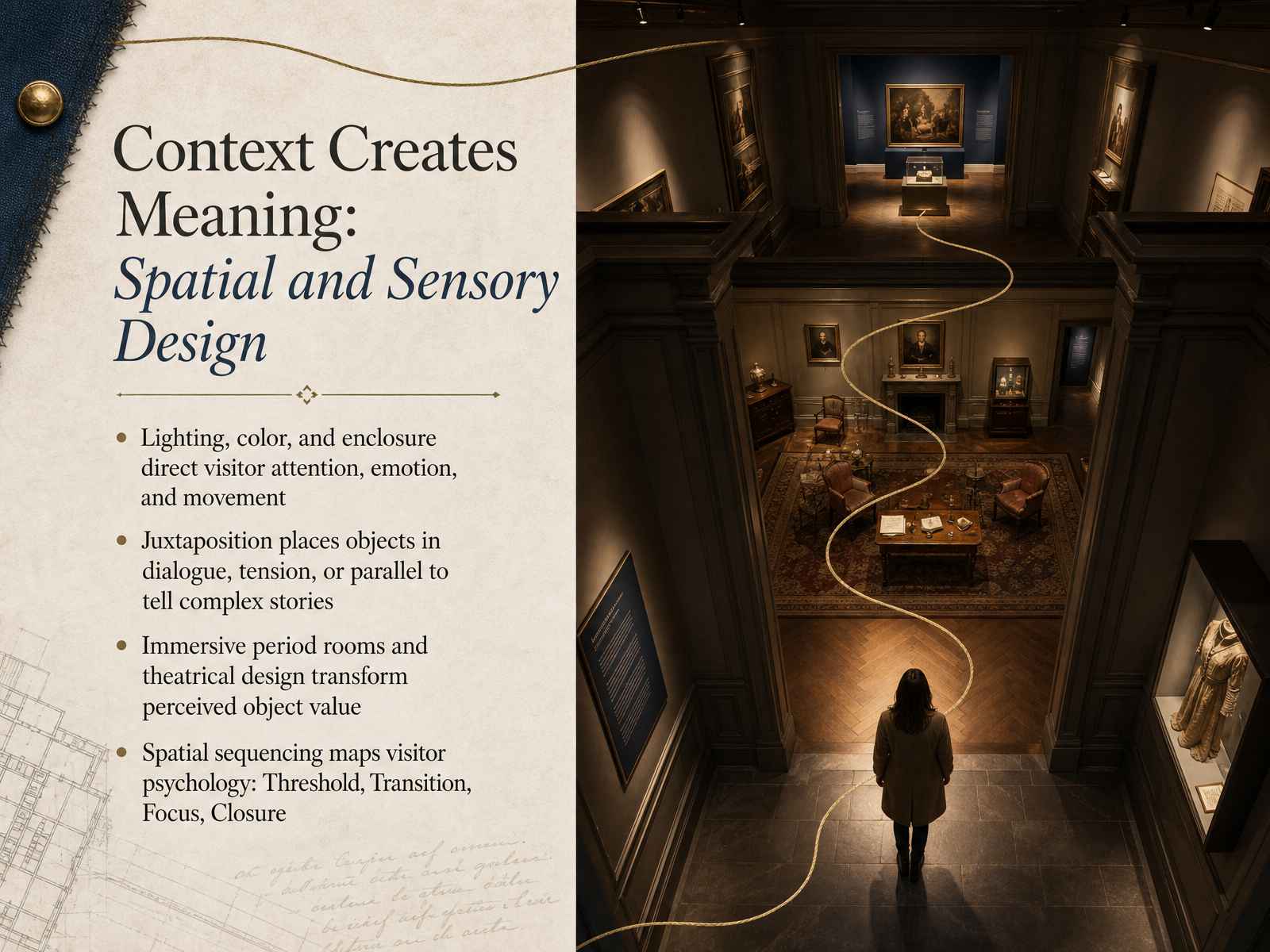 2 min
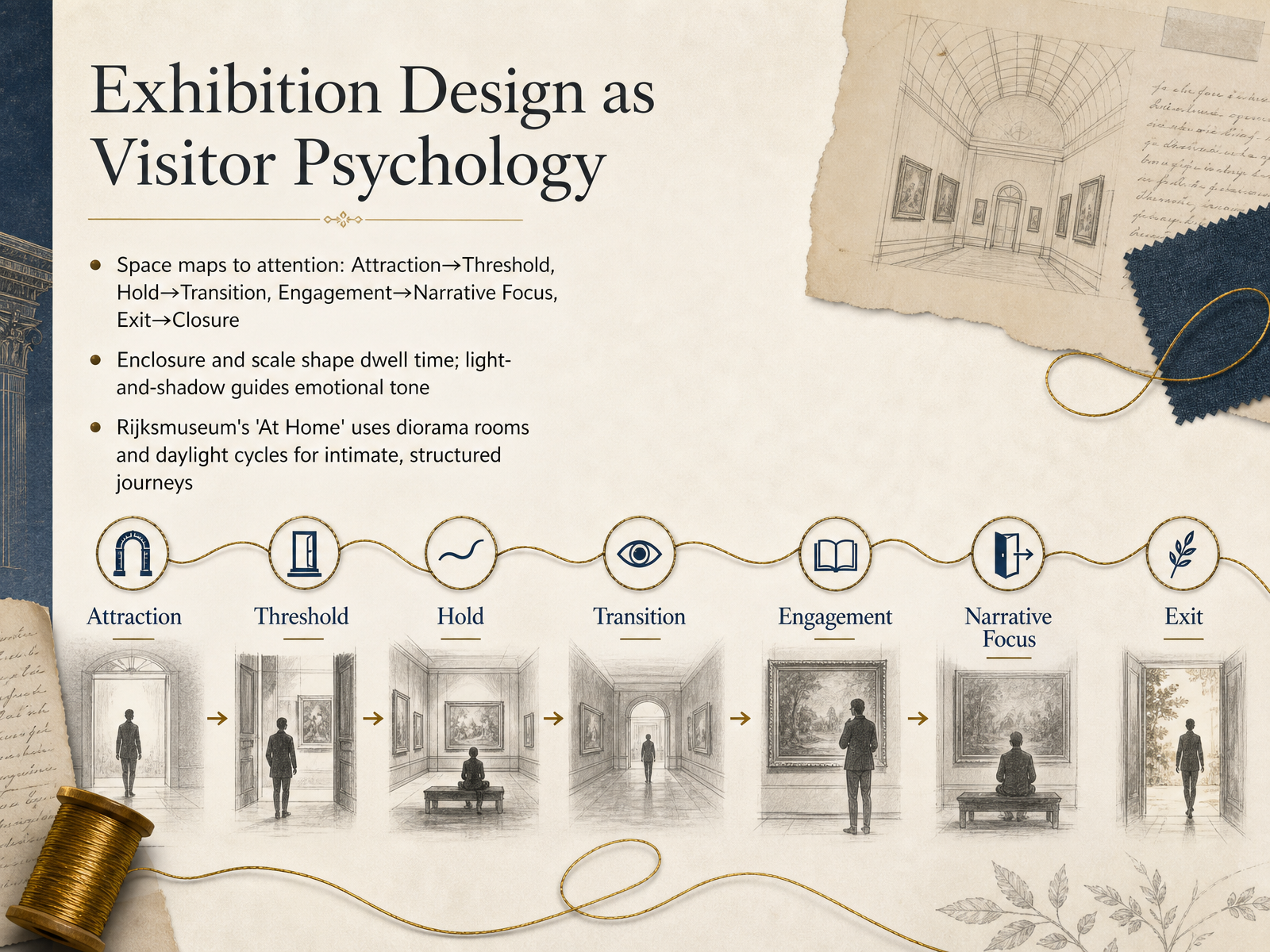
2 min - 09Exhibition Design as Visitor PsychologyNow let’s step back and consider how exhibition design itself shapes what you notice, when you pause, and how you feel. This is really a conversation about visitor psychology. Researchers now map spatial experience to four key attention stages. When you enter, open, visually generous spaces invite you in and help you orient — that’s the attraction threshold. As you start moving, transitional spaces gently hold your attention and guide your pace. At the heart of the exhibition, narrative focus spaces use intimacy, contrast, and careful sightlines to deepen your engagement with the stories on display. And finally, closure spaces offer a sense of resolution, giving you room to reflect before you leave. The physical qualities of a room — how enclosed it feels, its scale, and especially how light and shadow are handled — all cue your emotional response and directly influence how long you stay. A wonderful example is the Rijksmuseum’s ‘At Home in the Seventeenth Century.’ It uses diorama-like rooms and a daylight cycle that carries you from morning to night in a single day, creating an intimate, structured journey through domestic life. So when you walk through a gallery, consider that your attention is being gently choreographed by the space itself. Up next, we’ll explore whose story that space is telling, as we look at shifting authority and co-curation.
 washingtonian.comaam-us.orgamericanhistory.si.edu+22 min
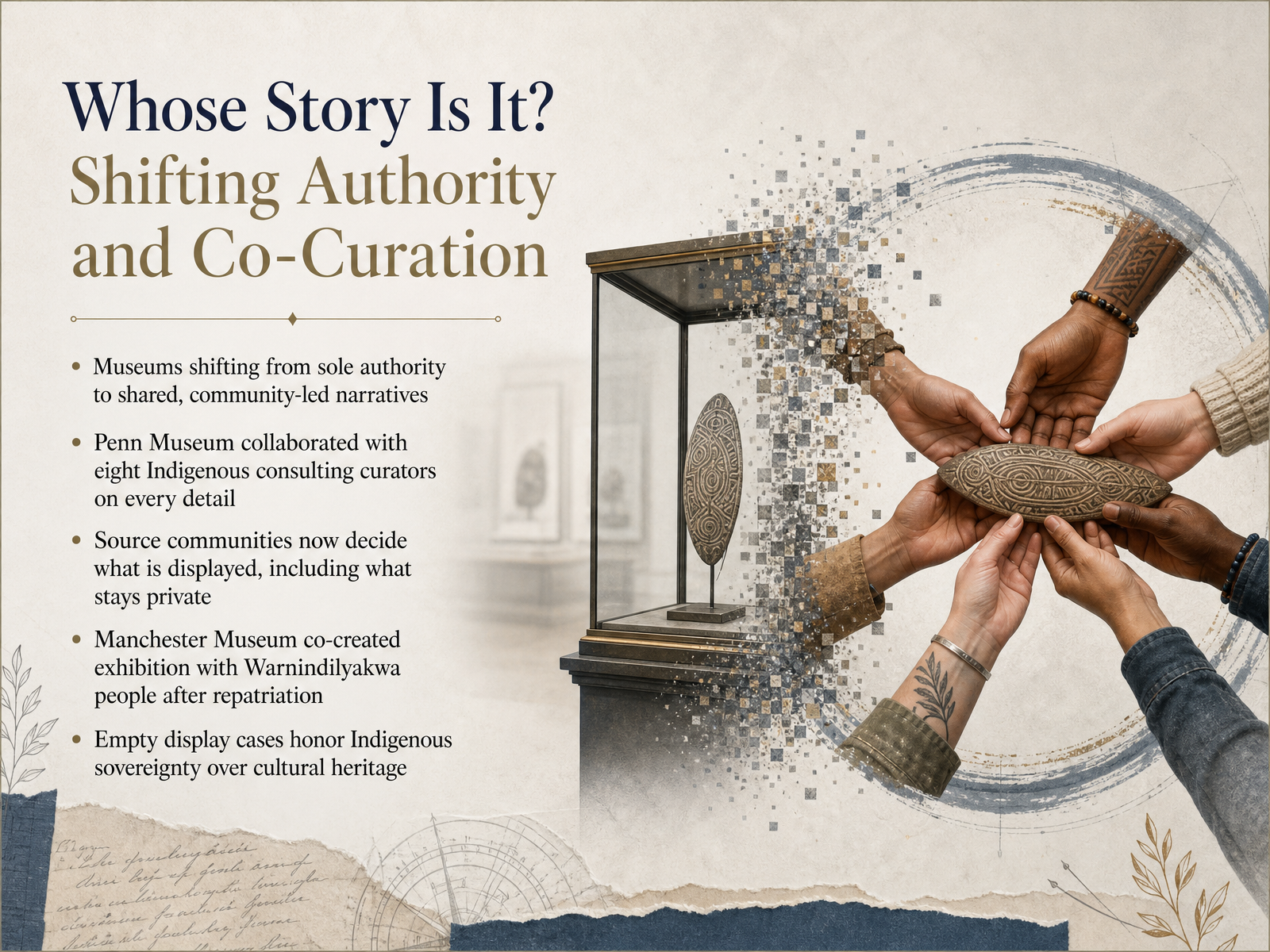
 - 10Whose Story Is It? Shifting Authority and Co-CurationSo now we come to a question that reshapes the entire museum experience: whose story is it? Increasingly, museums are moving from being the sole authority to becoming a platform for shared, community-led narratives. Take the Penn Museum, for example. Their new gallery was shaped in close collaboration with eight Indigenous consulting curators, who weighed in on every detail, from the objects selected to the color palette. This means the source communities are now making the decisions, including what stays private. Sometimes that choice is powerfully visible. After returning over one hundred and seventy items, Manchester Museum co-created a new exhibition with the Warnindilyakwa people, telling their story on their own terms. And in some places, you will find something particularly striking: an empty display case. It is not an oversight. It is a deliberate act of sovereignty, honoring a community's choice that some cultural heritage belongs outside the public view. The narrative is no longer told about them; it is built with them. Let's see next how this reshaping continues even after the objects are returned, when we explore Repatriation and Renewal.
 2 min
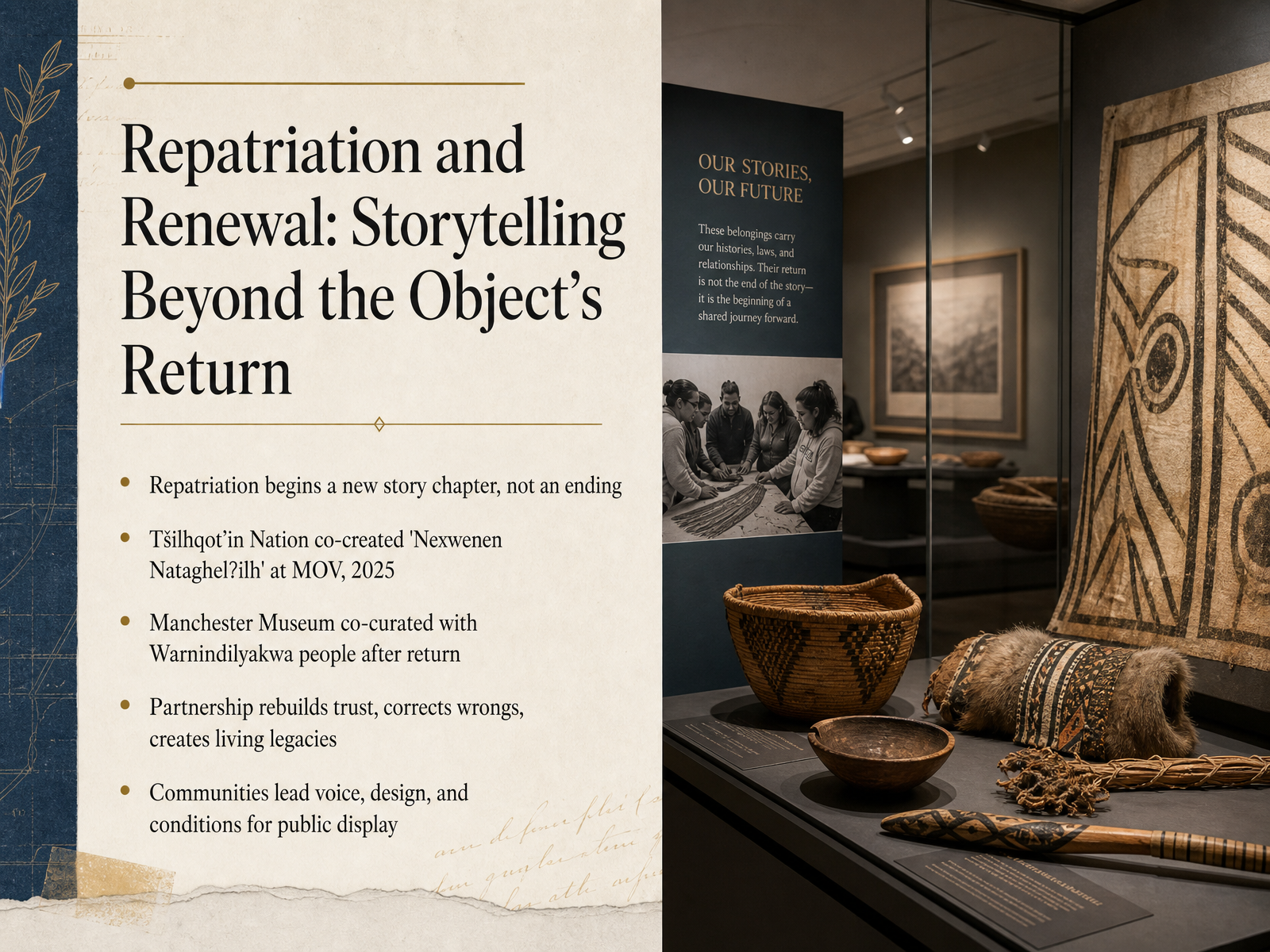
2 min - 11Repatriation and Renewal: Storytelling Beyond the Object's ReturnNow, let's consider what happens after objects go home. Repatriation isn't an ending; it often opens a rich new chapter of storytelling. Communities don't just receive belongings—they lead the curatorial voice. Take the Tŝilhqot’in Nation and the Museum of Vancouver. In 2025, they co-created an exhibition where juniper boughs cleanse the space, tree stumps from the territory serve as seating, and a documentary plays as if around a campfire. Similarly, after Manchester Museum returned 174 items to the Warnindilyakwa people, they co-curated a permanent exhibition that lets the community share their culture on their own terms. Even the handling sessions for shell dolls there follow a community condition: the dolls must come off display once a year to be played with. These partnerships rebuild trust, correct historical wrongs, and create living legacies. The lesson is clear: museums are learning to share authority, letting communities lead design, voice, and the conditions for public display. That idea of shared authority extends into digital spaces too, which brings us to our next topic, 'Digital Objects, Digital Narratives: New Frontiers.'
 2 min
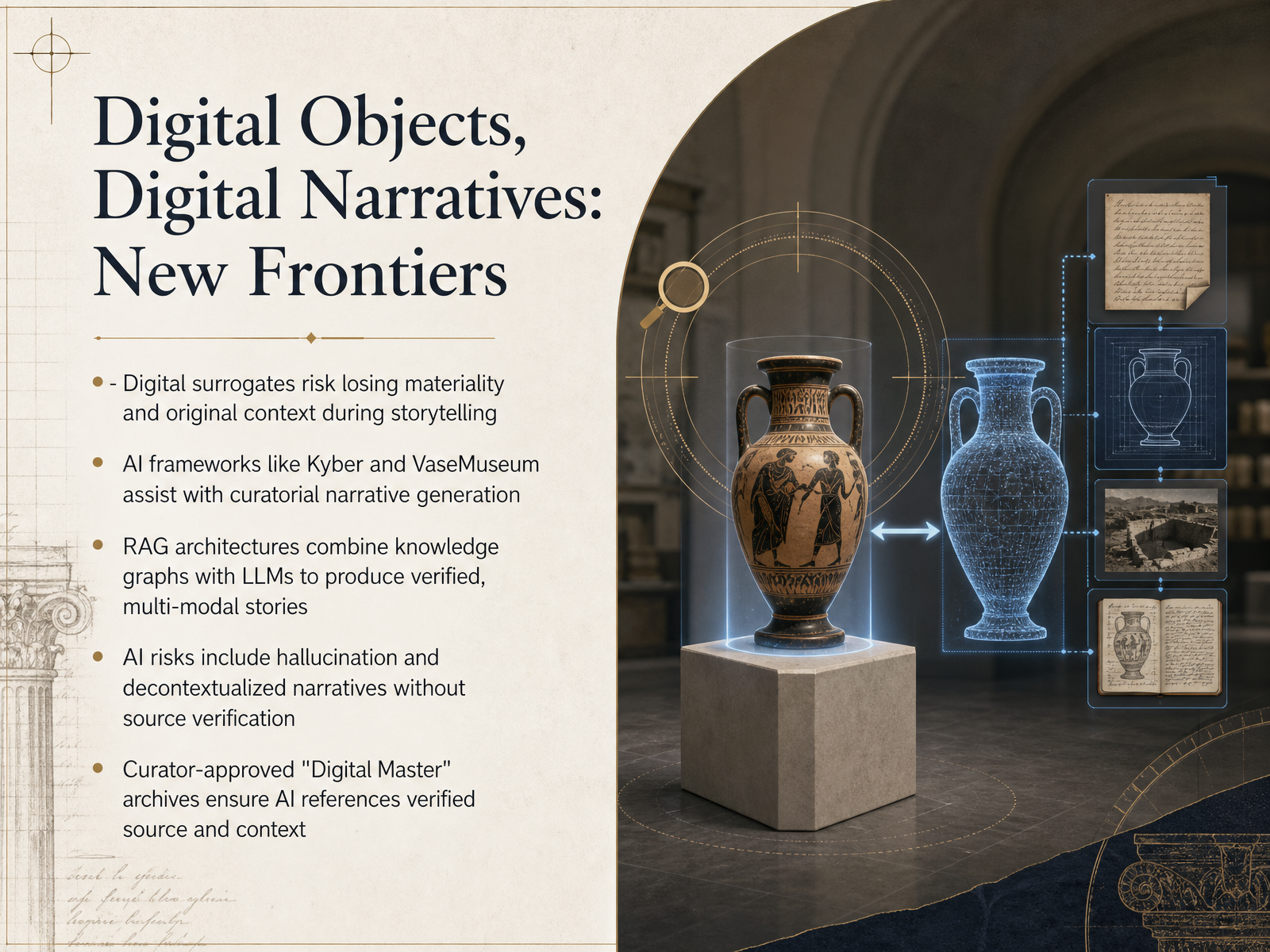
2 min - 12Digital Objects, Digital Narratives: New FrontiersMoving from the physical gallery to the digital frontier opens up exciting new possibilities, but also some important cautions. The first thing we have to acknowledge is that a digital surrogate, a photograph or a 3D scan, inevitably loses some of the object's materiality. The texture, the weight, the subtle way light plays across a surface. That sensory information, which is such a powerful part of storytelling, can be stripped away if we are not careful. To address this, museums are experimenting with AI frameworks like Kyber and VaseMuseum. These systems do more than just retrieve data. They assist curators by generating narrative threads, discovering connections between artworks, and suggesting thematic paths through a collection. They use what is called a RAG architecture, which stands for Retrieval-Augmented Generation. Think of it as combining a structured knowledge graph with a large language model to produce multi-modal stories grounded in verified facts. However, we must stay vigilant. AI can hallucinate, inventing confident-sounding details that are simply not true, or it can weave a compelling story that is completely decontextualized from the original artifact. The solution emerging in the field is the curator-approved Digital Master. This is a verified, source-linked archive that ensures any AI assistant references only trusted scholarship and authentic context, keeping our digital narratives honest and authoritative. Now, let's turn our attention to how we bring all these elements together.
 2 min
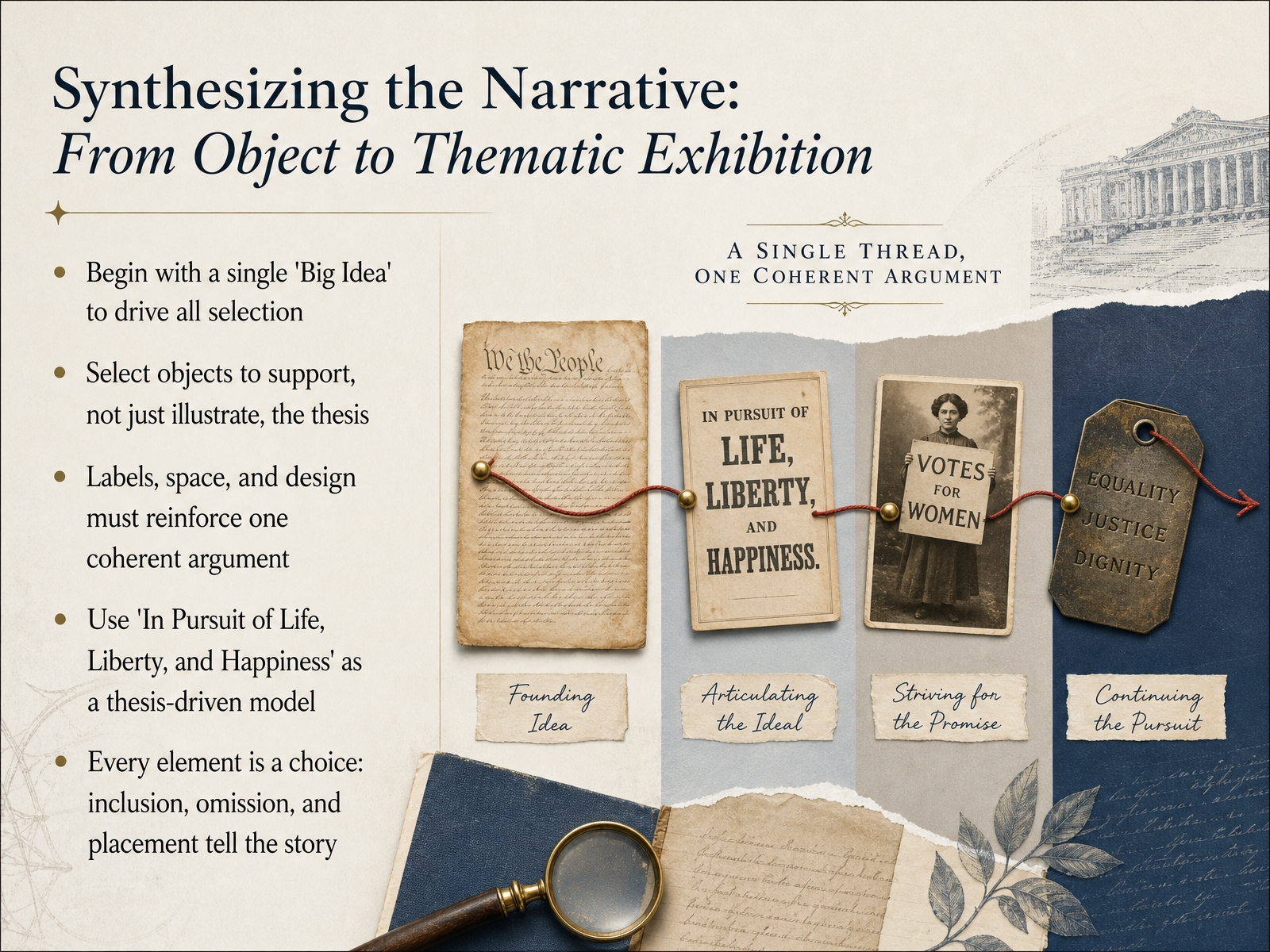
2 min - 13Synthesizing the Narrative: From Object to Thematic ExhibitionNow we bring all the pieces together to see how a single idea becomes a full thematic experience. It starts with what curators call the 'Big Idea'—a single sentence that drives every choice that follows. Think of the exhibition 'In Pursuit of Life, Liberty, and Happiness.' That Big Idea guided curators to select objects that don't simply illustrate history but actively support an argument. A simple lettuce carrier, for example, becomes a powerful statement about invisible labor and the pursuit of happiness. Remember, every element is a choice. Inclusion, omission, and placement all communicate meaning. Labels, lighting, and the physical space must reinforce one coherent argument, never contradicting it. So when you walk through a well-crafted exhibition, you are not just seeing a collection of things. You are experiencing a carefully argued story, told through objects, where every shadow and every word is intentional. Next, we will move from understanding this framework to applying it, with a tool for critical museum viewing in 'Transfer and Application.'
 washingtonian.comaam-us.orgamericanhistory.si.edu+22 min
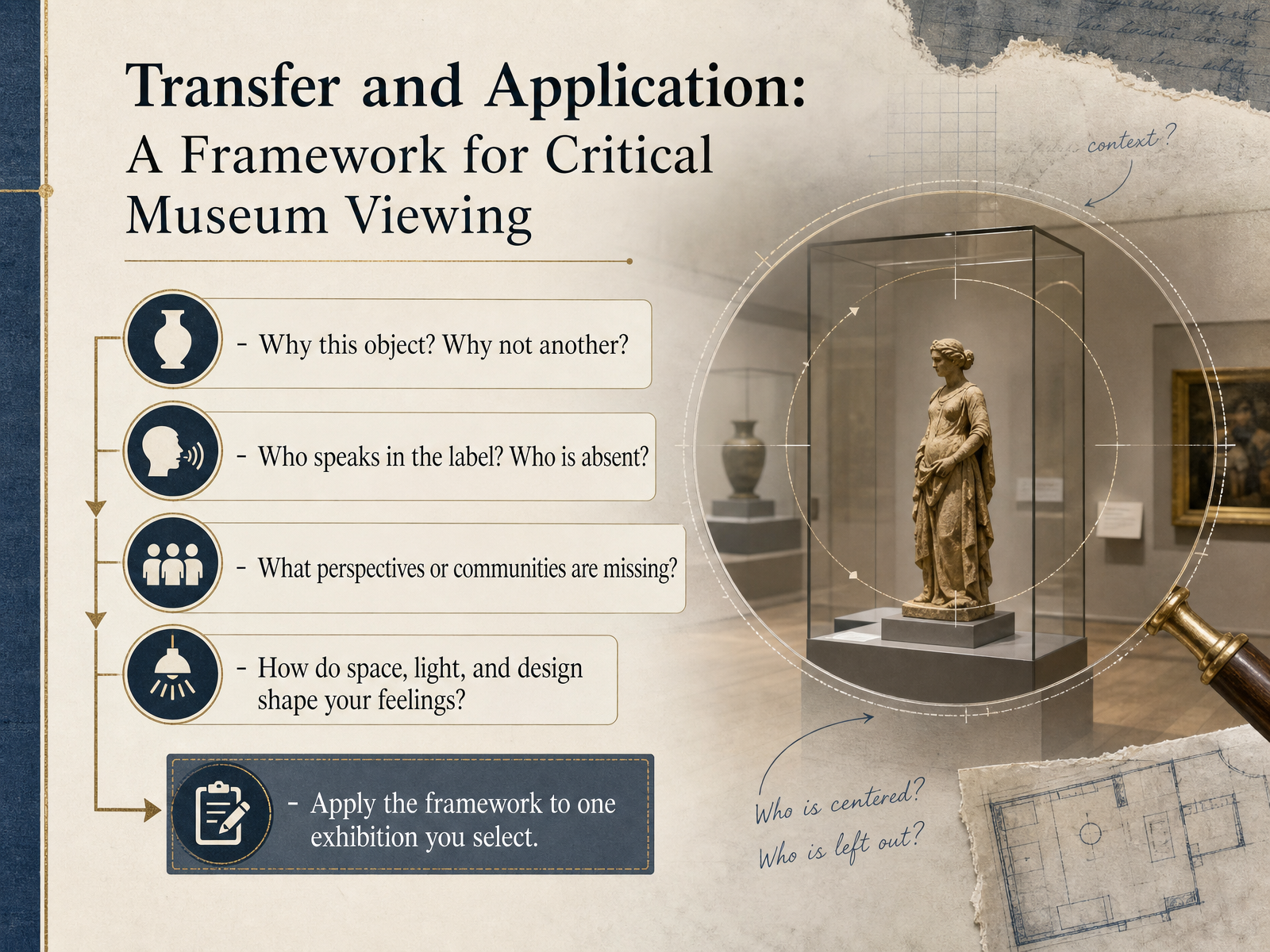
 - 14Transfer and Application: A Framework for Critical Museum ViewingNow we turn the lens on ourselves. How can you apply these ideas the next time you walk into a gallery? Think of this as your own framework for critical museum viewing. Start by asking, why this object and not another? Remember the lettuce carrier in the American history exhibition—a simple tool that told a story of migration and invisible labor. Next, look at the label. Who speaks in it, and who is absent? As we saw with the portrait of James the First, a label can either hide or reveal stories of colonialism, gender, and power. Then, widen your perspective. What communities or perspectives are missing from the room? The empty case at the Penn Museum powerfully reminds us that some stories are intentionally not for public view. Finally, feel the space itself. How do the lighting, the layout, and the design shape your emotions? Does a low-lit corner invite quiet reflection, or does a grand hall signal importance? For your final step, I invite you to take this framework and apply it to one exhibition you select. Walk through it slowly. Ask these questions. You'll begin to see the invisible curatorial choices that turn objects into narratives. Thank you for joining me on this journey behind the museum label. The next time you visit, you won’t just see a collection of old things. You'll read a living story, and you'll have the tools to decide what that story means to you. Keep wondering, keep questioning, and keep discovering.
 washingtonian.comaam-us.orgamericanhistory.si.edu+22 min
Take the deck with you
Download this course as a file — free, no sign-up needed.
- PDF handoutEvery slide page, ready to print or share.15 pages · 5.2 MBDownload
- Narrated PowerPointThe deck that presents itself — every slide carries the digital human's narration video.15 pages · 18.3 MBDownload
- PowerPoint slidesThe full deck as a .pptx — open it in PowerPoint, Keynote, or Google Slides.15 pages · 5.2 MBDownload
Free to use in your own training — please keep the PersonWise credit page at the end.
Have your own deck? Turn it into a course
Sources consulted
Web sources consulted while building this course.
- This New Exhibit Will Tell the Story of America with 250 Objects — washingtonian.com
- Rethinking the Narrative – American Alliance of Museums — aam-us.org
- Going behind the scenes with Forensic Science on Trial | National Museum of American History — americanhistory.si.edu
- Fighting for Freedom: Black Craftspeople and the Pursuit of Independence | Today's DAR — blog.dar.org
- Hew Locke: What have we here? – A review of the British Museum exhibition examining Empire and its afterlives – MUSEUM GEOGRAPHIES — museumgeographies.com
- Provenance inconnu and other stories: developing engaging labels for ancient history collections | Museum & Society — journals.le.ac.uk
- Communicating Provenances, — shop.mkb.ch
- Paths of art: How objects get into the museum - Building design — building-design.world
- Gallery of Shadows: A Modality Comparison of an Interactive Provenance Research — surface.syr.edu
- Guest Blog Post: “Material Storytelling: Student Reflections on Object-Based Research,” by Neo Khambule, Tiffany Huang, and Amanda J. Guzmán - Council for Museum Anthropology — museumanthropology.org
- Techniques for Collaborative Label Writing — artmuseuminterp.org
- Wording Identities - How Museums Label Diasporic Artists? — stedelijkstudies.com
- https://digital.lib.washington.edu/bitstreams/a79f0640-82d2-4fa7-98c3-37a20c216d4e/download — digital.lib.washington.edu
- Writing a museum label with 'Gendering the Museum' | Royal Museums Greenwich — rmg.co.uk
- Rethinking Museum Labels: Engagement Over Monologue — themuseumlabelproject.substack.com
- Museum’s Benin Bronzes Are Reclaimed by Wealthy Collector — nytimes.com
- Should Germany return Nefertiti bust to Egypt? — dw.com
- Buddha's sacred jewels head to auction - should they be returned to India? - BBC News — bbc.co.uk
- A Bid to Undo a Colonial-Era Wrong Touches a People’s Old Wounds — nytimes.com
- Naga skulls: Indian tribes seeks to bring home ancestral remains from UK museums — bbc.com