Marketing Segmentation Fundamentals
Begin
14 pages · ~28 min
Marketing Segmentation Fundamentals
Learn the core principles of market segmentation, including key criteria and methods to identify and target distinct customer groups effectively for marketing strategy.
What you’ll learn
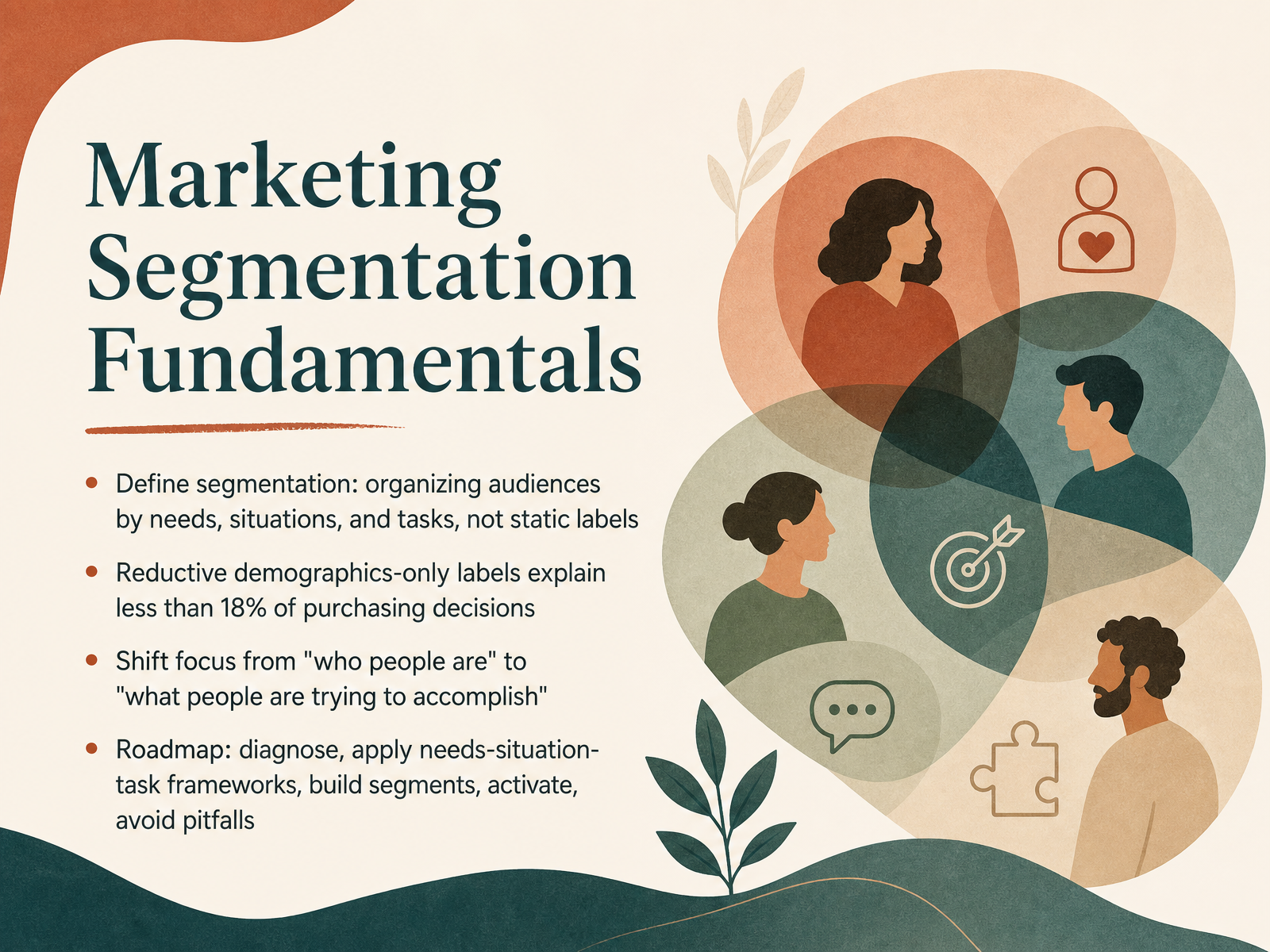
- 01Marketing Segmentation FundamentalsWelcome. Over the next few minutes we are going to rethink one of the most basic tools in marketing: segmentation. The goal here is not to memorize definitions, but to start seeing audiences the way they actually behave—grouped by needs, situations, and tasks, not reduced to labels on a spreadsheet. Consider this: static demographics like age or income explain less than eighteen percent of purchasing decisions. That number comes from behavioral science research that tracked real buying patterns, not just survey responses. So we are going to shift our focus from who people look like on paper to what they are trying to accomplish in a given moment. Today's roadmap works in five stages. First we diagnose why traditional labels fall short. Then we apply frameworks built around needs, situation, and task. Next we build segments that reflect those dynamics, activate them in real campaigns, and finally avoid common traps that make segmentation feel generic. By the end you will have a clear, practical lens for making marketing sharper and more human. Let's begin with the cost of sticking to labels alone.micebook.comintenthq.comsendxmail.com+22 min
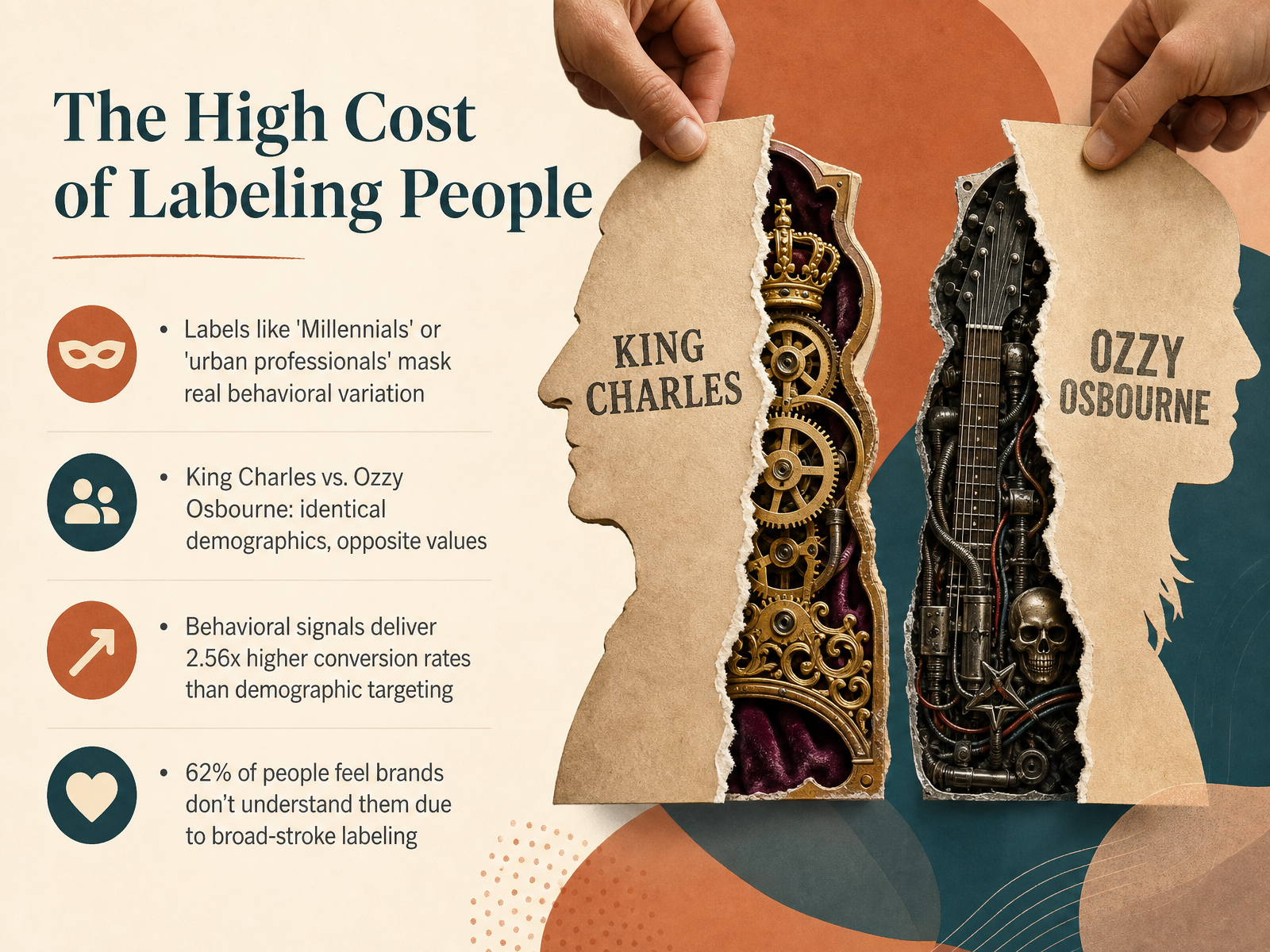
- 02The High Cost of Labeling PeopleLet's look at what it actually costs when we rely on labels like 'Millennials' or 'urban professionals.' These categories sound precise, but they mask enormous behavioral variation. Think about it this way. From a purely demographic standpoint, King Charles and Ozzy Osbourne look almost identical. Similar age, similar nationality, similar wealth bracket. Yet their values, their daily routines, and what they'd actually buy couldn't be further apart. That's the danger of demographics. They describe categories, but they don't predict behavior. And the data backs this up. One beauty retail study found that targeting based on live behavioral signals like how someone is browsing right now drove a two point five six times higher conversion rate compared to standard demographic targeting. That's not just a small edge. It's the difference between guessing and knowing. And here's the real wake-up call. Sixty-two percent of people feel brands simply don't understand them. That's because broad-stroke labeling makes people feel categorized, not seen. When we treat audiences as a collection of static labels, we sacrifice relevance and we waste budget reaching people who will never act. But when we shift our focus to what people actually need and do, everything changes. That's why our next step is shifting the unit of analysis, from identity to action.
 micebook.comintenthq.comsendxmail.com+22 min
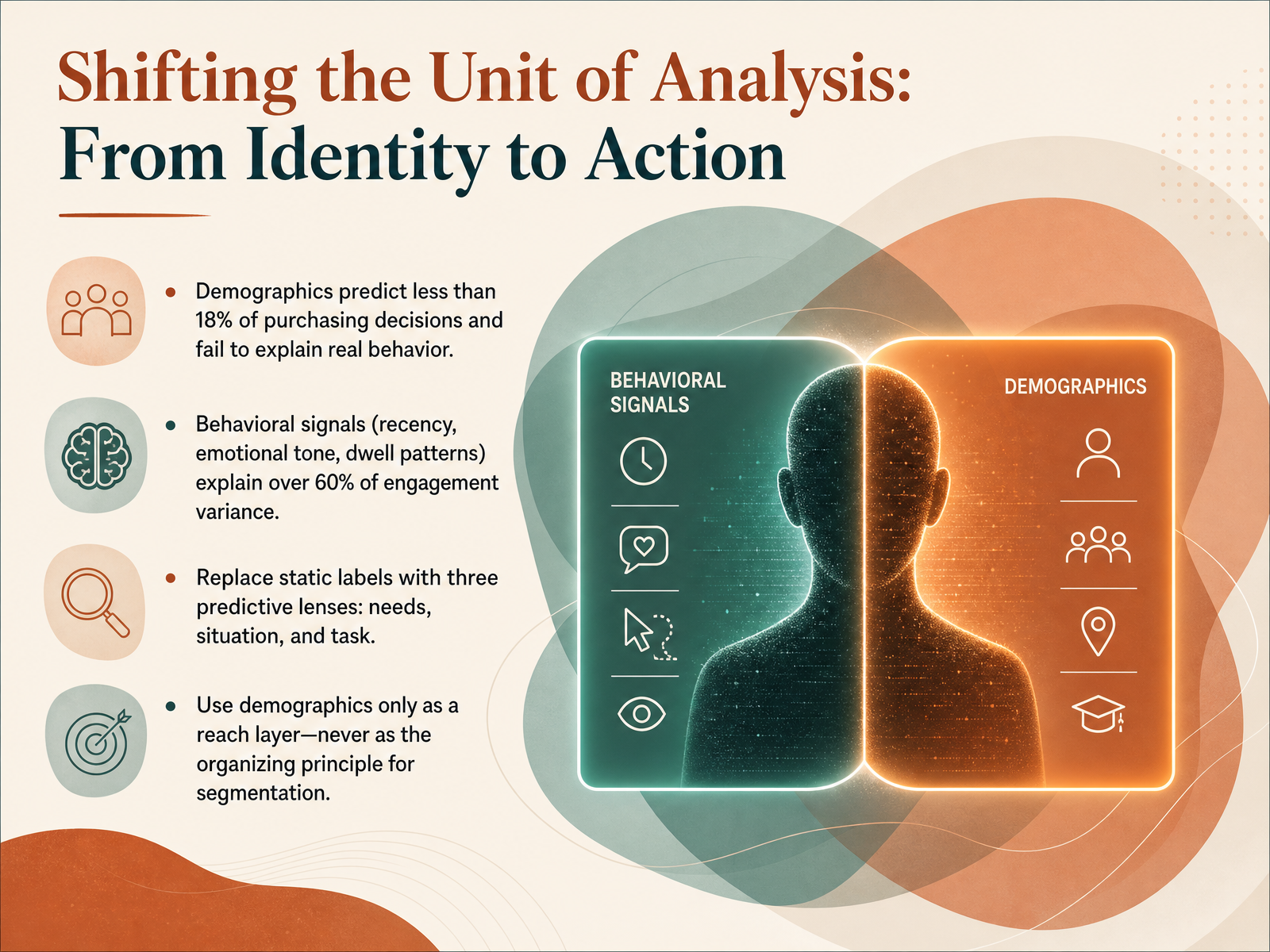
 - 03Shifting the Unit of Analysis: From Identity to ActionNow, let's shift how we think about the unit of analysis. Instead of starting with identity, we start with action. Research consistently shows that demographics predict less than eighteen percent of purchasing decisions. That means over eighty percent of what drives behavior is invisible if we only look at age or income. Meanwhile, behavioral signals like recency of engagement, emotional tone, and dwell patterns explain over sixty percent of engagement variance. So, we need to replace those static labels with three predictive lenses: needs, situation, and task. Think of demographics as a final reach layer, useful for media buying, but never as the organizing principle for your segmentation. When we group people by what they are trying to do, not just who they appear to be, our strategies become sharper and far more human. Next, let's unpack the first of those lenses: needs as the organizing principle.
 micebook.comintenthq.comsendxmail.com+21 min
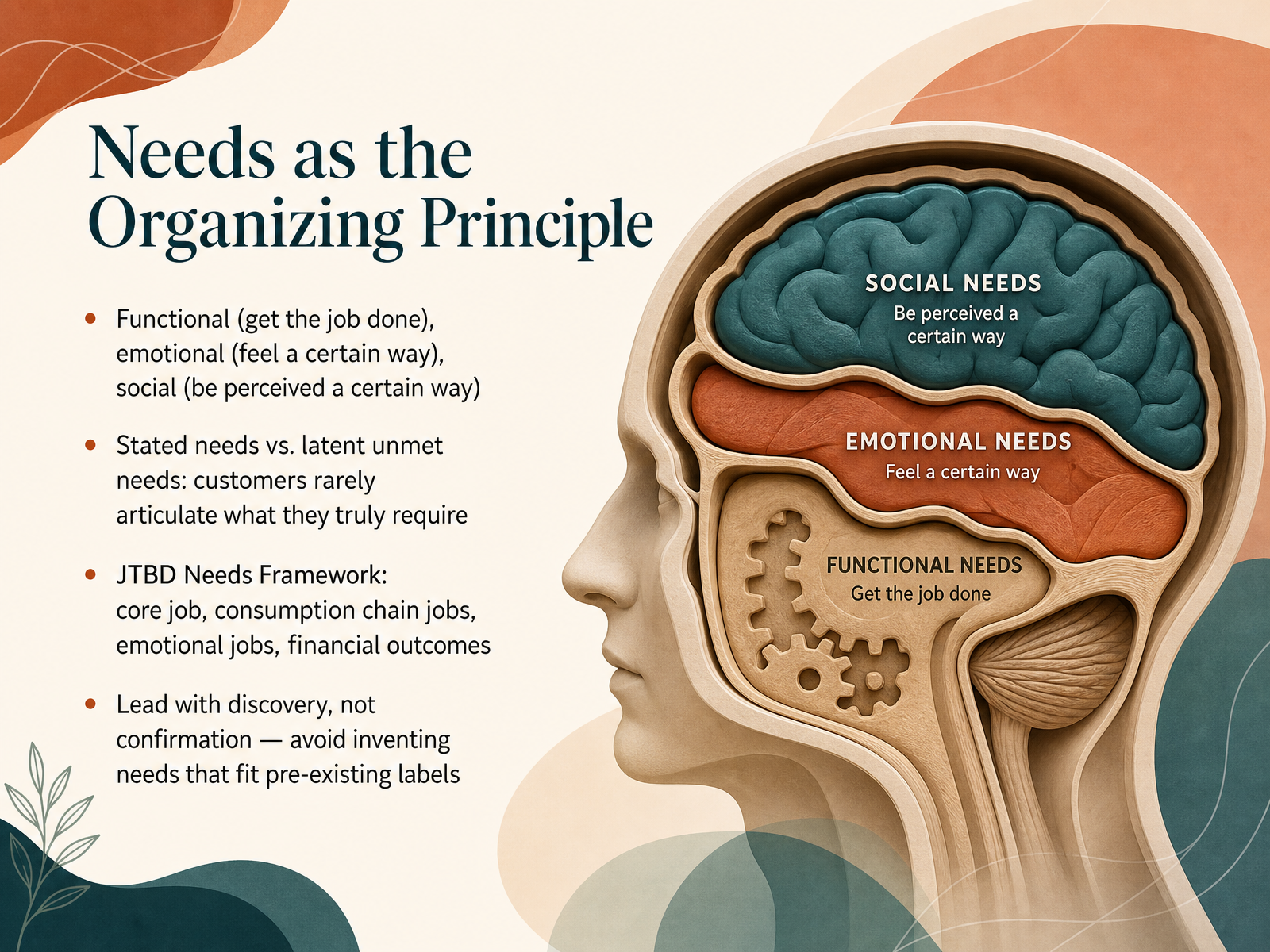
 - 04Needs as the Organizing PrincipleSo if we want to segment by needs, we have to get specific about what a need actually is. A single purchasing decision usually involves three layers. There’s the functional job, the practical task someone wants to complete. There’s the emotional job, how they want to feel during or after the process. And there’s the social job, how they want to be perceived by others. These three layers explain why someone might buy a premium power tool not just to drive screws faster, but to feel competent and to signal craftsmanship on a job site. The real challenge is that customers rarely articulate their deepest requirements. Stated needs are what people say they want, like a faster reporting tool. Latent needs are the unspoken struggles underneath, such as the anxiety of looking unprepared in a Monday morning meeting. To surface those, we use the Jobs-to-be-Done Needs Framework. It breaks the landscape down into the core job, the steps before and after the main task, the emotional jobs, and the financial outcomes people are trying to achieve. Here’s the critical discipline in all of this: lead with discovery, not confirmation. It’s tempting to invent a need that fits a pre-existing label like “budget-conscious buyer,” but that shortcut just puts a name on our assumptions. Instead, let the customer’s own struggle reveal the pattern. Up next, we’ll unpack the specific interview technique that makes that possible: the Switch Interview Method.
 jobstobedone.orgjobs-to-be-done.comjobs-to-be-done.com+22 min
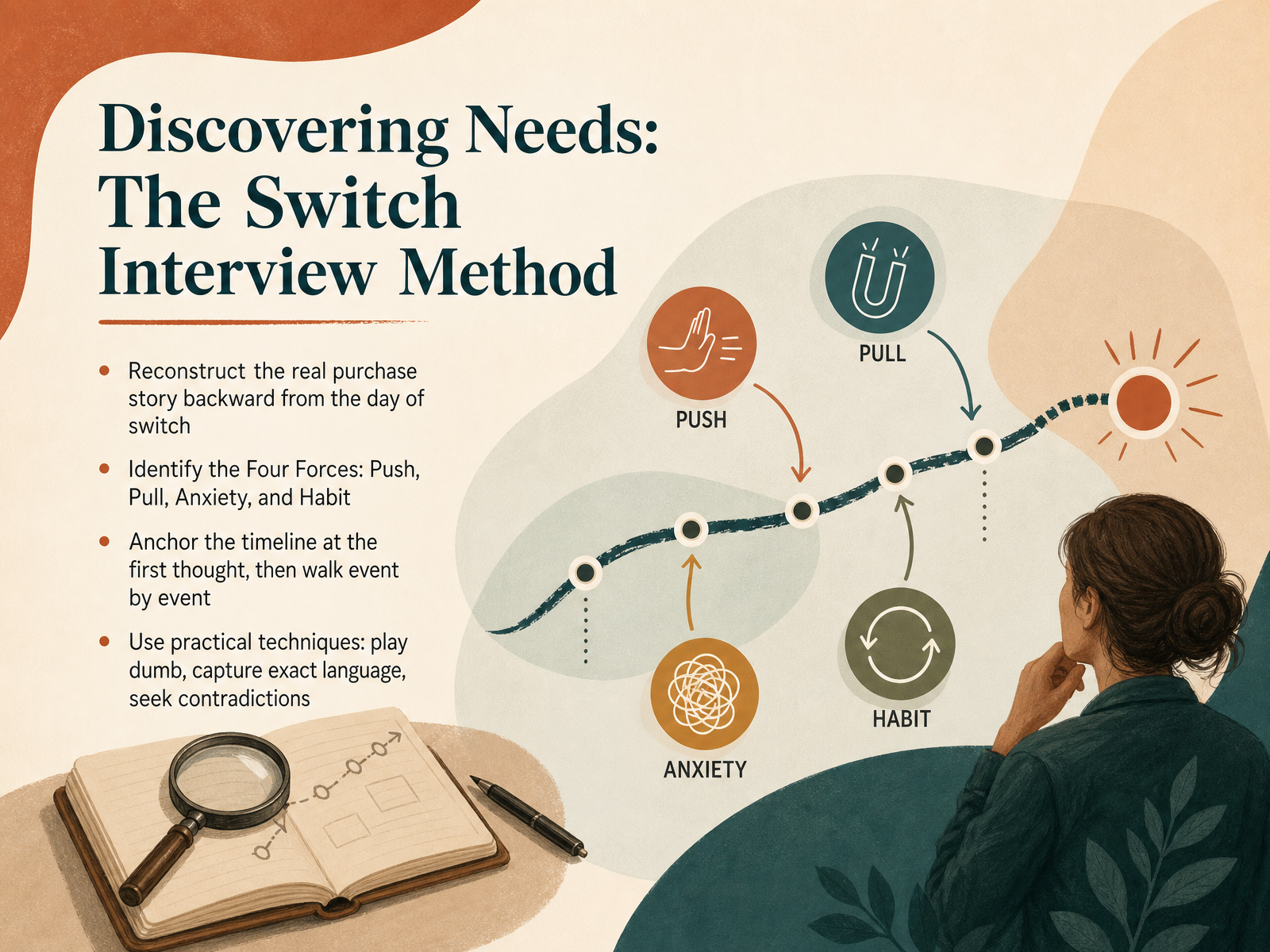
 - 05Discovering Needs: The Switch Interview MethodSo let’s look at one of the most powerful tools for uncovering those real needs: the Switch Interview. Think of it like a forensic case study. Instead of asking people what they generally want, you walk backwards with them through a real, recent purchase—day by day, event by event. You start by anchoring them on the actual day they switched, and then you retrace the story all the way back to the very first thought they ever had about making a change. We call that the first thought. From there, you move forward in time, but you’re not collecting opinions. You’re collecting specific, mundane details. Like, where were you? What did you do right after that? As the story unfolds, you start hearing four distinct forces. The push—that frustration with the old way. The pull—what made the new option so attractive. The anxiety—what they were nervous about that almost stopped them. And the habit—the inertia that kept them in the old way. A few practical techniques help here. Play dumb. Ask about the obvious. The insight is often hiding in what the customer thinks is too boring to mention. Capture their exact language. If they say “I just got fed up,” don’t paraphrase it. Write down “I just got fed up.” And when you hear a contradiction, don’t smooth it over. Treat it as a refinement. It’s telling you something important. Next, we’ll see how to take these powerful, messy, human stories and distill them into clear, validated needs segments.
 jobstobedone.orgjobs-to-be-done.comjobs-to-be-done.com+22 min
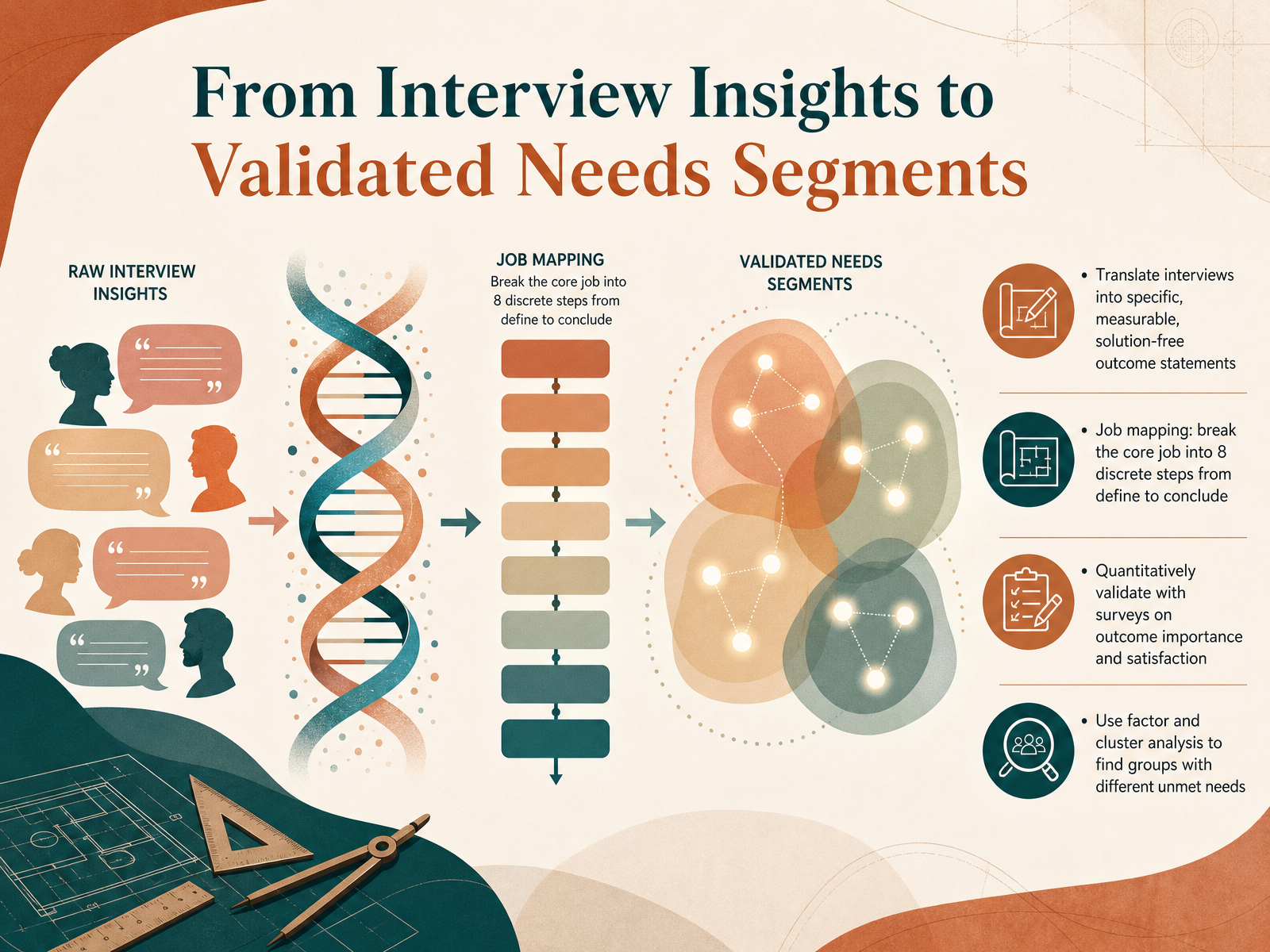
 - 06From Interview Insights to Validated Needs SegmentsNow, let's turn those rich interview insights into validated segments. The first step is to translate what you've heard into specific, measurable outcome statements. These aren't feature requests or solution ideas. They use a formula like 'minimize the time it takes to do X' or 'increase the likelihood of Y.' They're stable, solution-free, and tell you exactly how customers measure success.
Next, we use a technique called job mapping. This breaks the customer's core job into eight discrete steps, from 'define what I need' to 'conclude the task.' It creates a logical frame so we don't miss needs at any stage. For example, someone hiring a project management tool doesn't just track tasks. They also need to locate information, prepare inputs, and verify outcomes.
With those outcome statements in hand, we move to quantitative validation. We survey a larger audience, asking them to rate both the importance of each outcome and their current satisfaction with it. This is where we find the gaps—the unmet needs.
Finally, we feed that survey data into factor analysis and cluster analysis. These statistical methods group customers not by who they are, but by how they answer. We end up with segments of people who share the same profile of unmet needs. For instance, one group might struggle most with collaboration speed, while another’s biggest gap is reporting accuracy.
This entire flow—from interviews to outcomes to statistical clusters—shifts your segmentation from labels to the actual struggle that drives a purchase. Next, we'll explore how context refines those segments even further with situational segmentation: context is everything.
 jobstobedone.orgjobs-to-be-done.comjobs-to-be-done.com+22 min
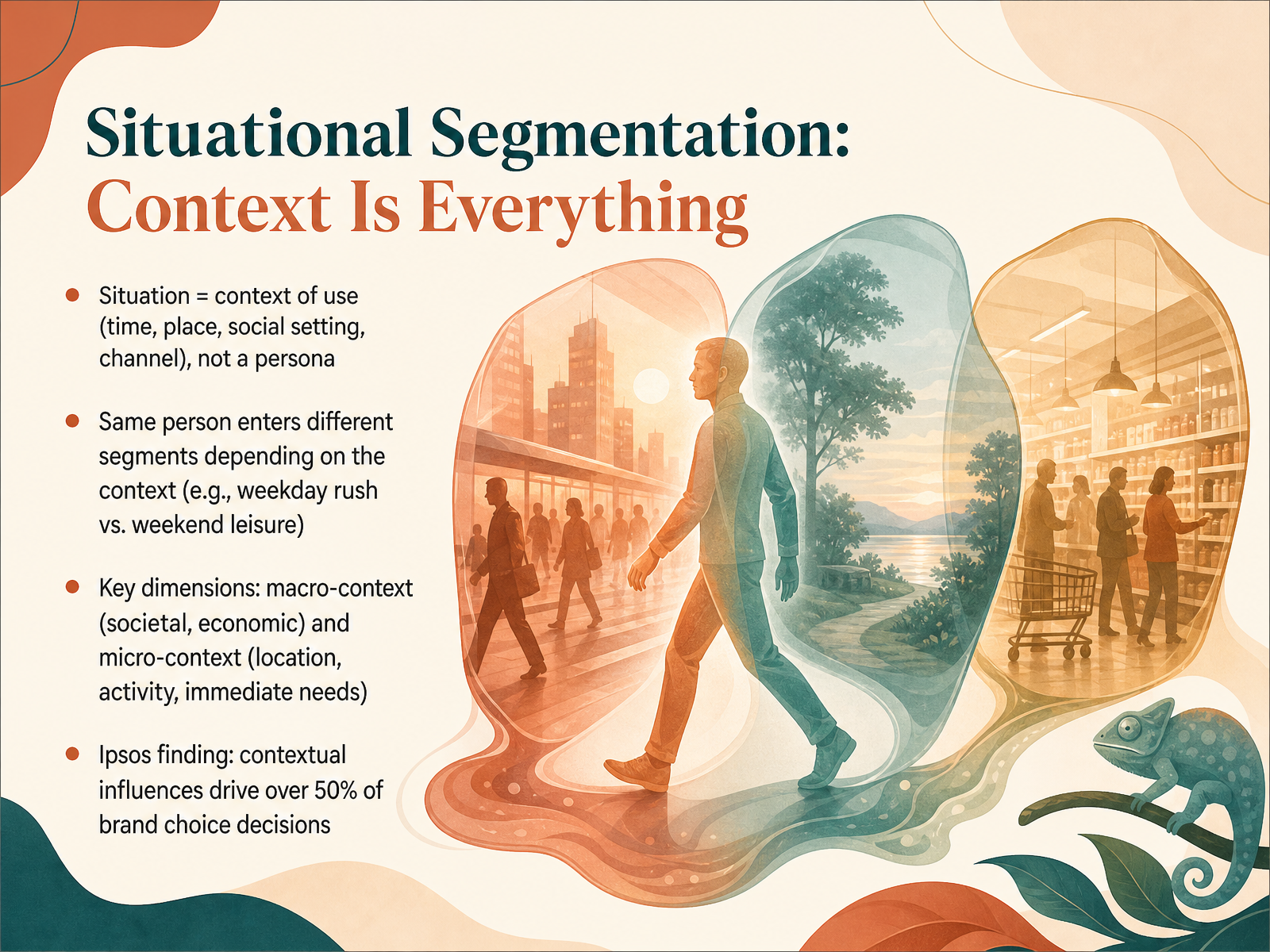
 - 07Situational Segmentation: Context Is EverythingNow let's look at situational segmentation, where context is everything. Here, a situation is defined by the context of use—the time, the place, the social setting, even the channel someone is using. This isn't about slotting people into fixed personas; it's about recognizing that the same person enters a completely different segment based on the moment. Think about a weekday morning rush versus a relaxed weekend afternoon. The functional and emotional needs in those two windows are worlds apart, even for the identical individual. To map this, we zoom in on two layers. The macro-context covers the big picture: societal trends and economic realities. The micro-context captures the immediate scene: your location, your current activity, and your pressing needs right now. This isn't just theory. Research from Ipsos shows that contextual influences drive over fifty percent of brand choice decisions. The situation often matters more than deep-seated attitudes. Next, we'll ground this in reality by looking at situational segmentation in practice.
 the-future-of-commerce.comumbrex.comipsos.com+22 min
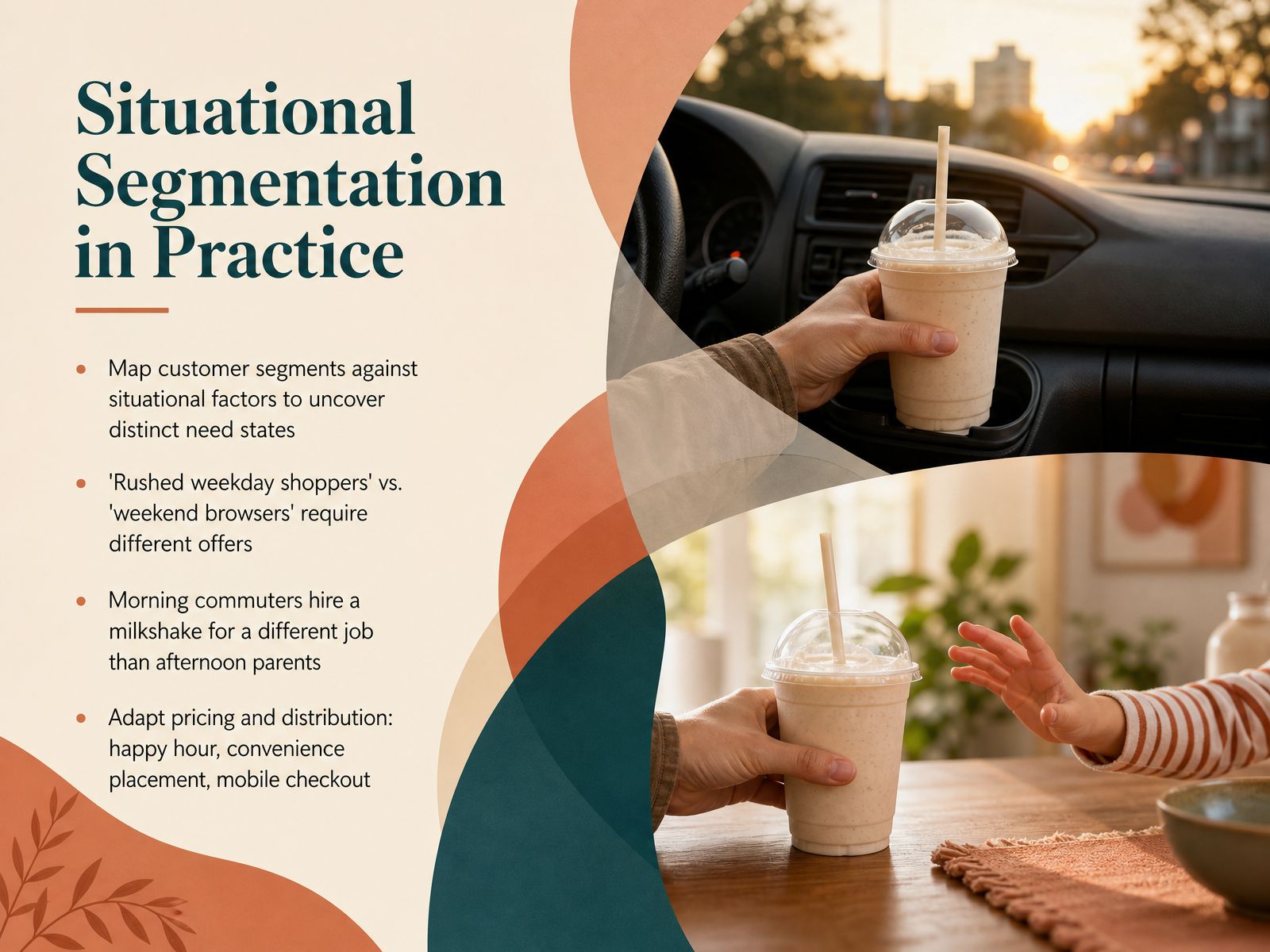
 - 08Situational Segmentation in PracticeWhen we talk about audiences in terms of their situation, we stop seeing static labels and start seeing patterns of need. The real work here is mapping your customer groups against situational factors—things like time pressure, location, or who else is present—to uncover distinct need states. Think about two shoppers in the same grocery aisle. One is a rushed weekday shopper who needs to buy dinner for tonight, get through checkout fast, and get home. The other is a weekend browser who wants meal inspiration and might linger over samples. They're the same demographic, perhaps, but the offers that serve them are completely different. Or consider the classic milkshake example. A morning commuter hires a milkshake to do a specific job: something filling that keeps them occupied on a long drive. An afternoon parent hires a milkshake for a different job: a small treat to share with a child. The product might be the same, but the need is defined by the moment. This thinking also helps you adapt your marketing mix. Pricing can flex to the situation, like happy hour or early-bird specials. Distribution can prioritize convenience placement at commuter hubs. Even checkout can shift, with mobile payment for on-the-go moments. The takeaway is simple: find the situation, solve the specific need, and let those insights guide your decisions. Next, we'll explore task-based segmentation—what it really means to hire a product for a job.
 the-future-of-commerce.comumbrex.comipsos.com+22 min
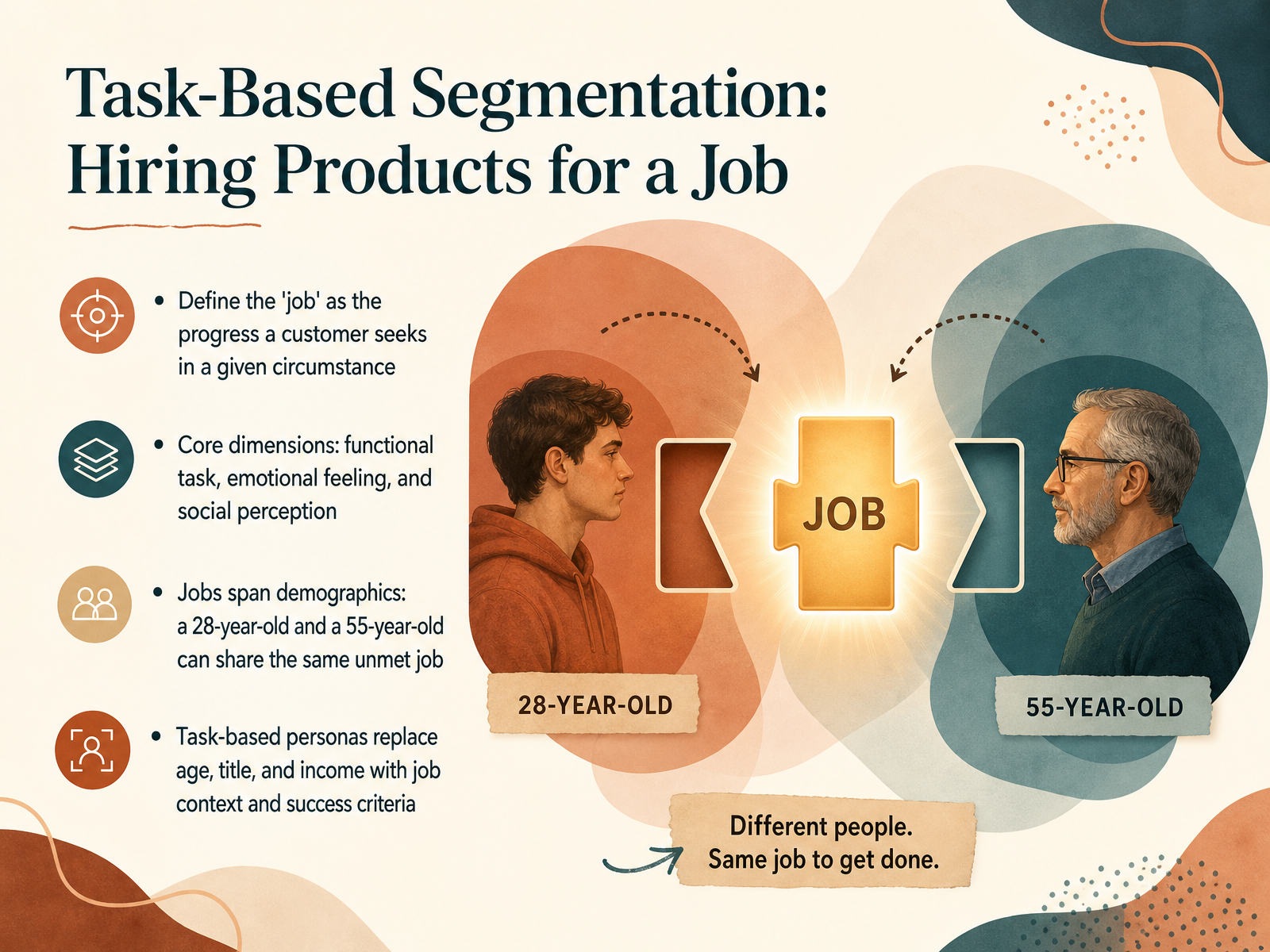
 - 09Task-Based Segmentation: Hiring Products for a JobNow let's shift our focus to task-based segmentation, where we stop looking at who a person is and start seeing the specific job they're trying to get done. Think of a 'job' here as the progress a customer seeks in a particular circumstance. It's not a to-do list item. It's the stable, underlying goal they want to achieve. This job has three core dimensions. The first is the functional task, the practical step someone needs to complete. But just as important are the emotional feeling, how they want to feel during and after the process, and the social perception, how they want to be seen by others. One of the most powerful realizations here is that jobs span demographics. A twenty-eight-year-old and a fifty-five-year-old can share the exact same unmet job, even if their hobbies or incomes look completely different on paper. Because of this, task-based personas replace age, title, and income with job context and success criteria. Instead of a persona that says 'Marketing Mary is thirty-two and lives in the city,' you get a persona defined by a specific struggle, like managing a complex project launch with a tight deadline and a need to feel in control. This gives you a much sharper, more human-centered tool for design and messaging.
 jobstobedone.orgjobs-to-be-done.comjobs-to-be-done.com+22 min
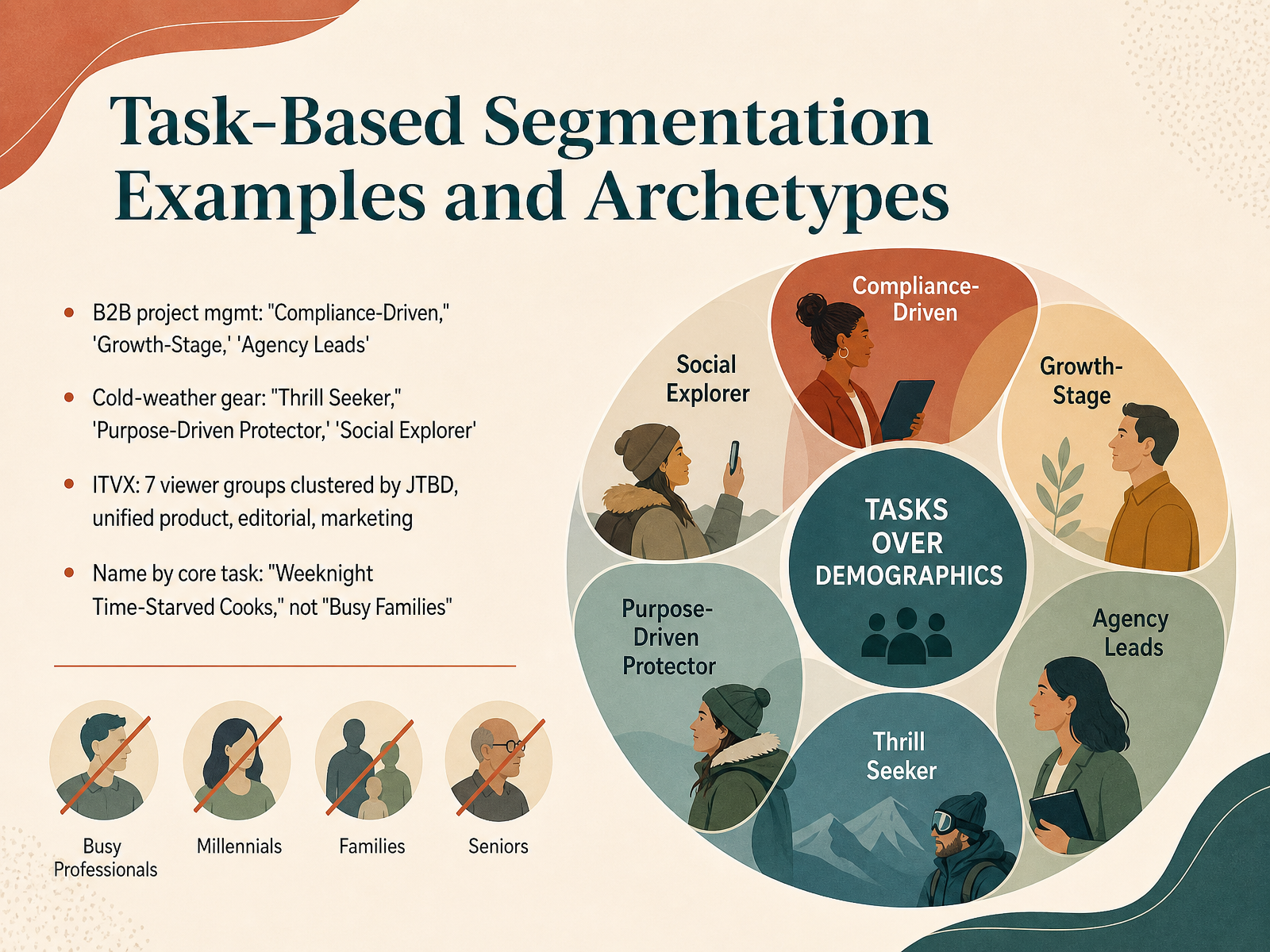
 - 10Task-Based Segmentation Examples and ArchetypesSo let's move from theory to some concrete examples of task-based segmentation in action. In B2B project management, you might see groups like Compliance-Driven managers, whose core task is proving governance for regulators. Then there are Growth-Stage coordinators, focused on scaling delivery without adding overhead. And Agency Leads, whose real job is maintaining client confidence through complete transparency. See how each label points to the work they are doing, not just their title? In consumer goods, think about cold-weather gear. Instead of 'outdoor enthusiasts,' we find Thrill Seekers hiring gear to push limits, Purpose-Driven Protectors choosing brands that align with their values, and Social Explorers prioritizing connection and belonging. The streaming platform ITVX used this exact approach, clustering seven million viewers by their jobs-to-be-done, which then unified their product, editorial, and marketing teams around a single, data-driven growth strategy. The naming convention is your litmus test. If you can name a segment 'Weeknight Time-Starved Cooks,' you have a sharp, actionable group. If you settle for 'Busy Families,' you have a stereotype that hides more than it reveals. That's the power of a task-based lens.
 the-future-of-commerce.comumbrex.comipsos.com+22 min
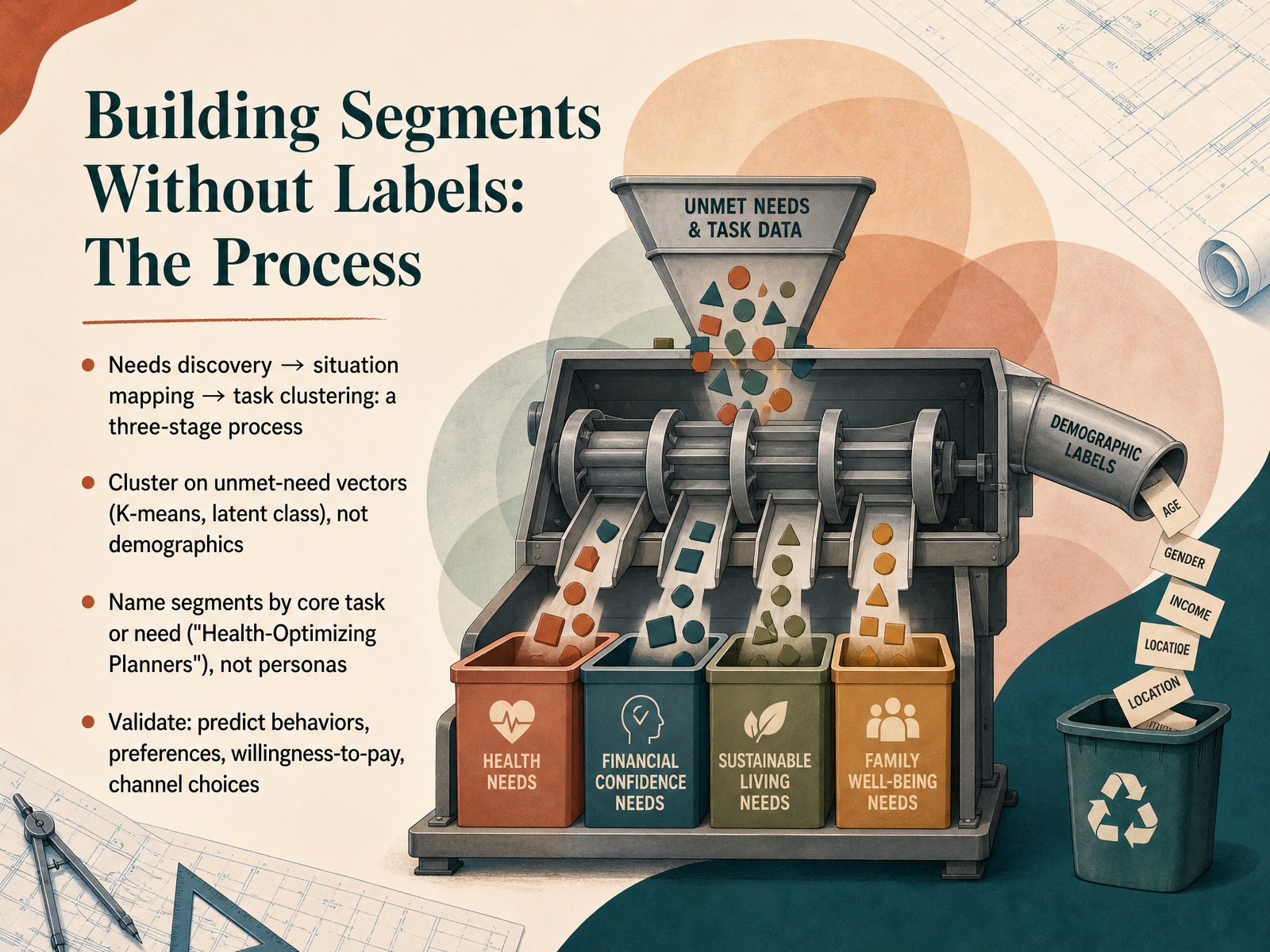
 - 11Building Segments Without Labels: The ProcessSo, how do we actually build these segments without falling back on labels? It helps to think of it as a three-stage process. First is needs discovery—you're listening for the real jobs people are trying to get done and the outcomes they want. Then you move into situation mapping, where you capture the context: when does that need arise, and what triggers it? Finally, you cluster around the tasks themselves. The math side—whether you use something like K-means or latent class analysis—clusters customers on those unmet-need vectors, not on age or job title. Here's a practical shift worth remembering. When you name your segments, skip the personas and describe the core task. Think 'Health-Optimizing Planners' rather than 'Busy Millennials.' That small change keeps your team anchored in what customers are trying to accomplish. Of course, a segment is only useful if it holds up, so the real test comes next: validation. You need to check whether the segment actually predicts behaviors, preferences, willingness to pay, and even channel choices. If it doesn't change how you act, it's just a label by another name. Coming up, we'll look at how to activate these segments in real campaigns and content.
 getperspective.aimailchimp.comumbrex.com+22 min
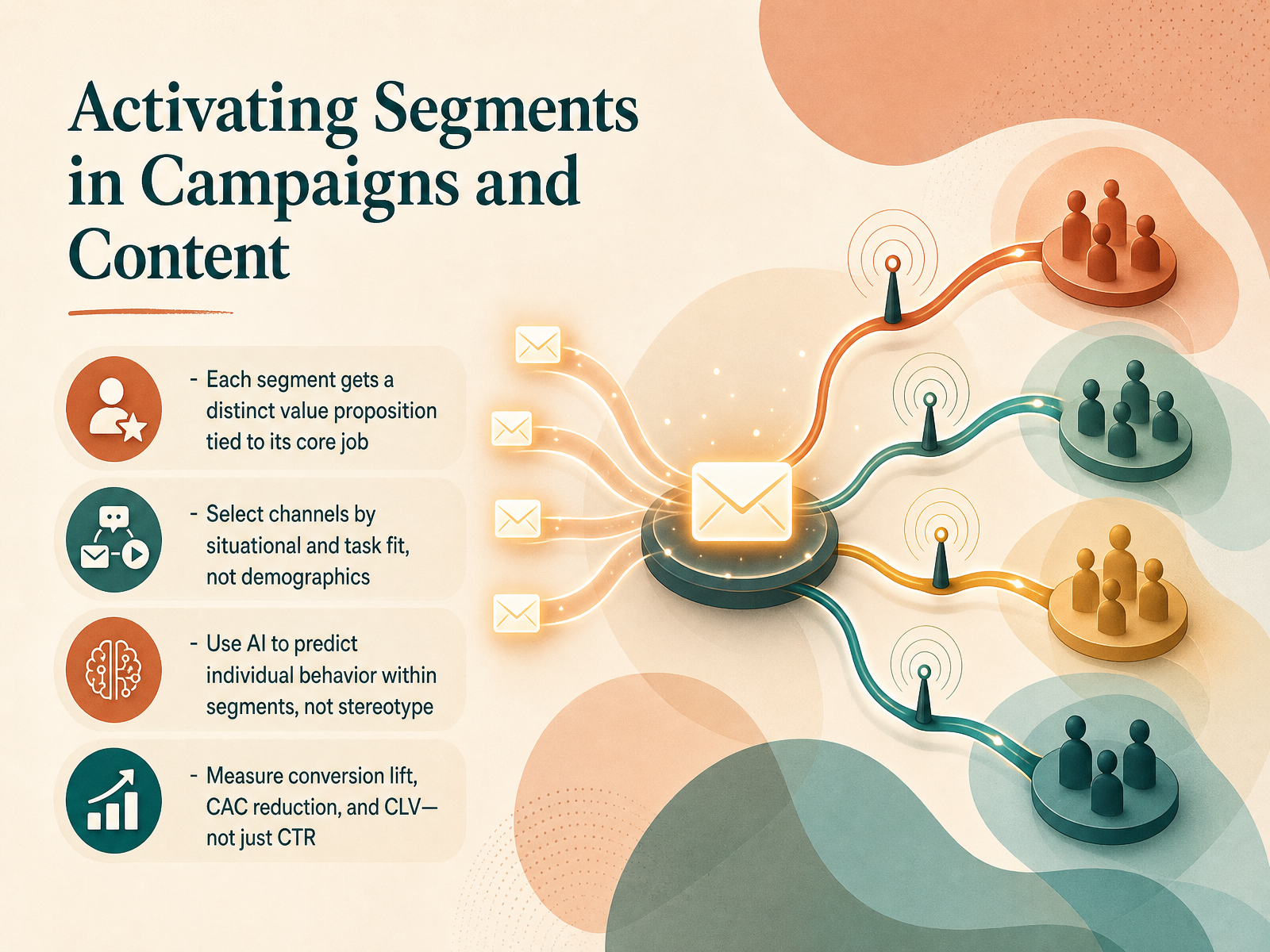
 - 12Activating Segments in Campaigns and ContentNow let's talk about how to bring these segments to life in your campaigns and content. First, give each segment a distinct value proposition that's tied to its core job to be done. Don't just describe who they are; articulate the progress they're trying to make and how you help. For channel selection, think about situational and task fit rather than demographics. Ask when and where someone needs your solution, and what device or environment they're in at that moment. Next, leverage AI to predict individual behavior within a segment, not to reinforce stereotypes. The goal is to see the person's likely next step based on real signals, not to assume everyone with the same job title acts identically. Finally, measure what matters. Track conversion lift, customer acquisition cost reduction, and customer lifetime value. Don't optimize solely for click-through rate, because a click isn't a relationship. These four practices help you activate segments as real, dynamic audiences. Up next, we'll look at common pitfalls and how to avoid them.
 micebook.comintenthq.comsendxmail.com+22 min
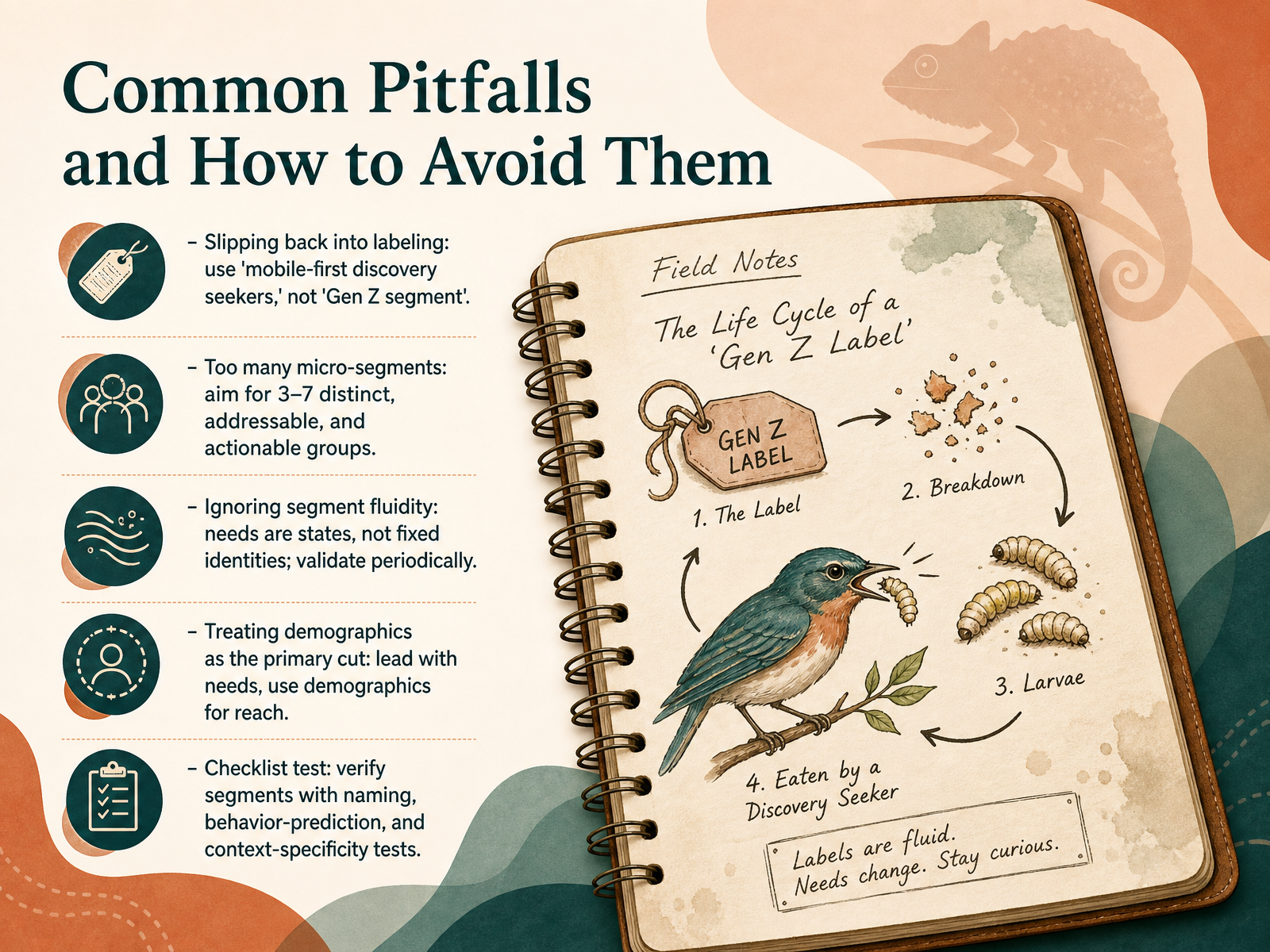
 - 13Common Pitfalls and How to Avoid ThemThat leads us to a few pitfalls worth watching for, and some simple ways to keep your segmentation work sharp. The biggest trap is slipping back into labels. For example, instead of saying 'Gen Z segment,' frame it as 'mobile-first discovery seekers.' The name should describe the need, not the demographic box. Another common mistake is creating too many micro-segments. Aim for three to seven distinct, addressable, and actionable groups. If you have fifteen, you probably can't resource any of them effectively. We also have to respect segment fluidity. Needs are states, not fixed identities. The same person can move between segments depending on the situation, so validate your segments periodically. And remember, demographics are useful for reach and sizing, but they shouldn't be your primary cut. Always lead with the need, then use demographics to find and scale. Finally, use a quick checklist test. Ask yourself: does the name reflect a need? Can it predict behavior? And is it tied to a specific context? Let's move on to our final topic: Practical Application and Next Steps.
 getperspective.aimailchimp.comumbrex.com+22 min
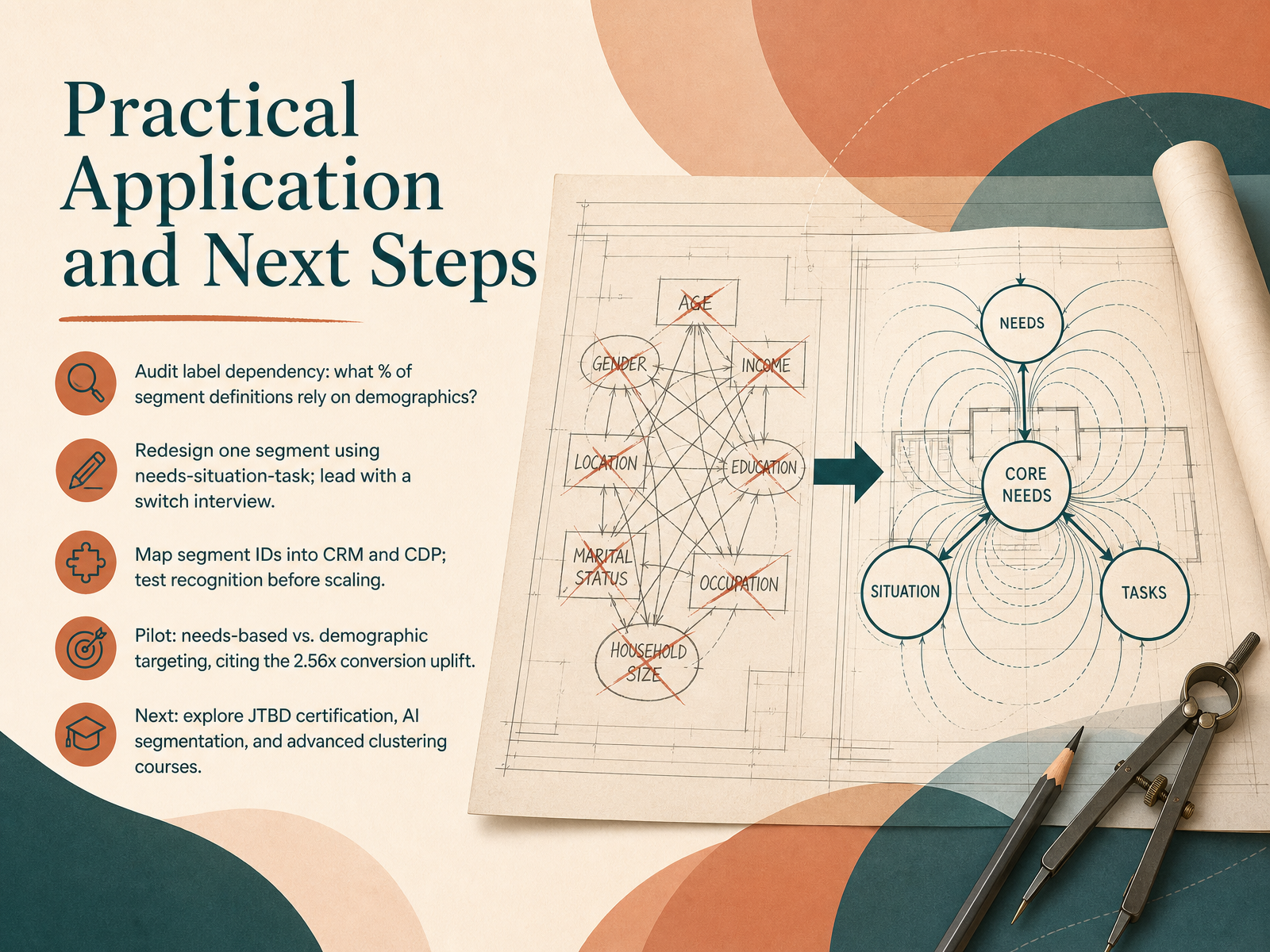
 - 14Practical Application and Next StepsLet's turn all of this into action. Your first step is a label audit. Look honestly at your current segments and ask: what percentage relies on demographics alone? Just knowing that number is a powerful starting point. Next, pick one segment and redesign it using needs, situations, and tasks. The best way to begin is with a switch interview, talking to customers about the moment they chose you over something else. Then, make it operational. Map your new segment IDs into your CRM and CDP, but test your recognition logic before you scale anything live. When you're ready to pilot, run a side-by-side test: needs-based targeting versus your old demographic approach. One beauty retailer saw a two point five six times conversion uplift when they made that shift, so the impact is real. And from here, the path is yours to choose. You might explore Jobs-to-be-Done certification, look into AI-assisted segmentation, or dive into advanced clustering courses. Thank you for being fully present and thinking like a partner in this work. The goal isn't more labels. It's sharper thinking and genuine understanding. Now go build segments that feel human.
 micebook.comintenthq.comsendxmail.com+22 min
Take the deck with you
Download this course as a file — free, no sign-up needed.
- PDF handoutEvery slide page, ready to print or share.15 pages · 4.6 MBDownload
- Narrated PowerPointThe deck that presents itself — every slide carries the digital human's narration video.15 pages · 18.6 MBDownload
- PowerPoint slidesThe full deck as a .pptx — open it in PowerPoint, Keynote, or Google Slides.15 pages · 4.5 MBDownload
Free to use in your own training — please keep the PersonWise credit page at the end.
Have your own deck? Turn it into a course
Sources consulted
Web sources consulted while building this course.
- Insights: Popping the Bubble of Audience Demographics - micebook. — micebook.com
- 1.6x CTR and 2.56x Conversion in Beauty Retail — Intent — intenthq.com
- The Psychology of AI Personalisation: Why Individual Prediction Beats Demographic Targeting | sendXmail — sendxmail.com
- How U.S. Cotton Moved to Behavior-Based Personas | Attest — askattest.com
- Beyond Demographics: Synthesizing Gen Z Audiences — darkmath.ai
- How to Run a JTBD Switch Interview (Step by Step) | JTBD — jobstobedone.org
- Customer Needs Through a Jobs-to-be-Done Lens | by Tony Ulwick | JTBD + Outcome-Driven Innovation — jobs-to-be-done.com
- How To Get Results From Jobs-to-be-Done Interviews | by Mike Boysen | JTBD + Outcome-Driven Innovation — jobs-to-be-done.com
- How to Conduct a Jobs-to-be-Done Interview That Uncovers Unspoken Customer Desires — jtbd.one
- How to run jobs to be done interviews · Talkful — talkful.io
- Unlocking customer insights: How situational segmentation enhances persona development — the-future-of-commerce.com
- Align Solutions with JTBD-Based Segmentation Framework — umbrex.com
- Mapping out demand spaces by context | Ipsos — ipsos.com
- UNDERSTANDING THE CONTEXT OF CONSUMPTION MOMENTS — ipsos.com
- Leveraging Situational Influences in Your Marketing Strategy • Journalism University — journalism.university
- How to Do Customer Segmentation Research in 2026: Beyond Demographics | Blog | Perspective AI — getperspective.ai
- What Is Needs-Based Segmentation in Marketing? — mailchimp.com
- Identify Key Segments: Needs-Based Segmentation — umbrex.com
- How to Discover Hidden Market Segments | Strategyn — strategyn.com
- Customer Segmentation: Definition, Examples + How to Do It — coursera.org