User Research Strategy Essentials
Begin
14 pages · ~28 min
User Research Strategy Essentials
This training helps researchers and product teams define clear user research goals and make informed method choices by weighing key tradeoffs.
What you’ll learn
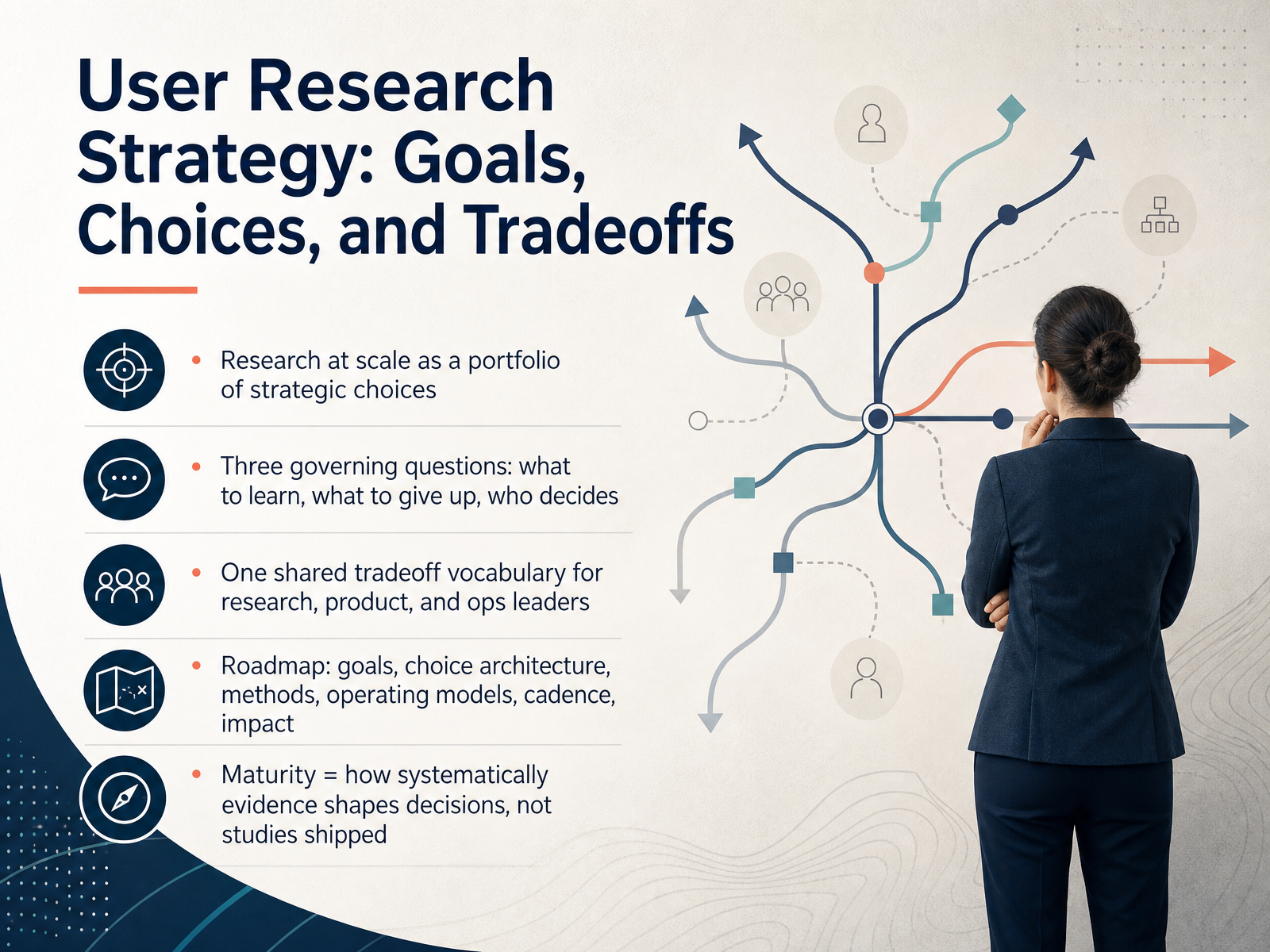
- 01User Research Strategy: Goals, Choices, and TradeoffsWelcome. This course is for research and product leaders who have to make research strategy real inside an organization, not just describe it. Over the next several lessons, we will treat research at scale as a portfolio of strategic choices. Every choice answers three governing questions: what do we need to learn, what are we willing to give up, and who gets to decide. Our goal is one shared tradeoff vocabulary across research, product, and operations leaders, so that resourcing, risk, and alignment are debated openly instead of assumed. We will move through goals, choice architecture, methods, operating models, cadence, and impact. And we will hold to one definition of maturity: it is not how many studies you ship, it is how systematically evidence shapes decisions. That distinction matters, because it changes what leaders fund, what they measure, and how they defend research when budgets tighten. Keep your own organization in mind as we go. Now let us look at why research strategies fail without explicit choices.rallyuxr.commaze.coqualitati.com+22 min
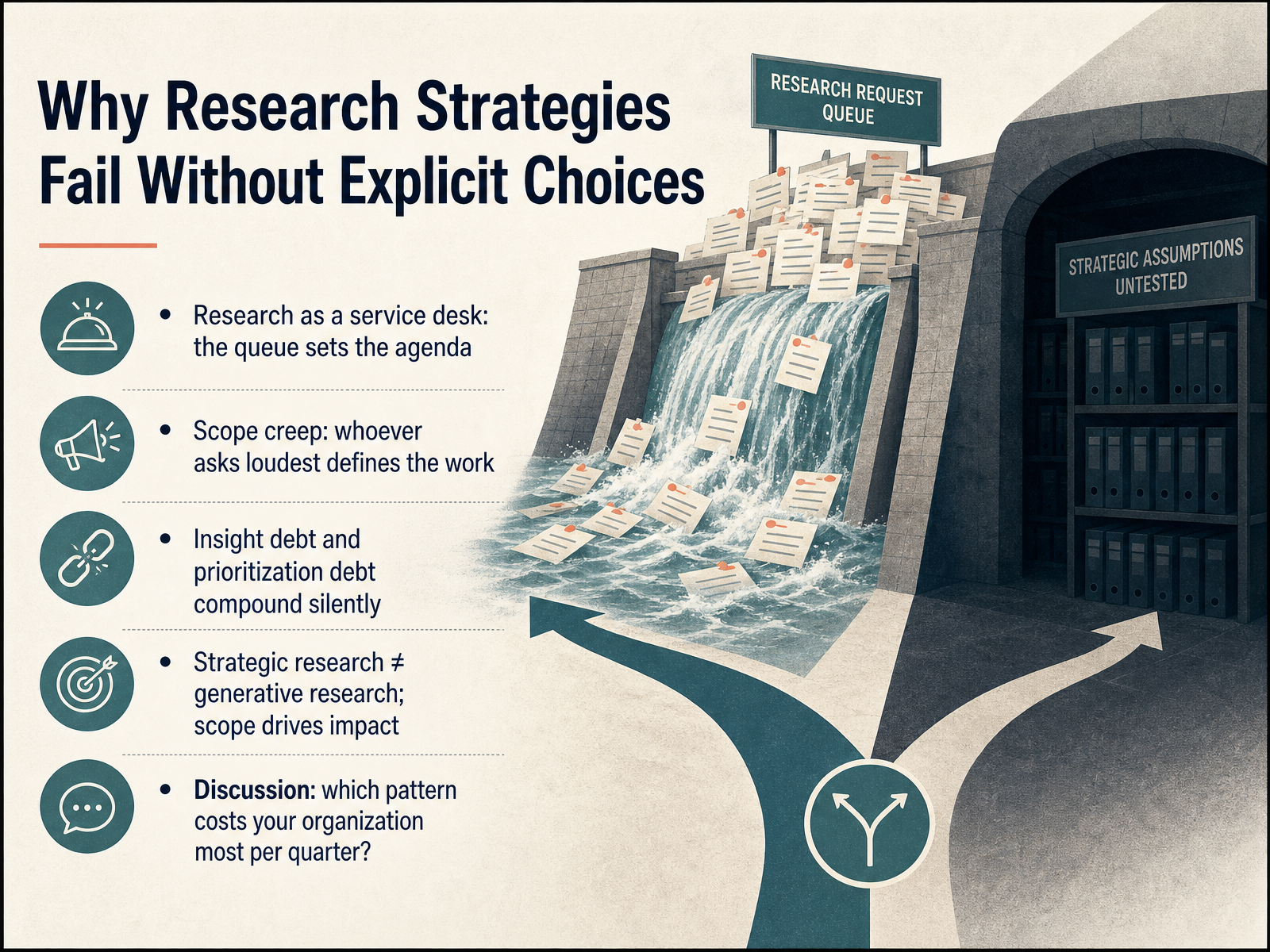
- 02Why Research Strategies Fail Without Explicit ChoicesLet's look at why research strategies fail when nobody makes explicit choices. Four patterns cause most of the damage. First, research as a service desk: the queue sets the agenda, so whoever files first wins. Second, scope creep: the loudest voice defines the work, regardless of strategic fit. Third, insight and prioritization debt: skipped synthesis and deferred decisions compound silently, and you only feel it a year later. Fourth, strategic research is not the same as generative research. Scope drives impact. A large scope evaluative study, like public sector usability benchmarking, can shift strategy. A small scope generative study often just improves an existing feature. Most mature teams keep roughly twenty percent of capacity for unplanned work and a portion for proactive investigation, then force a real cut line. When a higher priority request arrives, something lower gets stopped, and that decision is communicated openly. So here is the discussion question: which of these patterns costs your organization the most per quarter? Name it with a number, not a feeling. From Business Objectives to Researchable Learning Goals.
 handbook.gitlab.comuserintuition.aiportfoliohub.io+22 min
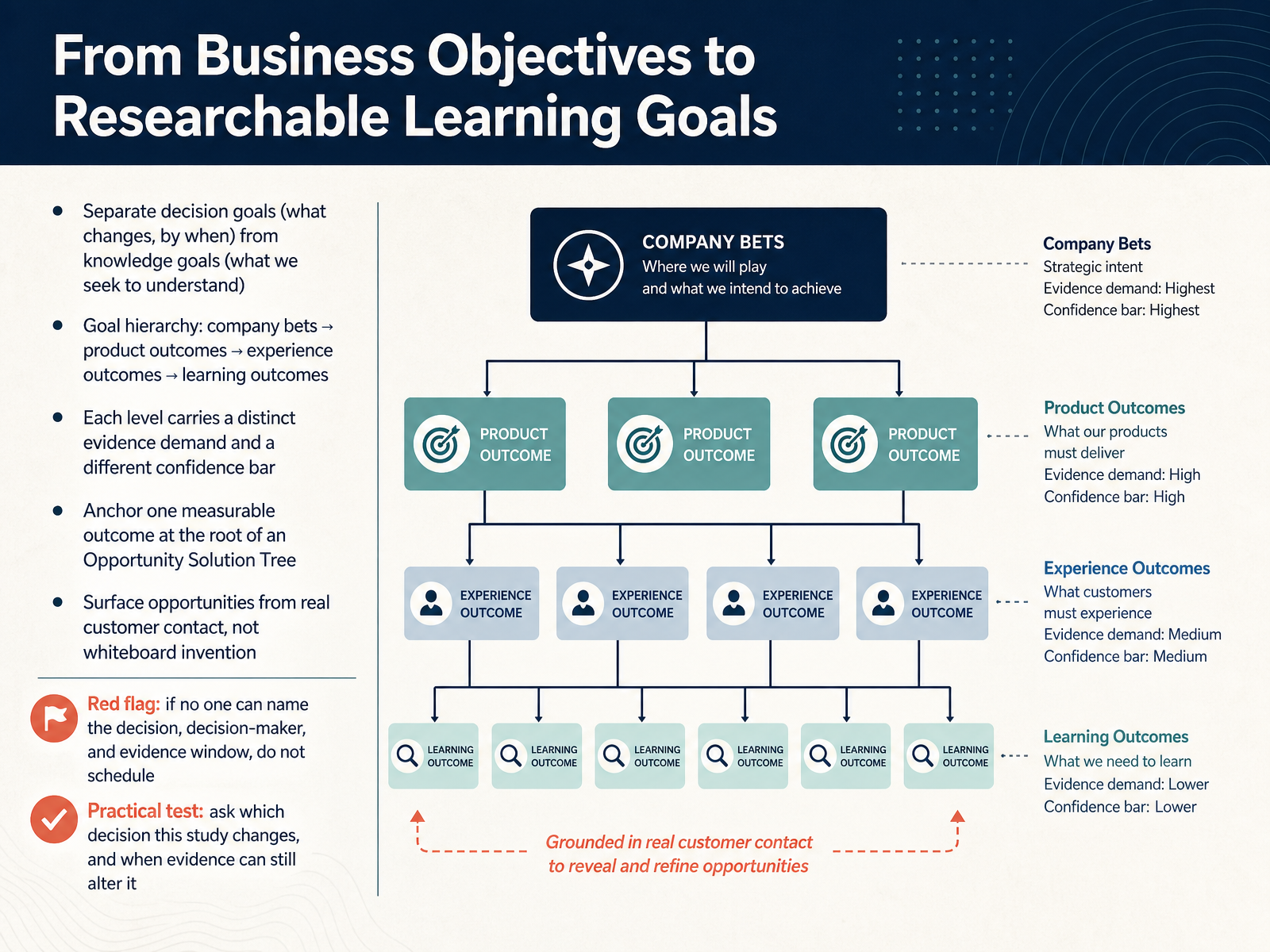
 - 03From Business Objectives to Researchable Learning GoalsLet's move from business objectives to researchable learning goals. Start by separating two things leaders often blur: decision goals, meaning what changes and by when, and knowledge goals, meaning what we seek to understand. Then place both on a hierarchy. Company bets define product outcomes, product outcomes define experience outcomes, and those define learning outcomes. Each level carries a different confidence bar. Your red flag is simple. If no one can name the decision, the decision-maker, and the window when evidence can still change the choice, do not schedule the study. So when discovery work begins, anchor one measurable outcome at the root of an Opportunity Solution Tree, and surface opportunities from real customer contact, not whiteboard invention. The practical test is this: ask which decision this study changes, and when evidence can still alter it. Use that test to protect your team from research that informs no one. Next, we turn to the choice architecture of a research portfolio.
 myles-innovation.comunifiedproductgraph.orgkoji.so+22 min
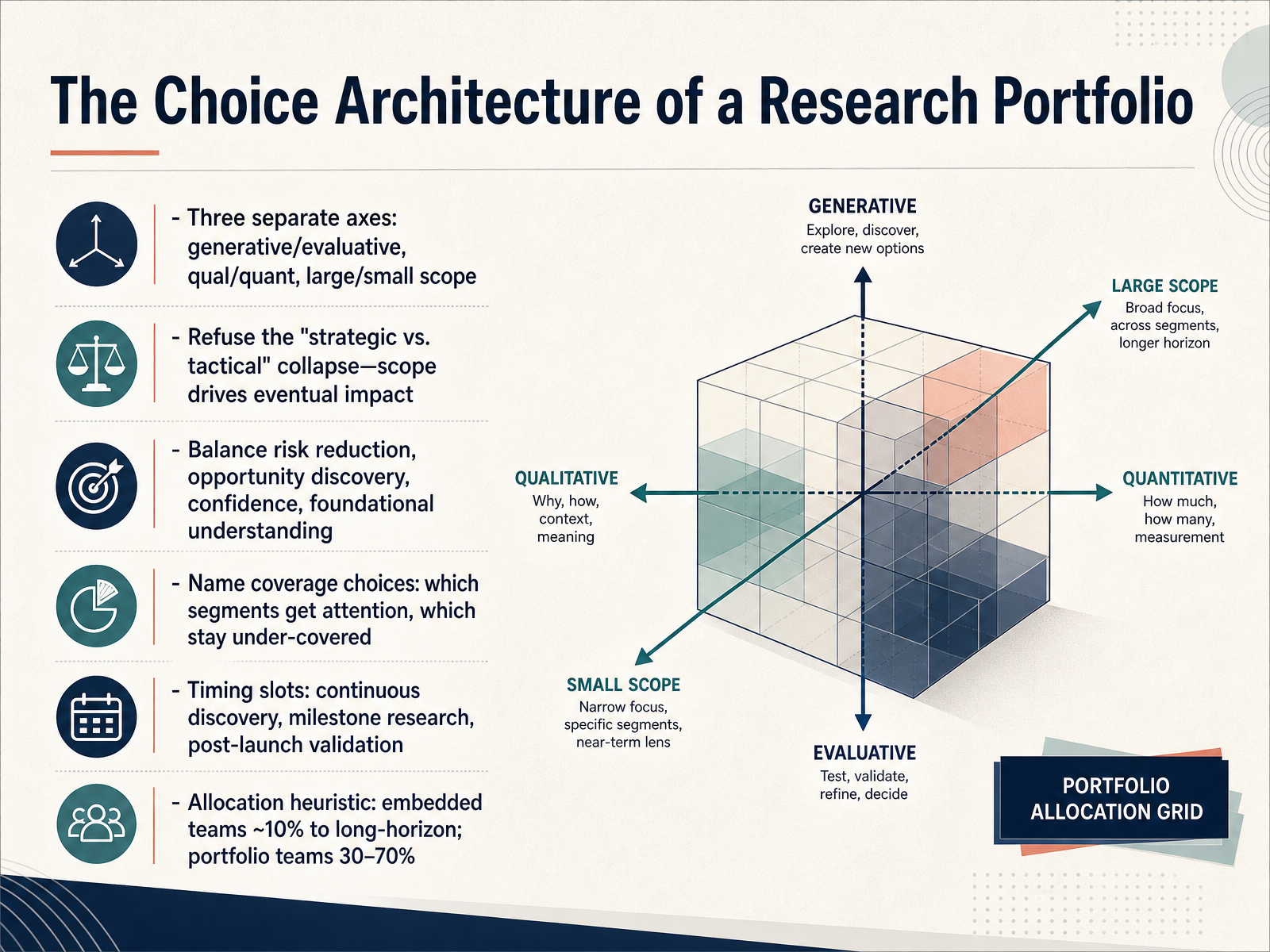
 - 04The Choice Architecture of a Research PortfolioLet's talk about the choice architecture of a research portfolio. Stop collapsing research into strategic versus tactical. That framing hides the dimensions you can actually plan. Separate three axes: generative or evaluative, qualitative or quantitative, and large or small scope. Scope is the one that drives eventual impact, because a ten out of ten outcome is planned, not promised. Balance four functions: risk reduction, opportunity discovery, confidence building, and foundational understanding. Then name your coverage choices out loud. Which segments get attention, and which stay under-covered. That is a resource decision, and it belongs on the readout cover. Timing matters too. Continuous discovery, milestone research, and post-launch validation are three different slots. For allocation, a useful heuristic: embedded teams reserve roughly ten percent for long-horizon work. Portfolio teams can run thirty to seventy percent. Calibrate to your risk tolerance and your maturity. Next, deciding what each study must buy: methods as tradeoffs.
 carljpearson.comdscout.comresources.rework.com+22 min
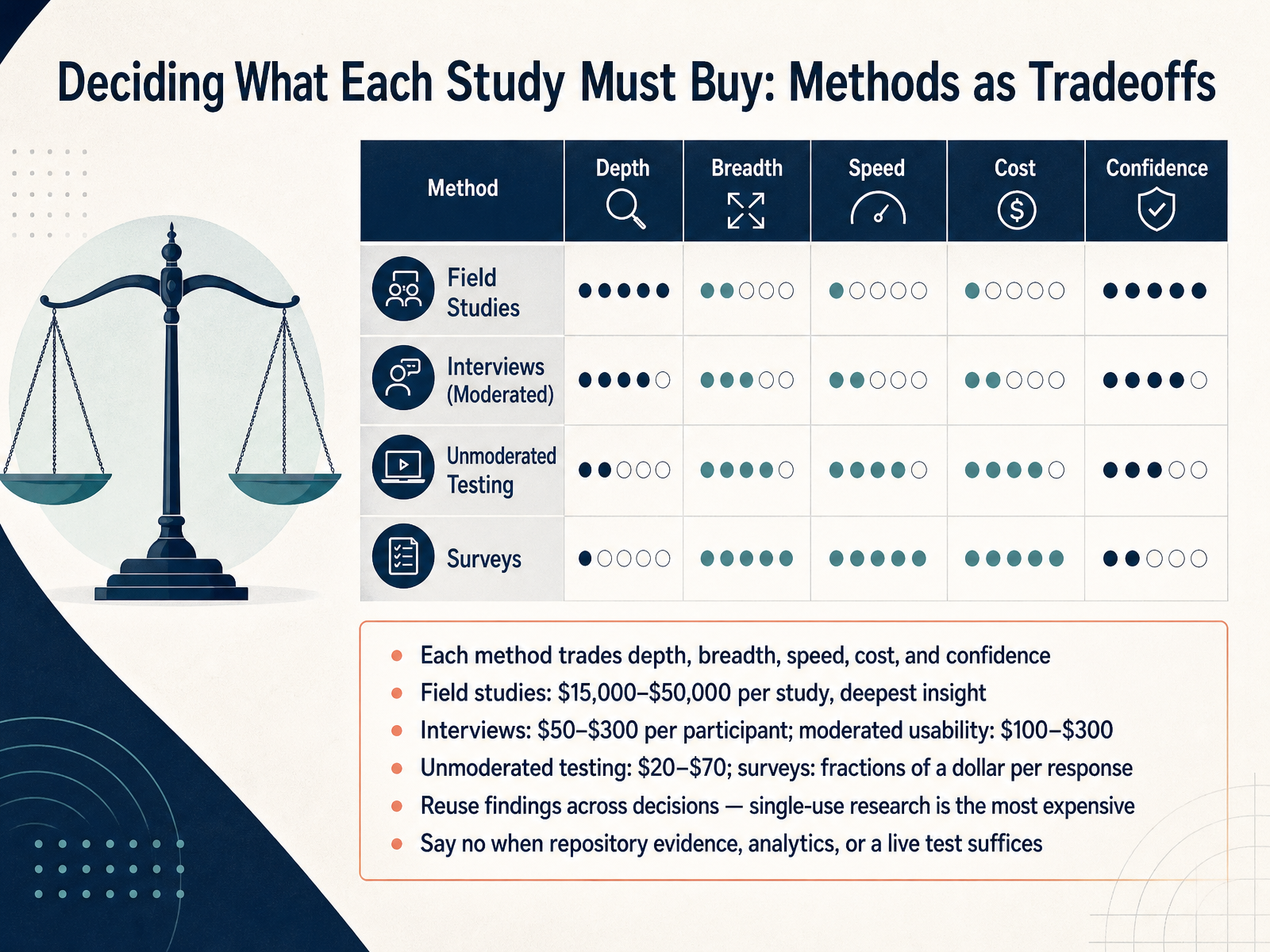
 - 05Deciding What Each Study Must Buy: Methods as TradeoffsLet's talk about what each study must buy. Every method trades depth, breadth, speed, cost, and confidence. None of them gives you all five.
Field studies run fifteen thousand to fifty thousand dollars and buy the deepest insight you can get. Interviews cost fifty to three hundred dollars per participant. Moderated usability sits at one hundred to three hundred. Unmoderated testing drops to twenty to seventy, and surveys cost fractions of a dollar per response.
So the real question isn't which method is best. It's what decision does this study need to support, and what's the cost of getting it wrong? Match the spend to the stakes.
One more thing. Reuse your findings across decisions. Single-use research is the most expensive research you can run. And say no when repository evidence, analytics, or a live test already answers the question.
Next, we'll look at Minimum Viable Rigor, and how to calibrate effort to decision risk.
 2 min
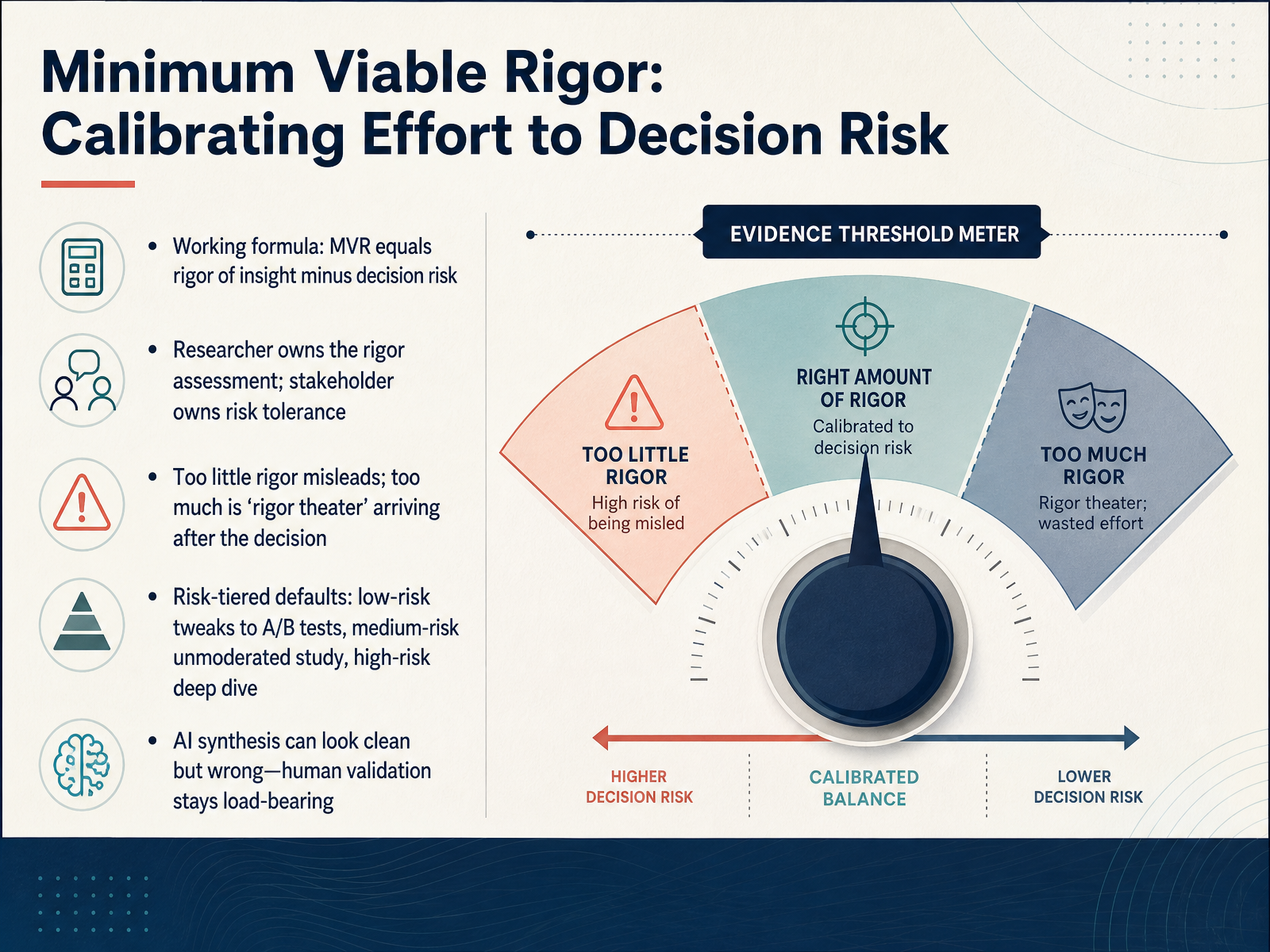
2 min - 06Minimum Viable Rigor: Calibrating Effort to Decision RiskNow let's talk about calibrating effort to decision risk, what some teams call minimum viable rigor. The working formula is simple: minimum viable rigor equals the rigor of your insight minus the decision risk. Two roles, two jobs. The researcher owns the rigor assessment: how clean is the methodology, how valid are the findings, which corners were cut and why. The stakeholder owns risk tolerance: if this decision goes wrong, what is the blast radius? Keep those separate and you keep credibility while moving fast. Get the calibration wrong in either direction and it costs you. Too little rigor misleads the business. Too much is rigor theater, pristine methodology arriving after the decision was already made. So use risk-tiered defaults. Low-risk tweaks go straight to A/B testing. Medium-risk decisions, like feature architecture, fit a quick unmoderated study. High-risk calls, such as strategic direction, warrant a full deep dive. One more thing: AI synthesis can look clean and still be wrong. Human validation stays load-bearing. Next, we look at speed traps: when faster research degrades decisions.
 rallyuxr.commaze.coqualitati.com+22 min
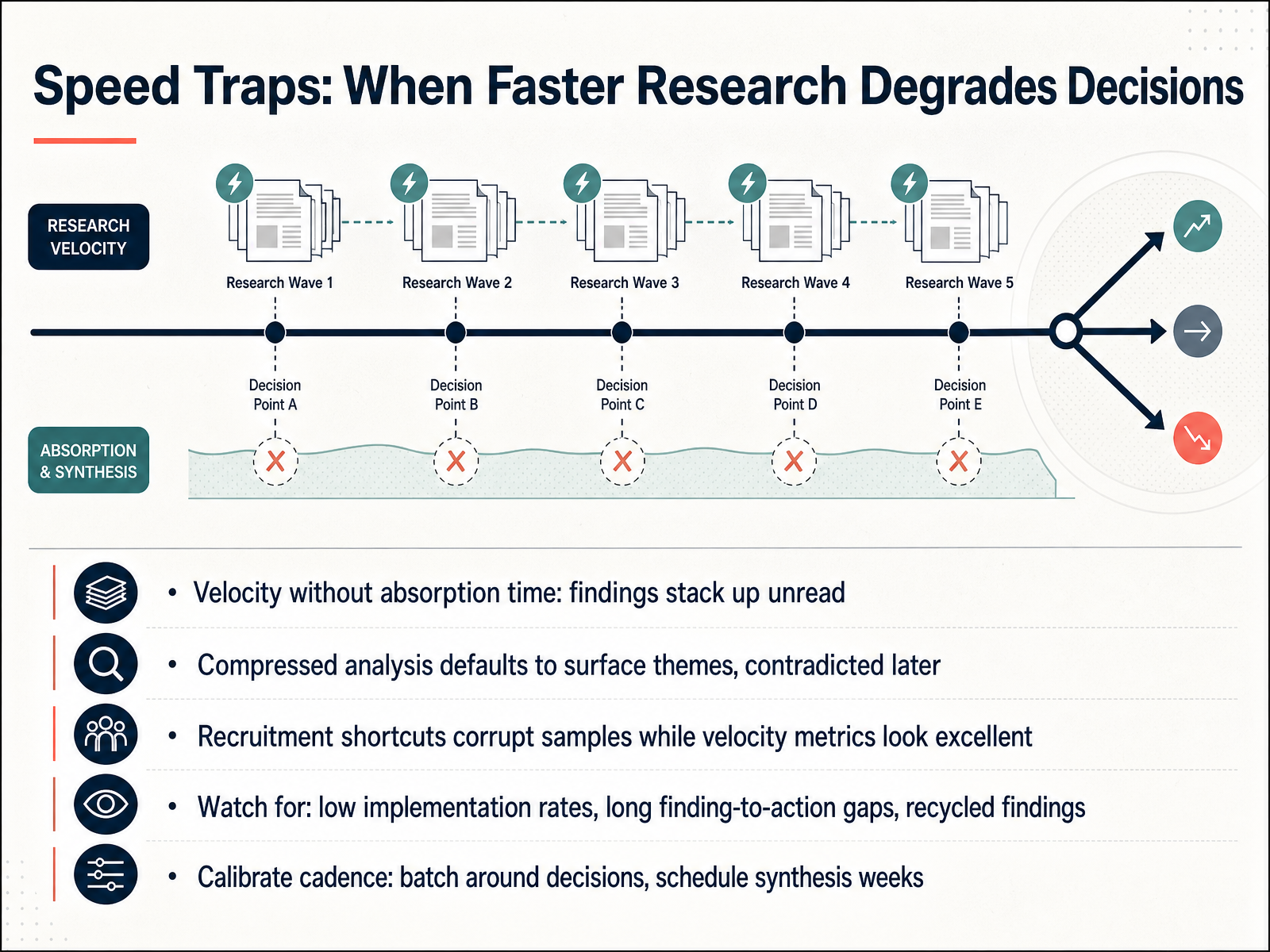
 - 07Speed Traps: When Faster Research Degrades DecisionsLet's talk about speed traps, because velocity is where good research programs quietly go wrong. Faster discovery cycles don't automatically produce better decisions. Often they produce the opposite.
The first trap is velocity without absorption time. You can ship findings weekly, but stakeholders cannot meaningfully process them at that rate. Findings stack up unread. Recommendations get acknowledged, not internalized. You are generating output without generating understanding.
The second trap is compressed analysis. Pattern recognition in qualitative data takes incubation time. Compress it into hours and researchers default to surface themes, the obvious patterns that require no reflection. Those findings tend to get contradicted by the next study, which erodes trust in the whole function.
The third trap is recruitment shortcuts. Speed pushes teams toward existing panels and convenience samples. Data quality degrades silently while your velocity metrics look excellent. That is the most dangerous combination, because nothing looks wrong.
So what should you watch? Low implementation rates. Long gaps between a finding and any action. And recycled findings, where the last three studies all rediscovered the same insight because nobody had time to build on prior work.
The fix is cadence, not less research. Batch discovery around actual decision points. Schedule synthesis weeks explicitly, so cross-study analysis has a home. And match depth to stakes, the same logic as minimum viable rigor. Keep the line: are you improving decision quality, or just producing faster? Next, we look at Choosing an Operating Model for Research and Research Ops.
 2 min
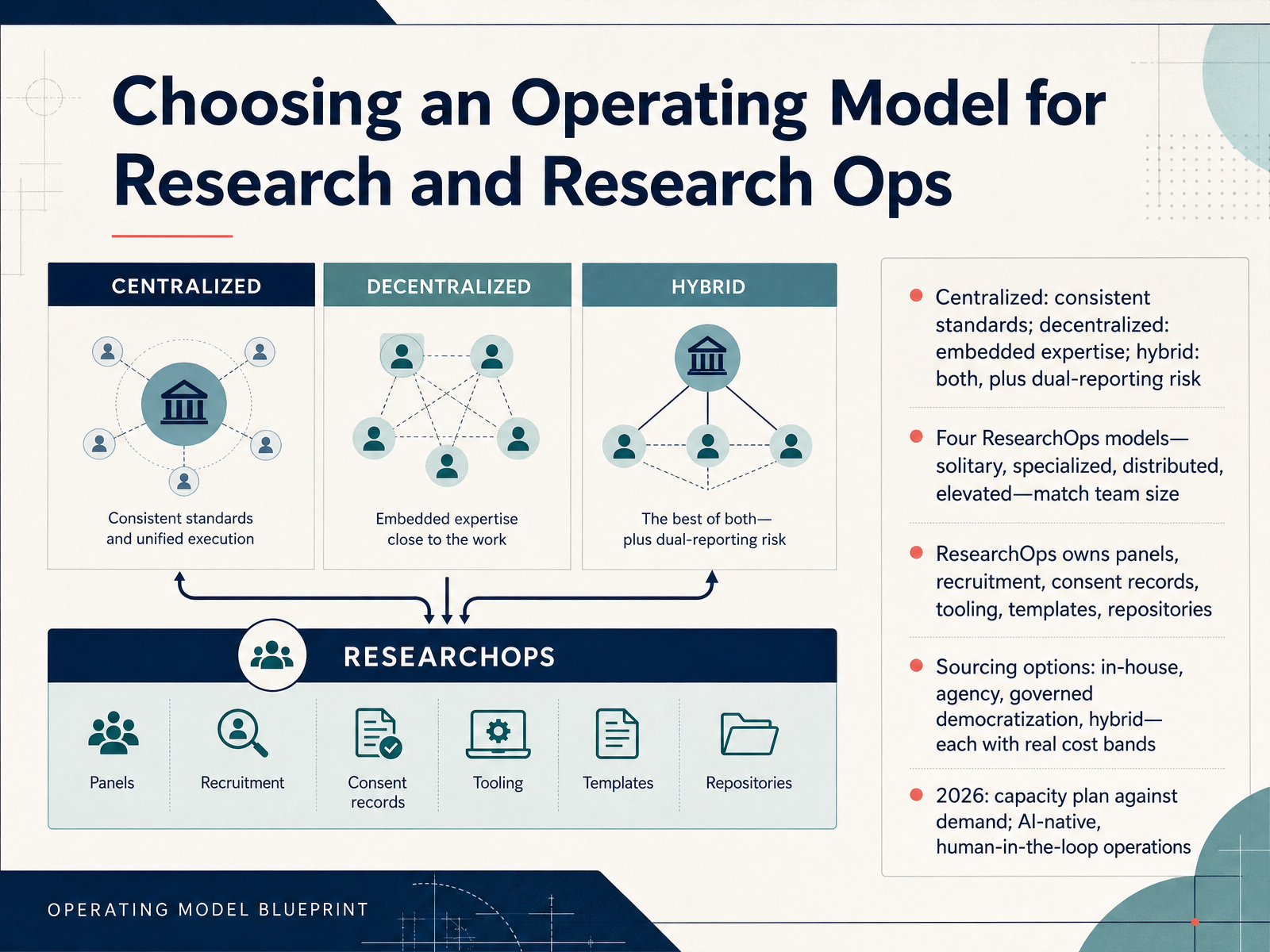
2 min - 08Choosing an Operating Model for Research and Research OpsNow let's talk about operating models for research and Research Ops. Three structural options dominate: centralized, decentralized, and hybrid. Centralized buys you consistent standards and an internal agency you can deploy fast, but it distances researchers from daily product work. Decentralized embeds expertise where decisions happen, at the cost of fragmentation. Hybrid aims for both, and its known complication is dual reporting, two managers with two sets of priorities. Layer on four Research Ops models, solitary, specialized, distributed, and elevated, and match them to team size. A ResearchOps team of one is a generalist; scale past ten researchers and you need a specialized or elevated layer. Whoever owns operations owns panels, recruitment, consent records, tooling, templates, and the repository. Sourcing is your next lever: in-house, agency, governed democratization, or a hybrid, each with a real cost band. So the choice is not philosophy, it is resourcing and risk. For twenty twenty-six, plan capacity against demand, and design AI-native operations with humans in the loop. Next, we look at getting that balance right: Democratization With Guardrails, Not Abdication.
 rallyuxr.commaze.coqualitati.com+22 min
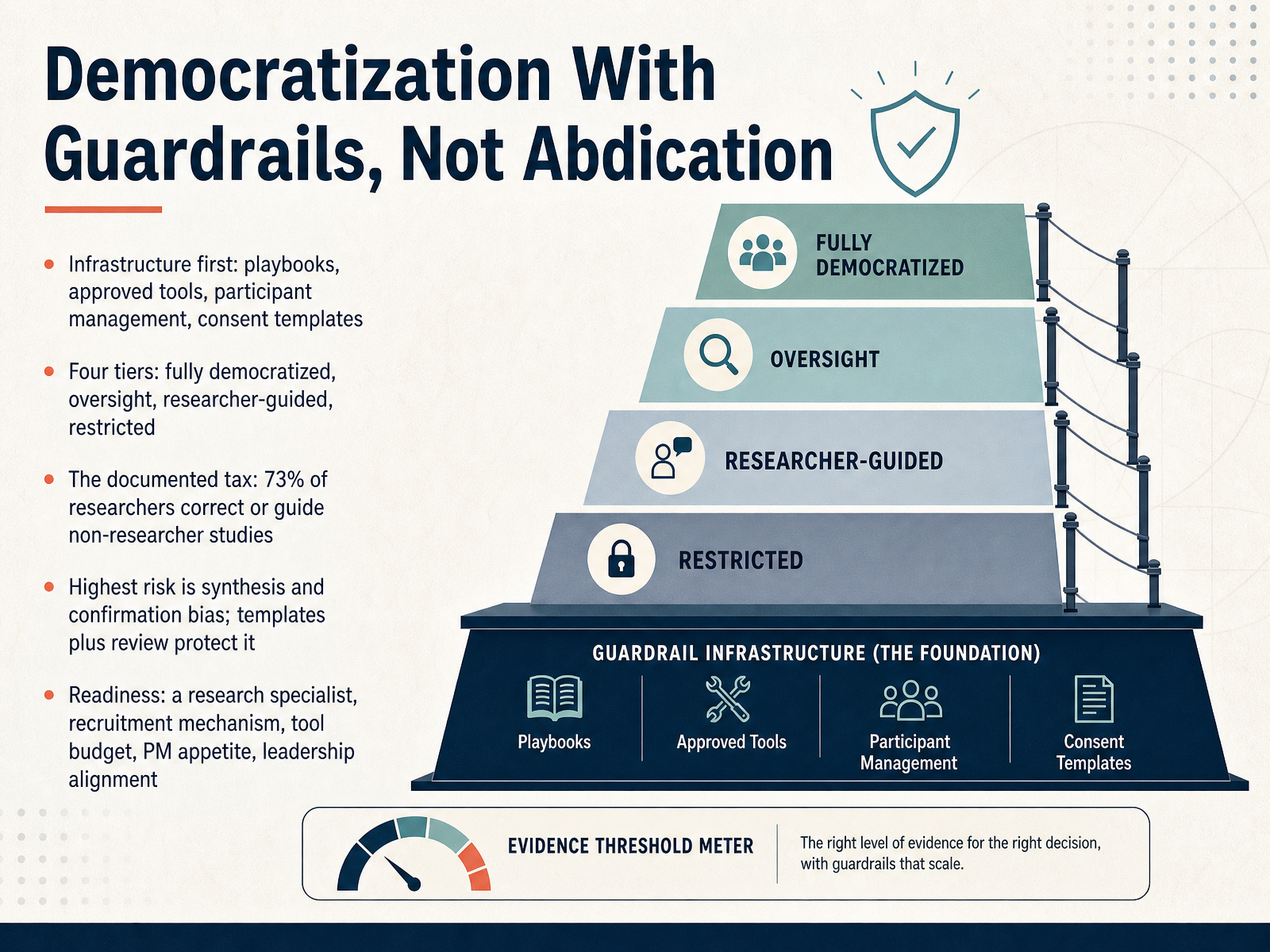
 - 09Democratization With Guardrails, Not AbdicationLet's talk about democratization with guardrails, not abdication. There's an important distinction here. Handing a product manager a Zoom link and wishing them luck isn't democratization. That's abdication. Real democratization starts with infrastructure: playbooks for each research type, an approved tools list, a shared participant management system, and consent templates. Next, define your tiers. Fully democratized studies need minimal oversight. Others require researcher review. Some need a researcher guiding the work. And high-stakes or sensitive research stays restricted to specialists. Be honest about the tax. Seventy-three percent of researchers report spending significant time correcting or guiding non-researcher studies. The highest risk sits in synthesis and confirmation bias. Templates and pre-study review are your best protection there. Before you scale, check readiness. Do you have a research specialist, a recruitment mechanism, tool budget, product manager appetite, and leadership alignment? If any of those five are missing, fix the gap first. Democratization without infrastructure produces worse research, not more of it. Next, we look at stakeholders, decision rights, and who actually decides.
 2 min
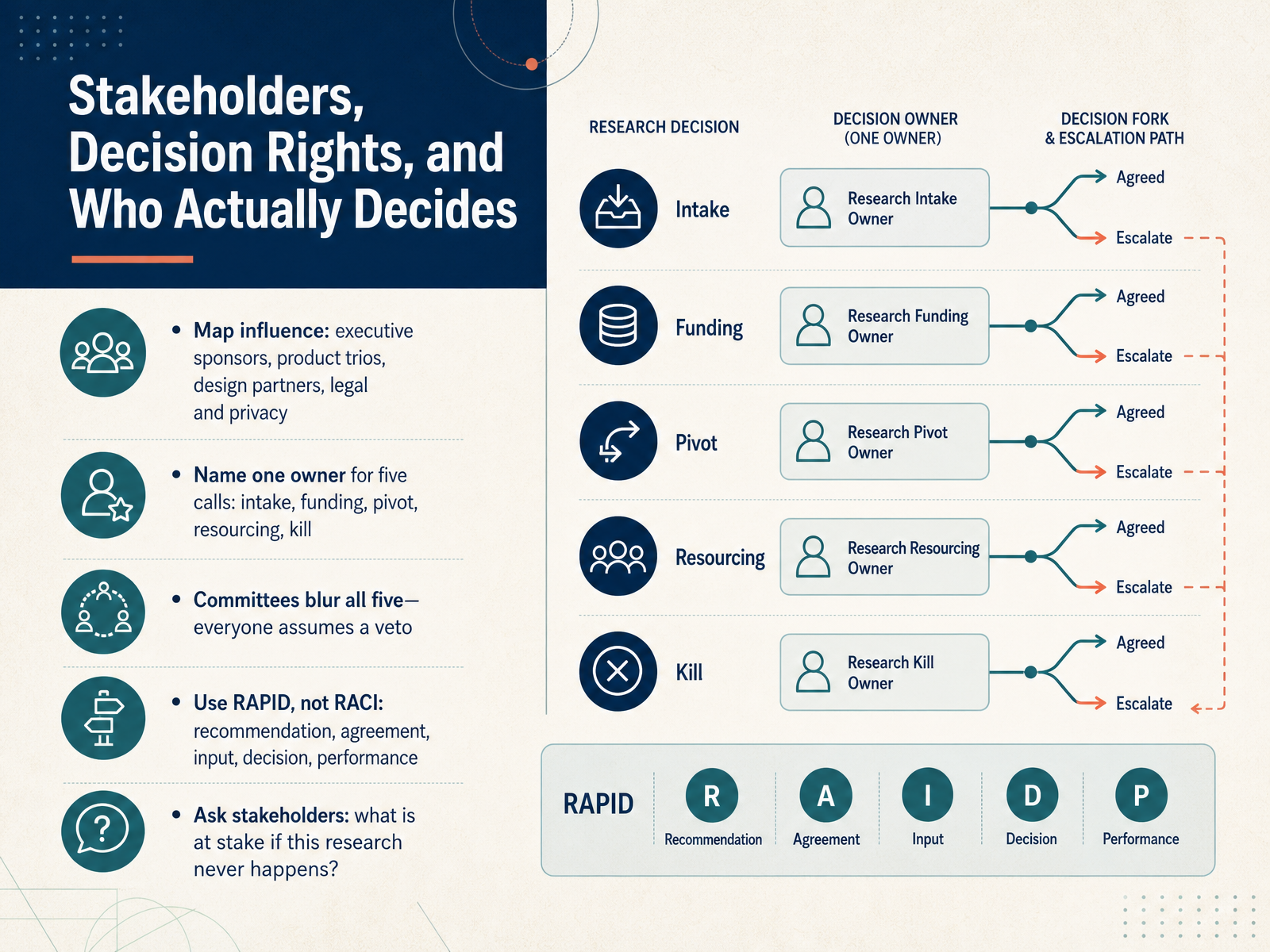
2 min - 10Stakeholders, Decision Rights, and Who Actually DecidesLet's talk about decision rights, because this is where research governance most often quietly fails. Start by mapping influence across four groups: executive sponsors, product trios, design partners, and legal and privacy. Then name one owner for each of five calls: intake, funding, pivot, resourcing, and kill. When you leave those to a committee, everyone assumes they hold a veto, and decisions stall. That is why RAPID beats RACI here. RAPID separates recommendation, agreement, input, decision, and performance. Input is advice, not a veto. Agreement is reserved for legal or regulatory grounds, and you keep that group as small as possible. The decider is one person, not a forum. If your research capacity is scarce, this is resourcing and risk management, not bureaucracy. And ask every stakeholder one question: what is at stake if this research never happens? That answer tells you whether they are a decision-maker or a spectator. Next, we look at the operating cadence that makes these rights real: intake, prioritization, and review.
 myles-innovation.comunifiedproductgraph.orgkoji.so+22 min
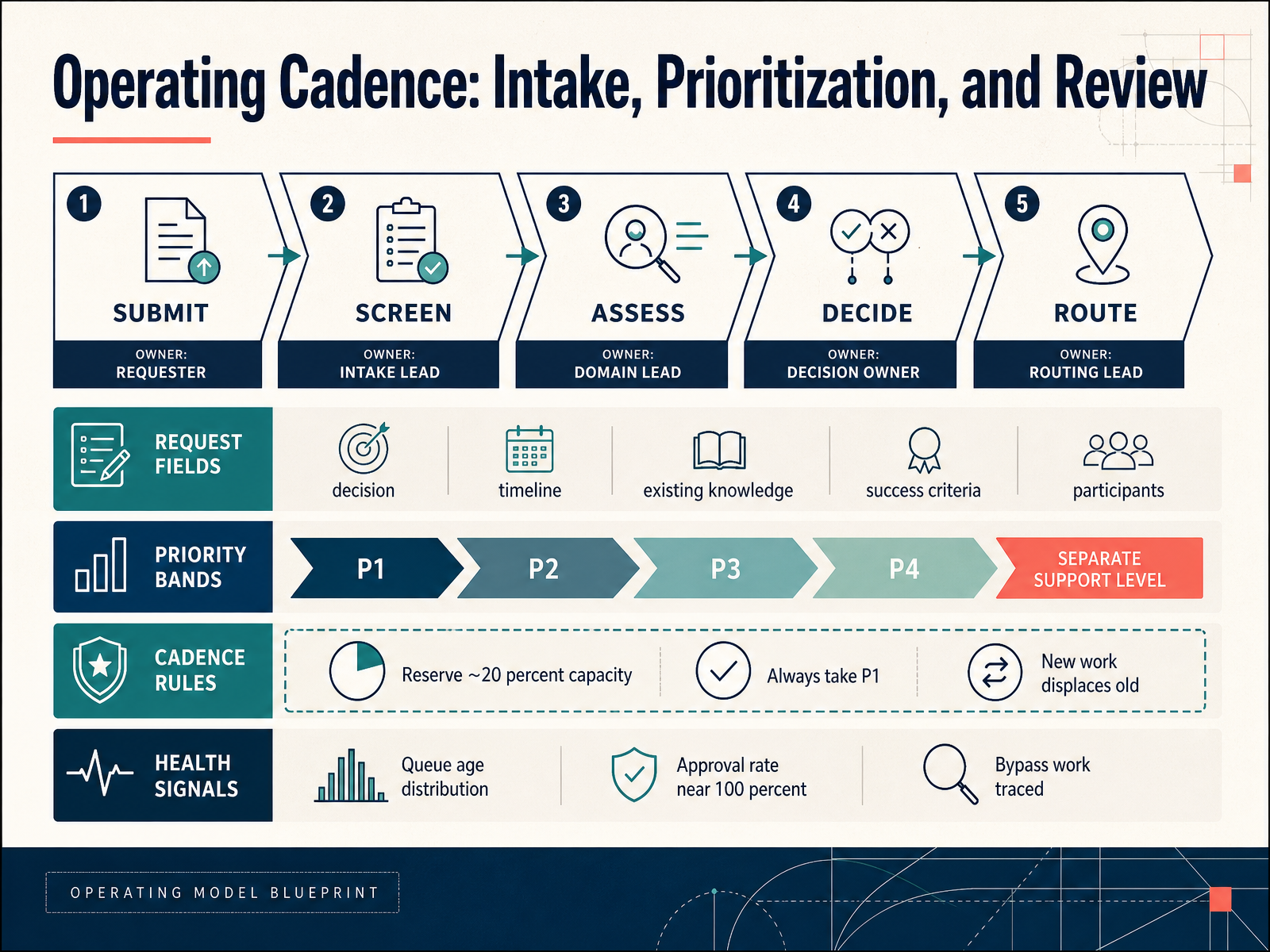
 - 11Operating Cadence: Intake, Prioritization, and ReviewLet's turn to your operating cadence: intake, prioritization, and review. The intake flow has five stages. Submit, screen, assess, decide, and route. Each stage needs a named owner. If nobody owns the screening step, requests sit for weeks. Every request should carry five fields: the decision it informs, the timeline, existing knowledge, success criteria, and required participants. That takes ten to fifteen minutes, and it replaces hours of debate later. Scoring then yields priority bands, from P1 through P4, plus a separate support level, so a P3 study can still get light review support rather than nothing. Then set three cadence rules. Reserve about twenty percent of capacity for ad hoc work and training. Always take P1. And when you're at capacity, new work displaces old work. Watch three health signals: queue age distribution, an approval rate near one hundred percent, which means you're recording decisions rather than making them, and bypass work, traced back to its origin. Next, measuring impact and paying down insight debt.
 handbook.gitlab.comuserintuition.aiportfoliohub.io+22 min
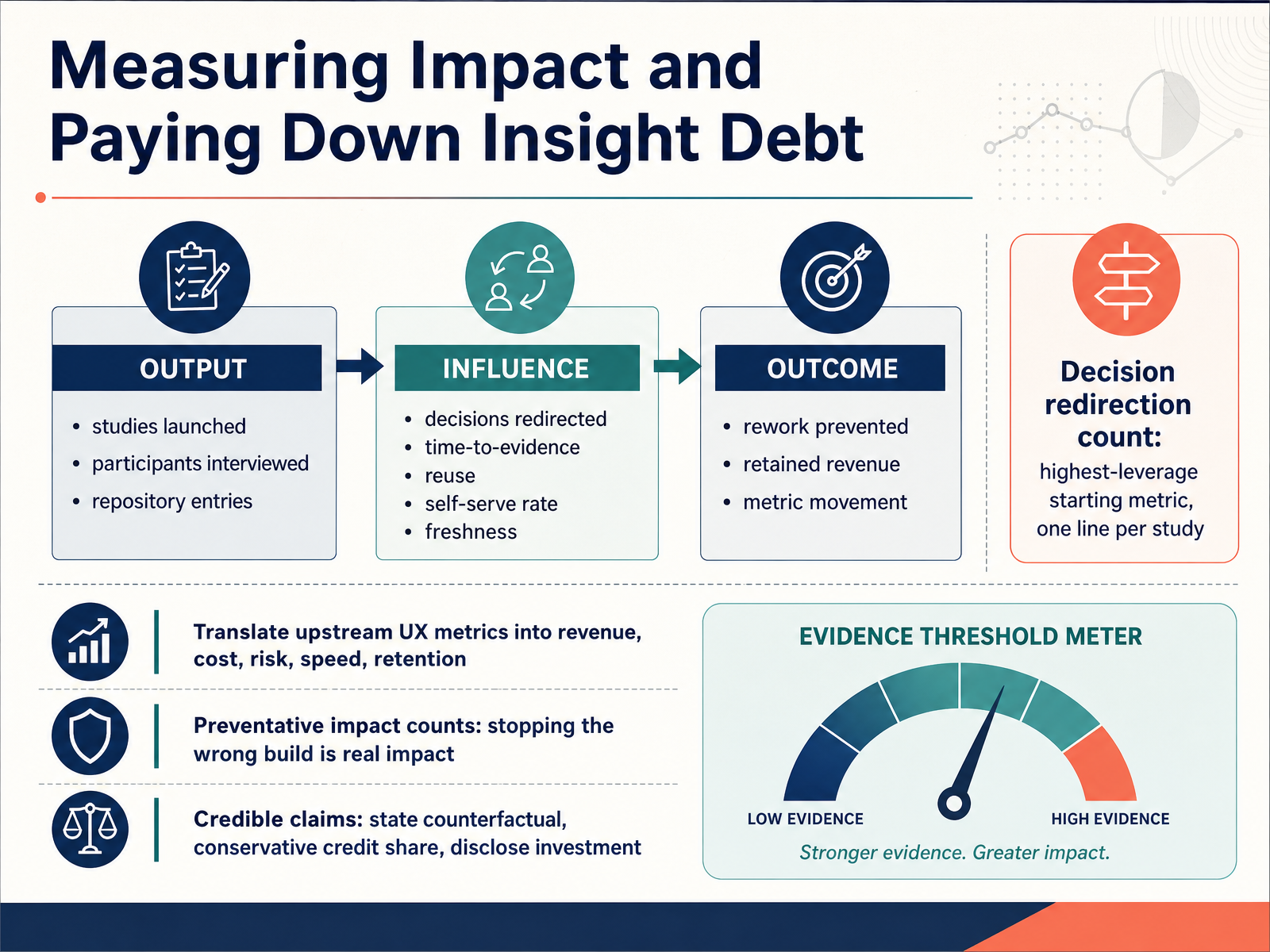
 - 12Measuring Impact and Paying Down Insight DebtNow let's talk about measuring impact and paying down insight debt. When leadership asks what research is worth, most teams answer with output: studies launched, participants interviewed, repository entries. That's activity, not impact. A more useful structure is three tiers. Output tells you whether enough research is happening. Influence tells you whether decisions are changing. Outcome connects those decisions to rework prevented, retained revenue, or metric movement. If you're just starting, the highest-leverage metric is decision redirection count. One line per study: here was our prior assumption, here was the evidence, here is what we chose instead. That log is your most defensible artifact. Then translate. Upstream UX metrics mean little to a CFO. Convert them into revenue, cost, risk, speed, or retention language. And count preventative wins. Stopping the wrong build is real impact, even when nothing ships. Finally, make your claims credible. State the counterfactual, claim a conservative share of credit, and disclose what you invested. Next, we'll work through this in practice with Worked Scenarios: Startup, Scaling Product Organization, Enterprise Portfolio.
 rallyuxr.commaze.coqualitati.com+22 min
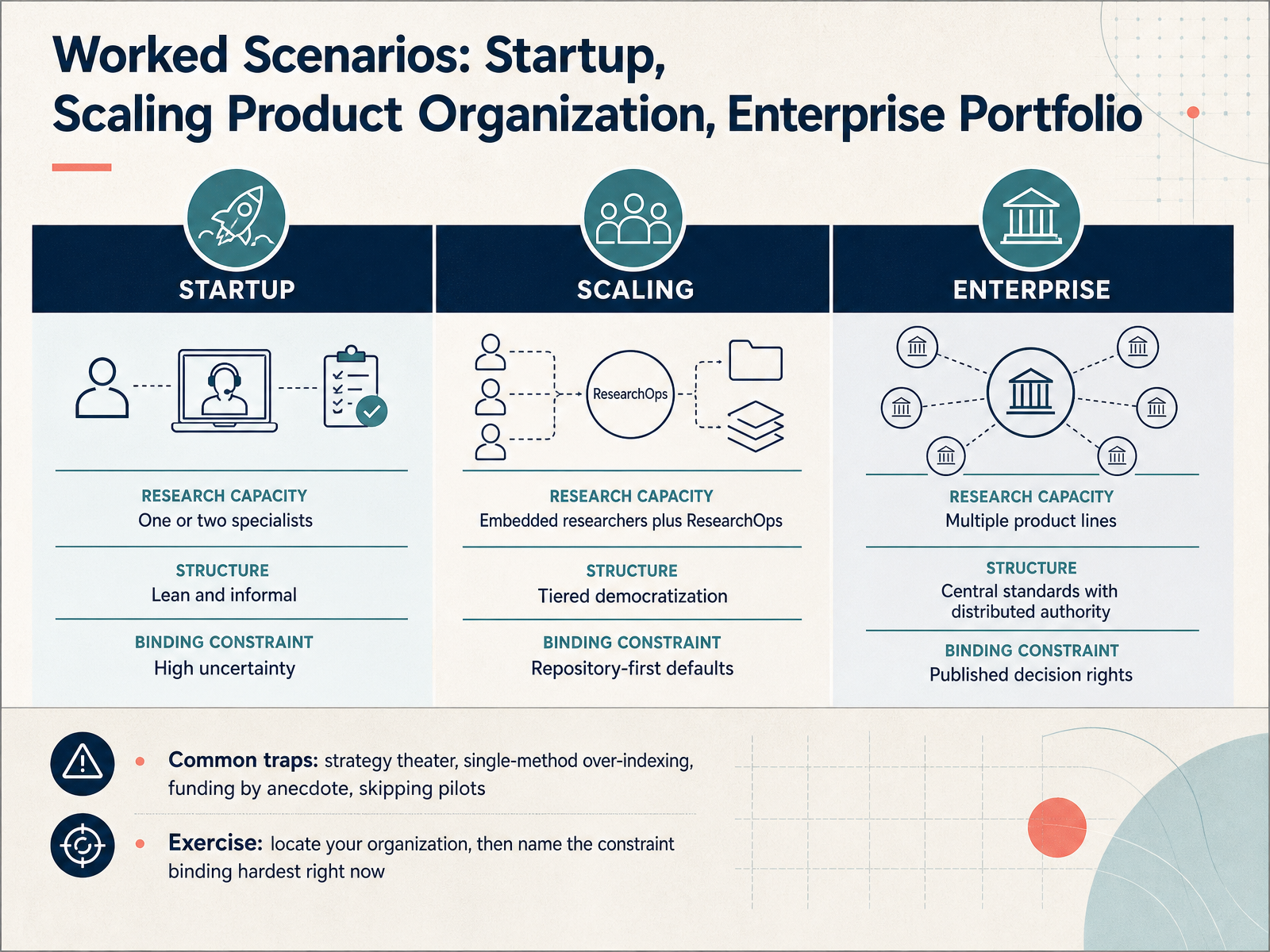
 - 13Worked Scenarios: Startup, Scaling Product Organization, Enterprise PortfolioNow let's ground all of this in three real operating contexts, because the right choices depend entirely on where you sit. A startup typically runs one or two specialists against high uncertainty. The sensible tradeoff is speed over rigor at the margin: AI-moderated interviews, lightweight validation, and a bias toward decisions you can reverse cheaply. A scaling product organization adds embedded researchers plus a ResearchOps function, then tiered democratization with repository-first defaults. Here the constraint inverts: consistent, findable evidence matters more than raw output. An enterprise portfolio runs multiple product lines, so the workable model is central standards with distributed authority and published decision rights. Centralize the standard, not the work. A few traps cut across all three: strategy theater, single-method over-indexing, funding by anecdote, and skipping pilots. So here's your exercise. Locate your organization on that spectrum, then name the one constraint binding hardest right now. That constraint, not a universal best practice, is what should drive your next investment. Next, we'll turn that judgment into action in Making Strategy Choices Stick: One-Page Canvas and a 90-Day Plan.
 rallyuxr.commaze.coqualitati.com+22 min
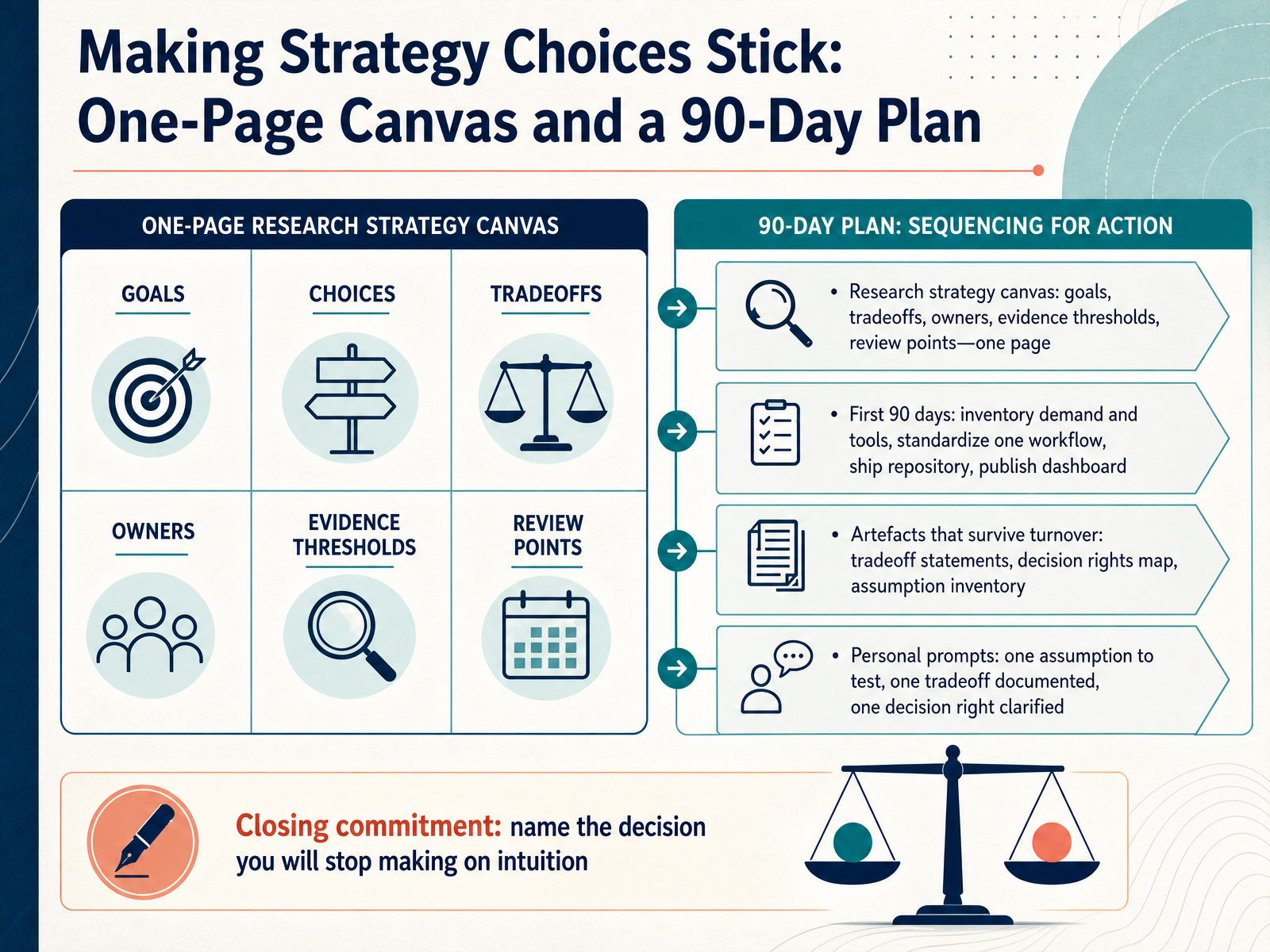
 - 14Making Strategy Choices Stick: One-Page Canvas and a 90-Day PlanLet's close by making your strategy choices stick. The tool is a one-page research strategy canvas, covering goals, tradeoffs, owners, evidence thresholds, and review points. One page forces real choices. Then a first ninety days: inventory demand and tools, standardize one workflow, ship the repository, publish the dashboard. Concrete artifacts outlast turnover: written tradeoff statements, a decision rights map, and an assumption inventory. As a personal prompt, name one assumption to test, one tradeoff to document, and one decision right to clarify this quarter. Your closing commitment: name the decision you will stop making on intuition. Start intake from a single channel. Track your decisions that cite research, and your time to evidence. Thank you for working through this course. You now have a defensible way to set research strategy, and the judgment to adapt it. Go make one choice stick.
 handbook.gitlab.comuserintuition.aiportfoliohub.io+22 min
Take the deck with you
Download this course as a file — free, no sign-up needed.
- PDF handoutEvery slide page, ready to print or share.15 pages · 4.5 MBDownload
- Narrated PowerPointThe deck that presents itself — every slide carries the digital human's narration video.15 pages · 18.3 MBDownload
- PowerPoint slidesThe full deck as a .pptx — open it in PowerPoint, Keynote, or Google Slides.15 pages · 4.4 MBDownload
Free to use in your own training — please keep the PersonWise credit page at the end.
Have your own deck? Turn it into a course
Sources consulted
Web sources consulted while building this course.
- The Research Ops Maturity Matrix | Rally UXR — rallyuxr.com
- Research Maturity Model Report | Maze — maze.co
- AI ResearchOps in 2026: A Maturity Model | Blog | Qualitati — qualitati.com
- The Enterprise UX Research Maturity Model: How Fortune 500 Companies Scale Research — akraya.com
- Leveling Up Your Research and Research Operations: Strategies for Scale — doi.org
- Research prioritization | The GitLab Handbook — handbook.gitlab.com
- Prioritizing Research Requests: A Triage Model That Works — userintuition.ai
- Project Intake Process: Steps, Stages, and Best Practices | Portfolio Hub — portfoliohub.io
- R&D portfolio management: When to fund, stop, and scale projects — itonics-innovation.com
- Tracking Business Goals Through Quarterly Project ... — centricconsulting.com
- Product Discovery: Methods for Finding What to Build Next — myles-innovation.com
- Opportunity Solution Tree | UPG Framework | UPG Reference — unifiedproductgraph.org
- Product Discovery Framework: The 2026 Continuous Discovery Operating System — Koji — koji.so
- Phases, metrics, and techniques of product discovery — doi.org
- Opportunity Solution Tree: A Guide to Smarter Product Discovery | Context Engineering Blog — contextengineering.ai
- Why "strategic" research needs a redefinition - Carl J. Pearson — carljpearson.com
- Approach Research Like a Financial Portfolio and Watch Your Investments Grow - Dscout — dscout.com
- "User Research That Moves the Roadmap, Not Just Confirms Hunches" — resources.rework.com
- Generative vs Evaluative UX Research with AI — userintuition.ai
- Can Specialization Increase Evaluative Research Capacity? | Maze — maze.co