Begin
14 pages · ~28 min
Reaction Rates: What Makes Reactions Faster
This training explains the factors that influence reaction rates and what makes chemical reactions faster. It is designed for chemistry students and learners seeking a clear understanding of reaction kinetics.
A digital instructor presents all 14 pages. Hold “Ask” at any point and ask out loud — the answer comes from this course. No sign-up needed.
What you’ll learn
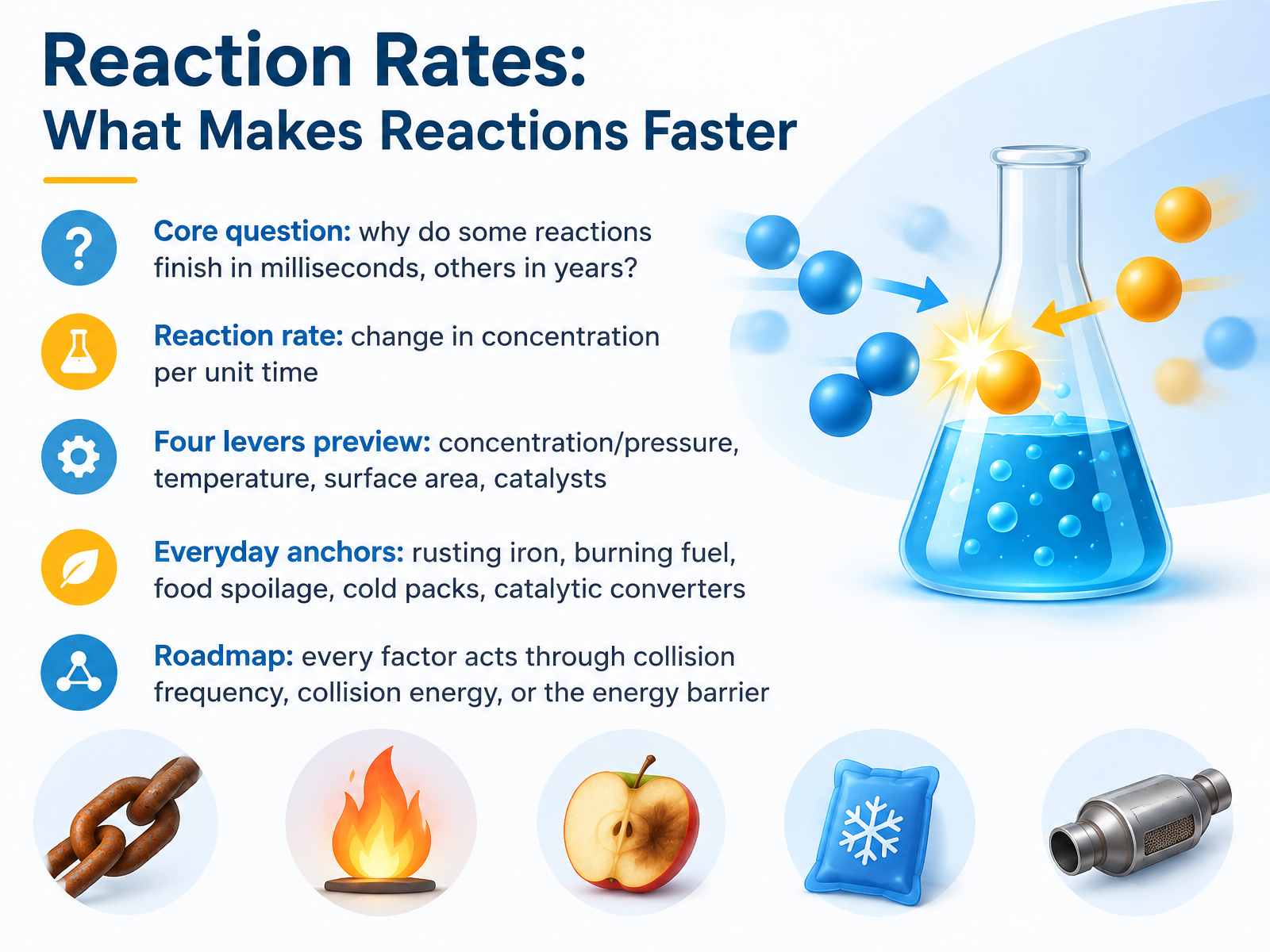
- 01Reaction Rates: What Makes Reactions FasterWelcome. Today we're exploring reaction rates, and one question sits at the center of everything. Why do some reactions finish in milliseconds, while others take years? Think about rusting iron compared with burning fuel. Same chemistry, very different speeds. So let's define our key term. Reaction rate is the change in concentration per unit time. In plain words, it tells us how quickly reactants are used up, or products appear. Over the next slides, we'll examine four levers that change that speed: concentration or pressure, temperature, surface area, and catalysts. You'll meet these ideas through everyday anchors, like food spoilage, cold packs, and catalytic converters in cars. And here's our roadmap. Every one of these factors works through one of three routes: how often particles collide, how much energy those collisions carry, or the height of the energy barrier they must overcome. Keep those three routes in mind. They'll connect everything we do. Next, we look at collision theory, the molecular basis of rate.pubs.rsc.orgdoi.orgdoi.org+22 min
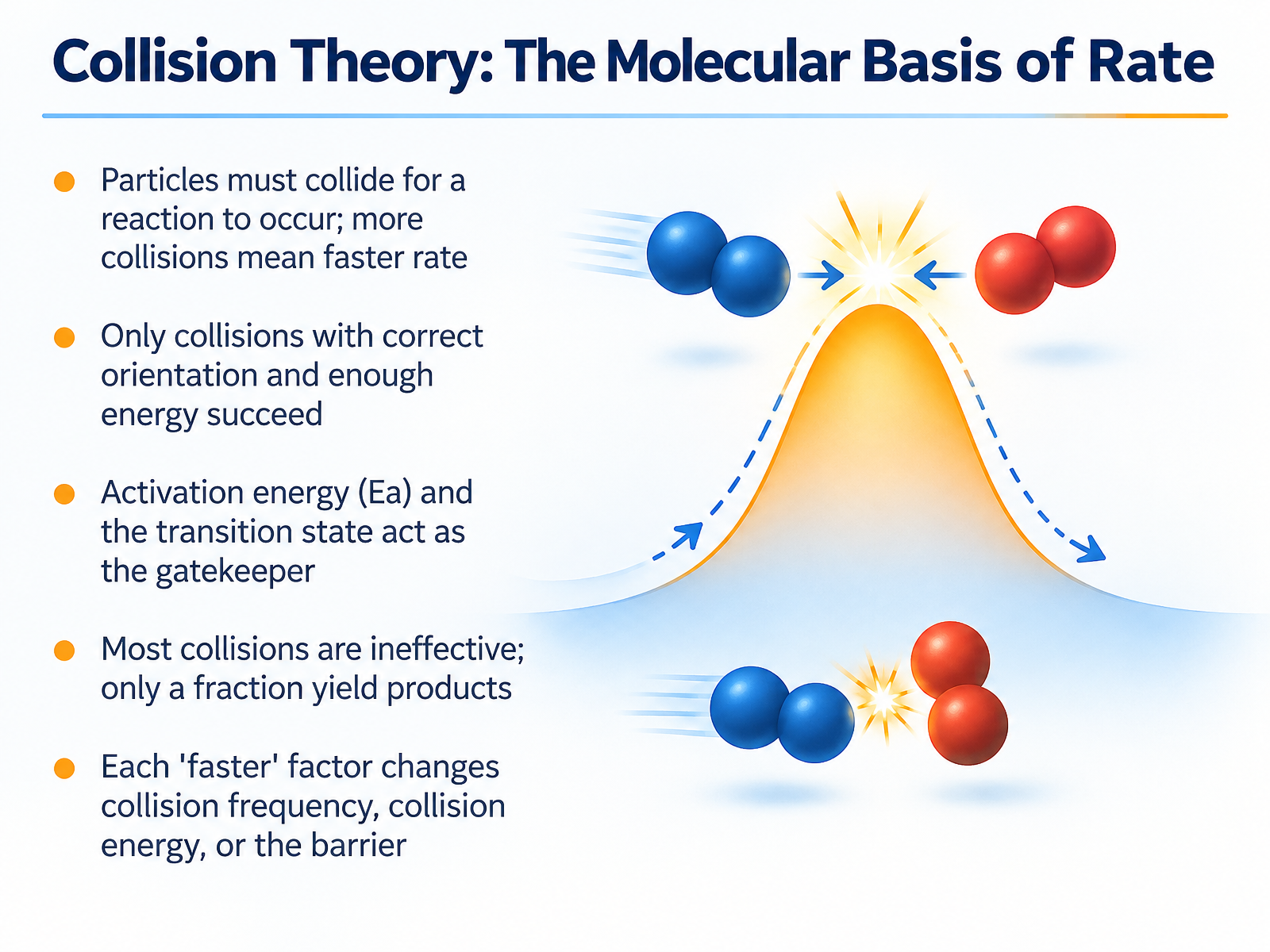
- 02Collision Theory: The Molecular Basis of RateNow let's look at the molecular basis of reaction rate, called collision theory. For a reaction to happen at all, particles must collide. More collisions in a given time generally mean a faster rate. But here is the key point. Only some collisions succeed. A collision must have the correct orientation, with the reactive parts facing each other. It must also carry enough energy. That minimum energy is called activation energy, written as E a. Think of it as a gatekeeper. When particles meet with enough energy and the right orientation, they briefly form an unstable arrangement called the transition state. Most collisions fail this test, so only a fraction yield products. That gives us a powerful idea. Every factor that makes a reaction faster works by changing collision frequency, collision energy, or the size of that energy barrier. Next, we will see how we actually measure and compare reaction speeds, in Reading the Rate: Measuring and Comparing Speeds.
 openstax.orgopenstax.orgdoi.org+22 min
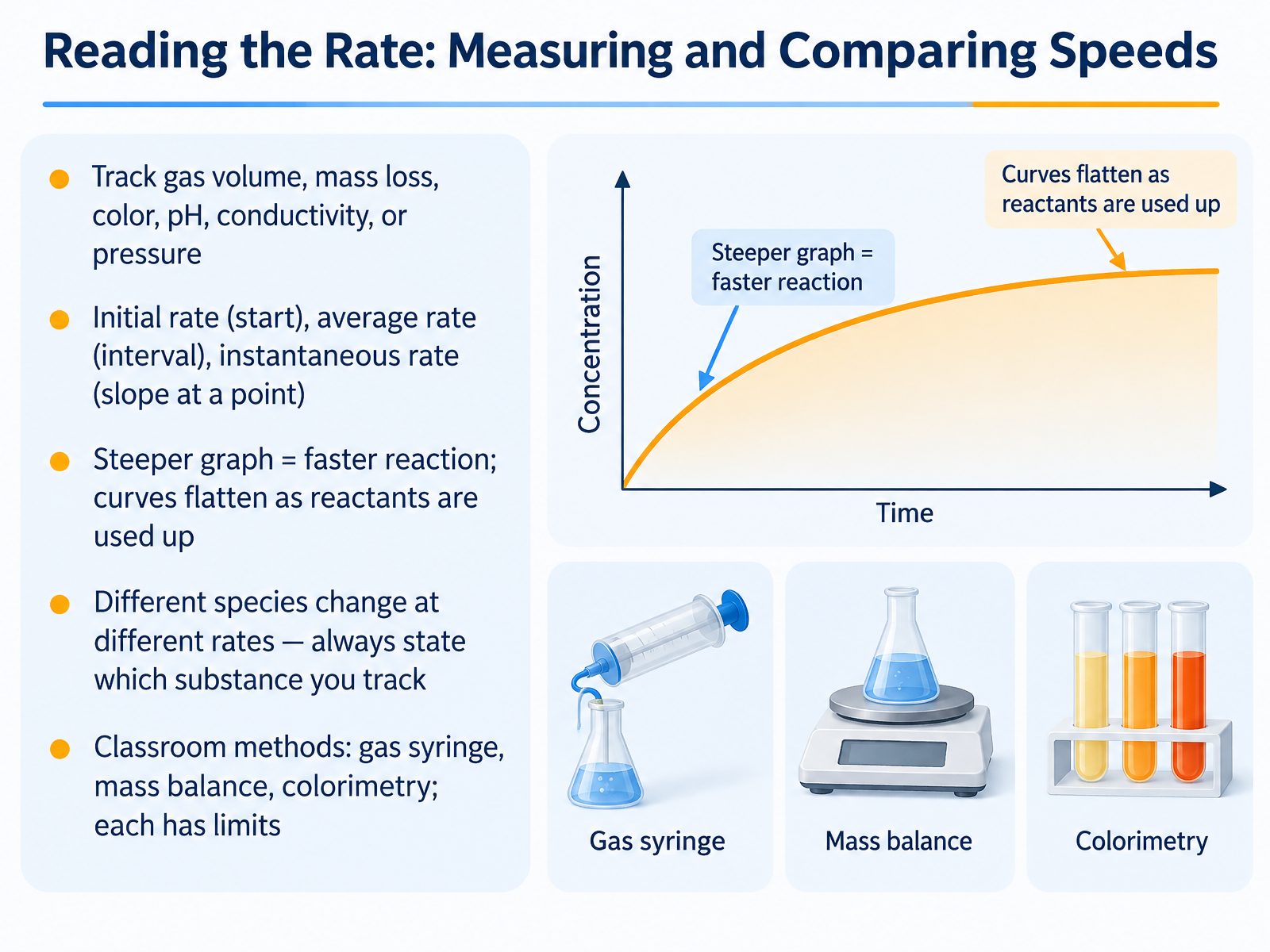
- 03Reading the Rate: Measuring and Comparing SpeedsNow that we know reactions can go fast or slow, let's look at how we actually measure that speed. You can track a gas volume, a loss of mass, a color change, a shift in pH, conductivity, or pressure. Pick one thing and follow it over time. Then we describe the rate in three ways. The initial rate is the speed right at the start. The average rate covers a time interval. The instantaneous rate is the slope at one exact point on the graph. Here is the key idea. A steeper graph means a faster reaction. And the curve flattens as reactants get used up. Also remember that different substances change at different rates, so always say which substance you are tracking. In class, common tools are a gas syringe, a mass balance, and colorimetry. Each one has limits, so choose the method that fits what you can actually observe. Next, we look at concentration and pressure.
 openstax.orgopenstax.orgdoi.org+22 min
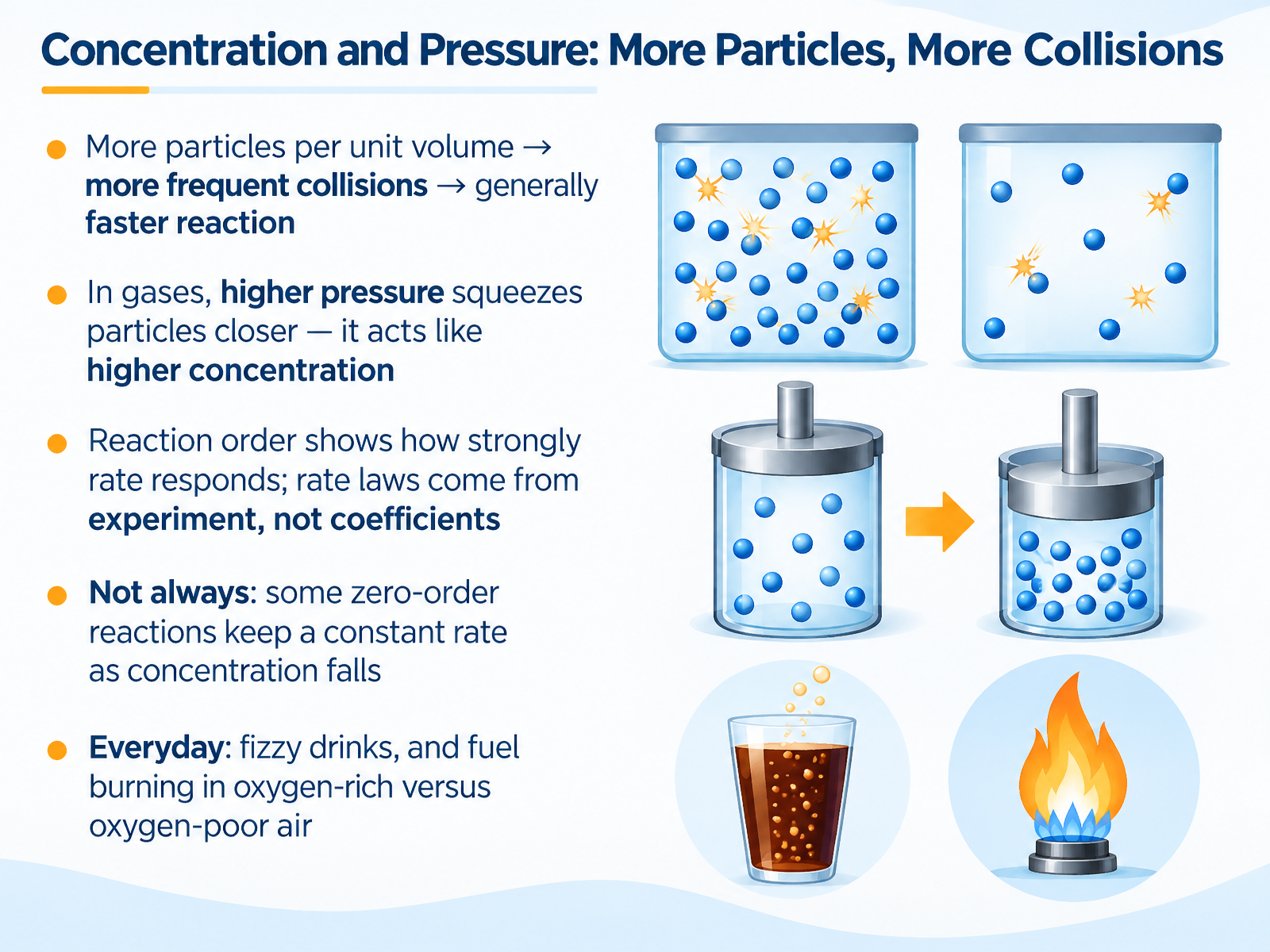
- 04Concentration and Pressure: More Particles, More CollisionsNow let's look at concentration and pressure. Concentration means how many particles sit in a given volume. More particles per unit volume lead to more frequent collisions, and that generally makes the reaction faster. In gases, higher pressure squeezes particles closer together, so it acts like a higher concentration. But be careful. Reaction order shows how strongly the rate responds to concentration. Rate laws come from experiments, not from the coefficients in a balanced equation. And it is not always true that more concentration means a faster reaction. Some zero-order reactions keep a constant rate as concentration falls. You can see this in everyday life. A fizzy drink releases gas faster when it is more concentrated with carbon dioxide. And fuel burns faster in oxygen-rich air than in oxygen-poor air. So remember: more particles usually means more collisions and a faster reaction, but always check the reaction order. Next, we will look at temperature, where more energy per collision changes the picture.
 pubs.rsc.orgdoi.orgdoi.org+22 min
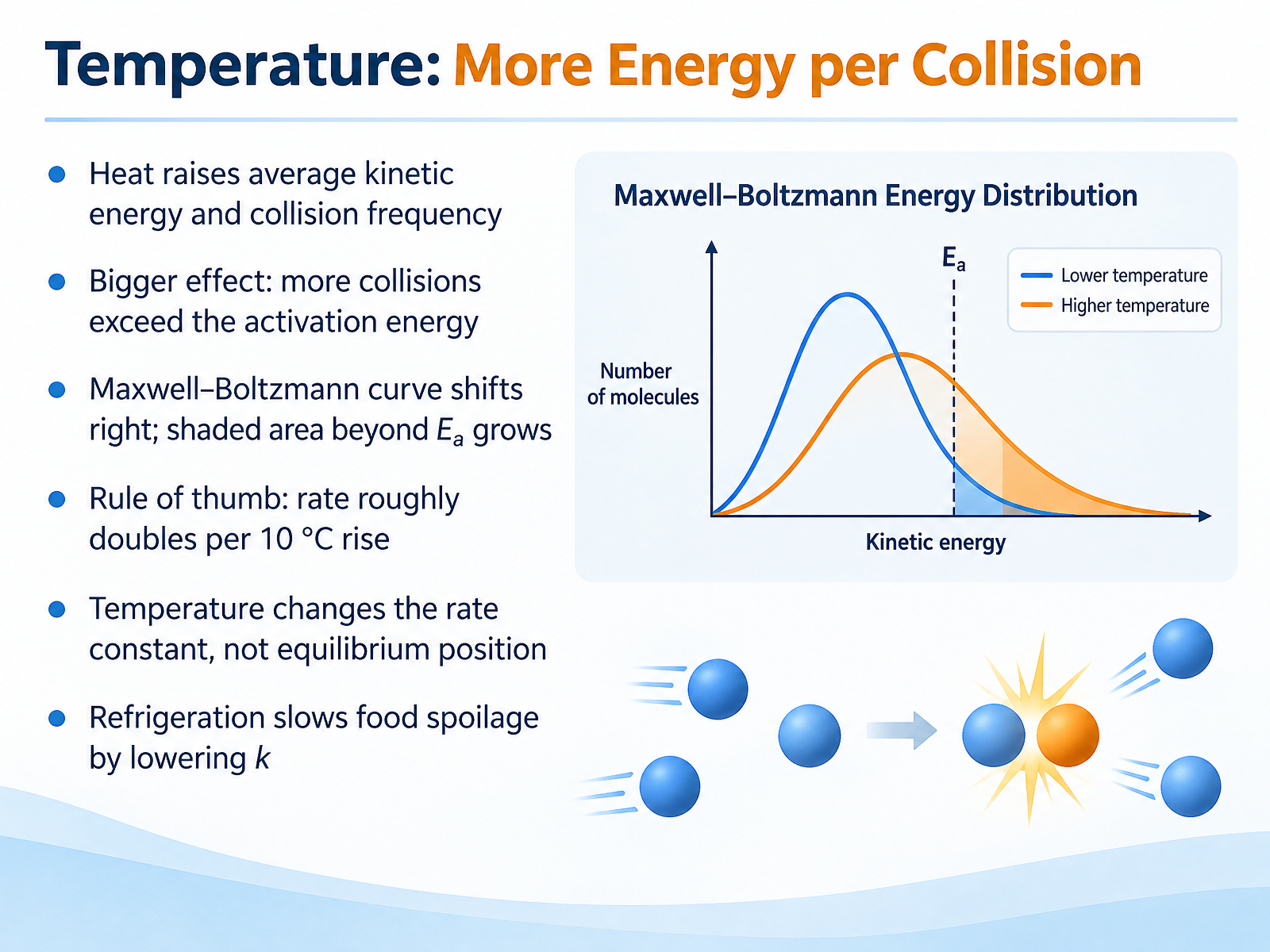
- 05Temperature: More Energy per CollisionNow let's look at temperature. Heat raises the average kinetic energy of particles. So collisions happen more often, and each collision carries more energy. But the bigger effect is this. A larger fraction of collisions now exceeds the activation energy, the minimum energy needed for a successful collision. On a Maxwell-Boltzmann curve, higher temperature shifts the distribution to the right. The shaded area beyond the activation energy grows. As a rule of thumb, reaction rate roughly doubles for every ten degree Celsius rise. Temperature changes the rate constant, the number that sets how fast the reaction goes. It does not change the equilibrium position. That is why refrigeration slows food spoilage. It lowers the rate constant. Next, we turn to surface area and mixing, where contact matters.
 edu.rsc.orgpublic.websites.umich.educhem.libretexts.org+21 min
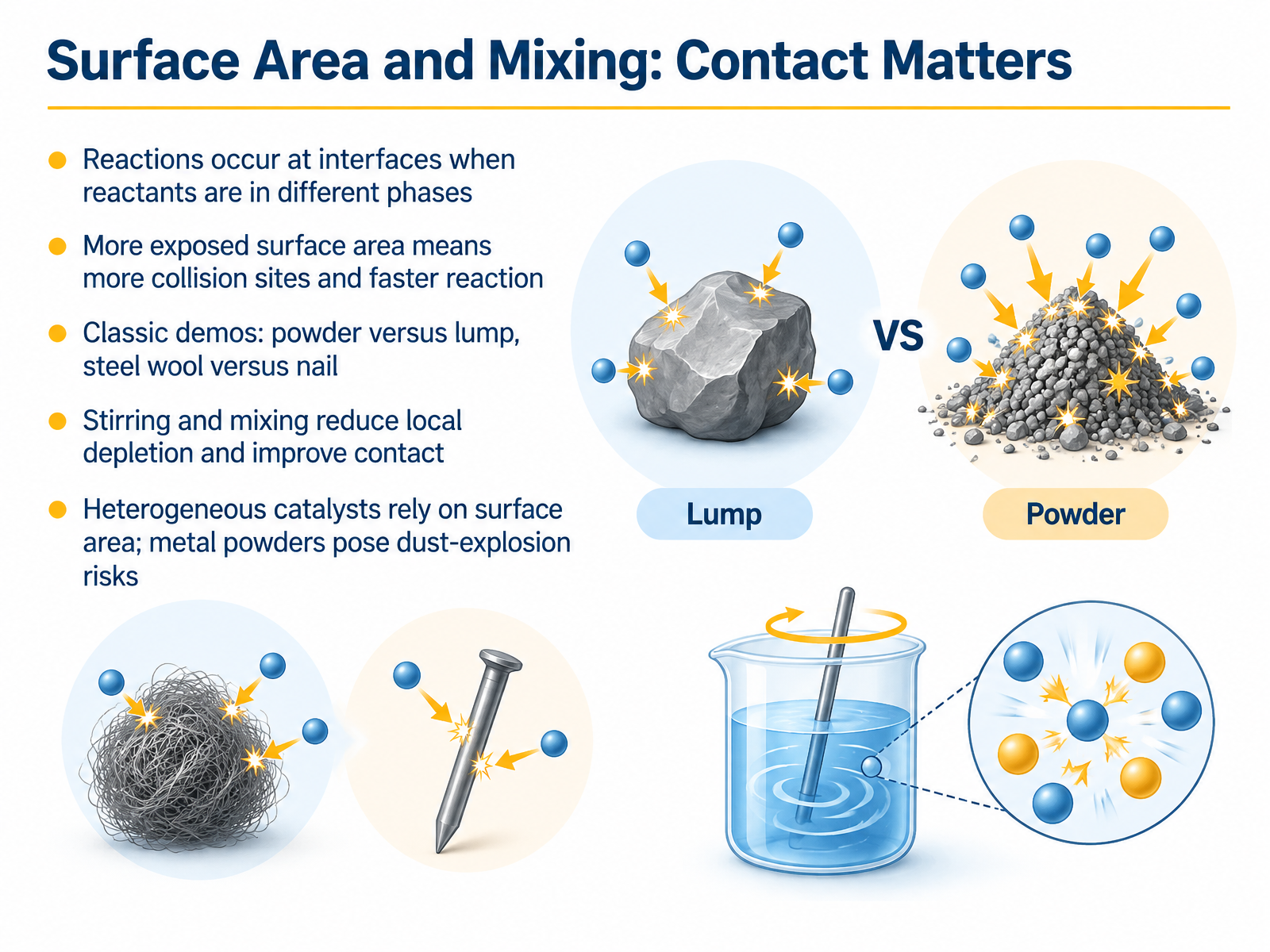
- 06Surface Area and Mixing: Contact MattersNow, let's look at surface area and mixing, because contact matters. When reactants are in different phases, they can only meet at the interface, the boundary where the two phases touch. More exposed surface area creates more collision sites. Collision theory tells us more collisions mean a faster reaction. A classic demo compares a powder with a single lump. The powder reacts much faster because far more particles are exposed. Steel wool reacts faster than a solid nail for the same reason. Stirring and mixing also help by reducing local depletion, where reactants near the interface run low. Better contact keeps fresh reactants arriving. Heterogeneous catalysts, which are in a different phase from the reactants, rely on surface area too. That is why they are often porous or powdered. But fine metal powders carry a real safety risk. Dispersed in air, they can trigger dust explosions, so handle them carefully. In short, more contact means faster reactions, and mixing maintains that contact. Next, we look at catalysts: lowering the barrier.
 openstax.orgopenstax.orgdoi.org+22 min
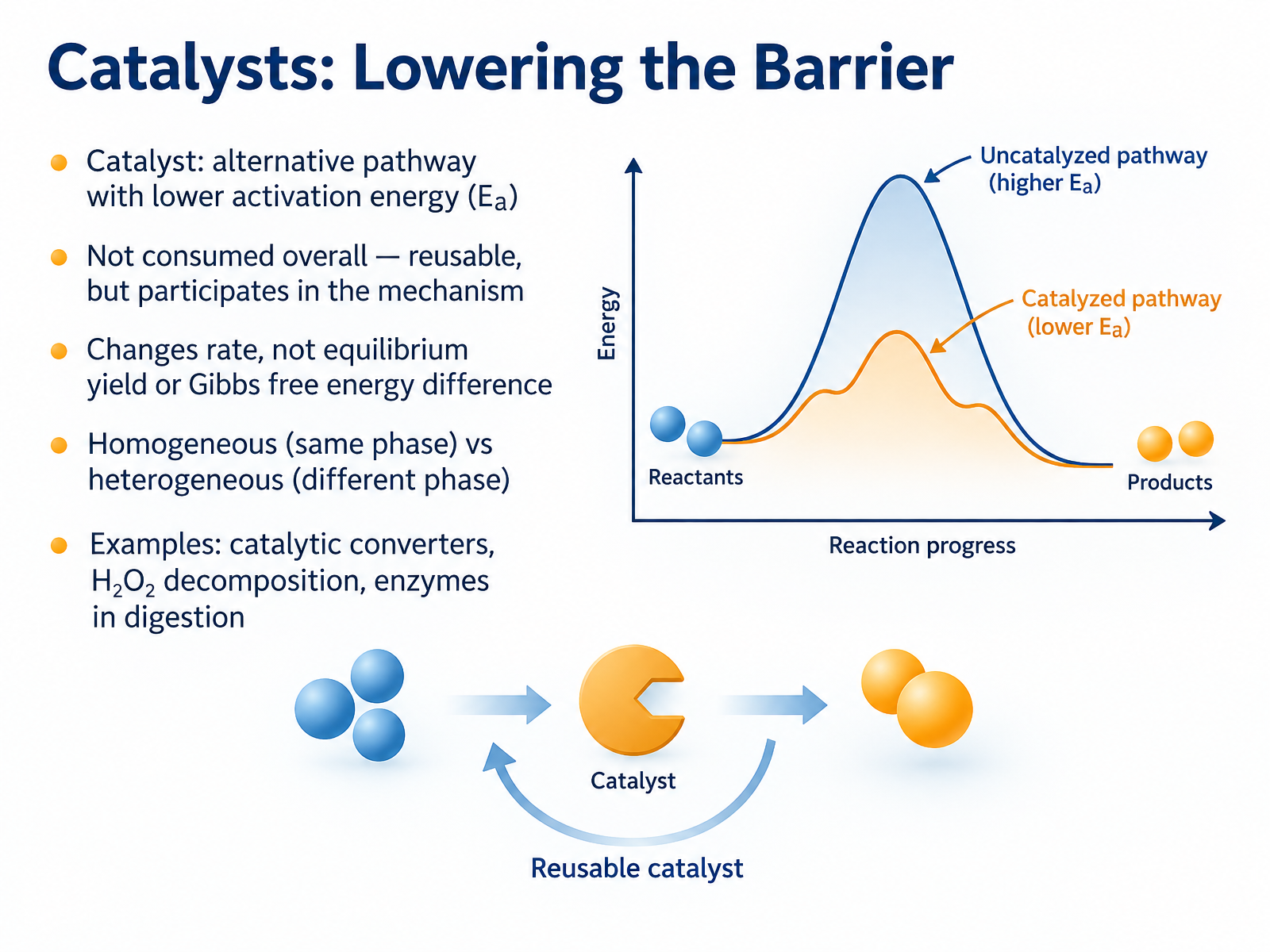
- 07Catalysts: Lowering the BarrierNext, let's look at catalysts. A catalyst provides an alternative pathway with a lower activation energy, often written E a. That means more reactant collisions have enough energy to succeed, so the reaction goes faster. The catalyst is not consumed overall. It is reusable, but it does take part in the mechanism. Importantly, a catalyst changes the rate, not the equilibrium yield or the Gibbs free energy difference. Catalysts can be homogeneous, meaning the same phase as the reactants, or heterogeneous, meaning a different phase. You meet catalysts in catalytic converters, in the decomposition of hydrogen peroxide, and as enzymes in digestion. So the key idea is this. A catalyst lowers the energy barrier and speeds up the reaction without being used up. That brings us to connecting the factors: frequency, energy, or barrier.
 openstax.orgopenstax.orgdoi.org+21 min
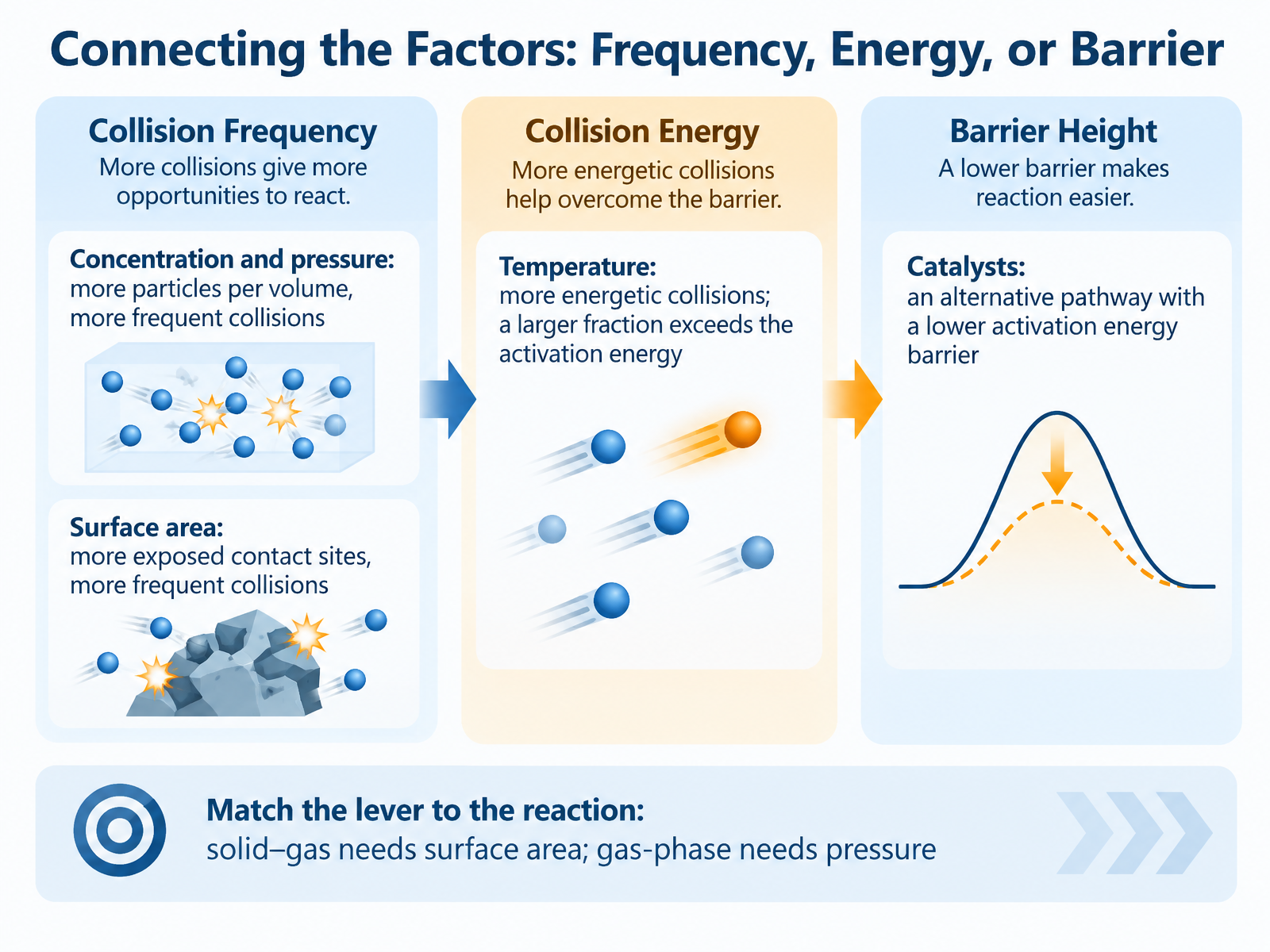
- 08Connecting the Factors: Frequency, Energy, or BarrierNow let's connect the factors. Each one changes reaction rate through collision frequency, collision energy, or the size of the energy barrier. Concentration and pressure put more particles in the same volume, so collisions happen more often. Surface area exposes more contact sites, so collisions happen more often too. Temperature does two things: particles collide more energetically, and a larger fraction exceeds the activation energy, the minimum energy needed to react. Catalysts provide an alternative pathway with a lower activation energy barrier. So match the lever to the reaction. A solid reacting with a gas needs more surface area. A gas-phase reaction responds to pressure. Next, Putting It Together: Designing Faster Reactions.
 openstax.orgopenstax.orgdoi.org+21 min
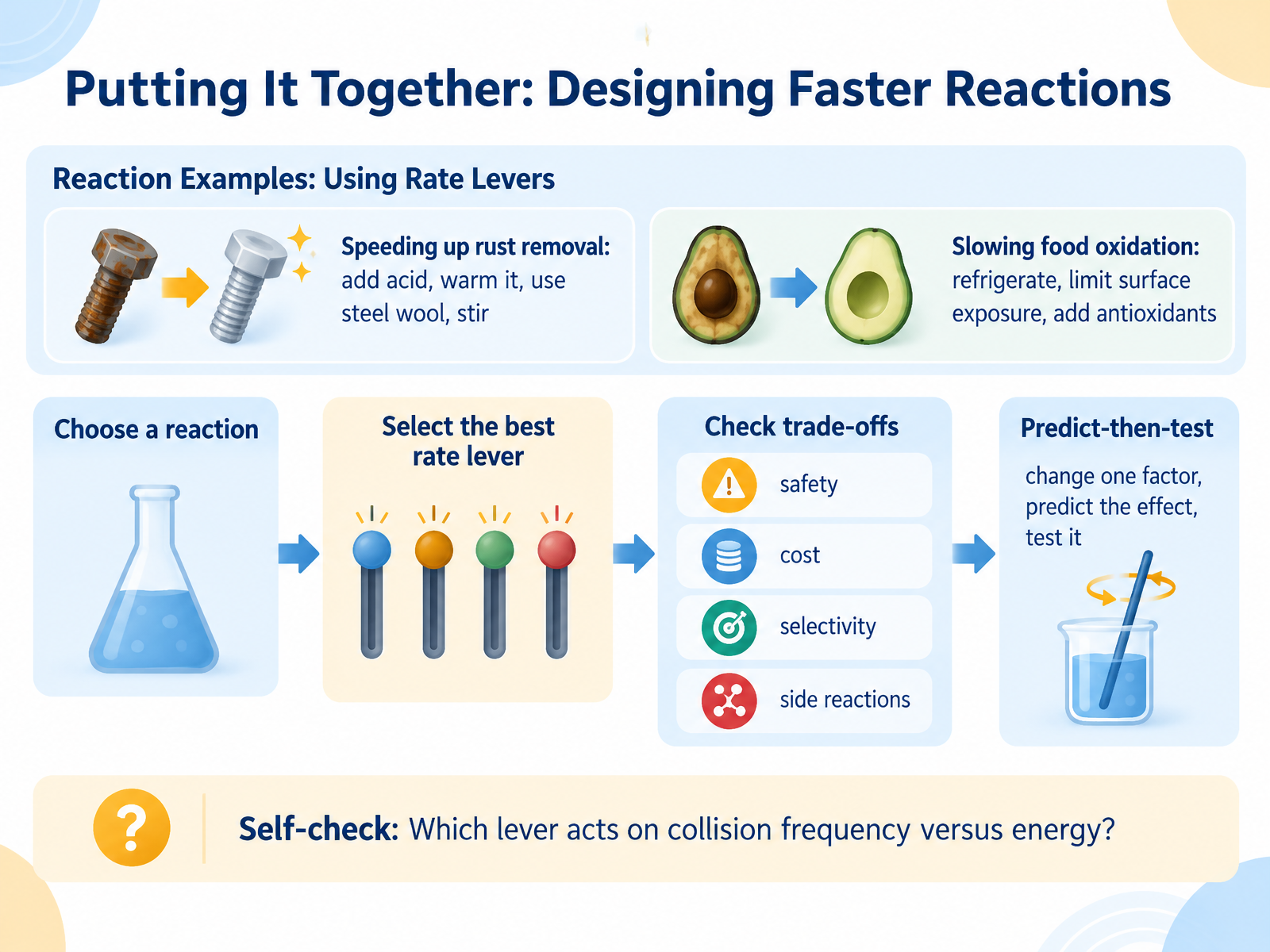
- 09Putting It Together: Designing Faster ReactionsNow let's put these ideas to work. For rust removal, you add acid, warm it, use steel wool for more surface area, and stir. That speeds up the collisions, so the rust goes faster. For slowing food oxidation, you refrigerate, limit surface exposure, and add antioxidants. Pushing a reaction faster has trade-offs: safety, cost, selectivity, and unwanted side reactions. So use a predict-then-test habit. Change one factor, predict the effect, then test it. Here's your self-check. Which lever acts on collision frequency, and which acts on the energy needed for a successful collision? Next, we'll look at common misconceptions and how to surface them.
 openstax.orgopenstax.orgdoi.org+21 min
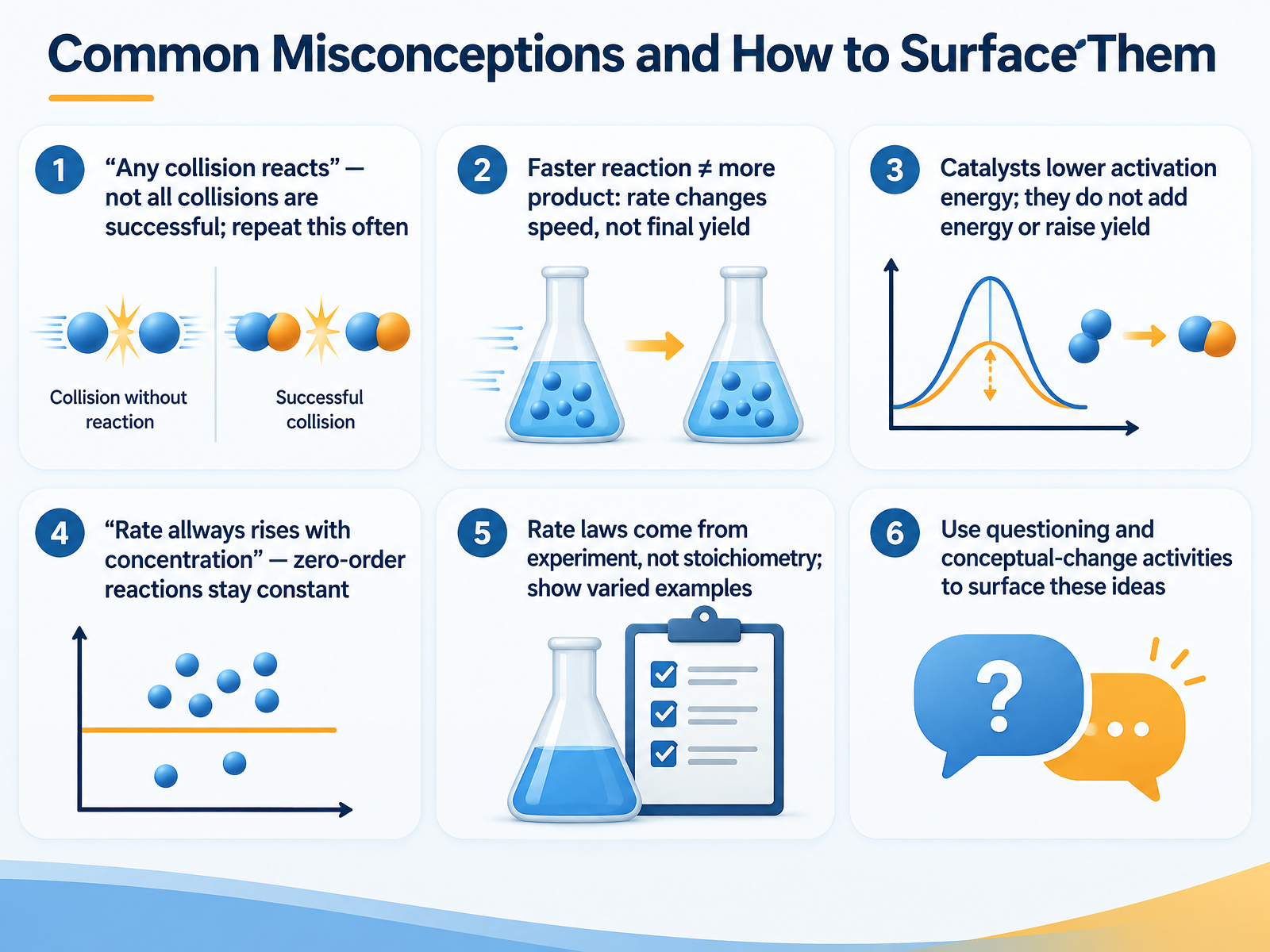
- 10Common Misconceptions and How to Surface ThemLet's look at some common misconceptions, and how to surface them. First, not all collisions lead to a reaction. Say that phrase often, because it corrects a very stubborn idea. Second, a faster reaction does not mean more product. Rate changes the speed, not the final yield. Third, catalysts lower the activation energy. They do not add energy, and they do not raise the yield. Fourth, rate does not always rise with concentration. In zero-order reactions, the rate stays constant. Fifth, rate laws come from experiment, not from the balanced equation. So show varied examples where the exponents do not match the coefficients. To surface these ideas, use questioning and conceptual-change activities, and let students explain their reasoning. To wrap up, name the misconception, compare it with evidence, and revisit it often. Next, we'll look at teaching with demonstrations and inquiry.
 pubs.rsc.orgdoi.orgdoi.org+21 min
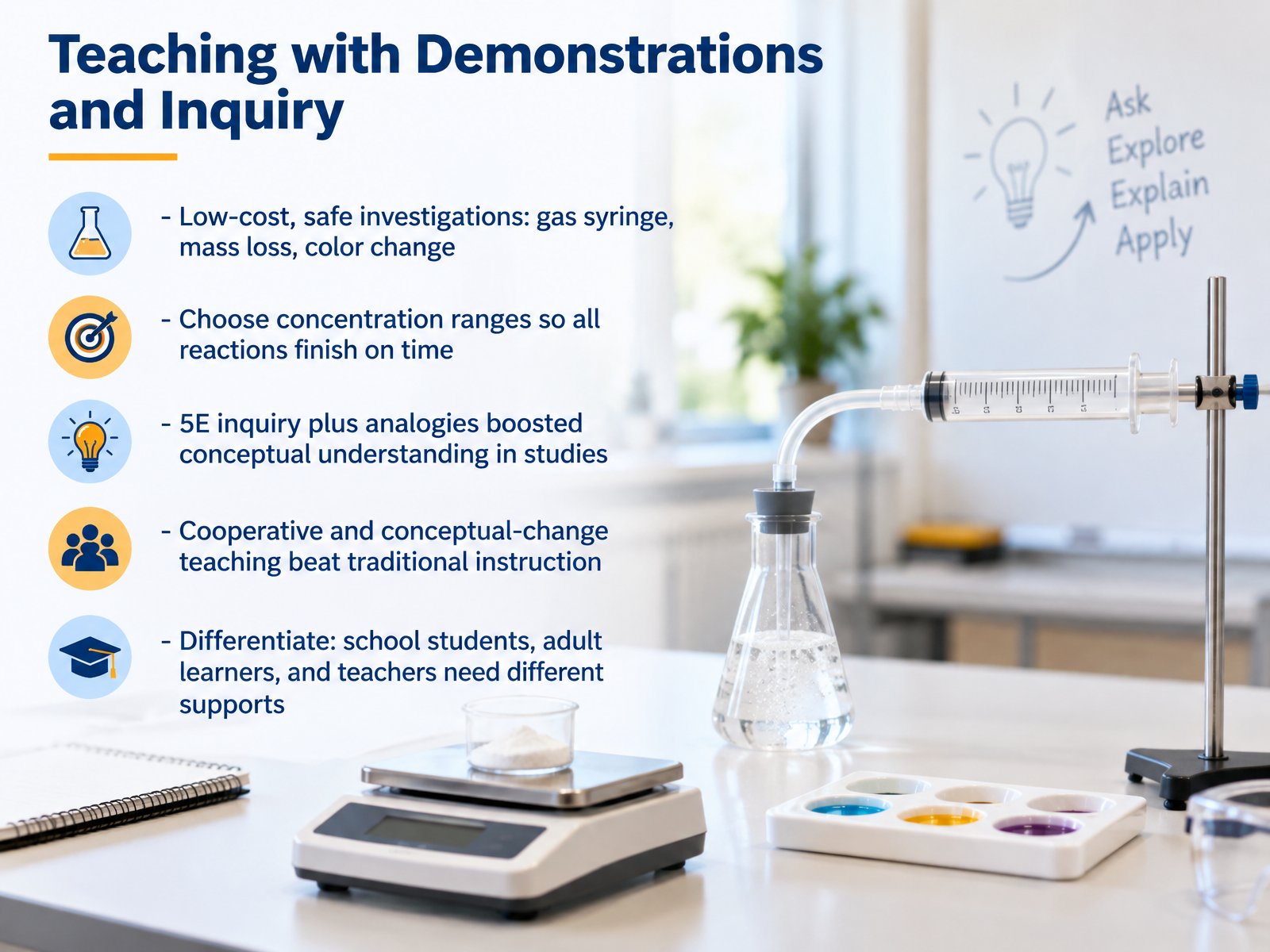
- 11Teaching with Demonstrations and InquiryNow, let's turn to teaching with demonstrations and inquiry. You do not need expensive equipment. A gas syringe, mass loss on a balance, or a simple color change can all reveal reaction rate clearly. One practical tip: choose concentration ranges so every reaction finishes within your lesson time. Otherwise, students leave thinking the slower reaction never ends. Research supports inquiry here. A 5E inquiry approach combined with analogies produced medium learning gains, and conceptual change and cooperative teaching outperformed traditional instruction. Finally, differentiate. School students, adult learners, and teachers each need different levels of support and different examples. Next, we look at assessment and feedback, and how to check understanding.
 pubs.rsc.orgdoi.orgdoi.org+22 min
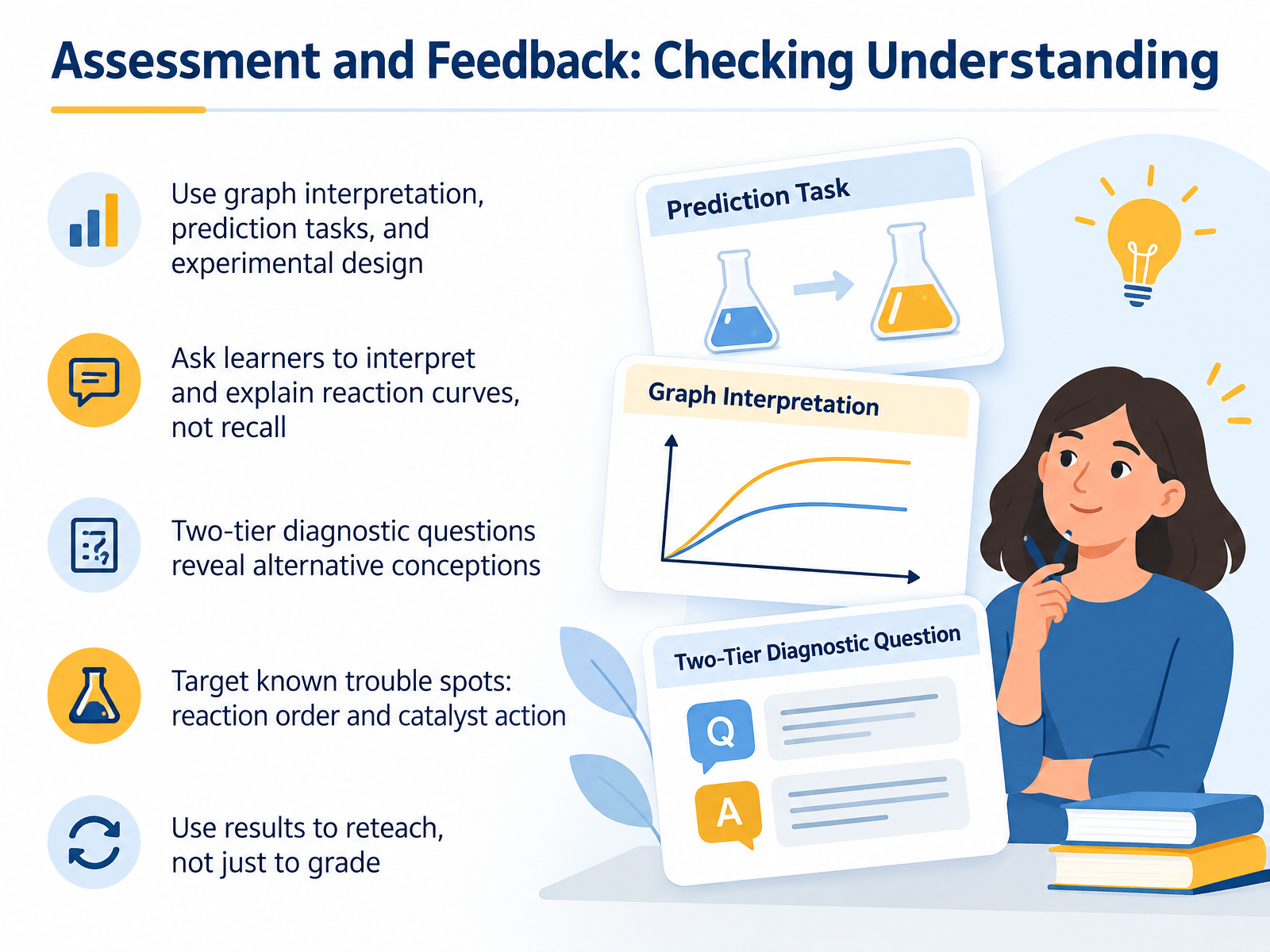
- 12Assessment and Feedback: Checking UnderstandingLet's talk about assessment and feedback. Good assessment checks understanding, not memory. So use graph interpretation, prediction tasks, and experimental design. Ask learners to interpret and explain reaction curves, rather than simply recall facts. For example, show a curve and ask what happens to rate over time, and why. Two-tier diagnostic questions are powerful here. The first tier asks for an answer. The second tier asks for the reason. That second tier reveals alternative conceptions. Target known trouble spots: reaction order, and catalyst action. Many learners believe rate always rises with concentration, or that catalysts change the final energy. Use what you find to reteach, not just to grade. Feedback should guide the next lesson. So, assessment becomes a tool for learning, not just a score. Next, we bring everything together in Synthesis: The Four Levers of Reaction Rate.
 pubs.rsc.orgdoi.orgdoi.org+22 min
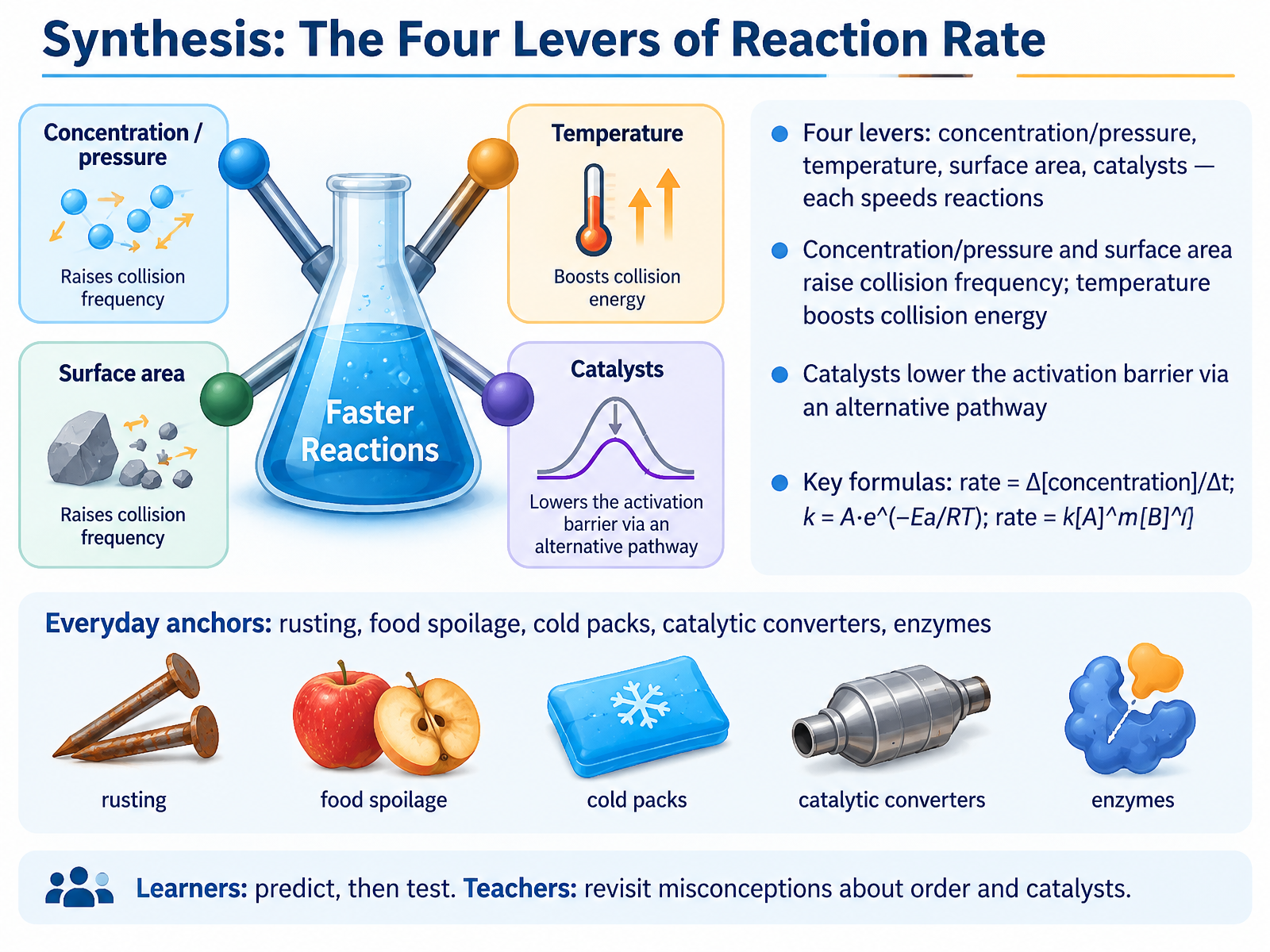
- 13Synthesis: The Four Levers of Reaction RateLet's bring everything together. There are four levers you can pull to make a reaction faster: concentration or pressure, temperature, surface area, and catalysts. Concentration, pressure, and surface area raise how often particles collide. Temperature raises the energy of those collisions. A catalyst works differently. It lowers the activation energy by offering an alternative pathway. Keep these formulas in mind. Rate equals the change in concentration divided by the change in time. The rate constant k equals A times e to the power of negative activation energy divided by R times T. And rate equals k times concentration of A to the m times concentration of B to the n. You can spot these levers every day, in rusting, food spoilage, cold packs, catalytic converters, and enzymes. Learners, make a prediction first, then test it. If you are teaching, revisit two common misconceptions: that reaction order comes from the balanced equation, and that catalysts are used up. Next, we will look at further resources and next steps.
 openstax.orgopenstax.orgdoi.org+22 min
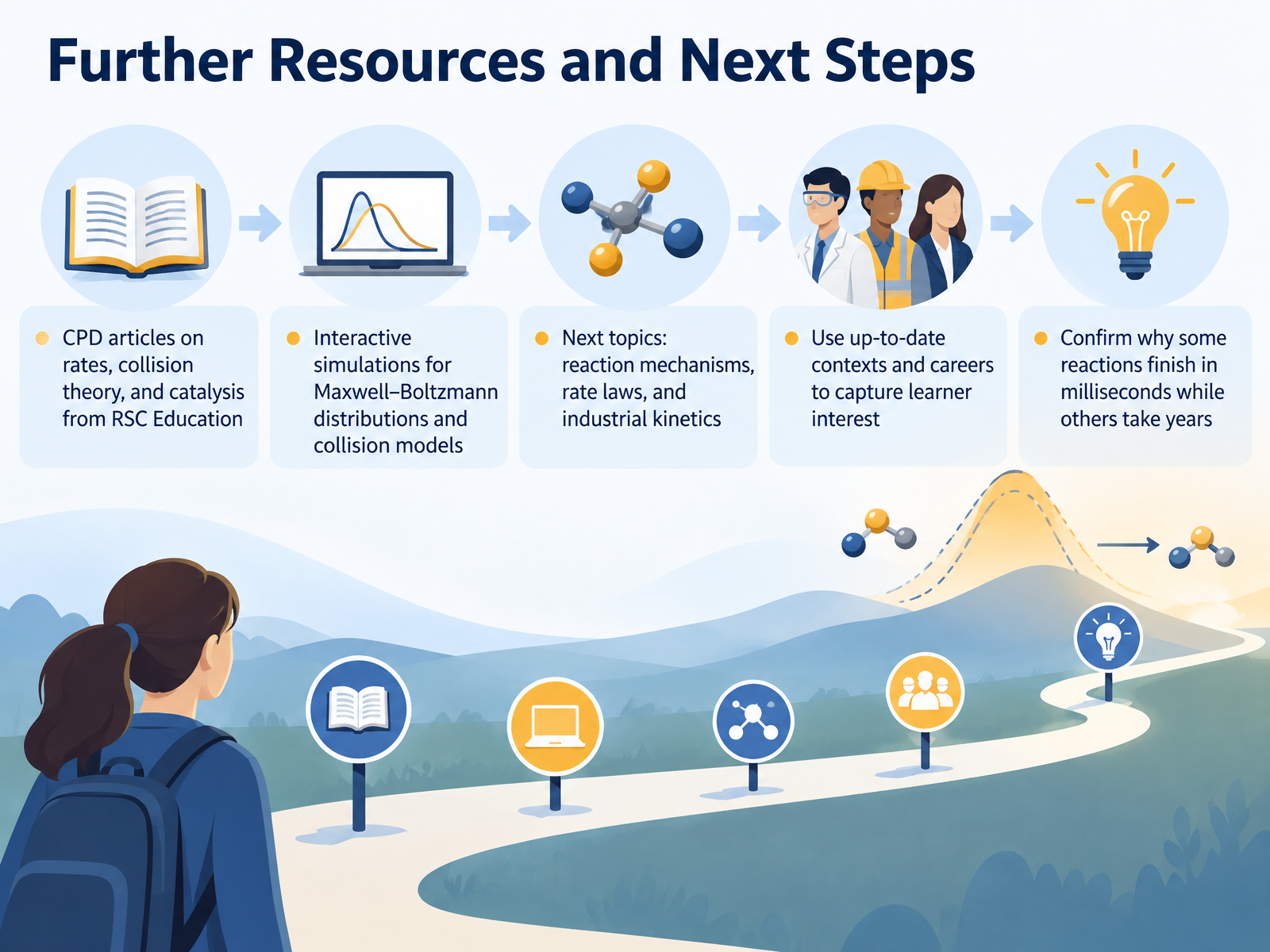
- 14Further Resources and Next StepsAs we close, here are some resources to keep learning going. The Royal Society of Chemistry Education site offers continuing professional development articles on rates, collision theory, and catalysis. These are written for teachers and adult learners, so they explain common misconceptions clearly. Interactive simulations can also help. Look for ones that show the Maxwell–Boltzmann distribution and collision models. You can change temperature and watch the curve shift, which makes the energy argument visible. Your next topics are reaction mechanisms, rate laws, and industrial kinetics. Keep the interest alive by using up-to-date contexts and careers. Catalysts sit at the cutting edge of science, and real examples capture learner attention. And keep returning to the core question: why do some reactions finish in milliseconds while others take years? The answer ties back to collision frequency, activation energy, temperature, and catalysts. Thank you for your attention. You now have a sound foundation in reaction rates. Keep questioning, keep testing, and trust that careful reasoning will carry you further.
 pubs.rsc.orgdoi.orgdoi.org+22 min
Take the deck with you
Download this course as a file — free, no sign-up needed.
- PDF handoutEvery slide page, ready to print or share.15 pages · 3.5 MBDownload
- Narrated PowerPointThe deck that presents itself — every slide carries the digital human's narration video.15 pages · 13.1 MBDownload
- PowerPoint slidesThe full deck as a .pptx — open it in PowerPoint, Keynote, or Google Slides.15 pages · 3.4 MBDownload
Free to use in your own training — please keep the PersonWise credit page at the end.
Have your own deck? Turn it into a course
Sources consulted
Web sources consulted while building this course.
- A review of research on the teaching and learning of chemical kinetics - Chemistry Education Research and Practice (RSC Publishing) DOI:10.1039/C5RP00176E — pubs.rsc.org
- Uncovering Students’ Genuine Misconceptions: Evidence to Inform the Teaching of Chemical Kinetics — doi.org
- Shifting students’ conceptions of the catalyst concept by carrying out discussion activities as reinforcement of STEM learning — doi.org
- Teaching rates of reaction post-16: part 2 | CPD article | RSC Education — edu.rsc.org
- Implementation of 5E inquiry incorporated with analogy learning approach to enhance conceptual understanding of chemical reaction rate for grade 11 students - Chemistry Education Research and Practice (RSC Publishing) — pubs.rsc.org
- Ch. 12 Summary - Chemistry 2e | OpenStax — openstax.org
- 12.5 Collision Theory - Chemistry 2e | OpenStax — openstax.org
- Collision theory — doi.org
- Factors Affecting Rates of Reaction - Student Academic Success — monash.edu
- Rates of Chemical Reactions — doi.org
- https://edu.rsc.org/download?ac=537831 — edu.rsc.org
- Chapter 3 · 7e · Elements of Chemical Reaction Engineering — public.websites.umich.edu
- 8.5: The Effect of Temperature on Reaction Rates - Chemistry LibreTexts — chem.libretexts.org
- B Derivation of the Exponential Energy Factor | CH22008 Lecture Notes — bjmorgan.github.io
- Collision theory and the Maxwell–Boltzmann distribution (video) — khanacademy.org