Content Marketing vs Content Strategy
Begin
15 pages · ~30 min
Content Marketing vs Content Strategy
Learn to distinguish content marketing from content strategy, including their tradeoffs and use cases, to build more effective content initiatives.
What you’ll learn
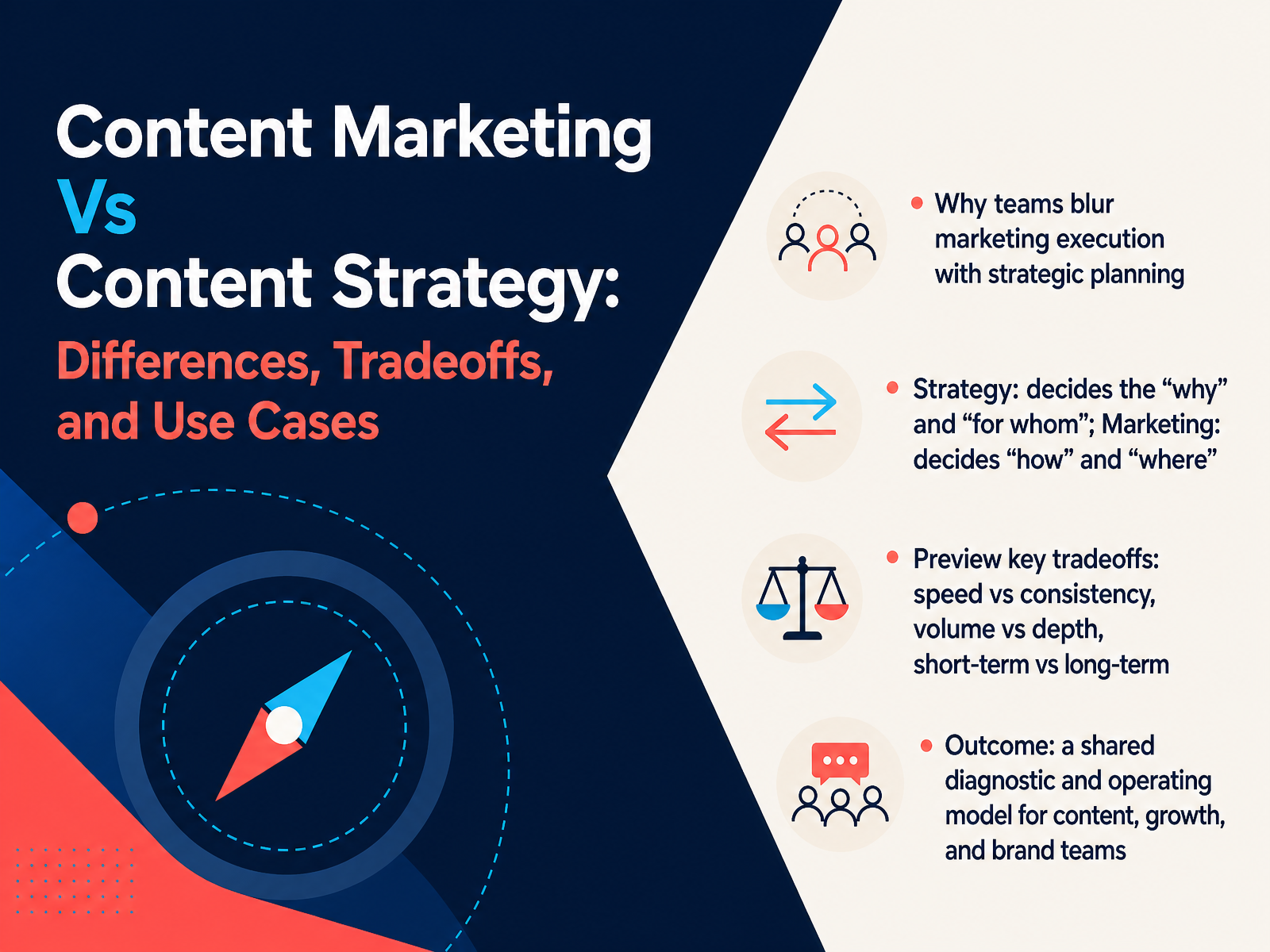
- 01Content Marketing Vs Content Strategy: Differences, Tradeoffs, and Use CasesWelcome. If you are here, you already know that content is expensive. The real question is whether it is an investment or just overhead. Today we are drawing a hard line between content strategy and content marketing. Not to split hairs, but to save your budget and your team's sanity. Strategy decides the why and the for whom. Marketing decides the how and the where. A strategy without execution is just a document. And marketing without a strategy is just noise. We are going to walk through the key tradeoffs you face every day: speed versus consistency, volume versus depth, short-term hits versus long-term compound growth. By the end, you will have a shared operating model for your content, growth, and brand teams. Let's start by looking at why smart teams still blur these lines.contestudios.comriseopp.comankordmedia.com+21 min
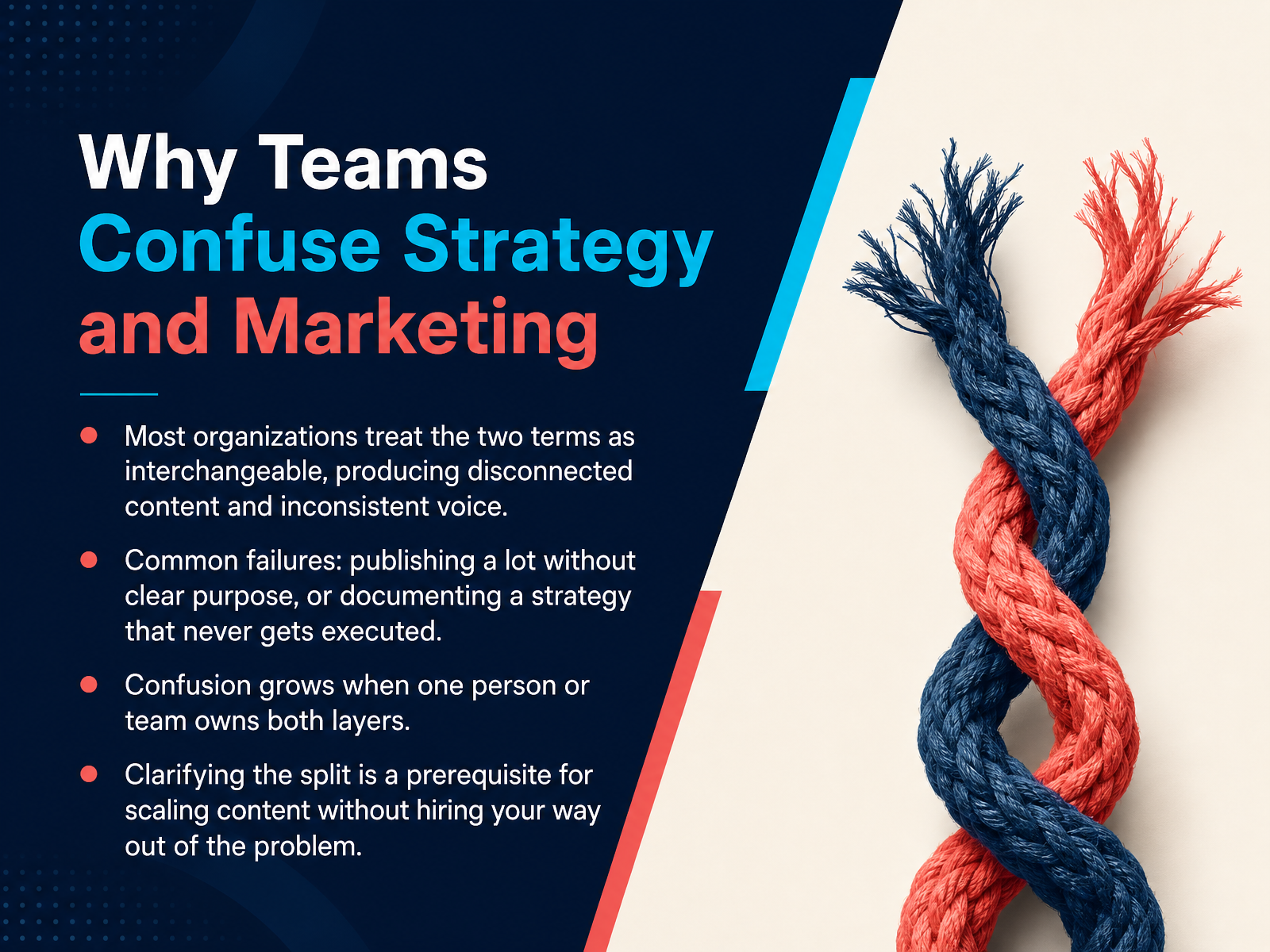
- 02Why Teams Confuse Strategy and MarketingLet's be honest. Most teams treat these terms like synonyms, and it costs them real money. They publish constantly, but without a clear purpose, or they write a beautiful strategy document that never sees the light of day. Both are expensive failures. The confusion gets worse when one person owns both layers, because they end up reacting to whatever feels urgent that week. The fix starts here. Split the plan from the execution, and suddenly you can scale without just hiring more writers. That's the real win. Now let's define exactly where each discipline starts and ends.
 contestudios.comriseopp.comankordmedia.com+21 min
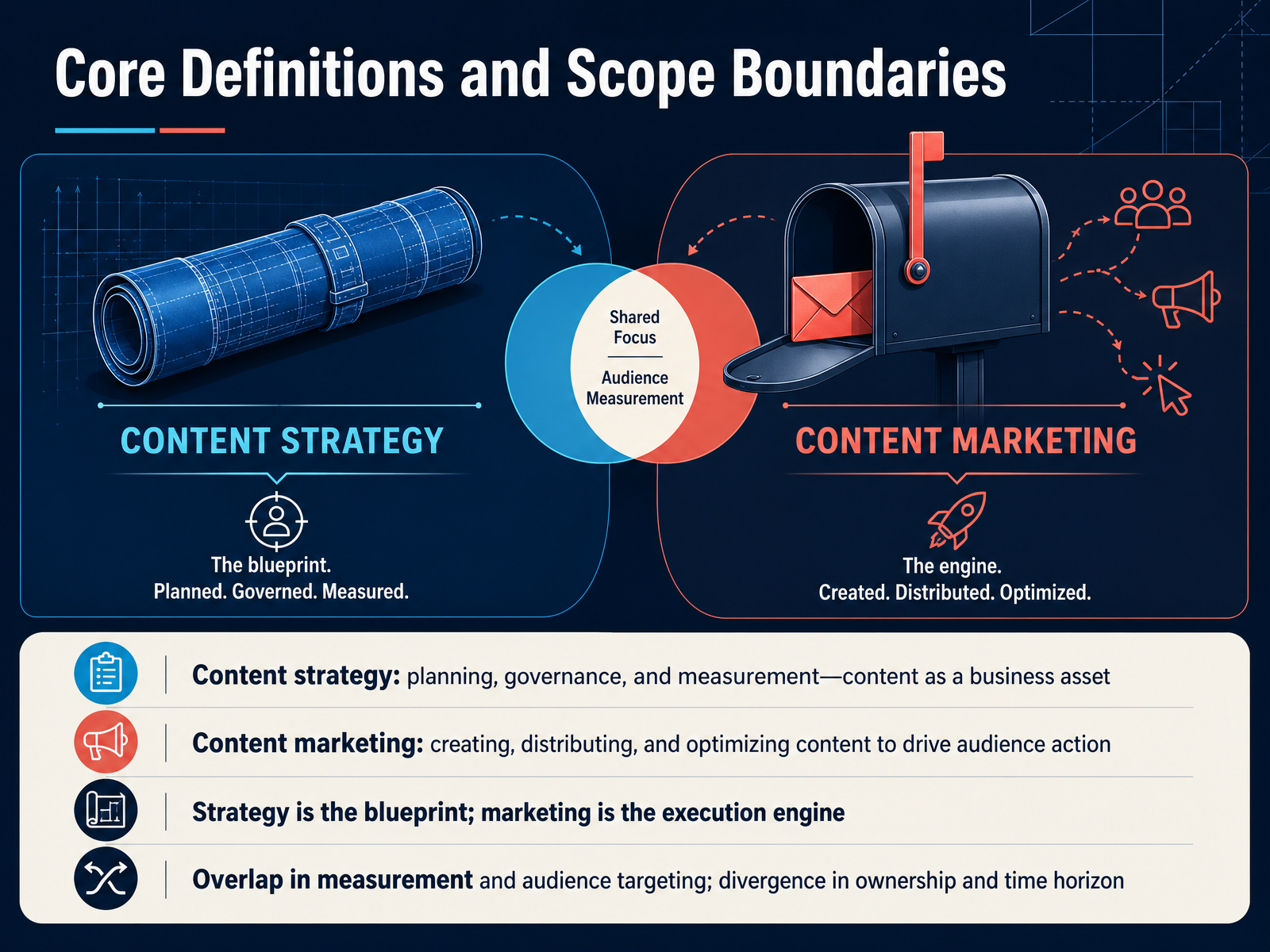
 - 03Core Definitions and Scope BoundariesLet’s get the definitions straight, because this is where most teams go wrong. Content strategy is the planning layer. It’s the blueprint that answers why we create content, who it’s for, what business goals it serves, and how we measure success. Think governance, audience personas, topic pillars, and long-term alignment. Content marketing, on the other hand, is the execution engine. It’s the writing, publishing, promoting, and optimizing—the blog posts, videos, emails, and social campaigns that actually reach your audience and drive action. The hard line? Strategy is the blueprint; marketing is the build. They overlap in measurement and audience targeting, but they diverge in ownership and time horizon. Strategy is owned by someone looking a year out. Marketing is owned by people operating this week. Tradeoff? If you invest only in marketing, you get volume without direction. If you invest only in strategy, you get a document that never ships. The real skill is knowing which hat to put on when. The takeaway? Strategy defines the game. Marketing plays it. Next, let’s talk about the decision layer versus the execution layer and how that split shapes your daily workflow.
 contestudios.comriseopp.comankordmedia.com+22 min
 - 04The Decision Layer vs The Execution LayerHere is where the rubber meets the road. Strategy is the decision layer. It answers who you're targeting, what you'll own, why that matters, and how you'll measure success. Marketing is the execution layer. It decides what goes live this week and where to optimize. So what does each one actually produce? Strategy hands you audience profiles, topical maps, style guides, and a governance RACI that says who approves what. Marketing hands you the assets: blog posts, emails, social content, ad campaigns. You need both. But if you are spending your week approving social copy, you're doing marketing. If you are mapping out which territory to dominate next quarter, you're doing strategy. Hard line: if you don't know your audience profile, your next blog post is guesswork. Let's look at how different teams actually split this work.
 rubicon.cxturboaudit.aiscalegrowth.digital+21 min
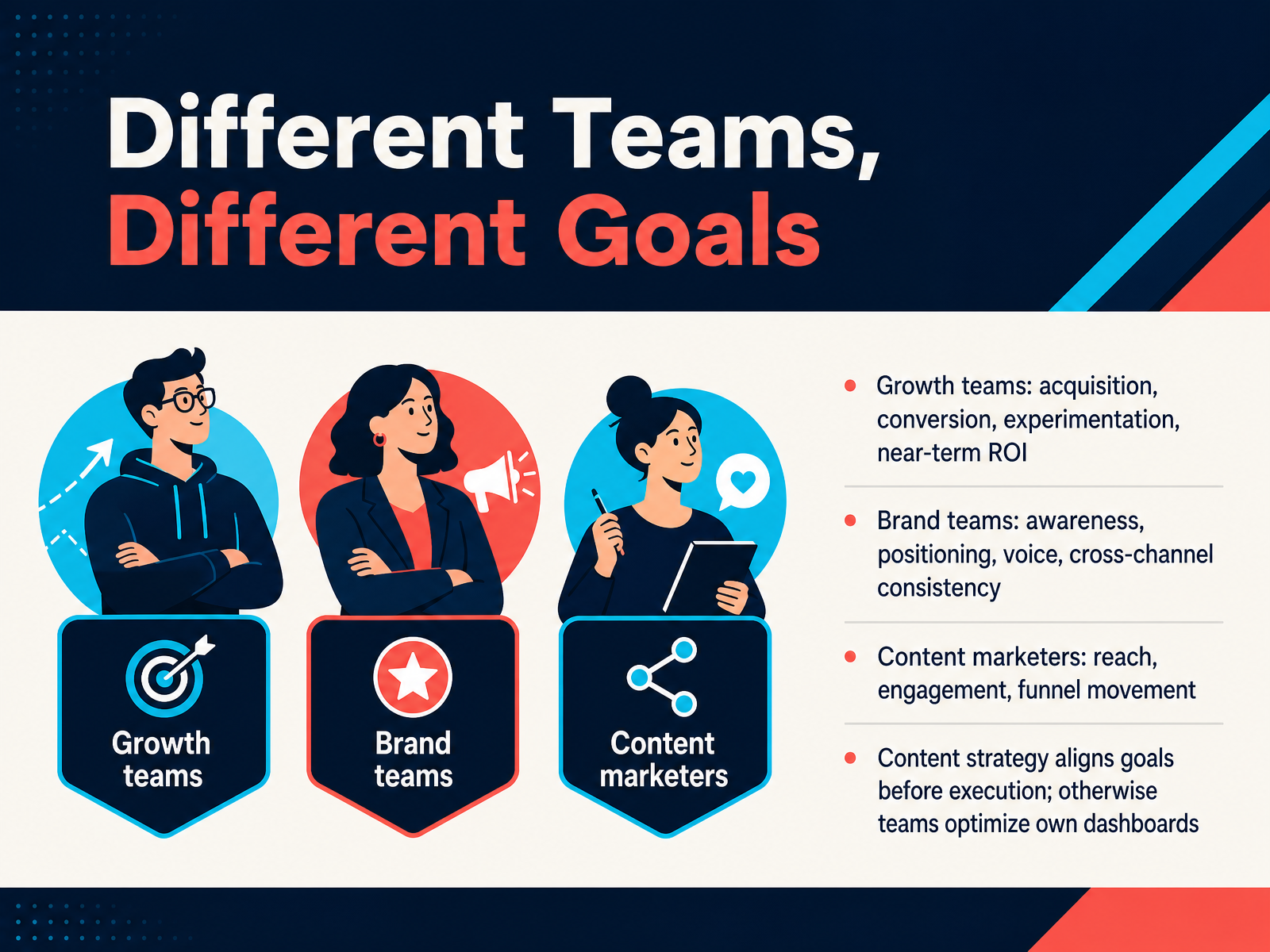
 - 05Different Teams, Different GoalsNow let's get real about ownership. Growth teams live on acquisition, conversion, and experimentation. Their dashboards reward speed and near-term ROI. Brand teams live on awareness, positioning, voice, and cross-channel consistency. Their scorecard is long-term equity. Content marketers sit in the middle, measuring reach, engagement, and funnel movement. Here's the hard line: when these teams operate without a shared content strategy, each one optimizes its own dashboard. The growth team A/B tests a headline that breaks brand voice. The brand team pushes a message with no conversion path. And the content team publishes daily without moving the funnel. Strategy aligns goals before execution. It forces the growth team and the brand team to agree on what winning means before a single asset is produced. That alignment is the difference between a library that compounds and noise that just gets published. Keep that in mind as we look at the tradeoffs in practice.
 contestudios.comriseopp.comankordmedia.com+22 min
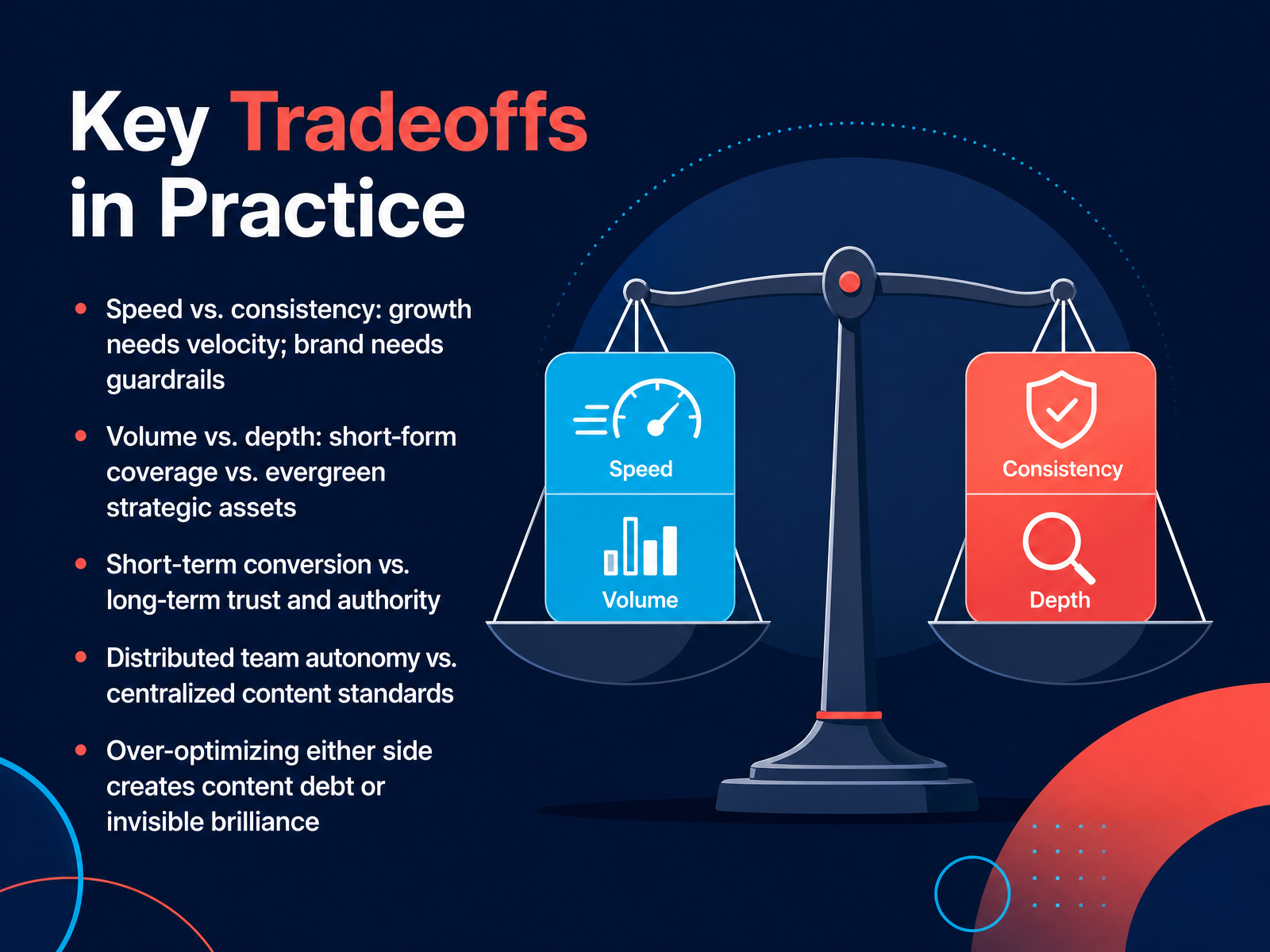
 - 06Key Tradeoffs in PracticeLet’s be honest about the real tradeoffs. Speed gives you visibility; consistency gives you trust. Growth teams need velocity, but brands need guardrails. If you sprint without standards, you build content debt—outdated pages, overlapping posts, and a site that loses authority. On the flip side, volume versus depth. Short-form coverage wins discovery; deep strategic assets win conversion. One shallow piece might rank today; a comprehensive guide keeps earning for years. Then there’s short-term conversion versus long-term trust. A quick offer can close a lead; thoughtful analysis builds the authority that makes the next sale easier. And distributed team autonomy versus centralized standards. Autonomy creates speed and local relevance; central standards protect voice and quality. The risk? Over-optimizing either side. Too much speed and consistency creates content debt. Too much depth and control creates invisible brilliance—great work nobody sees. The fix is knowing which goal each asset serves. Speed where freshness matters; depth where trust matters; consistency everywhere. Hard lines, intentional choices. Next, we’ll look at what the 2026 data actually says about velocity versus quality.
 winsomemarketing.comeditorialge.comphantom-iq.com+22 min
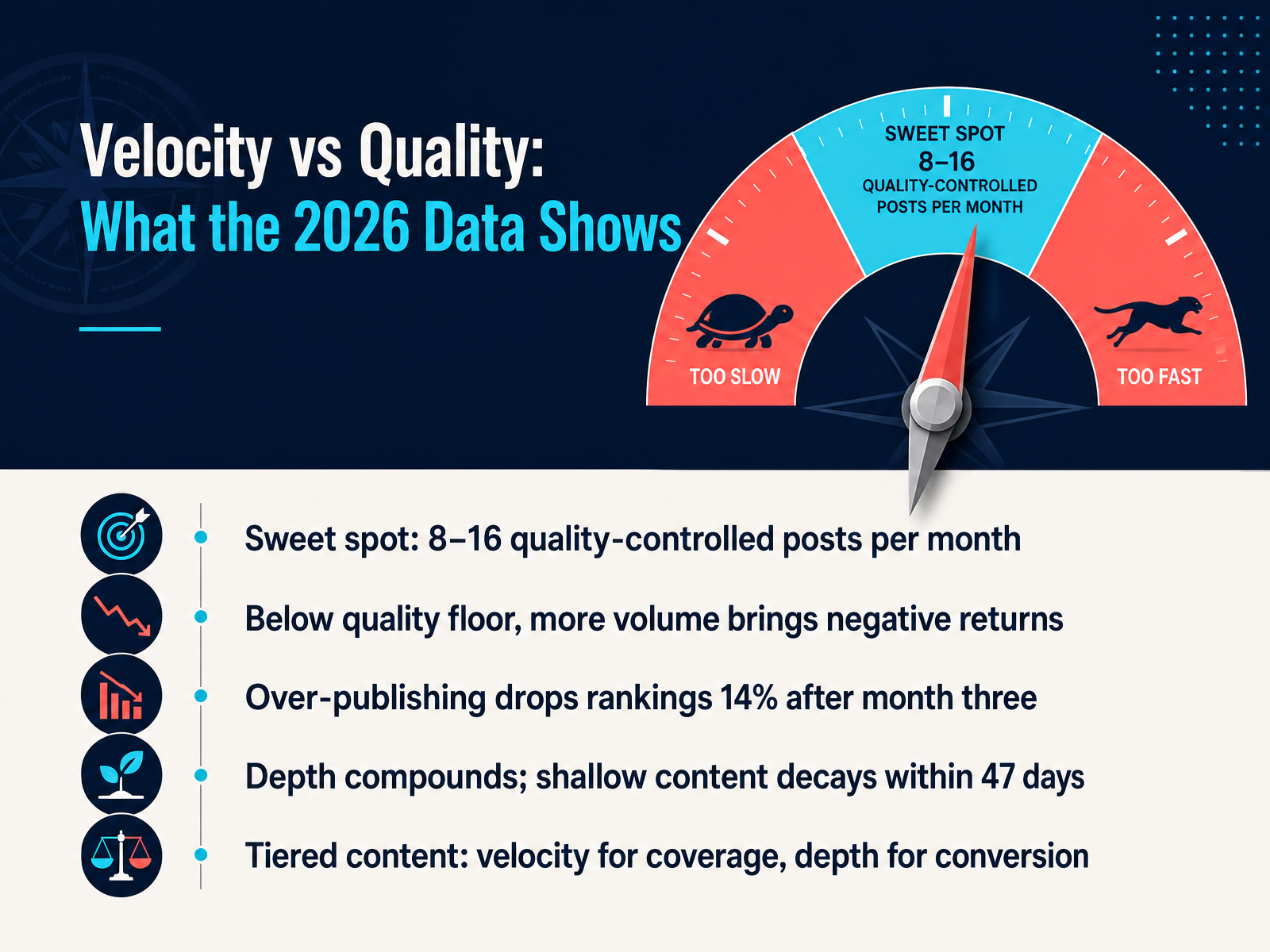
 - 07Velocity vs Quality: What the 2026 Data ShowsLet’s talk about what the 2026 data actually says about velocity versus quality. The sweet spot is real: eight to sixteen quality-controlled posts per month. That’s where traffic compounds. Below eight, you stall. Below four, over seventy percent of sites see flat or declining organic traffic. On the flip side, push past twenty-four posts, and rankings drop fourteen percent after month three. Over-publishing triggers the quality floor collapse — thinner posts, fewer sources, weaker internal links — and the whole site pays the price. Depth compounds. Shallow content decays in about forty-seven days. But here’s the key: velocity is for coverage, depth is for conversion. Publish frequently to build topical presence across clusters, but invest real depth in the pages that need to convert. The takeaway: find the band between eight and sixteen, keep every post above the quality floor, and let cluster depth do the heavy lifting. Next, let’s look at when content marketing takes the lead — and when it should step back.
 winsomemarketing.comeditorialge.comphantom-iq.com+22 min
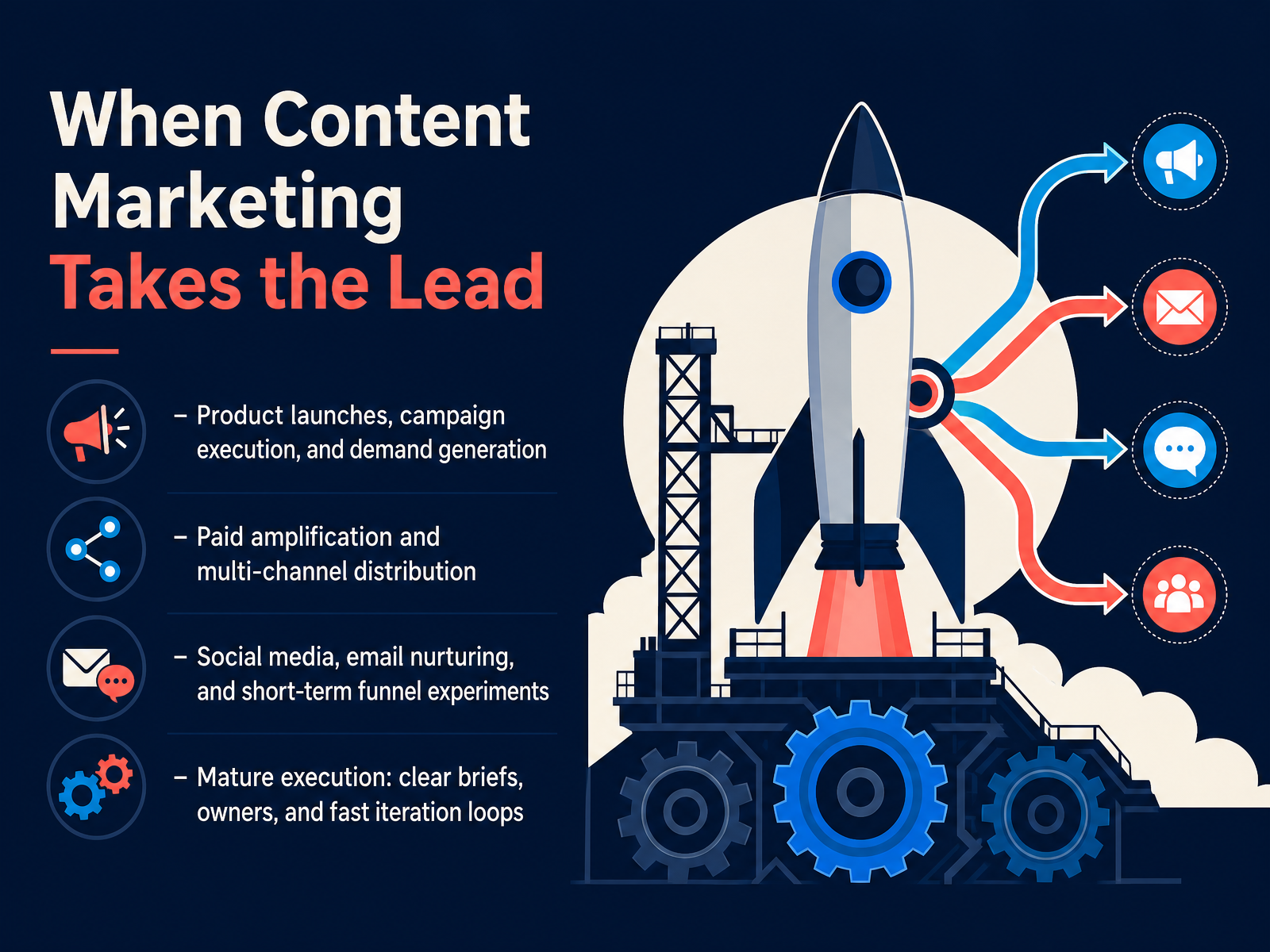
 - 08When Content Marketing Takes the LeadSo when does content marketing get to drive? When you have a product launch, a campaign with a hard deadline, or a demand-generation target that you need to hit this quarter. This is execution mode. Your focus shifts to paid amplification, multi-channel distribution, social media, email nurturing, and short-term funnel experiments. You are moving fast, iterating on what works, and scaling what gets clicks. The key here is mature execution. That means clear briefs, named owners, and fast iteration loops, so every asset has a purpose and no one is waiting for approval. In this mode, the strategy is already locked. Your job is to make the content perform. Think of it as the sprinter on the track, while strategy built the lane. When you're in campaign mode, let marketing sprint. If you have your briefs, your owners, and your loop, you're ready to run. But when the goal itself is unclear, that's when you stop sprinting and start mapping. That's exactly what we'll look at next, when content strategy must come first.
 wgcontent.comcontentmarketinginstitute.combritannica.com+21 min
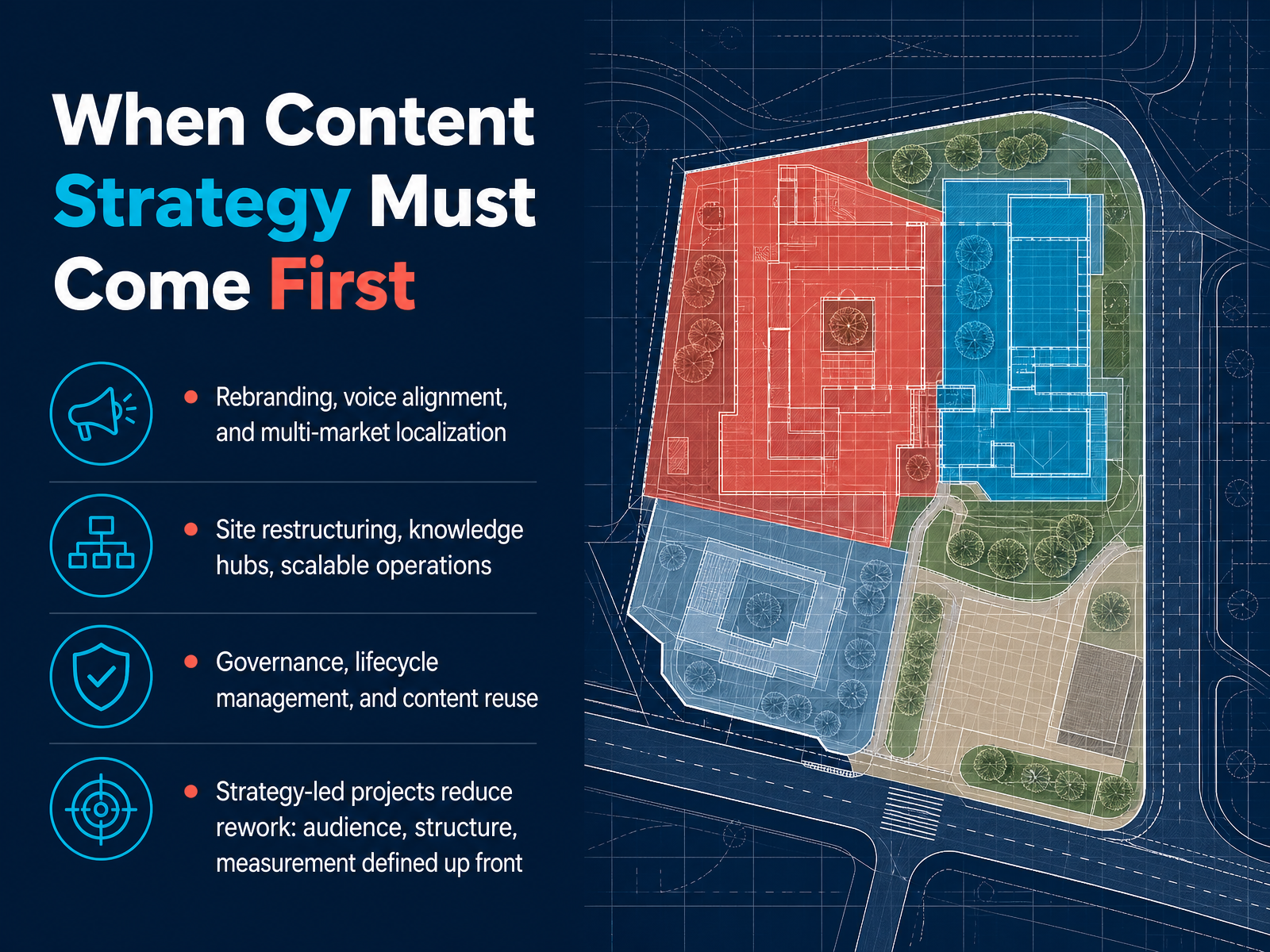
 - 09When Content Strategy Must Come FirstHere's the critical question: when does strategy need to come before tactics? When the foundation itself is shifting. Think rebranding, voice alignment, entering new markets with localization requirements. Or when you're restructuring your entire site, building knowledge hubs, or trying to scale operations across regions. Governance, lifecycle management, content reuse—these aren't tasks you can bolt on after the campaign's running. They need to be architected from the start. A strategy-led approach means you've defined the audience, the structure, and the measurement before you write a single brief. That's what separates a one-off push from a sustainable system. The payoff? Dramatically less rework. If you don't define the voice first, every localization team invents its own. If you don't structure the knowledge hub before you populate it, you'll be reorganizing for months. So the rule of thumb is simple: if the change touches how content is organized, governed, or reused, strategy absolutely comes first. Now, let's talk about the engine that makes strategy executable at scale.
 turboaudit.ai1 min
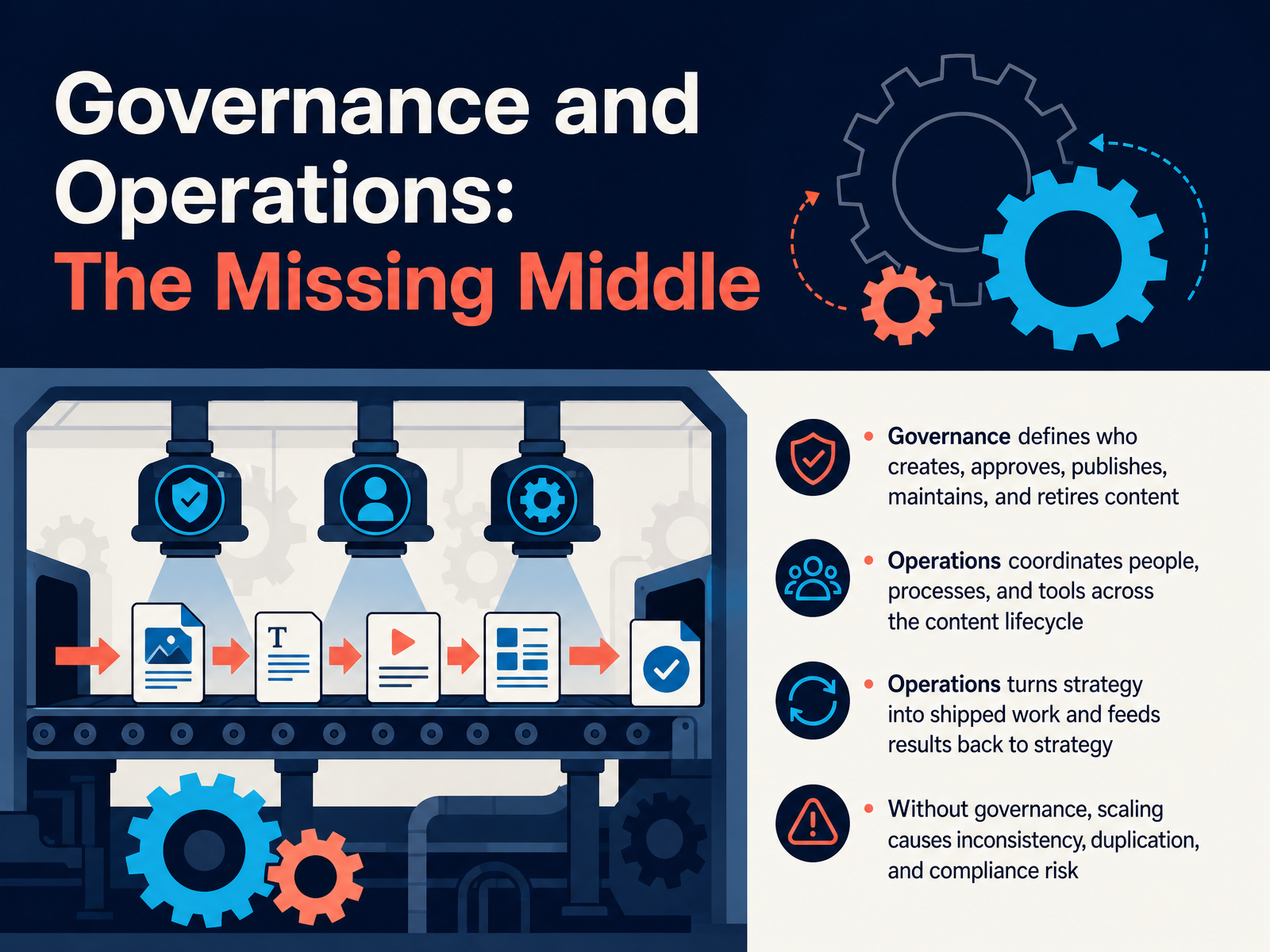
 - 10Governance and Operations: The Missing MiddleHere's where strategy often meets its breaking point. You can have a brilliant content strategy, but without governance and operations, it dies in the chaos of daily execution. Governance defines who creates, approves, publishes, maintains, and finally retires content. Operations coordinates the people, processes, and tools across that entire lifecycle. Think of governance as the rules of the road, and operations as the traffic control system. Operations is what turns strategy into shipped work, and it also feeds performance results back into strategy, so the loop keeps improving. But here's the hard truth: without governance, scaling content production leads to inconsistency, duplication, and serious compliance risk. You've seen it happen—brand voice drifting, teams creating overlapping pieces, and legal issues surfacing only after publication. The mature teams treat this as a distinct function, not an afterthought. They document who owns what, map every stage from ideation to retirement, and enforce standards through real workflows, not just a style guide in a shared drive. The takeaway is simple: strategy sets direction, but governance and operations make it repeatable at scale. Now, let's look at how this all fits together into a layered operating model.
 turboaudit.ai1 min
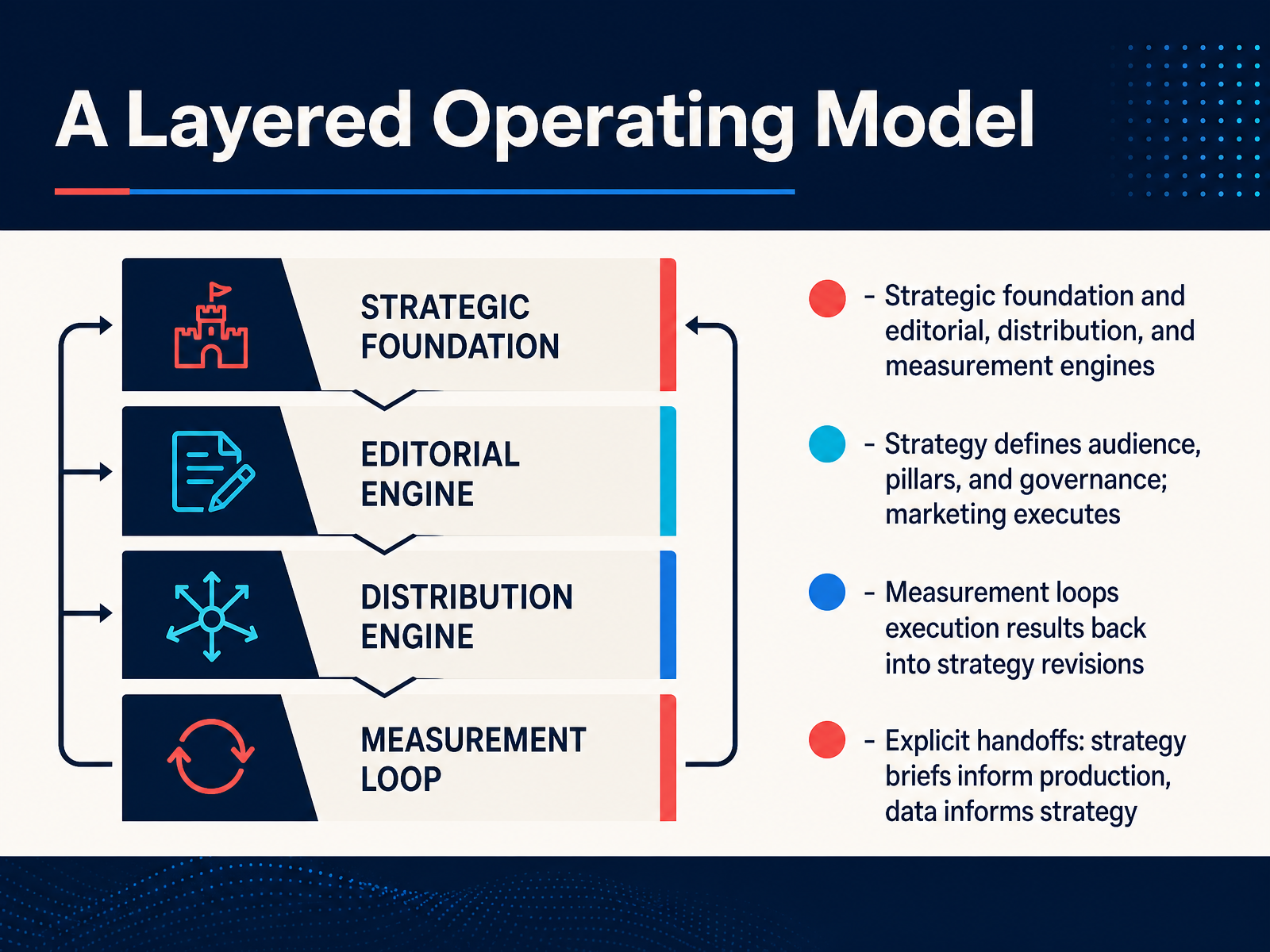
 - 11A Layered Operating ModelHere is where strategy and execution actually come together. The operating model is a layered system: a strategic foundation, with editorial, distribution, and measurement engines running on top of it. Strategy defines the audience, the content pillars, and the governance rules. Marketing executes against those definitions. But it is not a one-way street. Measurement loops execution results back into strategy, so the plan gets revised based on what the data actually says. The key is making the handoffs explicit. A strategy brief informs production. Production data informs the next strategy revision. That is the loop. No interpretation, no guessing. If your handoffs are fuzzy, your results will be too. The takeaway: strategy sets the direction, execution builds the momentum, and measurement keeps the whole thing honest.
 scalegrowth.digitalbrexconsulting.com1 min
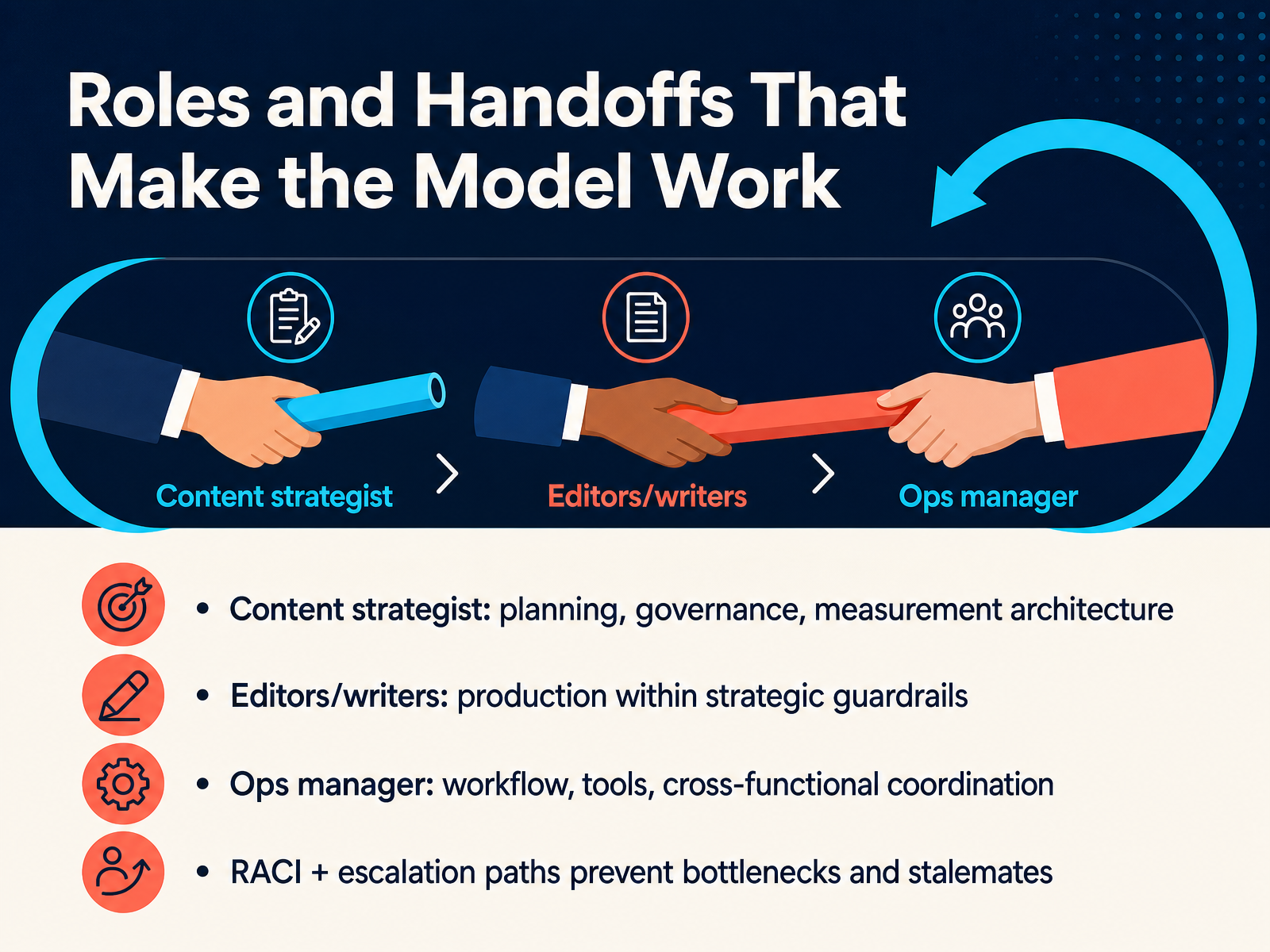
 - 12Roles and Handoffs That Make the Model WorkSo how does this actually work in practice? It comes down to four roles that keep the engine running. The content strategist owns the why: planning, governance, and how you measure success. They set the guardrails. Then editors and writers produce within those guardrails, so creativity doesn't drift off strategy. The ops manager is the connective tissue: they manage the workflow, the tools, and the cross-functional coordination that keeps legal, sales, and product from becoming bottlenecks. And finally, a RACI matrix with clear escalation paths. That's your anti-stall mechanism. When a subject matter expert and the brand team disagree on tone, you need to know who makes the call before the project grinds to a halt. Without these roles and handoffs, you get approval by committee and content that's efficiently pointless. With them, you get momentum. Here's the takeaway: strategy sets direction, operations removes friction, and governance prevents gridlock. Now let's talk about diagnosing your current state, so you can see which of these pieces you're missing.
 scalegrowth.digitalbrexconsulting.comturboaudit.ai1 min
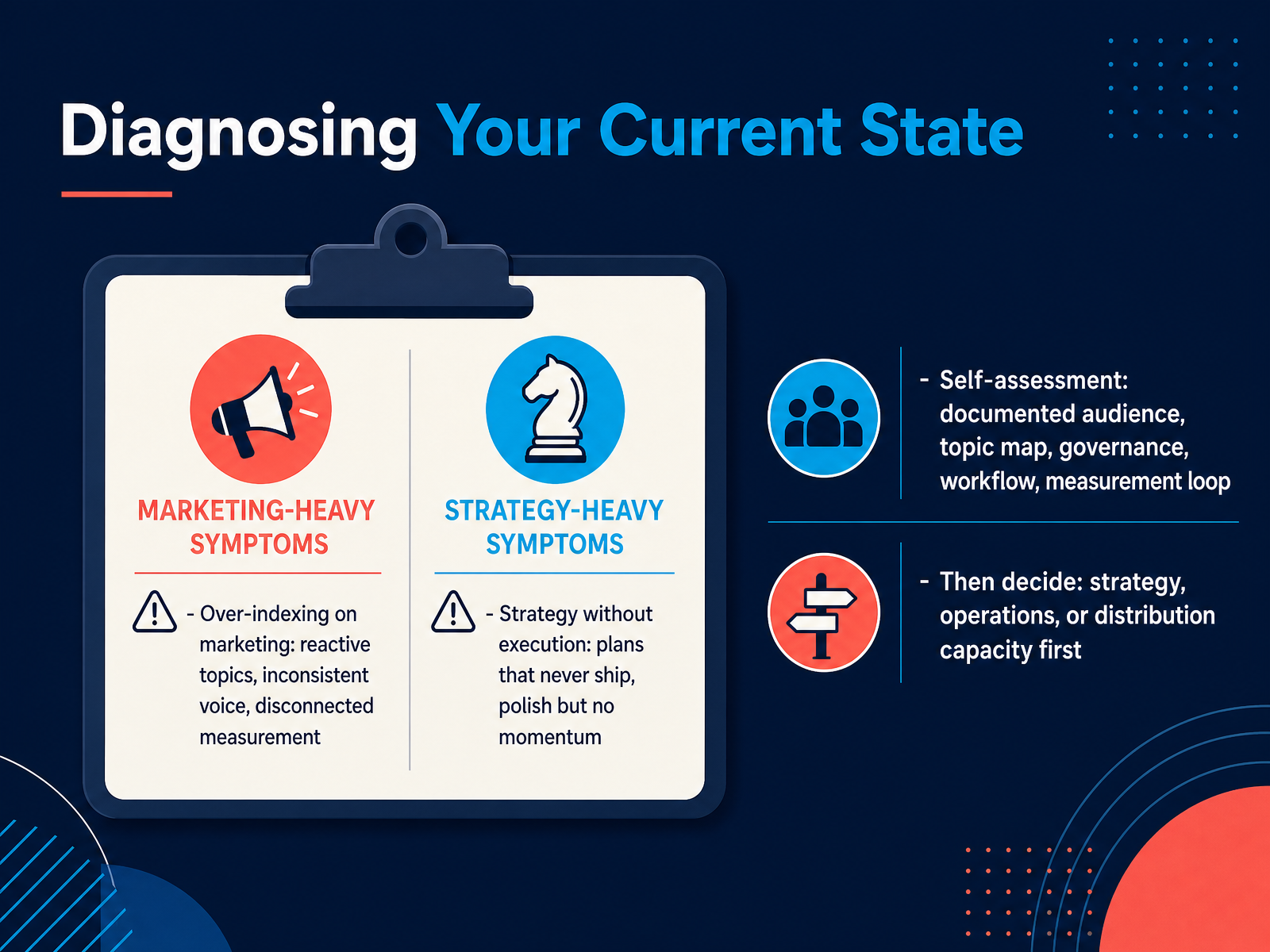
 - 13Diagnosing Your Current StateLet’s be honest about where your content operation actually stands today. If you’re over-indexing on marketing, you likely see reactive topics, an inconsistent brand voice, and measurement that doesn’t connect to outcomes. On the flip side, if you have strategy without execution, you have polished decks that never ship and momentum that fizzles out. So, run a quick self-assessment. Is your audience documented? Do you have a topic map that guides every piece? Is governance clear—who owns each decision? Is your workflow repeatable? And is there a real measurement loop that feeds back into the plan? Once you have those answers, the decision gets simpler. You don’t fix everything at once. You pick the bottleneck. If strategy is thin, invest there first. If production is chaotic, fix operations. If great content goes nowhere, build distribution capacity. That sequence is your roadmap. Now here’s the good news: you don’t need a huge overhaul to start. Your next move is to start small—one artifact, one loop, one pilot—to build momentum before you scale.
 scalegrowth.digitalbrexconsulting.com2 min
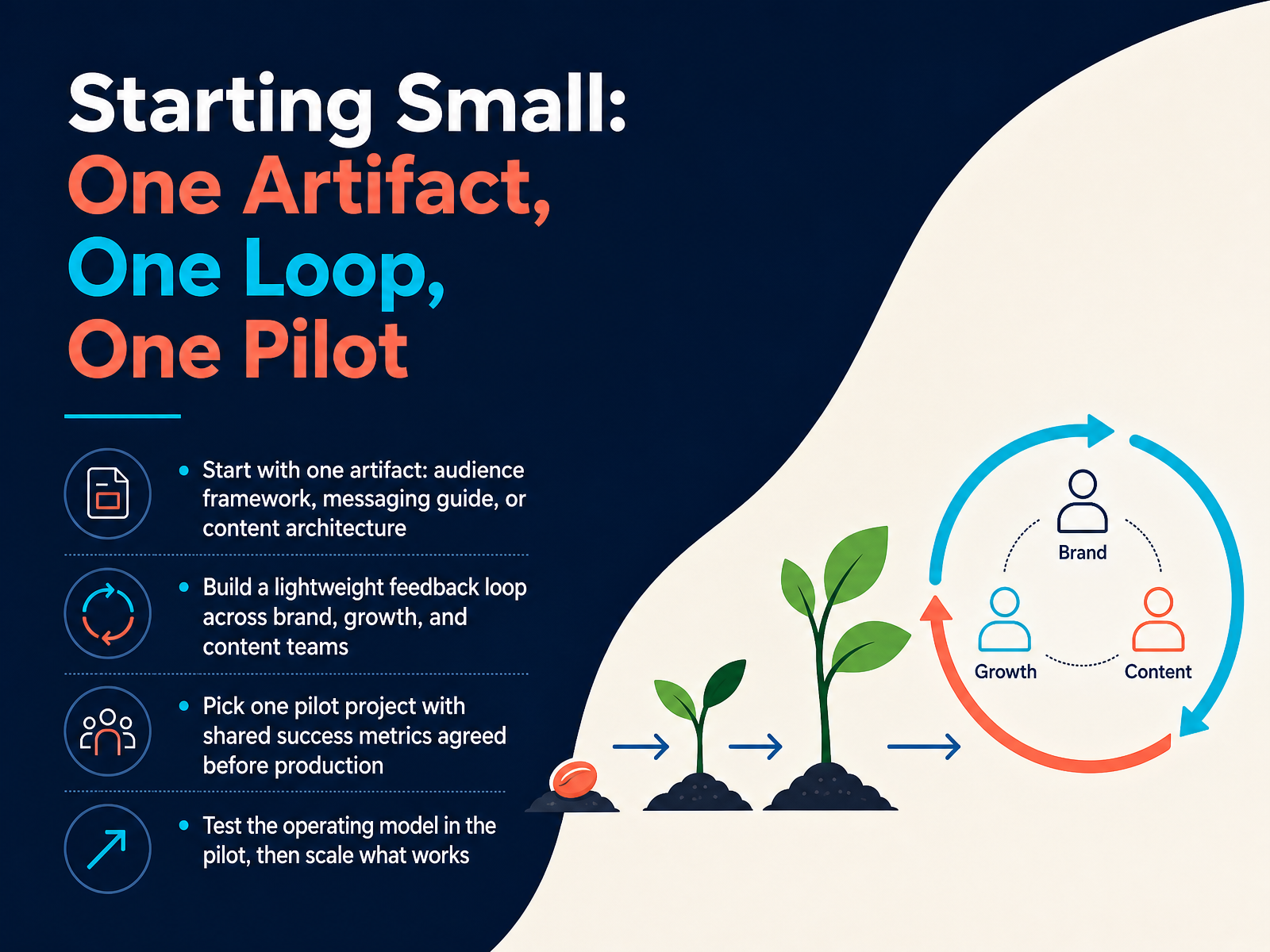
 - 14Starting Small: One Artifact, One Loop, One PilotSo don't try to overhaul everything at once. Start with one strategic artifact. Pick an audience framework, a messaging guide, or a content architecture. Just one. That's your anchor. Next, build a lightweight feedback loop across brand, growth, and content teams. A monthly check-in where each team shares what they're seeing and what they need. No heavy process, just a rhythm. Then choose one pilot project. A single campaign, a single content pillar, a single product launch. And here's the key: agree on the success metrics before you produce anything. Not after. That shared definition of done is what keeps the strategy and the execution aligned. Run your operating model inside that pilot. See where the approvals stall, where the feedback flows, and where the clarity breaks down. Then scale what works and drop what doesn't. In short, one artifact, one loop, one pilot, and let the results earn the bigger rollout. Now, let's move on to the practical next steps and templates that can help you put this into action right away.
 scalegrowth.digitalbrexconsulting.com1 min
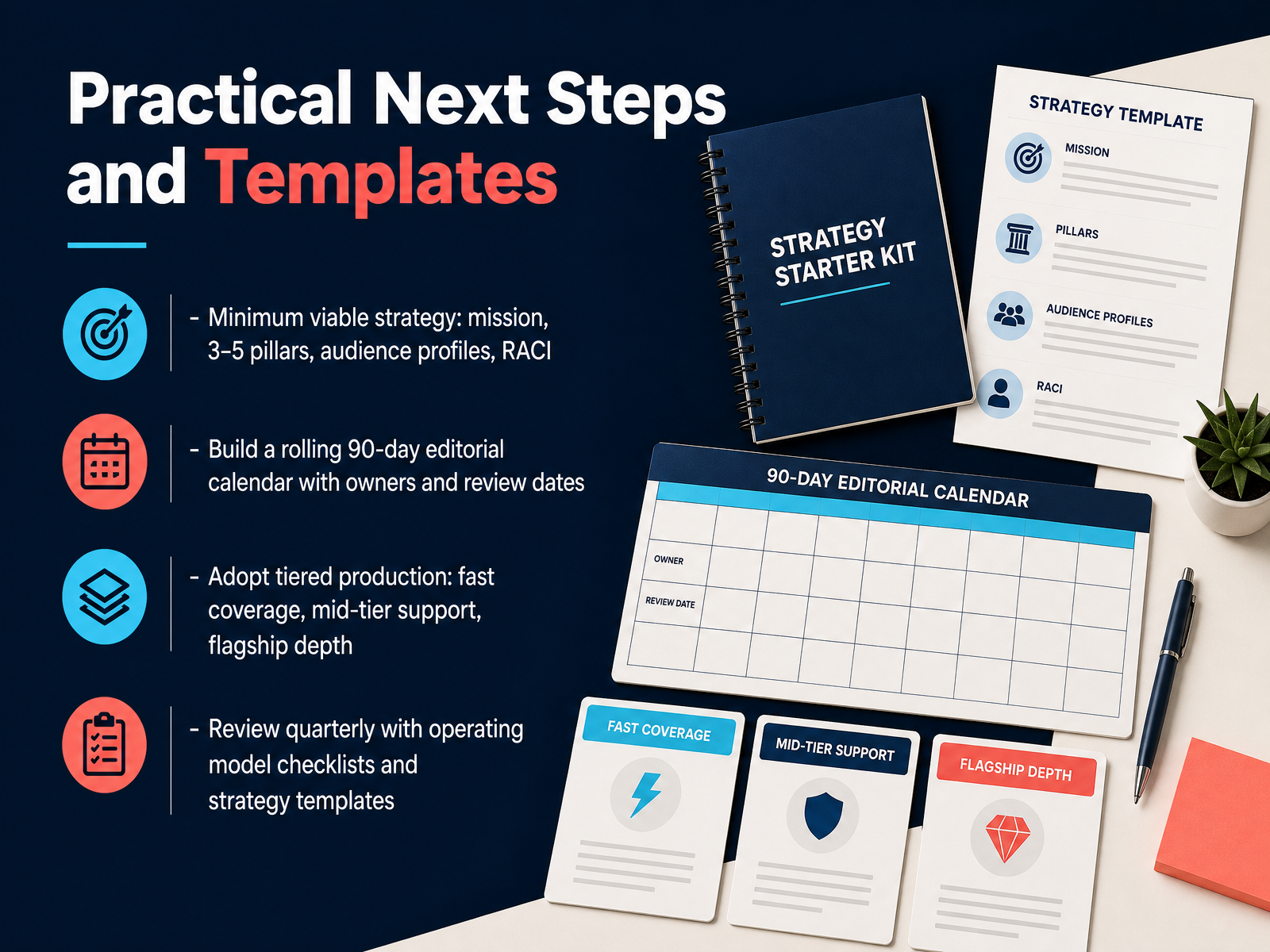
 - 15Practical Next Steps and TemplatesWe've covered the frameworks. Now let's make it real. Your first step is a minimum viable strategy. You don't need a hundred-page deck. Capture four things: your content mission, three to five pillars you'll own, audience profiles, and a RACI matrix. That's your operating system. Next, build a rolling ninety-day editorial calendar. Every piece has an owner, a deadline, and a review date. No owner, no piece. Now think about production. Adopt a tiered model. Fast coverage for news and quick wins. Mid-tier support for your core topics. And flagship depth for the pieces that define your authority. Finally, review quarterly. Use an operating model checklist and a strategy template. Ask what's working, what's not, and what needs to change. The template is a living document, not a static deck. Here's your takeaway. Strategy without operations stays in a deck. Operations without strategy is efficiently pointless. Build the minimum, schedule the work, tier your production, and review every quarter. That's how you turn this training into a system that compounds. Thanks for your time. Now go build it.
 scalegrowth.digitalbrexconsulting.comrubicon.cx+21 min
Take the deck with you
Download this course as a file — free, no sign-up needed.
- PDF handoutEvery slide page, ready to print or share.16 pages · 3.9 MBDownload
- Narrated PowerPointThe deck that presents itself — every slide carries the digital human's narration video.16 pages · 14.5 MBDownload
- PowerPoint slidesThe full deck as a .pptx — open it in PowerPoint, Keynote, or Google Slides.16 pages · 3.8 MBDownload
Free to use in your own training — please keep the PersonWise credit page at the end.
Have your own deck? Turn it into a course
Sources consulted
Web sources consulted while building this course.
- Content Strategy vs Content Marketing | Conte Studios — contestudios.com
- Content Marketing vs Content Strategy: Key ROI Differences - RiseOpp — riseopp.com
- Content Strategy vs Content Marketing Explained: Insights | Ankord — ankordmedia.com
- Content Strategy vs. Content Marketing: What's the Difference? | Thogt — thogt.io
- Content strategy and content marketing are different disciplines, most orgs conflate them and pay for it · a builder's codex — abcodex.iamkesava.com
- Content Strategy Activities & Deliverables — rubicon.cx
- Content Strategy: The Complete 2026 Guide | TurboAudit — turboaudit.ai
- Content Strategy Template: 10-Section Framework - Scale Growth Digital — scalegrowth.digital
- Ultimate Content Strategy Framework | DAP — digitalauthority.me
- Content Strategy Template for a Revenue-Driven Roadmap — brexconsulting.com
- Content Velocity vs. Content Depth: The Quality-Quantity Paradox — winsomemarketing.com
- Content Velocity vs Content Quality: The 2026 Data-Backed Answer — editorialge.com
- Content Velocity vs. Content Quality: Finding the Balance | Phantom IQ Insights — phantom-iq.com
- Content Velocity or Content Quality | Contentia — contentia.co
- The Hidden Tension Between Speed and Depth — easycontent.io
- Content strategy vs. content marketing: What's the difference? - WG Content — wgcontent.com
- What Is Content Marketing? — contentmarketinginstitute.com
- Content marketing — britannica.com
- Content Strategy: Definition, Framework & 2026 Guide | theStacc Glossary — thestacc.com
- How to Create a Content Strategy That Drives Results — online.hbs.edu