Begin
14 pages · ~28 min
Recruiting Users for User Research
Learn a practical workflow for recruiting the right users for user research, ideal for UX researchers and product teams seeking reliable study participants.
A digital instructor presents all 14 pages. Hold “Ask” at any point and ask out loud — the answer comes from this course. No sign-up needed.
What you’ll learn
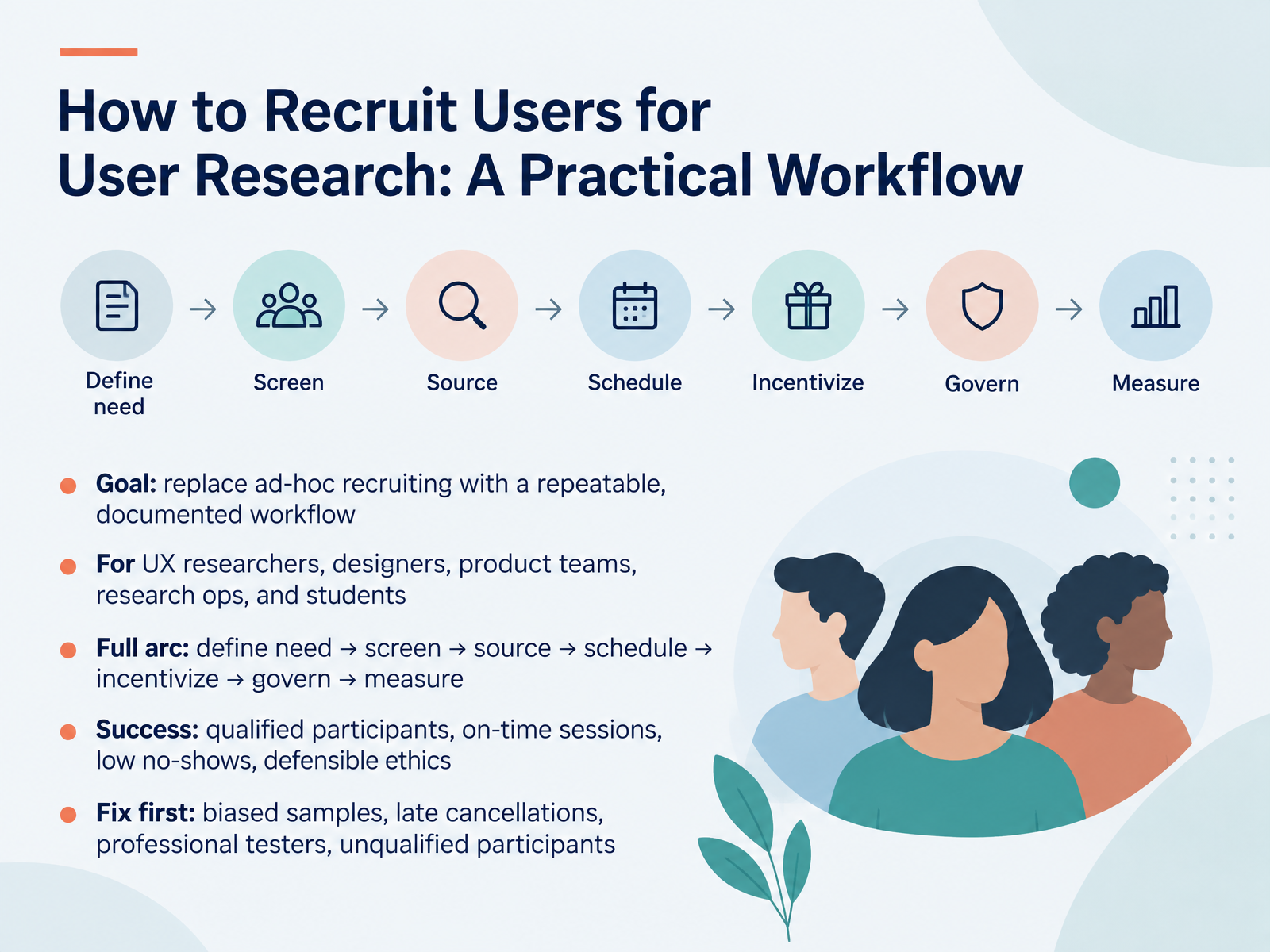
- 01How to Recruit Users for User Research: A Practical WorkflowWelcome. In this course, we build a recruiting workflow you can reuse, not improvise. Whether you're a UX researcher, a designer, a product team member, a research ops lead, or a student, the goal is the same: replace ad-hoc recruiting with a repeatable, documented process.
Here's the full arc we'll cover. Define the need, screen participants, source them, schedule sessions, incentivize fairly, govern ethics, and measure results. Success looks concrete: qualified participants, sessions on time, low no-shows, and ethics you can defend in a review.
We'll also fix the problems you probably recognize. Biased samples. Late cancellations. Professional testers. People who don't actually match your target user. These aren't rare failures. They come from having no system, so we'll build one step by step.
Start with the research need, not the recruiting list.nngroup.comnngroup.comnngroup.com+22 min
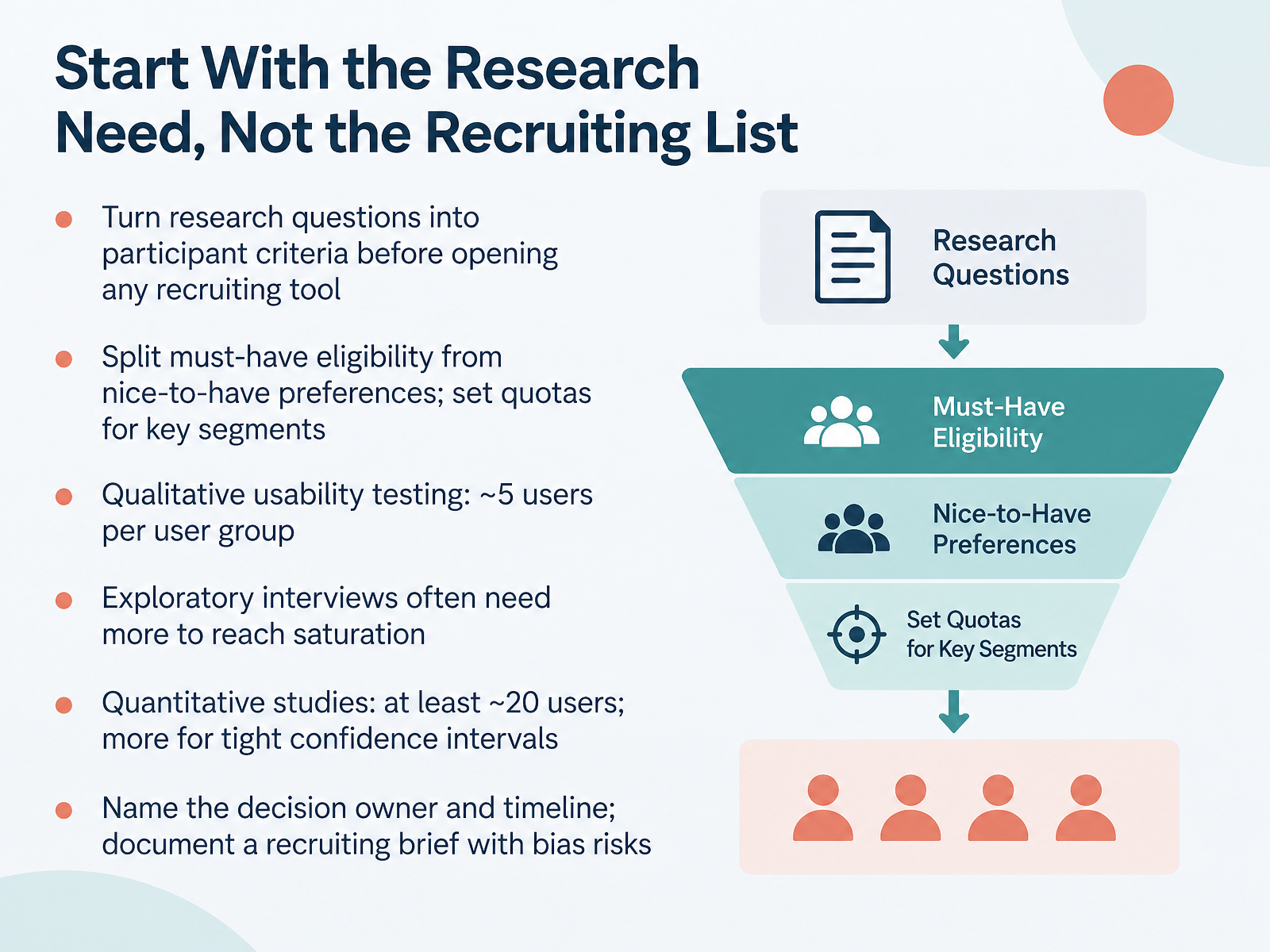
- 02Start With the Research Need, Not the Recruiting ListBefore you open any recruiting tool, start with the research need. Turn your research questions into participant criteria first. Then split must-have eligibility from nice-to-have preferences, and set quotas for the key segments that matter. Here is the trap I see often: teams build a recruiting list before they agree on who they actually need, and bias creeps in fast. For sample size, match the method. Qualitative usability testing usually works with about five users per user group. Exploratory interviews often need more to reach saturation, so start with five or six and analyze as you go. Quantitative studies need at least twenty users, and more if you want tight confidence intervals. Finally, name the decision owner and the timeline, and write a short recruiting brief that documents your criteria and known bias risks. That brief keeps everyone honest when the list gets long. Next, we look at Writing Screeners That Actually Filter.
 nngroup.comnngroup.comnngroup.com+22 min
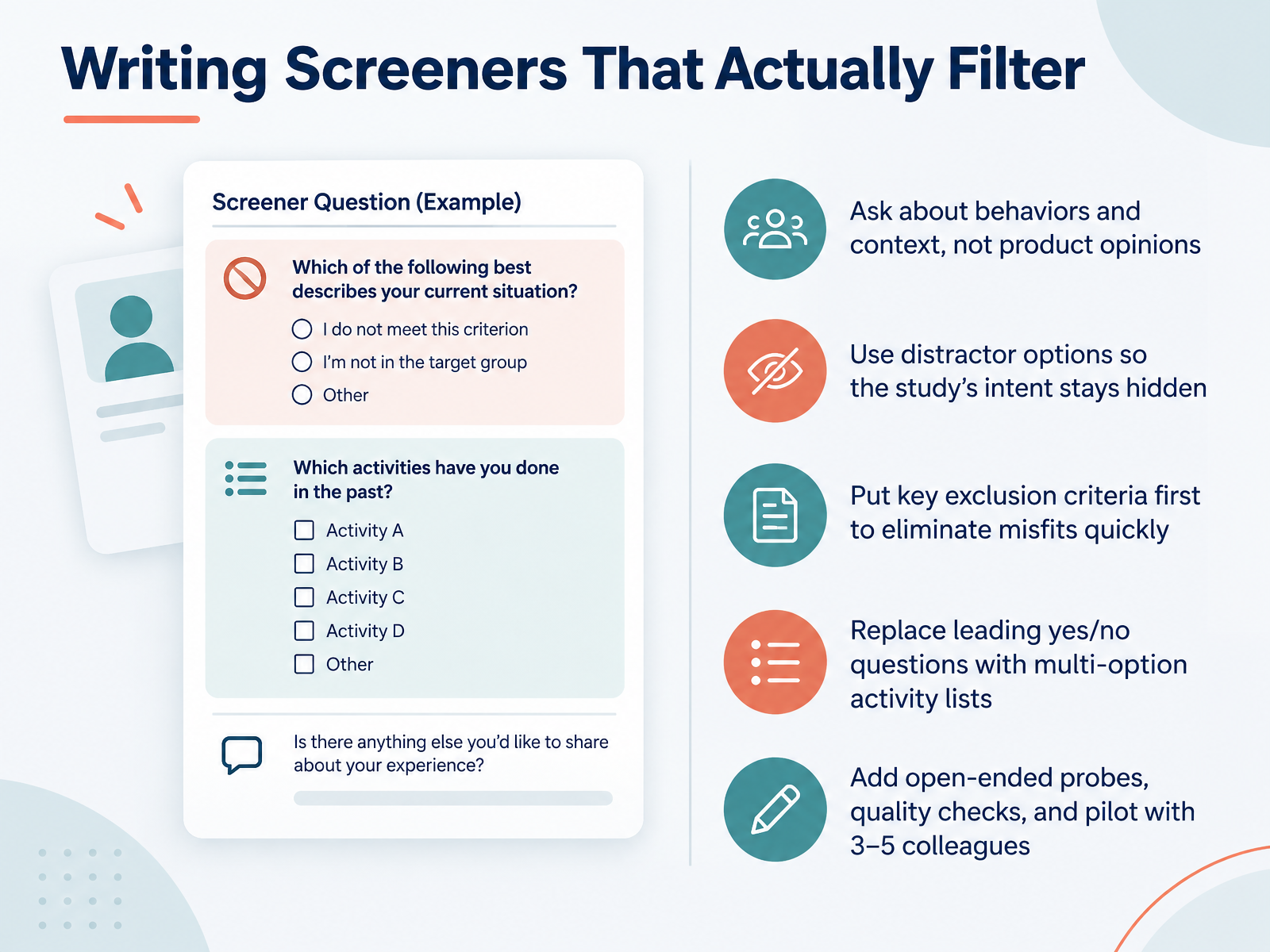
- 03Writing Screeners That Actually FilterNow let's write a screener that actually filters. Start by asking about behaviors and context, not product opinions. Instead of do you like this app, ask which activities they did in the last four weeks, and offer a list that includes distractors, like hiking, reading, and streaming music. Distractors keep your study intent hidden and prevent respondents from gaming the questionnaire. Put your key exclusion criteria first, so obvious misfits drop out early. Replace leading yes or no questions with multi-option activity lists, because a yes or no question telegraphs the answer you want. Add open-ended probes to check whether someone can articulate their experience, and watch for answers like abc typed into a text box. Then pilot with three to five colleagues and ask them to try to sneak through without being eliminated. That reveals the holes fast. Next, we'll look at sourcing channels and where participants actually come from.
 nngroup.comnngroup.comnngroup.com+22 min
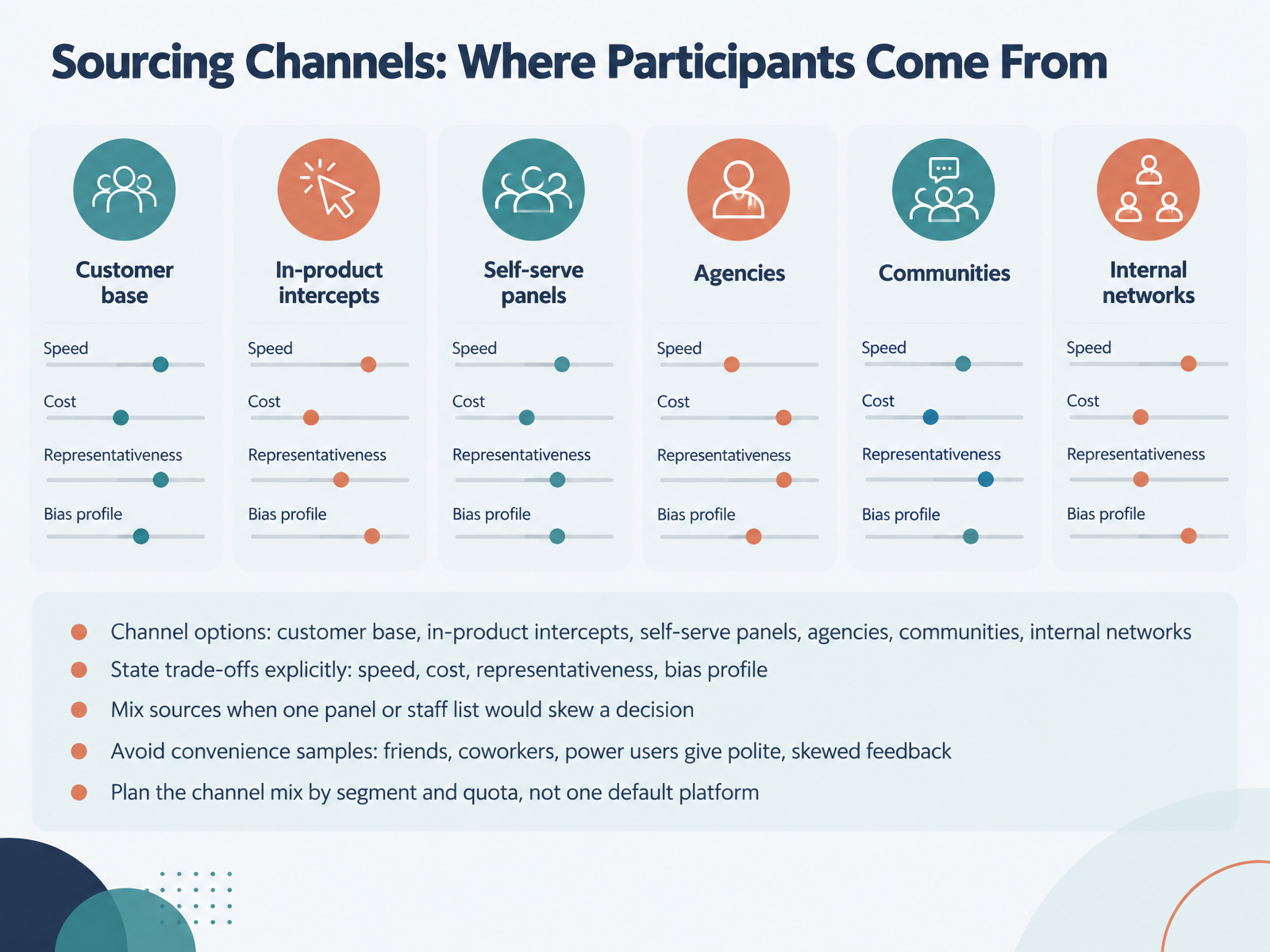
- 04Sourcing Channels: Where Participants Come FromNext, decide where your participants actually come from. You have real options: your customer base, in-product intercepts, self-serve panels, agencies, communities, and internal networks. Each one trades speed against cost, representativeness, and bias. State those trade-offs in your plan before anyone books a session. Mix sources when a single panel or staff list would skew the decision. And skip convenience samples. Friends, coworkers, and power users give polite, skewed feedback that flatters the design and hides the problem. Instead, plan the channel mix by segment and quota, not one default platform. For example, pair an intercept with a panel to cover both current users and newcomers. Now let's look at choosing a platform or agency in 2026.
 greatquestion.comcleverx.comcleverx.com+21 min
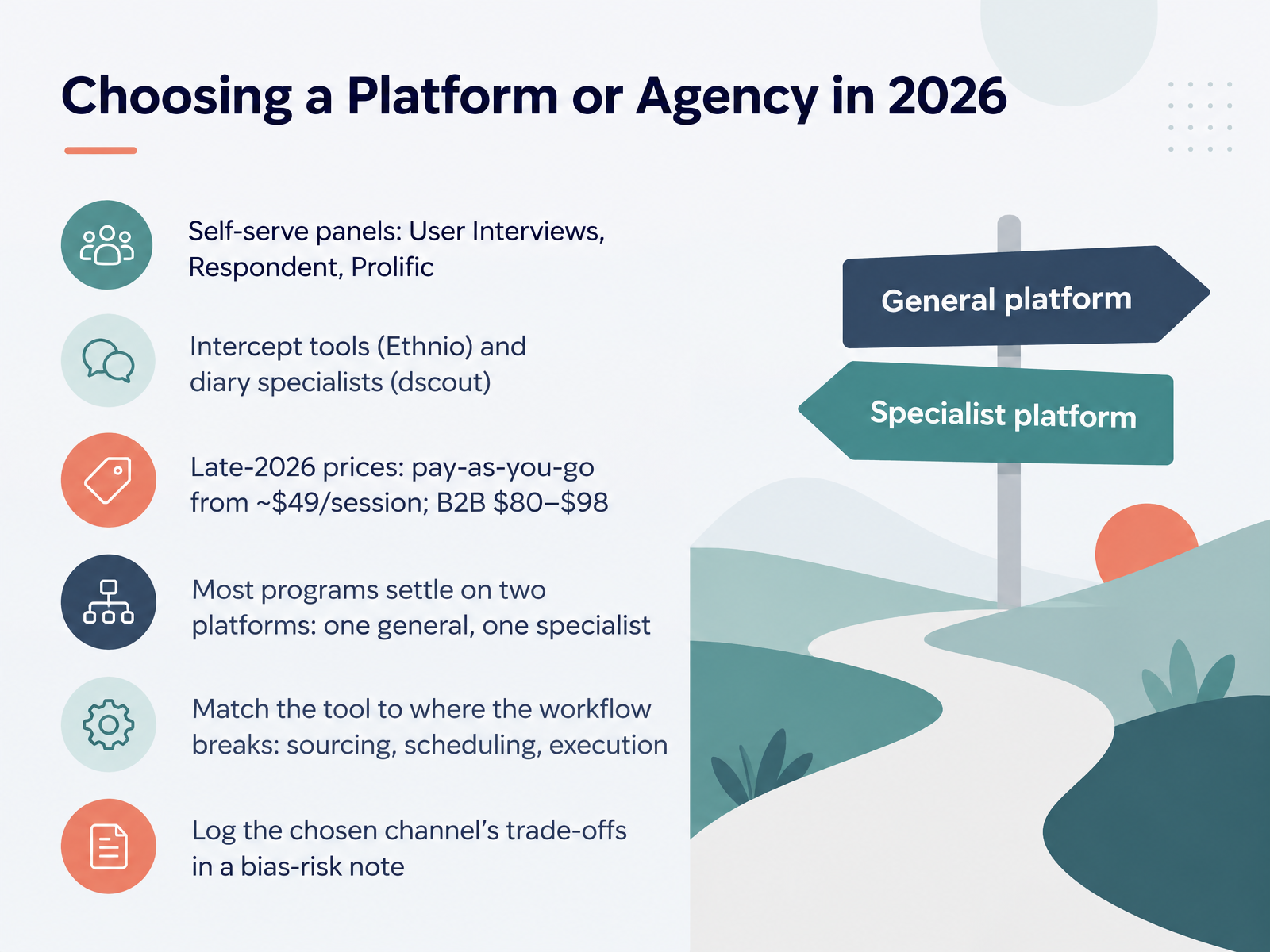
- 05Choosing a Platform or Agency in 2026Next, choose your platform or agency. First, diagnose where your workflow breaks: sourcing, scheduling, or execution. If you need broad B2B and B2C sessions, start with User Interviews or Respondent. For fast, low-cost unmoderated tasks and surveys, Prolific is a solid fit. Need intercepts from your own product? Use Ethnio. Running diary or longitudinal studies? That is dscout. On late twenty twenty-six pricing, expect pay-as-you-go from about forty-nine dollars per session, with B2B sessions typically eighty to ninety-eight dollars. Here is the pattern most programs land on: two tools, one general and one specialist. Log the trade-offs of your chosen channel in a bias-risk note, especially if a single panel distorts who you reach. Before you sign anything, check the vendor's own pricing page, because prices move. Now let's look at building and maintaining an in-house participant pool.
 greatquestion.comcleverx.comcleverx.com+21 min
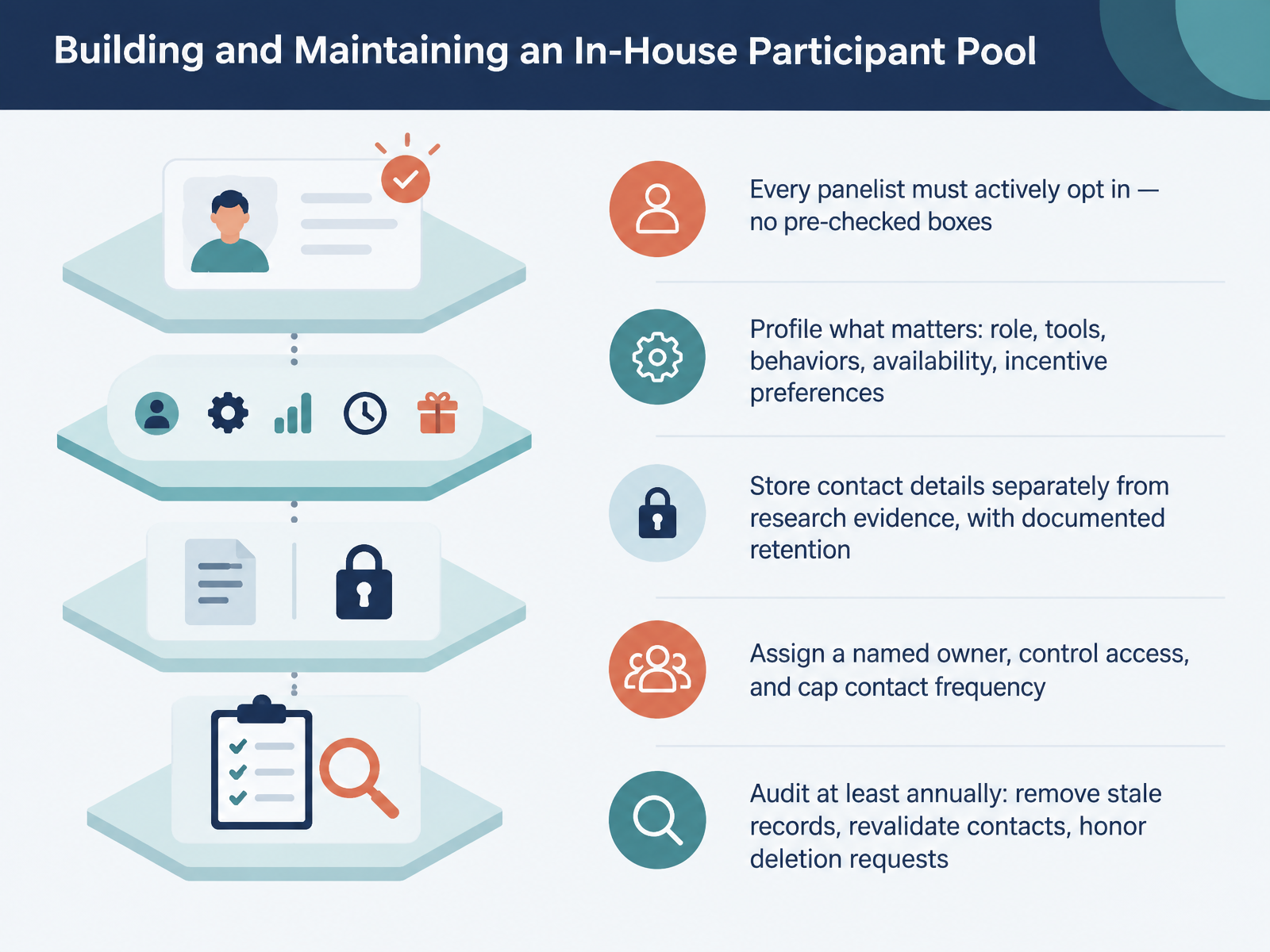
- 06Building and Maintaining an In-House Participant PoolNow let's set up a participant pool that stays healthy. First, build it on real opt-in. Every panelist must actively choose to join. No pre-checked boxes, and no adding people simply because they're customers. People need to know what they're signing up for and how to leave. Next, profile what actually matters for recruiting: role, tools they use, relevant behaviors, availability, and incentive preferences. Keep it proportionate. Don't ask for data you won't use. Then, store contact details separately from research evidence, with a documented retention period. Work with legal or compliance and tell participants how their data will be stored. Assign one named owner. Control who has access, and cap how often any one person can be contacted. Finally, audit at least annually. Remove stale records, revalidate contacts, and honor deletion requests quickly. A panel is living data, not a file you build once. With those safeguards in place, let's move on to scheduling, reminders, and cutting no-shows.
 nngroup.comresearch-operations.comstatic.sched.com+22 min
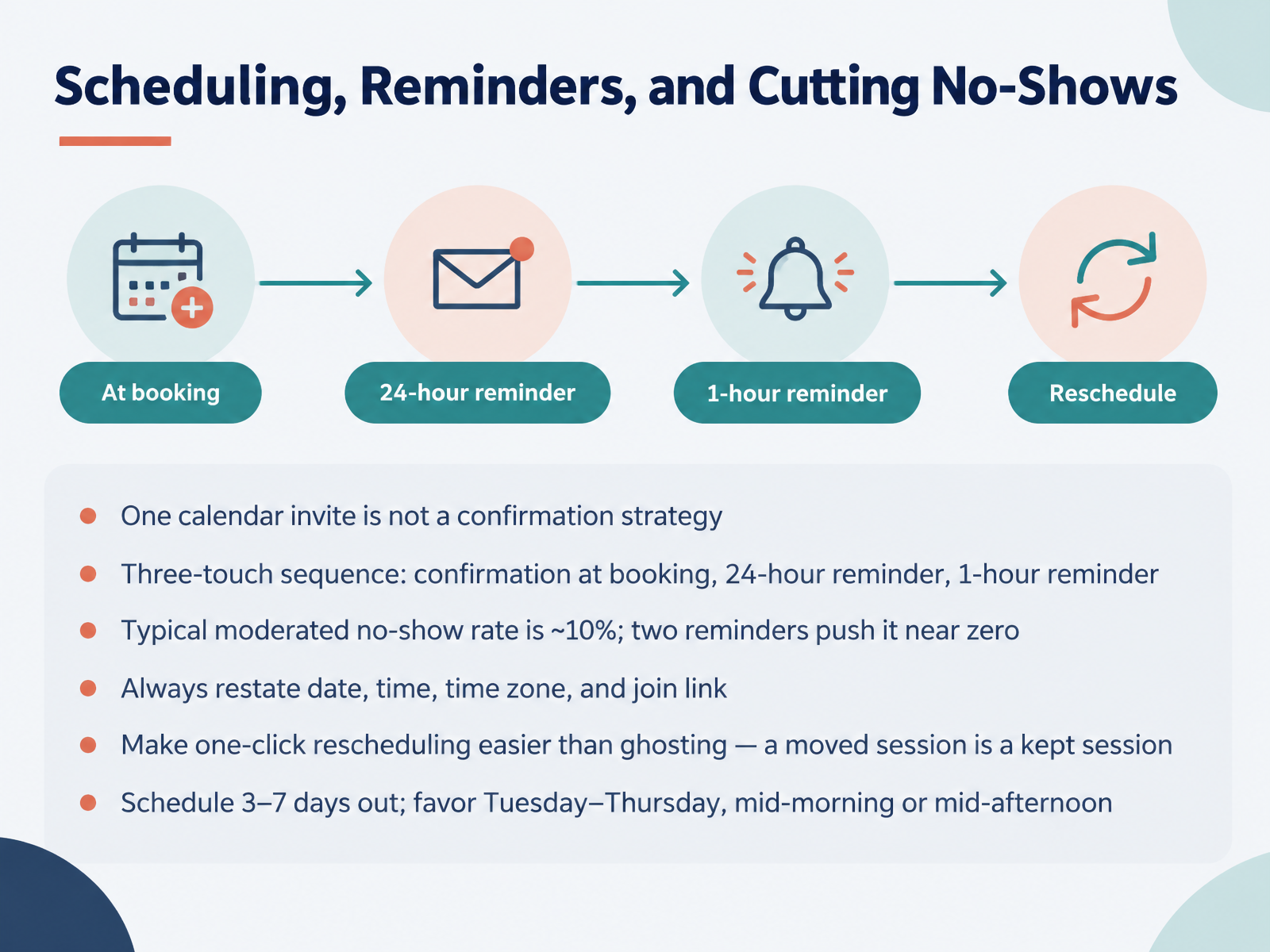
- 07Scheduling, Reminders, and Cutting No-ShowsNow let's talk about keeping the sessions you booked. One calendar invite is not a confirmation strategy. Use a three-touch sequence: a confirmation at booking, a reminder twenty-four hours out, and a short reminder one hour before. The typical no-show rate for moderated research sits around ten percent. Two reminders push it close to zero. In every message, restate the date, the time, the time zone, and the join link. Do not assume they kept the original invite. Then make rescheduling easier than ghosting. Put a one-click reschedule link in every confirmation and reminder. A moved session is a kept session. Finally, schedule three to seven days out, and favor Tuesday through Thursday, mid-morning or mid-afternoon. Motivation decays over longer lead times, and Mondays and Fridays carry more conflicts. Next, let's look at incentives: setting fair and defensible rates.
 1 min
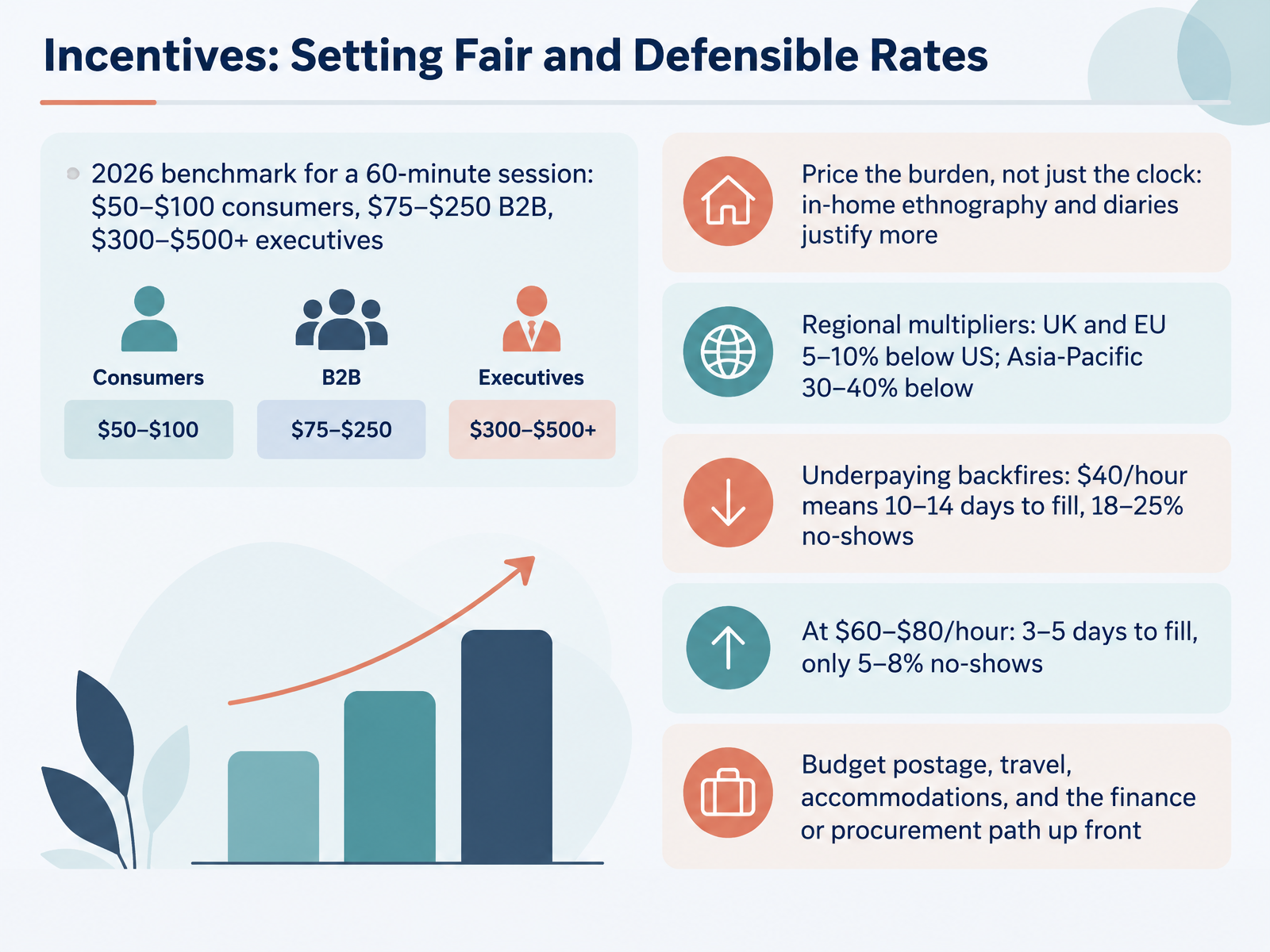
- 08Incentives: Setting Fair and Defensible RatesNow let's talk incentives, and how to set rates that are fair and defensible. Start with a benchmark. For a sixty-minute session in twenty twenty-six, plan on fifty to one hundred dollars for consumers, seventy-five to two hundred fifty for B2B, and three hundred to five hundred or more for executives. Then price the burden, not just the clock. An in-home ethnography or a diary study asks for far more, so it justifies a higher rate. Apply regional multipliers too. The UK and EU run five to ten percent below the US, and Asia-Pacific about thirty to forty percent below. Here is why underpaying backfires. At forty dollars an hour, expect ten to fourteen days to fill your slots, with eighteen to twenty-five percent no-shows. At sixty to eighty dollars an hour, you fill in three to five days, with only five to eight percent no-shows. Finally, budget postage, travel, accommodations, and the finance or procurement path up front, before you recruit. Let's move on to consent, privacy, and special protections.
 2 min
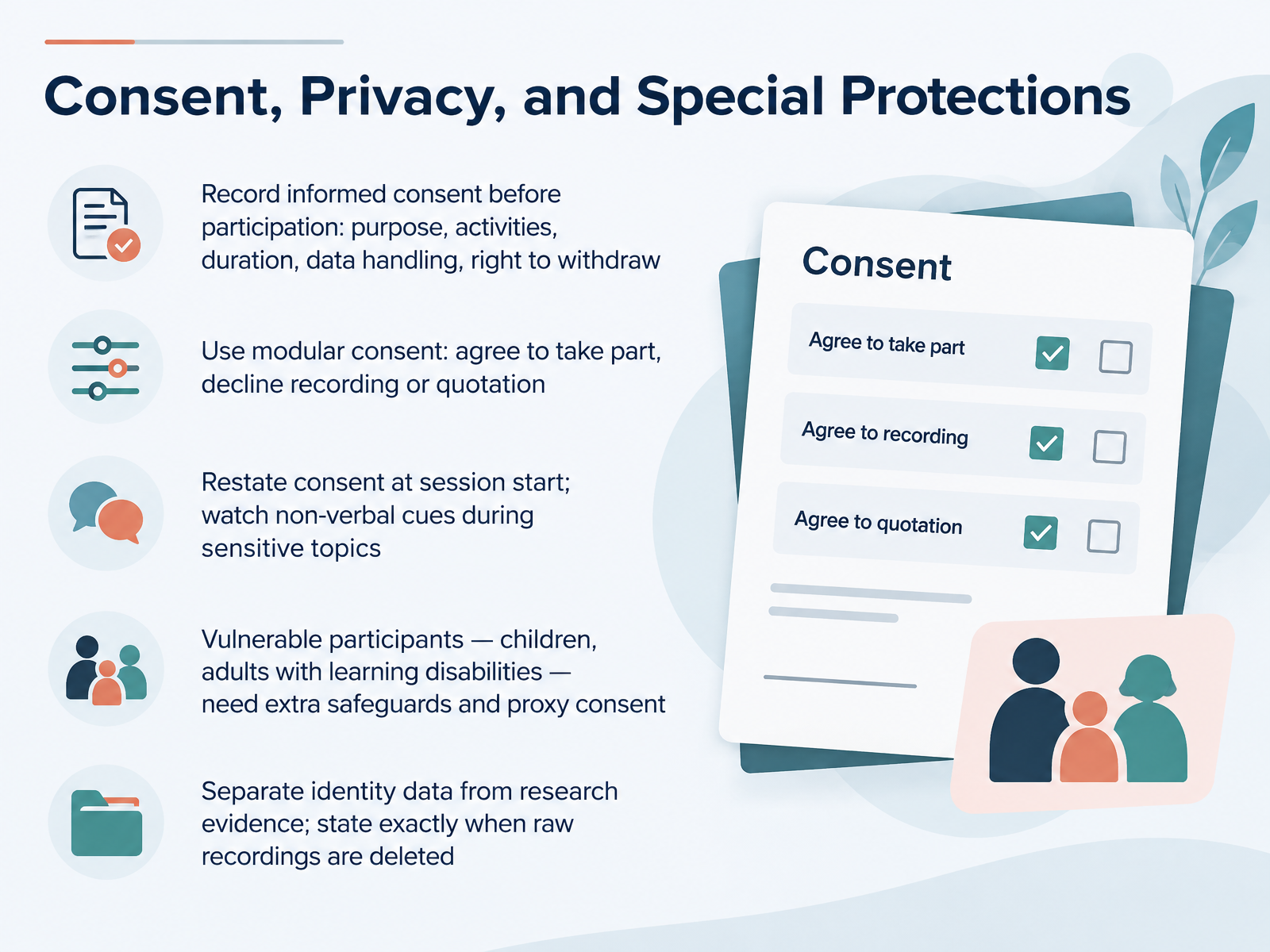
- 09Consent, Privacy, and Special ProtectionsNext, protect your participants with consent and privacy. Before any session, record informed consent covering the purpose, the activities, the duration, how you'll handle data, and the right to withdraw. Use modular consent. Let people agree to take part but decline recording or quotation. That keeps you from losing a good participant over a camera. At the session start, restate consent out loud, and during sensitive topics, watch non-verbal cues. If someone gives one-word answers and looks away, offer a break or ask if they want to stop. For vulnerable participants, such as children or adults with learning disabilities, add safeguards and get proxy consent from a parent or guardian alongside the participant's own agreement. Finally, separate identity data from research evidence, and state exactly when raw recordings are deleted. Write it down, and tell them who to contact to withdraw. That's the baseline. Now let's talk about running the pipeline, tracking and handoffs.
 1 min
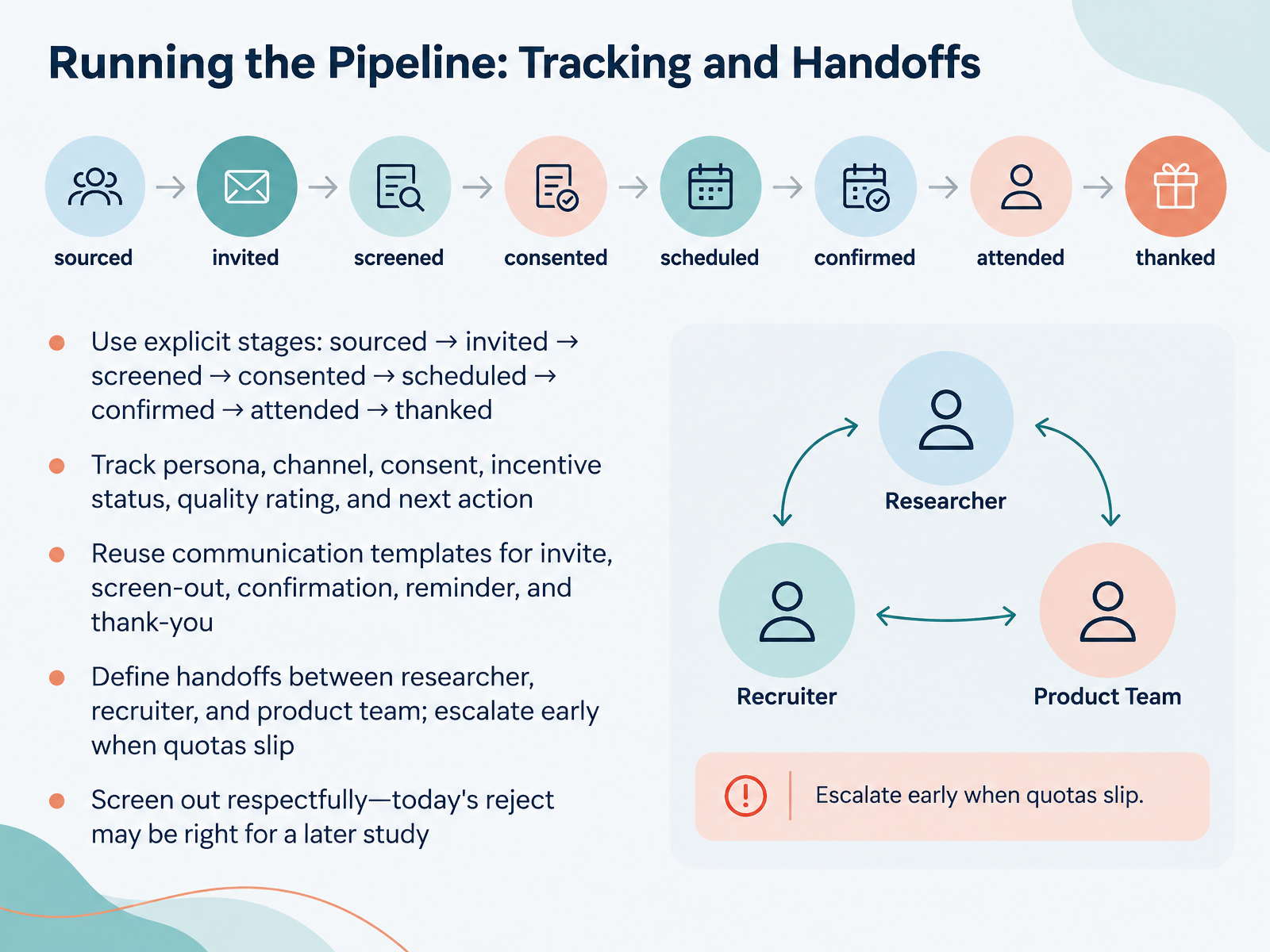
- 10Running the Pipeline: Tracking and HandoffsNow let's talk about running the pipeline. Build one tracker with explicit stages: sourced, invited, screened, consented, scheduled, confirmed, attended, and thanked. Every participant sits in exactly one stage, and every row has a next action and a due date. Why it matters? People fall through when stages stay fuzzy. Track the fields that drive decisions: persona, channel, consent, incentive status, and a simple quality rating. Reuse templates for the invite, screen-out, confirmation, reminder, and thank-you messages so tone stays consistent. Then define handoffs. The researcher sets quotas, the recruiter moves people through stages, and the product team flags scheduling conflicts. When a quota slips, escalate early and say what you need, instead of quietly scrambling. And screen out respectfully, because today's reject may be perfect for a later study. Keep them on a waitlist and tell them you'll be in touch. Next, we'll look at quality control: professional testers, fraud, and bias.
 2 min
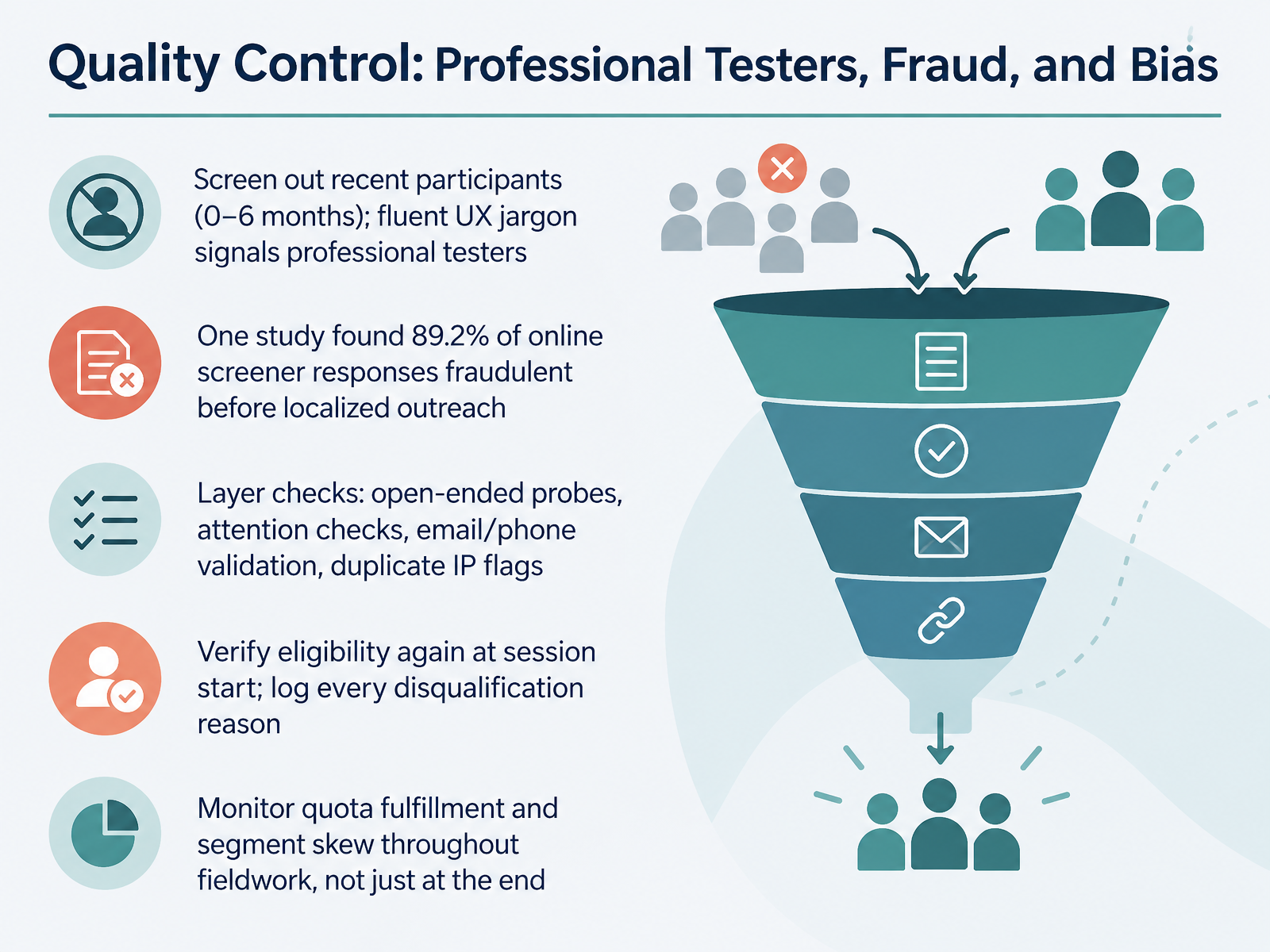
- 11Quality Control: Professional Testers, Fraud, and BiasNow let's talk quality control. Start by screening out anyone who participated in a study in the past zero to six months. And watch for fluent UX jargon. Terms like mental model or kerning often signal a professional tester. Why it matters? One study found that eighty nine point two percent of online screener responses were fraudulent before localized outreach. So do not rely on a single filter. Layer your checks. Use open-ended probes, attention checks, email and phone validation, and duplicate IP flags. Then verify eligibility again at the start of the session, and log every disqualification reason. Throughout fieldwork, monitor quota fulfillment and segment skew, not just at the end. This catches problems while you can still fix them.
 nngroup.comnngroup.comnngroup.com+21 min
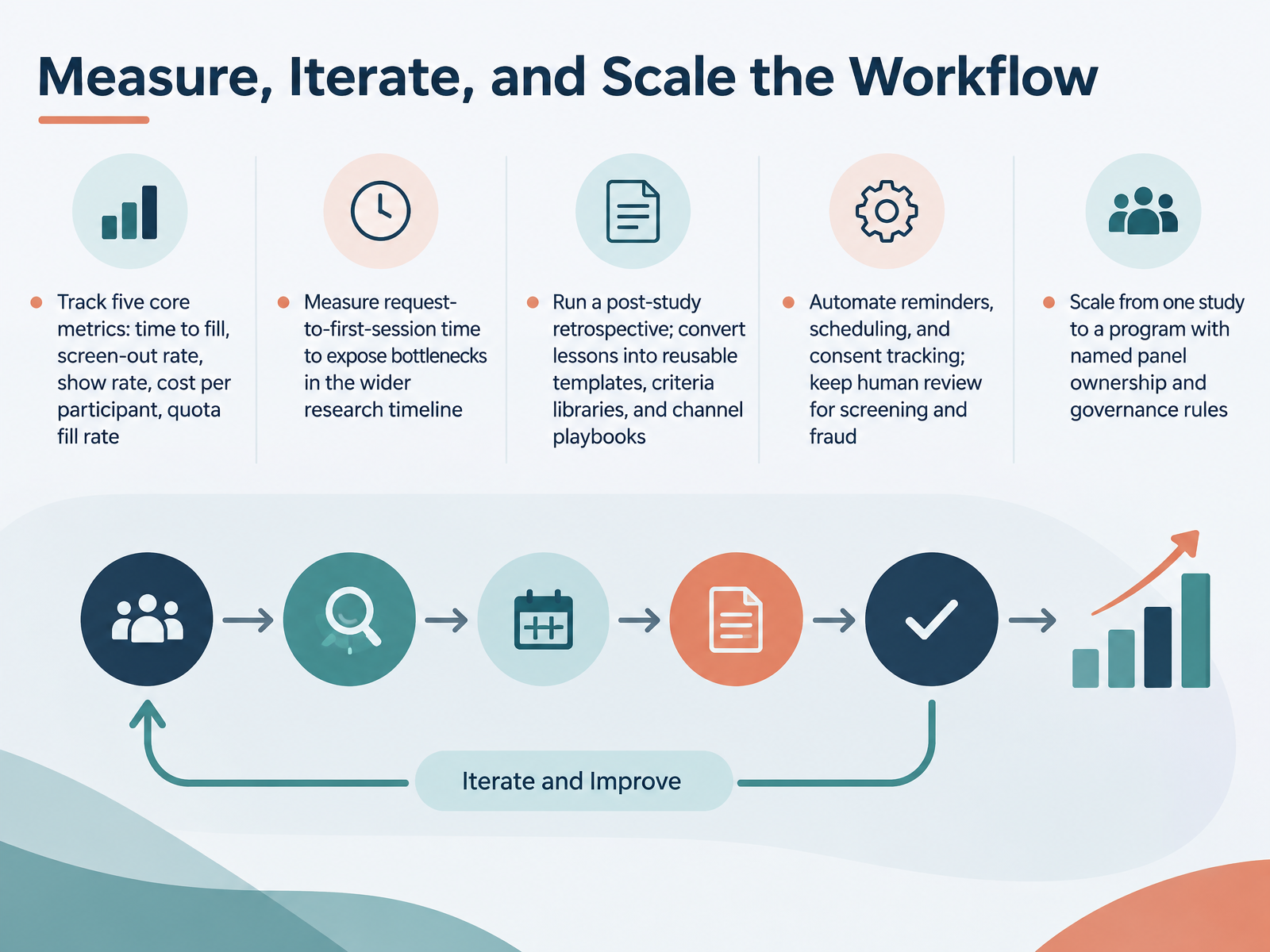
- 12Measure, Iterate, and Scale the WorkflowNow let's measure what you've built. Start by tracking five core metrics: time to fill, screen-out rate, show rate, cost per participant, and quota fill rate. They tell you where recruitment is actually breaking. Then measure request-to-first-session time. That single number exposes bottlenecks across the wider research timeline, not just recruiting. After each study, run a retrospective. Turn what you learn into reusable templates, criteria libraries, and channel playbooks. Automate reminders, scheduling, and consent tracking, but keep human review for screening and fraud. Two reminders, one at twenty-four hours and one at one hour, with a one-click reschedule link, push show rates close to zero no-shows. Finally, scale from one study to a program with named panel ownership and governance rules. Next, we put the whole workflow into practice in Worked Example: One Study End to End.
 2 min
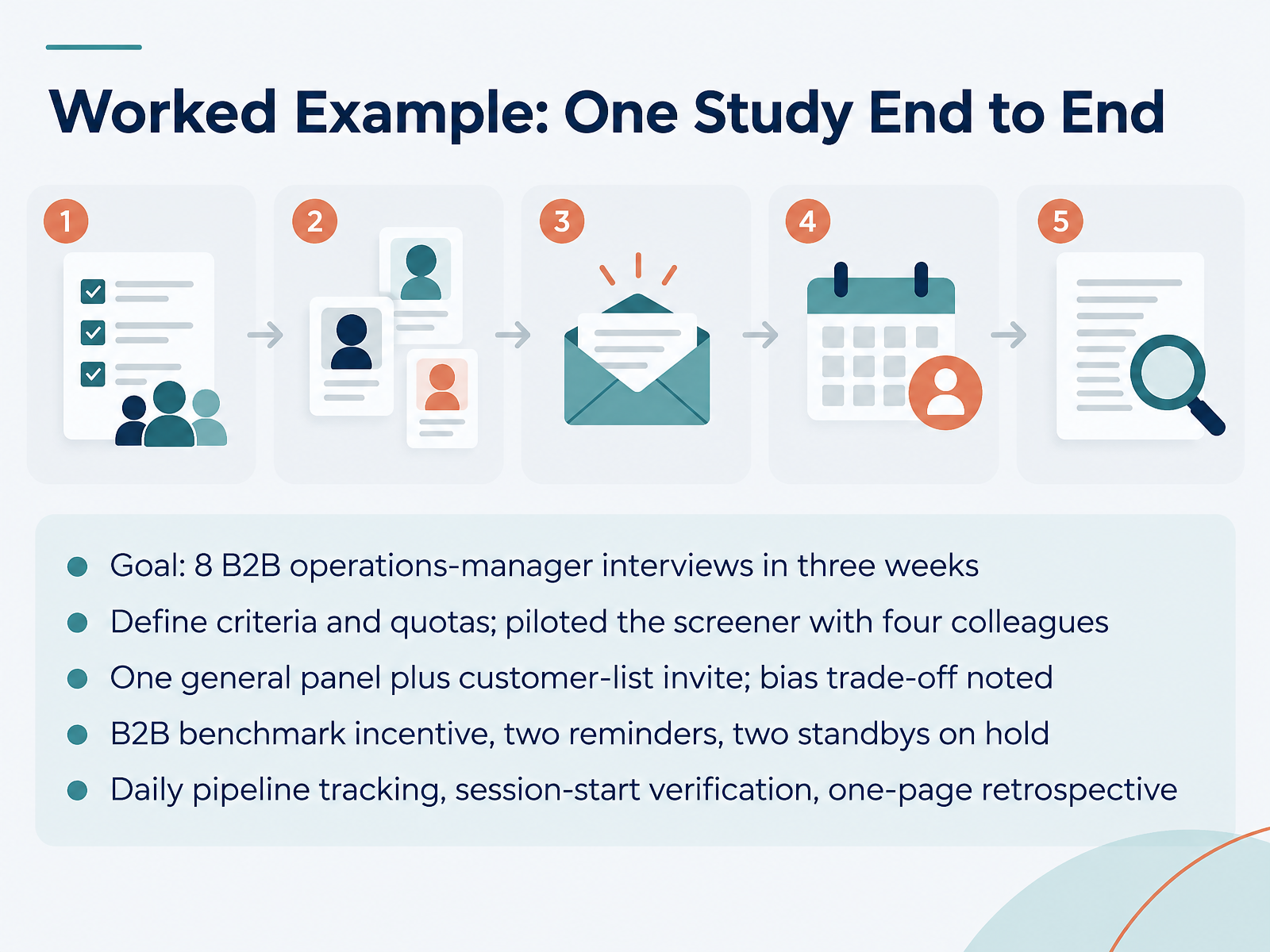
- 13Worked Example: One Study End to EndLet's walk through one study end to end. Eight B2B operations-manager interviews in three weeks. First, define your inclusion and exclusion criteria, set quotas, and pilot the screener with four colleagues. Ask them to try to sneak through. Here's why it matters: a loose screener lets professional testers in, and their answers skew your data.
Next, choose your sources. One general panel plus a customer-list invite. Each has a bias, so write the trade-off down, because a noted bias is a manageable one. Set a B2B benchmark incentive, send two reminders, and keep two standbys on hold.
Track the pipeline daily. Verify fit at session start. Then close with a one-page retrospective.
Here's the takeaway: define criteria clearly, pilot the screener, name your bias, and track until the last session. Next, let's turn this into an action plan and checklist for your next study.
 nngroup.comnngroup.comnngroup.com+22 min
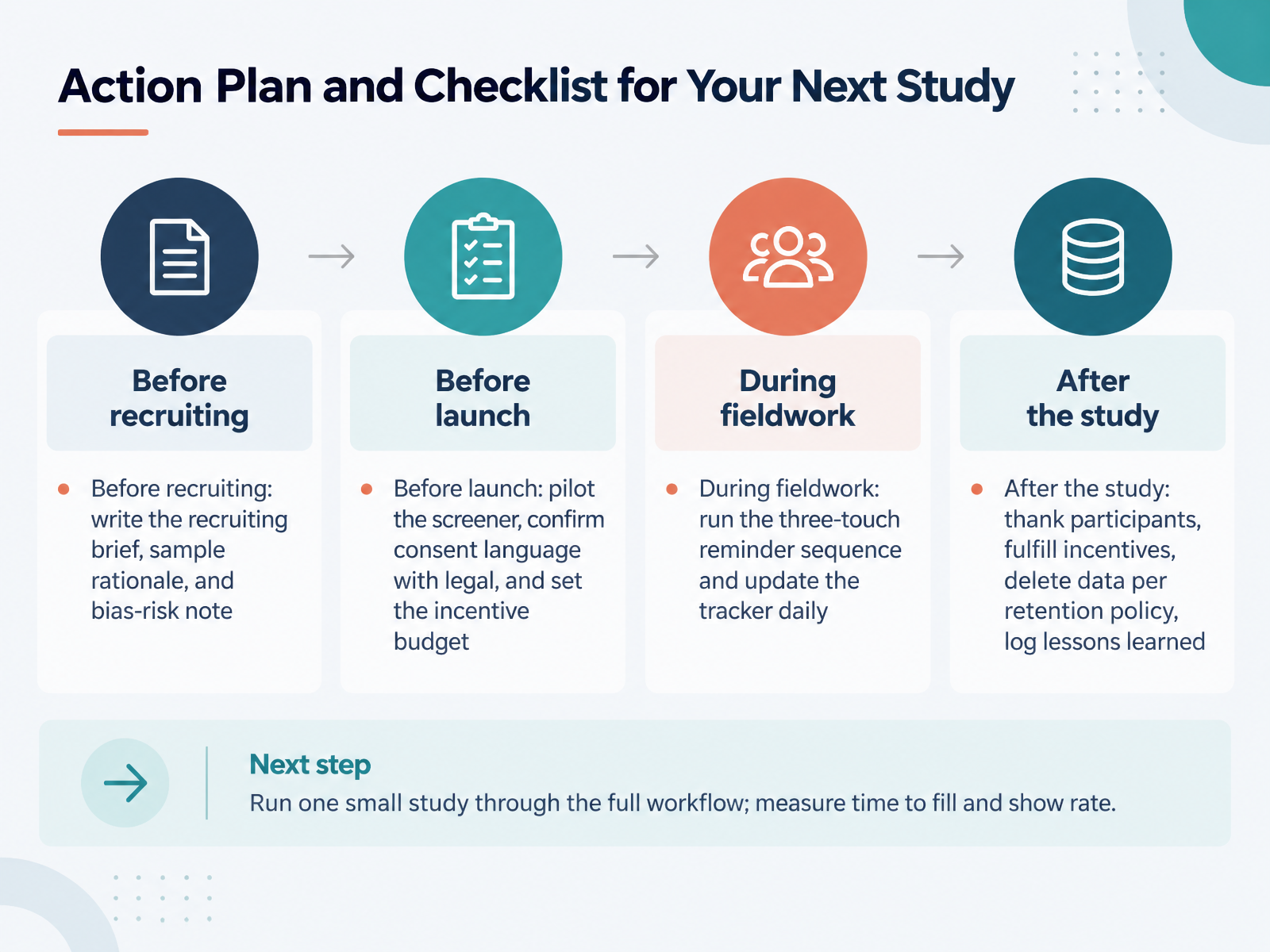
- 14Action Plan and Checklist for Your Next StudyBefore you wrap up, turn everything you've learned into a checklist you can reuse. Before recruiting, write the recruiting brief, the sample rationale, and a short bias-risk note. Why it matters: documenting this upfront is exactly what lets you defend your sample later. Before launch, pilot the screener on two or three colleagues, confirm your consent language with legal, and set the incentive budget. During fieldwork, run a three-touch reminder sequence and update your tracker daily, so you catch a slow fill before it becomes a crisis. After the study, thank participants, fulfill incentives promptly, delete data according to your retention policy, and log what you learned. Then take the next step. Run one small study through this entire workflow end to end. Measure time to fill and show rate, and use those two numbers as your baseline for the next one. Thank you for joining me through this workflow. You now have a practical, repeatable process. Start small, measure it, and improve with each study. Good luck.
 nngroup.comresearch-operations.comstatic.sched.com+21 min
Take the deck with you
Download this course as a file — free, no sign-up needed.
- PDF handoutEvery slide page, ready to print or share.15 pages · 2.9 MBDownload
- Narrated PowerPointThe deck that presents itself — every slide carries the digital human's narration video.15 pages · 12.9 MBDownload
- PowerPoint slidesThe full deck as a .pptx — open it in PowerPoint, Keynote, or Google Slides.15 pages · 2.9 MBDownload
Free to use in your own training — please keep the PersonWise credit page at the end.
Have your own deck? Turn it into a course
Sources consulted
Web sources consulted while building this course.
- How Many Test Users in a Usability Study? - NN/G — nngroup.com
- Qualitative Usability Testing: Study Guide - NN/G — nngroup.com
- 5 Users: Okay for Qual, Wrong for Quant (Video) - NN/G — nngroup.com
- Usabiilty Testing and User Experience Research Consulting | NN/g - NN/G — nngroup.com
- Sample Sizes for Qualitative Studies (Video) — nngroup.com
- Screening Participants for User-Research Studies - NN/G — nngroup.com
- Recruiting and Screening Candidates for User Research Projects - NN/G — nngroup.com
- Catching Problem Participants in Remote Unmoderated Studies - NN/G — nngroup.com
- Screener Surveys - UX Research Field Guide — userinterviews.com
- Recruiting 101 — usertesting.com
- Best user research recruitment tools in 2026 | Great Question — greatquestion.com
- Participant recruitment platform comparison: 2026 — cleverx.com
- Best Platforms to Find Research Participants in 2026 | CleverX Blog — cleverx.com
- Best Research Participant Recruitment Platforms in 2026: The Complete Buyer's Guide — koji.so
- Best User Research Recruitment Platforms in 2026 — uxia.app
- Best Practices for Building and Maintaining Your Own Research-Participant Database - NN/G — nngroup.com
- Recruitment and administration - Research Operations Sourcebook - ResearchOps Demo Suite — research-operations.com
- How to develop your own Enterprise-level UX Research Panel — static.sched.com
- Building and Managing a Research Panel | User Interviews — userinterviews.com
- The Definitive Guide to Participant Management and Recruitment — 21213308.fs1.hubspotusercontent-na1.net