Begin
14 pages · ~28 min
Reading Old Handwriting: Paleography
Learn to decipher historical handwriting in this paleography training, designed for historians, archivists, and genealogists working with old manuscripts.
A digital instructor presents all 14 pages. Hold “Ask” at any point and ask out loud — the answer comes from this course. No sign-up needed.
What you’ll learn
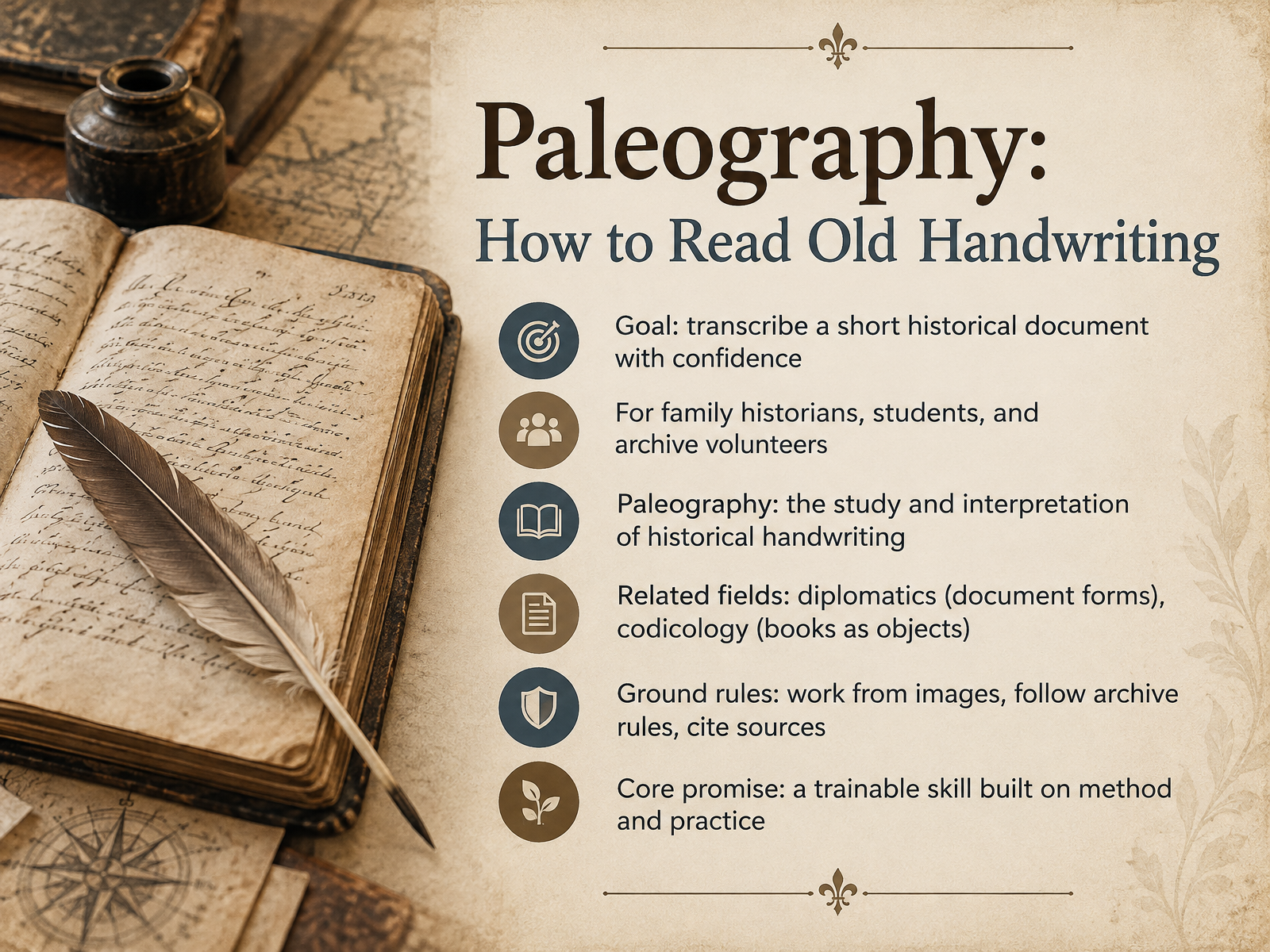
- 01Paleography: How to Read Old HandwritingWelcome. I'm glad you're here. This course is called Paleography: How to Read Old Handwriting. Our goal is simple and practical. By the end, you will transcribe a short historical document with confidence. You might be a family historian, a student, or an archive volunteer. Paleography is the study and interpretation of historical handwriting. Two related fields are worth knowing now. Diplomatics studies document forms, the standard wording and layout of records. Codicology studies books as physical objects. Here are our ground rules. We work from images, not the originals. We follow each archive's rules. And we cite our sources. One more thing. Paleography is a trainable skill. It is built on method and practice, not talent. Next, let's look at why handwriting changed over time.doi.orgfaculty.winthrop.edupeople.umass.edu+22 min
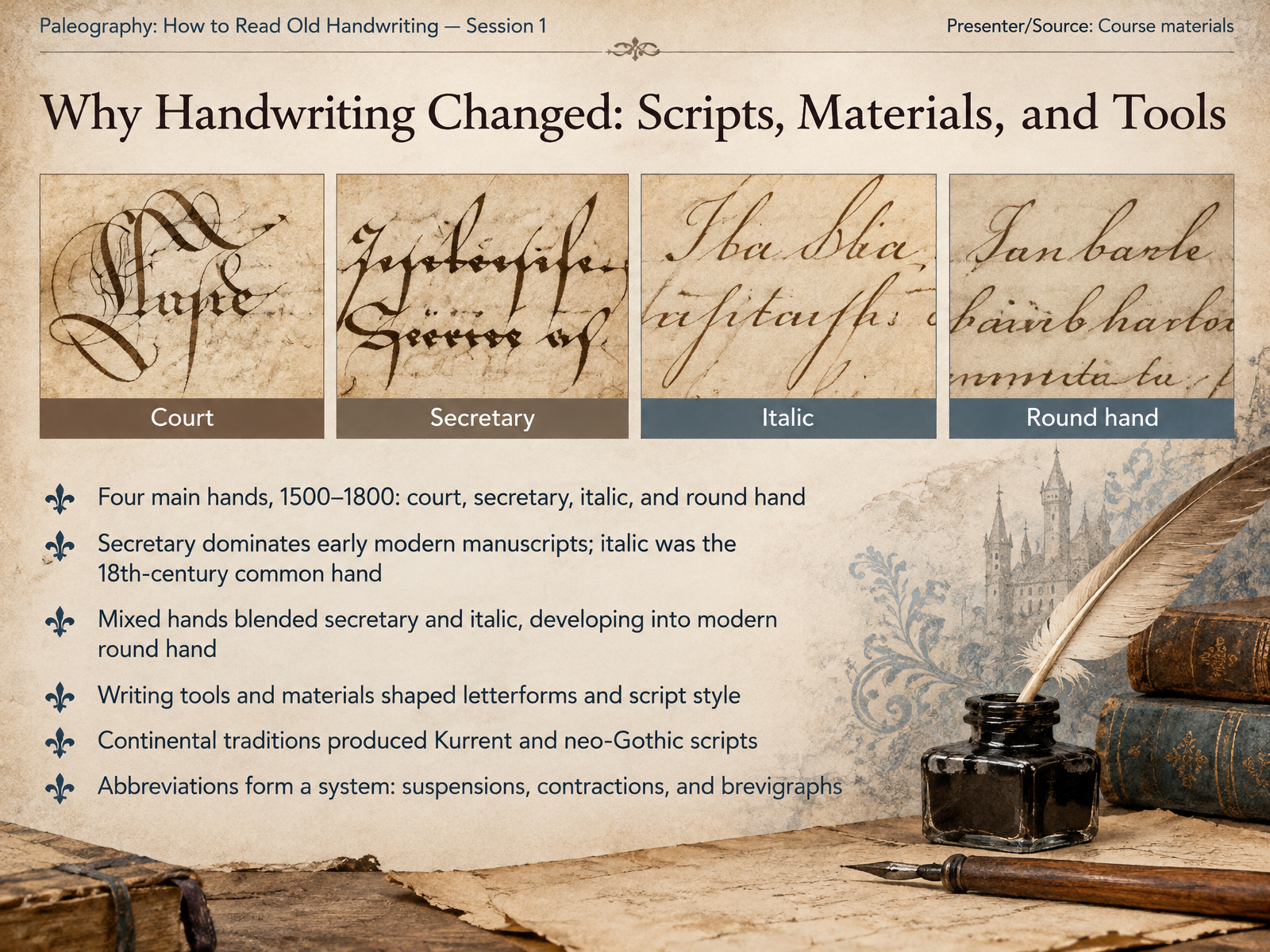
- 02Why Handwriting Changed: Scripts, Materials, and ToolsLet's take a step back and ask why old handwriting looks so different from ours. Between fifteen hundred and eighteen hundred, English documents mainly used four hands: court, secretary, italic, and round hand. Secretary dominates early modern manuscripts, but it can look almost like a foreign language at first glance. Italic was the common hand of the eighteenth century, and mixed hands blended secretary and italic, gradually becoming the modern round hand. Writing tools and materials shaped letterforms too, from cut quills to paper surfaces. On the continent, traditions produced Kurrent and neo-Gothic scripts. And abbreviations were not random. They formed a system of suspensions, contractions, and brevigraphs, which we will decode step by step. Now let's move on to the Paleographer's Toolkit: Deciphering Letter by Letter.
 script.byu.edunottingham.ac.ukbritannica.com+21 min
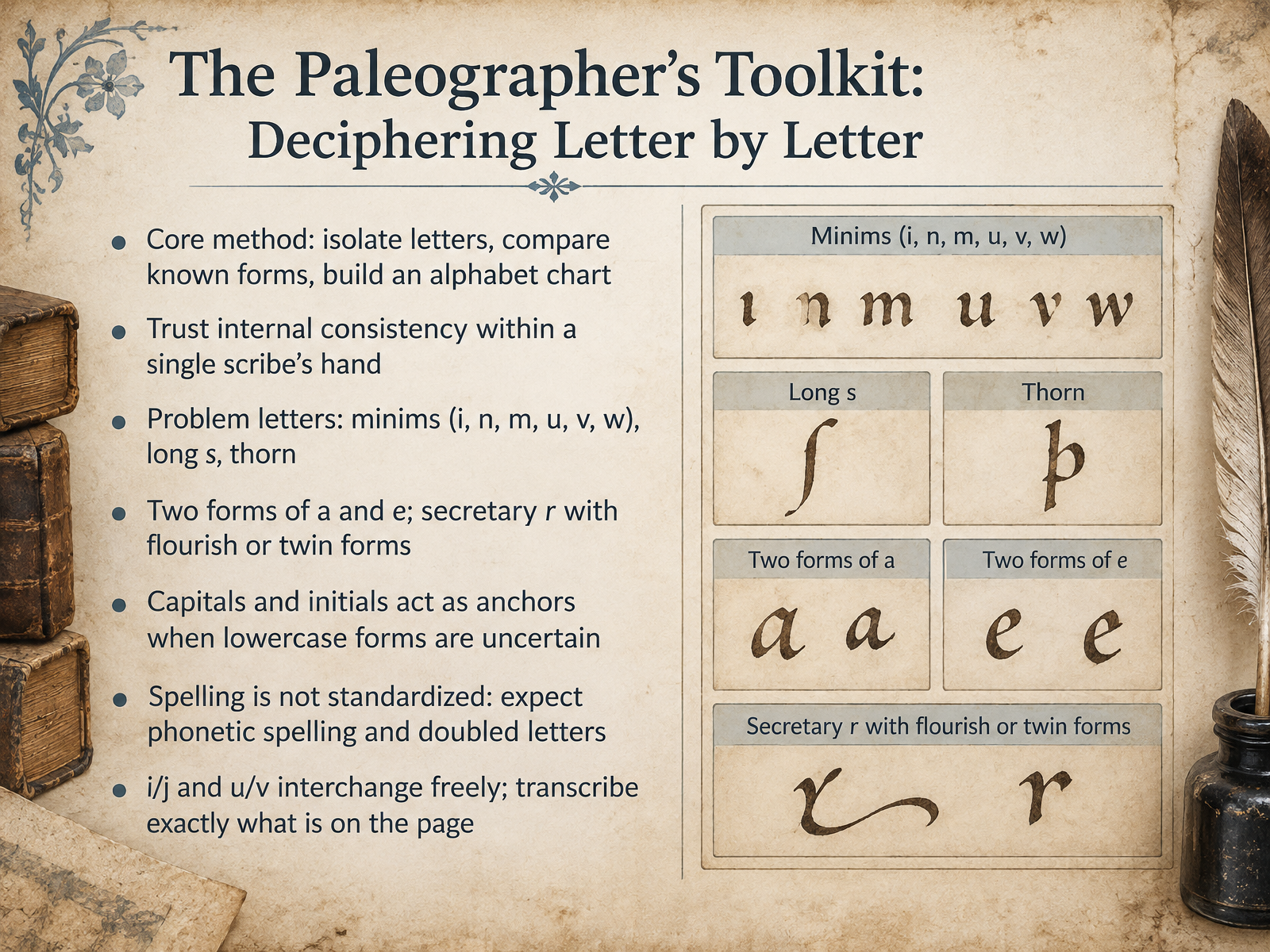
- 03The Paleographer's Toolkit: Deciphering Letter by LetterNow let's build your toolkit for deciphering letters one by one. The core method is simple. Isolate a single letter. Compare it with forms you already know. Then build your own alphabet chart as you go. Pause after each one and add a note. Trust the scribe's own consistency. Within one hand, the same letter is usually formed the same way each time. Some letters cause real trouble. Watch for minims, those short strokes in i, n, m, u, v, and w. Watch for long s, which looks like an f, and for thorn, which looks like a y but reads as t h. You may also meet two forms of a and e, and a secretary r with a flourish. When lowercase letters stay uncertain, use capitals and initials as anchors. And remember, spelling was not standardized. Expect phonetic spelling and doubled letters. Finally, i and j and u and v interchange freely, so transcribe exactly what is on the page. Next, let's look at reading the document, not just the words, and examine structure and formula.
 english.cam.ac.ukimages.folger.eduyork.ac.uk+22 min
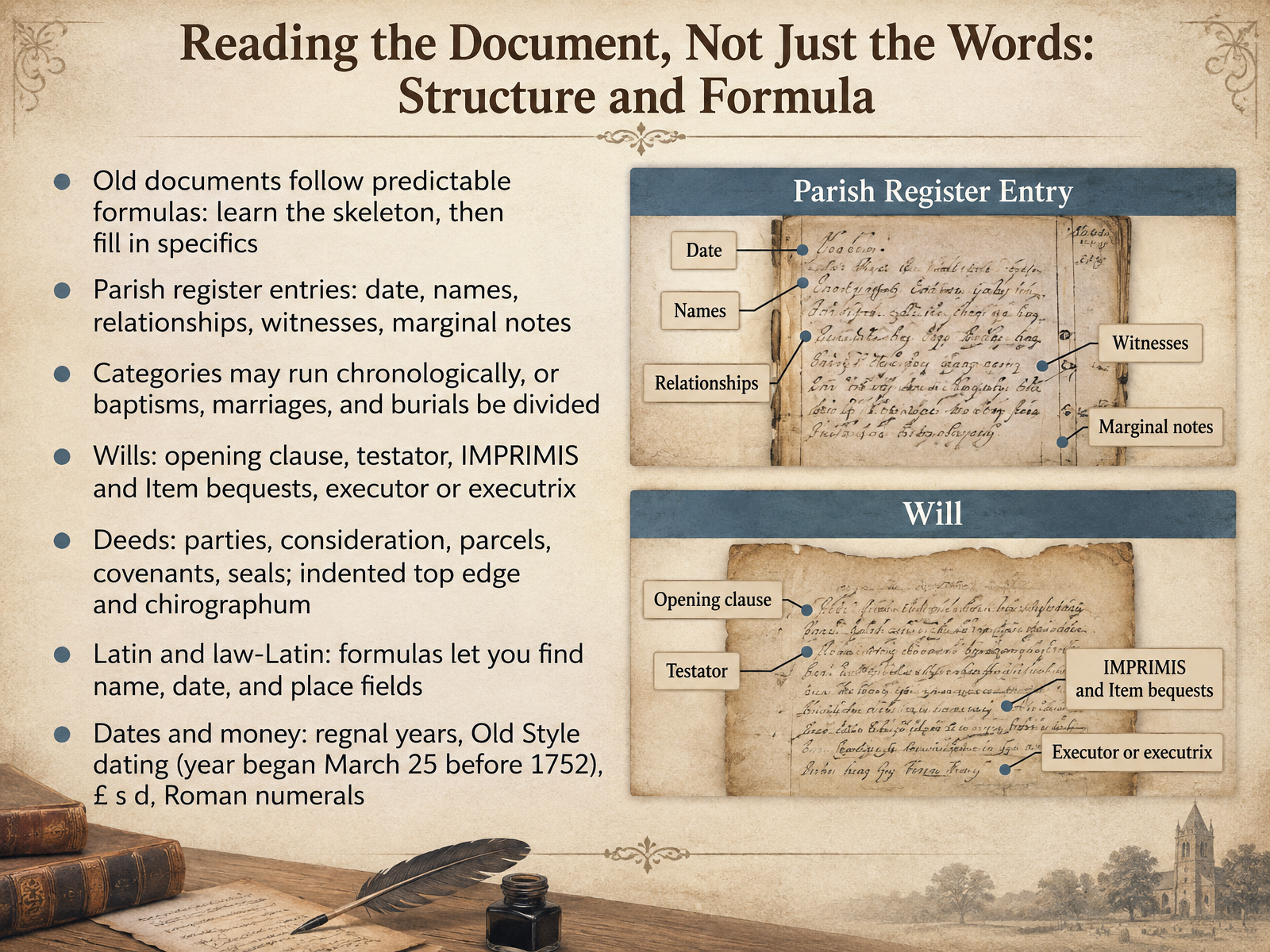
- 04Reading the Document, Not Just the Words: Structure and FormulaNow let's look at the document as a whole, not just the words. Old documents follow predictable formulas. Learn the skeleton first, then fill in the specifics. In a parish register, expect a date, names, relationships, witnesses, and sometimes marginal notes. Entries may run chronologically, or baptisms, marriages, and burials may be divided into separate sections. Wills follow their own pattern: an opening clause, the testator, bequests marked IMPRIMIS and Item, then the executor or executrix. Deeds list the parties, consideration, parcels, covenants, and seals, with an indented top edge or chirographum proving authenticity. Latin and law Latin use formulas too, which help you find name, date, and place fields. And watch dates and money: regnal years, Old Style dating before 1752, when the year began on March twenty-fifth, and amounts in pounds, shillings, and pence, often in Roman numerals. Learning the formula frees you to focus on the details that matter. Next, we'll bring those details together in Reading the Page's Context: Names, Places, Dates, and Numbers.
 archives.norfolk.gov.ukfh.familysearch.orggutenberg.org+22 min
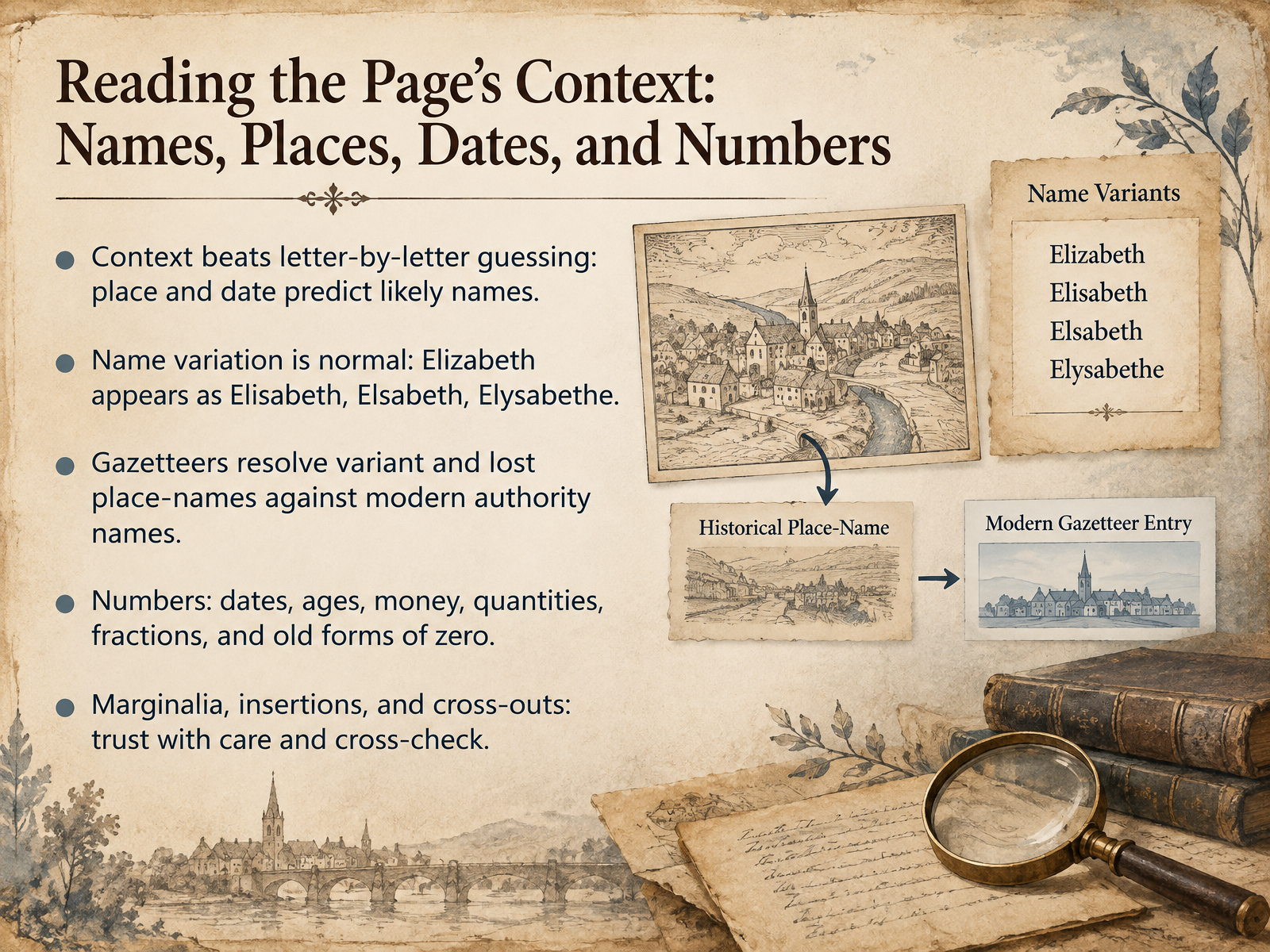
- 05Reading the Page's Context: Names, Places, Dates, and NumbersNow let's look at the page as a whole, because context often beats guessing letter by letter. Before you wrestle with a single word, ask two questions. Where was this written, and when? A parish register from a Yorkshire village in the seventeen hundreds will suggest a small, predictable set of local surnames and place names. Let that expectation guide your reading instead of fighting every stroke.
Next, remember that name variation is completely normal. Elizabeth may appear as Elisabeth, Elsabeth, or Elysabethe. That is not an error. It is simply spelling before dictionaries. When a place name looks unfamiliar, reach for a gazetteer. A gazetteer is a geographical index, and it links historic and variant place-name forms to a modern authority name, so a lost village can be identified.
Numbers need the same care: dates, ages, money, quantities, fractions, and old forms of zero. Finally, treat marginal notes, insertions, and crossed-out words with caution. Read them, but cross-check before you trust them.
Let's put these skills to work. In the next segment, Hands-On Practice: Transcribing Real Script Samples.
 2 min
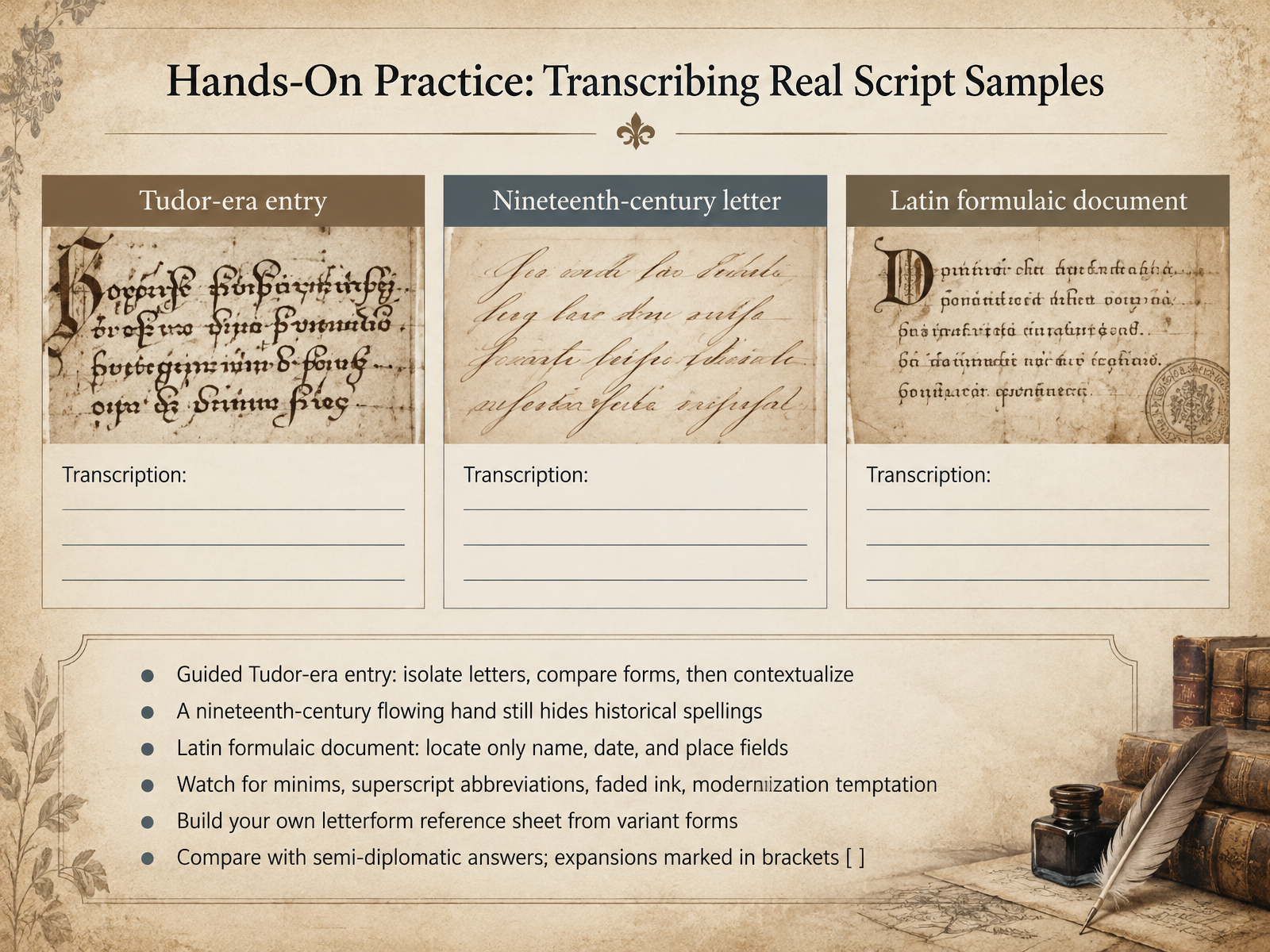
- 06Hands-On Practice: Transcribing Real Script SamplesNow let's put those skills to work with real script samples. Start with a guided Tudor-era entry. First, isolate each letter. Then compare forms against other examples on the page. Finally, read the whole entry in context. Next, try a nineteenth-century flowing hand. It looks easier, but it still hides historical spellings, so resist the urge to modernize. If you meet a Latin formulaic document, do not attempt every word. Just locate the name, the date, and the place fields. That is enough to anchor your research. As you work, watch for minims, those small vertical strokes that can look like n, u, or i. Watch for superscript abbreviations and faded ink. Keep a letterform reference sheet of your own, built from the variant forms you meet. When you are ready, compare your work with semi-diplomatic answers. Expansions appear in square brackets. That keeps your reading honest and exact. Next, we will look at transcriptions that stand up, covering conventions, uncertainty, and self-checking.
 archives.norfolk.gov.ukfh.familysearch.orggutenberg.org+21 min
- 07Transcripts That Stand Up: Conventions, Uncertainty, and Self-CheckingNow let's make sure your transcripts stand up to scrutiny. First, watch out for expectation bias. That is when you see the word you expect, not the one actually written. In a parish register, you may expect a name like Elizabeth, but the scribe may have written Elisabeth. So read what is on the page, not what your mind supplies.
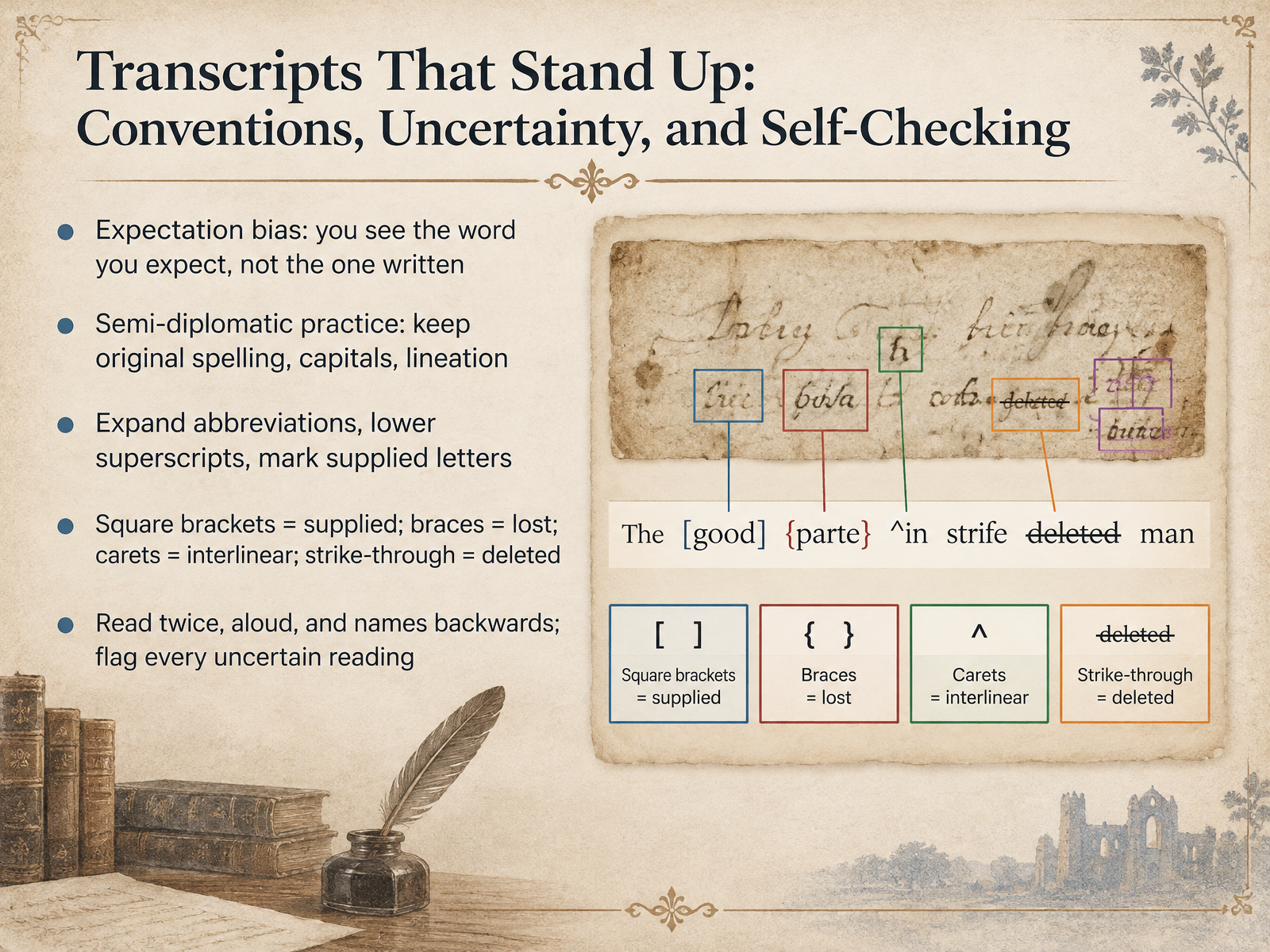
The safest approach is semi-diplomatic practice. Keep the original spelling, capitals, and line breaks. When you expand an abbreviation, lower any superscripts, and mark the letters you supply. A simple system is: square brackets for supplied letters, braces for lost or illegible text, carets for interlinear insertions, and strike-through for deleted words. State your conventions clearly at the top of your transcript.
Here is a habit that catches errors: read the whole entry twice, once aloud. Then read names backwards, letter by letter. Finally, flag every uncertain reading honestly. Never guess silently. An honest uncertain mark is worth more than a tidy guess. That is how your transcript earns trust.
 english.cam.ac.ukimages.folger.eduyork.ac.uk+22 min
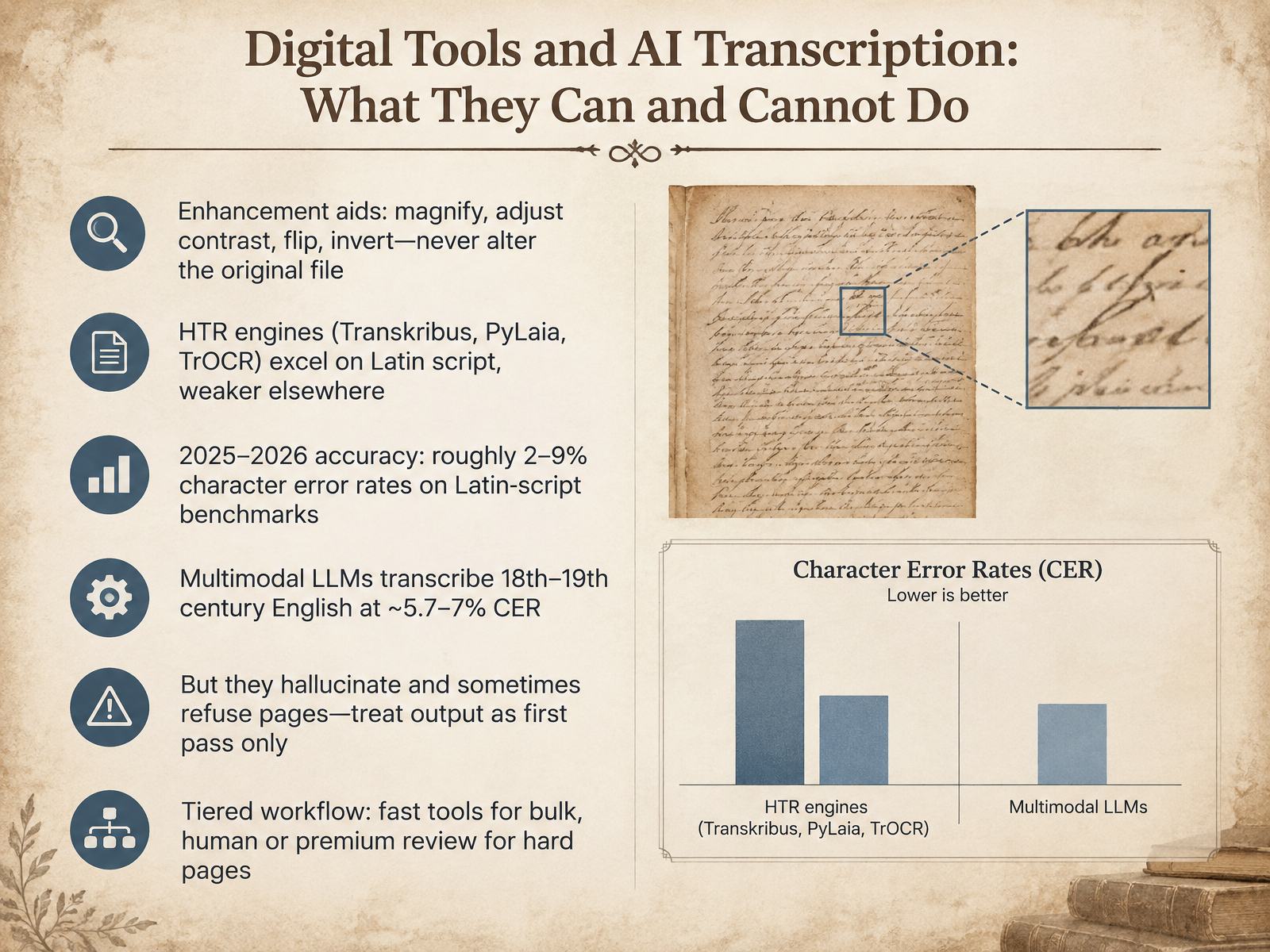
- 08Digital Tools and AI Transcription: What They Can and Cannot DoNow let's talk about digital tools, and what they can and cannot do. First, enhancement aids. You can magnify, adjust contrast, flip, or invert an image. But here is the rule: never alter the original file. Work on a copy. Next, HTR engines. That stands for handwritten text recognition. Tools like Transkribus, PyLaia, and TrOCR are strong on Latin script, but weaker on other scripts. In twenty twenty-five and twenty twenty-six, their error rates on Latin-script benchmarks were roughly two to nine percent. Multimodal large language models now transcribe eighteenth and nineteenth century English at about five point seven to seven percent character error rate. That sounds impressive, and it is. But two cautions. They hallucinate. They invent words that are not on the page. And sometimes they refuse a page entirely. So treat their output as a first pass only, never as final. Here is a practical tiered workflow. Use fast tools for bulk transcription, then bring in a human or premium review for the hard pages. That keeps costs down and accuracy high. Next, let's look at where you can practise these skills: Archives, Practice Collections, and Community Transcription.
 2 min
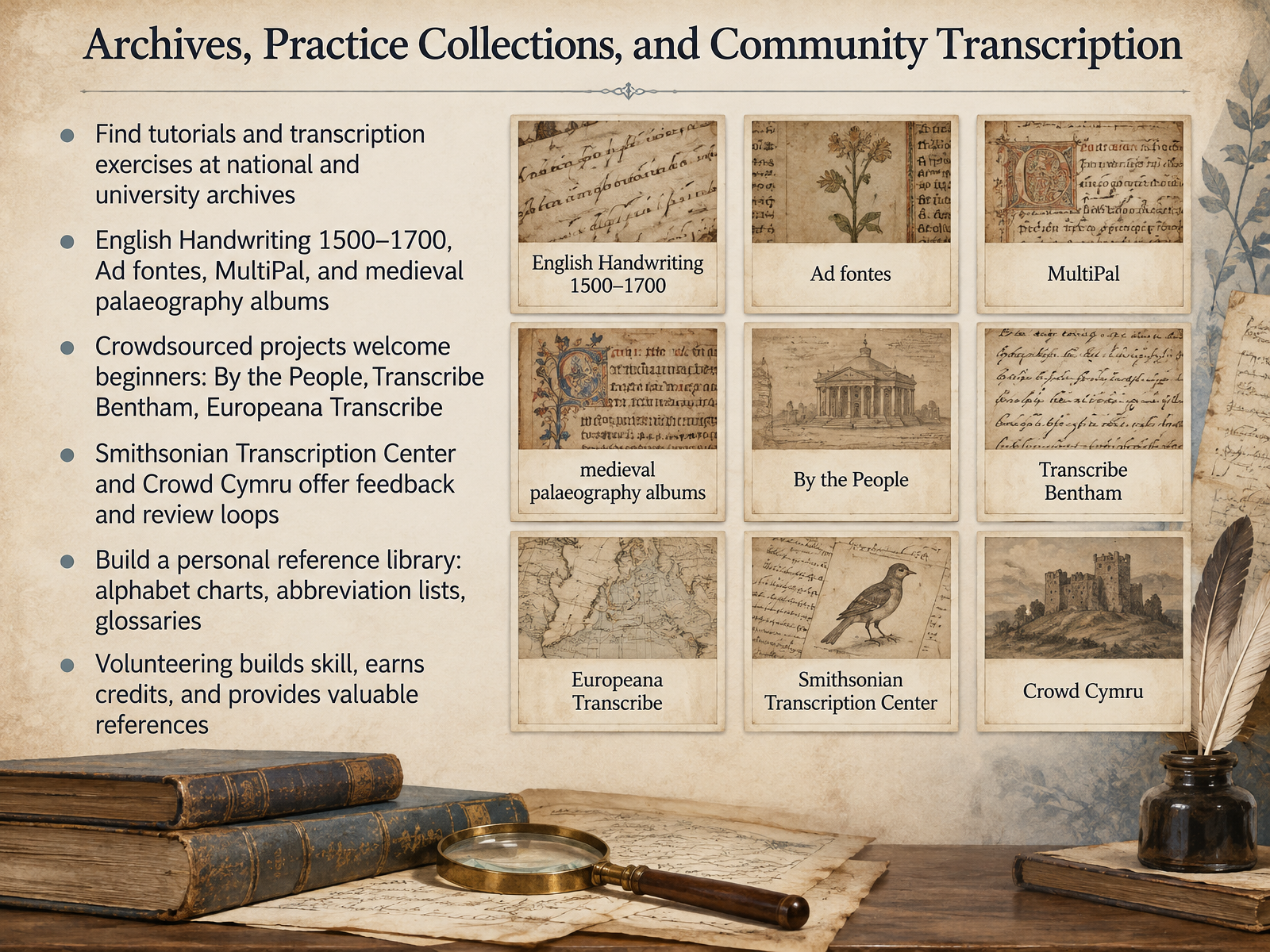
- 09Archives, Practice Collections, and Community TranscriptionNow let's talk about where to practice. You do not need to learn alone. National and university archives publish free tutorials and transcription exercises. If you want a starting point, try English Handwriting fifteen hundred to seventeen hundred from Cambridge, Ad fontes, MultiPal, or an interactive medieval palaeography album.
Crowdsourced projects welcome absolute beginners. By the People, Transcribe Bentham, Europeana Transcribe, the Smithsonian Transcription Center, and Crowd Cymru all offer feedback and review loops. Start with a short, clear page, transcribe it, then submit it for review. Someone will check your work, and comparing your version with the corrected one is where real learning happens.
As you practice, build a personal reference library. Alphabet charts, abbreviation lists, and glossaries save you time again and again. And remember, volunteering builds genuine skill, can earn you credits, and gives you references you can point to. So pick one project this week, transcribe a single page, and let the feedback teach you. Next, we will look at special cases, Latin, law hands, and damaged documents.
 2 min
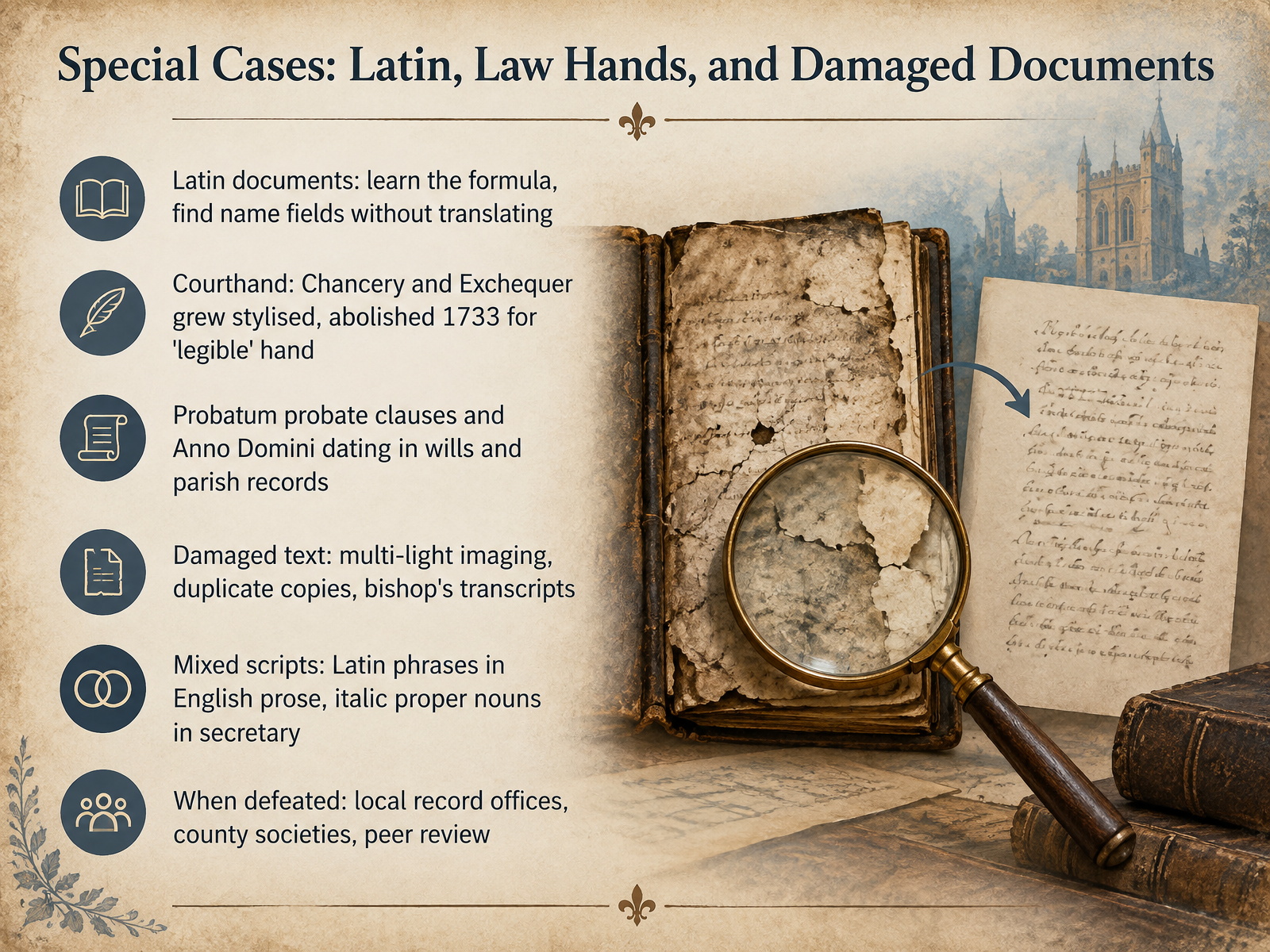
- 10Special Cases: Latin, Law Hands, and Damaged DocumentsNow let's look at special cases that often trip people up. Latin documents can feel intimidating, but you rarely need to translate every word. Learn the formula instead. In a probate clause, look for the word Probatum, meaning it was proved, and find the name fields around it. You can gather dates and names without full translation. Court hands are another challenge. Chancery and Exchequer scripts grew increasingly stylised over time, until they were abolished in seventeen thirty-three and replaced by a legible hand. If you meet a damaged document, try multi-light imaging, look for duplicate copies, or consult bishop's transcripts. And expect mixed scripts. Latin phrases often appear inside English prose, and italic proper nouns sit inside secretary text. When a reading defeats you, local record offices, county societies, and peer review are there to help. Take that step without embarrassment. Next, we'll explore common errors and how to avoid them.
 script.byu.edunottingham.ac.ukbritannica.com+22 min
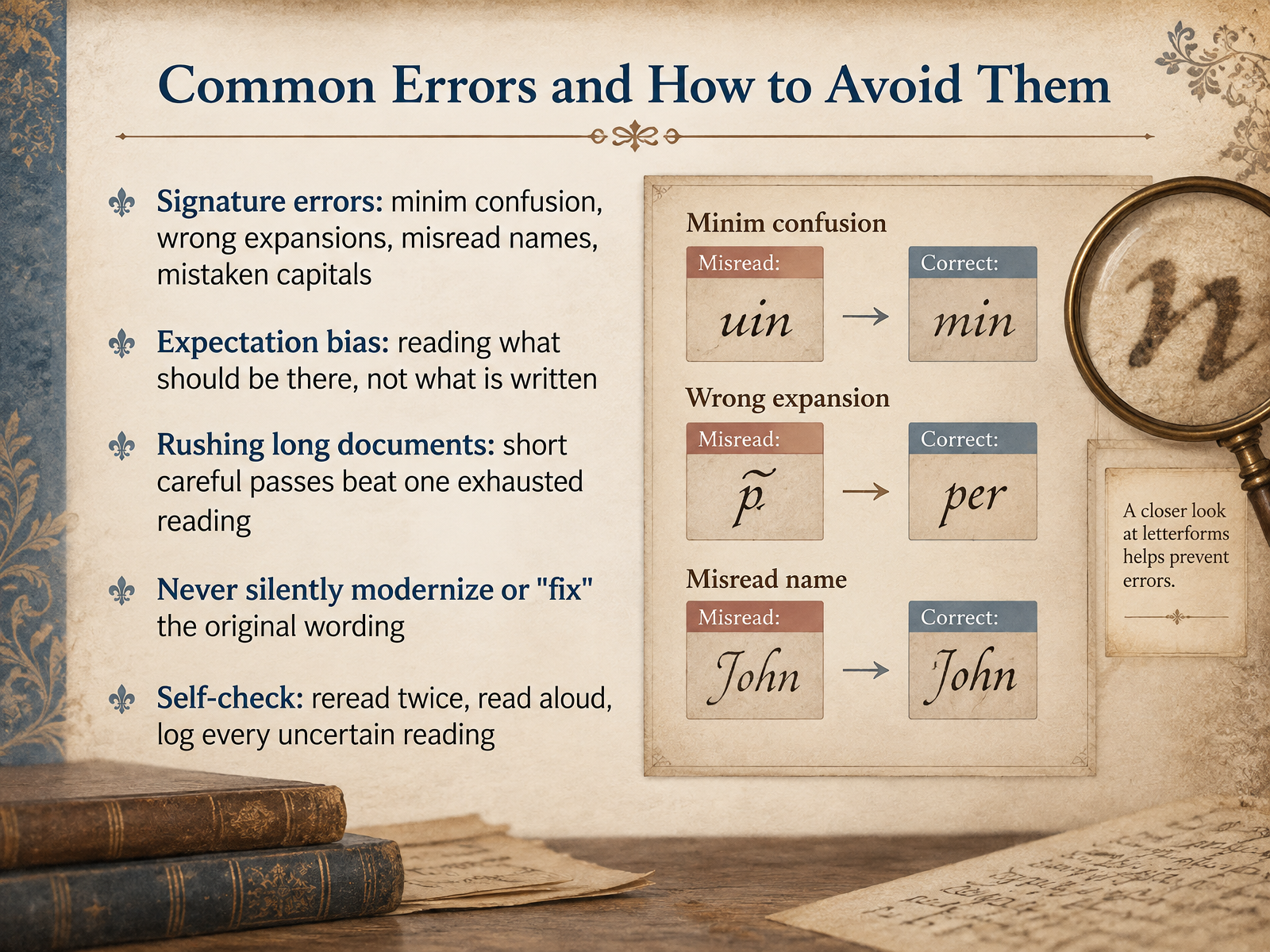
- 11Common Errors and How to Avoid ThemNow let's look at the mistakes we all make, and how to catch them. First, signature errors. Minim confusion happens when strokes like i, m, n, and u blur together, so a name can look like several different words. A surname such as Hammond could be misread as Hamond, or worse, as something entirely different. So slow down on names, and compare the letters with the same letters elsewhere on the page. Second, expectation bias. This is when we read what should be there, not what is written. You might expect a child named after a grandparent, so you write that name without checking. Resist it. Read the ink, not the family story. Third, rushing long documents. A will or a long parish register can exhaust you. Short careful passes beat one tired reading every time. Fourth, never silently modernize or fix the original wording. Keep the spelling as the scribe wrote it, and mark any expansion in brackets. Finally, self-check. Reread twice, read the entry aloud, and log every uncertain reading honestly. In our next part, From Reading to Research, we will use those careful transcriptions responsibly.
 archives.norfolk.gov.ukfh.familysearch.orggutenberg.org+22 min
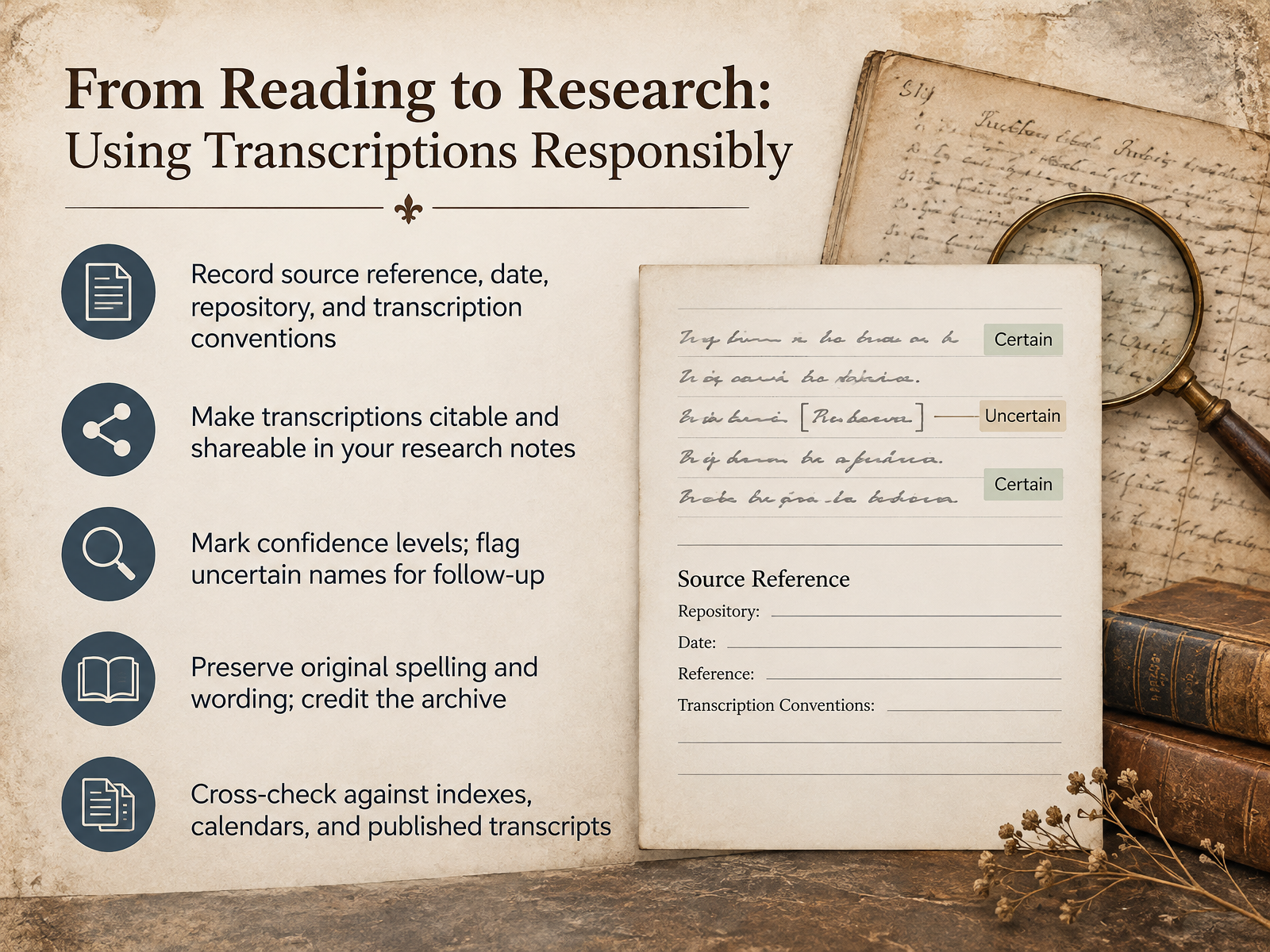
- 12From Reading to Research: Using Transcriptions ResponsiblyNow let's talk about using your transcriptions responsibly. This is where careful reading becomes real research. First, always record the source reference, the document date, the repository, and any transcription conventions you used. That way, anyone can find the original. Second, make your transcriptions citable and shareable in your research notes, so your work counts as evidence. Third, mark confidence levels. If a name is uncertain, write your best reading and flag it for follow-up. Preserve original spelling and wording, and credit the archive that holds the document. And finally, cross-check your reading against indexes, calendars, and published transcripts. If two sources disagree, note the conflict rather than choosing silently. That habit keeps your research honest and reliable. Let's move on to your paleography practice plan and next steps.
 archives.norfolk.gov.ukfh.familysearch.orggutenberg.org+21 min
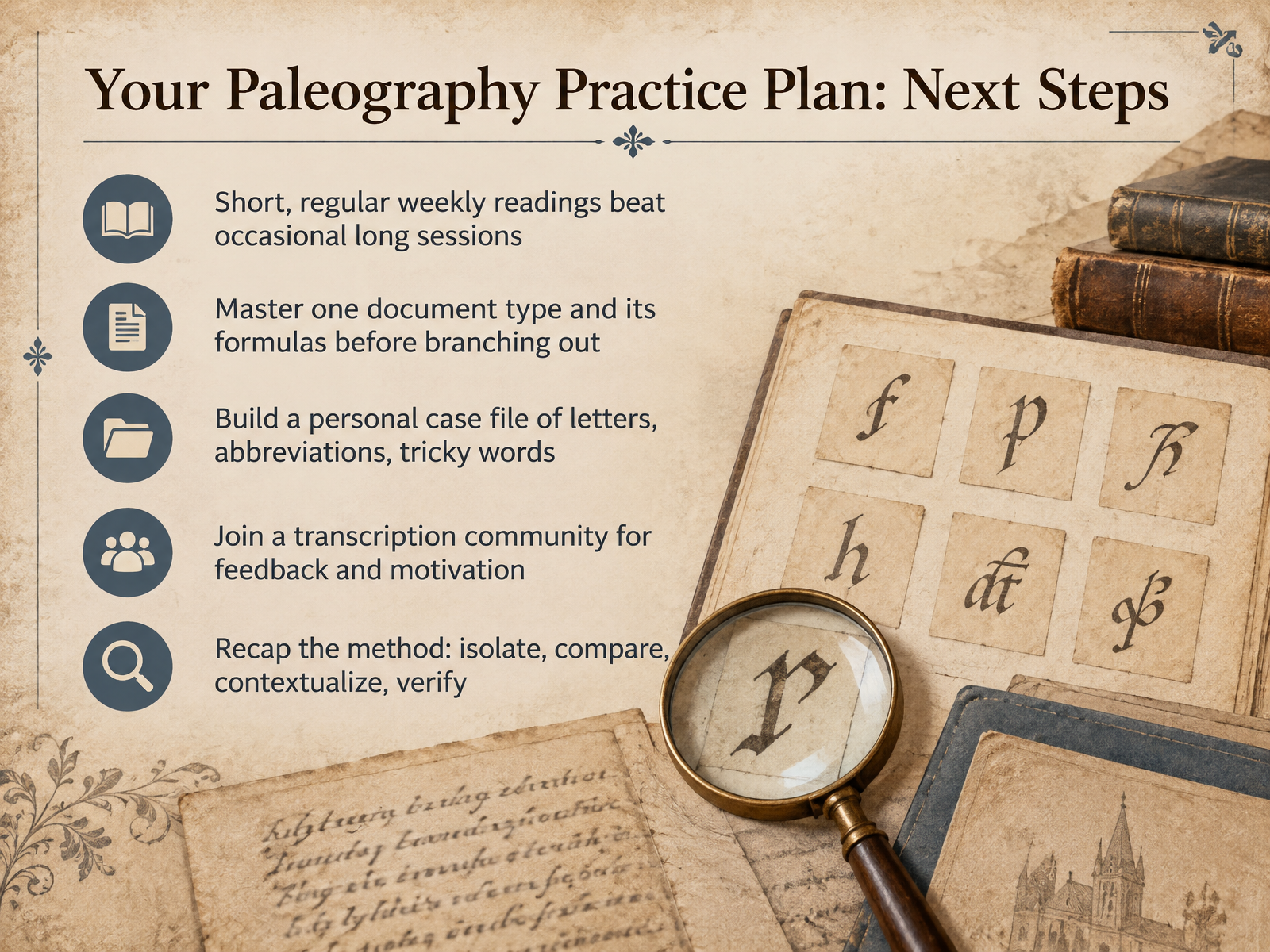
- 13Your Paleography Practice Plan: Next StepsNow let's turn your new skills into a plan you can actually keep. First, short, regular weekly readings beat occasional long sessions. Fifteen minutes on a Tuesday will teach you more than a three-hour cram on Sunday. Second, master one document type and its formulas before branching out. If you can read a parish register baptism entry, those same patterns will help you with a will. Third, build a personal case file of letters, abbreviations, and tricky words. Keep it simple, maybe a notebook or a folder on your computer. Fourth, join a transcription community for feedback and motivation. Projects like By the People or From the Page let you compare your work and learn from others. And always recap the method: isolate the letter or word, compare it to known forms, contextualize it with the date and document, then verify your reading. Start this week. Pick one short document and give yourself permission to be slow and uncertain. That is how real skill grows. Next, we will pull everything together in our course wrap-up.
 2 min
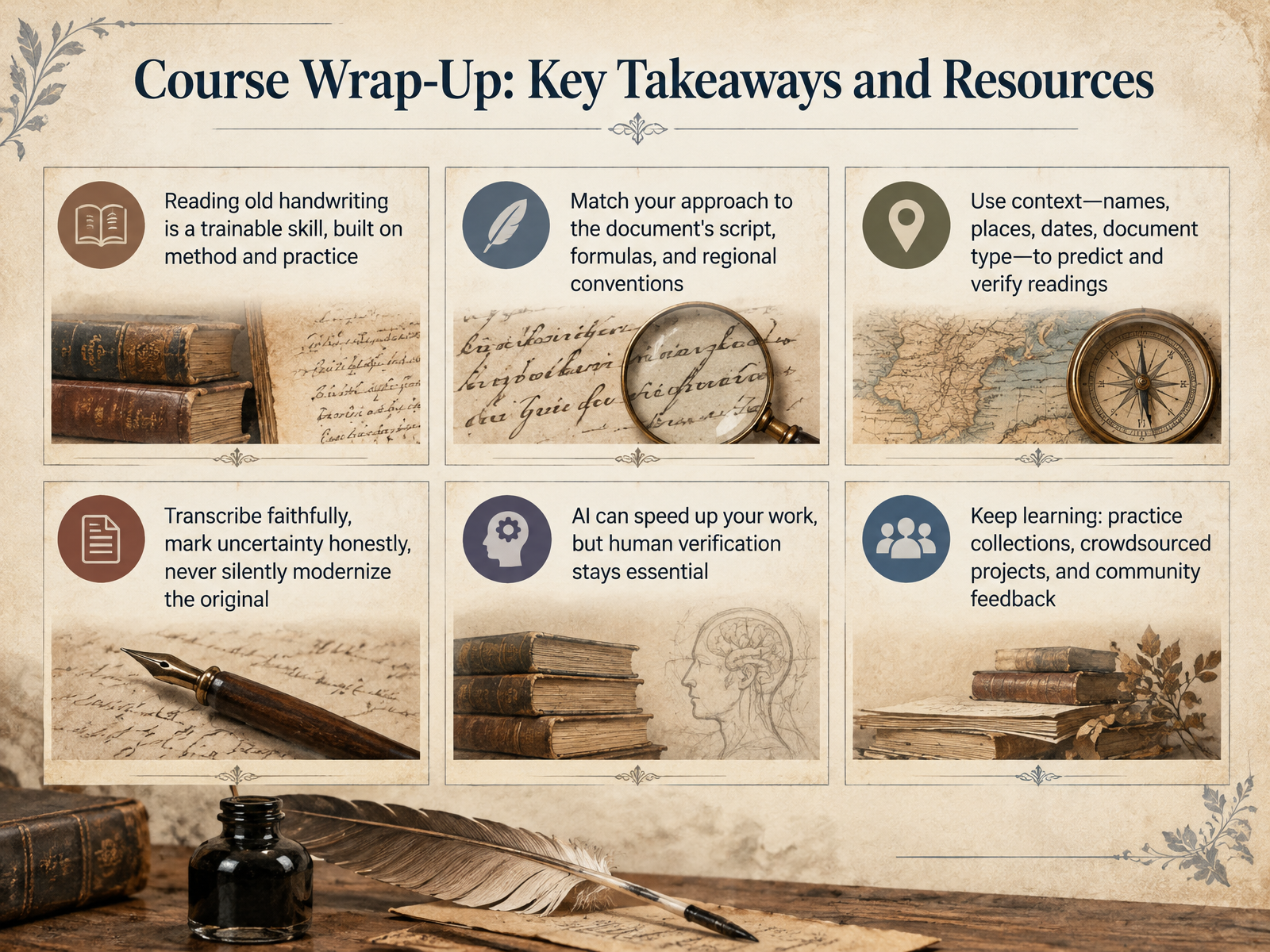
- 14Course Wrap-Up: Key Takeaways and ResourcesAs we close, let's gather what you've learned. Reading old handwriting is a trainable skill, built on method and steady practice. So match your approach to the document in front of you: its script, its formulas, its regional conventions. A parish register, a will, and a dated deed each follow their own habits. Then use context. Names, places, dates, and document type help you predict a reading, and then verify it. And always transcribe faithfully. Mark uncertainty honestly with square brackets or a question mark. Never silently modernize the original. One more thing. AI tools can speed up your work, but human verification stays essential. Machine reading still struggles with faded ink, odd abbreviations, and unfamiliar hands. So keep learning. Practice collections, crowdsourced projects like By the People and Transcribe Bentham, and feedback from a community will sharpen your eye faster than any single course. Thank you for joining me. You've built a real foundation here. Keep reading, keep questioning, and enjoy every document you bring back to life.
 doi.orgfaculty.winthrop.edupeople.umass.edu+22 min
Take the deck with you
Download this course as a file — free, no sign-up needed.
- PDF handoutEvery slide page, ready to print or share.15 pages · 5.9 MBDownload
- Narrated PowerPointThe deck that presents itself — every slide carries the digital human's narration video.15 pages · 18.5 MBDownload
- PowerPoint slidesThe full deck as a .pptx — open it in PowerPoint, Keynote, or Google Slides.15 pages · 5.9 MBDownload
Free to use in your own training — please keep the PersonWise credit page at the end.
Have your own deck? Turn it into a course
Sources consulted
Web sources consulted while building this course.
- Palaeography and Codicology — doi.org
- recto - the face of a manuscript page; in an (open) codex, the exposed side of the right-hand page; abbrev. as r, e.g. f.179r = the recto of folio 179 — faculty.winthrop.edu
- What is Palaeography? by Julian Brown Palaeography means, in the strict sense, the study of ancient handwriting, and its basic objects are these: first, to read ancient texts with accuracy; secondly, to date and localize their handwriting. As such it is a major component of two other more complex di — people.umass.edu
- 1. Introduction to Palaeography - Palaeography [beamer:En] — dhcluj.ro
- Paleography and Codicology — doi.org
- English: handwriting History — script.byu.edu
- Handwriting Styles - The University of Nottingham — nottingham.ac.uk
- Calligraphy - Writing manuals and copybooks (16th to 18th century) | Britannica — britannica.com
- Technologies of Writing in the Age of Print - Folgerpedia — folgerpedia.folger.edu
- Centre for the Study of the Renaissance — warwick.ac.uk
- English Handwriting 1500-1700: An Online Course — english.cam.ac.uk
- G1. Introduction — images.folger.edu
- READING THE PAST — york.ac.uk
- English Scripts - Paleography: Interpreting Handwriting in Genealogical Research - Research Guides at Library of Congress — guides.loc.gov
- English Handwriting 1500-1700: Sample Transcriptions — english.cam.ac.uk
- Parish registers — archives.norfolk.gov.uk
- OLD ENGLISH PALEOGRAPHY — fh.familysearch.org
- How to Decipher and Study Old Documents, by E. E. Thoyts—A Project Gutenberg eBook — gutenberg.org
- Palaeography Part 1: How to create abstracts from old documents — sog.org.uk
- Transcribing and Interpreting English Wills — wikitree.com