Content Marketing Planning and Execution
Begin
14 pages · ~28 min
Content Marketing Planning and Execution
Learn to plan and execute effective content marketing strategies that drive audience engagement and business growth. Ideal for marketers and business owners seeking practical, actionable techniques.
What you’ll learn
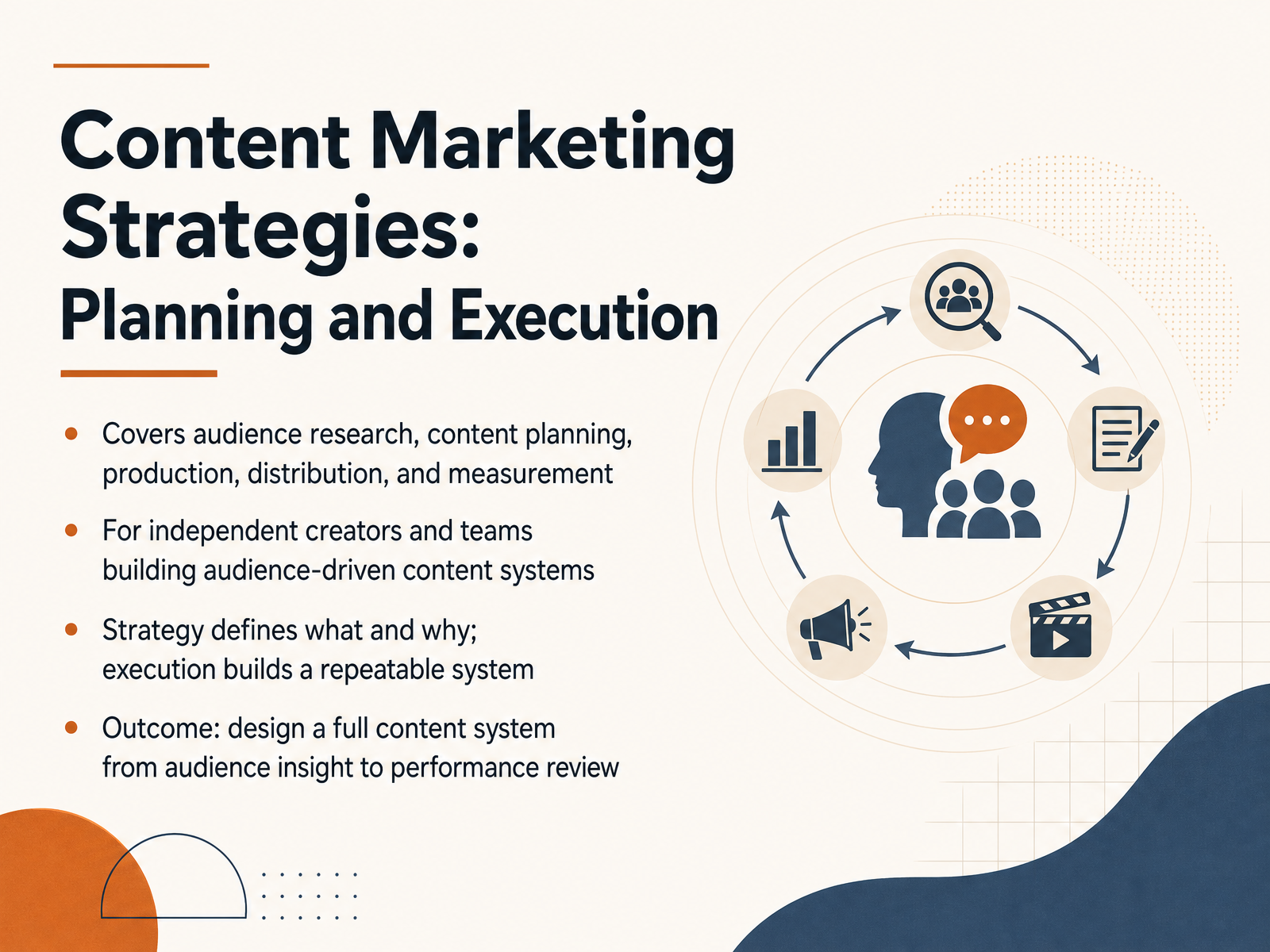
- 01Content Marketing Strategies: Planning and ExecutionWelcome. If you are here, you are probably tired of publishing content and hoping something sticks. You are not alone. That approach fails faster than ever. Today we are building a content system that actually works. Here is the honest truth: a content calendar is not a strategy. A strategy is the decision layer. It answers who you are trying to reach, what problems you solve for them, and how that work ties back to real business outcomes like pipeline or retention. Execution is the repeatable system that delivers those decisions. We will walk through audience research, planning, production, distribution, and finally measurement. By the end, you will have a full system that turns random posts into compounding trust and revenue. Let us get started. Next, we will look at why content marketing needs a system at all.planmoon.appyesoptimist.comcontentmarketinginstitute.com+21 min
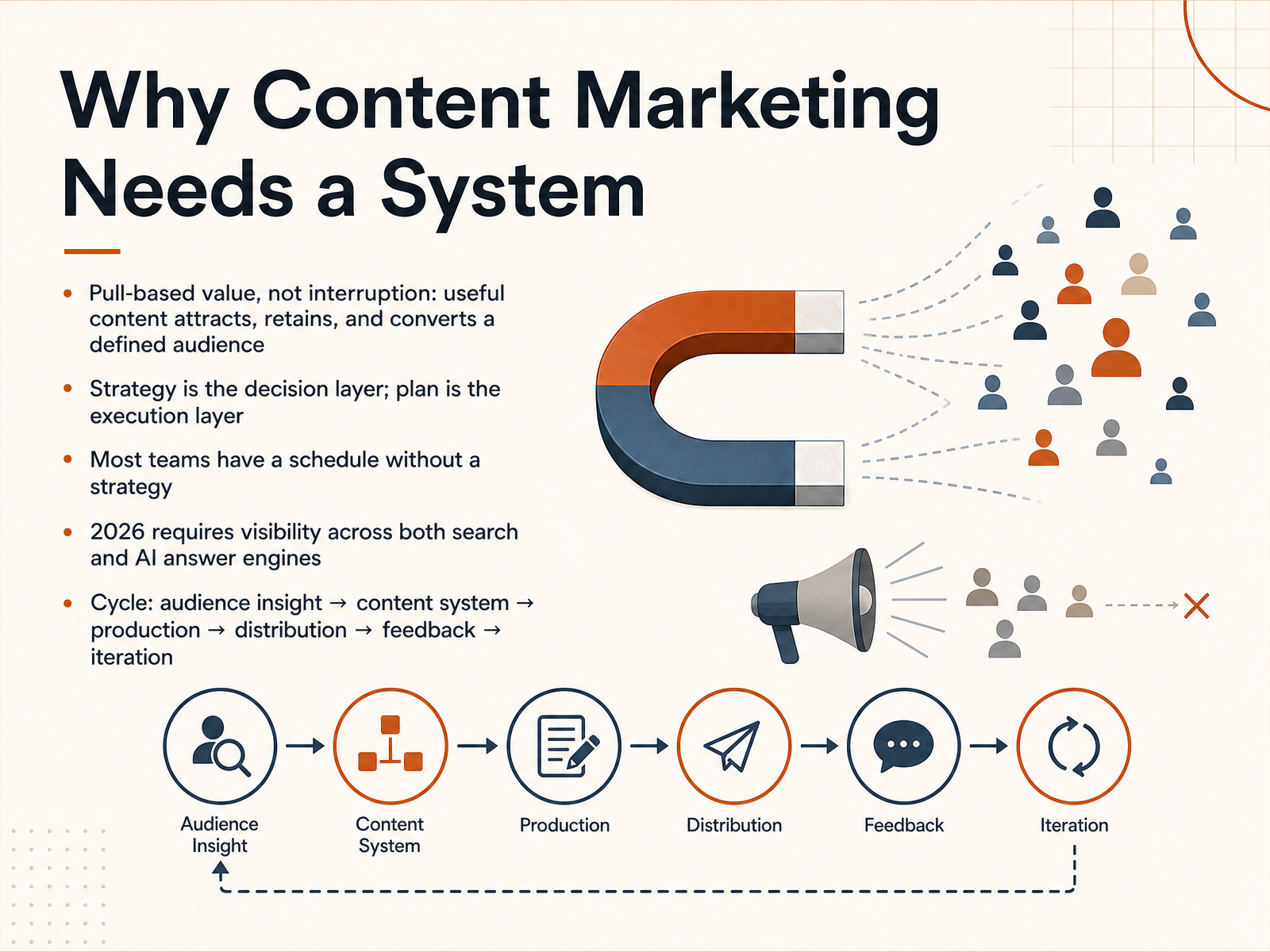
- 02Why Content Marketing Needs a SystemLet's get one thing straight right away: publishing content without a system is just activity, not strategy. Content marketing is pull-based value, not interruption. You attract, retain, and convert a defined audience by being useful, not by shouting over them. And that's why you need two distinct layers. Your strategy is the decision layer; it sets the direction, the outcomes, and who you serve. Your plan is the execution layer; it's the calendar, the formats, the deadlines. Most teams have a schedule without a strategy. If you removed the calendar and asked why a piece exists or who it serves, you'd hear silence. That's a schedule, not a system. In 2026, you also have to earn visibility across both search and AI answer engines. If you're not citable by the chatbots people actually use, you're invisible. So here's the cycle we'll build on: audience insight, then your content system, then production, distribution, feedback, and iteration. Commit to the system, and every piece of content starts compounding instead of scattering.
 planmoon.appyesoptimist.comcontentmarketinginstitute.com+21 min
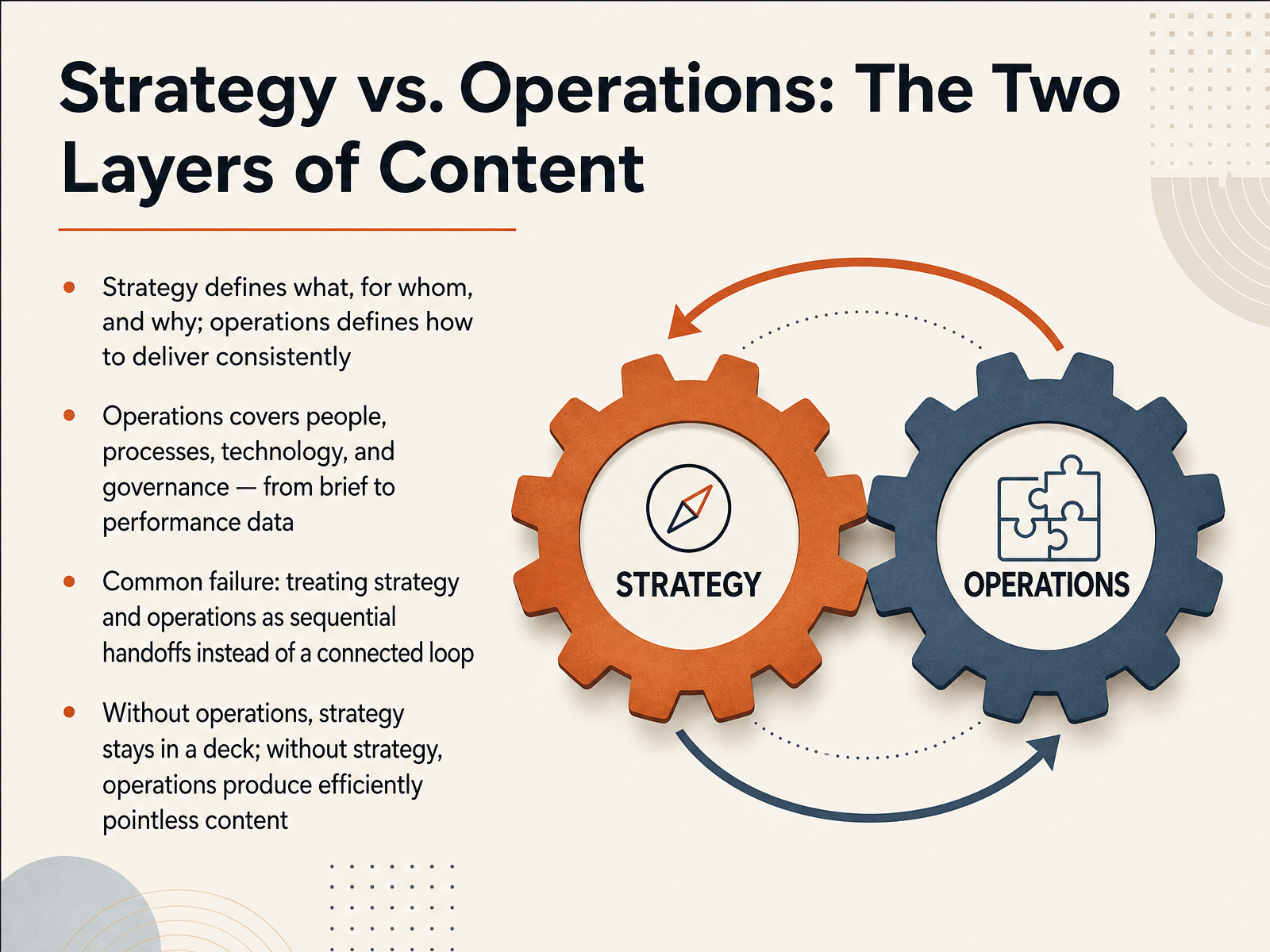
 - 03Strategy vs. Operations: The Two Layers of ContentLet's separate strategy from operations, because this distinction will save your content program. Strategy defines what you create, for whom, and why. Operations defines how you deliver that consistently: the people, the processes, the technology, and the governance, from brief all the way to performance data. Here's the common failure: teams treat them as sequential handoffs. Strategy gets written, handed to production, and never seen again. But strategy and operations are a connected loop, not a handoff. Without operations, your strategy stays stuck in a deck. Without strategy, operations produces content that's efficiently pointless. Think of a content calendar. It's an operational tool. It tells you when to publish, not what to say or why it matters. So don't confuse the two. Every time you plan a piece, ask: does this serve our audience and a business goal, and can we produce it at the quality and speed we need? When both answers are yes, you're on track. That loop—strategy informing what operations produces, and operations feeding performance data back to refine strategy—is how you build a system that scales. Now, let's move into audience research, where you replace assumptions with evidence.
 slatehq.comclearvoice.comthemarketingjuice.com+21 min
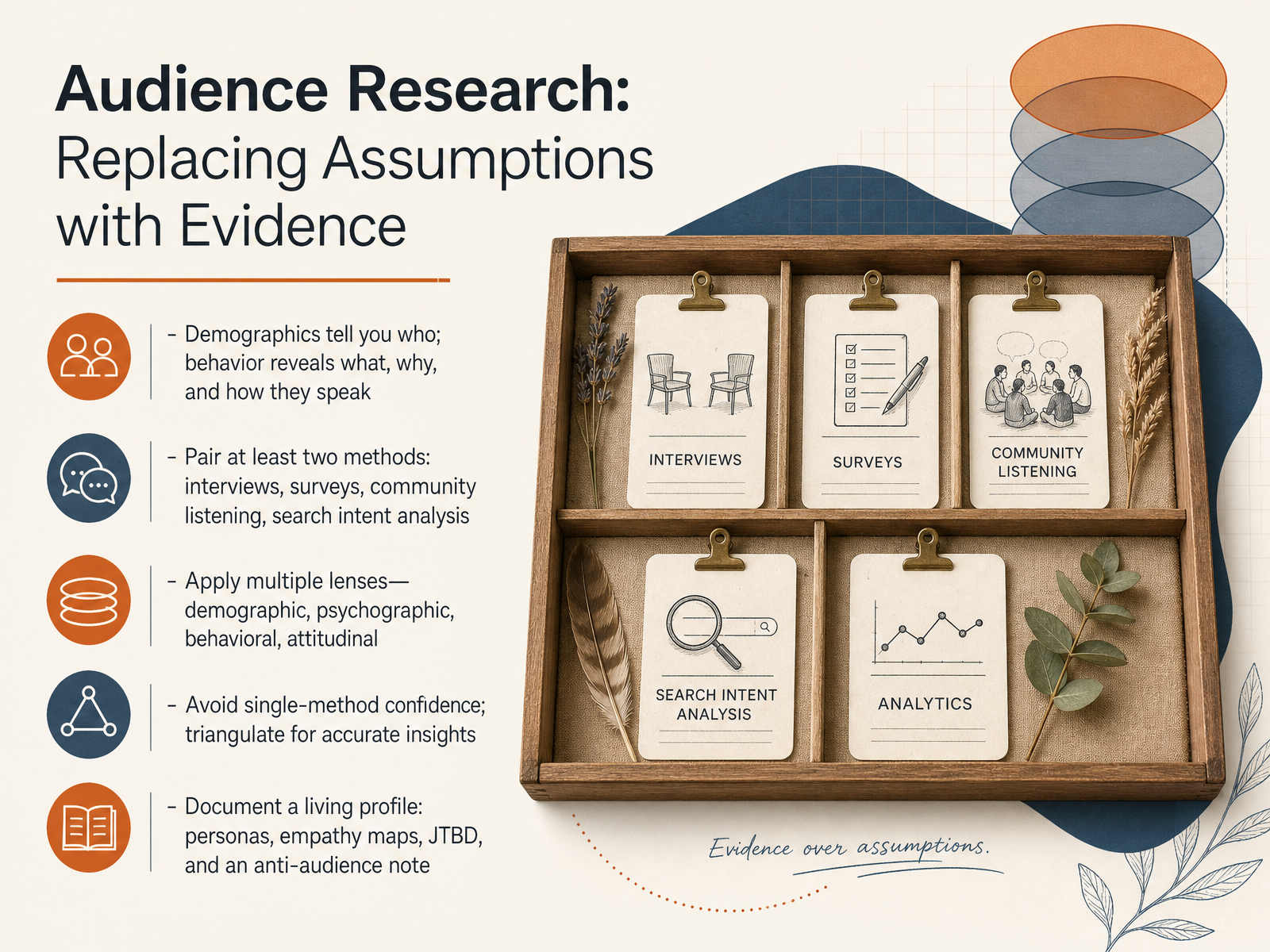
 - 04Audience Research: Replacing Assumptions with EvidenceNow let’s talk about replacing assumptions with evidence. Demographics tell you who your audience is, but they don’t tell you what they actually do, why they do it, or how they talk about their problems. To get that, you need to pair at least two research methods. For example, combine a few customer interviews with search intent analysis or community listening. That way you’re not relying on one biased source. Look at your audience through multiple lenses: demographic, psychographic, behavioral, and attitudinal. Each gives you a different angle. Demographics tell you who they are. Psychographics reveal values. Behavior shows what they do. Attitudinal data explains what they think and feel. The goal is to triangulate, so you avoid being confidently wrong. And once you have the evidence, build a living profile—personas, empathy maps, jobs to be done, and don’t forget an anti-audience note: who this content is not for. That keeps your writing sharp and focused. Remember: content problems are usually audience clarity problems. Get the evidence right, and the writing gets faster. Next, we’ll audit what you already have—your content inventory—to see what’s working and what’s wasting space.
 readaihandbook.comsparktoro.combacklinko.com+22 min
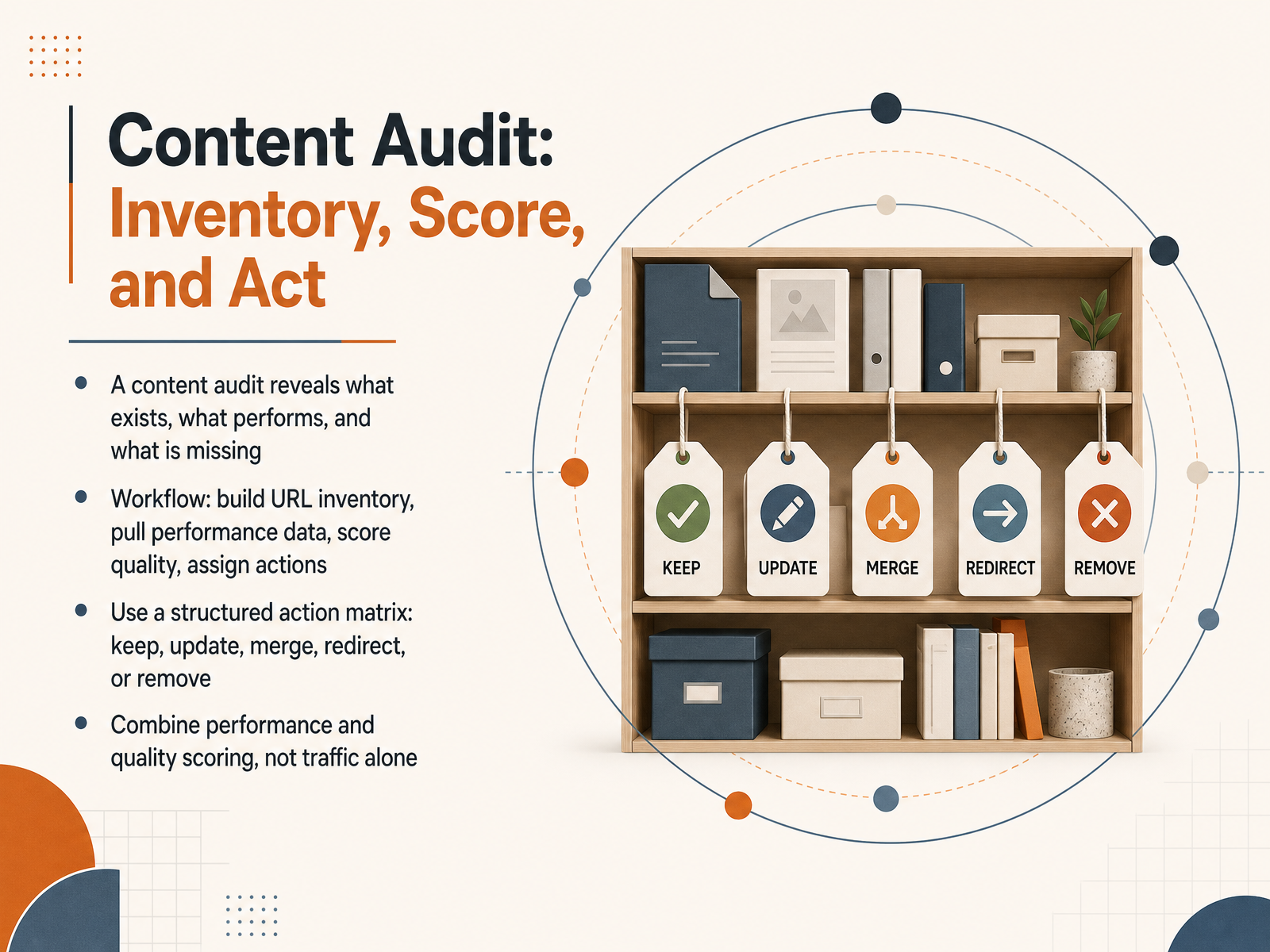
 - 05Content Audit: Inventory, Score, and ActNow let’s talk about the content audit. This is the step most teams skip, and it’s the reason their strategy falls flat. Start by building a complete URL inventory. Pull every page from your CMS, your sitemap, and a crawler. Merge them into one spreadsheet with metadata like publish date, content type, and target keyword. Next, pull the performance data: organic traffic, impressions, backlinks, and conversions. But don't stop there. Traffic alone lies. A page with five thousand visits can be outdated and thin. A page with low traffic can hold valuable link equity. That’s why you need a scoring rubric. Score every page on intent match, topical depth, freshness, and conversion clarity. Combine those quality scores with the performance data. Then assign a single action from the matrix: keep, update, merge, redirect, or remove. Never delete a page with backlinks. Merge it into a stronger page and set a 301 redirect. This turns your audit into a prioritized action plan, not just a report. And that plan sets you up perfectly for our next topic: structuring your content pillars and topic clusters.
 thestacc.comseolevelup.comsemrush.com+22 min
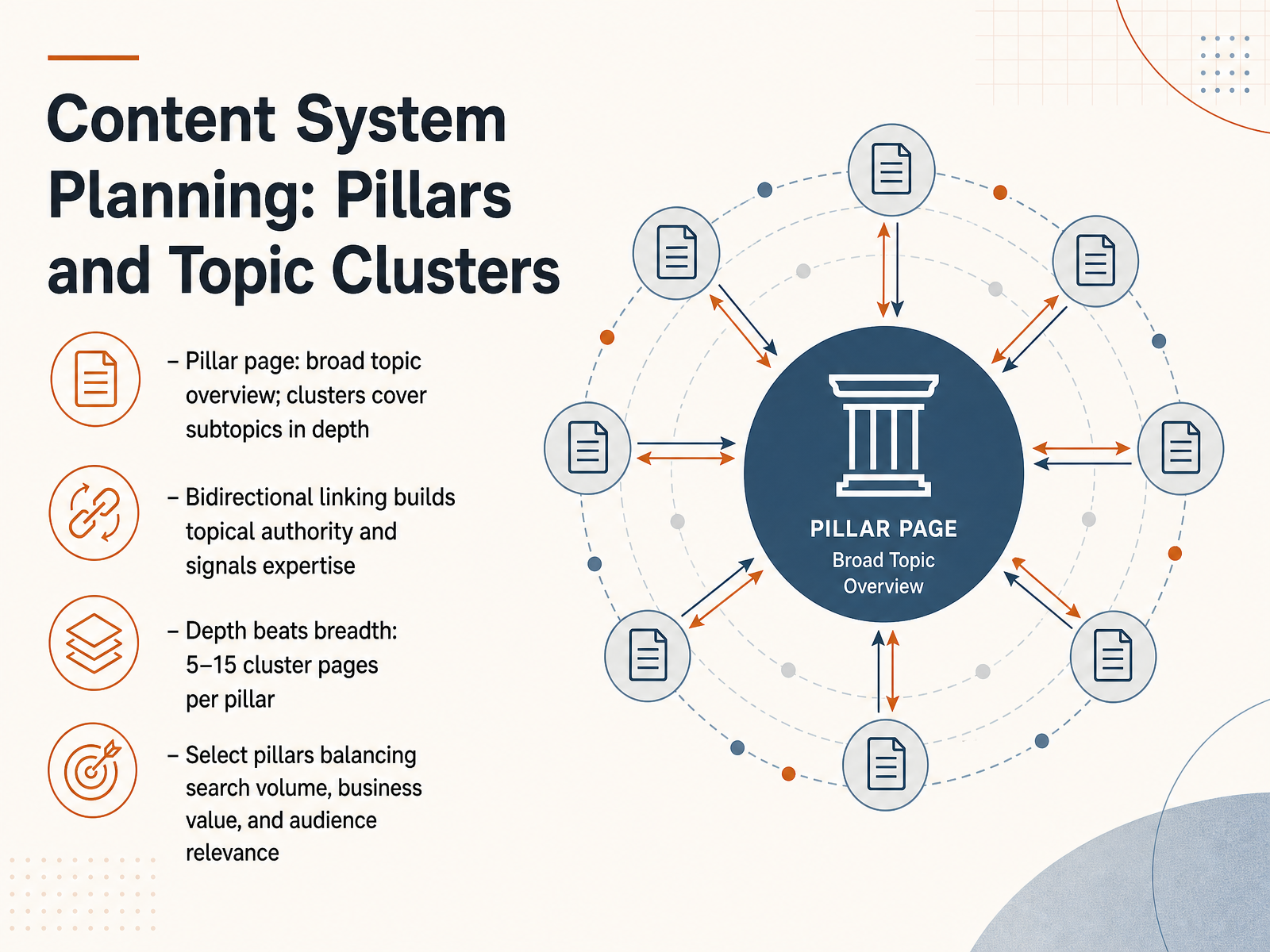
 - 06Content System Planning: Pillars and Topic ClustersNow let's turn that research into a working system. A topic cluster starts with one pillar page — a broad overview of the main topic — and then a set of cluster pages that go deep on specific subtopics. Think of the pillar as the hub, and each cluster page as a spoke. The critical move here is bidirectional internal linking. Every cluster page must link back to the pillar using descriptive anchor text, and the pillar must link out to each cluster. This two-way web is how search engines recognize you as an authority on the subject, not just someone who wrote a few related posts. Also, link related spokes to each other. That creates a dense network that signals true expertise. On scale, depth beats breadth. Target five to fifteen solid cluster pages per pillar, not fifty thin ones. A tight cluster of eight high-quality posts will outperform a sprawling cluster of thirty. As you pick your pillars, balance three factors: real search volume, direct business value, and relevance to the audience you actually serve. If a topic doesn't score on all three, it's not a pillar — it's just a blog post. Next, we'll map these clusters onto an editorial calendar and set measurable goals for the quarter.
 1 min
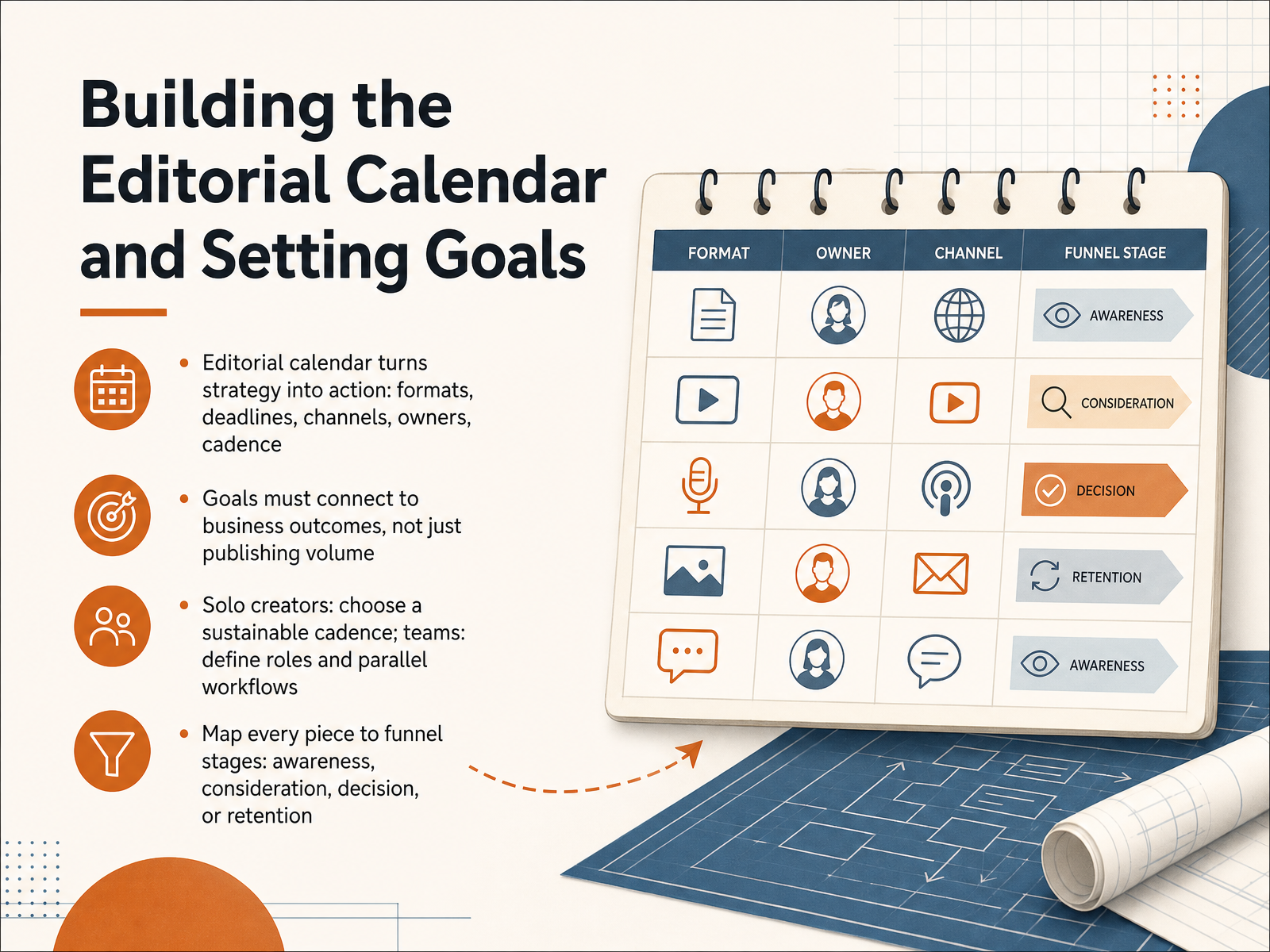
1 min - 07Building the Editorial Calendar and Setting GoalsNow let's turn that strategy into a working plan with an editorial calendar and clear goals. The calendar turns your ideas into action: formats, deadlines, channels, owners, and cadence. But here's the key: your goals must connect to business outcomes, not just publishing volume. So if you're a solo creator, pick a sustainable cadence, like one strong post a week instead of five rushed ones. If you're a team, define roles and build parallel workflows so one piece doesn't block another. And map every piece to a funnel stage: awareness, consideration, decision, or retention. For example, a how-to guide targets awareness, a comparison post hits consideration, a case study drives decision, and an onboarding email supports retention. That way, every piece has a job. Before you move on, ask: does each item on this calendar have a clear owner, a publish date, and a funnel stage? If not, it's just a list. Next, we'll look at the production pipeline, from brief to publish.
 slatehq.comclearvoice.comthemarketingjuice.com+21 min
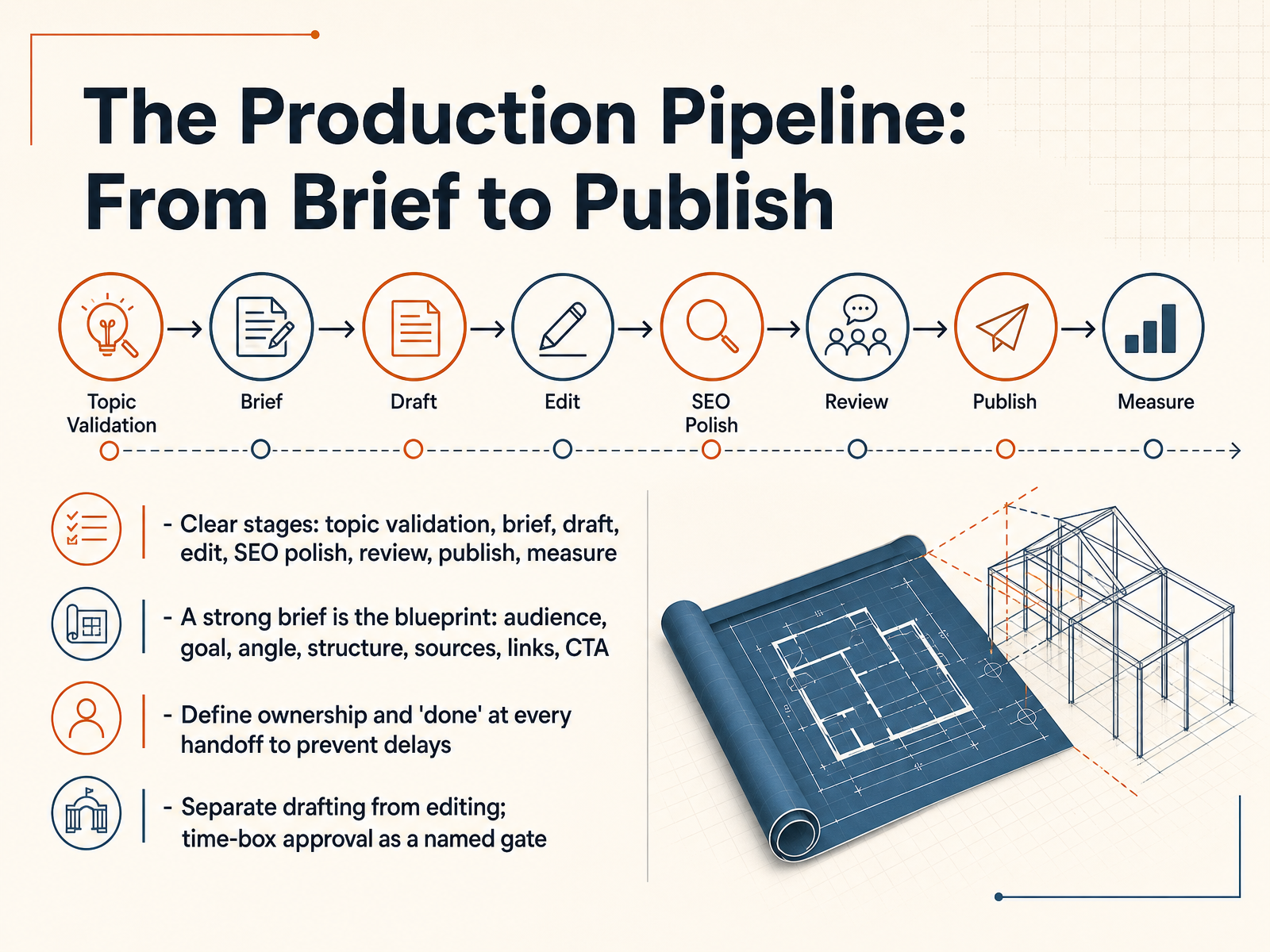
 - 08The Production Pipeline: From Brief to PublishNow let's talk about the production pipeline, the path from brief to published page. You've already validated the topic, so the next step is building a strong brief. Think of it as the blueprint for everything that follows. It should cover your audience, the goal, the angle, the structure, the sources, the internal links, and the call to action. A vague brief like 'write about content marketing ROI in 1500 words' is a prompt, not a blueprint. It will produce a draft that misses the mark. At every handoff, define who owns the work and what 'done' means. This prevents bottlenecks and keeps the pipeline moving. Critically, separate drafting from editing. A writer's job is to get a complete draft on the page, not to polish it. Editing is a separate stage with its own focus. And give approval a strict time box. Make it a named gate, say 24 to 48 hours, with one person accountable for the decision. When you do this, you cut revision cycles and ship on a predictable rhythm. Next, we'll look at how to turn that single asset into many outcomes through distribution and repurposing.
 1 min
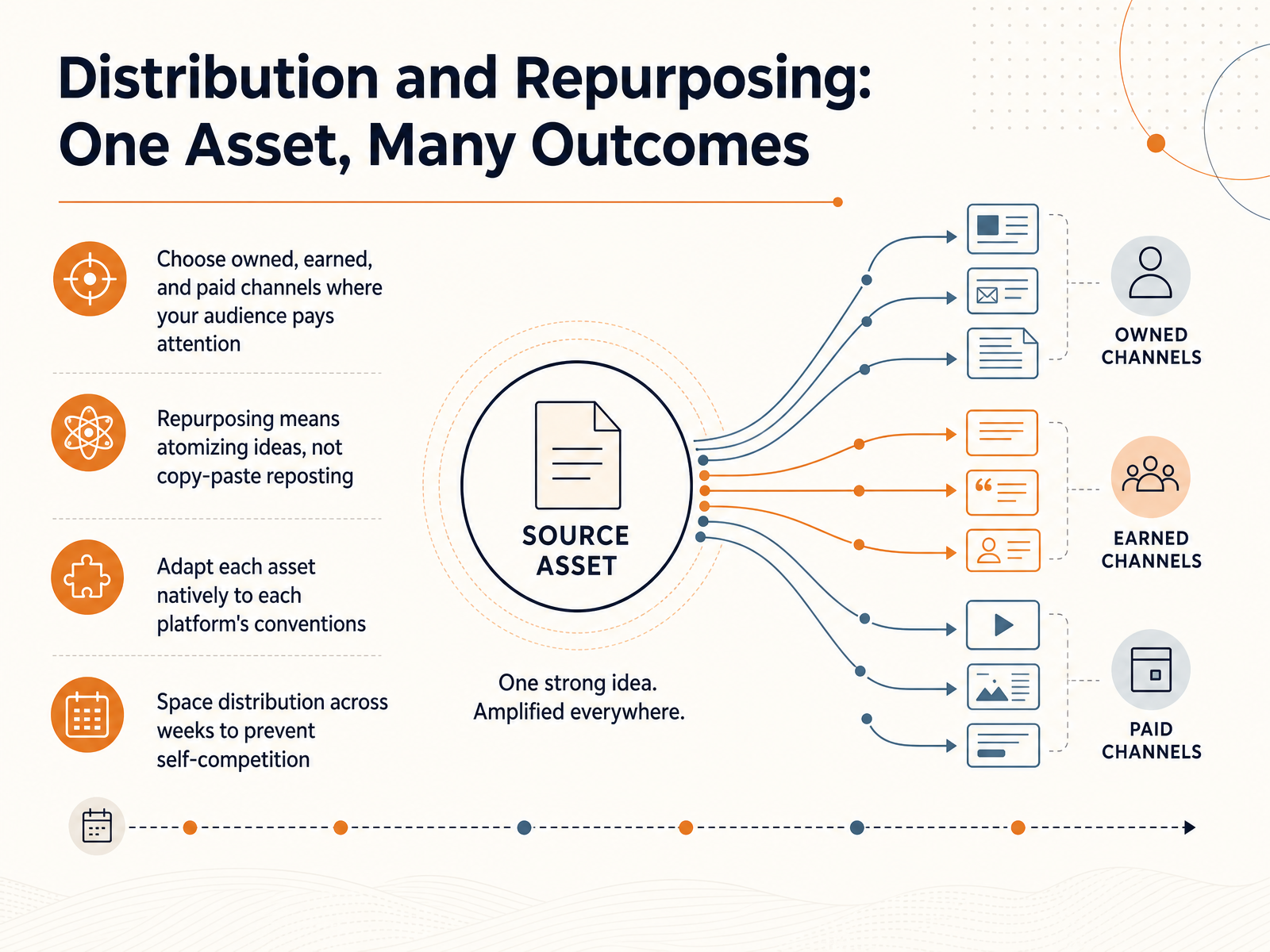
1 min - 09Distribution and Repurposing: One Asset, Many OutcomesLet’s talk distribution. One asset, many outcomes. One blog post doesn’t have to be just one post. It can become a LinkedIn post, a thread on X, a carousel, even a short video. But it’s not about copying and pasting the same text everywhere. That’s reposting, not repurposing. Start by choosing the owned, earned, and paid channels where your audience actually pays attention. Then atomize the source. Pull out the distinct ideas, not just paragraphs, and adapt each one natively to the platform’s conventions. A LinkedIn post reads differently than a TikTok caption. Write each piece to stand alone. And here’s the key: space it out. Don’t publish ten posts from one article on the same day. That competes with yourself. Spread it over three to four weeks to stay present without being repetitive. The pattern feels native, and your audience stays engaged. So when you plan your content engine, think of repurposing as a loop, not a one-time step. Next, we’ll talk about measuring what matters, moving from activity to actual impact.
 1 min
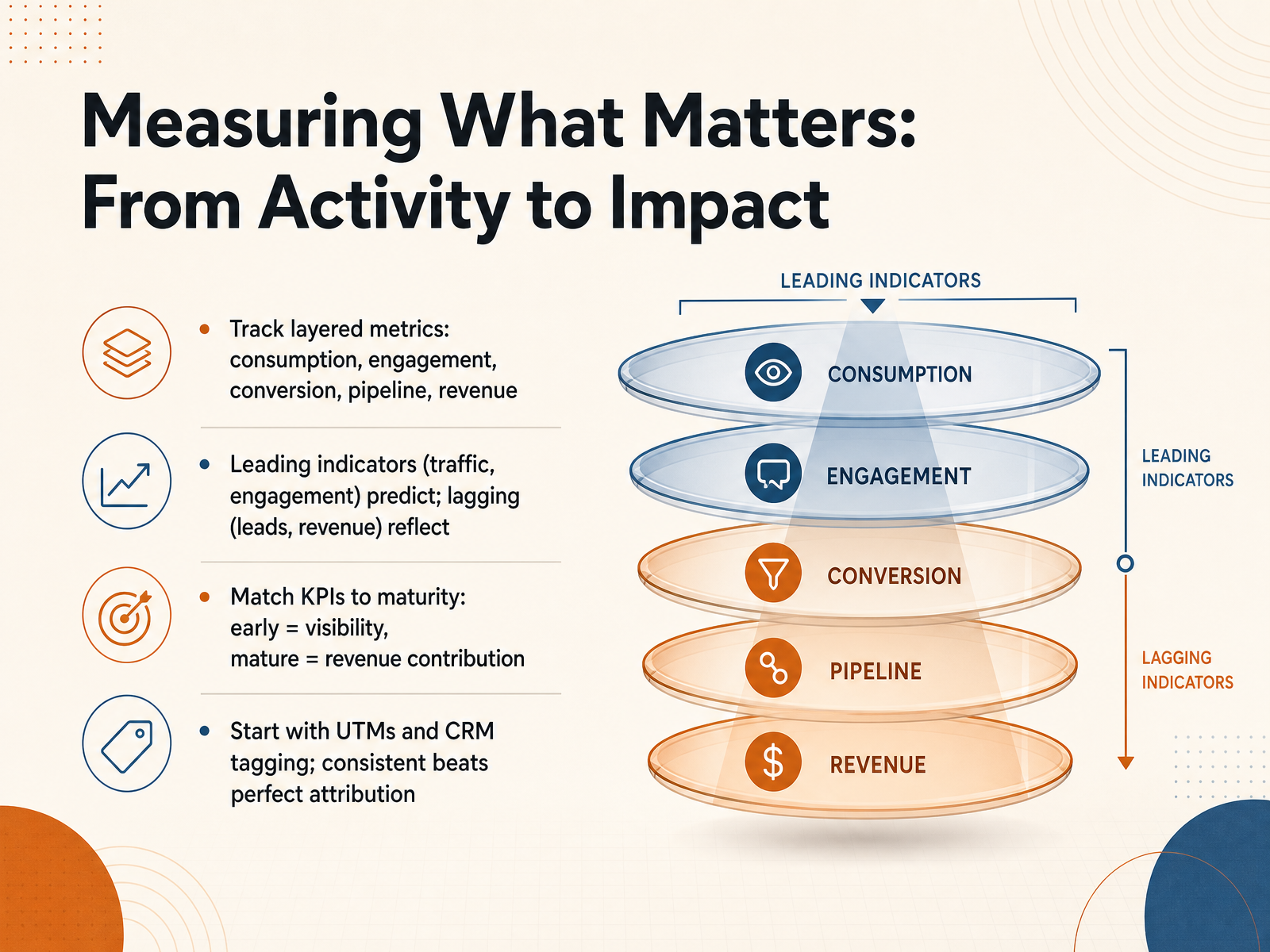
1 min - 10Measuring What Matters: From Activity to ImpactLet's talk about measuring what actually matters. We're moving from activity to impact. Here's the trap most creators fall into: they track pageviews and likes, and they call that success. But engagement without conversion is just noise. You need a layered approach. Start with consumption — are people reading? Then engagement — are they taking meaningful action? Then conversion — are they becoming leads? And finally, revenue — can you tie content to closed deals? Now, here's a key distinction: leading indicators like traffic and engagement predict future performance. Lagging indicators like leads and revenue reflect what's already happened. Both matter, but they answer different questions. Also, match your KPIs to your maturity. If your channel is three months old, focus on visibility and reach. If it's eighteen months old, you should be measuring revenue contribution. Expecting revenue attribution too early gives you unreliable numbers. Finally, start with UTMs and CRM tagging. Consistent tagging beats perfect attribution every time. An eighty percent accurate model you actually use is worth ten times more than a perfect model you never implement. Got it? Now let's talk about the feedback loop — how to review your results and iterate.
 2 min
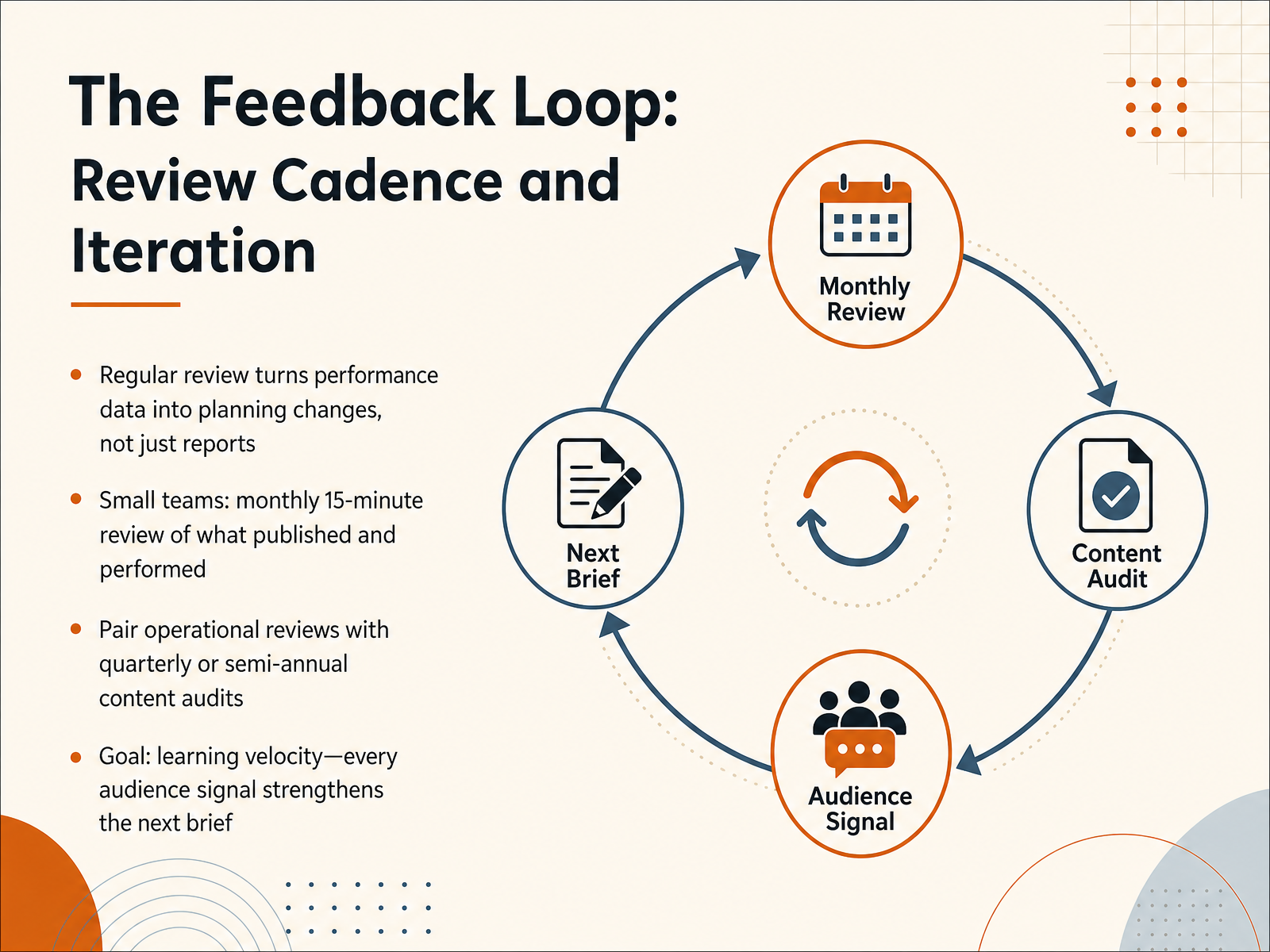
2 min - 11The Feedback Loop: Review Cadence and IterationNow let’s talk about the feedback loop. This is where performance data stops being a report and starts being your planning input. For small teams, the simplest cadence is a monthly fifteen-minute review. Ask three questions. What did we publish? What actually performed? And what do we change because of that? You do not need a dashboard with forty widgets. You need consistency and honesty. Beyond that monthly check, pair it with a quarterly or semi-annual content audit. That deeper pass looks at the full library. Which pieces are decaying? Which ones are still pulling value? The goal here is learning velocity. Every audience signal, every click pattern, every stagnant page should sharpen the next brief you write. If the data does not change what you create next, you are not iterating, you are just documenting. So keep the loop tight, make it a habit, and let every piece of content teach you something. Up next, we’ll break down the solo creator versus the team playbook.
 slatehq.comclearvoice.comthemarketingjuice.com+22 min
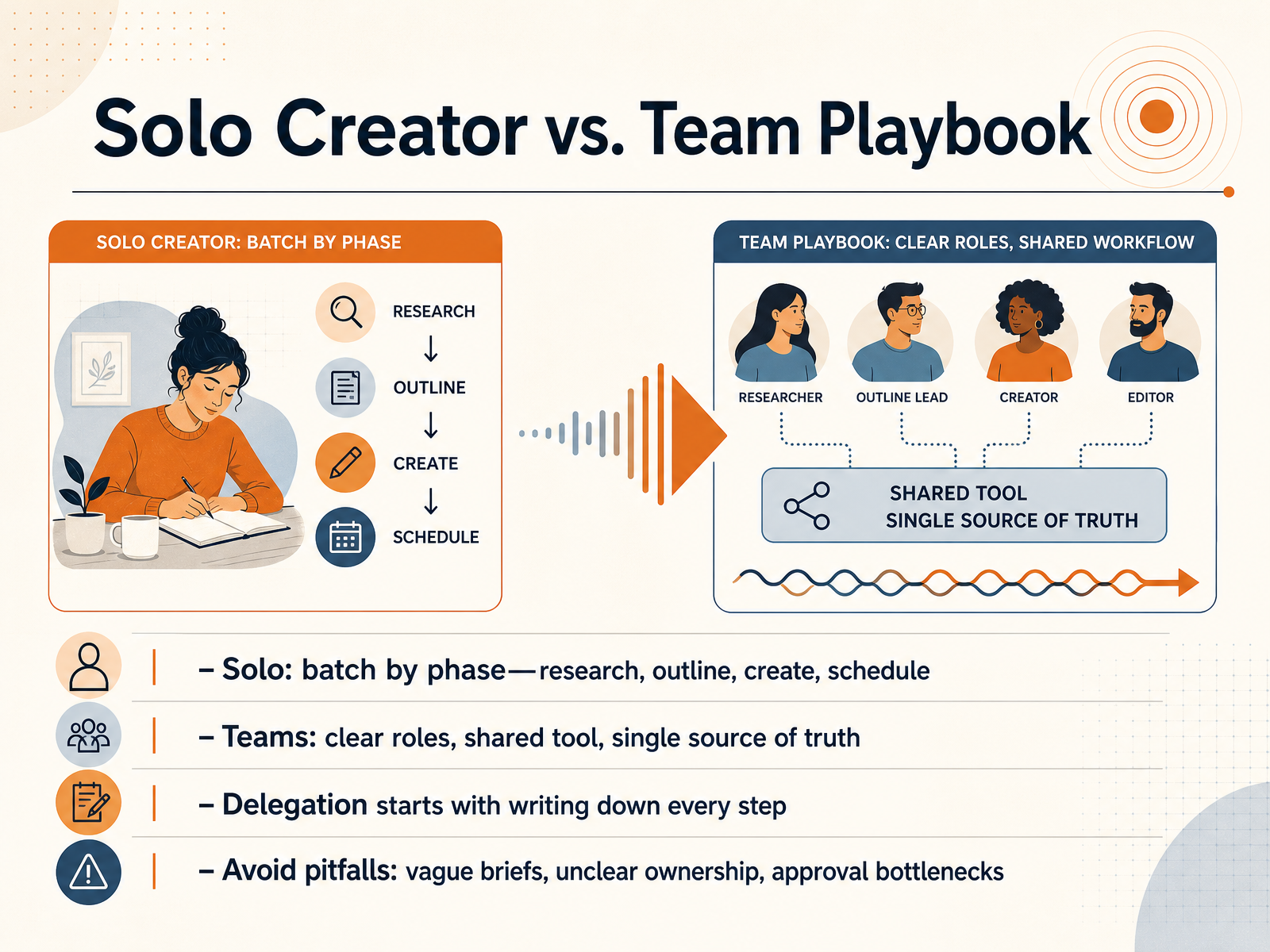
 - 12Solo Creator vs. Team PlaybookNow let's talk about the playbook, because the workflow changes depending on whether you're flying solo or running with a team. If you're a solo creator, batch your work by phase. Do all your research in one sitting, then all outlines, then all drafting, then all scheduling. You stay in one cognitive mode longer, and you stop paying the switching cost between tasks. For teams, the rules are different. You need clear roles, a shared tool, and one single source of truth. If the brief lives in one place and the draft in another, you've already lost. Delegation only works when you've written down every step first. You can't hand off a process you haven't defined. Now, the three pitfalls that sink most teams: vague briefs, unclear ownership, and approval bottlenecks. A brief that fits in one Slack message is too thin. When ownership is fuzzy, work stalls in review. And when approval has no owner, the piece waits. Fix those three and you fix most of your delays. That's the solo versus team playbook in action. Next, we'll look at the tools and governance that keep quality consistent as you scale.
 2 min
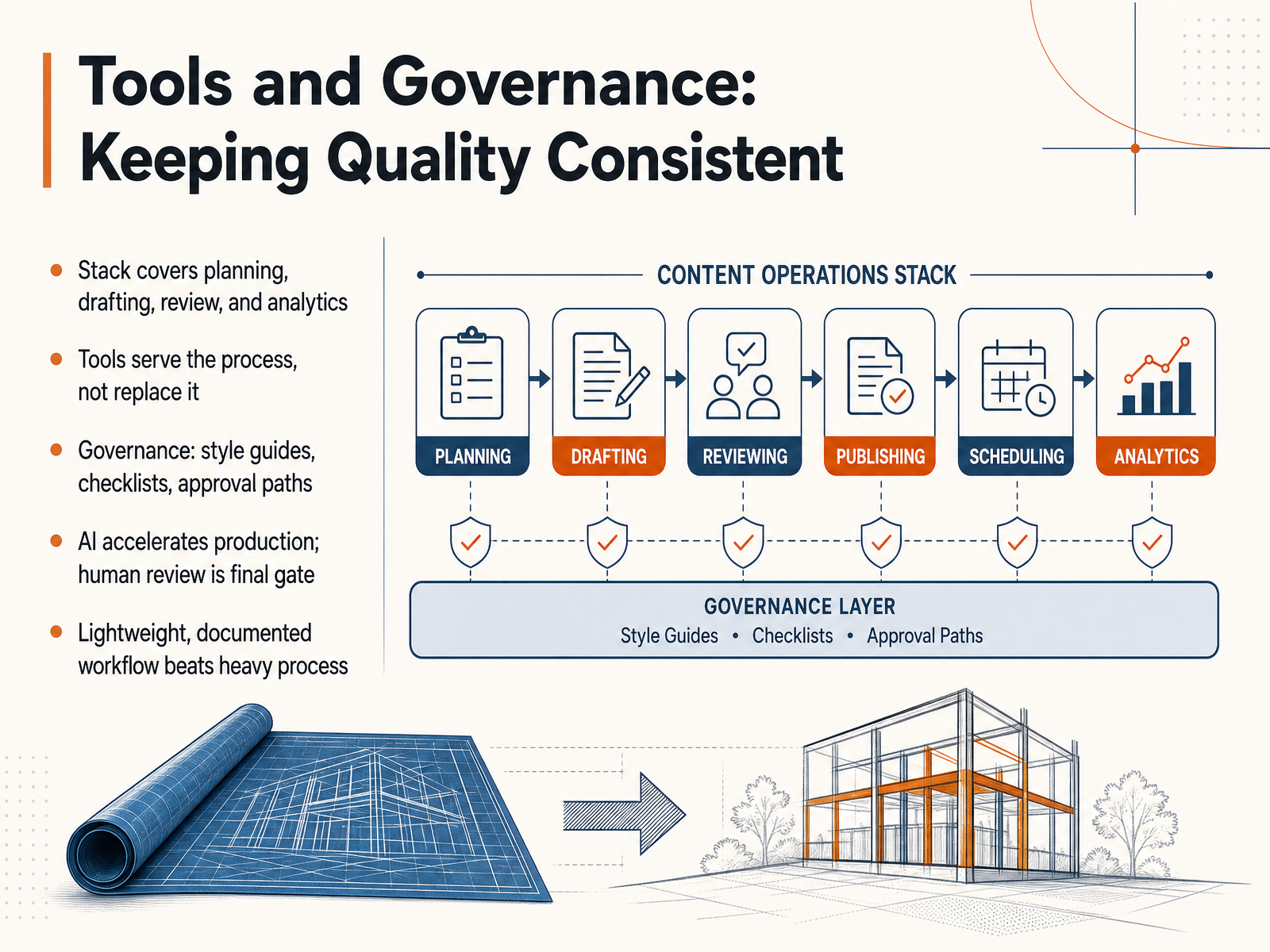
2 min - 13Tools and Governance: Keeping Quality ConsistentLet’s talk about the tools and the governance that keep quality consistent. Your stack should cover the full journey: planning, drafting, review, and analytics. But here’s the key—tools serve the process, they don’t replace it. A sophisticated setup won’t save you if roles and standards are unclear. Governance is your safety net: a style guide, checklists, and a clear approval path. Keep it lightweight. A documented workflow beats a heavy process every time. When it comes to AI, let it accelerate production, but keep human review as the final gate. The handoff that breaks most often is approval. Assign one accountable owner, not a committee. Give it a 24 to 48-hour window, and if it sits untouched, have an automatic nudge. That alone will catch most of your delays. Now, let's look at how to put this all into action with your 30- and 90-day plan.
 1 min
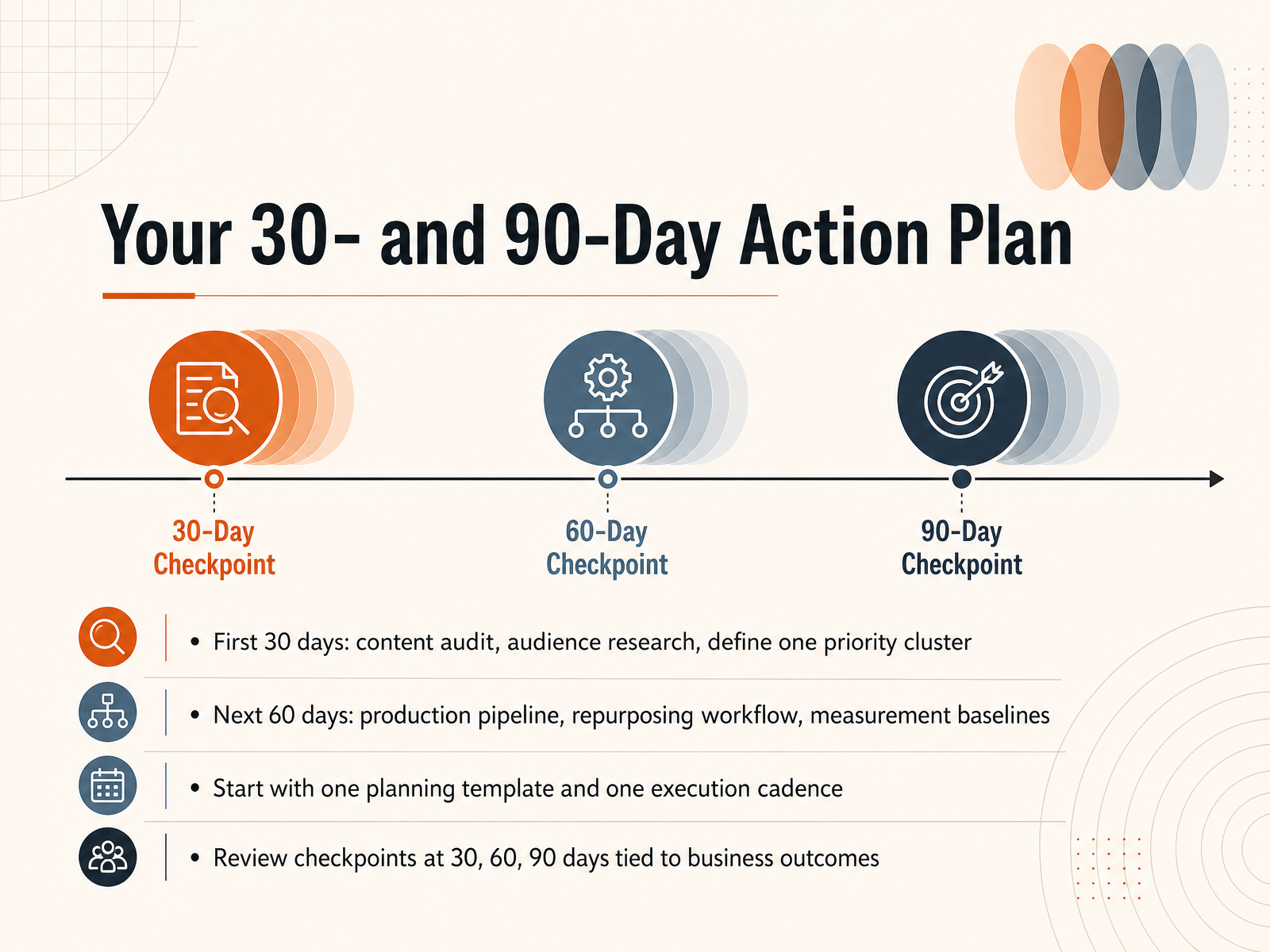
1 min - 14Your 30- and 90-Day Action PlanSo here's your roadmap. The first thirty days are about clarity. Run a content audit, do your audience research, and define your one priority topic cluster. Just one. This is your foundation. In the next sixty days, shift into production. Build your pipeline, set up a repurposing workflow, and lock in your baseline metrics before you start measuring. Start small. One planning template, one execution cadence. That's it. Don't build a complex system before you've proven the basics work. Then, tie everything to checkpoints. At day thirty, sixty, and ninety, review your progress against real business outcomes. Not vanity metrics. Revenue, leads, audience growth. This plan turns strategy into action. You have the framework. Now go execute, and I'll see you at the first checkpoint.
 thestacc.comseolevelup.comsemrush.com+21 min
Take the deck with you
Download this course as a file — free, no sign-up needed.
- PDF handoutEvery slide page, ready to print or share.15 pages · 3.6 MBDownload
- Narrated PowerPointThe deck that presents itself — every slide carries the digital human's narration video.15 pages · 15.5 MBDownload
- PowerPoint slidesThe full deck as a .pptx — open it in PowerPoint, Keynote, or Google Slides.15 pages · 3.6 MBDownload
Free to use in your own training — please keep the PersonWise credit page at the end.
Have your own deck? Turn it into a course
Sources consulted
Web sources consulted while building this course.
- What Is a Content Marketing Strategy? A Plain-English Guide for 2026 - Planmoon Blog — planmoon.app
- How to Build a Content Marketing Strategy that (Still) Works in 2026 | Optimist — yesoptimist.com
- What Is Content Marketing? — contentmarketinginstitute.com
- https://www.traficxo.com/blog/content-marketing-strategy-complete-guide — traficxo.com
- Content Marketing Strategy: Build a Plan That Drives Leads (2026) — autimark.com
- Content Operations vs. Content Strategy: Differences & Examples (2026) | Slate — slatehq.com
- Content Operations vs. Content Strategy: A Detailed Breakdown — clearvoice.com
- Content Operations Framework: Build One That Works — themarketingjuice.com
- What Is Content Operations? A Framework for Scaling Without Chaos | SparkBlog — sparkblog.dev
- Master Content Operations and Keep Your Team Moving Forward — contentmarketinginstitute.com
- Audience Research: A Multi-Method Framework - by Ryan Stax — readaihandbook.com
- Audience Research: The Complete Guide for Marketers in 2025 - SparkToro — sparktoro.com
- Audience Research: Stop Guessing What Your Buyers Care About — backlinko.com
- How to do audience research in content marketing — contentconnect.site
- The Audience Insight Framework | Nomad Foundr — nomadfoundr.com
- Content Audit Template: Inventory, Score, and Fix Pages — thestacc.com
- Content Audit Checklist for SEO Pros: 2026 Guide - SEOLEVELUP, LLC — seolevelup.com
- How to do a website content audit in 2026 (with template) - Semrush — semrush.com
- Free Content Audit Framework Tool: Score and Prioritise Every Piece of Content You Own · Rob T. Case — robtcase.com
- Content Audit Template — Inventory, Scoring, Gap Analysis & Action Plan — whitelife.us