Content Marketing Framework Essentials
Begin
14 pages · ~28 min
Content Marketing Framework Essentials
Learn the core components of a content marketing framework and how to apply them strategically to plan, create, and measure effective content.
What you’ll learn
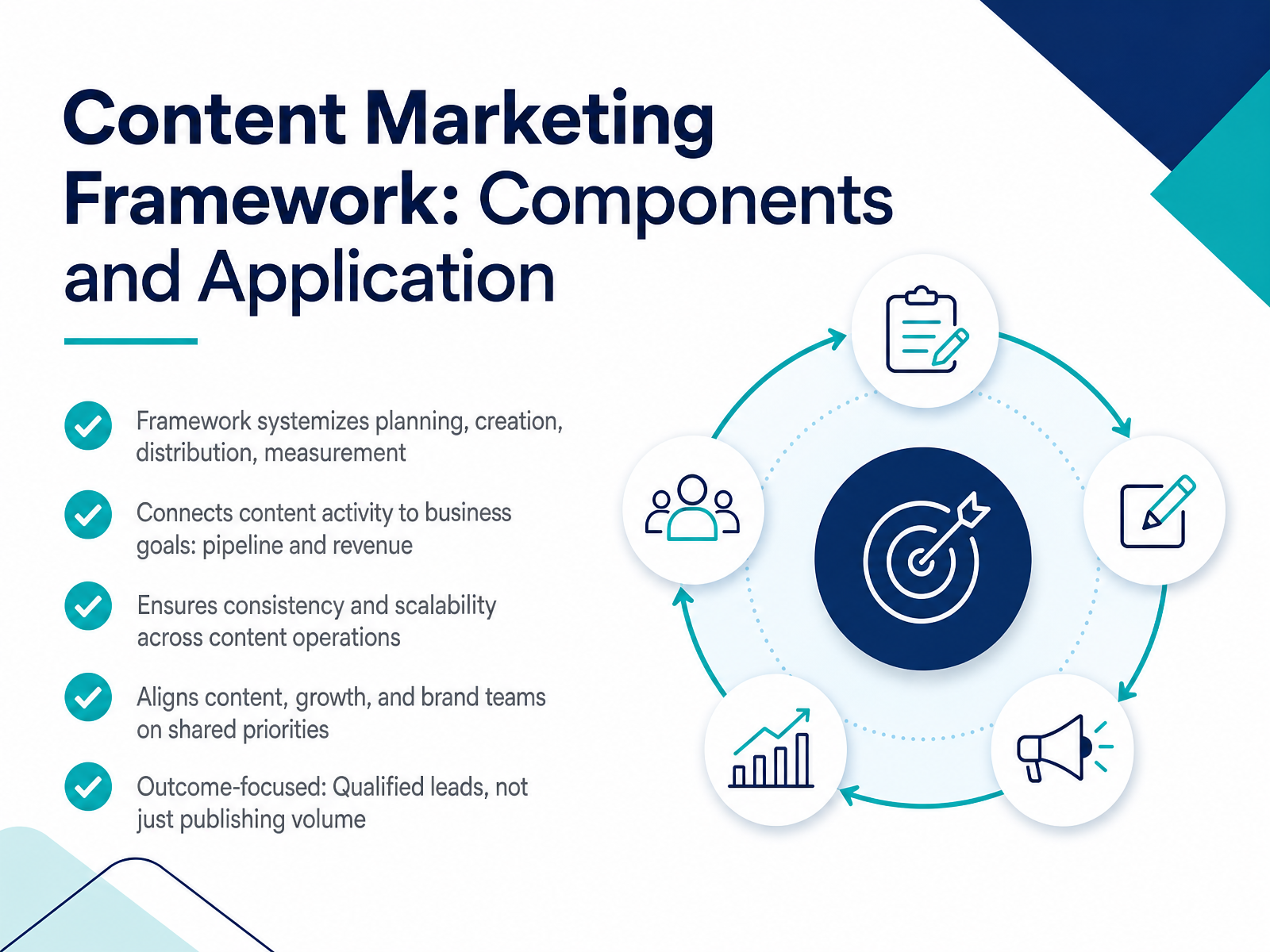
- 01Content Marketing Framework: Components and ApplicationWelcome. If you're here, you already know that publishing content and building a growth engine are two different things. Today, we're going to close that gap with a content marketing framework. This isn't about theory. This is about operationalizing how you plan, create, distribute, and measure content so every piece has a job and connects directly to pipeline and revenue. You already have the fundamentals, so let's focus on making your efforts scalable and consistent. We'll also look at how this framework gets your content, growth, and brand teams aligned on the same shared priorities. The outcome we're after is clear: qualified leads, not just publishing volume. Let's get to work and see why a framework beats content chaos.marketful.comswingintel.comdigitalmarketacademy.in+21 min
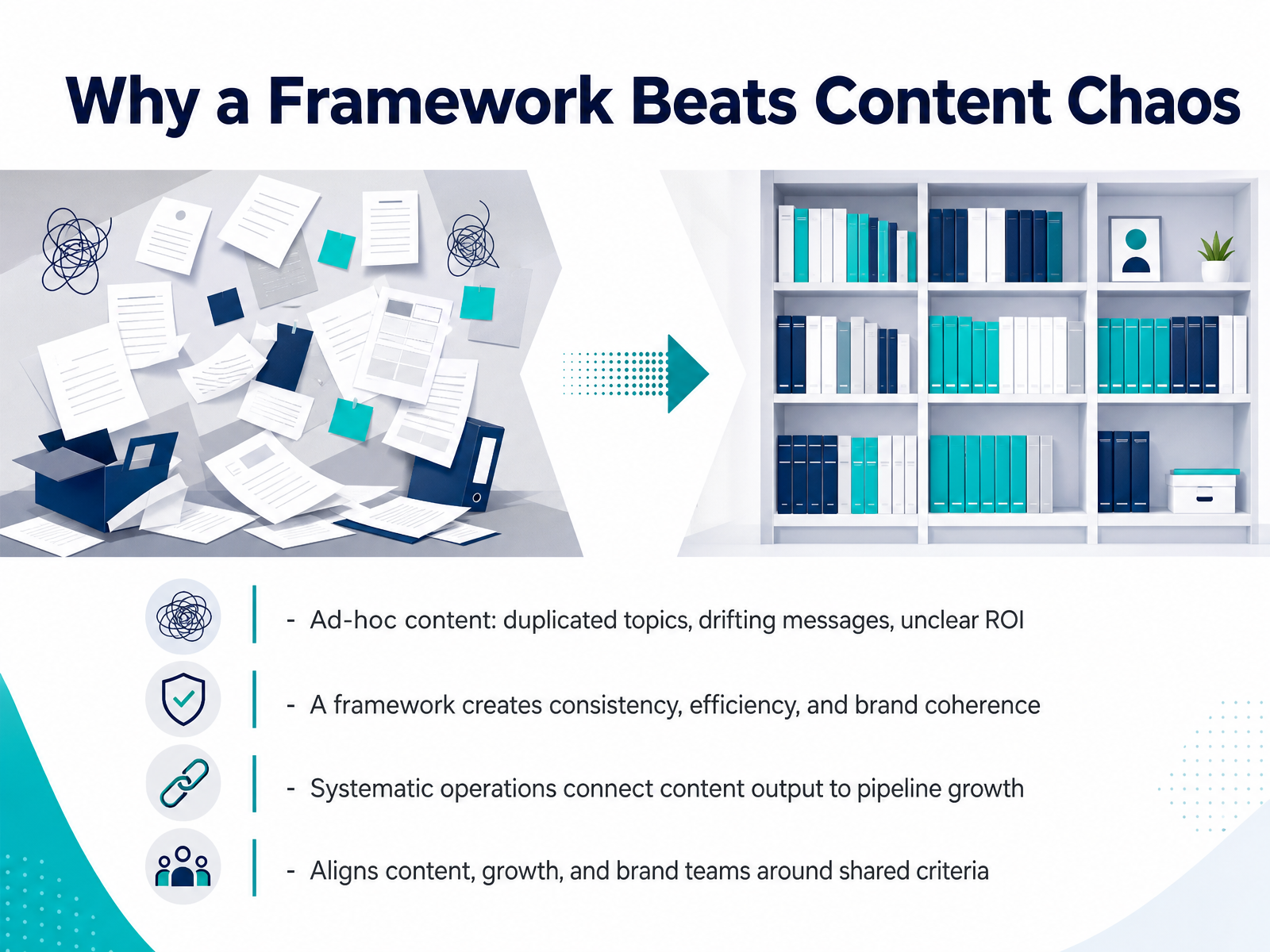
- 02Why a Framework Beats Content ChaosLet's be honest. Without a framework, content marketing is just chaos with a publishing schedule. Topics get duplicated. Messages drift off-brand. And when leadership asks about ROI? You can't give a clear answer. That's the ad-hoc trap too many teams fall into. A framework changes the game. It's not about restricting creativity; it's about ensuring every piece of content has a job and a purpose. It creates consistency across your messaging, makes your team more efficient, and builds a coherent brand narrative that actually compounds over time. More importantly, it connects your efforts directly to pipeline growth. When your system is structured, you can finally link content output to leads and revenue. This alignment is critical. It gets your content, growth, and brand teams operating on the same page, with shared criteria for success. You're not just producing content anymore; you're building a growth engine. So, with that foundation in mind, let's break down the anatomy of a content marketing framework that makes this possible.
 tenspeed.ioplanmoon.apptenspeed.io+21 min
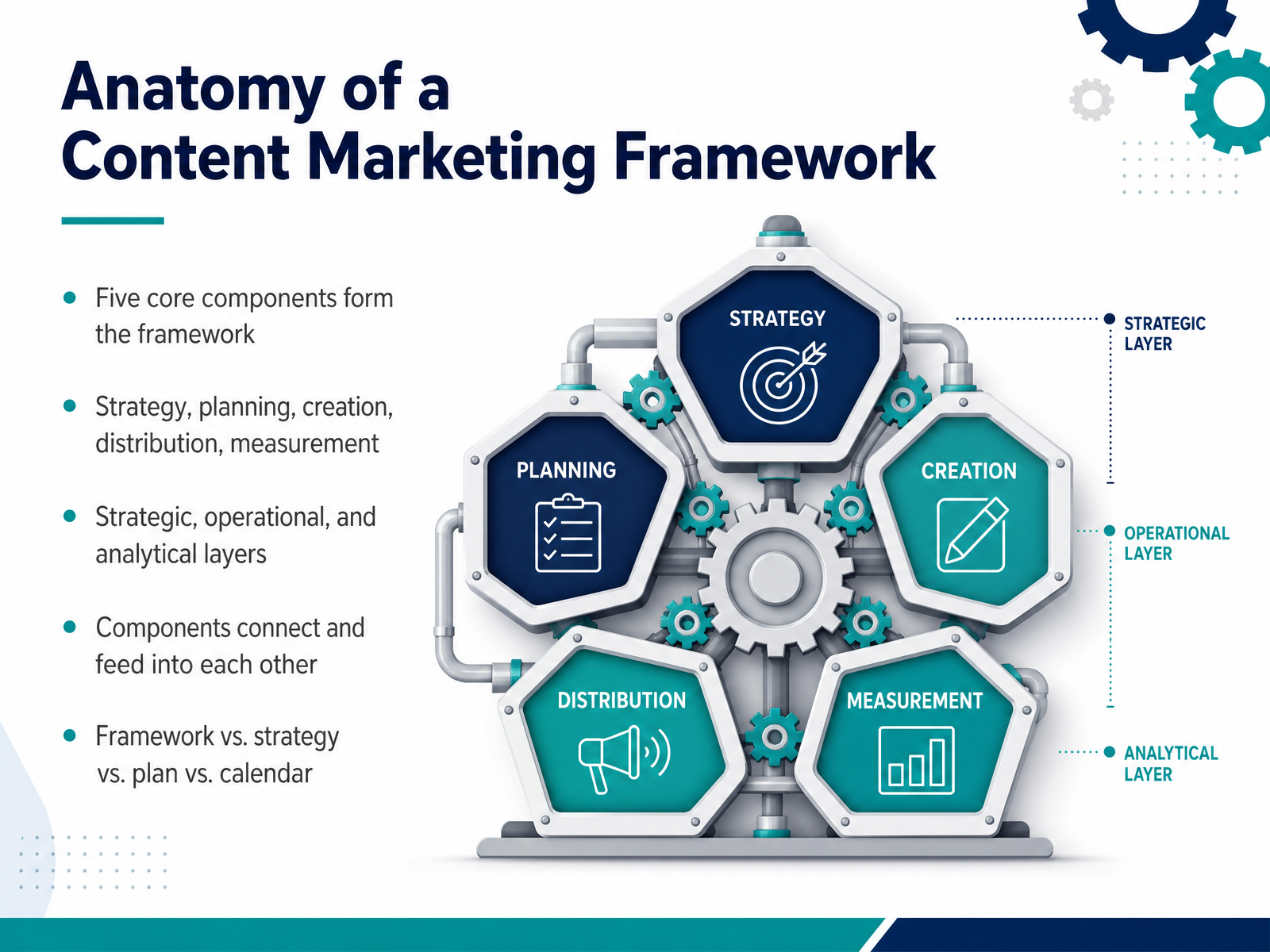
 - 03Anatomy of a Content Marketing FrameworkLet's pull back the curtain on what a content marketing framework actually is. Think of it as your operating system for growth. It's built on five core components: strategy, planning, creation, distribution, and measurement. These aren't silos though. They stack into three distinct layers. The strategic layer is your vision: the audience you serve, the position you own, the goals you're driving toward. The operational layer is execution: your topic pillars, editorial calendar, production workflow. And the analytical layer closes the loop: performance metrics, ROI, and the insights that feed back into strategy. Here's the critical point. These components aren't a linear checklist. They're a connected system. Strategy informs planning, planning shapes creation, creation feeds distribution, and measurement tells you what to adjust. When they work together, the whole system compounds. And this is where the terminology matters. A framework is your structure. A strategy is your direction. A plan is your roadmap. And a calendar is just the schedule. Get the framework right, and everything else falls into place. Next, we'll dig into the strategic foundation: defining your audience, your objectives, and your positioning.
 marketful.comswingintel.comdigitalmarketacademy.in+22 min
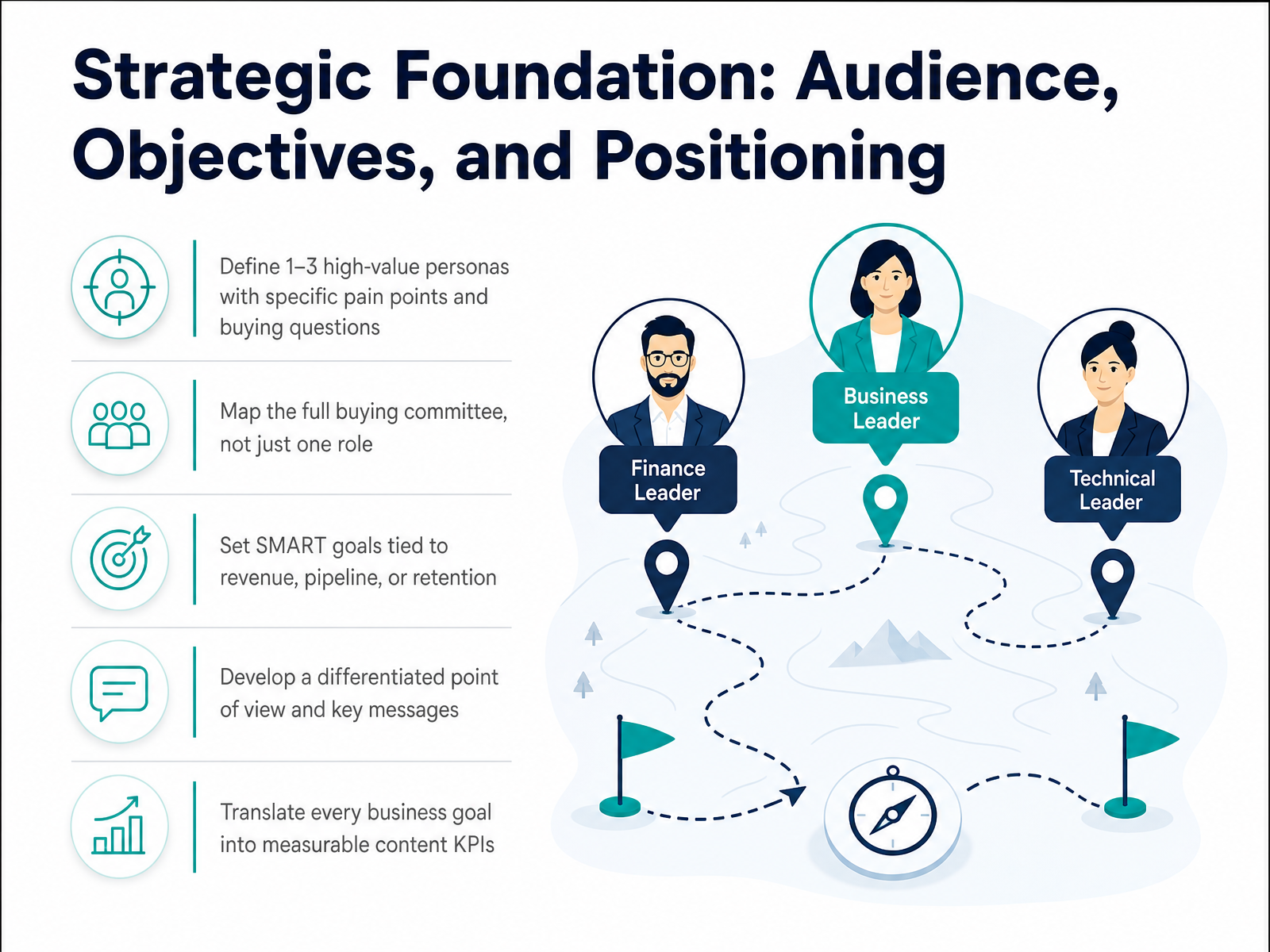
 - 04Strategic Foundation: Audience, Objectives, and PositioningThis is where strategy stops being abstract and starts being actionable. The foundation has three layers, and they need to lock together. Audience first. Don't just build one persona—build one to three high-value ones, with specific pain points and the actual questions they're asking before they buy. And in B2B, map the full buying committee, not just the decision-maker. A VP of Marketing and a CTO have completely different information needs. Second, objectives. Set SMART goals that tie directly to revenue, pipeline, or retention. Vague goals produce vague results, but a goal like generating two hundred qualified leads per quarter gives your team something to reverse-engineer. Finally, positioning. Develop a differentiated point of view and key messages that make your content unmistakably yours. Then translate every business goal into measurable content KPIs. That's the discipline that keeps content from becoming a volume game. Lock these three layers in first, and everything downstream—topics, formats, distribution—gets easier. Next, we'll build your content architecture with pillars, clusters, and the buyer journey.
 monday.comclarigital.commarketful.com+22 min
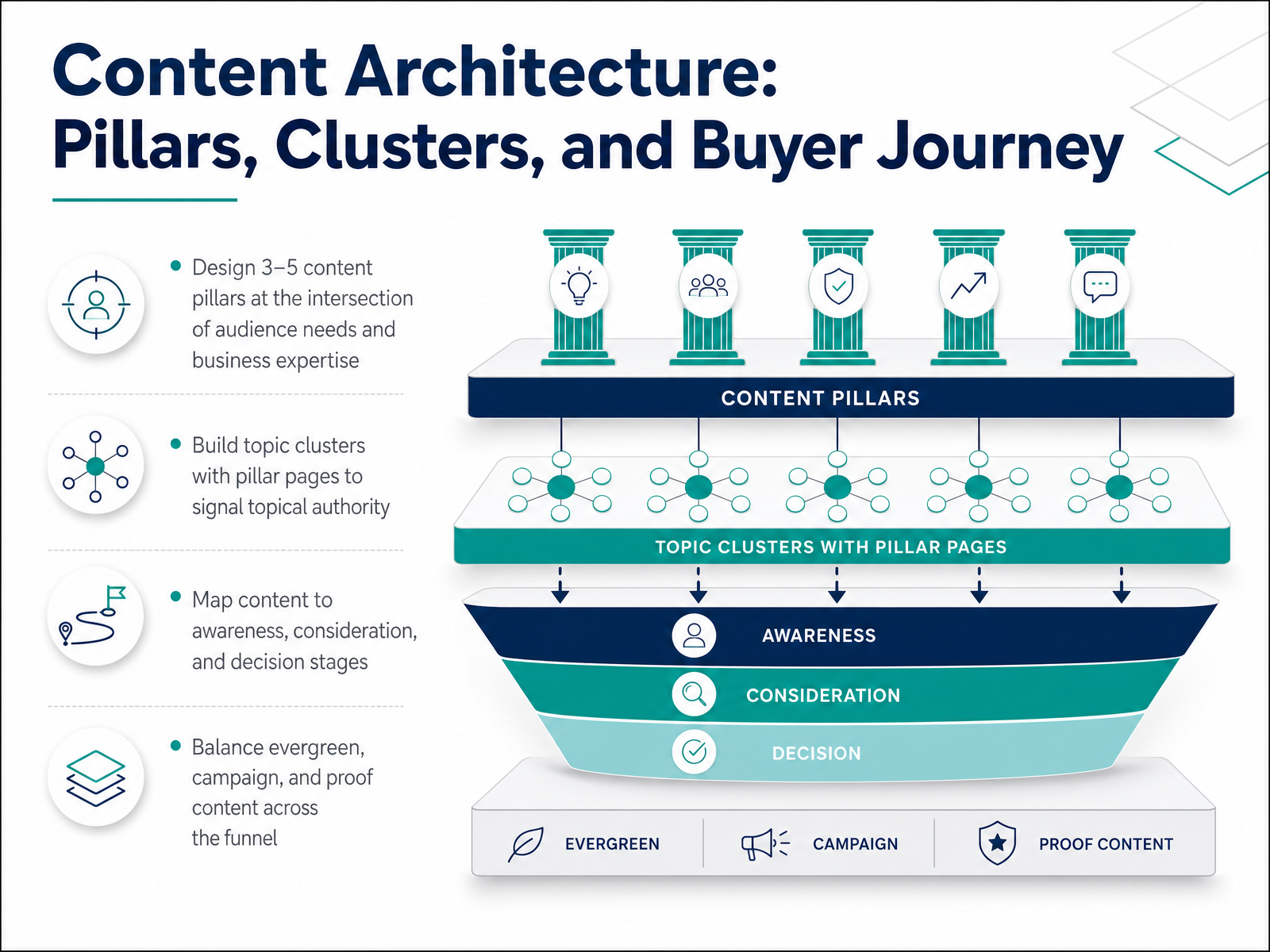
 - 05Content Architecture: Pillars, Clusters, and Buyer JourneyNow let's talk about content architecture. This is where structure meets strategy. You want to design three to five content pillars. These sit at the intersection of what your audience cares about and where your business has real expertise. Think of your pillars as the core territories you'll own. Once you have those, build topic clusters around them. A comprehensive pillar page supported by focused articles that link back to it. This signals topical authority to search engines and to AI platforms. Each cluster piece strengthens the whole collection. Next, map your content to the buyer journey. Awareness, consideration, and decision. Each stage needs a different type of content, a different objective, and different metrics. Too many programs are top-heavy with awareness content and thin where it actually drives decisions. Finally, balance your content mix across the funnel. Combine evergreen assets that compound over time, campaign content that captures momentum, and proof content like case studies and ROI analyses that removes final objections. Get this balance right and your content library becomes a system, not just a collection. From here, we'll move into the editorial planning and production workflow that brings this architecture to life.
 marketful.comswingintel.comdigitalmarketacademy.in+22 min
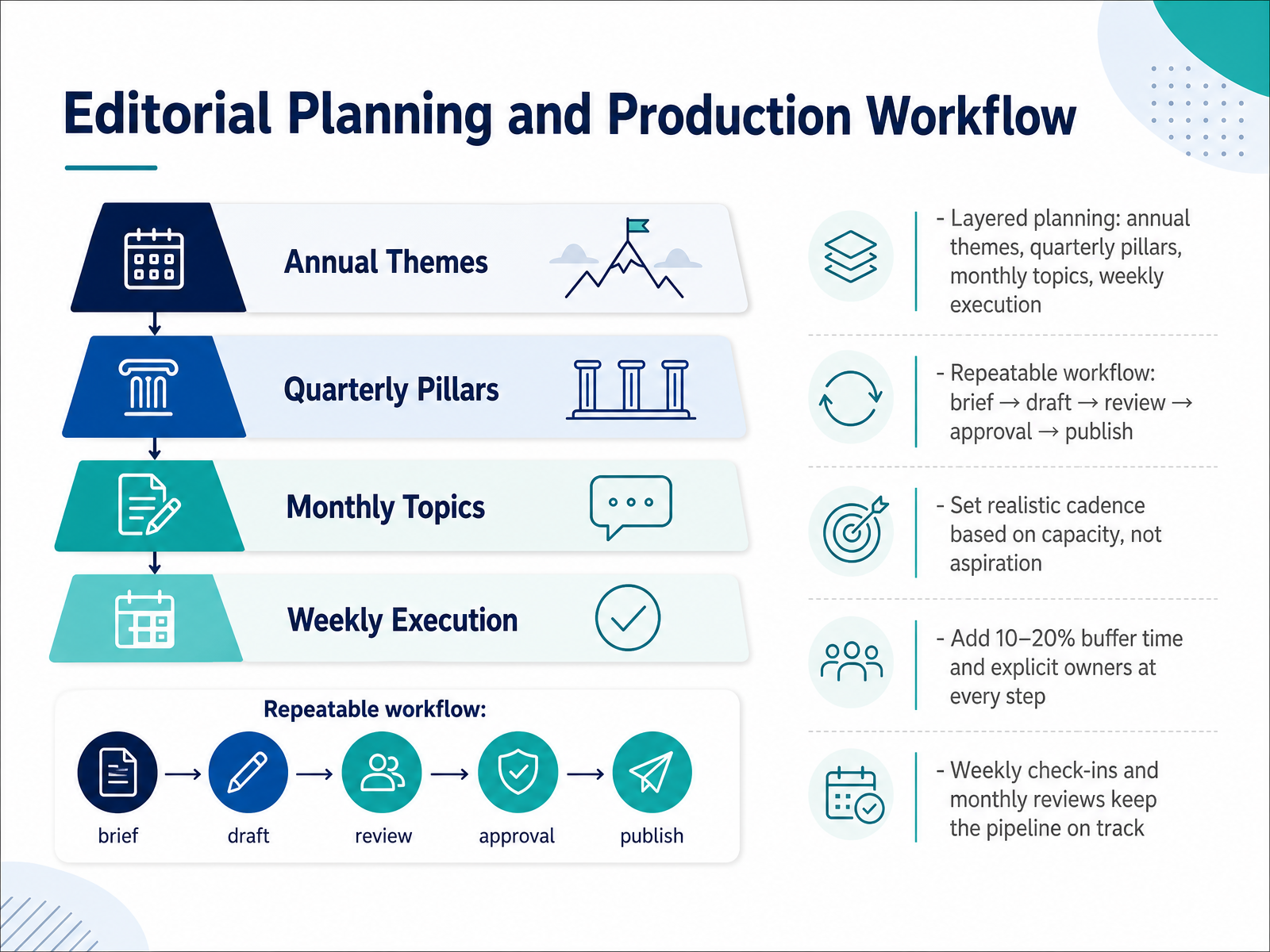
 - 06Editorial Planning and Production WorkflowNow let's talk about the engine room: editorial planning and production workflow. You know the drill—great ideas die without a repeatable process. Here's the framework. Start with layered planning: annual themes set your strategic direction, quarterly pillars align campaigns, monthly topics lock in specifics, and weekly execution keeps the factory running. Think of it as zooming from the satellite view down to the street level. Next, build a repeatable workflow: brief, draft, review, approve, publish. Same order, every time. It removes guesswork and makes handoffs clean. Now the part most teams skip: set a realistic cadence based on your actual capacity, not your aspirations. Two solid pieces a week beats five that collapse by week three. Add a ten to twenty percent buffer to absorb the inevitable rush requests. And assign explicit owners at every step—someone owns the brief, someone owns the draft, someone owns the final yes. No ambiguity. Then protect the pipeline with a thirty-minute weekly check-in and a monthly review. That's where you catch blockers early and adjust before small delays become big fires. Keep the system simple, visible, and owned. Now, once the workflow's solid, the next question is: how do you maintain quality standards while the volume scales? Let's dig into that.
 automateed.comstoryflow.soevergreenfeed.com+22 min
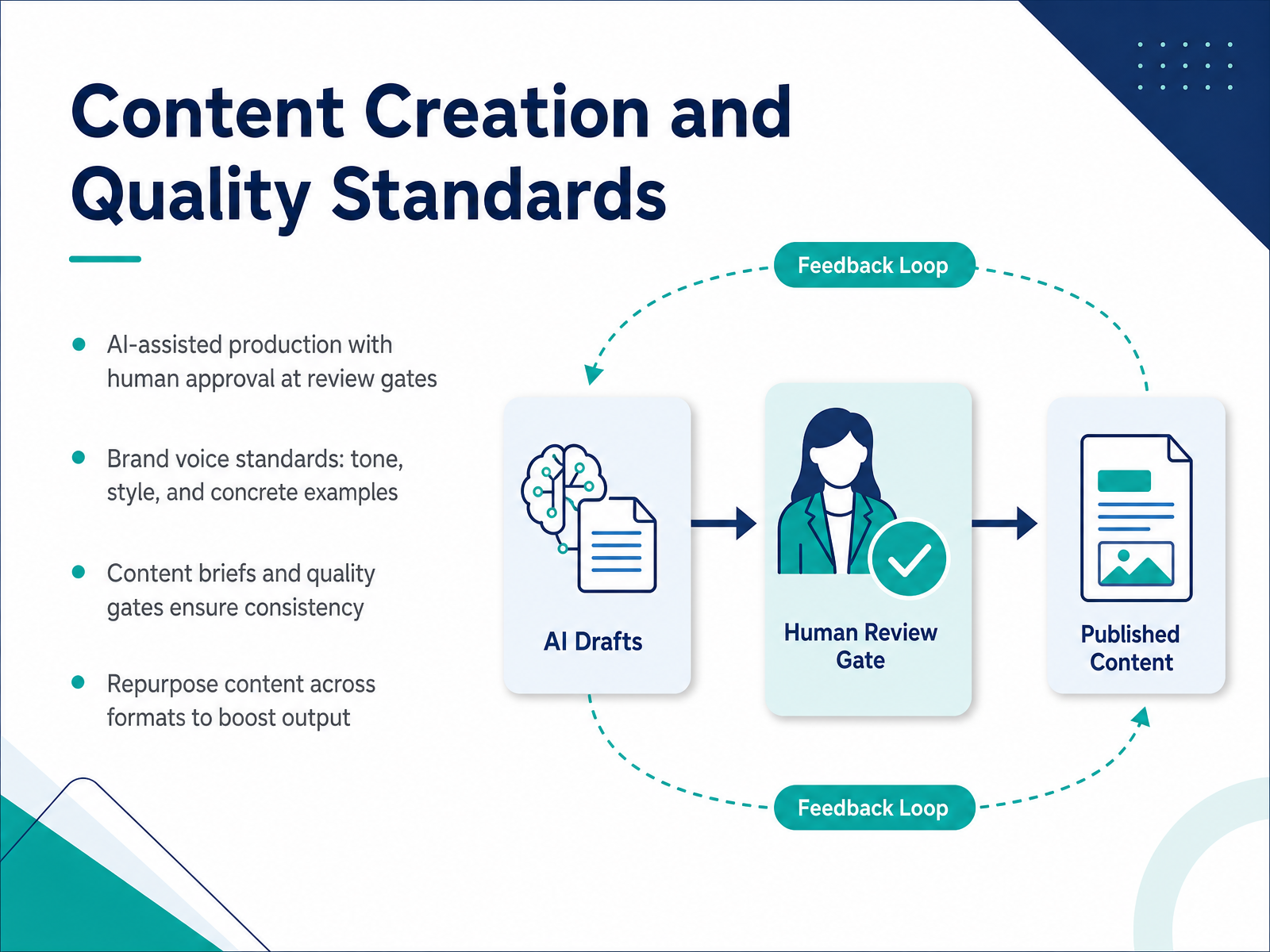
 - 07Content Creation and Quality StandardsNow let's talk about production discipline. AI gets you the first draft, but your standards get you the final piece. Think of it this way: your brand voice document is the spec, but a quality gate is the enforcement. And enforcement matters more than intent. So, build a working voice standard. Not a forty-page PDF buried in a drive. Ruthlessly practical: tone traits on a spectrum, before-and-after examples, a banned phrases list. Make it a reference your team actually checks. Then layer in content briefs that pre-load the guardrails. Voice rules, structural notes, and required elements in the brief itself. That way, writers and AI start on-brief instead of hoping they stumble onto it. For quality gates, set objective scoring. Specific checks for tone, terminology, and factual consistency. In our work, teams typically see first-draft pass rates climb past sixty percent within weeks. And here's the multiplier: repurpose. Turn one strong asset into a dozen formats. The thinking is done once, so the voice stays consistent across every repackaged piece. That's how you scale output without scaling inconsistency. Next, let's look at how to get that output in front of the right eyes with a distribution strategy.
 teambench.ai1 min
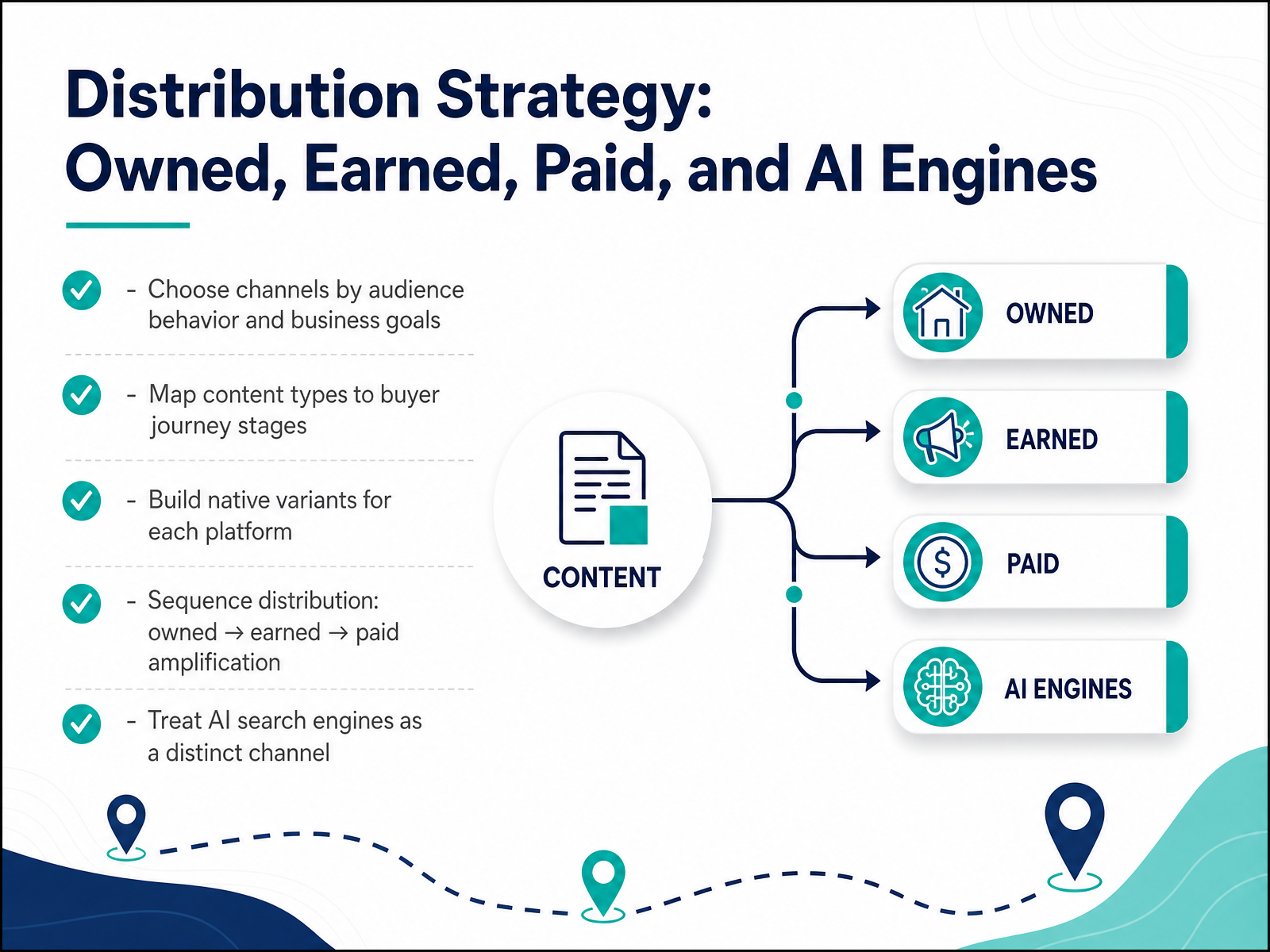
 - 08Distribution Strategy: Owned, Earned, Paid, and AI EnginesNow let's talk about distribution strategy, because this is where great content either gets seen or disappears. The old owned, earned, and paid model still holds, but in 2026 there's a fourth engine: AI search platforms like ChatGPT, Perplexity, and AI Overviews. Treat AI engines as a distinct channel, because citations there convert at several times the rate of traditional organic search. That's pre-qualified traffic. So how do you put this together? Start with channel selection. Choose channels based on audience behavior and business goals, not on where it's easy to post. Map content types to buyer journey stages. Awareness content goes to social and search, consideration content goes to email and webinars, and conversion content goes to landing pages and sales follow-up. Then build native variants for each platform. A LinkedIn post should not look like a blog excerpt. And sequence your distribution: publish first on owned channels like your blog and email list, layer in earned reach through PR and communities, then use paid amplification to accelerate what already shows traction. That sequencing compounds your reach. One more thing, don't treat AI engines as an afterthought. Structure content for extraction with clear headings and direct answers so the models can cite you easily. If you only amplify after the organic signals look strong, you'll spend smarter money and get better returns. Now let's look at how to measure all of this with a proper model covering KPIs, attribution, and AI visibility.
 marketful.comswingintel.comdigitalmarketacademy.in+22 min
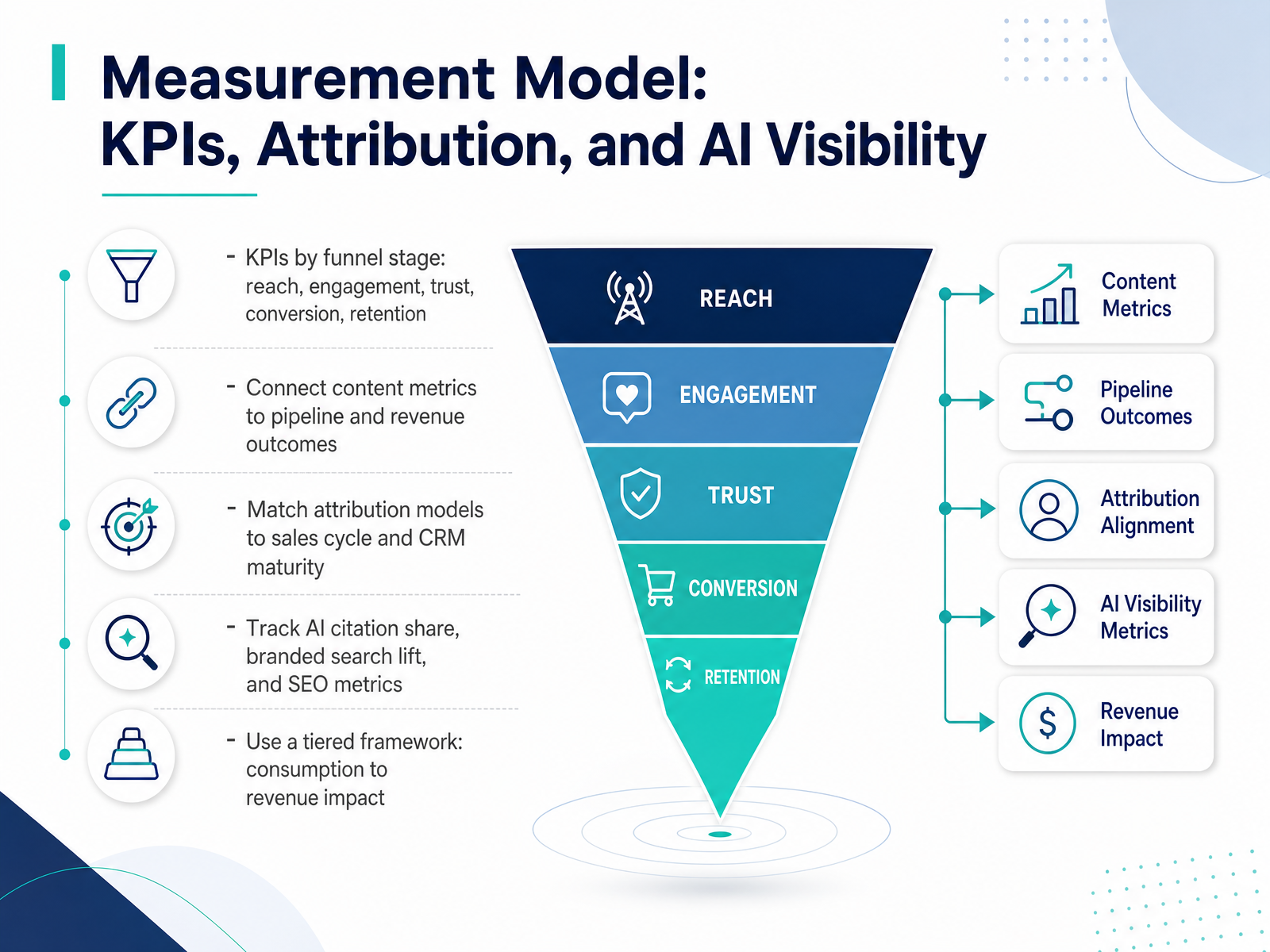
 - 09Measurement Model: KPIs, Attribution, and AI VisibilityNow let's talk about measurement—the part where frameworks either prove their worth or fall apart. You already know that traffic alone won't cut it. So let's build a model that connects content to actual business outcomes. Start with KPIs mapped to funnel stages: reach at the top, engagement, trust, then conversion, and finally retention. Each stage answers a different question, from 'Did they see it?' to 'Did it keep them?'. But here's the crucial shift: don't stop at consumption metrics. Connect those content interactions to pipeline and revenue outcomes. That's what earns you a seat at the budget table. Attribution is next. Match your model to your sales cycle and CRM maturity. If your cycle is long and your data is clean, multi-touch works. If you're just starting, assisted touch or even first-touch gives you defensible numbers faster than a complex model running on weak data. And don't ignore the AI visibility layer—track citation share, branded search lift, and SEO metrics as early indicators of future pipeline. The takeaway? Use a tiered framework that moves from consumption to revenue impact. Report the full journey, not just the highlight reel. Next, let's cover governance and continuous improvement.
 marketful.comswingintel.comdigitalmarketacademy.in+22 min
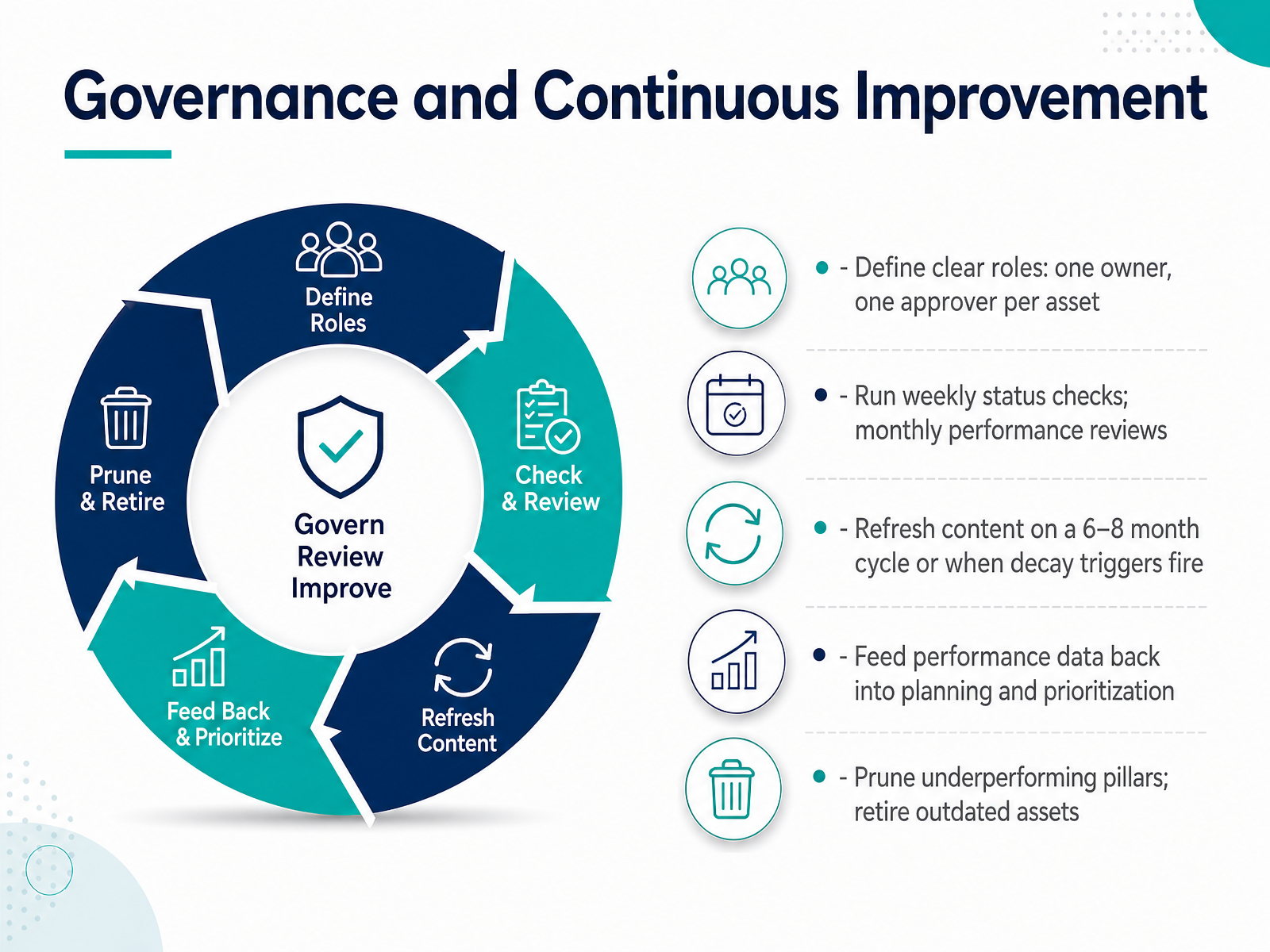
 - 10Governance and Continuous ImprovementLet's talk about governance. A framework only works if roles are crystal clear. For every asset, one owner and one approver. That's non-negotiable. Then, build in your rhythm. A quick weekly status check to catch blockers early, and a monthly performance review to see what's actually moving the needle. Content decays faster than it used to. With AI-driven search volatility, plan to refresh on a six to eight month cycle, or sooner when you see performance dip. But don't just create in a vacuum. Feed performance data straight back into your planning. If a pillar is underperforming, prune it. Retire outdated assets. That's how you keep the engine running smoothly. Governance isn't bureaucracy, it's what keeps your strategy alive.
 automateed.comstoryflow.soevergreenfeed.com+21 min
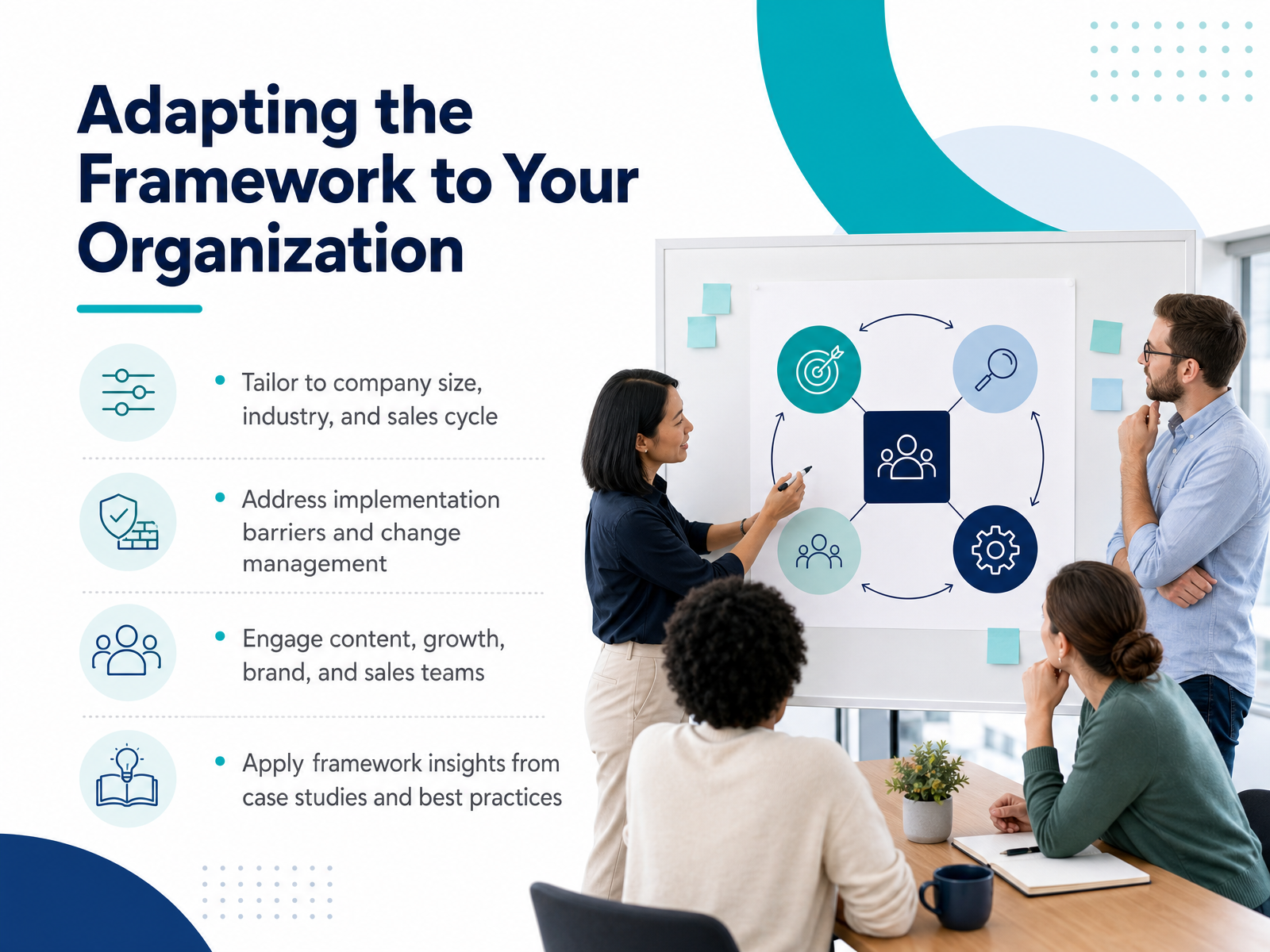
 - 11Adapting the Framework to Your OrganizationNow let's talk about making this framework work in your world. A one-size-fits-all approach will fail you here. The first step is tailoring the framework to your company's size, industry, and sales cycle. A lean startup with a two-week sales cycle needs a very different content cadence than an enterprise player with a six-month committee review. Your framework should flex to that reality. Second, be honest about implementation barriers. Change management is real. New workflows, new approval processes, they all meet resistance. Acknowledge that upfront and build buy-in before you roll anything out. Third, and this is critical, engage the content, growth, brand, and sales teams together. Sales is the goldmine. They hear the real objections and buyer questions every day. The case studies we covered were built on deep interviews with sales teams. That's where the raw material for high-converting content lives. Finally, take the insights from those case studies and apply them deliberately. Whether that's the pain-point SEO approach or the buyer-intent content shifts, your playbook should be informed by what's already proven. Pull the pieces that fit your context, not the whole blueprint. That's how you make this framework structurally sound for your organization. Next, let's look at what the results actually look like with real-world examples.
 marketful.comswingintel.comdigitalmarketacademy.in+21 min
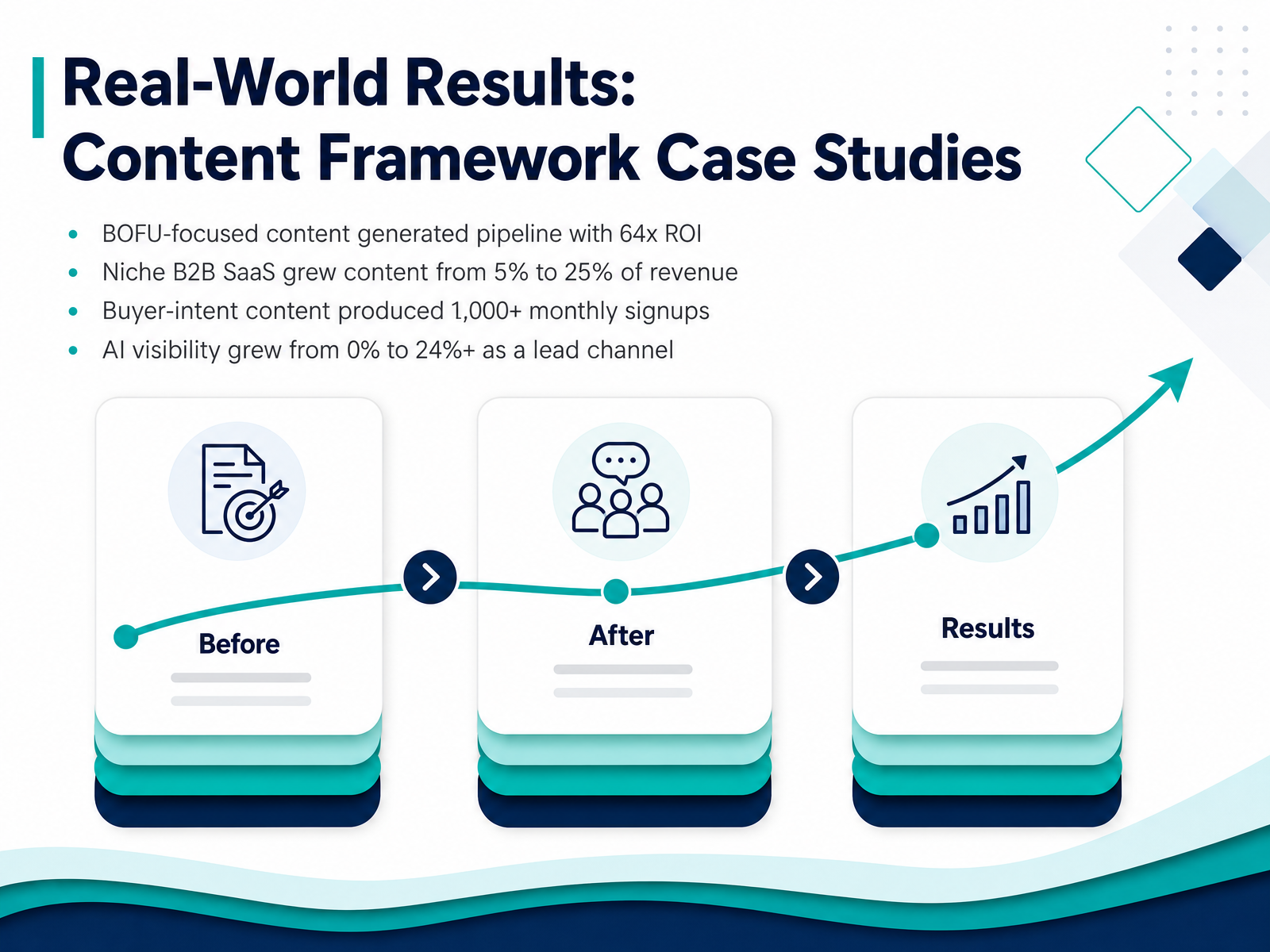
 - 12Real-World Results: Content Framework Case StudiesNow let's talk about what this framework actually delivers. The results speak for themselves. One payment company built a seven-figure pipeline by focusing exclusively on bottom-of-funnel content. They saw a 64 times return on investment. That's versus just 5 times for their paid ads. The key? They targeted buying keywords, not traffic keywords. And they interviewed their internal experts for every article. A niche B2B software company did something similar. They moved content from five percent to over twenty-five percent of total revenue in eighteen months. Their playbook? Forty-six product-centric articles targeting buyer intent. They didn't chase volume. They chased relevance. SweetProcess took a different angle. They shifted from informational content to buyer-intent content. The result? Over one thousand monthly signups from organic search alone, with no ad spend. And finally, deeploi built AI visibility from zero to twenty-four percent. That created an entirely new lead channel that didn't exist before. What ties these together? They all aligned content to commercial outcomes and built attribution to prove it. Remember, the framework isn't just structure. It's the discipline that compounds into revenue. Now, let's look at how you can build your own action plan and adoption roadmap to replicate these results.
 2 min
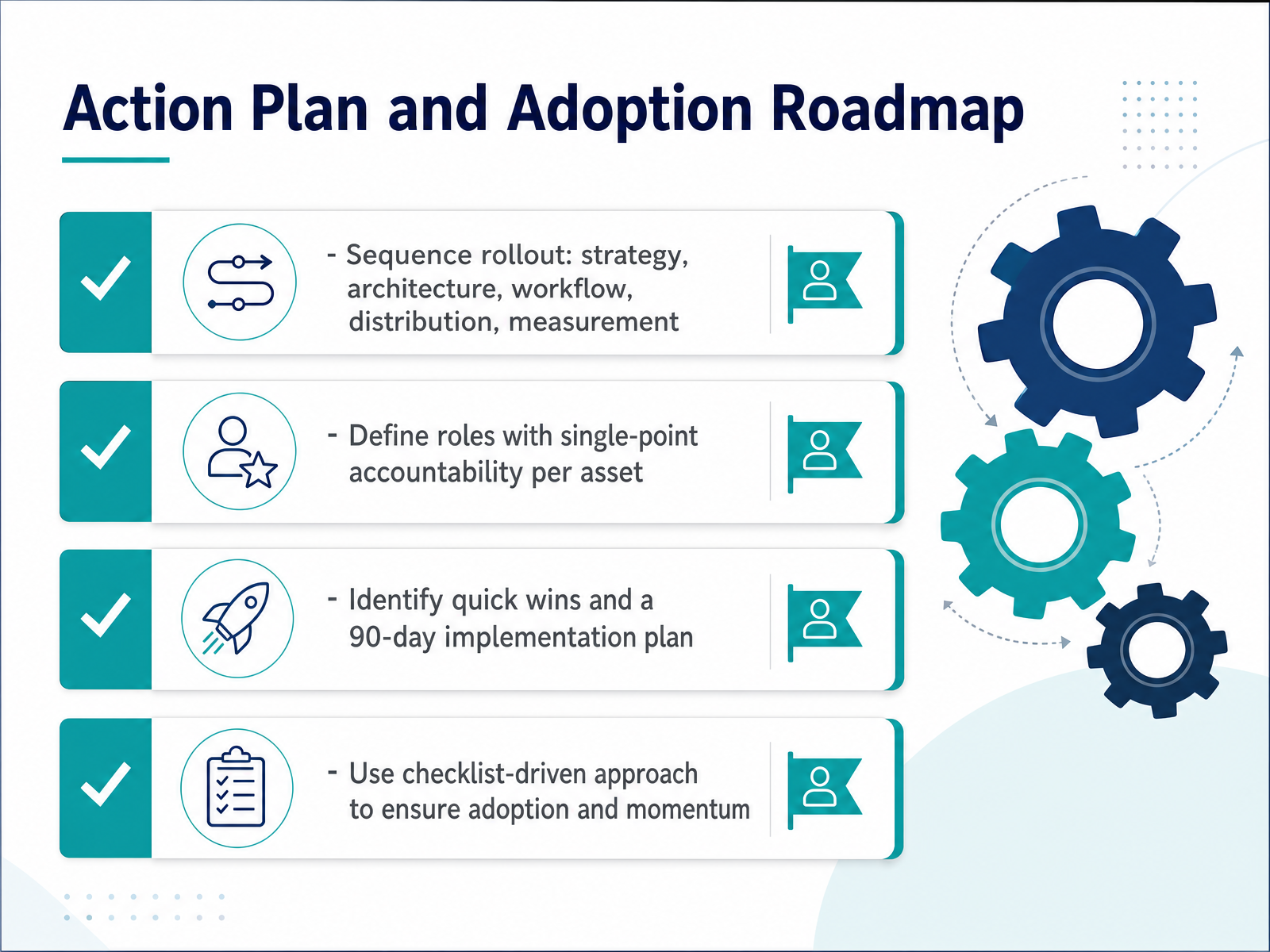
2 min - 13Action Plan and Adoption RoadmapNow let's turn this framework into action. The rollout sequence matters. Start with strategy, then architecture, then workflow, then distribution, and finally measurement. Getting this order right prevents rework. Define roles with single-point accountability for every asset. If one person owns each piece, nothing falls through the cracks. Identify your quick wins. These are the pieces you can refresh or optimize this week that move the needle inside 90 days. Build your 90-day plan around them, and run it checklist-driven. Track the briefs, the drafts, the approvals, the publishes. Momentum comes from checking things off. Start small, stay consistent, and let the framework carry the team. Up next, the key takeaways and next steps to lock this in."
 automateed.comstoryflow.soevergreenfeed.com+21 min
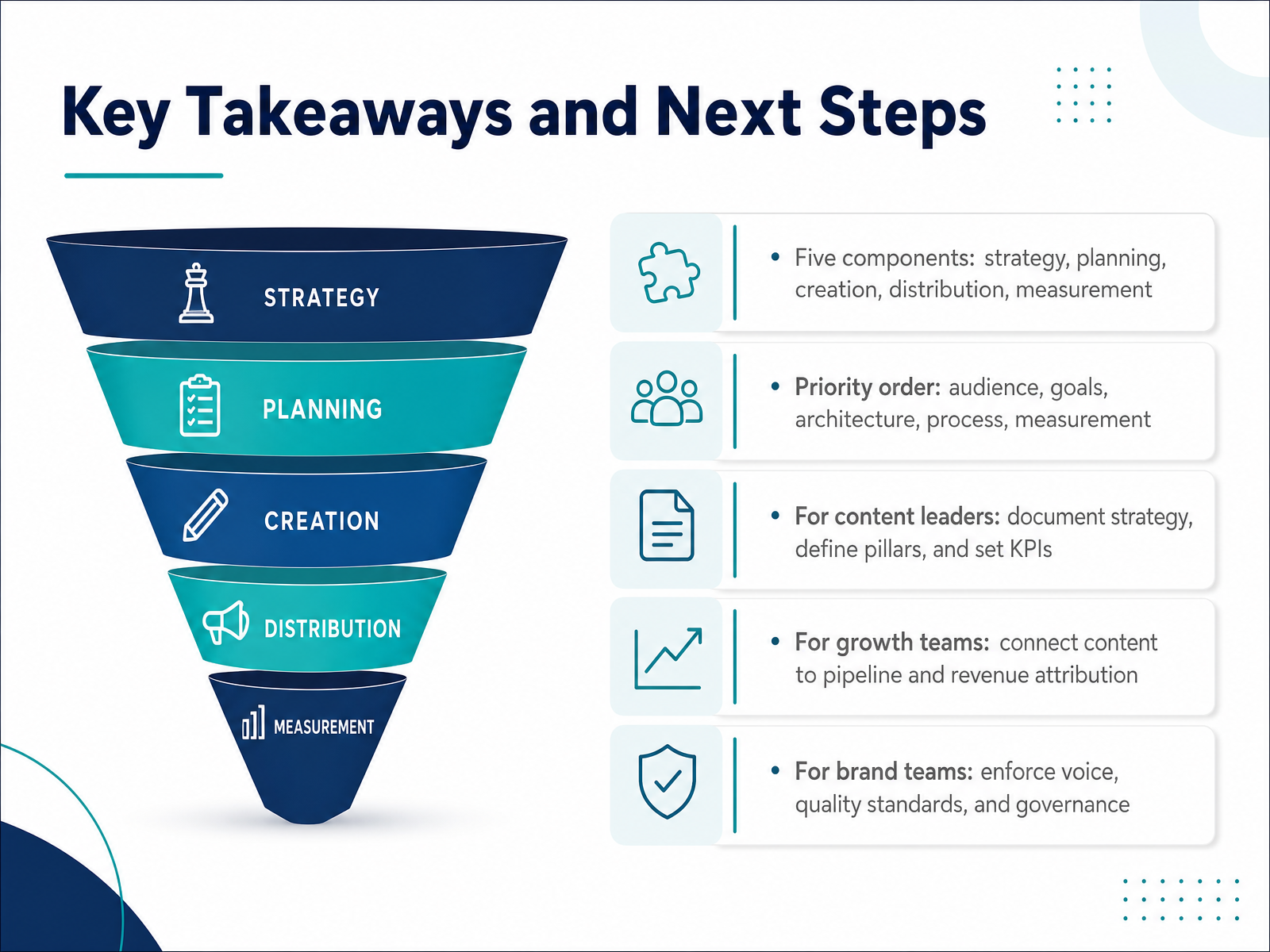
 - 14Key Takeaways and Next StepsLet’s wrap this up. Five components hold the system together: strategy, planning, creation, distribution, and measurement. It’s a closed loop. But the building order matters just as much. Start with your audience. Then your goals. Then the content architecture, the process that produces it, and finally, how you measure it. That sequence prevents wasted effort. For content leaders, the mandate is clear. Document the strategy. Define your pillars. Set KPIs before production starts. For growth teams, the bar is commercial connection. Tie every asset to pipeline and revenue attribution. Show leadership the dollar impact, not just the traffic. And for brand teams, governance is the contribution. Enforce voice, quality standards, and a review process that holds the line. If each of these groups executes its role, the framework stops being a document and becomes a growth engine. Thank you for working through this with me. You now have the full model. The next step is to diagnose where your current operation is weakest, then fix that one component first. Small, focused action wins every time. Let’s get to work.
 marketful.comswingintel.comdigitalmarketacademy.in+22 min
Take the deck with you
Download this course as a file — free, no sign-up needed.
- PDF handoutEvery slide page, ready to print or share.15 pages · 3.1 MBDownload
- Narrated PowerPointThe deck that presents itself — every slide carries the digital human's narration video.15 pages · 15.3 MBDownload
- PowerPoint slidesThe full deck as a .pptx — open it in PowerPoint, Keynote, or Google Slides.15 pages · 3.0 MBDownload
Free to use in your own training — please keep the PersonWise credit page at the end.
Have your own deck? Turn it into a course
Sources consulted
Web sources consulted while building this course.
- Content Marketing: The Complete Guide (2026) — marketful.com
- Content Marketing Strategy for 2026: Framework, Tactics, and AI Deep Research Workflows | SwingIntel — swingintel.com
- Content Marketing Strategy Guide 2026 (Step by Step) — digitalmarketacademy.in
- Content Marketing Strategy 9-Step Framework, Examples, and How to Make It Work in 2026 - SEOSERVICES1 — seoservices1.com
- Content Strategy: The Complete 2026 Guide | TurboAudit — turboaudit.ai
- Content Marketing Framework: B2B Guide to Connecting Content to Revenue | Ten Speed — tenspeed.io
- A Content Marketing Strategy Framework for Growing Teams (+ Free Template) - Planmoon Blog — planmoon.app
- How to Build a Content Strategy Framework (2026) | Ten Speed — tenspeed.io
- Content Marketing Framework: Outcomes Over Output — themarketingjuice.com
- Content Marketing: The Strategy, Framework, and Execution That Drive Sustainable Growth - Filip Konecny Enterprises — filipkonecny.com
- How To Build A Content Marketing Strategy That Drives Revenue — monday.com
- Content Strategy Framework: Build a Plan That | Digital Codex — clarigital.com
- Content Marketing Strategy: How to Build One in 2026 — marketful.com
- The IDEAL Content Strategy Framework: Drive 3x More Leads — jaroeducation.com
- Editorial Calendar Setup for Teams: How to Create & Build — automateed.com
- What is a Content Calendar? The Complete Guide (2026) | Storyflow — storyflow.so
- Master Editorial Calendar Management: 2026 Guide - EvergreenFeed Blog — evergreenfeed.com
- Content Calendar 2026: Practical Method and Tools - Incremys — incremys.com
- Content Strategy Guide for Smarter Editorial Planning — editorialge.com
- Brand Consistency at Scale: The Definitive Guide | TeamBench — teambench.ai