Begin
14 pages · ~28 min
Medieval Manuscript Production
Discover how medieval illuminated manuscripts were created, from parchment and ink to gold leaf and binding, for anyone interested in book history and medieval craft.
A digital instructor presents all 14 pages. Hold “Ask” at any point and ask out loud — the answer comes from this course. No sign-up needed.
What you’ll learn
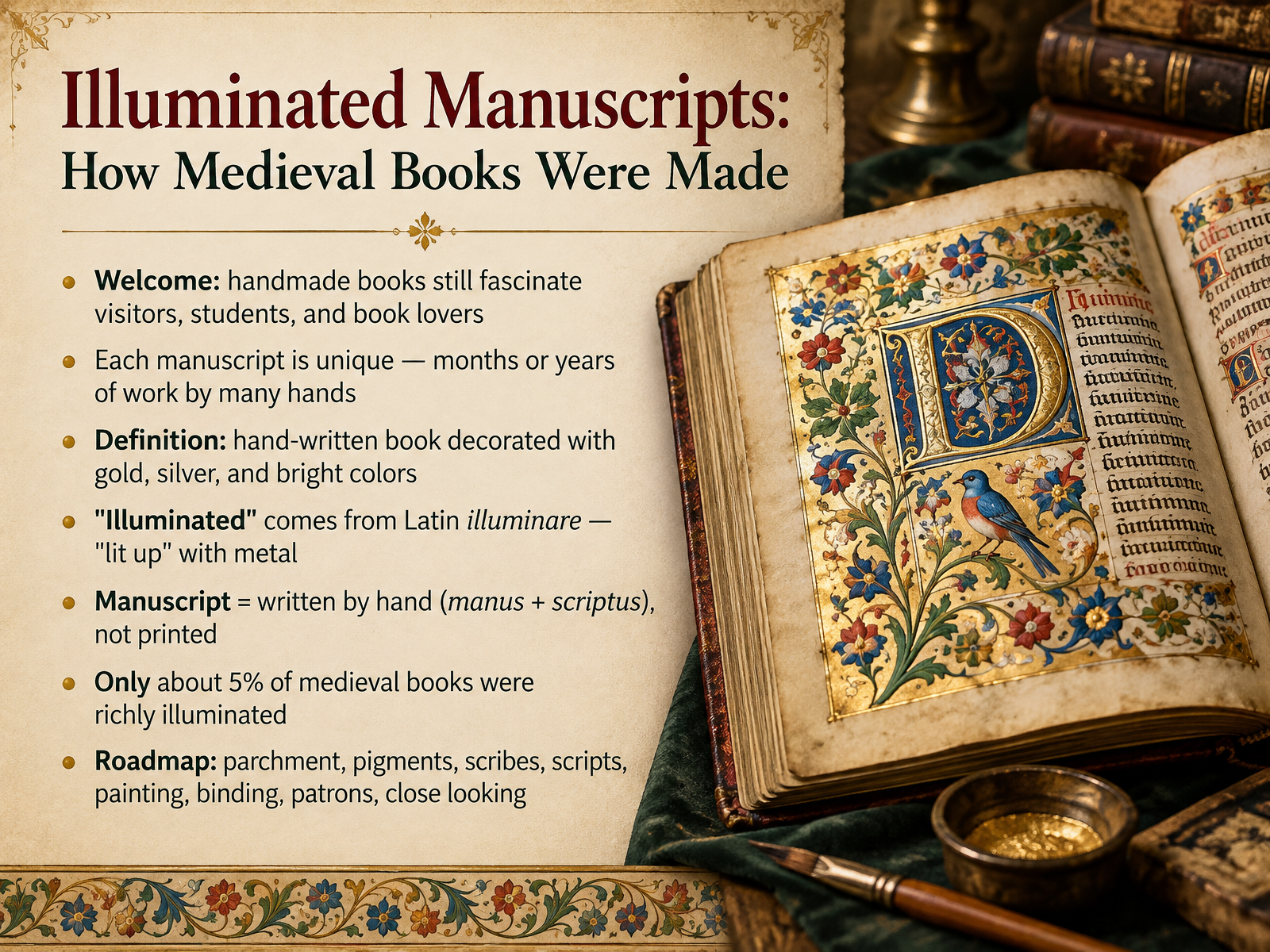
- 01Illuminated Manuscripts: How Medieval Books Were MadeWelcome. I'm glad you're here. Over the next few slides, we'll look at how medieval books were made, from preparing animal skin pages to sewing the final binding. It's a story of patience and real craft. Every manuscript was made by hand, and each one is unique, often taking months or years and many pairs of hands to finish. So what exactly is an illuminated manuscript? It's a handwritten book decorated with gold, silver, and bright colors. The word illuminated comes from the Latin illuminare, meaning lit up, because gold leaf catches the light as you turn a page. Manuscript comes from manus, hand, and scriptus, writing, so it simply means written by hand, not printed. One thing worth knowing: only about five percent of medieval books were richly illuminated. The rest were plain and valued for their words. As we go, we'll cover parchment, pigments, scribes, scripts, painting, and binding, and you'll leave knowing how to look closely at a real manuscript. Let's begin with what counts as an illuminated manuscript.nationalgallery.org.uknga.govnew.artsmia.org+22 min
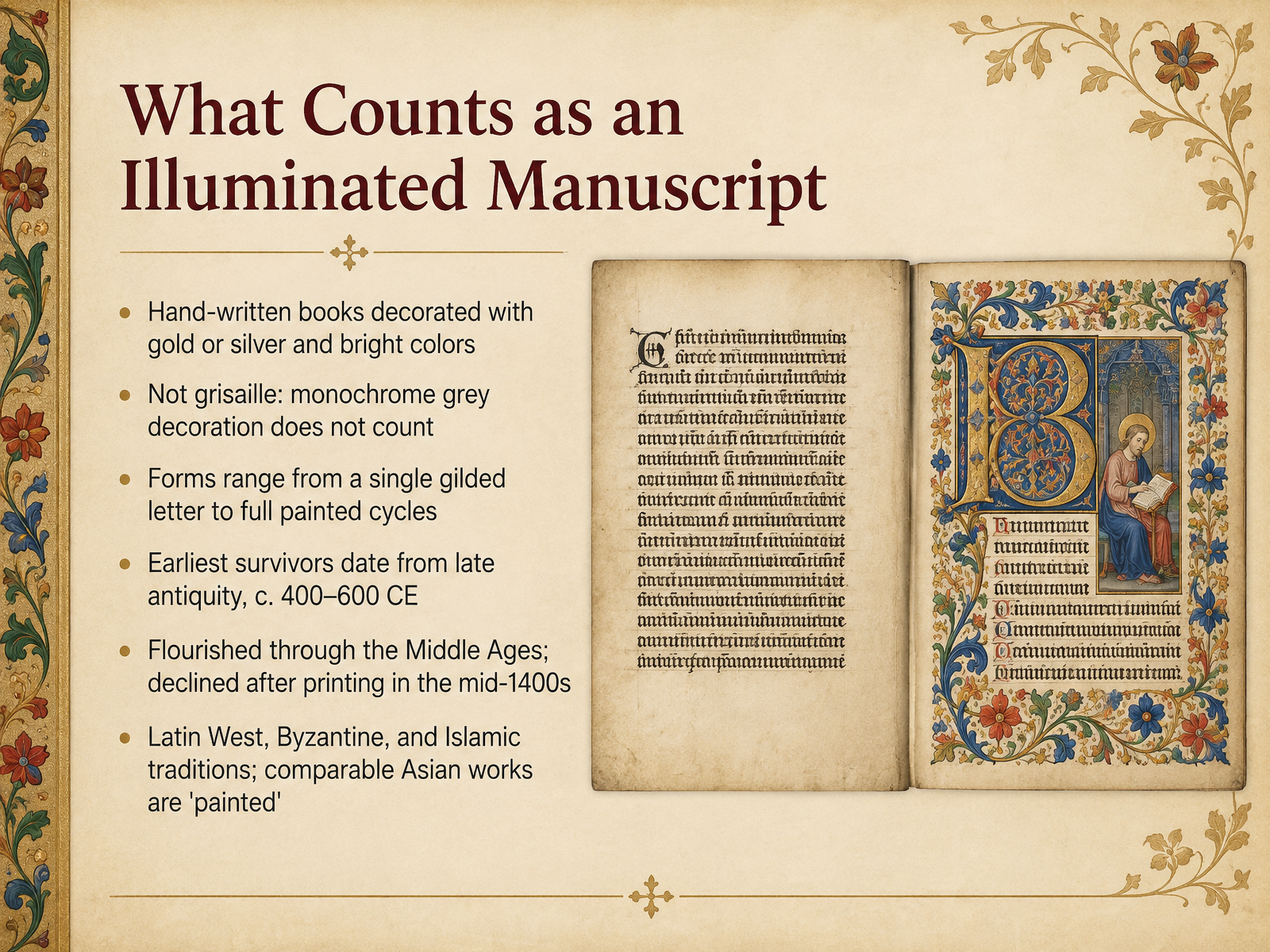
- 02What Counts as an Illuminated ManuscriptSo what exactly counts as an illuminated manuscript? The simplest answer is a hand-written book decorated with gold or silver, along with bright colors. That gold is the key. A manuscript decorated only in grey tones, a technique called grisaille, doesn't count on the strict definition, because nothing lights up. The decoration itself can be tiny or enormous. It might be a single gilded capital letter at the start of a page, or a whole cycle of painted scenes. Now, these books go back a long way. The earliest survivors date from late antiquity, roughly the years four hundred to six hundred. They flourished all through the Middle Ages, then declined after printing arrived in the mid fourteen hundreds. And the tradition was wide, spanning the Latin West, the Byzantine world, and Islamic workshops, though comparable works in Asia are usually described as painted rather than illuminated. Keep that gold standard in mind as we go. Next, we look at The Evidence in the Object: How We Know What We Know.
 nationalgallery.org.uknga.govnew.artsmia.org+21 min
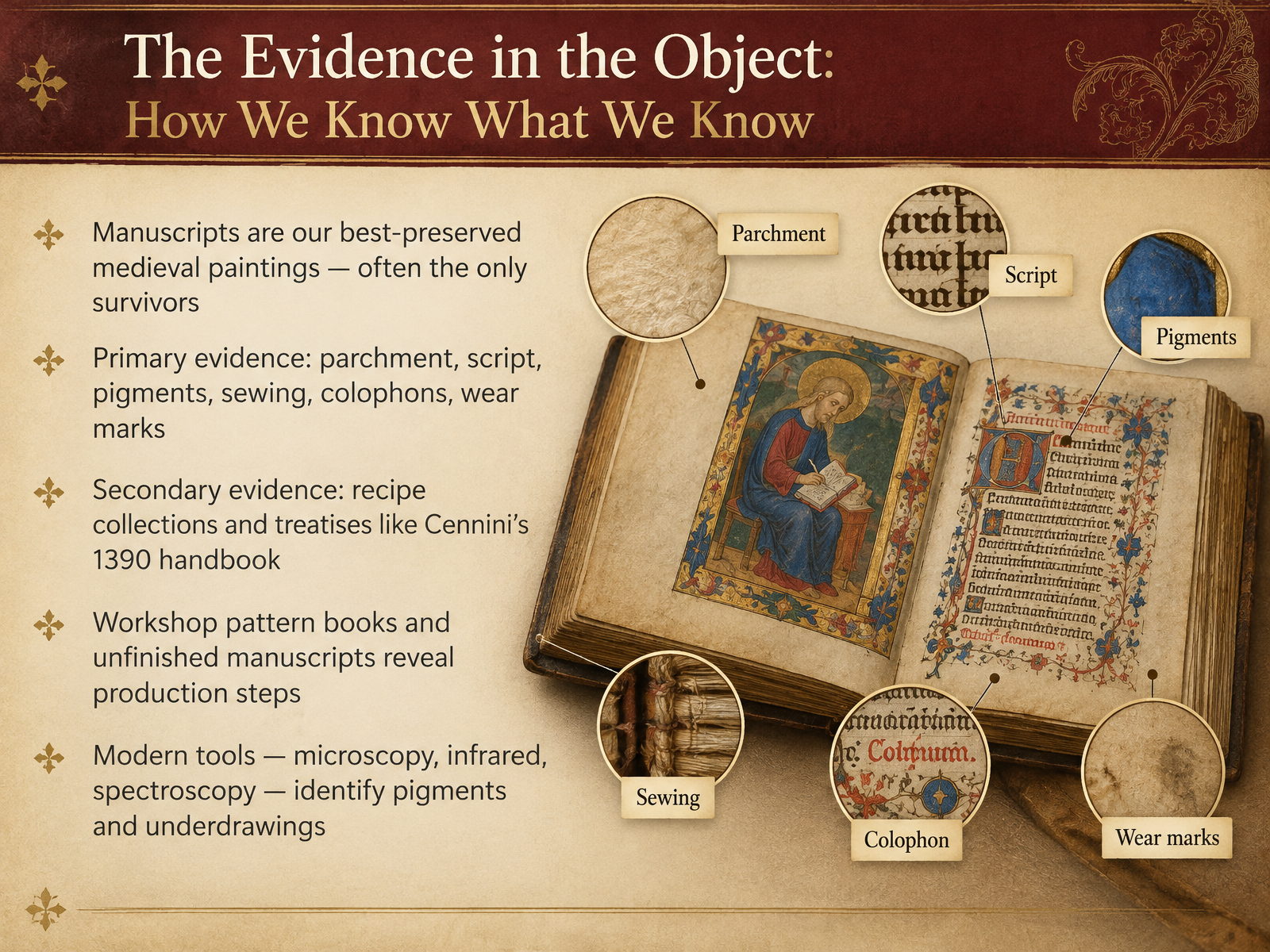
- 03The Evidence in the Object: How We Know What We KnowSo how do we actually know how these books were made? Much of it comes straight from the objects themselves. Illuminated manuscripts are our best-preserved medieval paintings, and for many places and periods, the only ones that survive. Look closely and the book becomes evidence. The parchment, the handwriting, the pigments, the sewing of the binding, a colophon, which is a note the scribe sometimes left at the end, and simple wear marks all tell us something. We also have written recipes, like Cennino Cennini's craftsman's handbook from thirteen ninety. Workshop pattern books and manuscripts left unfinished show us the steps in order. And today, tools like microscopy, infrared imaging, and spectroscopy help identify pigments and reveal underdrawings hidden beneath the paint. Every page is a small archive. From animal skin to page, making parchment and vellum is where the story begins, and that's our next step.
 nationalgallery.org.uknga.govnew.artsmia.org+22 min
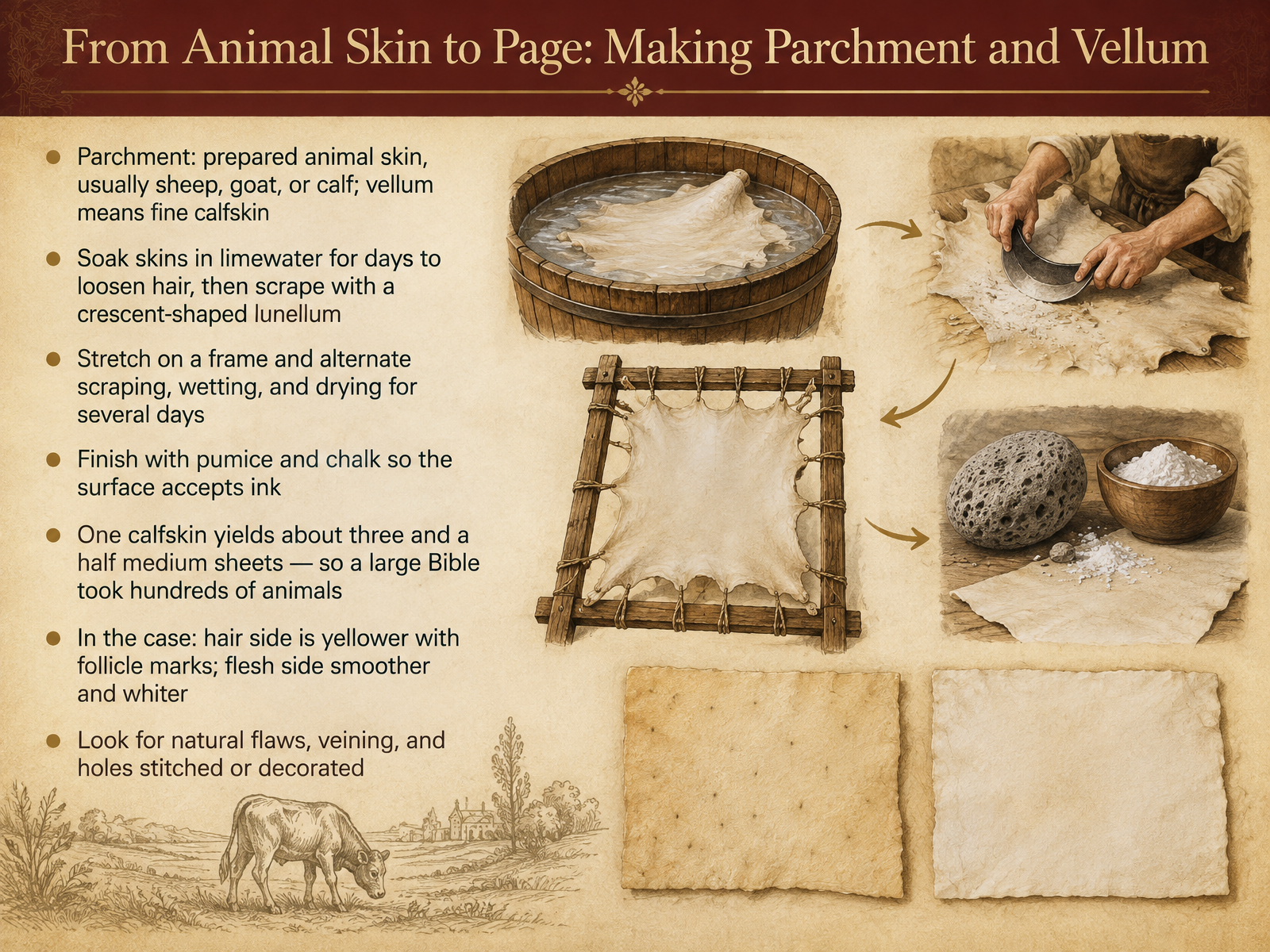
- 04From Animal Skin to Page: Making Parchment and VellumSo before anyone could write a word, someone had to make the page itself. Parchment is prepared animal skin, usually sheep, goat, or calf. Vellum is the finer version, made from calfskin. The skins soaked in limewater for days to loosen the hair, then a crescent-shaped knife called a lunellum scraped it away. The maker stretched each skin on a wooden frame and alternated scraping, wetting, and drying for several days. A final rub of pumice and chalk left a surface that would accept ink. Here is the part that surprises people. One calfskin yields only about three and a half medium sheets, so a large Bible took hundreds of animals. In the case, compare the two sides. The hair side looks yellower, with follicle marks. The flesh side is smoother and whiter. And look closely for natural flaws, veining, and holes that were stitched or decorated rather than thrown away. Next, Inks, Pigments, and Gold: The Illuminator's Palette.
 getty.educuriosity.lib.harvard.edubnf.fr+22 min
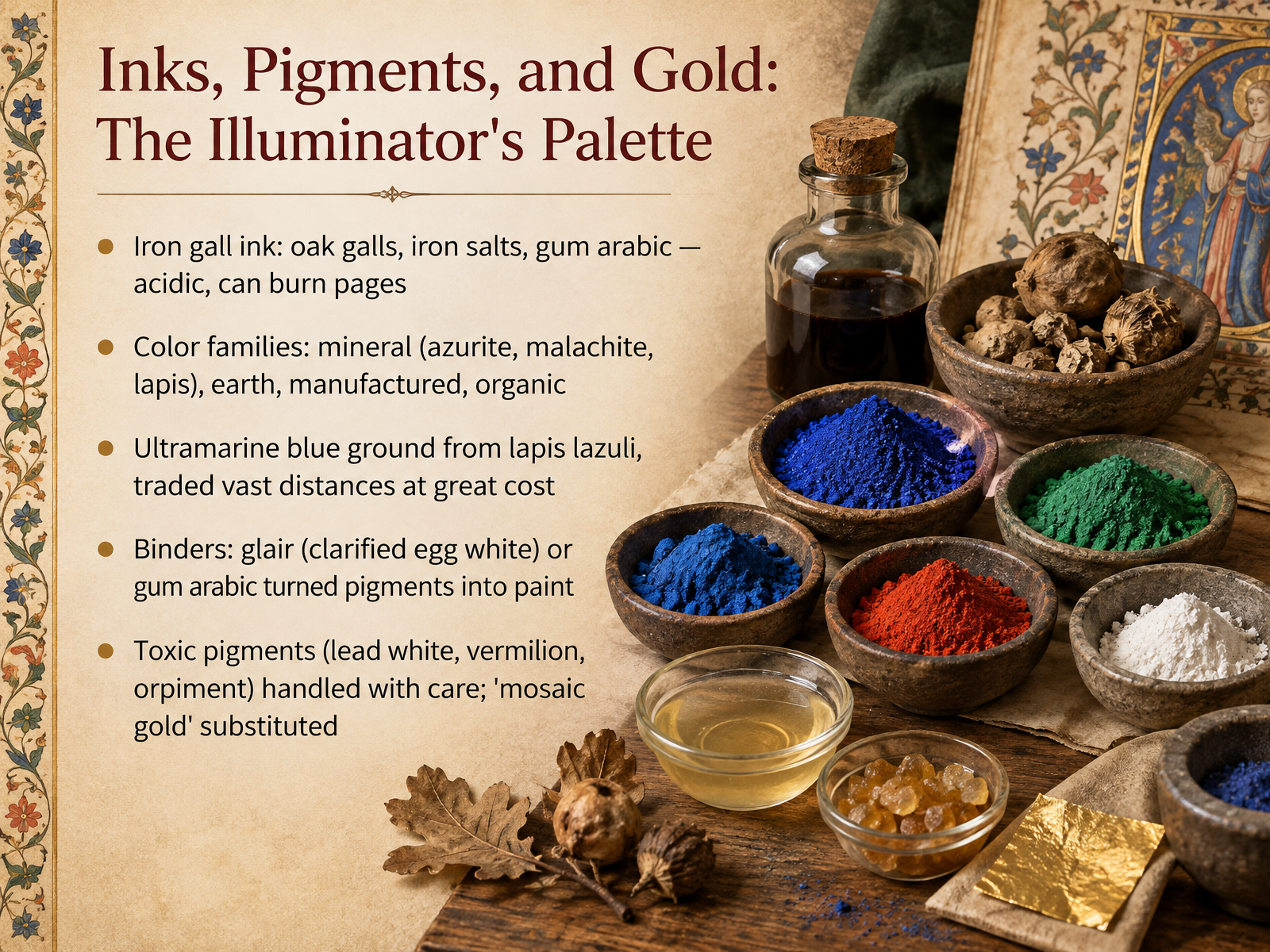
- 05Inks, Pigments, and Gold: The Illuminator's PaletteNow let's look at what actually made those colors. The everyday writing ink was iron gall ink, made from oak galls, which are little growths on oak trees, mixed with iron salts and gum arabic, a sap that thickens the liquid. It was acidic, and over centuries it can burn right through a page. Painters' colors fell into families: minerals like azurite and malachite, earth colors, manufactured pigments, and organic ones from plants. The most prized was ultramarine, ground from lapis lazuli, a stone traded across vast distances at enormous cost. To turn any powder into paint, you mixed it with a binder, either glair, which is clarified egg white, or gum arabic. Some pigments were dangerous. Lead white, vermilion, and orpiment were toxic and handled with care, and craftsmen sometimes used a safer imitation called mosaic gold instead. Next, we'll see how that gold went onto the page, in Writing in Gold: Gilding Techniques.
 doi.orgpre1600ms.beinecke.library.yale.edudoi.org+22 min
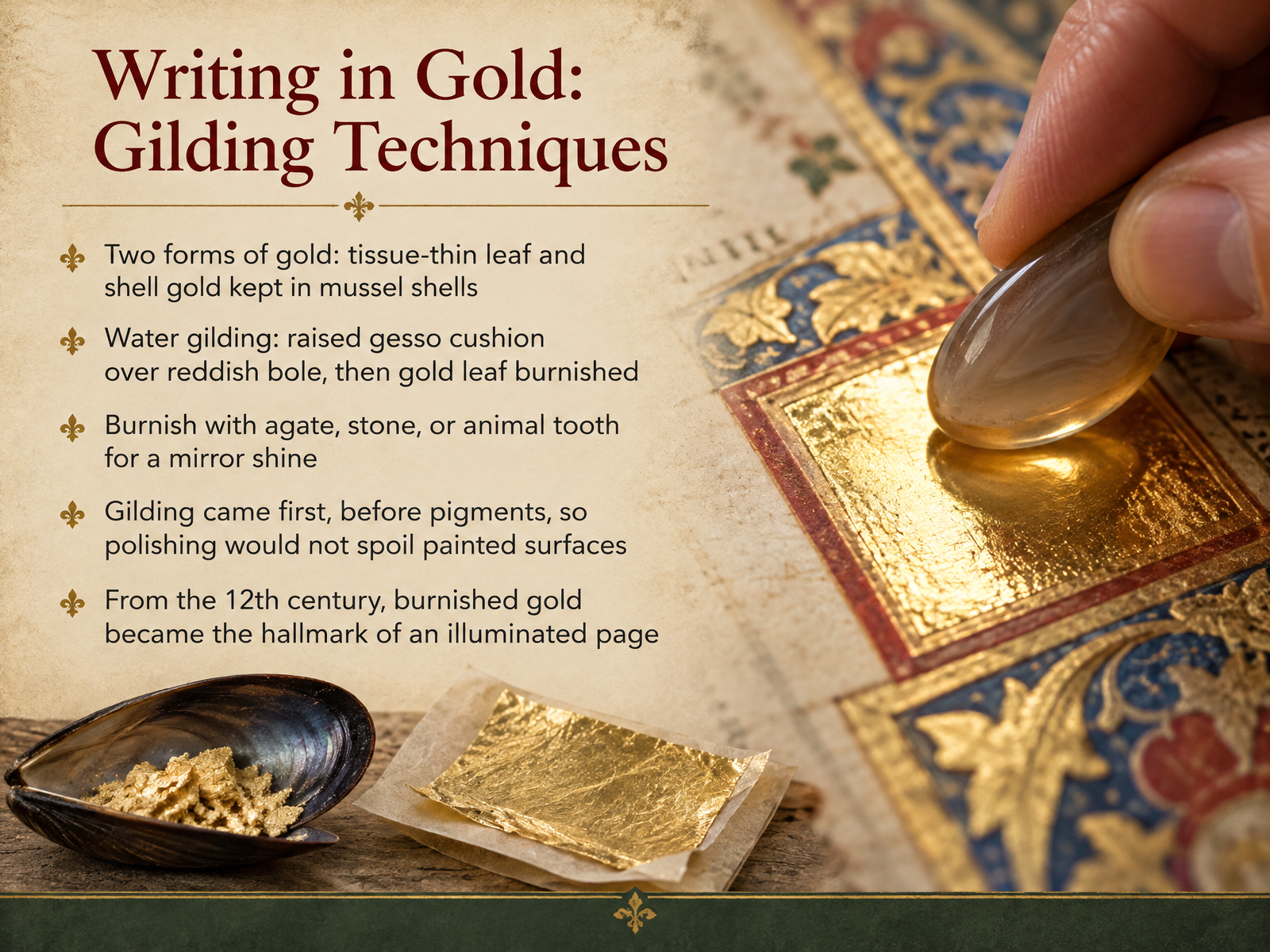
- 06Writing in Gold: Gilding TechniquesNow let's turn to gold, the part of these books that still catches the eye. Illuminators used gold in two main forms. One was gold leaf, metal hammered so thin it is almost like tissue. The other was shell gold, powdered gold mixed with a little glue and kept in a mussel shell, then painted on like paint. For the shine on a page, many artists used water gilding. They built a small raised cushion of gesso, a chalky preparation, over a layer of reddish bole, a fine clay that warms the gold. Then they laid down the leaf and burnished it, rubbing it with an agate, a smooth stone, or even an animal tooth, until it shone like a mirror. Here is the part that surprises people. Gilding came first, before the pigments, so all that rubbing would not spoil the painted surfaces. And from the twelfth century onward, that burnished gold became the hallmark of an illuminated page. Next, let's look at the people who made these books, in The Scriptorium and the Scribe's Work.
 doi.orgpre1600ms.beinecke.library.yale.edudoi.org+22 min
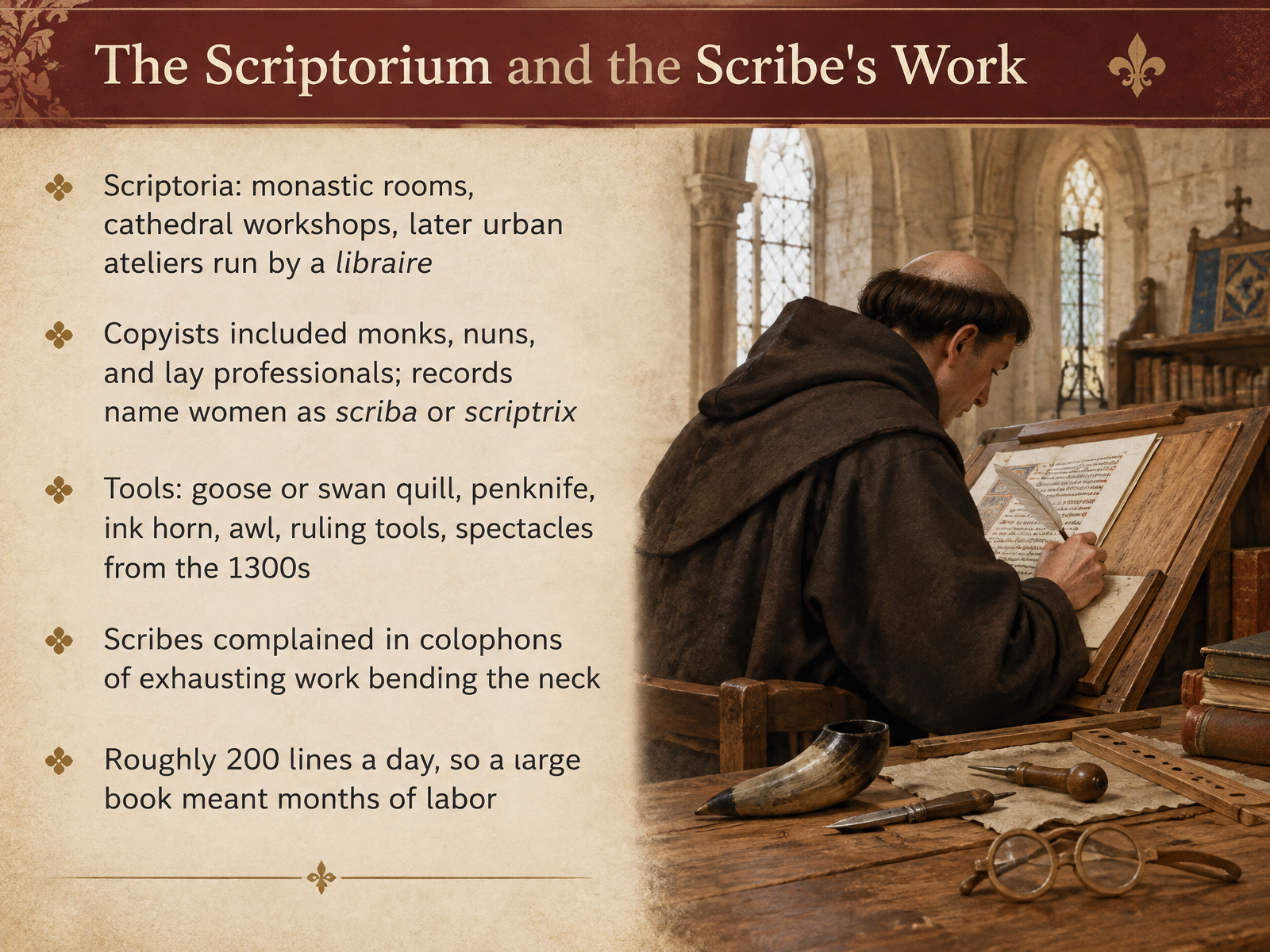
- 07The Scriptorium and the Scribe's WorkNow, where did all this copying actually happen? A scriptorium was simply a room set aside for writing. Some belonged to monasteries, some to cathedral workshops, and later, in towns, to commercial ateliers run by a libraire, a book dealer who organized the work. The copyists were monks, nuns, and lay professionals. Records name women as scriba or scriptrix, meaning female scribe. The tools were modest: a goose or swan quill, a penknife for sharpening and scraping away mistakes, an ink horn, an awl, ruling tools, and from the fourteen hundreds, spectacles. It was hard physical work. One scribe complained that the craft was exhausting, bending the neck for twice a three hour shift. A good scribe managed roughly two hundred lines a day, so a large book could mean months of labor. Laying Out the Page Before the First Word.
 corpus.cam.ac.ukassets.cambridge.orgdoi.org+22 min
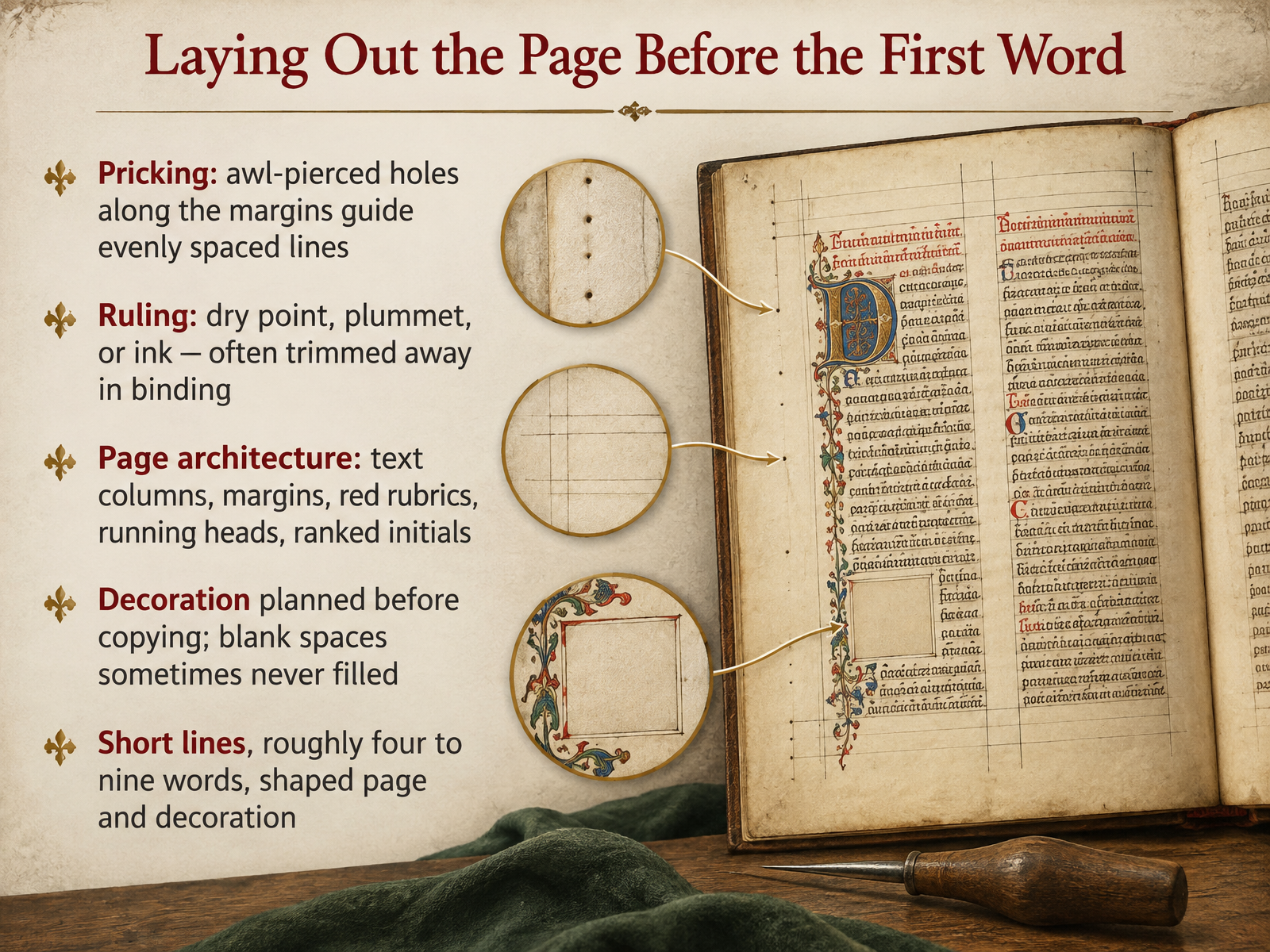
- 08Laying Out the Page Before the First WordBefore a single word is written, the page has to be laid out. Scribes began by pricking. Using a sharp awl, they pierced a row of small holes along the margins. Those holes acted as guide marks, so the lines could be spaced evenly down the page. Next came ruling, drawing the lines themselves. Scribes used a dry point, which pressed a faint groove into the skin, or a plummet, a soft lead point, or sometimes ink. And here is something interesting. Because pricking and ruling happened near the edges, much of that evidence was trimmed away when the book was bound, so many manuscripts no longer show it. The layout was also a kind of architecture. Text sat in columns, with margins around them, red headings called rubrics, running heads at the top, and initials in a ranked hierarchy of sizes. All of this decoration was planned before copying began, and sometimes the blank spaces reserved for it were never filled. Even the writing itself shaped the page. Lines were short, roughly four to nine words, which kept the columns tidy and left room for ornament. Now let us look at the letters themselves, in Scripts and How to Read Them.
 getty.educuriosity.lib.harvard.edubnf.fr+22 min
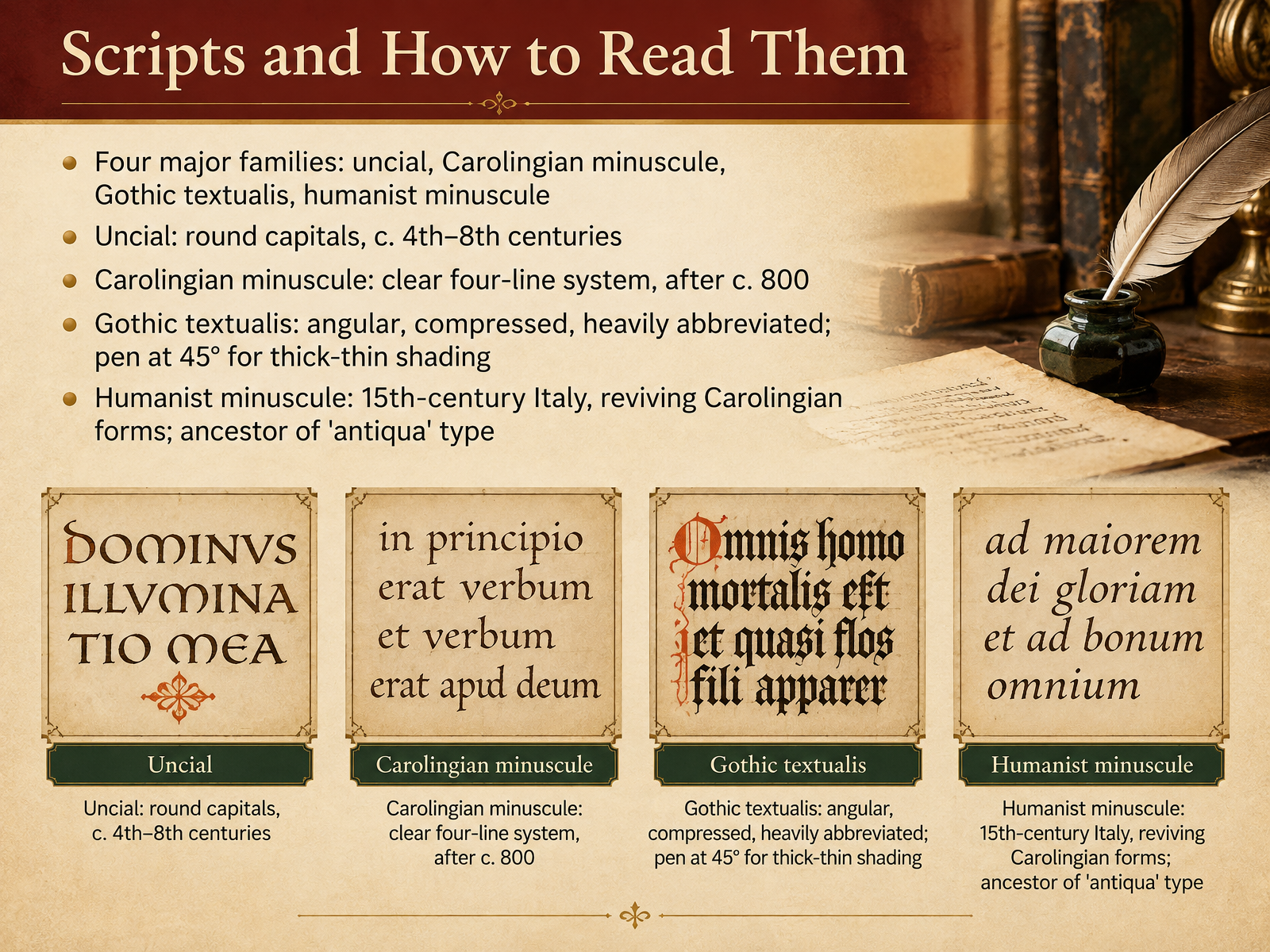
- 09Scripts and How to Read ThemNow, let's look at the scripts themselves, and how to read them. Most medieval book hands fall into four big families. Uncial is the earliest of these, a round script of capital letters, used roughly from the fourth to the eighth century. After about eight hundred, Carolingian minuscule brought clear lowercase letters, lined up on a four line system, so it is comparatively easy to read today. Gothic textualis came later. It looks angular and tightly compressed, packed with abbreviations, and scribes held the pen at about forty five degrees to create that thick and thin shading. Finally, humanist minuscule appeared in fifteenth century Italy, when scholars revived the older Carolingian forms. It became the ancestor of the antiqua type we still print with. One useful takeaway: the rounder the letters, the easier they generally are to read. Next, we turn to painting the page, and the techniques and regional styles that shaped it.
 2 min
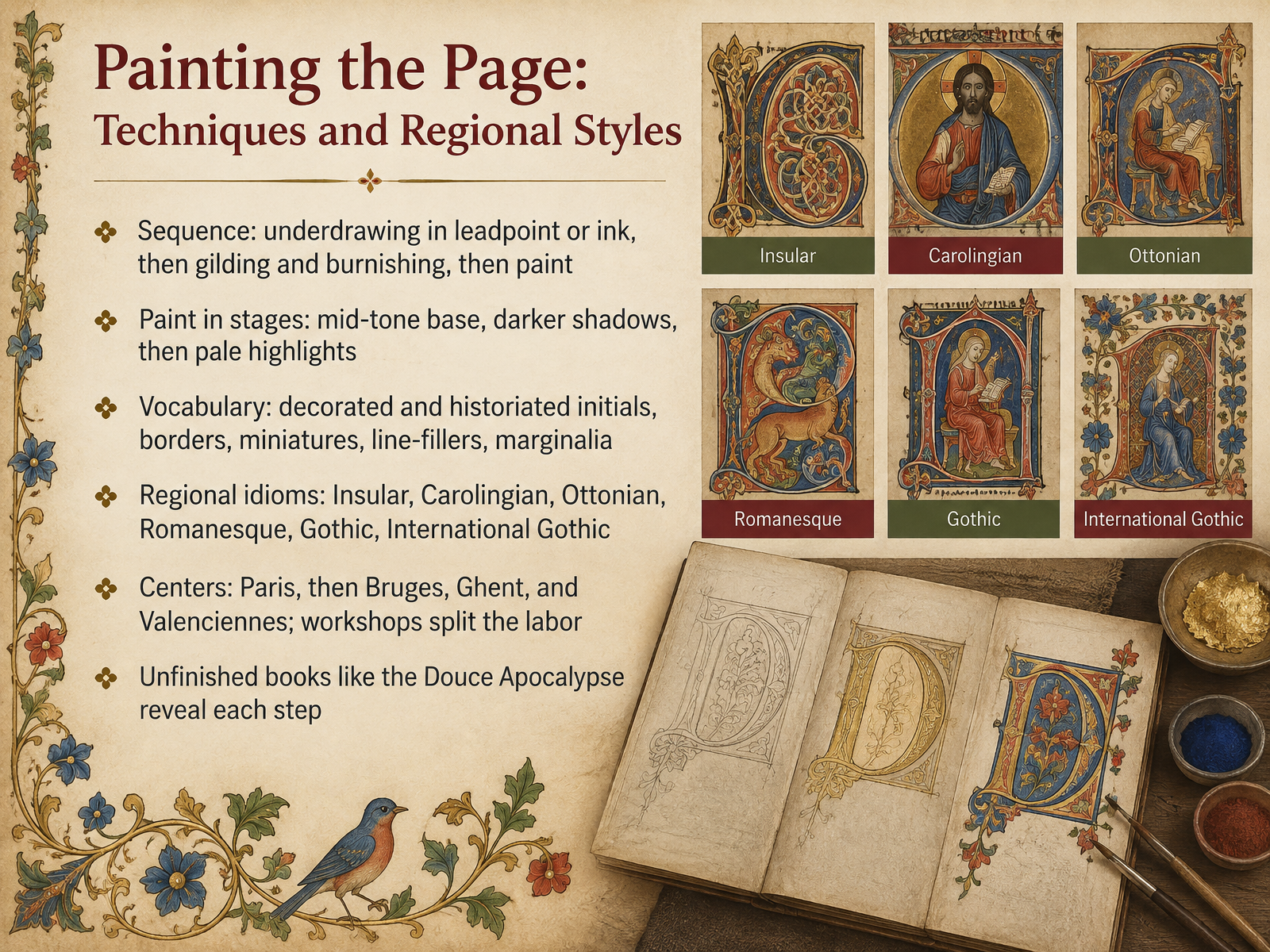
- 10Painting the Page: Techniques and Regional StylesNow let's look at what actually happened on the page. The artist began with an underdrawing, a faint sketch in leadpoint or ink. Then came the gold. Leaf was laid on a sticky ground and burnished, rubbed with a smooth stone or a tooth, until it flashed as you turned the page. Only then did color go on, in stages: a mid-tone base first, then darker shadows, then pale highlights. Along the way you meet terms like decorated initials, historiated initials that hold a small scene, borders, miniatures, line-fillers, and marginalia, the little drawings or notes in the margins. Styles shifted by region, from Insular to Carolingian, Ottonian, Romanesque, Gothic, and International Gothic. Paris led in the early fourteen hundreds, then Bruges, Ghent, and Valenciennes, with workshops splitting the labor. Unfinished books like the Douce Apocalypse let us watch each step. Next, binding and assembling the book.
 getty.edunew.artsmia.orgnationalgallery.org.uk+22 min
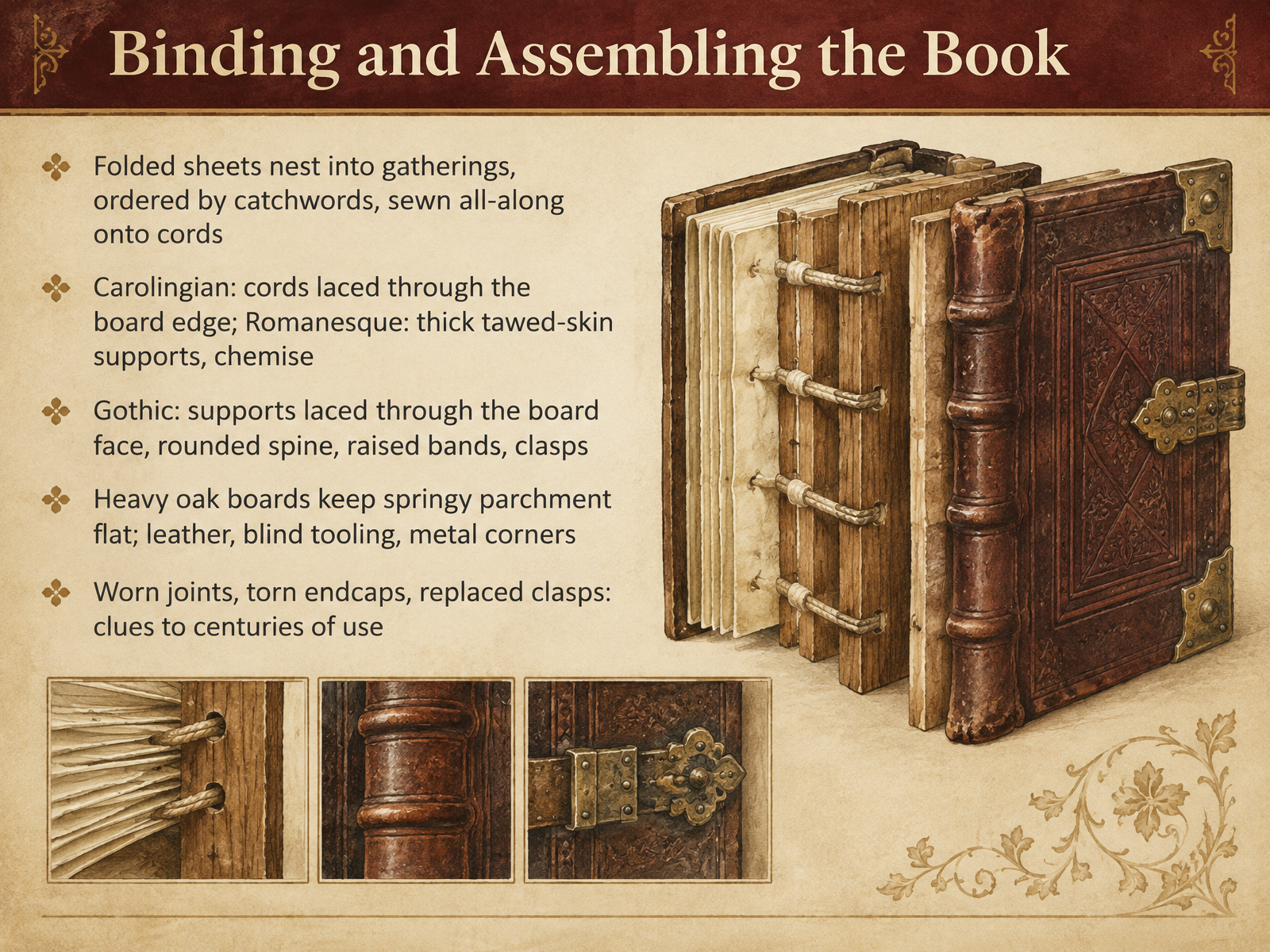
- 11Binding and Assembling the BookNow the book finally comes together. The folded sheets, called gatherings, are stacked in order, checked against small catchwords written at the bottom of the last page, and then sewn all the way along onto cords. Those cords connect the text to the wooden boards. In Carolingian bindings, the cords are laced through the edge of the board. Romanesque bindings use thick tawed-skin supports, and often a chemise, a soft outer cover that protected the edges. Gothic bindings lace the supports through the face of the board, which pulls the spine into a gentle round, with raised bands and clasps. Heavy oak boards keep the springy parchment flat. Then comes leather, blind tooling, and metal corners. And when you see worn joints, torn endcaps, or replaced clasps, you are looking at centuries of use. Next, we turn to the people who read and used these books: Patrons, Readers, and Uses of Medieval Books.
 2 min
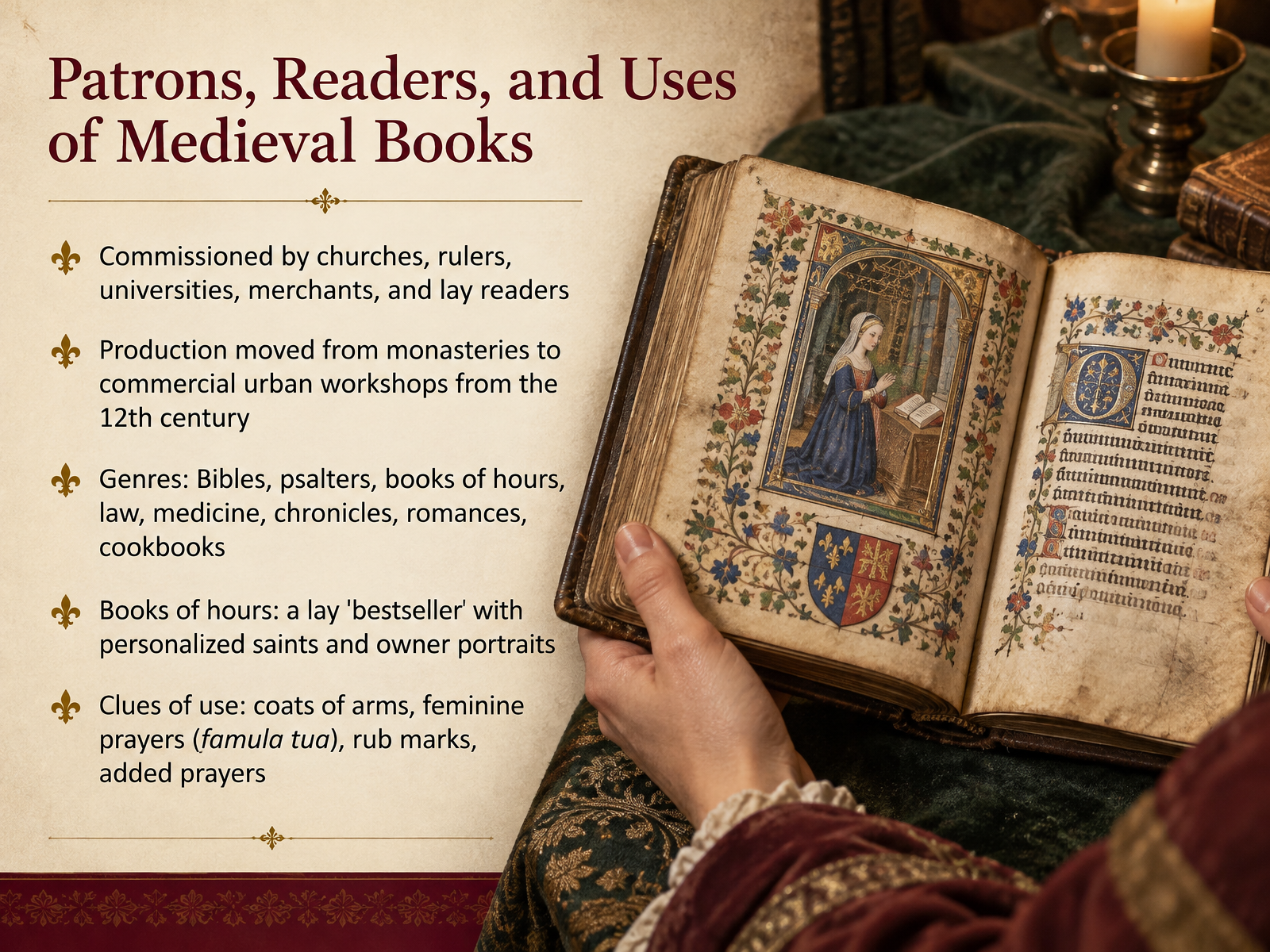
- 12Patrons, Readers, and Uses of Medieval BooksNow let's look at who these books were for. Churches and rulers commissioned them, and so did universities, merchants, and ordinary lay readers. From the twelfth century onward, production shifted from monasteries into commercial urban workshops, where professional scribes and artists made books for sale. The range of genres was wide: Bibles, psalters, law, medicine, chronicles, romances, even cookbooks. But the great bestseller was the book of hours, a personal prayer book for laypeople, often personalized with chosen saints or a portrait of the owner. And books carry clues of use. Coats of arms, prayers written in the feminine voice with the phrase famula tua, meaning your female servant, rubbed or darkened pages, and prayers added by hand all tell us who held the book and where they lingered. Next, we'll look closely at reading a manuscript in the museum.
 2 min
- 13Close Looking: Reading a Manuscript in the MuseumNow let's put all of that into practice and look closely at a manuscript in the gallery. Start with the basics. Check the support, meaning the parchment or paper. Then look at the script, the layout, and any faint ruling lines. Notice the pigments, then the gold, and only after that, any later marks. Those small marks are often the best evidence of making and use: corrections, doodles, thumbprints, repairs, and inscriptions. Try reading an opening as one composition, where the rubric, the miniature, and the start of a new section work together. And remember why the lights stay so dim, around fifty lux, with ultraviolet filtering. Pages are rotated and time-limited because light damage is cumulative and permanent. Parchment also needs stable humidity. Next, we'll look at hands-on practice and where to explore further.
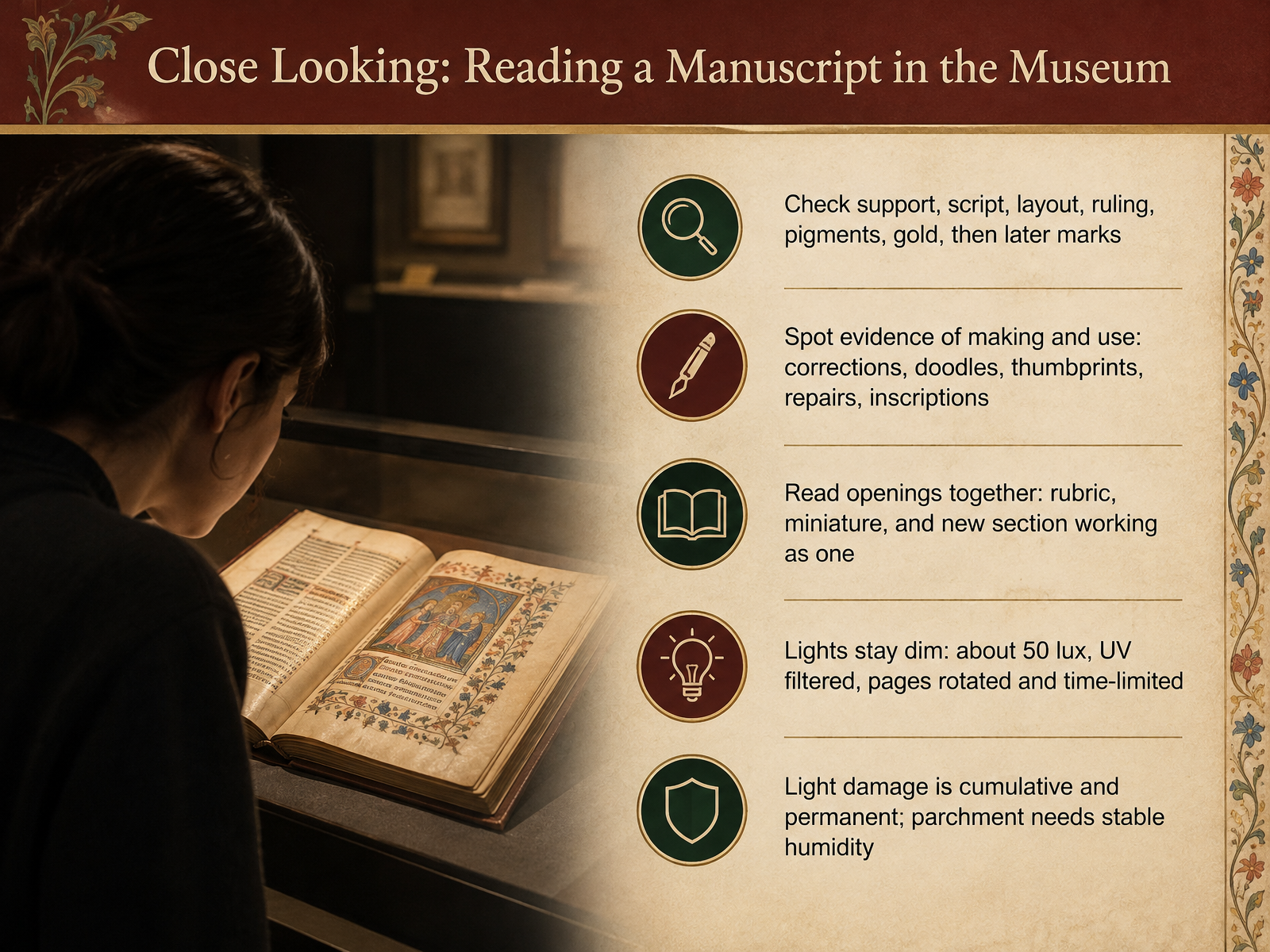 2 min
- 14Hands-On Practice and Where to Explore NextBefore we finish, let's bring it all together. Every medieval book you've seen here was made by many hands, working from animal skin, pigment, and gold. And the best way to understand that is to try it yourself. Match a few scripts side by side, sketch a page layout, and look closely for pricking and ruling, the tiny holes and faint lines that guided the scribe's hand. When you're ready to explore further, the Digital Bodleian, Gallica, DigiVatLib, and e-codices let you turn pages online for free, and tools that search across collections make it easy to compare books from different libraries. In person, check special collections galleries, facsimiles you can handle, and handling sessions at museums and libraries. And if you'd like to keep learning, printed reading lists and glossaries are a friendly next step. Thank you for joining me. Go turn some pages, and enjoy the looking.
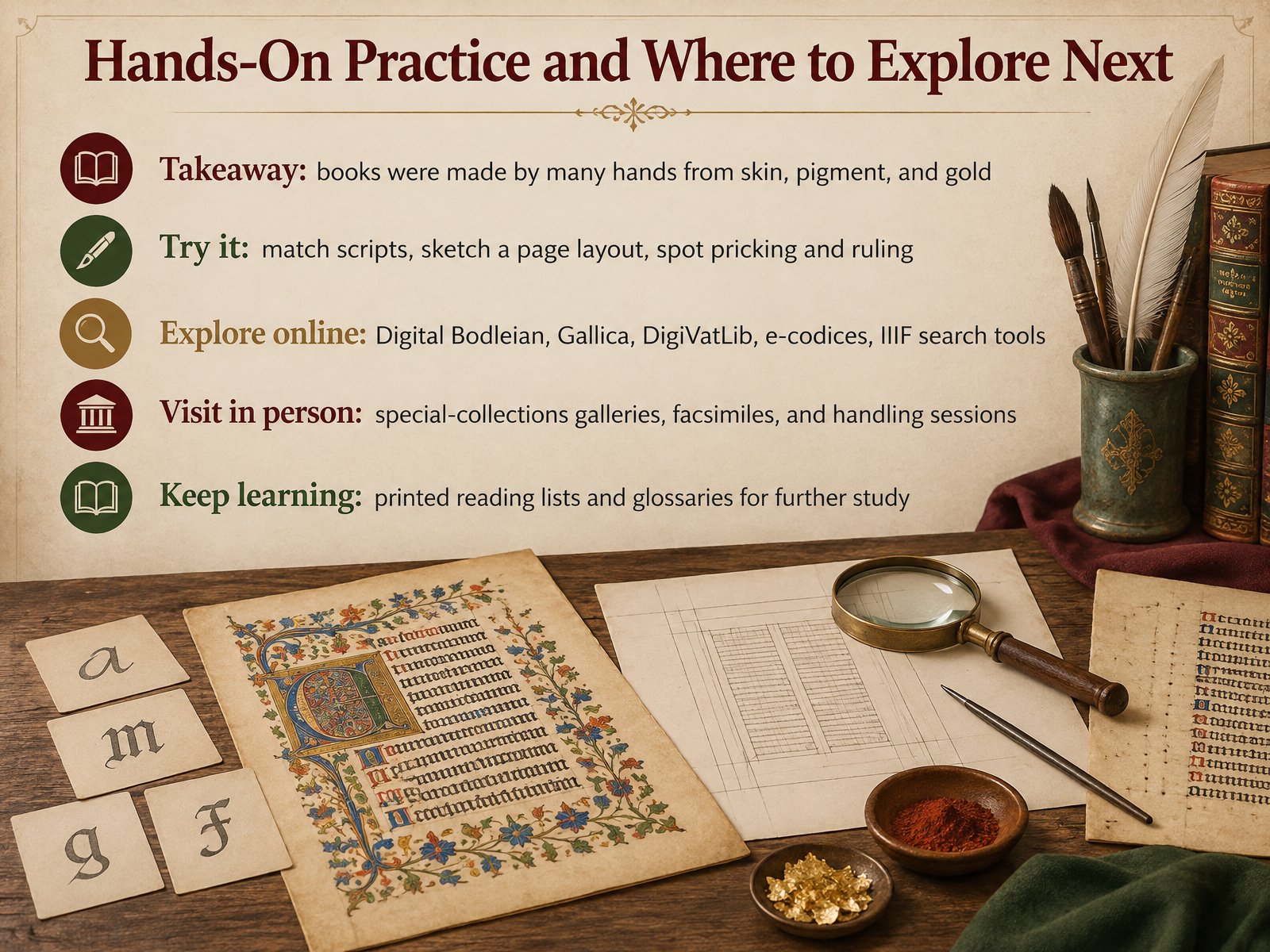 2 min
Take the deck with you
Download this course as a file — free, no sign-up needed.
- PDF handoutEvery slide page, ready to print or share.15 pages · 6.1 MBDownload
- Narrated PowerPointThe deck that presents itself — every slide carries the digital human's narration video.15 pages · 15.3 MBDownload
- PowerPoint slidesThe full deck as a .pptx — open it in PowerPoint, Keynote, or Google Slides.15 pages · 6.1 MBDownload
Free to use in your own training — please keep the PersonWise credit page at the end.
Have your own deck? Turn it into a course
Sources consulted
Web sources consulted while building this course.
- Illuminated manuscript | Glossary | National Gallery, London — nationalgallery.org.uk
- Illuminated Manuscripts — nga.gov
- Medieval Illuminated Manuscripts –– Minneapolis Institute of Art — new.artsmia.org
- Manuscript Illumination in Northern Europe - The Metropolitan Museum of Art — metmuseum.org
- ILLUMINATED — fitzmuseum.cam.ac.uk
- The Making of a Medieval Book (Getty Exhibitions) — getty.edu
- Pages | Medieval & Renaissance Manuscripts - CURIOSity Digital Exhibits — curiosity.lib.harvard.edu
- Medieval book production: manufacturing manuscripts — bnf.fr
- How to Make a Medieval Manuscript - Medieval Manuscripts in Special Collections - LibGuides at UVa Library — guides.lib.virginia.edu
- Differences between Parchment, Vellum and Paper — archives.gov
- Mediaeval Islamic Inkmaking Recipes: Provenance, Dating, and Authorship in a Rare Egyptian Manuscript — doi.org
- Italy, c. 1440 — pre1600ms.beinecke.library.yale.edu
- Writing in Gold and Silver. Byzantine Ink Recipes from MS Bononiensis 1808 — doi.org
- Inks as Instruments of Writing — doi.org
- Literary text: ENA 3960.5 — geniza.princeton.edu
- Making medieval manuscripts | Corpus Christi College University of Cambridge — corpus.cam.ac.uk
- Women as Scribes — assets.cambridge.org
- Materials, Methods, and Motives: Female Scribal Agency in Late Medieval and Early Modern Italian Religious Houses — doi.org
- Making a medieval manuscript — birgitconstant.com
- 20 Essential Tools of a Medieval Scribe — medievalists.net