Begin
14 pages · ~28 min
Weathering and Erosion: Landscape Change
This training explains weathering and erosion processes for learners studying how natural forces shape and wear down landscapes.
A digital instructor presents all 14 pages. Hold “Ask” at any point and ask out loud — the answer comes from this course. No sign-up needed.
What you’ll learn
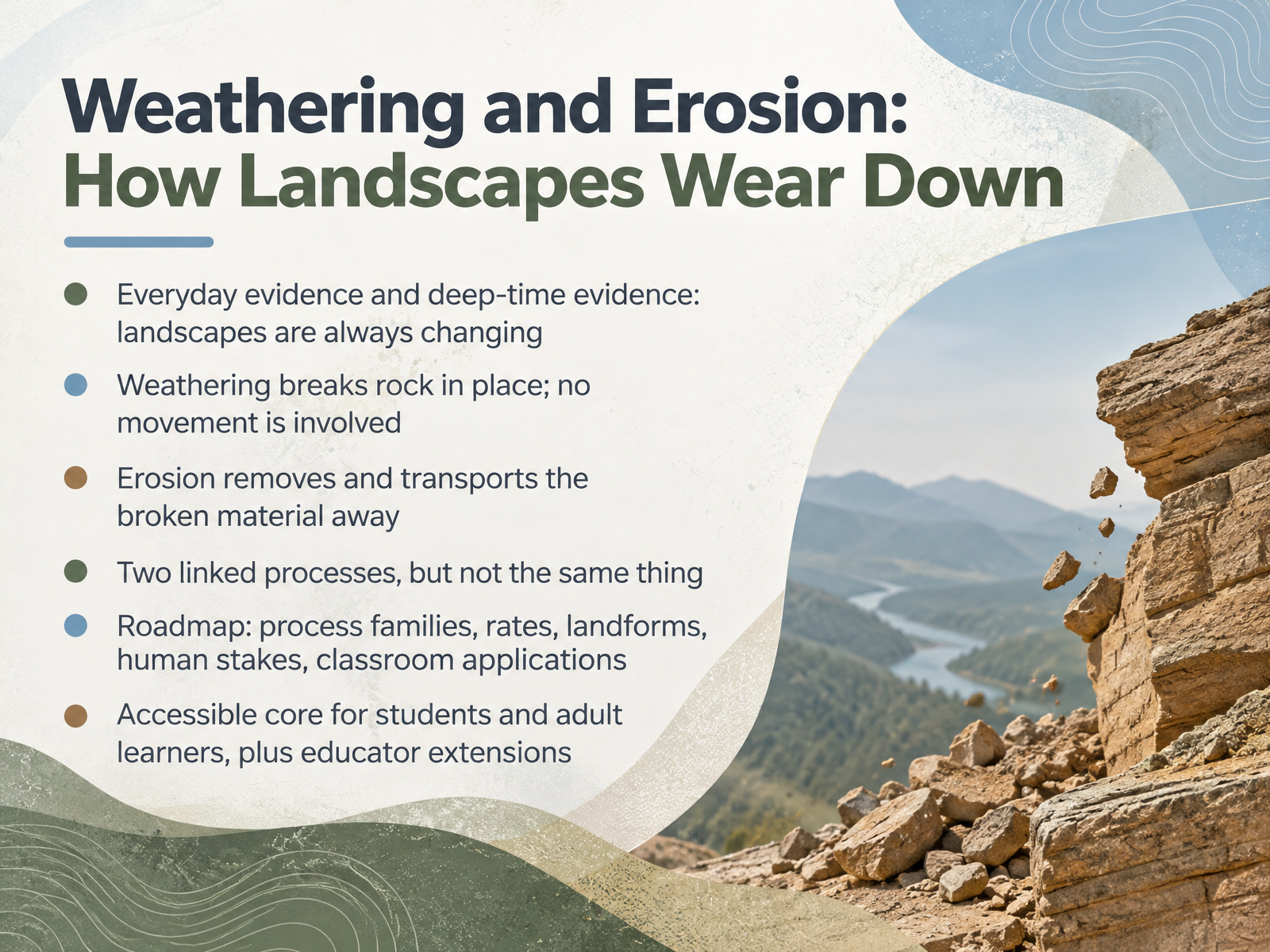
- 01Weathering and Erosion: How Landscapes Wear DownWelcome. I'm glad you're here. Today we're looking at two processes that shape every landscape on Earth: weathering and erosion. Our goal is simple. By the end, you'll be able to tell these two processes apart, and see them in the world around you. Here's the key distinction. Weathering breaks rock down in place. No movement is involved. Erosion then removes that broken material and carries it away. They're linked, but they are not the same thing. You can see evidence in everyday life, like cracks in a sidewalk, and in deep time, like canyons carved over millions of years. Landscapes are always changing. Along the way, we'll cover the process families, rates, landforms, human stakes, and classroom applications. The core material is built for students and adult learners, with extensions for educators. So let's begin with how landscapes stay in balance. Next up: Background, Landscapes in Balance.nps.govnps.govnps.gov+22 min
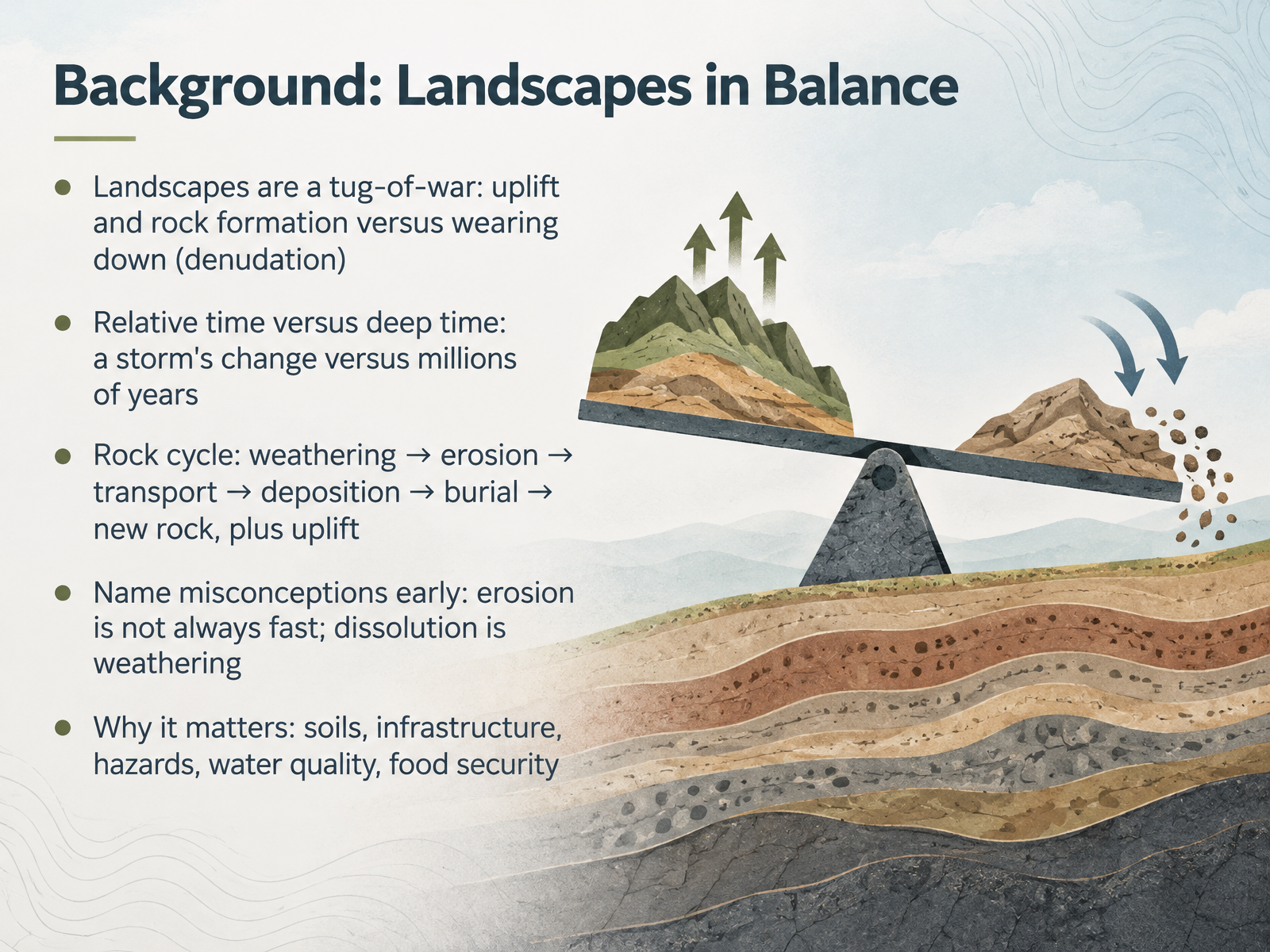
- 02Background: Landscapes in BalanceLet's build a bit of context before we dig into the details. Think of a landscape as a tug-of-war. Uplift and rock formation push land up. Denudation, the wearing down of the surface, pulls it back. These forces work on very different clocks. A single storm can shift sand and carve a bank in hours. A mountain range may take millions of years to wear away. That contrast between relative time and deep time matters. Now the rock cycle links it all. Weathering breaks rock down. Erosion moves it. Then transport, deposition, burial, and eventually new rock, with uplift bringing it back to the surface. Let's name two misconceptions early. Erosion is not always fast, and dissolution is weathering, not erosion, because nothing solid is removed. This is not abstract. Soils, infrastructure, hazards, water quality, and food security all depend on these processes. Next, we look at physical weathering, breaking rock without changing its chemistry.
 geolsoc.org.ukbbc.co.ukeducation.nationalgeographic.org+22 min
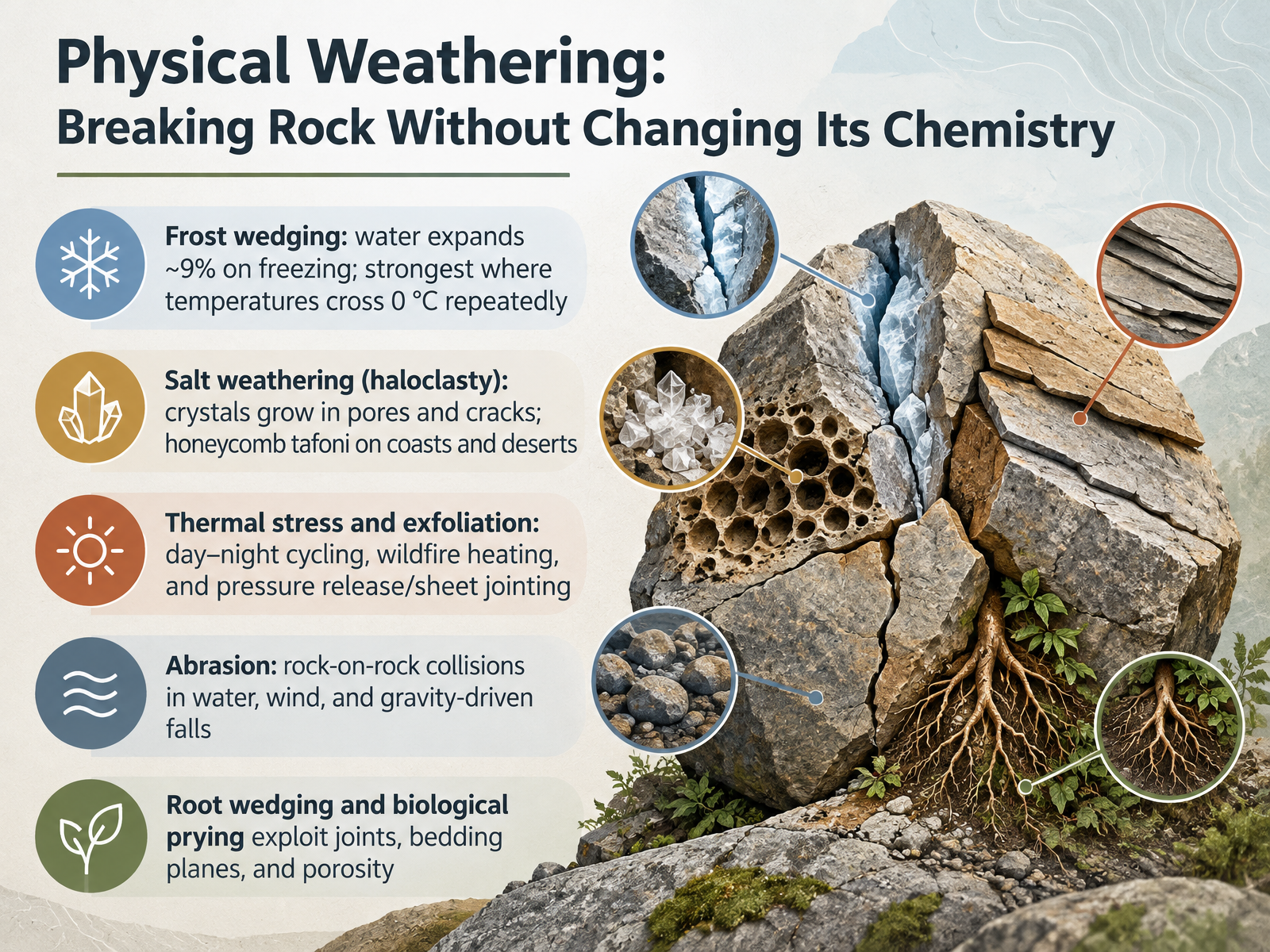
- 03Physical Weathering: Breaking Rock Without Changing Its ChemistryNow let's look at physical weathering, where rock breaks apart without changing its chemistry. Five mechanisms do most of the work. First, frost wedging. Water seeps into cracks and expands by about nine percent when it freezes, prying the rock open. It is strongest where temperatures cross zero degrees Celsius again and again. Second, salt weathering, or haloclasty. Salt crystals grow in pores and cracks and push grains apart, producing honeycomb tafoni on coasts and in deserts. Third, thermal stress and exfoliation. Day and night cycling, wildfire heating, and pressure release called sheet jointing peel away outer layers. Fourth, abrasion. Rock collides with rock in water, wind, and gravity-driven falls, rounding and grinding fragments smaller. Fifth, root wedging and biological prying, where plant roots exploit joints, bedding planes, and porosity. Notice the common thread. Each process widens existing weaknesses and increases surface area, which sets the stage for chemical attack. Next, we move on to chemical weathering, rock transformed by water and air.
 dnr.sc.govcmes.utah.edudoi.org+22 min
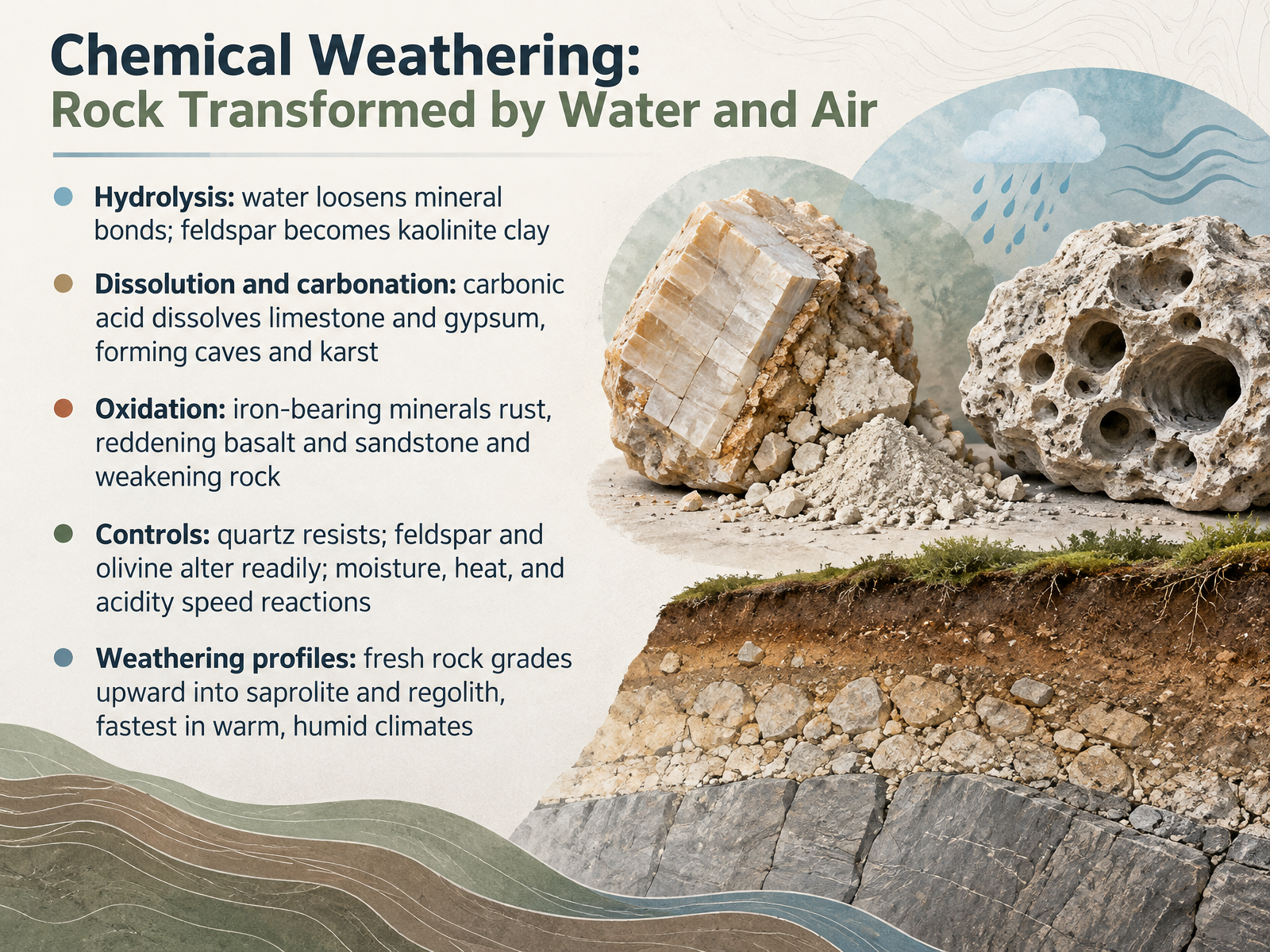
- 04Chemical Weathering: Rock Transformed by Water and AirNow let's look at chemical weathering, where water and air actually transform rock. There are three key processes to know. First, hydrolysis. Water loosens the chemical bonds inside a mineral. Feldspar, common in granite, alters into kaolinite clay, leaving that chalky white coating you see on weathered stone. Second, dissolution and carbonation. Carbon dioxide dissolves in water to form weak carbonic acid. That acid dissolves limestone and gypsum, hollowing out caves and building karst landscapes with sinkholes and towers. Third, oxidation. Oxygen and water react with iron-bearing minerals, and the rock rusts. Basalt and sandstone redden and weaken. Now, not all minerals respond the same way. Quartz resists weathering, while feldspar and olivine alter readily. Moisture, heat, and acidity all speed the reactions. And if you dig downward, you often find a weathering profile. Fresh rock grades upward into soft saprolite and then regolith. This happens fastest in warm, humid climates. Coming up next, biological weathering and soil formation.
 geo.libretexts.orgsoils4teachers.orgpressbooks.ccconline.org+22 min
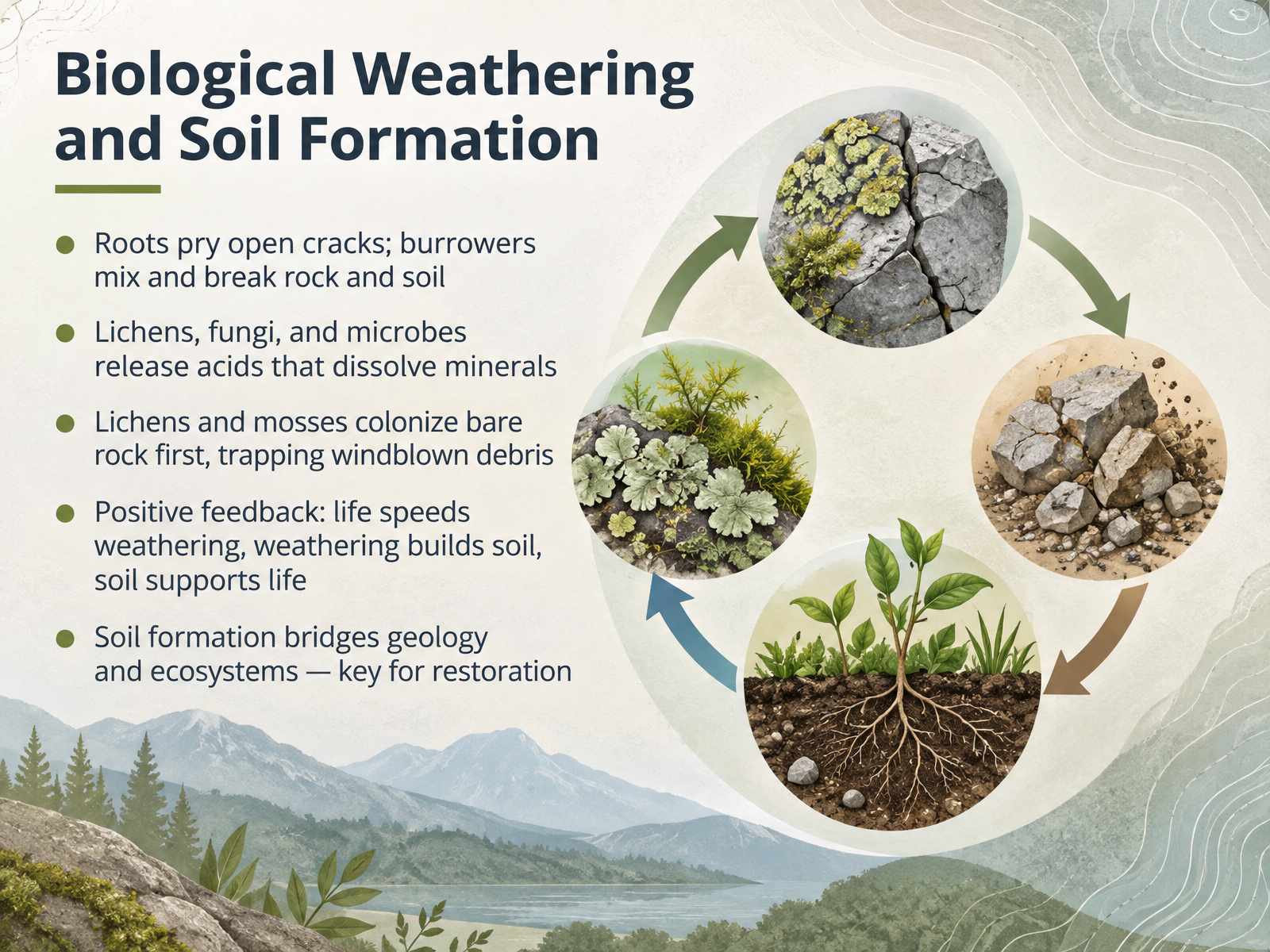
- 05Biological Weathering and Soil FormationNext, let's look at biological weathering and soil formation. Living organisms break down rock in two ways: physically and chemically. Plant roots push into cracks and pry the rock apart, while burrowers like earthworms and insects mix and break up rock and soil. At the same time, lichens, fungi, and microbes release organic acids that dissolve minerals, weakening the rock further. Lichens and mosses are often the first life on bare rock. They trap windblown debris, and as they die, organic matter builds up. This creates a positive feedback loop: life speeds weathering, weathering builds soil, and soil supports more life. That is why soil formation bridges geology and ecosystems, and why it matters so much for restoration. Coming up next, we'll see how erosion and transport move that weathered material.
 dnr.sc.gov1 min
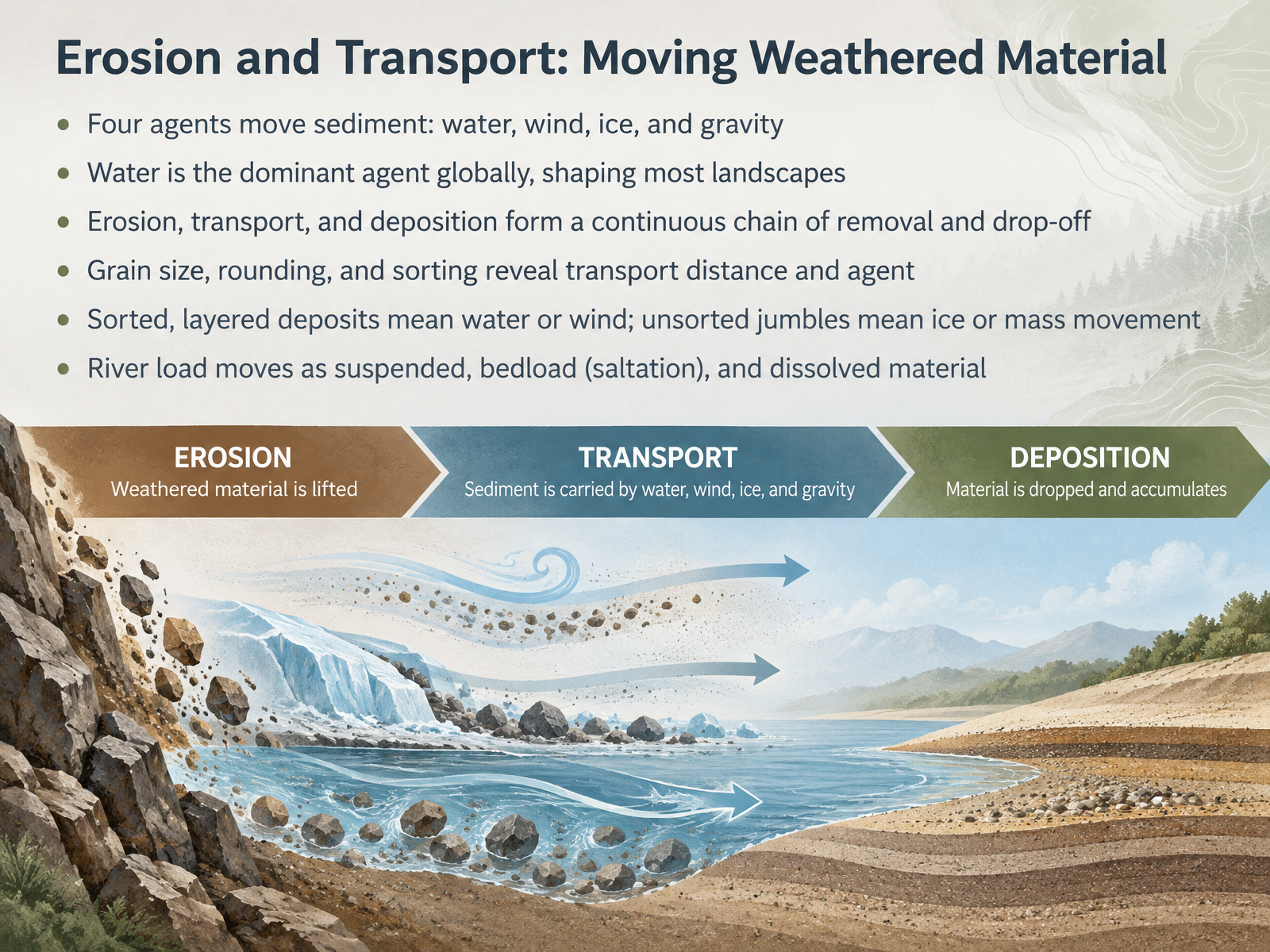
- 06Erosion and Transport: Moving Weathered MaterialNow that material is broken down, what happens to it next? That's erosion, and erosion is really about movement. Four agents do the moving: water, wind, ice, and gravity. Water is the dominant agent worldwide, and it has shaped most of the landscapes you know. Erosion, transport, and deposition form one continuous chain. Material is removed, carried along, and dropped off when the energy falls. The deposit itself leaves clues. Grain size, rounding, and sorting tell you how far the sediment traveled and which agent carried it. Sorted, layered deposits point to water or wind. Unsorted jumbles, with every size mixed together, point to ice or mass movement. And a river carries its load three ways: in suspension, as bedload that bounces along the bottom, and as dissolved material. In the next section, we look at the controls on weathering and erosion rates.
 dnr.sc.govnps.govnps.gov+22 min
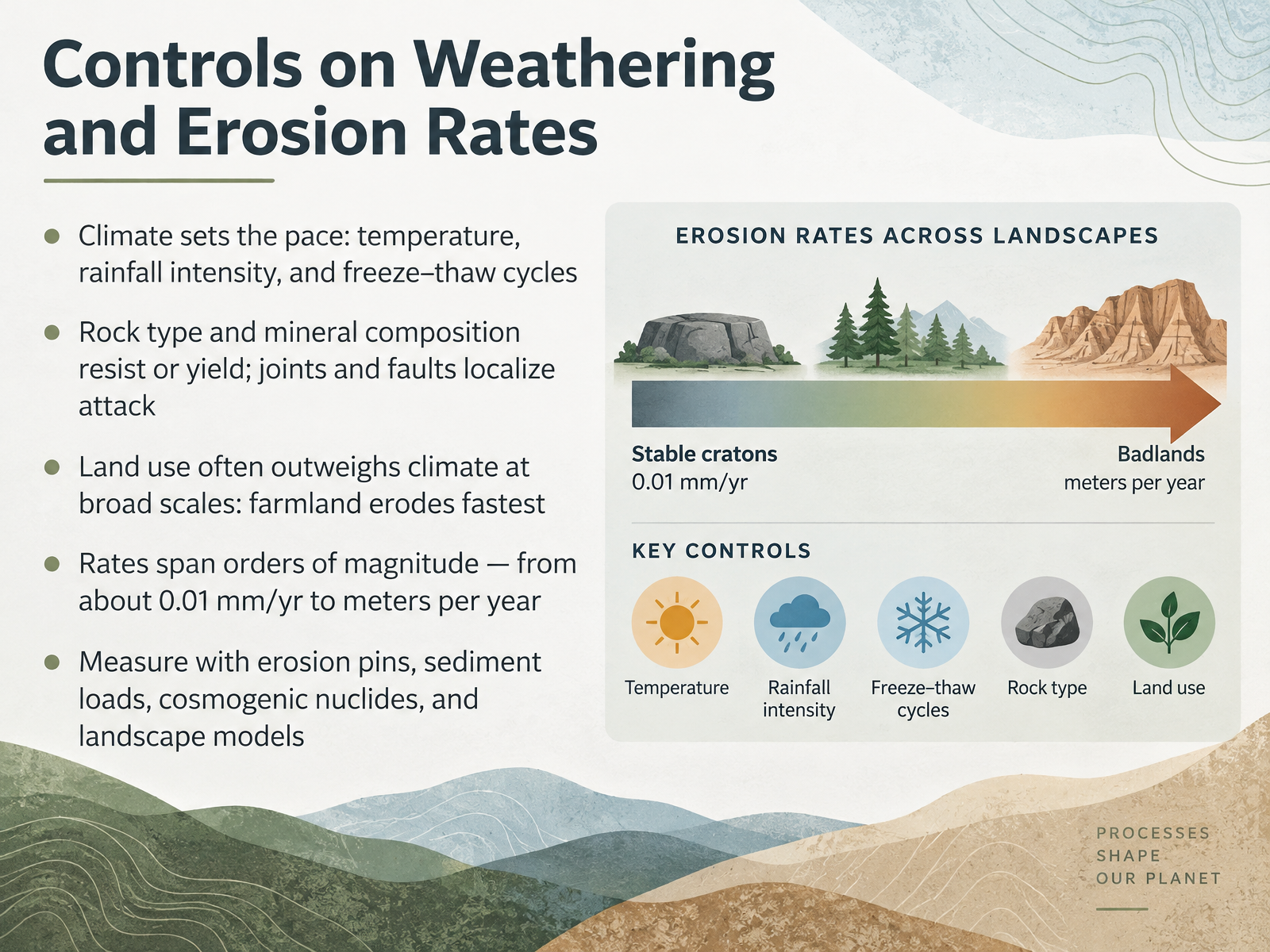
- 07Controls on Weathering and Erosion RatesNow let's look at what controls how fast weathering and erosion actually happen. Climate sets the pace. Temperature, rainfall intensity, and repeated freeze and thaw cycles all influence how quickly rock breaks down and sediment moves. Rock type matters too. Hard, resistant minerals slow the process, while weaker rocks yield more easily, and joints and faults localize attack by giving water a way in. But at broad scales, land use often outweighs climate. Farmland erodes fastest, while forests and shrublands typically lose the least soil. And rates span orders of magnitude, from about zero point zero one millimeters per year up to meters per year. To measure them, researchers use erosion pins, sediment loads, cosmogenic nuclides, and landscape models. Each method captures a different timescale, so the numbers aren't always directly comparable. The key takeaway is this. Climate, rock, and land use interact, and human land management can accelerate or slow erosion dramatically. Next, we'll look at landscapes and landforms and how to read the evidence they leave behind.
 2 min
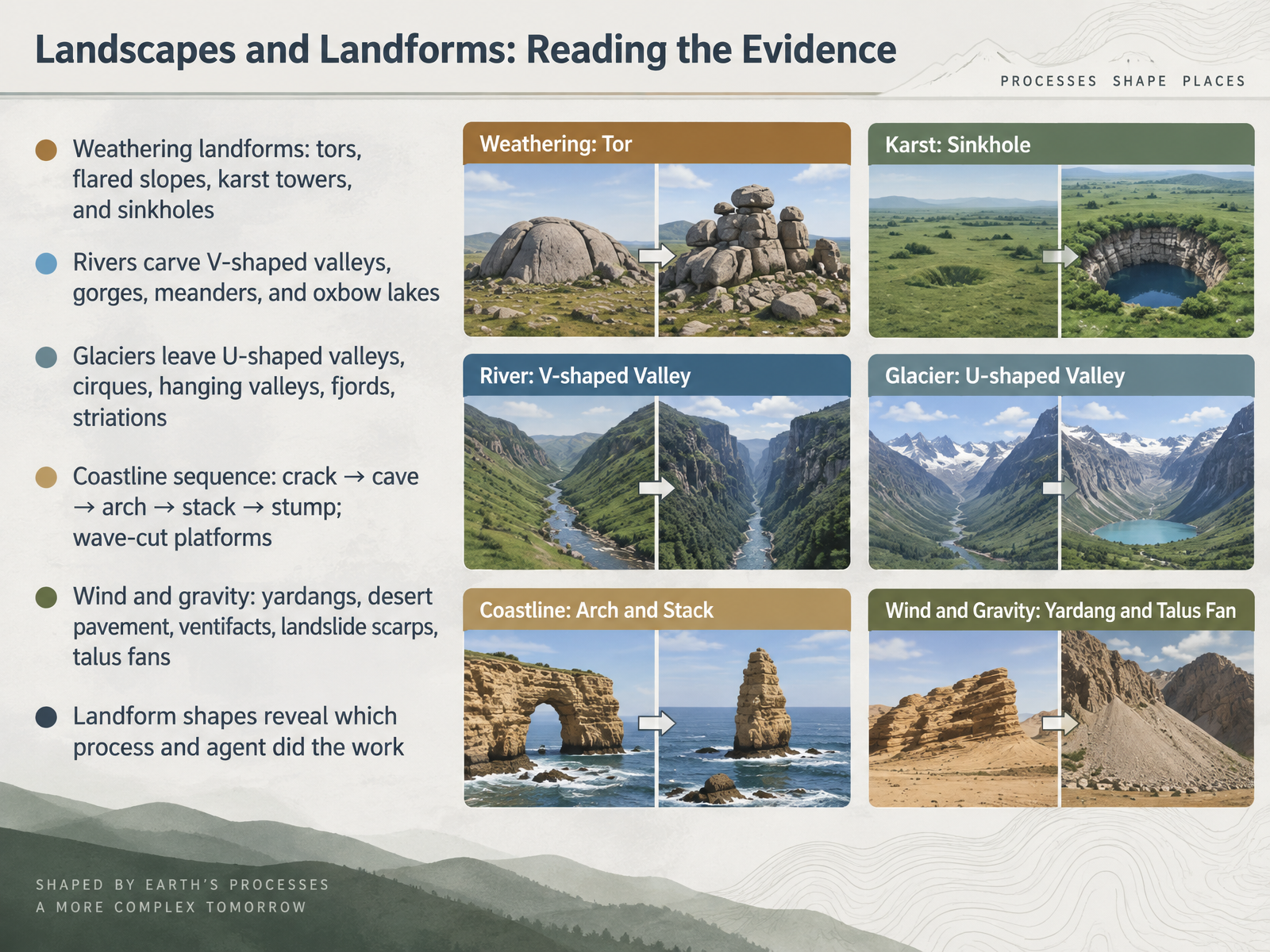
- 08Landscapes and Landforms: Reading the EvidenceNow let's put that knowledge to work by reading the evidence in real landscapes. Landform shape tells you which process and which agent did the work. Weathering leaves tors, flared slopes, karst towers, and sinkholes. Rivers carve V-shaped valleys, gorges, meanders, and oxbow lakes. Glaciers leave U-shaped valleys, cirques, hanging valleys, fjords, and striations, the long parallel grooves scraped into bedrock. On coastlines, look for a sequence. A crack widens into a cave, then an arch, then a stack, and finally a stump, often with wave-cut platforms below. Wind and gravity leave their own signatures. Yardangs, desert pavement, and ventifacts show wind abrasion, while landslide scarps and talus fans show gravity at work. So when you face a landscape, ask what shape it is, and which agent could have made it. That habit turns scenery into evidence. Next, we look at the human side: soil loss, hazards, and management.
 geolsoc.org.ukbbc.co.ukeducation.nationalgeographic.org+22 min
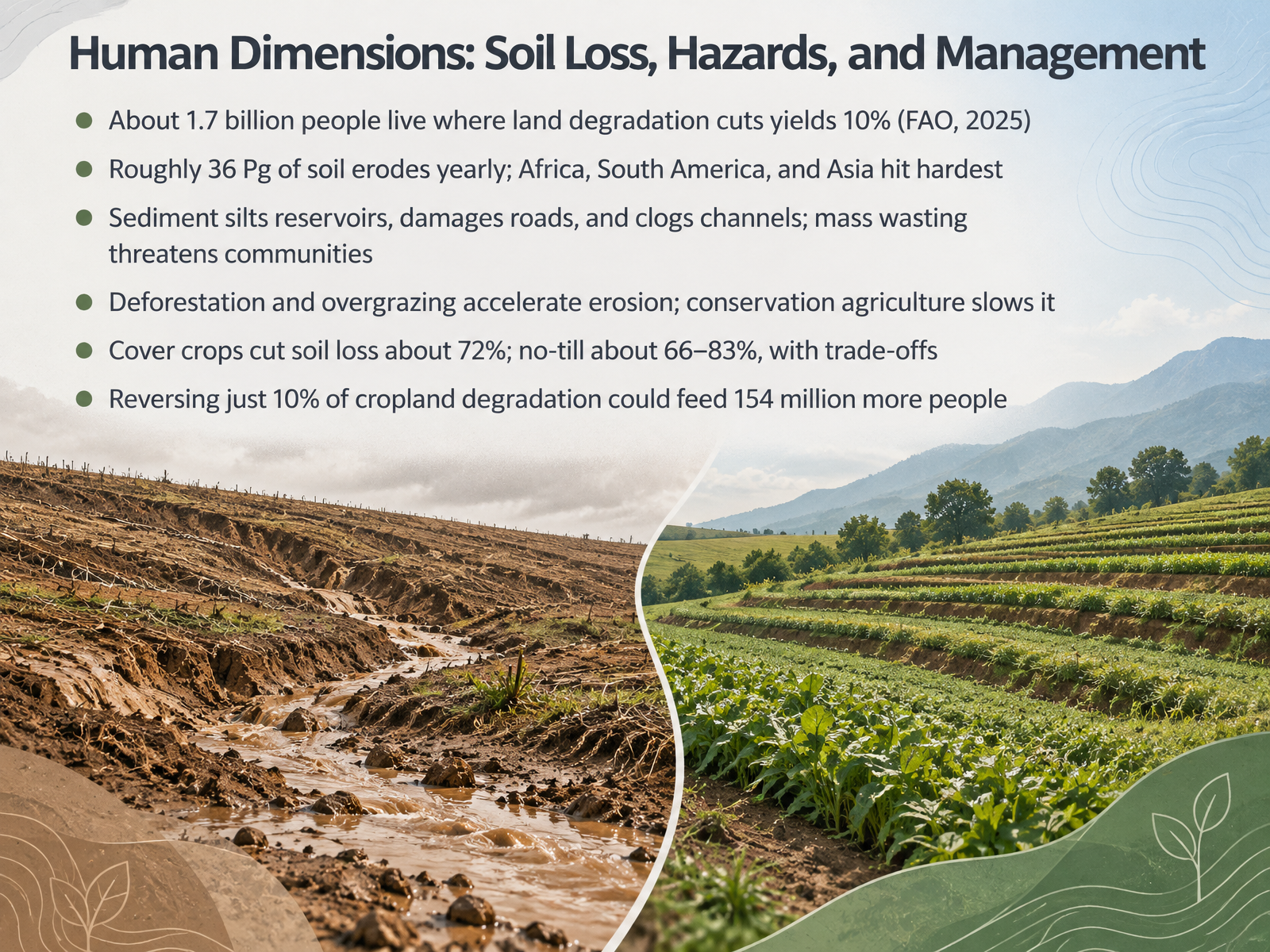
- 09Human Dimensions: Soil Loss, Hazards, and ManagementNow let's connect erosion to people. According to the Food and Agriculture Organization, about 1.7 billion people live in areas where land degradation lowers crop yields by ten percent. Globally, roughly 36 petagrams of soil erode each year. Africa, South America, and Asia are hit hardest. The consequences reach beyond farms. Sediment silts up reservoirs, damages roads, and clogs channels, while mass wasting, like landslides, threatens communities. Human choices drive much of this. Deforestation and overgrazing accelerate erosion, while conservation agriculture slows it. Cover crops cut soil loss by about 72 percent, and no-till by roughly 66 to 83 percent, though each has trade-offs. Here is the hopeful part. Reversing just 10 percent of cropland degradation could feed 154 million more people. Next, we'll look at teaching and applying these concepts.
 2 min
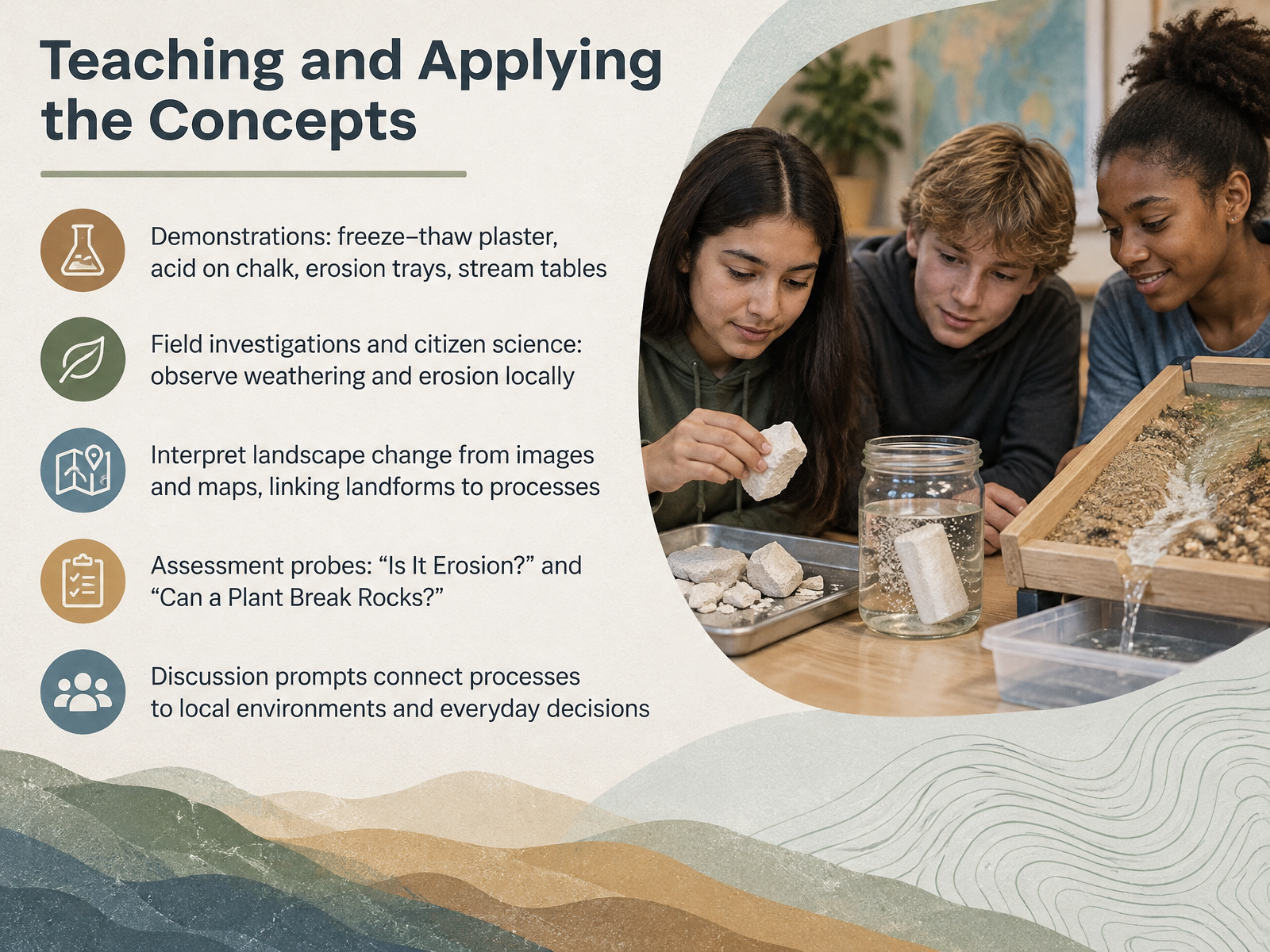
- 10Teaching and Applying the ConceptsSo how do we turn these ideas into real learning? Start with demonstrations. Freeze and thaw plaster to model frost wedging. Drop acid on chalk to show chemical weathering. Use erosion trays, and stream tables to watch water move sediment and reshape a channel. Then take students outside for field investigations or citizen science, and have them observe weathering and erosion in their own community. Images and maps extend the lesson, because students can interpret landscape change and link landforms to the processes that formed them. Assessment probes like Is It Erosion and Can a Plant Break Rocks reveal common misconceptions, especially confusing weathering with erosion. Finally, discussion prompts help learners connect these processes to their local environment and to everyday decisions. Next, we look closely at weathering versus erosion, the in-place versus transport distinction.
 1 min
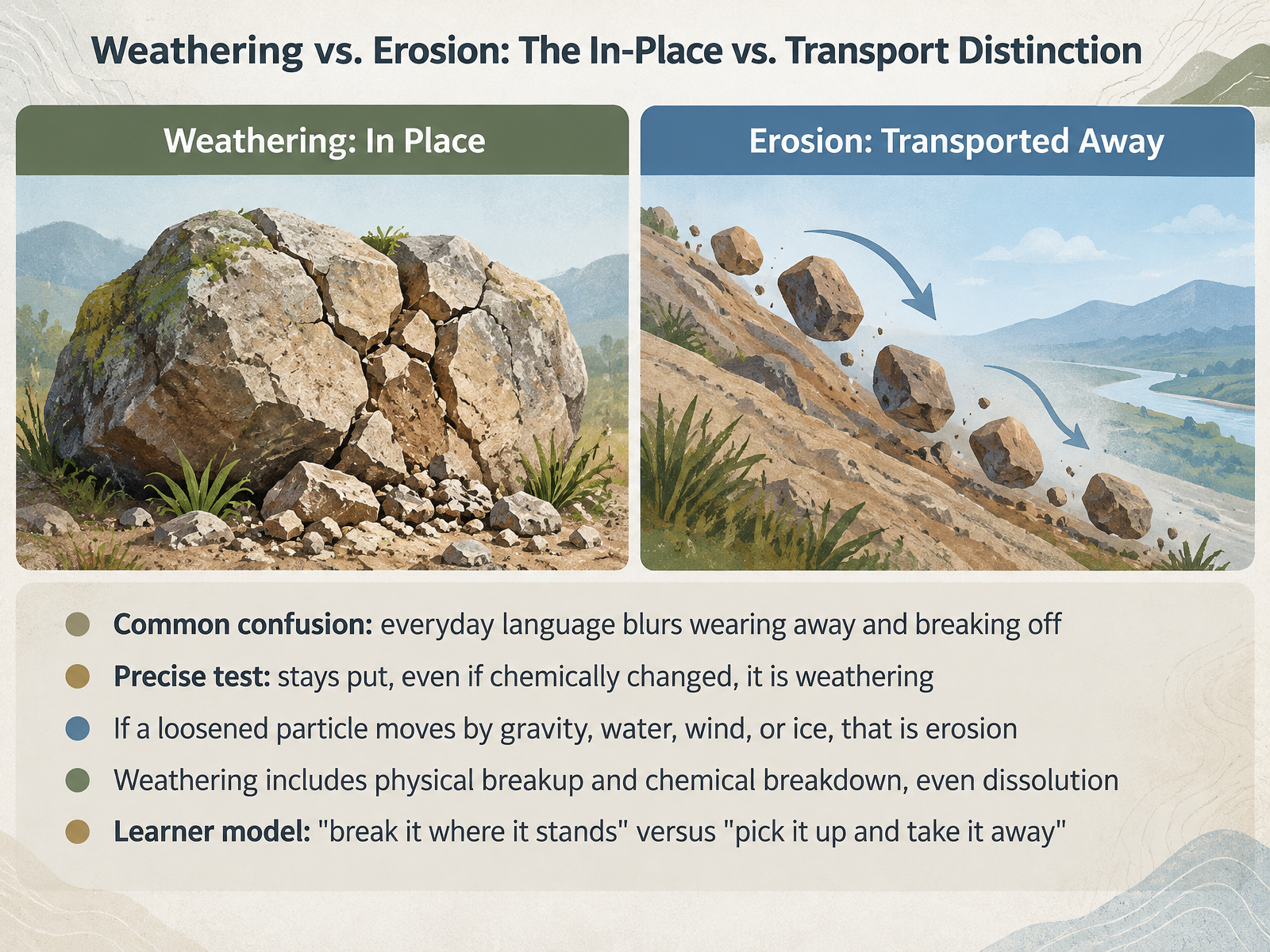
- 11Weathering vs. Erosion: The In-Place vs. Transport DistinctionLet's clear up one of the most common mix-ups in this whole topic. In everyday language, we say rock is worn away, and that blurs two different processes. Here is the precise test. If a particle is loosened, chemically or mechanically, but stays put, that is weathering. Even if the rock is chemically changed, or dissolved by slightly acidic rainwater, it still counts as weathering because no solid material has moved. Now, if that loosened particle actually moves, carried by gravity, water, wind, or ice, that is erosion. So weathering includes both physical breakup and chemical breakdown. A simple learner model helps. Weathering means break it where it stands. Erosion means pick it up and take it away. Next, we will watch that distinction play out in a real landscape, in our case study, the wearing-down machine in action.
 nps.govnps.govnps.gov+22 min
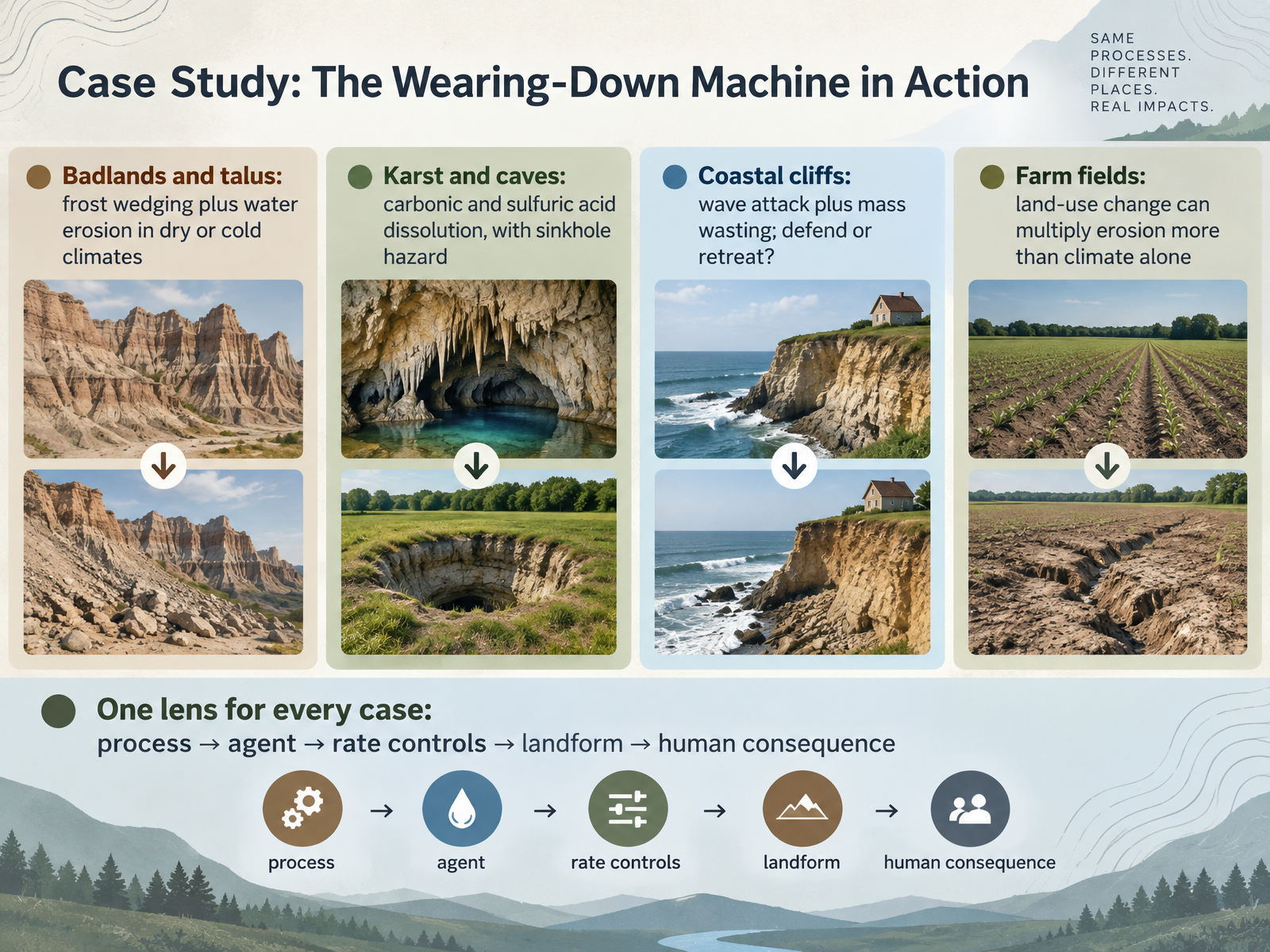
- 12Case Study: The Wearing-Down Machine in ActionNow let's put the wearing-down machine to work on real landscapes. In badlands and cold, dry settings, frost wedging pries rock apart, and water carries the debris downhill, building talus slopes at the base of cliffs. In karst, carbonic and sulfuric acid dissolve limestone and gypsum, forming caves, and when a cave roof collapses, a sinkhole can follow. Along coastal cliffs, wave attack undercuts the rock, and mass wasting brings it down. So communities face a real choice: defend, or retreat. In farm fields, land-use change can multiply erosion far more than climate alone. Studies show that converting forest or grassland to cropland sharply raises erosion rates, and that land-use change can outweigh climate effects. Across all four cases, use one lens: process, agent, rate controls, landform, human consequence. Coming up next, Designing a Lesson Sequence: From Phenomena to Assessment.
 2 min
- 13Designing a Lesson Sequence: From Phenomena to AssessmentNow let's put all of this together into a lesson sequence. Start with a local phenomenon, something learners can actually see, like a rock face, a muddy river after a storm, or a sea arch on the coast. Then sequence the content logically. Begin with definitions, move into process families like mechanical and chemical weathering, then rates, landforms, and human use. Build in hands-on investigations. Freeze-thaw stations, stream tables, and image or map interpretation all let learners test their definitions and observe cause and effect. Probe misconceptions directly. Ask, is it erosion? And, can a plant break rocks? These friendly-talk probes reveal whether learners separate weathering from transport. Finally, adapt the vocabulary and depth for your audience, whether students, adult learners, or teacher professional development. Same phenomena, same evidence, different level of precision. Next, we'll pull together the key takeaways and next steps.
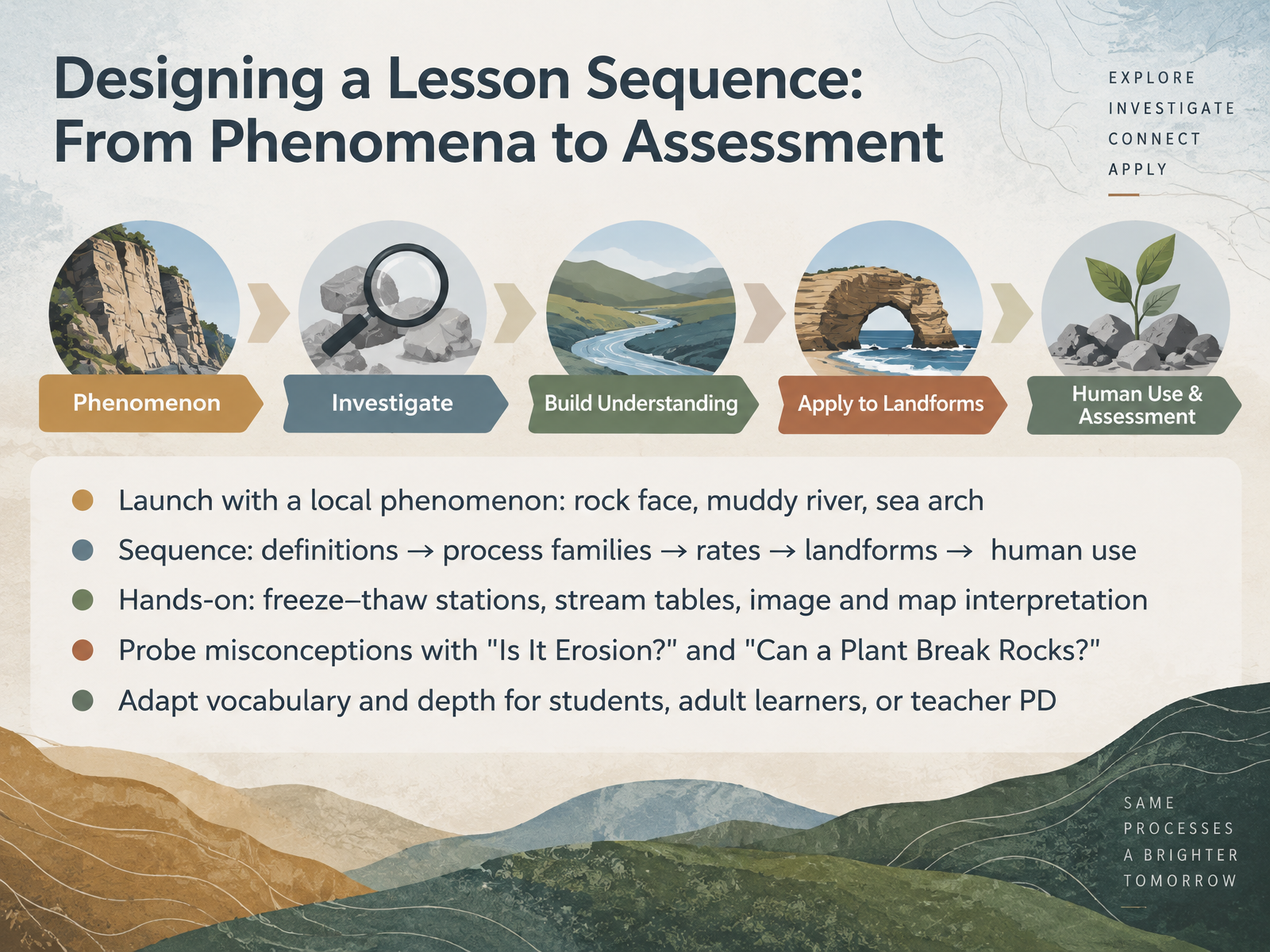 2 min
- 14Key Takeaways and Next StepsLet's bring this all together. Weathering breaks rock in place. Erosion moves the products away. And physical, chemical, and biological weathering work together, with water as the common thread. Water, wind, ice, and gravity each leave distinctive landforms and sediment clues. Remember, sorted and layered sediment points to water or wind. Unsorted, jumbled deposits point to ice. Erosion rates also vary with climate, rock type, structure, vegetation, and land use. So here is your next step. Choose one local feature, like a stream bank, a roadside cut, or a shoreline. Make careful observations. Run one simple demonstration, such as a stream table with sand. Then connect what you see to a local decision, like planting cover crops or managing runoff. Thank you for learning with me. Keep observing, keep asking questions, and take that curiosity outside.
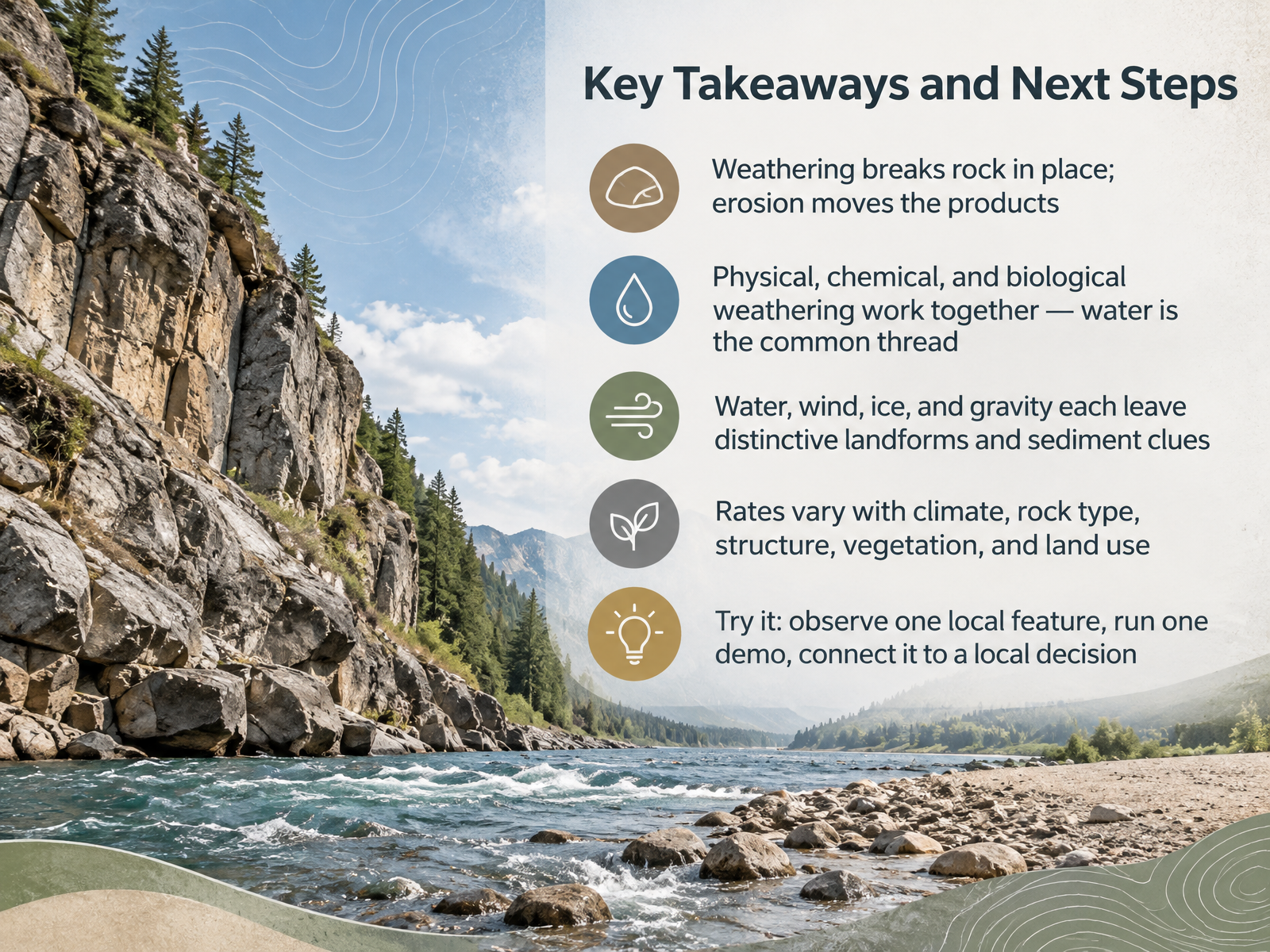 nps.govnps.govnps.gov+22 min
Take the deck with you
Download this course as a file — free, no sign-up needed.
- PDF handoutEvery slide page, ready to print or share.15 pages · 5.8 MBDownload
- Narrated PowerPointThe deck that presents itself — every slide carries the digital human's narration video.15 pages · 16.0 MBDownload
- PowerPoint slidesThe full deck as a .pptx — open it in PowerPoint, Keynote, or Google Slides.15 pages · 5.8 MBDownload
Free to use in your own training — please keep the PersonWise credit page at the end.
Have your own deck? Turn it into a course
Sources consulted
Web sources consulted while building this course.
- Weathering and Erosion (U.S. National Park Service) — nps.gov
- About - Erosion: Water, Wind & Weather (U.S. National Park Service) — nps.gov
- Erosion: Water, Wind & Weather — nps.gov
- Erosion, Weathering, and Change Activity Guide — nps.gov
- Changes in the Landscape: Weathering and Erosion - Teachers (U.S. National Park Service) — nps.gov
- Geological Society - The Rock Cycle (KS3) — geolsoc.org.uk
- The rock cycle - The Earth and atmosphere - KS3 Chemistry - BBC Bitesize — bbc.co.uk
- The Rock Cycle — education.nationalgeographic.org
- 6.2: The Rock Cycle - Geosciences LibreTexts — geo.libretexts.org
- Erosion and Transport — geolsoc.org.uk
- Weathering, Erosion, and Mass-Wasting Processes — dnr.sc.gov
- Erosion and Weathering - College of Mines and Earth Sciences - The University of Utah — cmes.utah.edu
- The STRATegy COLUMN for Precollege Science Teachers Exploring Weathering — doi.org
- 8.1: Physical Weathering - Geosciences LibreTexts — geo.libretexts.org
- Weathering — education.nationalgeographic.org
- 8.2: Chemical Weathering - Geosciences LibreTexts — geo.libretexts.org
- Soil Weathering Processes | Soils 4 Teachers — soils4teachers.org
- 5.2 Chemical Weathering — Physical Geology – 2nd Edition – Physical Geology — pressbooks.ccconline.org
- 2.3 - Types of Weathering - Chemical — passel2.unl.edu
- Chemical Weathering — geolsoc.org.uk