Clarifying Project Roles with RACI
Begin
14 pages · ~28 min
Clarifying Project Roles with RACI
A training for project teams to define roles and responsibilities using the RACI matrix, improving accountability and communication.
What you’ll learn
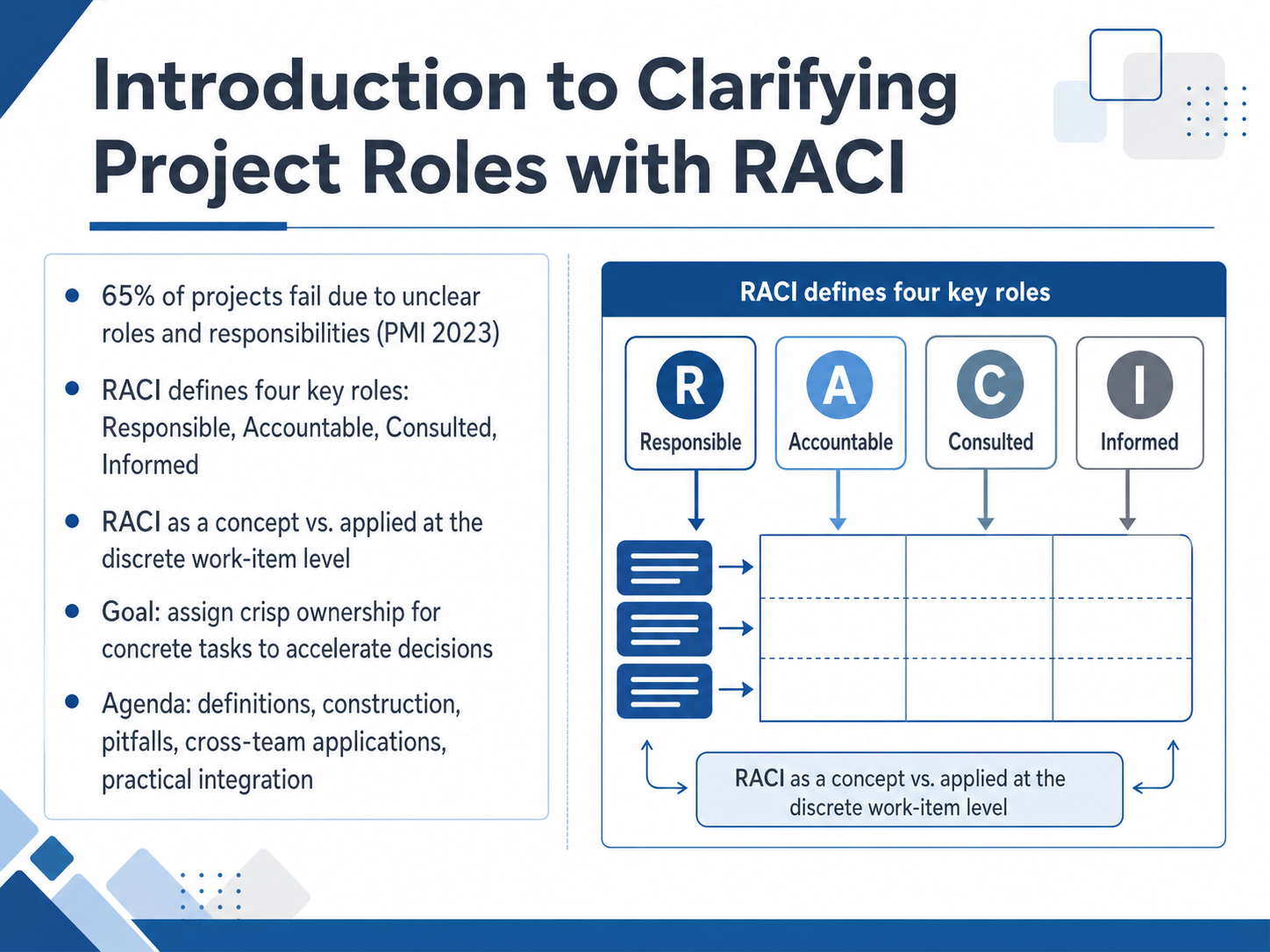
- 01Introduction to Clarifying Project Roles with RACIWelcome. In this course, we're going to tackle a problem that affects most organizations: unclear project roles. Did you know that sixty-five percent of projects fail because people don't know who is doing what? That's from the PMI's Pulse of the Profession report. It's a huge source of rework, delays, and frustration. The solution we'll focus on is RACI. RACI is a simple framework that defines four key roles: Responsible, Accountable, Consulted, and Informed. Today, we won't just talk about RACI as a high-level concept. We'll apply it at the discrete work-item level. Our goal is to help you assign crisp ownership for concrete tasks so your team can make decisions faster. We'll cover the core definitions, how to build the matrix, common pitfalls, and how to integrate it across teams. Let's move to the first step by looking at the specific symptoms of role confusion and how RACI can fix them.hyring.comkaryakeeper.comresources.rework.com+22 min
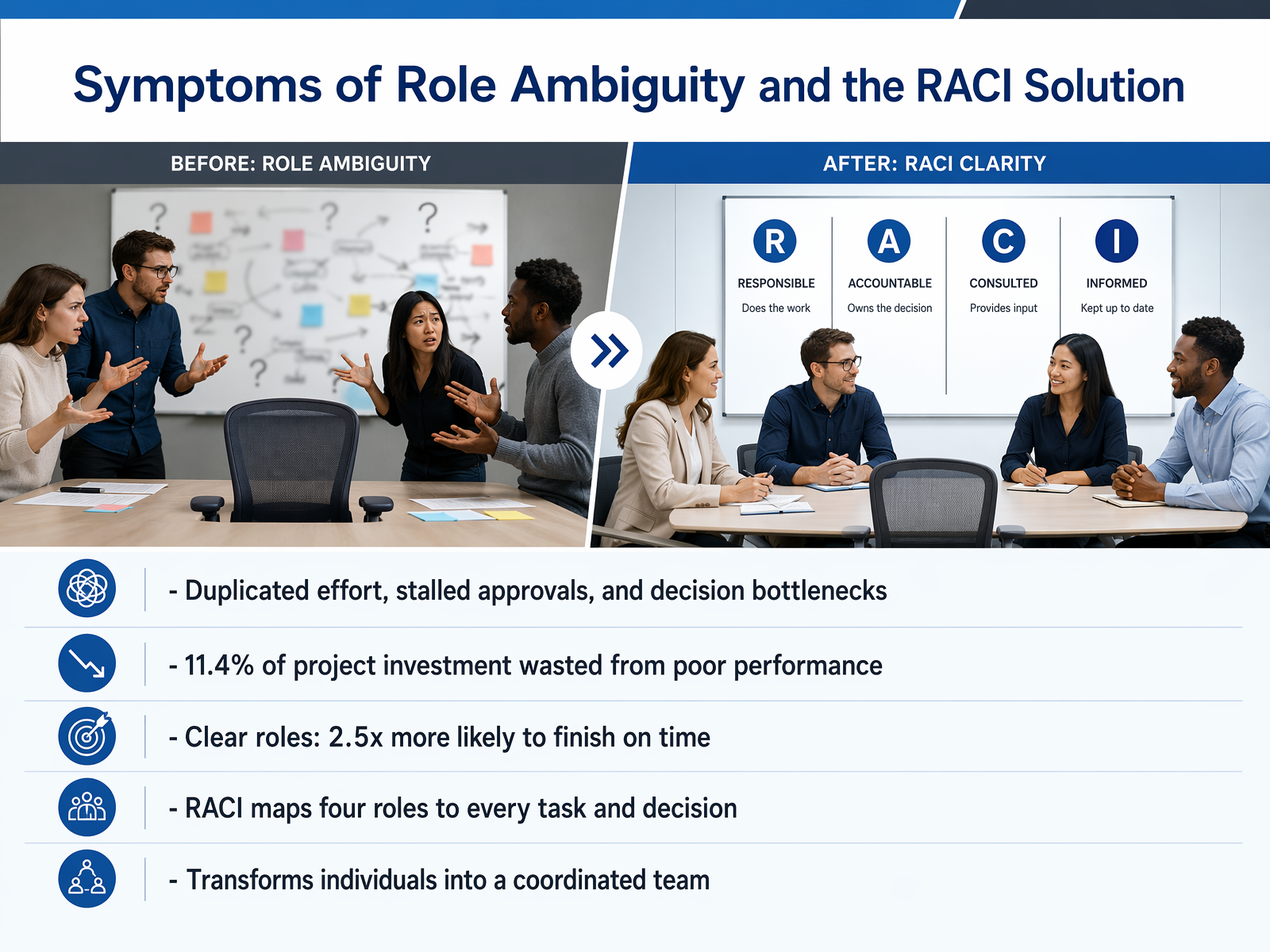
- 02Symptoms of Role Ambiguity and the RACI SolutionLet's look at what happens when roles aren't clear. You've probably seen the symptoms firsthand: duplicated effort where two people do the same work, approvals that stall for days because no one knows who has the final say, and decision bottlenecks that slow everything to a crawl. These aren't just annoyances. Research shows that eleven point four percent of project investment is wasted due to poor performance, and much of that traces back to role confusion. The flip side is equally powerful. When roles are clearly defined, teams are two and a half times more likely to finish on time. That's where RACI comes in. RACI stands for Responsible, Accountable, Consulted, and Informed. It maps these four specific roles to every task and decision in your project. Instead of a group of individuals guessing who does what, RACI transforms them into a coordinated team with shared expectations. Next, we'll break down the core definitions of Responsible and Accountable so you can start assigning them with confidence.
 2 min
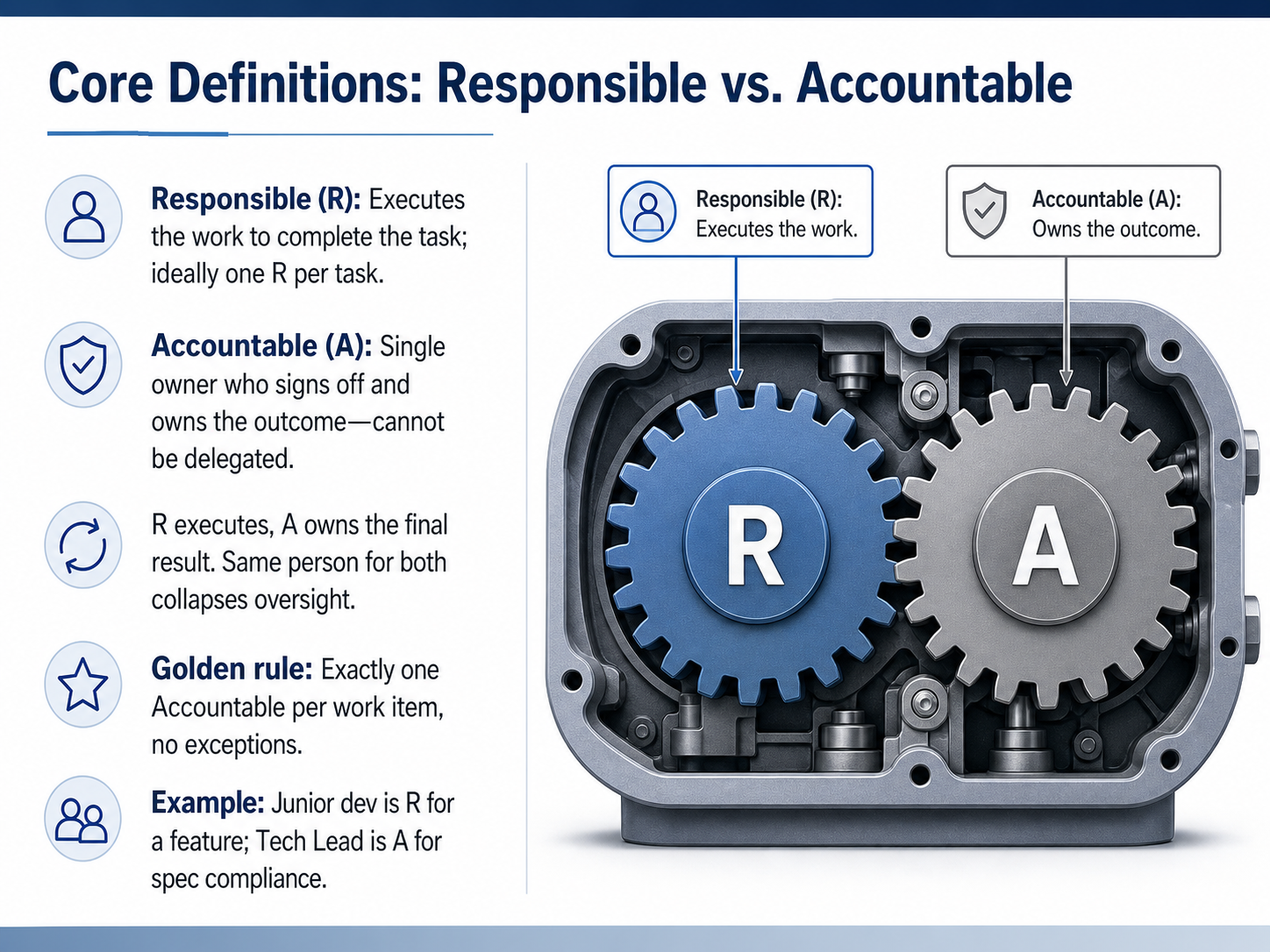
2 min - 03Core Definitions: Responsible vs. AccountableNow let's clarify the two most important roles in RACI: Responsible and Accountable. These terms are often confused, but in a RACI chart they have very distinct meanings. The Responsible person, the R, is the one who actually does the work. They execute the task from start to finish. Ideally, you should have exactly one Responsible per work item to avoid confusion. Next, the Accountable, the A, is the single owner who signs off and approves the final result. This person owns the outcome, and this accountability cannot be delegated. The golden rule is this: there is exactly one Accountable per work item, no exceptions. When the same person is both Responsible and Accountable, you lose that critical second layer of oversight, so having two different people in these roles creates a healthy check and balance. Think of it with a software example. The junior developer is Responsible for writing the code. The tech lead is Accountable for ensuring that feature meets the specification and is ready to ship. Let's continue to the other two roles, Consulted and Informed, which manage the flow of input and updates.
 asana.comatlassian.comcio.com+22 min
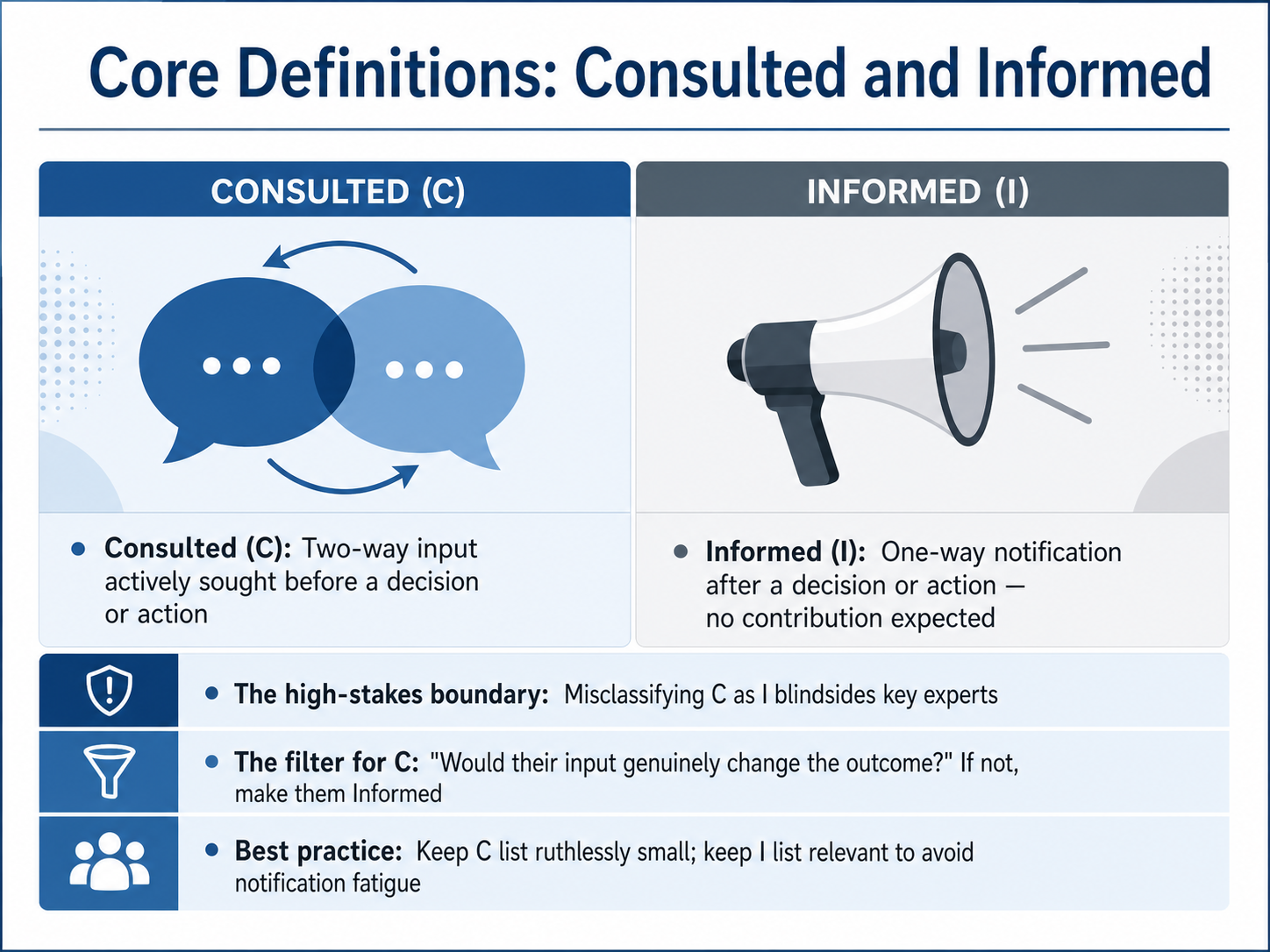
 - 04Core Definitions: Consulted and InformedNow we come to the two roles that are most often confused: Consulted and Informed. The difference between them is a major source of project friction, so let's get very clear on it. Consulted means someone whose input is actively sought before a decision is made or an action is taken. This is a two-way communication loop. You ask for their expertise, they provide it, and their input genuinely shapes the outcome. Informed, on the other hand, is a one-way notification after the fact. You tell them what happened, but you don't expect a contribution. The high-stakes boundary here is misclassifying someone as Informed when they should be Consulted. Doing this blindsides key experts and can lead to costly rework. A practical filter you can use is to ask one simple question: Would their input genuinely change the outcome? If the honest answer is no, they should be Informed. A best practice is to keep your Consulted list ruthlessly small to avoid delays, and keep your Informed list relevant to prevent notification fatigue. Next, let's talk about why applying RACI at the work-item level matters so much.
 asana.comatlassian.comcio.com+22 min
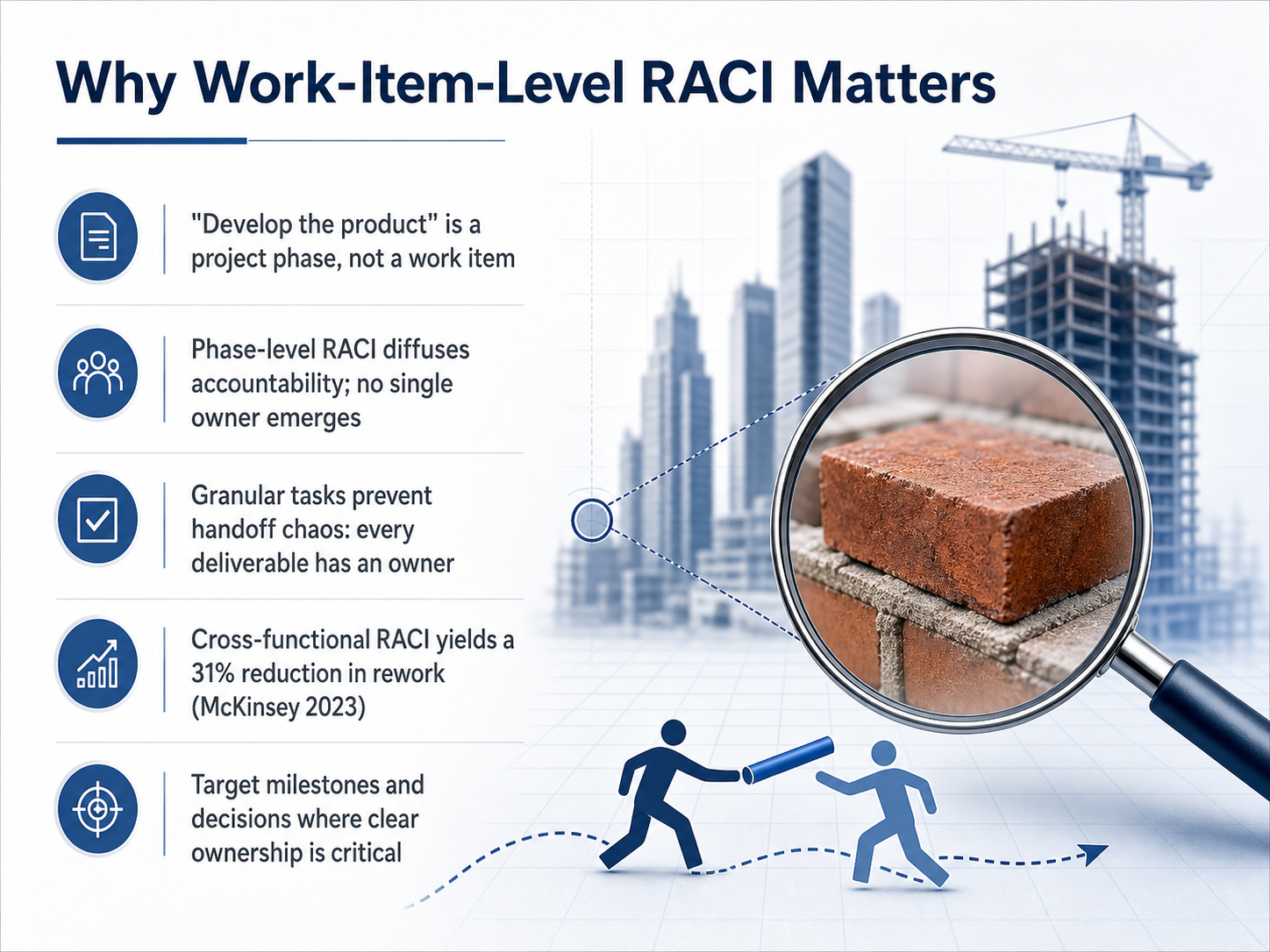
 - 05Why Work-Item-Level RACI MattersNext, let's talk about why applying RACI at the work-item level makes such a difference. Imagine your project plan includes a task called 'Develop the product.' That is a broad project phase, not a specific work item. When you assign RACI roles at the phase level, accountability gets diffused. No single person emerges as the clear owner for key deliverables, and that is when handoff chaos starts to creep in. By breaking work down into granular tasks, every deliverable gets a direct owner. This clarity directly reduces rework. In fact, McKinsey found in 2023 that cross-functional teams using clear task ownership reduce rework by thirty-one percent. So, when you build your chart, zero in on milestones and decisions where clear ownership is critical. That is where work-item-level RACI gives you the biggest payoff. Now, let's move from the 'why' to the 'how' and start constructing a RACI chart step by step.
 slack.comasana.complane.so+22 min
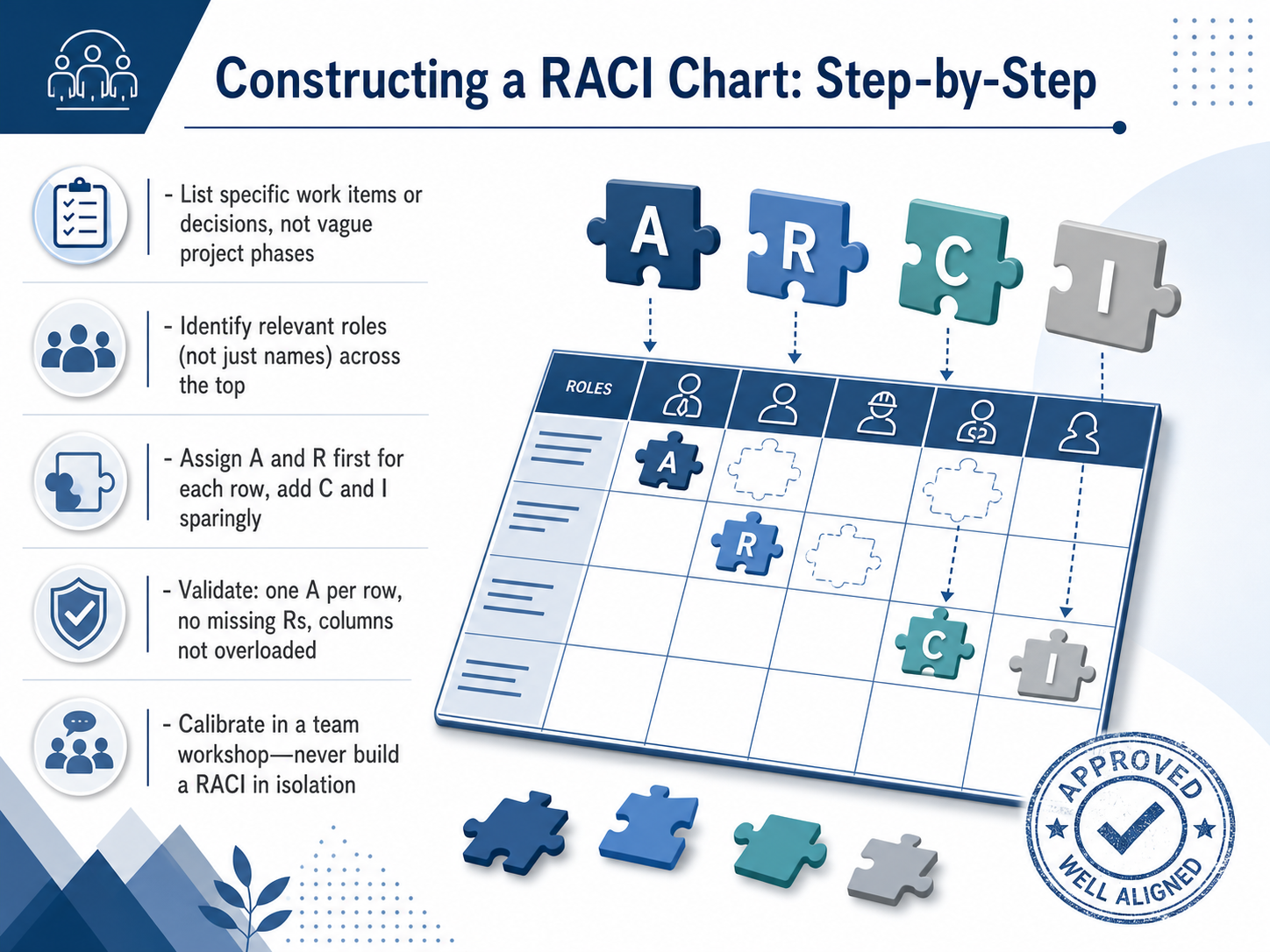
 - 06Constructing a RACI Chart: Step-by-StepNow let’s actually build that chart, step by step. Start with your list of work items. Be specific, like "approve homepage wireframes" or "complete UAT sign-off." Avoid vague phases like "design phase." Specific tasks make real accountability possible. Next, across the top of your chart, list roles, not just names. Roles like Project Manager, UX Designer, or Tech Lead make the matrix more durable than listing individual people. Once your grid is ready, assign the A and R for each row first. Every task needs exactly one accountable person and at least one responsible person. Add C and I roles sparingly. Before marking someone consulted, ask whether they truly need to give input, or if being informed is enough. Excess consultation creates meetings. Now validate your draft. Scan each row for a single A. Ensure no row is missing its R. Check each column so no one person is overloaded with A roles. Then, the most important step: calibrate this in a team workshop. Never finalize a RACI in isolation. The conversations that surface disagreements are often the real value of the exercise. Let’s apply those rules with a practical health check next.
 asana.comatlassian.cominfinkey.com+22 min
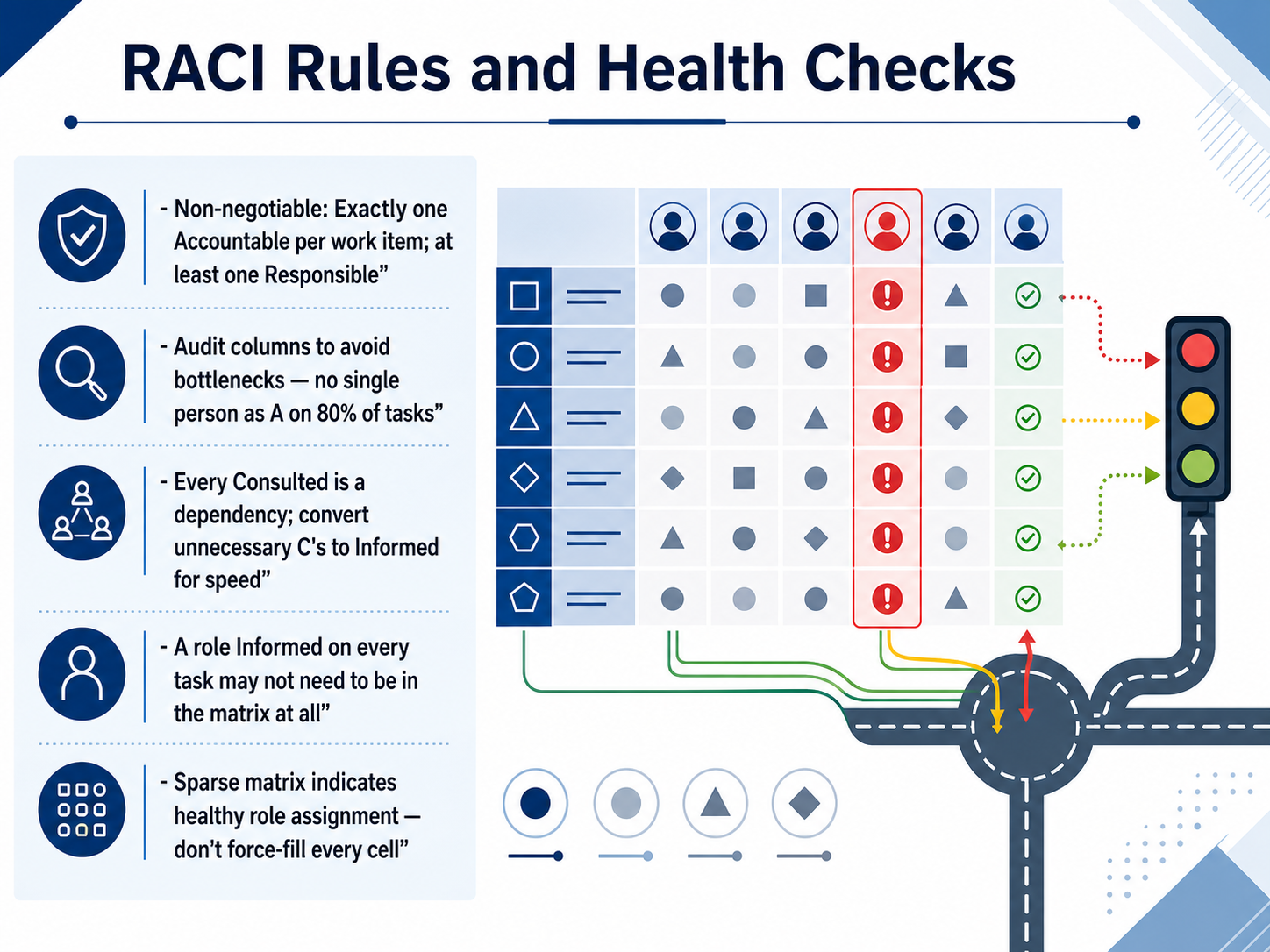
 - 07RACI Rules and Health ChecksNow that you know how to assign each role, let's talk about the rules that keep your RACI matrix healthy. These are non-negotiable checks you should run every time. First, every single work item must have exactly one Accountable. If you put two A's on a task, you've essentially got zero, because decisions will stall. That same task also needs at least one Responsible to do the work; otherwise, it's just an idea floating in space. Next, audit your columns for balance. If one person is the Accountable for eighty percent of your tasks, you've created a massive bottleneck. Nothing moves without them. Also, look hard at your Consulted column. Every C is a dependency, meaning their input is required before you can move forward. If someone's opinion is nice to have but not essential, convert them to Informed to speed up execution. In fact, if a person is Informed on every single task, they might not need to be in the matrix at all. Finally, a healthy matrix is sparse. You don't need to fill every cell. Blank spaces are a sign of clear, focused role assignment. Now, let's see what happens when we ignore these rules as we look at the most common pitfalls and anti-patterns.
 mckinsey.comai.visual-paradigm.comgoalite.com+12 min
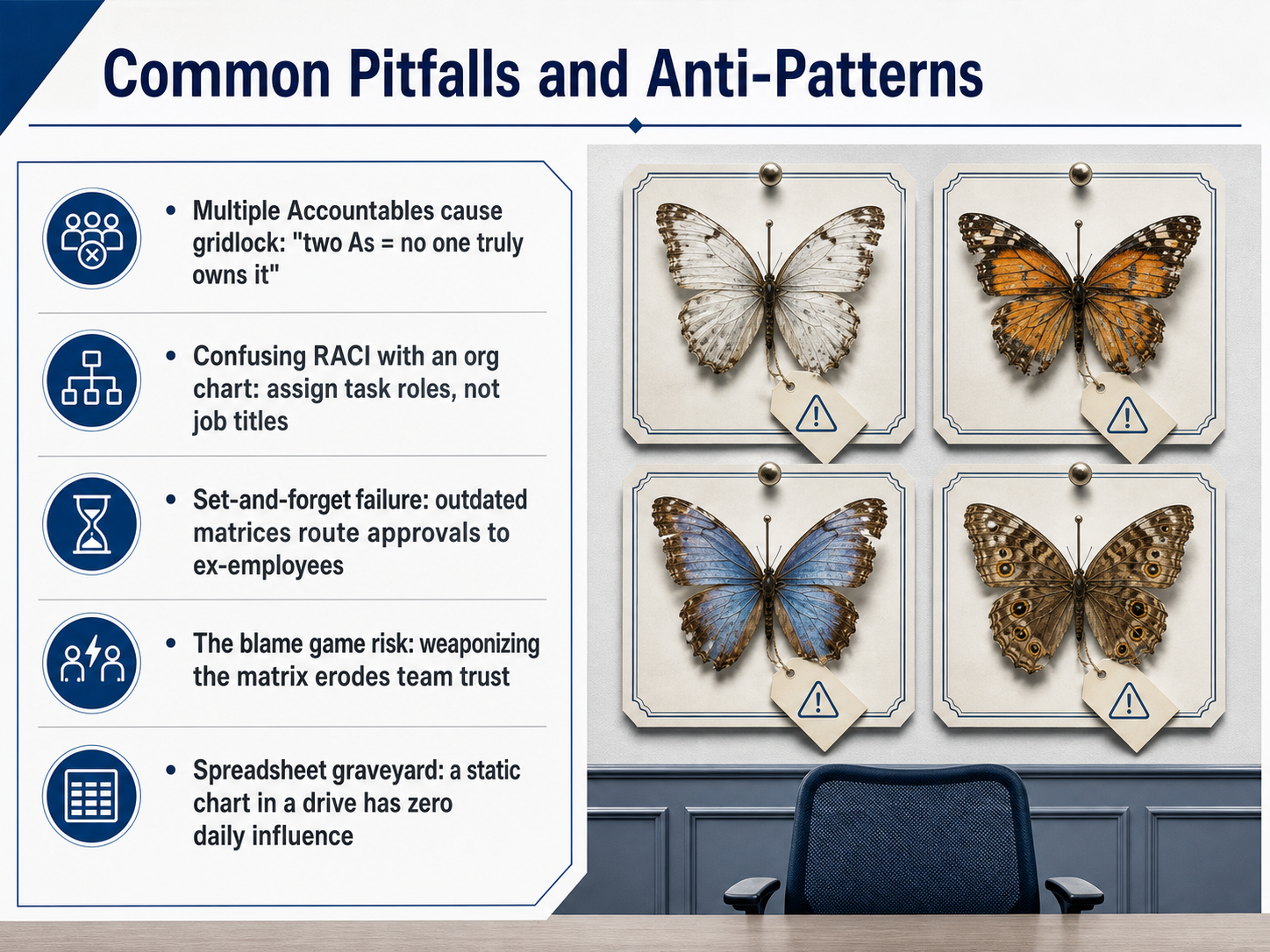
 - 08Common Pitfalls and Anti-PatternsLet's look at what can quietly break a RACI, starting with the biggest rule. If you assign two Accountables to one task, you have no Accountable. The phrase to remember is, two A's means no one truly owns it. Next, confuse RACI with an org chart. Assign task roles, not job titles. A director should not be the Responsible person for every task just because of their rank. Third, the set and forget failure. A RACI built once and never updated will eventually route approvals to ex-employees. Fourth, be careful with intent. Using the matrix to assign blame when something goes wrong will destroy team trust. Finally, the spreadsheet graveyard. A static chart sitting unopened in a shared drive has zero daily influence. The RACI must live where the work happens. Let's move next to handling RACI under pressure, specifically in cross-team and matrix structures.
 mckinsey.comai.visual-paradigm.comgoalite.com+11 min
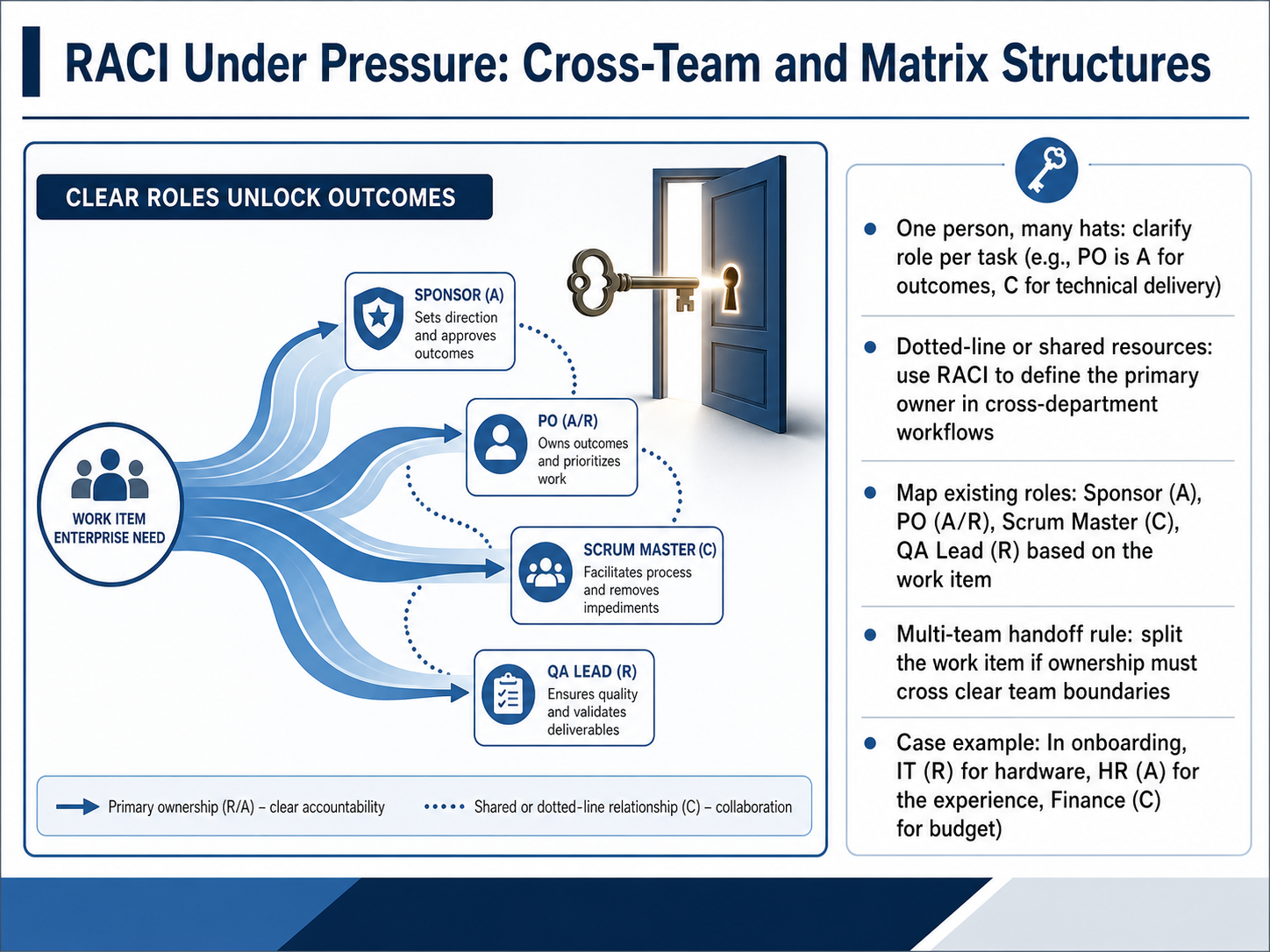
 - 09RACI Under Pressure: Cross-Team and Matrix StructuresNow let's take RACI into environments where clarity often breaks down — cross-team projects and matrix structures. In these settings, one person often wears many hats. A Product Owner, for example, might be Accountable for the business outcome, but only Consulted on the technical delivery. RACI helps you separate those responsibilities per task, not just per role. When you work with dotted-line reports or shared resources, use the matrix to name the primary owner for each cross-department workflow. Look at your existing roles on a specific work item. Your Sponsor is often Accountable, the Product Owner might be Accountable or Responsible, a Scrum Master is usually Consulted, and a QA Lead is Responsible for testing. If a work item creates a handoff between two teams with clear boundaries — like IT and HR — don't blur the ownership. Split the work item. A good case to remember: during employee onboarding, IT is Responsible for hardware provisioning, HR is Accountable for the overall experience, and Finance is Consulted on budget. This rule keeps ownership from falling between teams. Next, we'll integrate RACI into your daily work and tooling.
 asana.comkillonemeeting.com2 min
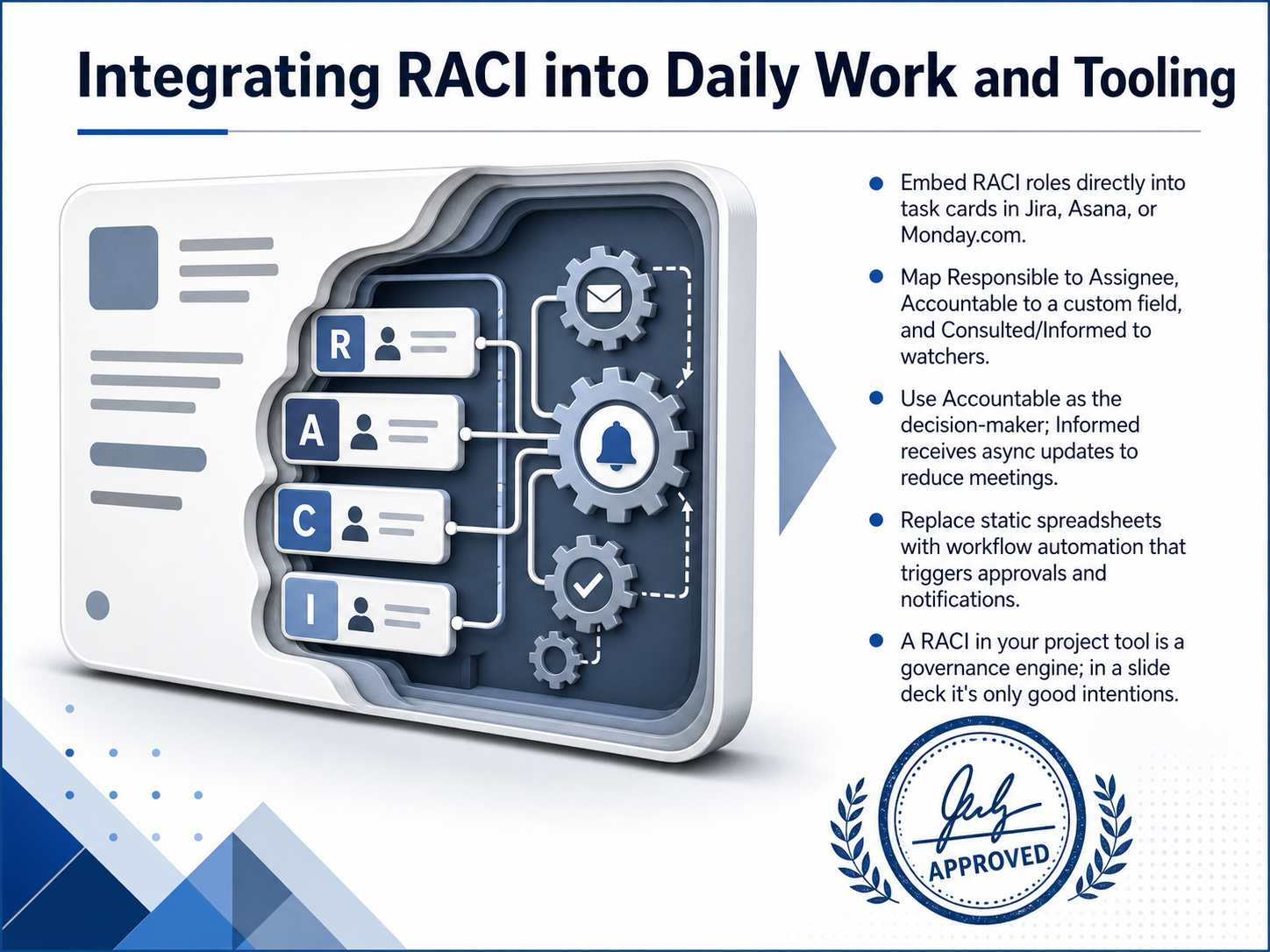
 - 10Integrating RACI into Daily Work and ToolingYou now have a solid understanding of the four RACI roles. But a RACI chart sitting in a static spreadsheet is just good intentions. To make it effective, you must embed it directly into your daily project tools. Start by adding RACI roles directly to task cards in your work management platform, whether that is Jira, Asana, or Monday. Map the Responsible role to the standard assignee field. Create a custom people field for the Accountable decision-maker. Then add your Consulted and Informed team members as task watchers or followers. This setup does more than just document roles. It turns your RACI into a live governance engine. The Accountable person triggers approvals, while the Informed group receives automatic, read-only updates, which can dramatically reduce unnecessary meetings. By replacing spreadsheets with workflow automation, you ensure that every task moves forward with clear ownership. A living RACI inside your project tool drives execution, not just planning. Let’s extend this idea further by looking at some models that go beyond the basic RACI framework.
 asana.com2 min
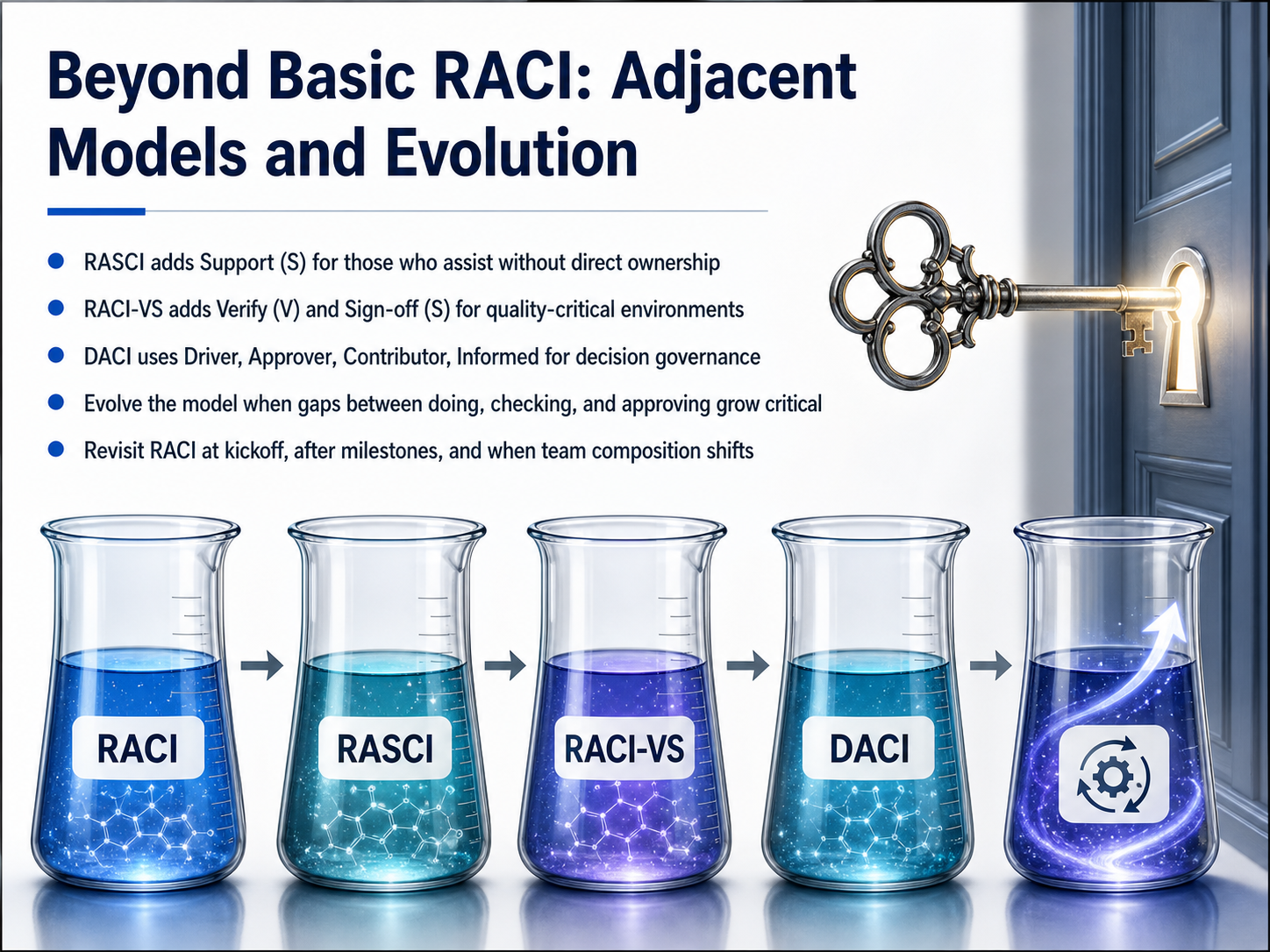
 - 11Beyond Basic RACI: Adjacent Models and EvolutionNow, let's look beyond the basic RACI model. Once you are comfortable with the core four roles, you may find your project needs a little more precision. That is where adjacent models come in. RASCI, for example, adds an S for Support. These are the people who actively assist the Responsible person, but do not own the task themselves. Think of a junior analyst who pulls data for a report you own. In strictly controlled quality environments, consider RACI-VS. It adds V for Verify and a second S for Sign-off. This separates the person who checks the work for accuracy from the person who gives final formal approval. For decision-heavy processes, you might use DACI. Here, Driver replaces Responsible, and you have an explicit Approver, Contributors, and those kept Informed. The key takeaway is to evolve your model when the gaps between doing, checking, and approving become critical and start causing confusion. You should also plan to revisit your RACI assignment at project kickoff, after any major milestone, and any time your team composition shifts. This keeps accountability clear as the work changes. Up next, you will put this into practice with an exercise where you assign RACI to a real-world scenario.
 2 min
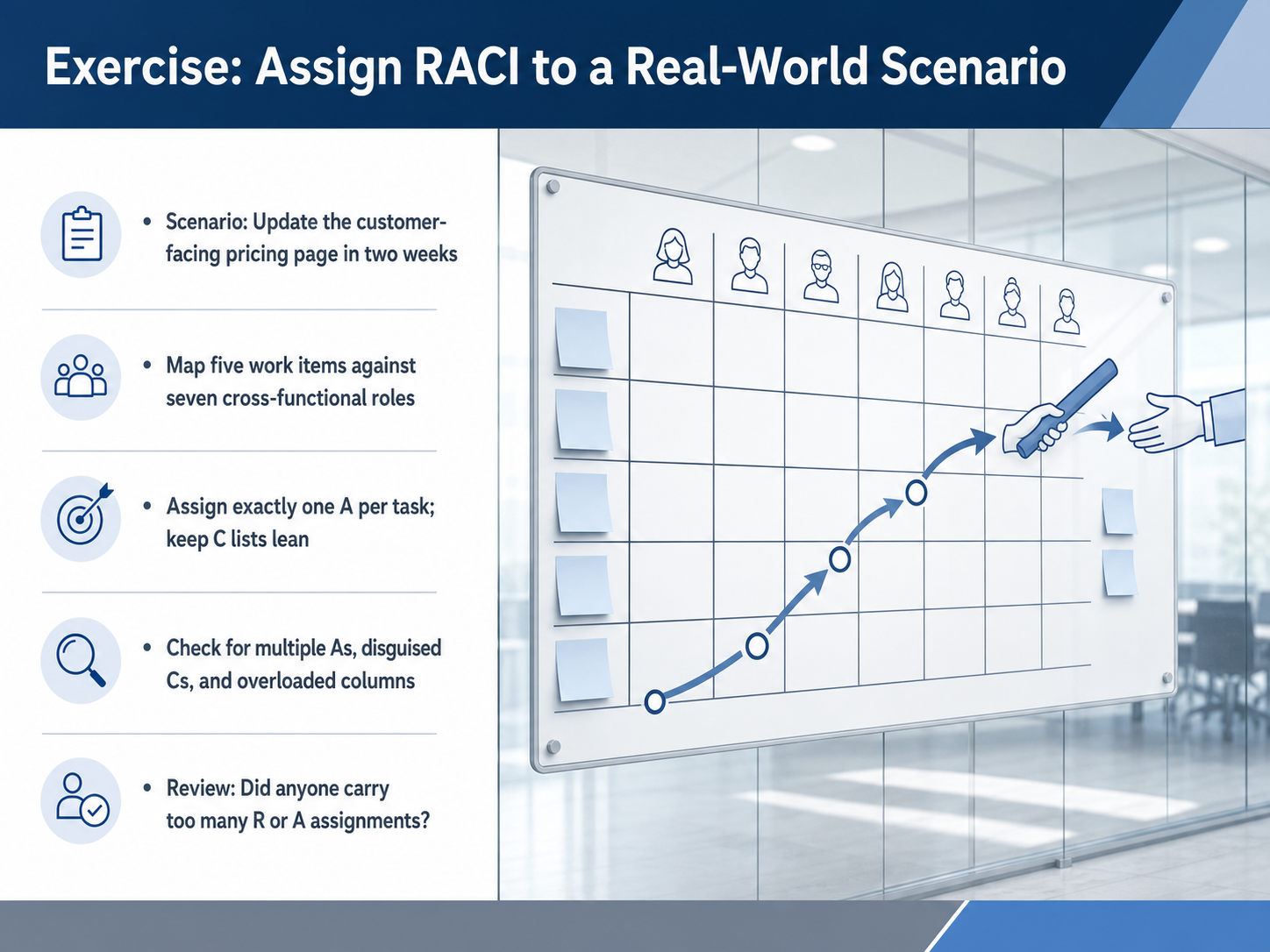
2 min - 12Exercise: Assign RACI to a Real-World ScenarioNow it's time to put the RACI framework into practice with a realistic exercise. Imagine your team needs to update the customer-facing pricing page in just two weeks. You have five specific work items to deliver, and seven cross-functional roles to consider. Your first task is to map each work item to the right roles using the RACI definitions. Remember the core rules: every task must have exactly one Accountable person, and only one. If you find yourself assigning multiple A's, that's a red flag you need to resolve. Keep your Consulted lists lean. If you're consulting too many people on a single task, you're probably creating a meeting you don't need. Once you've filled in your matrix, step back and review your columns. Does anyone carry too many R or A assignments? That often signals a bottleneck. Also check for disguised Cs—people marked as Informed who actually expect to give input. Making these adjustments now will save you from confusion later on. As you wrap up this exercise, we'll move into the next slide where you'll learn a peer review protocol and build a personal action plan to apply these skills on your own projects.
 asana.comatlassian.cominfinkey.com+22 min
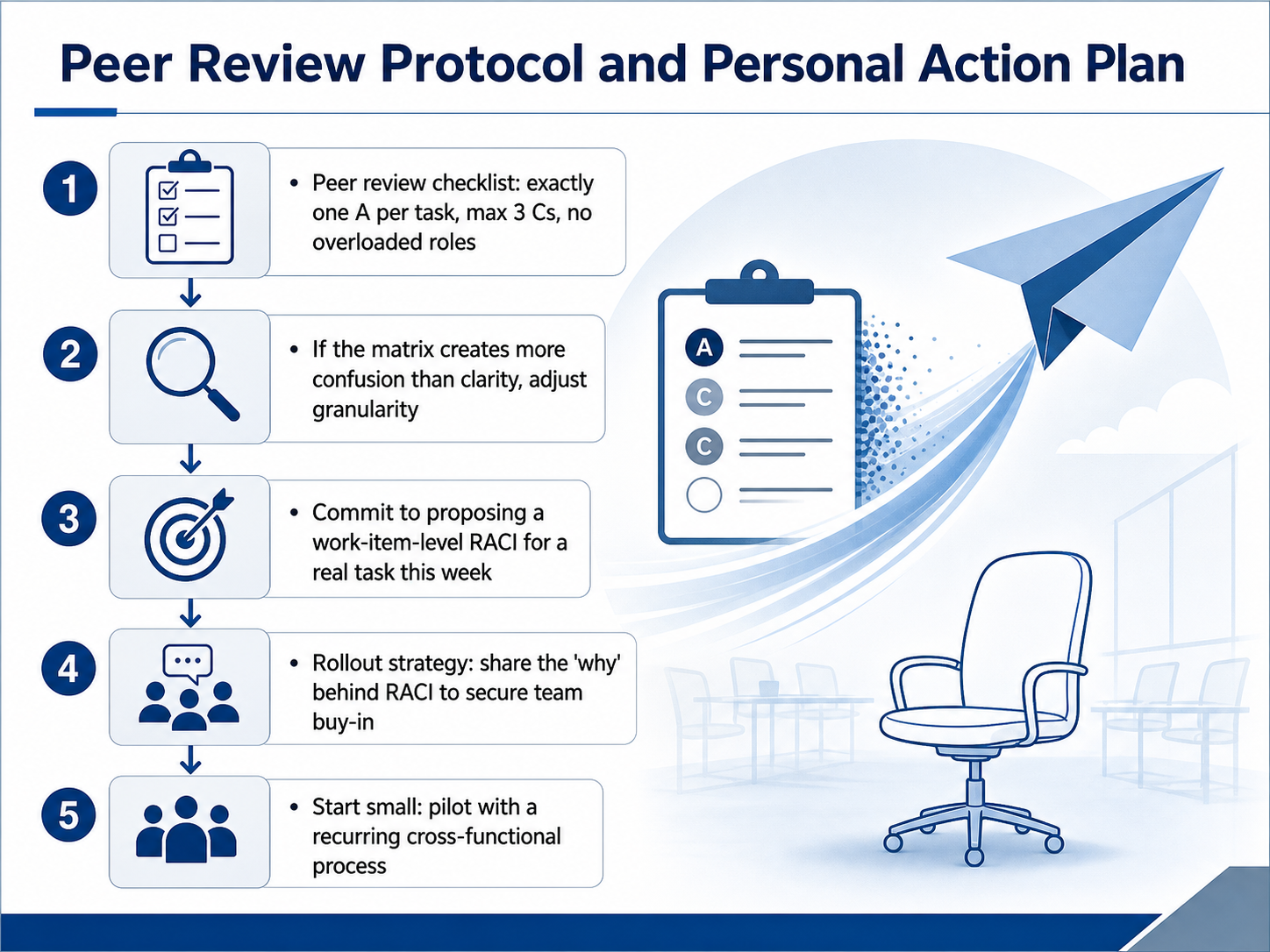
 - 13Peer Review Protocol and Personal Action PlanNow that you know the basics, let's talk about peer review and your own action plan. Before finalizing any RACI, run through a simple checklist. Every task must have exactly one Accountable person, no more, no less. Limit the number of Consulted roles to three per task to avoid decision loops. And watch for overloaded individuals with too many roles across the board. If the matrix creates more confusion than clarity, your tasks might be too granular or too broad. Adjust the task level until the responsibilities make sense. Here is your personal commitment for this week. Propose a work-item-level RACI for one real task you are handling. As you roll this out, share the 'why' behind RACI to secure team buy-in, not just the chart itself. Start small and pilot it with a single recurring cross-functional process. This builds confidence before scaling up. In the next slide, we will wrap up with a summary, maintenance cadence, and the key takeaways.
 asana.comatlassian.cominfinkey.com+22 min
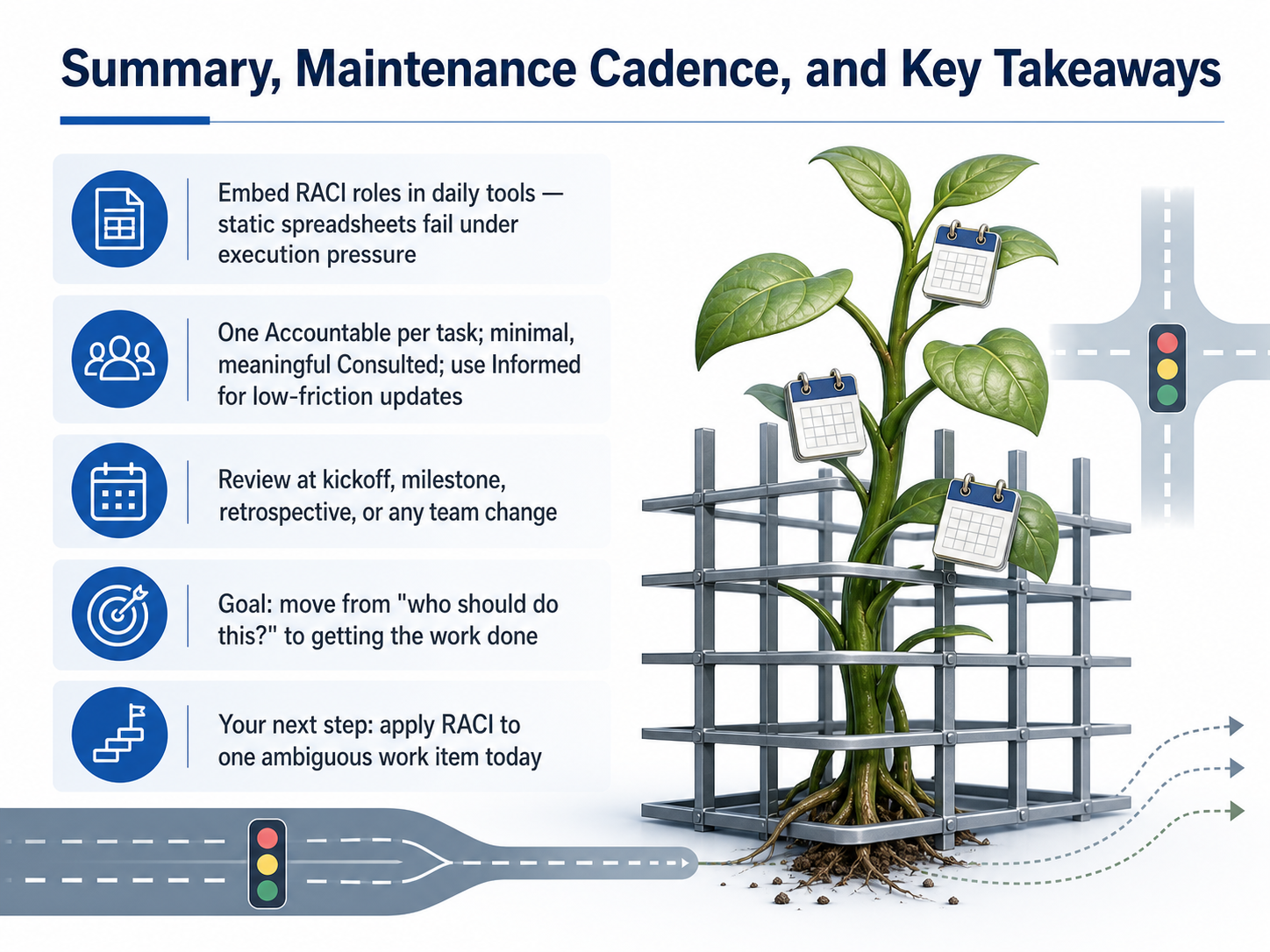
 - 14Summary, Maintenance Cadence, and Key TakeawaysLet's wrap up with how to make RACI stick and what to do today. First, embed RACI roles in your daily tools. A static spreadsheet fails under execution pressure because nobody opens it. Instead, put RACI assignments into the workflow system where approvals and handoffs actually happen. Second, remember the core rules that prevent the most common failures. One Accountable per task, no exceptions. Keep your Consulted list short; every C is a dependency that can slow you down. Use Informed for low-friction updates that don't require input. Third, treat the RACI as a living document. Review it at kickoff, at milestones, in retrospectives, and whenever the team changes. The goal is not to build a perfect chart. The goal is to move from 'who should do this?' to actually getting the work done. Your one next step: pick one ambiguous work item today and apply RACI to it. Define who is Responsible, who is Accountable, who truly must be Consulted, and who just needs to be Informed. That single action starts building the clarity habit. Thank you for going through this course. Clarity in roles is one of the highest-impact things you can bring to your team. Start with that one item today, and you'll already be making a difference.
 mckinsey.comai.visual-paradigm.comgoalite.com+12 min
Take the deck with you
Download this course as a file — free, no sign-up needed.
- PDF handoutEvery slide page, ready to print or share.15 pages · 3.9 MBDownload
- Narrated PowerPointThe deck that presents itself — every slide carries the digital human's narration video.15 pages · 16.0 MBDownload
- PowerPoint slidesThe full deck as a .pptx — open it in PowerPoint, Keynote, or Google Slides.15 pages · 3.8 MBDownload
Free to use in your own training — please keep the PersonWise credit page at the end.
Have your own deck? Turn it into a course
Sources consulted
Web sources consulted while building this course.
- What Is a RACI Matrix? Definition & Guide | Hyring — hyring.com
- RACI Matrix: Definition, Steps & Free Template Guide — karyakeeper.com
- RACI Matrix: What is it and examples in everyday use — resources.rework.com
- What Is a RACI Chart? How to Use RACI to Assign Project Roles — bit.ly
- Why Your RACI Chart Isn't Working, And How to Fix — profit.co
- RACI Charts: The Ultimate Guide, with Examples [2025] — asana.com
- RACI Chart: What is it & How to Use | The Workstream — atlassian.com
- The RACI matrix: Your blueprint for project success - CIO — cio.com
- RACI Matrix: Your Ultimate Guide in 2026 (+Free Templates) — project-management.com
- What is a RACI chart? Definition, examples, and best practices — business.adobe.com
- RACI Model Explained: Definition, Benefits, and How to Use It — slack.com
- RACI charts: Definition, benefits and examples | Plane Blog — plane.so
- What Is the RACI model? — monday.com
- From Chaos to Clarity: Why Your Projects Need RACI - KPI Fire — kpifire.com
- Comprehensive Guide To RACI Charts 2025 | Infinkey Solutions — infinkey.com
- Raci Framework - Project Management FormulaProject Management Formula — projectmanagementformula.com
- RACI Matrix: Complete Guide With Examples & Free Template | Kill One Meeting — killonemeeting.com
- The limits of RACI—and a better way to make decisions — mckinsey.com
- Common Mistakes in RACI Matrices and How to Avoid Them | VP Online — ai.visual-paradigm.com
- The RACI Model: How to Use It, Where It Breaks Down — goalite.com