Acids, Bases, and pH
Begin
13 pages · ~26 min
Acids, Bases, and pH
An introductory course on acids, bases, and pH, designed for beginners to understand fundamental concepts and measurement principles.
What you’ll learn
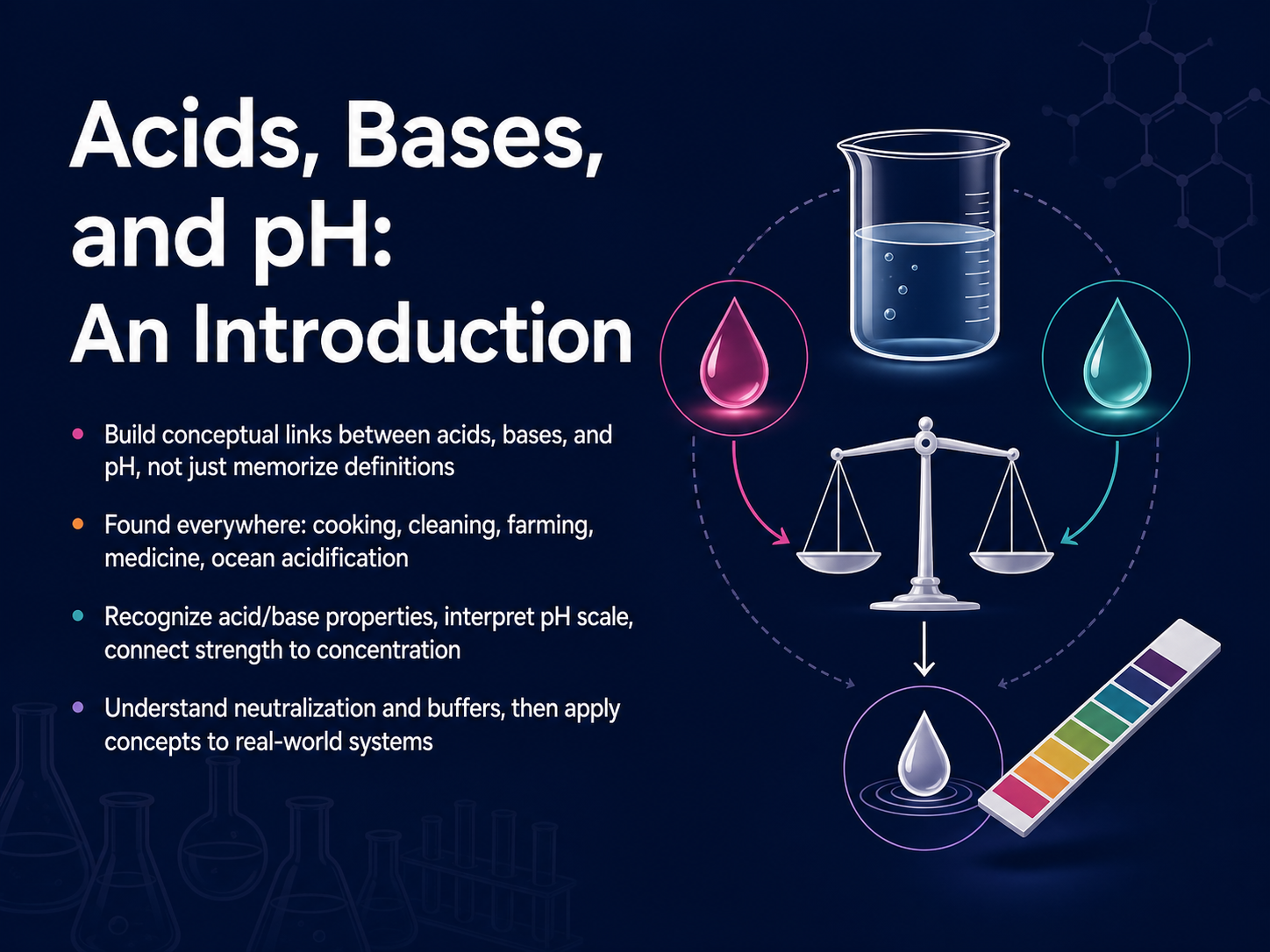
- 01Acids, Bases, and pH: An IntroductionWelcome. In this session, we're going to build a clear picture of acids, bases, and pH—not by memorizing definitions, but by understanding how these ideas connect. These aren't just lab topics. They show up when you cook, when you clean, in farming, in medicine, and even in the health of our oceans. By the end, you'll be able to recognize acid and base properties, confidently read the pH scale, and connect strength to concentration. We'll also explore neutralization and buffers, and then apply these ideas to real-world systems. Up next, we'll look at everyday encounters with acids and bases.1 min
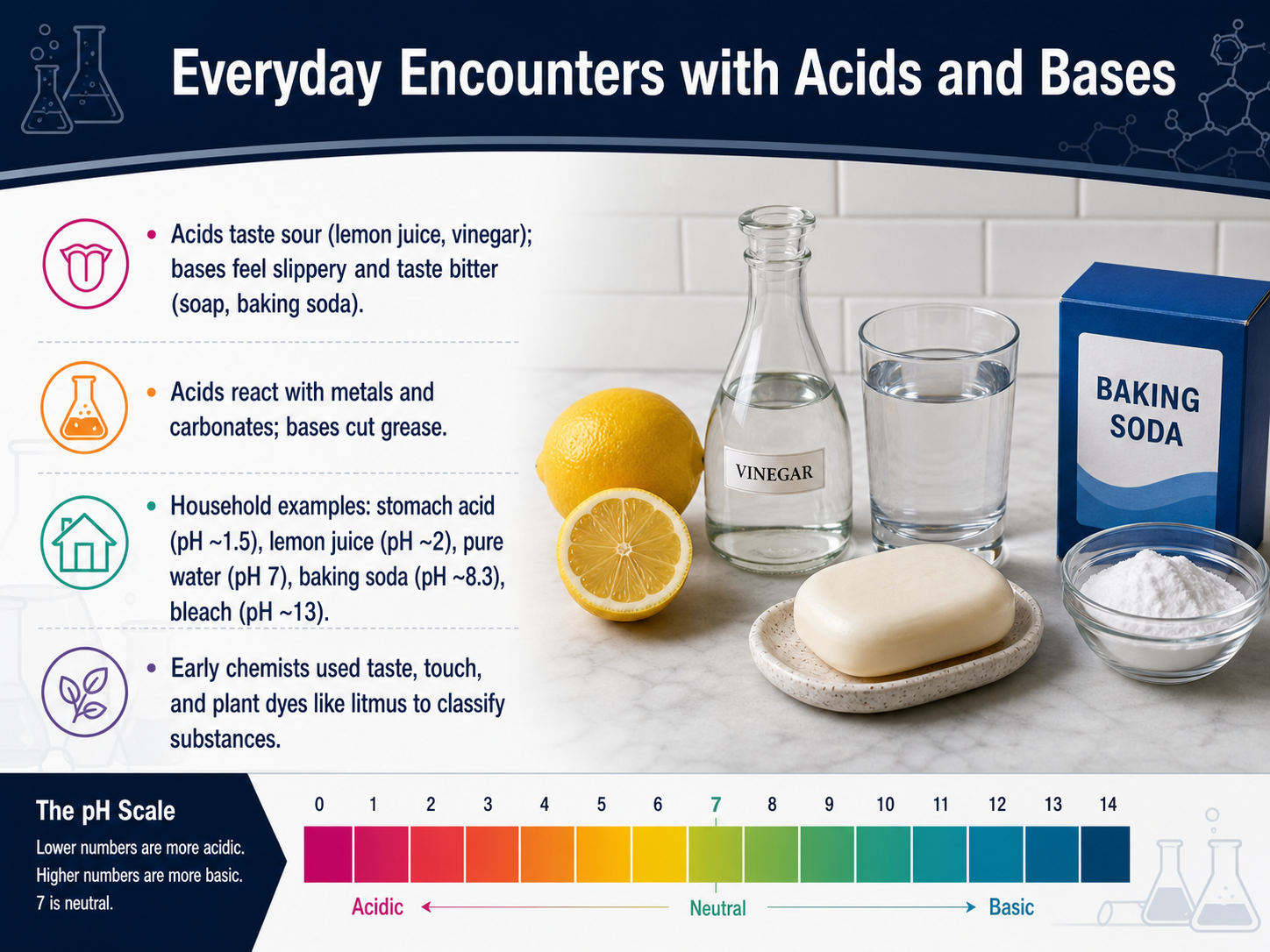
- 02Everyday Encounters with Acids and BasesNow let's connect these ideas about acids and bases to things we encounter every day. Think about the last time you tasted a lemon or a splash of vinegar. That sharp, sour taste is a signature of acids. On the other hand, if you've ever mixed baking soda with water and felt it, you might have noticed a slippery, almost soapy feel and a bitter taste. That's characteristic of a base. Even the way these substances work at home gives us clues. Acids, like vinegar, can react with baking soda, while we rely on bases, like soap, to cut through grease. To bring order to these observations, scientists introduced a tool called the pH scale, a simple number system from zero to fourteen that measures how acidic or basic something is. Right in the middle, at a pH of seven, sits pure water. It's perfectly neutral. As we move down the scale, we find stronger acids. Your stomach acid is very low, around pH one point five, while lemon juice is close to pH two. Moving up from neutral, baking soda has a pH of about eight point three, and strong cleaners like bleach can reach a pH of thirteen. Long before digital meters existed, early chemists used their senses to identify these patterns, relying on taste, touch, and even color-changing plant dyes like litmus to classify substances. Next, we will build on this introduction to explore the three fundamental models that explain acid and base behavior.
 bbc.co.ukeli10.co.uktrustatoms.com+22 min
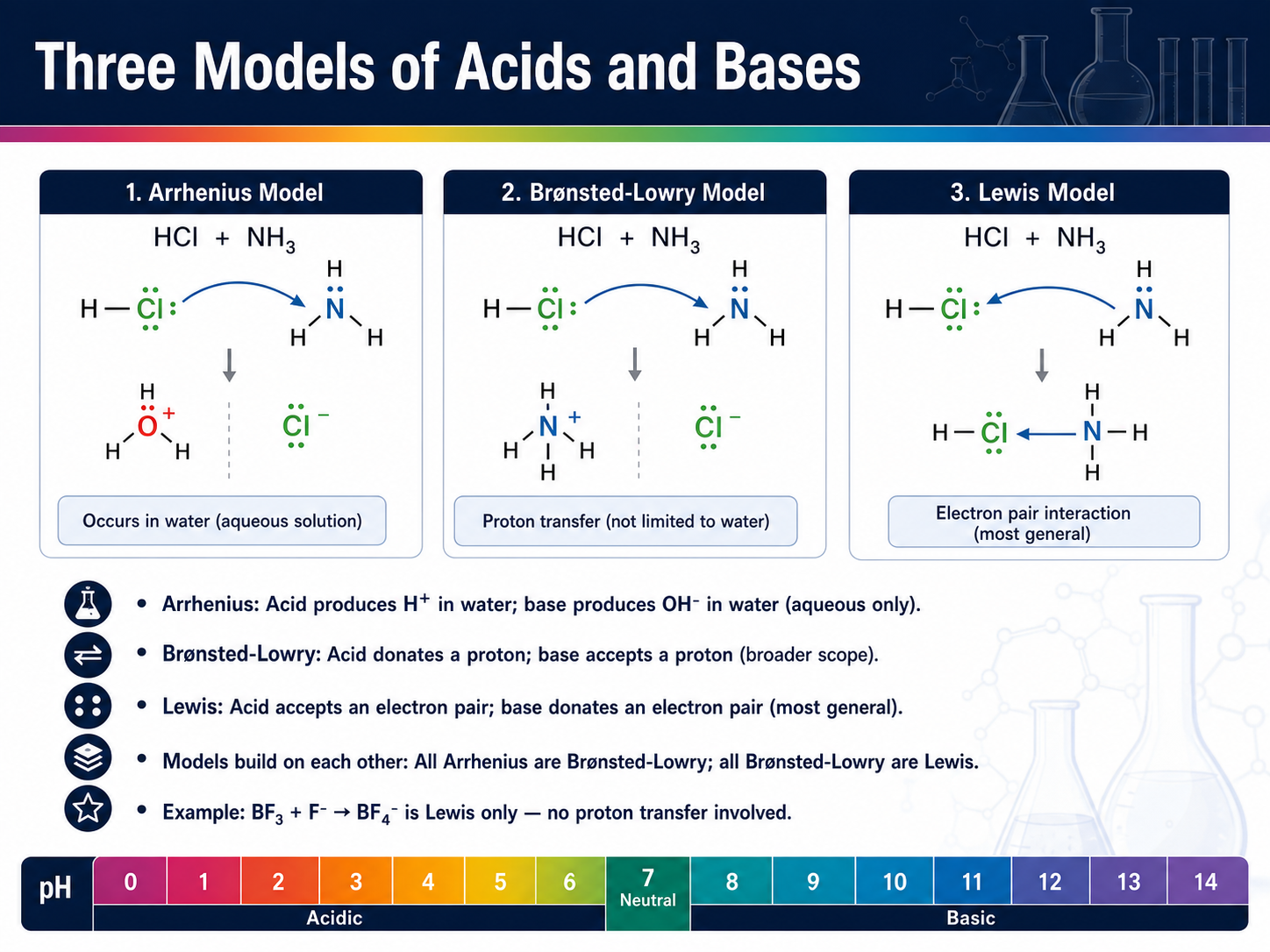
 - 03Three Models of Acids and BasesNow that we have a feel for what makes something acidic or basic, let's look at how scientists have formalized these ideas. Chemists actually use three main models to define acids and bases, and they build on each other like expanding circles. The first and simplest is the Arrhenius model. It says an acid produces hydrogen ions in water, and a base produces hydroxide ions. But this only works in water. The second model, Brønsted-Lowry, broadens the view. Here, an acid is a proton donor, and a base is a proton acceptor. This covers reactions outside of water, too. The third and most general is the Lewis model. A Lewis acid accepts an electron pair, and a Lewis base donates one. This model includes everything the others do, and more. Think of it this way: all Arrhenius acids and bases are also Brønsted-Lowry, and all Brønsted-Lowry are also Lewis. But the reverse isn't always true. A great example is boron trifluoride reacting with a fluoride ion. Boron trifluoride accepts an electron pair from fluoride, so it's a Lewis acid. But no proton is transferred, so it's not a Brønsted-Lowry or Arrhenius acid. This hierarchy gives us a complete toolkit for understanding acid-base behavior. Next, let's connect these models to the familiar pH scale, and see what that number really means.
 chem.libretexts.orgchem.libretexts.orgchem.libretexts.org+22 min
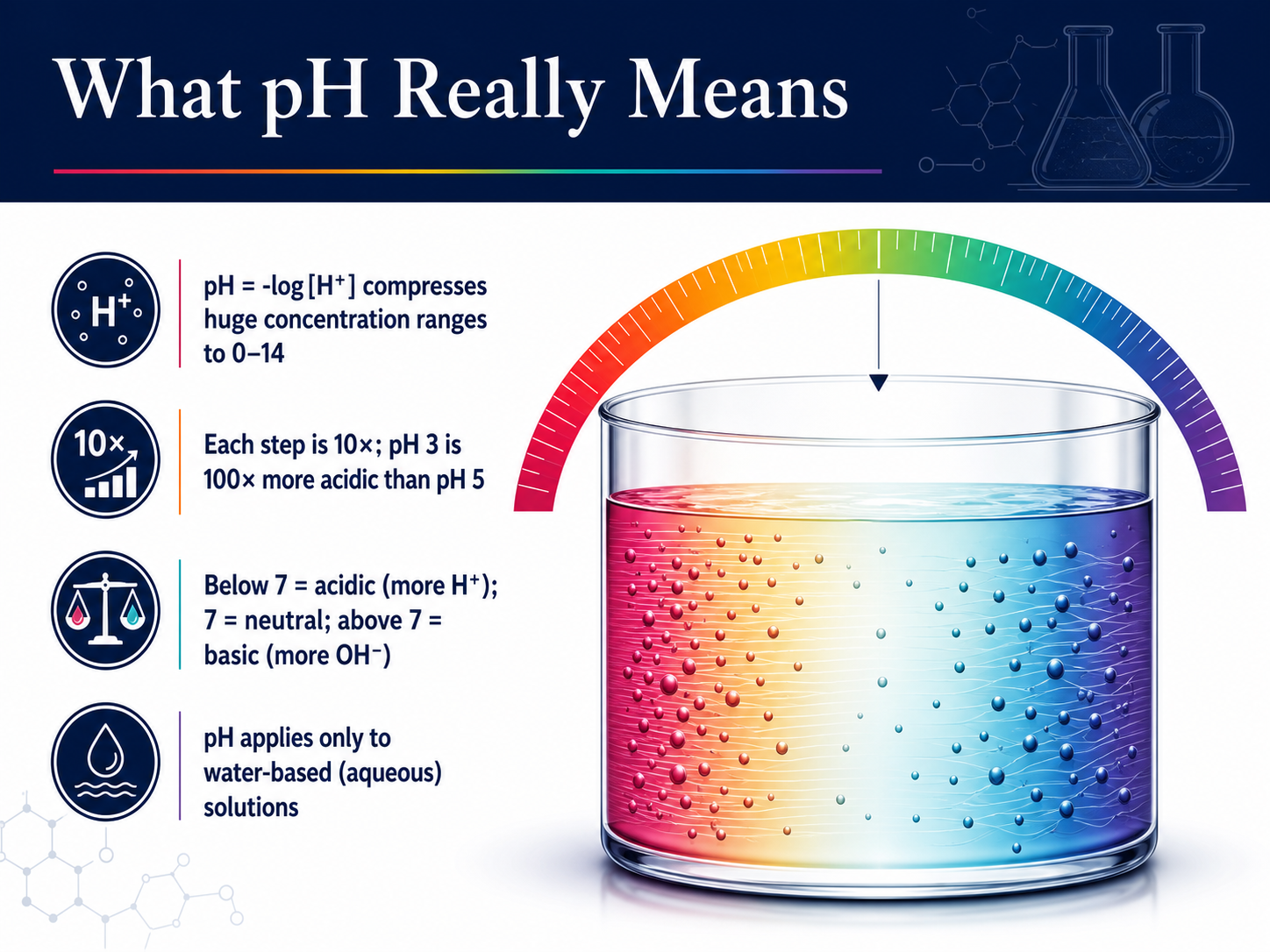
 - 04What pH Really MeansNow let's look at what that pH number actually represents. You might recall that the 'p' and 'H' stand for the 'power of Hydrogen'. The pH scale is a clever shortcut scientists use to express the concentration of hydrogen ions in a solution. Because that concentration can vary wildly—from extremely high to incredibly low—we use a logarithmic scale to compress a huge range into numbers we can easily manage, from zero to fourteen. This means each whole step on the scale represents a tenfold change. For example, a solution with a pH of three is ten times more acidic than one with a pH of four, and importantly, it’s one hundred times more acidic than a pH of five. On this scale, a pH of seven is neutral, meaning the hydrogen and hydroxide ions are perfectly balanced. Pure water is a classic example. When you go below seven, you have more hydrogen ions, so the solution is acidic. Go above seven, and hydroxide ions dominate, making it basic or alkaline. One final, crucial point: this measurement only applies to water-based, or aqueous, solutions. We're now going to see how we can measure pH in practice.
 bbc.co.ukeli10.co.uktrustatoms.com+22 min
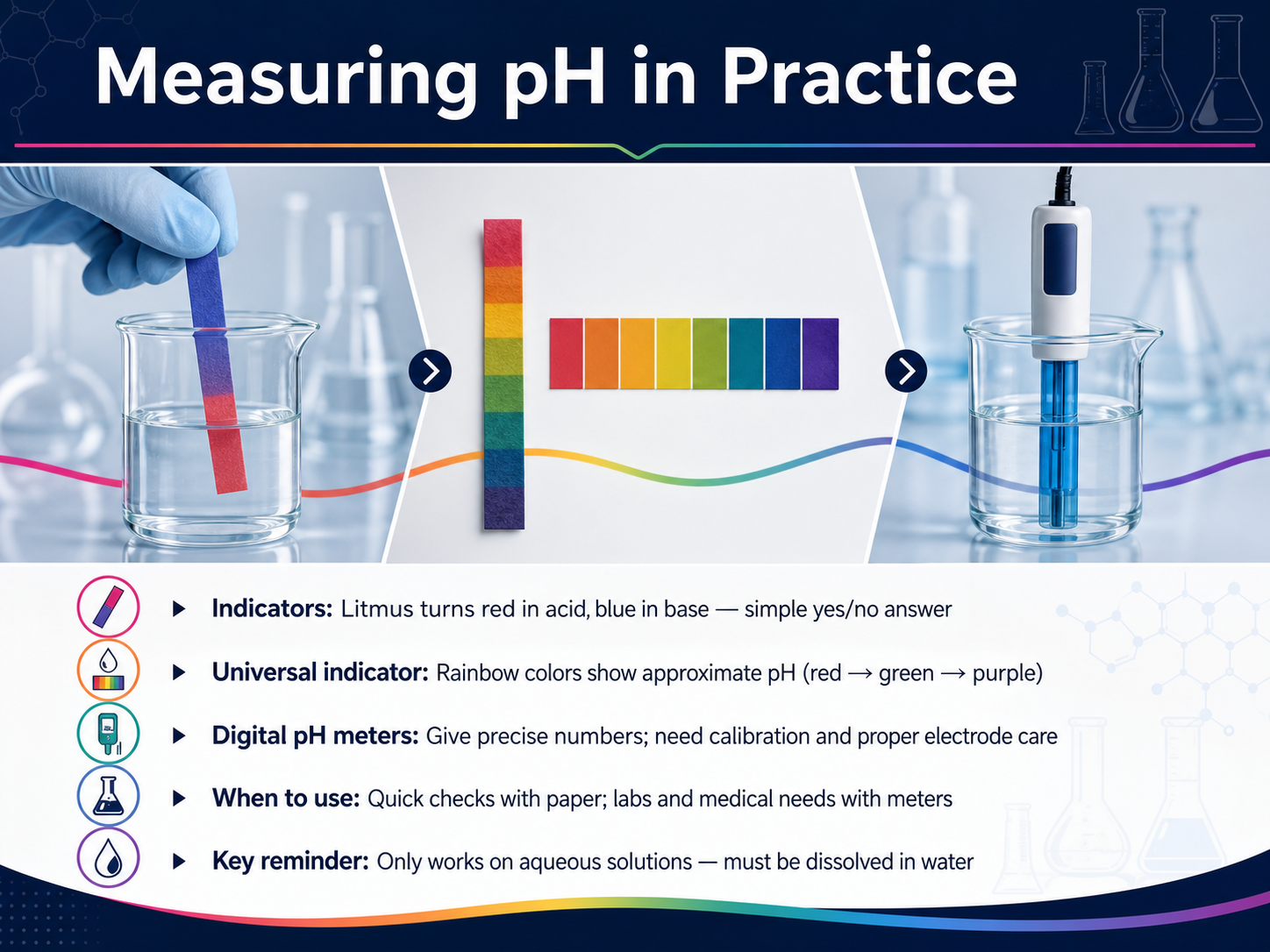
 - 05Measuring pH in PracticeNow that we understand the pH scale, let's look at how we actually measure it in the real world. Think of these tools as different levels of precision, like using your finger to test bathwater versus using a thermometer.
The simplest tool is an indicator. The most classic example is litmus paper. It gives you a simple yes or no answer: it turns red for acid and blue for base. But what if you need a number? That's where universal indicator comes in. It changes through a rainbow of colors—from red for strong acids, through green for neutral, to purple for strong bases. You match the color to a chart to get an approximate pH value.
For a precise number, we use a digital pH meter. It's like a sensitive electronic thermometer for acidity, but it requires careful handling. You must calibrate it often and keep the electrode tip clean and moist. So, when should you use which? Paper strips are perfect for a quick field check, but in a medical lab or a chemistry experiment, you need the accuracy of a digital meter.
But here is the one rule you must never forget: you can only measure pH in aqueous solutions. The substance must be dissolved in water. You cannot just stick a probe into pure oil or alcohol.
Next, let's clear up a common point of confusion: the critical distinction between strength and concentration.
 bbc.co.ukeli10.co.uktrustatoms.com+22 min
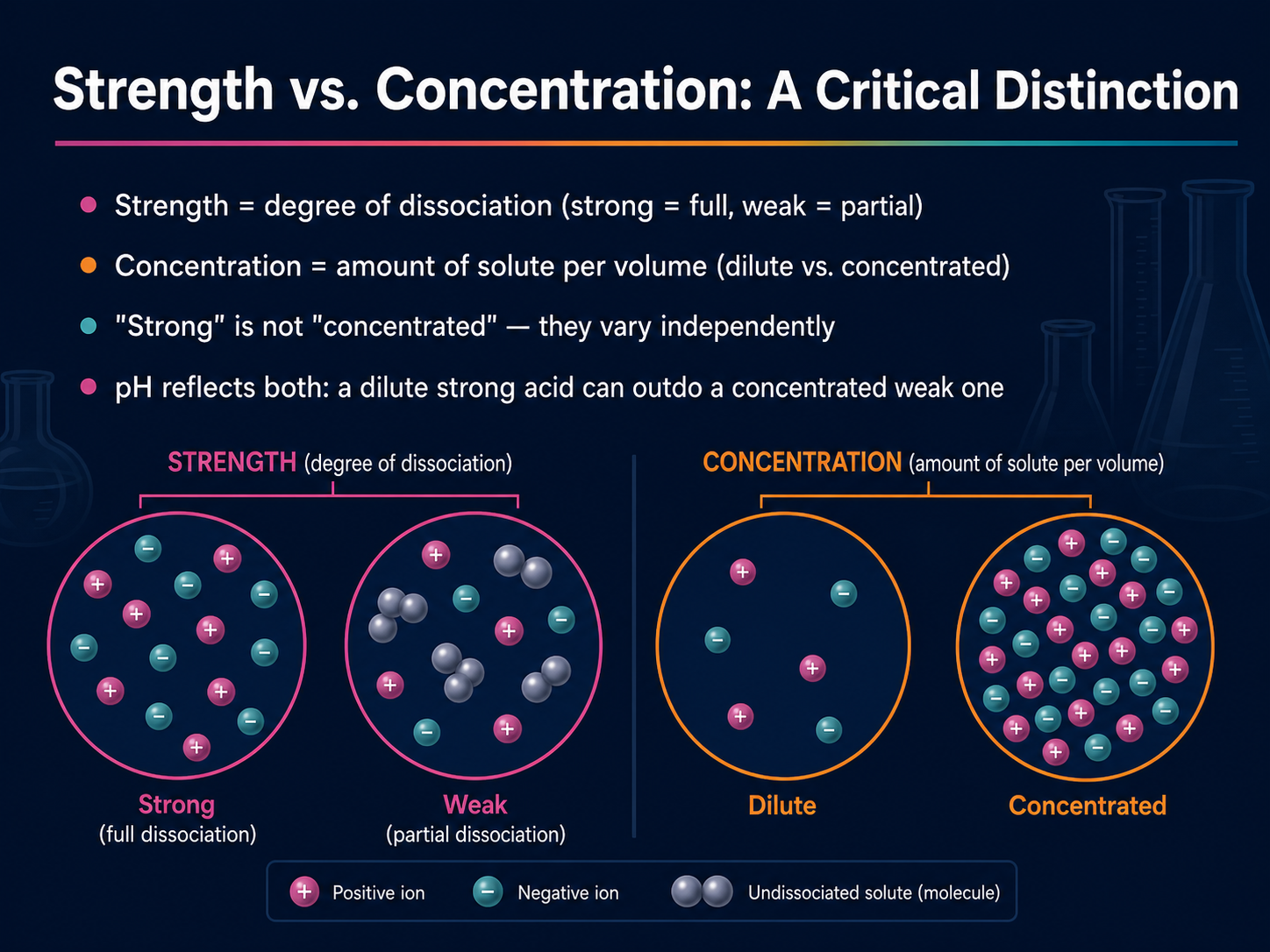
 - 06Strength vs. Concentration: A Critical DistinctionNow that we have a feel for acids and bases, let’s clear up a common point of confusion: the difference between strength and concentration. These two terms sound similar in everyday language, but in chemistry they describe completely different things. Strength refers to how completely a substance dissociates, or breaks apart, in water. A strong acid releases essentially all of its hydrogen ions, while a weak acid only releases a small fraction of them. Concentration, on the other hand, is simply how much of that substance is packed into a given volume of water, regardless of whether it is strong or weak. This means strength and concentration can vary independently. You can have a very concentrated weak acid, or a very dilute strong acid. The pH depends on the actual number of free hydrogen ions floating in the solution, so it reflects both factors. For instance, a dilute strong acid can actually produce more hydrogen ions than a concentrated weak one. Next, we will see what happens when acids and bases come together, in Neutralization: When Acids and Bases Meet.
 chem.libretexts.orgchem.libretexts.orgchem.libretexts.org+22 min
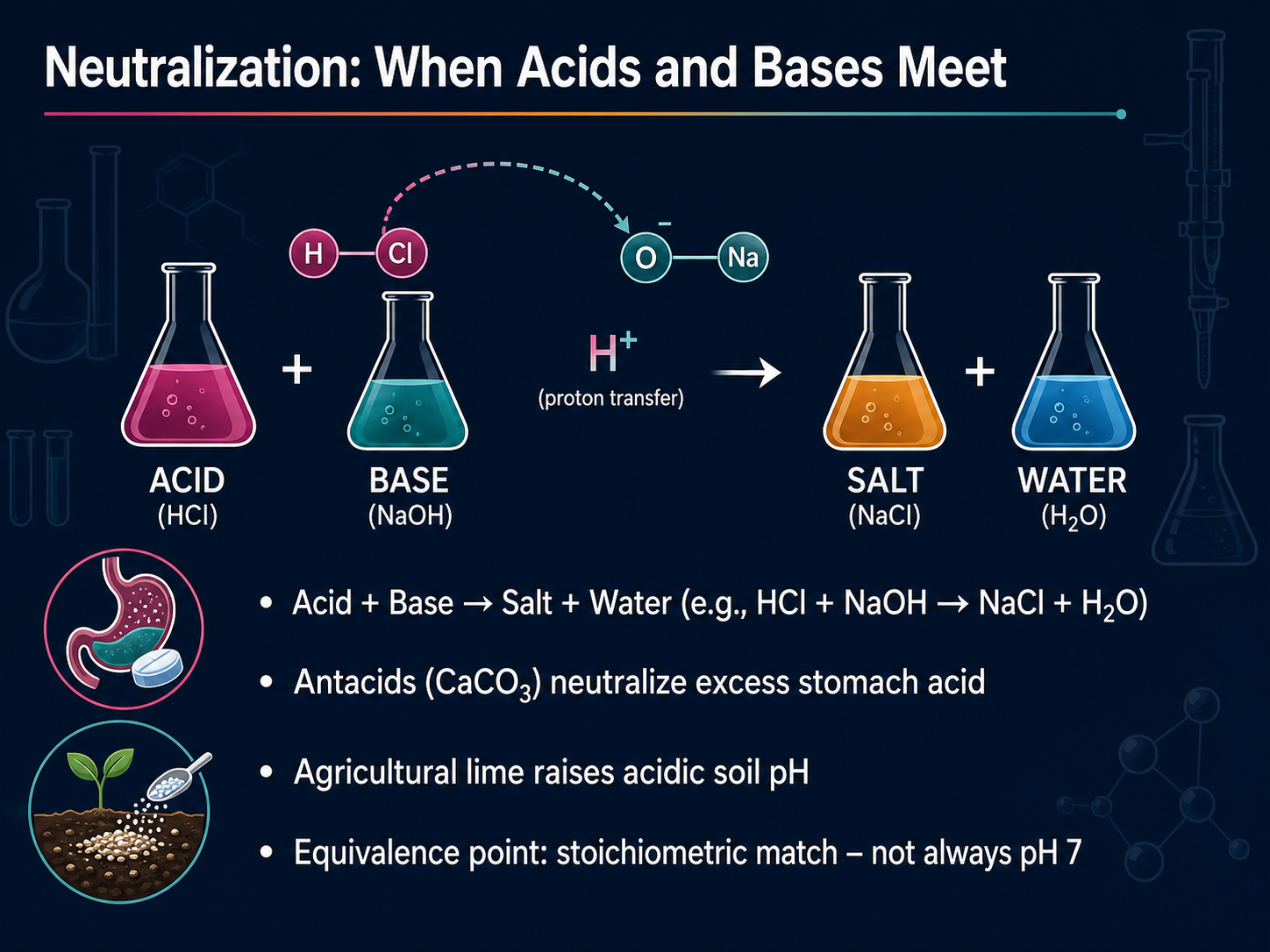
 - 07Neutralization: When Acids and Bases MeetNow let’s look at what happens when acids and bases meet. This process is called neutralization. In a neutralization reaction, an acid and a base react to form two new products: a salt and water. For example, when hydrochloric acid mixes with sodium hydroxide, they produce ordinary table salt, sodium chloride, and water. You can think of it as the acid and base effectively canceling each other out. This idea is used in everyday life. If you have ever taken an antacid tablet for heartburn, you have used neutralization. Antacids contain a base like calcium carbonate that reacts with and calms excess stomach acid. Farmers use the same principle when they spread agricultural lime on fields. The lime gently neutralizes acidic soil, bringing the pH closer to neutral so plants can grow better. In the lab, chemists track neutralization using an equivalence point. This is the exact moment when the amount of base added is chemically equal, or stoichiometrically matched, to the acid present. It is important to note that the equivalence point does not always mean a neutral pH of seven. It simply means the precise balance point of the reaction. Next, we will explore how certain solutions resist pH changes by looking at buffers and how pH stays stable.
 2 min
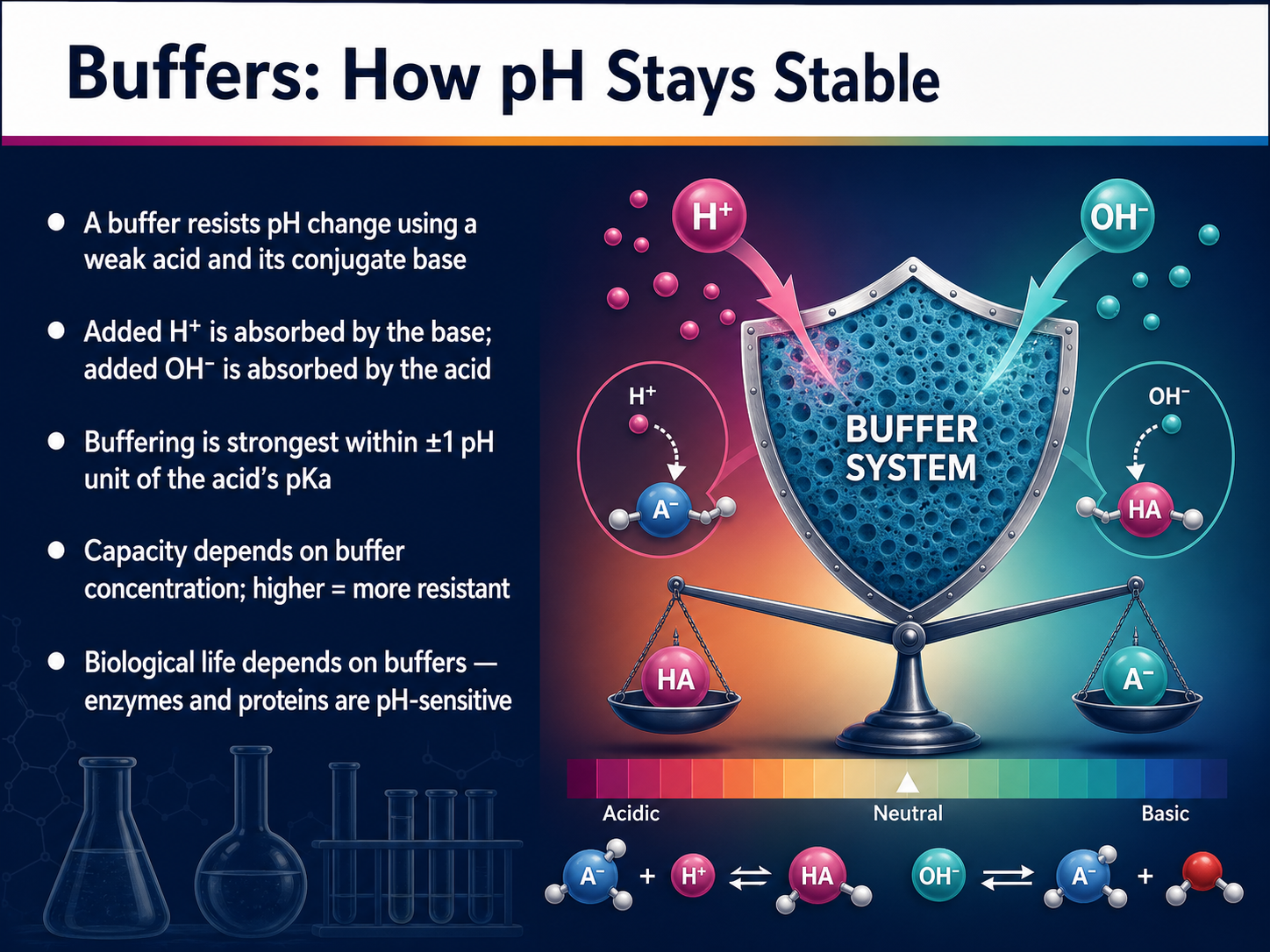
2 min - 08Buffers: How pH Stays StableNow let’s see how the body keeps pH stable even when acids or bases enter the system. The key players are buffers. A buffer is a pairing of a weak acid and its conjugate base that works like a chemical sponge. When extra hydrogen ions appear, the base soaks them up. When hydroxide ions arrive, the acid neutralizes them. This teamwork resists sudden pH shifts. A buffer is strongest within one pH unit of its pKa, the point where the acid and base are balanced like two sides of a seesaw. Strength also depends on concentration. More buffer molecules mean more capacity to handle pH challenges. In the body, this is critical because proteins and enzymes are exquisitely sensitive to pH. Even a slight drift can disrupt their shape and stop reactions. That tight control depends on buffers standing guard, especially the bicarbonate system we will examine next: Biological Buffers in Action.
 pmc.ncbi.nlm.nih.govbio.libretexts.orgbio.libretexts.org+21 min
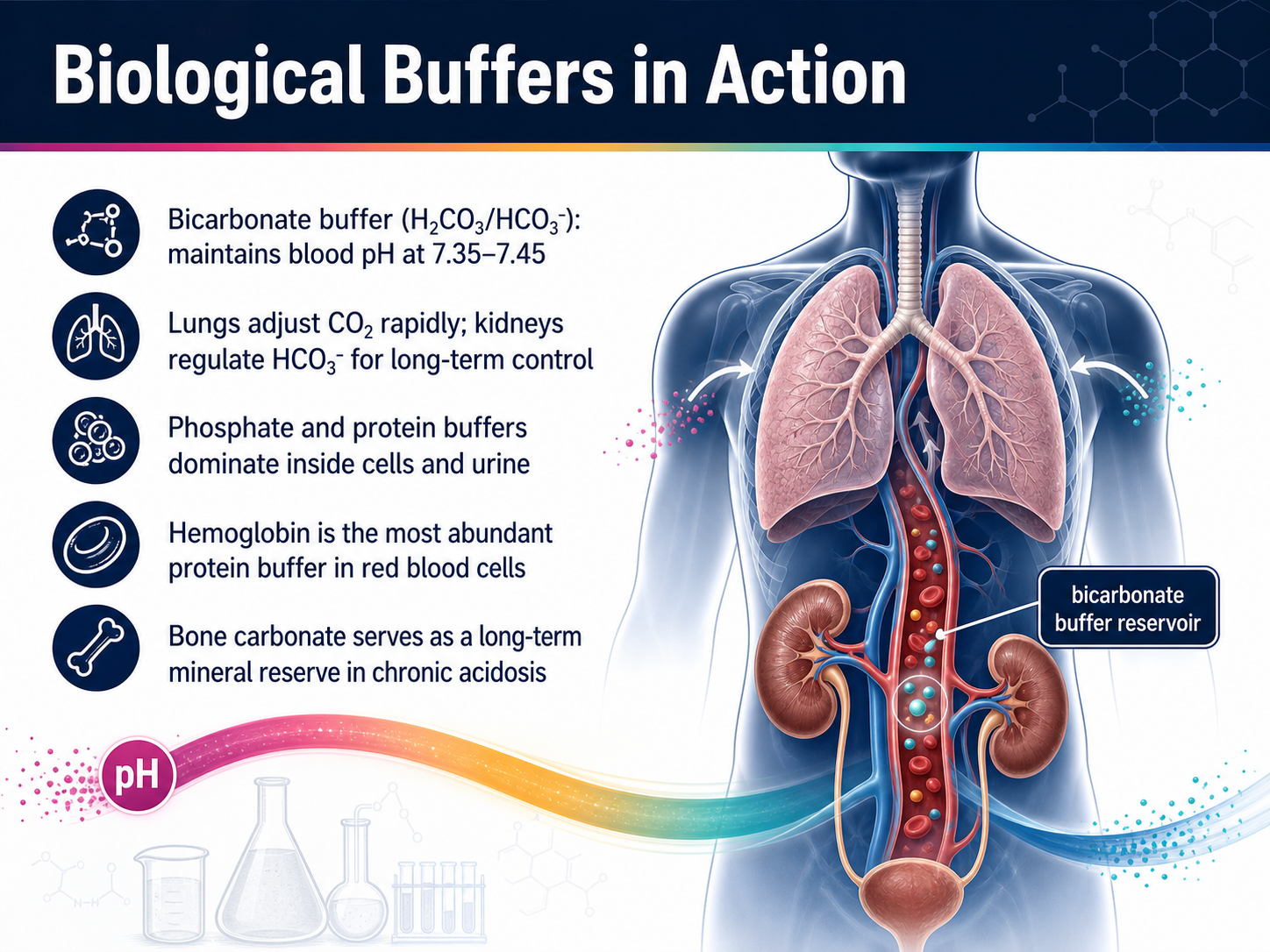
 - 09Biological Buffers in ActionNow let's see how these buffer systems work together inside the body. Think of the bicarbonate buffer in your blood as a chemical seesaw. On one side sits carbonic acid, and on the other sits bicarbonate. When activity in your muscles adds acid to the blood, the seesaw shifts—bicarbonate grabs the extra hydrogen ions, and the lungs breathe out the carbon dioxide that results. This partnership keeps blood pH tightly locked between 7.35 and 7.45. The lungs adjust quickly within minutes, while the kidneys regulate bicarbonate over hours or days for long-term control. Inside your cells, phosphate buffers and protein buffers take center stage. Hemoglobin is the most abundant protein buffer in red blood cells, where it soaks up hydrogen ions during gas exchange. Even bone plays a role—its carbonate mineral reserves act as a long-term buffer during chronic acidosis, slowly releasing carbonate to neutralize acid. Together, these systems form a layered defense, buying time so your body can restore balance. Next, we'll look at how acids, bases, and pH apply in industry and daily life.
 pmc.ncbi.nlm.nih.govbio.libretexts.orgbio.libretexts.org+22 min
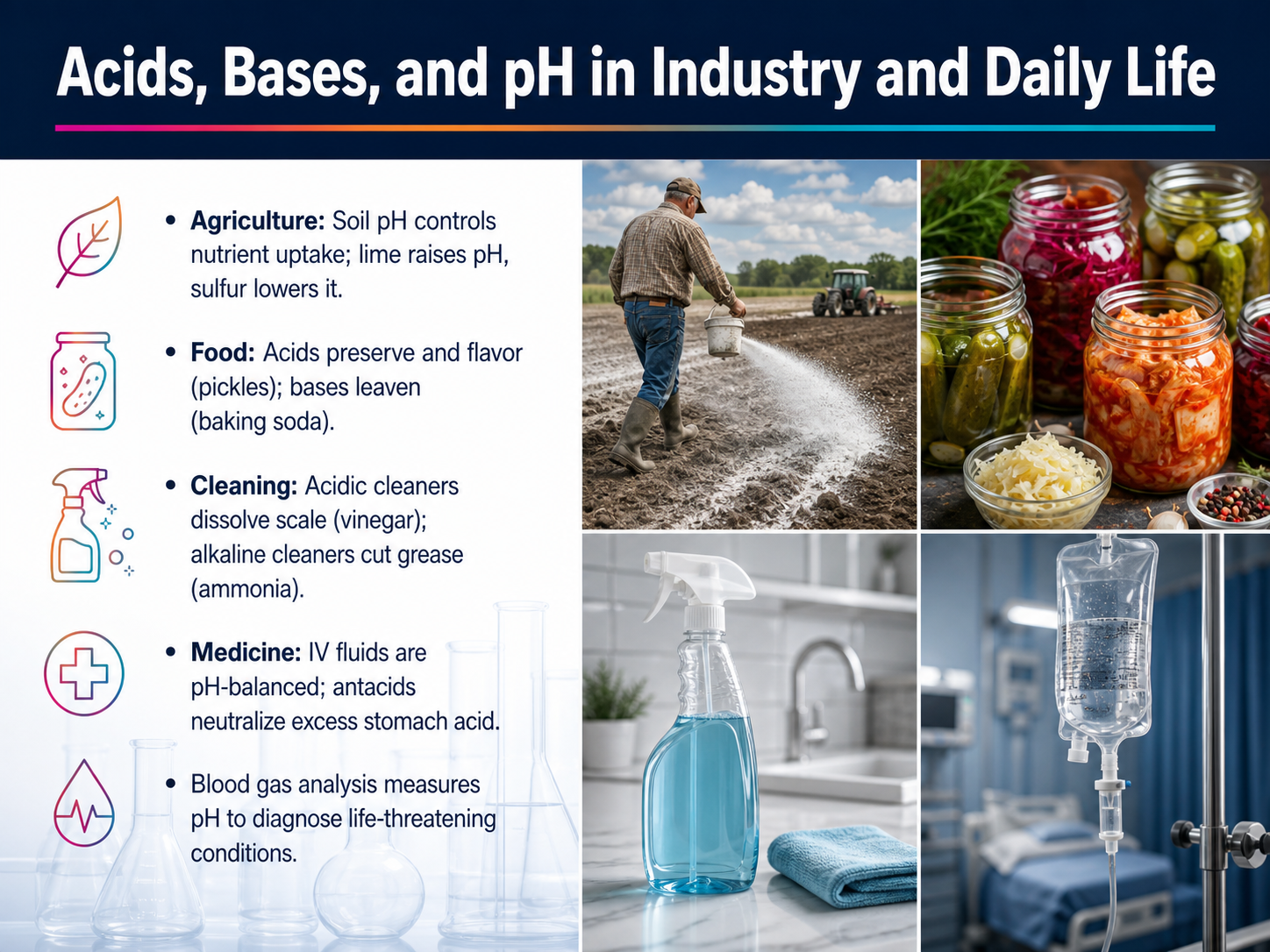
 - 10Acids, Bases, and pH in Industry and Daily LifeNow, let’s connect these ideas to the world around us. We’ve built an understanding of what pH means, so let’s look at how we actively use and manage acids and bases in industry and in our daily routines. In agriculture, soil pH controls whether plants can absorb nutrients. If the soil is too acidic, farmers add lime to raise the pH. If it’s too alkaline, they might add sulfur to lower it. In food, acids preserve and flavor things, giving pickles their tang. And bases leaven baked goods, which is why baking soda makes your cakes rise. For cleaning, we use both sides of the scale. Acidic cleaners, like vinegar, dissolve hard water scale, while alkaline cleaners, like ammonia, cut through grease. In medicine, IV fluids are carefully pH‑balanced. We also use simple bases, like antacids, to neutralize excess stomach acid. Even in a hospital, a blood gas analysis measures pH to diagnose serious, life‑threatening conditions. Next, we’ll explore the far‑reaching consequences of shifting pH on a global scale, as we dive into ocean acidification: a planetary case study.
 bbc.co.ukeli10.co.uktrustatoms.com+22 min
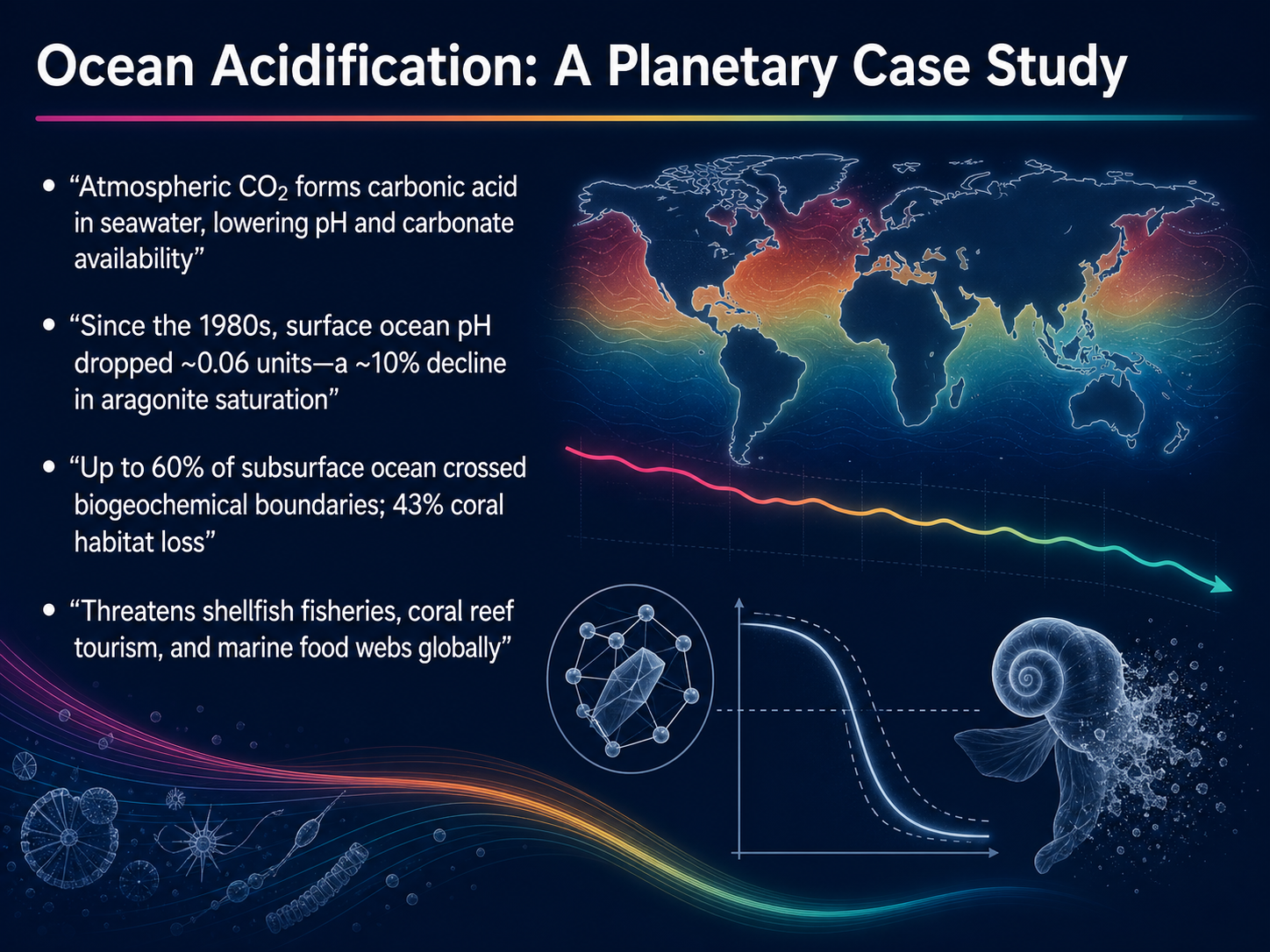
 - 11Ocean Acidification: A Planetary Case StudyNow let's bring these concepts together with a real-world example: ocean acidification. When carbon dioxide from the atmosphere dissolves into seawater, it forms carbonic acid. This process increases the concentration of hydrogen ions, which lowers the pH of the ocean. At the same time, it reduces the availability of carbonate ions, which are critical building blocks for many marine organisms. Since the nineteen eighties, the surface pH of the ocean has dropped by about zero point zero six units. That may sound small, but it represents roughly a thirty percent increase in acidity. It also means a ten percent decline in aragonite saturation, making it harder for creatures like corals and shellfish to build their shells. The impact is already visible. Up to sixty percent of the subsurface ocean has crossed key biogeochemical thresholds, and we have lost about forty-three percent of coral habitats globally. These changes threaten more than just marine life; they jeopardize shellfish fisheries, coral reef tourism, and the entire marine food web. Up next, we’ll examine a related atmospheric issue, acid rain and its environmental consequences.
 2 min
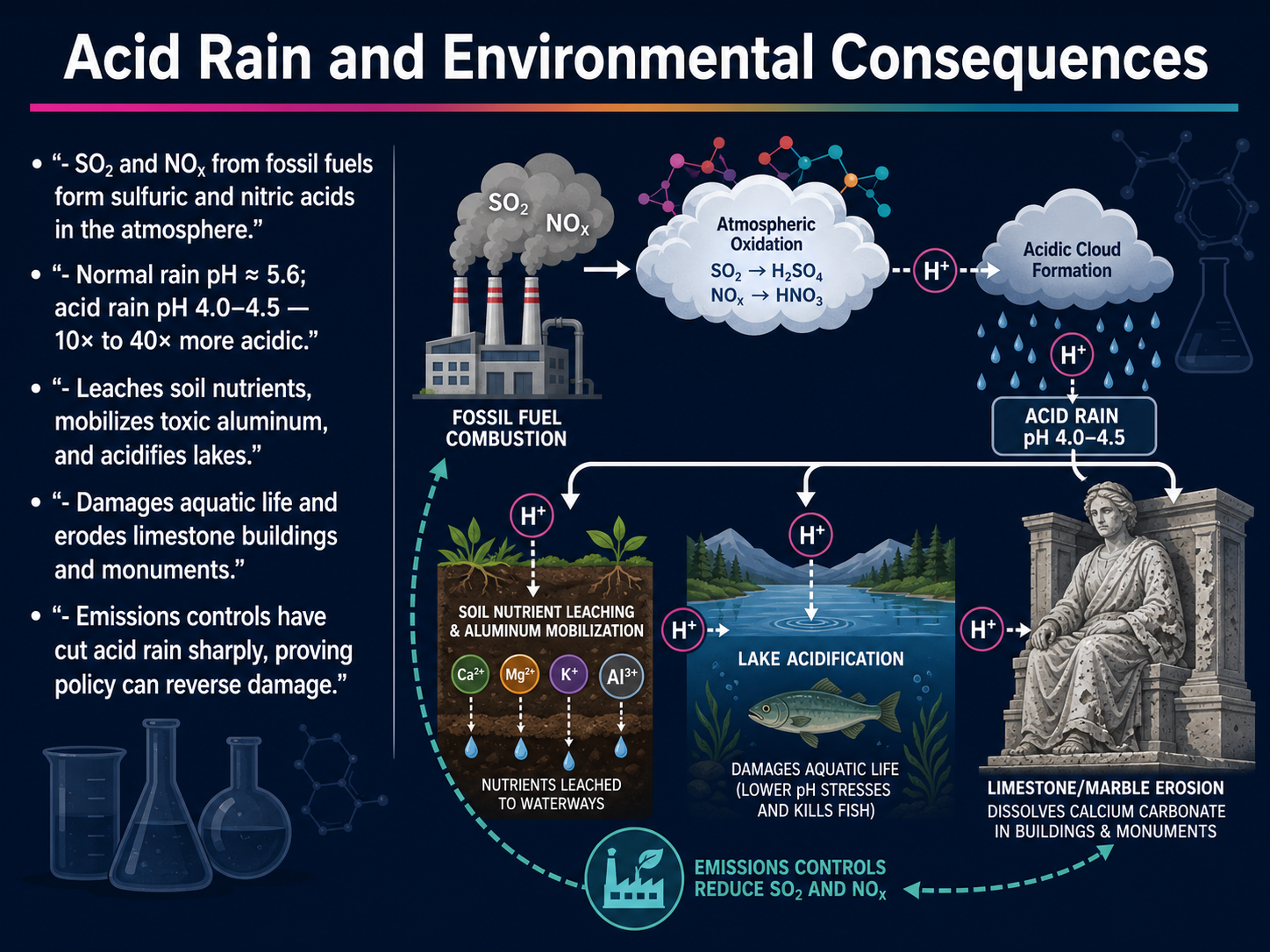
2 min - 12Acid Rain and Environmental ConsequencesNow let’s connect acids, bases, and pH to a real-world environmental issue: acid rain. When we burn fossil fuels like coal and oil, they release sulfur dioxide and nitrogen oxides into the air. Those gases react with water in the atmosphere to form sulfuric acid and nitric acid, which then fall as rain, snow, or fog. Remember, normal rain is already slightly acidic, with a pH around five point six. Acid rain, however, often drops to a pH between four and four point five. Because the pH scale is logarithmic, that drop means the rain can be ten to forty times more acidic than normal. This shift has serious consequences. Acid rain leaches essential nutrients like calcium and magnesium from the soil. It also mobilizes toxic metals, such as aluminum, which wash into lakes and streams, making the water more acidic and harming fish and aquatic insects. On land, forests become stressed and more vulnerable to disease. You may have also seen it damage old buildings and monuments, slowly dissolving limestone and marble. But here is the hopeful part: recognizing this problem led to emissions controls in many countries, which have significantly reduced acid rain. It’s a strong example of how understanding chemistry helps us create policies that repair environmental damage. Next, we’ll bring all these ideas together in our final section, Conceptual Integration and Review.
 bbc.co.ukeli10.co.uktrustatoms.com+22 min
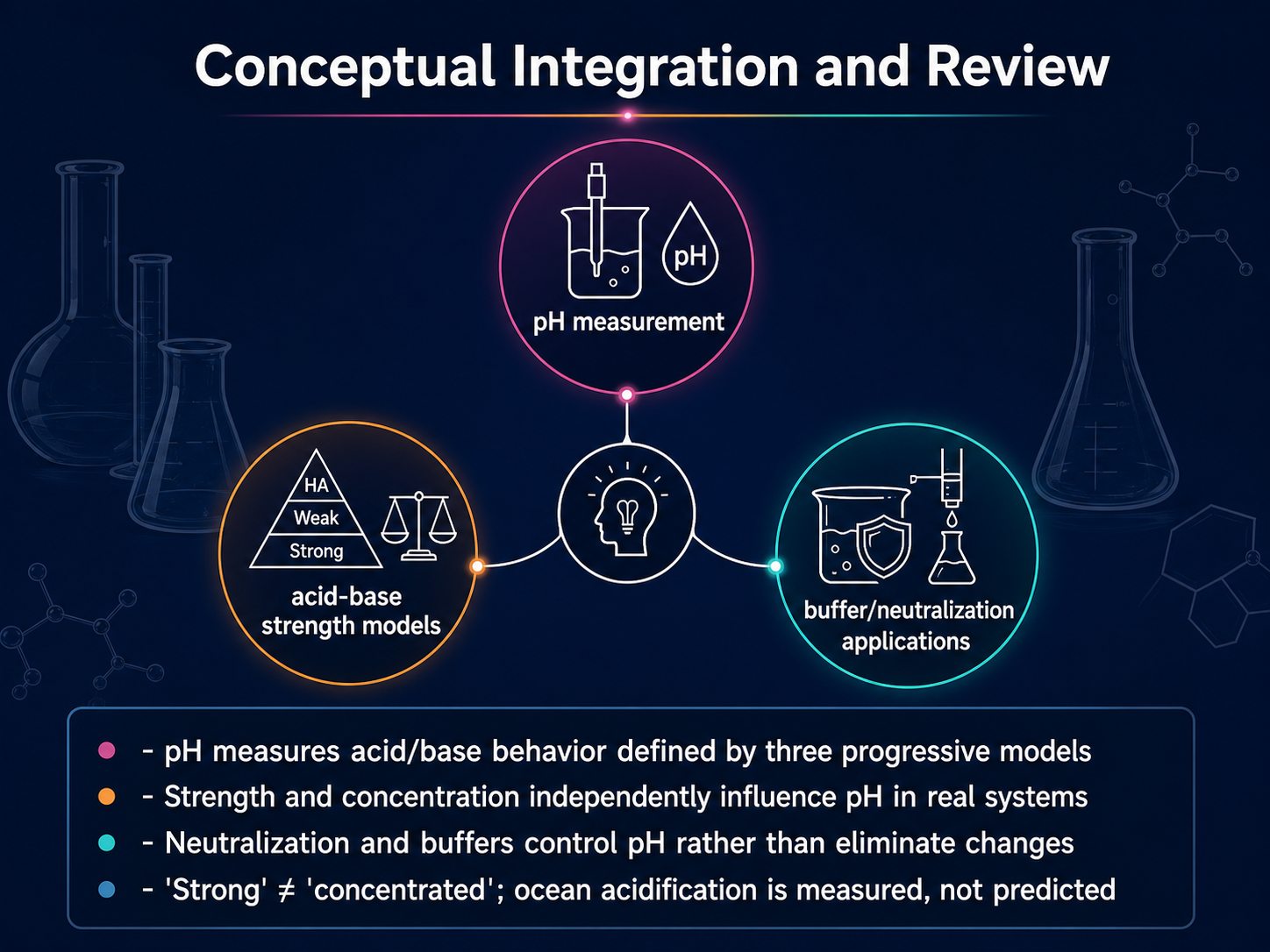
 - 13Conceptual Integration and ReviewLet's take a moment to bring all these ideas together. pH is a scale that measures acidity or basicity, and we've built that understanding through three progressive models: the Arrhenius, Brønsted-Lowry, and Lewis definitions. Each model deepens our view of what acids and bases actually do. In real systems, strength and concentration work independently. A strong acid isn't the same as a concentrated one, and a dilute strong acid can have a very different pH than a concentrated weak acid. We also saw that neutralization and buffers don't eliminate pH changes. Instead, they control changes, either by reacting acids and bases together, or by resisting shifts when small amounts are added. And finally, remember that 'strong' is about dissociation, not how much is present. This is why ocean acidification is something we measure directly. Even though the ocean is vast, the measured pH shift tells us exactly how carbon dioxide is changing seawater chemistry. Thank you for joining this exploration of acids, bases, and pH. I encourage you to keep asking how these invisible interactions shape the visible world around you.
 2 min
2 min
Take the deck with you
Download this course as a file — free, no sign-up needed.
- PDF handoutEvery slide page, ready to print or share.14 pages · 3.5 MBDownload
- Narrated PowerPointThe deck that presents itself — every slide carries the digital human's narration video.14 pages · 29.6 MBDownload
- PowerPoint slidesThe full deck as a .pptx — open it in PowerPoint, Keynote, or Google Slides.14 pages · 3.4 MBDownload
Free to use in your own training — please keep the PersonWise credit page at the end.
Have your own deck? Turn it into a course
Sources consulted
Web sources consulted while building this course.
- What is the pH scale and what does it measure? — bbc.co.uk
- The pH Scale: Measuring How Acidic or Basic Things Are — Explain Like I'm 10 — eli10.co.uk
- What Is pH? - Trust Atoms — trustatoms.com
- What is pH? — epa.gov
- pH Scale Lesson for Kids: Definition & Facts — study.com
- 3.2: Brønsted and Lewis Acids and Bases — chem.libretexts.org
- 3.1: Acid-Base Theories - Chemistry LibreTexts — chem.libretexts.org
- 3.1: Acid-Base Theories - Chemistry LibreTexts — chem.libretexts.org
- 2.3: Acid-Base Theories and Concepts - Chemistry LibreTexts — chem.libretexts.org
- Acid–base reaction - Alternative Definitions | Britannica — britannica.com
- Acid–base balance: a review of normal physiology - PMC — pmc.ncbi.nlm.nih.gov
- 20.7 Acid–Base Balance - Biology LibreTexts — bio.libretexts.org
- 10.8: Biological Buffers - Biology LibreTexts — bio.libretexts.org
- 2.2: Buffering - Medicine LibreTexts — med.libretexts.org
- Buffering systems in the human body — uwa.edu.au