Change Management: Stages, Roles, Deliverables
Begin
14 pages · ~28 min
Change Management: Stages, Roles, Deliverables
This training teaches the Change Management Process, covering key stages, roles, and deliverables to help participants effectively plan and execute organizational changes.
What you’ll learn
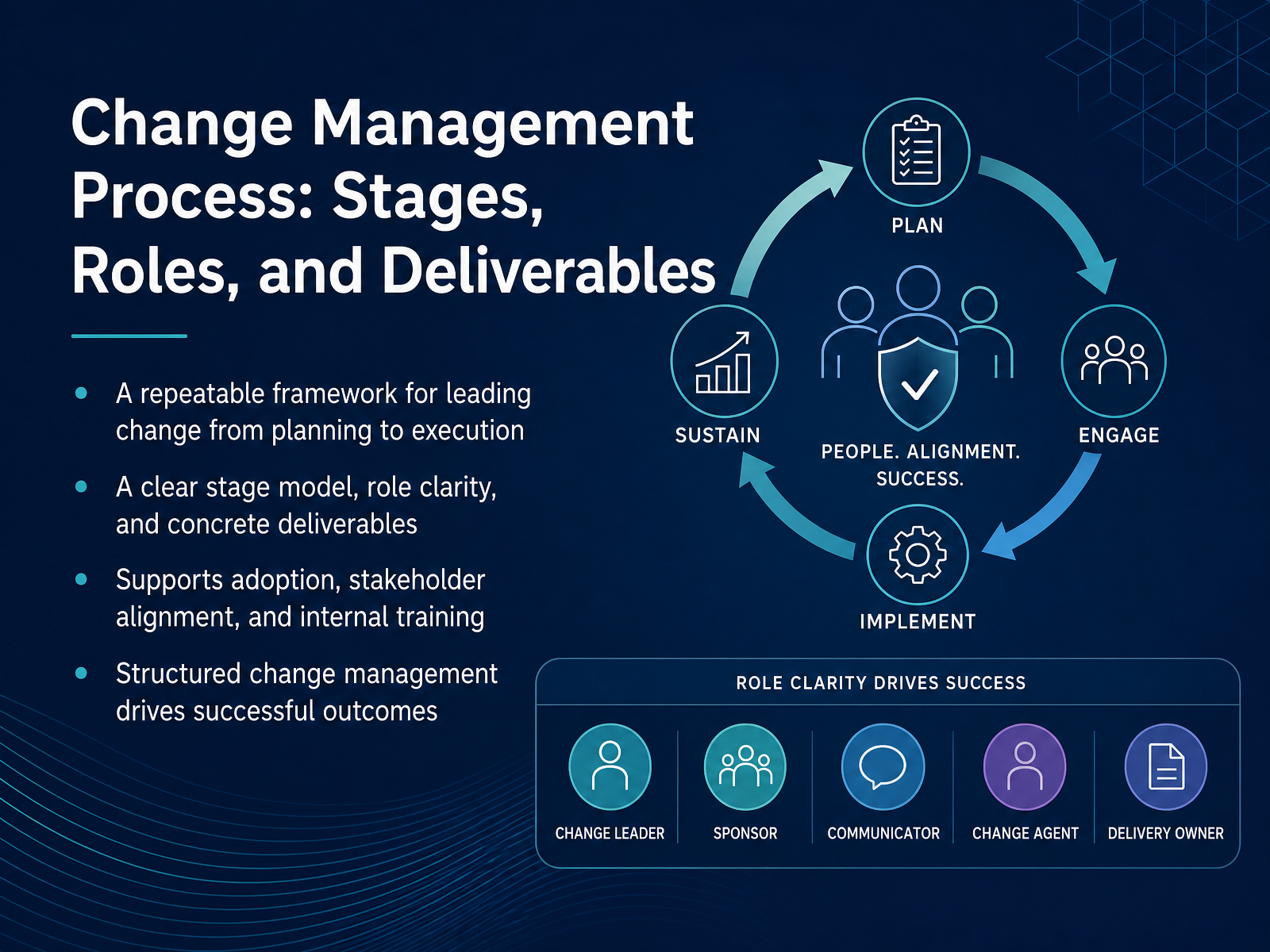
- 01Change Management Process: Stages, Roles, and DeliverablesWelcome. If you're responsible for guiding change in your organization, you know the real challenge isn't the plan on paper. It's getting people to actually adopt it. That's what this course is about. We're going to walk through a practical, repeatable change management process. Not theory, but how to structure your work from planning through execution. You'll get a clear stage model that shows you what to do and when. You'll see how to define roles so sponsors, managers, and practitioners know exactly where they fit. And you'll know what tangible deliverables to produce at each step, the documents that keep stakeholders aligned and show progress. Throughout, we'll focus on what drives successful outcomes: adoption, stakeholder alignment, and what you need to build effective internal training. By the end, you'll have a playbook you can customize and scale to your own initiatives. Next, we'll look at why a structured approach matters and what's at stake when change is managed without one.prosci.comprosci.comonline.hbs.edu+22 min
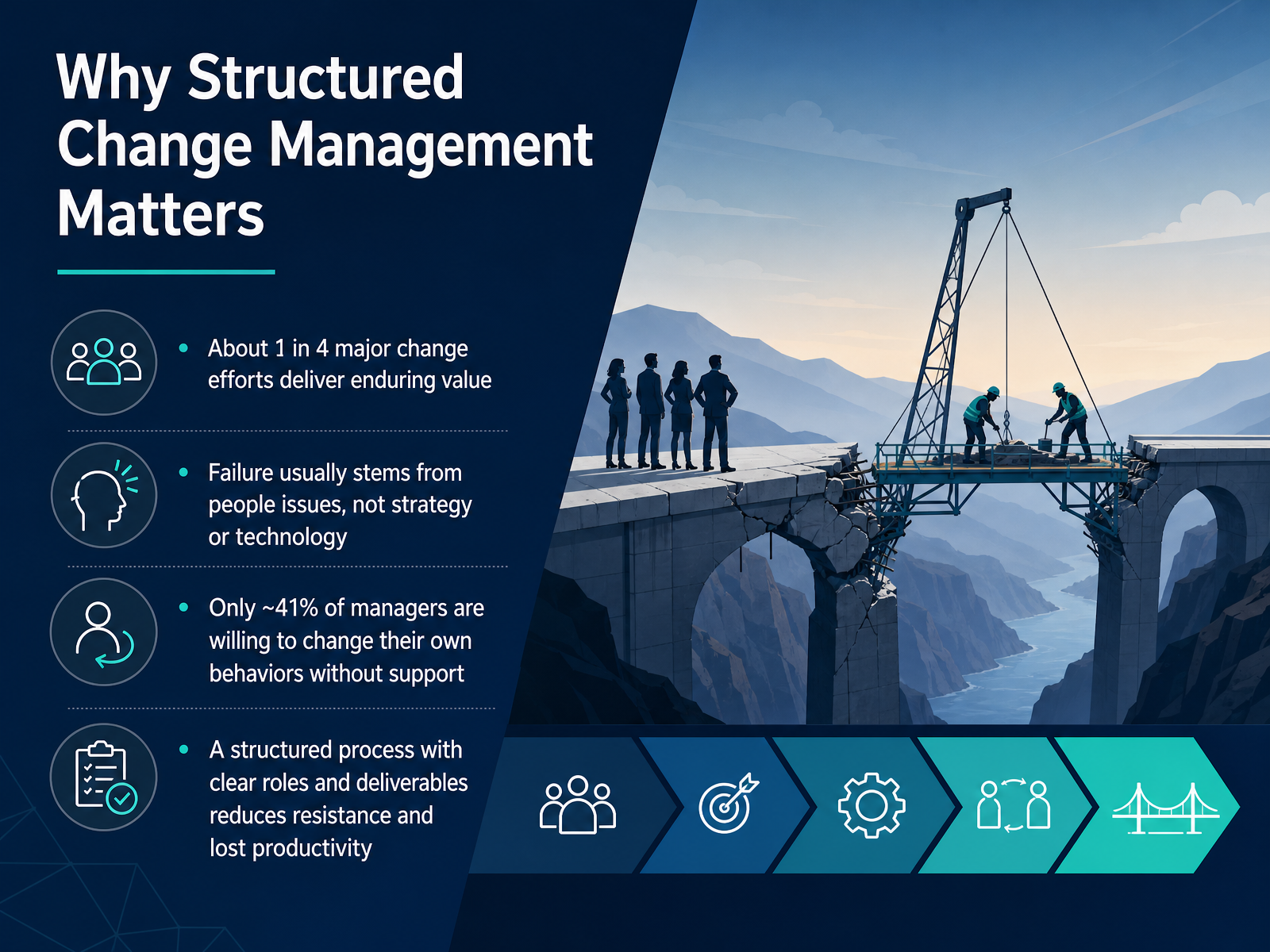
- 02Why Structured Change Management MattersLet's start with why a structured process matters, because the numbers are sobering. Only about one in four major change efforts actually delivers lasting value. The other three don't fail because of bad strategy or weak technology. They fail because of the people side. Resistance, fatigue, and managers who aren't equipped to lead their teams through the transition. In fact, only about forty-one percent of managers are willing to change their own behaviors to support a change initiative. That's a huge bottleneck. If the people closest to the work aren't bought in, even the best-designed program will stall. That's exactly why a structured process with clear roles and defined deliverables is non-negotiable. It gives you a systematic way to reduce resistance, protect productivity, and give managers the support they actually need. That structure is what separates transformations that stall from transformations that stick. Next, let's anchor on the core concepts and shared language we'll use throughout this course.
 ocmsolution.comprnewswire.comprnewswire.com+21 min
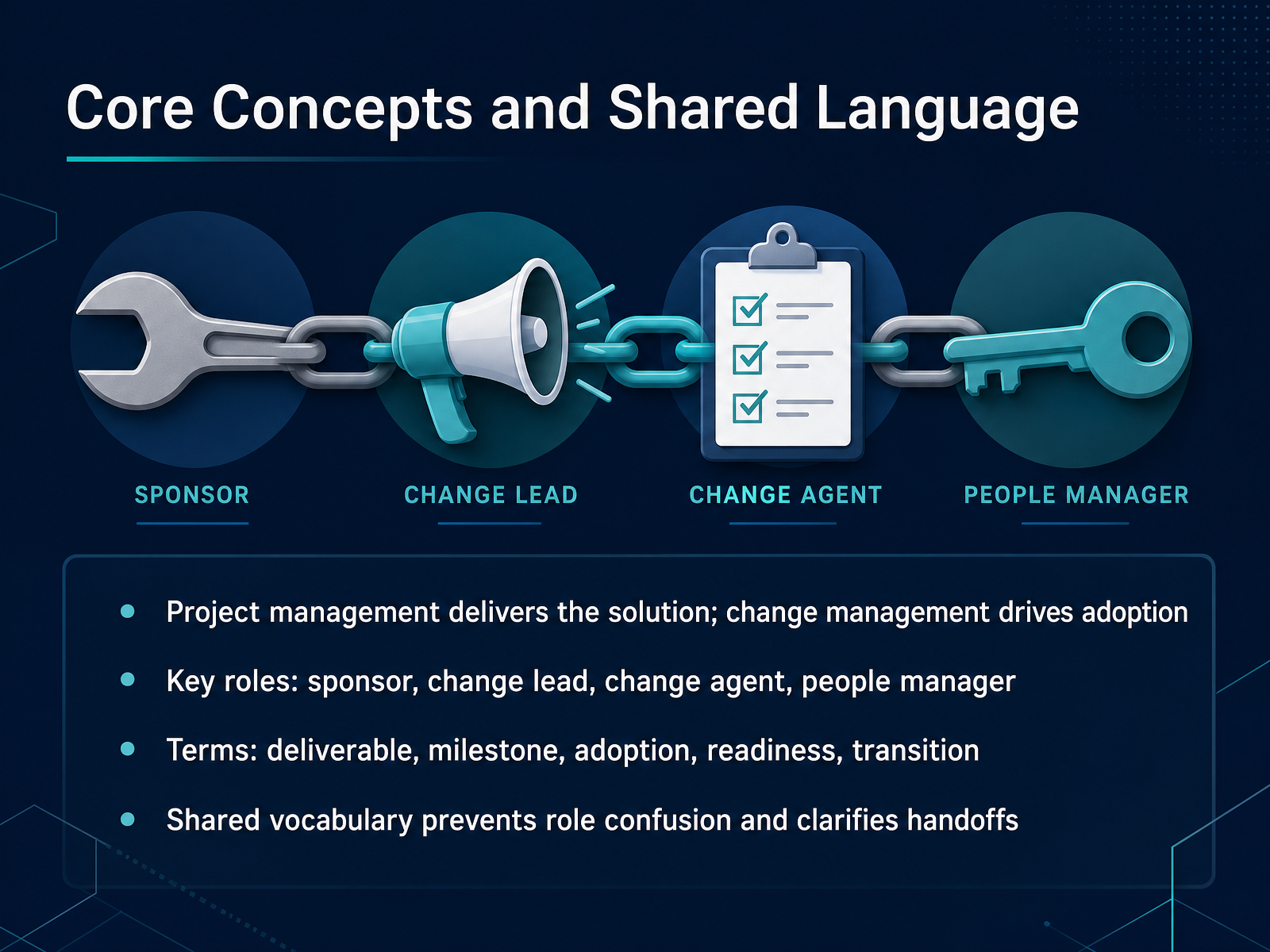
 - 03Core Concepts and Shared LanguageBefore we dive into the phases, let’s align on the language we’ll use throughout this course. Project management delivers the solution—the new system, the process, the structure. Change management drives adoption, making sure people actually use it. Both are needed, but they are not the same job. You’ll work with four core roles. The sponsor authorizes and funds the change, and their visible participation is the top predictor of success. The change lead plans and executes the people-side activities. Change agents are the frontline supporters who champion the change with their peers. And people managers coach their teams through the transition. Now, the shared terms. A deliverable is a tangible output, like a training plan or a readiness assessment. A milestone marks a scheduled checkpoint. Adoption means employees are using the new way consistently. Readiness is a measure of whether they can and will. Transition is the bridge between the current state and the future state. Using this shared vocabulary prevents role confusion and clarifies handoffs. When everyone speaks the same language, ownership stays clear. That clarity becomes critical as we move into the three-phase change process at a glance.
 adminit.ucdavis.eduapm.org.ukhr.ucdavis.edu+22 min
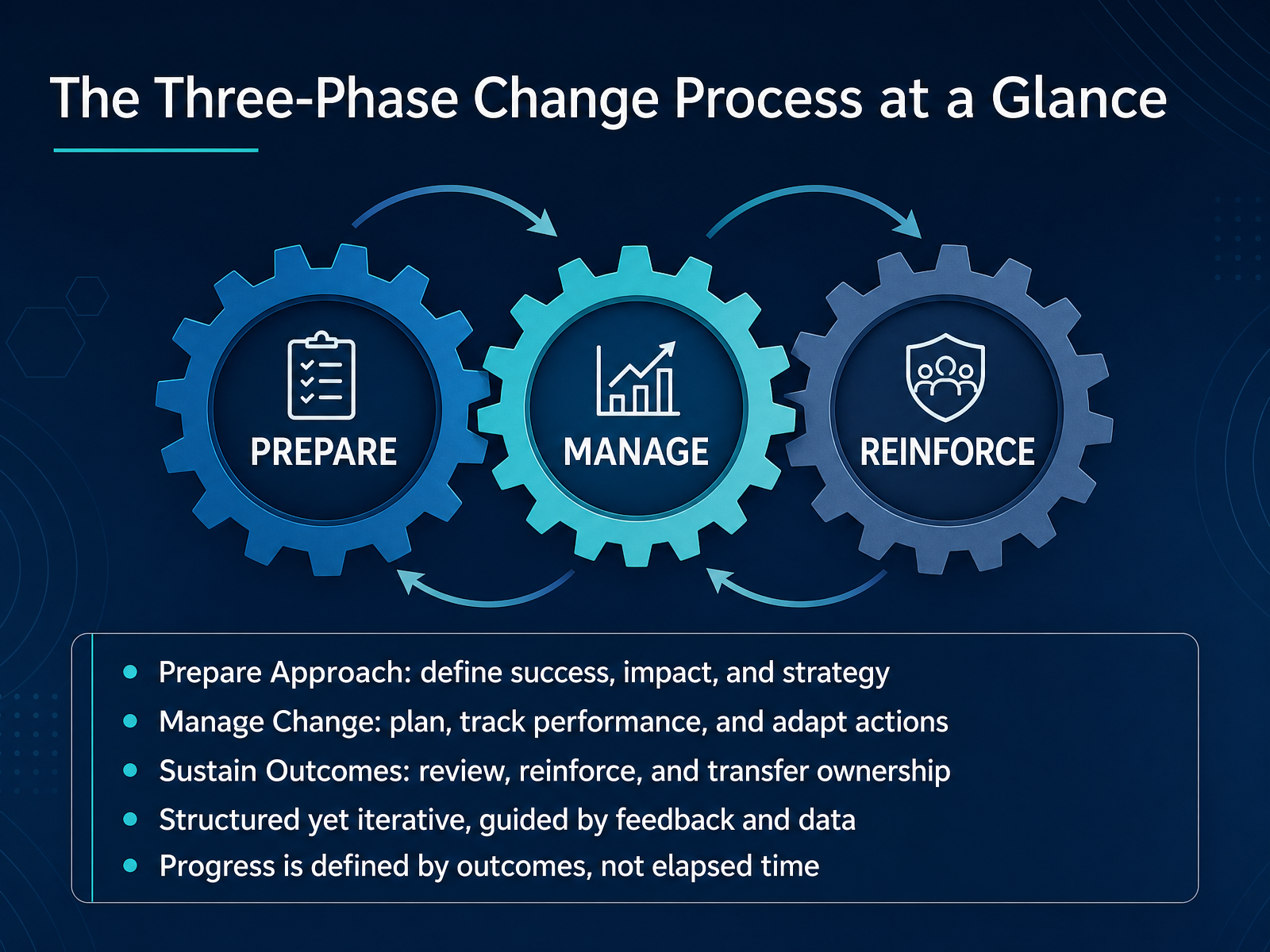
 - 04The Three-Phase Change Process at a GlanceLet’s take a step back and look at the whole process as three connected phases. First, Prepare Approach. Here you define success, assess impact, and shape your strategy. The deliverable is a clear change management strategy that guides everything else. Second, Manage Change. This is where you plan, track performance, and adapt actions as you go. Your Master Change Management Plan consolidates all the individual plans and keeps the team aligned. Third, Sustain Outcomes. You review performance, reinforce new behaviors, and transfer ownership to the business. The Change Management Closeout documents results and hands over responsibility. Remember, this process is structured but iterative. You are guided by feedback and data, not just the calendar. Progress is defined by outcomes, not elapsed time. So keep your focus on what is achieved, not how long it has been. Now let’s dive into the first phase, Prepare Approach.
 prosci.comprosci.comonline.hbs.edu+21 min
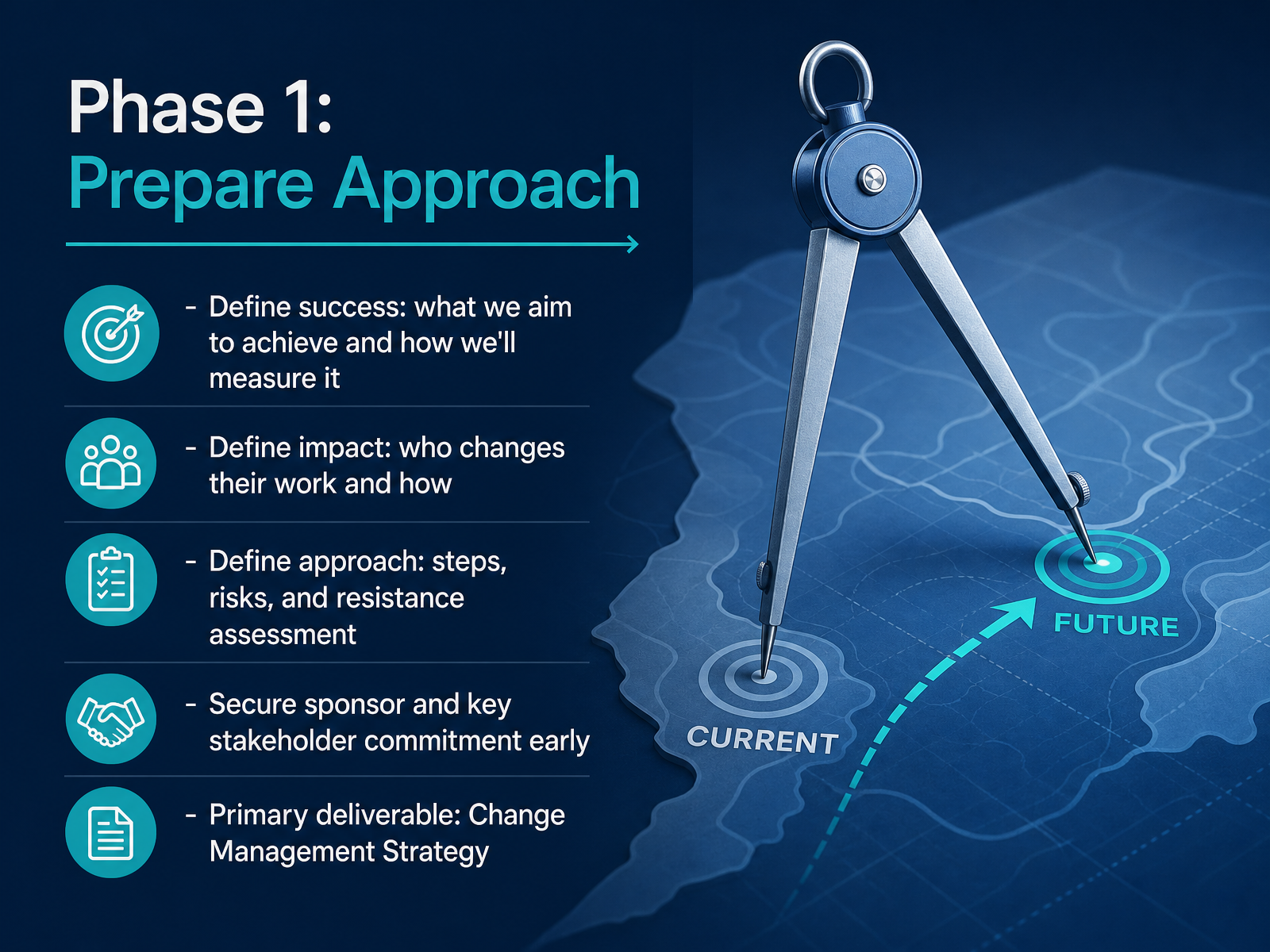
 - 05Phase 1: Prepare ApproachLet’s look at the first phase: Prepare Approach. This is where you set the strategic foundation for everything that follows. You’ll define success first—not just the end goal, but the measurable criteria that will tell you whether you achieved it. Then, you define impact: identify who has to change their work, and exactly how their daily tasks will shift. Don’t underestimate this analysis—it drives your entire plan. Next, you define your approach. Map the steps, assess the risks, and identify where resistance is likely to surface. And here’s the critical move: secure your sponsor and key stakeholders now, not later. Without active, visible commitment early on, your strategy will stall. The primary deliverable for this phase is the Change Management Strategy document. It captures all of this—success measures, impact analysis, risks, and sponsorship—and it becomes the blueprint that guides your next moves. Get this right, and you position the entire change for success. Next, we’ll move into Phase 2: Manage Change, where you turn this strategy into action.
 prosci.comprosci.comonline.hbs.edu+22 min
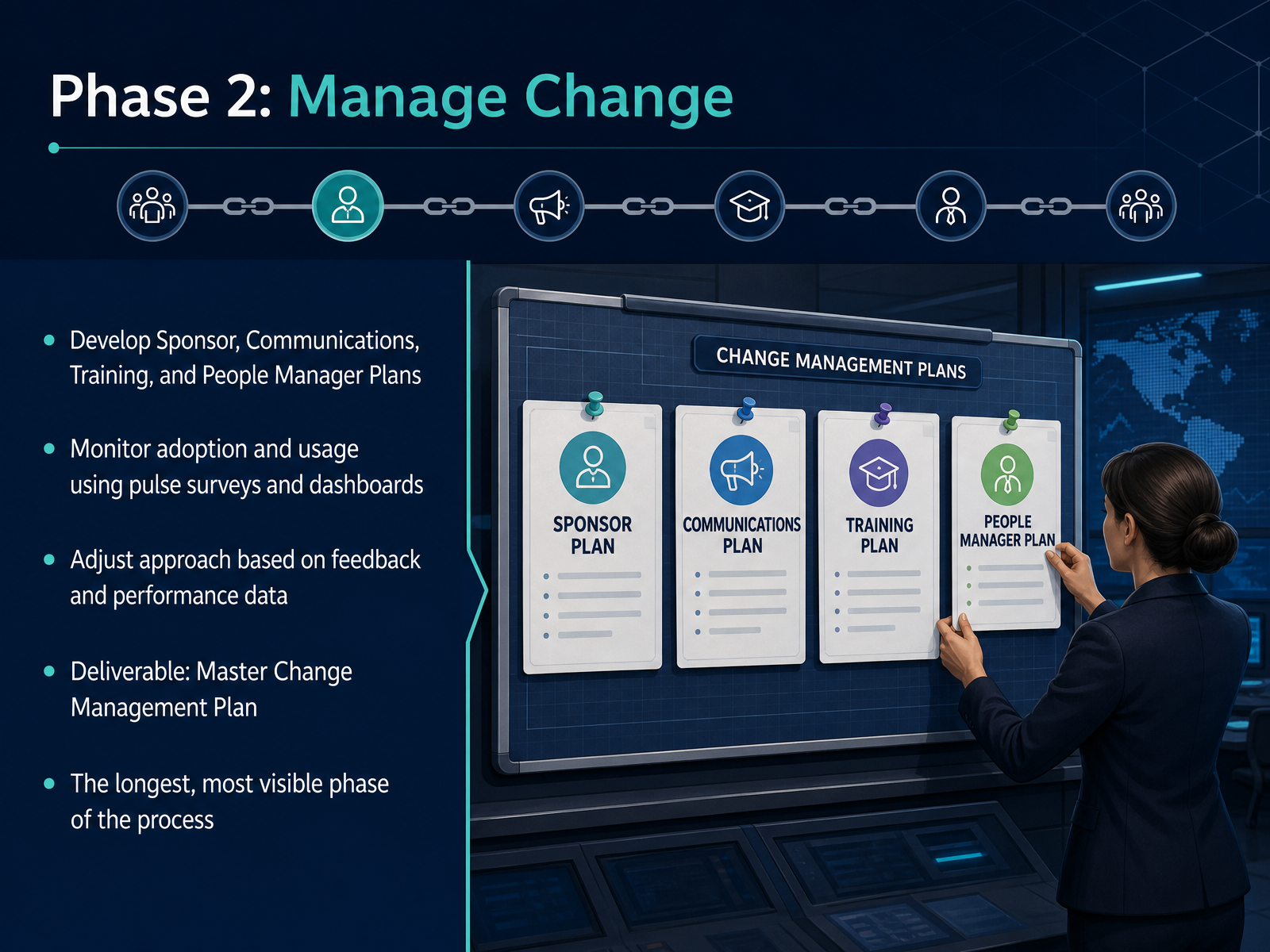
 - 06Phase 2: Manage ChangeNow we move into the second phase: Manage Change. This is where your strategy becomes action. It’s the longest and most visible phase, so expect to operationalize quickly. You’ll need to develop the four core plans: Sponsor, Communications, Training, and People Manager. Each one names specific owners and concrete timelines. But don’t just set them and step back. You’ll monitor adoption and usage constantly, using pulse surveys and dashboards that show real behavior, not just attendance. That data drives your next move: adapt the approach based on feedback and performance, not instinct. The deliverable here is the Master Change Management Plan. It consolidates all those individual plans into one guiding document your team will use to stay aligned. Remember, this phase is about disciplined execution. Keep the pace steady, keep measuring, and be ready to adjust. That sets you up to move into the final phase: Sustain Outcomes.
 prosci.comprosci.comonline.hbs.edu+21 min
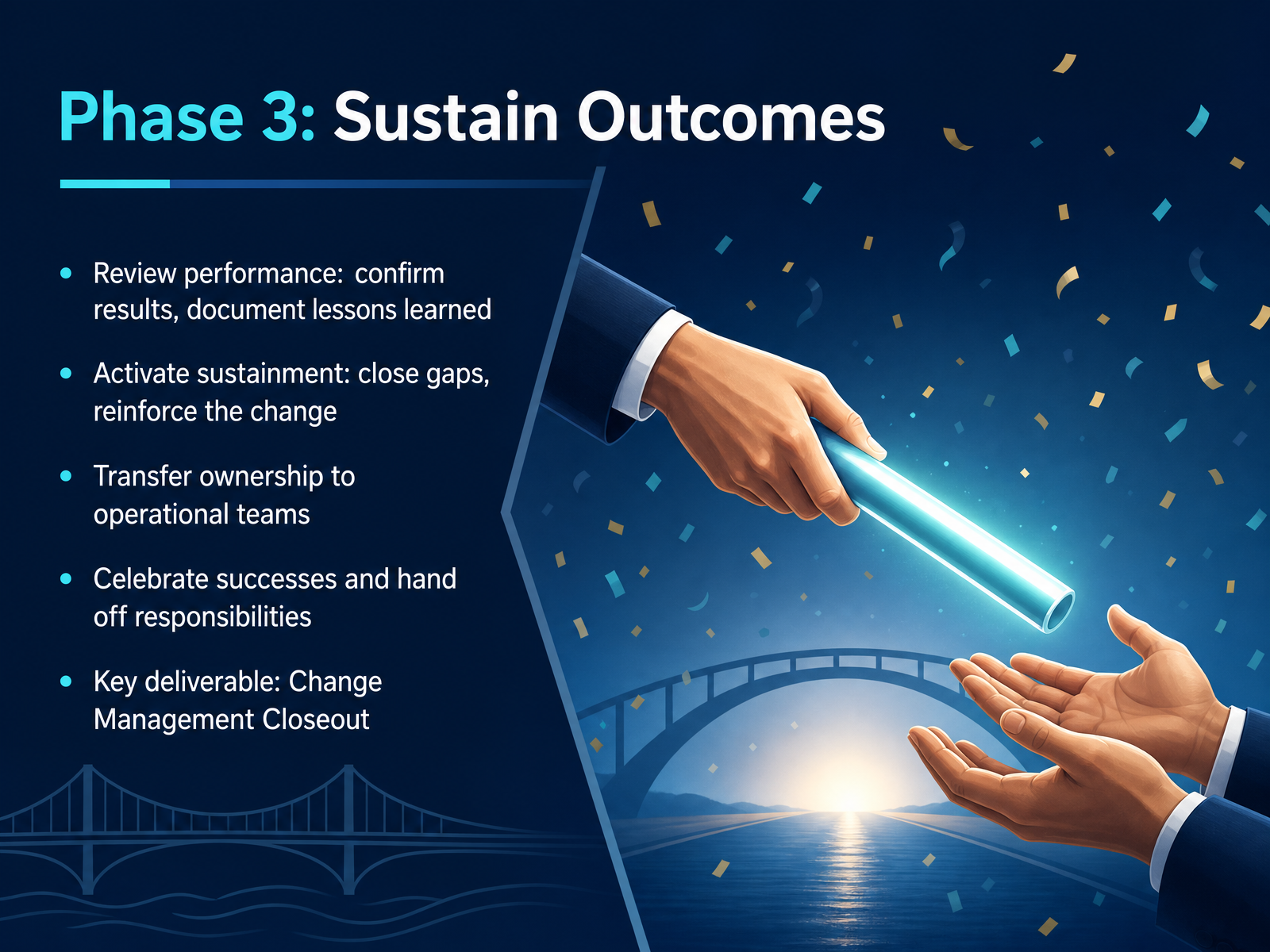
 - 07Phase 3: Sustain OutcomesNow we move into Phase 3: Sustain Outcomes. This is where the change either sticks or fades. Start by reviewing performance against the goals you set in Phase 1. Confirm the results with data, and document lessons learned while they are fresh. Next, activate sustainment. Identify any gaps in adoption, and reinforce the behaviors that support the new way of working. Then transfer ownership to operational teams. This is a formal handoff. They need the knowledge, the assets, and the accountability to keep the change alive. Take time to celebrate successes publicly, then hand over responsibilities with clarity. The key deliverable here is the Change Management Closeout. It documents performance status, captures lessons learned, and prepares the organization to own the change long after the project team moves on. Get this phase right, and the change becomes business as usual. Get it wrong, and you risk sliding back to the old ways within months. Next, we’ll walk through roles and responsibilities across the entire process.
 prosci.comprosci.comonline.hbs.edu+21 min
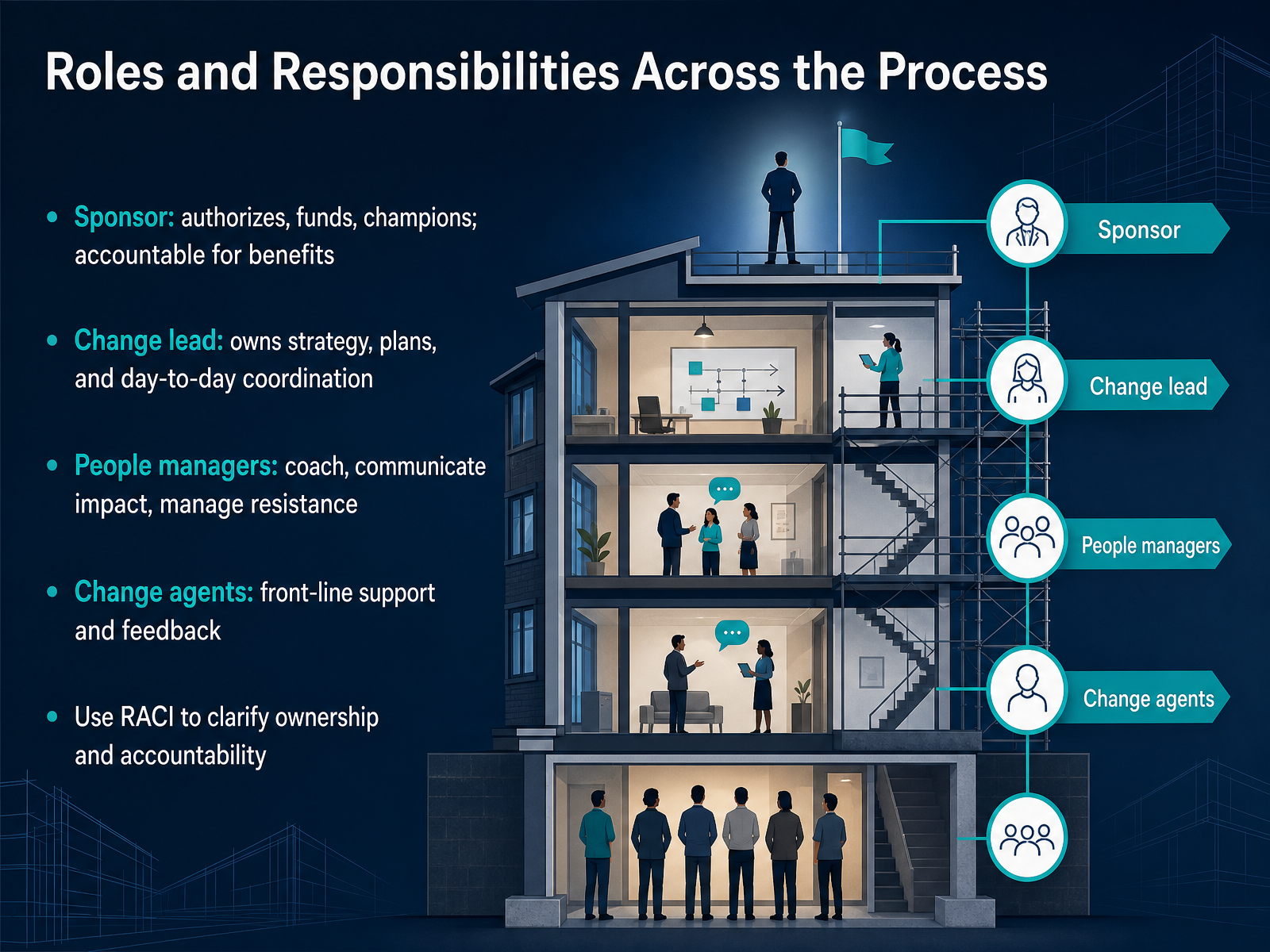
 - 08Roles and Responsibilities Across the ProcessLet’s pause here and make sure everyone knows exactly what they own. In change management, clarity beats authority every time. The sponsor authorizes, funds, and champions the initiative. They are accountable for delivering the benefits, and they need to stay visibly engaged, not just at kickoff. The change lead owns the strategy, the plans, and the day-to-day coordination. That’s who keeps the trains running on time and escalates when something stalls. People managers coach their teams, communicate the personal impact, and manage resistance where it actually happens—at the desk level. Change agents are your front-line supporters. They give feedback, answer questions, and help peers adopt new ways of working. To make all of this explicit, use a RACI. Assign who is Responsible, who is Accountable, who is Consulted, and who is Informed for every major deliverable. If you skip this, you get duplication, gaps, and finger-pointing later. Now, let’s look at what each of these roles actually produces, in the next section on key deliverables by phase.
 givainc.comdocs.microfocus.comwellingtone.com+21 min
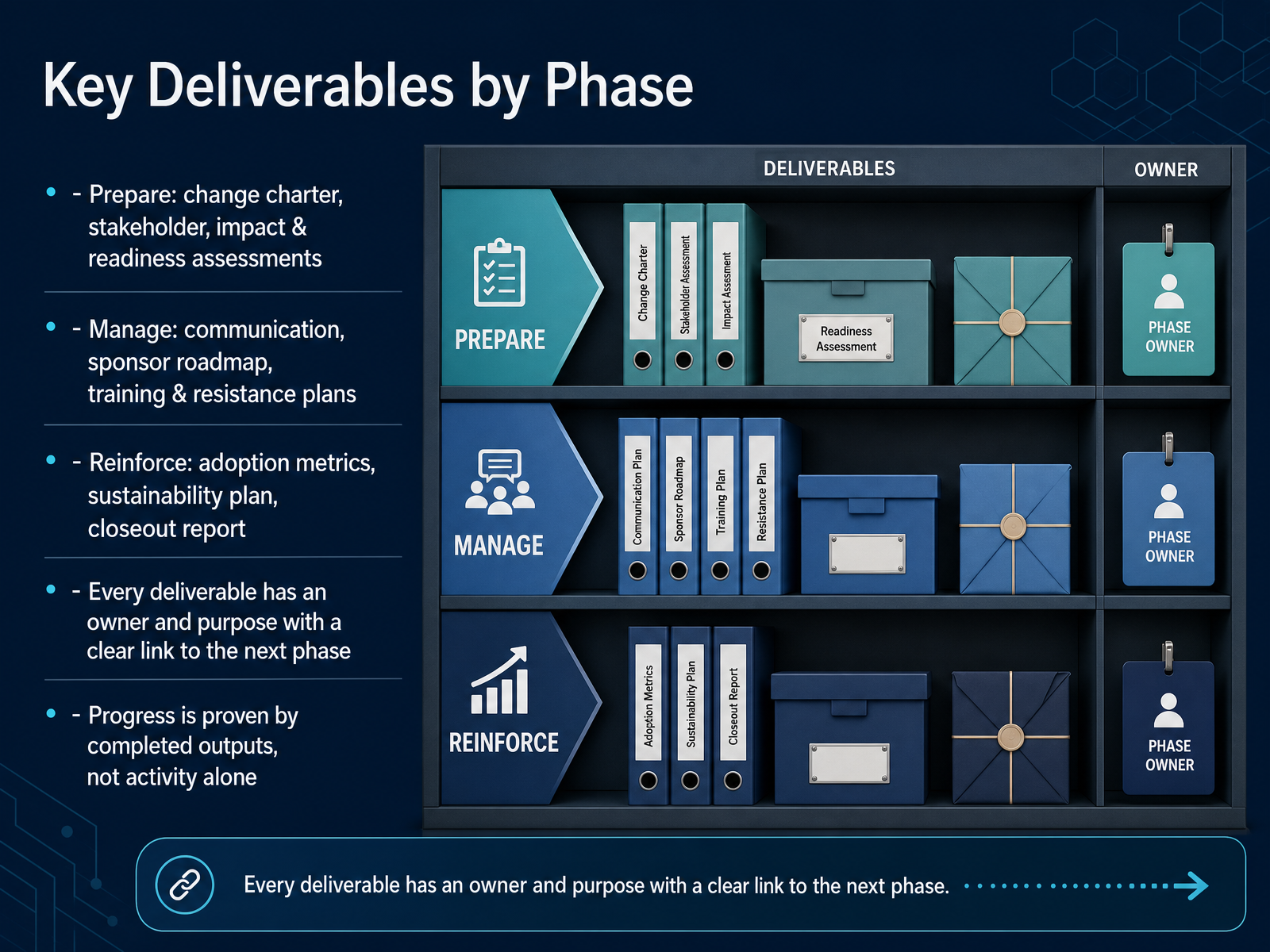
 - 09Key Deliverables by PhaseLet’s talk about what you actually produce in each phase. In Prepare, the deliverables are the change charter, stakeholder analysis, and the impact and readiness assessments. These are your evidence that the change is understood and funded. In Manage, you shift to execution. Communication plans, the sponsor roadmap, training, and resistance plans. Each one must have a named owner. Each one must connect to the next phase. And in Reinforce, you prove it worked. Adoption metrics, a sustainability plan, and a closeout report that captures lessons learned. Keep one rule in mind. Progress is proven by completed outputs, not activity alone. A meeting is not a deliverable. A deck is not adoption. If it doesn’t produce a signed document, a measured result, or a clear handoff, it’s noise. Next, we’ll take a closer look at the three deliverables that carry the most weight: assessments, communication, and training plans.
 cdn.ymaws.comprosci.comprosci.com+21 min
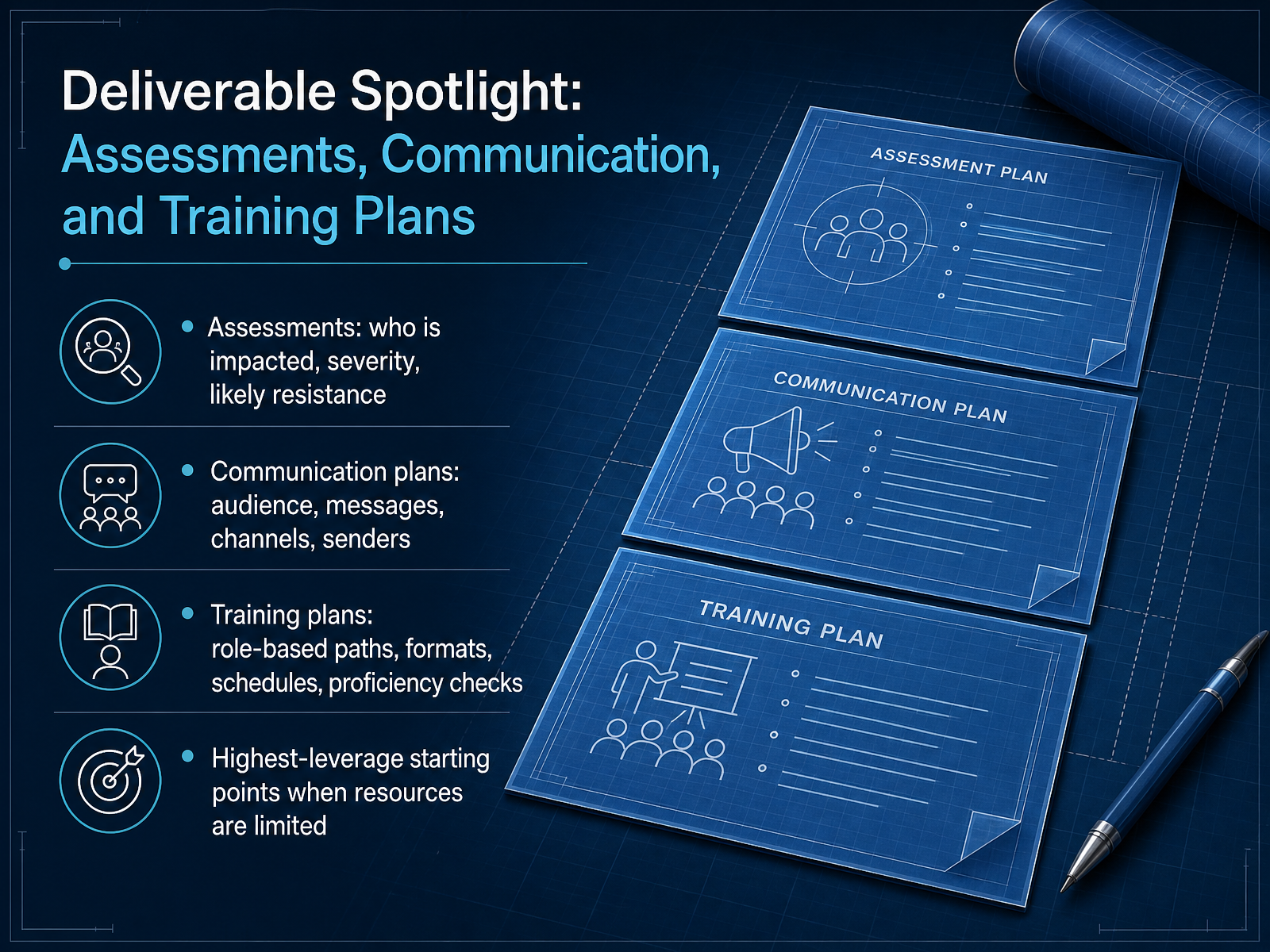
 - 10Deliverable Spotlight: Assessments, Communication, and Training PlansNow let's focus on the three deliverables that carry the most weight: assessments, communication plans, and training plans. Assessments are your diagnostic. You need to identify who is impacted, the severity of that impact, and where resistance is most likely to surface. Do not guess here. Use this data to shape everything else. Communication plans are your roadmap for messaging. For each audience, define the message, the channel, and the sender. Remember, employees want to hear business reasons from executives and personal impact from their direct managers. Training plans should be role-based, not generic. Use the right format, sequence it close to go-live, and build in proficiency checks. If resources are tight, start with the impact assessment. It forces you to define who and what is truly affected. Then build your communication plan and training needs analysis from that. These three documents give you the highest practical return when time is short. Next, we'll walk through what execution actually looks like in practice.
 cdn.ymaws.com2 min
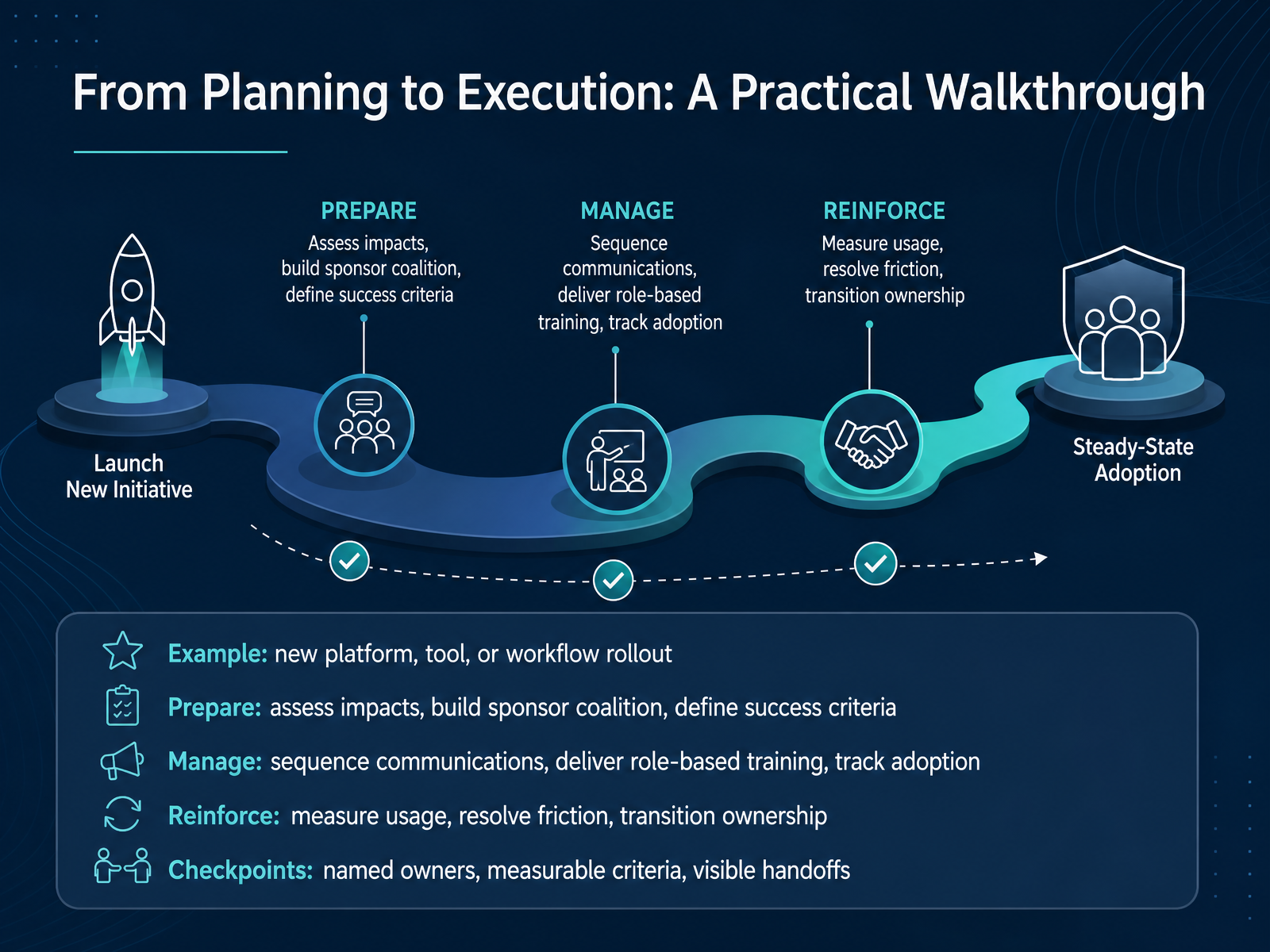
 - 11From Planning to Execution: A Practical WalkthroughLet's walk through what this actually looks like in practice. You're rolling out a new platform or workflow. Start with the Prepare phase. Assess the impact on each role. Build your sponsor coalition early, and define what success looks like in measurable terms. Then move into Manage. Sequence your communications so people hear the right message at the right time. Deliver training that is role-specific, not generic. Track adoption through system usage, not just attendance. Finally, Reinforce. Measure actual usage against your targets, resolve friction points quickly, and transition ownership to the business. Throughout each stage, keep your checkpoints visible. Named owners, measurable criteria, and clear handoffs. That is how you turn a plan into a working reality, and avoid the common trap of a rollout that goes live but never gets adopted. Up next, we will look at the common challenges that derail these efforts, and how managers should respond.
 cdn.ymaws.comprosci.comprosci.com+22 min
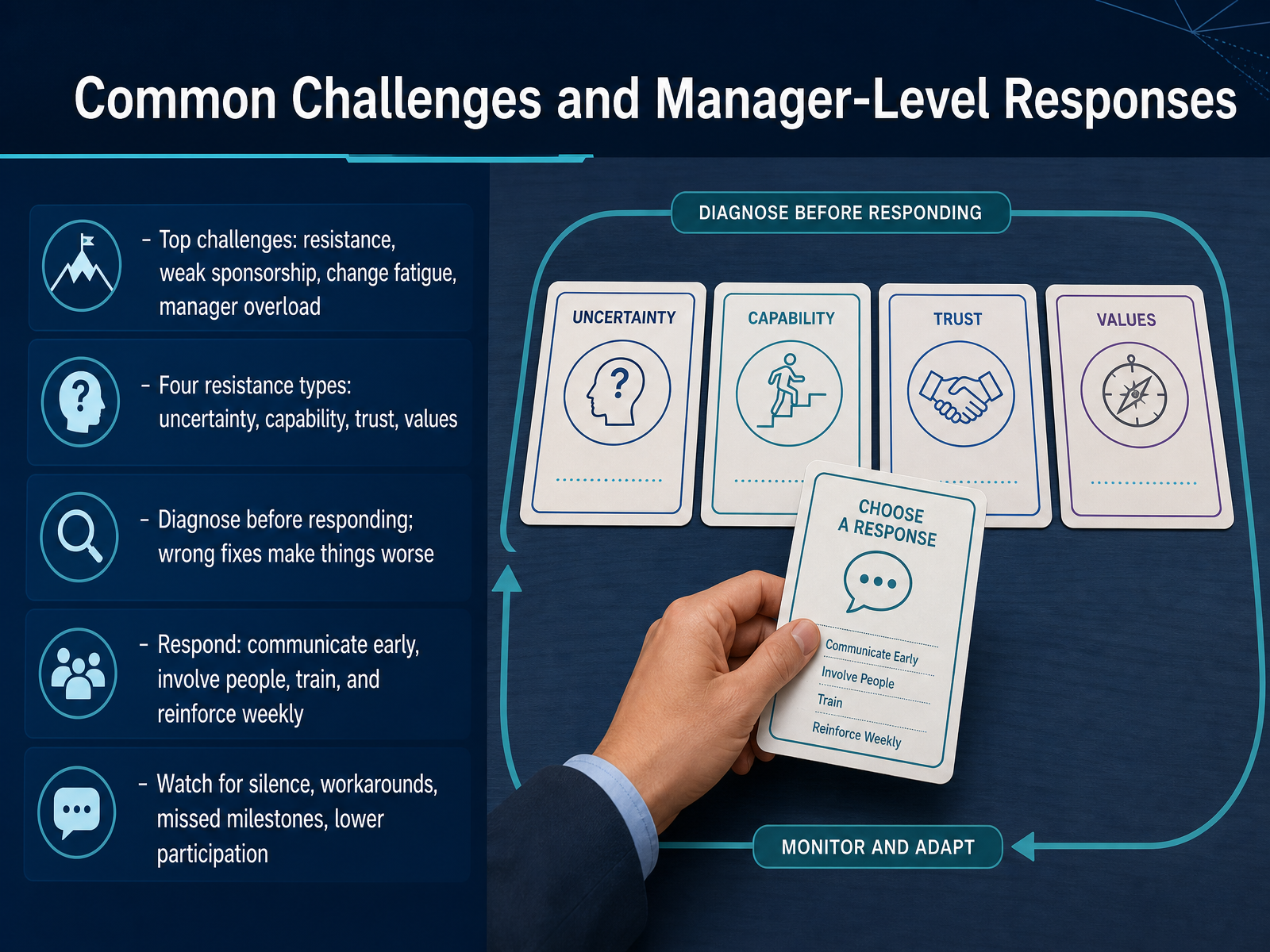
 - 12Common Challenges and Manager-Level ResponsesLet’s talk about the challenges that will actually test your change plan. The top four are resistance, weak sponsorship, change fatigue, and manager overload. You’ll see all of them, so plan for them now. On resistance, don’t treat it as one problem. Diagnose the type first. It could be uncertainty, where people lack information. Capability, where they doubt their skills. Trust, which comes from past failed changes. Or values, where they believe the change is fundamentally wrong. The wrong fix makes things worse. So respond with precision. Communicate early and honestly. Involve people in shaping the rollout. Provide real training, not just a deck. And reinforce the new behaviors weekly, because habits fade fast. Also, watch the quiet signals. Silence in meetings, workarounds, missed milestones, and lower participation. Those are early warning signs that adoption is stalling. Your job as a manager is to catch those signals and act before they compound. This is where the model becomes practical. Next, we’ll turn this whole process into internal training content your team can actually use.
 ocmsolution.comprnewswire.comprnewswire.com+22 min
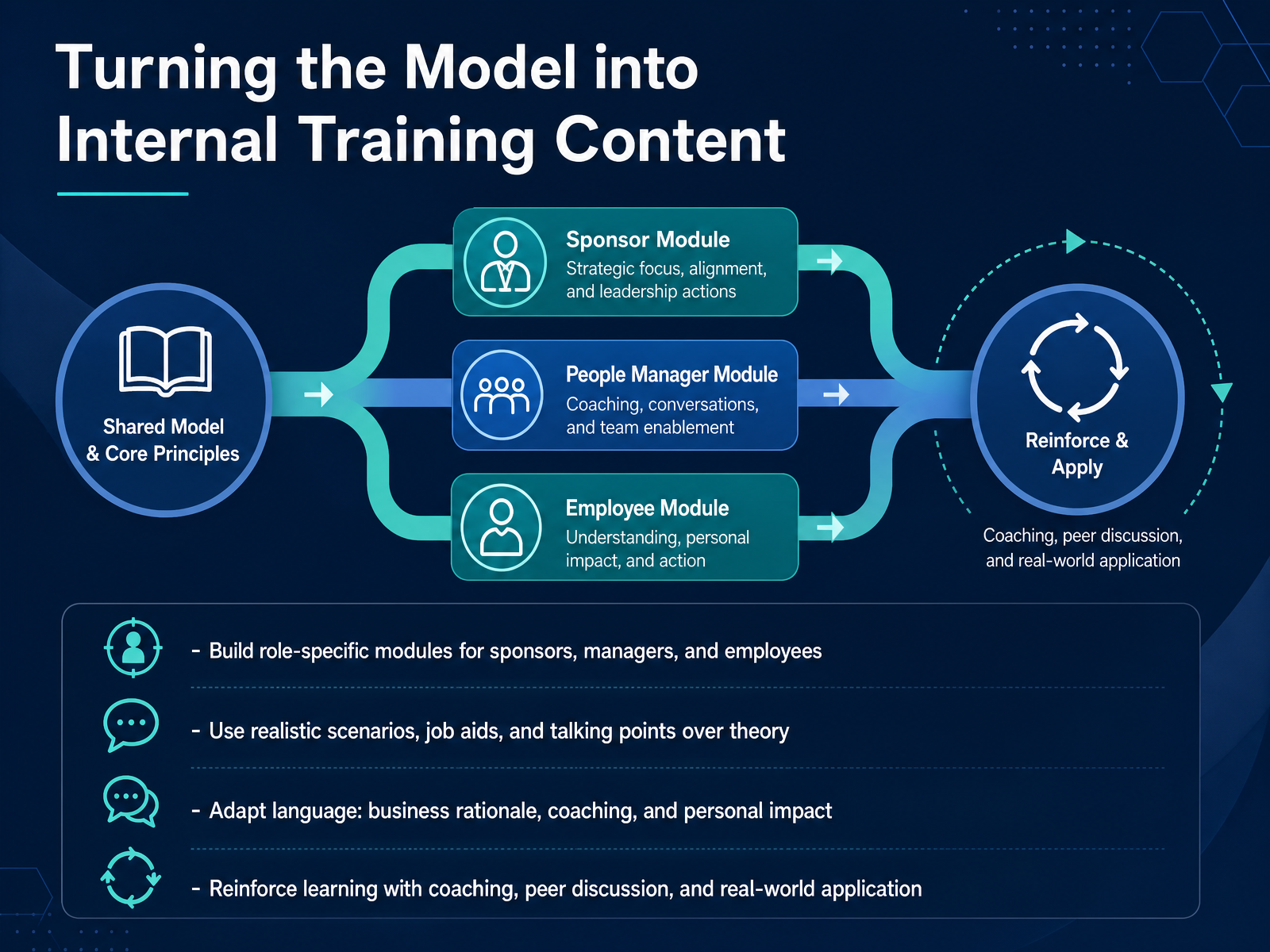
 - 13Turning the Model into Internal Training ContentNow, let's look at turning this model into internal training content. You'll want to build role-specific modules. Sponsors need the business rationale and the visibility playbook. Managers need coaching skills and resistance-management tactics. Employees need to understand the personal impact, the 'what's in it for me.' Skip the theory-heavy decks. Use realistic scenarios, job aids, and talking points they can use in their next one-on-one. The language should shift by audience: business terms for sponsors, coaching language for managers, and concrete personal benefits for employees. And don't assume a single workshop is enough. Reinforce the learning with coaching, peer discussion, and real-world application. A manager who practices the conversation once in training will handle it much better when resistance actually surfaces on their team. That's how training becomes capability. With that in mind, let's move to our final point: the action plan and next steps.
 givainc.comdocs.microfocus.comwellingtone.com+21 min
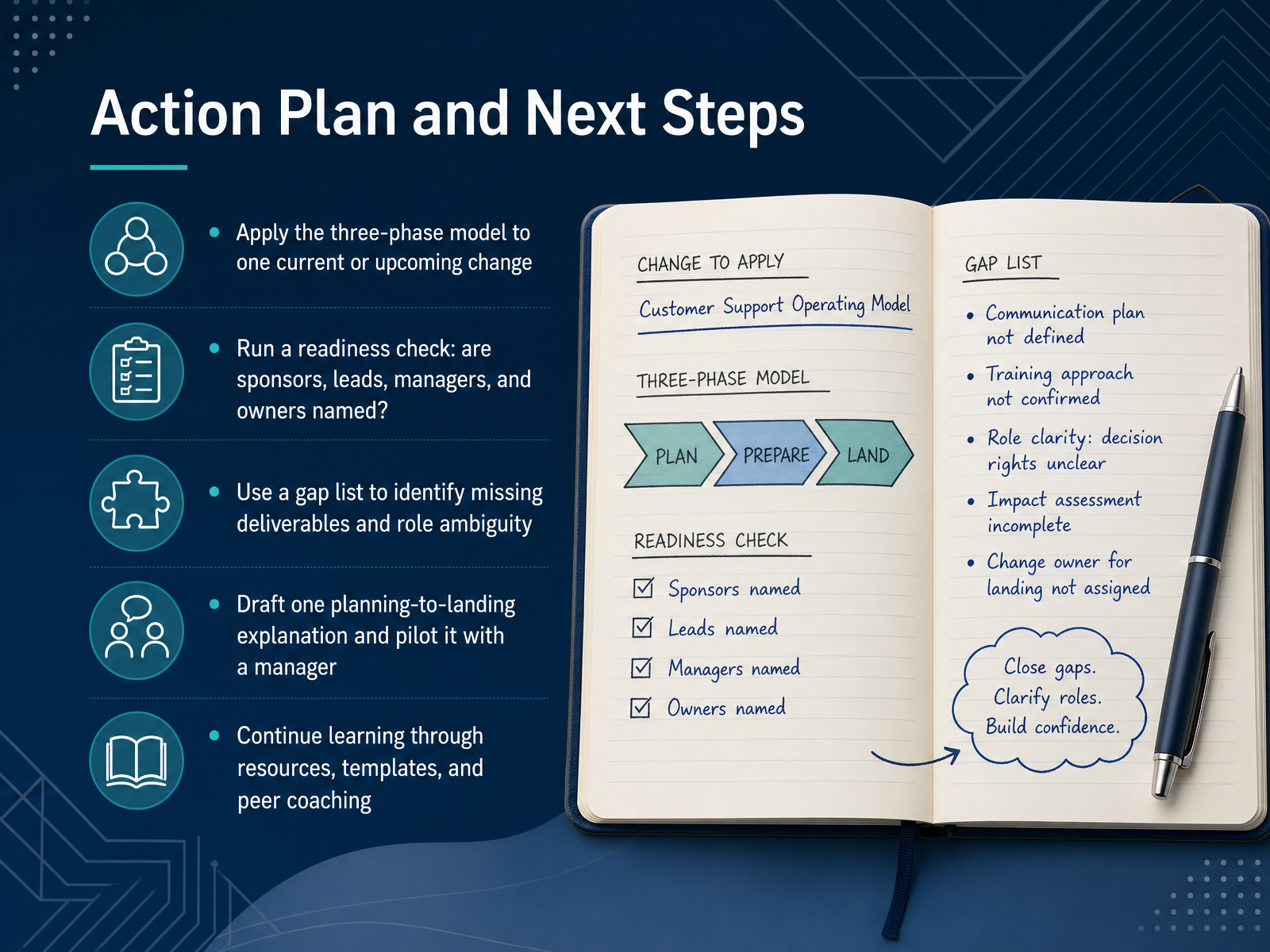
 - 14Action Plan and Next StepsYou now have the full playbook. The next step is to apply it. Pick one current or upcoming change and run it through the three-phase model we’ve covered. Start with a readiness check: are your sponsors, leads, managers, and process owners named and engaged? If not, that’s your first gap. Then build a gap list that captures missing deliverables and role ambiguity—this becomes your action register. Draft a concise planning-to-landing explanation and pilot it with one manager; their feedback will sharpen your message before wider rollout. Finally, keep learning. Use the templates and resources available, and lean on peer coaching to refine your approach. You have the tools and the process. Now it’s about disciplined execution. Thanks for your time, and good luck driving change that sticks.
 cdn.ymaws.com1 min
Take the deck with you
Download this course as a file — free, no sign-up needed.
- PDF handoutEvery slide page, ready to print or share.15 pages · 3.7 MBDownload
- Narrated PowerPointThe deck that presents itself — every slide carries the digital human's narration video.15 pages · 13.2 MBDownload
- PowerPoint slidesThe full deck as a .pptx — open it in PowerPoint, Keynote, or Google Slides.15 pages · 3.6 MBDownload
Free to use in your own training — please keep the PersonWise credit page at the end.
Have your own deck? Turn it into a course
Sources consulted
Web sources consulted while building this course.
- Prosci 3-Phase Process — prosci.com
- Change Management Process - Prosci — prosci.com
- 5 Steps in the Change Management Process | HBS Online — online.hbs.edu
- ACMP_Standard_2023_10_18.pdf — cdn.ymaws.com
- 11 Steps to Implementing a Change Management Process | Bloomfire — bloomfire.com
- 2025-2026 Organizational Change Management — ocmsolution.com
- Kearney releases 2025 Transformation Study — prnewswire.com
- The Grossman Group and The Harris Poll Unveil Landmark Study on What Drives - and Derails - Change Success — prnewswire.com
- [Research Report] The Change Tipping Point | The Grossman Group | The Harris Poll — yourthoughtpartner.com
- Why Change Management Fails: It's About People, Not ... — forbes.com
- Change Management Glossary | Administrative Innovation and Technology — adminit.ucdavis.edu
- Enabling Change SIG - Common Vocabulary — apm.org.uk
- Change Management Glossary — hr.ucdavis.edu
- Change Management Basics: Glossary — prosci.com
- PMI Lexicon of Project Management Terms — pmi.org
- Change Management Roles & Responsibilities — givainc.com
- RACI matrix for Change Management — docs.microfocus.com
- Change Management Roles & Responsibilities - Wellingtone — wellingtone.com
- ITIL change management roles & responsibilities — manageengine.com
- Do You Need a Roles and Responsibilities Matrix for ... — prosci.com