AI for UX Research Workflow
Begin
14 pages · ~28 min
AI for UX Research Workflow
Learn a practical AI workflow to plan, conduct, and analyze UX research faster. Ideal for UX researchers, designers, and product teams new to AI tools.
What you’ll learn
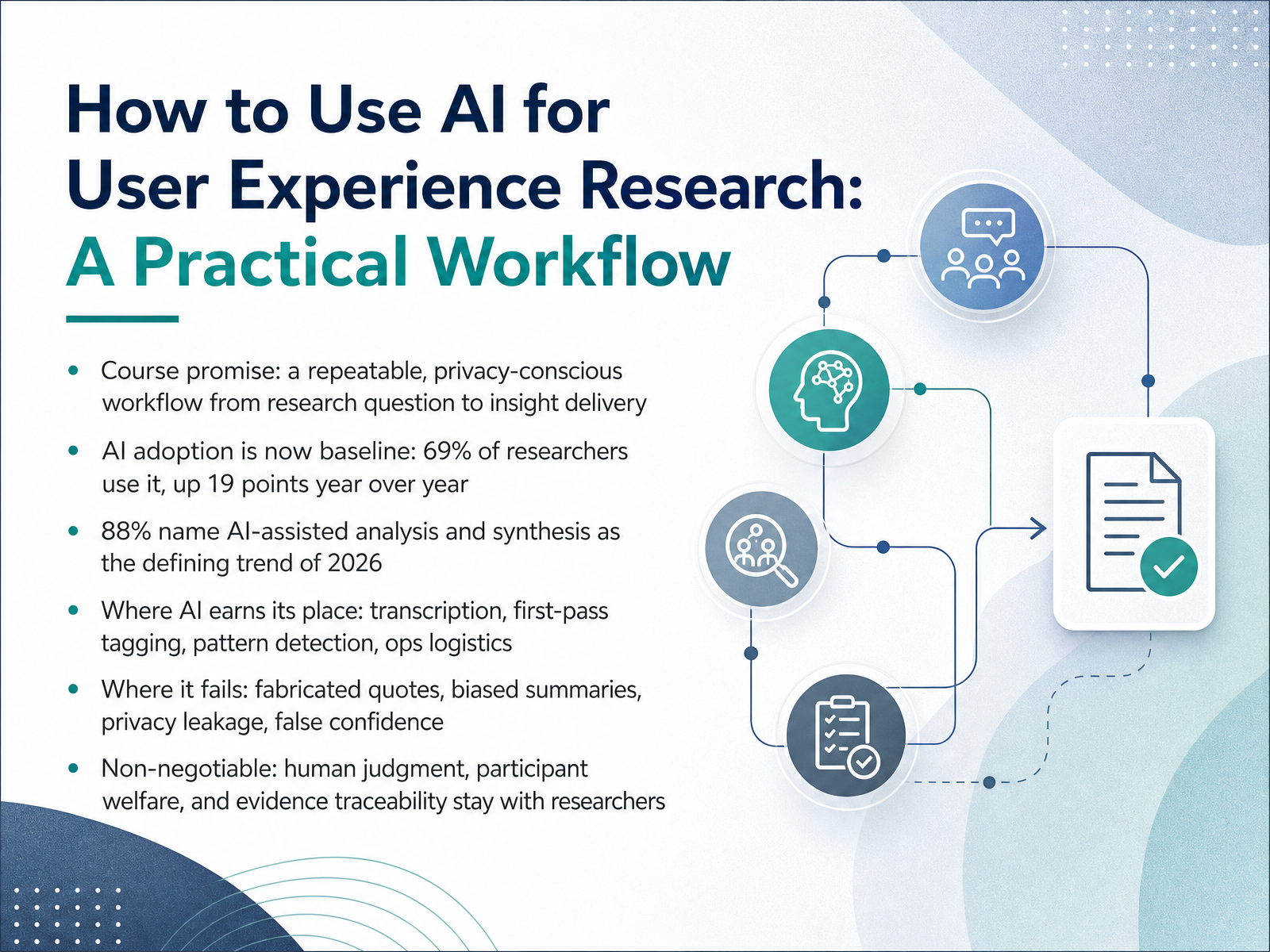
- 01How to Use AI for User Experience Research: A Practical WorkflowWelcome. I'm glad you're here. Over the next several slides, we'll build a repeatable, privacy-conscious workflow that takes you from research question all the way to insight delivery. Let's start with where the field stands. AI adoption is now baseline. Sixty-nine percent of researchers use it, up nineteen points year over year. And eighty-eight percent name AI-assisted analysis and synthesis as the defining trend of twenty twenty-six. So where does AI actually earn its place? Transcription. First-pass tagging. Pattern detection. And operations logistics. Where does it fail? Fabricated quotes. Biased summaries. Privacy leakage. And false confidence. Here's the non-negotiable. Human judgment, participant welfare, and evidence traceability stay with you, the researcher. Keep that line in mind, because everything that follows is built around it. Next, let's look at the AI-assisted research lifecycle at a glance.medium.comnetizenexperience.commerren.io+21 min
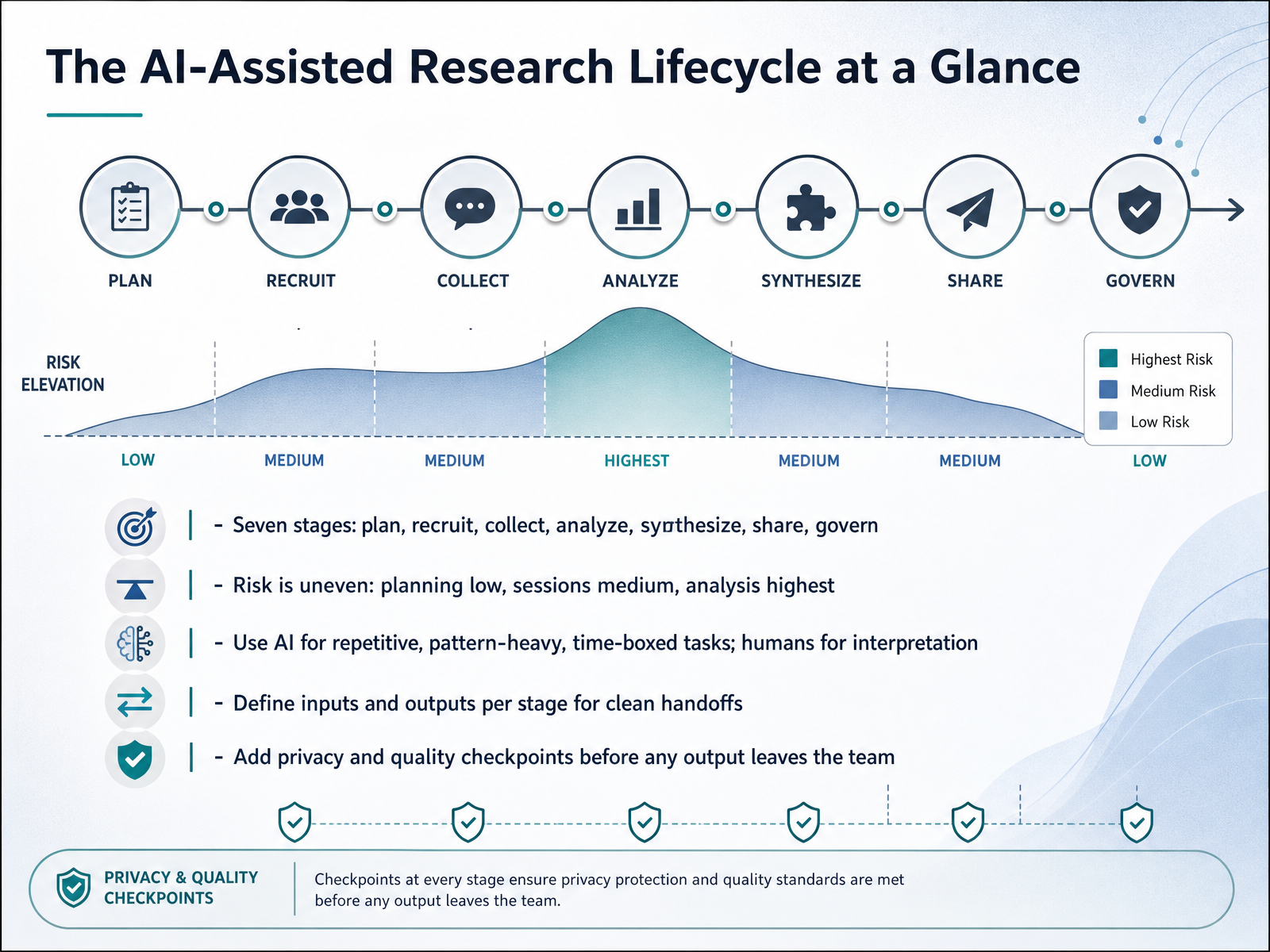
- 02The AI-Assisted Research Lifecycle at a GlanceLet's look at the AI-assisted research lifecycle at a glance. Think of it as seven stages: plan, recruit, collect, analyze, synthesize, share, and govern. Now notice that risk is not even. Planning is low risk. Live sessions are medium. Analysis is highest, because that's where interpretation and bias creep in. So use AI for repetitive, pattern-heavy, time-boxed tasks, like screening respondents or tagging transcript segments. Keep humans on interpretation, like deciding what a theme means for the roadmap. For clean handoffs, define the input and output of each stage up front. For example, a screener goes in, a ranked participant list comes out, and a researcher spot-checks a sample before sessions begin. And before any output leaves the team, such as an insight report, add privacy and quality checkpoints. Next, we'll go deeper into guardrails first: privacy, consent, and data handling.
 ethn.iocleverx.comethn.io+22 min
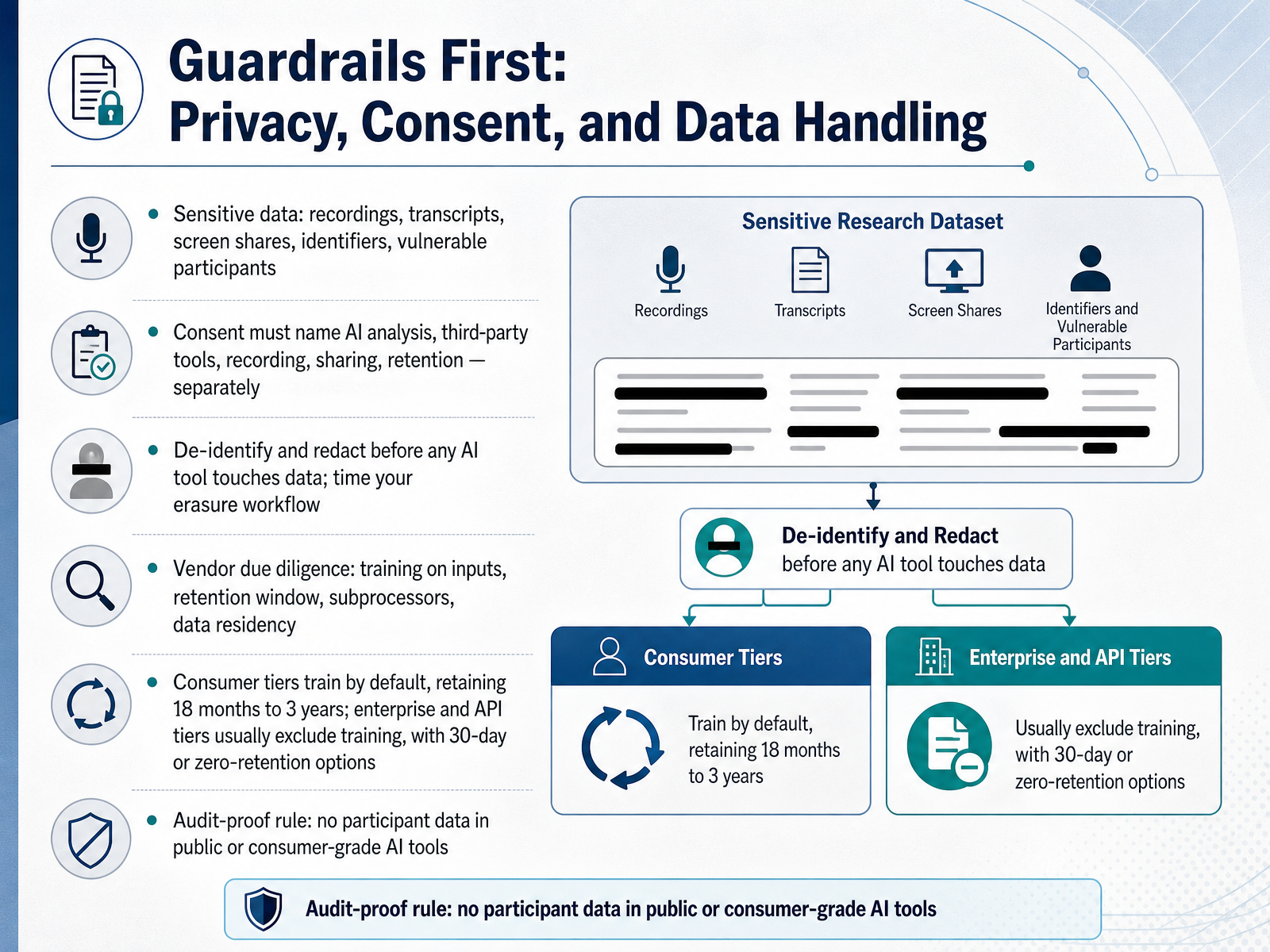
 - 03Guardrails First: Privacy, Consent, and Data HandlingLet's make guardrails the first thing you set up, before any participant data touches an AI tool. Sensitive data includes recordings, transcripts, screen shares, and direct identifiers, and it deserves extra care when participants are vulnerable. Your consent form must name AI analysis, third-party tools, recording, sharing, and retention separately, not as one bundled clause. Before you paste transcripts, strip participant names and replace them with role codes, then confirm your erasure workflow is timed to your stated retention window. Run vendor due diligence and ask directly: does the tool train on inputs, what is the retention window, who are the subprocessors, and where does data reside. Consumer tiers train by default and often retain data for eighteen months to three years, while enterprise and API tiers usually exclude training and offer thirty-day or zero-retention options. So keep this audit-proof rule: no participant data in public or consumer-grade AI tools. Next, we'll look at Planning and Study Design with AI.
 conductatlas.comdevelopers.openai.comaipolicydesk.com+21 min
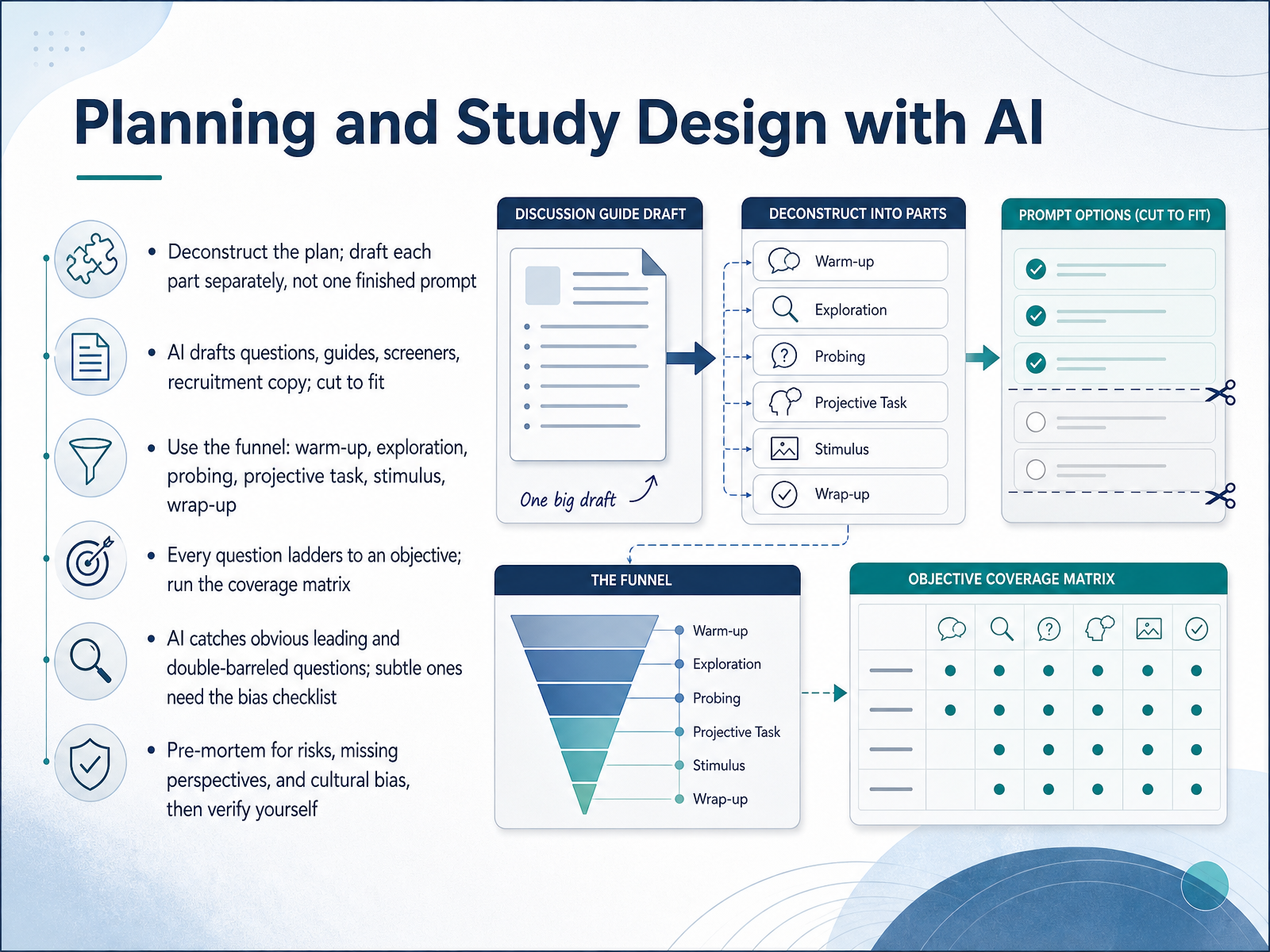
 - 04Planning and Study Design with AILet's move into planning and study design. Don't ask AI for one finished prompt. Deconstruct the plan and draft each part separately. AI can draft questions, guides, screeners, and recruitment copy. Cut each draft to fit. Then structure the guide with the funnel: warm-up, exploration, probing, a projective task, stimulus, and wrap-up. Every question must ladder to an objective, so run the coverage matrix and flag any objective with no question. AI will catch obvious leading and double-barreled questions, but subtle ones need your bias checklist. Finish with a pre-mortem for risks, missing perspectives, and cultural bias. Then verify it yourself before anyone sees it. Next, we'll cover recruiting, scheduling, and research ops with AI.
 medium.comnetizenexperience.commerren.io+21 min
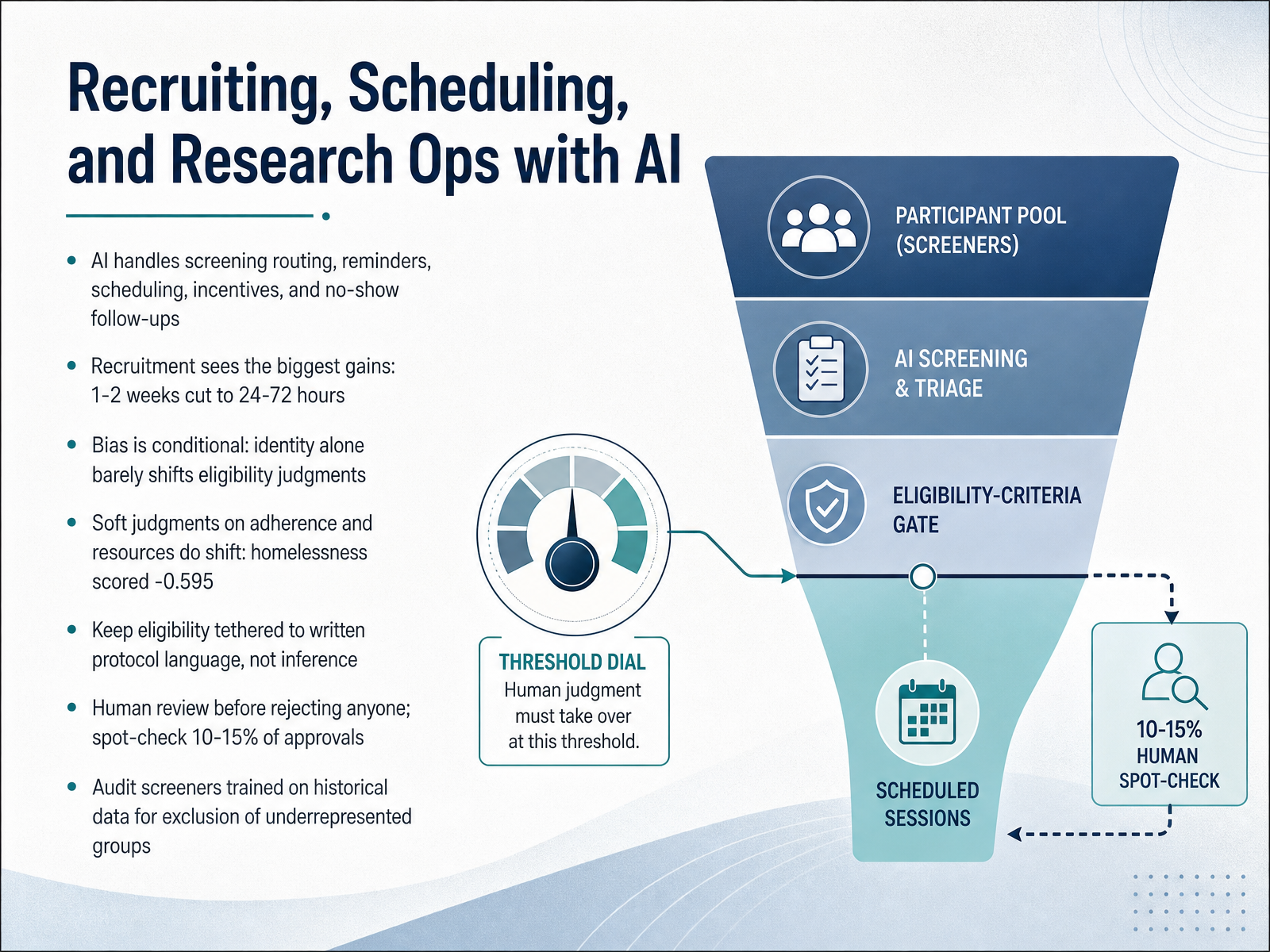
 - 05Recruiting, Scheduling, and Research Ops with AINext, let's look at recruiting, scheduling, and research ops. AI can handle screening routing, reminders, scheduling, incentives, and no-show follow-ups. The biggest gains land in recruitment: timelines that took one to two weeks can shrink to twenty-four to seventy-two hours. Take a pause here and think about your screener. Bias is conditional. Identity alone barely shifts eligibility judgments. But soft judgments on adherence and resources do shift. For example, homelessness scored minus zero point five nine five on adherence. So keep eligibility tethered to your written protocol language, not inference. Require human review before rejecting anyone, and spot-check ten to fifteen percent of approvals. Finally, audit screeners trained on historical data for exclusion of underrepresented groups. Coming up next, AI in live sessions: moderation, notes, and transcription.
 doi.orgdoi.orgai.jmir.org+21 min
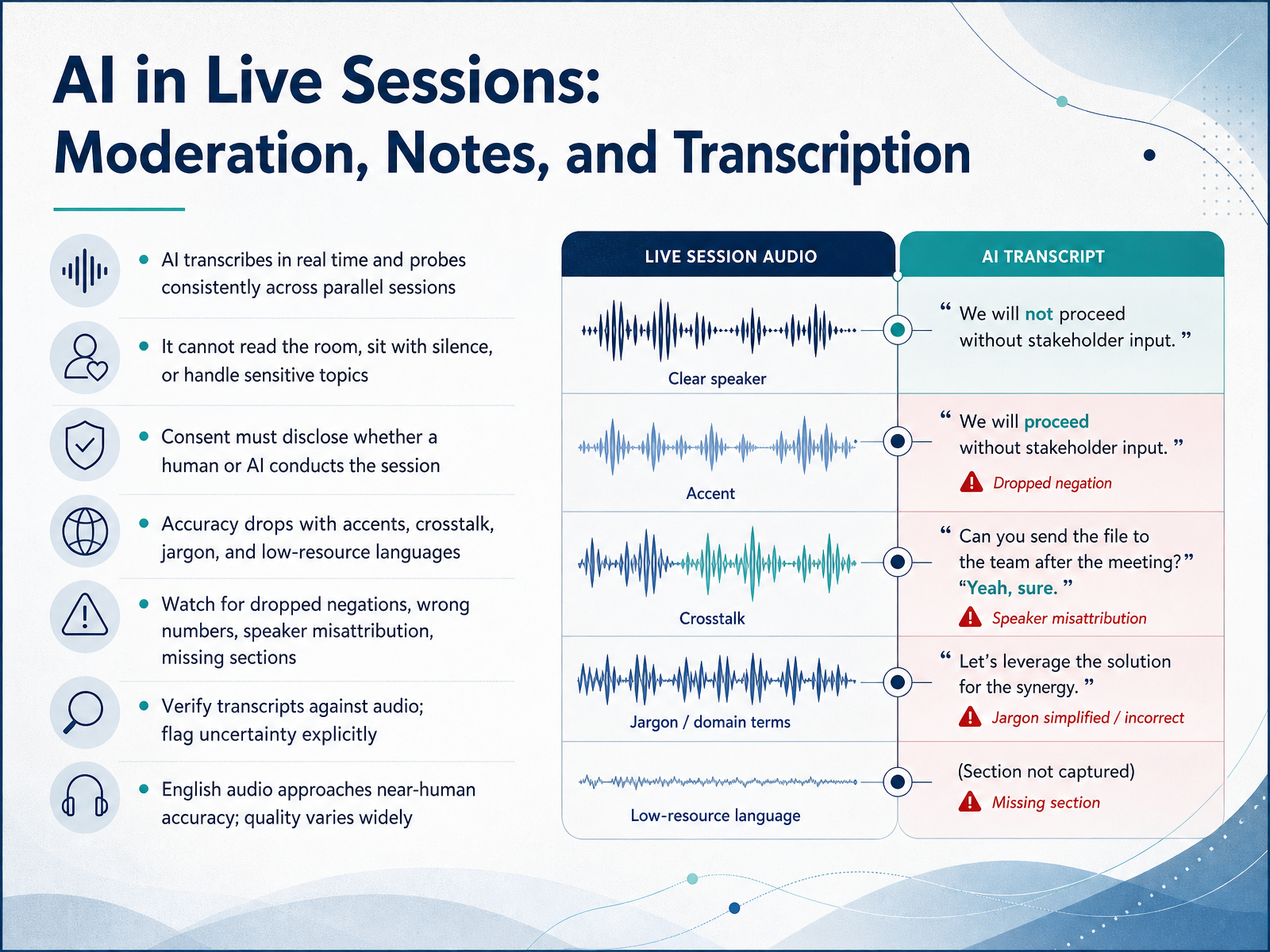
 - 06AI in Live Sessions: Moderation, Notes, and TranscriptionNow let's talk about AI inside the live session itself: moderation, notes, and transcription. Here's what works well. AI transcribes in real time, and it probes consistently across parallel sessions, so a screener question or interview guide gets applied the same way every time. Pause here. Now here's the limit. It cannot read the room, sit with silence, or handle sensitive topics. That part stays human. Pause. On consent, be explicit. Your consent form must disclose whether a human or an AI conducts the session. Pause. Expect accuracy to drop with accents, crosstalk, jargon, and low-resource languages. Pause. And watch for the classic failure modes: dropped negations, wrong numbers, speaker misattribution, and missing sections. Pause. So before you code anything, verify transcripts against the audio, and flag uncertainty explicitly rather than guessing. Pause. One benchmark to hold onto: English audio approaches near-human accuracy, but quality varies widely across languages and audio conditions. Treat the transcript as a first draft, not the final dataset. Next, we move from raw data to themes, with AI-assisted analysis and coding.
 2 min
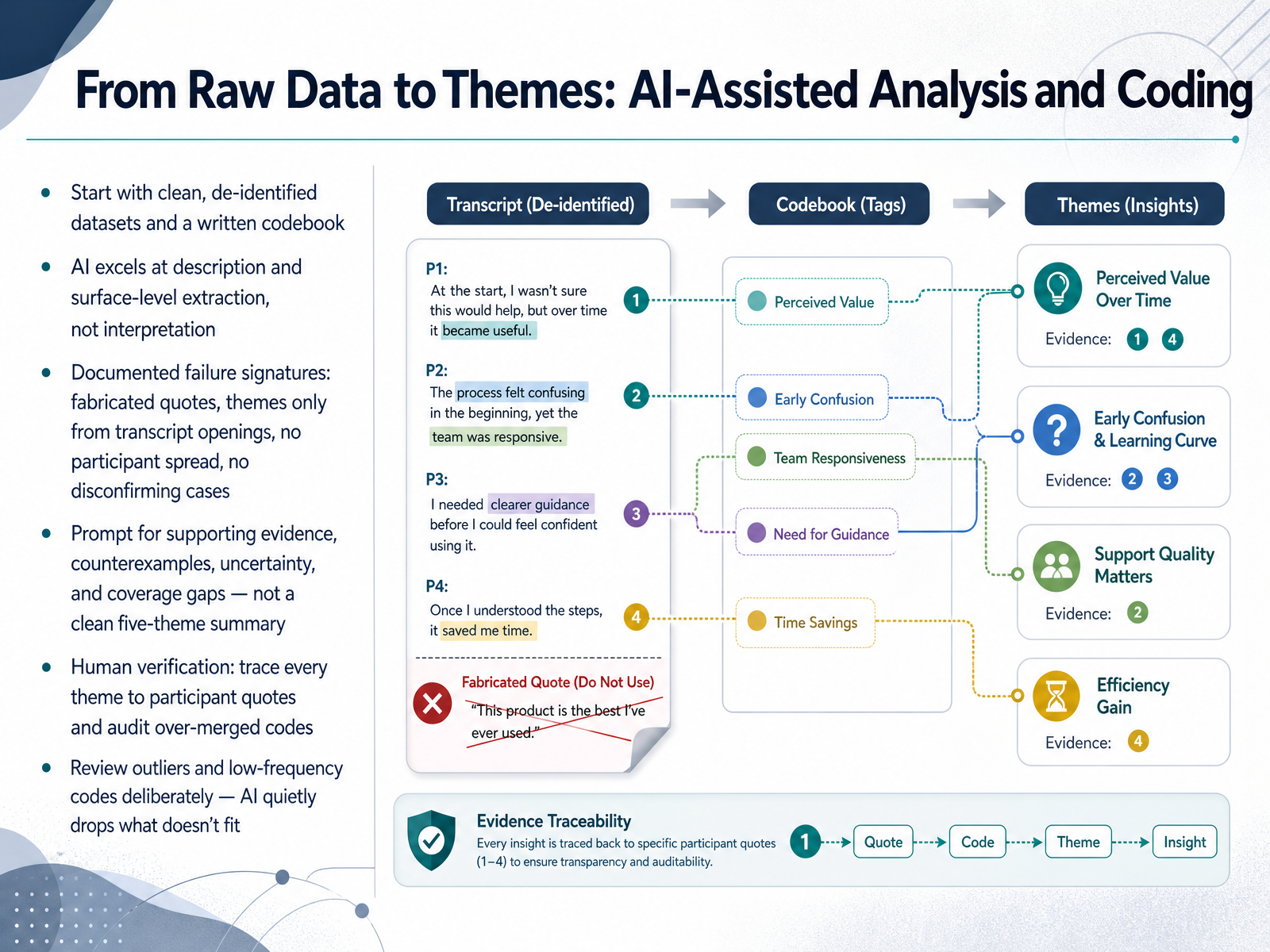
2 min - 07From Raw Data to Themes: AI-Assisted Analysis and CodingLet's turn raw data into themes, with AI assisting and you in control. Start with clean, de-identified datasets and a written codebook. Before you paste any transcript, strip participant names and replace them with role codes, then check that against your consent scope and IRB approval. Now set expectations correctly. AI excels at description and surface-level extraction, not interpretation. So prompt for supporting evidence, counterexamples, uncertainty, and coverage gaps, not a clean five-theme summary. Document the known failure signatures. Fabricated quotes. Themes drawn only from the openings of transcripts. No participant spread. No disconfirming cases. For human verification, trace every theme back to participant quotes, and audit over-merged codes. Then deliberately review outliers and low-frequency codes, because AI quietly drops what doesn't fit. Keep this loop tight, and you keep the rigor. Next, let's look at synthesis, storytelling, and artifacts people act on.
 ethn.iocleverx.comethn.io+22 min
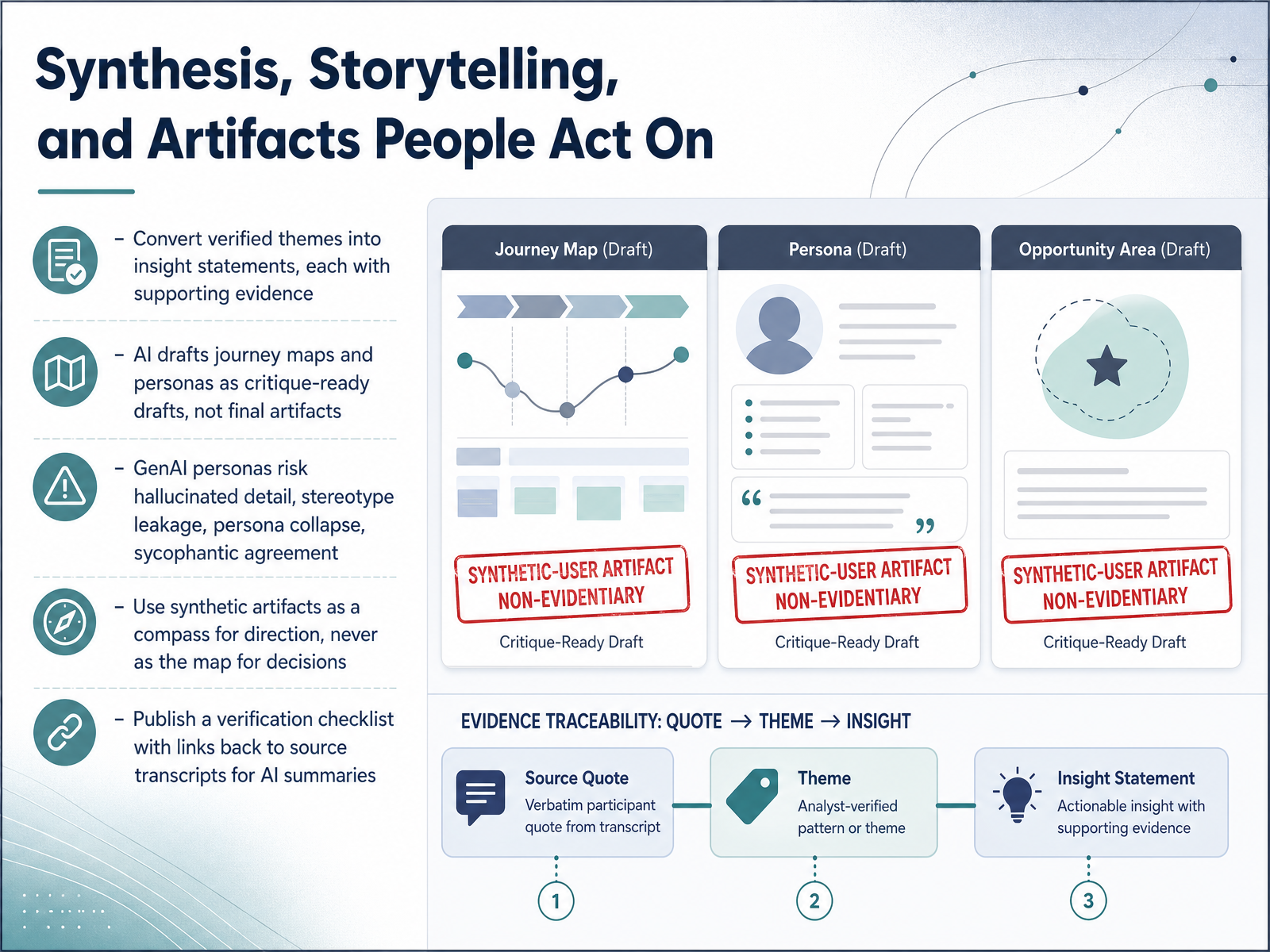
 - 08Synthesis, Storytelling, and Artifacts People Act OnNow let's turn verified themes into artifacts people actually act on. First, write each insight statement with its supporting evidence attached, so the claim and the proof travel together. Next, let AI draft your journey maps and personas as critique-ready drafts, never final artifacts. Pause here. Before you share a synthetic persona, check for hallucinated detail, stereotype leakage, persona collapse, and sycophantic agreement. Then treat synthetic artifacts as a compass for direction, never as the map for decisions. Close the loop by publishing a verification checklist with links back to your source transcripts, so anyone can trace an AI summary to the quotes behind it. That traceability is what keeps stakeholders trusting the work. Next, we'll look at evals and quality control for AI research outputs.
 1 min
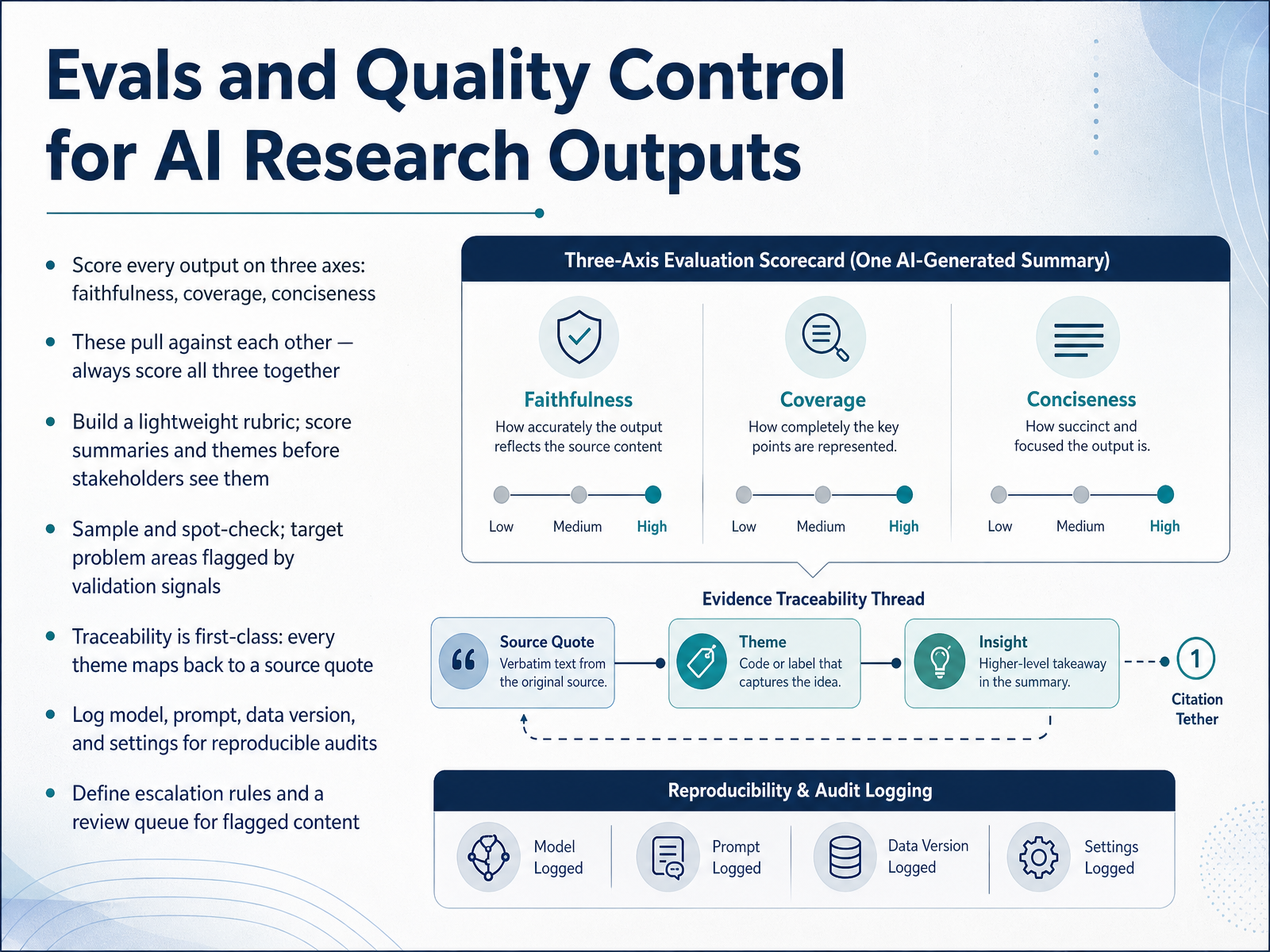
1 min - 09Evals and Quality Control for AI Research OutputsLet's talk about how you quality control what the AI hands back. Start by scoring every output on three axes: faithfulness, coverage, and conciseness. They pull against each other, so always score all three together. A summary can be faithful and complete yet bloated, or tight but missing your key point. Next, build a lightweight rubric, and score summaries and themes before any stakeholder sees them. Then sample and spot-check, targeting problem areas flagged by validation signals. Make traceability first-class. Every theme maps back to a source quote, so a claim like pricing friction should link to the exact transcript line. Log the model, prompt, data version, and settings for reproducible audits. Finally, define escalation rules and a review queue for flagged content. The takeaway: trust the evidence chain, not the polish. That sets up our next topic, Four Critical Handoff Points in the Human-AI Workflow.
 2 min
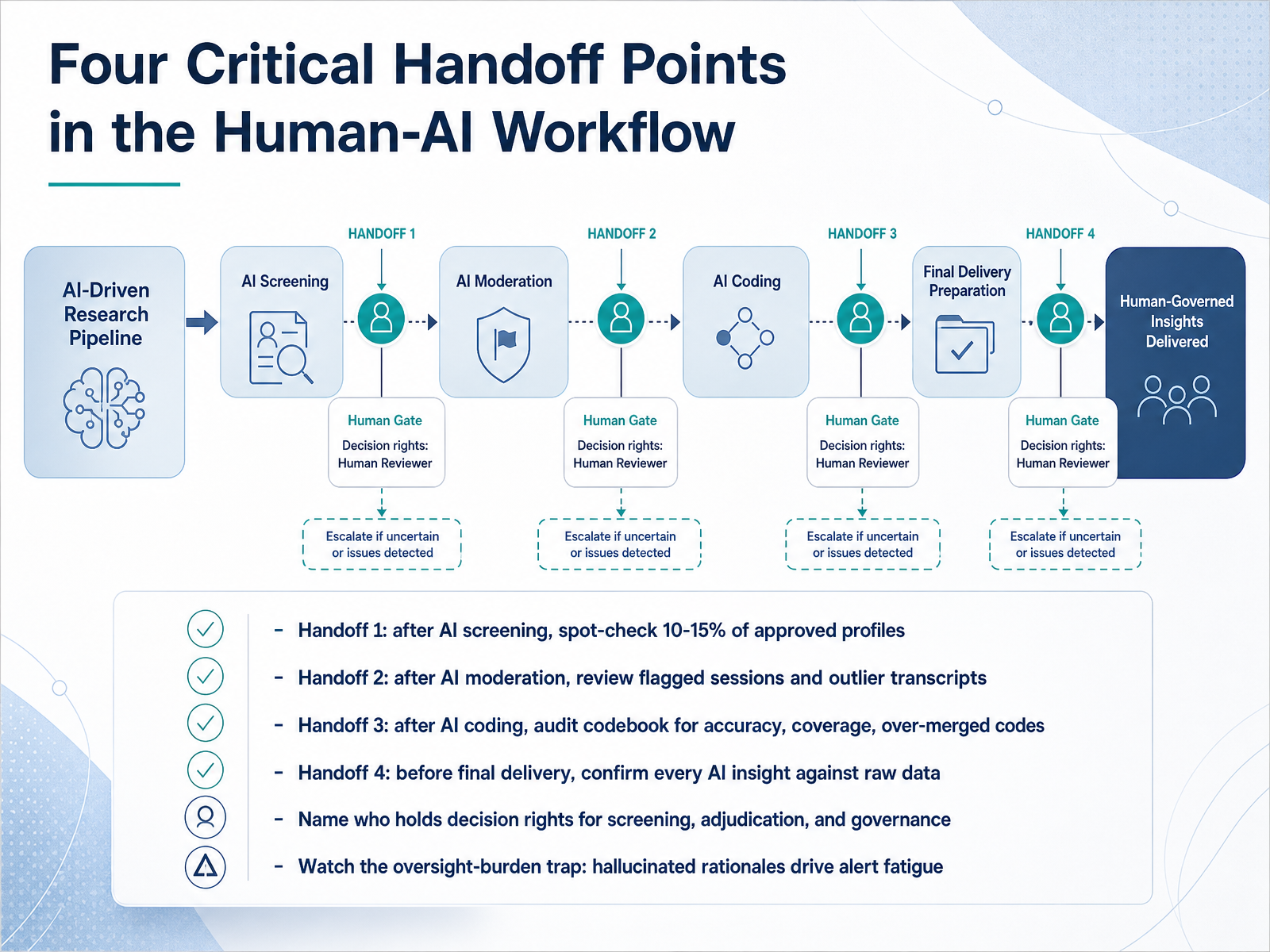
2 min - 10Four Critical Handoff Points in the Human-AI WorkflowLet's walk through the four critical handoff points in a human-AI workflow. Handoff one: after AI screening, spot-check ten to fifteen percent of approved profiles for role, seniority, and industry accuracy. Pause here and confirm that sample matches your screener intent. Handoff two: after AI moderation, review flagged sessions and outlier transcripts, because low-frequency signals are often your most valuable. Handoff three: after AI coding, audit the codebook for accuracy, coverage, and over-merged codes that collapse distinct concepts. Handoff four: before final delivery, confirm every AI insight against raw data and source quotes. Also name who holds decision rights for screening, adjudication, and governance. And watch the oversight-burden trap: hallucinated rationales drive alert fatigue. So keep overrides intentional and auditable. Next, we turn to team governance: policy, roles, and training.
 ethn.iocleverx.comethn.io+22 min
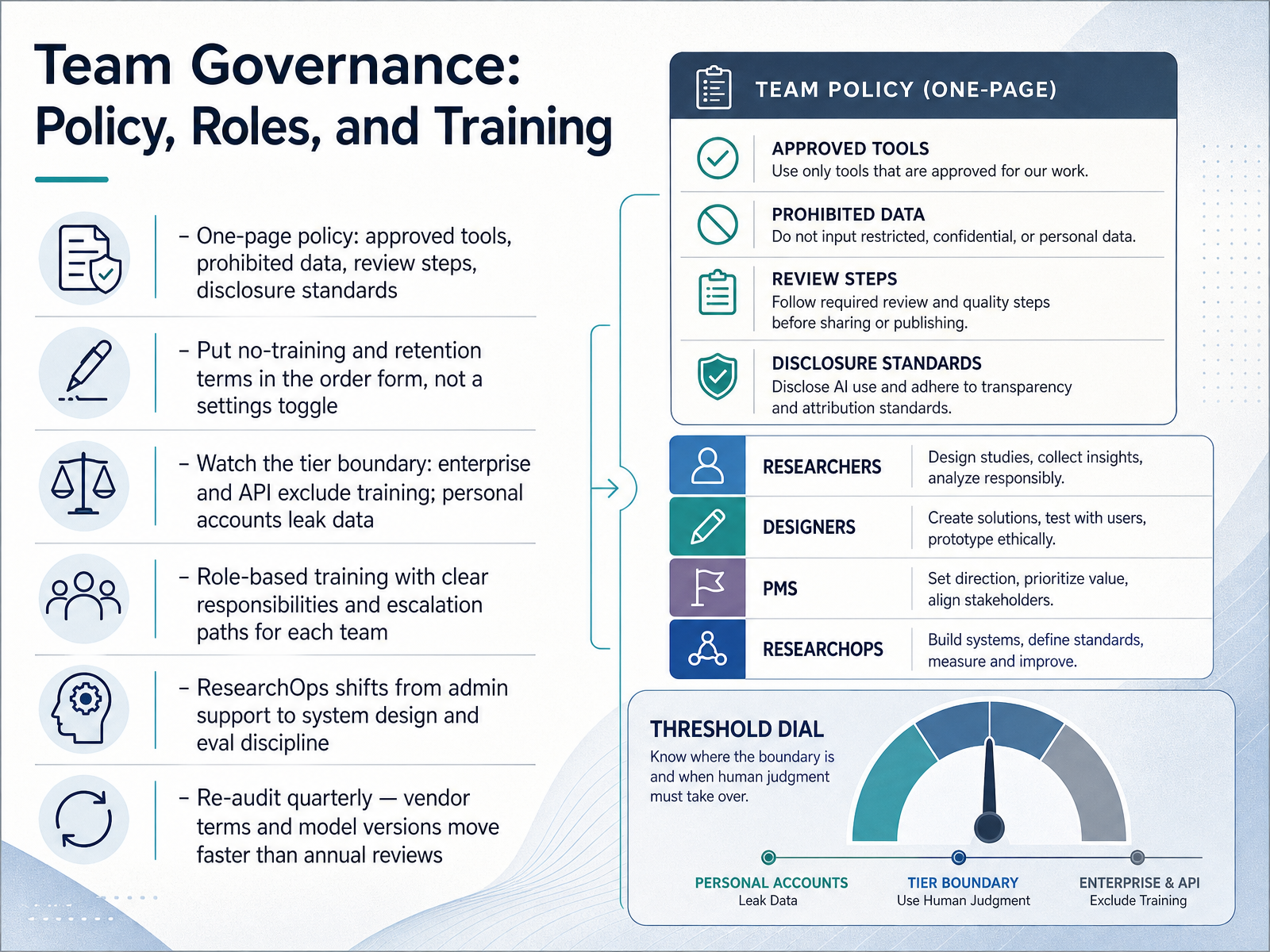
 - 11Team Governance: Policy, Roles, and TrainingLet's talk about team governance, because individual good habits don't scale. Start with a one page policy. Name approved tools, prohibited data, review steps, and disclosure standards. Then put no-training and retention terms in the order form, not a settings toggle. A sales rep's verbal assurance won't override the contract. Watch the tier boundary closely. Enterprise and API tiers usually exclude training, but personal accounts can leak participant data into training pipelines. Next, assign role based training with clear responsibilities and escalation paths. Your ResearchOps lead shifts from admin support to system design and evaluation discipline. Finally, re-audit quarterly, because vendor terms and model versions move faster than annual reviews. That cadence is what keeps your insight report defensible. Next, we'll walk through a 30-Day Adoption Plan and Metrics That Matter.
 conductatlas.comdevelopers.openai.comaipolicydesk.com+21 min
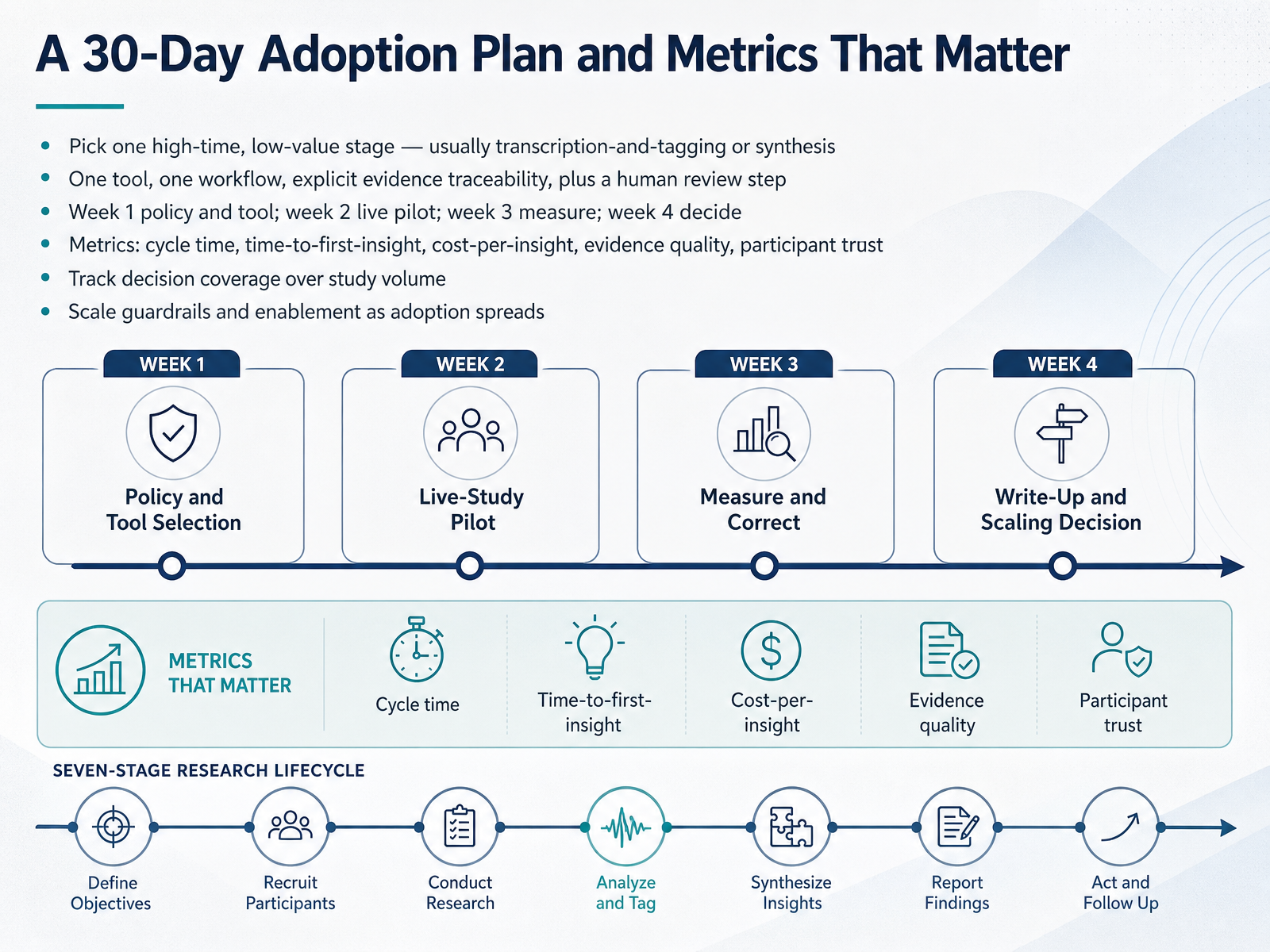
 - 12A 30-Day Adoption Plan and Metrics That MatterLet's talk about turning all of this into a thirty-day plan. Start by picking one high-time, low-value stage, usually transcription-and-tagging or synthesis. Choose one tool and one workflow, with explicit evidence traceability and a human review step. Then sequence it: week one, write the policy and stand up the tool. Week two, run a live pilot on a real study. Week three, measure honestly. Week four, decide whether to scale, adjust, or stop. Track five metrics: cycle time, time-to-first-insight, cost-per-insight, evidence quality, and participant trust. Also track decision coverage over study volume, so you can see whether more studies actually inform more decisions. As adoption spreads, add scale guardrails and enablement. If your pilot gains are real, expand to a second stage. Next, let's cover what to keep human as tools keep changing.
 ethn.iocleverx.comethn.io+22 min
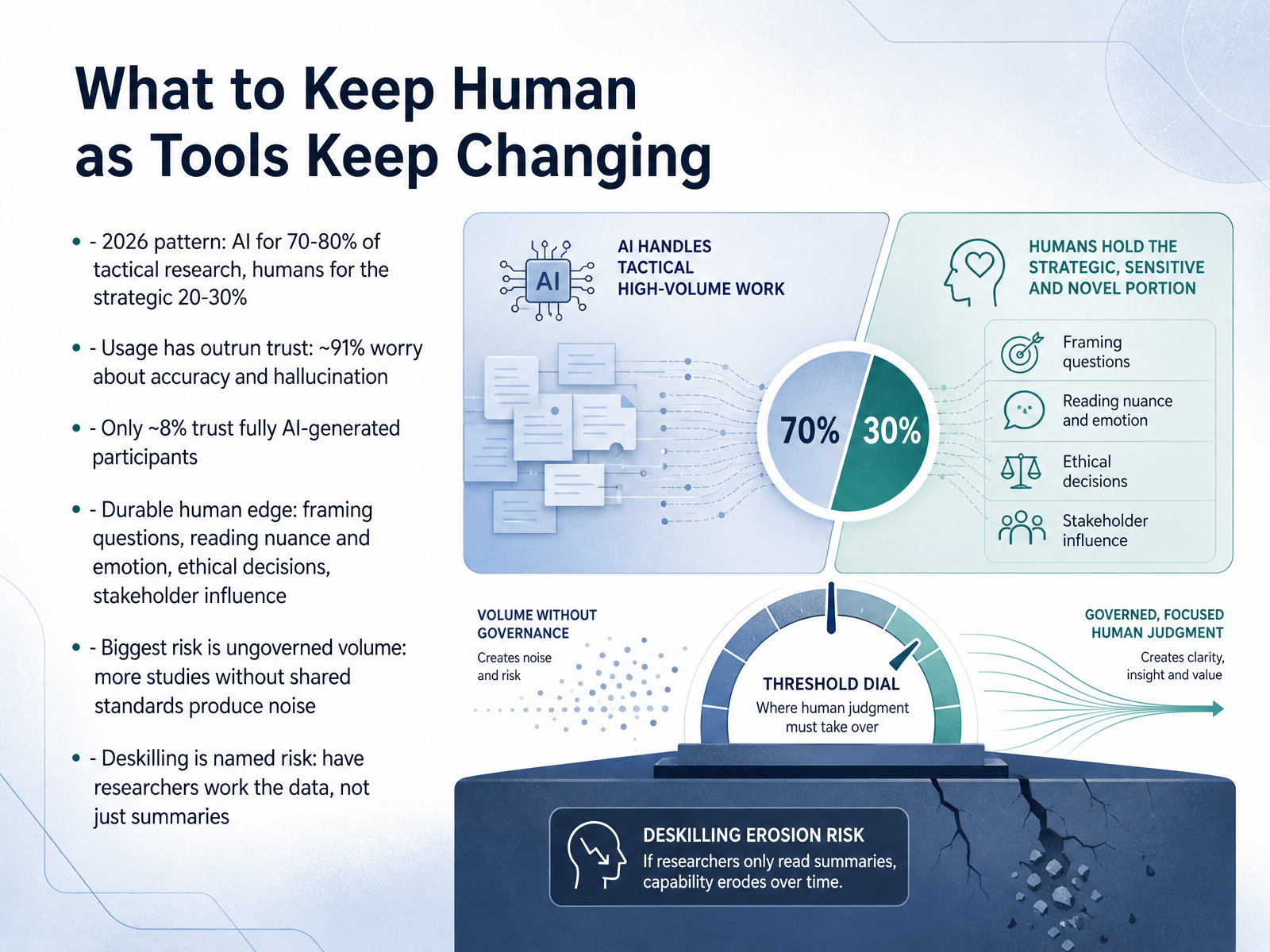
 - 13What to Keep Human as Tools Keep ChangingNow, let's talk about what to keep human as tools keep changing. The two thousand twenty-six pattern is clear. Let AI carry about seventy to eighty percent of tactical work, like transcription and first-pass tagging. You keep the strategic twenty to thirty percent. But usage has outrun trust. Roughly ninety-one percent of researchers worry about accuracy and hallucination. And only about eight percent fully trust AI-generated participants. So hold onto the durable human edge. Framing questions. Reading nuance and emotion. Ethical decisions. Stakeholder influence. The biggest risk is ungoverned volume. More studies without shared standards just produce noise. And deskilling is a named risk, so have researchers work the raw data, not only the summaries. Next, let's put this into practice on one study stage.
 1 min
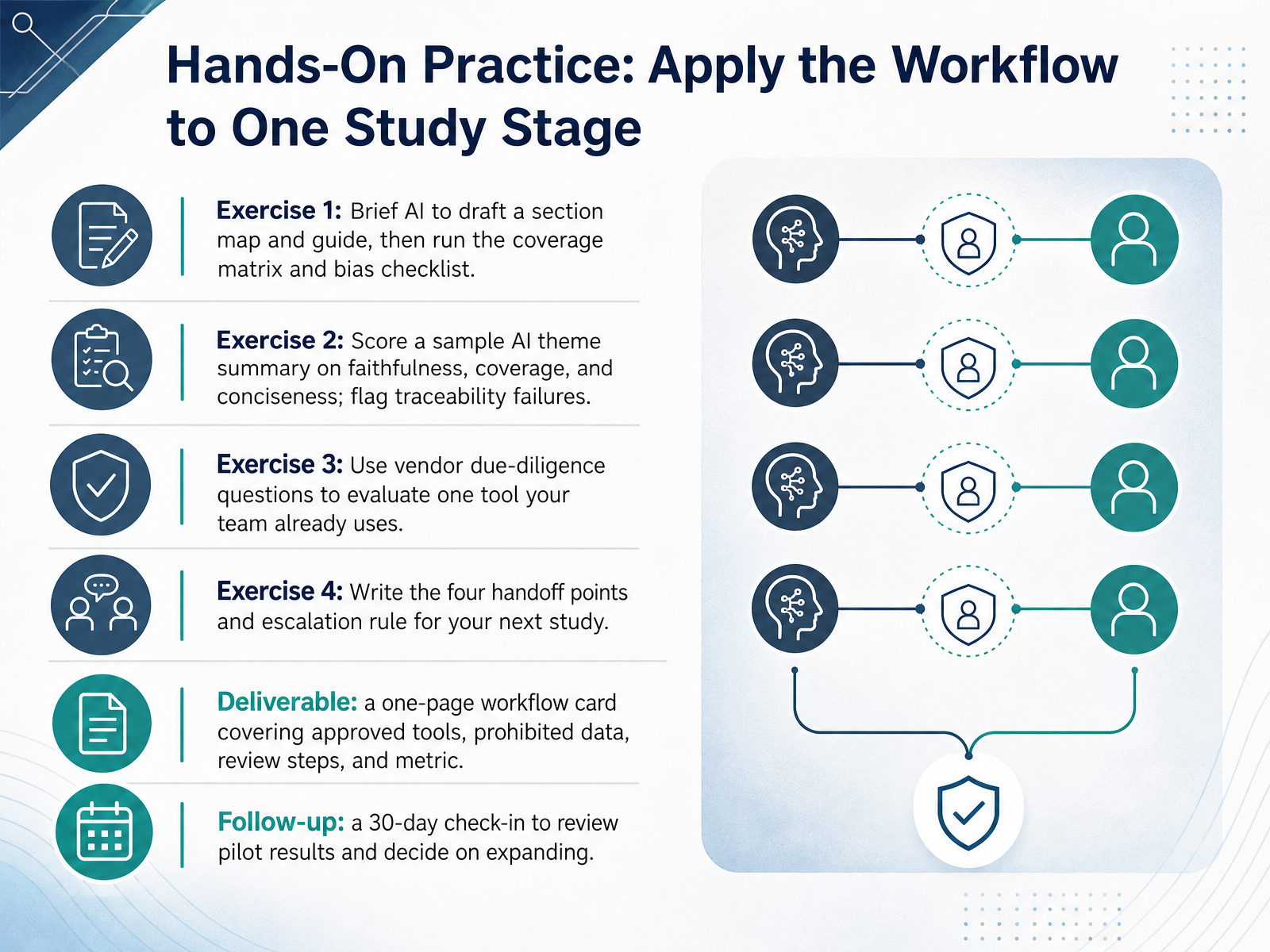
1 min - 14Hands-On Practice: Apply the Workflow to One Study StageLet's put the workflow to work on one study stage. Pick a stage you're running now and choose one or two exercises. First, brief your AI tool with static and dynamic context, then ask for a section map before any questions. Review the funnel and objectives, then draft the guide. Run the coverage matrix and the five point bias checklist before you write a single question you intend to ask. Pause and note which exercise fits your current timeline. Second, score a sample AI theme summary on faithfulness, coverage, and conciseness. Verify each theme against raw quotes, check segment splits, and flag any traceability failures where a claim has no supporting quote. Third, take one tool your team already uses and run the vendor due diligence questions. Ask whether it trains on your inputs, who can review them, how long data is retained, and what the liability cap is. Before you paste transcripts, strip participant names and replace them with role codes. Fourth, write the four handoff points, including the escalation rule, for your next study. Your deliverable is a one page workflow card listing approved tools, prohibited data, review steps, and one success metric. Schedule a thirty day check in to review pilot results and decide whether to expand. Thanks for working through all fourteen slides with me. You now have a repeatable, defensible workflow. Start small, stay rigorous, and let your research judgment lead.
 medium.comnetizenexperience.commerren.io+22 min
Take the deck with you
Download this course as a file — free, no sign-up needed.
- PDF handoutEvery slide page, ready to print or share.15 pages · 4.4 MBDownload
- Narrated PowerPointThe deck that presents itself — every slide carries the digital human's narration video.15 pages · 25.3 MBDownload
- PowerPoint slidesThe full deck as a .pptx — open it in PowerPoint, Keynote, or Google Slides.15 pages · 4.3 MBDownload
Free to use in your own training — please keep the PersonWise credit page at the end.
Have your own deck? Turn it into a course
Sources consulted
Web sources consulted while building this course.
- How to Write a Qualitative Discussion Guide Using AI | by Shruthi Venkatesh | Apr, 2026 | Medium — medium.com
- AI in UX Research (Part 3): Designing Discussion Guides and Fieldwork with Gemini | Netizen Experience — netizenexperience.com
- AI-Driven Discussion Guide For Qualitative Research — merren.io
- An AI prompt for creating discussion guides — philmorton.co
- AI User Research: The Complete Guide (2026) — userintuition.ai
- Start Using the Study Lifecycle as Your Framework for AI in UX Research — ethn.io
- Human-AI workflow for user research: best practices | CleverX Blog — cleverx.com
- Google UXR Director on the Study Lifecycle as a Roadmap — ethn.io
- How To Use AI for UX Research in 2026 — designrush.com
- AI in user research 2026: complete playbook | CleverX Blog — cleverx.com
- What 38 AI Companies Actually Say About Your Data (2026), ConductAtlas — conductatlas.com
- Data controls in the OpenAI platform — developers.openai.com
- Does Your AI Vendor Train on Your Business… · AI Policy Desk — aipolicydesk.com
- Zero Training Policy: What Your AI Vendor Owes You in Writing — merciv.com
- AI Data Retention: ChatGPT, Claude, Gemini Policies (2026) — witness.ai
- Sociodemographic bias in large language model clinical trial screening — doi.org
- Use of AI as a Research Recruitment Tool: Ethical Elements, Considerations, and Recommendations — doi.org
- JMIR AI - Large Language Models in Clinical Trial Recruitment: Sociotechnical and Economic Framework Development Study — ai.jmir.org
- Full article: Use of AI as a Research Recruitment Tool — tandfonline.com
- AI/ML-based strategies for enhancing equity, diversity, and inclusion in randomized clinical trials | Trials | Springer Nature Link — link.springer.com