Begin
14 pages · ~28 min
Introduction to Organic Chemistry
This introductory training teaches the fundamentals of organic chemistry, helping learners identify carbon compounds and understand their structure and bonding.
A digital instructor presents all 14 pages. Hold “Ask” at any point and ask out loud — the answer comes from this course. No sign-up needed.
What you’ll learn
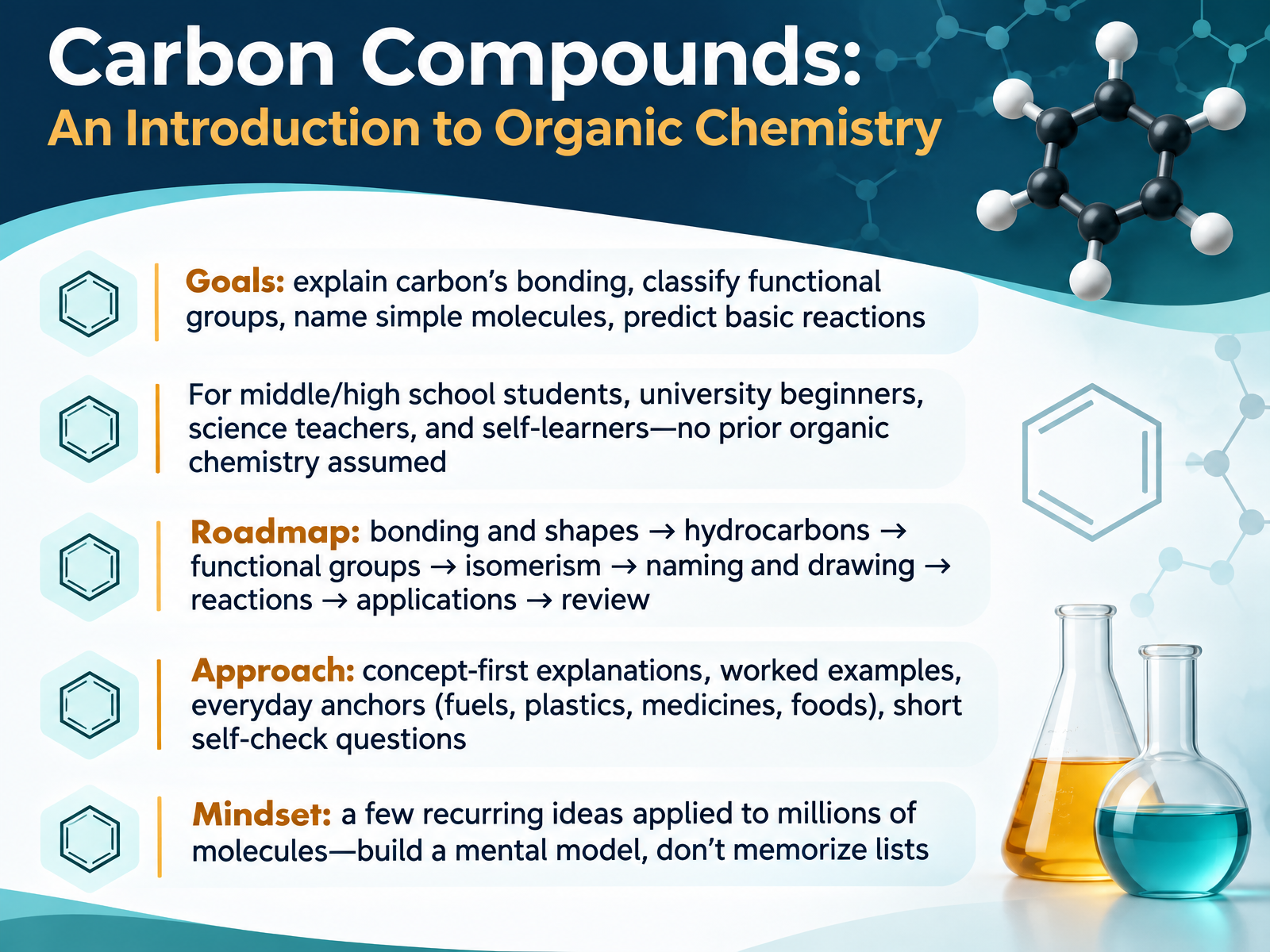
- 01Carbon Compounds: An Introduction to Organic ChemistryWelcome. In this course, we will explore carbon compounds and build a practical introduction to organic chemistry. No prior organic chemistry is needed, so if you are a student, a teacher, or a curious self-learner, you are in the right place. Our goals are clear. We will explain how carbon bonds, classify functional groups, name simple molecules, and predict basic reactions. We will move step by step, from bonding and molecular shapes to hydrocarbons, functional groups, isomerism, naming and drawing, reactions, and real applications. Along the way, we will use familiar anchors like fuels, plastics, medicines, and foods. The key mindset is this. A few recurring ideas apply to millions of molecules, so build a mental model instead of memorizing lists. Think of carbon compounds as family members who share common traits. Let us start by asking why carbon is so special. Next, we look at why carbon, focusing on tetravalence, catenation, and the bonding toolkit.thoughtco.comwou.eduqualifications.pearson.com+22 min
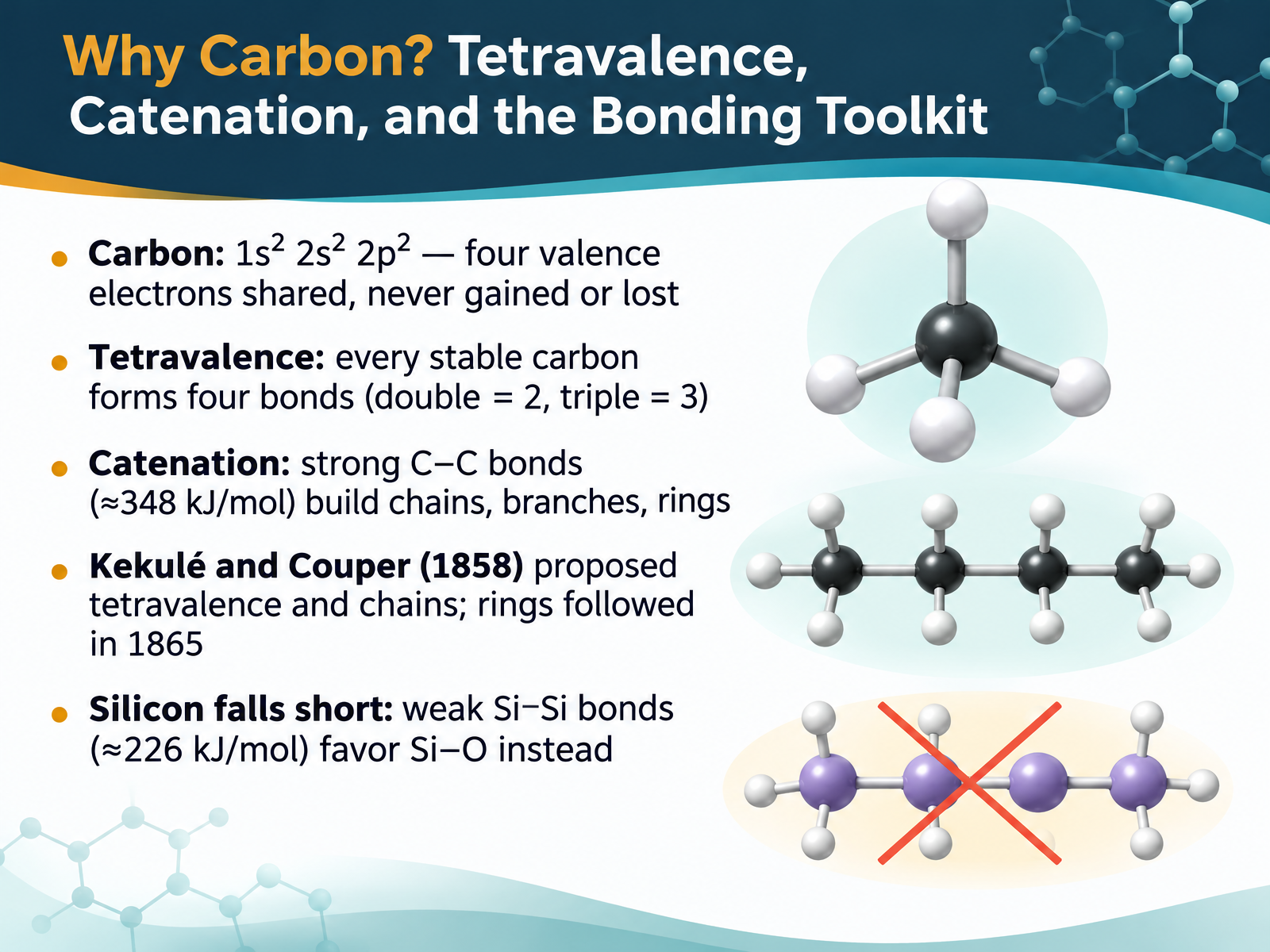
- 02Why Carbon? Tetravalence, Catenation, and the Bonding ToolkitLet's look at why carbon, specifically, is the backbone of organic chemistry. Carbon's electron configuration is one s two, two s two, two p two. That gives it four valence electrons, and it shares all four rather than gaining or losing them. This means every stable carbon forms four bonds. This is called tetravalence. A double bond counts as two bonds, and a triple bond counts as three. Next, catenation means carbon can bond to itself in long chains, branches, and rings. That works because carbon to carbon bonds are strong, about three hundred forty eight kilojoules per mole. In eighteen fifty eight, Kekule and Couper proposed tetravalence and carbon chains, and rings followed in eighteen sixty five. Silicon falls short here. Its silicon to silicon bonds are weak, about two hundred twenty six kilojoules per mole, so it prefers bonding to oxygen instead. The takeaway is simple. Four bonds plus strong carbon to carbon links give us endless carbon skeletons. Next, we turn to the three shapes around carbon, s p three, s p two, and s p.
 openstax.orgtutorda.orgchem.libretexts.org+22 min
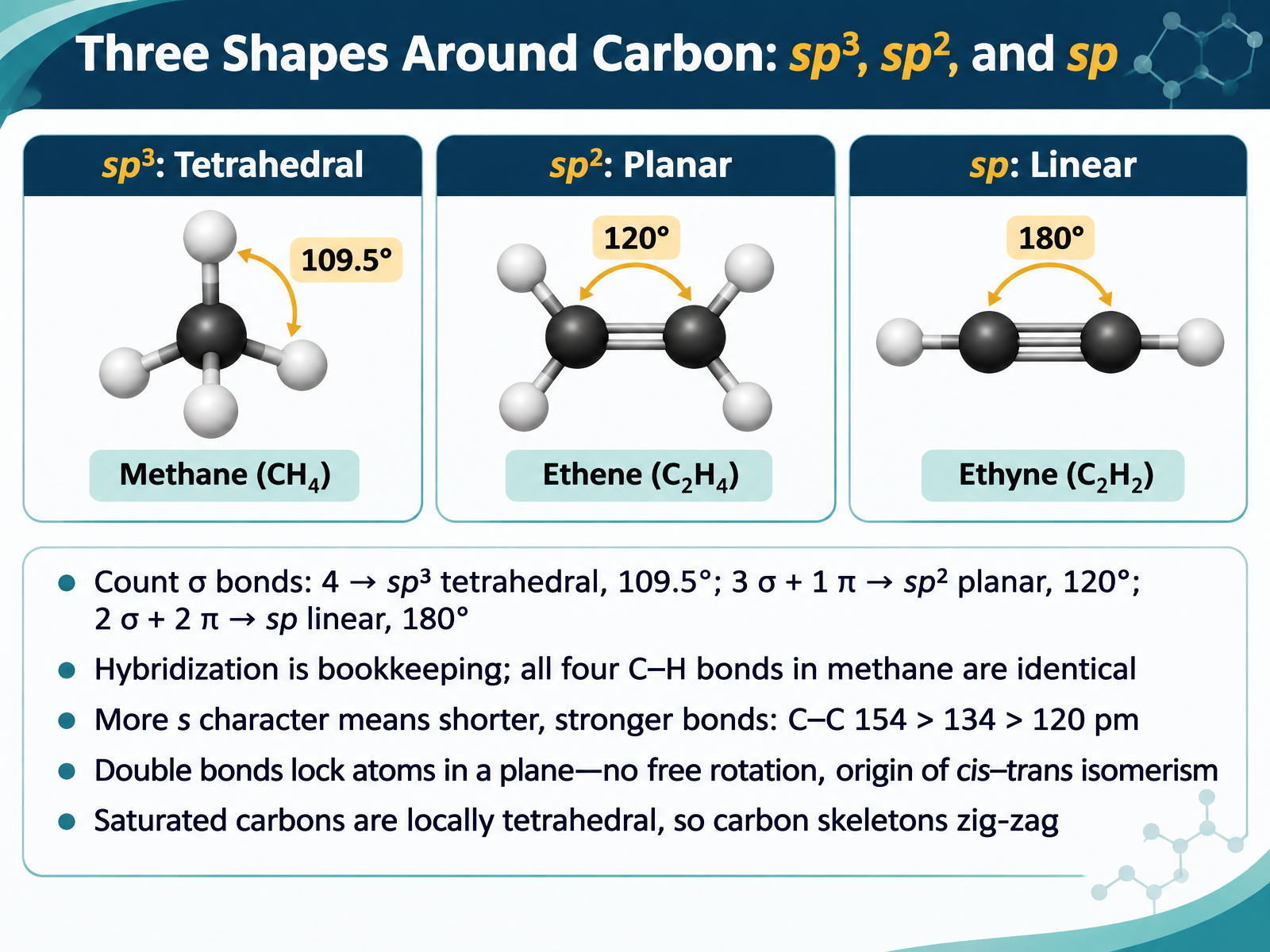
- 03Three Shapes Around Carbon: sp³, sp², and spNow let's look at the three shapes carbon can take. The key idea is simple: count the sigma bonds around a carbon. Four sigma bonds give an sp three carbon. That is tetrahedral, with angles of one hundred nine point five degrees, as in methane. Three sigma bonds plus one pi bond give an sp two carbon. That is flat and trigonal planar, one hundred twenty degrees, as in ethene. Two sigma bonds plus two pi bonds give an sp carbon. That is linear, one hundred eighty degrees, as in ethyne. Think of hybridization as bookkeeping. In methane, all four carbon hydrogen bonds are identical, even though the label sounds complicated. Next, more s character means shorter, stronger bonds. The carbon carbon bond lengths drop from one hundred fifty four picometers in ethane to one hundred thirty four in ethene, and one hundred twenty in ethyne. Also, a double bond locks its atoms in one plane, so there is no free rotation. That is the origin of cis trans isomerism. Finally, saturated carbons are locally tetrahedral, which is why carbon skeletons zig zag. Next, let's build on these shapes in hydrocarbons one: alkanes and the homologous series.
 openstax.orgtutorda.orgchem.libretexts.org+22 min
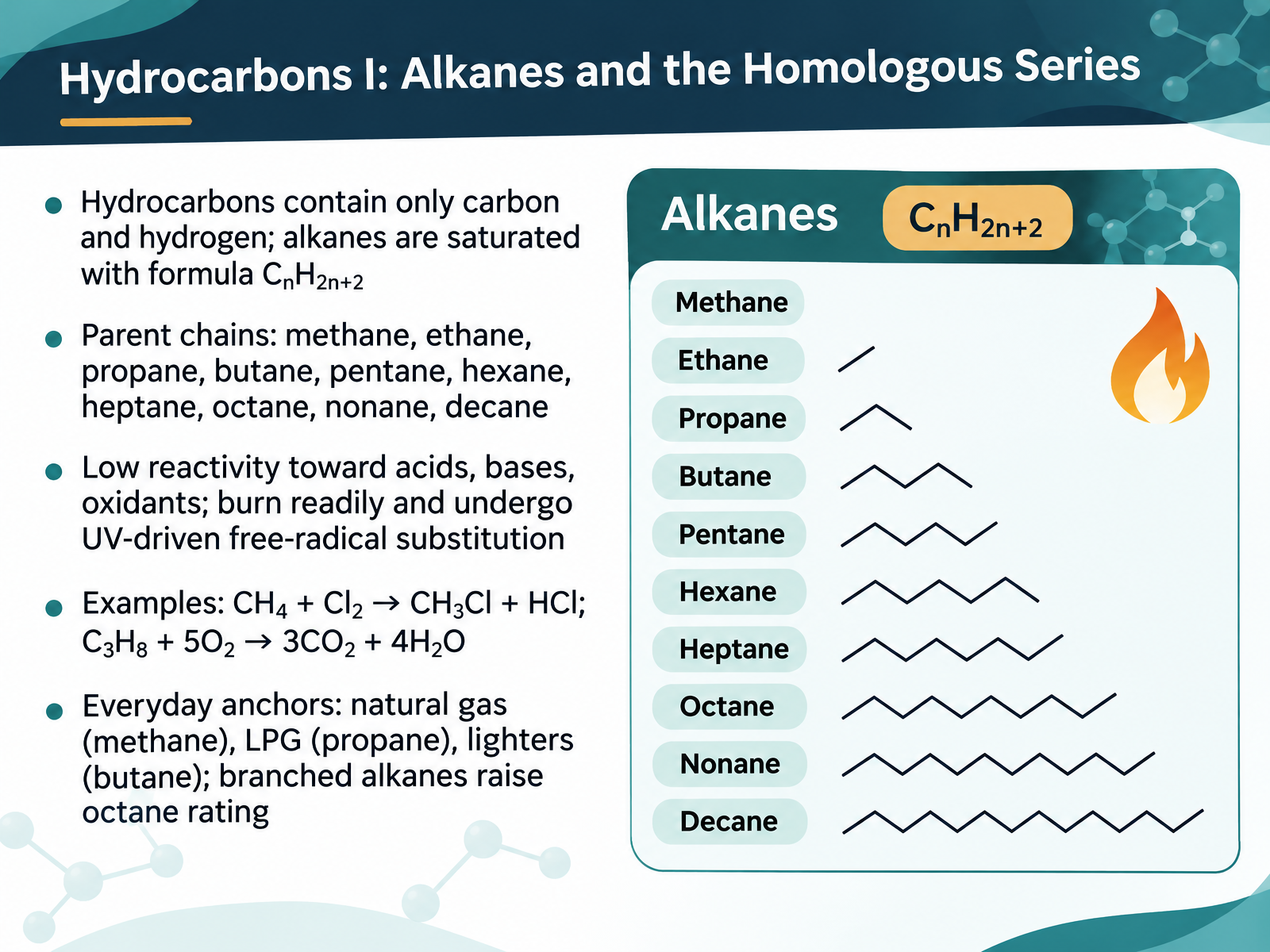
- 04Hydrocarbons I: Alkanes and the Homologous SeriesNow let us look at our first family of hydrocarbons, the alkanes. A hydrocarbon is a compound made only of carbon and hydrogen. Alkanes are saturated, meaning every carbon has only single bonds, and they follow the formula C subscript n H subscript two n plus two. Notice the parent chains: methane, ethane, propane, butane, pentane, hexane, heptane, octane, nonane, and decane. This ordered pattern is called a homologous series. Alkanes are fairly unreactive toward acids, bases, and oxidants, but they burn readily. For example, propane plus five oxygen molecules gives three carbon dioxide plus four water molecules. In ultraviolet light, alkanes also undergo free-radical substitution, such as methane plus chlorine giving chloromethane plus hydrogen chloride. You already meet these compounds daily: natural gas is mostly methane, L P G is propane, and lighters use butane. Branched alkanes help raise gasoline's octane rating. Next, we will explore unsaturated hydrocarbons: alkenes, alkynes, and aromatic rings.
 thoughtco.comwou.eduqualifications.pearson.com+21 min
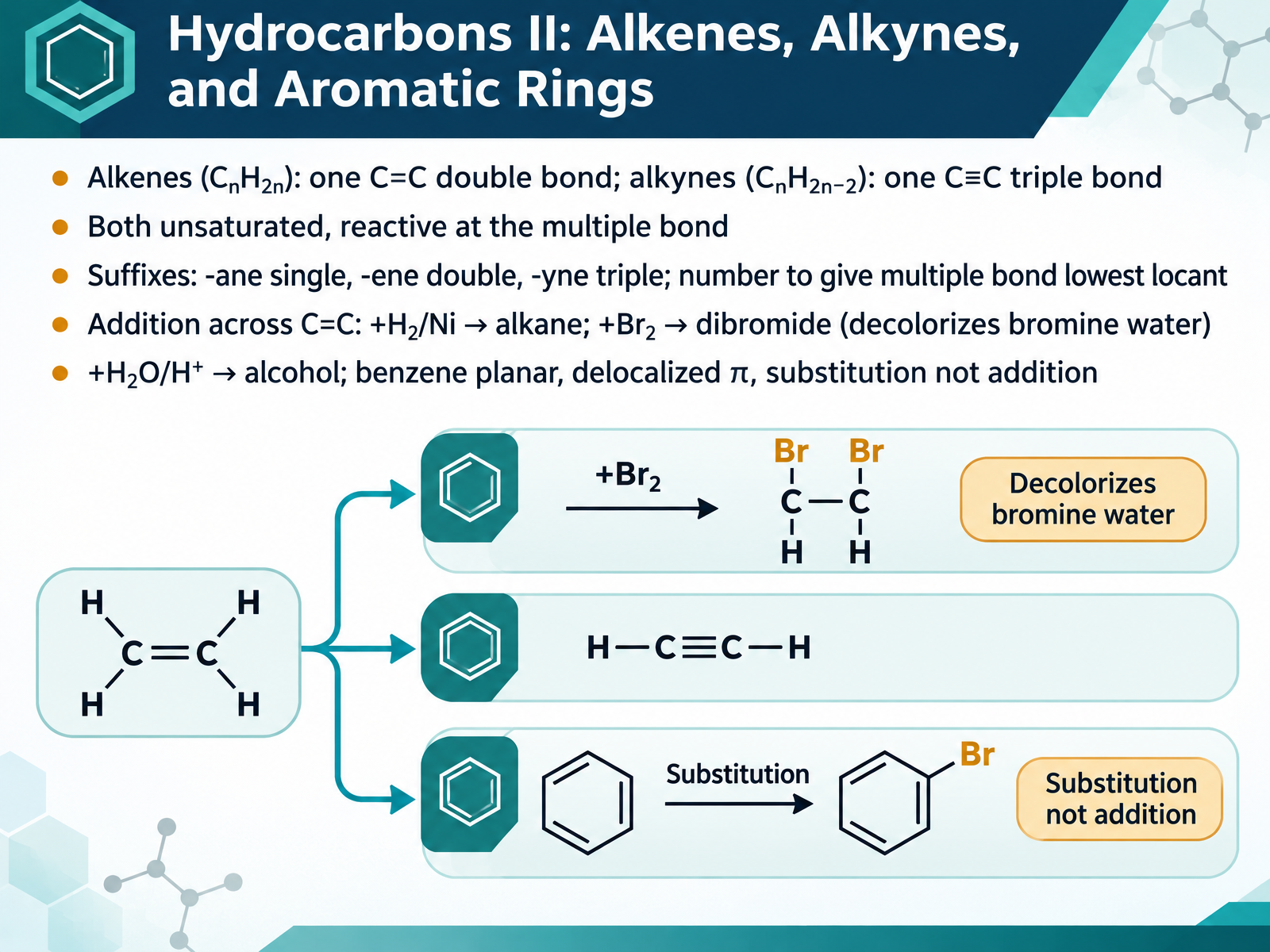
- 05Hydrocarbons II: Alkenes, Alkynes, and Aromatic RingsLet's move on to hydrocarbons with multiple bonds. An alkene has one carbon to carbon double bond, with the formula C n H two n. An alkyne has one carbon to carbon triple bond, with the formula C n H two n minus two. Both are unsaturated, and both are reactive at that multiple bond. For naming, remember the suffixes: ane for single bonds, ene for double bonds, and yne for triple bonds. Number the chain to give the multiple bond the lowest possible locant. Now for the key reactions. Adding hydrogen with a nickel catalyst turns an alkene into an alkane. Adding bromine gives a dibromide, and this decolorizes bromine water, which is a useful test. Adding water with acid gives an alcohol. Aromatic rings like benzene are different. Benzene is planar, with delocalized pi electrons, so it favors substitution rather than addition. Next, we'll look at functional groups, and why they define reactivity.
 thoughtco.comwou.eduqualifications.pearson.com+22 min
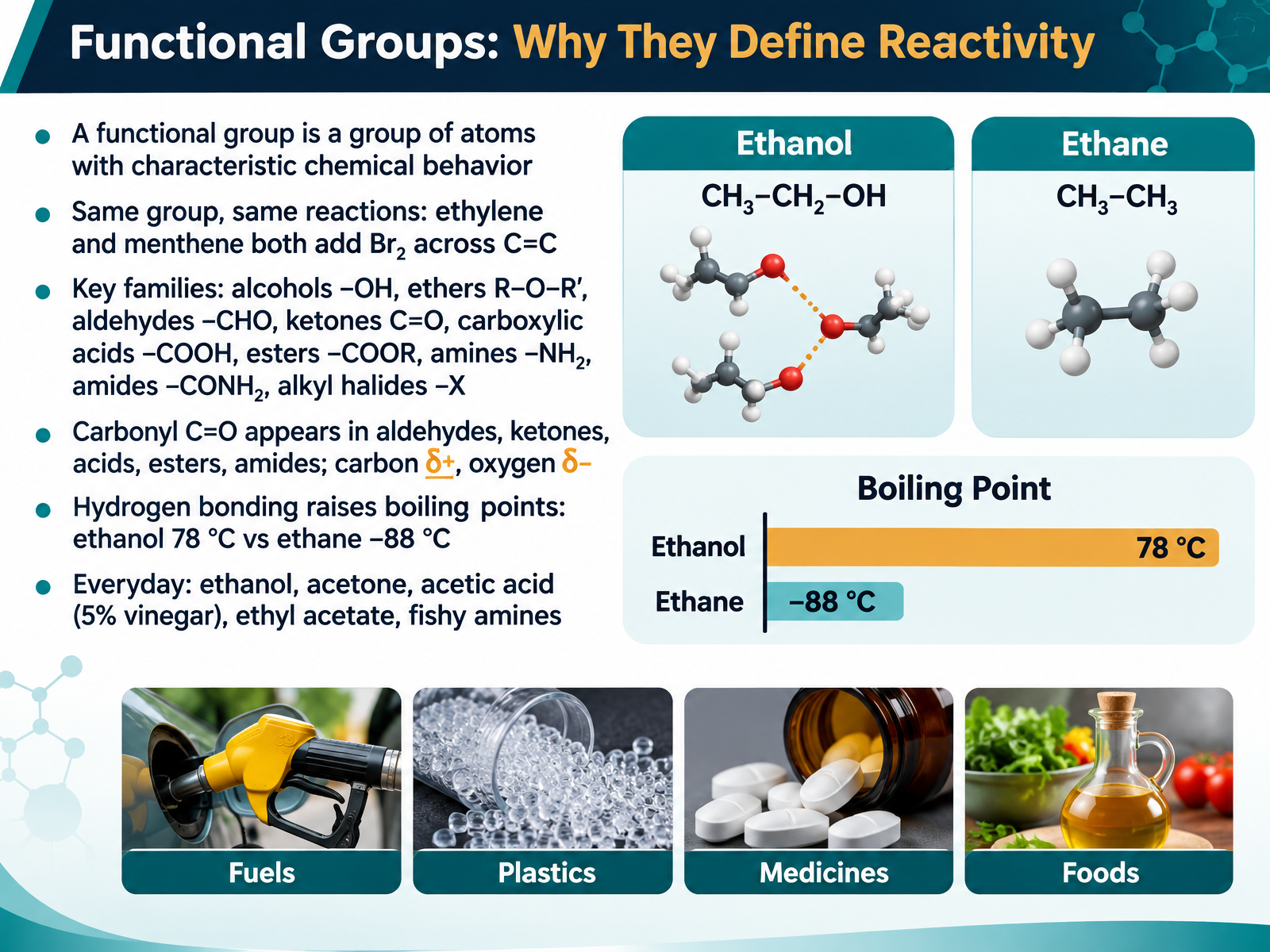
- 06Functional Groups: Why They Define ReactivityNow let's look at functional groups, the parts of a molecule that define its reactivity. A functional group is a group of atoms that has a characteristic chemical behavior. This means the same group undergoes the same reactions, almost regardless of the rest of the molecule. For example, ethylene and menthene are very different in size, yet both add bromine across their carbon-carbon double bond. Next, the key families you should recognize: alcohols with an O H group, ethers, aldehydes, ketones, carboxylic acids, esters, amines, amides, and alkyl halides. Notice the carbonyl group, a carbon double bonded to oxygen, appears in aldehydes, ketones, acids, esters, and amides. In every case, the carbonyl carbon is slightly positive and the oxygen is slightly negative. This polarity helps explain properties. For instance, hydrogen bonding raises boiling points, so ethanol boils at seventy-eight degrees Celsius, while ethane boils near minus eighty-eight degrees Celsius. You meet these groups daily in ethanol, acetone, the acetic acid in five percent vinegar, ethyl acetate, and the fishy smell of amines. So, remember that functional groups give us a powerful shortcut for predicting how organic molecules behave. Next, we move on to isomerism: same formula, different molecules.
 ck12.orgopenstax.orgopen.edu+22 min
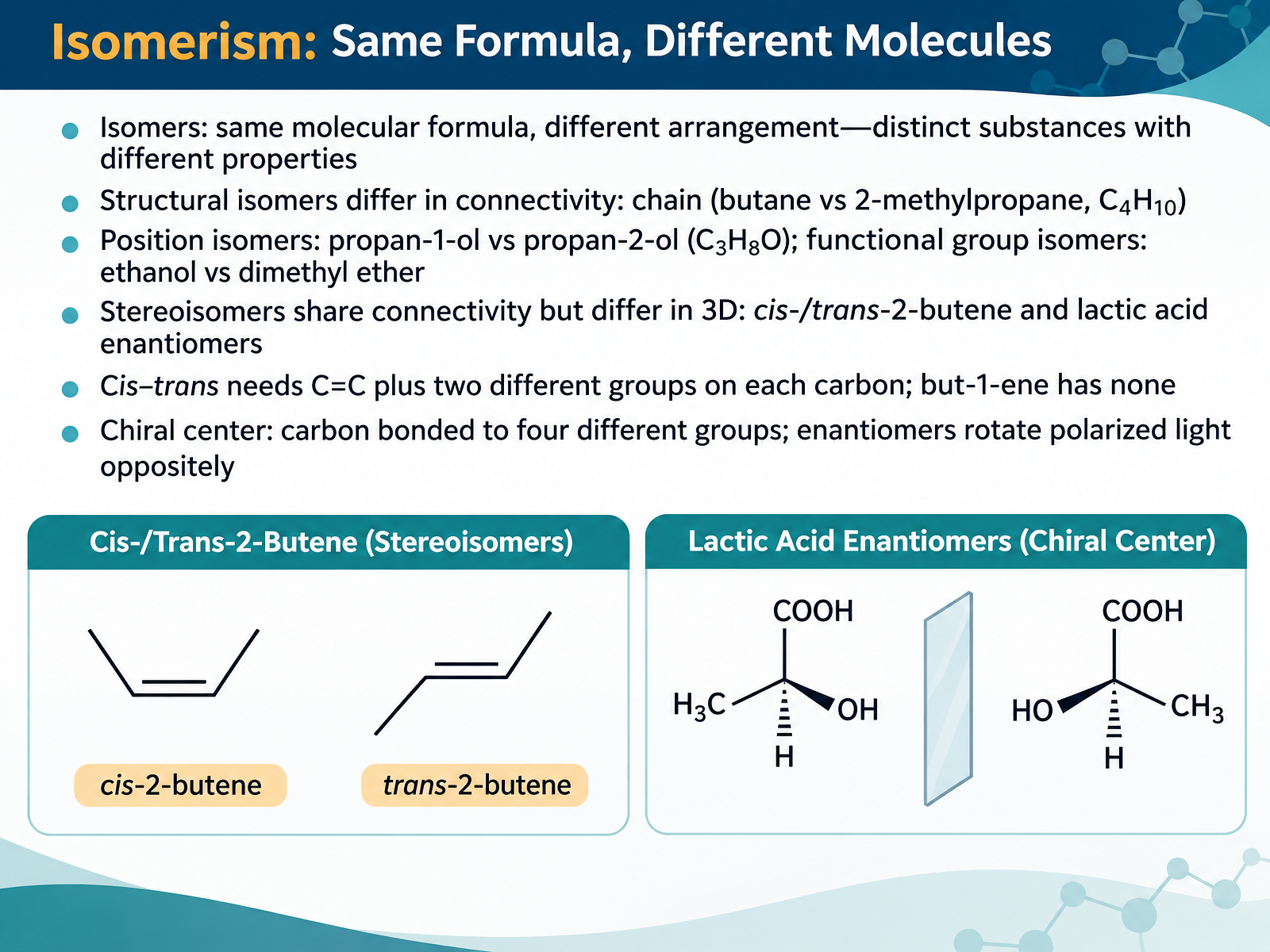
- 07Isomerism: Same Formula, Different MoleculesNow let's look at isomerism. Isomers share the same molecular formula, but their atoms are arranged differently. That makes them distinct substances with different properties. Structural isomers differ in connectivity. For example, butane and 2-methylpropane share the formula C four H ten, but one is a straight chain and the other is branched. Position isomers place the same group on a different carbon. Propan-1-ol and propan-2-ol show this. Functional group isomers have entirely different groups, like ethanol and dimethyl ether, both C two H six O. Next, stereoisomers share connectivity but differ in three dimensions. Cis and trans 2-butene are one example. Cis-trans isomerism requires a carbon-carbon double bond with two different groups on each carbon. But-1-ene has two hydrogens on one carbon, so it cannot show this. Finally, a chiral center is a carbon bonded to four different groups. Its two mirror-image forms, called enantiomers, rotate polarized light in opposite directions. Lactic acid is a familiar example. So remember, same formula does not mean the same molecule. Next, we will see how to name these molecules using IUPAC rules.
 creative-chemistry.org.ukmagazines.hachettelearning.comallen.in+22 min
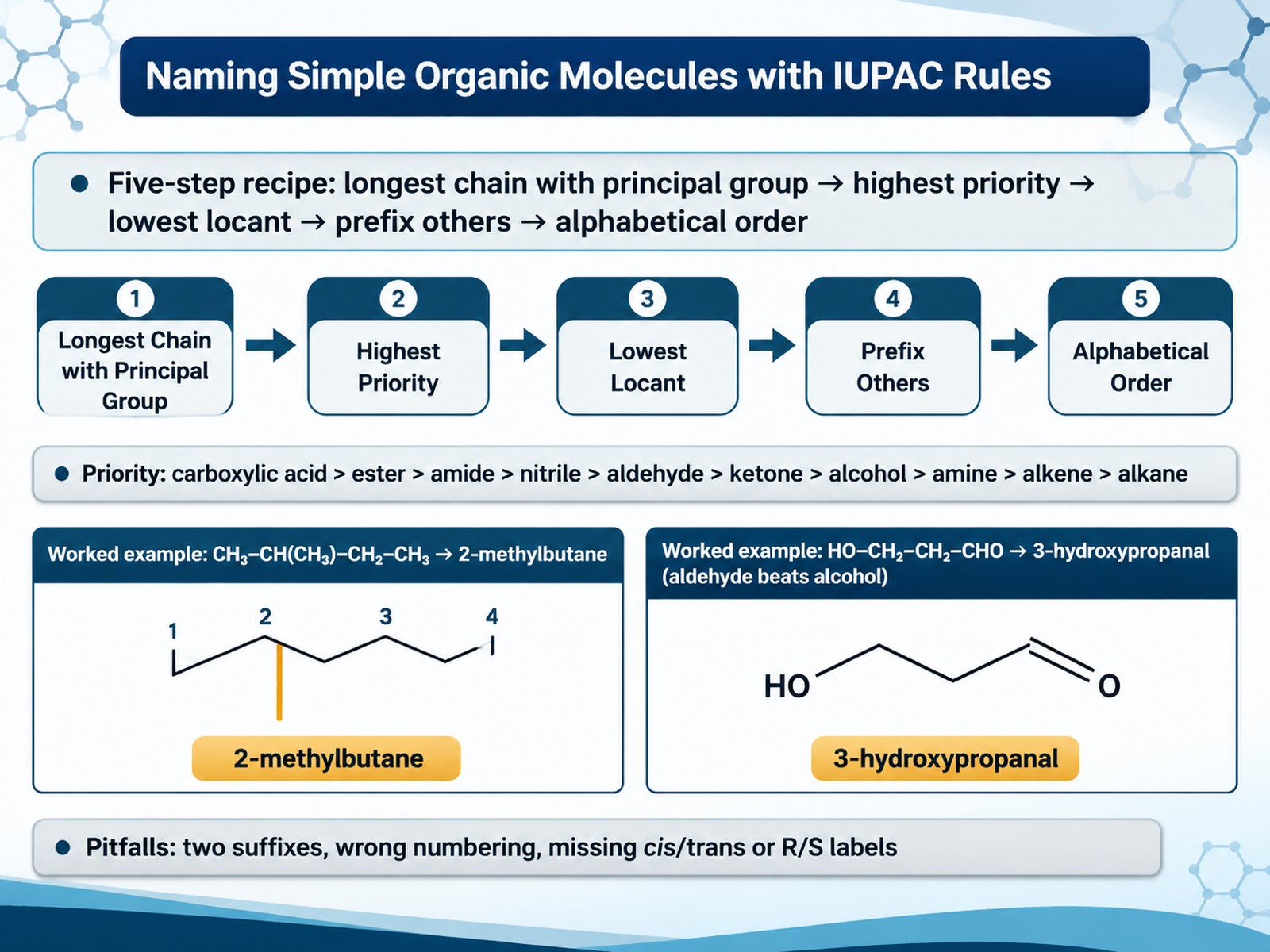
- 08Naming Simple Organic Molecules with IUPAC RulesNow let's turn to naming molecules with the IUPAC system. Here is a five-step recipe you can apply every time. First, find the longest chain that contains the principal group. Second, identify the highest-priority functional group. Third, number the chain so that group gets the lowest possible locant. Fourth, name every other group as a prefix. Fifth, place those prefixes in alphabetical order.
Priority matters here. From highest to lowest, it runs: carboxylic acid, ester, amide, nitrile, aldehyde, ketone, alcohol, amine, alkene, then alkane. Only the highest group becomes the suffix. So in the molecule C H three, C H with a methyl branch, C H two, C H three, the longest chain has four carbons, and numbering from the branch end gives 2 methylbutane. In H O, C H two, C H two, C H O, the aldehyde outranks the alcohol, so we get 3 hydroxypropanal.
Watch for three common slips: using two suffixes, numbering from the wrong end, and leaving out cis, trans, or R and S labels. Next, we look at drawing conventions, condensed, full, and skeletal formulas.
 ck12.orgopenstax.orgopen.edu+22 min
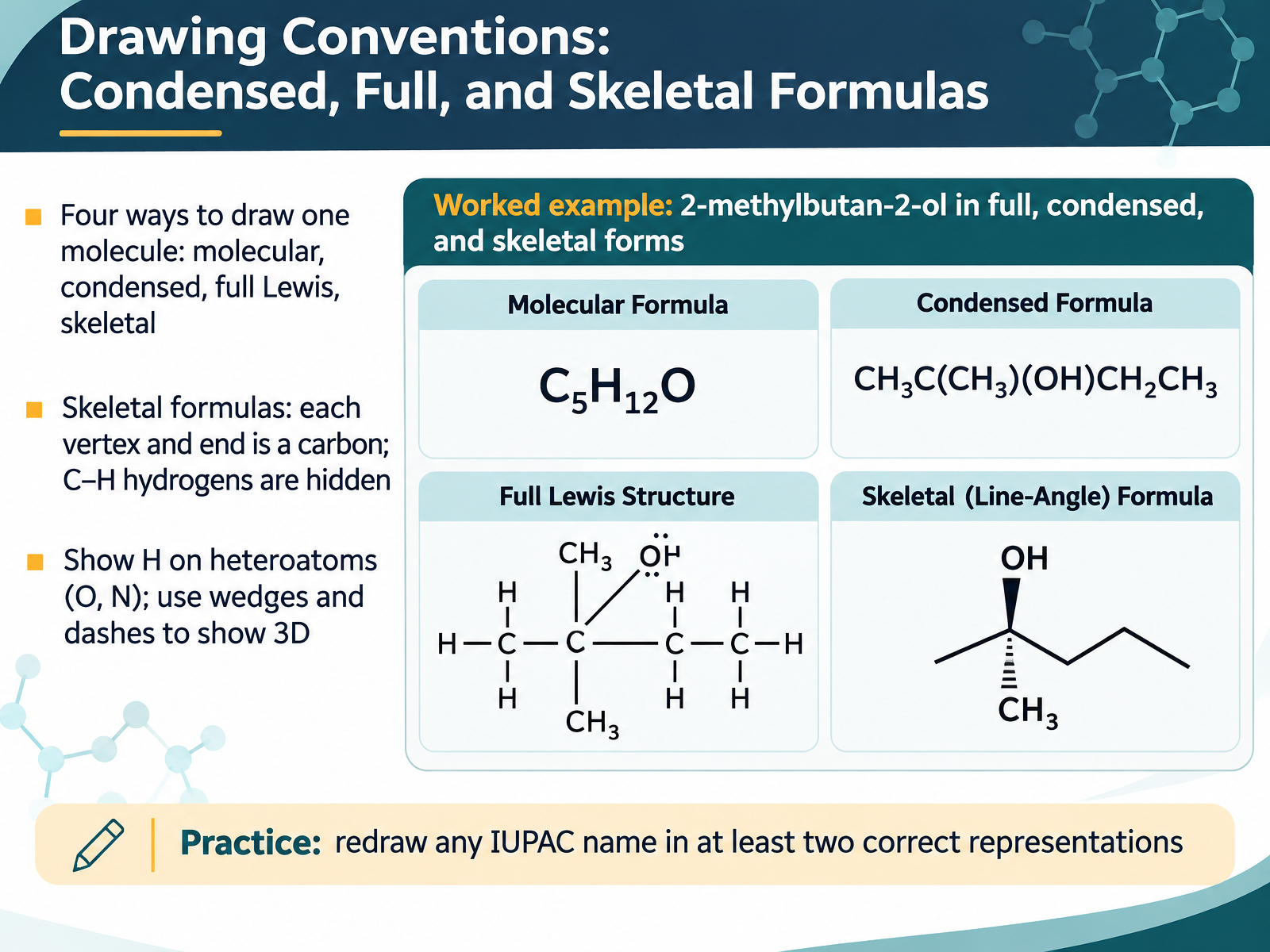
- 09Drawing Conventions: Condensed, Full, and Skeletal FormulasNow let's look at drawing conventions. One molecule can be drawn in four common ways: a molecular formula, a condensed formula, a full Lewis structure, and a skeletal formula. In a skeletal formula, every vertex and every end of a line is a carbon, and the hydrogens attached to carbon are hidden. This means we still show hydrogens on heteroatoms, such as oxygen and nitrogen. We also use solid wedges and dashed lines to show three-dimensional shape. Let's work through 2-methylbutan-2-ol. In the full Lewis structure, you draw every carbon, every hydrogen, and every bond. In the condensed form, you group atoms together, like CH3 and CH2 units, around the central carbon bearing the OH group. In the skeletal form, you draw the carbon skeleton as a zigzag, place the OH on the correct carbon, and leave the carbon-attached hydrogens implied. For practice, take any IUPAC name and redraw it in at least two correct representations. Check each carbon has exactly four bonds. Next, we move on to reaction patterns: substitution, addition, and elimination.
 openstax.orgtutorda.orgchem.libretexts.org+22 min
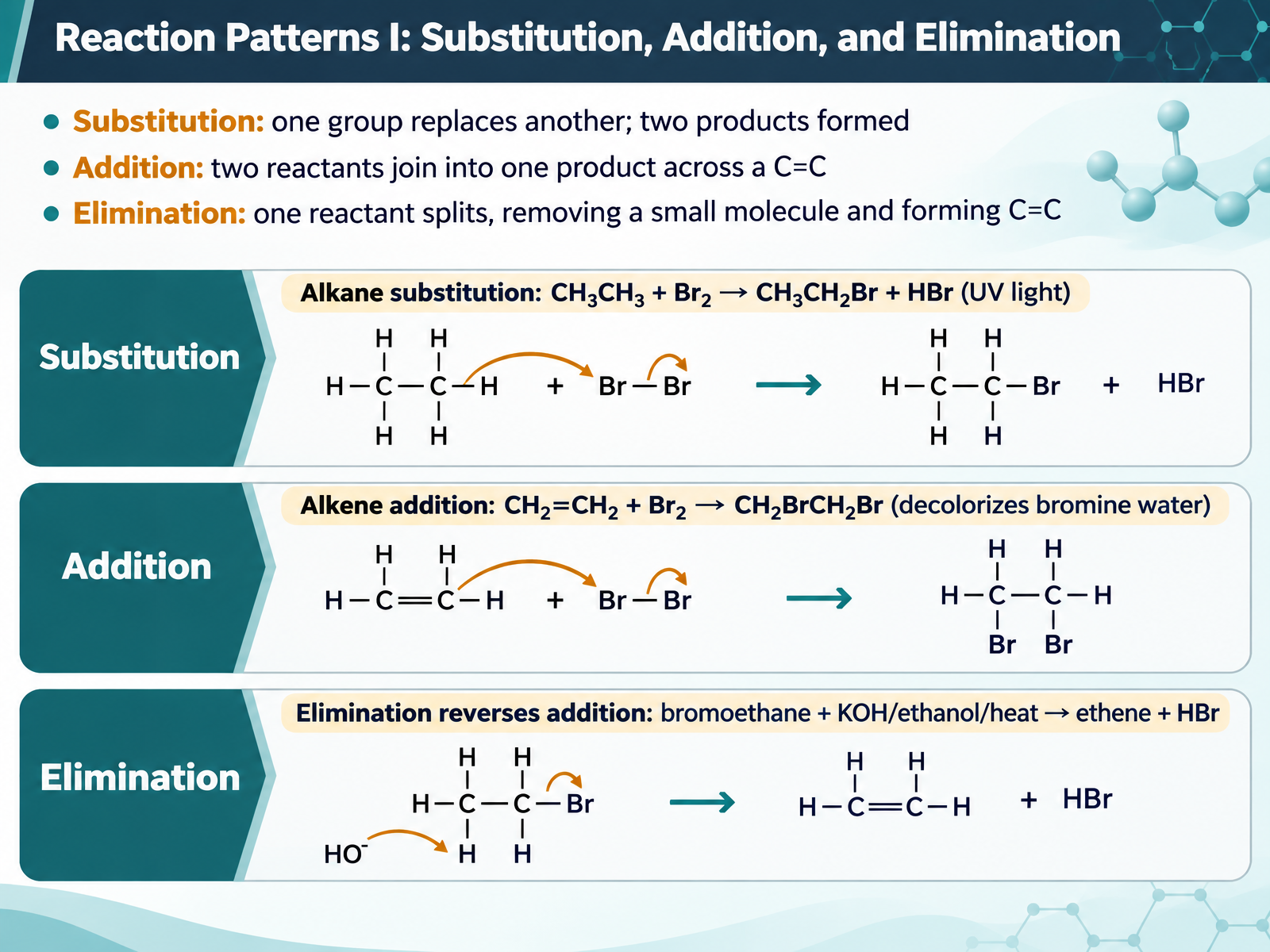
- 10Reaction Patterns I: Substitution, Addition, and EliminationNow let's look at three reaction patterns you will see again and again. First, substitution. In a substitution reaction, one atom or group is replaced by another group, and two products form. Ethane plus bromine, under ultraviolet light, gives bromoethane plus hydrogen bromide. Second, addition. Here two reactants join into one product, and the double bond of an alkene opens up. Ethene plus bromine gives a dibromo product, and this reaction decolorizes bromine water. Third, elimination. A single reactant splits apart, a small molecule is removed, and a carbon-carbon double bond forms. Notice that elimination reverses addition. For example, bromoethane heated with potassium hydroxide in ethanol gives ethene plus hydrogen bromide. So substitution exchanges, addition joins, and elimination removes. Next, we will look at oxidation, reduction, and curved-arrow basics.
 2 min
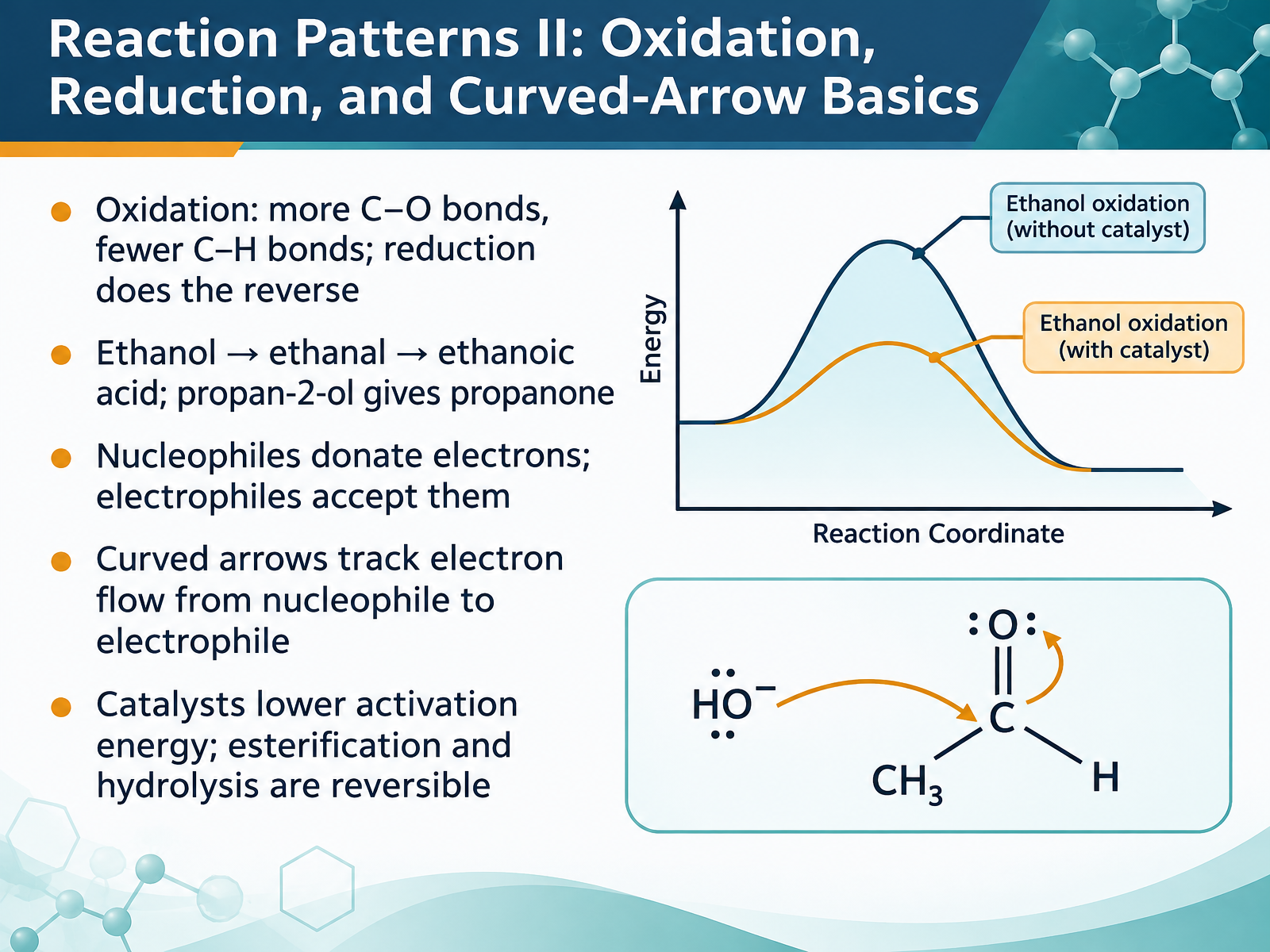
- 11Reaction Patterns II: Oxidation, Reduction, and Curved-Arrow BasicsNext, let's look at reaction patterns involving oxidation, reduction, and electron flow. In organic chemistry, oxidation means more carbon to oxygen bonds and fewer carbon to hydrogen bonds. Reduction does the reverse. For example, ethanol oxidizes to ethanal, then to ethanoic acid. Propan-2-ol oxidizes to propanone. This means we can track oxidation by counting bonds, not just electrons. Now, nucleophiles donate electrons, while electrophiles accept them. Curved arrows track electron flow from the nucleophile to the electrophile. Think of the arrow as showing where electrons move during the reaction. Catalysts lower activation energy, so reactions proceed faster. Esterification and hydrolysis are reversible, meaning they can go forward or backward depending on conditions. In the next slide, we'll explore organic chemistry in everyday life and industry, where these reactions matter in products and processes.
 2 min
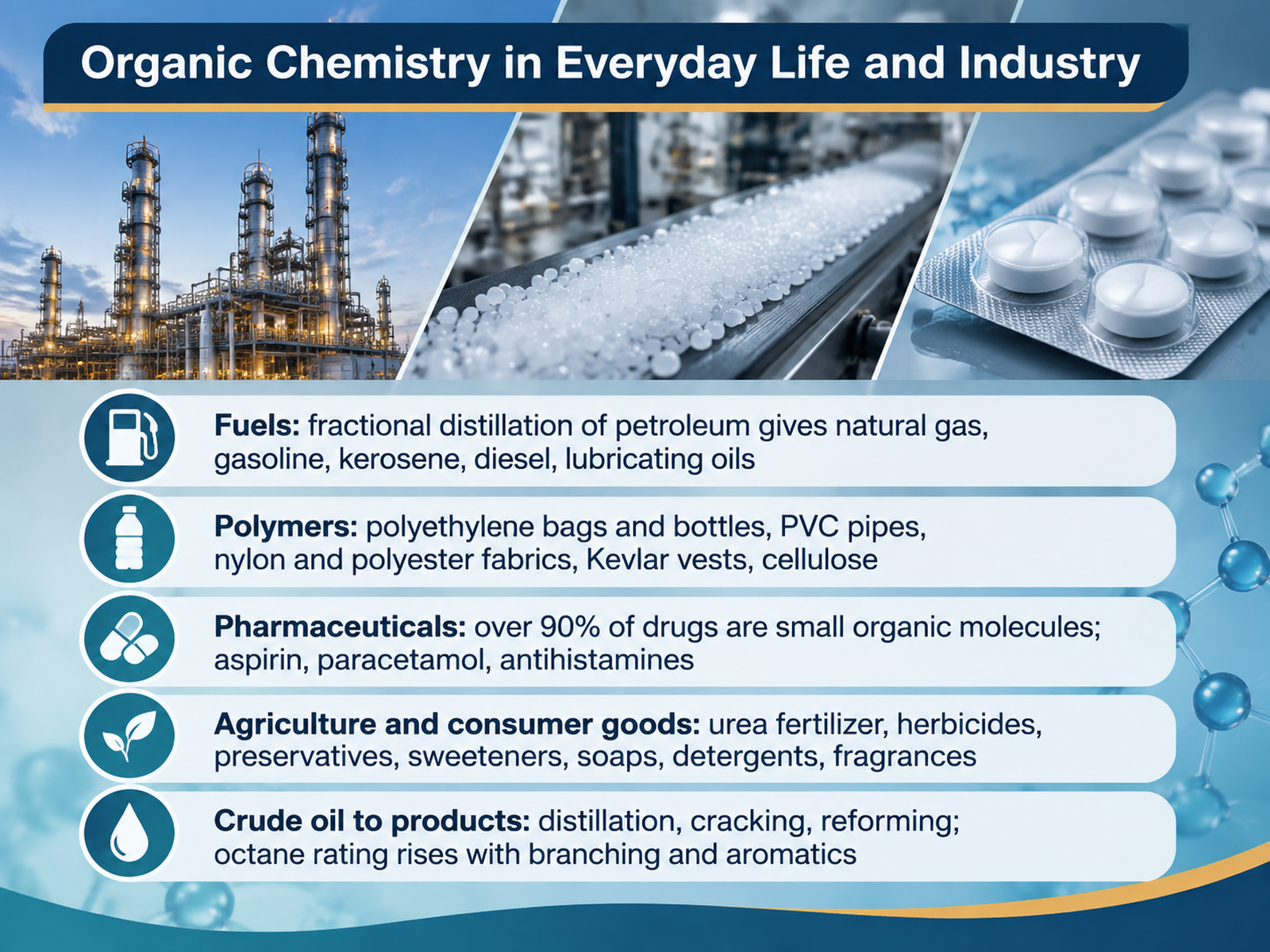
- 12Organic Chemistry in Everyday Life and IndustryNow let's see how organic chemistry shows up in everyday life and industry. Start with fuels. Crude oil is a mixture of hydrocarbons, and fractional distillation separates them by boiling point. This gives natural gas, gasoline, kerosene, diesel, and lubricating oils. Heavier fractions are then cracked and reformed into useful fuels. Octane rating measures resistance to knocking, and it rises with branched alkanes and aromatics. Next, polymers. Polyethylene makes bags and bottles, PVC makes pipes, nylon and polyester make fabrics, Kevlar makes protective vests, and cellulose is a natural polymer. Then pharmaceuticals. Over ninety percent of drugs are small organic molecules, including aspirin, paracetamol, and antihistamines. Finally, agriculture and consumer goods rely on urea fertilizer, herbicides, preservatives, sweeteners, soaps, detergents, and fragrances. The takeaway is simple. Carbon compounds power, clothe, heal, and feed us every day. Next, we move to biomolecules and green chemistry, where carbon chemistry goes next.
 thoughtco.comwou.eduqualifications.pearson.com+22 min
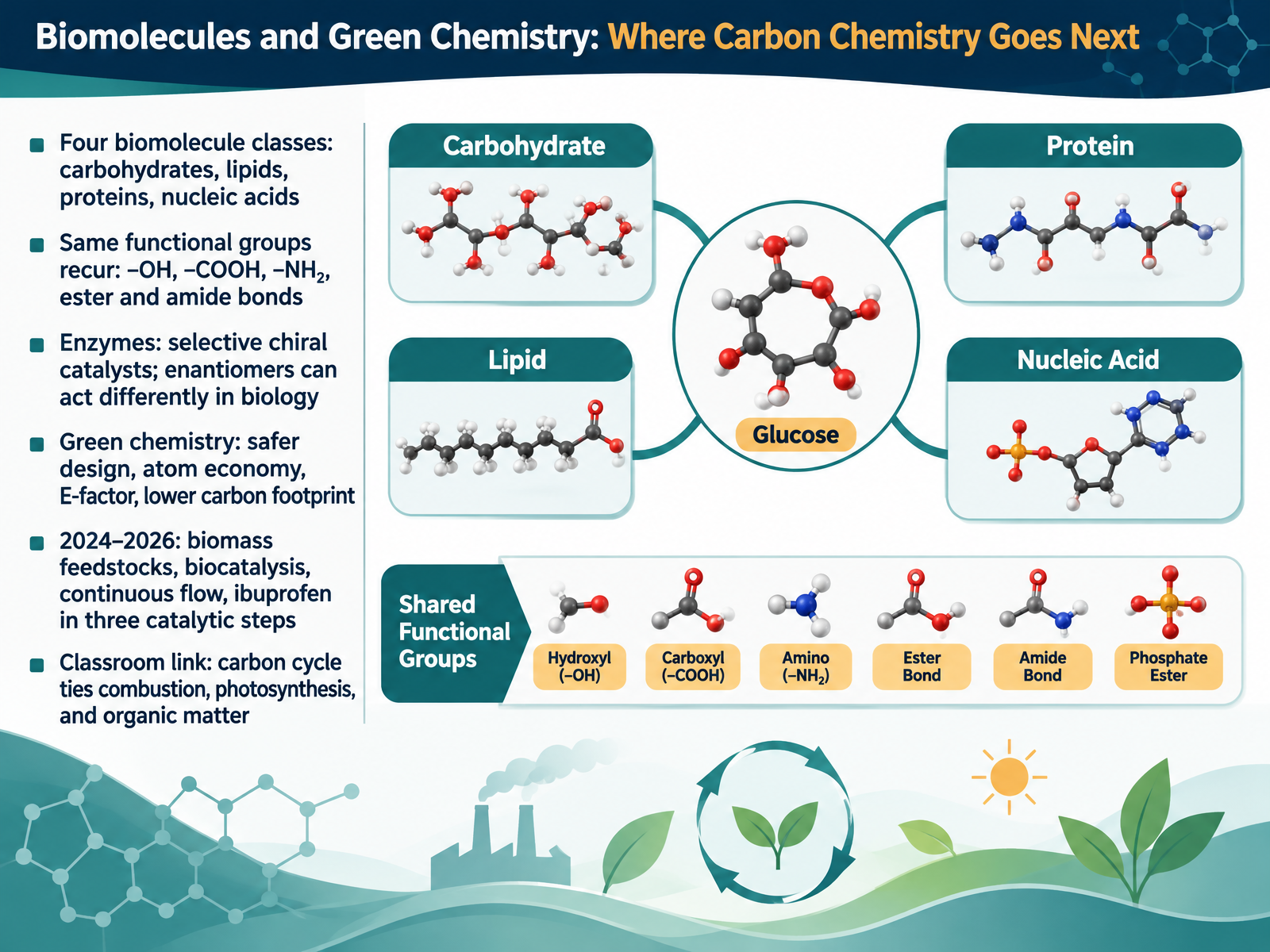
- 13Biomolecules and Green Chemistry: Where Carbon Chemistry Goes NextNow let's see where carbon chemistry goes next. In living things, carbon appears in four biomolecule classes: carbohydrates, lipids, proteins, and nucleic acids. Notice that the same functional groups keep returning, including hydroxyl, carboxyl, amino, ester, and amide groups. Enzymes are proteins that act as selective chiral catalysts. This means two mirror-image molecules, called enantiomers, can behave differently in biology. Next, green chemistry asks us to design safer processes, and to measure them with atom economy, the E-factor, and carbon footprint. From 2024 to 2026, key directions include biomass feedstocks, biocatalysis, and continuous flow, plus ibuprofen made in three catalytic steps. In your classroom, the carbon cycle links combustion, photosynthesis, and organic matter. So remember: carbon chemistry connects life, industry, and sustainability. Next, let's move to review, practice, and your next steps.
 2 min
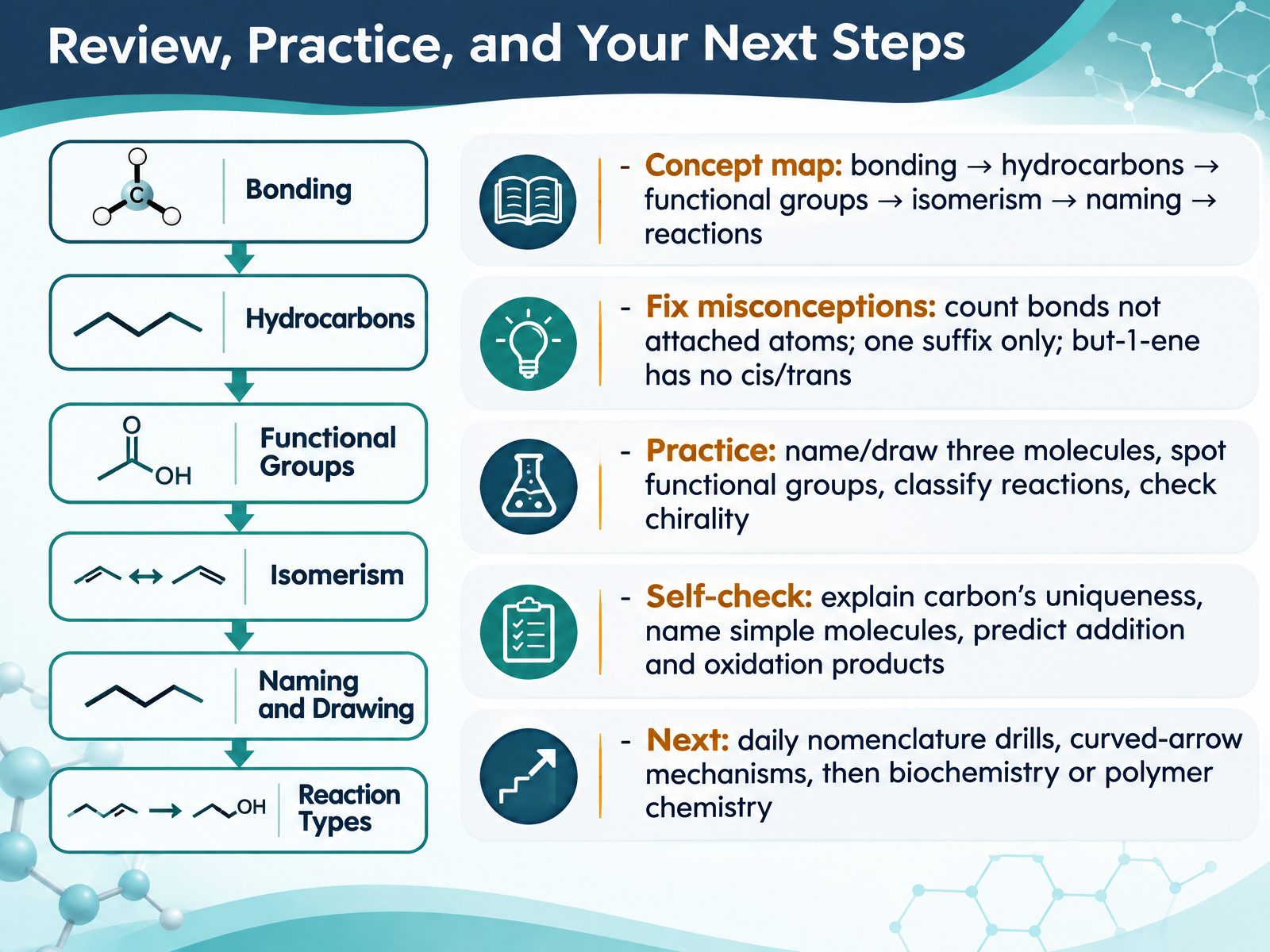
- 14Review, Practice, and Your Next StepsLet's bring everything together. Our concept map runs from bonding, to hydrocarbons, to functional groups, then isomerism, naming, and reactions. Next, fix three common misconceptions. Count bonds, not attached atoms, when checking carbon's four bonds. Use only one suffix per name, because only the highest-priority group becomes the suffix. And but-1-ene has no cis or trans forms, since its double-bond carbon carries two identical hydrogens. Now practice: name and draw three molecules, spot their functional groups, classify a few reactions, and check chirality. For self-check, explain carbon's uniqueness, name simple molecules, and predict addition and oxidation products. Your next steps are daily nomenclature drills, then curved-arrow mechanisms, followed by biochemistry or polymer chemistry. Thank you for learning with me. Keep practicing, stay curious, and you will build real confidence in organic chemistry.
 2 min
Take the deck with you
Download this course as a file — free, no sign-up needed.
- PDF handoutEvery slide page, ready to print or share.15 pages · 4.0 MBDownload
- Narrated PowerPointThe deck that presents itself — every slide carries the digital human's narration video.15 pages · 15.4 MBDownload
- PowerPoint slidesThe full deck as a .pptx — open it in PowerPoint, Keynote, or Google Slides.15 pages · 3.9 MBDownload
Free to use in your own training — please keep the PersonWise credit page at the end.
Have your own deck? Turn it into a course
Sources consulted
Web sources consulted while building this course.
- Examples of Organic Chemistry in Everyday Life — thoughtco.com
- CH105: Consumer Chemistry - Chemistry — wou.edu
- Unit 28: Industrial Applications of Organic Chemistry — qualifications.pearson.com
- Real-life applications - Organic Chemistry - Organic Chemistry and Modern Life, Applications of organic chemistry, Hydrocarbons, Alkanes — scienceclarified.com
- Organic Chemistry Applications: From Materials to Medicine to Energy — learnhowtoscience.com
- 1.6 sp3 Hybrid Orbitals and the Structure of Methane - Organic Chemistry | OpenStax — openstax.org
- 8.1 Carbon's Bonding, Structural Formulae and Classification — Class 11 Chemistry — tutorda.org
- 4.1.1: Carbon: Always Tetravalent and Often Tetrahedral — chem.libretexts.org
- 2.3 Carbon - Biology 2e | OpenStax — openstax.org
- Tetravalence of Carbon & Shapes of Molecules — Class XI Chemistry | NEETz — neetz.in
- Functional Groups | CK-12 Foundation — ck12.org
- 3.1 Functional Groups - Organic Chemistry | OpenStax — openstax.org
- Pain and Aspirin: Pain and aspirin: 4.2 The functional group approach | OpenLearn - Open University — open.edu
- Table 3-3. Summary of properties for functional groups - General Chemistry — armymedical.tpub.com
- 2.4: Functional Groups — chem.libretexts.org
- Isomerism - Creative Chemistry — creative-chemistry.org.uk
- Types of isomerism - Hodder Education Magazines — magazines.hachettelearning.com
- Structure and Stereoisomerism: Types, Geometrical & Optical Isomers, Chirality & Examples — allen.in
- SATHEE CUET: Chemistry Isomerism — sathee.iitk.ac.in
- 8.6 Isomerism | NCERT 11 Chemistry — chemistrystudent.com