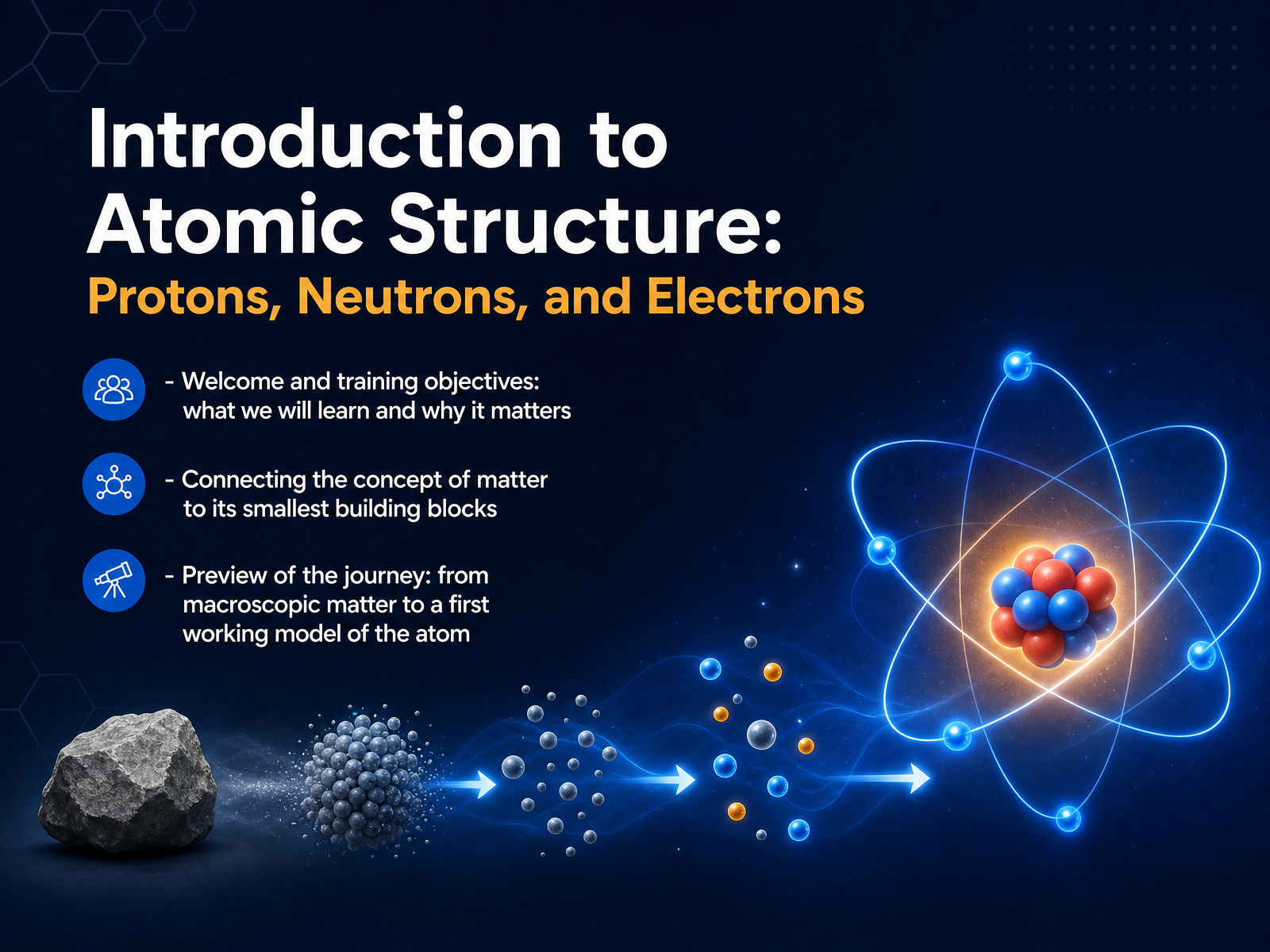
Atomic Structure: Protons, Neutrons, Electrons
Begin
15 pages · ~30 min
Atomic Structure: Protons, Neutrons, Electrons
This training introduces the basic atomic structure, covering protons, neutrons, and electrons, for learners new to chemistry.
What you’ll learn
- 01Introduction to Atomic Structure: Protons, Neutrons, and ElectronsWelcome. Think about a piece of metal, a drop of water, or the air you breathe. All of it, everything you can touch and see, is made of matter. But what is matter made of? Today, we start a journey to find the smallest building blocks of that matter. We will build a simple model of the atom, a tiny, invisible world with just three key parts: protons, neutrons, and electrons. By the end, you will have a clear picture of how these parts fit together. This first model is a powerful tool that helps us understand why materials behave the way they do. Let's begin by seeing how we go from the things we can hold in our hands to the particles we can only imagine. Next, we will explore why we need this model to explain the world around us.edu.rsc.orgeric.ed.govojs.cuni.cz+21 min
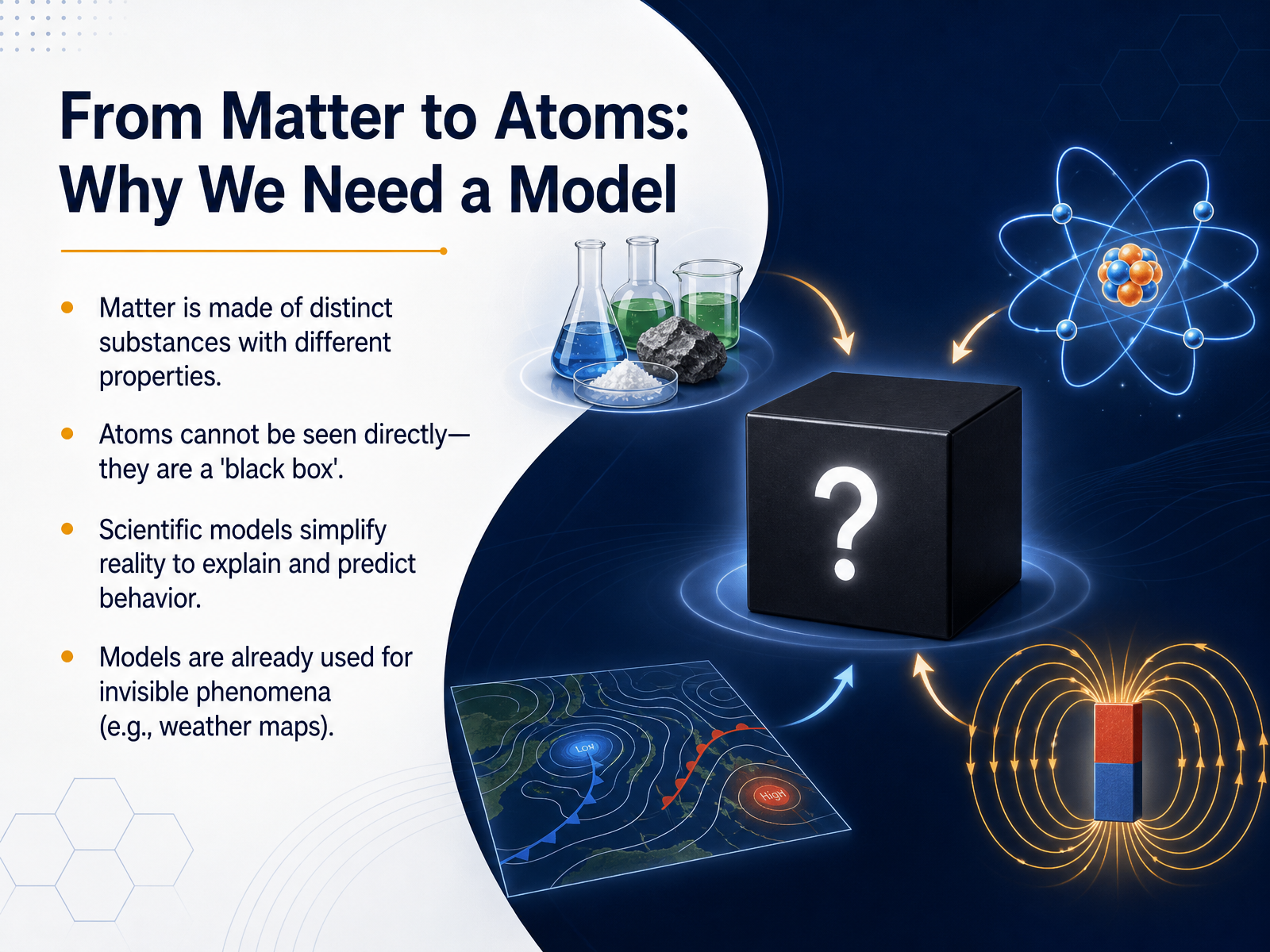
- 02From Matter to Atoms: Why We Need a ModelWe know that matter is made of different substances. Each one has its own properties. But what is the smallest piece of that substance? That is the atom. Here is the challenge. We cannot see an atom directly. Not even with a simple light microscope. To us, it is a black box. We can observe what goes in and what comes out, but the inside is hidden. So, what do we do when something is invisible? We build a model. A scientific model is a simplified picture that helps us explain and predict behavior. Think of a weather map. You cannot see high pressure or a cold front, but a map makes those invisible patterns visible. We will use the same strategy for the atom. We will build a simple model, piece by piece, to explain how atoms work. Let's start by understanding the scale. How small is an atom?
 edu.rsc.orgproquest.comscience-education-research.com+21 min
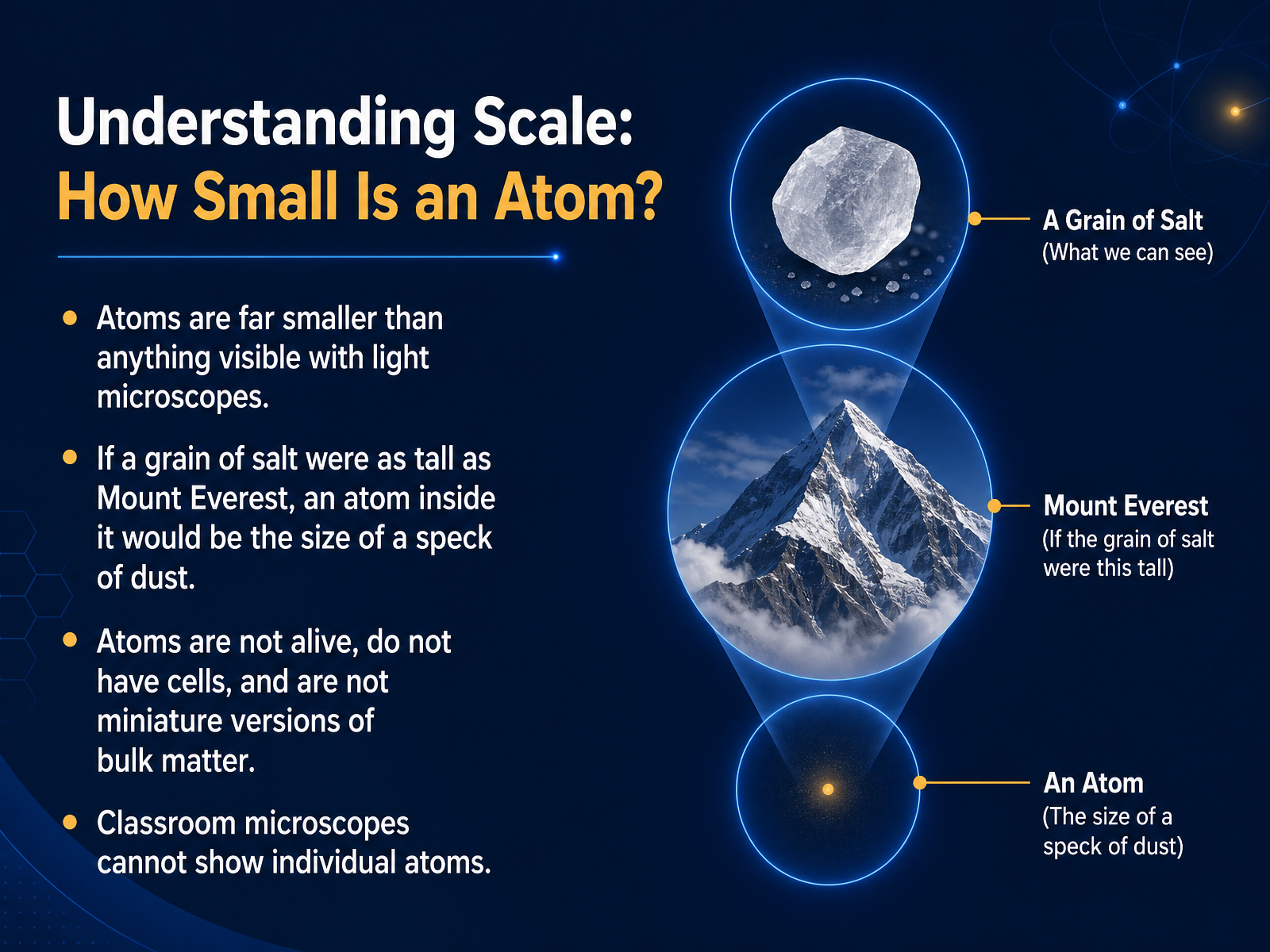
 - 03Understanding Scale: How Small Is an Atom?Now, let's tackle a really important question about scale. Just how small is an atom? It's a size that's genuinely hard to wrap your head around. Atoms are far, far smaller than anything you can see with a regular light microscope in a classroom. To help you picture this, let's use a comparison. Imagine a single grain of salt. If we could magically blow that grain up until it was as tall as Mount Everest, then a single atom inside it would be just a tiny speck of dust. That's the incredible scale we're talking about. Because they are so small, it's also important to know what atoms are not. They are not alive, they don't have cells, and they aren't just miniature versions of the larger material they make up. A single atom of gold isn't a tiny, shiny piece of gold. These are big ideas, but they're completely graspable. Now, let's use this picture of scale to start building our model of the atom itself by looking at the three main subatomic particles.
 edu.rsc.orgeric.ed.govojs.cuni.cz+21 min
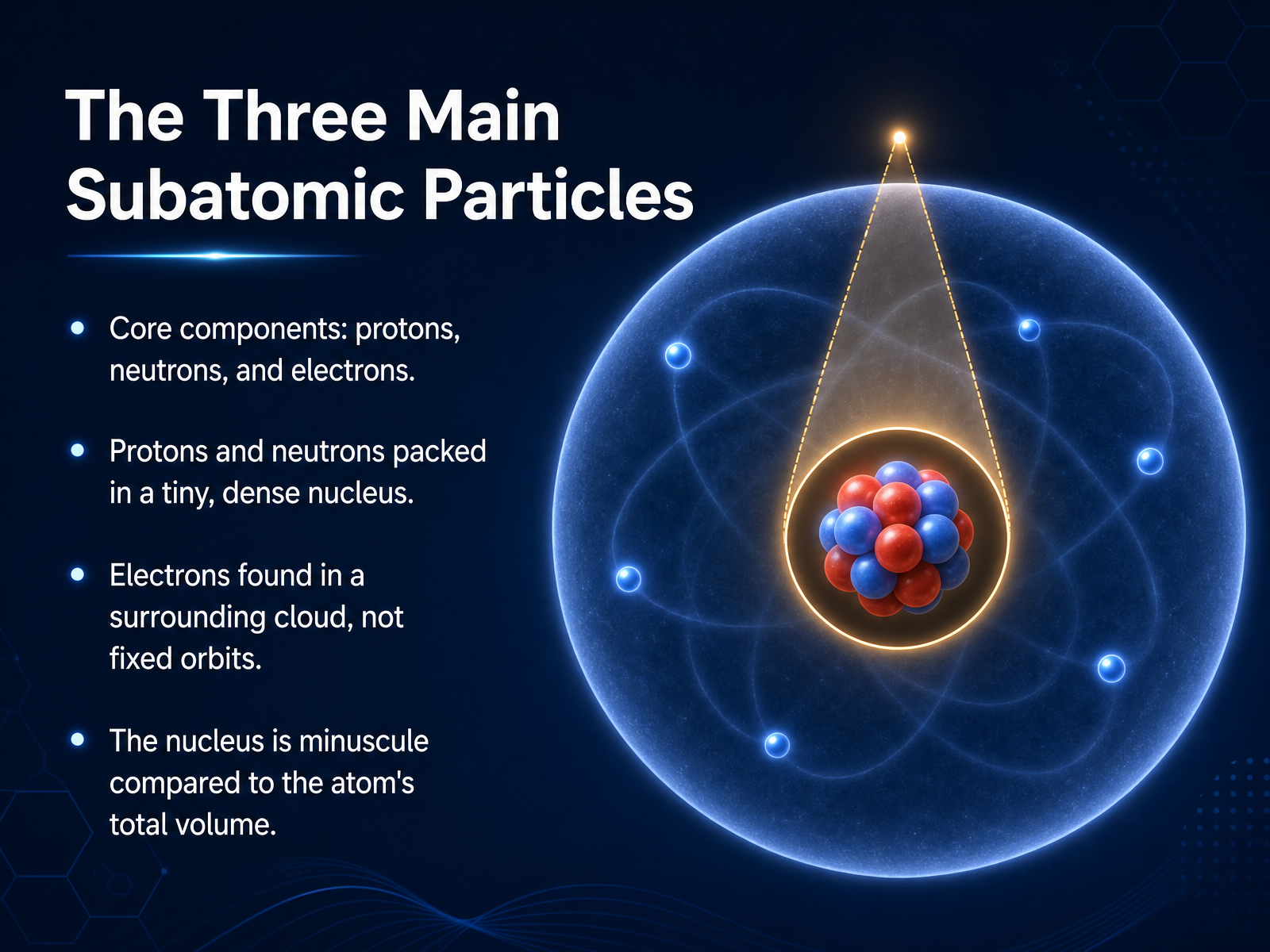
 - 04The Three Main Subatomic ParticlesLet's explore the three main subatomic particles that make up an atom. First, we have protons, which carry a positive charge. Next, there are neutrons, which have no charge at all. Together, the protons and neutrons are packed tightly into a very tiny, dense center called the nucleus. Think of the nucleus as a small, heavy core. Now, what about the electrons? Electrons are negatively charged, and they don't live in the nucleus. Instead, they exist in a large, surrounding cloud. This cloud is not a hard shell or a fixed orbit like a planet's path. It's a region where we are most likely to find an electron moving around. And here's a surprising fact: the nucleus is incredibly small compared to the atom's total volume. The atom is mostly empty space where the electron cloud exists. Up next, we will compare the charge and relative mass of these particles.
 edu.rsc.orgeric.ed.govojs.cuni.cz+22 min
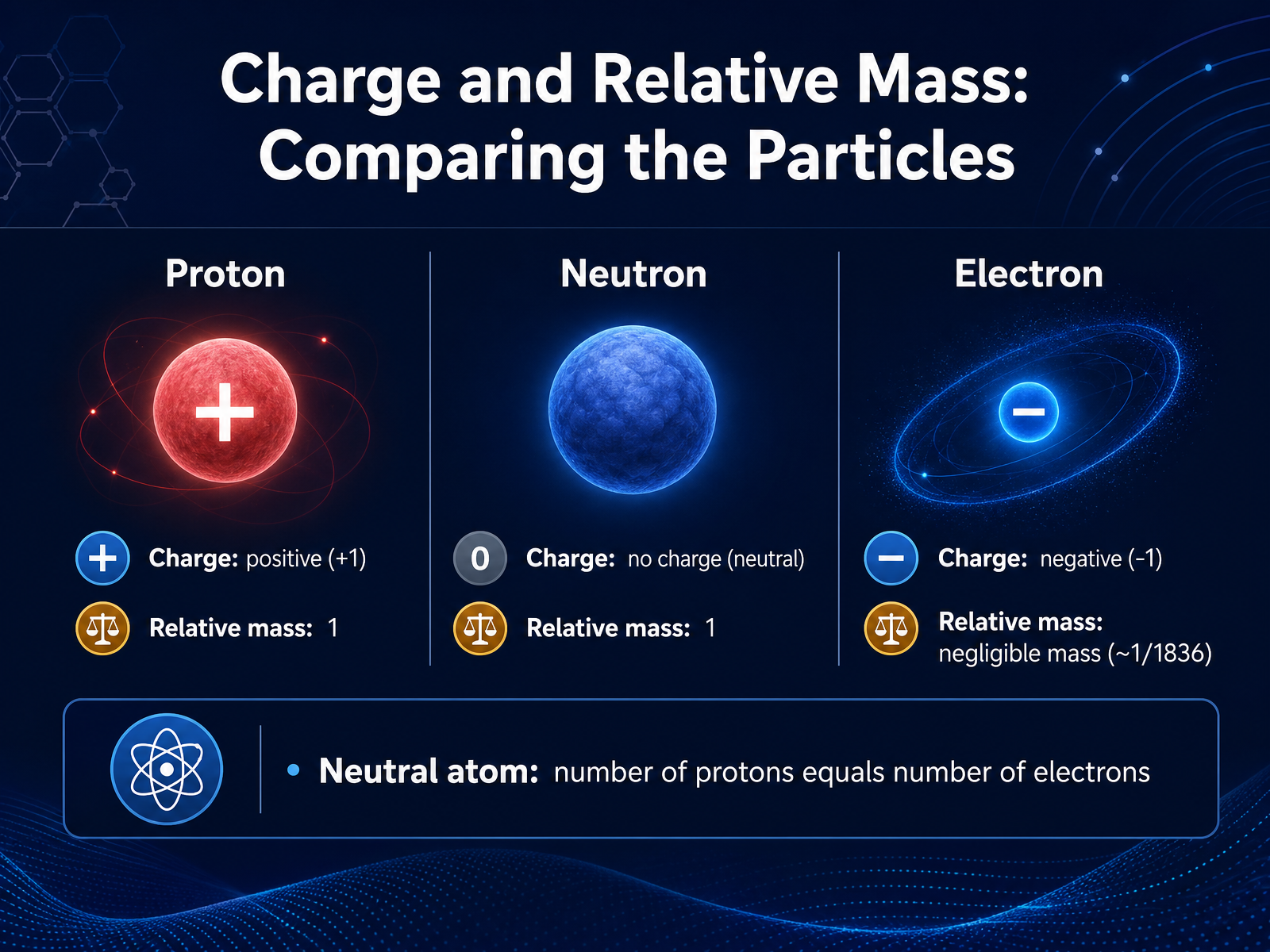
 - 05Charge and Relative Mass: Comparing the ParticlesNow let's compare the three particles we find inside the atom. We can tell them apart by looking at two things: electric charge and relative mass. First, the proton. Protons live in the center of the atom, and they carry a positive charge. We write that as plus one. In our simple model, we give a proton a relative mass of one. Next, the neutron. Neutrons also sit in the center, right next to the protons. They have no charge at all—they are neutral. And their relative mass is also one. That means a neutron has about the same mass as a proton. Finally, the electron. Electrons move around the outside of the atom and carry a negative charge, which we write as minus one. Here is the big surprise: the electron's mass is so small that we call it negligible. In fact, it is about one eighteen-hundredth the mass of a proton. So most of the atom's mass is packed into those central protons and neutrons. There is also a rule for a neutral atom: the number of protons equals the number of electrons. The positive and negative charges balance each other out perfectly. Next, we will use these ideas to understand atomic number and what makes each element unique.
 edu.rsc.orgeric.ed.govojs.cuni.cz+22 min
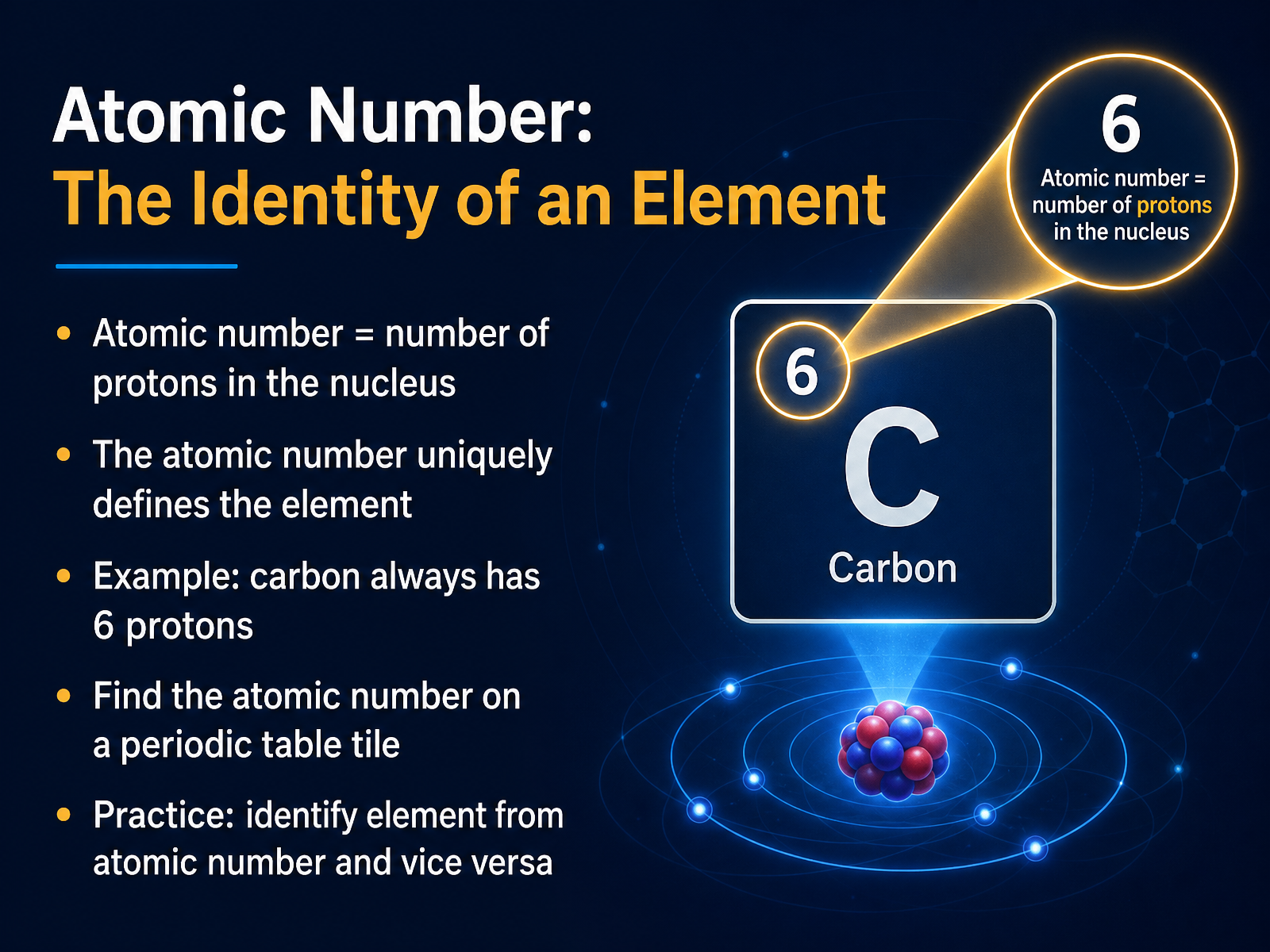
 - 06Atomic Number: The Identity of an ElementNow we get to something that makes every element unique. This slide is about the atomic number. Think of the atomic number as the identity card of an element. It tells us exactly how many protons are in the nucleus of a single atom. And that number of protons is what defines the element. For example, carbon always has exactly six protons. If an atom has six protons, it is carbon, every single time. You can find this special number easily on a periodic table tile. It is usually the large whole number at the top. Let us practice. If you see an element with an atomic number of eight, it is oxygen. If you are looking at gold, its atomic number is seventy-nine. The atomic number is the key to naming the element. Next, we will build on this idea to learn about mass number and how to calculate the number of neutrons.
 edu.rsc.orgeric.ed.govojs.cuni.cz+21 min
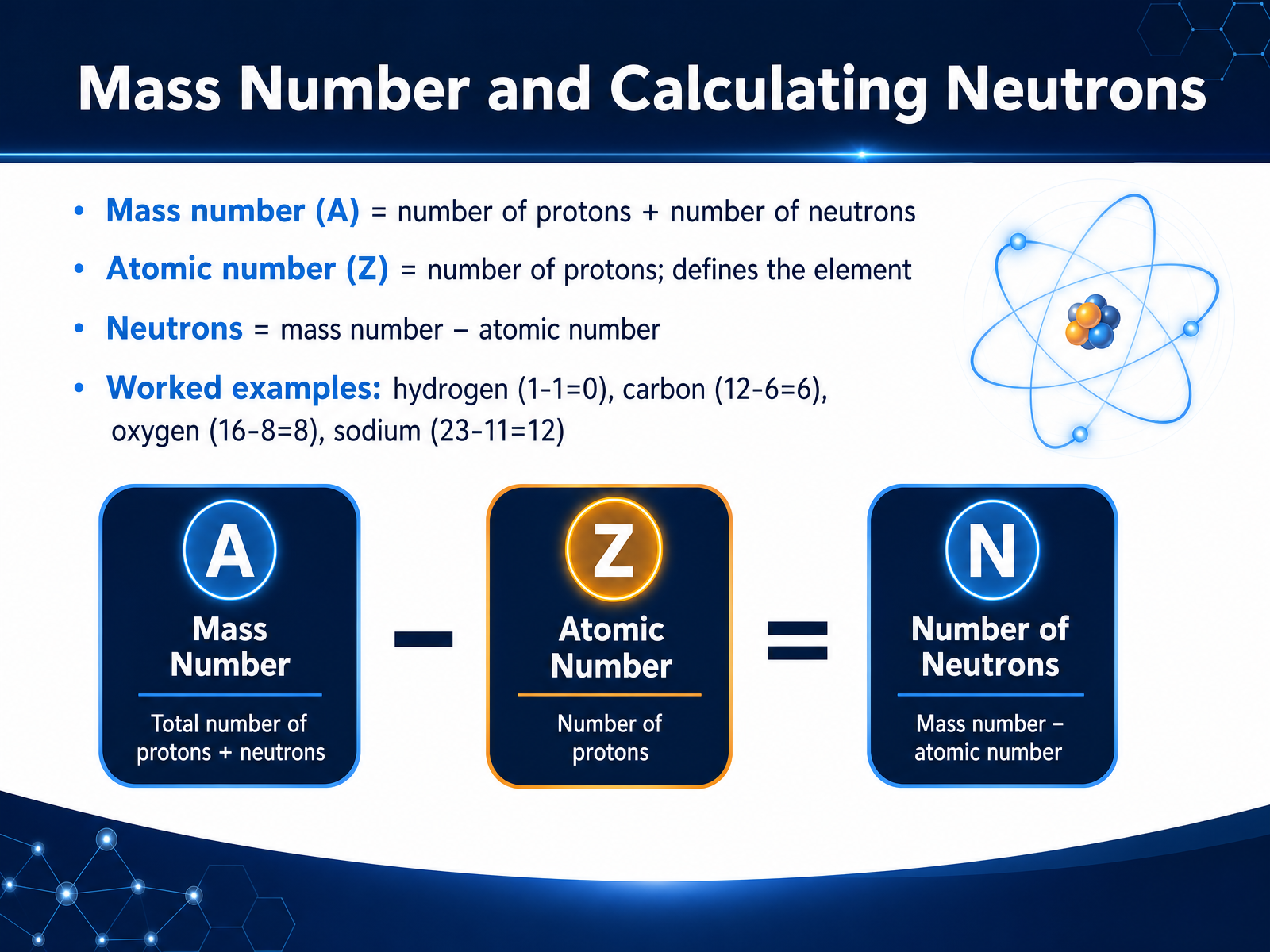
 - 07Mass Number and Calculating NeutronsNow let's use those two building blocks, protons and neutrons, to make sense of a very practical number called the mass number. Think of it as a simple count. The mass number, which we often write as a capital A, is just the number of protons plus the number of neutrons inside the nucleus. It ignores the tiny electrons because their mass is almost zero. There is another number you will see, the atomic number, written as a capital Z. This is our definition of the element. It tells you the number of protons, and nothing else. Carbon always has six protons, so its atomic number is six. Here is where it gets useful. If you know the mass number and the atomic number, you can find the hidden number of neutrons. Just subtract the atomic number from the mass number. Let's work through a few examples together. For a hydrogen atom, the mass number is one and the atomic number is one. One minus one gives us zero neutrons. For a common carbon atom, the mass number is twelve, and the atomic number is six. Twelve minus six equals six neutrons. For oxygen, the mass number is sixteen, and the atomic number is eight. That leaves us with eight neutrons. And for sodium, the mass number is twenty-three, and the atomic number is eleven. Twenty-three minus eleven gives us twelve neutrons. So even though we cannot see the neutrons, you just calculated them. Next, we will learn how to read this information directly from a standard element notation.
 edu.rsc.orgeric.ed.govojs.cuni.cz+22 min
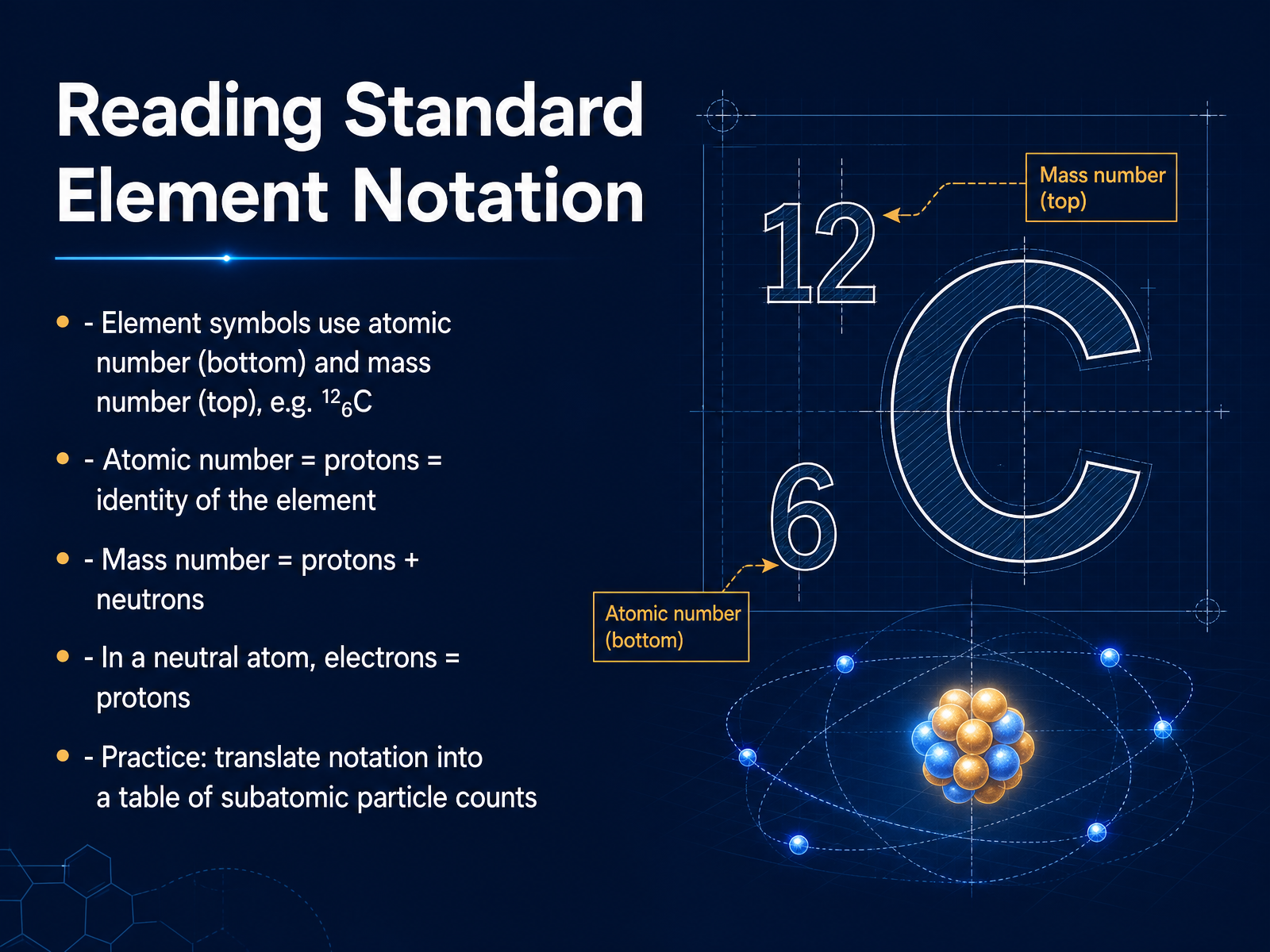
 - 08Reading Standard Element NotationNow we have a simple way to read and write key information about any atom. It is called standard element notation. Look at the example carbon twelve six. The larger number at the top is the mass number. That tells us the total protons plus neutrons. The smaller number at the bottom is the atomic number. The atomic number tells us only the number of protons. And here is the core idea. The atomic number is the identity of the element. If the atomic number changes, the element changes. In a neutral atom the number of electrons equals the number of protons. So knowing the atomic number gives us the electron count as well. Let us practice translating this notation into a table of subatomic particle counts. For carbon twelve six, the atomic number six means six protons. In a neutral atom that means six electrons. The mass number twelve means protons plus neutrons, so twelve minus six gives us six neutrons. We fill in the table as six protons, six neutrons, and six electrons. Next we will see where those electrons are arranged. We will explore energy levels and shells.
 edu.rsc.orgeric.ed.govojs.cuni.cz+21 min
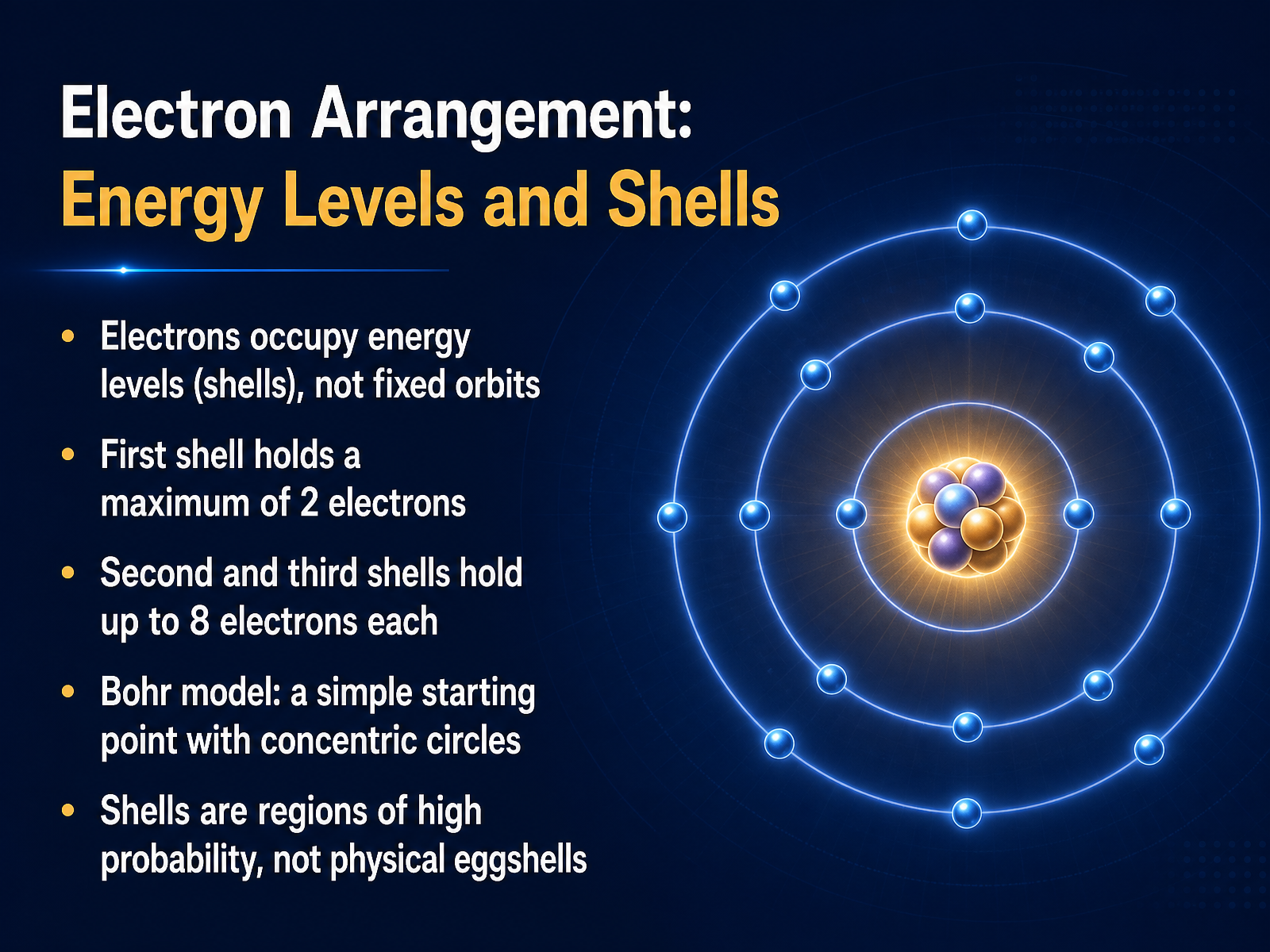
 - 09Electron Arrangement: Energy Levels and ShellsNow let's look at where the electrons live. They don't orbit randomly. They are arranged in energy levels, which we often call shells. But here's a key idea—these shells are not physical eggshells, and electrons don't follow fixed, planet-like orbits. Instead, a shell is a region of high probability, where you are most likely to find an electron. Think of it as a fuzzy, three-dimensional space, not a solid track. The first shell is closest to the nucleus. It's the smallest region and can hold a maximum of two electrons. The second shell is a bit further out, and it can hold up to eight electrons. The third shell can hold up to eight electrons as well, at least for the first twenty elements we study. The Bohr model, with its flat, concentric circles, is a great starting point to visualize this. It's a simple map, but remember, those circles just represent these energy levels, not the actual path of the electron. Let's move on and take a closer look at that simple map, the Bohr model, as a first-step visualization.
 edu.rsc.orgeric.ed.govojs.cuni.cz+22 min
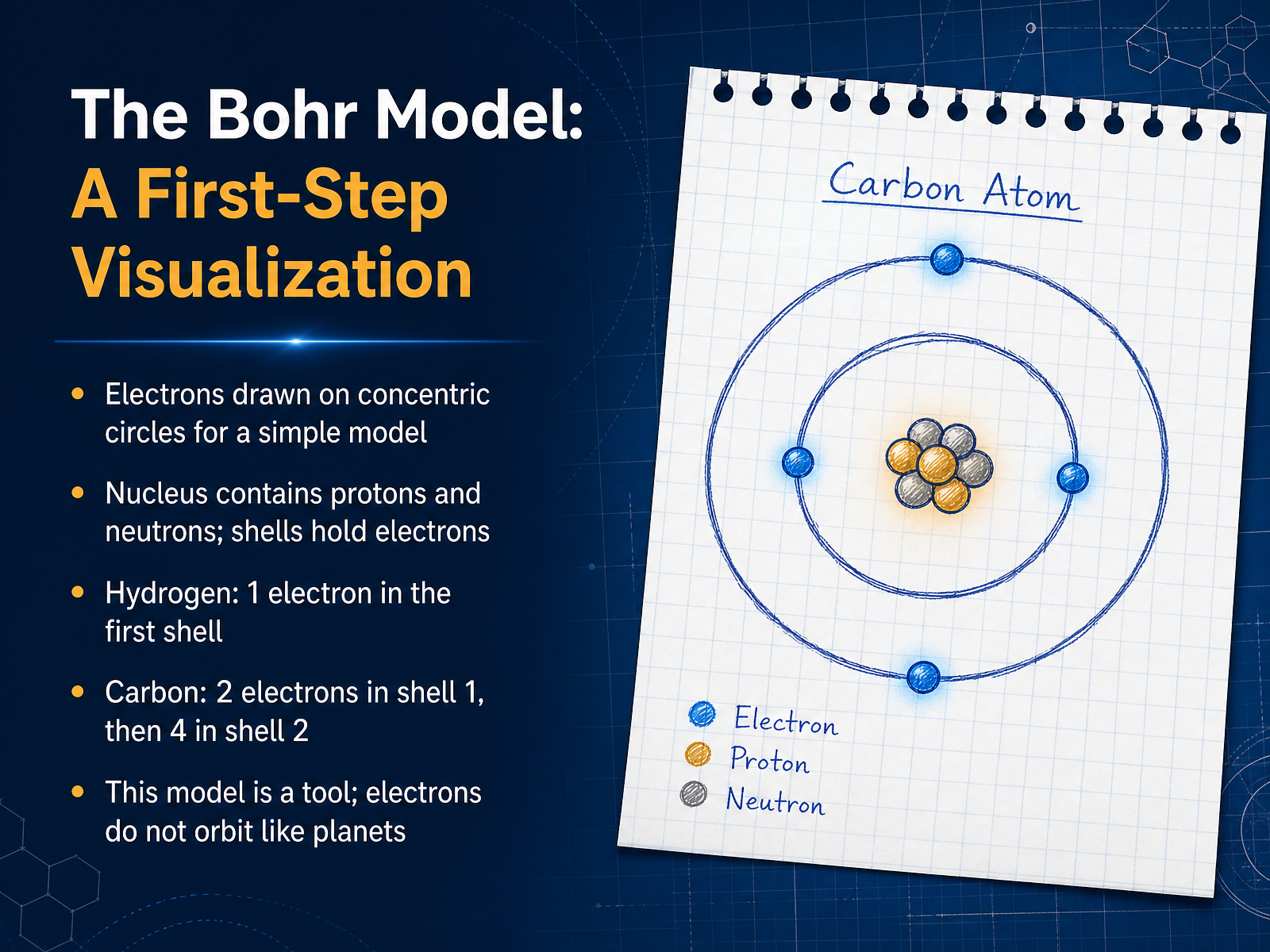
 - 10The Bohr Model: A First-Step VisualizationNow we have a simple way to picture an atom. It's called the Bohr model. Think of it as a first-step drawing that helps us see where the parts go. In this model, the nucleus sits in the center. It holds the protons and neutrons. Around the nucleus, we draw circles. We call these circles shells, and they hold the electrons. Let's look at two examples. A hydrogen atom has just one proton and one electron. In our model, we place that single electron in the first shell, right next to the nucleus. A carbon atom is a bit bigger. It has six electrons. We put two electrons in the first shell, and then four electrons in the second shell. This model is a fantastic tool for learning, but here is one important thing to remember. The electrons do not really orbit the nucleus like planets around a sun. That is a helpful picture, but it is not how they actually move. We use this model to build understanding, and later we will add more detail. Next, we will use this model to build atoms and practice with the first twenty elements.
 edu.rsc.orgeric.ed.govojs.cuni.cz+22 min
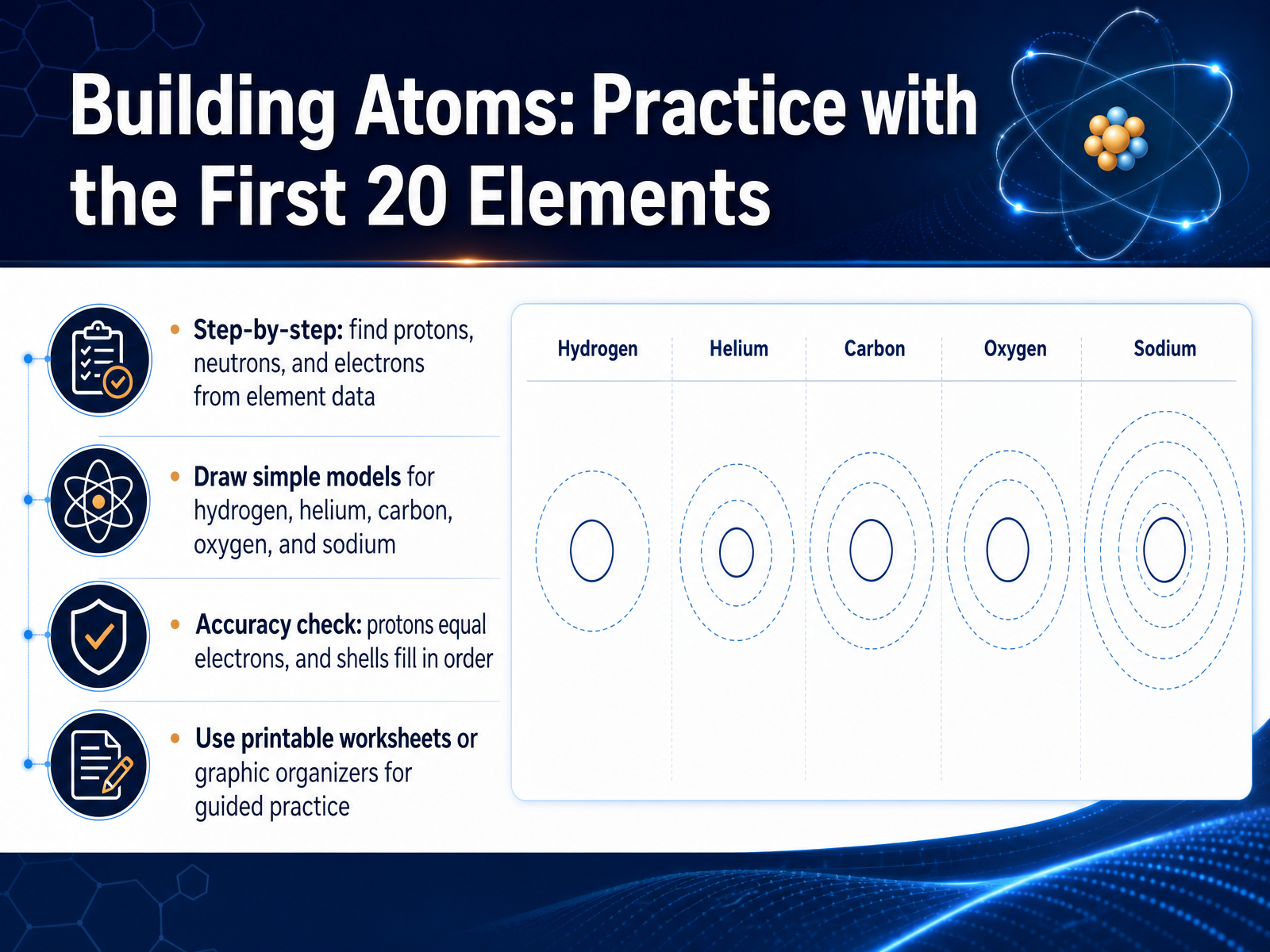
 - 11Building Atoms: Practice with the First 20 ElementsNow we get to build atoms ourselves, starting with the first twenty elements. Let’s take it step by step. First, look at an element’s data on your periodic table. You’ll see two important numbers. The atomic number tells you the number of protons. And in a neutral atom, the number of electrons equals the number of protons. To find the neutrons, take the atomic mass, round it to a whole number, and subtract the atomic number. Then we draw a simple model. We place the protons and neutrons together in the center as a tiny nucleus. Electrons go into shells around the nucleus. The first shell holds up to two electrons. The second shell can hold up to eight. We’ll practice this with hydrogen, helium, carbon, oxygen, and sodium. Use the printable worksheets or graphic organizers to guide your drawing. Check your work: do the protons and electrons match? Are the shells filled in order, from the inside out? These small accuracy checks build strong habits. Now let’s clear up common misunderstandings. Next up: Common Misconceptions About Atomic Structure.
 fwd.iws.eduteacherspayteachers.comteacherspayteachers.com+22 min
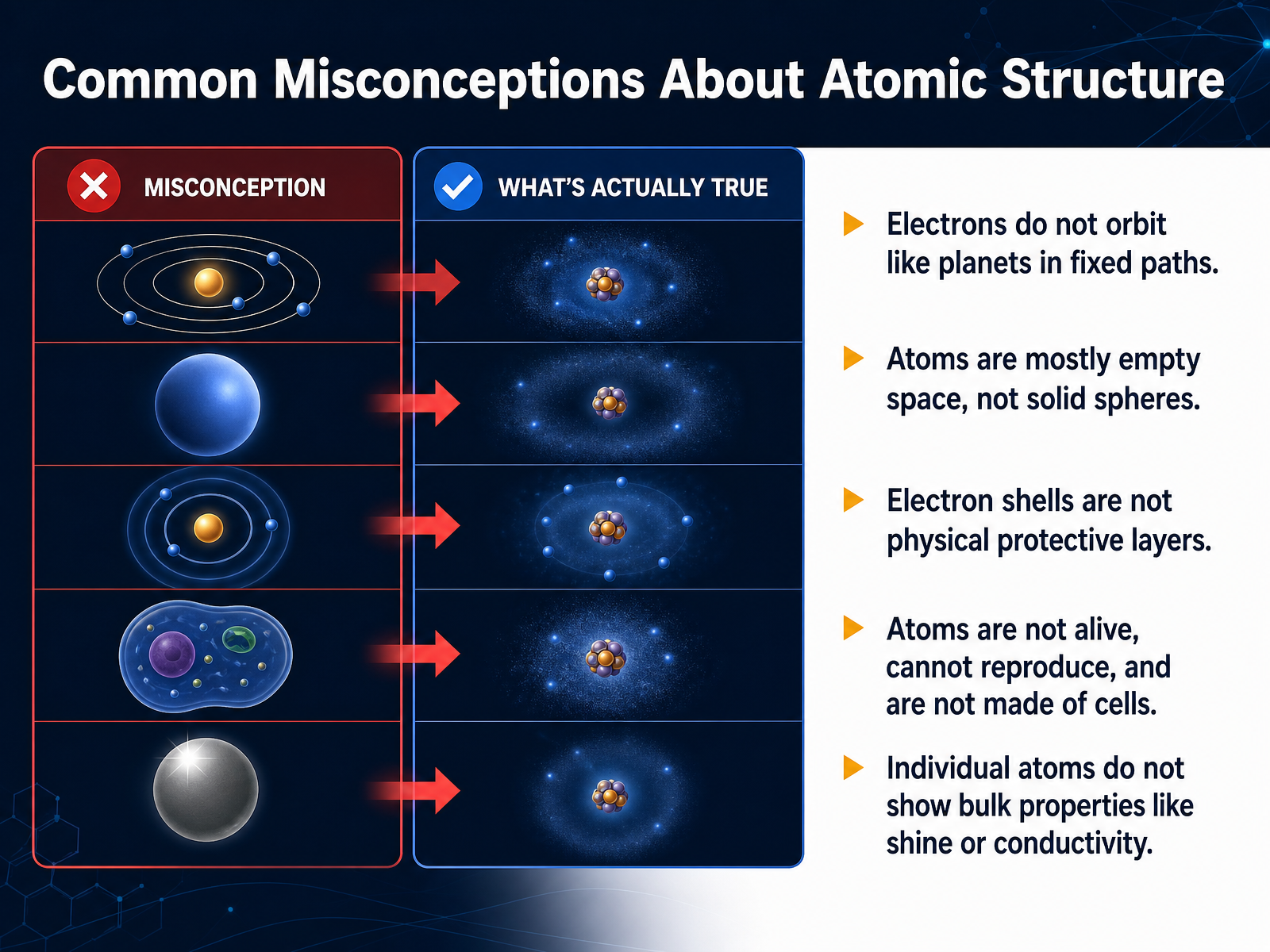
 - 12Common Misconceptions About Atomic StructureNow, let’s clear up some common misunderstandings about atomic structure. First, electrons do not orbit the nucleus like planets in fixed paths. They move within regions called electron shells, but these shells are not physical protective layers, like an eggshell. Second, atoms are mostly empty space, not solid spheres. The nucleus is tiny, and the electrons are far away. Third, atoms are not alive. They cannot reproduce, and they are not made of cells. An atom’s nucleus is very different from a cell’s nucleus. Finally, individual atoms do not show bulk properties like shine or conductivity. One gold atom is not shiny or golden. Those properties emerge when countless atoms work together. So, just remember: atoms are mostly empty, have no fixed orbits, no physical shells, are not alive, and their bulk properties come from the group. Next, we’ll explore how to use analogies wisely, including their strengths and pitfalls.
 edu.rsc.orgeric.ed.govojs.cuni.cz+22 min
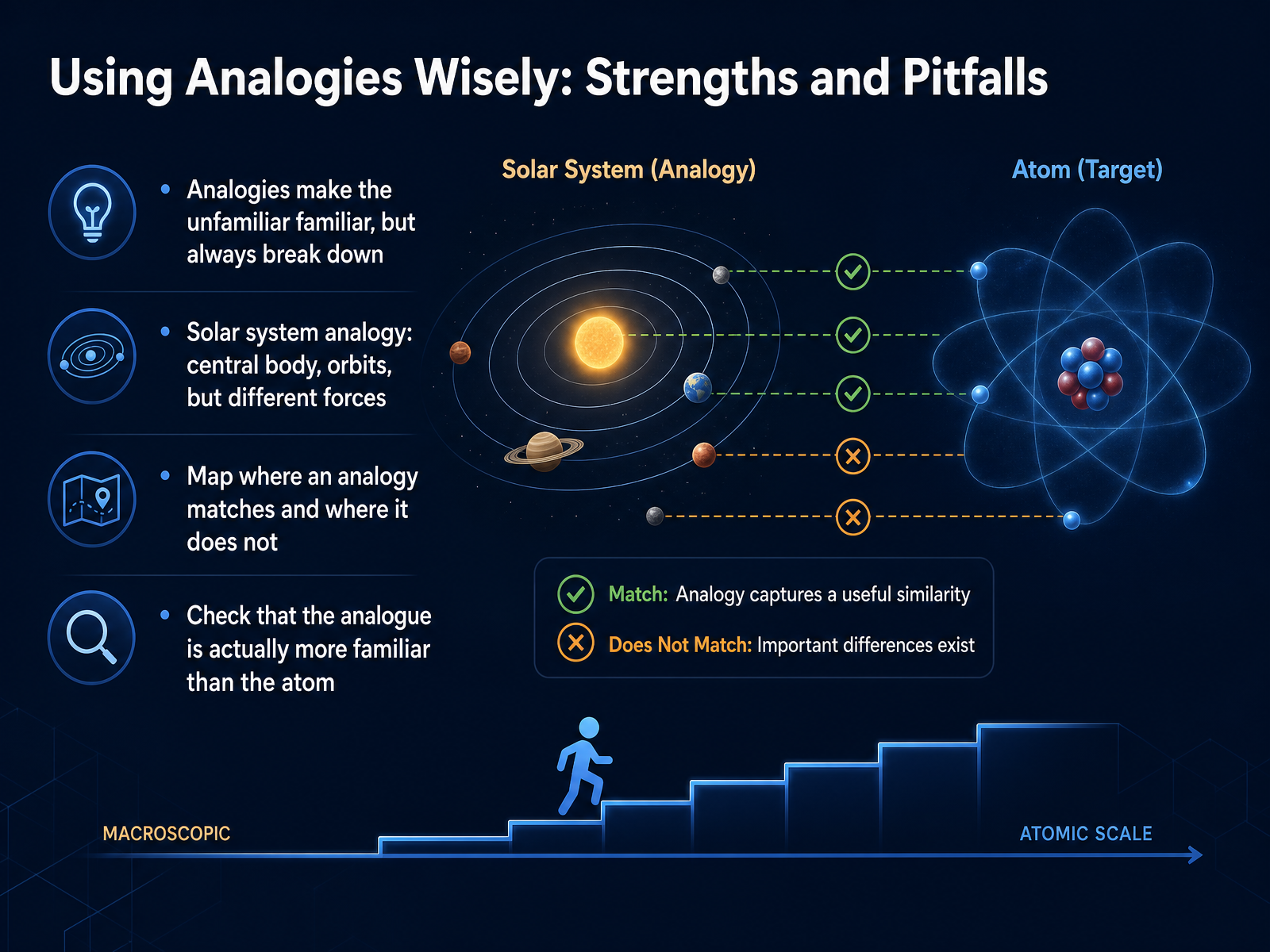
 - 13Using Analogies Wisely: Strengths and PitfallsNow, let’s talk about something we use all the time in learning: analogies. An analogy helps us link something new to something we already know. But here’s the catch: every analogy eventually breaks down. Take the classic comparison between an atom and a solar system. It’s a great starting point. Both have a central body—a nucleus or a sun. Both have smaller things moving around that center. But the forces at work are completely different. The solar system runs on gravity, while the atom runs on electrical attraction and repulsion. The electrons also repel each other, while planets attract. So, a good rule of thumb is to map out exactly where an analogy matches and where it doesn’t. And always ask yourself: is the thing I’m comparing it to actually more familiar to you than the atom itself? If not, the analogy can’t do its job of making the unfamiliar feel familiar. Next, let’s use what we’ve learned to distinguish atoms from molecules and ions.
 edu.rsc.orgproquest.comscience-education-research.com+21 min
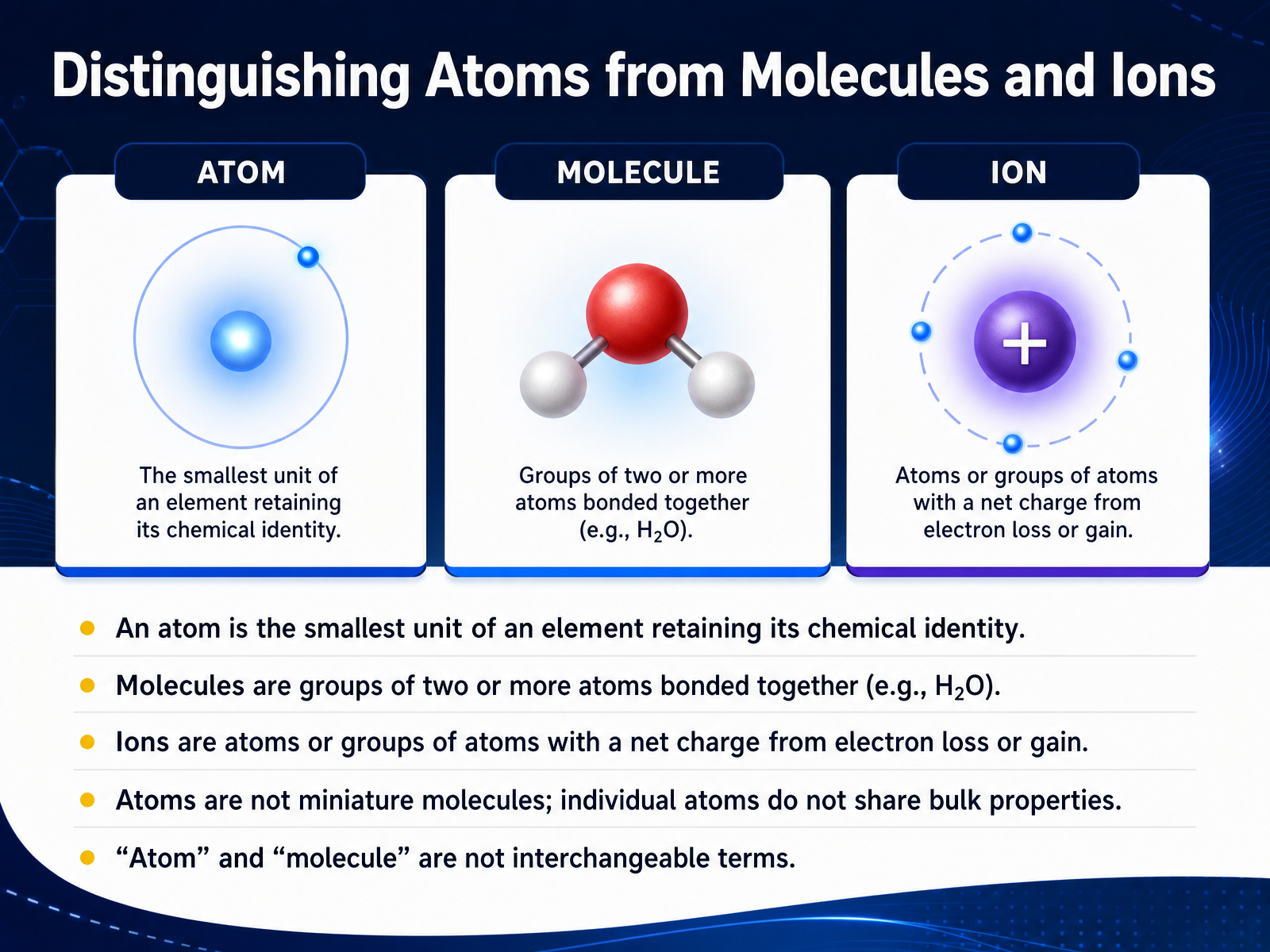
 - 14Distinguishing Atoms from Molecules and IonsNow let's clear up a common mix-up: the difference between atoms, molecules, and ions. It's easy to hear these words and think they all mean the same tiny thing, but they don't. An atom is the smallest unit of an element that still acts like that element. Think of it as a single, complete building block. Molecules, on the other hand, are groups of two or more atoms bonded together. Water is a perfect example. One water molecule is made of two hydrogen atoms and one oxygen atom bonded together. Ions are atoms or groups of atoms that have gained or lost an electron, giving them a net charge. A key point to remember is that an atom is not a miniature molecule. A single gold atom does not look or act like a lump of gold you can hold. Those bulk properties only appear when countless atoms are grouped together. So, atom and molecule are not interchangeable terms. They describe different structures. With that distinction clear, we're ready to pull everything together in our final slide: Summary and Self-Check: Key Takeaways.
 edu.rsc.orgeric.ed.govojs.cuni.cz+22 min
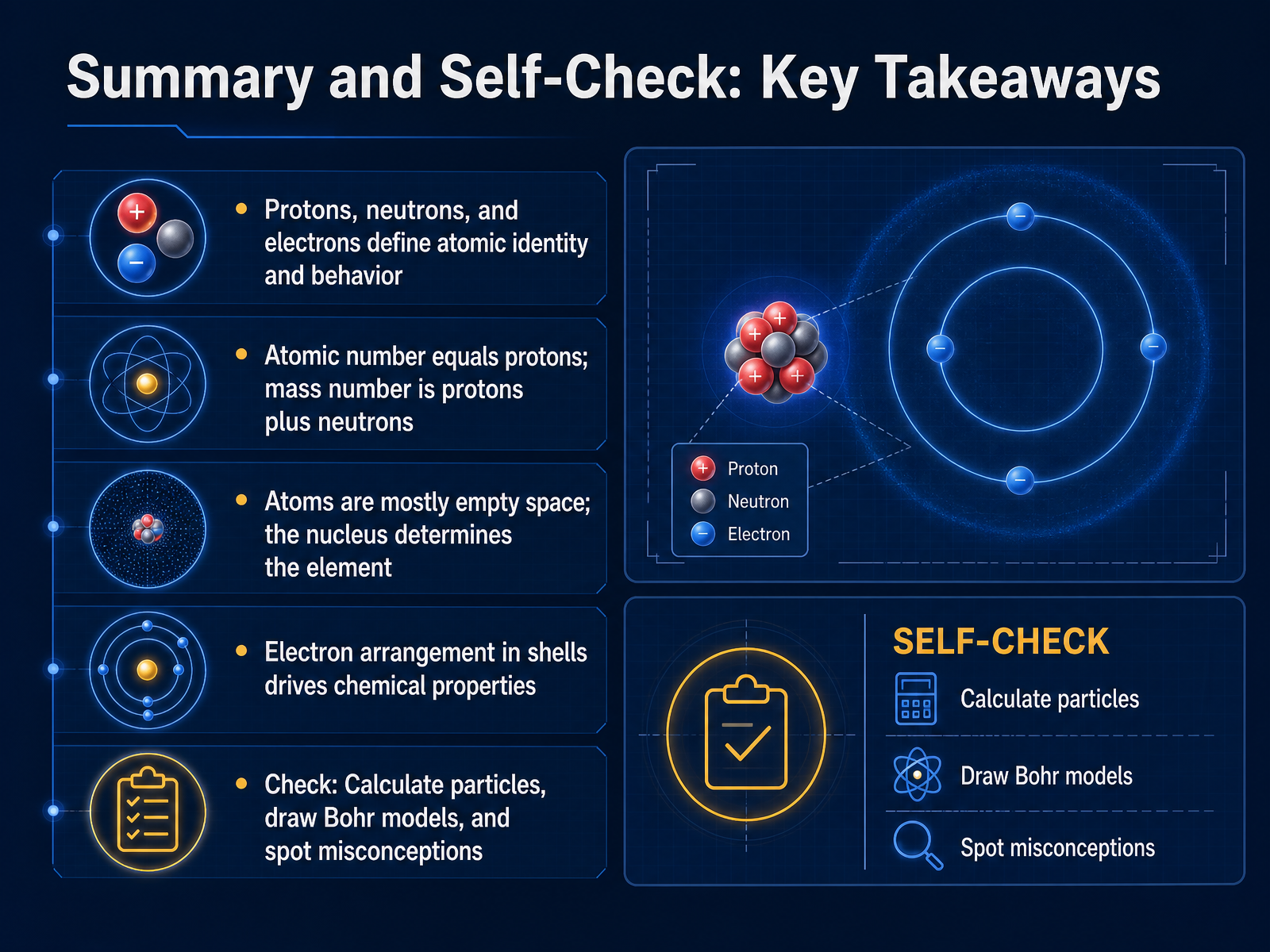
 - 15Summary and Self-Check: Key TakeawaysLet's take a moment to review what we've built together. We now know that protons, neutrons, and electrons are the tiny parts that give an atom its identity and behavior. The atomic number simply counts the protons, and the mass number is the sum of protons and neutrons. Remember, most of an atom is empty space, with the dense nucleus at the center defining which element it is. Those electrons we place in shells around the nucleus are what drive chemical properties. Here's where you can check your own understanding: try calculating the number of particles in a given atom, practice drawing a simple Bohr model, and stay alert for common misconceptions. For example, atoms are not alive, electron shells are not hard protective covers, and individual atoms don't share the same properties as a chunk of metal. Thank you for building your first model of the atom. You've done wonderful work, and this foundation will serve you well as we explore deeper. Keep asking clear questions, and let your curiosity lead the way.
 edu.rsc.orgeric.ed.govojs.cuni.cz+22 min
Take the deck with you
Download this course as a file — free, no sign-up needed.
- PDF handoutEvery slide page, ready to print or share.16 pages · 3.8 MBDownload
- Narrated PowerPointThe deck that presents itself — every slide carries the digital human's narration video.16 pages · 14.2 MBDownload
- PowerPoint slidesThe full deck as a .pptx — open it in PowerPoint, Keynote, or Google Slides.16 pages · 3.8 MBDownload
Free to use in your own training — please keep the PersonWise credit page at the end.
Have your own deck? Turn it into a course
Sources consulted
Web sources consulted while building this course.
- Chemical misconceptions I: Chemical structure | Misconceptions | RSC Education — edu.rsc.org
- ERIC - EJ971549 - Junior High School Students' Ideas about the Shape and Size of the Atom, Research in Science Education, 2012-Aug — eric.ed.gov
- Pupils’ Misconceptions about Atoms Juxtaposed to the Structure of Matter as Imagined by Ancient Thinkers | Scientia in educatione — ojs.cuni.cz
- Misconceptions About the Atomic Theory — azimpremjiuniversity.edu.in
- Student ideas and misconceptions for the atom: A Latent Class Analysis with covariates — doi.org
- Chemical misconceptions II: An analogy for the atom | Resource | RSC Education — edu.rsc.org
- Some analogies for teaching atomic structure at the high school level — proquest.com
- https://science-education-research.com/downloads/publications/2001/Taber-2001-When-analogy-breaks-down-AMV.pdf — science-education-research.com
- 7 Engaging Activities for Teaching Atoms - Beakers and Ink — beakersandink.com
- Understanding Analogous Atomic and Solar Systems – Science-Education-Research — science-education-research.com
- Bohr Diagram Worksheet First 20 Elements - Printable Study Planner — fwd.iws.edu
- Drawing Atomic Structure Worksheet | Protons, Neutrons and Electrons — teacherspayteachers.com
- {free} Atomic Structure of the First 20 Elements by Ms Joelle | TPT — teacherspayteachers.com
- Atomic Structure of the First 20 Elements — teacherspayteachers.com
- Atomic structure of the first 20 elements | Teaching Resources — tes.com