Project Scope Definition
Begin
13 pages · ~26 min
Project Scope Definition
Learn to define clear project scope boundaries and objectives to manage stakeholder expectations and prevent scope creep.
What you’ll learn
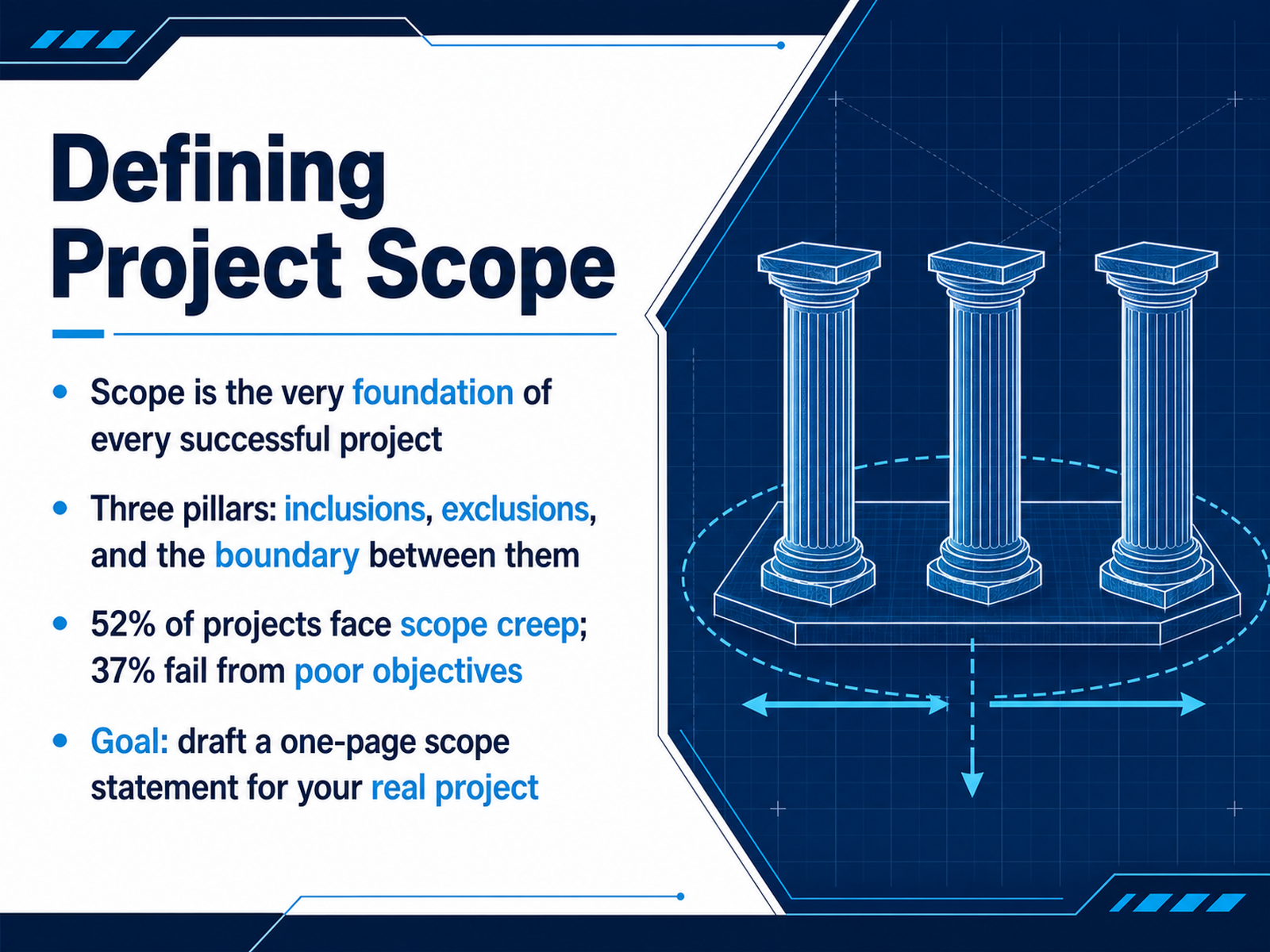
- 01Defining Project ScopeWelcome. Today we are going to define project scope, which is the very foundation of every successful project. Think of scope as a clear agreement built on three pillars: what is included in the project, what is explicitly excluded, and the boundary that separates the two. This is not just a formality. Research shows that fifty-two percent of projects face scope creep, and thirty-seven percent fail because of poorly defined objectives. Our practical goal today is to help you draft a one-page scope statement for a real project you are working on. By the end, you will have a tool that prevents misunderstandings and keeps your team aligned. Let's begin by looking at the real cost of ambiguity and why scope truly matters.1 min
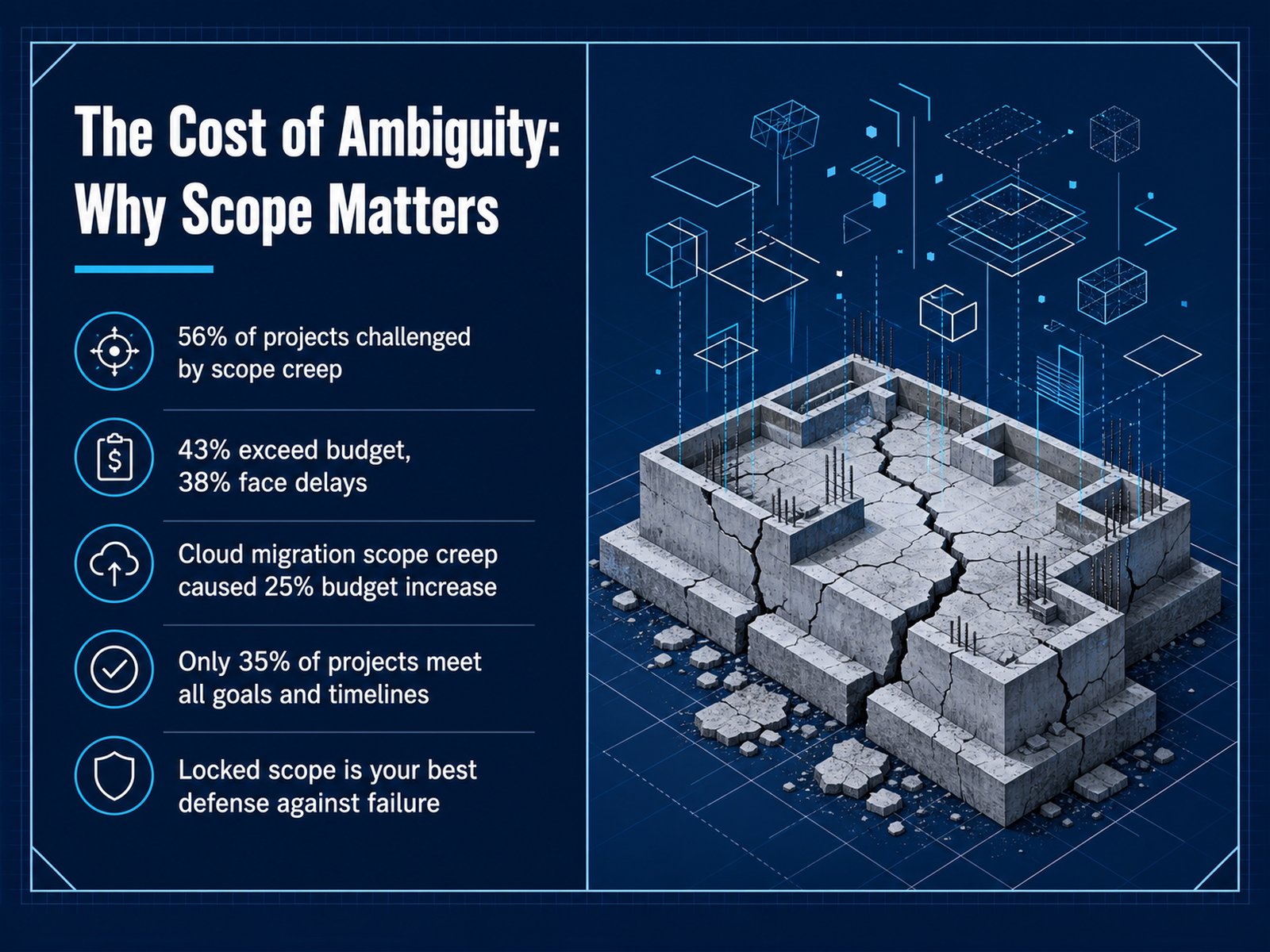
- 02The Cost of Ambiguity: Why Scope MattersLet’s look at the real cost of ambiguity. Numbers tell a clear story here. Fifty-six percent of projects are challenged by scope creep. That means more than half of all projects struggle because the boundaries were fuzzy from the start. Forty-three percent exceed their budget, and thirty-eight percent face significant delays. Think about a cloud migration I recently reviewed. Unclear scope caused a twenty-five percent budget increase. That’s real money lost to confusion. The data gets even more striking. Only thirty-five percent of projects actually meet all their goals and timelines. The solution is straightforward. A locked scope is your best defense against failure. It turns vague intentions into a clear, shared understanding. Next, let’s explore what project scope actually means.
 1 min
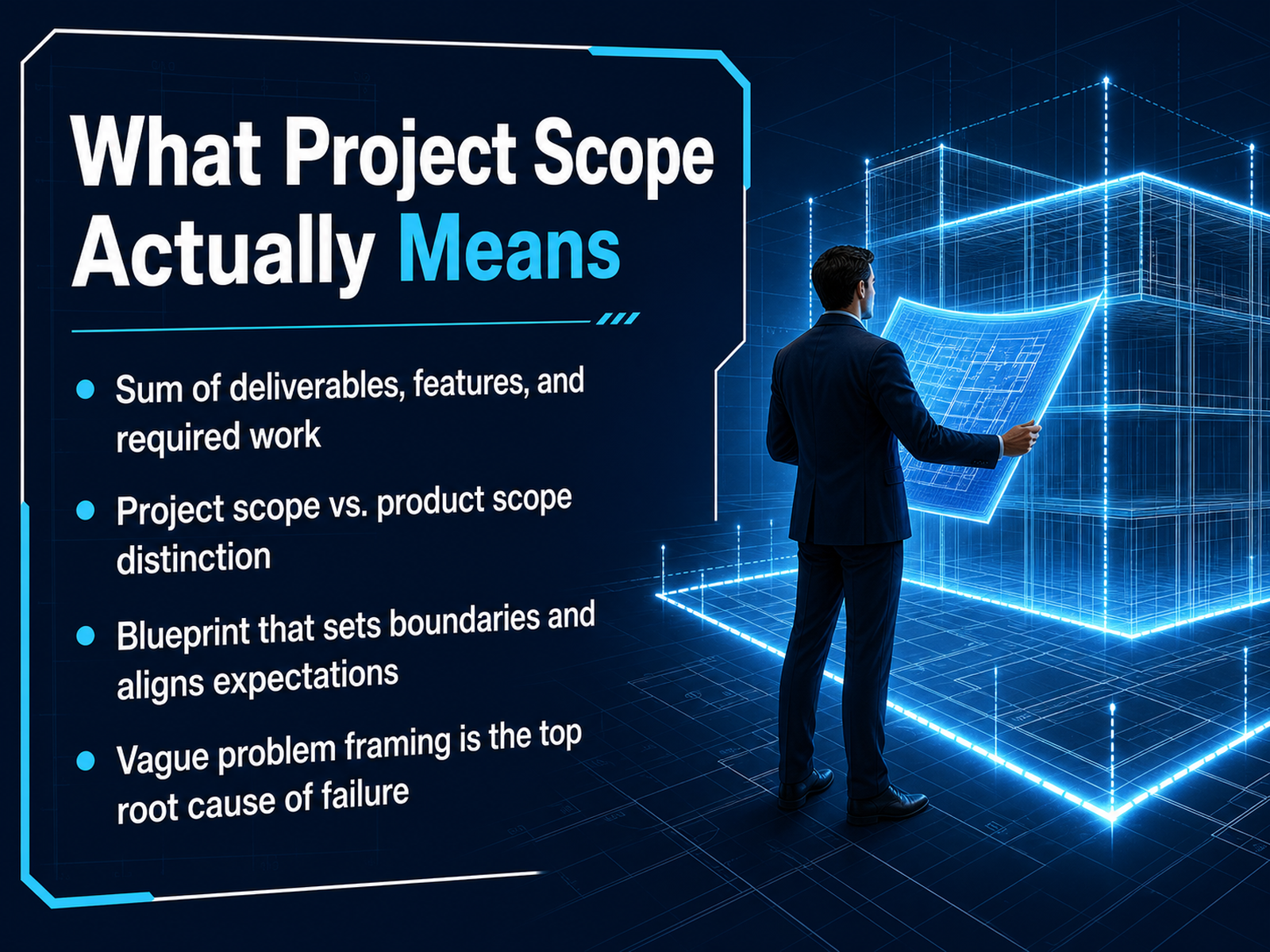
1 min - 03What Project Scope Actually MeansSo, what does project scope actually mean? Think of it as the total package: the sum of every deliverable, every feature, and all the work required to get there. Now, it helps to separate project scope from product scope. Product scope is about the features and functions of what you're building. Project scope is the work needed to deliver it. Together, they form a blueprint. This blueprint sets clear boundaries and aligns everyone's expectations early on. And that matters because vague problem framing is the top root cause of project failure. When the edges are blurry, misunderstandings and surprises take over. A clear scope is your practical shield against that chaos. Next, let's get specific by looking at what belongs inside the project: the inclusions that define your commitment.
 1 min
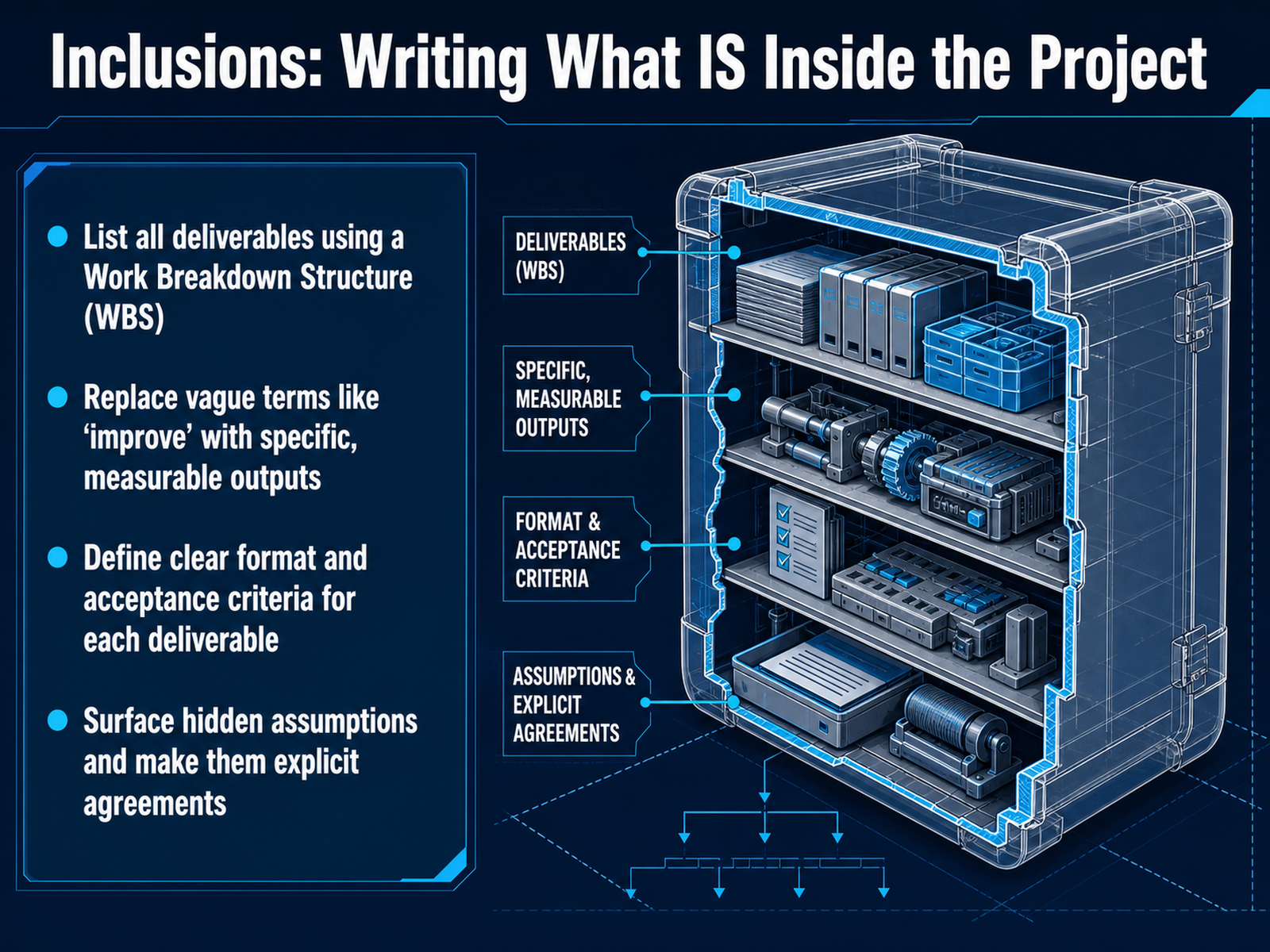
1 min - 04Inclusions: Writing What IS Inside the ProjectLet's move into the heart of defining scope: writing down exactly what is inside the project. We'll start by listing every single deliverable using a tool called a Work Breakdown Structure, or WBS. Think of the WBS as your project's blueprint. It breaks the big final product into smaller, manageable pieces, so nothing gets forgotten. Next, we need to swap out vague words like 'improve' for specific, measurable outputs. Instead of 'improve the website,' you might define it as 'reduce the page load time to under two seconds.' This makes success checkable. For each piece, you must also define its format and how you'll know it's done. For example, a 'training guide' is vague. Saying 'a searchable PDF training guide under twenty megabytes, reviewed and approved by the department head' is a clear, testable deliverable. Finally, this process surfaces your hidden assumptions. You might assume the client provides all the images, but they might assume you're taking the photos. Writing the inclusions forces these assumptions into the open, turning them into explicit agreements before the work starts. This method gives you a solid foundation, leaving no room for guesswork. Now that we know what's inside the project, let's flip the coin and define what is not in scope.
 2 min
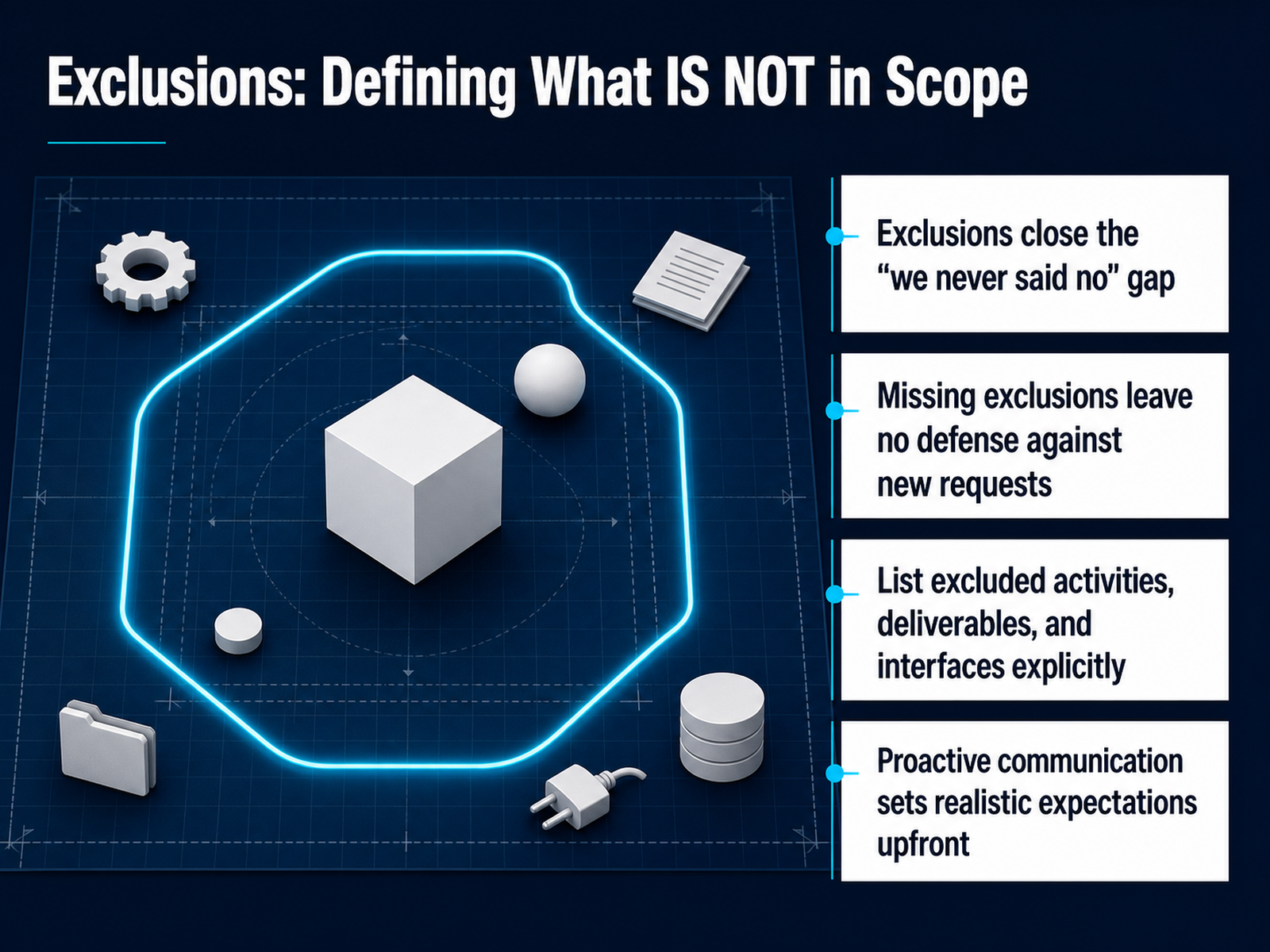
2 min - 05Exclusions: Defining What IS NOT in ScopeMoving from what the project includes to what it does not include is where scope really becomes a practical tool. Exclusions close the we never said no gap. When you do not define what is out, there is no defense against new requests that feel like they should be simple but actually pull the team off track. To prevent this, list excluded activities, deliverables, and interfaces explicitly. For example, you might state that the project does not include migrating historical data, building a mobile app, or integrating with a third-party billing system. This level of clarity is not about being difficult; it is about proactive communication that sets realistic expectations upfront. Stakeholders may still ask for extras later, but now you have a shared reference point to guide the conversation. Next, we will look at the boundary itself and how to draw a clear line between what is in and what is out.
 1 min
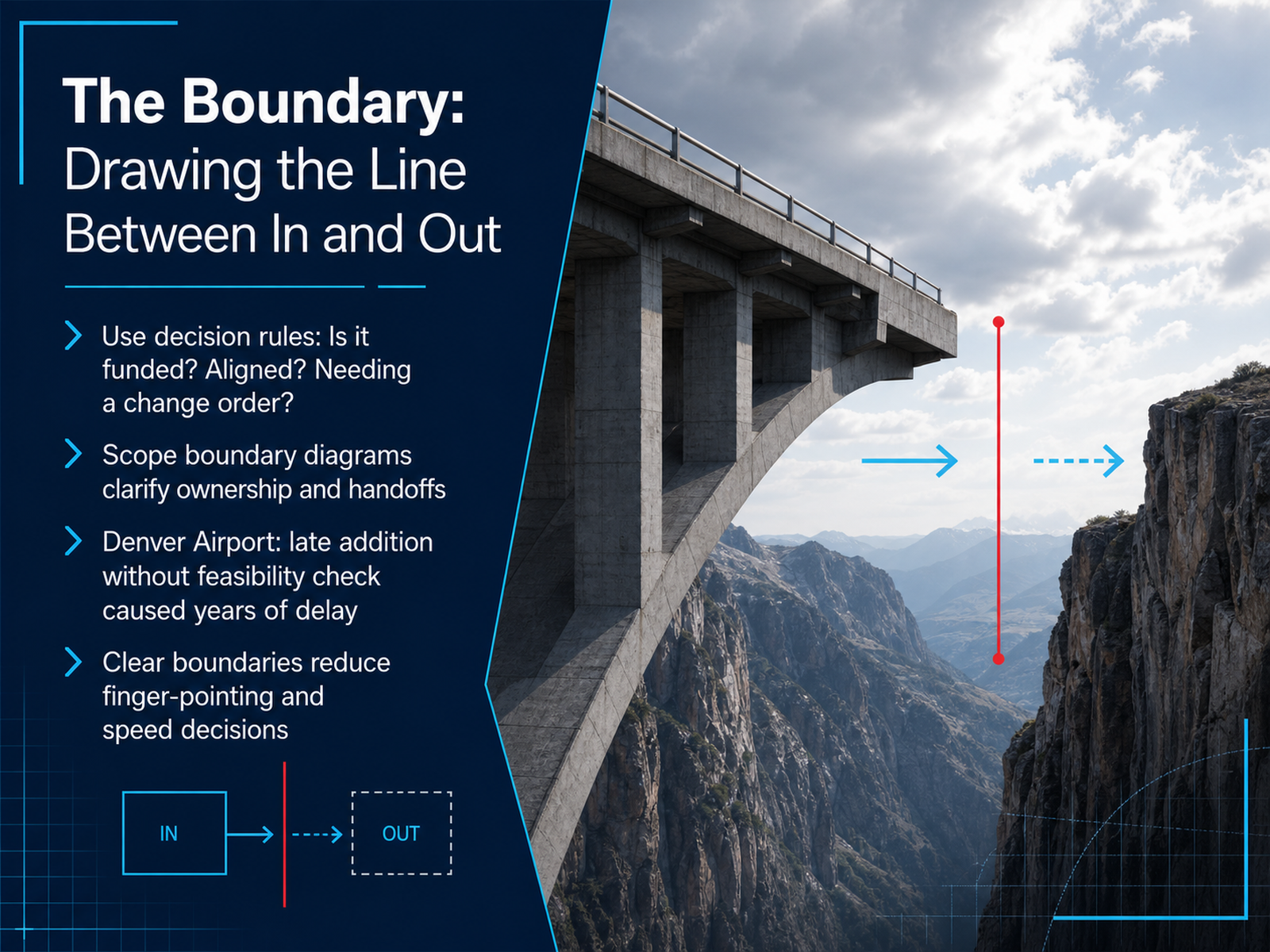
1 min - 06The Boundary: Drawing the Line Between In and OutSo how do we actually draw that line between what's in and what's out? The boundary works best when we use a few simple decision rules. Three questions can guide almost every situation. First, is the item funded in the current budget? If not, it probably sits outside the scope. Second, is it aligned with the approved objectives? A great idea that falls outside our goals still falls outside the boundary. And third, would adding it require a formal change order? If the answer is yes, you have just identified a scope boundary. Visual tools help too. Scope boundary diagrams make ownership and handoffs immediately clear, showing exactly where one team's work ends and another's begins. Consider the Denver Airport baggage system. A late addition was approved without a proper feasibility check, and that single boundary violation caused years of delay and massive cost overruns. When boundaries are clear from the start, you reduce finger-pointing and speed up decisions, because everyone knows who owns what and when a request crosses the line. Next, let's look at how clear boundaries prevent common problems.
 2 min
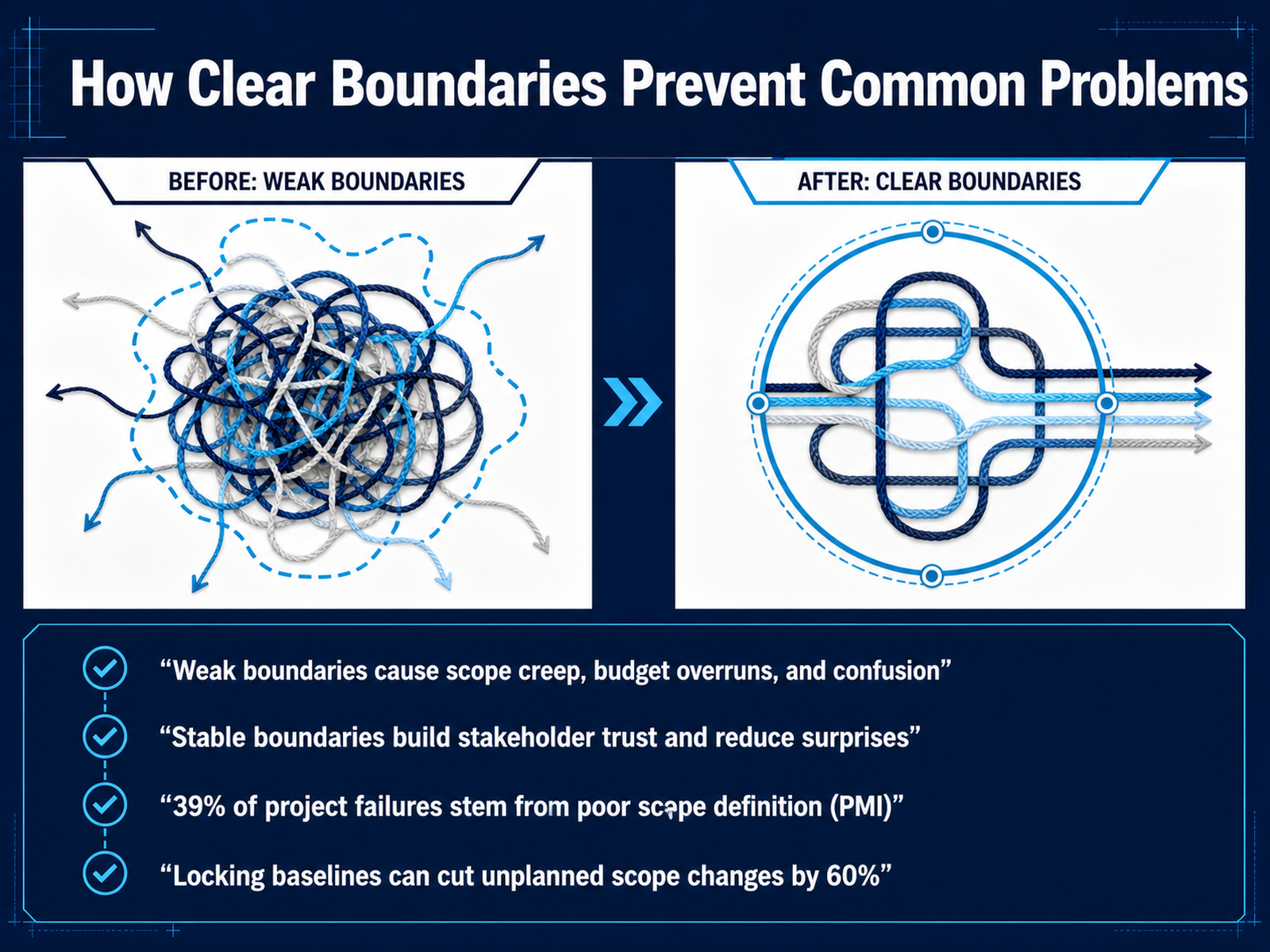
2 min - 07How Clear Boundaries Prevent Common ProblemsLet's look at why clear boundaries matter in practice. When boundaries are weak, it's almost a guarantee you'll run into scope creep. That's when new tasks quietly slip into the project without anyone officially agreeing to them. The result is almost always budget overruns and confusion among the team. But when boundaries are stable, something very different happens. Stakeholders start to trust the process because they know exactly what to expect, and it dramatically reduces those last-minute surprises that derail schedules. The numbers back this up. According to the Project Management Institute, thirty-nine percent of project failures are traced directly back to poor scope definition. Even better, research shows that simply locking your baselines can cut unplanned scope changes by up to sixty percent. Think of boundaries not as restrictions, but as your best tool for protecting the project's success. Next, we will move from theory to practice by building a practical scope statement.
 2 min
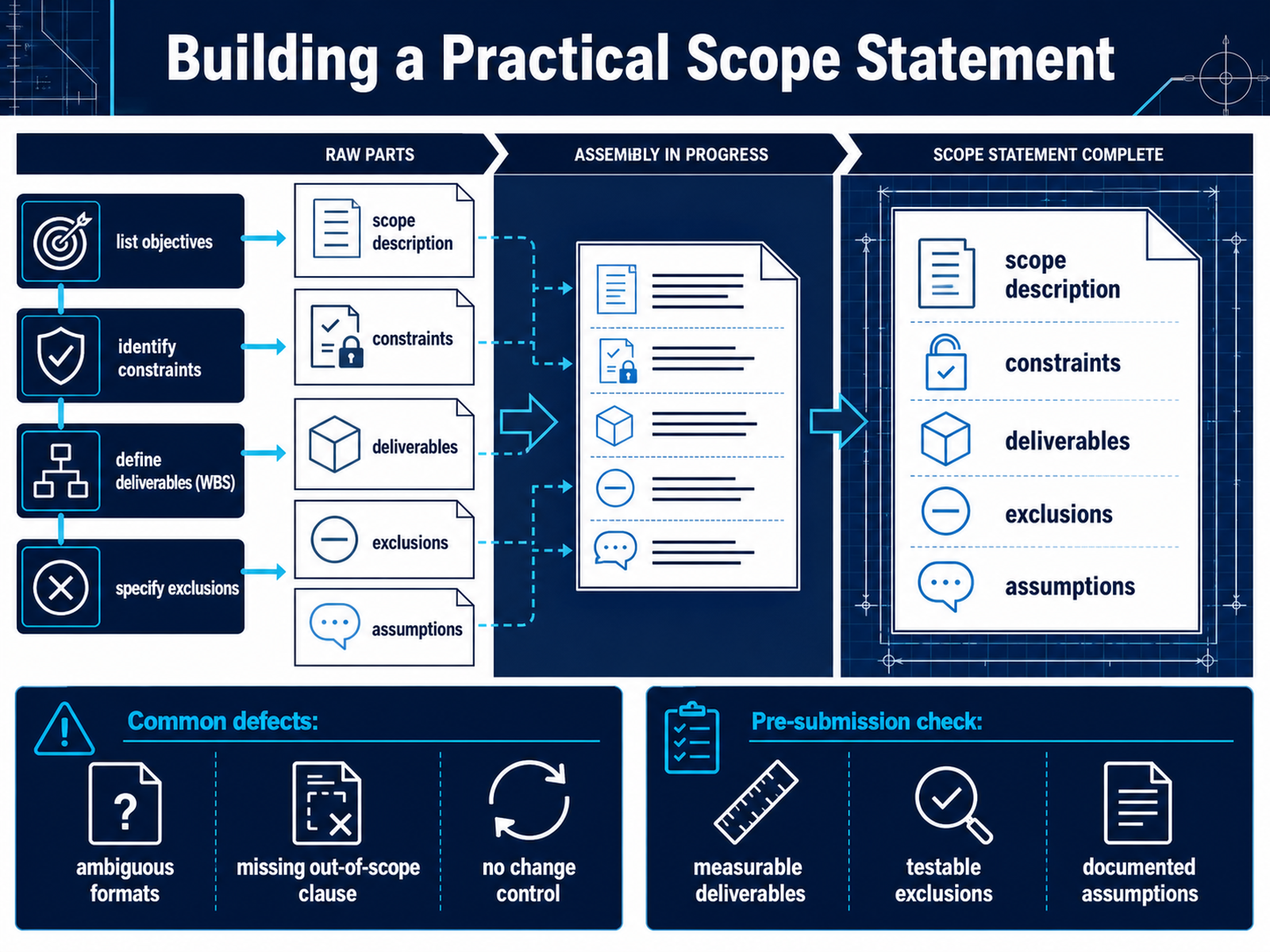
2 min - 08Building a Practical Scope StatementNow let's turn those concepts into a practical scope statement you can actually use. A strong statement must include five clear parts: the scope description, deliverables, exclusions, constraints, and assumptions. I recommend building it step by step. Start by listing your objectives, then identify the constraints you have to work within. From there, define your deliverables, a work breakdown structure helps a lot here. Finally, specify what is out of scope. Watch out for common defects we see in projects. Avoid ambiguous formats, never skip the out-of-scope clause, and make sure you have a change control process defined. Before submitting anything, run a quick check. Are your deliverables measurable? Are your exclusions testable? Have you documented your assumptions? If the answer is yes to all three, you've built a solid foundation. Next, we'll focus on validating the scope and getting stakeholder agreement.
 1 min
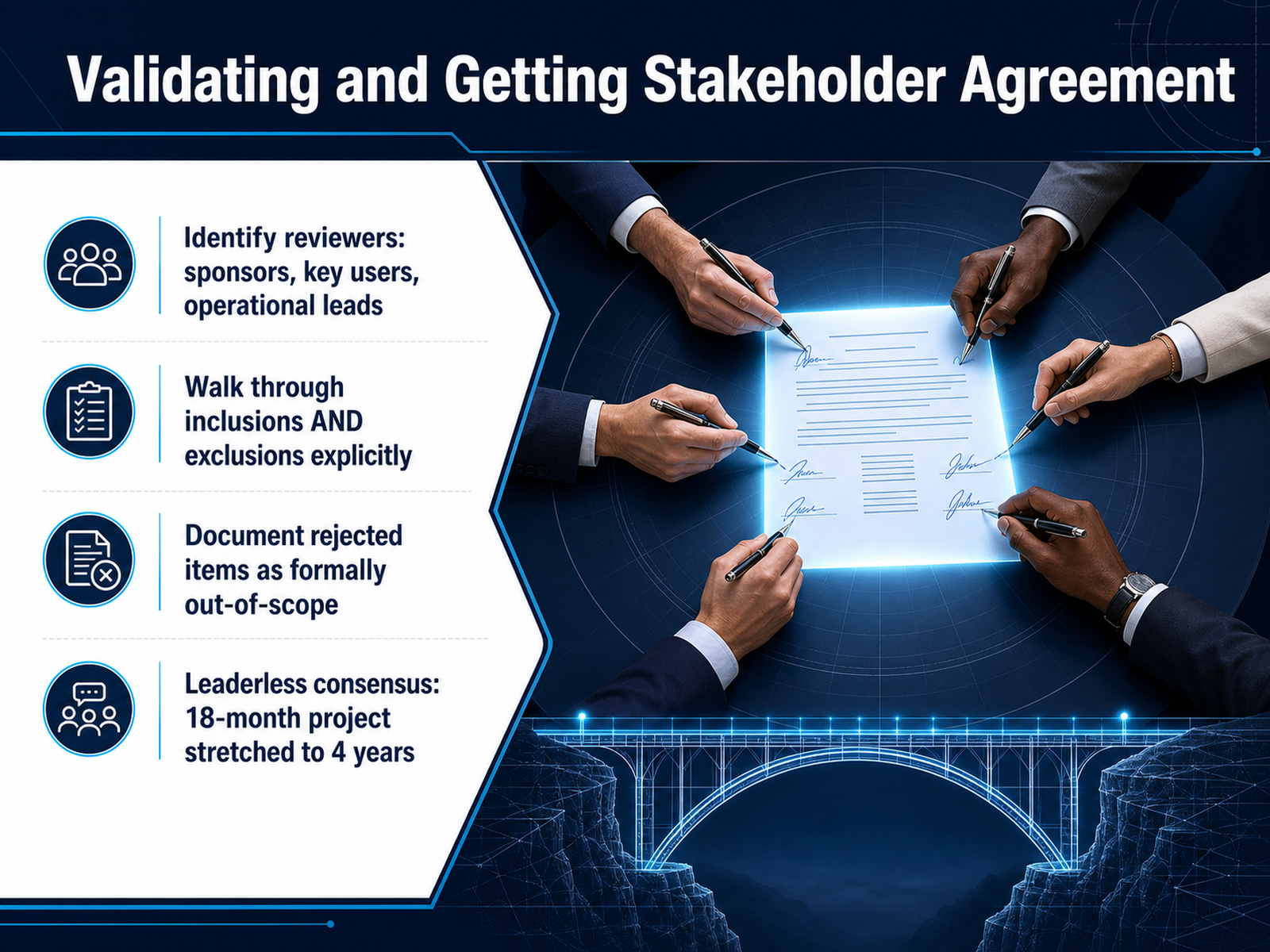
1 min - 09Validating and Getting Stakeholder AgreementLet's talk about making the scope official through stakeholder validation. You can’t just email the document and hope for the best. First, identify the right reviewers. You need sponsors who control the budget, key users who do the daily work, and operational leads who will support the result. Missing any of these groups creates blind spots. When you walk them through the document, cover both the inclusions and the exclusions explicitly. Don’t assume they’ll notice what's missing. Point to the list of rejected items and say, 'These are formally out of scope.' Getting a nod of agreement here prevents those items from creeping back in later. If you skip this step, you risk what we call leaderless consensus. Everyone nods along in the meeting, but nobody truly commits. We once saw an eighteen-month project stretch to four years because no one said no to small additions along the way. Formal agreement is your best defense against that drift. Up next, we’ll examine common scope mistakes and how to fix them.
 2 min
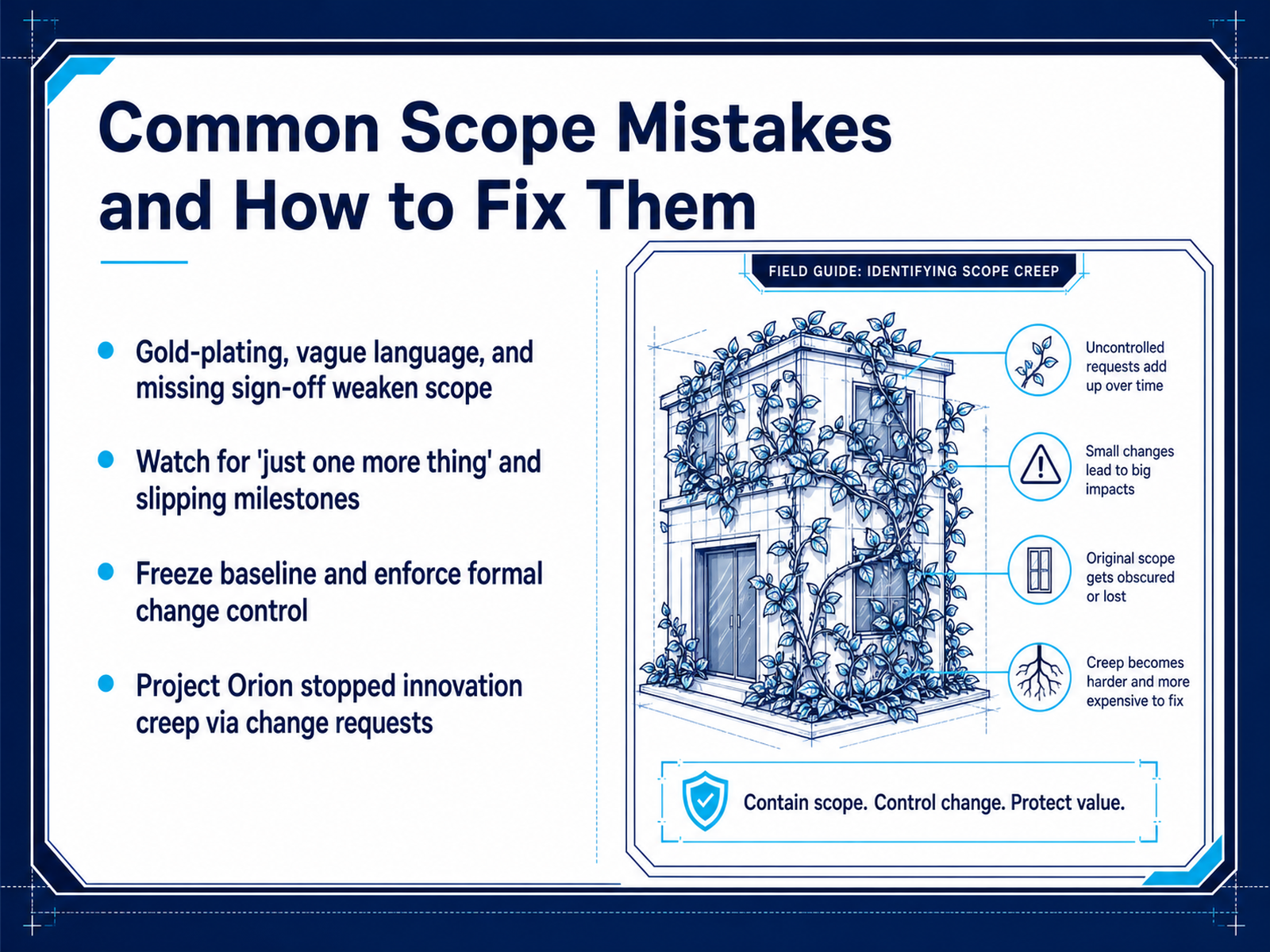
2 min - 10Common Scope Mistakes and How to Fix ThemLet's move on to some of the most common scope mistakes and, more importantly, how to fix them. First, watch out for gold-plating, vague language, and missing sign-off. Gold-plating means adding unrequested features that the team thinks are nice to have. Vague language, like saying 'fast performance' instead of 'under two-second load time,' creates confusion. And without a formal sign-off, you have no shared commitment. Another red flag is the phrase 'just one more thing.' Those small, informal requests add up quickly and cause milestones to slip. To prevent this, you need to freeze your baseline once it is approved. Then, enforce a formal change control process. This does not mean you never change course. It means every change is evaluated for impact on time, cost, and resources before it is added. For example, Project Orion successfully stopped innovation creep by routing every new idea through a change request. The team stayed focused, and valuable ideas were still captured for the next phase. That is how a solid change process protects the team and the timeline. Next, we will put this into practice with an exercise where you will draft your own one-page scope statement.
 2 min
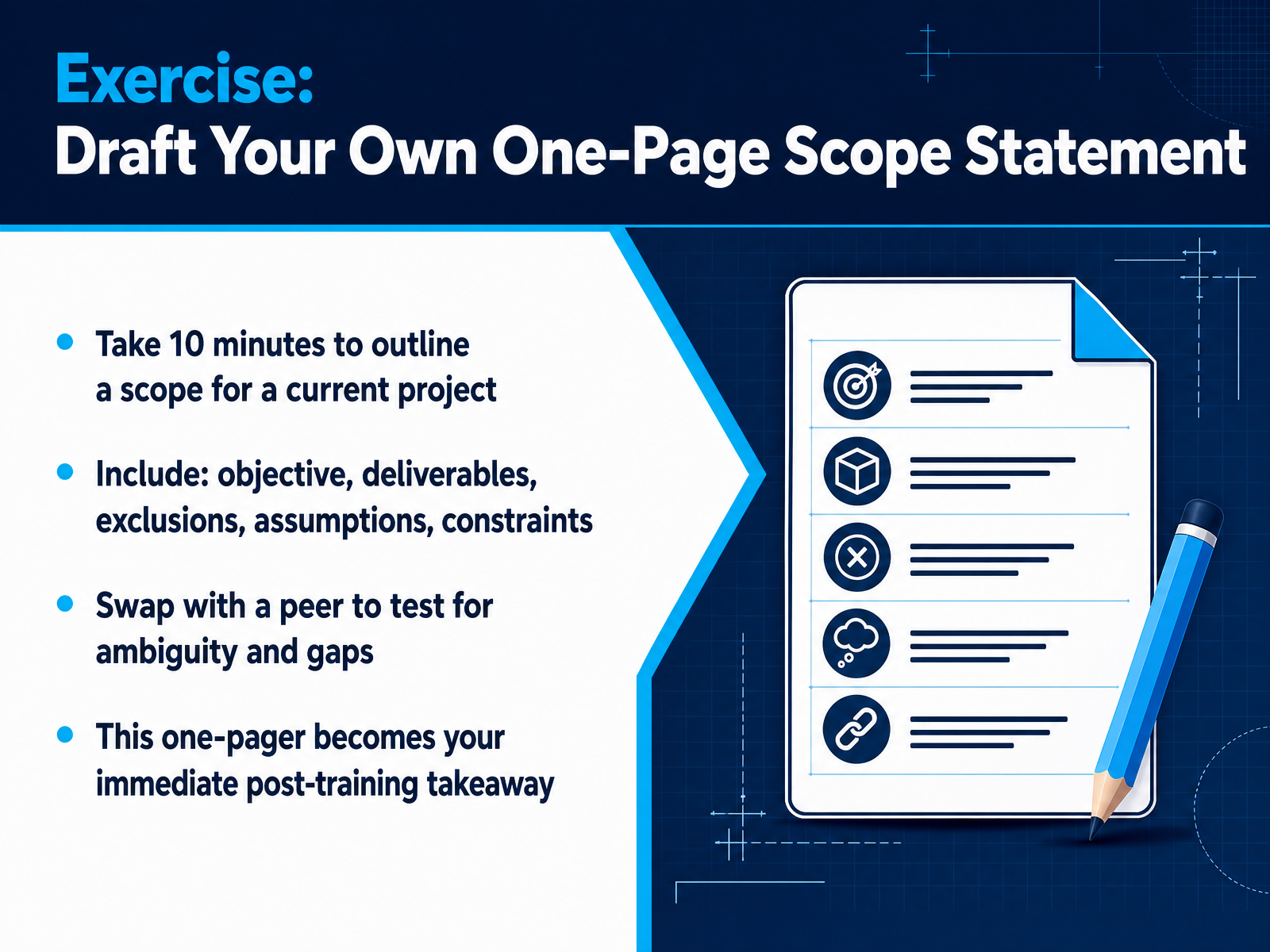
2 min - 11Exercise: Draft Your Own One-Page Scope StatementNow it's your turn to put scope into practice. Take the next ten minutes to draft a one-page scope statement for a real project you're working on right now. Your statement should include five clear sections: the objective, the key deliverables, what's explicitly excluded, the assumptions you're making, and any known constraints like deadlines or resource limits. Once you have a draft, swap with a peer and check each other's work. Look specifically for ambiguity or gaps, places where a stakeholder might read something different than you intended. This isn't about perfect formatting. It's about making sure what's in your head ends up clearly on the page. The one-pager you build here becomes your immediate takeaway after this training, something you can use tomorrow on the job. Next, we'll look at change control and how to protect your scope after it's been defined.
 1 min
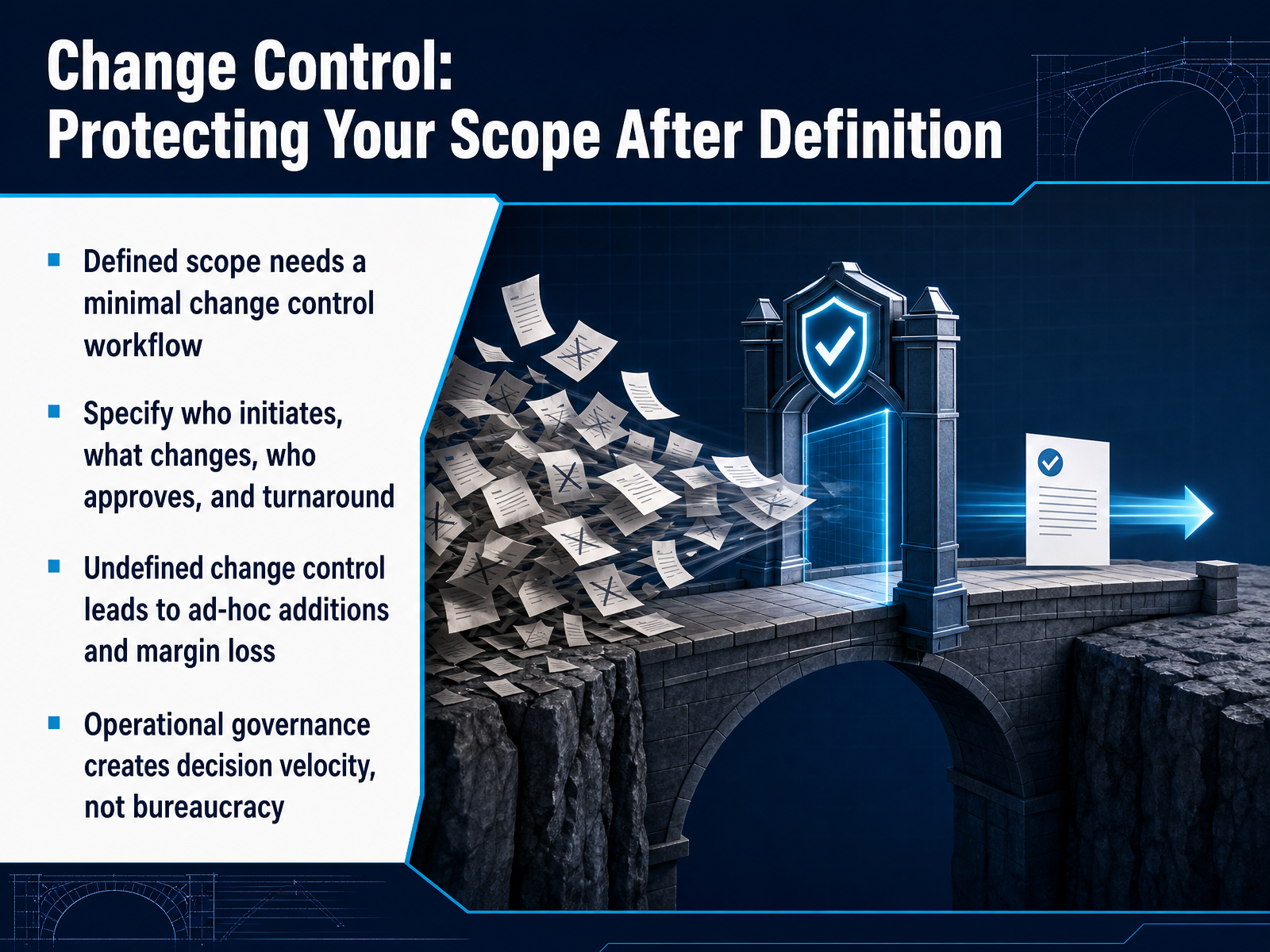
1 min - 12Change Control: Protecting Your Scope After DefinitionNow that your scope is defined, let's talk about keeping it protected. Think of change control as your scope's immune system. Without it, every small 'just one more thing' request starts adding up, and your project quietly bleeds time and budget. You need a simple but clear workflow. Decide upfront who can initiate a change request. Specify what information is needed to describe the change. Name the person or group who approves it, and set an expected turnaround time. This isn't about creating red tape. When change control is undefined, teams suffer from ad-hoc additions and eroding margins. A well-defined governance process actually creates decision velocity. Everyone knows the path, so decisions happen faster, not slower. Protecting your scope means protecting your success.
 1 min
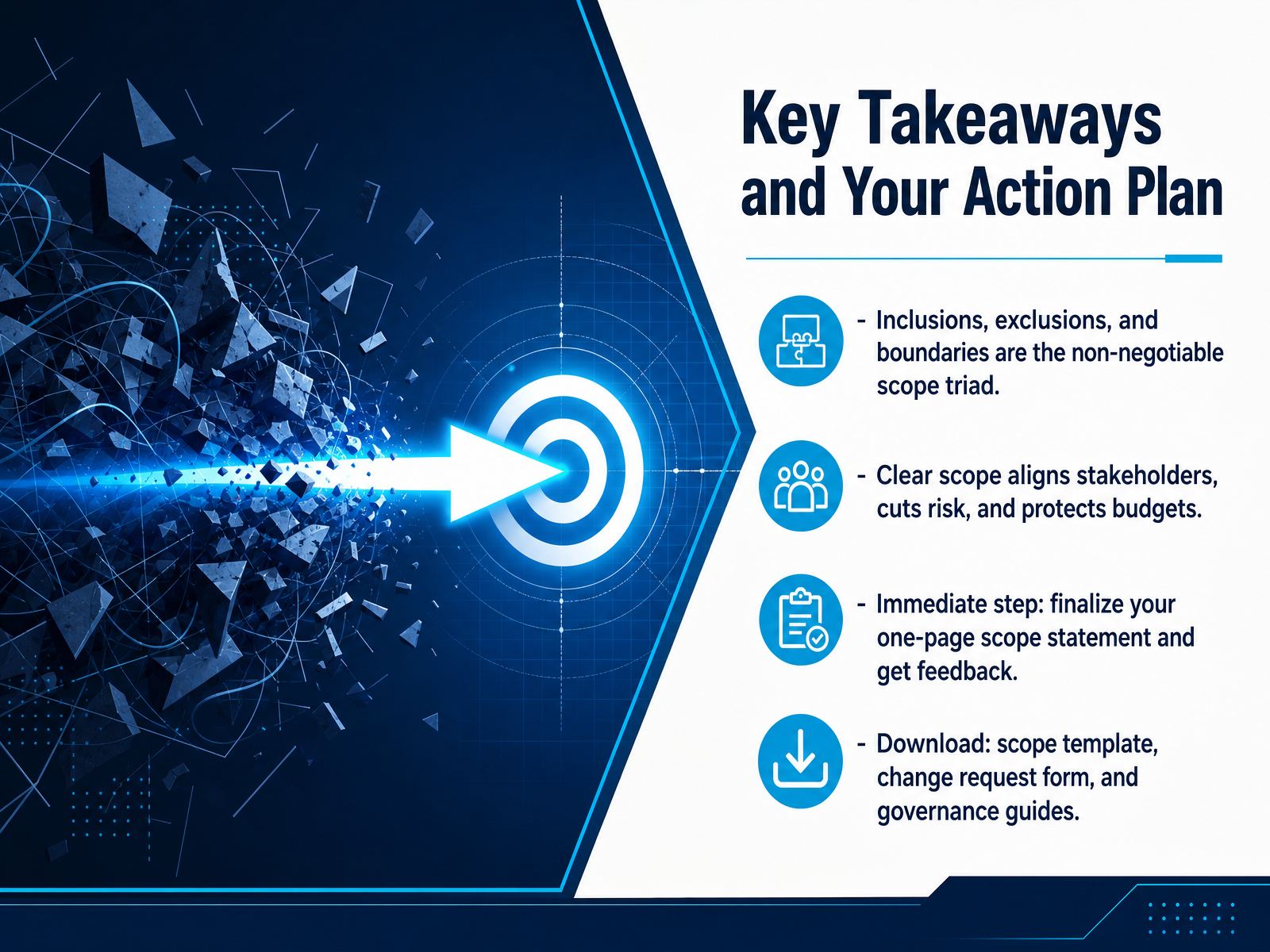
1 min - 13Key Takeaways and Your Action PlanWe have covered a lot together, so let's bring it all home with the key takeaways and your personal action plan. First, remember the scope triad: inclusions, exclusions, and boundaries. These are not optional details, they are the non-negotiable foundation for every project. Think of them as your project's constitution. Second, a clear scope is your strongest tool for aligning stakeholders, cutting down on risk, and protecting both your budget and your timeline. It turns vague expectations into a shared, concrete understanding. Now, your immediate next step is crystal clear. Finalize your one-page scope statement while the ideas are fresh, and then share it to get direct feedback. This act alone prevents most scope problems. To make it easy for you, I have prepared three practical downloads: a scope statement template, a change request form, and a set of governance guides. Download them, use them, and make them a habit. Thank you for your focus and engagement today. You now have everything you need to lead with clarity. Go define your project's success.
 2 min
2 min
Take the deck with you
Download this course as a file — free, no sign-up needed.
- PDF handoutEvery slide page, ready to print or share.14 pages · 3.9 MBDownload
- Narrated PowerPointThe deck that presents itself — every slide carries the digital human's narration video.14 pages · 12.4 MBDownload
- PowerPoint slidesThe full deck as a .pptx — open it in PowerPoint, Keynote, or Google Slides.14 pages · 3.8 MBDownload
Free to use in your own training — please keep the PersonWise credit page at the end.
Have your own deck? Turn it into a course