Begin
14 pages · ~28 min
User Research Fundamentals
Learn to conduct foundational user research by planning studies, gathering insights, and translating findings into actionable design decisions—ideal for aspiring UX professionals.
A digital instructor presents all 14 pages. Hold “Ask” at any point and ask out loud — the answer comes from this course. No sign-up needed.
What you’ll learn
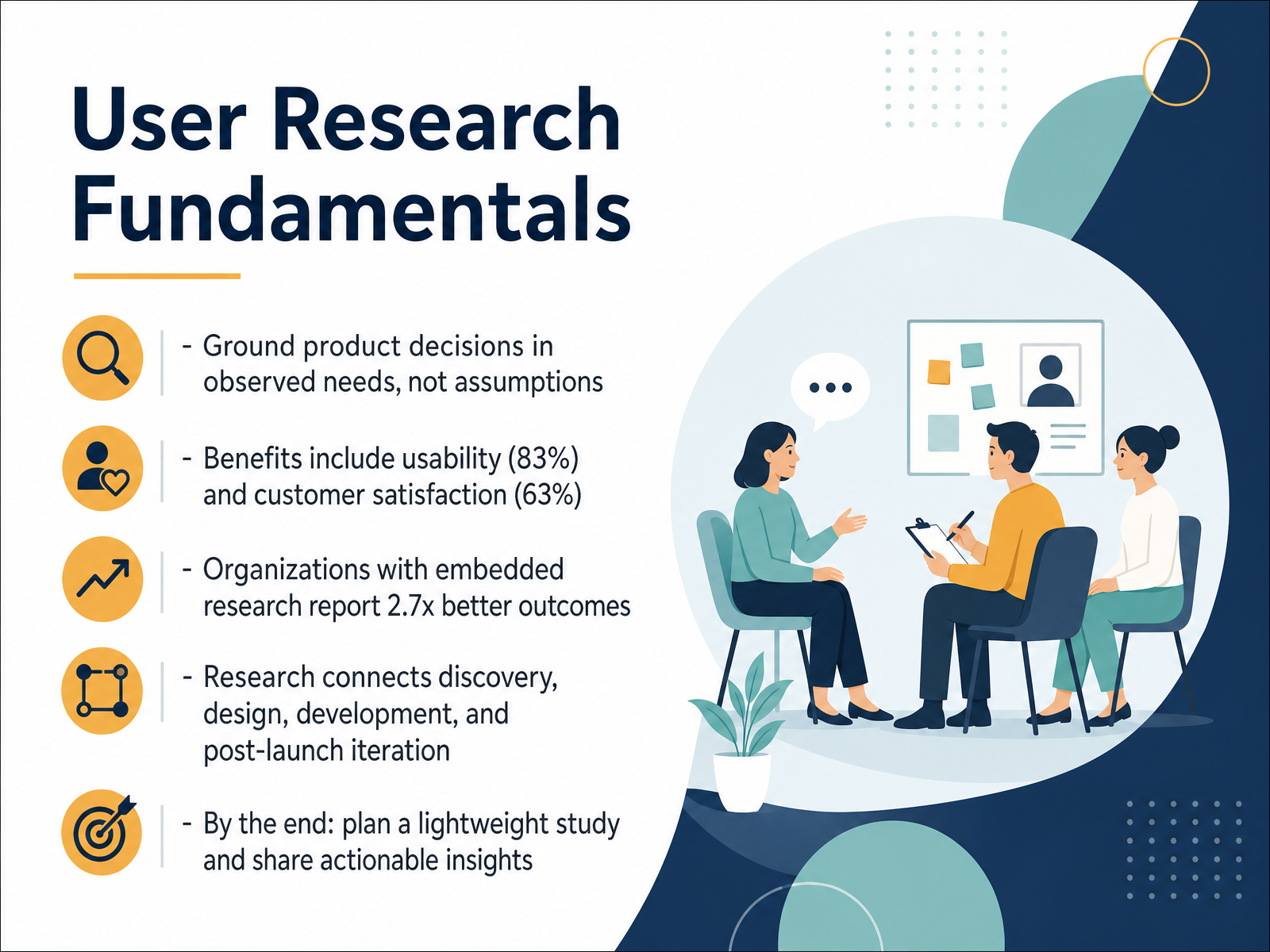
- 01User Research FundamentalsWelcome to User Research Fundamentals. If you're a product manager, designer, or startup founder, you know how easy it is to fall in love with our own ideas. This course is about replacing those internal assumptions with observed needs from real users. Think of research as a flashlight in a dark room. It shows us where the furniture is, where the sharp corners are, and where the exits are located. The data backs this up. Organizations that embed research into their workflow see an eighty-three percent improvement in usability and a sixty-three percent improvement in customer satisfaction. Even better, teams that make research a core habit report two point seven times better outcomes. Throughout this journey, we'll connect research to discovery, design, development, and what happens after launch. By the end, you won't just understand the theory; you'll be ready to plan a lightweight study and share insights that actually drive decisions. Let's start by looking at why solid research consistently beats even the most confident guessing.maze.couserinterviews.comdovetail.com+21 min
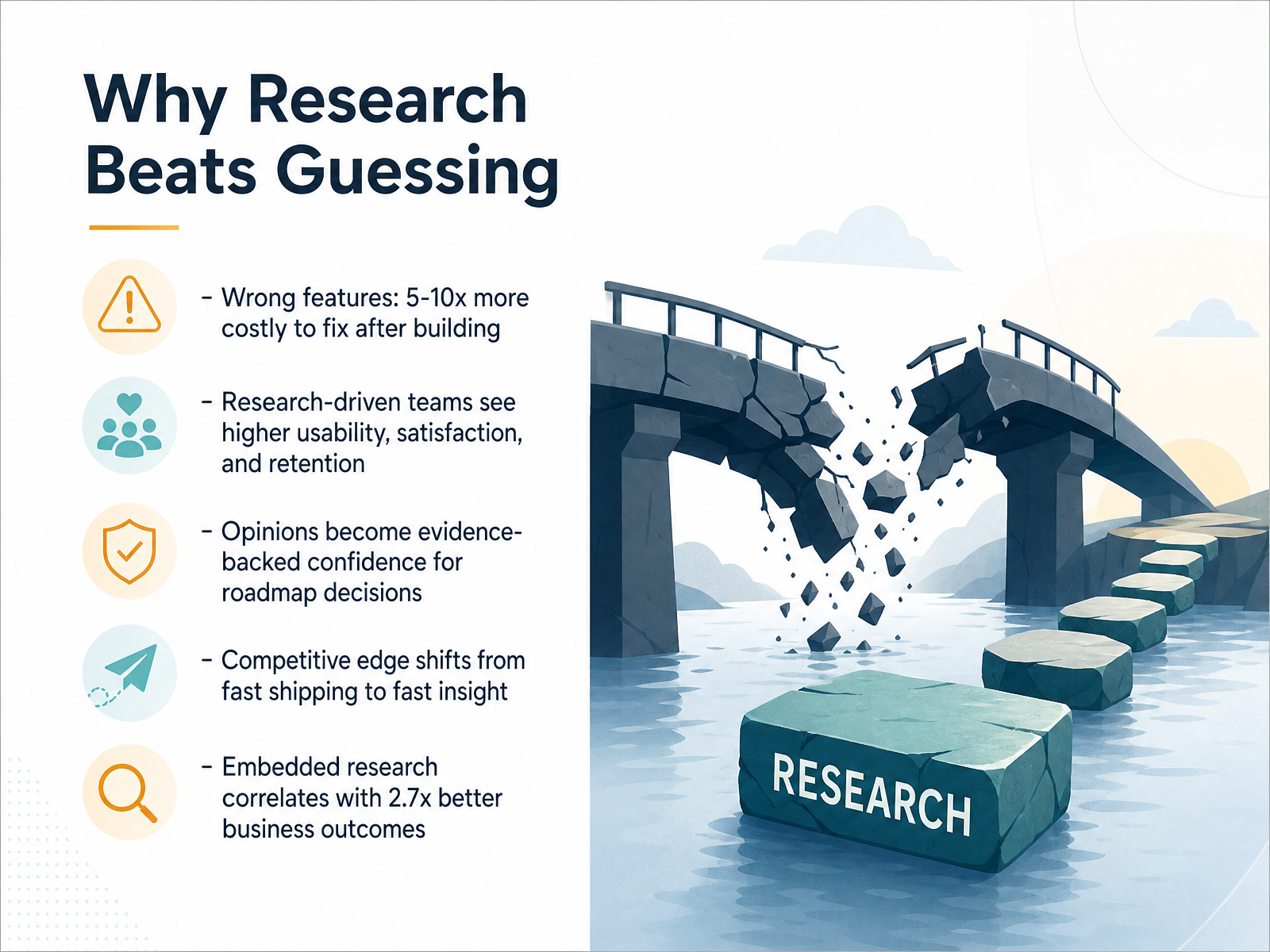
- 02Why Research Beats GuessingSo why does research actually beat guessing? Let's look at the cost. When we build the wrong feature, fixing it later can be five to ten times more expensive than catching the mistake early. Teams that make research a habit consistently see higher usability, better satisfaction, and stronger retention. Instead of arguing over opinions in a roadmap meeting, we get evidence backed confidence. The competitive edge is shifting too. It is no longer just about shipping fast. It is about learning fast. The data backs this up. Organizations that embed research into their strategy report about two point seven times better business outcomes. So we are not just talking about a nice to have. This is a practical way to protect your budget and your roadmap. Coming up next, we will break down the core concepts and terminology you will need to get started.
 maze.couserinterviews.comdovetail.com+21 min
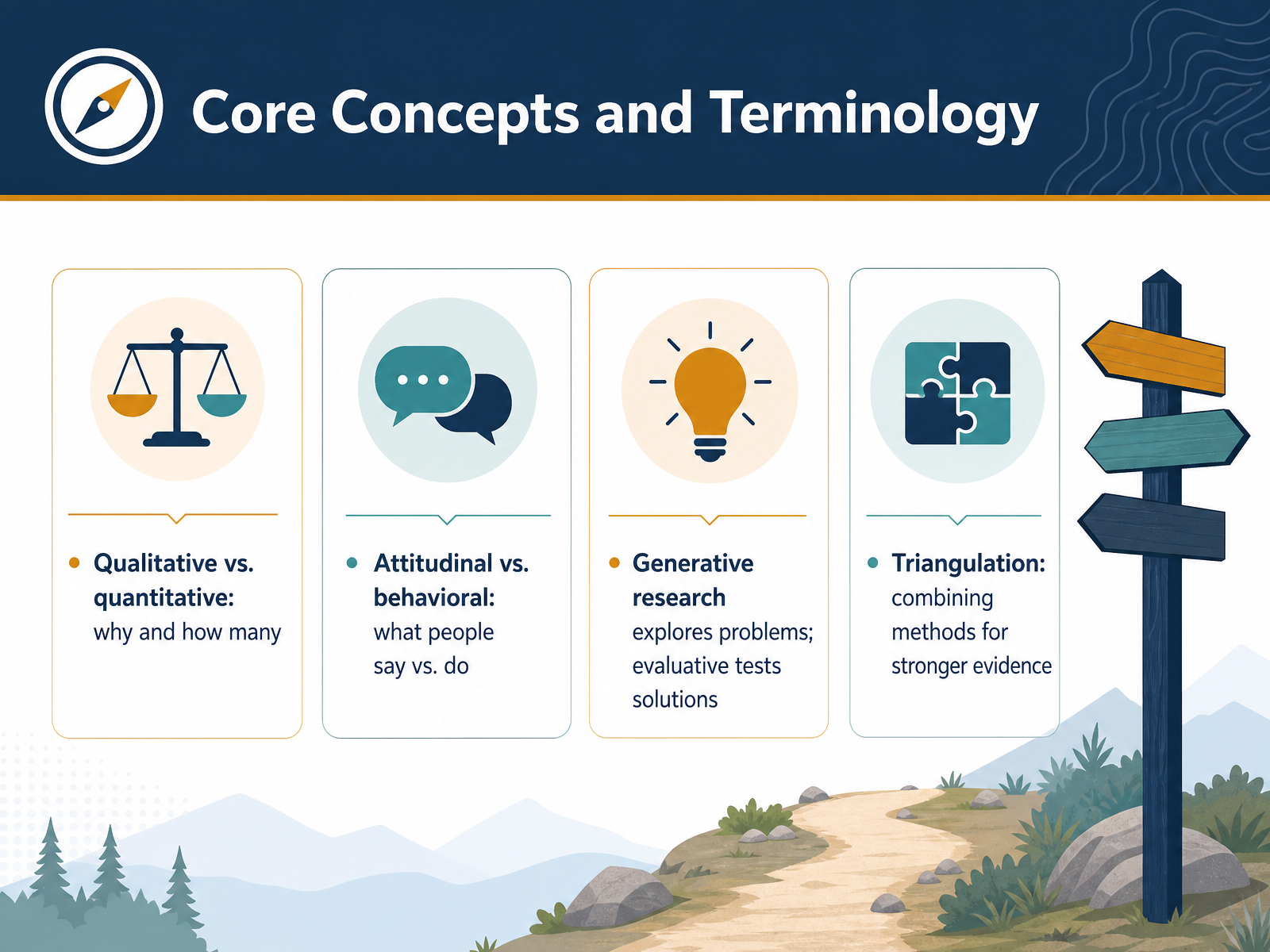
 - 03Core Concepts and TerminologyLet's get comfortable with the core vocabulary of user research. First, the classic split: qualitative versus quantitative. Qualitative research asks why. It usually involves a small group, maybe five to eight people per segment, and helps you uncover motivations through interviews or observations. Quantitative research asks how many or how much. It uses larger samples and numerical data, like analytics or surveys, to measure behavior and validate patterns. Next, consider attitudinal versus behavioral. Attitudinal is what people say they do or prefer, like in a survey. Behavioral is what they actually do, which you see in usability tests or analytics. These often differ, so observing behavior is crucial. We also distinguish between generative and evaluative research. Generative explores problems before you build, while evaluative tests a solution you have designed. Finally, triangulation means combining methods, such as pairing analytics with interviews, to get stronger evidence. Next, let's move into practical applications with qual versus quant in practice.
 nngroup.comuxdesigninstitute.commaze.co+22 min
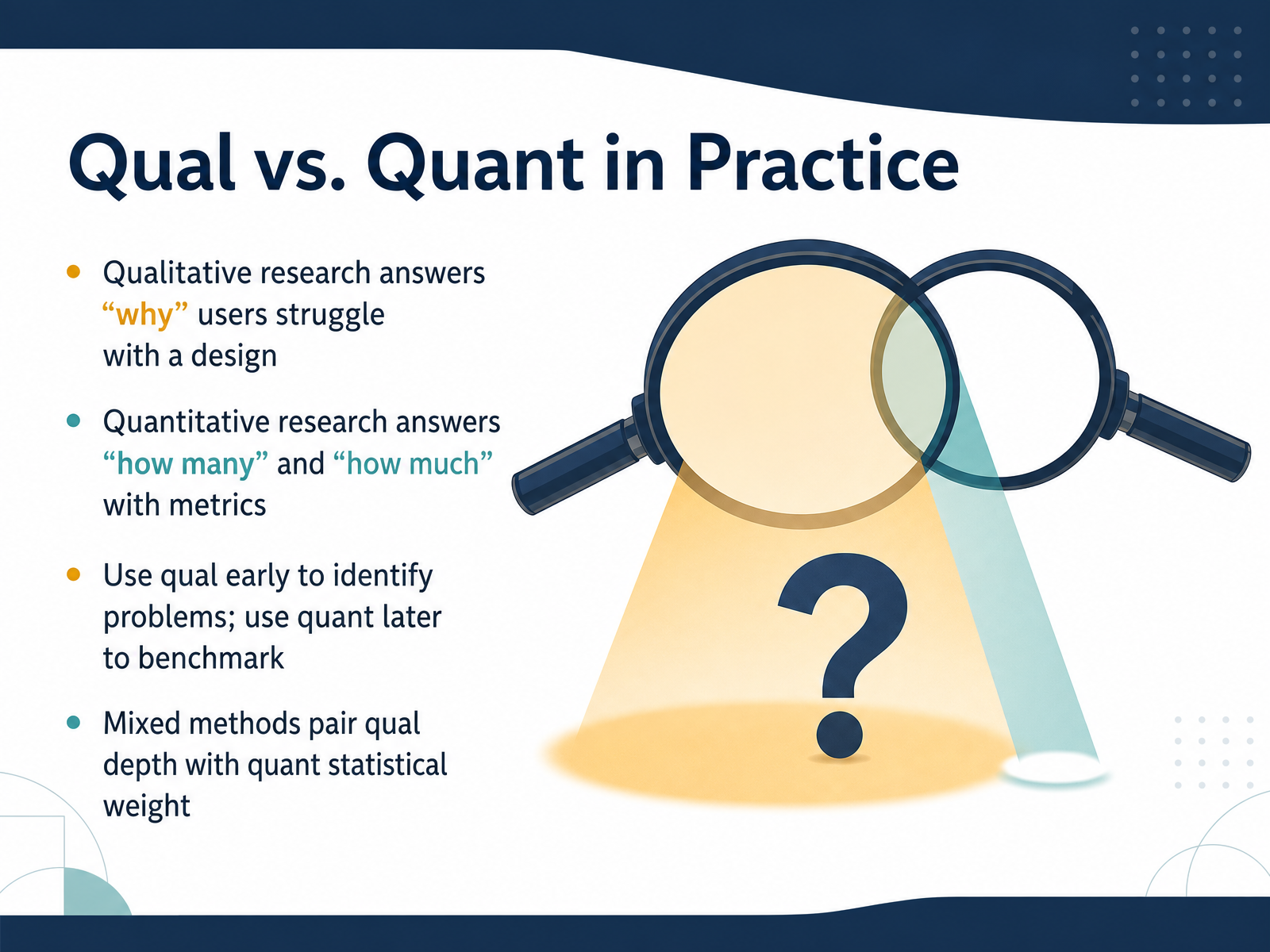
 - 04Qual vs. Quant in PracticeNow let's talk about the two main types of research you will use in practice: qualitative and quantitative. Qualitative research is your tool for answering the question why. It helps you understand why users struggle with a design or why a feature is confusing. For example, watching someone try to complete a checkout and hearing them explain their thought process tells you exactly where the friction is. Quantitative research, on the other hand, answers how many and how much. It gives you the numbers, like task completion rates or the percentage of users who abandon a form. A good rule of thumb is to use qualitative research early to identify problems and generate ideas. Then use quantitative research later to measure, benchmark, and track improvements over time. Most successful teams use a mixed methods approach. This pairs the depth of qualitative insights with the statistical weight of quantitative data, giving you a complete picture before you make a major decision. Next, we'll look at planning research that answers real questions.
 nngroup.comuxdesigninstitute.commaze.co+21 min
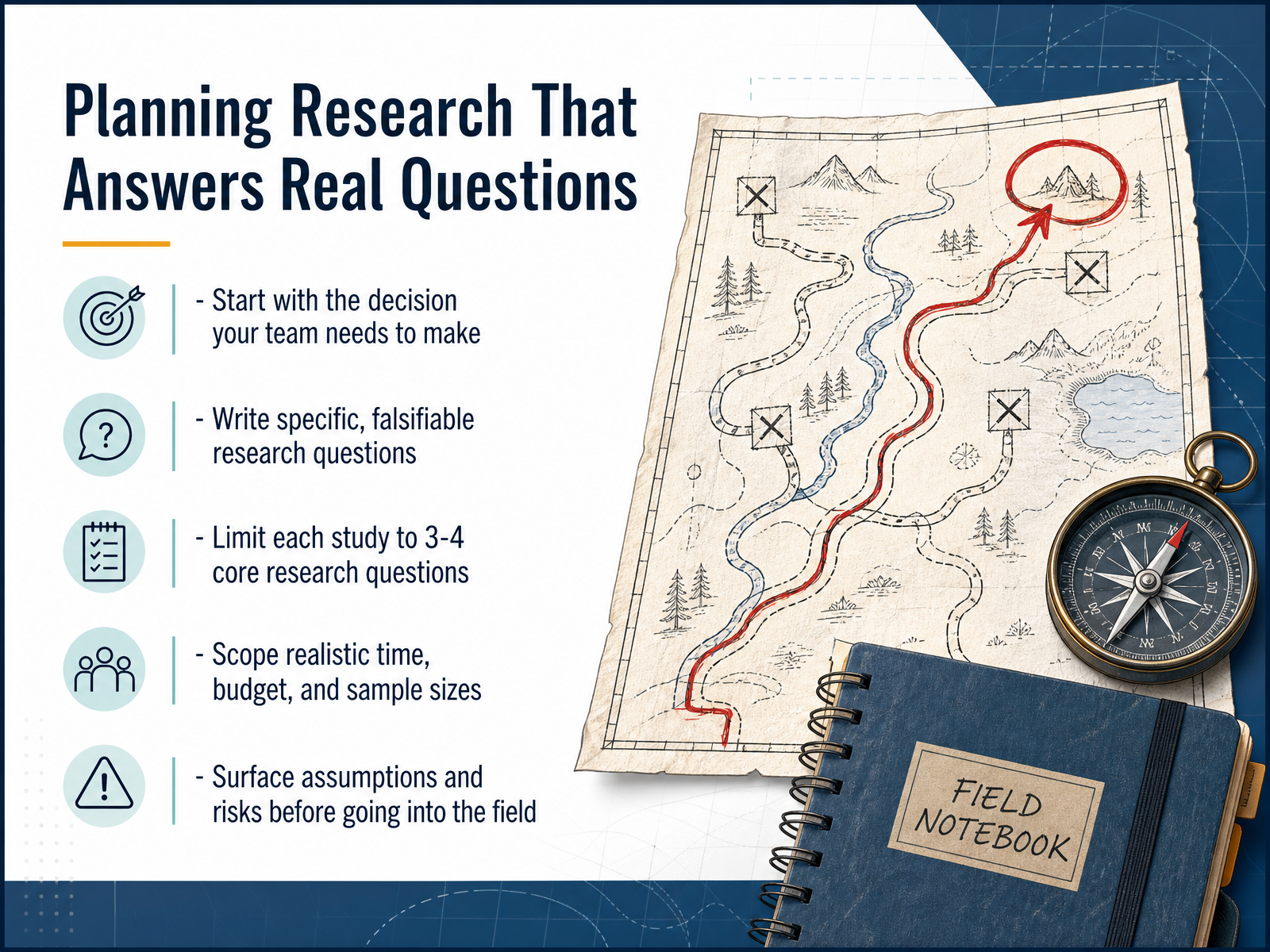
 - 05Planning Research That Answers Real QuestionsBefore you recruit anyone or write a single interview question, let's talk about planning. The best research starts with a decision your team actually needs to make. Maybe you need to choose between two onboarding flows, or decide whether a new feature is worth building. That decision is your anchor. From there, write research questions that are specific and falsifiable. Instead of asking, do users like our product, ask, what stops users from inviting a teammate in their first week. A good question can be answered wrong, and that is what makes it useful. Keep your study tight. Three or four core research questions is plenty. More than that, and you are doing a survey, not a focused study. Be realistic about time, budget, and sample size. Five to eight well-chosen participants can reveal most usability issues. Finally, surface your assumptions and risks before you go into the field. Write down what you think you will hear. That way, when you are surprised, you will notice it. Next, let's look at how to choose the right method for the questions you have written.
 nngroup.comuserinterviews.comusertesting.com+21 min
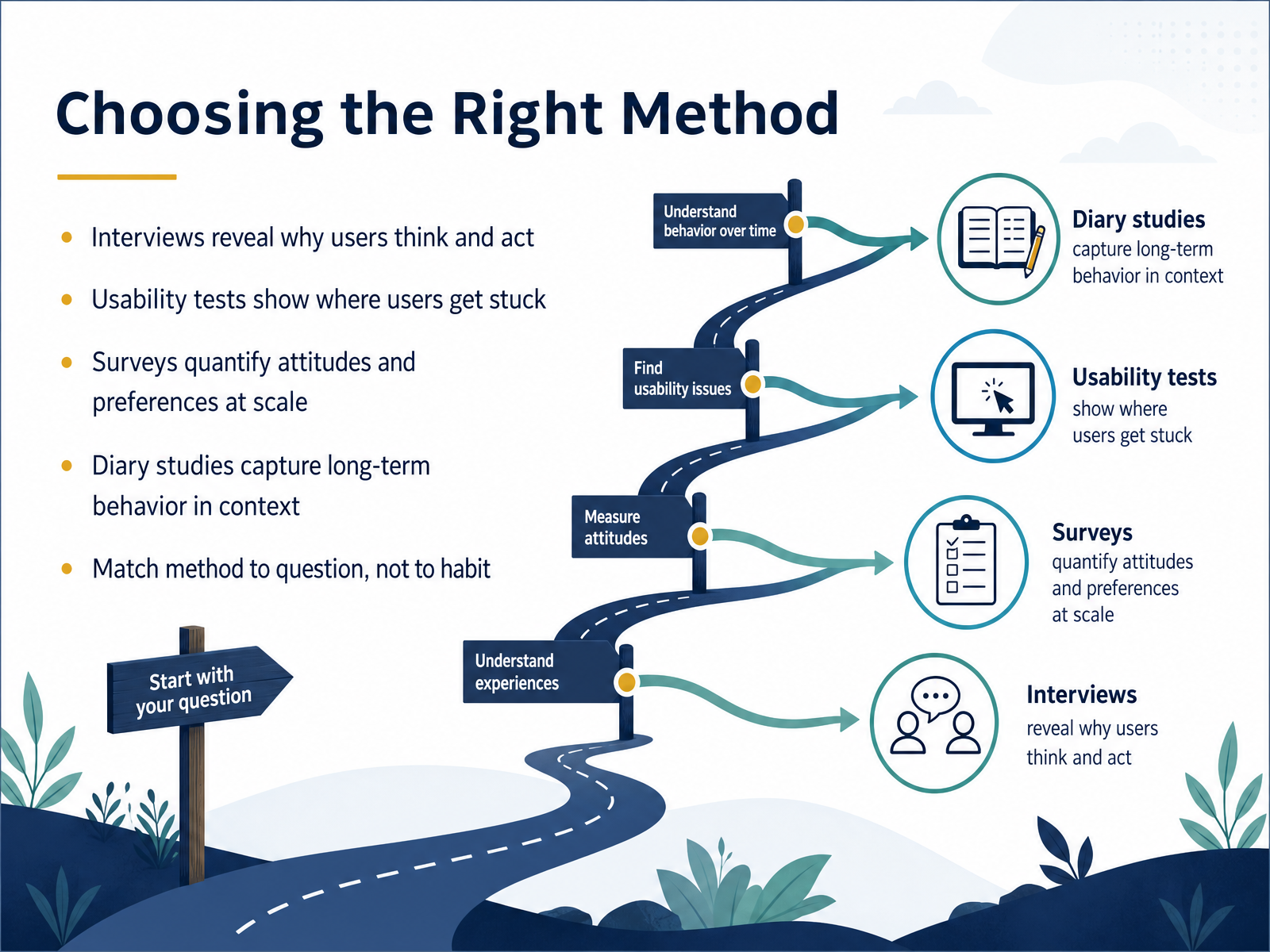
 - 06Choosing the Right MethodNow, let's talk about choosing the right research method. Think of it like picking the right tool for a job. A hammer is great for nails, but not for screws. We have a few key tools in our kit. First, interviews reveal why users think and act a certain way. They give us the story behind the behavior. Next, usability tests show us exactly where users get stuck when they try to complete a task. We watch them, and the friction points become obvious. Surveys quantify attitudes and preferences from a large group. They give us the numbers to back up our ideas. And finally, diary studies capture behavior over time in a real-world context. It is like getting a peek into someone's actual week, not just a single moment in a lab. The golden rule here is to match the method to your question, not to your habit. It is easy to always run a survey, but that will not tell you why someone is confused. Start with what you need to learn, and let that guide your choice. We will look at how to find the right people to talk to next.
 nngroup.comuserinterviews.comusertesting.com+21 min
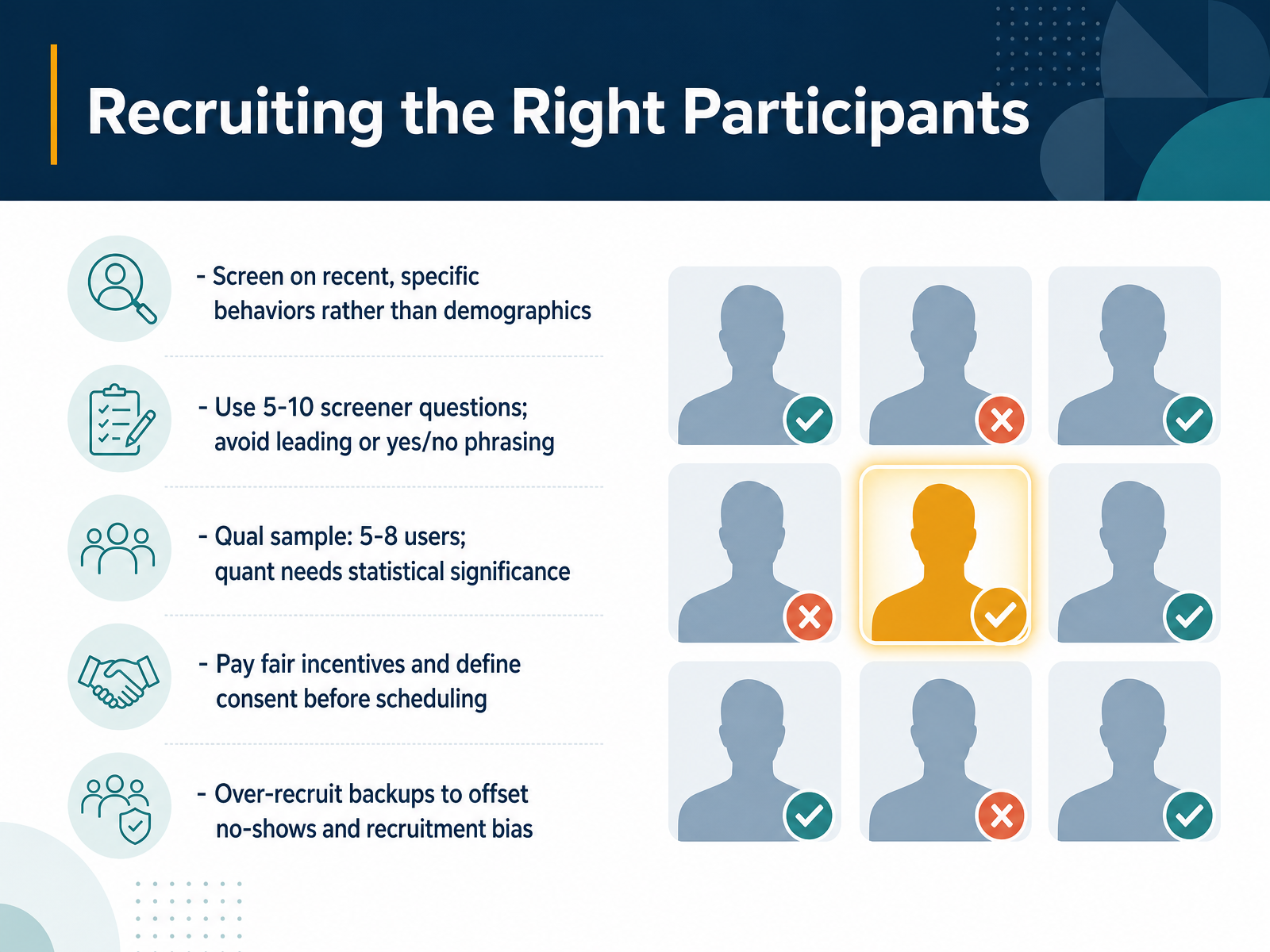
 - 07Recruiting the Right ParticipantsNow, let's talk about one of the most common places research goes wrong: recruiting the right people. Instead of screening on demographics like age or job title, focus on recent, specific behaviors. You want to hear from someone who booked a trip last month, not someone who says they might travel someday. Keep your screener to about five to ten questions, and avoid leading or yes or no phrasing. Ask open-ended questions like, "Tell me about the last time you planned a trip," so you can hear how they think and speak. For qualitative studies, five to eight participants is usually enough to uncover major patterns. For surveys and other quantitative work, you'll need a much larger, statistically significant sample. Before anyone is scheduled, pay fair incentives and define consent clearly. People are giving you their time and stories, so respect that from the very first interaction. Finally, always over-recruit backups. No-shows happen, and having a few extra people lined up keeps your timeline from falling apart. Get this right, and you'll gather rich, honest data. Next, we'll move into how to run the sessions themselves in a way that reveals what's really going on.
 1 min
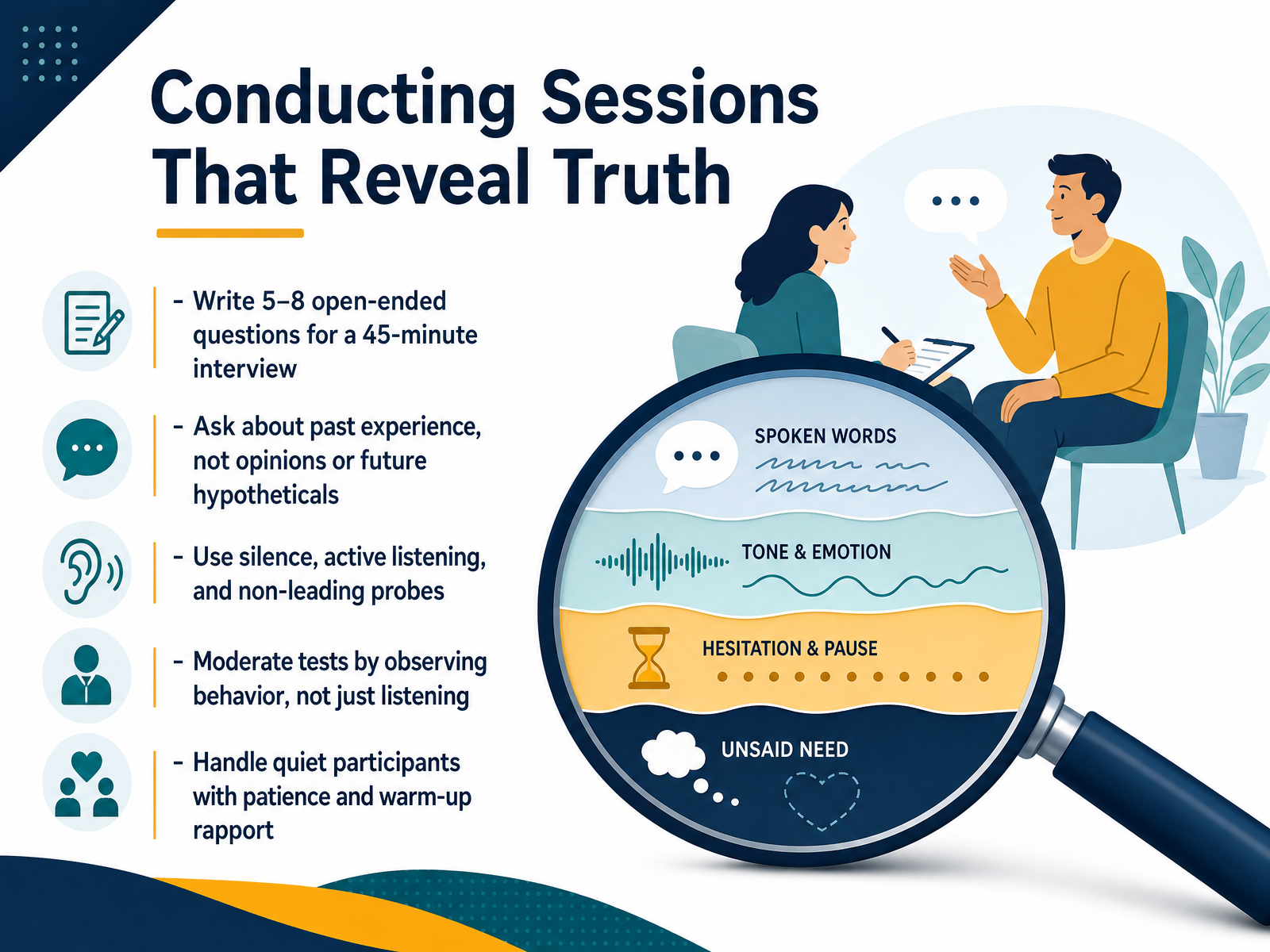
1 min - 08Conducting Sessions That Reveal TruthWhen we run sessions, our real goal is to see the truth behind what people say, and especially what they do. For a 45-minute interview, keep your guide short. Five to eight open questions is plenty. Each question should open a conversation, not just collect a quick yes or no. Ask about real past experiences instead of opinions or future hypotheticals. For example, instead of asking if someone would use a feature, ask them to walk you through the last time they needed to solve that problem. During the conversation, use silence. Let people think. Listen actively, and ask neutral follow-ups like tell me more about that. Avoid leading probes that suggest the answer you want. In test sessions, watch what participants do, not only what they say. Behavior reveals friction that words often hide. And if someone is quiet, warm them up first with easy questions about their day or their role. Patience here pays off later. Let's move on to making sense of research data.
 nngroup.comuserinterviews.comusertesting.com+21 min
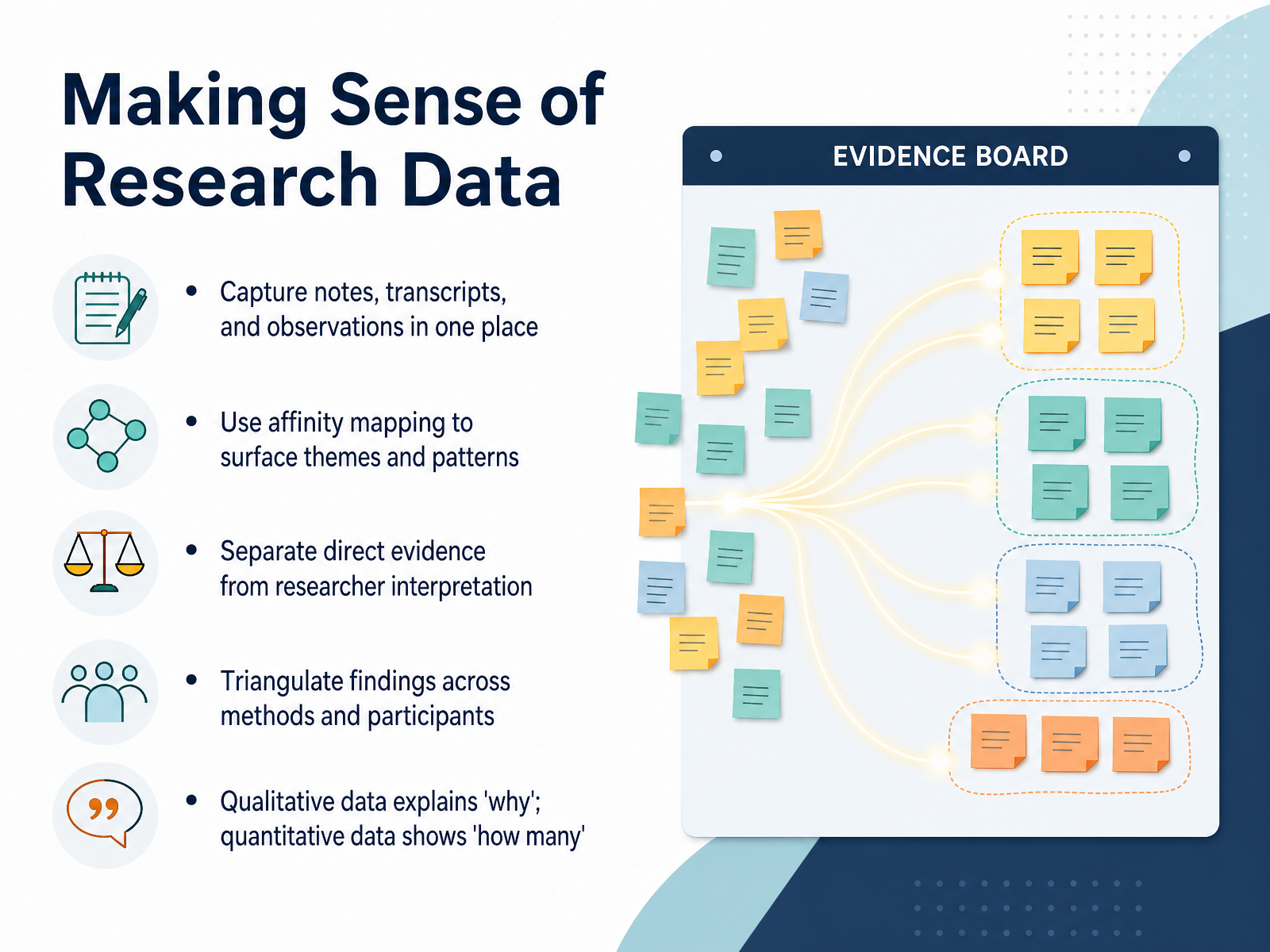
 - 09Making Sense of Research DataNow that we've gathered all this rich data, we need to make sense of it. Start by collecting your notes, transcripts, and observations in one place. Don't let them sit scattered across different documents. Next, use affinity mapping to surface themes. This just means grouping related observations together, like sticky notes on a wall, until clear patterns start to emerge. It's also crucial to separate what you directly observed from your own interpretation of it. The user's words and actions are evidence. Your thoughts about what they mean are analysis. Keep those distinguishable. Then, triangulate your findings across different methods and participants to build confidence. A theme that appears in interviews and in survey data is much stronger than a single quote. Finally, remember the core distinction: qualitative data explains the why, while quantitative data shows you how many. One gives you the story, the other gives you the scale. By combining them, you can move from raw observations to clear, defensible insights. These are the insights we'll learn how to package and share next in our session on sharing insights that drive decisions.
 nngroup.comuxdesigninstitute.commaze.co+22 min
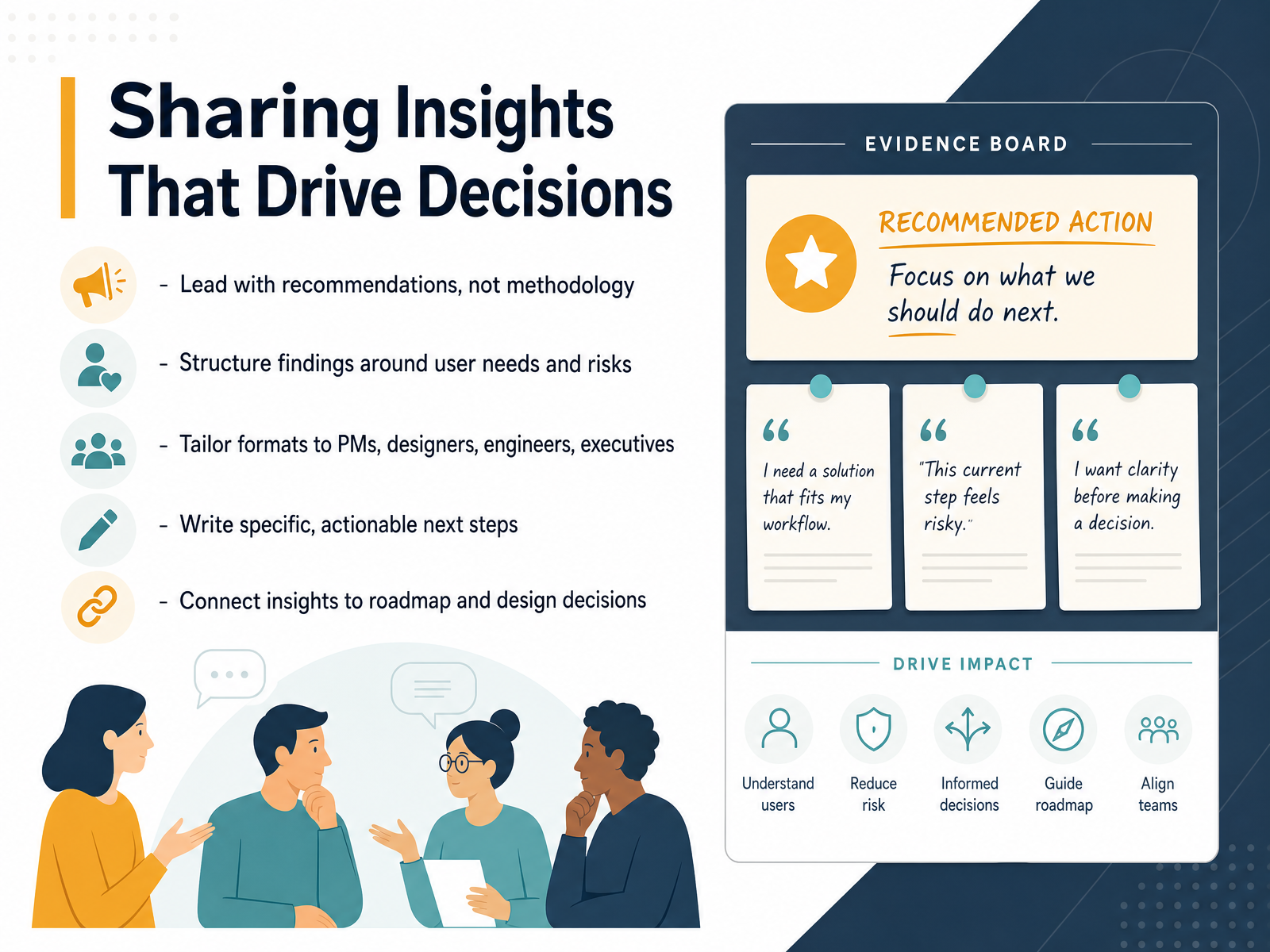
 - 10Sharing Insights That Drive DecisionsNow let's talk about sharing insights that actually drive decisions. The biggest shift here is to lead with your recommendation, not your method. Your stakeholders rarely care how you recruited participants. They care what to do next. So open with the decision, and keep the evidence trail as backup. Structure findings around user needs and risks. For example, instead of saying users struggle with onboarding, say new users risk abandoning signup because they cannot find the onboarding checklist. Then tailor the format to your audience. A product manager wants roadmap impact. A designer wants specific interaction details. An engineer wants technical constraints. An executive wants business risk and return. Write specific actionable next steps. Weak recommendations sound like consider simplifying navigation. Strong ones sound like merge billing and subscription under one Plan and Billing label. Finally, connect insights directly to roadmap and design decisions. Mention which upcoming sprint or feature this research should influence. When people read your summary, they should know exactly what changes and why. Next, we will look at communicating these findings to people who do not work in research.
 1 min
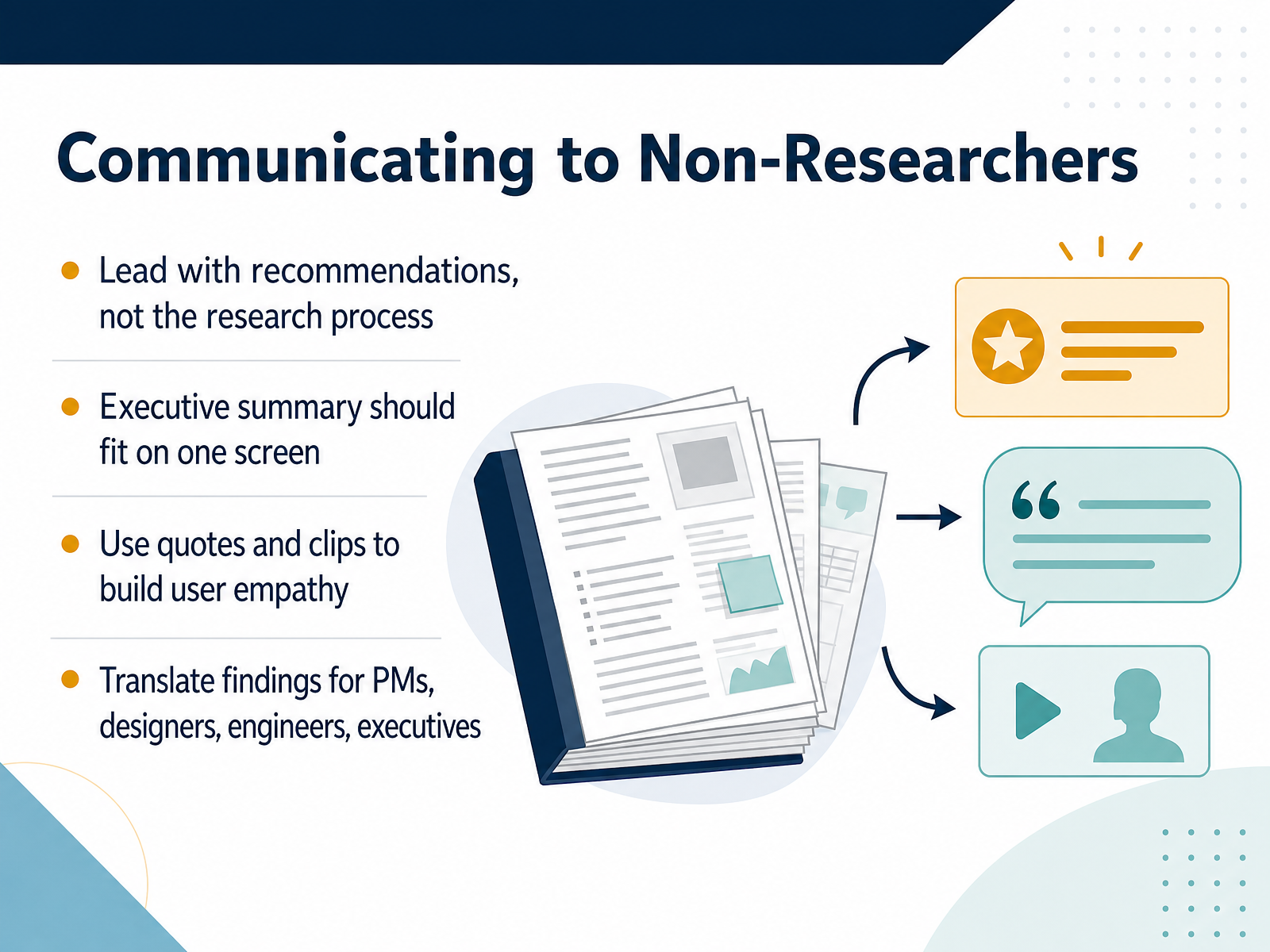
1 min - 11Communicating to Non-ResearchersNow that we have gathered our insights, the real challenge begins: communicating them to people who were not in the room. The golden rule here is to lead with recommendations, not the research process. Your stakeholders usually do not care about your methodology right away. They care about what to do next. Think of it like a news headline. You tell them the outcome first, and the backstory comes later. Your executive summary should be a quick view that fits on one screen. Imagine a busy product manager skimming this between meetings. They should get the gist in under two minutes. To build empathy, use real clips and quotes. Letting an engineer hear a user struggle is far more powerful than telling them it happened. Finally, translate your findings. A PM cares about roadmap impact, a designer cares about the user journey, and an executive cares about business value. Speak their language. Next, we will look at putting user research into practice.
 2 min
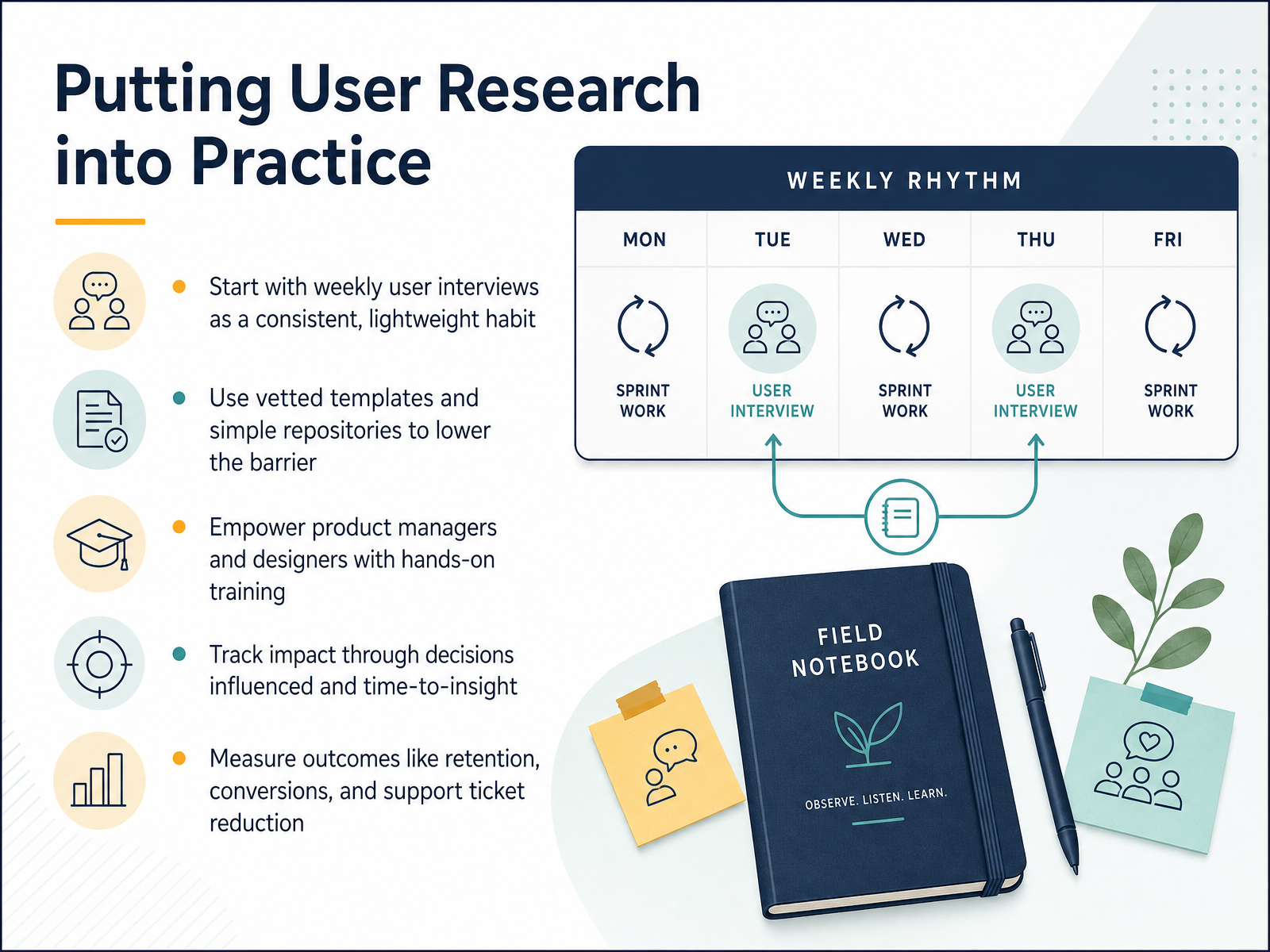
2 min - 12Putting User Research into PracticeLet’s bring all of this together into a realistic starting point. You don’t need a perfect research program to begin. The most successful teams build a lightweight habit first, and the simplest version of that is a weekly user interview. It’s consistent, it’s manageable, and it keeps a steady stream of customer perspective flowing into your decisions. To lower the barrier even further, rely on vetted templates and a simple place to store what you learn, like a shared folder or a lightweight repository. That removes the blank page problem and keeps past insights from getting lost. At the same time, give product managers and designers hands-on training and simple guardrails, so research doesn’t live with just one person. As you build this practice, track two things early: the decisions your research influences, and how quickly you move from a question to a reliable insight. Over time, connect the work to outcome metrics you already care about, like retention, conversion, or a drop in support tickets. That’s how research stops feeling like extra work and starts shaping what ships. Up next, we’ll look at the actionable toolkit and templates you can reuse right away.
 1 min
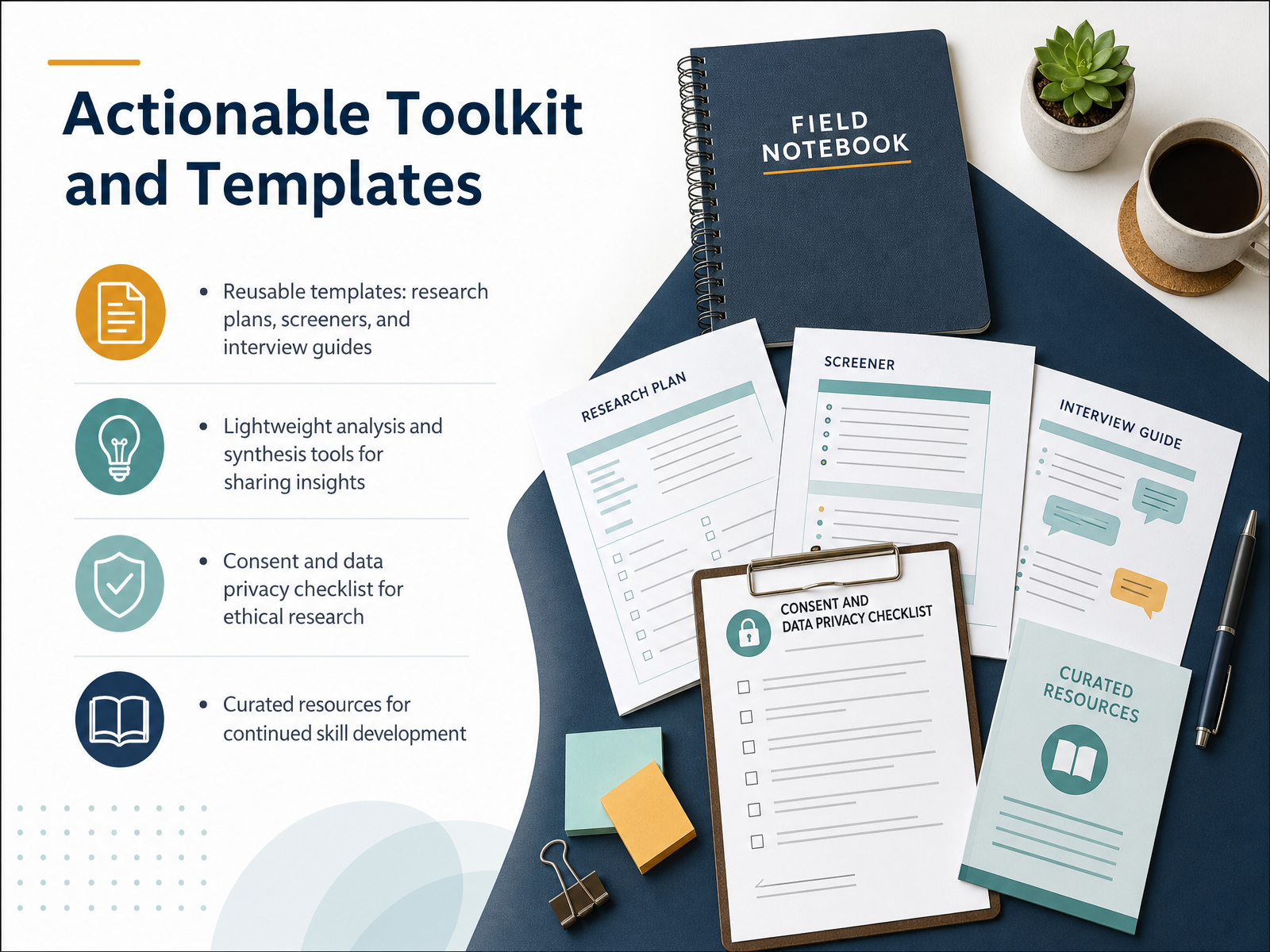
1 min - 13Actionable Toolkit and TemplatesBefore we wrap up, I want to leave you with a few practical tools you can put to work right away. Think of these as your starting kit, so you don't have to face a blank page. First, templates. We've put together reusable formats for research plans, participant screeners, and interview guides. Imagine grabbing a ready-made structure and just filling in your specific questions, saving you hours of setup. Second, lightweight analysis tools. Once you've gathered data, you'll need a simple way to cluster themes and share them with your team. These tools help you move from messy notes to clear insights without a heavy software budget. Third, our consent and privacy checklist. This is non-negotiable. It ensures you're handling participant information ethically and legally from the very first conversation. Finally, we've curated a list of trusted resources for when you're ready to go deeper. You'll find articles and guides on everything from advanced interviewing to synthesis methods. These resources are your bridge from learning the basics to mastering the craft. Next, let's pull everything together with some key takeaways and your next steps for putting this into practice.
 nngroup.comuserinterviews.comusertesting.com+22 min
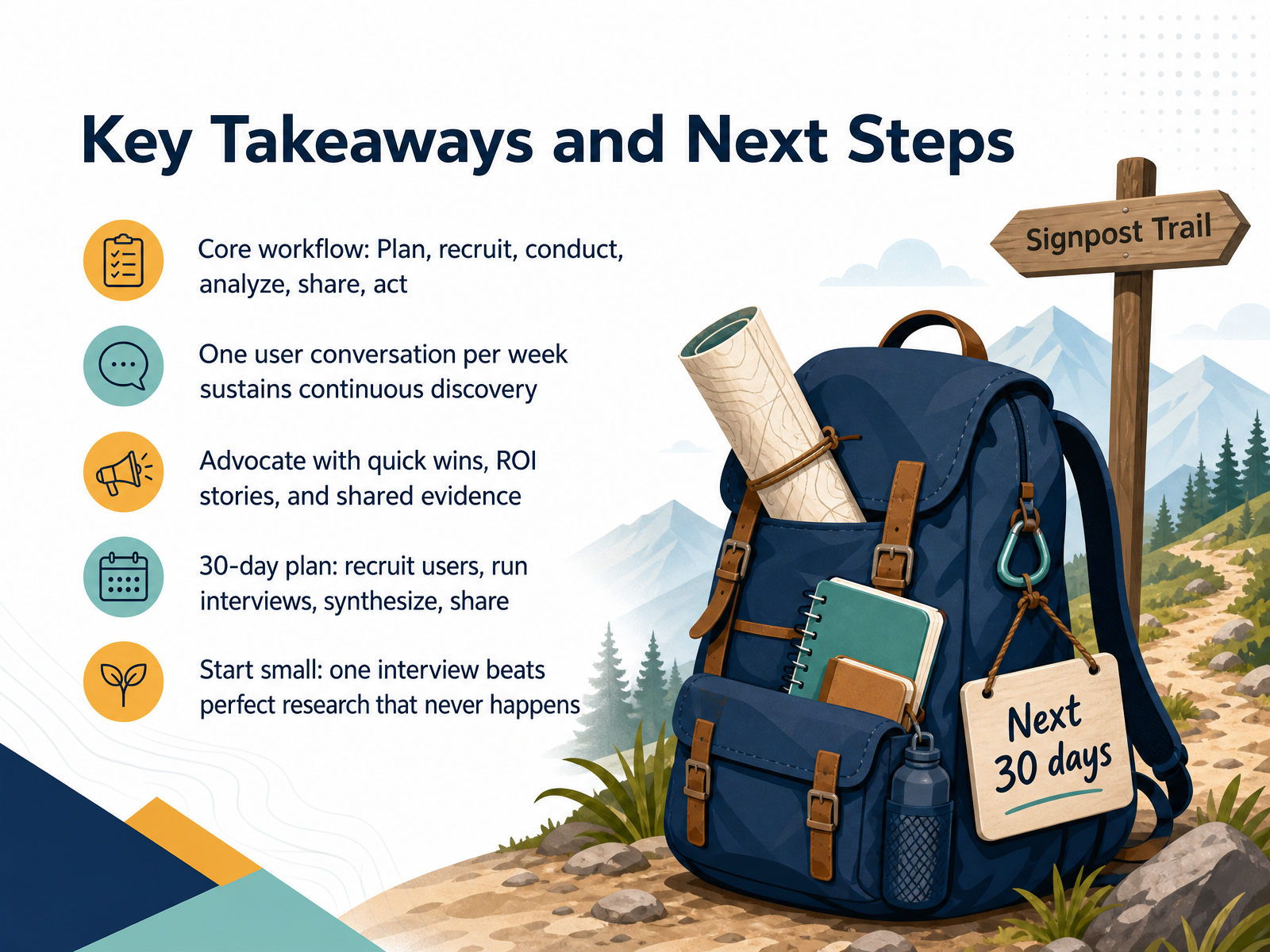
 - 14Key Takeaways and Next StepsAnd that brings us to the end of our journey together. Let's quickly recap the essentials. The core workflow for user research is simple: plan, recruit, conduct, analyze, share, and act. To keep that cycle moving, aim for just one user conversation per week. It sounds small, but that steady rhythm is what powers continuous discovery. When you gather insights, advocate for them with quick wins, stories that show your return on investment, and evidence the whole team can see. If you're wondering where to start, here's a simple thirty day plan. Use the first week to recruit a few users. Then, run interviews, synthesize what you learn, and share it with your team. Most importantly, remember to start small. One honest interview beats perfect research that never happens. Thank you so much for learning with me. I'm confident you now have the foundational tools to make better, more user-centered decisions. Go have that first conversation, and build something great.
 maze.couserinterviews.comdovetail.com+21 min
Take the deck with you
Download this course as a file — free, no sign-up needed.
- PDF handoutEvery slide page, ready to print or share.15 pages · 3.5 MBDownload
- Narrated PowerPointThe deck that presents itself — every slide carries the digital human's narration video.15 pages · 14.4 MBDownload
- PowerPoint slidesThe full deck as a .pptx — open it in PowerPoint, Keynote, or Google Slides.15 pages · 3.4 MBDownload
Free to use in your own training — please keep the PersonWise credit page at the end.
Have your own deck? Turn it into a course
Sources consulted
Web sources consulted while building this course.
- The Future of User Research Report 2025 | Maze — maze.co
- The Product Manager’s Guide to UX Research | User Interviews — userinterviews.com
- The power of user research in product management - Dovetail — dovetail.com
- The State of User Research Report 2025 — userinterviews.com
- The Product Manager's Guide to User Research | Maze — maze.co
- Quantitative vs. Qualitative Usability Testing - NN/G — nngroup.com
- Quantitative vs. qualitative research - UX Design Institute — uxdesigninstitute.com
- Guide to Quantitative & Qualitative UX Research Methods - Maze — maze.co
- Qualitative vs quantitative user research: when to use each - Hearsay — hearsay.to
- Qualitative vs. Quantitative vs. Mixed Methods in UX Research — userinterviews.com
- Writing an Effective Guide for a UX Interview - NN/G — nngroup.com
- User Research Questions | UX Research Field Guide — userinterviews.com
- How to ask good questions in user research | UserTesting — usertesting.com
- How to Write User Interview Questions — Koji Blog — koji.so
- How to write a user research plan · Talkful — talkful.io
- When to Use Which User-Experience Research Methods — nngroup.com
- How to Choose a User Research Method — userinterviews.com
- Consider These Variables Before You Choose a UX Research Method | UserTesting Blog — usertesting.com
- What user research techniques work best for your project? — uxdesigninstitute.com
- UX Research Method Selection Tool | User Interviews — userinterviews.com