Introduction to Soil Composition
Begin
16 pages · ~32 min
Introduction to Soil Composition
Learn the fundamentals of soil composition—minerals, water, air, and life—and their roles in supporting ecosystems.
What you’ll learn
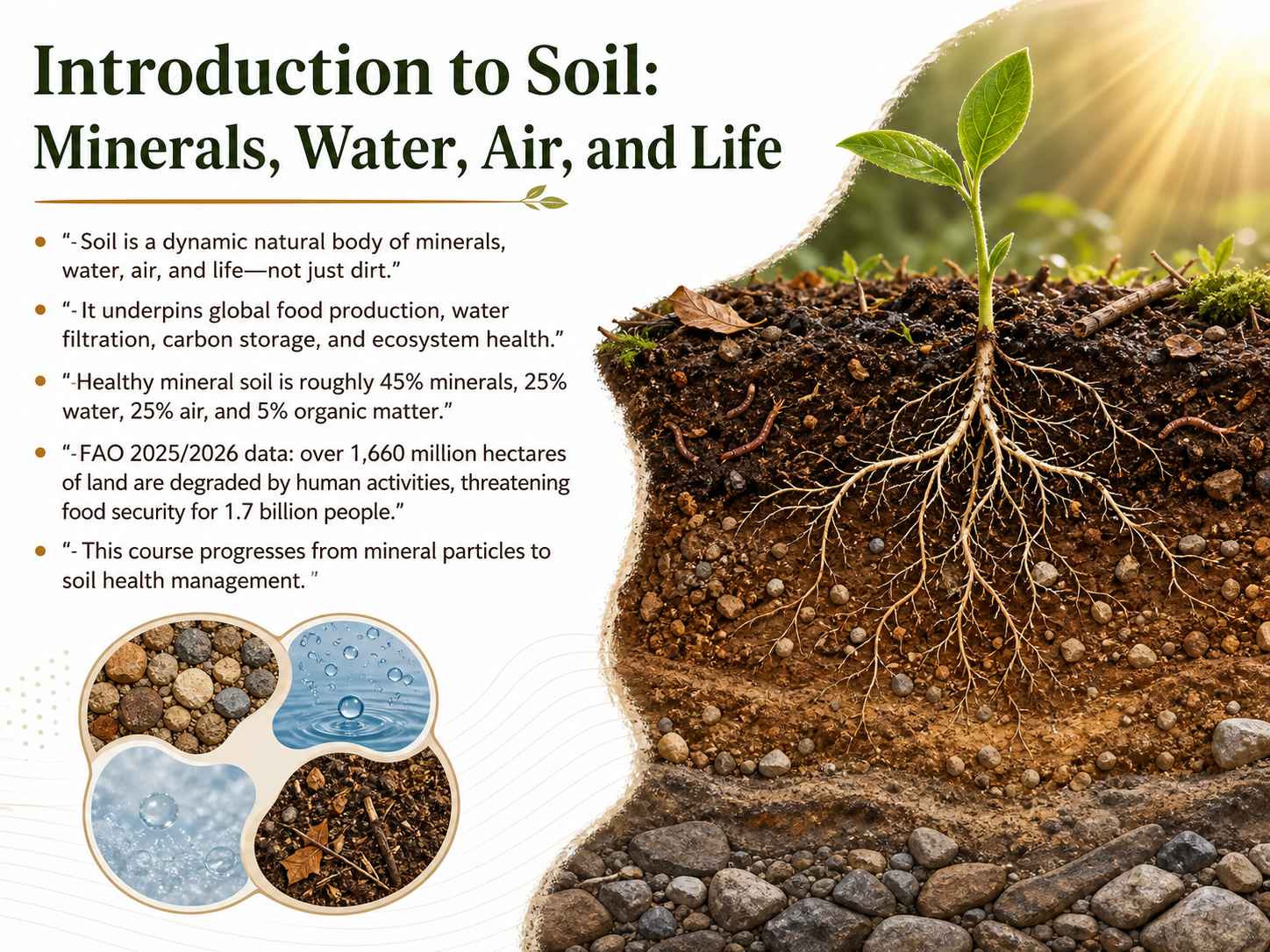
- 01Introduction to Soil: Minerals, Water, Air, and LifeWelcome to our journey into the world beneath our feet. My name is [Instructor Name], and I'm excited to guide you through this course, 'Introduction to Soil: Minerals, Water, Air, and Life.' Together, we'll move beyond the idea of soil as just dirt. Think of it instead as a dynamic, living layer—a blend of minerals, water, air, and organic life that makes nearly everything else on land possible. In healthy soil, these components exist in a remarkable balance: roughly forty-five percent is mineral particles, while water and air each make up about twenty-five percent, leaving about five percent for organic matter. This thin skin of the Earth underpins our global food production, filters our water, stores carbon, and keeps entire ecosystems healthy. But it's also under threat. Recent FAO data shows that over one point six billion hectares of land are now degraded by human activities. This directly threatens food security for approximately one point seven billion people. It's a silent crisis, but one we can address. In this course, we'll start with the smallest mineral particles and build our understanding all the way to practical soil health management, offering a hopeful path forward. Now, let's begin by looking closer at the soil's architecture in our next slide, 'Viewing Soil as a Living System.'fao.orgfao.orgopenknowledge.fao.org+22 min
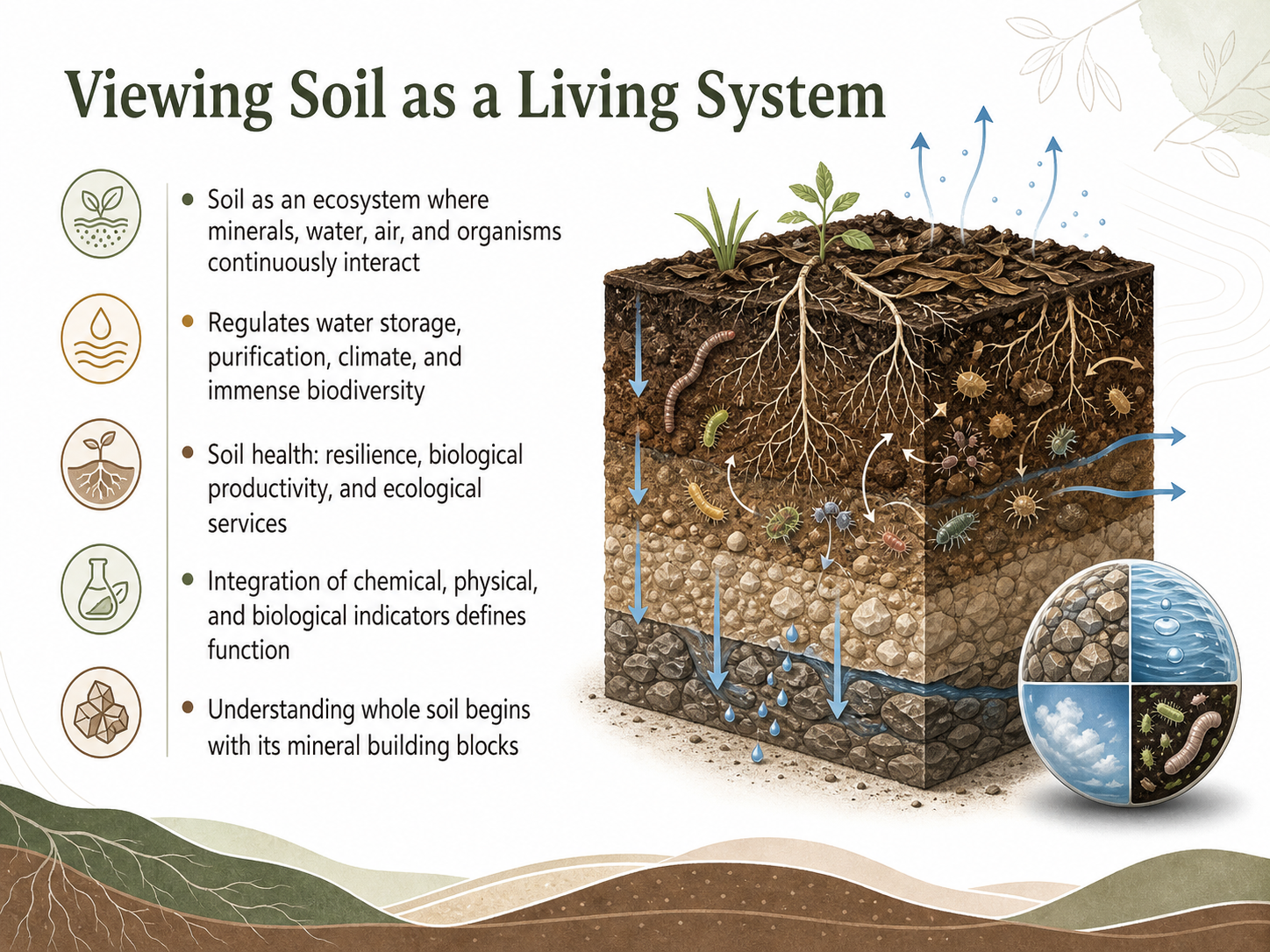
- 02Viewing Soil as a Living SystemNow let’s shift our perspective and look at soil as a living system. Instead of just dirt under our feet, think of soil as a busy ecosystem where minerals, water, air, and countless organisms are constantly interacting. Together, they regulate how water is stored and purified, help control our climate, and support an immense diversity of life. When we talk about soil health, we’re really describing its resilience, its biological productivity, and the essential ecological services it provides. To truly understand how a soil functions, we look at a mix of chemical, physical, and biological indicators. But every living system has a foundation, and for soil, that starts with its mineral building blocks. In the next part, we’ll unpack those very pieces — the mineral particles sand, silt, and clay.
 1 min
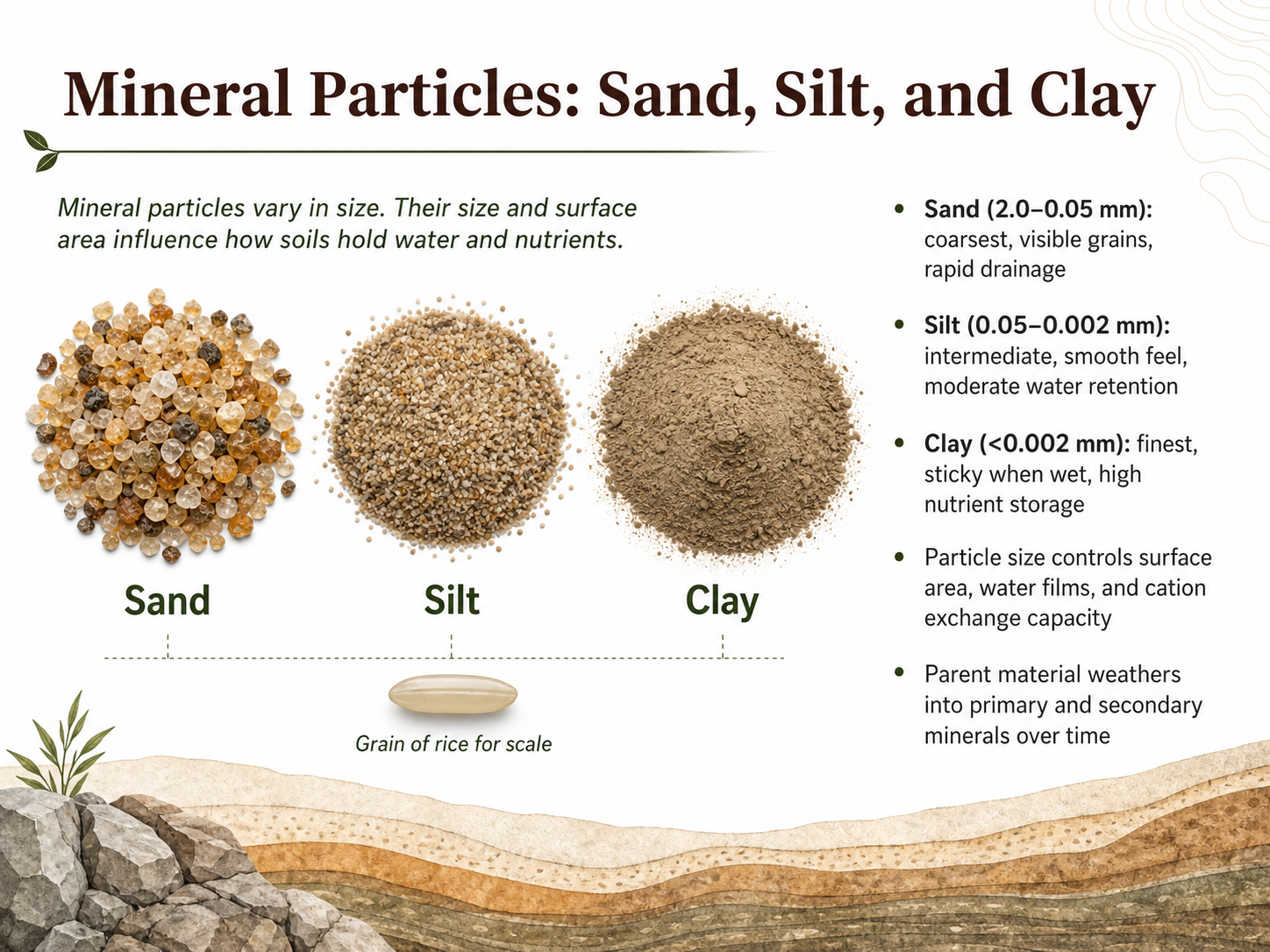
1 min - 03Mineral Particles: Sand, Silt, and ClayLet's get to know the mineral building blocks of soil: sand, silt, and clay. These particles are simply different sizes of weathered rock. Think of sand as the largest piece, visible to the naked eye, measuring between two and zero-point-zero-five millimeters. Water drains right through sand very quickly. Silt is the middle child, with particles between zero-point-zero-five and zero-point-zero-zero-two millimeters. It feels smooth, like flour, and holds onto water a bit longer. Finally, clay represents the tiniest particles, each smaller than zero-point-zero-zero-two millimeters. Clay feels sticky when wet and acts like a magnet, holding onto nutrients that plants need. Why does size matter so much? Smaller particles have an enormous amount of surface area relative to their size. This surface area creates thin films of water and enables a process called cation exchange capacity, which we can simply think of as the soil's pantry, storing and supplying nutrients for roots. All of these minerals start as solid bedrock, which weathers and breaks down into primary and secondary minerals over long periods of time. Up next, we will put these particle sizes together and see how their combinations map out on the soil texture triangle.
 2 min
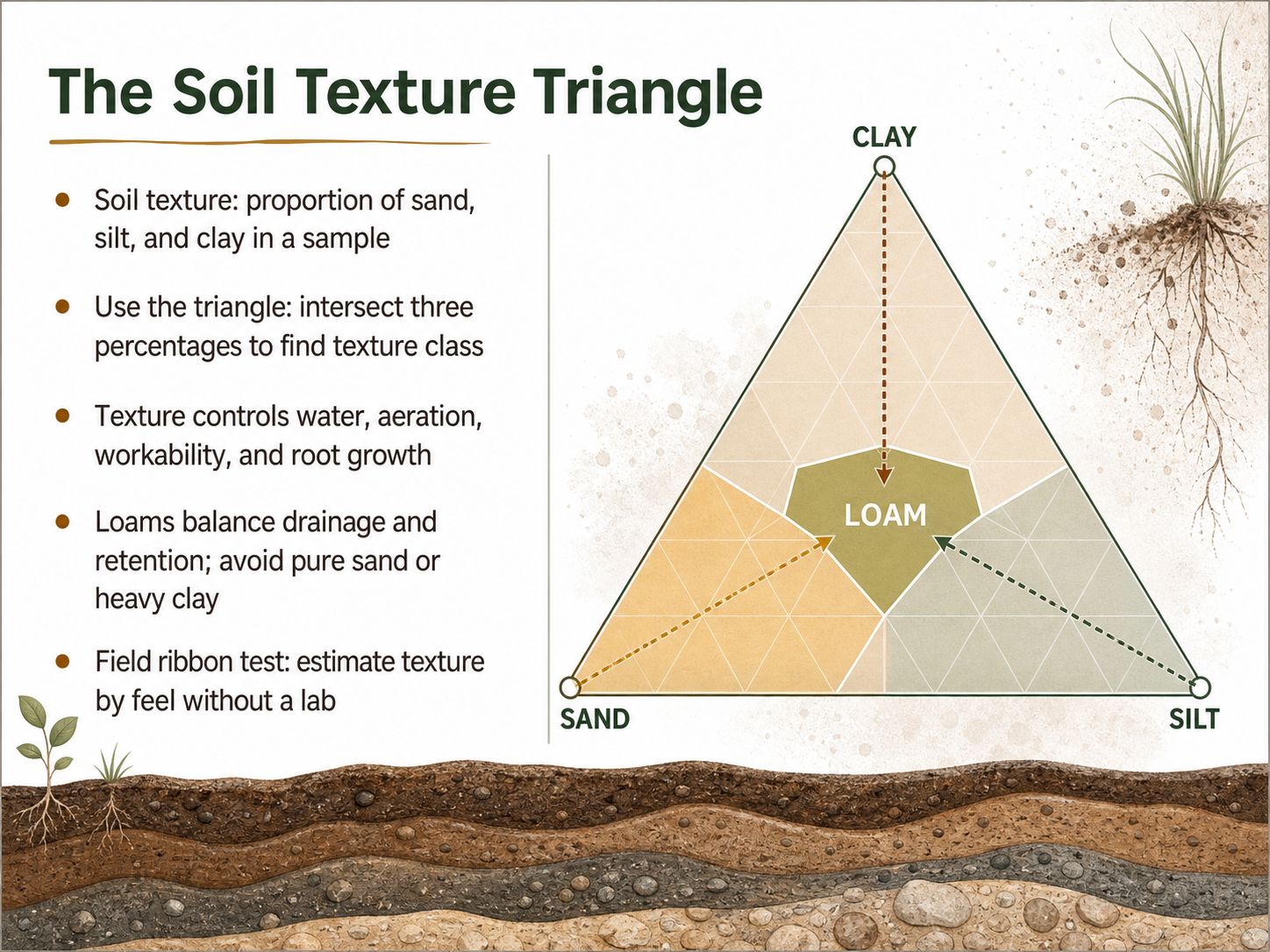
2 min - 04The Soil Texture TriangleLet's look at a powerful tool for understanding your soil: the texture triangle. Soil texture simply refers to the proportion of sand, silt, and clay in a sample. To use the triangle, you take those three percentages and follow the lines inward until they intersect. The zone where they meet tells you your soil's texture class. This is important because texture directly controls how water drains, how well air moves through the soil, how easy it is to work with, and how freely roots can grow. A loam is often ideal because it balances drainage and moisture retention. You generally want to avoid extremes, like pure sand that dries out too fast or heavy clay that stays waterlogged. If you don't have a lab, you can do a simple field ribbon test to estimate texture just by feel. Now, let's zoom in closer on how water actually behaves in that soil matrix.
 2 min
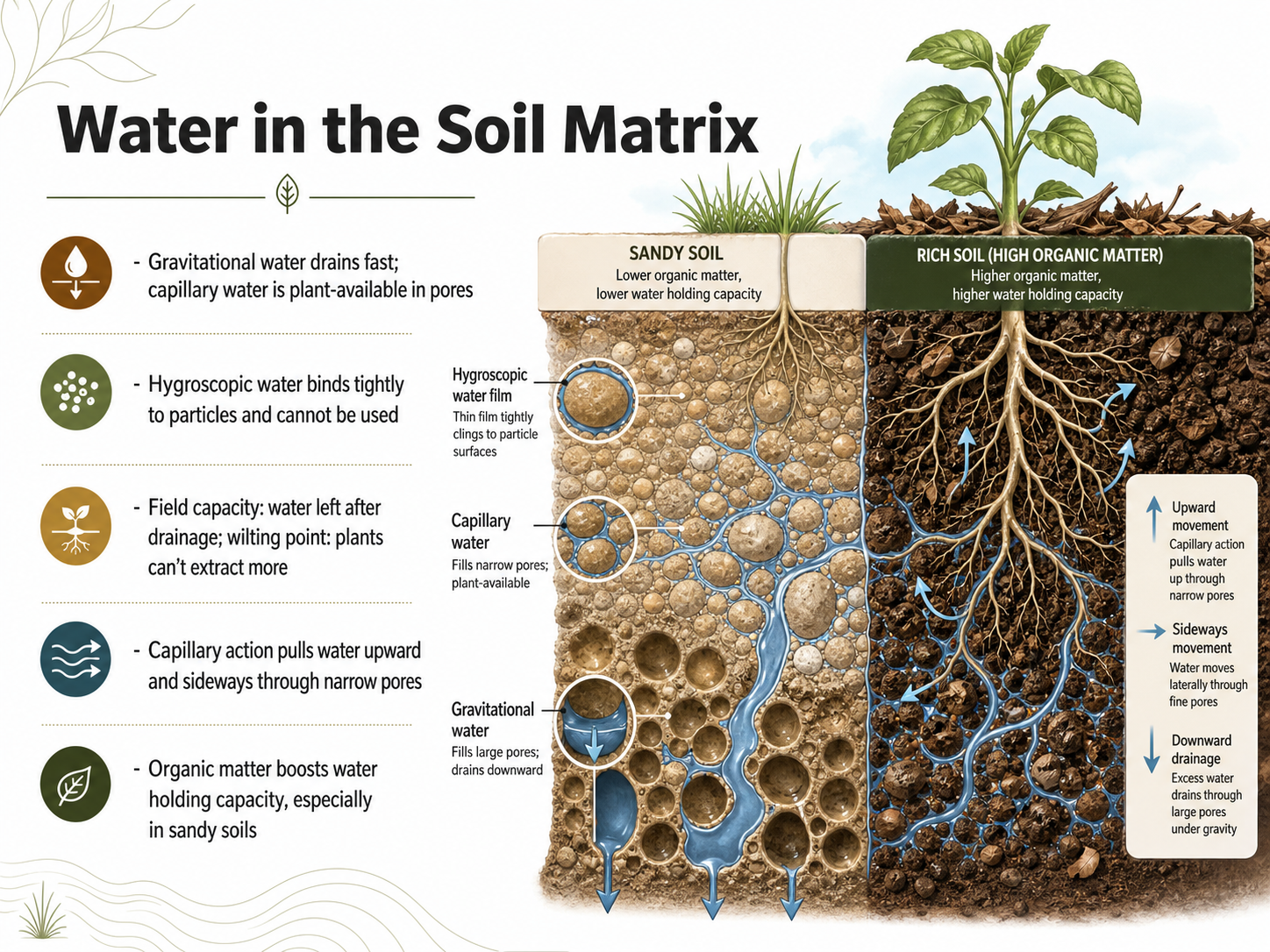
2 min - 05Water in the Soil MatrixNow let's look at how water actually behaves inside the soil. Not all water in the ground is available to plants. Gravitational water drains quickly through large pores right after a rain, just like water pouring through a sieve. What plants really rely on is capillary water. This water stays in the smaller pores, held by surface tension, exactly like a paper towel drawing up a spill. A third type, called hygroscopic water, binds so tightly to soil particles that roots cannot pull it away. We measure this balance with two important points. Field capacity tells you how much water the soil holds after the free drainage stops. The wilting point is when the remaining moisture is so tightly held that plants wilt and cannot recover. Capillary action is also why water moves upward and sideways through narrow spaces, bringing moisture closer to roots. And here is a helpful tip: organic matter acts like a sponge. Adding compost, even to sandy soil, dramatically boosts how much plant-available water the ground can store. Next, we will apply these ideas to texture, structure, and water movement.
 2 min
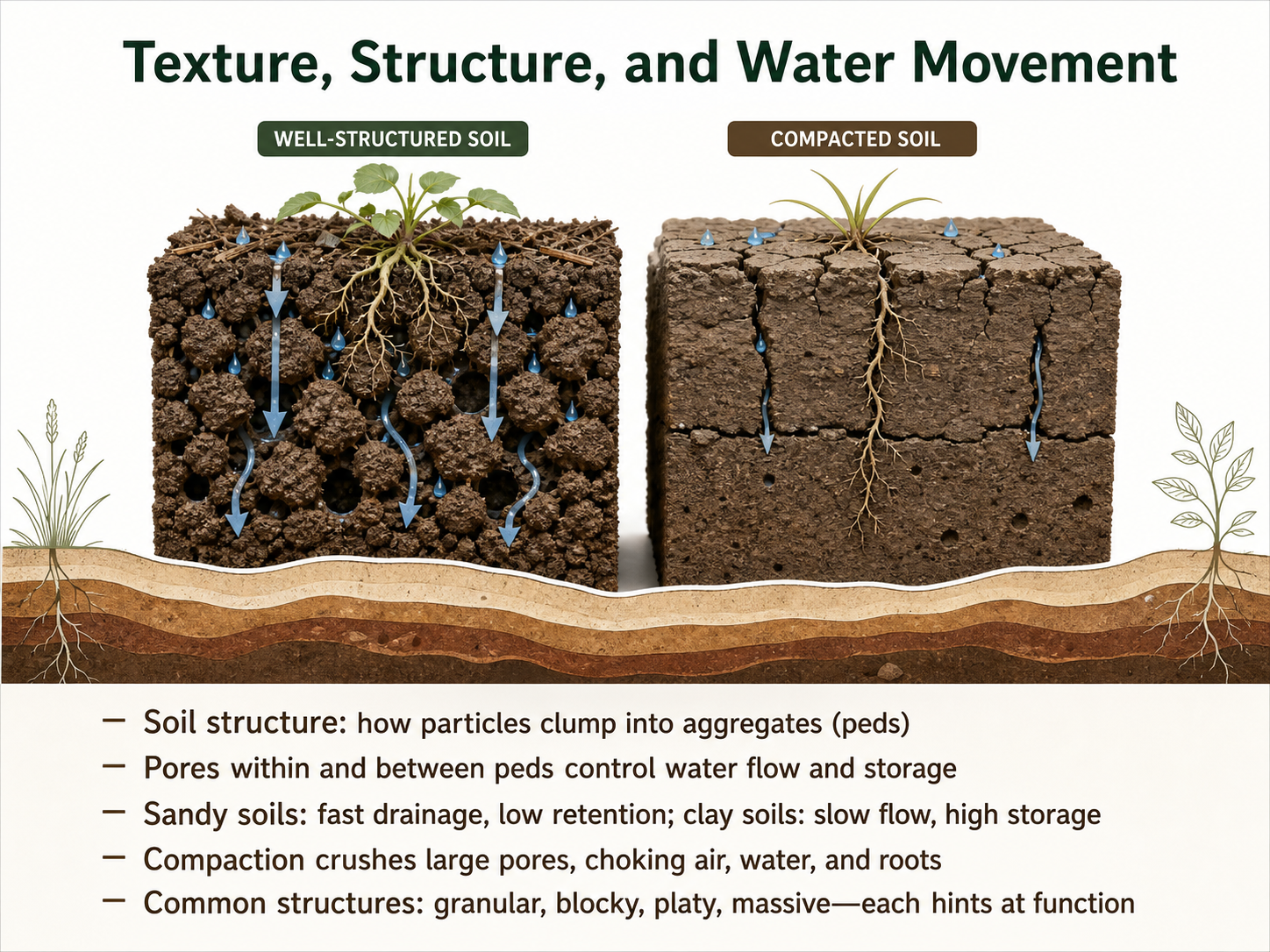
2 min - 06Texture, Structure, and Water MovementNow let's think about how those soil particles actually clump together. This is what we call soil structure. The individual sand, silt, and clay particles bind into small groups called aggregates, or peds. These peds create two types of open spaces: small pores inside each clump, and larger pores between the clumps. This network of pores is the highway and reservoir for water. In a sandy soil, the pores are large and connected, so water drains through very quickly. That's great for air, but it means the soil doesn't hold much moisture. A clay soil is the opposite. It's full of tiny pores that grip water tightly, so drainage is slow, but storage is high. Now, imagine stepping on wet soil. That weight crushes the large pores. When compaction happens, you lose the spaces that let air and water move, and roots struggle to push through. You can often read a soil's story by its structure. A granular structure, like small crumbs, usually sits at the surface and is great for roots. A blocky structure forms deeper down. Platy structures are flat and layered, and a massive structure is just a solid block with almost no pore space. Each shape hints at how water can move. Next, we'll zoom into those pores to explore air and gas exchange in soil.
 2 min
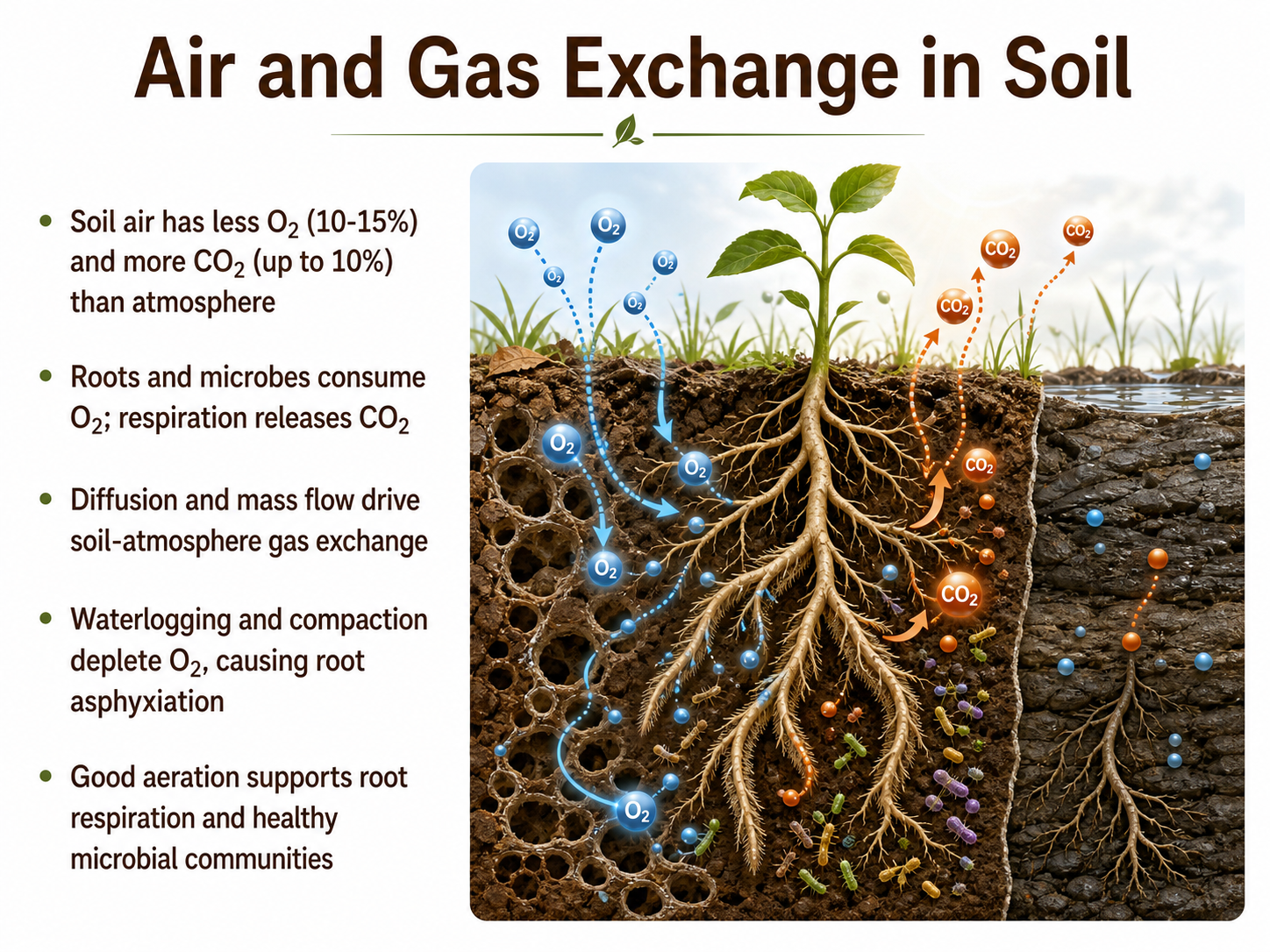
2 min - 07Air and Gas Exchange in SoilNow let's talk about the air inside soil, and how it's very different from the air above ground. Soil air holds much less oxygen than the atmosphere. While the atmosphere has about twenty-one percent oxygen, soil air typically contains only ten to fifteen percent. At the same time, carbon dioxide levels can climb all the way up to ten percent, compared to just a tiny fraction above ground. Why does this happen? It's because roots and soil microbes are constantly breathing. They consume oxygen through respiration and release carbon dioxide as a waste product. This exchange depends on two main processes. Diffusion helps gases move from areas of high concentration to low concentration, and mass flow carries air in and out as water moves through the soil spaces. But when soil becomes waterlogged or heavily compacted, the flow of fresh air stops. Oxygen gets depleted quickly, and roots can essentially suffocate, a condition we call root asphyxiation. Healthy soil aeration is vital. It delivers the oxygen roots and microbes need to thrive. Next, we'll explore how all this living activity connects through soil organic matter and the food web.
 2 min
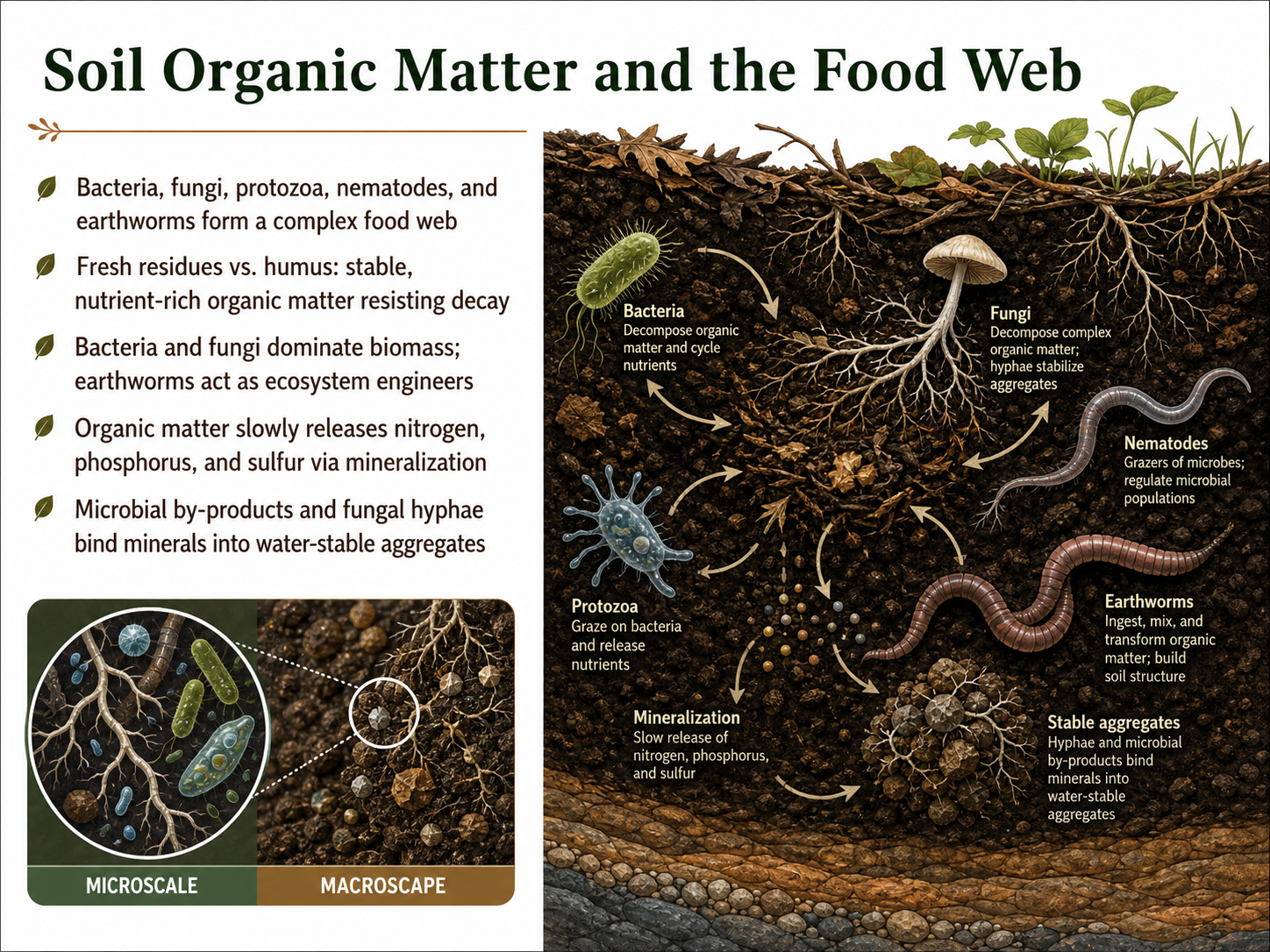
2 min - 08Soil Organic Matter and the Food WebMoving from the mineral and water components we just discussed, let's look at the living, breathing part of soil—the organic matter and the incredible food web it supports. Think of this organic matter as the soil's pantry and its bustling kitchen, all in one. Inside this dark fraction, you have a complex community: tiny bacteria and fungi, single-celled protozoa, microscopic nematode worms, and larger engineers like earthworms. They are all eating and being eaten, cycling nutrients around the clock. A key distinction here is between fresh residues, like a recently fallen leaf, and humus. Humus is the stable, dark, nutrient-rich material that resists further decay—it’s the long-term storage of soil fertility. In this food web, bacteria and fungi actually dominate the living biomass. Meanwhile, earthworms act as ecosystem engineers, physically mixing the soil and creating channels for air and water. As these microbes consume and break down materials, they slowly release essential nutrients like nitrogen, phosphorus, and sulfur in a process we call mineralization. This is the main course meal for plants. On top of that, the sticky by-products from bacteria and the thread-like hyphae of fungi act like a living glue, binding mineral particles together into stable, crumbly aggregates that resist erosion. Now that we’ve seen the food web that builds soil structure, let's step into the next slide to meet the key players themselves in 'The Living Engine: Soil Organisms at Work.'
 2 min
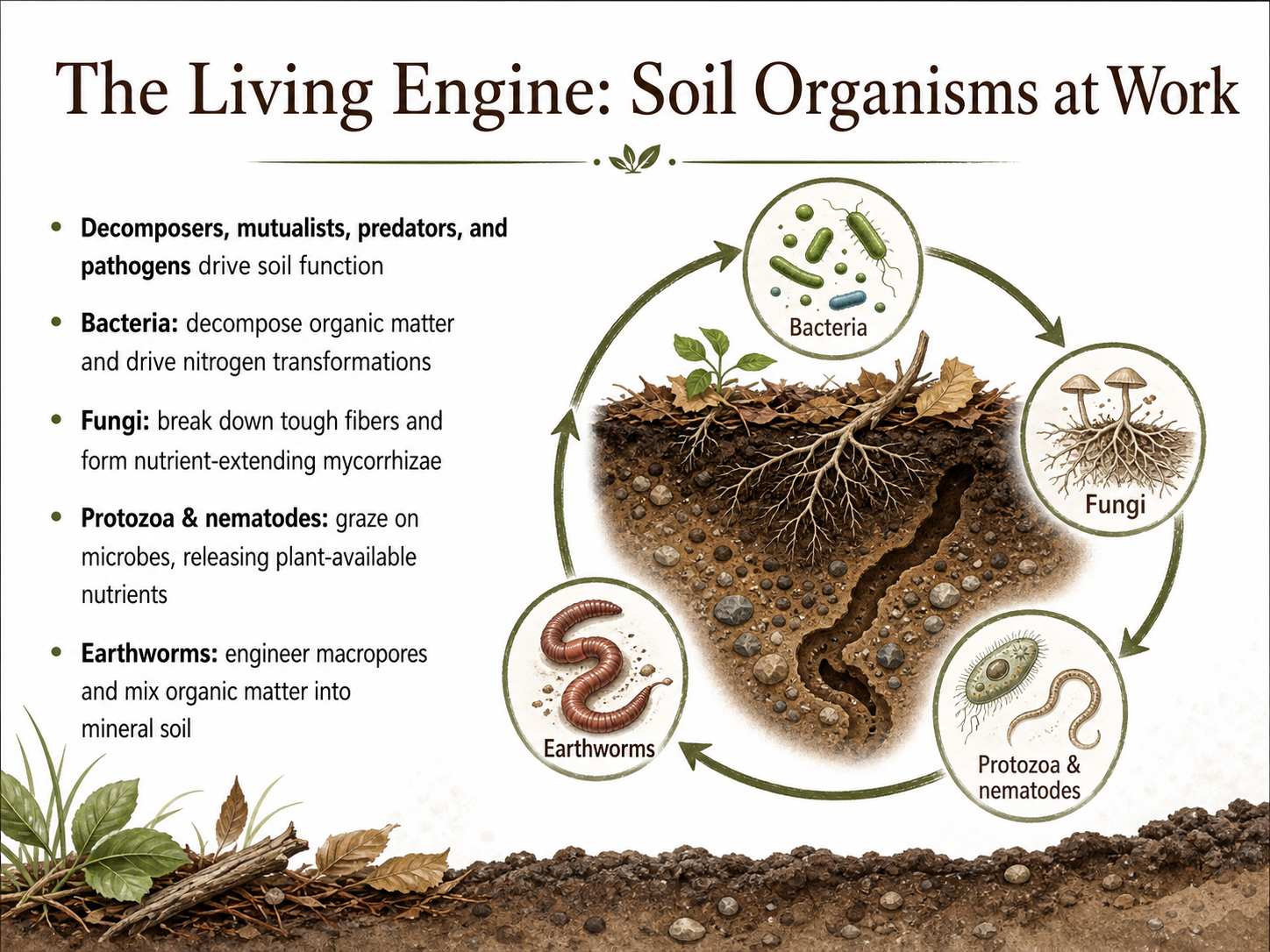
2 min - 09The Living Engine: Soil Organisms at WorkNow, let's explore the living engine that powers the soil. Imagine a bustling underground city where countless organisms work together, each with a specific job. These include decomposers, mutualists, predators, and pathogens, all driving essential soil functions. Let's meet some key citizens. Bacteria are the master recyclers, decomposing organic matter and transforming nitrogen into forms plants can use. Then we have fungi, which break down tough plant fibers and create vast networks called mycorrhizae. Think of these as nutrient superhighways, extending a plant's root reach to access more water and minerals. Next, tiny protozoa and nematodes graze on bacteria and fungi. As they feed, they release excess nutrients in a plant-available form, acting like a natural fertilizer service. Finally, consider the earthworm, a true ecosystem engineer. As earthworms burrow, they create channels, or macropores, that allow air and water to flow. They also mix organic matter from the surface deep into the mineral soil, enriching the layers below. This constant biological activity truly makes soil a living, breathing system. Next, we'll see how all this activity is organized in the distinct layers of a soil profile.
 2 min
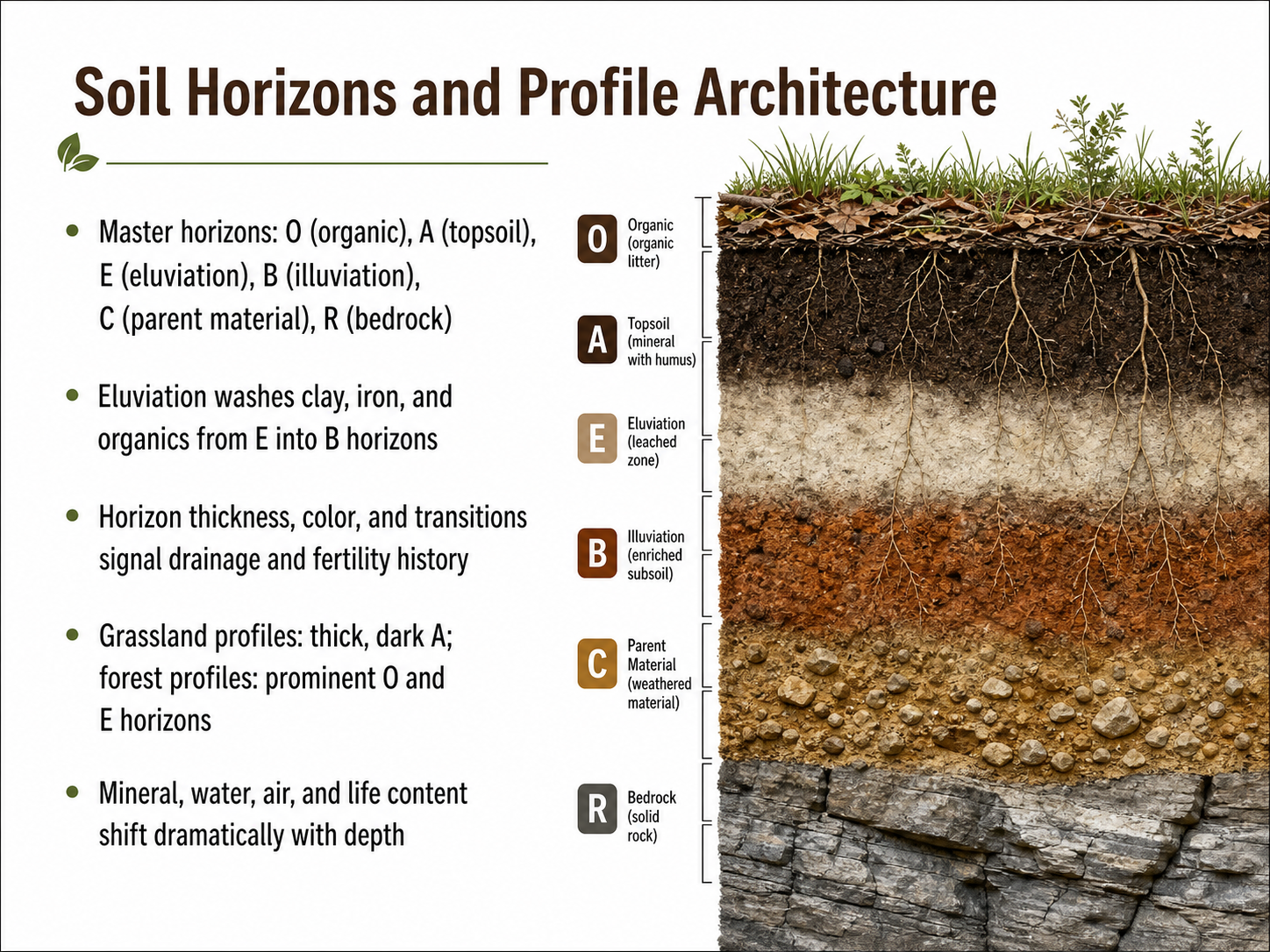
2 min - 10Soil Horizons and Profile ArchitectureNow let's look at the soil's architecture through its layers, or horizons. Think of a soil profile like a layered cake, where each band tells a story. At the top is the O horizon, a thin organic layer of leaves and decaying matter. Below that is the A horizon, or topsoil, rich and dark, where most roots and life are concentrated. Next comes the E horizon, a zone of eluviation. Eluviation simply means washing out. Here, water moves downward, carrying fine clay, iron, and organic materials out of this layer, often leaving it pale or sandy. Those washed-out materials accumulate in the B horizon below, a process called illuviation. This horizon is often denser and more colorful with accumulated clays and minerals. Further down, we find the C horizon, the weathered parent material, and finally, the hard bedrock, the R horizon. The thickness and color of these layers signal drainage and fertility history. For example, a grassland profile usually has a very thick, dark A horizon, while a forest profile often shows a prominent O and E horizon. As you go deeper, the balance of minerals, water, air, and life shifts dramatically, with organic life fading in the lower horizons. Next, we'll connect this architecture to the dynamic world of nutrient cycling, focusing on the carbon and nitrogen stories.
 2 min
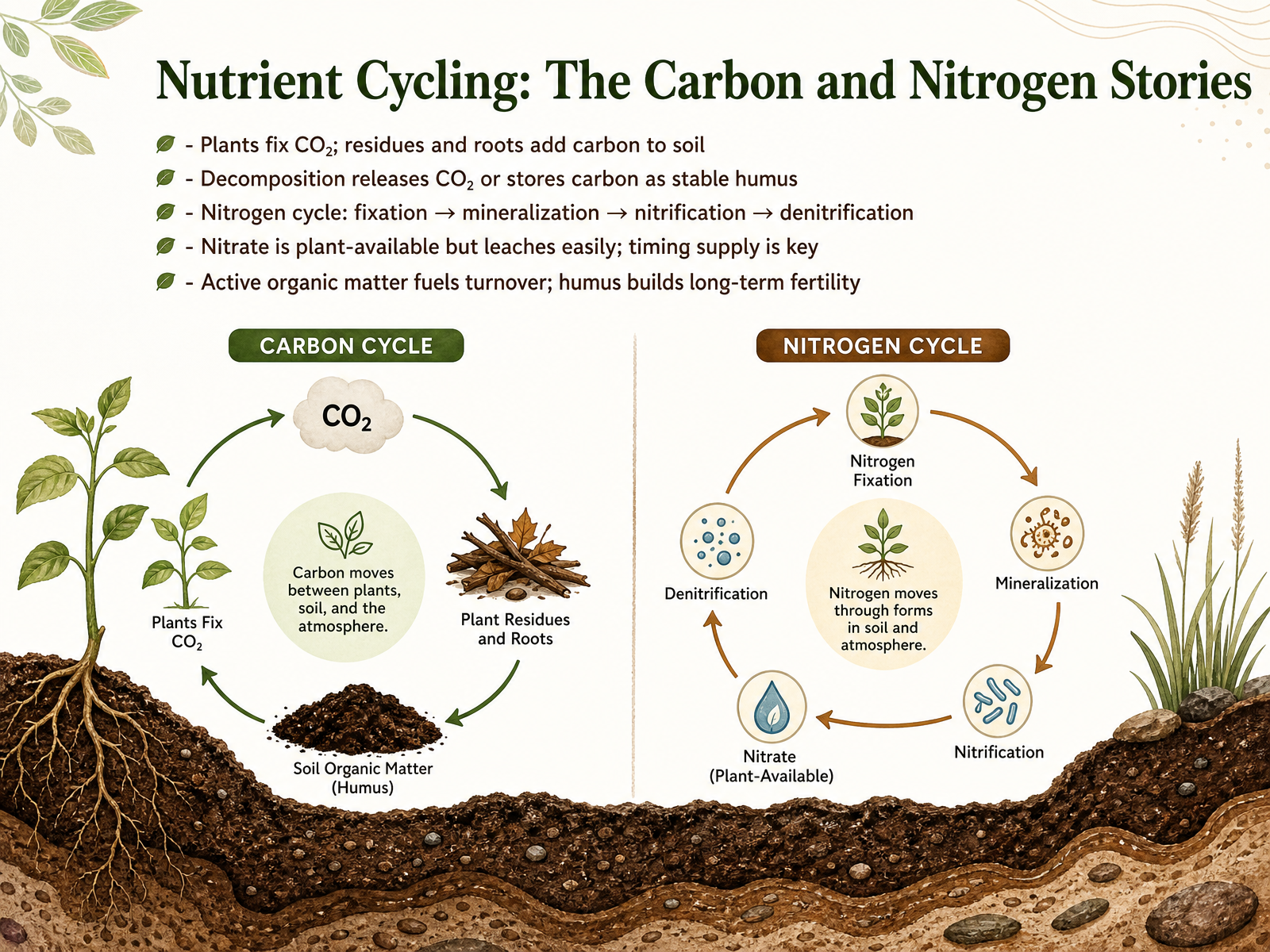
2 min - 11Nutrient Cycling: The Carbon and Nitrogen StoriesNow let's follow two essential stories that unfold right beneath our feet: the carbon story and the nitrogen story. Think of soil as a breathing, living pantry that constantly gives and receives. Plants pull carbon dioxide from the air and turn it into leaves and stems. When those leaves fall, or when roots die back, that carbon enters the soil. Then, the tiny decomposers go to work. They break some of that material down, releasing carbon dioxide back into the air. But a portion of the carbon gets transformed into a stable, dark material called humus, which can lock carbon safely in the soil for a very long time. The nitrogen story is just as dynamic. We start with special bacteria that can grab nitrogen right from the air, a process called fixation. Then, other microbes convert that nitrogen through a chain of steps: mineralization, nitrification, and finally into a form called nitrate, which plant roots can easily drink up. But nitrate is slippery. It can wash away with heavy rain, so timing its supply to when plants are hungry is really important. The fresh, active organic matter fuels the busy microbial kitchen, while the stable humus builds the deep, long-term fertility of the soil. Up next, we will explore how phosphorus and sulfur cycle, and meet the remarkable fungal networks that connect plant roots.
 2 min
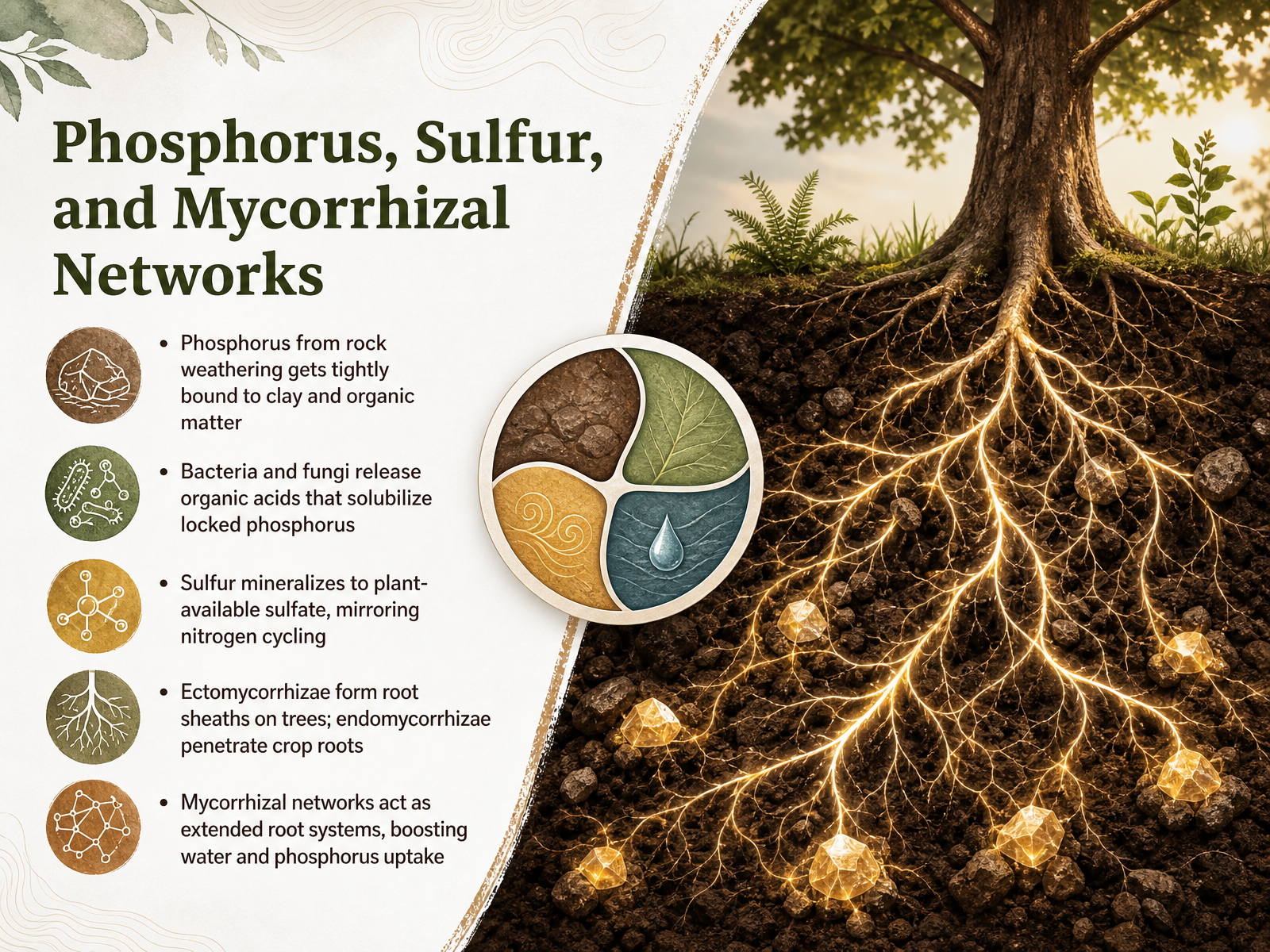
2 min - 12Phosphorus, Sulfur, and Mycorrhizal NetworksMoving on, let's look at two more essential nutrients, phosphorus and sulfur, and a fascinating underground partnership. Phosphorus enters soil from the slow weathering of rocks. Once there, it gets tightly locked onto clay particles and organic matter, making it hard for plants to reach. Think of it as money stuck in a safe. Fortunately, certain bacteria and fungi release natural acids that act like the combination, freeing up that locked phosphorus so roots can absorb it. Sulfur follows a similar story. It transforms from organic forms into plant-available sulfate through a process that mirrors the nitrogen cycle we discussed. Now, for the partnership. Some fungi connect directly with plant roots. Ectomycorrhizae wrap the outside of tree roots, forming a protective sheath, while endomycorrhizae actually grow inside crop roots. These fungal threads act as an extended root system, reaching far into the soil to dramatically boost water and phosphorus uptake for the plant. Next, we will explore the key factors that control how all of this comes together to form soil.
 1 min
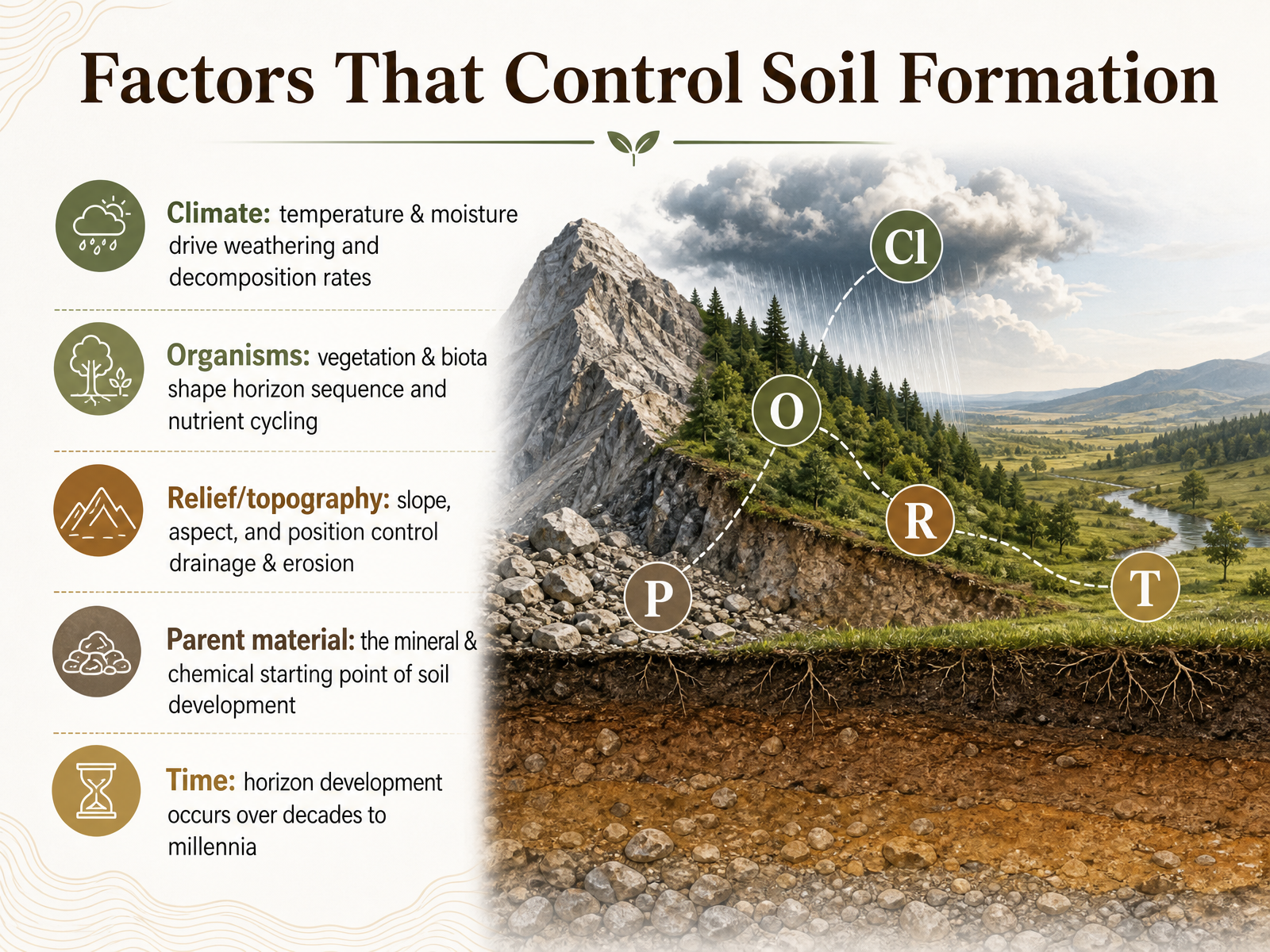
1 min - 13Factors That Control Soil FormationNow let's look at what actually controls how a soil forms. Soil scientists use a classic framework to explain this, often called Clorpt: Climate, Organisms, Relief, Parent material, and Time. First, climate. Temperature and moisture are the big drivers here. They control how fast rocks weather and organic matter decomposes. Think of a warm, wet rainforest versus a cold, dry desert. The rainforest's intense climate creates deep, heavily weathered soils much faster. Next, organisms. Plants, microbes, and animals like earthworms shape the soil's horizons and drive nutrient cycling. A dense forest adds a thick layer of leaf litter, while a grassland creates a deep, fibrous root network, building soil in totally different ways. Third is relief, or topography. This is the shape of the land. A steep slope will have more erosion and faster water runoff. But a valley bottom collects water and minerals washed down from above, often creating deeper soils. The direction a slope faces, its aspect, also matters because it affects temperature and moisture. The fourth factor is parent material. This is the mineral starting point, the actual rock or sediment. A soil forming on quartz-rich sandstone will be sandy and nutrient-poor, while one forming on volcanic basalt will often be richer and more fertile. Finally, time. Soil formation isn't instant. Developing distinct layers, or horizons, takes decades, centuries, or even millennia. A young soil might look barren, but given enough time and the influence of the other four factors, it will develop its own unique character. These five factors all work together. Next, we'll add one more to the list: human impacts as a soil-forming factor.
 umn-soil-2125.github.iosoils.landcareresearch.co.nzextension.umn.edu+22 min
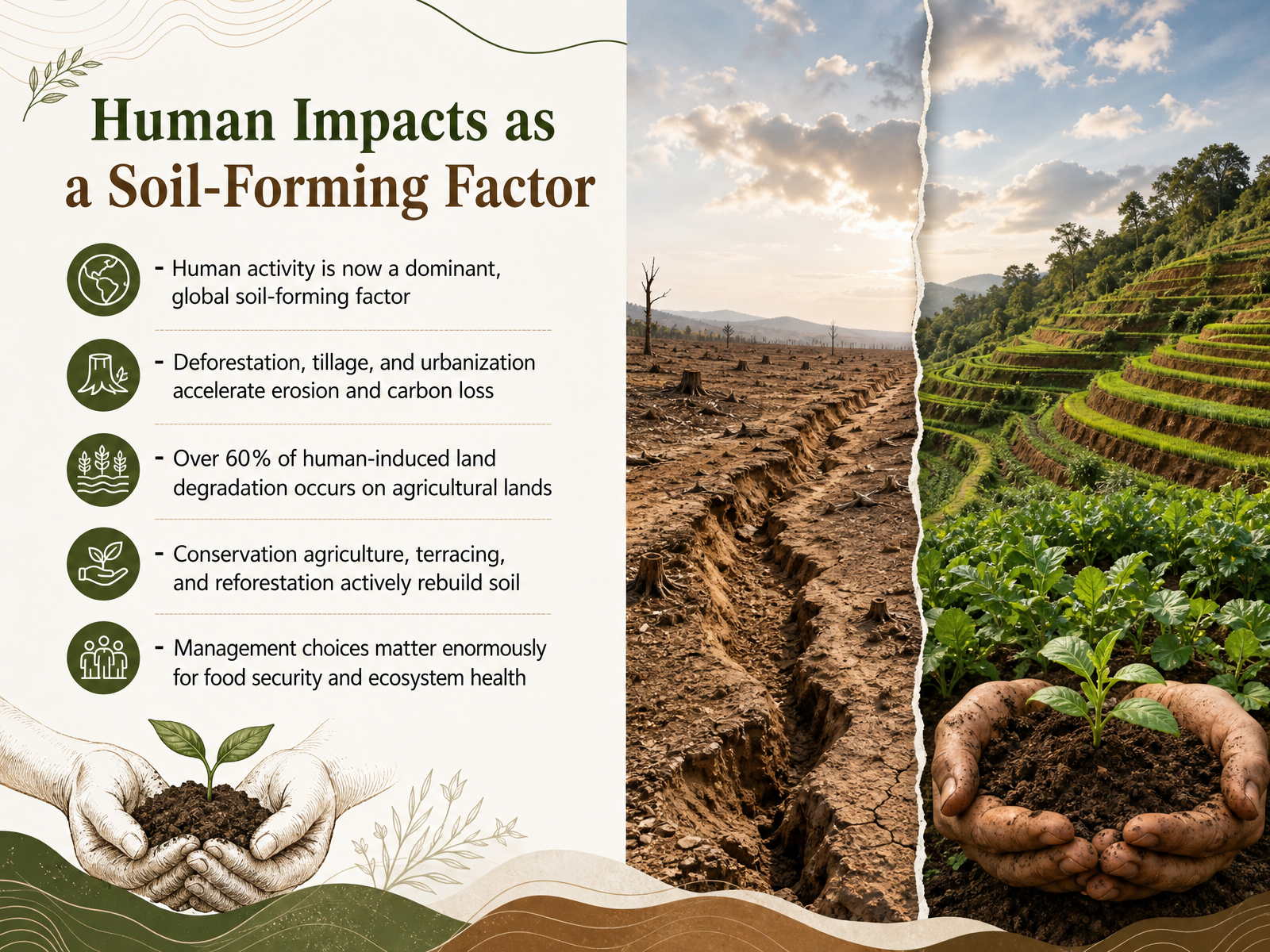
 - 14Human Impacts as a Soil-Forming FactorNow let's turn to a factor that once seemed local but is now reshaping soils across the entire planet: human activity. We have become a dominant, global soil-forming factor. When we clear forests for timber or farmland, when plowing exposes bare soil to wind and rain, and when cities and roads seal the ground under concrete, we accelerate two things especially erosion and carbon loss. Imagine removing a lid from a jar of rich, dark earth. Without that protective cover, water and air quickly strip away the topsoil, and stored carbon escapes into the atmosphere. Over sixty percent of human-caused land degradation happens on agricultural lands croplands and pastures we depend on for food. This isn't just an environmental statistic. Approximately one point seven billion people live in areas where crop yields are already sinking because of that degradation. But here is the hopeful part. Management choices matter enormously. Practices like conservation agriculture, building terraces along hillsides, and reforesting worn-out fields actively rebuild soil. They act like putting the lid back on and slowly refilling what was lost. In fact, reversing just ten percent of human-caused degradation on existing cropland could feed over one hundred and fifty million additional people every year, strengthening food security and restoring ecosystems at the same time. Soil remembers how we treat it, and we can choose to be a force that heals it.
 fao.orgfao.orgopenknowledge.fao.org+22 min
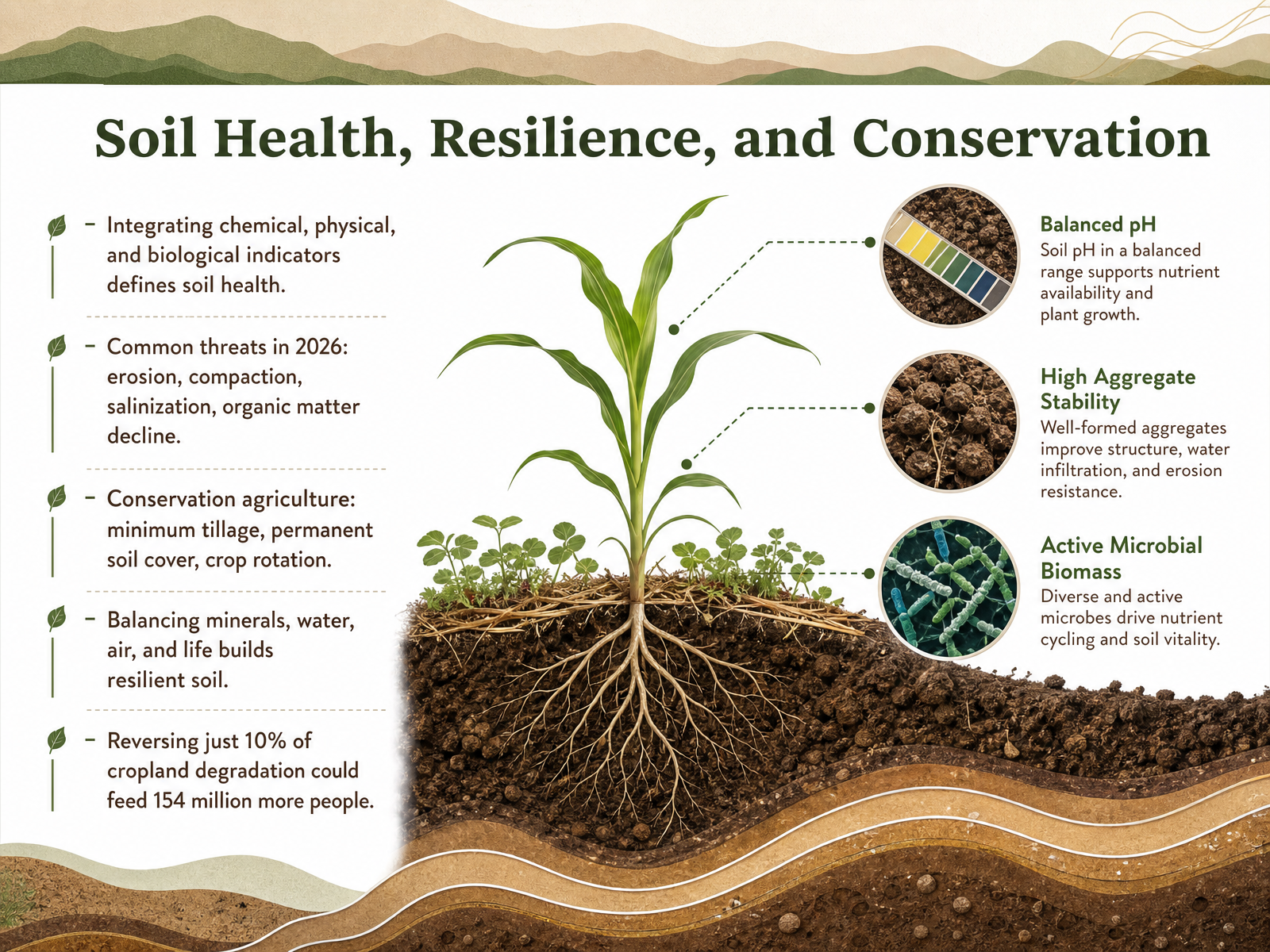
 - 15Soil Health, Resilience, and ConservationNow let's bring everything together and talk about soil health, resilience, and the power of conservation. Think of soil health like a three-legged stool. It stands on chemical, physical, and biological indicators. If one leg is weak, the whole system is at risk. In 2026, the most common threats we're seeing globally are erosion, compaction, salinization, and the decline of organic matter. These pressures are often caused by unsustainable farming and land use. But there's a powerful solution. It's called conservation agriculture. This approach uses three main practices, minimum tillage to avoid disturbing the soil structure, permanent soil cover with crops or residue to protect the surface, and crop rotation to support biodiversity and nutrient balance. By consciously balancing minerals, water, air, and life, we build resilient soil that can better withstand droughts and heavy rains. Here's a remarkable fact from the FAO. If we reversed just ten percent of human-induced degradation on existing croplands, using these exact practices, we could feed an additional one hundred fifty-four million people every year. This shows how powerful healthy soil really is. Now, let's move from understanding the problem to applying these solutions in our final step, From Theory to Practice, Summary and Next Steps.
 fao.orgfao.orgopenknowledge.fao.org+22 min
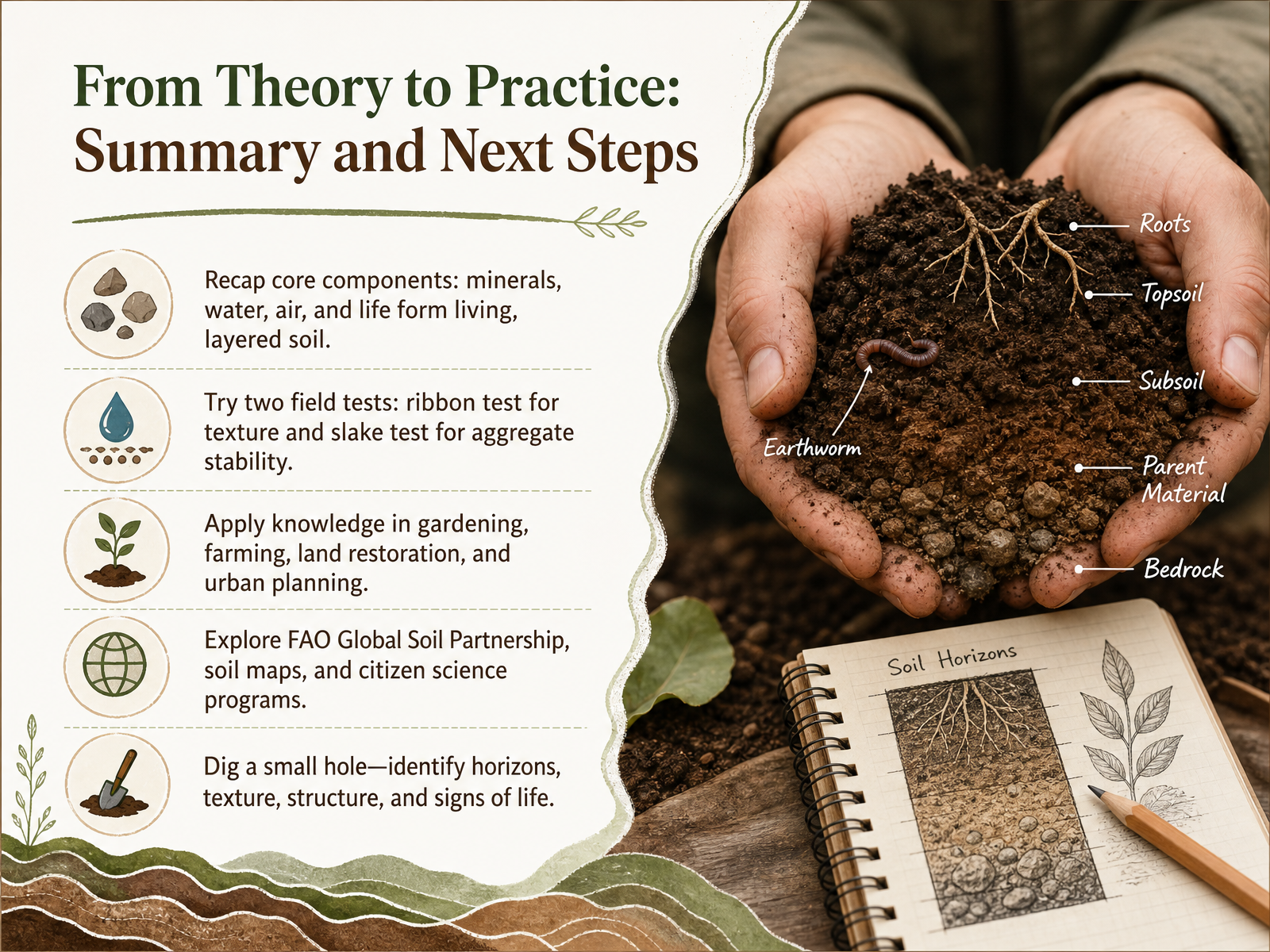
 - 16From Theory to Practice: Summary and Next StepsWe have reached the end of our journey, so let us briefly tie everything together. You now know that healthy soil is a living, layered system built from minerals, water, air, and countless organisms. To test this yourself, try two simple field experiments: the ribbon test helps you feel soil texture, and the slake test shows how well soil aggregates hold together in water. This knowledge is not just theoretical. You can apply it in your own garden, in large-scale farming, in land restoration projects, or even in urban green planning. If you want to go deeper, wonderful resources are waiting. Explore the FAO Global Soil Partnership, look at online soil maps, or join a citizen science project near you. And my final invitation is this: step outside, dig a small hole no deeper than your elbow, and see what you can identify. Notice the layers, feel the texture, observe the structure, and look for signs of life. The story of the earth is right beneath your feet, and now you know how to read it. Thank you for learning with me, and happy exploring.
 fao.orgfao.orgopenknowledge.fao.org+22 min
Take the deck with you
Download this course as a file — free, no sign-up needed.
- PDF handoutEvery slide page, ready to print or share.17 pages · 6.8 MBDownload
- Narrated PowerPointThe deck that presents itself — every slide carries the digital human's narration video.17 pages · 20.5 MBDownload
- PowerPoint slidesThe full deck as a .pptx — open it in PowerPoint, Keynote, or Google Slides.17 pages · 6.8 MBDownload
Free to use in your own training — please keep the PersonWise credit page at the end.
Have your own deck? Turn it into a course
Sources consulted
Web sources consulted while building this course.
- 1.7 billion people experience lower crop yields due to land degradation — fao.org
- 15.3.1 Proportion of land that is degraded over total land area | SDG Indicators Data Portal | Food and Agriculture Organization of the United Nations — fao.org
- The State of the World’s Land and Water Resources for Food and Agriculture 2025 — openknowledge.fao.org
- Status of the World's Soil Resources: Introductory Information — openknowledge.fao.org
- The global distribution of human-induced land degradation and areas at risk — openknowledge.fao.org
- Basic Soil Science (SOIL 2125) Lecture Summaries - Spring 2025 - Lecture 3.1: Soil Genesis and Soil Forming Factors: Theoretical Foundation and Development of Modern Theories of Soil Formation — umn-soil-2125.github.io
- Factors affecting soil formation » New Zealand Soils Portal - Manaaki Whenua - Landcare Research — soils.landcareresearch.co.nz
- Five factors of soil formation — extension.umn.edu
- Basic Soil Science (SOIL 2125) Lecture Summaries - Spring 2025 - Lecture 3-3: Soil Forming Factors - Climate, Organisms, Relief, and Time — umn-soil-2125.github.io
- Jenny Equation — soil.evs.buffalo.edu