Reading Historical Letters
Begin
14 pages · ~28 min
Reading Historical Letters
Teaches students how to analyze historical letters by examining voice, audience, and context.
What you’ll learn
- 01Reading Historical Letters: Voice, Audience, and ContextWelcome. In this session, we will read historical letters as primary sources. Our goal is to move beyond surface summaries and make careful, analytical judgments about a writer’s world. A letter gives us a unique window into the author’s voice and the audience they had in mind. To read deeply, we will use a four-part framework: the author, the recipient, the purpose, and the historical situation. You will practice a repeatable method for extracting meaning, one that you can apply well beyond this course. By the end, you will approach any historical letter with sharper questions and greater confidence. Let’s begin by examining why letters matter as a genre, and what makes historical correspondence such a distinctive source of evidence.1 min
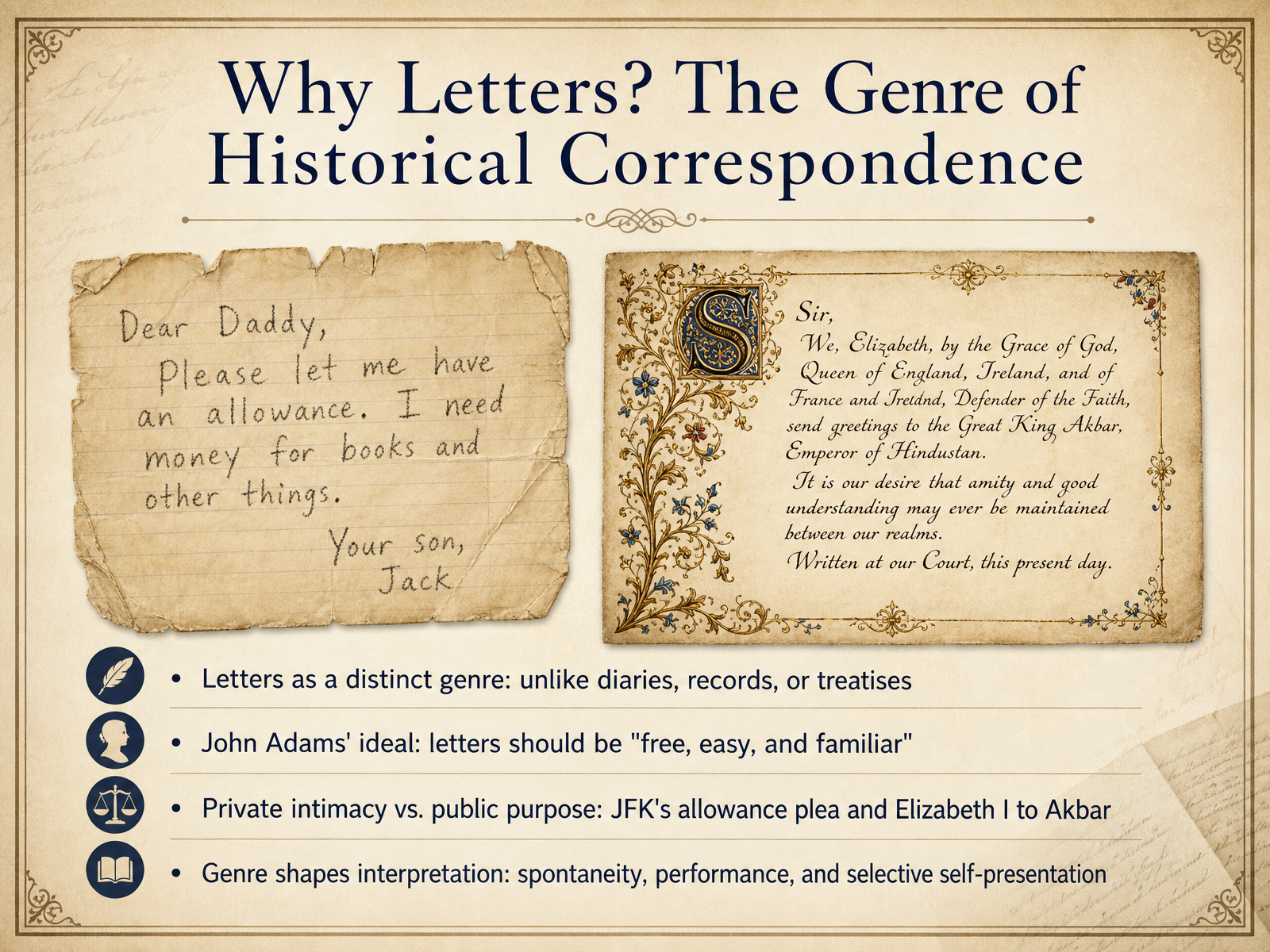
- 02Why Letters? The Genre of Historical CorrespondenceBefore we dig into specific letters, let's pause on the genre itself. Why treat a letter differently than a diary entry or a political treatise? The form sets up expectations. John Adams once wrote that a letter should feel free, easy, and familiar. That ideal hints at spontaneity, but it's a crafted spontaneity. A letter is a performance shaped by the relationship between the sender and the recipient. Consider the shift in tone from a private, intimate plea for an allowance, like the one written by a young John F. Kennedy to his father, to a public diplomatic message from Elizabeth the First to Emperor Akbar. Same genre, but the audience and purpose completely transform the content. As we move forward, watch for three things: the writer's selective self-presentation, the pressure of the intended audience, and the blend of private voice with public purpose. Let's apply this lens directly to our first core concept, authorial voice.
 2 min
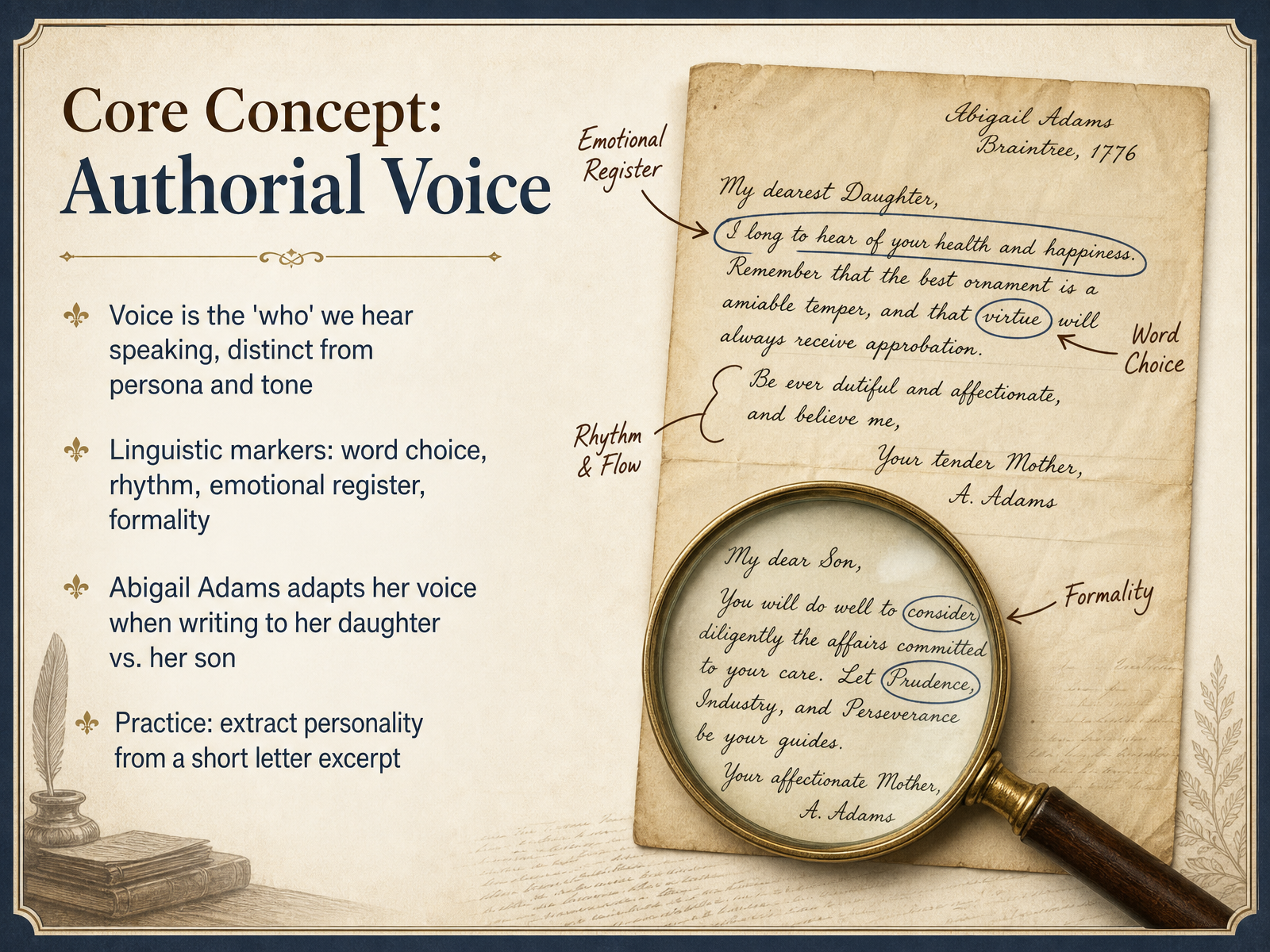
2 min - 03Core Concept: Authorial VoiceMoving to our first core concept, let's examine authorial voice. Voice is the distinct 'who' we hear speaking on the page. It is different from a constructed persona or emotional tone. Voice is the consistent linguistic fingerprint of the writer. We detect it through specific markers: word choice, sentence rhythm, emotional register, and level of formality. A skilled writer often adapts their voice depending on the recipient. Consider Abigail Adams. When she writes to her daughter, her voice carries a confiding, nurturing register. When addressing her son, the same author shifts toward a more instructive and formal linguistic pattern. Let's put this into practice. On screen is a short letter excerpt. As you read, try to extract the personality behind the words. Focus on the concrete clues in the language to define who is speaking. Now, let's apply this same analytical lens to the other side of the correspondence. Next, we will explore how the audience shapes the content of a letter.
 2 min
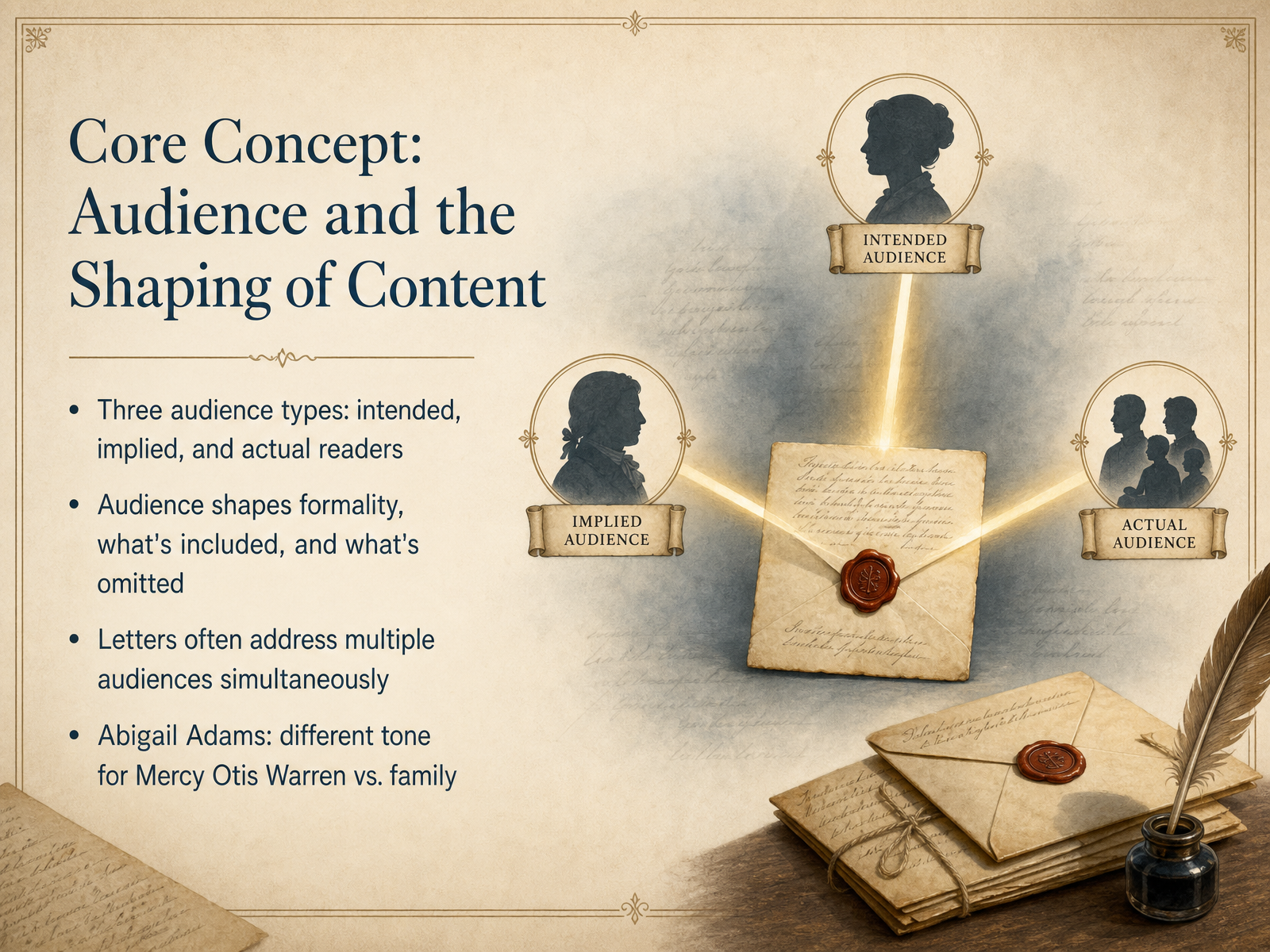
2 min - 04Core Concept: Audience and the Shaping of ContentWhen we read a historical letter, one of the most revealing questions we can ask is: who was this written for? The answer is rarely simple. We can identify at least three types of readers. The intended reader is the named recipient—the person the author consciously addresses. The implied reader is the wider circle the author may have expected would eventually see the letter, perhaps family members or political allies. And then there is the actual reader—which, centuries later, includes us. Understanding these layers helps us analyze how audience shapes the letter’s formality, what details are included, and what is deliberately left out. Letters often address multiple audiences at the same time. Consider Abigail Adams. When she writes to her friend Mercy Otis Warren, her tone is often intellectual and politically candid, treating Warren as a trusted equal. But in letters to her husband John or her sister, she may adopt a more intimate or practical voice, even when discussing the same events. So as we examine a letter, we need to trace how the author’s sense of audience sculpts the message itself. Next, we will go deeper into another shaping force: the specific purpose and occasion behind the correspondence.
 2 min
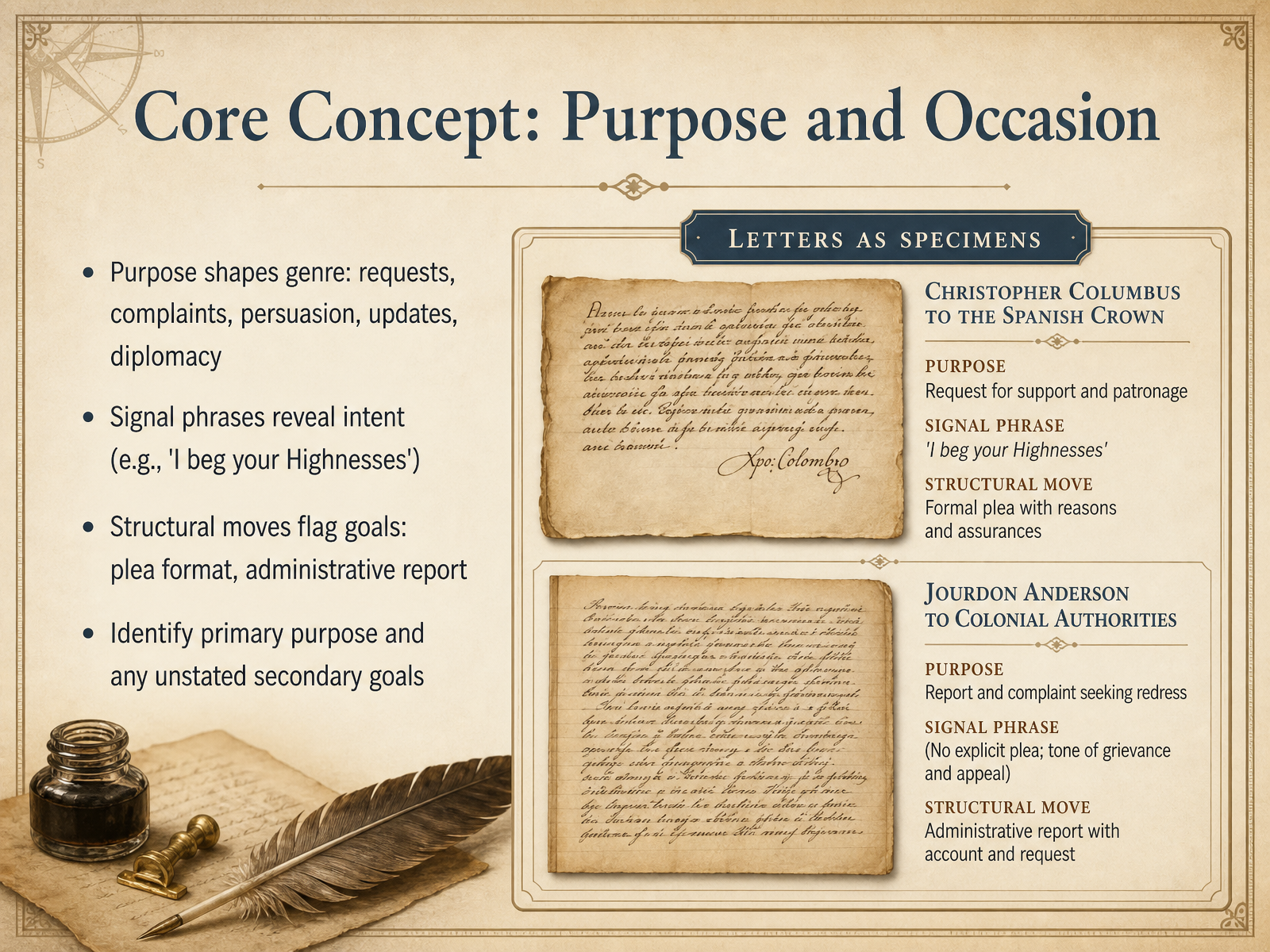
2 min - 05Core Concept: Purpose and OccasionMoving to purpose and occasion—these two forces directly shape what a letter is and what it tries to accomplish. Purpose shapes genre. A request reads differently from a complaint, a diplomatic update, or an attempt at persuasion. Listen for signal phrases that reveal intent. When Columbus writes 'I beg your Highnesses,' that language instantly signals supplication and a hierarchical relationship. Structural moves also flag goals. A plea often follows a predictable format: statement of hardship, appeal for intervention, and a closing petition. An administrative report usually prioritizes facts, chronologies, and recommendations. Your task is to identify the primary purpose and then ask a deeper question: are there unstated secondary goals at work? A merchant reporting poor sales might primarily be providing an update, but secondarily laying the groundwork for a future request for credit. Always weigh what the letter openly does against what it might quietly be trying to achieve. Next, we’ll build on this by reconstructing the historical context that surrounds the letter.
 2 min
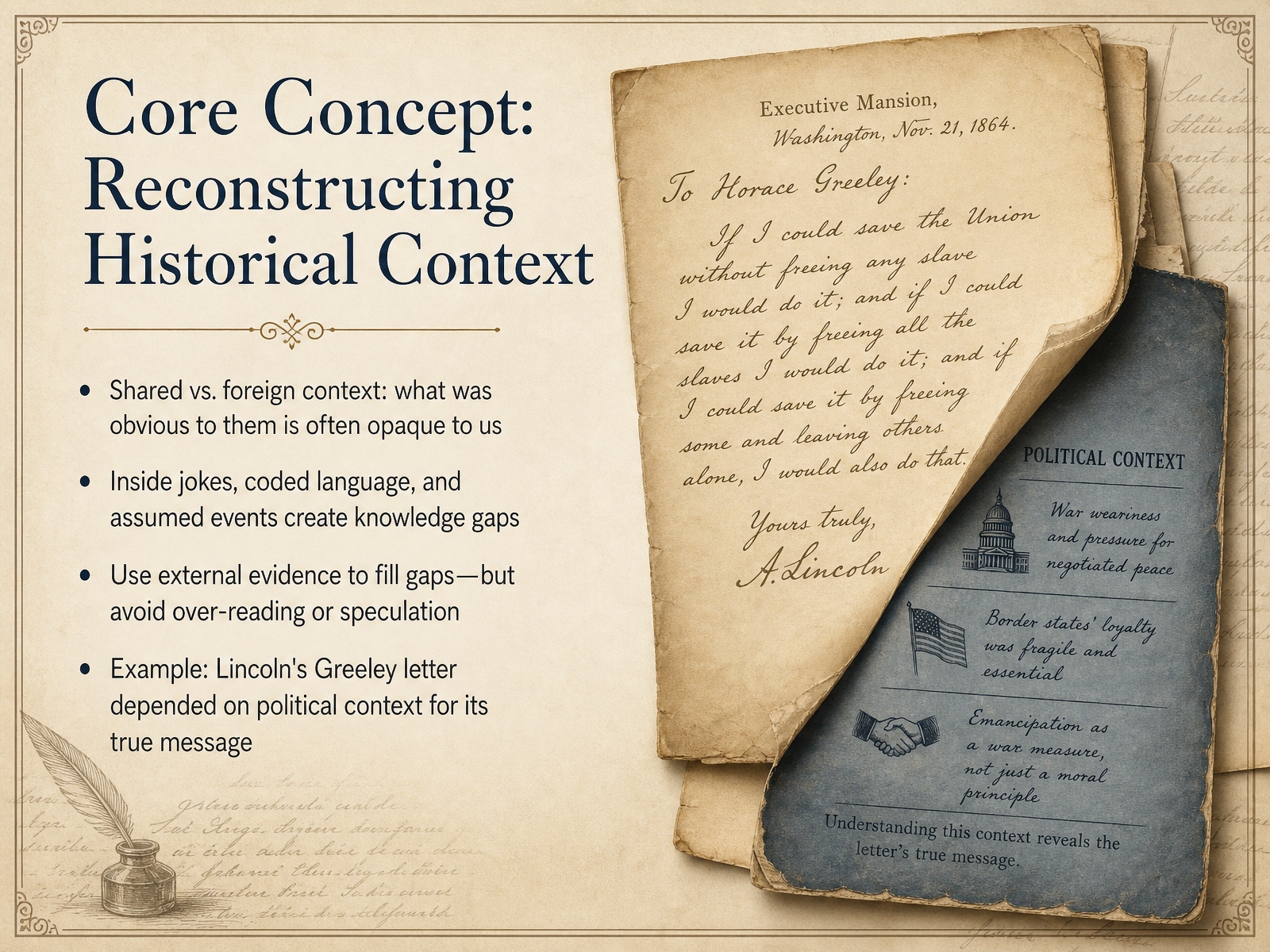
2 min - 06Core Concept: Reconstructing Historical ContextLet's turn now to the challenge of reconstructing historical context. When we read a modern email, we share a cultural landscape with the sender. But with historical letters, what was obvious to them is often completely opaque to us. References to current events, political alliances, or social customs were so embedded in daily life that the author never needed to explain them. This creates a shared context that we, as outsiders, must actively rebuild. Inside jokes, coded language, and casually mentioned events can become significant knowledge gaps. A passing reference to a meeting or a sly, humorous remark between friends can carry deep meaning that we risk missing entirely. To fill these gaps, we turn to external evidence—other letters, newspaper accounts, or biographical records. But we must proceed with caution. The goal is informed interpretation, not over-reading or wild speculation. We look for clues that the original recipients would have recognized, and we weigh those clues against documented facts. Consider Lincoln's famous letter to Horace Greeley. On its surface, it states a moderate position on slavery. But its true message depended entirely on the political context of the time—what Lincoln's contemporaries knew about the shifting war aims and public opinion. Stripping away that context leads to a fundamental misunderstanding of his strategy. In short, our job is to make the familiar strange again, and then make it knowable through careful, evidence-based reconstruction. Next, we'll explore what happens when a letter's audience expands unexpectedly, in our next topic: when letters go public versus private audiences.
 2 min
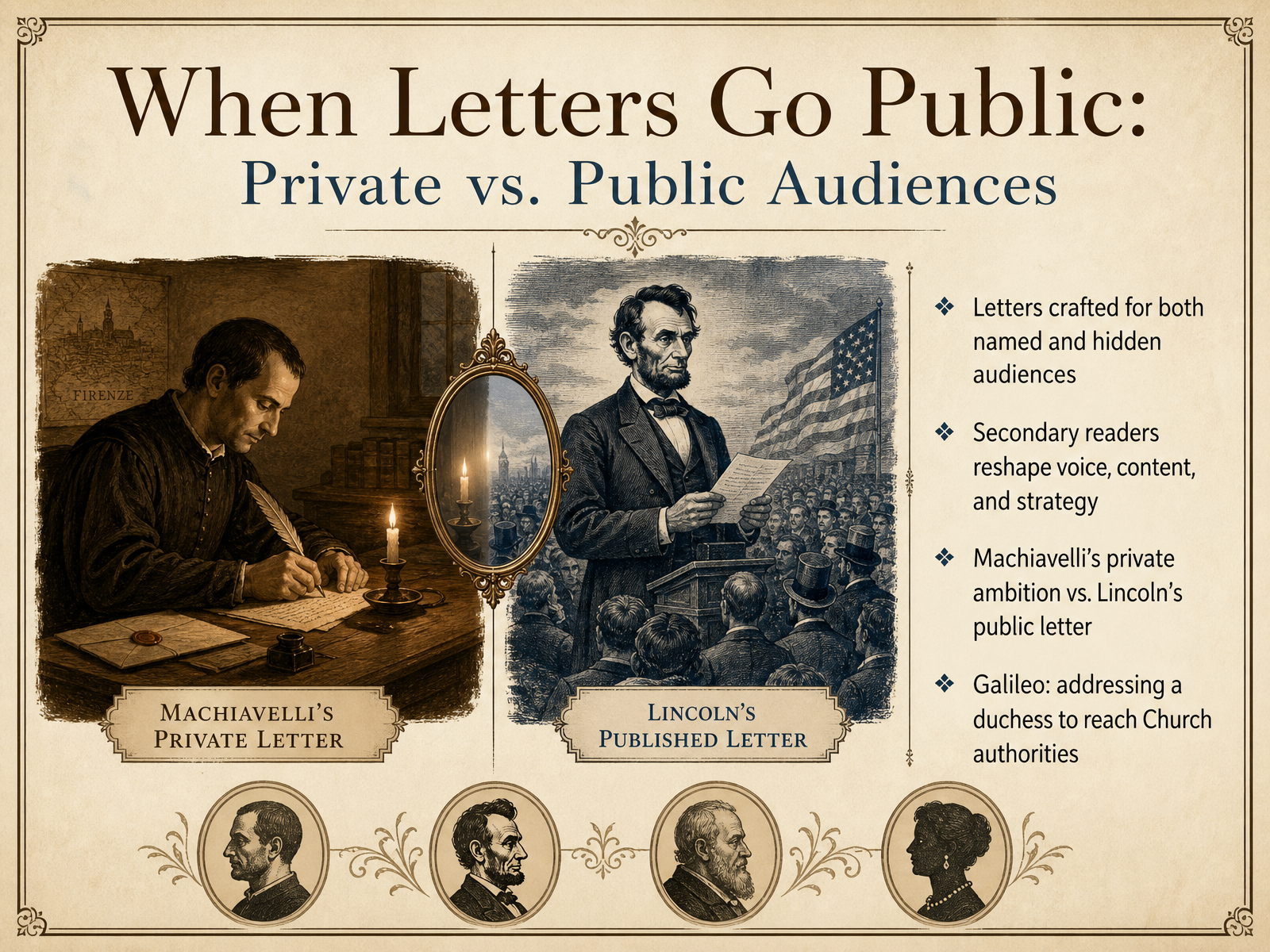
2 min - 07When Letters Go Public: Private vs. Public AudiencesNow let's consider a crucial shift: when private correspondence is crafted with a public purpose. Many historical letters have both a named recipient and a hidden, secondary audience. Those secondary readers profoundly reshape the letter's voice, its content, and its rhetorical strategy. Take Niccolò Machiavelli. His private letters to friends reveal raw ambition and a desire to return to political power. Contrast that with Abraham Lincoln's public letter to Horace Greeley, which was clearly designed to be printed in newspapers and shape Northern public opinion on emancipation. Another masterful example is Galileo. He addressed his letter to the Grand Duchess Christina, but his hidden audience was Church authorities. His careful, respectful tone was a strategic choice to defend his scientific findings while navigating a very dangerous institutional landscape. So, as you read, always ask: who else might be listening? That question will guide our next topic: reading tone between the lines.
 2 min
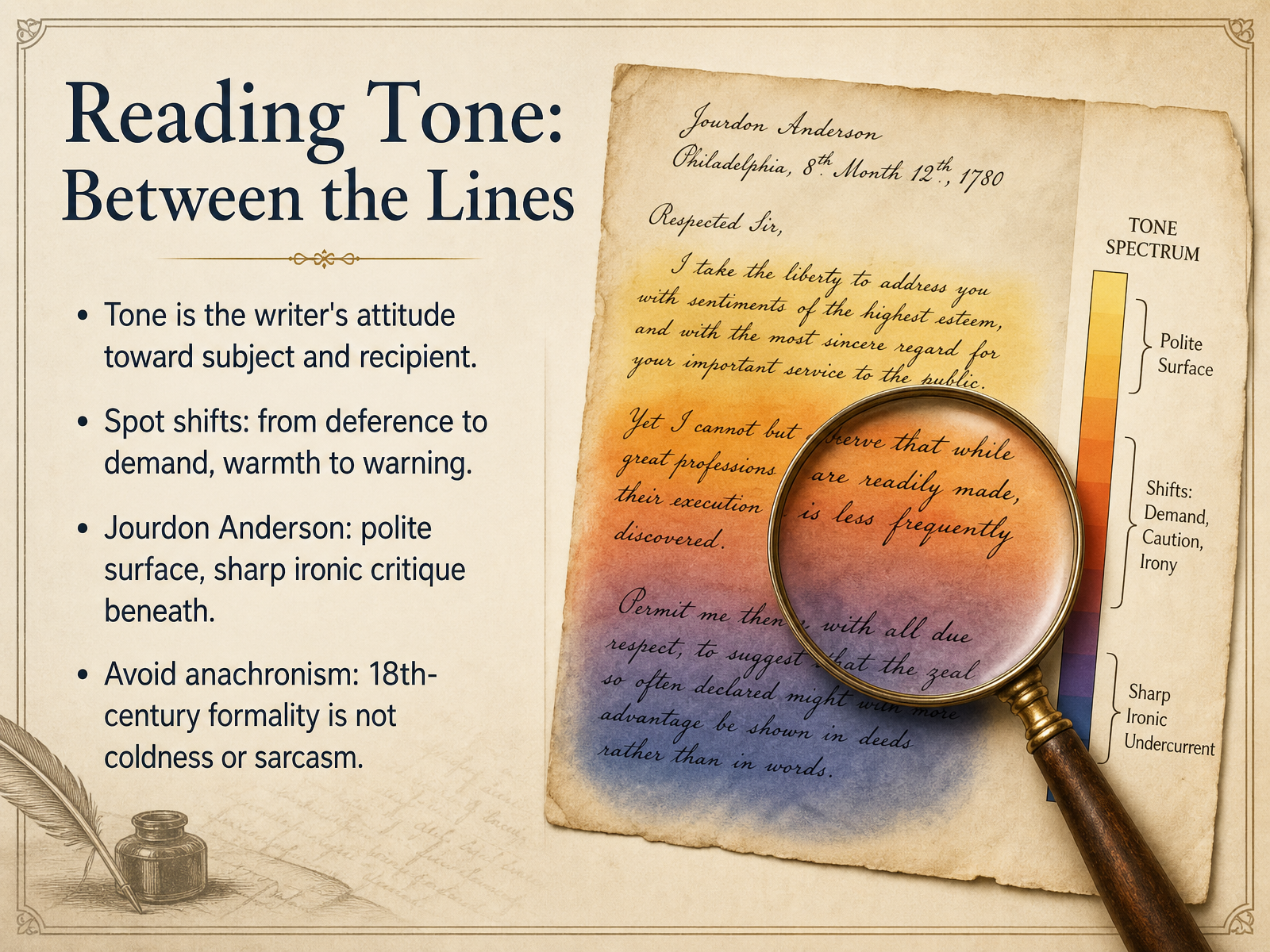
2 min - 08Reading Tone: Between the LinesNow let's talk about reading tone—the writer's attitude toward both the subject and the recipient. Tone lives between the lines, and it's often where the real meaning hides. As you read, watch for shifts. A letter might begin with deference and then pivot to a quiet demand. It may open with warmth and close with a veiled warning. These shifts signal a change in strategy or emotional intensity. Consider Jourdon Anderson's famous letter to his former enslaver. On the surface, the tone is exquisitely polite. But beneath that politeness runs a sharp, ironic critique. Anderson uses formality as a weapon. A word of caution here: avoid anachronism. An eighteenth-century letter filled with elaborate formal phrasing is not necessarily cold or sarcastic. That formality was often a sign of respect, not distance. Weigh the conventions of the period before you assign a modern emotional label to an old phrase. Let's carry this skill forward into our next topic—identifying rhetorical moves in historical letters.
 2 min
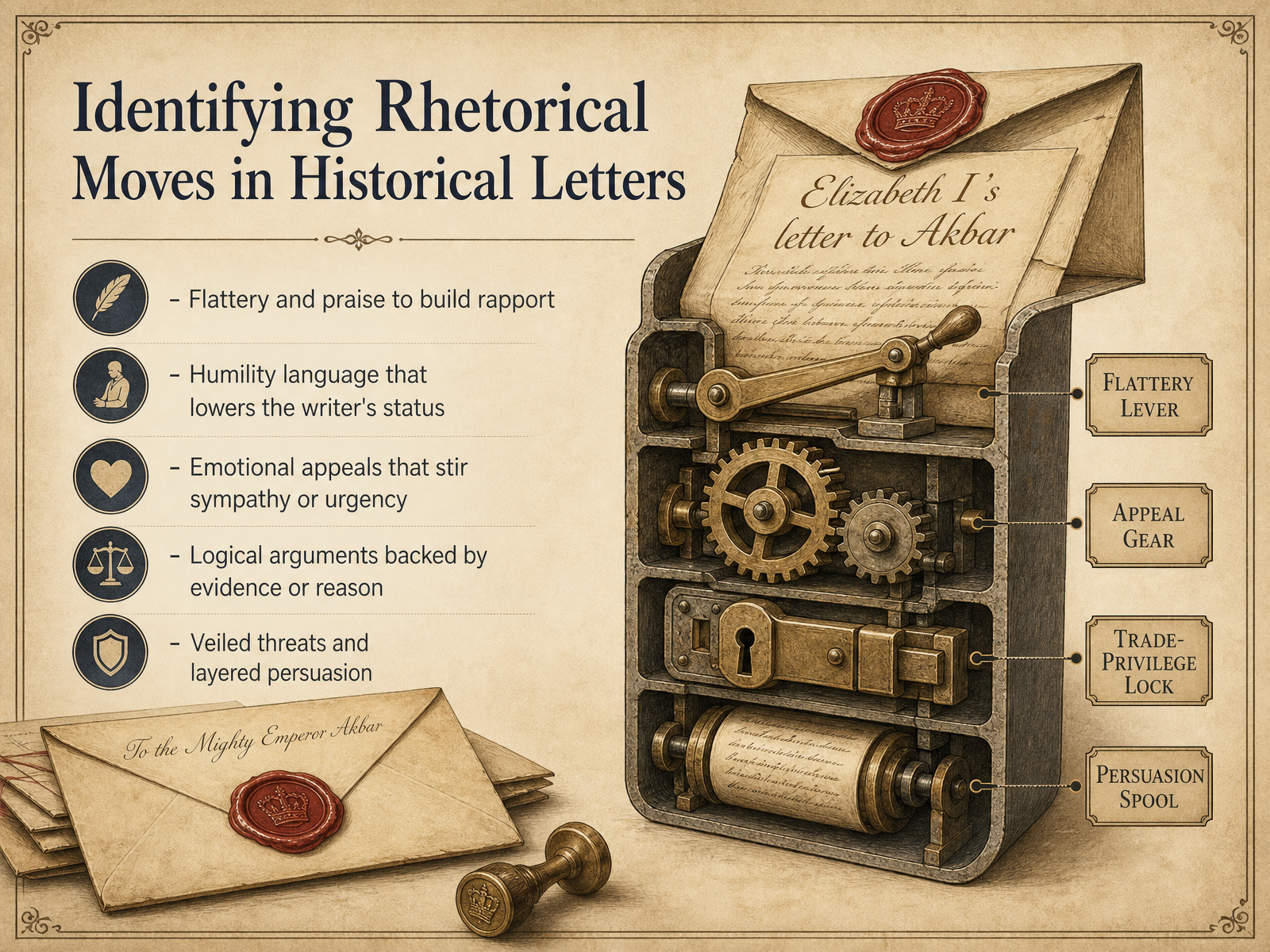
2 min - 09Identifying Rhetorical Moves in Historical LettersNow let's identify some common rhetorical moves you will find in historical letters. First, look for flattery and praise used to build rapport with the recipient. A writer might compliment the recipient's wisdom or generosity before making a request. Second, notice humility language that deliberately lowers the writer's own status. Phrases like 'I am but a humble servant' can be a strategic choice rather than simple modesty. Third, watch for emotional appeals designed to stir sympathy or a sense of urgency. A description of personal suffering or impending danger is often crafted to move the reader to action. Fourth, examine any logical arguments the writer constructs. These might include evidence, reasoned steps, or references to shared principles. Finally, be alert to veiled threats and layered persuasion. A writer may hint at consequences or combine flattery with a subtle warning to pressure the recipient. Recognizing these moves helps you see how the writer is shaping the message. Next, we will put all these skills together in a four-step reading framework.
 2 min
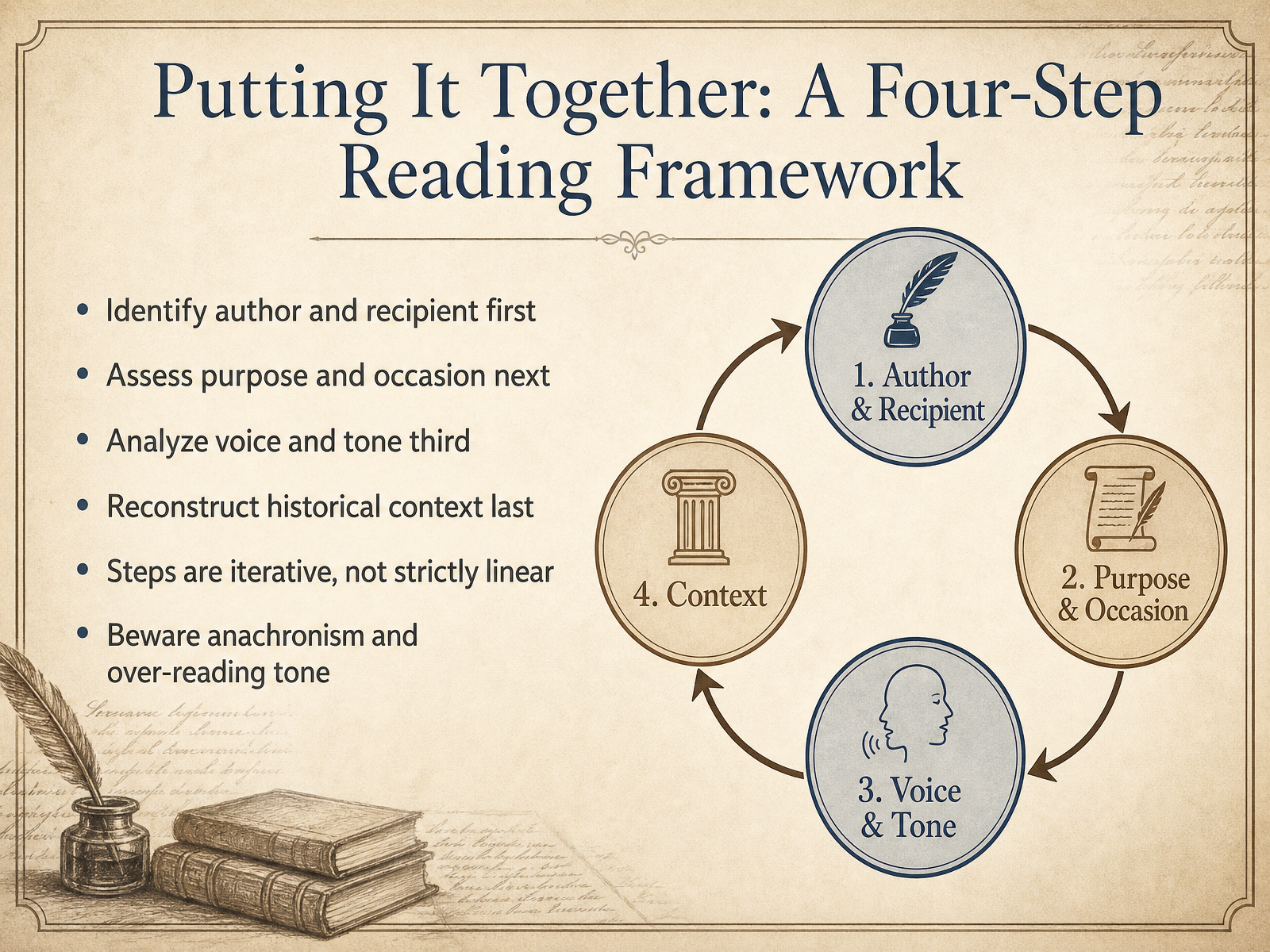
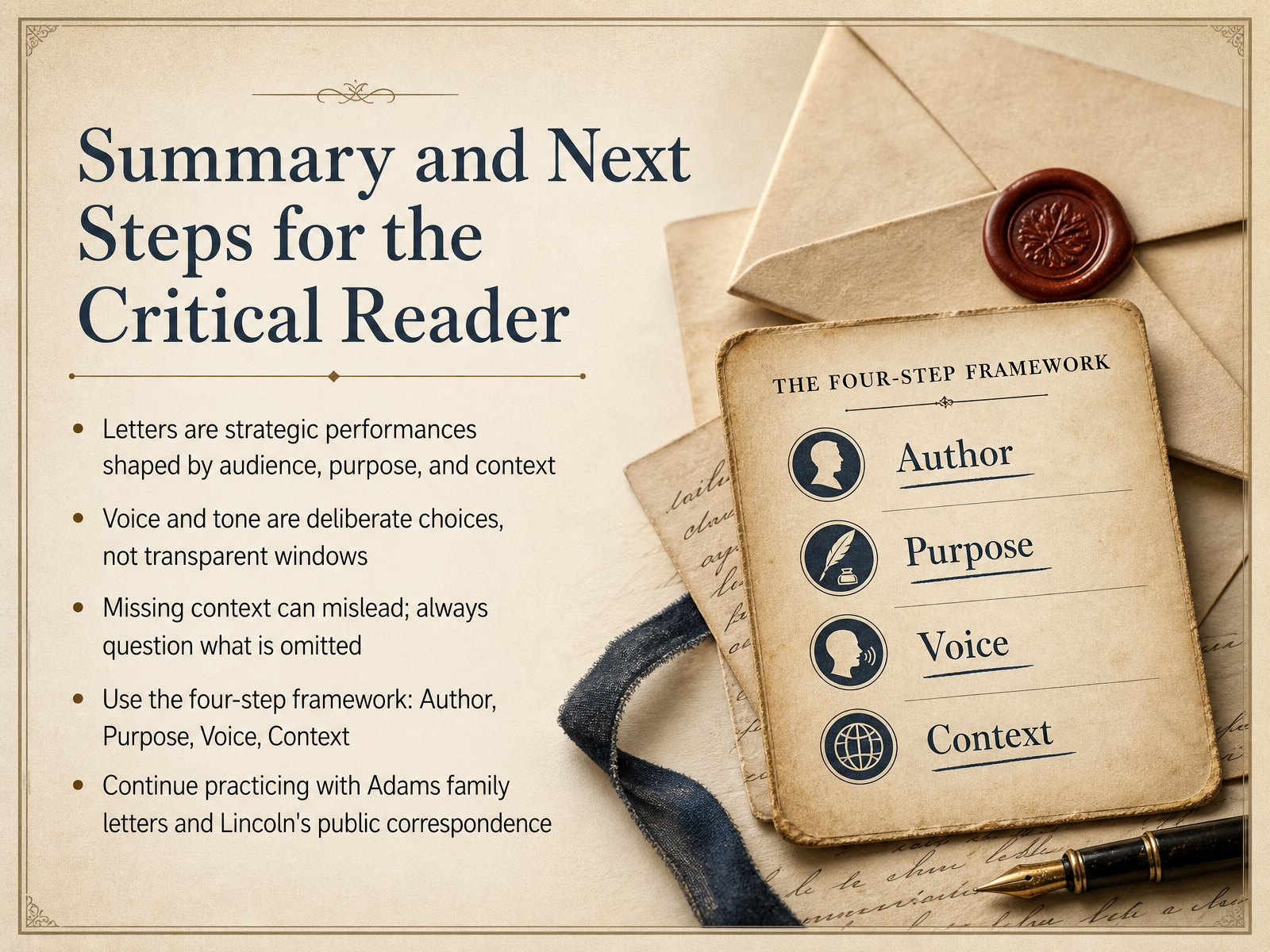
2 min - 10Putting It Together: A Four-Step Reading FrameworkNow let's bring these skills together into a practical, repeatable framework you can apply to any historical letter. We'll work through four steps, though in practice you'll often move back and forth between them rather than following a rigid sequence. First, identify the author and the recipient. Who is writing, and to whom? What is their relationship? A letter to a sibling carries different assumptions than a letter to a commanding officer. Second, assess the purpose and occasion. Why was this letter written now? Is it a condolence, a request, a report? The immediate occasion shapes everything that follows. Third, analyze voice and tone. Is the language formal or intimate, restrained or emotional? Look for word choice, sentence rhythm, and what remains unsaid. Fourth, reconstruct the broader historical context. What social conventions, political pressures, or economic realities surrounded this exchange? As you work through these steps, remain on guard against two common pitfalls: anachronism, reading present-day values into the past, and over-reading tone, where we assign emotional weight the writer may never have intended. Up next, we'll put this framework into action with a demonstration analysis of a letter titled 'A Plea for a Raise' by a young John F. Kennedy.
 2 min
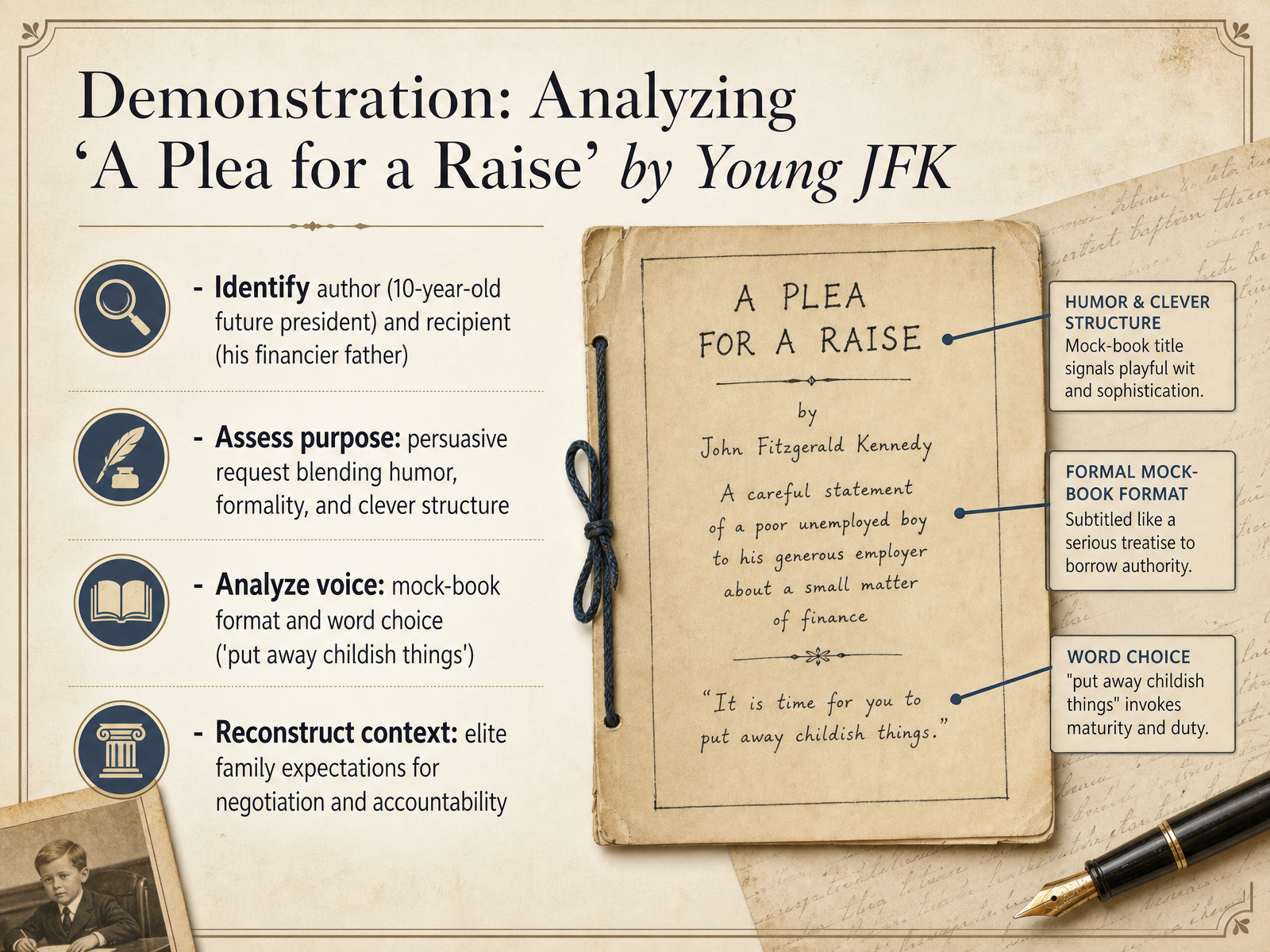
2 min - 11Demonstration: Analyzing 'A Plea for a Raise' by Young JFKNow let's apply our framework to a real document: a plea for a raise written by a ten-year-old John F. Kennedy. First, identify the author and recipient. The author is a young boy who would one day become president. The recipient is his father, Joseph Kennedy, who controlled the family finances. Next, assess the purpose. Young Jack structures his request as a persuasive argument, blending humor with formal reasoning. He doesn't simply ask for money; he builds a case. Analyze the voice. He adopts a mock-book format and chooses phrases carefully to sound mature, even quoting scripture with 'put away childish things.' Finally, reconstruct the context. This letter reflects an elite family environment where children were expected to negotiate and justify their spending with accountability. Together, these elements show how a child's playful note can reveal serious family values.
 2 min
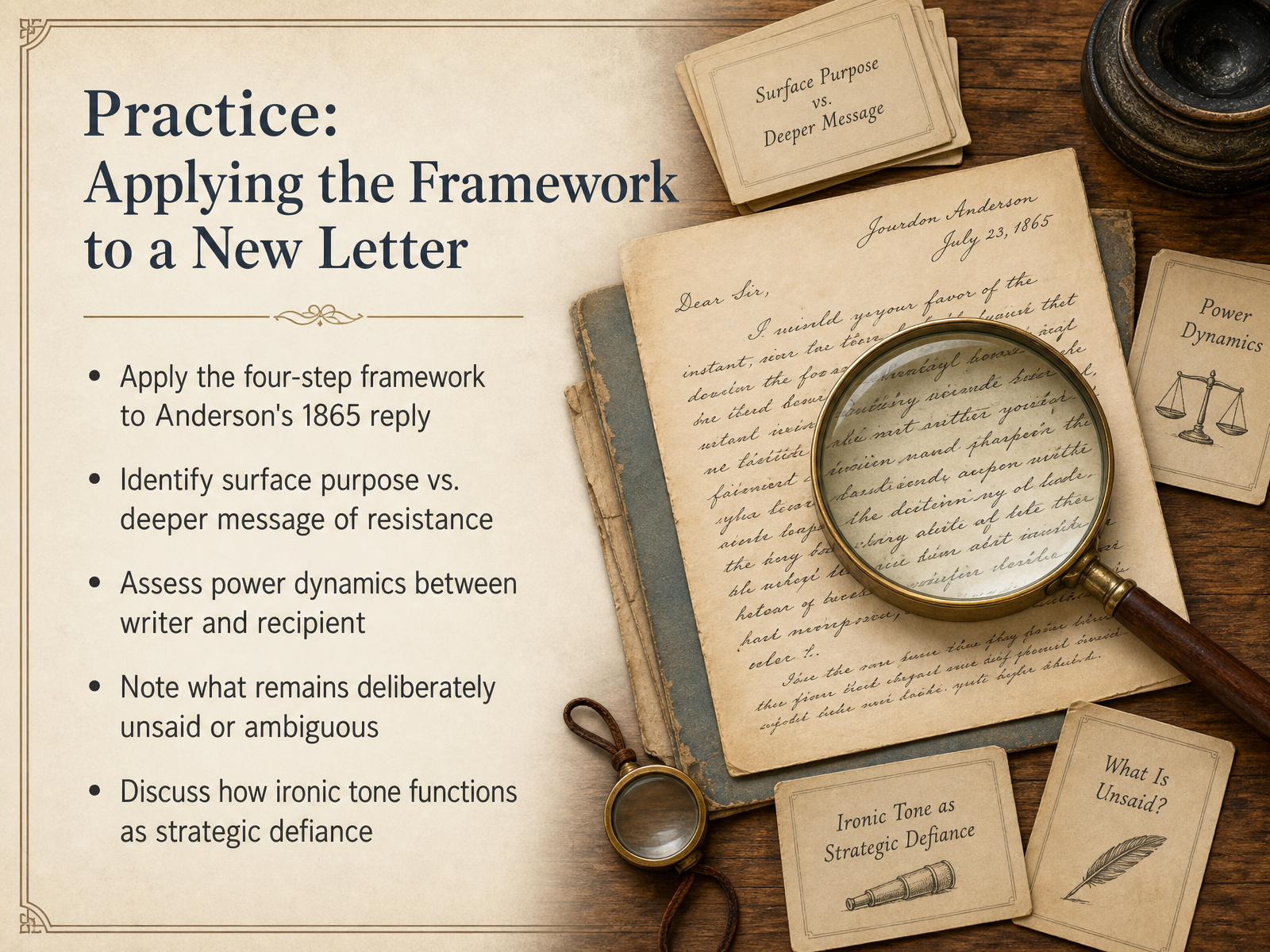
2 min - 12Practice: Applying the Framework to a New LetterLet's apply our four-step framework to a new piece: Anderson's 1865 reply. Begin by asking what the surface purpose appears to be. Is it a simple acknowledgment, a logistical update? Now move deeper. Where does Anderson signal a message of resistance running beneath that surface? Consider the power dynamics at play. Who holds institutional authority, and who holds moral or experiential authority? Pay close attention to what the writer deliberately leaves unsaid or wraps in ambiguity. Those silences are often deliberate. Finally, examine the ironic tone. A compliant phrase delivered with irony becomes an act of strategic defiance, allowing the writer to technically obey while unmistakably refusing. Work through each step and see what layers emerge. In our next segment, we'll come together to debrief and discuss multiple interpretations of this same letter.
 1 min
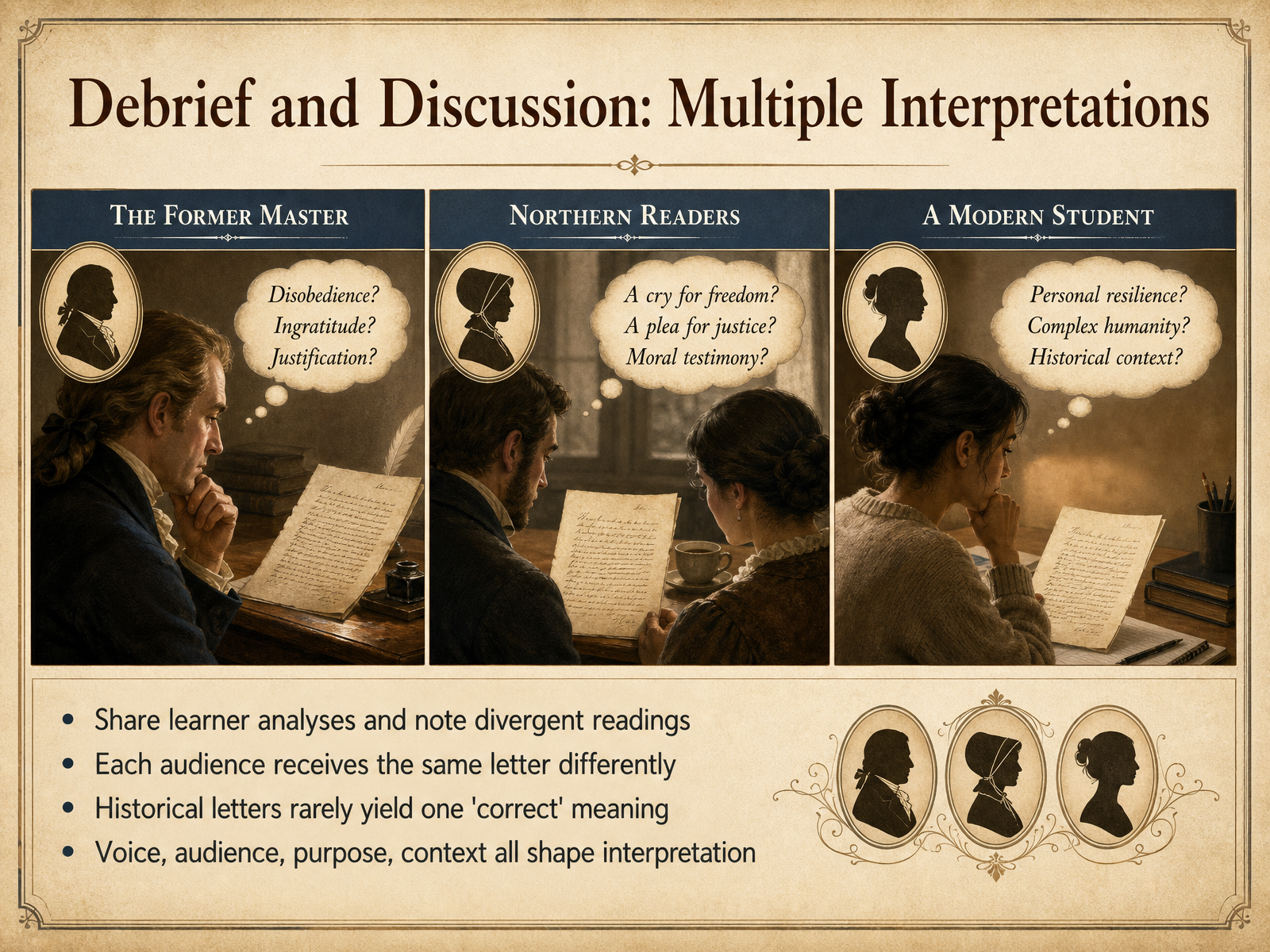
1 min - 13Debrief and Discussion: Multiple InterpretationsLet's take a moment to consider how these analyses played out. You may notice something striking. Several learners looking at the very same letter often reach quite different conclusions. This is not a sign of error. It is evidence that historical documents are alive with multiple possibilities. The same sentence can read as affection to one audience and as political loyalty to another. Every recipient brings assumptions, and every reader today brings a new set of questions. So rather than hunting for the single correct meaning, focus on what your evidence supports. Ask yourself why your reading differs from a colleague's. What aspect of voice, audience, purpose, or context did each of you weigh differently? That reflection is where deeper understanding happens. Next, we will pull these threads together in our summary and discuss next steps for the critical reader.
 2 min
2 min - 14Summary and Next Steps for the Critical ReaderWe have covered a lot of ground together, so let us briefly pull the threads into a clear takeaway you can use going forward. Every historical letter is a strategic performance, carefully shaped by its audience, its purpose, and the context in which it was written. Voice and tone are never accidental windows into a writer's soul; they are deliberate choices meant to produce a specific effect on the reader. Always ask what is missing or left unsaid, because missing context can easily lead us to misinterpret the document. To keep your analysis steady, return to the four-step framework we built: Author, Purpose, Voice, and Context. Your next step as a critical reader is to keep practicing with the Adams family letters and Lincoln's public correspondence. Apply the frame, test your judgments, and let the silences speak as loudly as the words. Thank you for working through this material so thoughtfully, and I look forward to seeing the insights you will uncover.
 2 min
2 min
Take the deck with you
Download this course as a file — free, no sign-up needed.
- PDF handoutEvery slide page, ready to print or share.15 pages · 5.8 MBDownload
- Narrated PowerPointThe deck that presents itself — every slide carries the digital human's narration video.15 pages · 16.4 MBDownload
- PowerPoint slidesThe full deck as a .pptx — open it in PowerPoint, Keynote, or Google Slides.15 pages · 5.8 MBDownload
Free to use in your own training — please keep the PersonWise credit page at the end.
Have your own deck? Turn it into a course