Begin
14 pages · ~28 min
Change Management Roadmap
This training guides managers and change leaders through building a change management roadmap with clear priorities, milestones, and communication plans to drive successful organizational change.
A digital instructor presents all 14 pages. Hold “Ask” at any point and ask out loud — the answer comes from this course. No sign-up needed.
What you’ll learn
- 01Change Management Roadmap: Priorities, Milestones, and CommunicationWelcome to Change Management Roadmap: Priorities, Milestones, and Communication.
This course is built for change and transformation leaders, programme owners, project managers, and the HR and communications teams who coordinate organizational change every day.
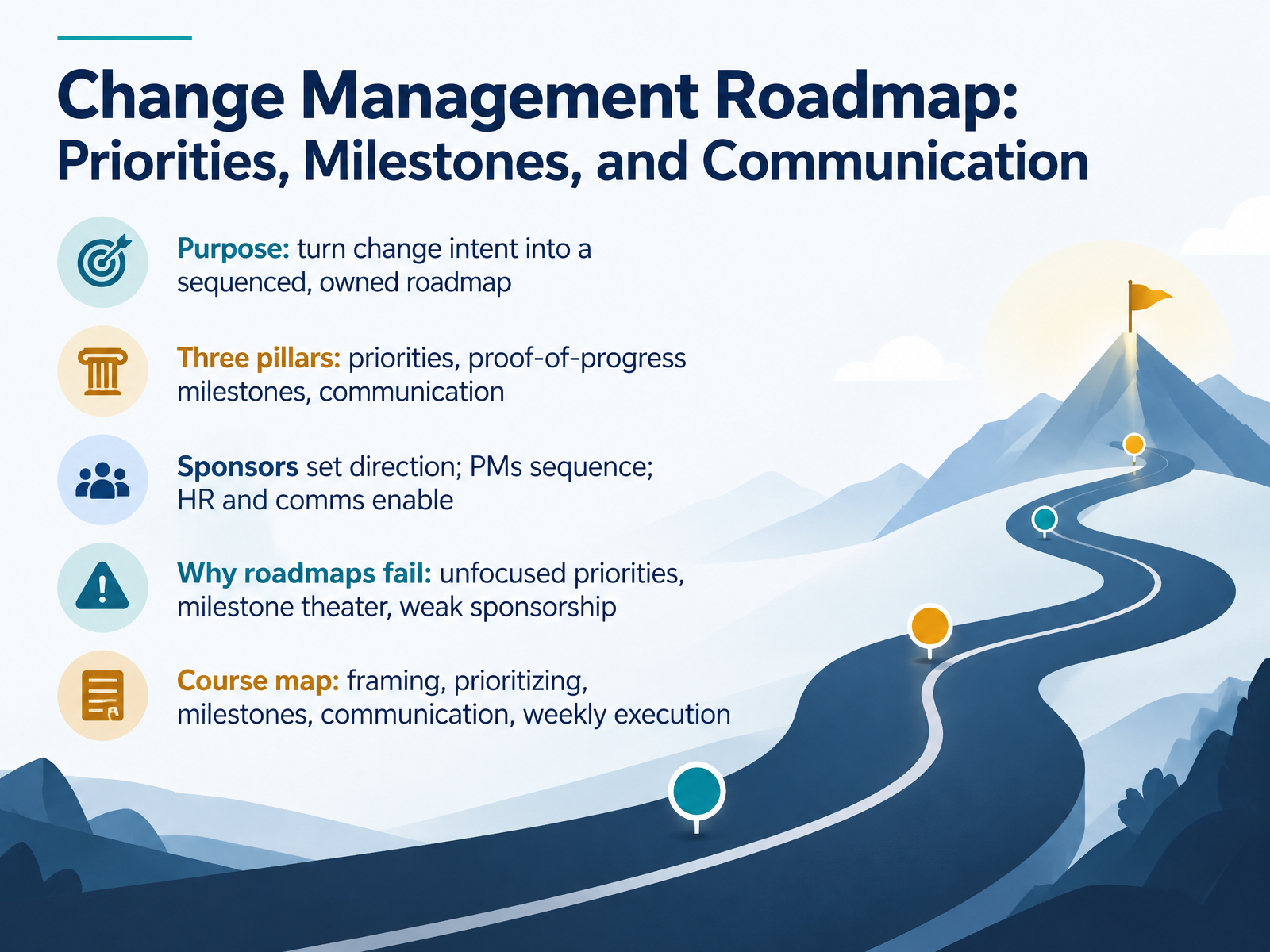
Our goal is simple: turn change intent into a sequenced, owned roadmap. That roadmap rests on three pillars. First, priorities. Second, proof-of-progress milestones. Third, communication.
Ownership matters just as much as structure. Sponsors set direction. Project managers sequence the work. HR and communications enable adoption across teams.
Most roadmaps fail for predictable reasons. Unfocused priorities that try to do everything at once. Milestone theater, where dates slip because they were never tied to real outcomes. And weak sponsorship that leaves change looking like a project task, not a leadership commitment.
Over the next modules, we will cover the course map: framing, prioritizing, milestones, communication, and weekly execution.
Let's start with framing. From intent to roadmap.trupeer.ainmsconsulting.comteamspective.com+22 min
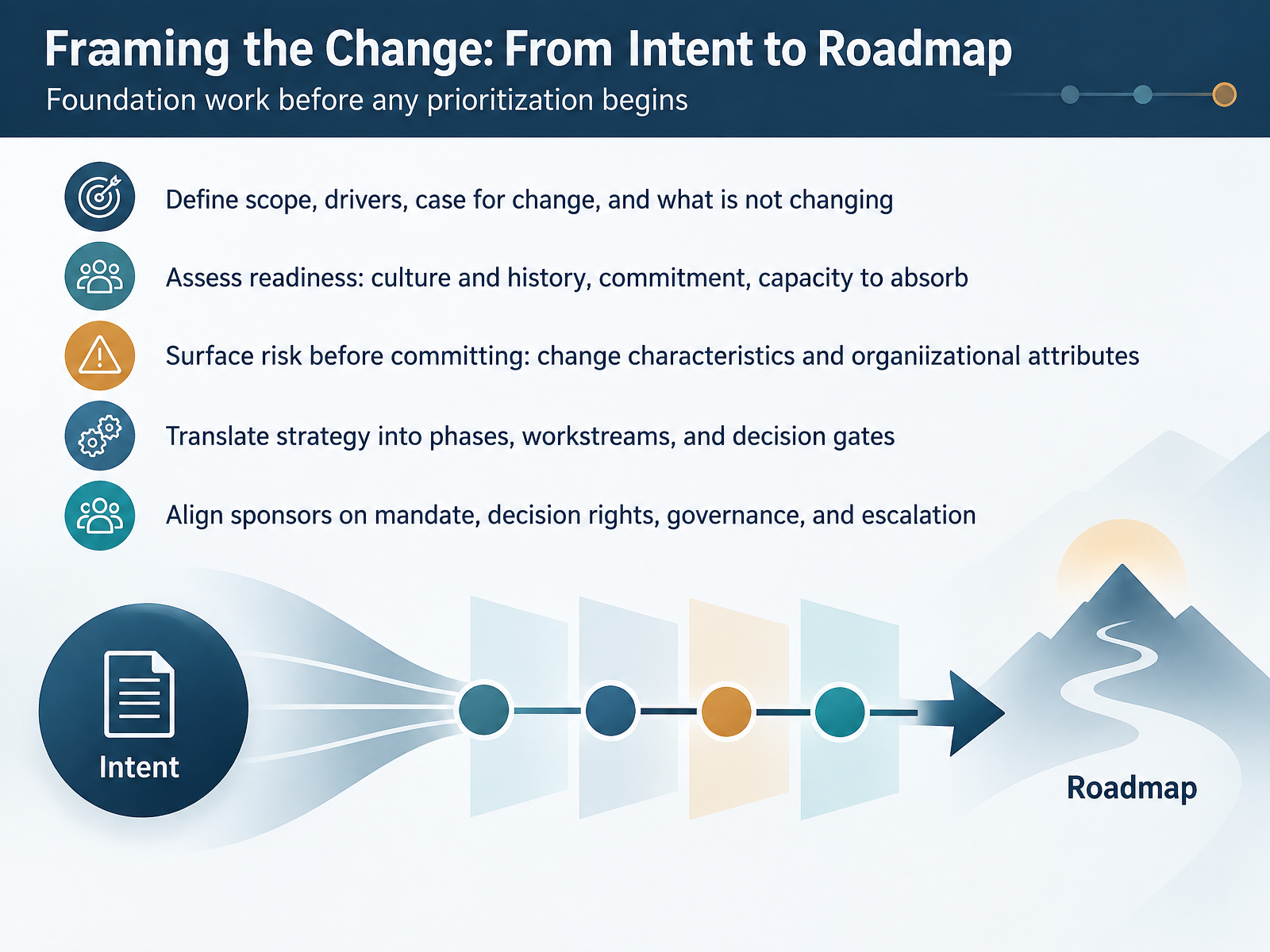
- 02Framing the Change: From Intent to RoadmapLet's start with the foundation. Before you prioritize anything, you need to frame the change. That means five moves, in order.
First, define scope, drivers, and the case for change, including what is not changing. Being explicit about what stays the same reduces anxiety and prevents rumor.
Second, assess readiness. Look at culture and history, sponsor commitment, and the organization's real capacity to absorb this on top of everything else.
Third, surface risk before you commit. Weigh the change characteristics, scope, depth, number of people affected, against organizational attributes like past change experience and current workload.
Fourth, translate strategy into phases, workstreams, and decision gates, so progress is visible and trade-offs get made on schedule, not by default.
Fifth, align sponsors on mandate, decision rights, governance, and escalation. If leaders cannot resolve disagreements fast, delivery stalls.
Get these five right, and prioritization becomes a decision. Skip them, and you are sequencing guesswork.
Next, let's look at distinguishing change, project, and programme management.
 trupeer.ainmsconsulting.comteamspective.com+22 min
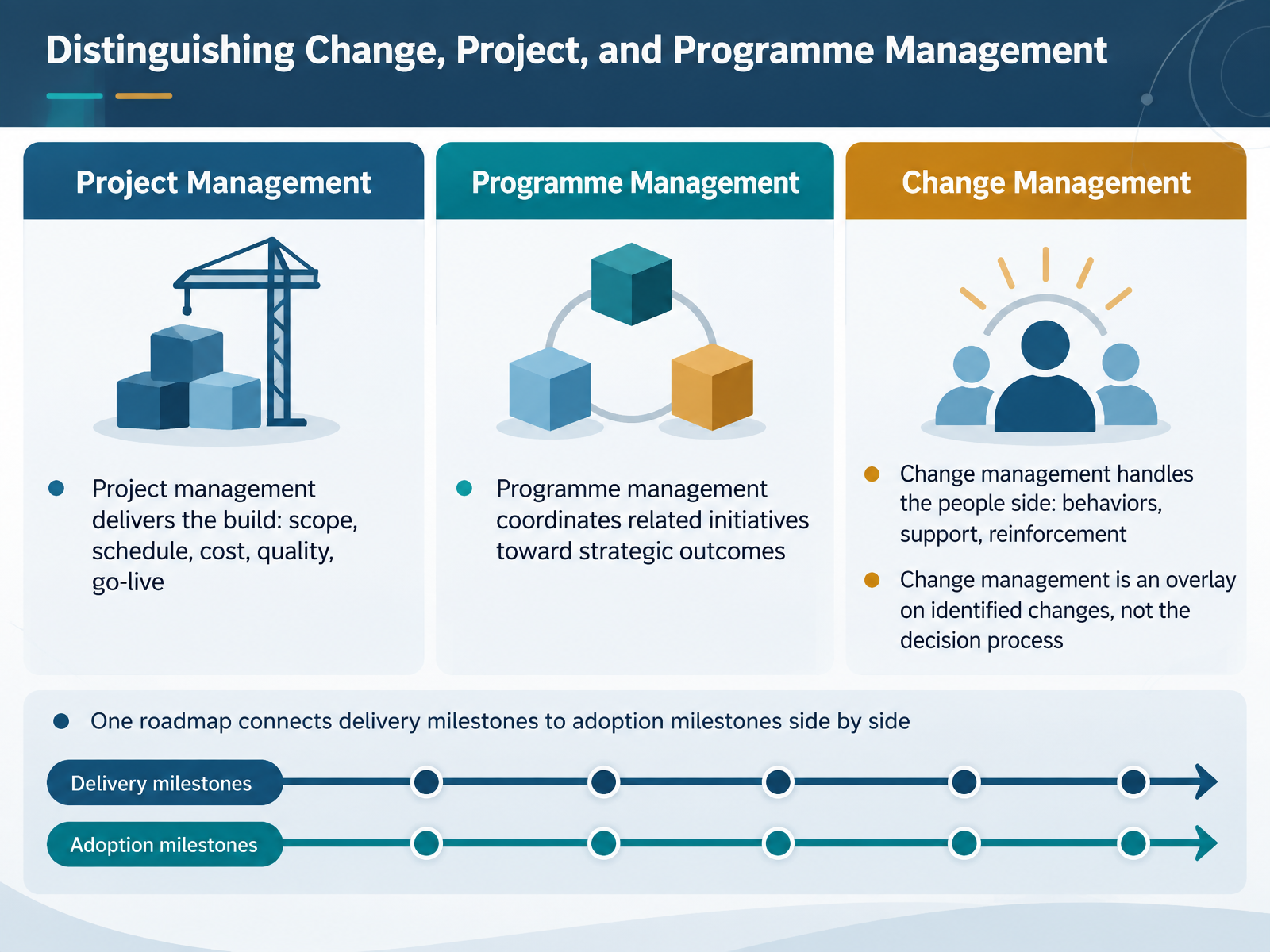
 - 03Distinguishing Change, Project, and Programme ManagementLet's draw a clear line between three disciplines that often get blurred on a roadmap. Project management delivers the build. It owns scope, schedule, cost, quality, and go-live. Programme management sits above that, coordinating related initiatives toward strategic outcomes so the dependencies stay visible. Change management handles the people side: the behaviors, the support, and the reinforcement that make adoption stick. One important distinction. Change management is an overlay on changes that are already identified. It does not decide what changes. It equips people to adopt them. And here is the coordination point that matters most. One roadmap connects delivery milestones and adoption milestones side by side. So when go-live is green, you can see whether usage is green too. Project green, adoption amber is a signal to act, not to celebrate. Keep that single view, and the sponsor can make trade-offs before benefits slip.
 trupeer.ainmsconsulting.comteamspective.com+21 min
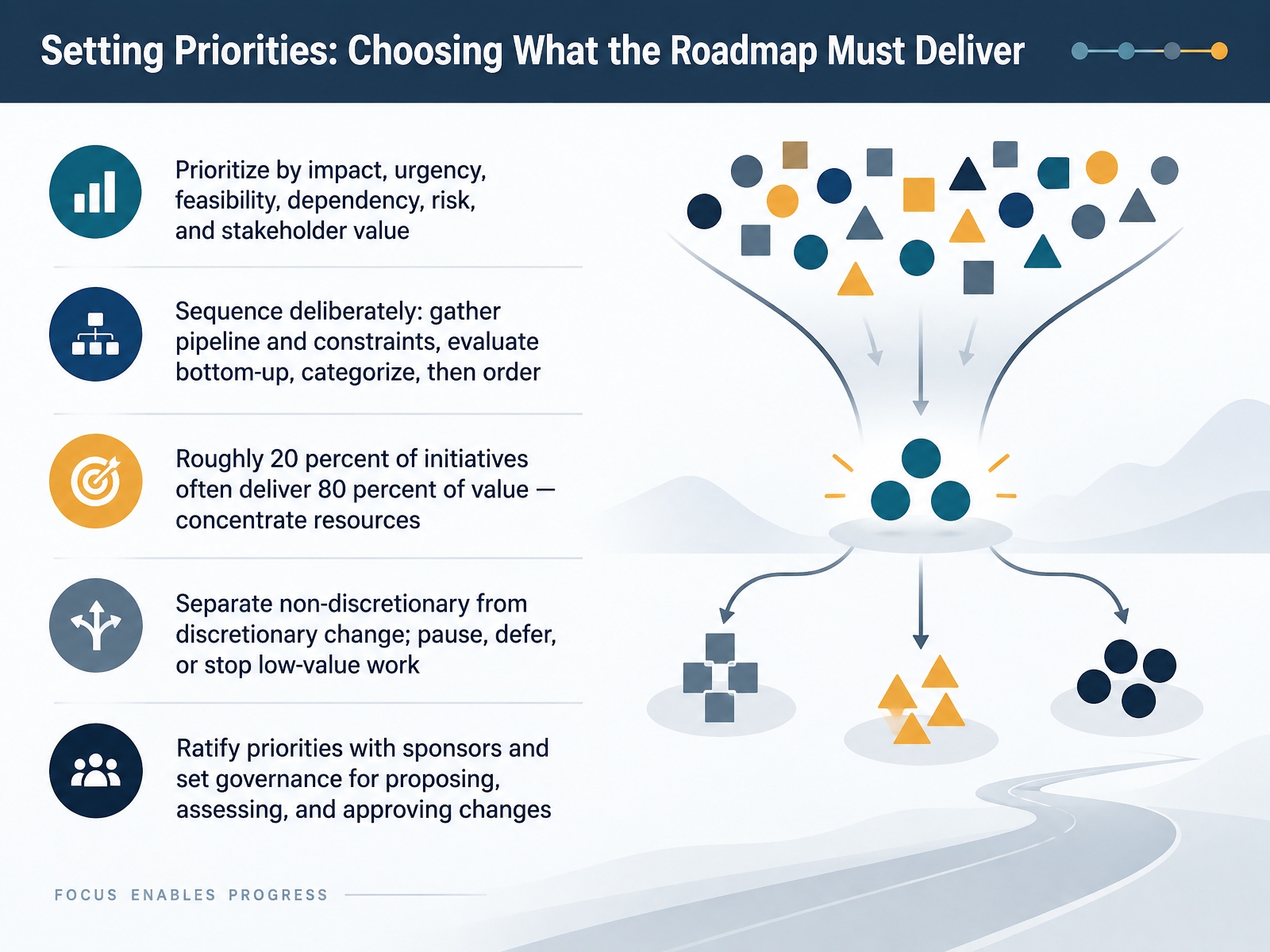
 - 04Setting Priorities: Choosing What the Roadmap Must DeliverLet's turn to setting priorities, choosing what the roadmap must deliver. Start by scoring every initiative against impact, urgency, feasibility, dependency, risk, and stakeholder value. Then sequence deliberately: gather the full pipeline and your real constraints, evaluate bottom up with the teams, categorize into strategic, no regret, and low value, and only then order the work. Keep the eighty twenty rule front of mind. Roughly twenty percent of initiatives often deliver eighty percent of the value, so concentrate resources there. Separate non discretionary change, the regulatory and competitive must dos, from discretionary work, and pause, defer, or stop anything low value. Finally, ratify priorities with your sponsors and lock in governance for proposing, assessing, and approving changes. That decision rights clarity is what keeps the roadmap honest when new ideas arrive. Next, we'll look at managing change saturation and portfolio capacity.
 prosci.combcg.com2652075.fs1.hubspotusercontent-na1.net+21 min
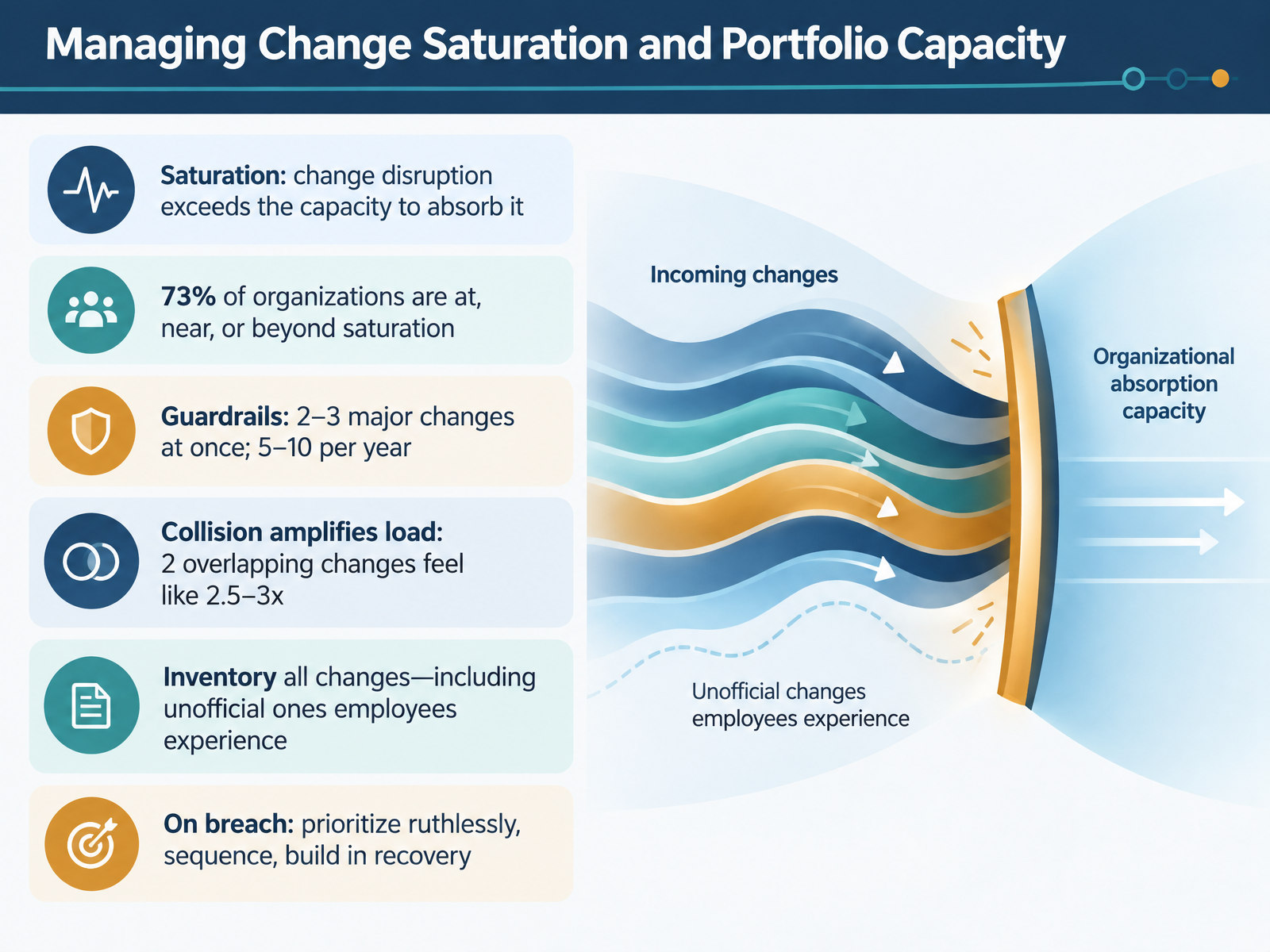
 - 05Managing Change Saturation and Portfolio CapacityNow let's talk about saturation and portfolio capacity. Saturation happens when change disruption exceeds your organization's capacity to absorb it, and the data is sobering. Seventy-three percent of organizations report being at, near, or beyond saturation. So set guardrails: no more than two to three major changes running at once, and five to ten across the year. Why so strict? Because collision amplifies load. Two overlapping changes don't feel like double the demand, they feel more like two and a half to three times, as context switching compounds the strain. Your first move is inventory. List every change hitting a given group, including the unofficial ones employees actually experience, like restructures or leadership shifts that never made the portfolio. If you breach the guardrails, act deliberately: prioritize ruthlessly, sequence the rest, and build in recovery time between waves. Treat capacity as finite, and protect it like a budget. Next, we turn to designing milestones that prove progress.
 prosci.combcg.com2652075.fs1.hubspotusercontent-na1.net+22 min
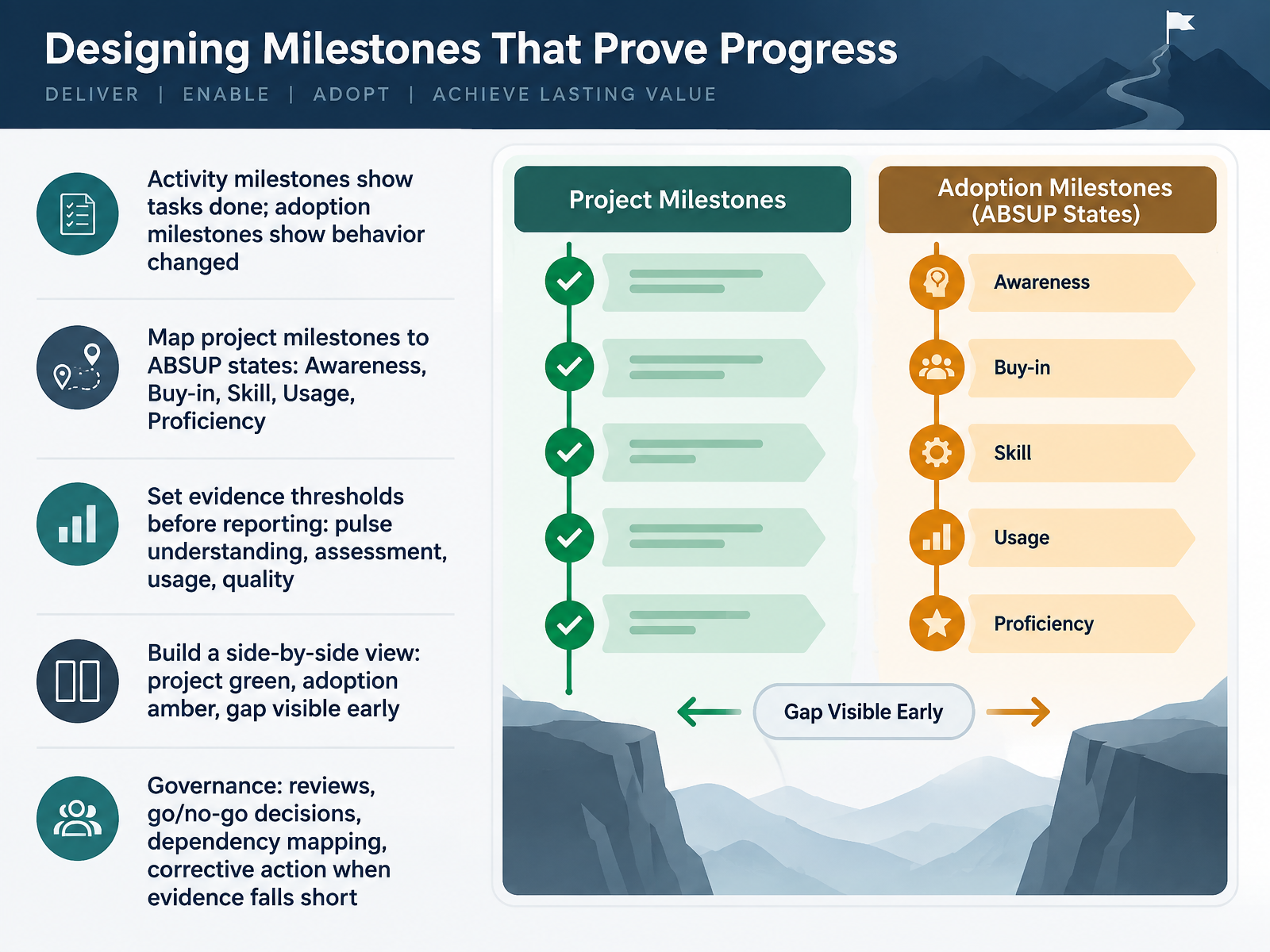
 - 06Designing Milestones That Prove ProgressNow let's talk about designing milestones that actually prove progress. Here's the distinction that matters. Activity milestones show tasks done. Adoption milestones show behavior changed. A system can be built and training complete, while people still work the old way. So map your project milestones to the ABSUP states: Awareness, Buy-in, Skill, Usage, and Proficiency. For example, before go-live you may need Usage readiness. At hypercare exit, you need Proficiency. Next, set evidence thresholds before you start reporting. Pulse understanding for Awareness, assessment for Skill, system data for Usage, and quality or rework for Proficiency. Then build a side-by-side view. Project green, adoption amber, and the gap visible early enough to act on. Governance ties it together. Regular reviews, go and no-go decisions, dependency mapping, and corrective action when the evidence falls short. The takeaway: adoption milestones turn measurement into steering, not just scorekeeping. Let's move on to leading and lagging indicators for adoption.
 adopt-it.ainmsconsulting.comadopt-it.ai+22 min
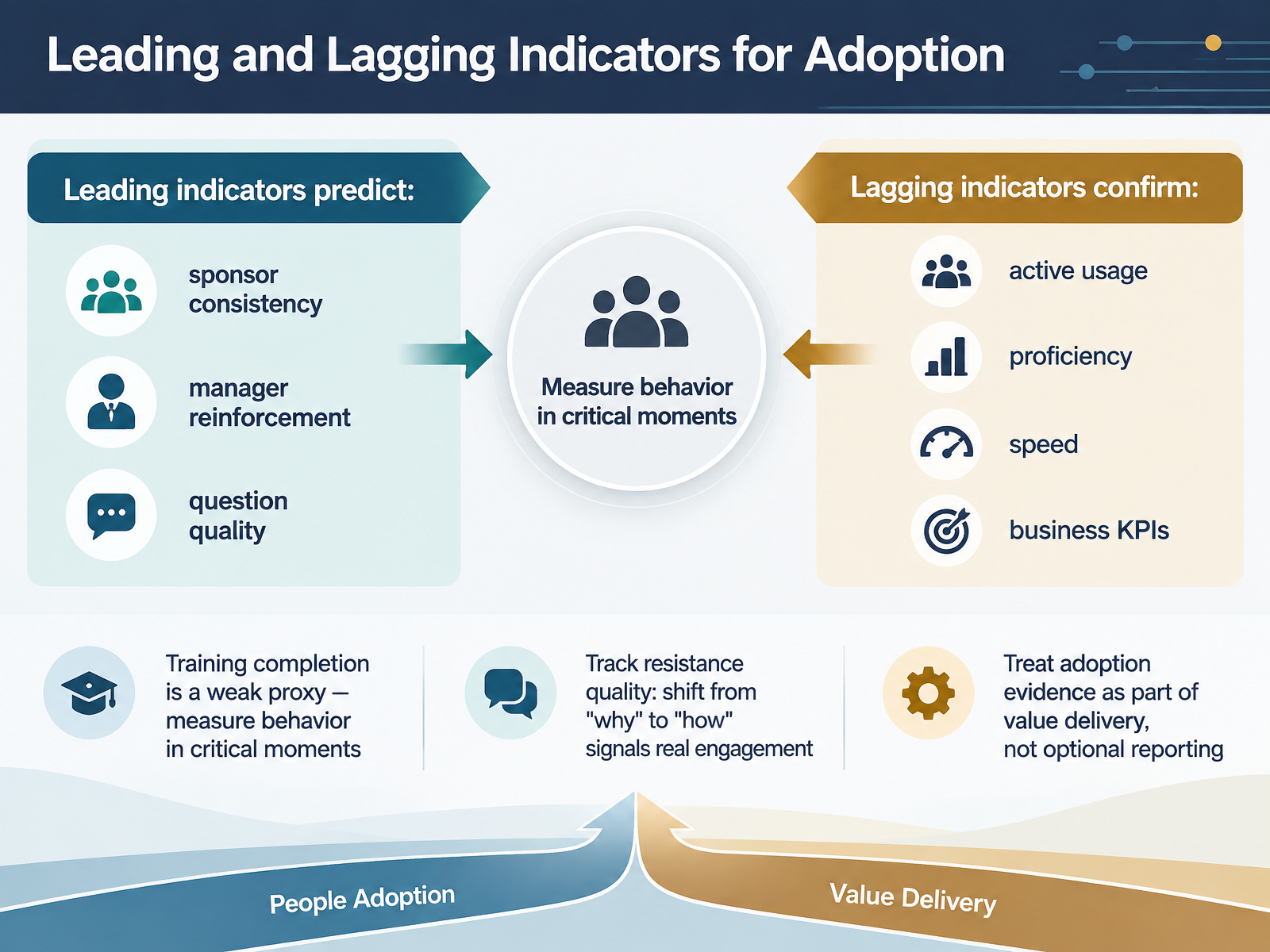
 - 07Leading and Lagging Indicators for AdoptionLet's move on to leading and lagging indicators for adoption. Leading indicators predict whether adoption will hold. Watch three things: sponsor consistency, manager reinforcement, and question quality. When managers ask how questions, adoption is taking root. When they ask whether questions, resistance is still active. Lagging indicators confirm what already happened. Active usage, proficiency, speed to proficiency, and the business KPIs tied to value. Now, avoid one common trap. Training completion is a weak proxy for adoption. Measure behavior in the critical moments, not attendance. Track resistance quality over time. The shift from why are we doing this to how do we handle this signals real engagement. Finally, treat evidence as part of value delivery, not optional reporting. Put project milestones and adoption evidence side by side. If project status is green but adoption is amber, that gap is your next decision. Assign an owner, pick a targeted action, and review it at the next cadence. Let's turn to the communication plan that carries this work forward: Communication Strategy: Audiences, Messages, and Channels.
 adopt-it.ainmsconsulting.comadopt-it.ai+22 min
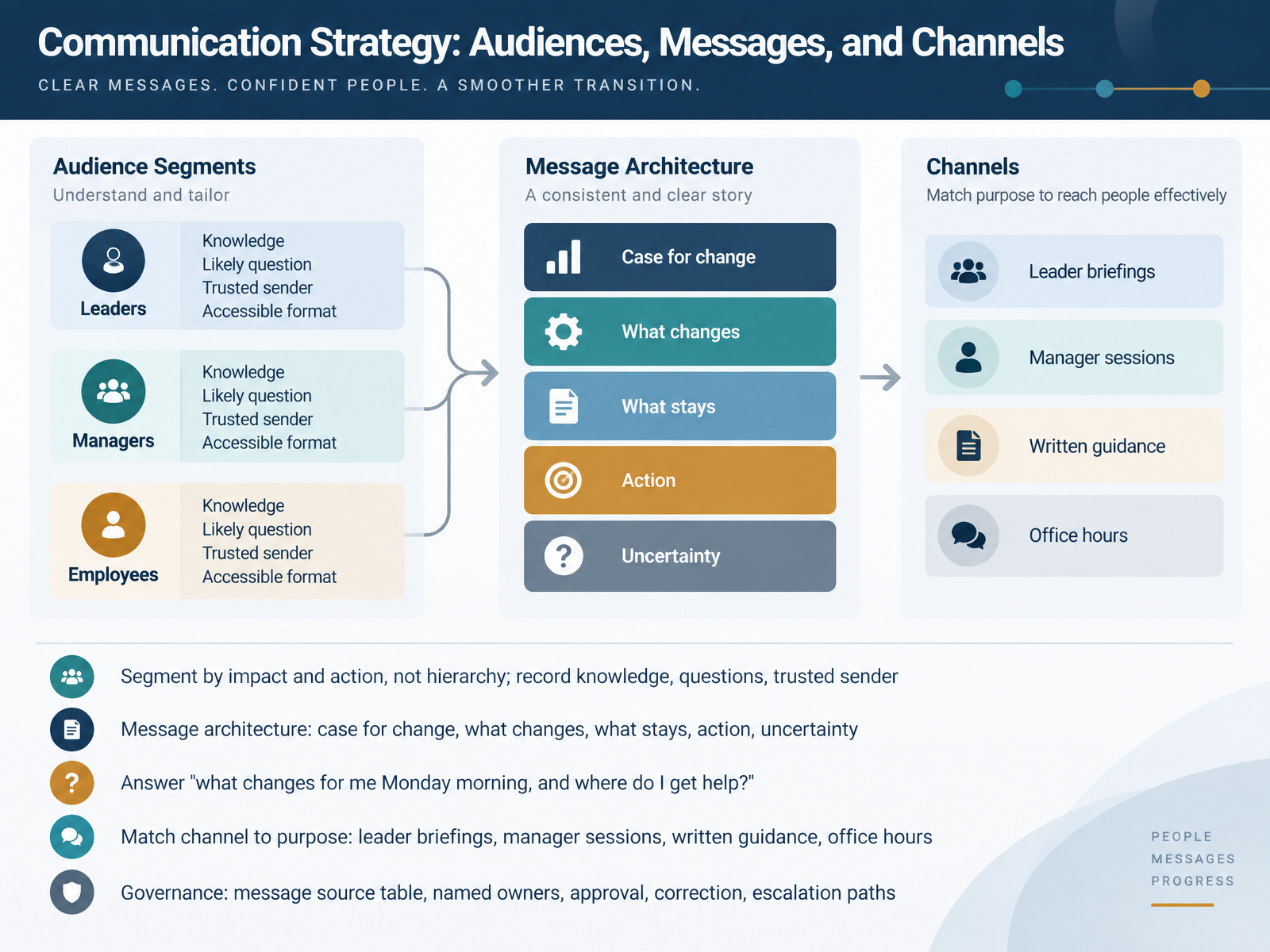
 - 08Communication Strategy: Audiences, Messages, and ChannelsNow let's build the communication strategy itself. Segment your audiences by impact and action, not by hierarchy. For each group, record what they already know, their likely questions, the action you need from them, and the trusted sender they'll actually listen to. Then, build a message architecture you apply consistently. Cover five things. The case for change. What is changing. What stays the same. The specific action required. And what is still uncertain, with a date for the next update. Answer the question every single person is asking. What changes for me on Monday morning, and where do I get help? Match channel to purpose. Leader briefings for context. Manager sessions to prepare local conversations. Written guidance to preserve instructions. Office hours to surface questions. Finally, lock down governance. Maintain a message source table, link every material claim to an approved decision, and name one owner for each message and each delivery event. Define how corrections and escalations move, and who has authority to pause distribution. Do that, and communication becomes a reliable system rather than noise. That sets up the next step, the manager cascade and enablement.
 learning.sap.comk-state.eduragan.com+22 min
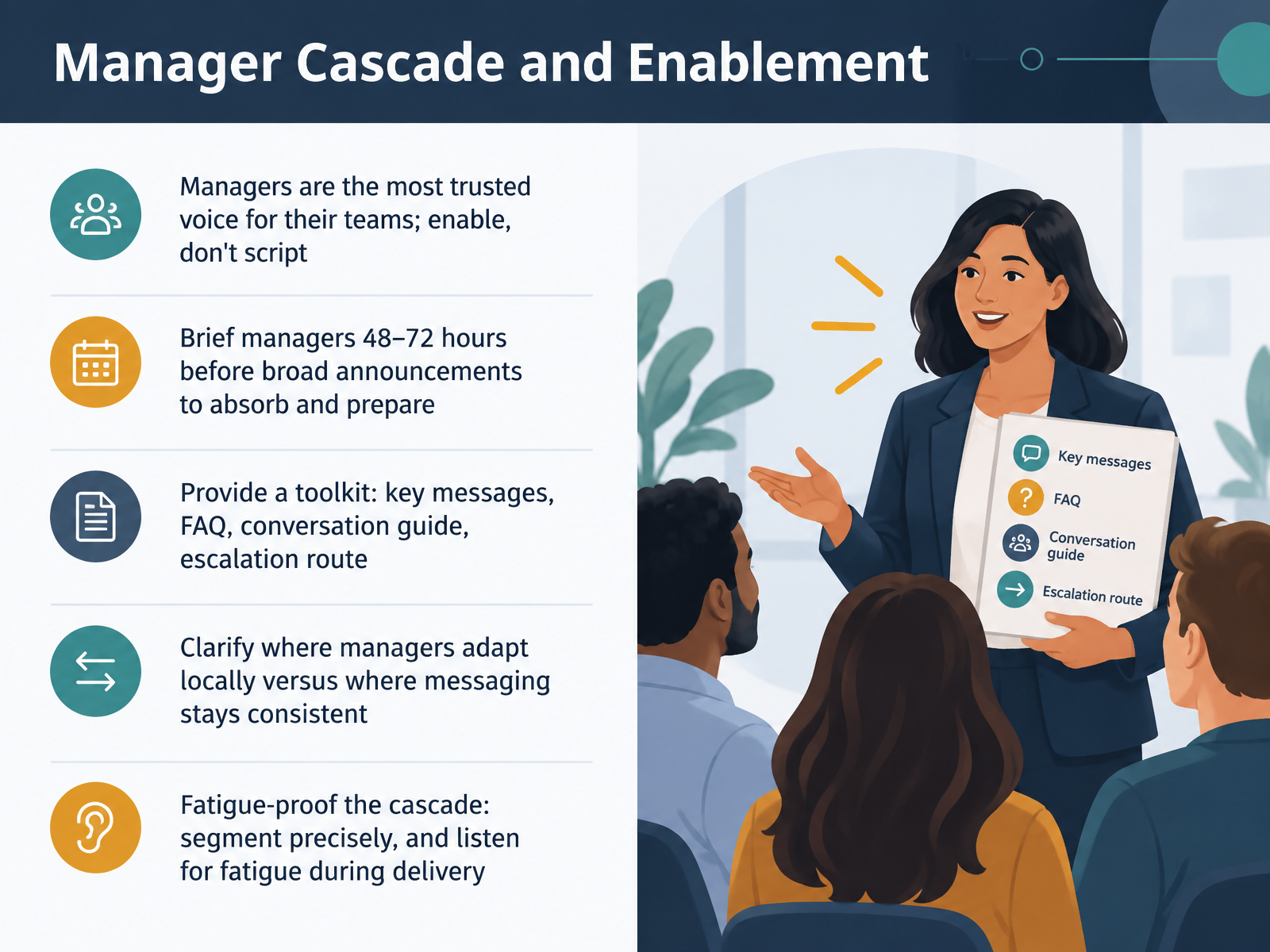
 - 09Manager Cascade and EnablementNow let's look at the manager cascade and enablement. Managers are the most trusted voice for their teams, so enable them, don't script them. Treat them as communicators, not delivery channels.
Brief managers forty-eight to seventy-two hours before any broad announcement. That gives them time to absorb the news, ask questions, and work through their own reaction before they face their teams. Then hand them a toolkit: key messages, an FAQ, a conversation guide, and a clear escalation route for questions they can't answer.
Be explicit about where managers can adapt locally and where messaging stays consistent. Team context differs. The headline should not.
Finally, fatigue-proof the cascade. Segment precisely, so people only receive what affects them, and listen for fatigue during delivery, not after. If managers keep getting noise, their teams will stop trusting the signal. Prepare managers well, and the message lands.
 learning.sap.comk-state.eduragan.com+22 min
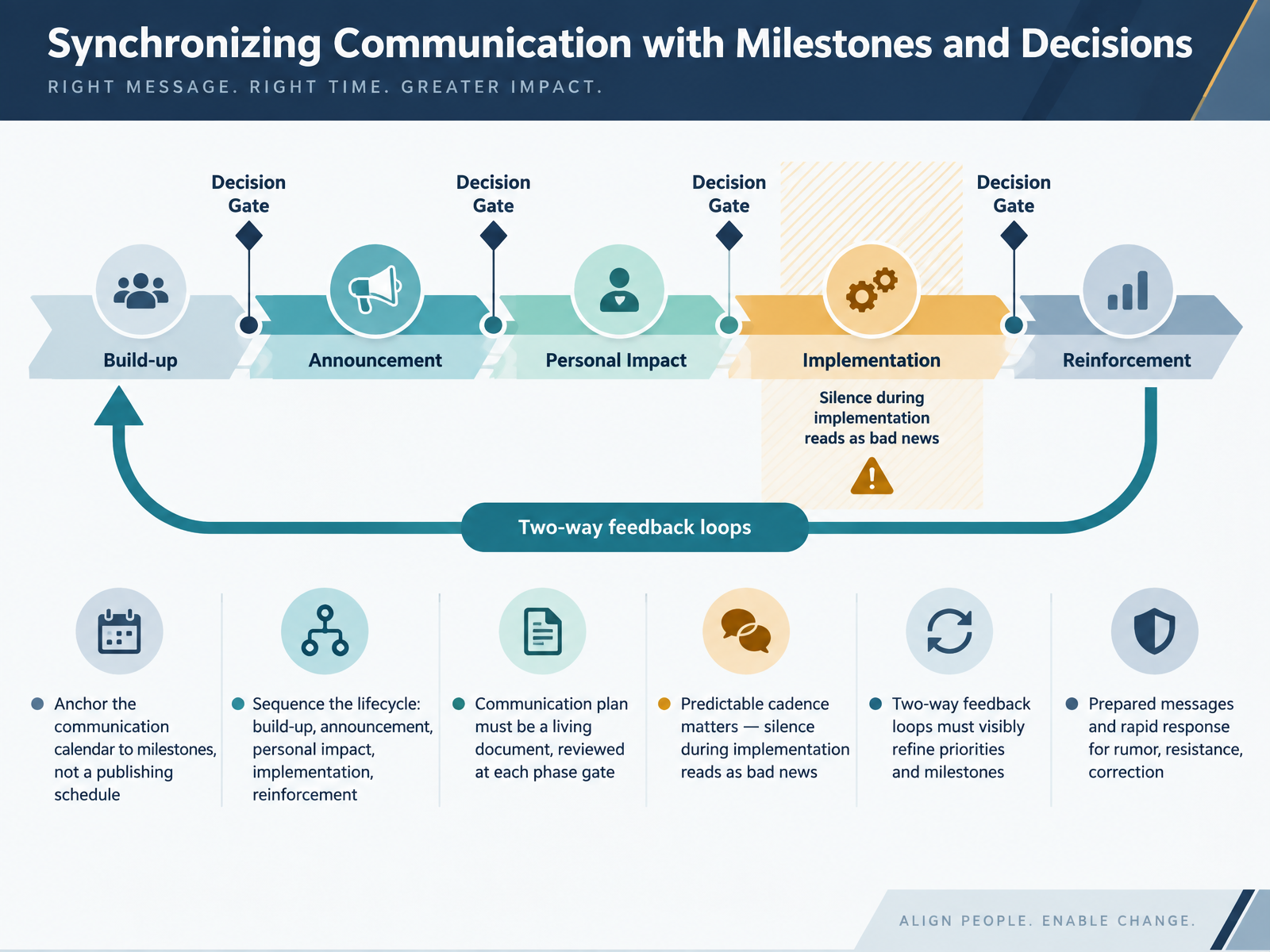
 - 10Synchronizing Communication with Milestones and DecisionsLet's talk about synchronizing communication with your milestones and decisions. The first principle: anchor the communication calendar to milestones, not a publishing schedule. Nobody needs a newsletter on the fifteenth of every month. They need to hear from you before a decision lands, not after.
Sequence the lifecycle deliberately: build-up, announcement, personal impact, implementation, reinforcement. In the build-up, you're preparing sponsors and managers. At announcement, you go wide and consistent. Personal impact is where you answer what changes for me. Implementation is where communication most often goes quiet, and silence there reads as bad news.
So treat the communication plan as a living document. Review it at every phase gate, because your stakeholder list, channels, and cadence will shift.
Two more things. First, predictable cadence matters more than volume. Second, two-way feedback loops must visibly refine priorities and milestones, or people stop bothering. And keep prepared messages and rapid response ready for rumor, resistance, and correction.
Next, we look at Roadmap Artifacts, Tooling, and Governance Rhythm.
 learning.sap.comk-state.eduragan.com+22 min
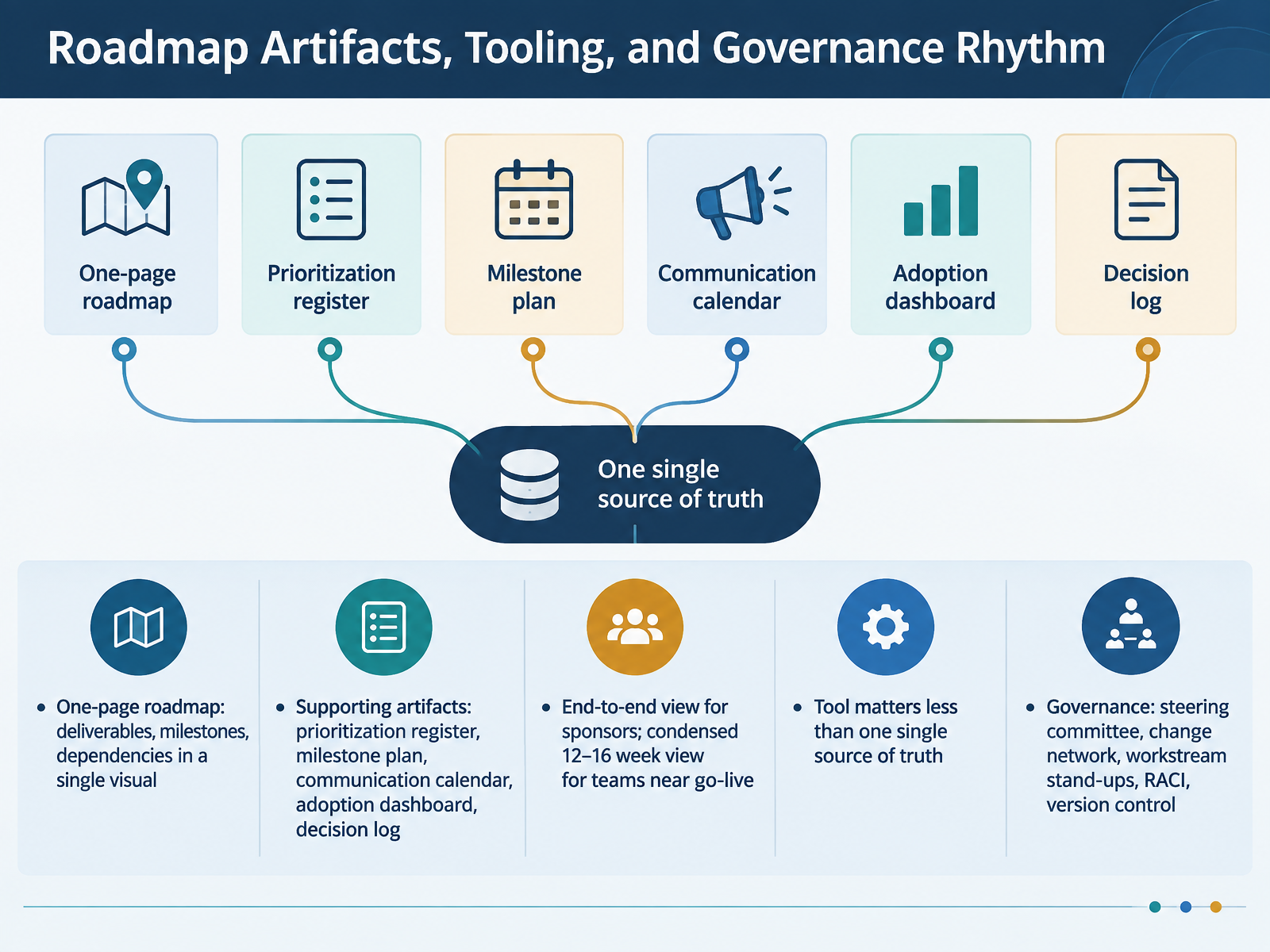
 - 11Roadmap Artifacts, Tooling, and Governance RhythmNow let's lock down the artifacts and governance rhythm that keep your roadmap trustworthy. Start with one page. Your one-page roadmap shows deliverables, milestones, and dependencies in a single visual. That page is the anchor for sponsors. Around it, five supporting artifacts do the heavy lifting: a prioritization register, a milestone plan, a communication calendar, an adoption dashboard, and a decision log. Then match the view to the audience. Sponsors get the end-to-end view. Teams near go-live get the condensed twelve to sixteen week view, so they see exactly what lands before launch. On tooling, be pragmatic. The tool matters less than having one single source of truth. Pick a platform and commit. Finally, set your governance rhythm: a steering committee, a change network, workstream stand-ups, a clear RACI, and disciplined version control. One roadmap, one truth, one cadence. Next, we move into execution rhythm: tracking, reporting, and course correction.
 trupeer.ainmsconsulting.comteamspective.com+22 min
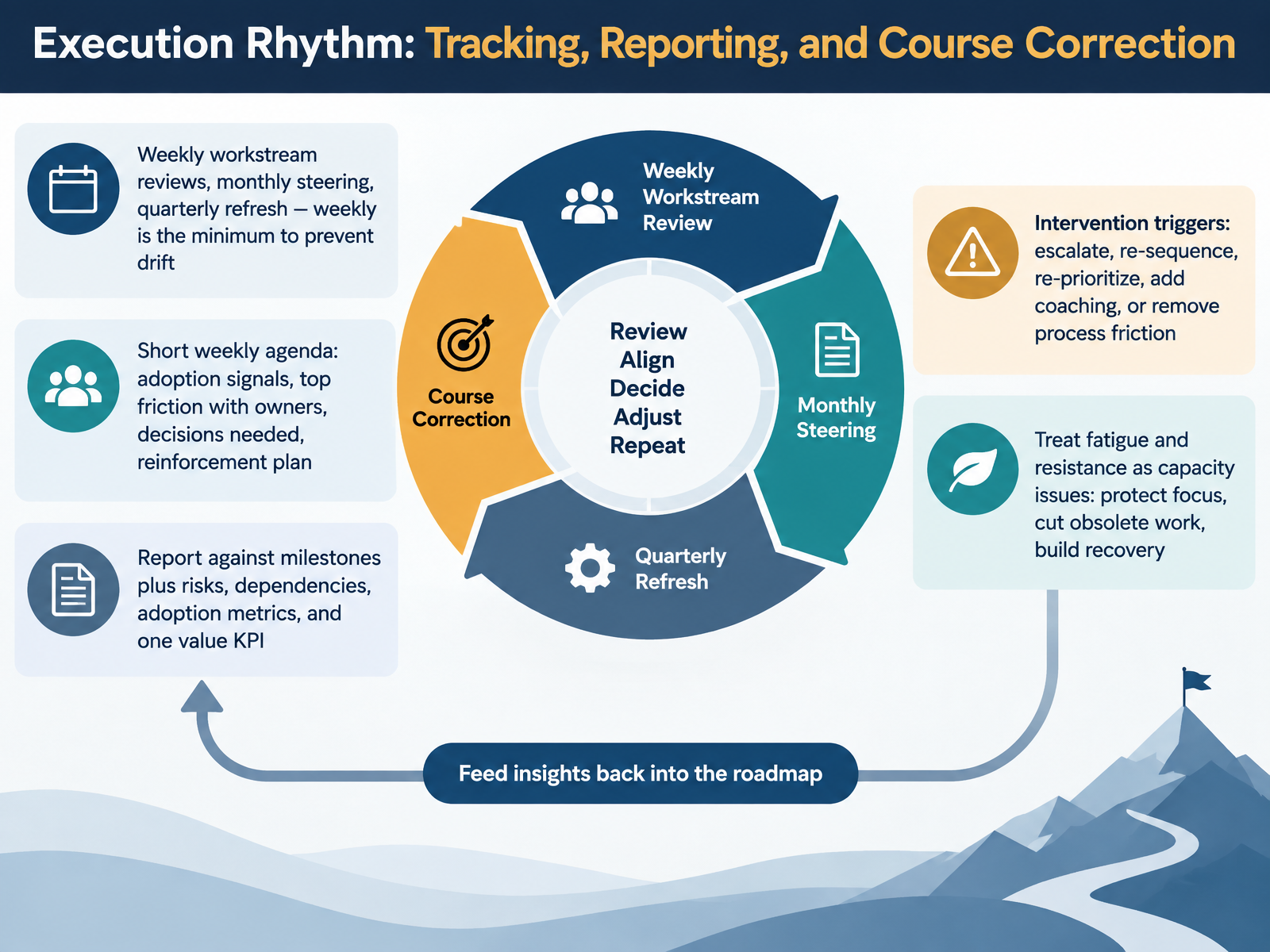
 - 12Execution Rhythm: Tracking, Reporting, and Course CorrectionLet's talk about execution rhythm. This is where a roadmap becomes a running system. Weekly workstream reviews, monthly steering, and a quarterly refresh. Weekly is the minimum cadence that prevents drift. Keep that weekly agenda short. Adoption signals. Top friction, each item with a named owner. Decisions needed. And the reinforcement plan for the coming week. Report against milestones, not just activity, alongside risks, dependencies, adoption metrics, and one value KPI. Define your intervention triggers in advance: escalate, re-sequence, re-prioritize, add coaching, or remove process friction. When a trigger fires, act on it. Next, treat fatigue and resistance as capacity issues, not attitude problems. Protect focus, cut obsolete work, and build in recovery between waves. The test is simple: does each review end with owners, decisions, and dates? That's the rhythm that keeps change moving. Next, we look at sustaining change: reinforcement, handover, and benefit realization.
 learning.sap.comk-state.eduragan.com+21 min
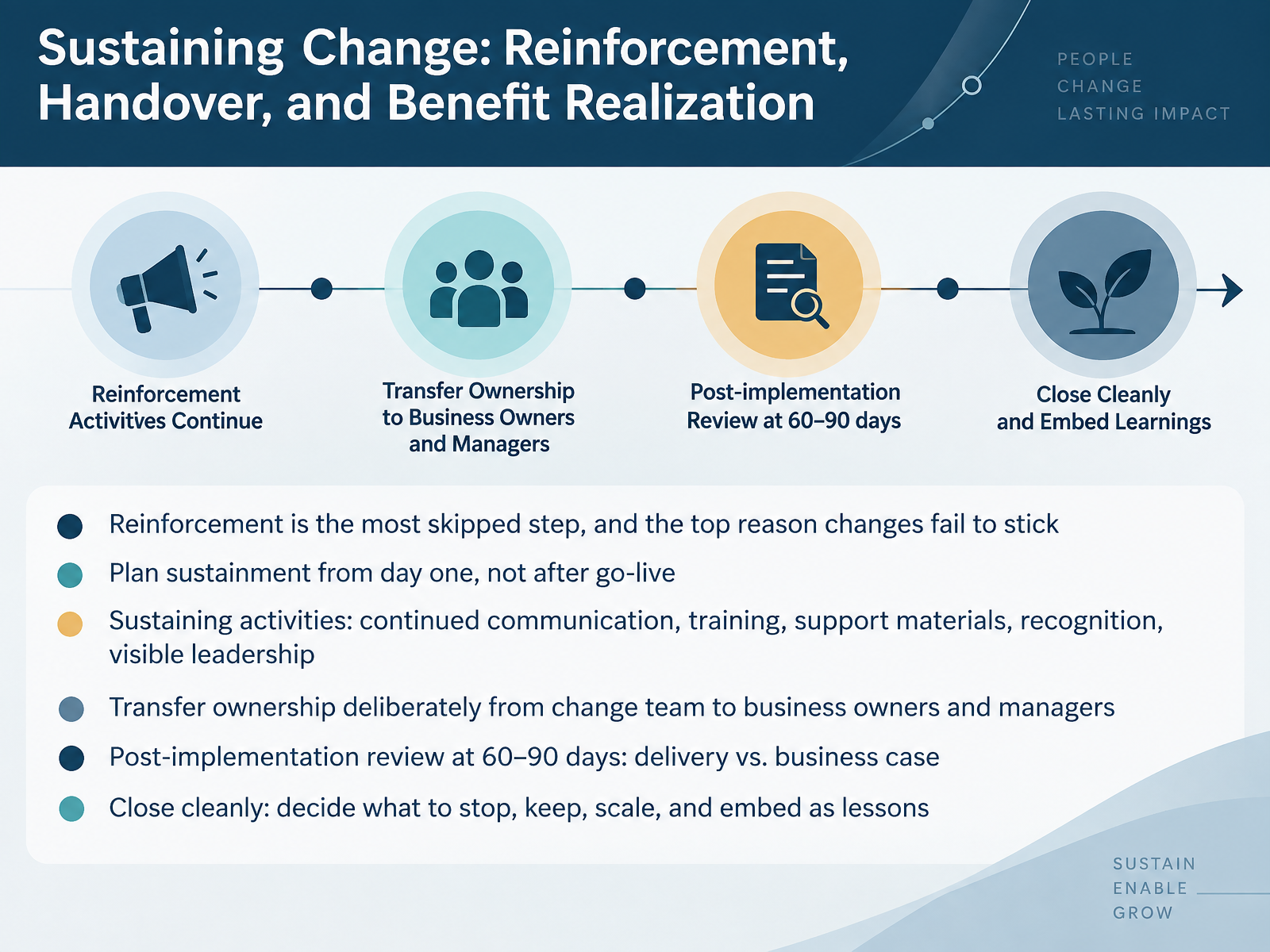
 - 13Sustaining Change: Reinforcement, Handover, and Benefit RealizationNow let's talk about sustaining change, because this is where value either compounds or quietly erodes. Reinforcement is the most skipped step in change, and the top reason changes fail to stick. So plan sustainment from day one, not after go-live. Build it into your programme plan and your budget, with named owners and a cadence. Sustaining activities are practical: continued communication, ongoing training, support materials, recognition, and visible leadership. Next, transfer ownership deliberately. Move from the change team to business owners and managers, and confirm they accept the accountability. Then hold a post-implementation review at sixty to ninety days, comparing delivery against the business case. Finally, close cleanly: decide what to stop, what to keep, what to scale, and what to embed as lessons. The takeaway is simple. Sustainment is a planned milestone, not an afterthought. That leads us into common pitfalls, success factors, and your action plan.
 2 min
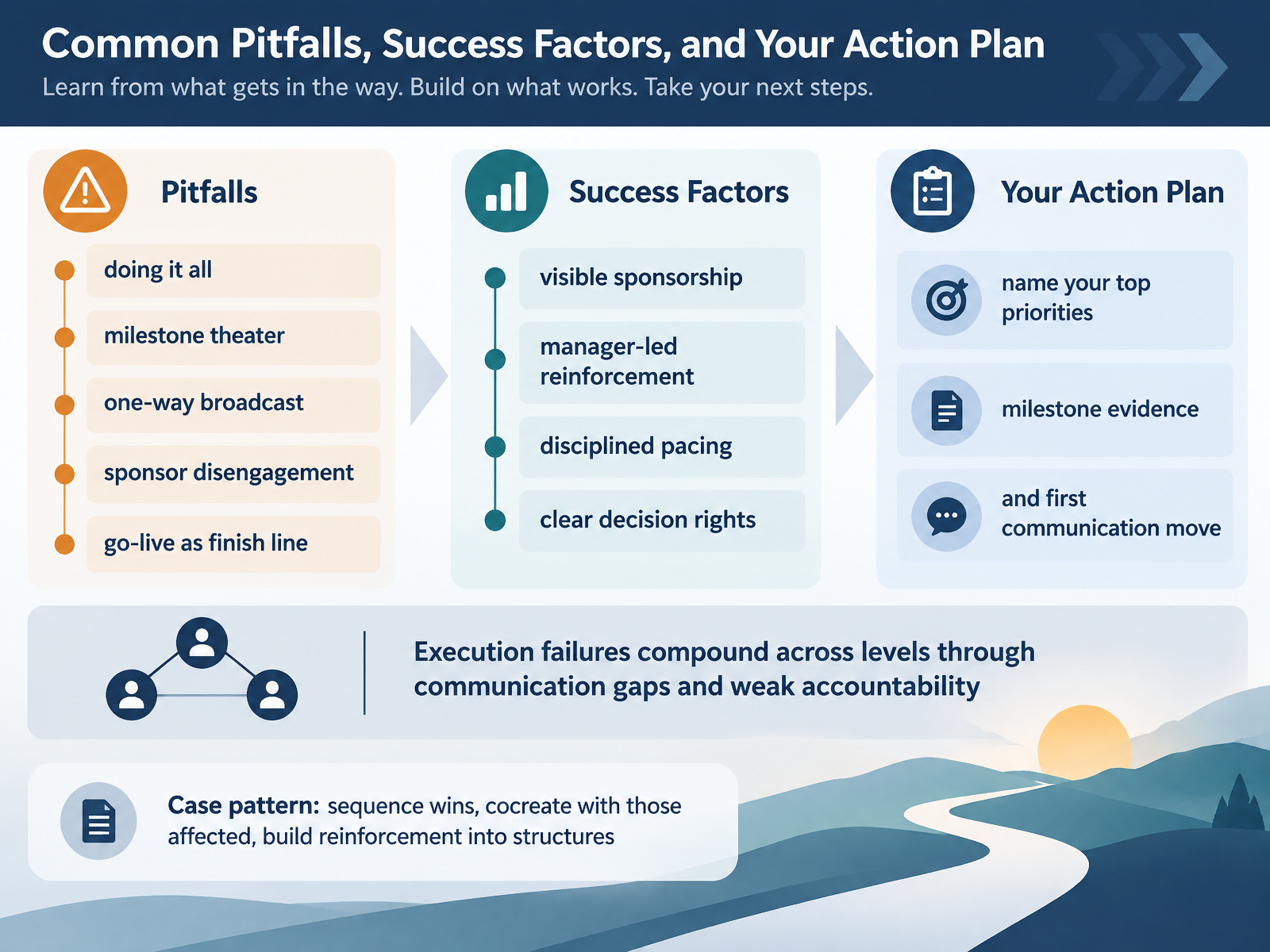
2 min - 14Common Pitfalls, Success Factors, and Your Action PlanAs we close out the roadmap, let's name the traps and the moves that separate programs that stick from programs that stall. Start with the pitfalls. Doing it all at once spreads your sponsors and your managers too thin. Milestone theater hits dates without evidence that behavior actually changed. One-way broadcast tells people what is happening but never listens. Sponsor disengagement, and treating go-live as the finish line, both kill momentum right when reinforcement matters most. Here is the trap underneath all five: execution failures compound. A communication gap at the top becomes a weak accountability loop at the middle, and quiet disengagement at the front line. The success factors are just as concrete. Visible sponsorship. Manager-led reinforcement. Disciplined pacing. Clear decision rights. The case pattern is consistent: sequence wins, cocreate with the people affected, and build reinforcement into your structures, not your intentions. So for your action plan, name three things now. Your top priorities, the milestone evidence that proves progress, and your first communication move, with an owner and a date. Thank you for working through this roadmap with me. You now have the sequence, the cadence, and the language. Go make the next decision, brief your sponsor, and put your first milestone on the calendar this week. You are ready.
 2 min
2 min
Take the deck with you
Download this course as a file — free, no sign-up needed.
- PDF handoutEvery slide page, ready to print or share.15 pages · 3.2 MBDownload
- Narrated PowerPointThe deck that presents itself — every slide carries the digital human's narration video.15 pages · 26.5 MBDownload
- PowerPoint slidesThe full deck as a .pptx — open it in PowerPoint, Keynote, or Google Slides.15 pages · 3.1 MBDownload
Free to use in your own training — please keep the PersonWise credit page at the end.
Have your own deck? Turn it into a course
Sources consulted
Web sources consulted while building this course.
- The Change Management Process: A Step-by-Step Guide for 2026 — trupeer.ai
- Change Management Execution Playbook 2026 Steps Tools and Metrics — nmsconsulting.com
- Change Management Plan Template: Modern Network-Based Approach for 2026 | Teamspective — teamspective.com
- Plan Your Change Journey With Our Change Management Roadmap Template – Techno PM - Project Management Templates Download — techno-pm.com
- Change Management Best Practices: How To Lead Organizations Through Technology Transitions in 2026 – Enterprisehub — enterprisehub.org
- Strategies To Recognize and Deal With Change Saturation — prosci.com
- The Power of Priorities in a Transformation | BCG — bcg.com
- Change Portfolio — 2652075.fs1.hubspotusercontent-na1.net
- 6 Strategies for Reducing Change Saturation - Prosci — prosci.com
- Change Saturation and Pacing | COMPEL Framework — compelframework.org
- Compare ABSUP Milestones with Project Milestones to Track Real Adoption Progress | Adopt It Help Center — adopt-it.ai
- Change Management Metrics (2026): Adoption Scorecards and Indicators — nmsconsulting.com
- Measure Adoption Progress for Impacted Groups During Change | Adopt It Help Center — adopt-it.ai
- PMP 2026 Adoption and Transition Indicators | PM Exams — pmexams.com
- Leading vs. Lagging Indicators: How to Measure Digital Transformation with Better OKRs | Xodiac — xodiac.ca
- Planning Communication — learning.sap.com
- Change Communications Resource Guide — k-state.edu
- A practical guide to fatigue-proof internal comms cascades - Ragan Communications — ragan.com
- How to use a communication cascade (+ a free template!) — useworkshop.com
- Change Communication Plan Template: Audiences, Messages, Channels and Owners — kiolo.com