Begin
13 pages · ~26 min
Impressionism: Painting Light and Modern Life
This training explores how Impressionist artists captured light and modern life, designed for learners interested in art history and visual analysis.
A digital instructor presents all 13 pages. Hold “Ask” at any point and ask out loud — the answer comes from this course. No sign-up needed.
What you’ll learn
- 01Impressionism: How Artists Painted Light and Modern LifeWelcome. I'm glad you're here. Today we're looking at Impressionism, and I'd like you to think of it as a set of deliberate experiments, not finished sketches. In the eighteen seventies and eighteen eighties, a group of artists in France showed their work outside the official Salon. They were chasing light, color, and modern life. Together, we'll build a small toolkit: close looking, side-by-side comparison, and a three-question routine. What light? What moment? What modern life? You'll try these on real paintings as we go. Impressionism still matters, because it changed what art records: everyday life, weather, speed, and perception itself. Our roadmap runs from the Salon and the famous exhibition of eighteen seventy-four, through technique and modern subjects, to key figures, the art market, guided looking, and the legacy. So relax, look closely, and ask questions as we go. Next, let's step back and meet the world these artists were pushing against: Before Impressionism, the Academy and the Salon.en.wikipedia.orgnga.govnga.gov+22 min
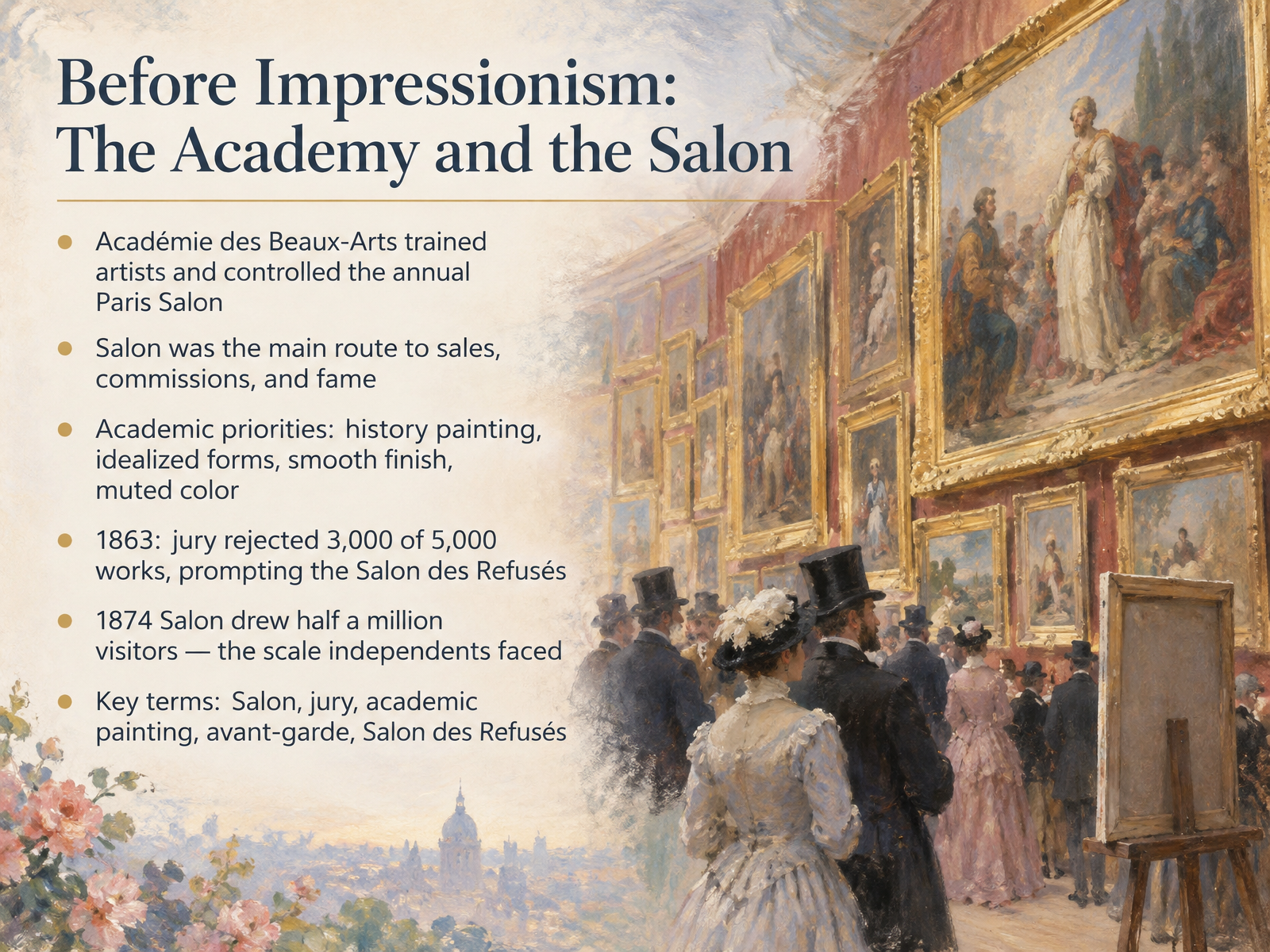
- 02Before Impressionism: The Academy and the SalonTo understand what the Impressionists were pushing against, let's step inside the art world they inherited. In Paris, the Académie des Beaux-Arts trained artists and controlled the annual Salon, the huge official exhibition. And the Salon was really the main route to sales, commissions, and fame. Now, the jury that ran it leaned toward history painting, idealized figures, smooth finish, and muted color. A handy term here is academic painting, meaning work made to those official rules. In eighteen sixty-three, the jury rejected three thousand of five thousand works, and the outcry led to the Salon des Refusés, a show of the refused. So just picture the scale they faced. The eighteen seventy-four Salon drew half a million visitors, while the independents, the avant-garde, were trying to be seen at all. Keep that contrast in mind as we turn to a movement taking shape. In eighteen seventy-four, a breakaway exhibition would change everything.
 archive.orghaissa.huma-num.frjournals.openedition.org+22 min
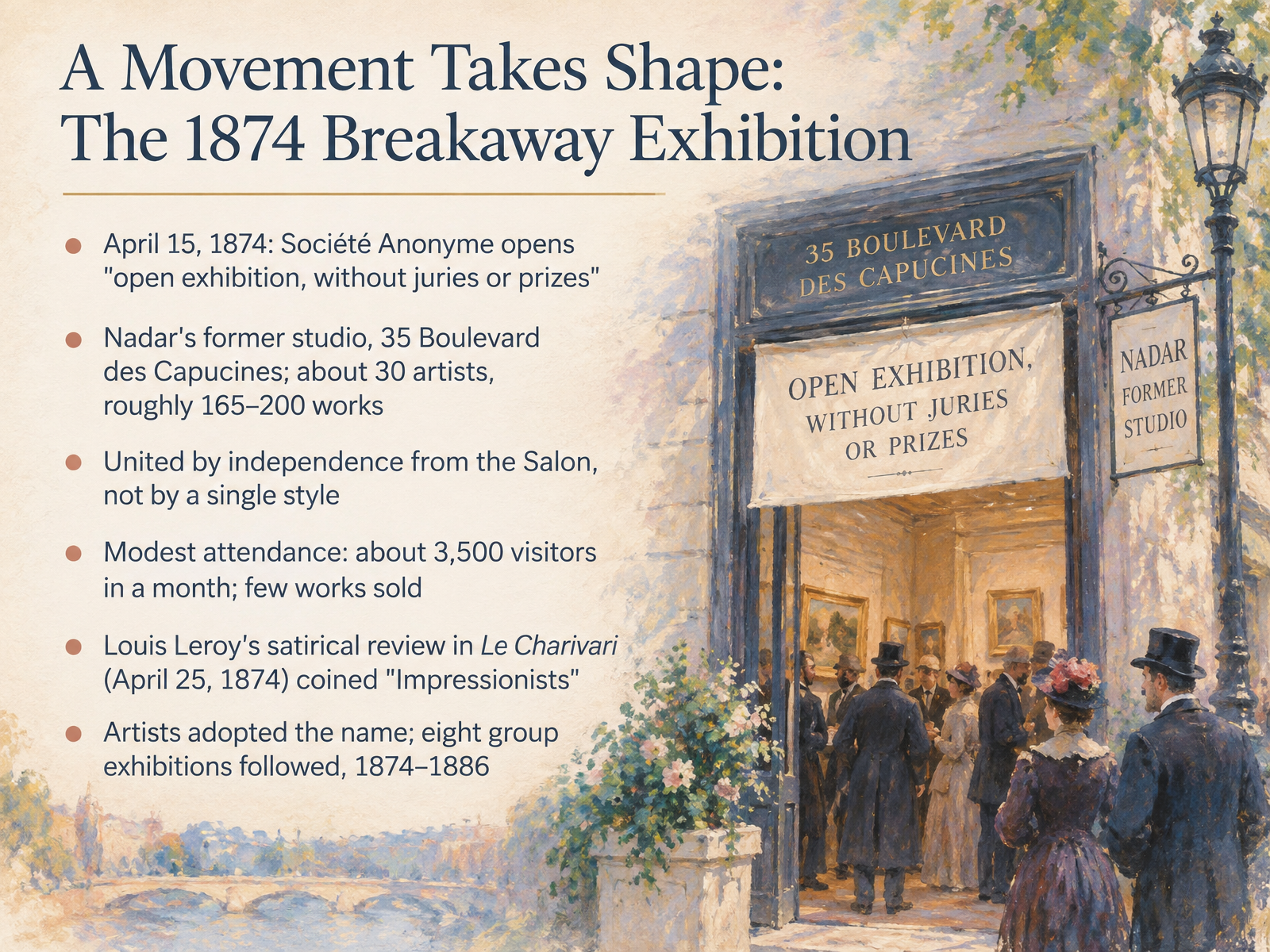
- 03A Movement Takes Shape: The 1874 Breakaway ExhibitionNow let's look at how the movement actually took shape. On April fifteenth, 1874, a group called the Société Anonyme opened what it described as an open exhibition, without juries or prizes. Picture the setting. A former photography studio, once run by Nadar, at thirty-five Boulevard des Capucines. Around thirty artists filled it with roughly one hundred sixty-five to two hundred works. Here's the key idea. They weren't united by one style. What held them together was independence from the official Salon. And at first, the public barely noticed. About three thousand five hundred visitors came in a month, and only a few works sold. Then, on April twenty-fifth, the critic Louis Leroy published a satirical review in Le Charivari. Mocking a Monet painting titled Impression, Sunrise, he called the group Impressionists. The artists adopted the name, and it stuck. Seven more exhibitions followed, through 1886. Next, we'll see exactly how these painters captured light.
 culture.gouv.fren.wikipedia.orgen.wikisource.org+22 min
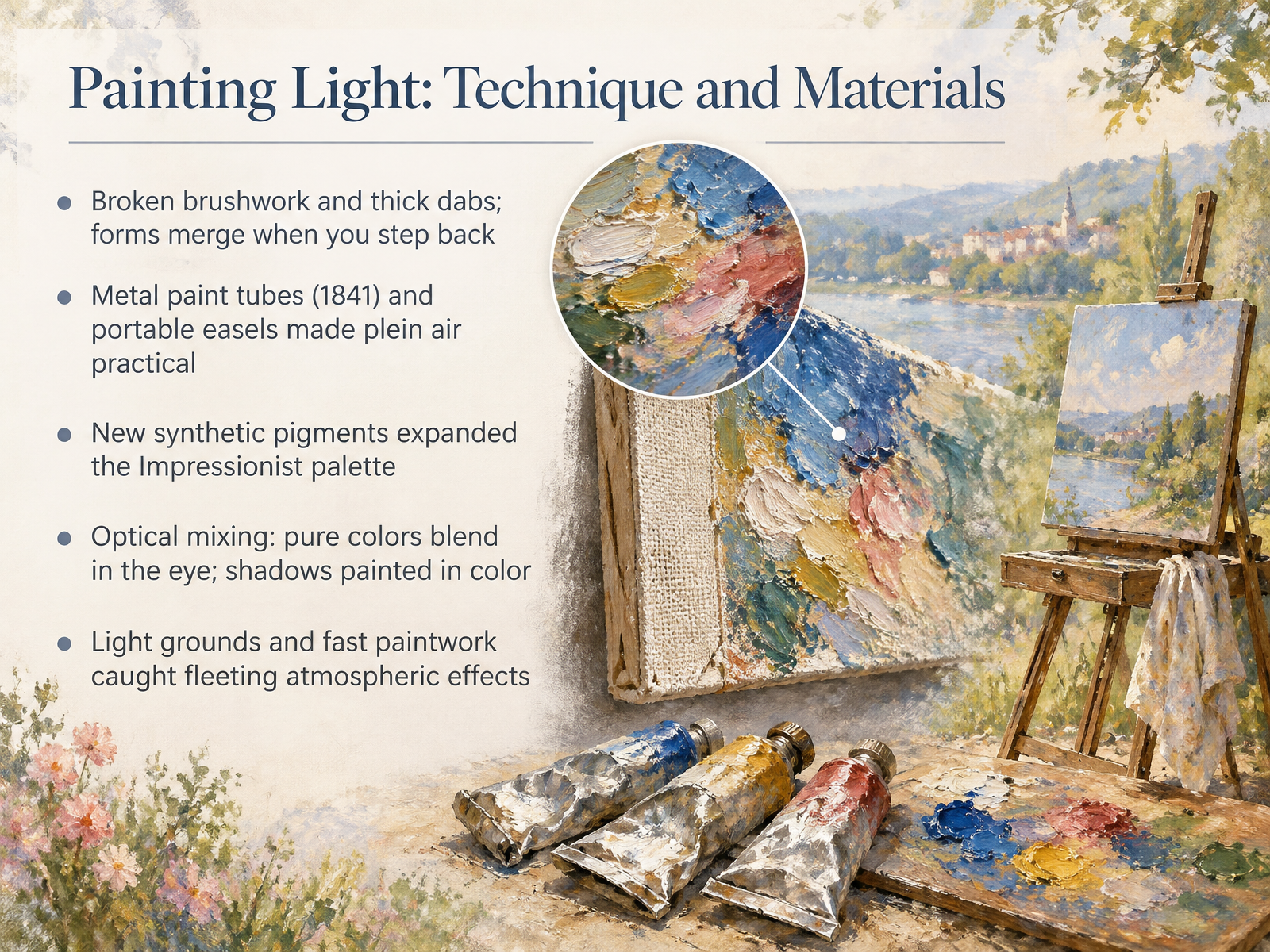
- 04Painting Light: Technique and MaterialsNow let's look at how these painters actually worked. Up close, an Impressionist canvas dissolves into thick dabs and broken strokes of paint. But step back, and those separate marks merge into trees, water, and people. Here's what helped make that possible. Metal paint tubes arrived in eighteen forty one, and with portable easels they made painting outdoors, or plein air, practical. Chemistry lent a hand too. New synthetic pigments brightened the palette, so of the twenty main colors these artists used, twelve were new. Look closely and you'll see optical mixing. Pure colors sit side by side and blend in your eye, and shadows are painted in color rather than gray or black. Working on light grounds with fast paintwork, they caught fleeting effects of light and weather before the scene changed. So when you visit, give yourself two views: close, then far. Modern Life as Subject: City, Leisure, and Industry.
 ngv.vic.gov.aurem.routledge.comen.wikipedia.org+22 min
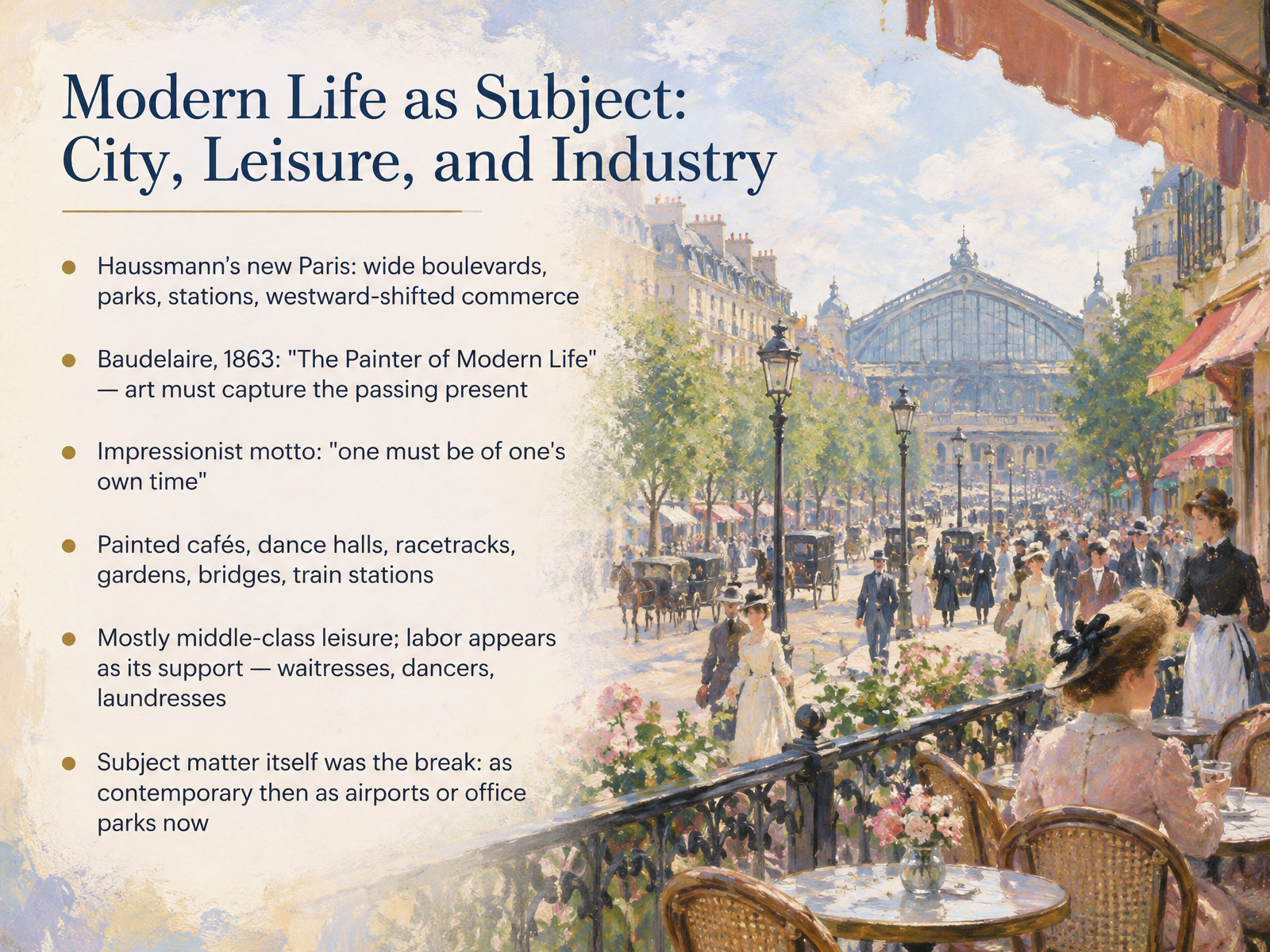
- 05Modern Life as Subject: City, Leisure, and IndustrySo let's look at what the Impressionists actually chose to paint. Much of it came straight from a changing city. Under Baron Haussmann in the eighteen fifties and sixties, Paris was rebuilt with wide, tree-lined boulevards, new parks, and grand train stations, and the center of commerce shifted westward. In eighteen sixty-three, the poet Charles Baudelaire published an essay called The Painter of Modern Life. His argument was simple. Art must capture the passing present, not just stories from the distant past. The Impressionists took that to heart. Their motto was, one must be of one's own time. So they painted cafes, dance halls, racetracks, gardens, bridges, and train stations. Notice that most of this is middle-class leisure. Labor appears mainly as its support, in waitresses, dancers, and laundresses. And that subject matter was itself the break. These scenes were as contemporary then as airports or office parks are today. Next, we'll meet some of the key figures and look at how their approaches differed.
 2 min
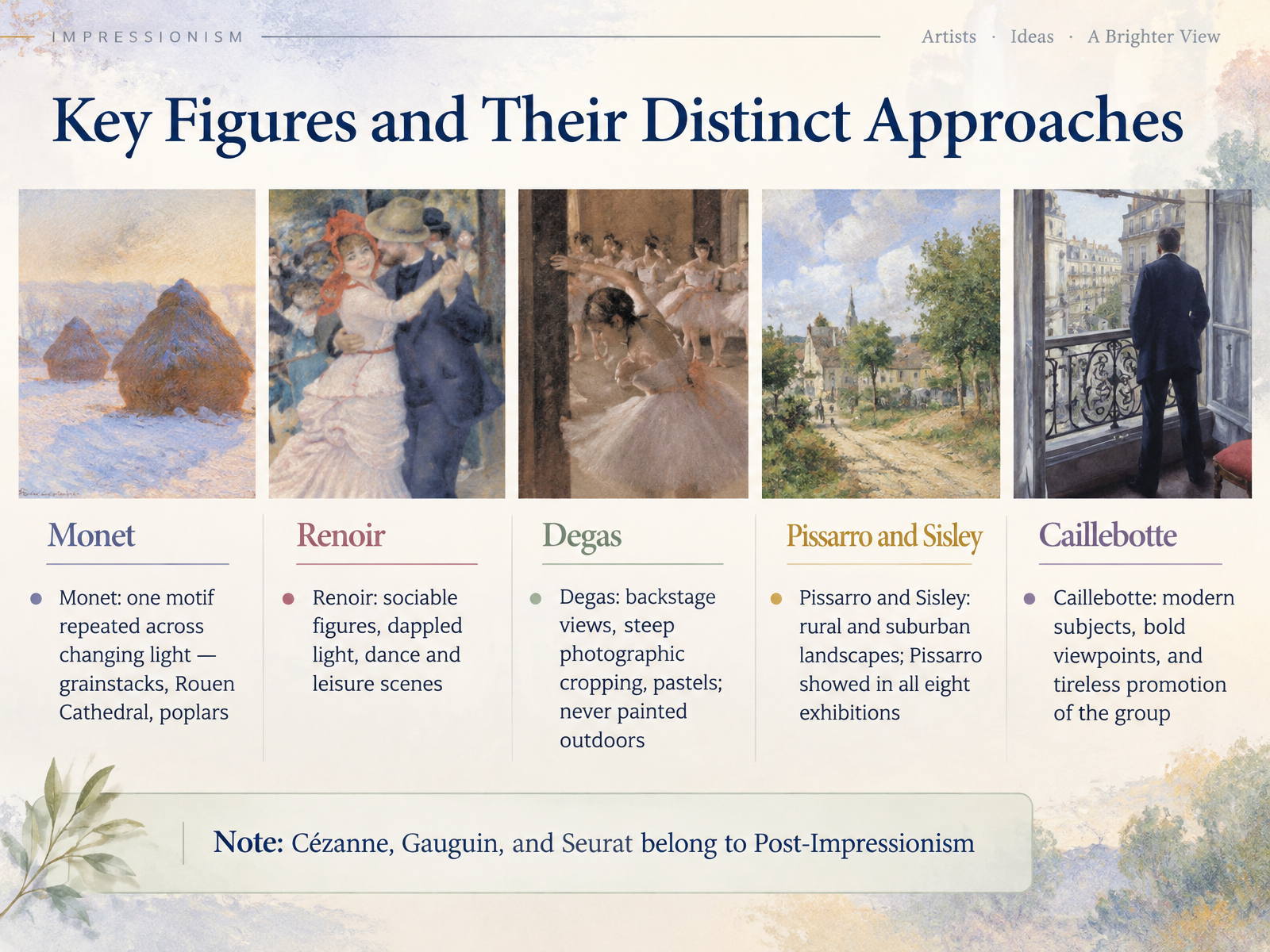
- 06Key Figures and Their Distinct ApproachesNow let's meet the key figures, each with a distinct approach. Monet took one motif and painted it again and again, across changing light. Think of his grainstacks, the Rouen Cathedral, or the poplars. Renoir favored sociable figures, dappled light, and scenes of dance and leisure. Degas worked backstage, using steep, photographic cropping and soft pastels, and he never painted outdoors. Pissarro and Sisley focused on rural and suburban landscapes, and Pissarro showed in all eight exhibitions. Caillebotte chose modern subjects and bold viewpoints, and he was a tireless promoter of the group. One more line to keep in mind: Cézanne, Gauguin, and Seurat belong to Post-Impressionism. Next, we look at Morisot and Cassatt: Modernity from the Inside.
 en.wikipedia.orgnga.govnga.gov+21 min
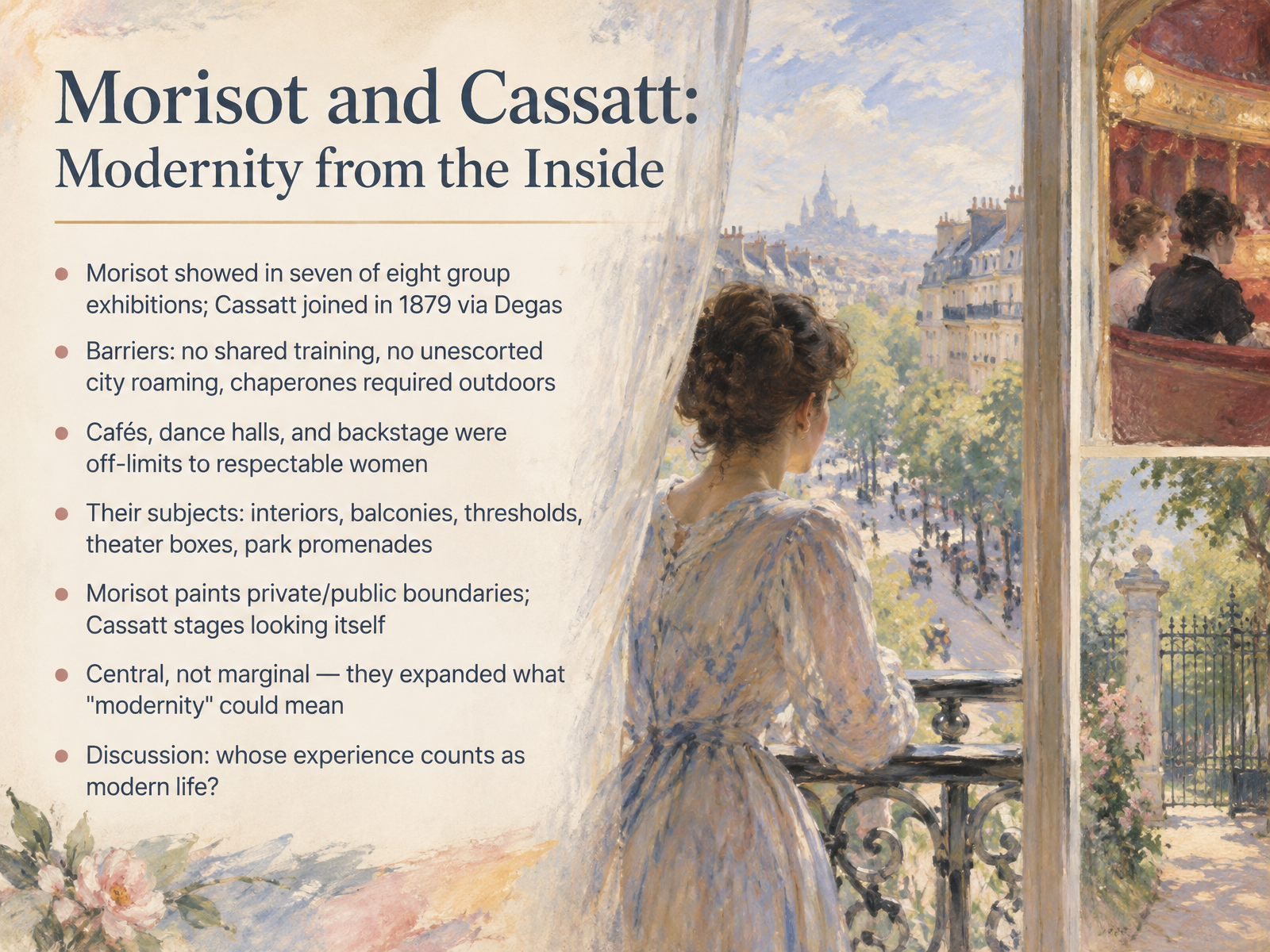
- 07Morisot and Cassatt: Modernity from the InsideNow let's look at two women at the very center of Impressionism, Berthe Morisot and Mary Cassatt. Morisot took part in seven of the eight group exhibitions, and Cassatt joined in eighteen seventy nine at the invitation of Edgar Degas. Picture the barriers they faced. They had no shared training with the men, they could not roam the city alone, and outdoors they needed a chaperone. Cafés, dance halls, and backstage were simply off limits to respectable women. So look at what they painted instead. Interiors, balconies, thresholds, theater boxes, and park promenades. Morisot lingers on the line between private and public, while Cassatt stages the act of looking itself. These artists were never marginal. They widened what modernity could mean. Here's a question to hold as you walk on. Whose experience counts as modern life? Next, we'll turn to reception, market, and the path to acceptance.
 2 min
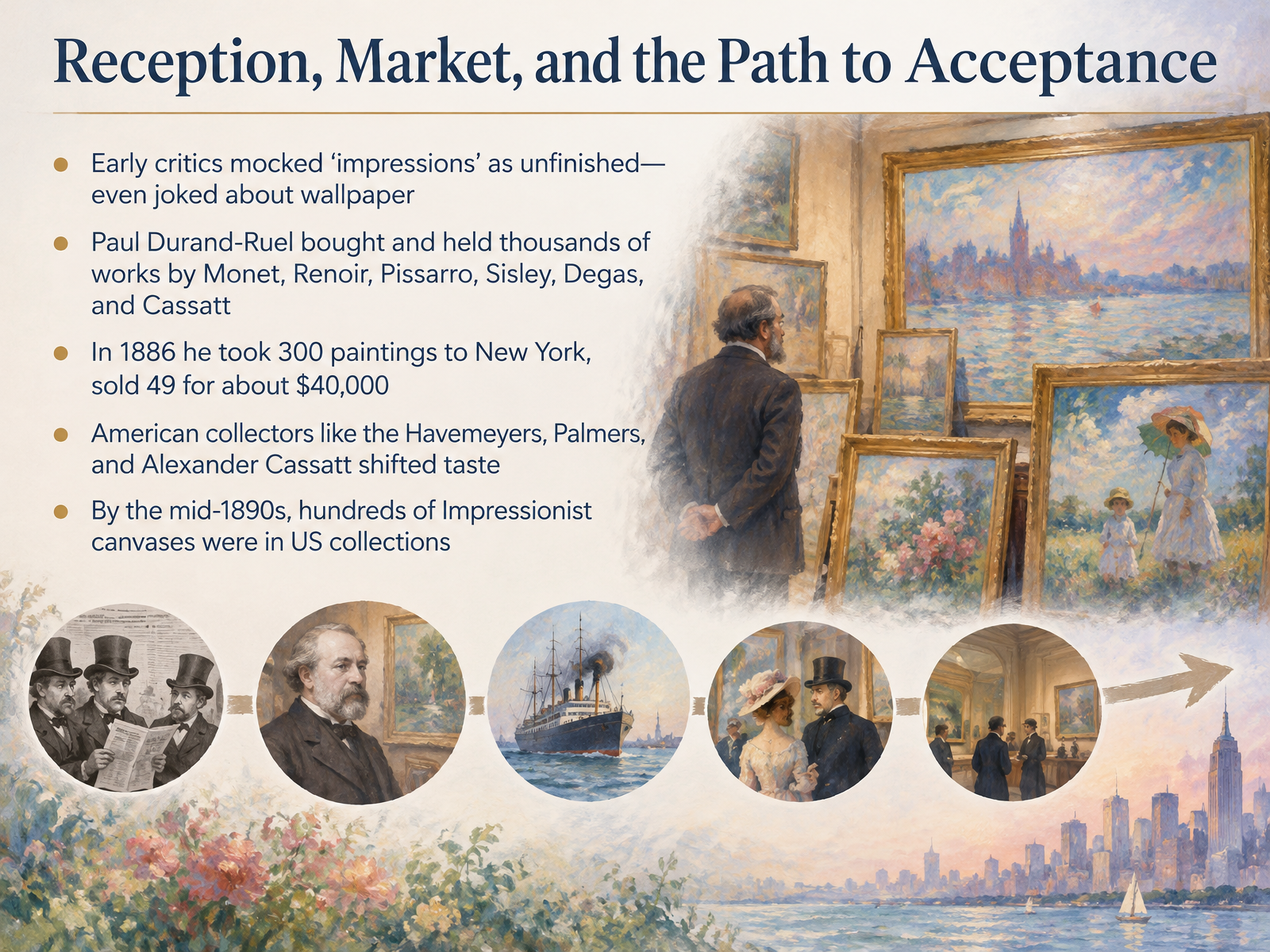
- 08Reception, Market, and the Path to AcceptanceNow let's talk about how Impressionism moved from mockery to acceptance. Imagine you're a critic in Paris in the eighteen seventies. These paintings look sketchy, unfinished. One writer even joked that wallpaper was more finished than Monet's seascape. The word impression began as an insult. But a dealer named Paul Durand-Ruel saw something else. He bought and held thousands of works by Monet, Renoir, Pissarro, Sisley, Degas, and Cassatt. Then, in eighteen eighty-six, he packed three hundred paintings and took them to New York. He stayed three months, and he sold forty-nine pictures for about forty thousand dollars. That was serious money for art back then. American collectors like the Havemeyers, the Palmers, and Alexander Cassatt began to shift taste. By the mid eighteen nineties, hundreds of Impressionist canvases were in American collections. So here's the takeaway: this style we now call beloved was once laughed at. What changed was a patient dealer, bold collectors, and a new audience. Next, we'll look closely together in Looking Closely: A Guided Practice Session.
 en.wikipedia.orgnga.govnga.gov+22 min
- 09Looking Closely: A Guided Practice SessionNow let's put all of this into practice, together. Choose one painting and ask three simple questions. What is the light doing? What moment is being captured? And what does it tell us about modern life? Then step back for the overall effect. Step close for broken color and colored shadows. Try comparing two versions of the same motif, and point to specific evidence for what changed. Look for cropping, high viewpoints, and off-center subjects. Ask yourself what the frame leaves out. And here's a myth to check: loose surfaces often mask carefully constructed compositions. For a group exercise, offer three evidence-based observations, not opinions. What you see, and where you see it. Coming up next, we'll trace the legacy of Impressionism into modern art.
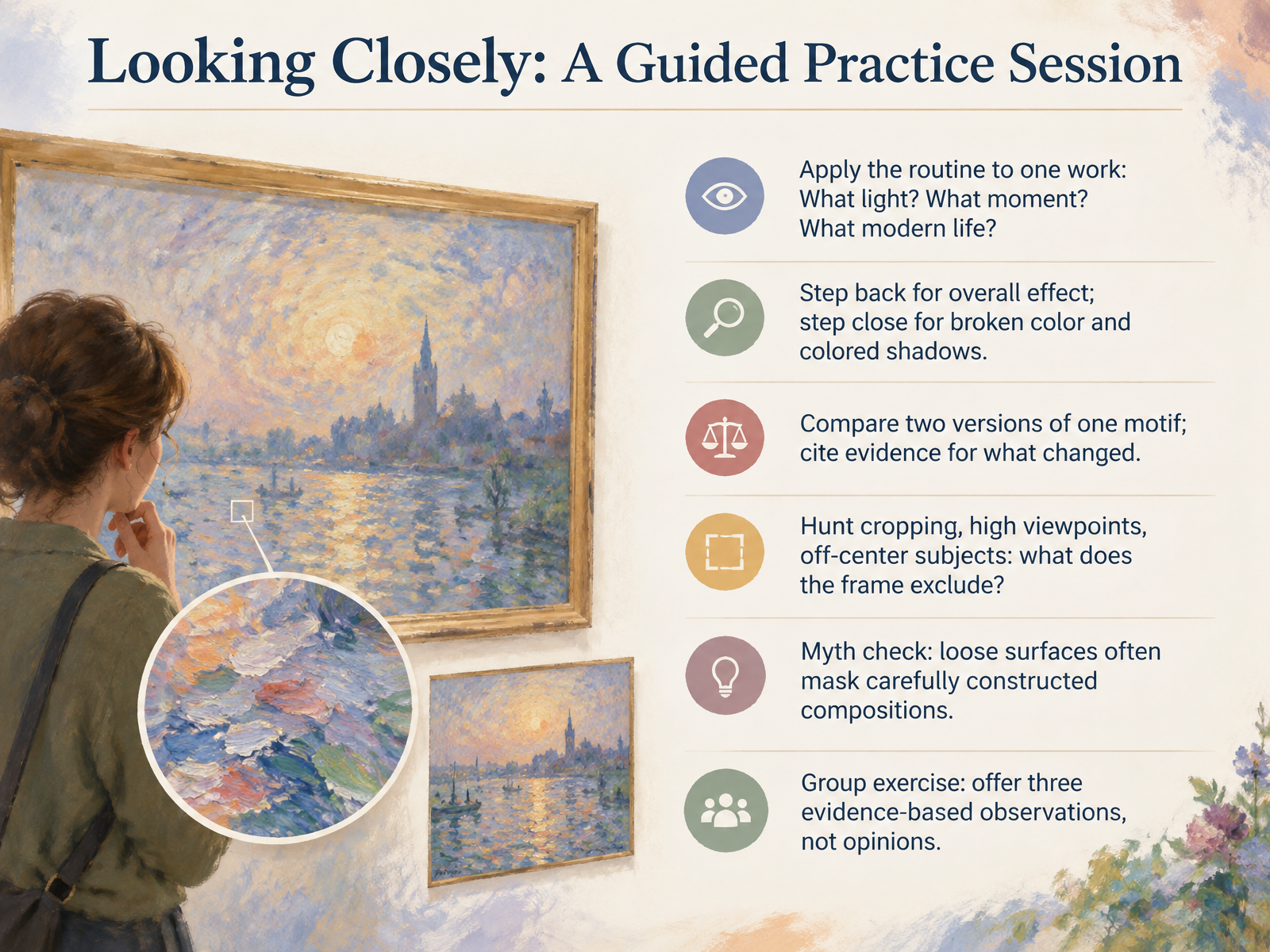 en.wikipedia.orgnga.govnga.gov+21 min
- 10Legacy: From Impressionism to Modern ArtSo what did all of this leave behind? Quite a lot, as you can see. Impressionist strategies fed straight into Post-Impressionism. Think of Seurat and Signac, who took broken color to its logical end with pointillism, small dots of pure color that, from a distance, blend in your eye. That pushed painting right to the edge of abstraction. And the way the Impressionists worked, independent exhibitions, friendly dealers, private galleries, became a template for the modern art world. Their reach spread too, from Germany and Belgium across to the United States, where dealers and collectors helped shape national collections. One practical point, if you visit. Impressionist surfaces are often fragile, and works on paper especially so. That is why lighting stays low. Display decisions balance visibility with conservation. So when a gallery feels dim, it is protecting the very light these artists chased. Next, let's look at Impressionism in today's museums, from 2025 into 2026.
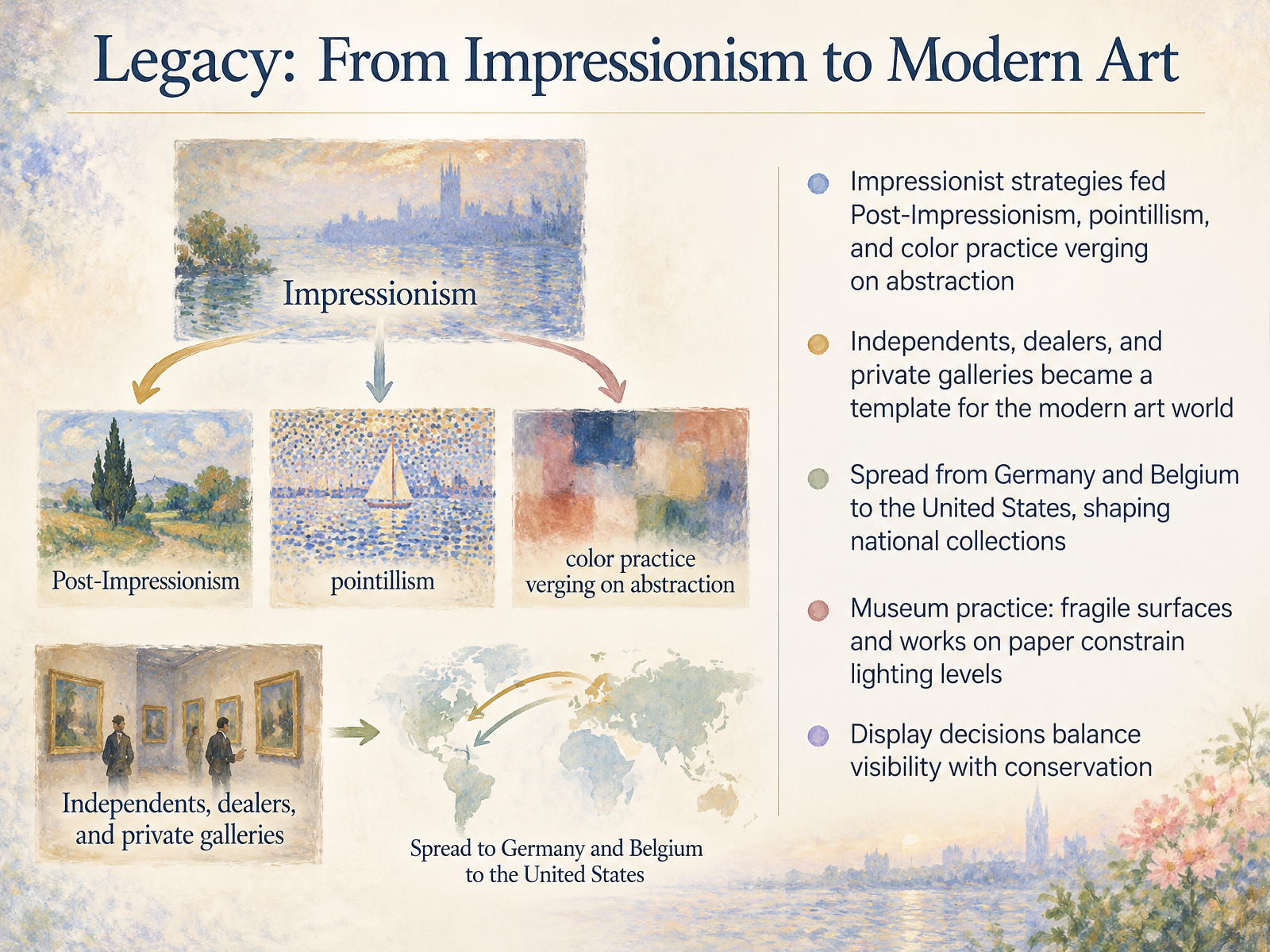 en.wikipedia.orgnga.govnga.gov+22 min
- 11Impressionism in Today's Museums (2025–2026)Now, let's bring this closer to home. Impressionism is alive and well in today's museums. The anniversary show Paris 1874 reunited works from that very first exhibition, at the National Gallery of Art and the Musée d'Orsay. Into the Modern, drawn from the Museum of Fine Arts, Boston, is at National Gallery Singapore through the first of March, 2026. In Los Angeles, Collecting Impressionism at LACMA asks how museums and donors built Impressionist taste. And in Denver, The Honest Eye is the first major retrospective of Camille Pissarro in the United States in over forty years. Notice the pattern. These shows foreground collectors, dealers, gender, and environment, more than individual genius. Next, let's gather some takeaways for your next museum visit.
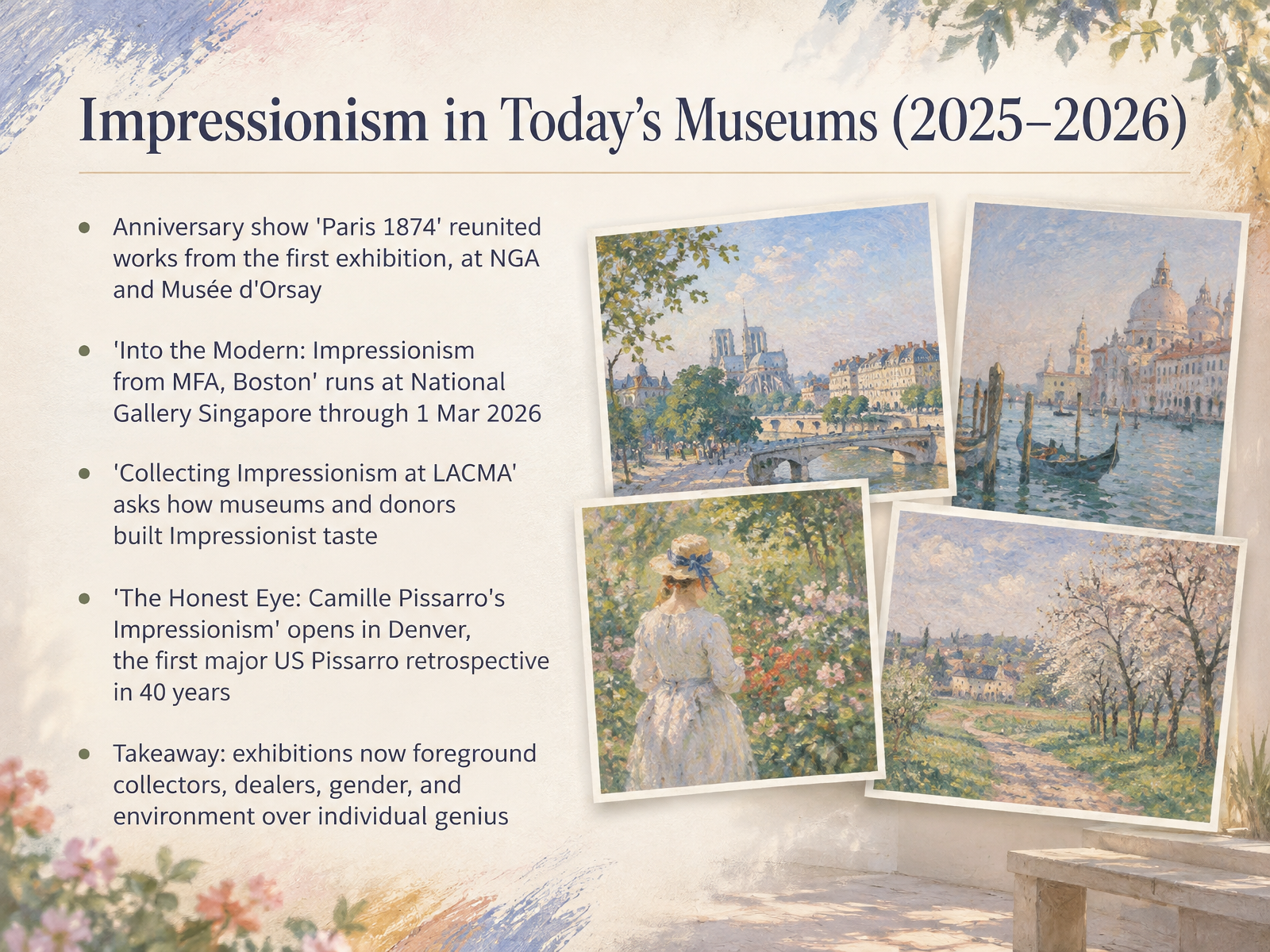 1 min
- 12Takeaways for Your Next Museum VisitSo let's bring this home, with a few things you can carry into your next museum visit. When you stand before a painting, ask three questions. What light is this? What moment is being captured? And what modern life is being shown? Then try getting close, and stepping back. Up close, you see the brushwork. From a distance, those colors start to blend. And that visible surface is part of the subject. Next, notice who is included and who is not. Class, gender, and access shape the scene, which is why Berthe Morisot and Mary Cassatt painted so many interiors and gardens. Finally, read the label for makers and markets. Dealers, collectors, and donors helped shape what museums call good taste. So here is a reflection for you. Name one painting you will now see differently, and why. That question is worth keeping. Coming up next, we will put your looking skills to the test. Quick Check: Test Your Looking Skills.
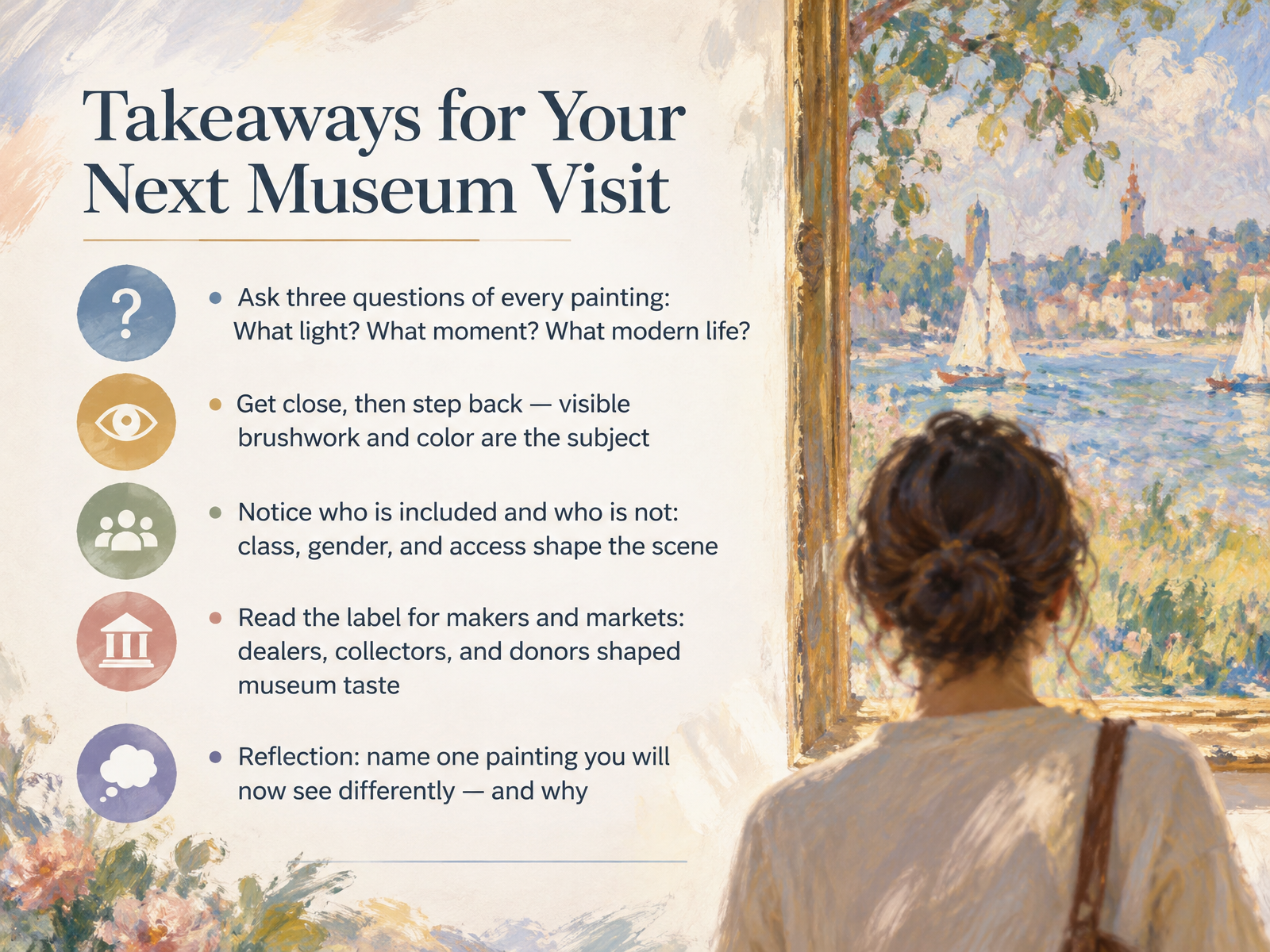 en.wikipedia.orgnga.govnga.gov+22 min
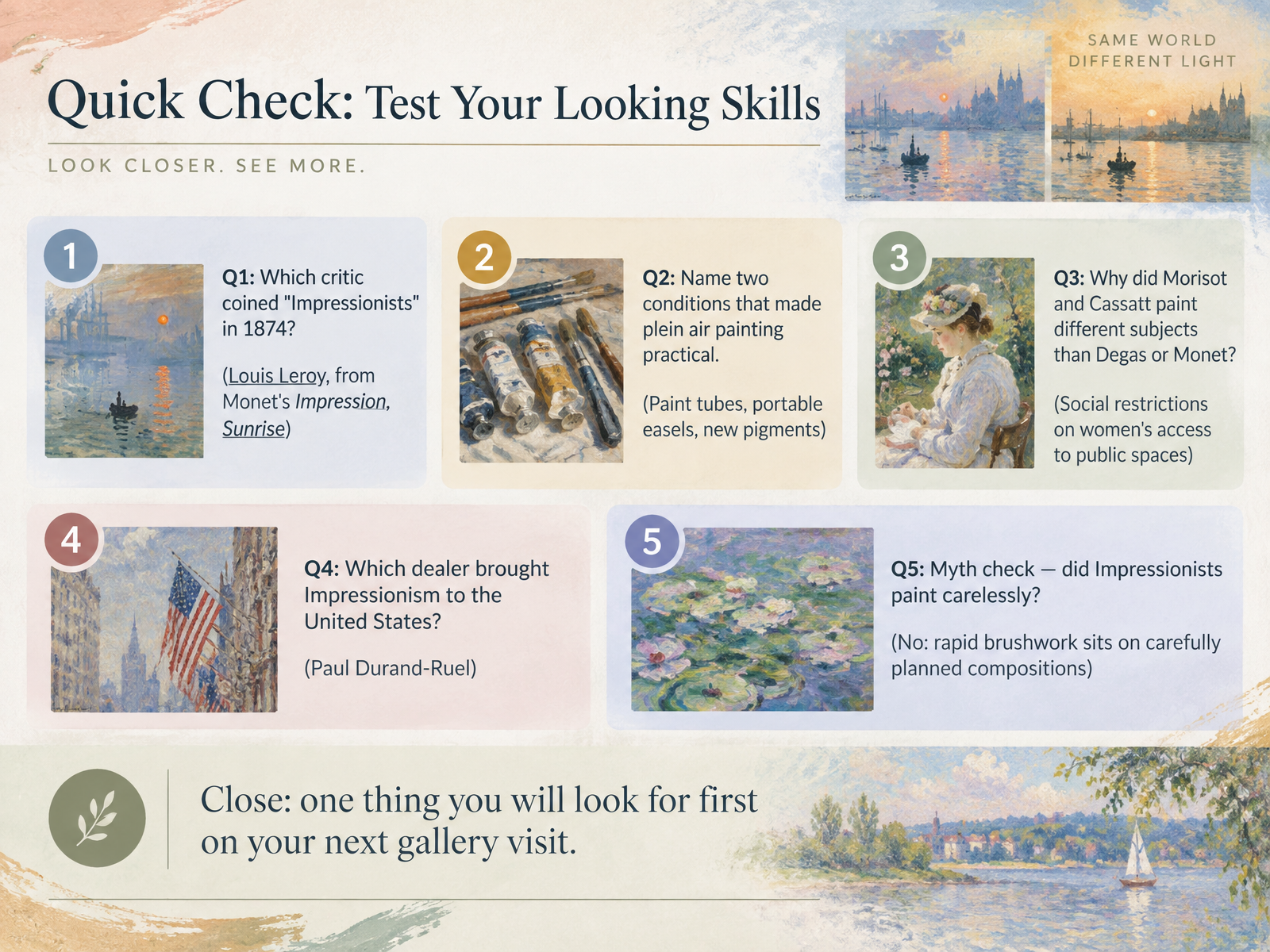
- 13Quick Check: Test Your Looking SkillsLet's finish with a quick check of your looking skills. Here are five questions. Which critic coined the word Impressionists in 1874? That was Louis Leroy, from Monet's painting Impression, Sunrise. Next, name two conditions that made painting outdoors practical. Paint in metal tubes, portable easels, and new synthetic pigments. Third, why did Berthe Morisot and Mary Cassatt paint different subjects than Degas or Monet? Because social restrictions limited women's access to public spaces like cafes and backstage areas. Fourth, which dealer brought Impressionism to the United States? Paul Durand-Ruel, who organized a large New York exhibition in 1886. And a myth check: did the Impressionists paint carelessly? No. Their rapid brushwork sits on carefully planned compositions. So before you go, ask yourself one thing. On your next gallery visit, what will you look for first? Thank you for joining me today. You have done wonderful looking. Keep trusting your eyes, and enjoy the paintings.
 en.wikipedia.orgnga.govnga.gov+22 min
Take the deck with you
Download this course as a file — free, no sign-up needed.
- PDF handoutEvery slide page, ready to print or share.14 pages · 5.2 MBDownload
- Narrated PowerPointThe deck that presents itself — every slide carries the digital human's narration video.14 pages · 14.3 MBDownload
- PowerPoint slidesThe full deck as a .pptx — open it in PowerPoint, Keynote, or Google Slides.14 pages · 5.2 MBDownload
Free to use in your own training — please keep the PersonWise credit page at the end.
Have your own deck? Turn it into a course
Sources consulted
Web sources consulted while building this course.
- Impressionism — en.wikipedia.org
- What Is Impressionism? 4 Things to Know | National Gallery of Art — nga.gov
- 1874: The Birth of Impressionism: Discover how a landmark exhibition led to the birth of an influential movement. | National Gallery of Art — nga.gov
- Paris 1874: The Impressionist Moment | National Gallery of Art — nga.gov
- Exhibition Paris 1874 Inventing impressionism | Musée d'Orsay — musee-orsay.fr
- Full text of "Catalogues of the Paris Salon 1673 to 1881" — archive.org
- Salon de 1863 · Les peintres médaillés au Salon (1848-1880) · HAISSa — haissa.huma-num.fr
- What Gave the Salon Jury Its Legitimacy (1791–1880)? — journals.openedition.org
- Parcours « Les peintres, le Salon, la critique, 1848-1870 » | Musée d'Orsay — musee-orsay.fr
- L’internationalisation des expositions parisiennes et la crise du système du Salon à la fin du xixe siècle — doi.org
- 1874 – Première exposition | Ministère de la Culture — culture.gouv.fr
- First Impressionist Exhibition — en.wikipedia.org
- Exhibition of the Impressionists - Wikisource, the free online library — en.wikisource.org
- 1874 expo reviews - Impressionism — impressionism.nl
- partakers 1st 'impressionist' exposition - Impressionism — impressionism.nl
- https://www.ngv.vic.gov.au/french_impressionism_learning_resource_fa/ — ngv.vic.gov.au
- Impressionism (Painting) - Routledge Encyclopedia of Modernism — rem.routledge.com
- Impressionism — en.wikipedia.org
- Techniques of the Impressionists — stephenhaley.com.au
- Introduction and Gallery Descriptions - Frist Art Museum — fristartmuseum.org