Begin
14 pages · ~28 min
Communicating Content Marketing to Stakeholders
This training helps marketers present content marketing plans and results to stakeholders, building skills to gain buy-in and communicate value clearly.
A digital instructor presents all 14 pages. Hold “Ask” at any point and ask out loud — the answer comes from this course. No sign-up needed.
What you’ll learn
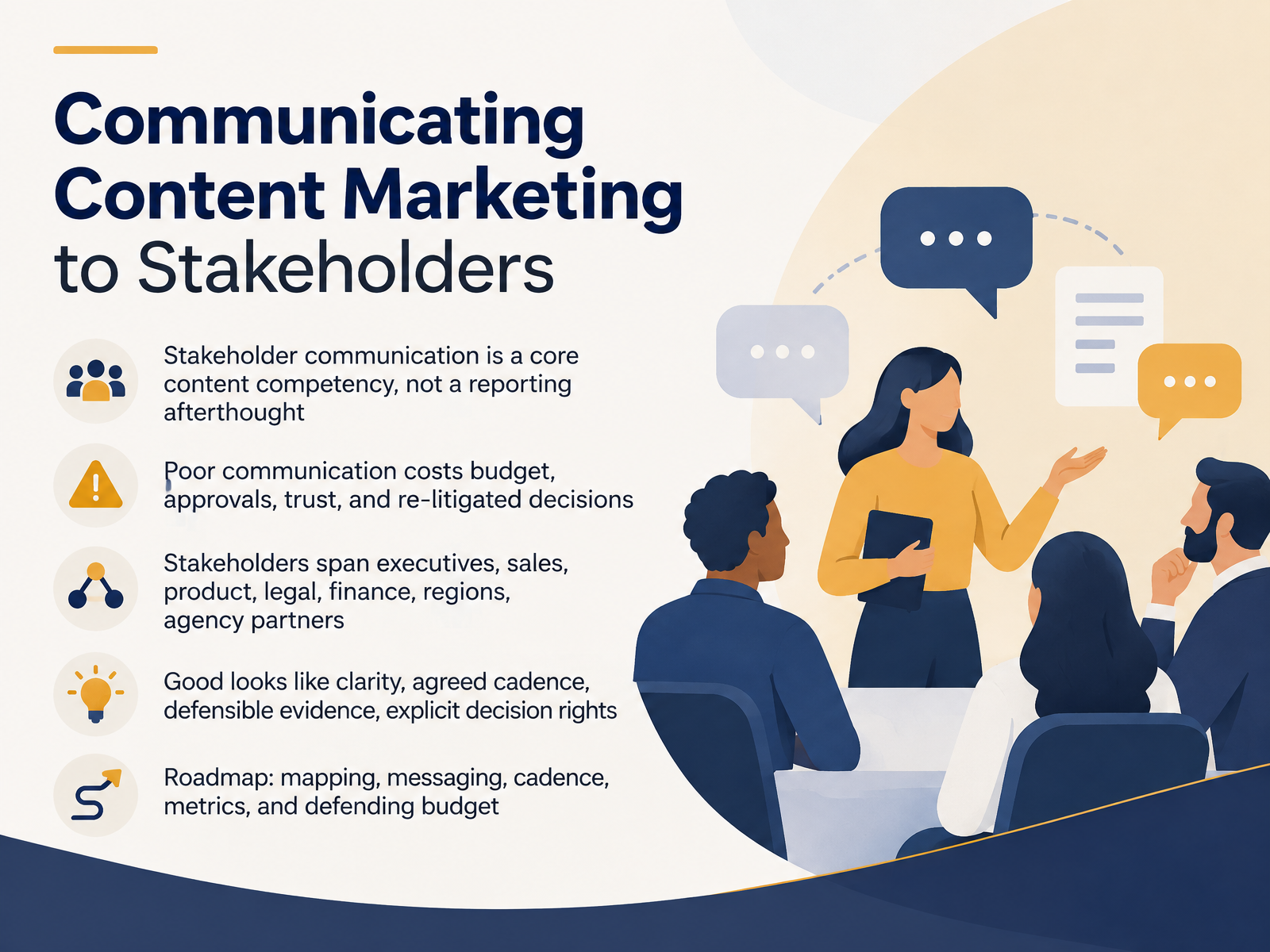
- 01Communicating Content Marketing to StakeholdersWelcome. Over the next fourteen slides, we are going to work on a skill that quietly decides whether your content program thrives or gets cut: communicating content marketing to stakeholders.
Here is the core idea. Stakeholder communication is a core content competency, not a reporting afterthought. When it is weak, the cost shows up fast. Budget gets trimmed. Approvals stall. Trust erodes. Decisions you thought were settled get re-litigated six weeks later.
And your stakeholders are a wide group. Executives, sales, product, legal, finance, regional teams, agency partners. Each one cares about something different, and each one can slow you down or speed you up.
So what does good look like? Clarity. An agreed cadence. Defensible evidence. And explicit decision rights, meaning everyone knows who actually decides what.
Across this course, we will cover five areas: mapping your stakeholders, messaging, cadence, metrics, and defending budget.
Now let's look at where communication usually breaks down. Next up: Why Communication Breaks: The Measurement and Credibility Gap.tenspeed.iocometly.comgtmstack.app+21 min
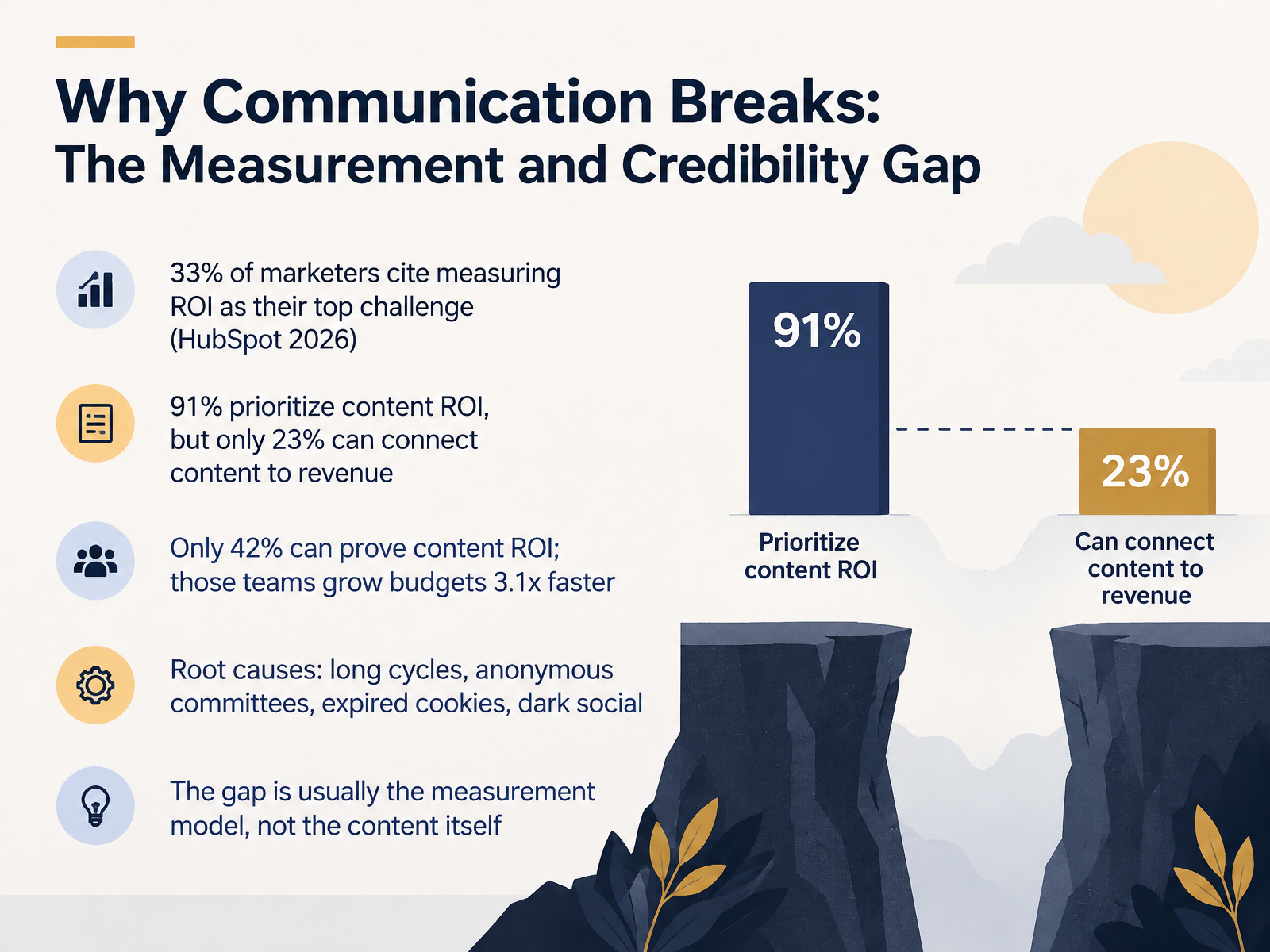
- 02Why Communication Breaks: The Measurement and Credibility GapLet's talk about why communication so often breaks down, and it usually comes down to two linked problems: measurement and credibility. Start with the data. Thirty-three percent of marketers say measuring return on investment is their top challenge. Ninety-one percent say content ROI is a priority, yet only twenty-three percent can actually connect content to revenue. And only forty-two percent can prove content ROI. Here's what matters: those teams grow their budgets three point one times faster. The root causes are familiar. Long cycles, anonymous committees, expired cookies, and dark social. So when a stakeholder pushes back, the gap is usually the measurement model, not the content itself. Next, let's map the stakeholder landscape for content teams.
 1 min
1 min - 03Stakeholder Landscape for Content TeamsLet's map the stakeholder landscape your content team actually works within every day. Not the org chart, the influence map.
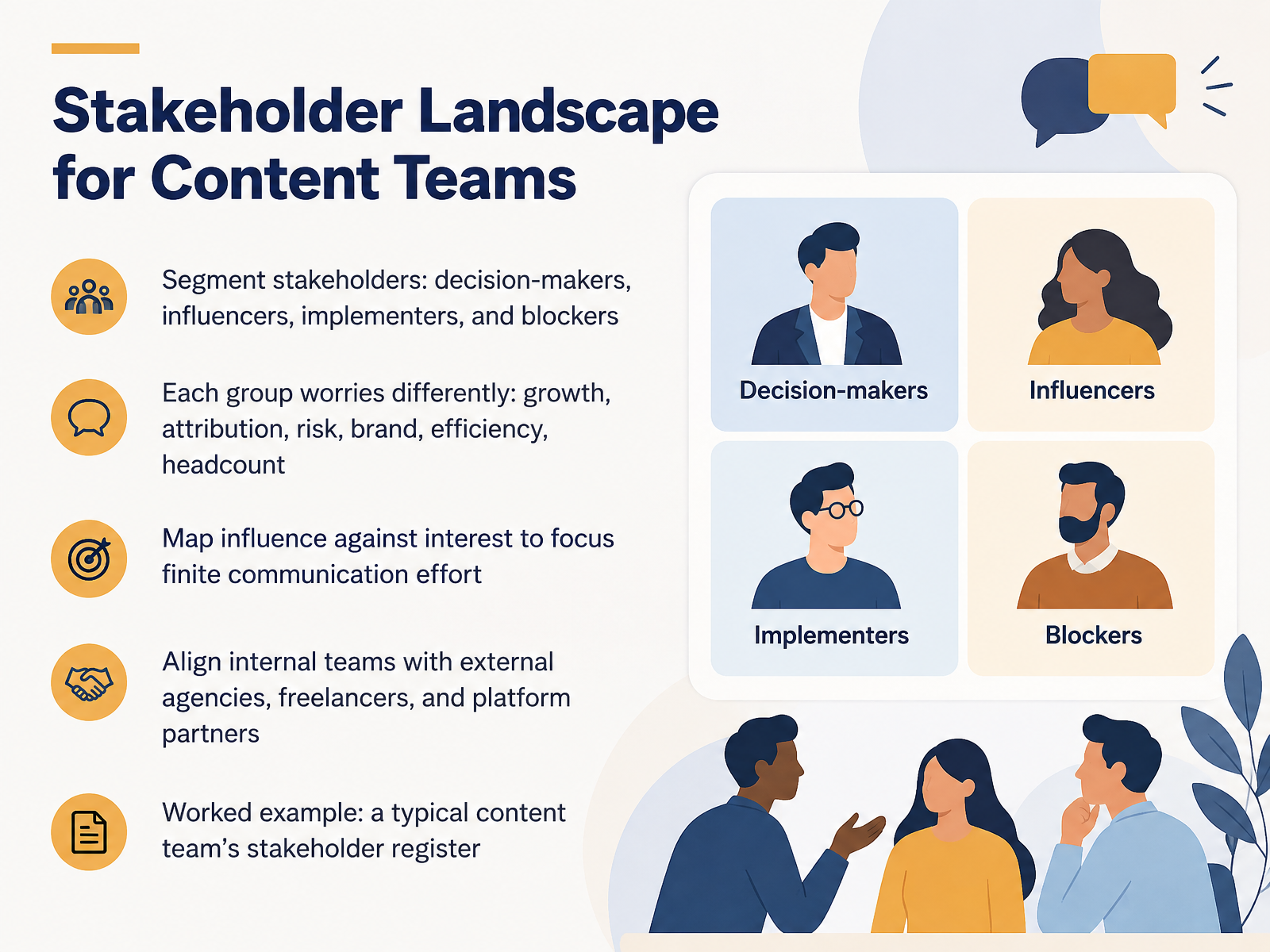
Start by segmenting stakeholders into four practical groups: decision-makers, who approve and fund. Influencers, who shape direction. Implementers, who do the work. And blockers, who can slow or stop it. Same person can play different roles on different projects, so check per initiative, not once a year.
Each group worries differently. Growth, attribution, risk, brand, efficiency, headcount. Knowing which worry is active tells you what evidence to lead with. A finance partner may care about attribution. Legal may care about risk. Both are valid. Your job is to match the message.
Next, map influence against interest. High influence, high interest gets deep, frequent updates. High influence, low interest gets short, decision-ready summaries. Low influence, high interest gets context and credit. Low influence, low interest gets a light touch. This is how you focus finite communication effort without burning your team out.
And don't forget external partners. Agencies, freelancers, and platform reps are stakeholders too. Align them with the same register so internal and external teams tell one consistent story.
Let's walk a worked example: a typical content team's stakeholder register. Name, role, what they care about, preferred cadence, and who owns the relationship. One page. Reviewed quarterly.
Takeaway: segment roles, name the worry, map influence to interest, and include external partners. That register becomes your communication plan.
Next, let's look at the power-interest grid, and how to match engagement to each stakeholder.
 2 min
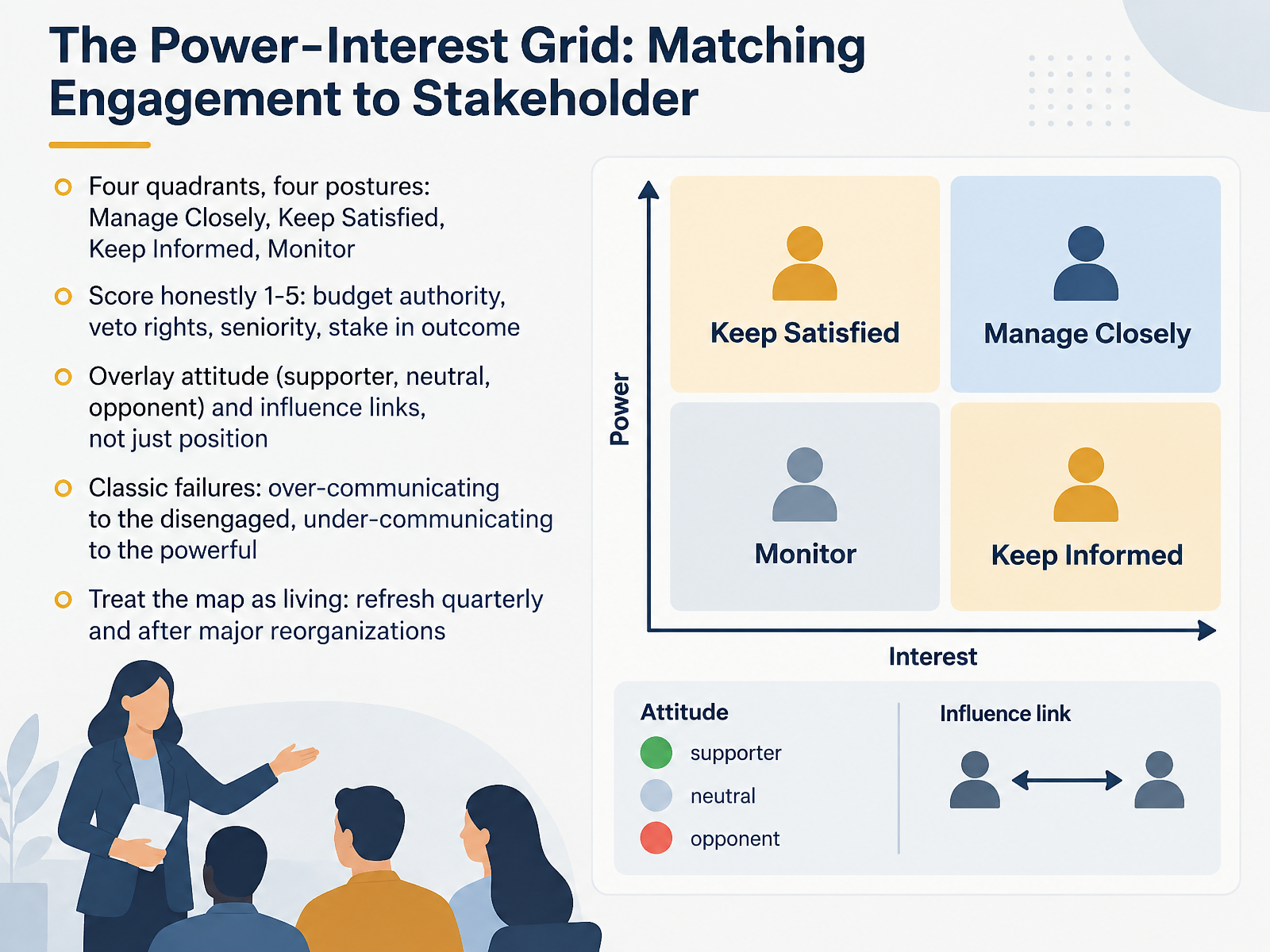
2 min - 04The Power-Interest Grid: Matching Engagement to StakeholderLet's talk about mapping stakeholders so your engagement actually matches their power and interest. The grid gives you four quadrants, and four postures. Manage Closely for high power, high interest. Keep Satisfied for high power, lower interest. Keep Informed for lower power, high interest. And Monitor for low power, low interest. Score honestly, one to five, on budget authority, veto rights, seniority, and stake in the outcome. Then overlay attitude. A supporter, a neutral, or an opponent. And map influence links, not just titles. Position alone will mislead you. Two classic failures to avoid: over-communicating to the disengaged, and under-communicating to the powerful. Both burn credibility. Treat this as a living map. Refresh it quarterly, and after any major reorganization. Next, we'll look at four specific stakeholders. Four Stakeholders, Four Different Rooms: CFO, CMO, CEO, Sales.
 2 min
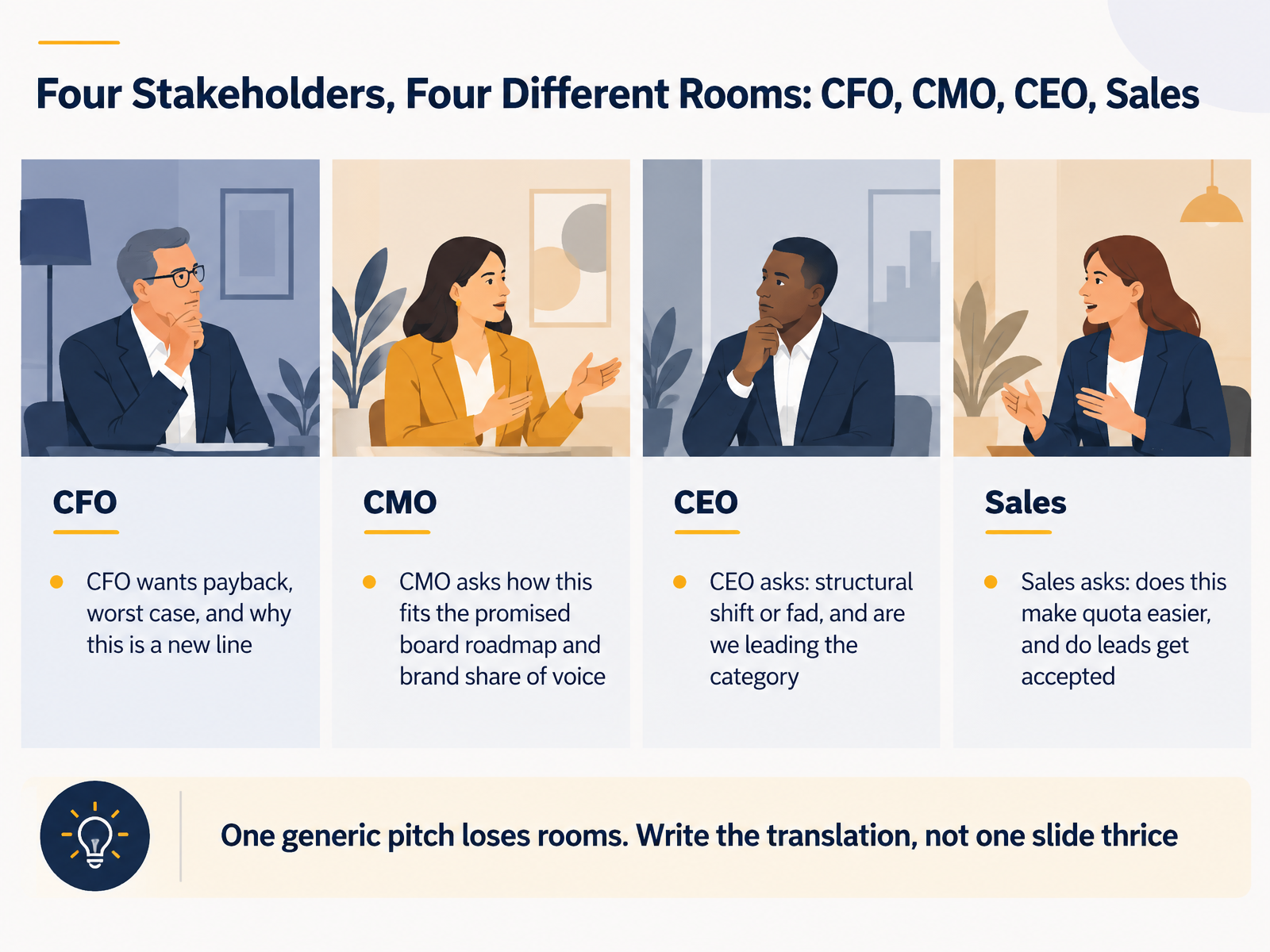
2 min - 05Four Stakeholders, Four Different Rooms: CFO, CMO, CEO, SalesNow let's talk about the four rooms your content pitch will walk into. The chief financial officer wants payback, a worst case scenario, and a clear reason this is a new line rather than a reallocation from existing budget. The chief marketing officer asks a different question. How does this fit the roadmap we already promised the board, and how does it move our brand share of voice? The chief executive officer is testing whether this is a structural shift or a fad, and whether we are leading the category or catching up. And sales asks the most grounded question of all. Does this make quota easier, and will the leads actually get accepted by the team? Here is the practical implication. One generic pitch loses all four rooms. So write the translation, not one slide repeated three times. Same story, different emphasis for each audience. Next, we look at translating content work into business value.
 1 min
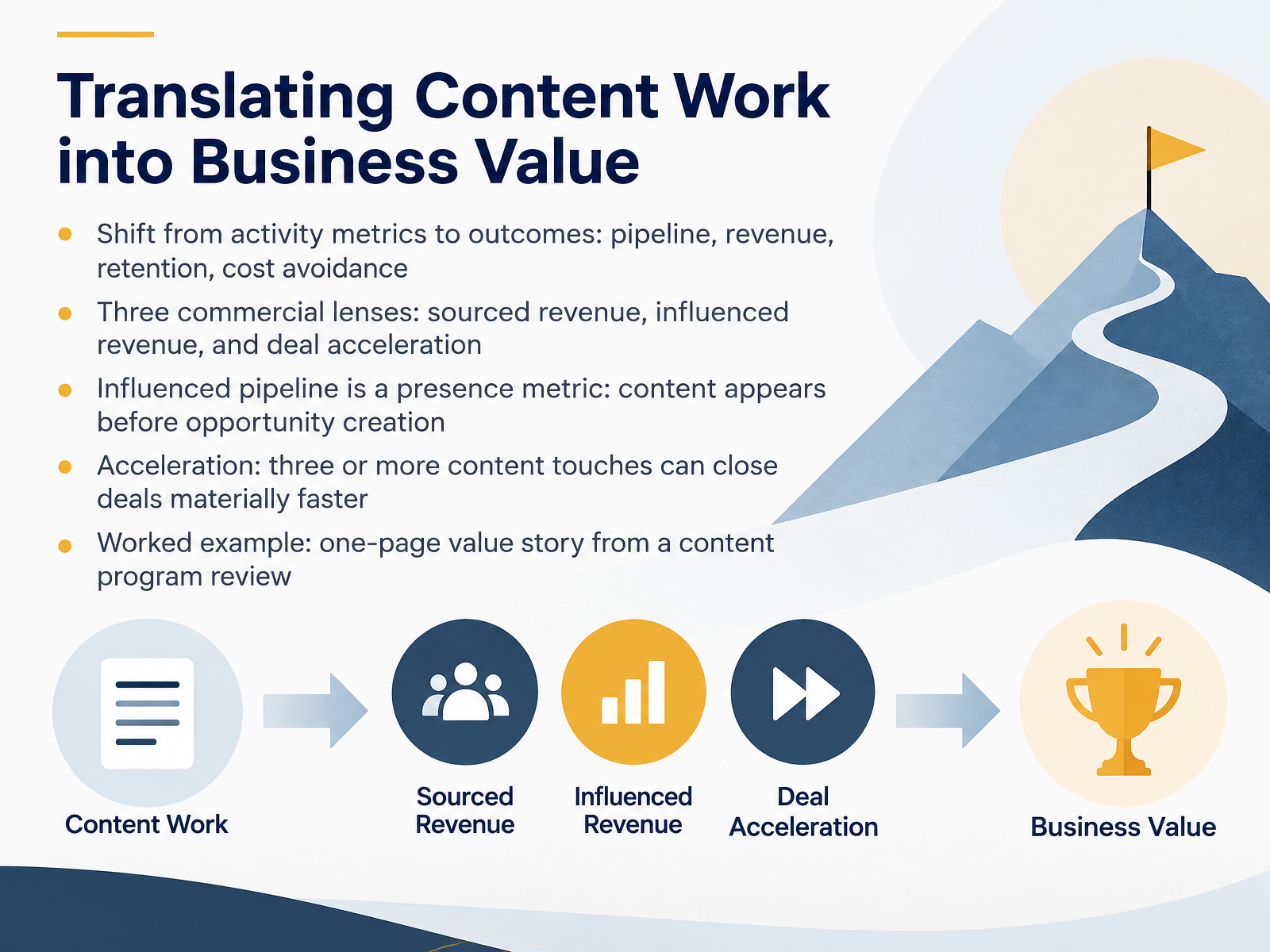
1 min - 06Translating Content Work into Business ValueLet's shift from activity to value. Move your reporting from clicks and output volume to outcomes: pipeline, revenue, retention, and cost avoidance. Your leadership cares about those four. Use three commercial lenses. Sourced revenue: content directly generated the lead. Influenced revenue: content appeared before opportunity creation, so treat it as a presence metric, not proof of cause. And deal acceleration: when a buyer engages three or more content touches, deals often close materially faster. For example, a one-page value story from a program review can show sourced and influenced pipeline side by side, plus average days to close with three or more touches versus fewer. That single page gives your team a credible business conversation without overclaiming. Next, let's look at attribution realities and how to report honestly.
 1 min
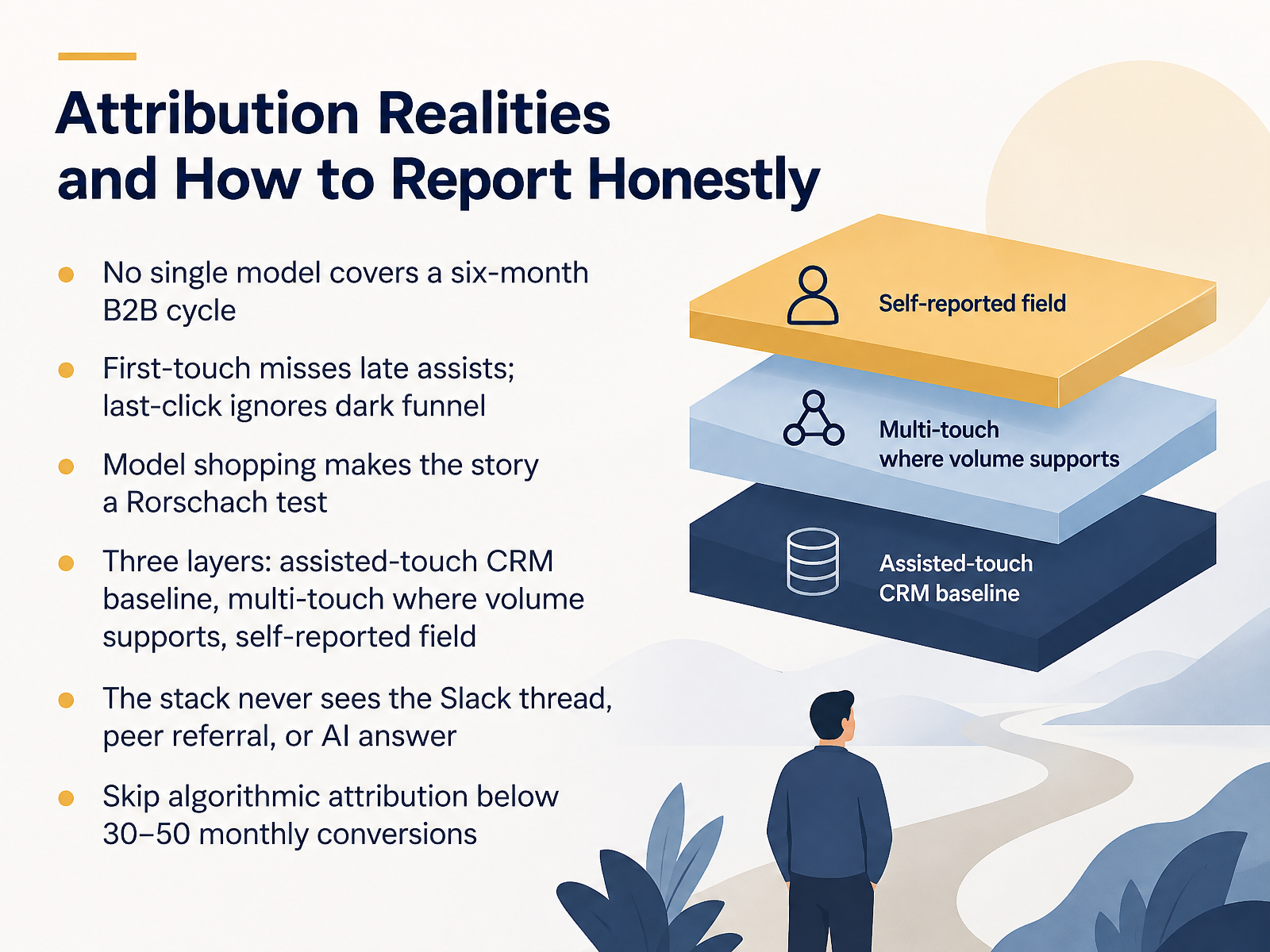
1 min - 07Attribution Realities and How to Report HonestlyLet's talk about attribution realities, and how to report them honestly. Here's the hard truth. No single model covers a six-month B2B cycle. First-touch gives all the credit to the moment someone first showed up. Last-click gives it all to the final form fill. Neither sees the dark funnel, the conversations and research that happen between. So if your team keeps model shopping, the story starts to look like a Rorschach test. Everyone sees what they want. Instead, layer your reporting. Start with an assisted-touch baseline from your CRM. Add multi-touch where conversion volume genuinely supports it. Then bring in self-reported field data. Ask buyers what actually influenced them. And accept that your stack will never see the Slack thread, the peer referral, or the AI answer that shaped the decision. One practical rule, skip algorithmic attribution below thirty to fifty monthly conversions. You'll just be modeling noise. That sets up the next question, which is about reporting ranges, not theatrical precision.
 1 min
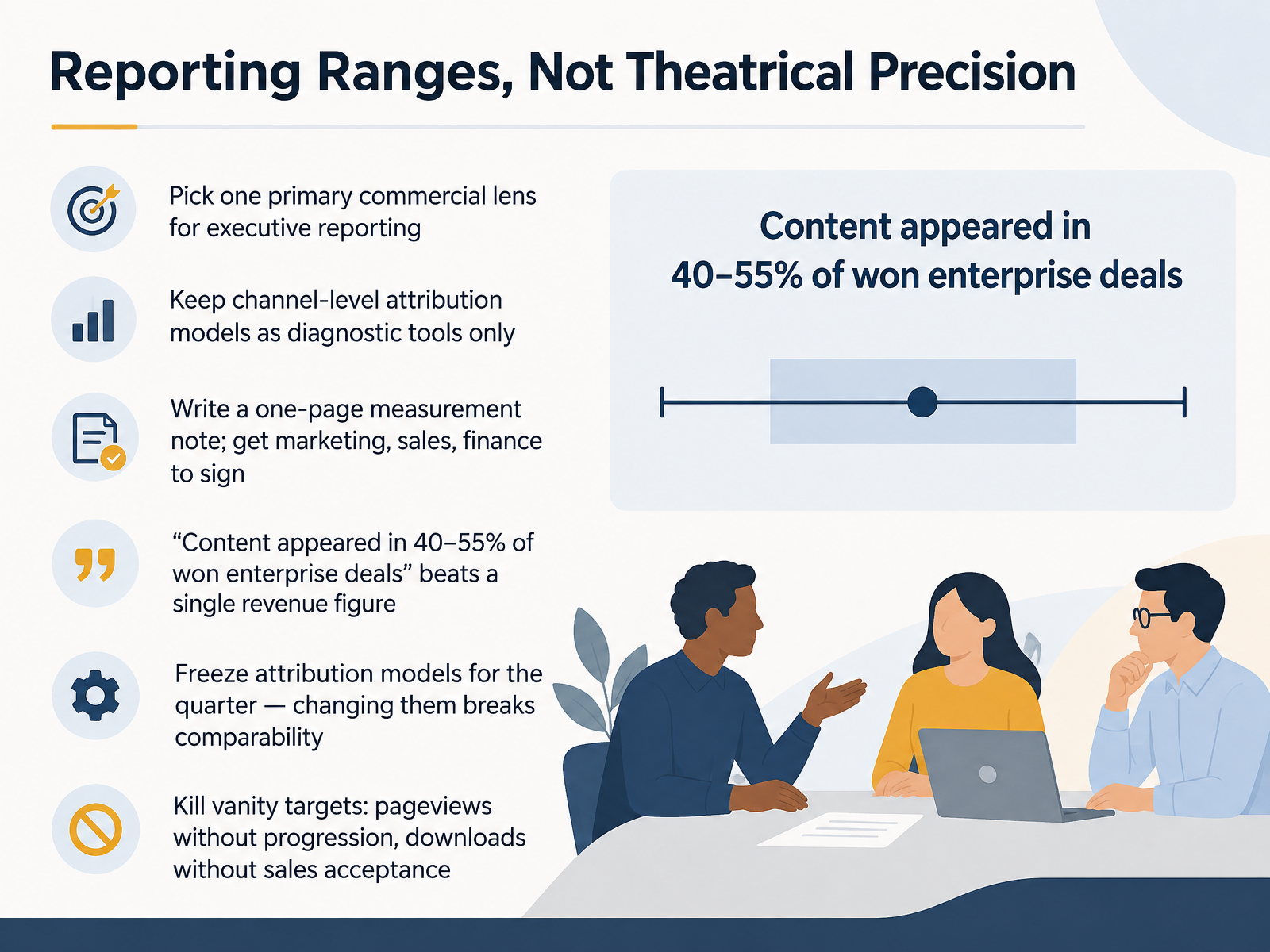
1 min - 08Reporting Ranges, Not Theatrical PrecisionNow let's talk about reporting ranges, not theatrical precision. Precision feels safe, but false precision is worse than an honest range. So start by picking one primary commercial lens for executive reporting. One. Then keep channel level attribution models as diagnostic tools only. They help your team optimize. They should not be your headline. Write a one page measurement note, and get marketing, sales, and finance to sign it. That signature matters. It prevents the same debate every quarter. When you report, a range beats a single figure. Content appeared in forty to fifty five percent of won enterprise deals. That statement is defensible. That single revenue number usually is not. Next, freeze your attribution models for the quarter. Changing them mid quarter breaks comparability. And finally, kill vanity targets. Pageviews without progression. Downloads without sales acceptance. Those are noise. What you want instead is a measure your stakeholders already trust. Next, we will look at cadence, formats, and tiered reporting.
 2 min
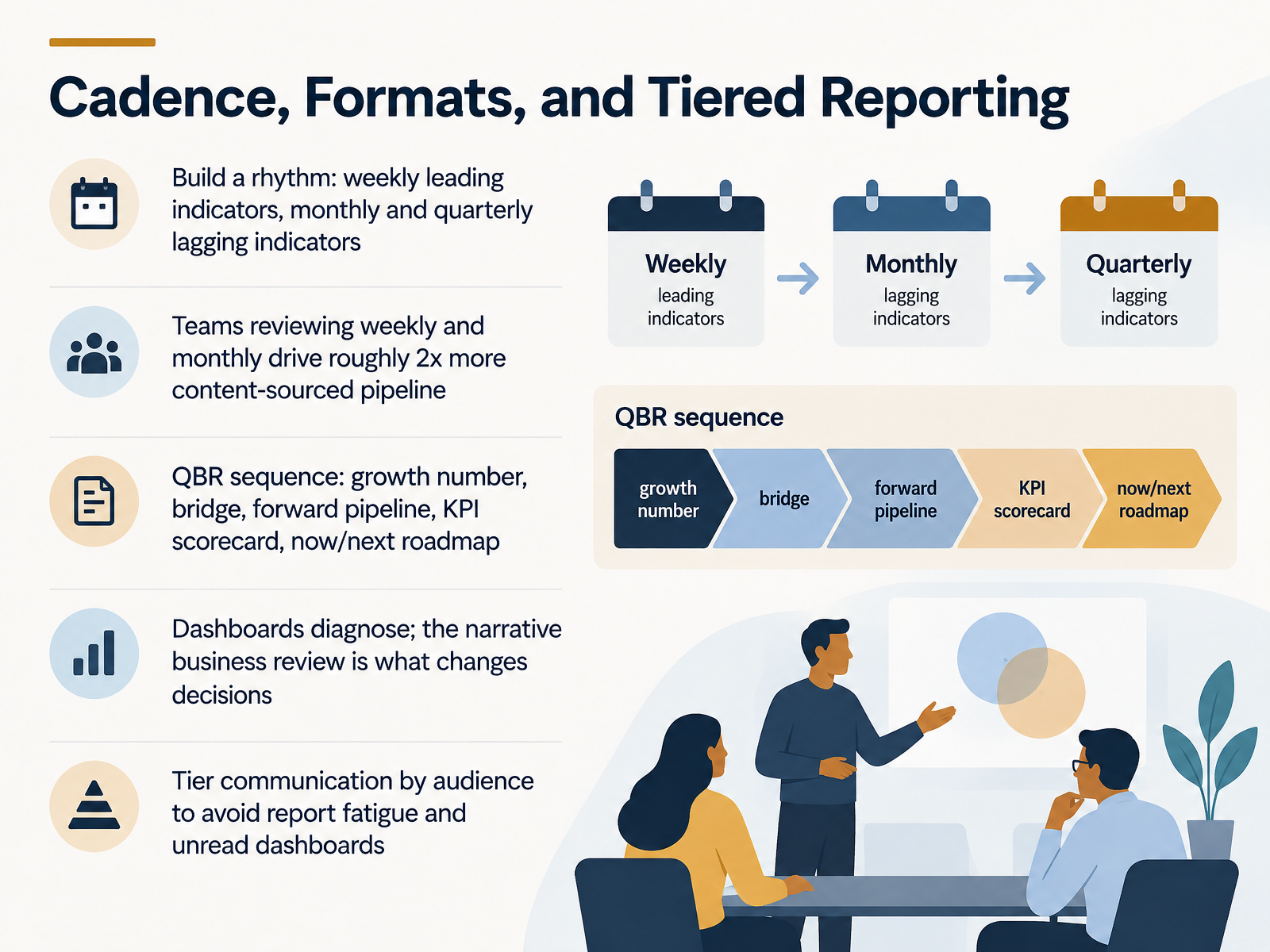
2 min - 09Cadence, Formats, and Tiered ReportingNow let's talk about cadence, formats, and tiered reporting. This is where content programs often either gain real momentum or quietly stall. Start with a rhythm. Weekly, you track leading indicators: pipeline created, assets shipped, engagement from target accounts. Monthly and quarterly, you look at lagging indicators, like closed-won revenue and content-sourced pipeline. Teams that review both weekly and monthly drive roughly twice the content-sourced pipeline. That is not a small edge. It is a structural advantage. For quarterly business reviews, run the same sequence every time: the growth number first, then the bridge, then forward pipeline, then the KPI scorecard, and close with a now and next roadmap. That consistency builds trust across finance, sales, and leadership. Here is the key distinction: dashboards diagnose; the narrative business review is what changes decisions. A dashboard tells you what moved. A well-framed narrative tells people what to do about it. Finally, tier communication by audience. Executives need the big picture. Managers need operational detail. Editors need format-level insight. Same data, different cuts. Match the depth to the decision each audience owns. That prevents report fatigue and unread dashboards. Next, we will look at audience-specific messaging and narrative structures.
 2 min
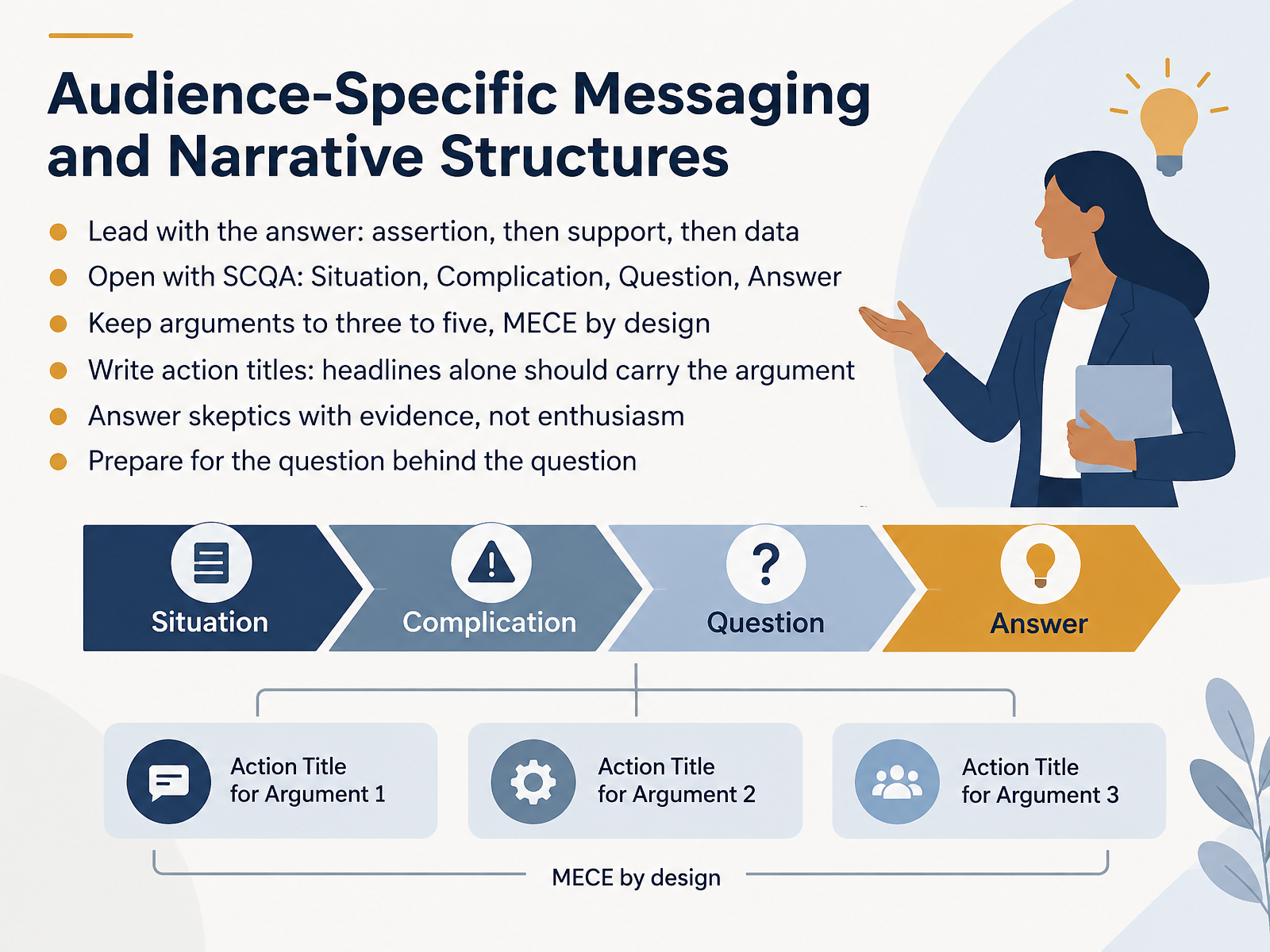
2 min - 10Audience-Specific Messaging and Narrative StructuresNow let's talk about shaping your message for specific audiences. Start with the answer, not the buildup. State your assertion, then support it, then bring the data. Executives often read the headline and stop, so give them the conclusion first.
Another structure is SCQA. That stands for Situation, Complication, Question, Answer. Open with the current state, introduce the tension, pose the question that matters, then deliver your answer. It builds a case without losing busy readers.
Keep your core arguments to three to five, and make them mutually exclusive and collectively exhaustive. That is what MECE means. No overlaps, no gaps. Write action titles. The headline alone should carry the argument. If a reader only scans the titles, they should still follow your logic.
When skeptics push back, answer with evidence, not enthusiasm. Data beats conviction in a review meeting. And prepare for the question behind the question. Someone asks about cost, but really they want to know risk. Anticipate that layer, and you save everyone a follow-up.
The takeaway? Choose the structure that fits your audience and decision timeline. Next, we will look at navigating approvals, legal review, and brand governance.
 2 min
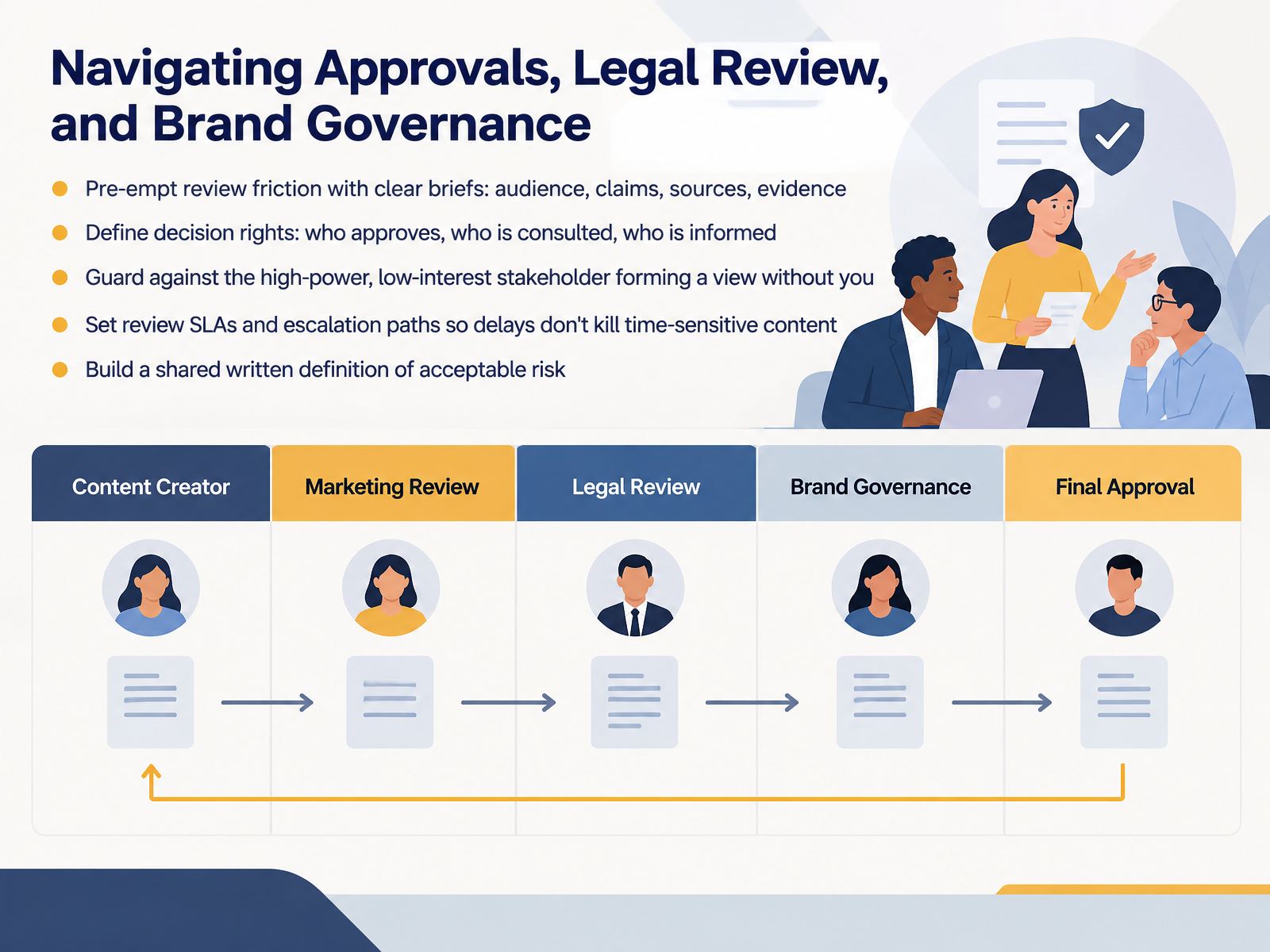
2 min - 11Navigating Approvals, Legal Review, and Brand GovernanceNow let's talk about approvals, legal review, and brand governance. This is where good content often slows down, so let's make it deliberate. First, pre-empt review friction with clear briefs. State the audience, the claims, the sources, and the evidence up front. If your brief says who the piece is for and what it asserts, legal and brand reviewers spend their time on the actual risk, not on reconstructing your intent. Second, define decision rights. Be explicit about who approves, who is consulted, and who is simply informed. Ambiguity here is what turns a two-day review into two weeks. Third, watch the high-power, low-interest stakeholder. That's the executive or partner who doesn't engage early, then forms a strong view late. Keep them informed at key milestones so they're never seeing the content for the first time at final sign-off. Fourth, set review service-level agreements and escalation paths. Agree on turnaround times, and name the person who breaks a tie. Time-sensitive content dies in silence, not in debate. Finally, build a shared written definition of acceptable risk. Not a vibe. A document your team and your reviewers can point to. When everyone agrees on what low, medium, and high risk looks like, reviews get faster and less personal. Next, we'll look at difficult conversations and expectation resetting.
 2 min
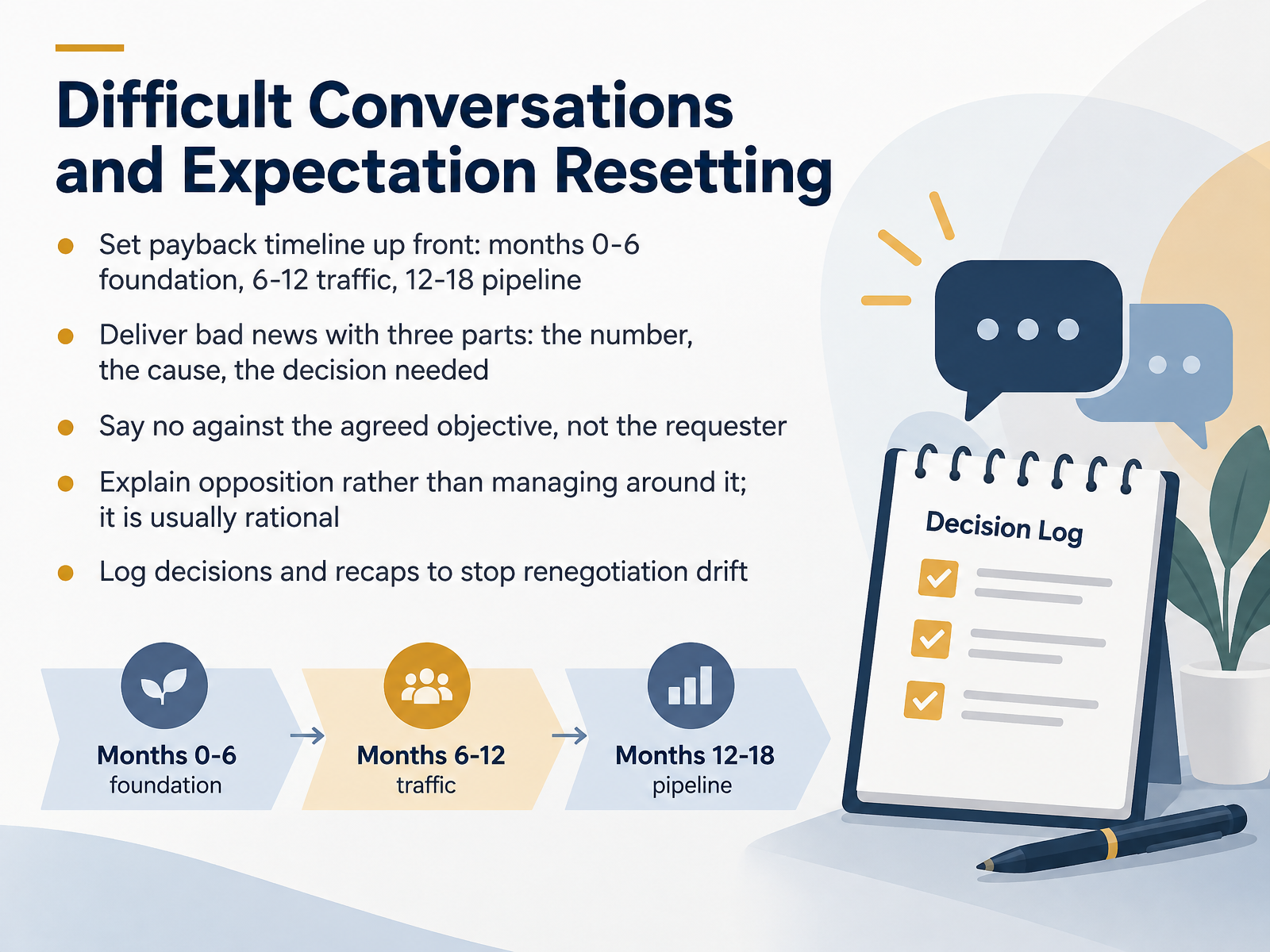
2 min - 12Difficult Conversations and Expectation ResettingNow let's talk about the hard part. Difficult conversations and resetting expectations. Start with payback timeline. Say it up front, before anyone commits. Months zero to six build the foundation. Six to twelve, you drive traffic. Twelve to eighteen, pipeline impact shows. When you agree on that arc early, slow months feel like the plan, not a failure. When bad news comes, deliver it in three parts. The number, the cause, and the decision needed. Here's an example. Organic sessions came in twenty percent under target. The cause was a delayed migration. The decision needed is whether we push the launch or add paid support. Keep it that clean. Next, when you say no, push back against the agreed objective, not the requester. You're not rejecting a person. You're testing a priority. If the objective changed, that's a strategy conversation, and that's fine. Then, explain your opposition instead of managing around it. Most resistance is rational. Someone is protecting a commitment you can't see. Name the tradeoff out loud. Finally, log decisions and recaps. A short written record stops the same debate from reopening every month. That's renegotiation drift, and documentation is the fix. Up next, defending budget with benchmarks and unit economics.
 2 min
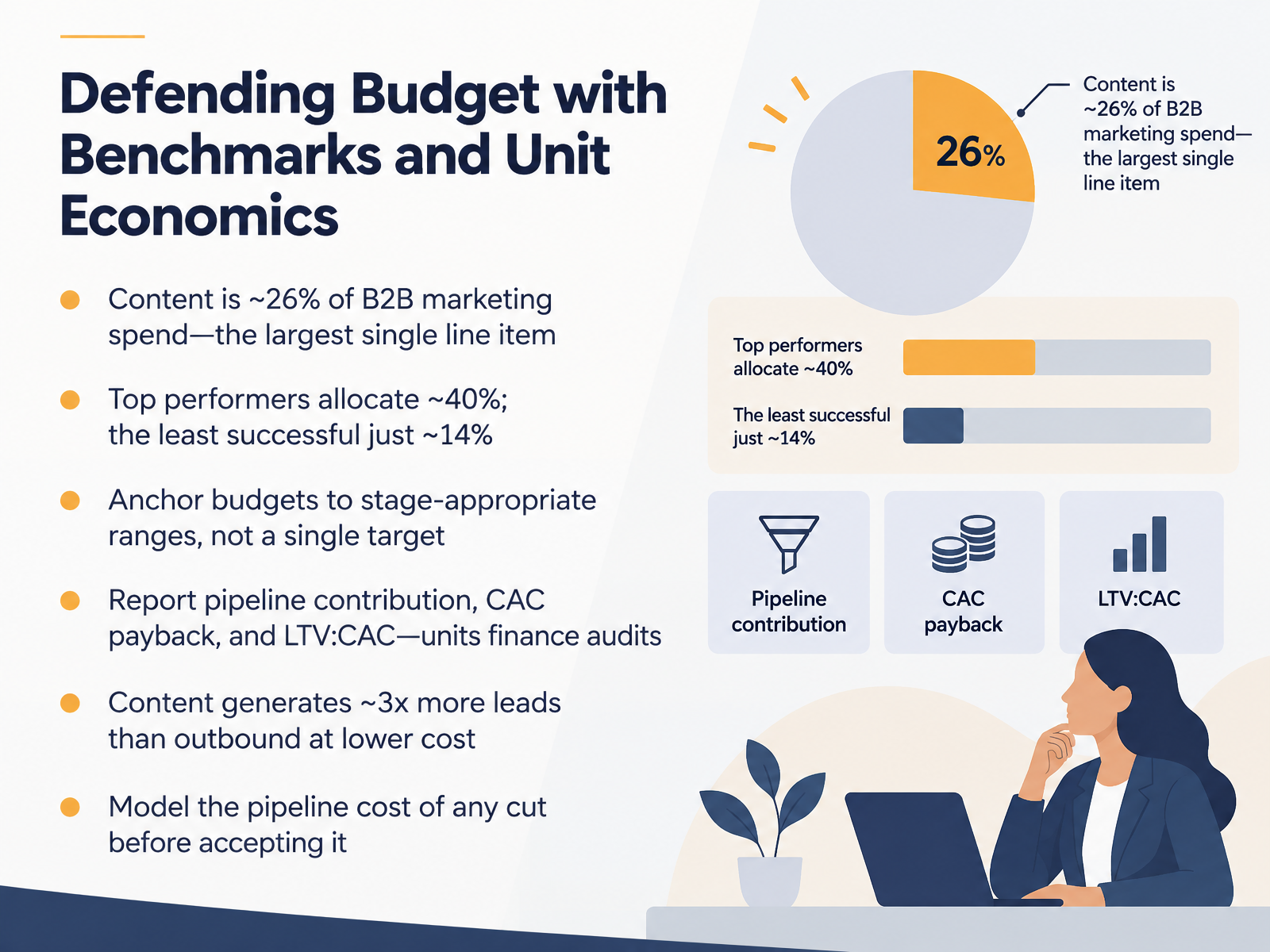
2 min - 13Defending Budget with Benchmarks and Unit EconomicsNow let's talk about defending budget with benchmarks and unit economics. Content is roughly twenty-six percent of B2B marketing spend. That makes it the largest single line item. And the spread between winners and losers is wide. Top performers allocate about forty percent. The least successful allocate just fourteen. So don't anchor to one target number. Anchor to a stage-appropriate range, based on your growth stage and goals. When you report, speak finance's language. Pipeline contribution, CAC payback, and LTV to CAC. These are the units finance audits. Content also generates about three times more leads than outbound, at a lower cost. That is a strong argument. But use it carefully. Before you accept any cut, model the pipeline cost. Ask what pipeline you lose, and when. That turns a budget debate into a tradeoff conversation, not a turf war. Bring ranges, not single points. Bring units finance trusts. And bring the cost of the cut. That is how you hold the line.
 2 min
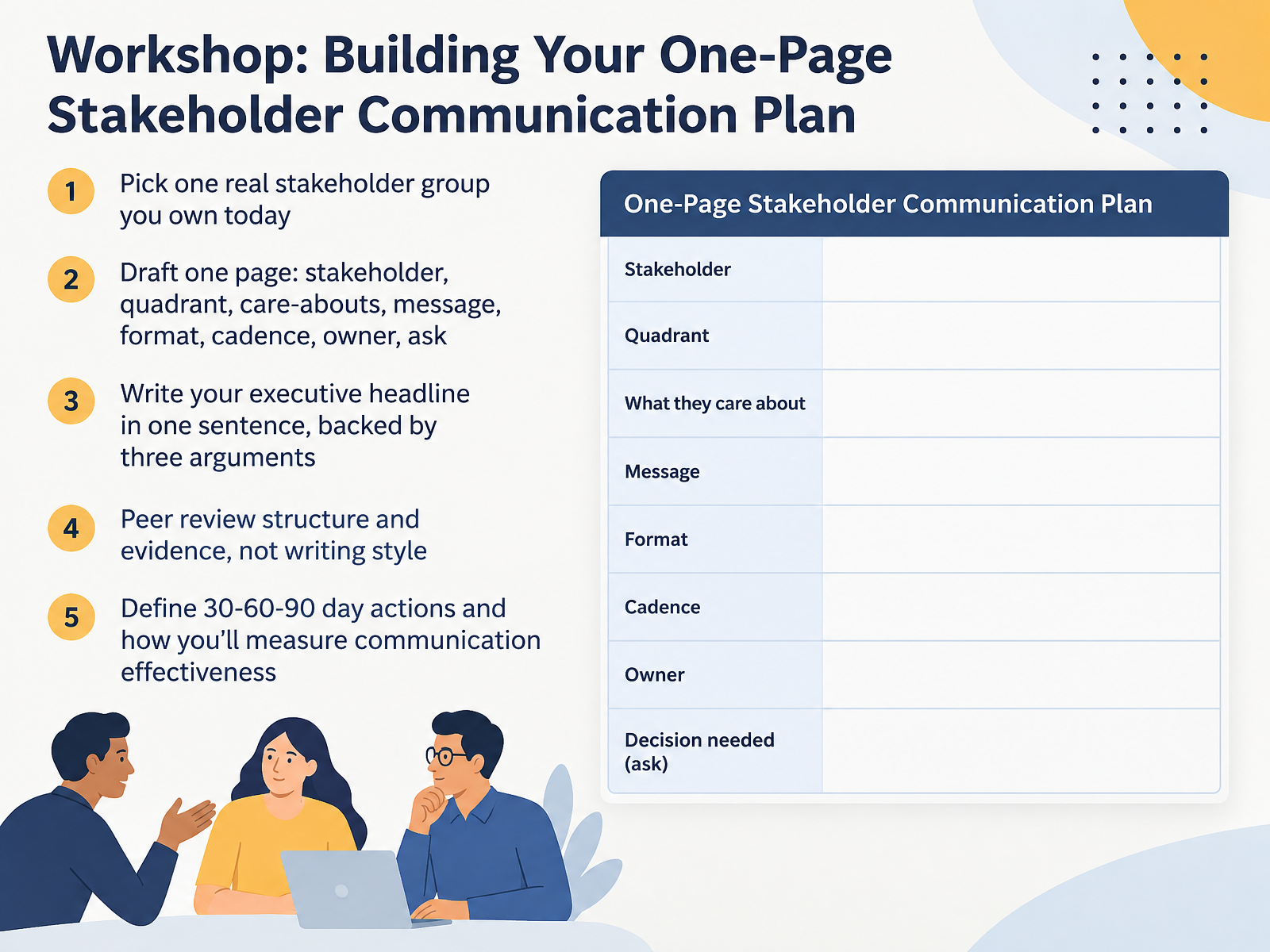
2 min - 14Workshop: Building Your One-Page Stakeholder Communication PlanLet's put this into practice. Pick one real stakeholder group you own today. Not a hypothetical, one you are accountable to this quarter. On a single page, capture eight fields: the stakeholder, their quadrant, what they care about, your core message, the format, the cadence, the owner, and the specific ask. Keep it to one page. If it spills over, your message is not sharp enough yet. Next, write your executive headline in one sentence, then back it with three arguments. That structure survives scrutiny in a way that a data dump never will. For peer review, focus on structure and evidence. Resist rewriting each other's sentences. The question is whether the logic holds and the proof is there. Finally, define your thirty, sixty, and ninety day actions, and decide now how you will measure communication effectiveness. Alignment, faster approvals, fewer repeated questions. That is your real scorecard, not opens and impressions alone. So take the page, test it with one colleague, and refine it. Communication becomes influence when we make it deliberate. Thank you for your work across this course, and go build that plan.
 2 min
2 min
Take the deck with you
Download this course as a file — free, no sign-up needed.
- PDF handoutEvery slide page, ready to print or share.15 pages · 3.3 MBDownload
- Narrated PowerPointThe deck that presents itself — every slide carries the digital human's narration video.15 pages · 15.3 MBDownload
- PowerPoint slidesThe full deck as a .pptx — open it in PowerPoint, Keynote, or Google Slides.15 pages · 3.2 MBDownload
Free to use in your own training — please keep the PersonWise credit page at the end.
Have your own deck? Turn it into a course
Sources consulted
Web sources consulted while building this course.
- Content Marketing Attribution: A Framework for B2B Teams | Ten Speed — tenspeed.io
- Marketing Influenced Pipeline Reporting Guide 2026 — cometly.com
- Measuring Content ROI for GTM: Tying Content to Pipeline | GTMStack — gtmstack.app
- Measuring B2B content ROI when attribution is broken | Current Ventures — current-ventures.io
- The B2B Content Measurement Framework That Actually Connects to Revenue - Chief Content Marketer — chiefcontentmarketer.com