Begin
14 pages · ~28 min
Reading Secondary Sources in History
This training teaches learners how to read secondary sources critically and understand how historians construct arguments from evidence. Ideal for students and researchers developing historical analysis skills.
A digital instructor presents all 14 pages. Hold “Ask” at any point and ask out loud — the answer comes from this course. No sign-up needed.
What you’ll learn
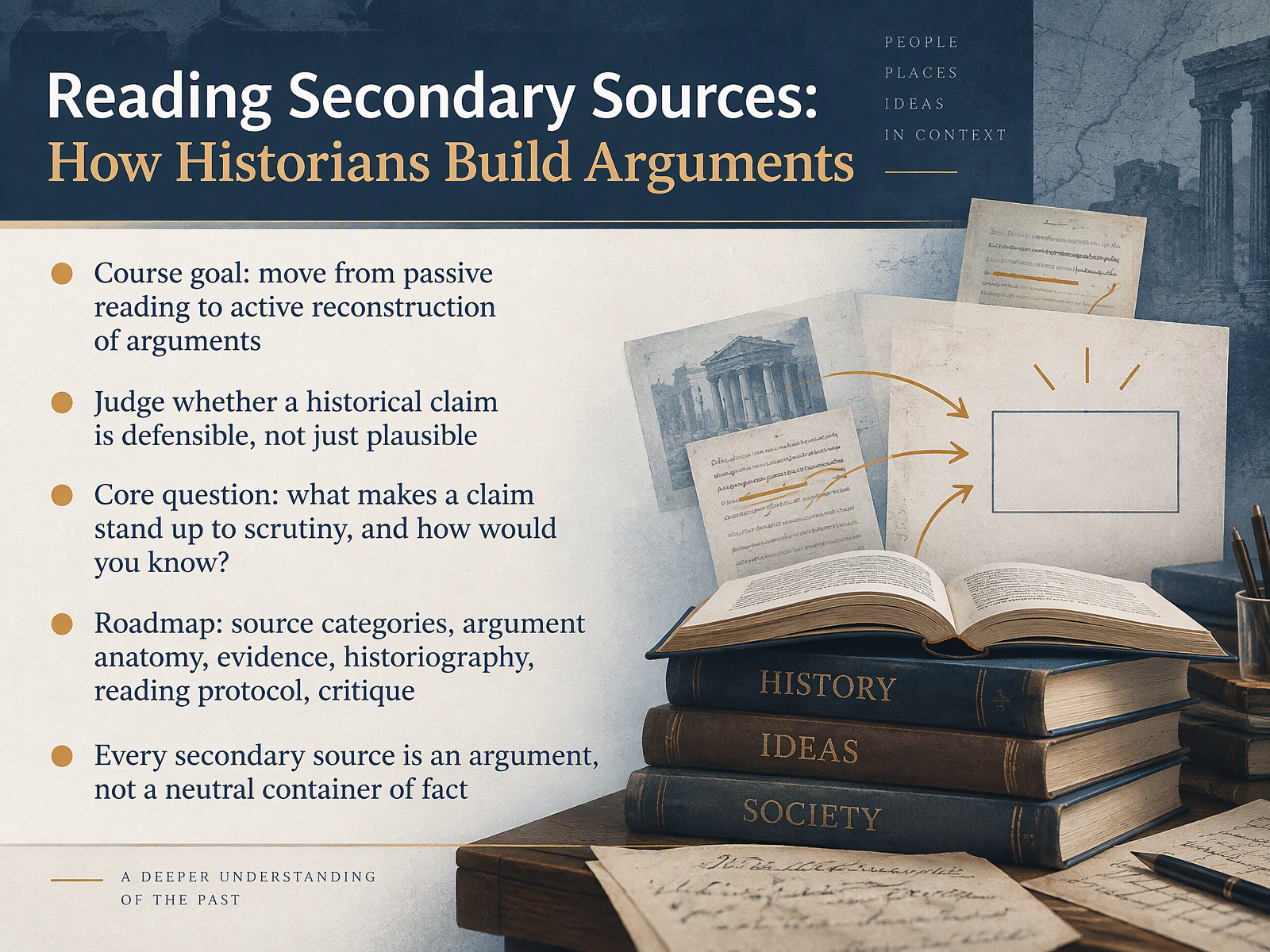
- 01Reading Secondary Sources: How Historians Build ArgumentsWelcome. I'm glad you're here. Over the next several lessons, we'll work on a skill that sits at the heart of historical study: reading secondary sources well. A secondary source is a scholar's account of the past, written after the events it describes. Our goal is to move you from passive reading, where you absorb information, to active reconstruction, where you identify an author's argument and test it. Historians ask not just whether a claim sounds plausible, but whether it is defensible. So keep one core question in mind: what makes a claim stand up to scrutiny, and how would you know? Here is our roadmap. We'll cover source categories, the anatomy of an argument, the role of evidence, historiography, a practical reading protocol, and finally, critique. Above all, remember this: every secondary source is an argument, not a neutral container of fact. For now, take one article you've been assigned and ask what the author is trying to prove. Next, we'll look at primary, secondary, and tertiary sources, and why the category matters.2 min
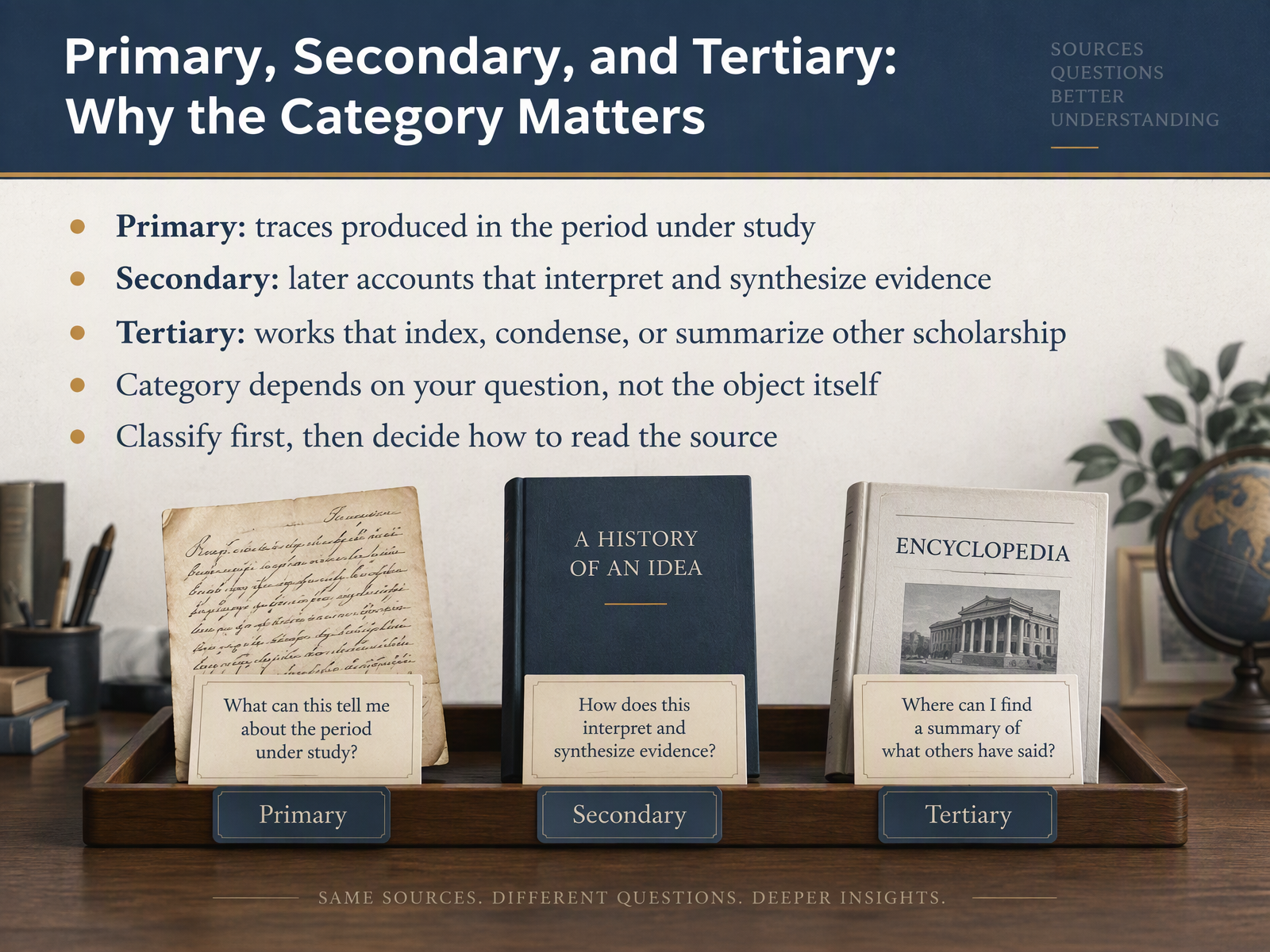
- 02Primary, Secondary, and Tertiary: Why the Category MattersLet's begin with a distinction you will use constantly: primary, secondary, and tertiary sources. A primary source is a trace produced in the period you are studying. A diary, a treaty, a photograph, a tax record. A secondary source is a later account that interprets and synthesizes that evidence, like a scholarly article or a history book. A tertiary source indexes, condenses, or summarizes other scholarship. Think of a textbook, an encyclopedia entry, or a bibliography. Here is the key idea. The category depends on your question, not on the object itself. That same diary becomes primary if you study its author, but secondary if it reports on events the author only heard about. So classify first, then decide how to read the source. Ask what role it plays in your specific argument. Before we go further, try this with the source in front of you now. Write down your research question, then label the source's role relative to that question. That small habit will sharpen every reading you do. Next, we look at the anatomy of a historical argument.
 2 min
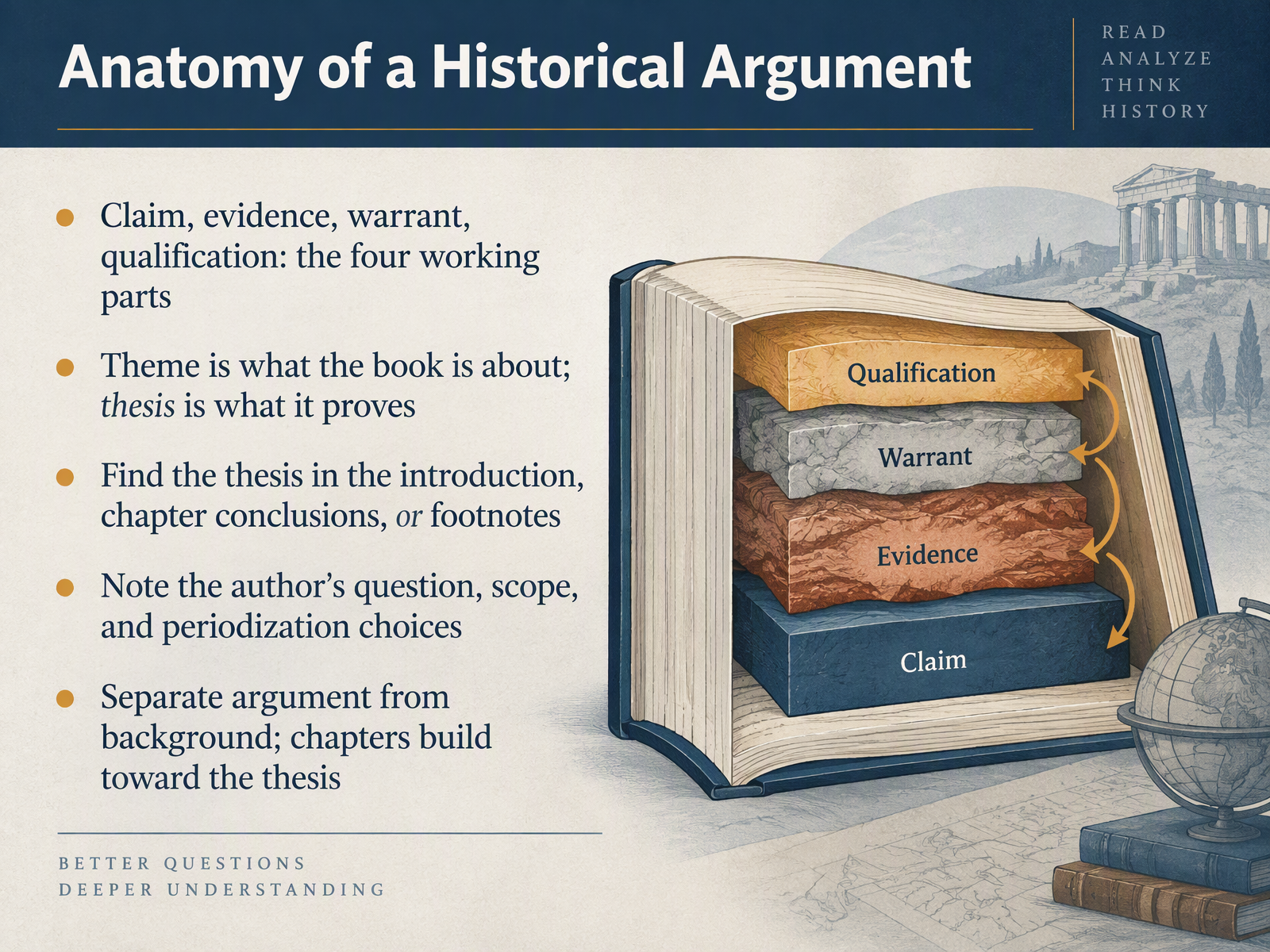
- 03Anatomy of a Historical ArgumentLet's move on to the anatomy of a historical argument. Every historical argument has four working parts. The claim is what the author asserts. The evidence is the material that supports it. The warrant is the reasoning that connects evidence to claim. And the qualification is where the author limits the claim. A second distinction matters just as much. The theme is what the book is about. The thesis is what it proves. So a theme might be the Industrial Revolution, while the thesis argues that factory work reshaped family roles in a specific region. To locate the thesis, check the introduction, the chapter conclusions, and even the footnotes. Then note the author's guiding question, scope, and periodization choices. Finally, separate argument from background. Chapters should build toward the thesis, not just report facts. Your next step is to write out the thesis of one source in a single sentence, then trace where the evidence supports it. Next, we turn to evidence, inference, and the historian's craft.
 2 min
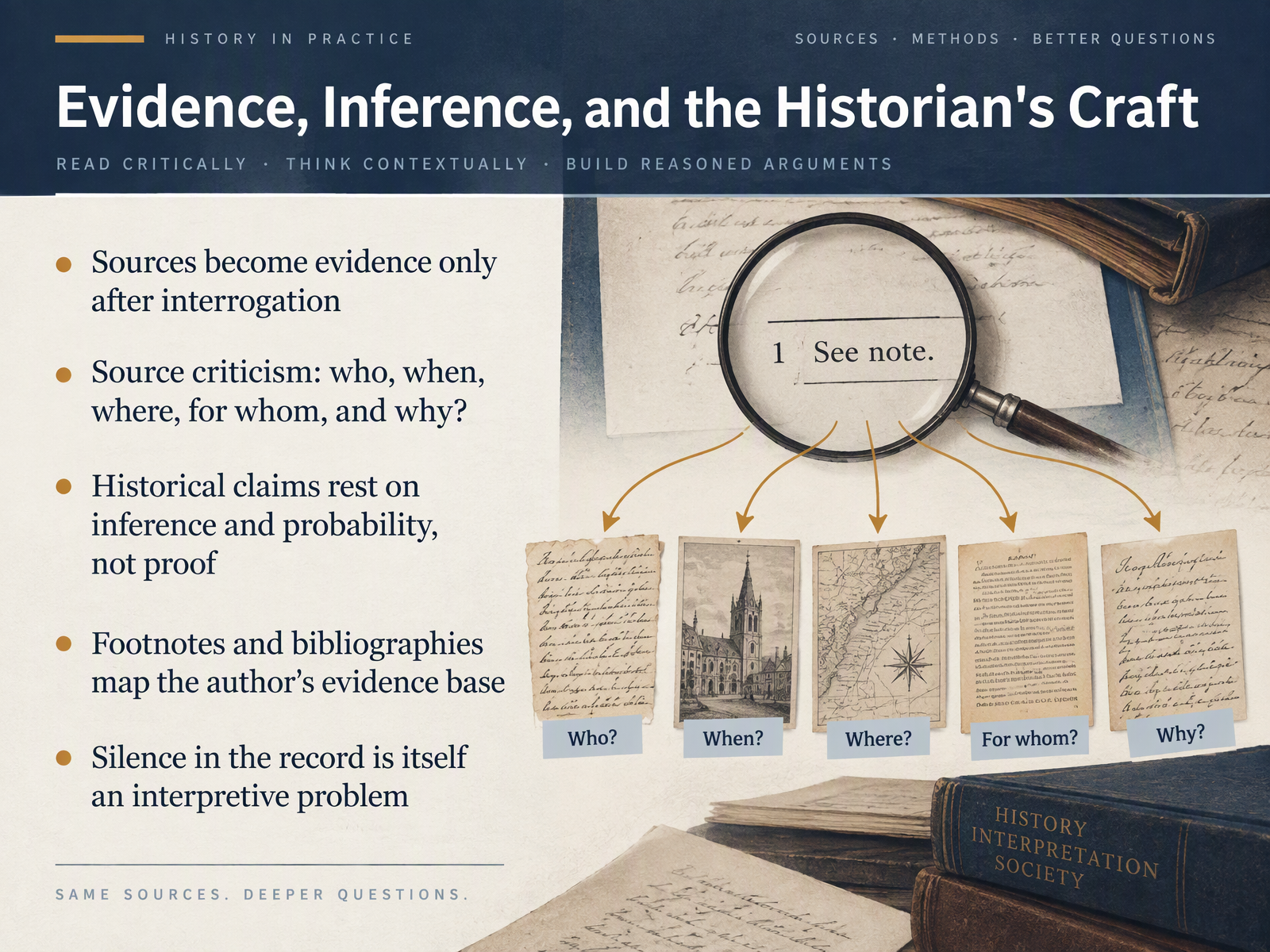
- 04Evidence, Inference, and the Historian's CraftLet's turn now to evidence, inference, and the historian's craft. Here is a principle worth remembering. A source becomes evidence only after interrogation. A document sitting in an archive is just an object. It becomes evidence when you ask who wrote it, when, where, for whom, and why. That is source criticism. And here is a harder truth. Historical claims rest on inference and probability, not proof. We rarely have certainty, only the most reasonable reading of the surviving record. So check the author's footnotes and bibliography. They map the evidence base, and gaps there tell you something. Finally, silence in the record is itself an interpretive problem. Absence is not automatic proof that nothing happened. Your next step, when you read a secondary source, is to trace one footnote back to its source and ask whether the original evidence supports the claim. That habit will sharpen every argument you encounter. Next, we look at historiography, reading a book in its conversation.
 2 min
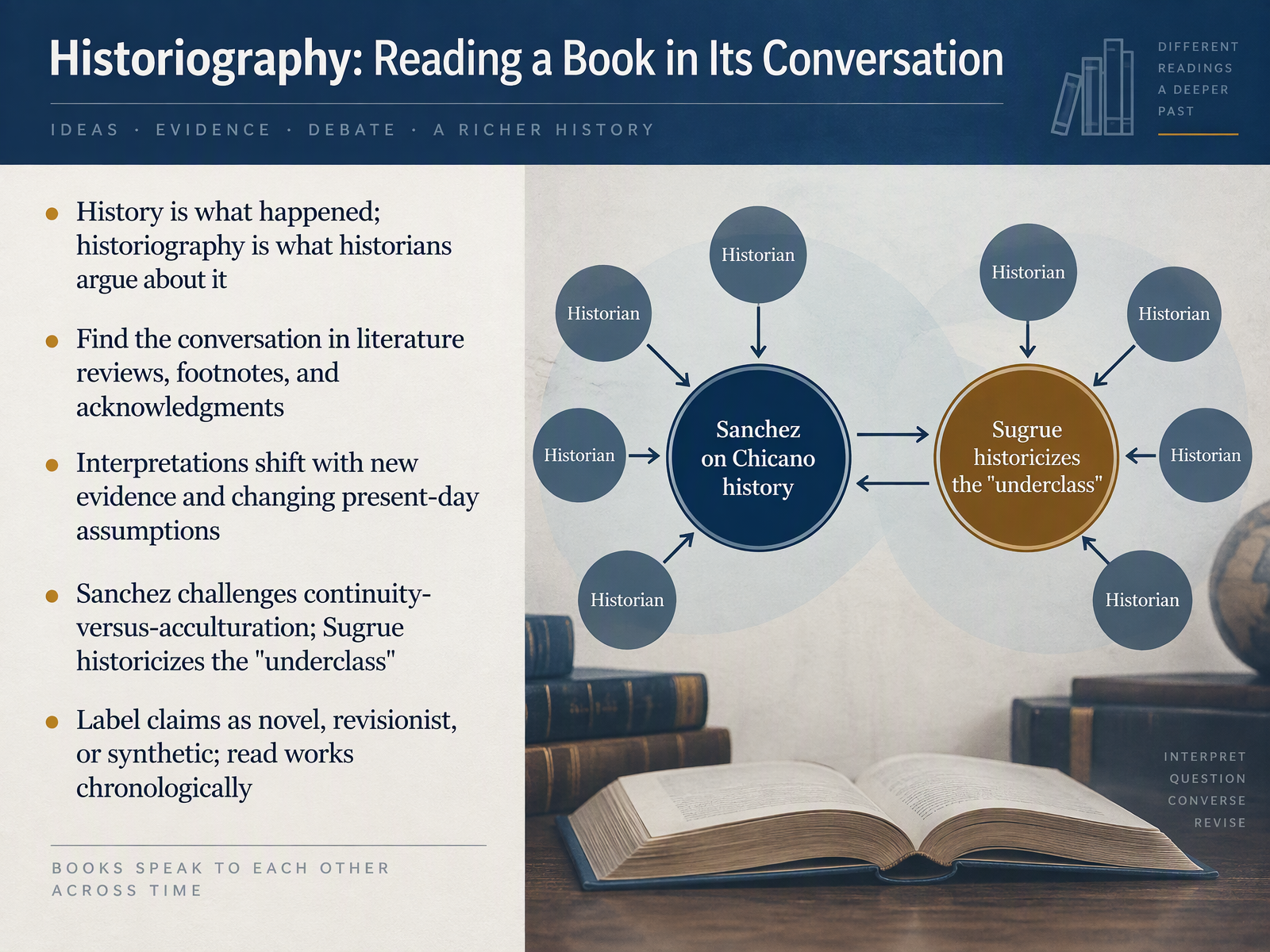
- 05Historiography: Reading a Book in Its ConversationLet's turn to historiography. History is what happened. Historiography is what historians argue about it. That distinction matters, because a book is never speaking alone. It is answering other books. So find the conversation. Look in the literature review, where authors position themselves against earlier work. Check the footnotes, where they borrow evidence and dispute rivals. And read the acknowledgments; they often reveal the scholarly community shaping the questions. Interpretations also shift. New evidence arrives, and present-day assumptions change what scholars notice. Consider Sanchez, who challenges a simple continuity-versus-acculturation story, or Sugrue, who historicizes the idea of an underclass rather than treating it as a fixed description. Here is a practical move. As you read, label each claim as novel, revisionist, or synthetic. Then read the works chronologically, so you can see the argument develop. Before you begin the next reading, check the book's citations and ask which conversation it joins. Next, Pre-Read: Reading the Book Before You Read the Book.
 2 min
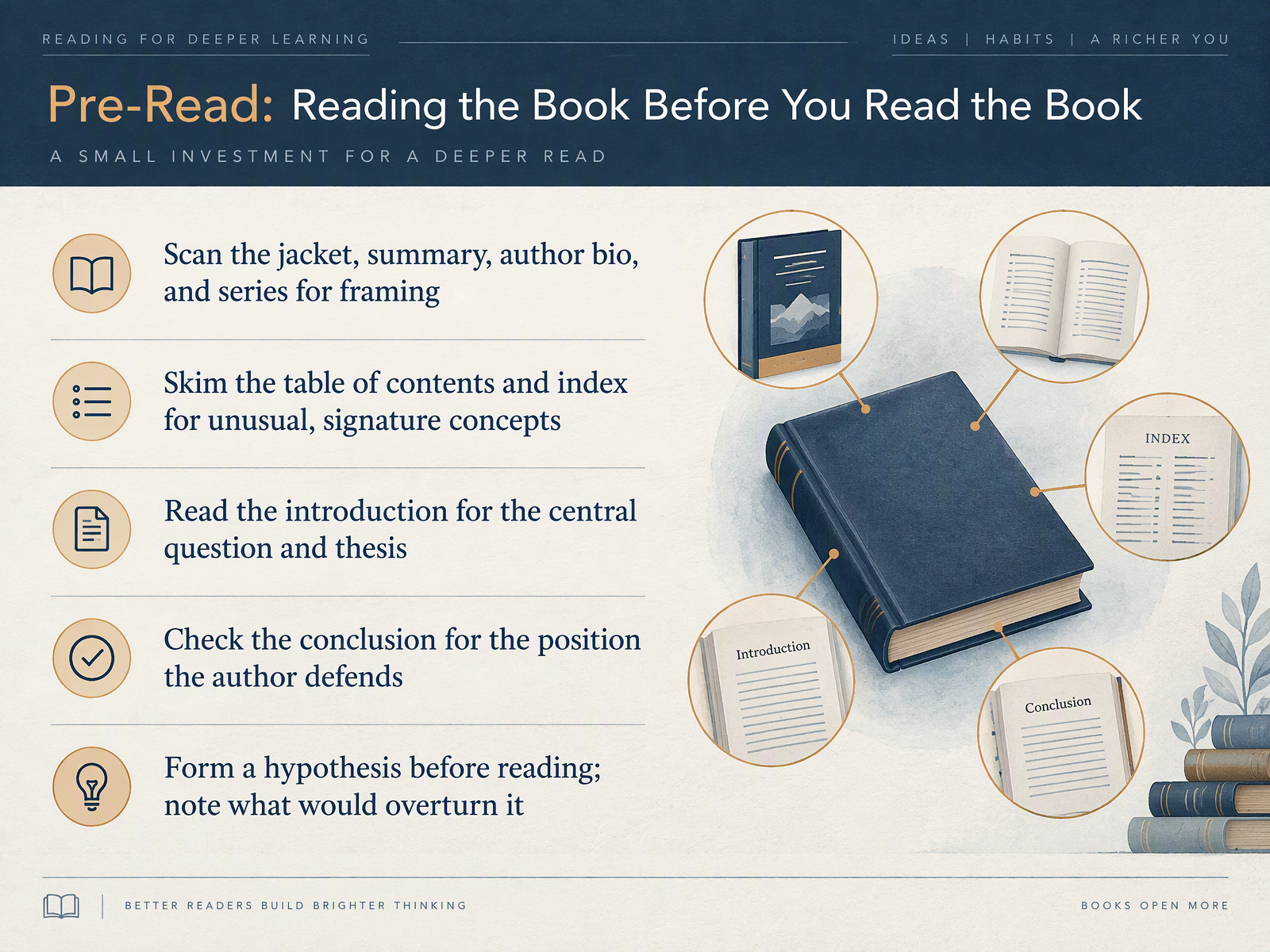
- 06Pre-Read: Reading the Book Before You Read the BookLet's look at a skill you can use before you read the book itself. Call it pre-reading. It means gathering clues about the author's argument before you commit to a full chapter.
Start with the jacket. Scan the summary, the author bio, and the series. These frame the book. They tell you what tradition the author writes in and who they expect to persuade. Then skim the table of contents and the index. Look for unusual, signature concepts. In a book on the French Revolution, an entry like 'political culture' repeated across chapters signals the author's main lens.
Next, read the introduction for the central question and thesis. What puzzle is the author trying to solve? Then check the conclusion for the position they defend. Finally, form a hypothesis before reading. Write down what evidence would overturn it. This keeps you curious rather than passive.
A practical next step: choose one book on your shelf and pre-read it for ten minutes. So how do you carry those hypotheses through a full reading systematically? That brings us to the critical reading protocol, a repeatable workflow.
 2 min
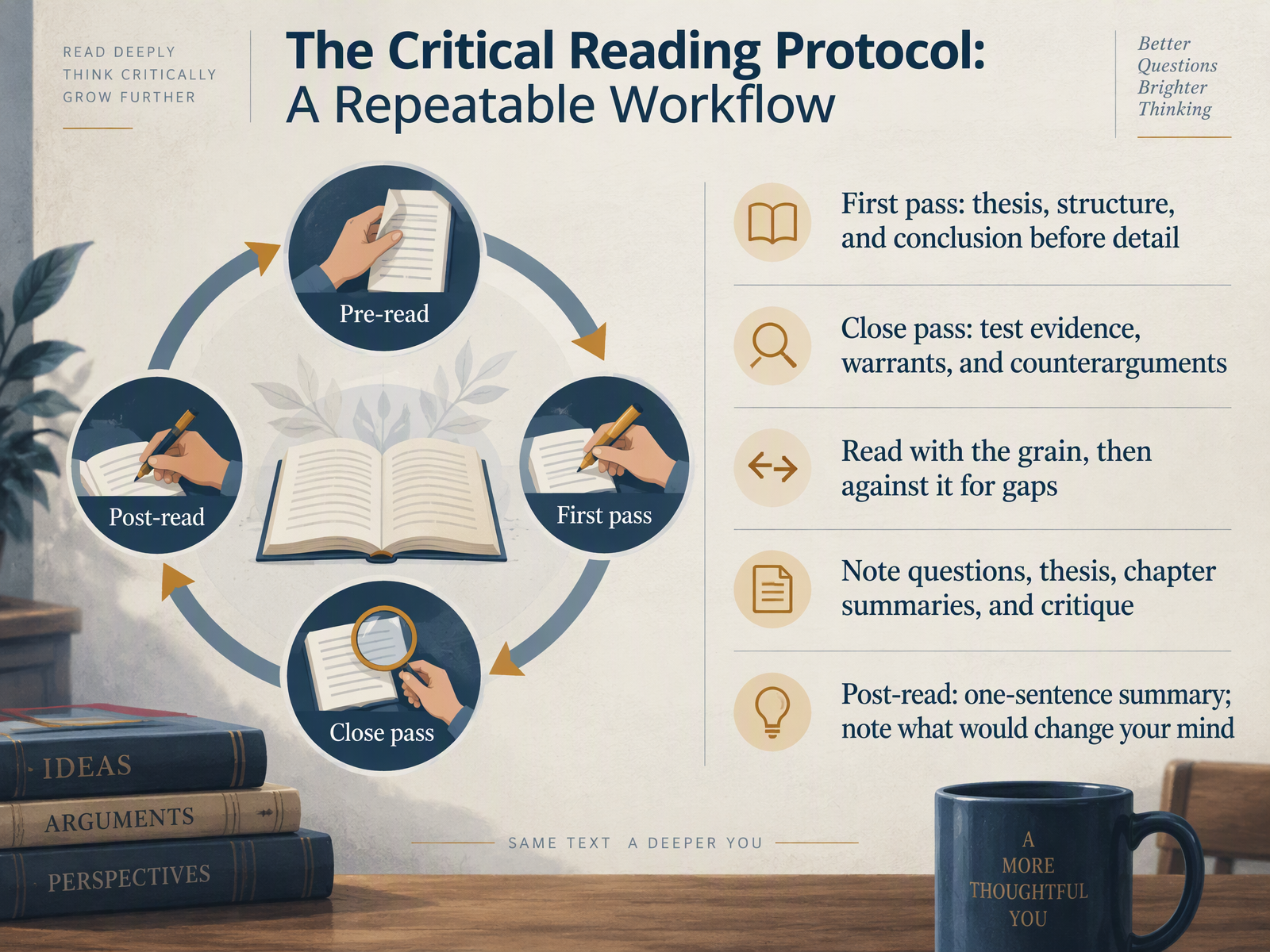
- 07The Critical Reading Protocol: A Repeatable WorkflowLet's turn next to a repeatable workflow for reading secondary sources critically. On your first pass, read for thesis, structure, and conclusion before you touch the detail. Ask what the author claims and how the chapters are organized to support it. Then make a close pass. Test the evidence, the warrants, and any counterarguments. A warrant is the assumption linking evidence to claim, so check whether it actually holds. Read with the grain first, following the author's argument on its own terms. Then read against it, looking for gaps, silences, and evidence that does not fit. As you read, keep a running log. Note your questions, the thesis, short chapter summaries, and your critique. After you finish, write a one-sentence summary of the book's argument, and note what evidence would change your mind. Try this on your next article and see how much sharper your notes become. Next, we'll look at spotting weak arguments and hidden assumptions.
 2 min
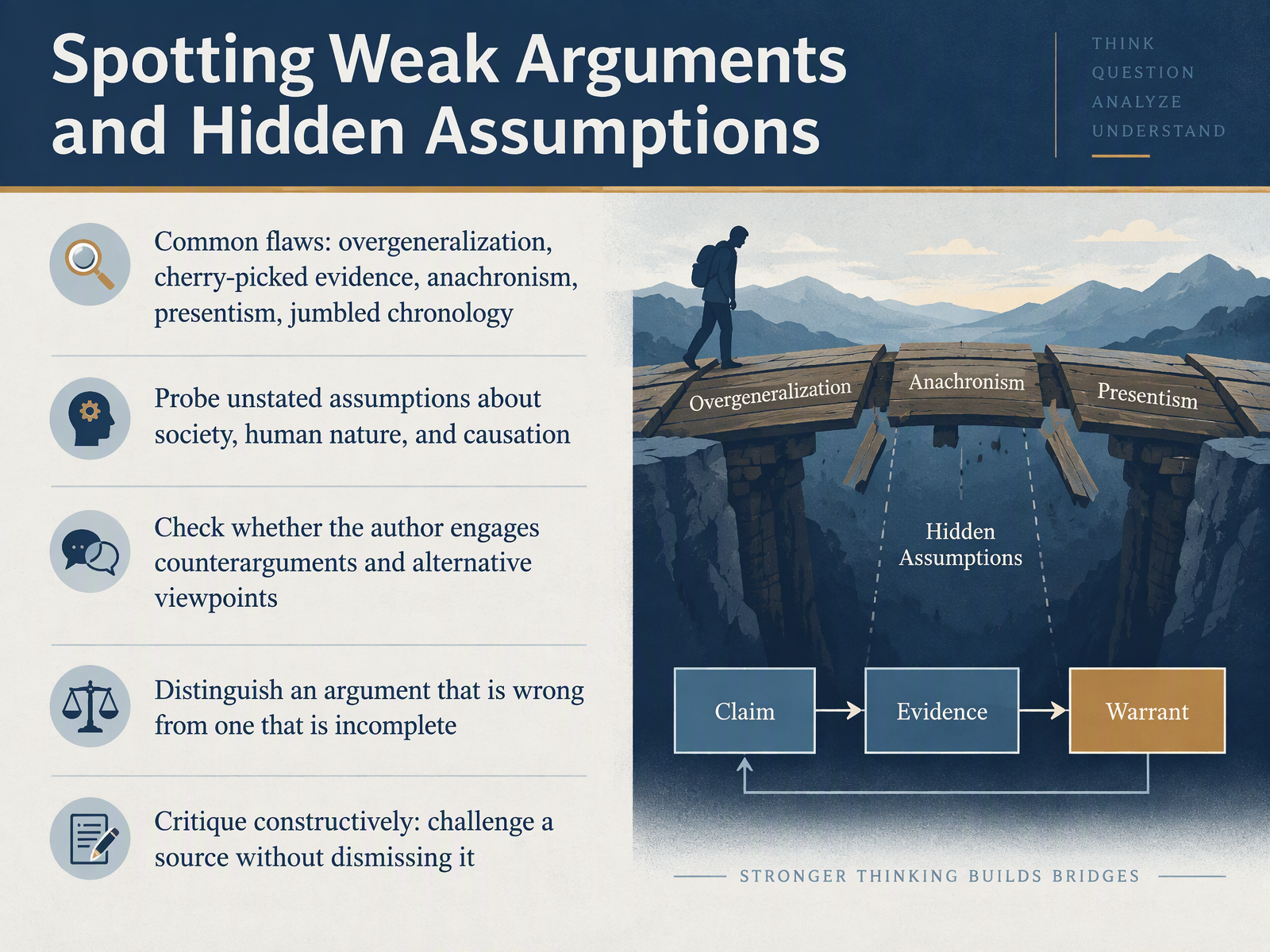
- 08Spotting Weak Arguments and Hidden AssumptionsLet's move on to spotting weak arguments and hidden assumptions. Historians make recognizable mistakes. Watch for overgeneralization, where one case is stretched to explain everything. Watch for cherry-picked evidence, where inconvenient sources get left out. Then there are anachronism, judging the past by ideas that did not yet exist, and presentism, reading today's values back into it. Jumbled chronology can also break a causal claim. So probe the unstated assumptions. What does the author assume about human nature, society, or what causes change? Ask whether they engage counterarguments or quietly avoid them. And distinguish an argument that is wrong from one that is incomplete. Be constructive. Challenge a source without dismissing it. For now, pick one source you are reading and write down two assumptions it never states aloud. That practice carries directly into our next topic, using secondary sources responsibly through synthesis, quotation, and citation.
 2 min
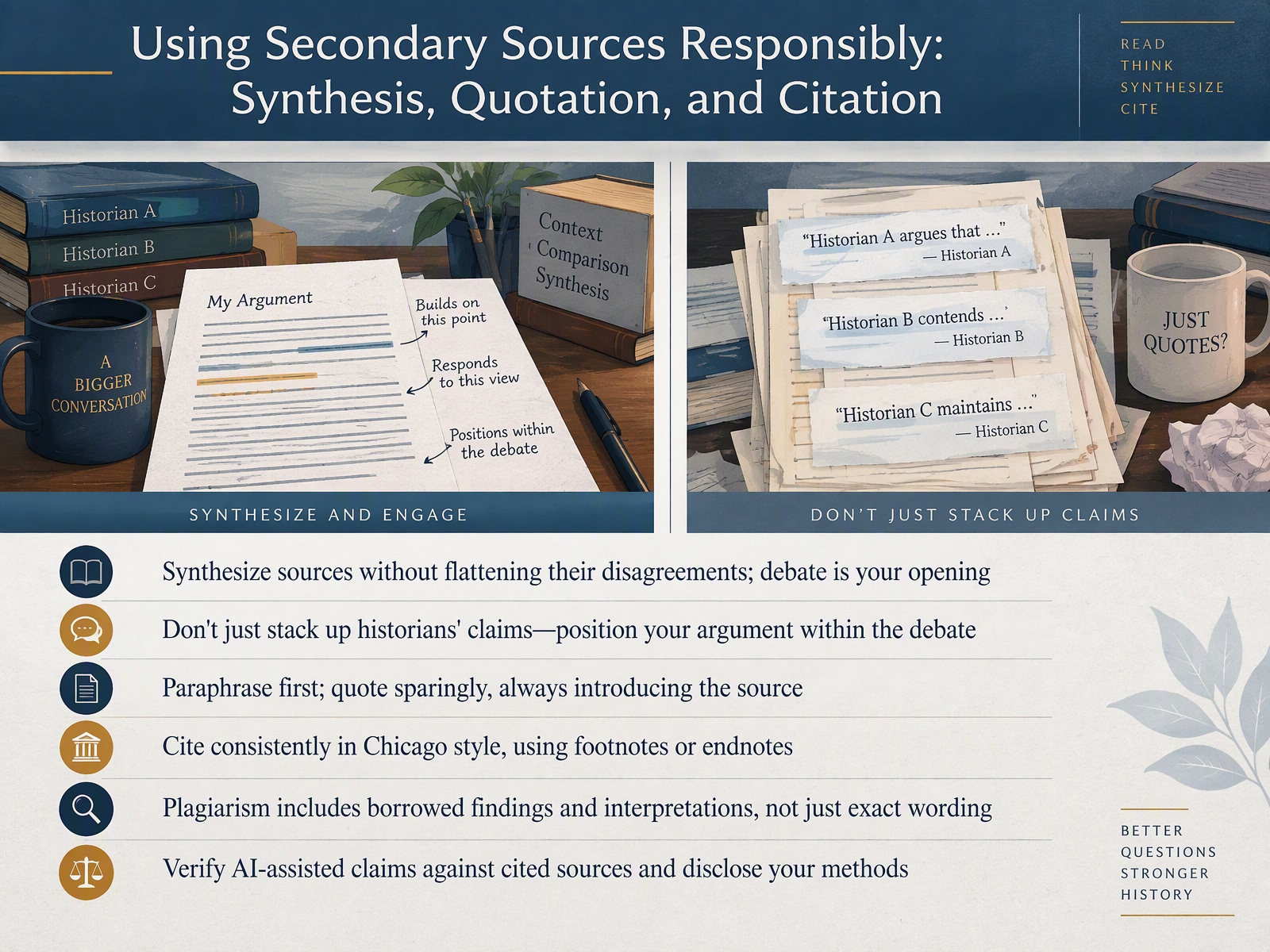
- 09Using Secondary Sources Responsibly: Synthesis, Quotation, and CitationNow let's talk about using secondary sources responsibly. Good historical writing depends on synthesis, careful quotation, and consistent citation. Here's the key instruction. Synthesize sources without flattening their disagreements. When historians argue, that debate is your opening, not an obstacle. Don't simply stack one historian's claim on top of another. Position your own argument within the debate. Show where you agree, where you push back, and why. Next, paraphrase first. Quote sparingly, and always introduce the source before the quotation. Use Chicago style consistently, in footnotes or endnotes. And remember that plagiarism includes borrowed findings and interpretations, not just exact wording. That trips up many careful writers, so check yourself. Finally, if you use AI-assisted claims, verify them against the cited sources and disclose your methods. Then bring these habits to the next step: Practice Lab: Annotate, Reconstruct, and Critique.
 2 min
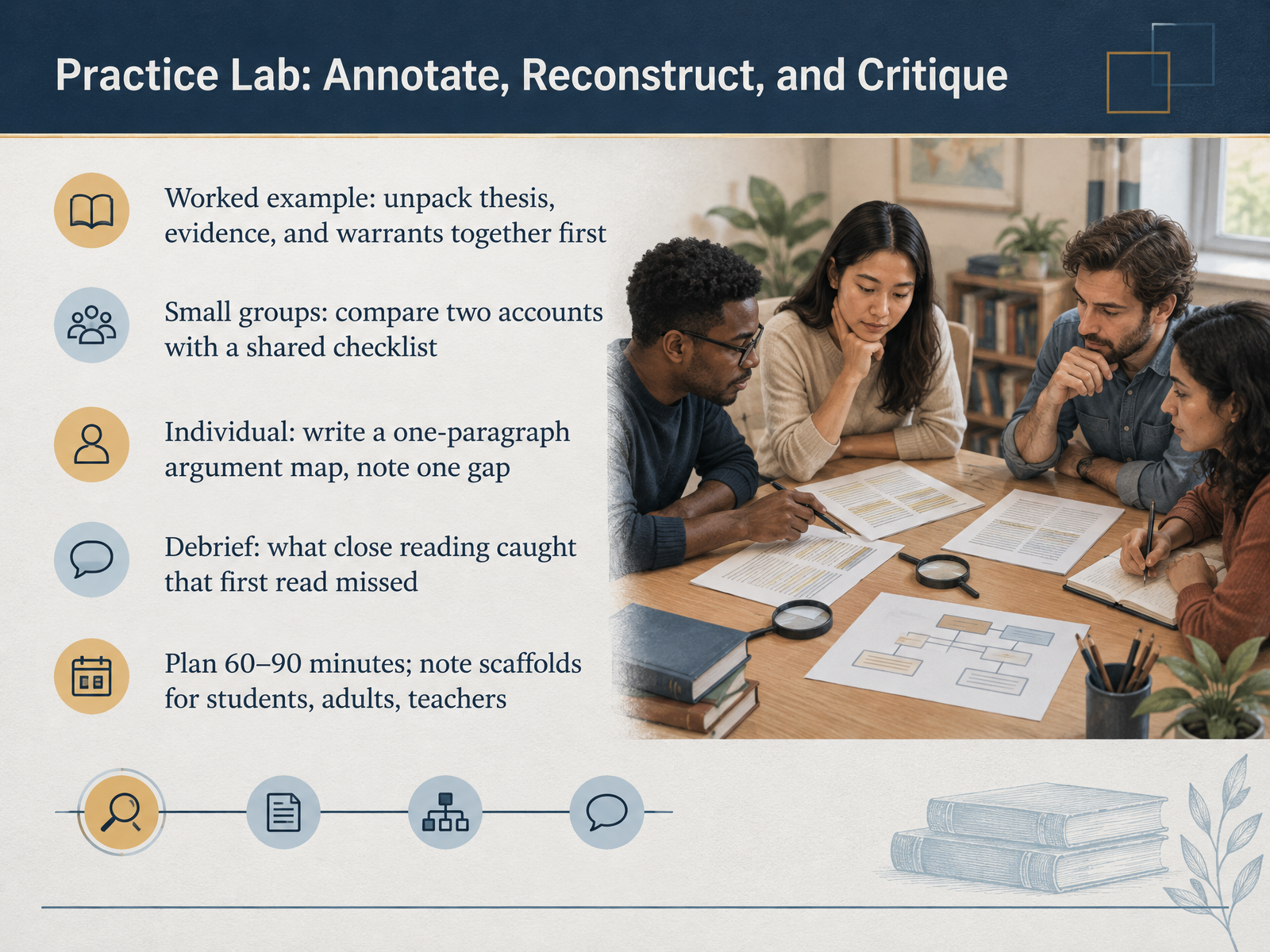
- 10Practice Lab: Annotate, Reconstruct, and CritiqueNow let's put these reading habits into practice. In this lab, you will annotate, reconstruct, and critique a secondary source. Start with a worked example. Together, unpack the thesis, the evidence, and the warrants, meaning the assumptions that link evidence to claim. Do this aloud so listeners hear the reasoning.
Next, small groups compare two accounts of the same event using a shared checklist. Look for where the authors agree, and where their interpretations diverge.
Then individually, write a one-paragraph argument map of one source, and note one gap in its reasoning or evidence.
Close with a debrief. Ask what close reading caught that the first read missed. Plan sixty to ninety minutes for this lab. Prepare scaffolds for students, adult learners, and teachers, such as sentence starters or a checklist. Before moving on, choose one annotation you will try on your next source. Next, we look at teaching the skill and scaffolding for different learners.
 2 min
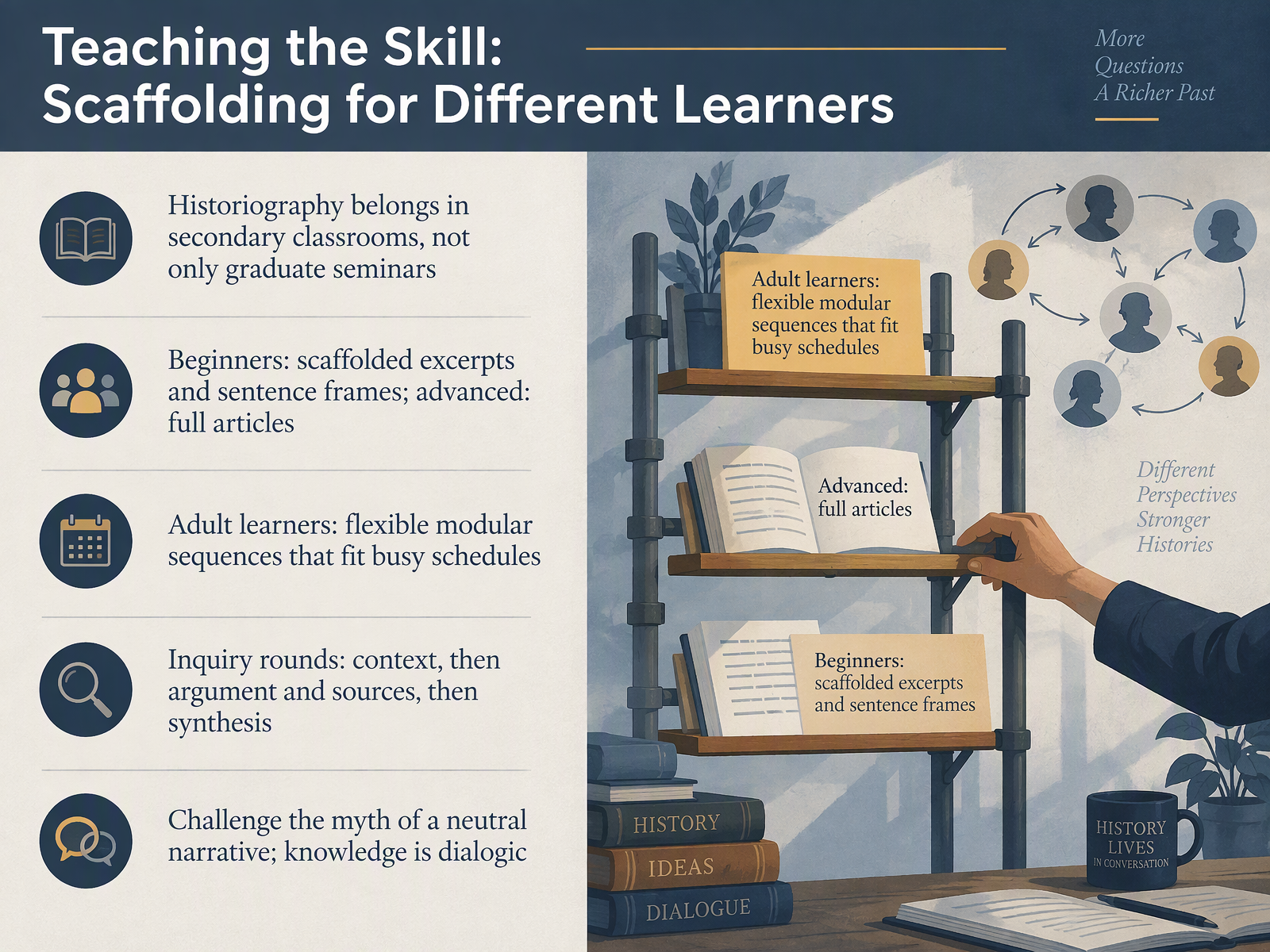
- 11Teaching the Skill: Scaffolding for Different LearnersSo how do we actually teach this skill? Start with the principle. Historiography belongs in secondary classrooms, not only in graduate seminars. Then match the scaffold to the learner. Beginners can work with short, guided excerpts and sentence frames, such as, this author argues that, because. Advanced readers can take on complete journal articles. Adult learners often need flexible, modular sequences that fit busy schedules, so keep each unit short and self-contained. Try running inquiry rounds. First establish context. Then examine the argument and its sources. Then ask students to synthesize. And challenge the myth of a neutral narrative. Historical knowledge is dialogic. It is built through debate. A practical next step is to design one inquiry round for a text you already teach.
 2 min
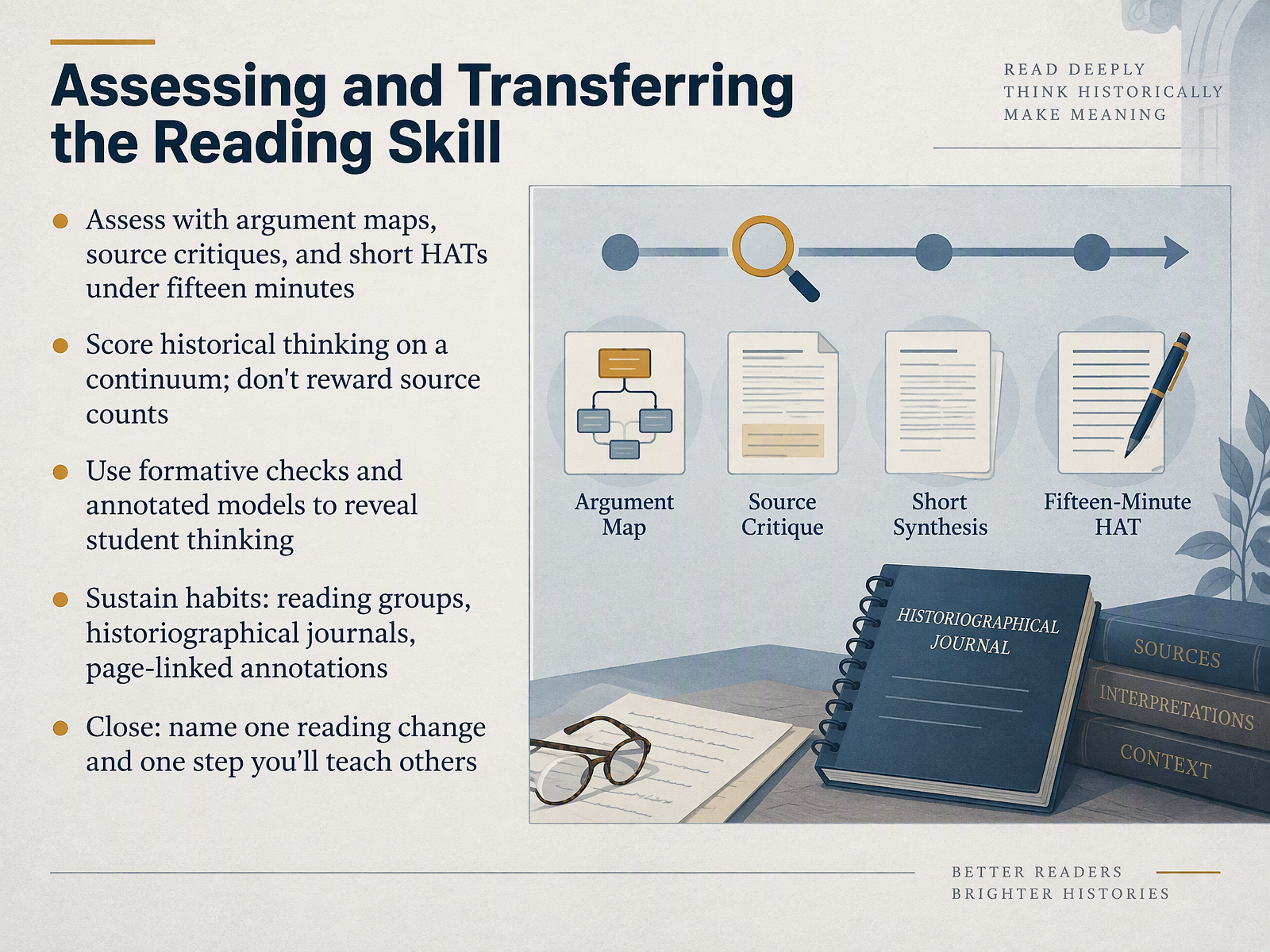
- 12Assessing and Transferring the Reading SkillLet us turn to assessment. Assess with argument maps, short source critiques, and document-based questions you can finish in under fifteen minutes. Score historical thinking on a continuum. Do not simply reward how many sources a student cites. Use formative checks and annotated models to reveal how a student is thinking, not just what they concluded. To sustain the habit, form reading groups, assign historiographical journals, and keep annotations linked to specific pages. Interpreting sources is genuinely difficult, so treat every check as information, not a verdict. Your next step is practical. Close this session by naming one change you will make in your own reading, and one step you will teach to others. Now, let us consider common misconceptions and how to address them.
 1 min
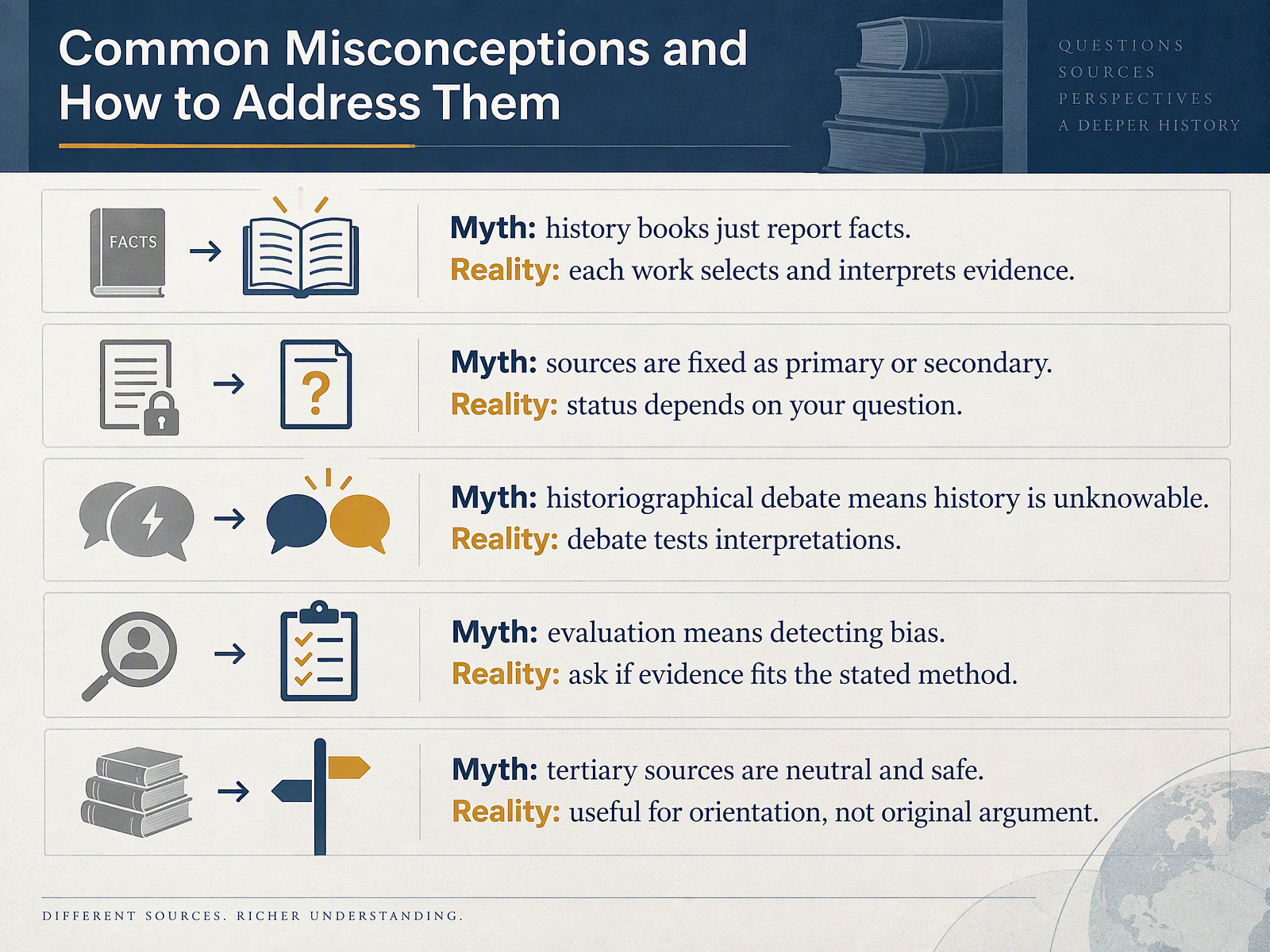
- 13Common Misconceptions and How to Address ThemLet's clear up a few common misconceptions about reading secondary sources. First, history books do not simply report facts. Every work selects and interprets evidence, so ask what the author chose to leave out. Second, sources are not permanently fixed as primary or secondary. Their status depends on your question. A textbook is secondary for most research, but it becomes a primary source if you are studying how a period was taught. Third, historiographical debate does not mean history is unknowable. Debate is how interpretations get tested and refined. Disagreement is a sign of a working field, not a failed one. Fourth, evaluation is not just detecting bias. Bias is easy to spot and easy to dismiss. Instead, ask whether the evidence actually fits the method the author claims to use. Check the citations before accepting the claim. Finally, tertiary sources like encyclopedias are not neutral and safe. Use them for orientation, then follow their citations to original arguments. As you read, pick one of these myths and test it against your current book. Next, we will pull these ideas together in Key Takeaways and Next Steps.
 2 min
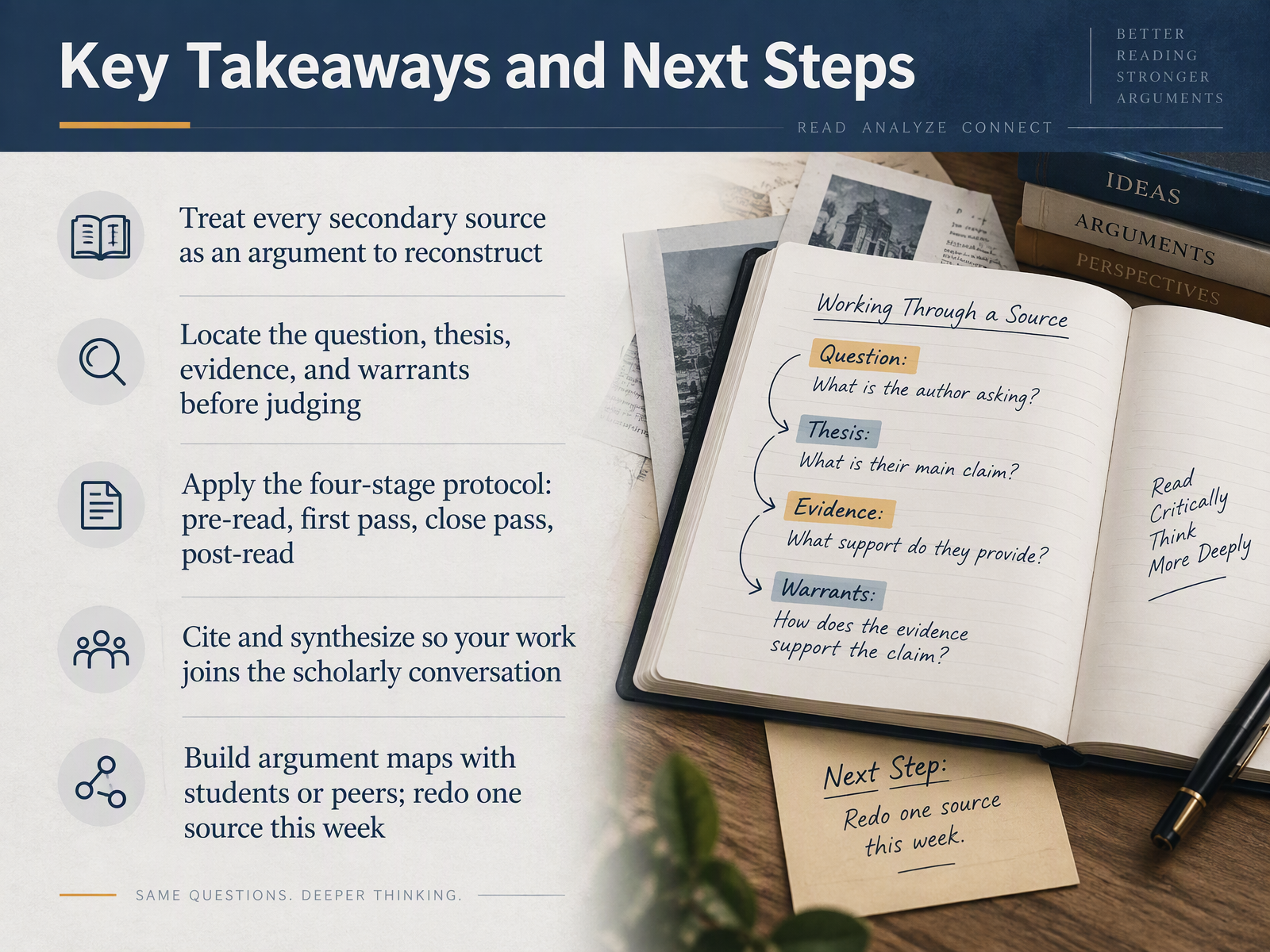
- 14Key Takeaways and Next StepsLet's bring this together. First, treat every secondary source as an argument to reconstruct, not a container of facts. A textbook chapter on the fall of Rome, for instance, is making a case about causes. Second, locate the question, thesis, evidence, and warrants before judging. Ask what the author assumes must be true for the evidence to support the claim. Third, apply the four-stage protocol: pre-read, first pass, close pass, and post-read. Fourth, cite and synthesize so your work joins the scholarly conversation. And fifth, build argument maps with students or peers. Argument mapping simply means drawing the claim, evidence, and assumptions as a diagram. Then redo one source this week. Pick an article you have already read and map its argument. Thank you for your careful work. Interpreting sources is genuinely difficult, and that difficulty is where the learning happens. Keep asking questions, stay curious about disagreement, and you will build arguments that hold up.
 2 min
Take the deck with you
Download this course as a file — free, no sign-up needed.
- PDF handoutEvery slide page, ready to print or share.15 pages · 4.9 MBDownload
- Narrated PowerPointThe deck that presents itself — every slide carries the digital human's narration video.15 pages · 14.5 MBDownload
- PowerPoint slidesThe full deck as a .pptx — open it in PowerPoint, Keynote, or Google Slides.15 pages · 4.9 MBDownload
Free to use in your own training — please keep the PersonWise credit page at the end.
Have your own deck? Turn it into a course