Building a Social Media Marketing Team
Begin
14 pages · ~28 min
Building a Social Media Marketing Team
This workflow helps marketing managers and team leads build and structure an effective social media marketing team, covering roles, hiring, and collaboration practices.
What you’ll learn
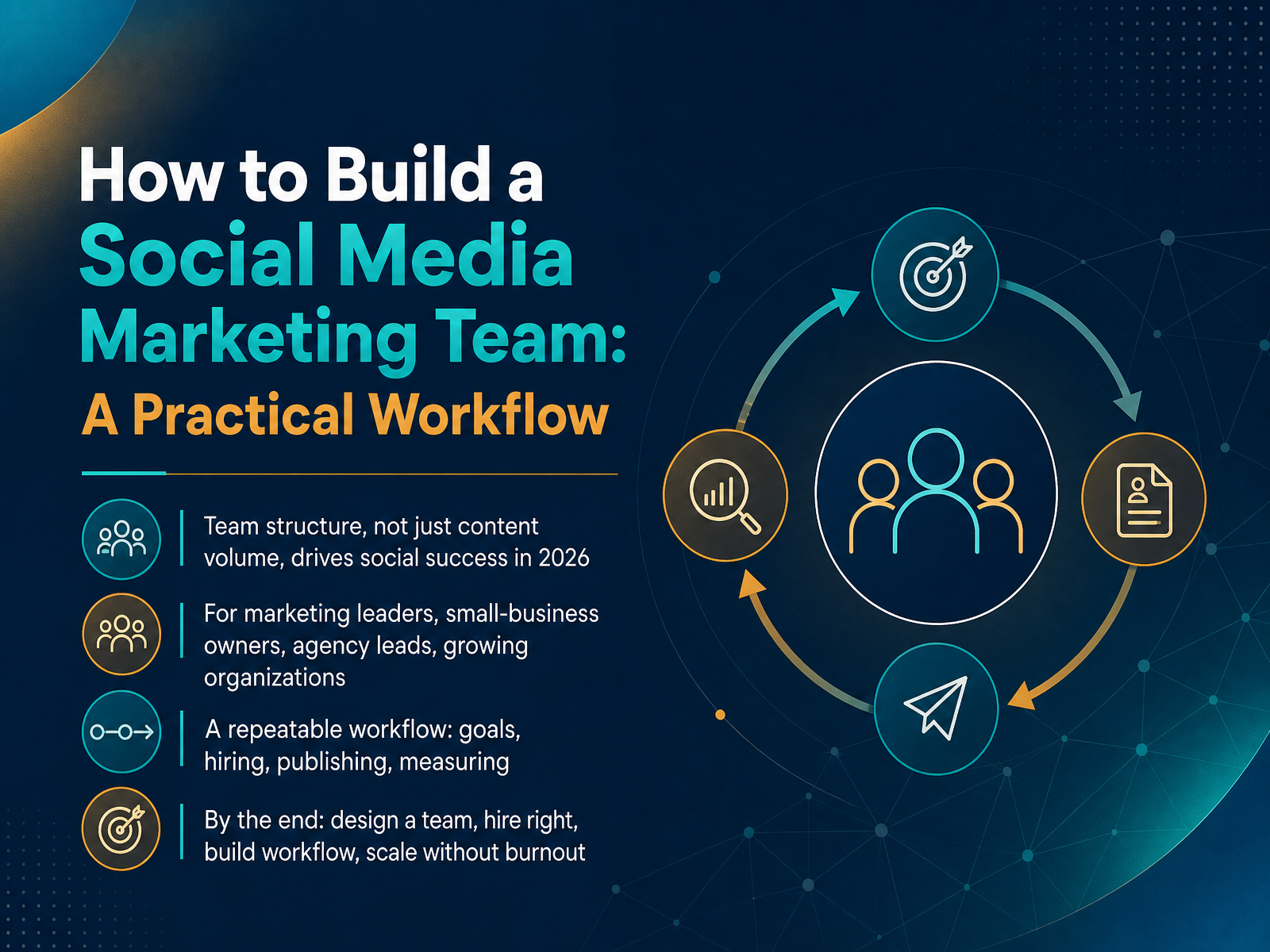
- 01How to Build a Social Media Marketing Team: A Practical WorkflowWelcome. If you own social media results, and you are working with limited time and uneven skills, this is for you. Here is the core idea for this course. Team structure, not content volume, drives social success in 2026. More posts will not fix a broken setup. The right roles, in the right order, will. This is built for marketing leaders, small business owners, agency leads, and growing organizations. Over the next few slides, we will walk a repeatable workflow. Four steps. Set clear goals. Hire against real bottlenecks. Build a publishing rhythm. Then measure what moves the business. By the end, you will be able to design a team that fits your budget, hire the right people at the right time, build a workflow your team can actually follow, and scale without burning people out. Start with this mindset. One clear owner per outcome beats one person doing everything. Let's get into it. The Broken Model of Generalist Social Teams.socialpilot.coblog.hootsuite.comconstantcontact.com+21 min
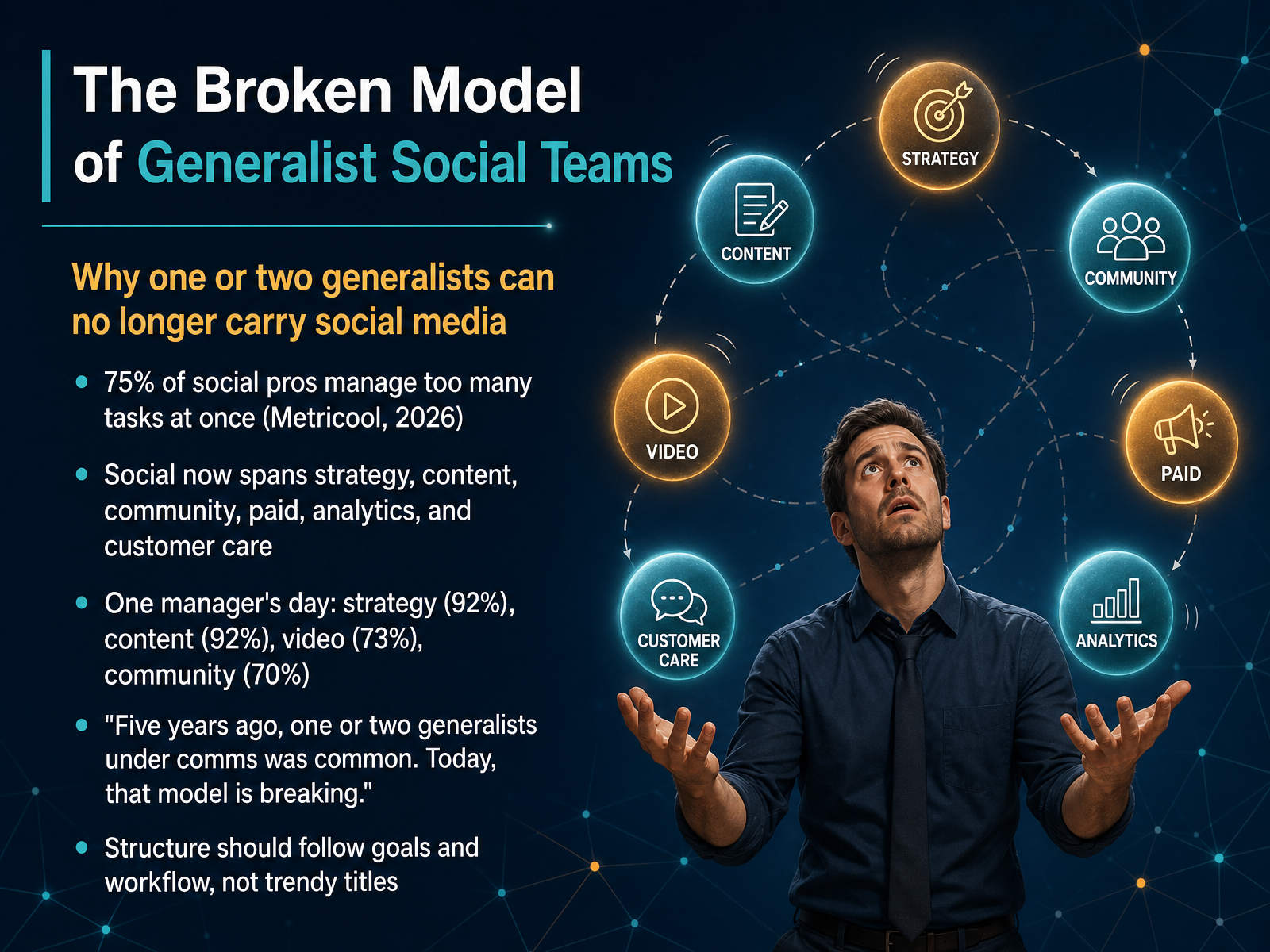
- 02The Broken Model of Generalist Social TeamsLet's talk about why the old social media team model is breaking. If you're still running one or two generalists, you're asking them to do the impossible. Seventy-five percent of social professionals say they manage too many tasks at once. That's not a morale problem. It's a structural one. Think about what social actually covers now. Strategy, content, community, paid, analytics, and customer care. One manager's day proves it. Eighty percent or more of them handle strategy and content. Nearly three-quarters edit video. And around seventy percent manage community. That's five jobs in one chair. As one agency founder put it, five years ago, one or two generalists under communications was common. Today, that model is breaking. So here's your takeaway. Structure should follow your goals and your workflow, not trendy titles. Stop hiring for job descriptions that only exist on paper. Start mapping the actual work. Who owns strategy? Who produces content? Who handles the inbox? Who reads the data? If one person owns all of it, nothing gets done well. And you can't show return on investment you can't measure. Next, let's clarify your goals and social media scope, so you know exactly where to start.
 socialpilot.coblog.hootsuite.comconstantcontact.com+21 min
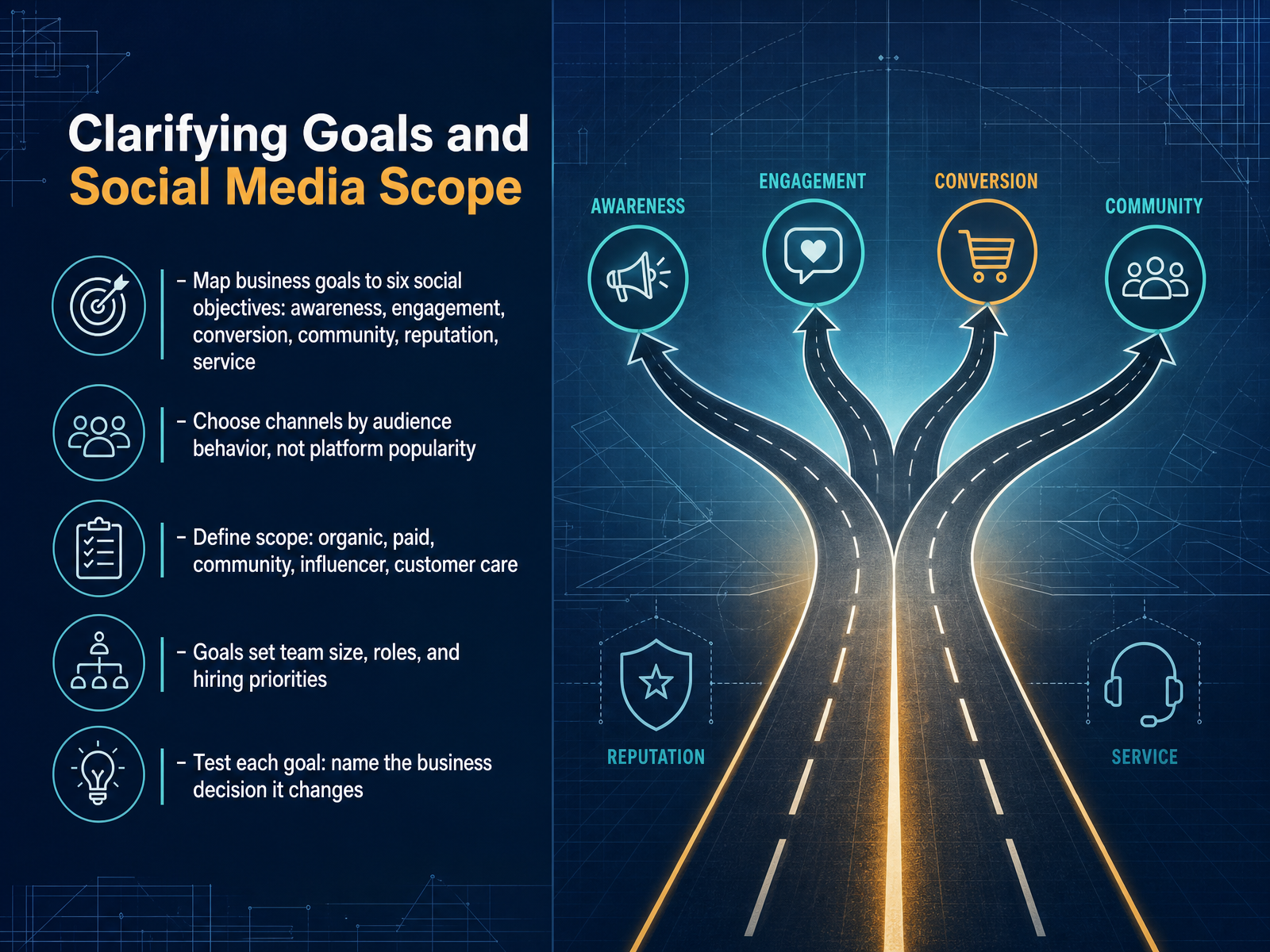
 - 03Clarifying Goals and Social Media ScopeLet's talk about clarifying goals and scope. This is where most social teams get into trouble, so get it right upfront. First, map your business goals to six social objectives: awareness, engagement, conversion, community, reputation, and service. Pick the two or three that actually matter this quarter. Second, choose channels by audience behavior, not platform popularity. Be where your buyers already make decisions. Third, define your scope across organic, paid, community, influencer, and customer care. Be honest about what you can staff and sustain. Your scope sets your team size, your roles, and your hiring priorities. And here's the test for every goal: name the business decision it changes. If more budget, a new market, or a product change would follow from hitting that goal, it's real. If nothing changes, it's a vanity metric. Keep your list short and defendable. Next, we move from business goals to social media KPIs.
 blog.hootsuite.comsynthesio.combuffer.com+22 min
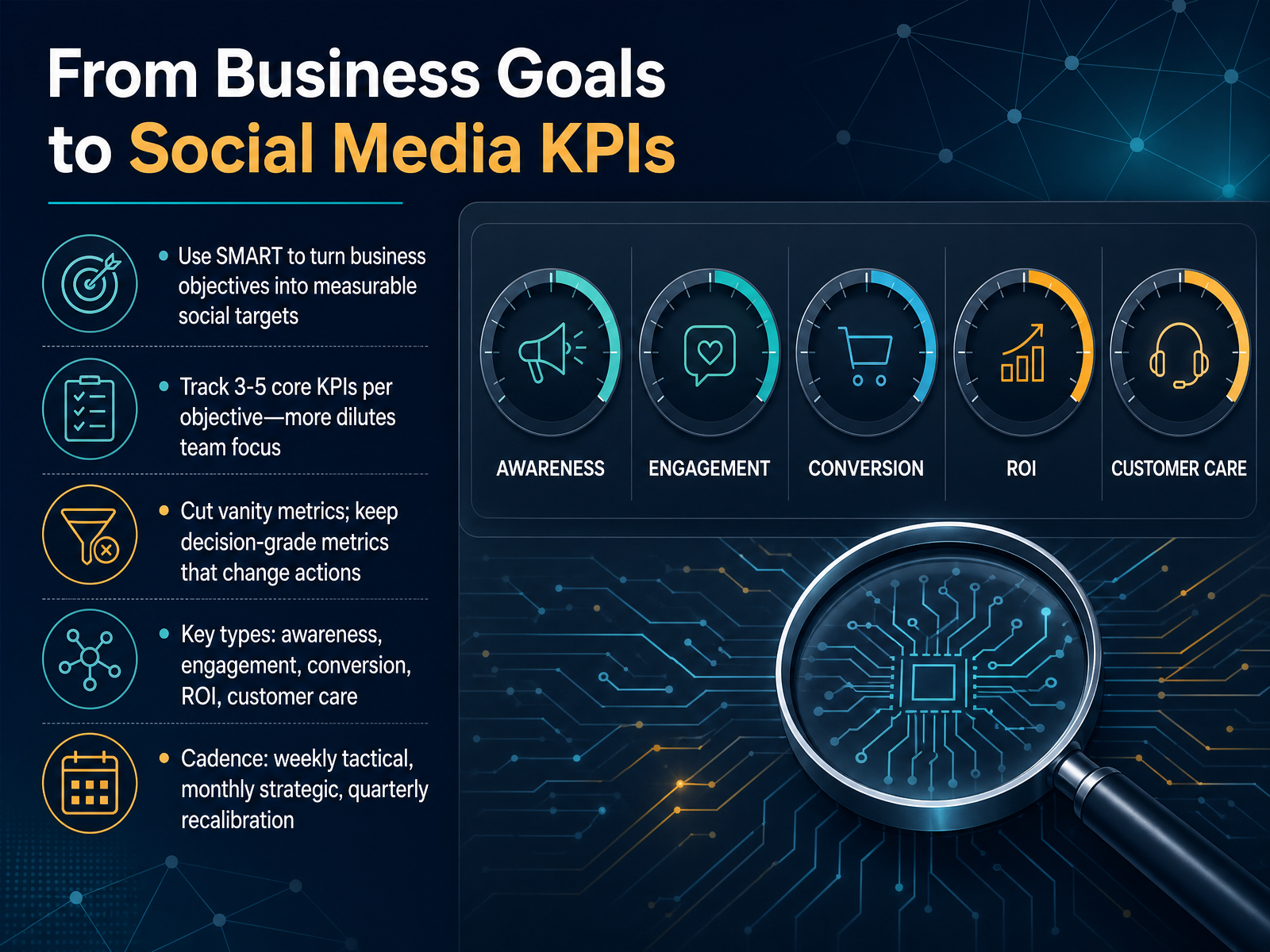
 - 04From Business Goals to Social Media KPIsLet's move from goals to measurement. You have business objectives. Now turn them into social media KPIs. Start with SMART. That means every target is specific, measurable, achievable, relevant, and time-bound. So instead of grow on LinkedIn, you say, raise engagement rate from two percent to three percent by the end of the quarter.
Next, keep it tight. Track three to five core KPIs per objective. More than that dilutes your team's focus and makes it harder to act.
Cut vanity metrics. A metric earns a place if it changes a decision. Followers only matter if they drive discovery, conversion, or retention. Keep decision-grade numbers in these areas: awareness, engagement, conversion, return on investment, and customer care.
Finally, set your cadence. Review tactical numbers weekly. Do a strategic review monthly. Recalibrate your goals quarterly, because the market moves faster than an annual plan.
So that's the chain: business goal, SMART target, a short KPI list, and a review rhythm you can defend. Next, let's look at Core Roles and Responsibilities in 2026.
 blog.hootsuite.comsynthesio.combuffer.com+22 min
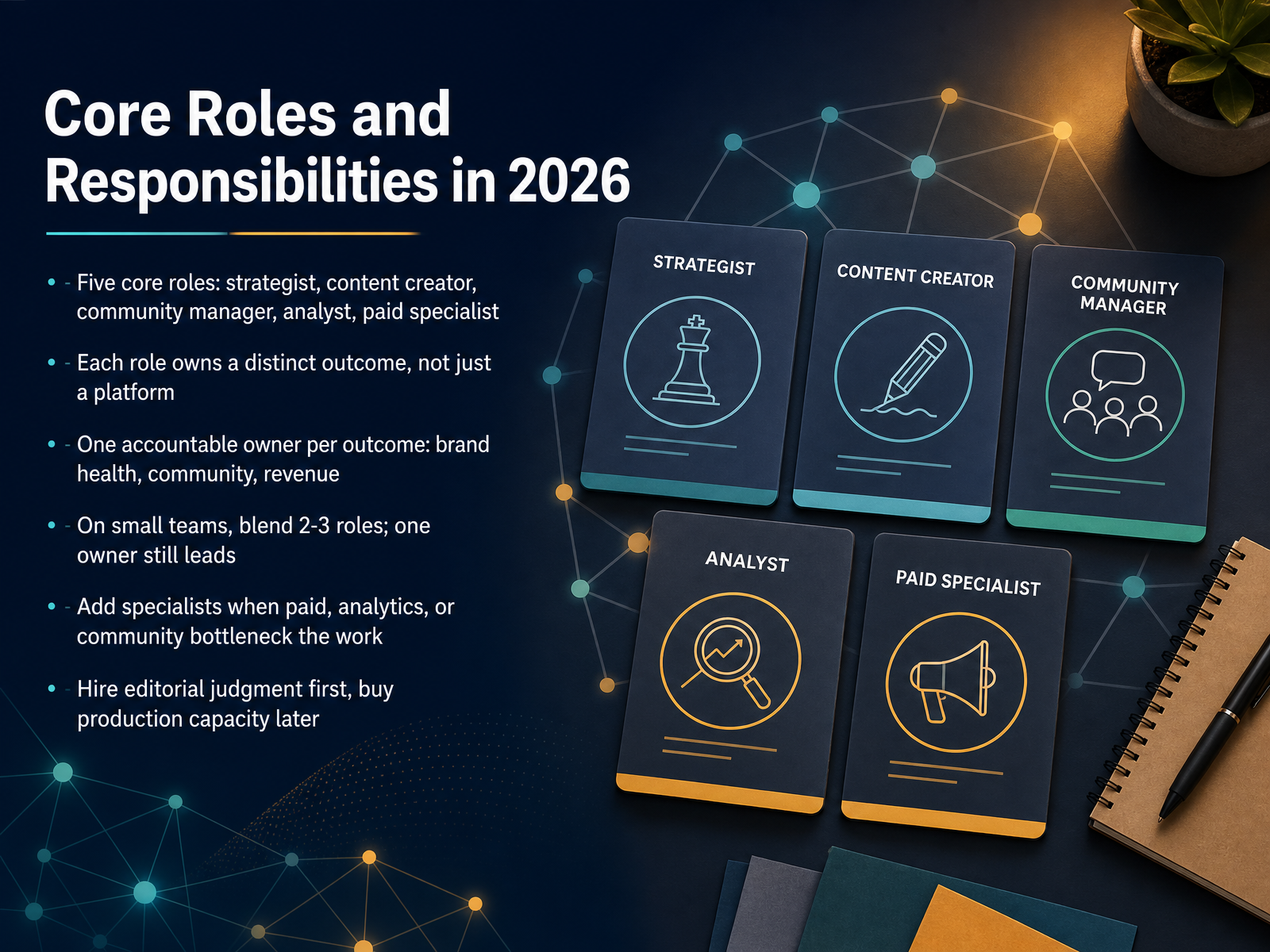
 - 05Core Roles and Responsibilities in 2026Now let's map the core roles. In 2026, five roles cover almost everything: a strategist, a content creator, a community manager, an analyst, and a paid specialist. Here's the key shift. Each role owns a distinct outcome, not just a platform. Strategist owns brand health. Community manager owns community. Paid specialists and analysts own revenue signal and spend. One accountable owner per outcome, always. On small teams, blend two or three roles into one person, but keep one owner leading. Add specialists only when paid, analytics, or community start to bottleneck the work. And here's the hiring rule that saves money: hire editorial judgment first. Buy production capacity later. A great editor can direct freelancers. A room full of editors cannot fix unclear priorities. Next, we'll look at designing a team structure that scales.
 sugarpixels.comindeed.commicroposter.so+22 min
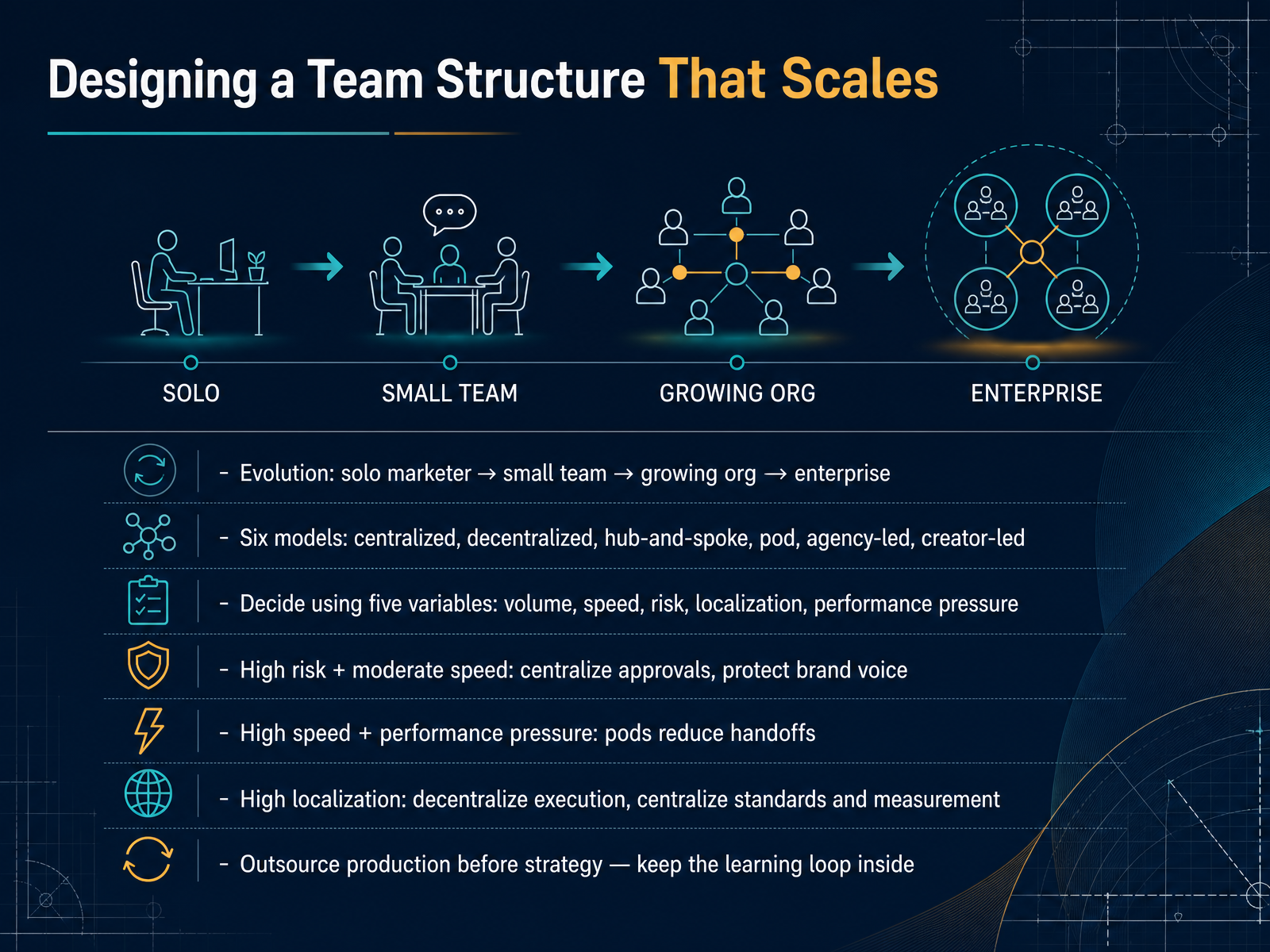
 - 06Designing a Team Structure That ScalesNow let's talk structure. Your team model should change as you grow. You start with one marketer doing everything. Then a small team. Then a growing org. Then enterprise. There are six common models: centralized, decentralized, hub-and-spoke, pod, agency-led, and creator-led. None is perfect. Pick based on five variables: volume, speed, risk, localization, and performance pressure. High risk with moderate speed? Centralize approvals and protect brand voice. High speed with performance pressure? Pods reduce handoffs and move faster. High localization? Push execution to local teams, but keep standards and measurement central. One rule that saves money: outsource production before strategy. You always keep the learning loop inside. That's how you scale without losing your edge. Next, we'll look at the break-even decision: In-House, Agency, or Hybrid.
 mydropai.comaibrify.cominfluencerdb.net+21 min
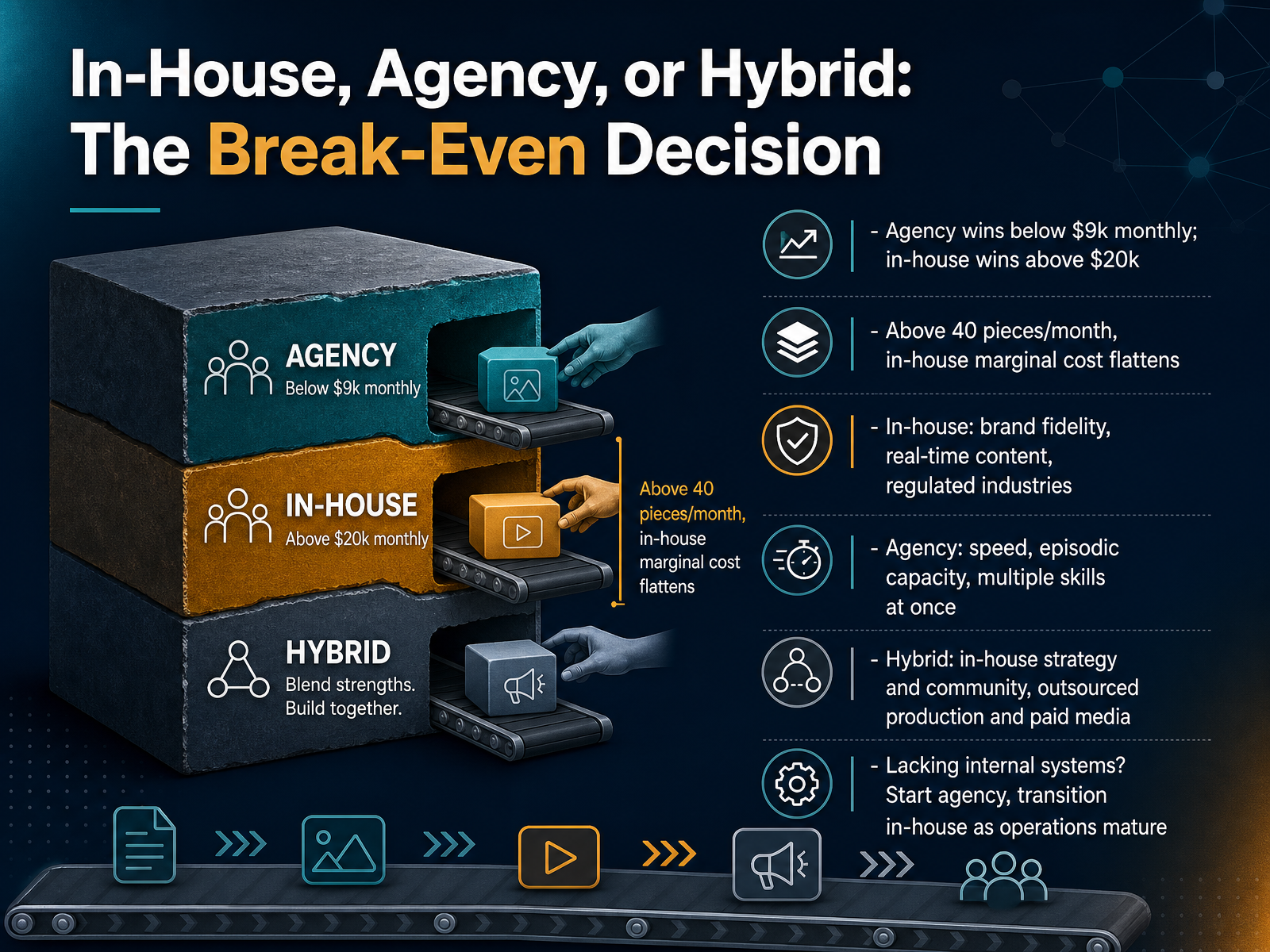
 - 07In-House, Agency, or Hybrid: The Break-Even DecisionNow let's settle the build versus buy question with real numbers. Below nine thousand dollars a month in total social spend, an agency almost always wins on all-in cost. Above twenty thousand, in-house starts to win, but only if you truly need production volume above thirty to forty pieces a month, because that is where in-house marginal cost flattens while agency retainers keep climbing. The middle zone is ambiguous, so score four levers: volume, complexity, control, and speed. In-house buys brand fidelity, real-time content, and compliance depth for regulated industries. Agency buys speed, episodic capacity, and multiple skills at once. Your hybrid route keeps strategy and community in-house while outsourcing production and paid media, which fits most teams between fifteen and sixty employees. Lacking internal systems? Start with an agency, build the cadence, then transition in-house as operations mature. Next, we cover skills and hiring criteria for a twenty twenty-six team.
 mydropai.comaibrify.cominfluencerdb.net+22 min
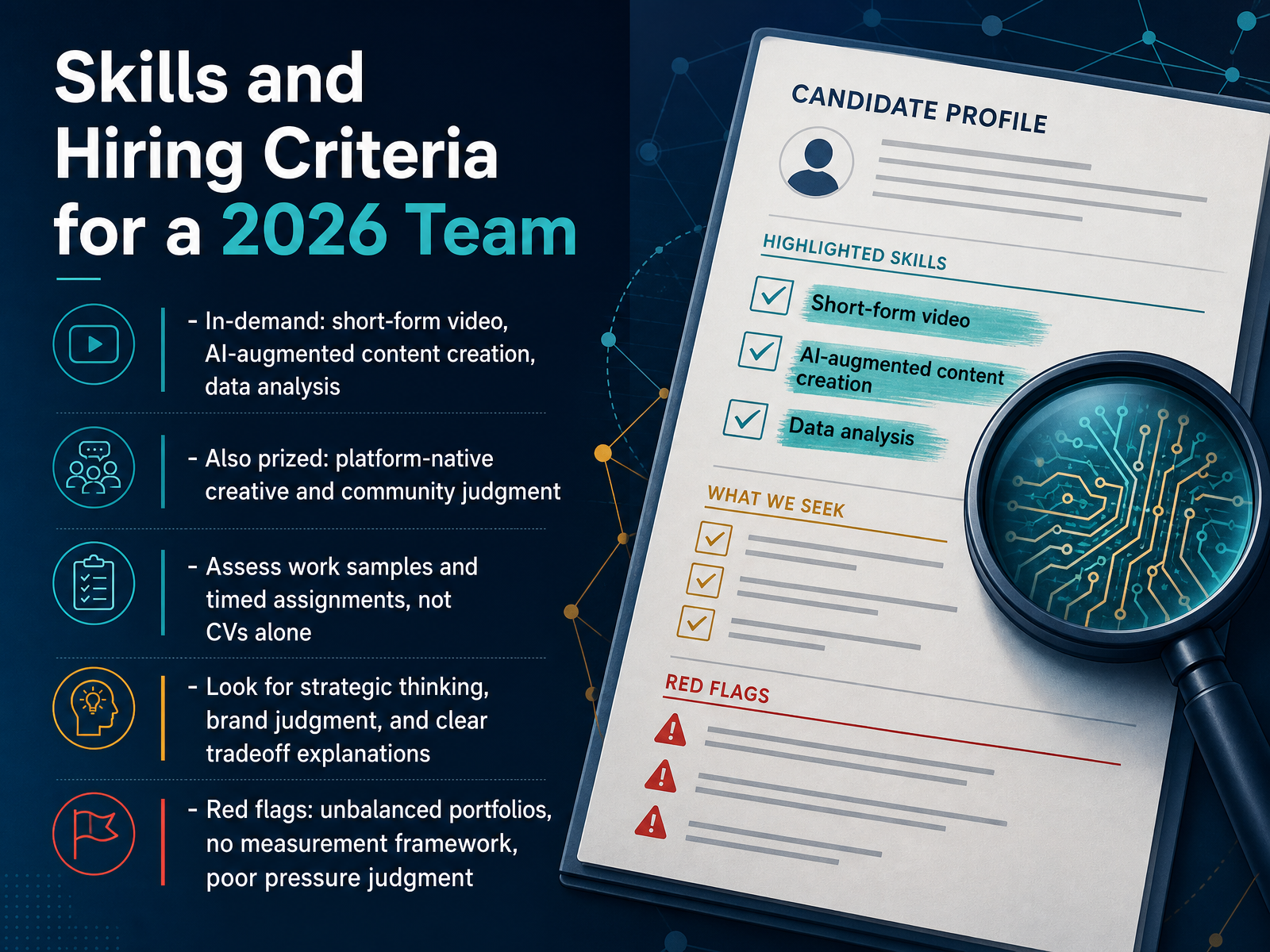
 - 08Skills and Hiring Criteria for a 2026 TeamNow let's talk about who you actually hire. For a 2026 team, three skills are in demand: short-form video, AI-augmented content creation, and data analysis. You also want platform-native creative and real community judgment. Those are harder to teach. So test for them. Assess work samples and timed assignments, not CVs alone. A strong candidate ships post examples plus a measurement framework for each platform they own. In interviews, look for strategic thinking, brand judgment, and clear explanations of tradeoffs. Ask them to walk you through a campaign that underperformed, and listen for what they changed. Watch for red flags: unbalanced portfolios, no measurement framework, and poor judgment under pressure. If they can't explain how they'd handle a frustrated customer in public, that's a risk. Here's your takeaway. Hire for judgment and measurement, then train the tools. Building a Repeatable Social Media Workflow.
 workello.comsugarpixels.comindeed.com+22 min
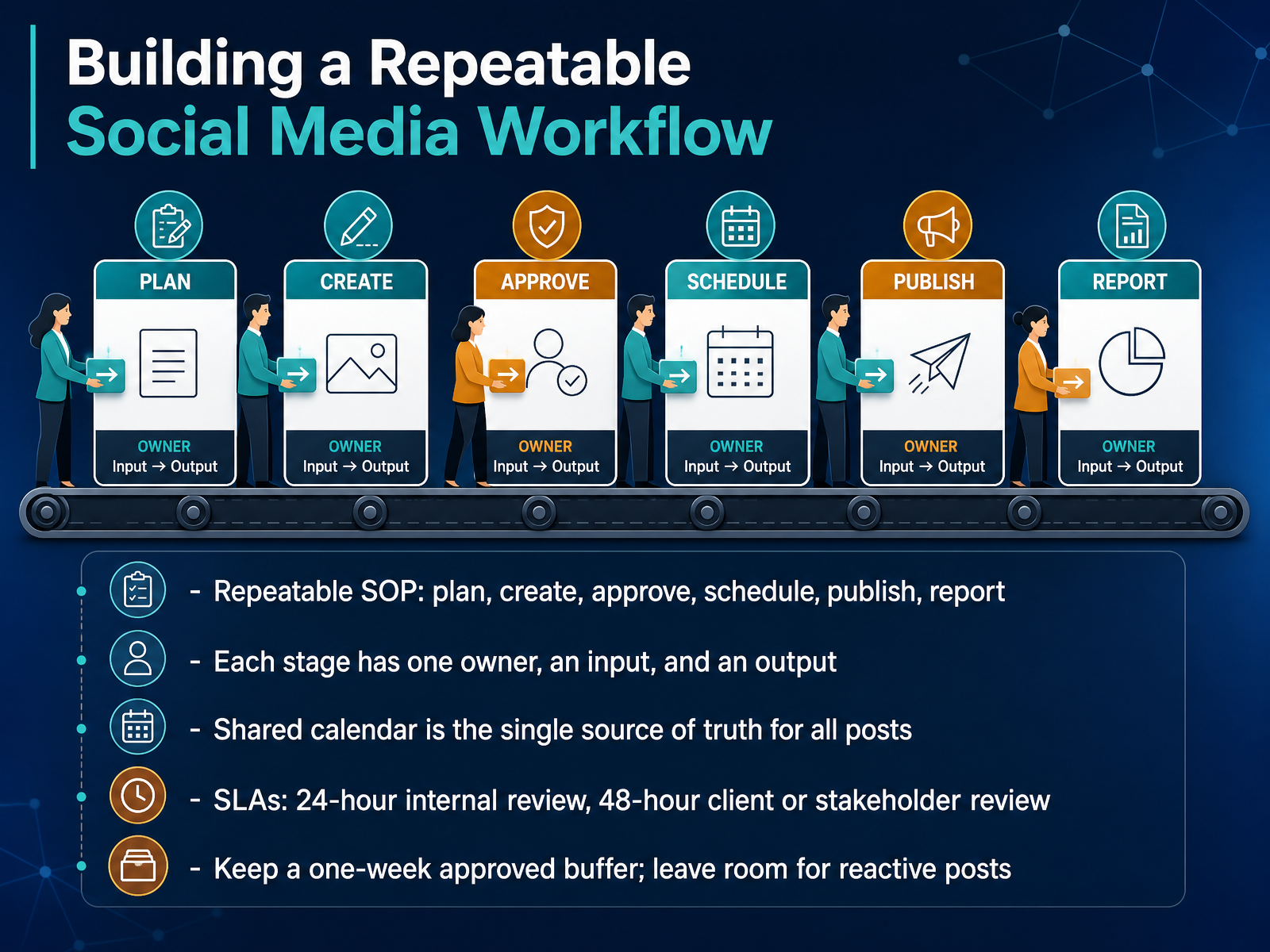
 - 09Building a Repeatable Social Media WorkflowLet's make the workflow repeatable. Run six stages in order: plan, create, approve, schedule, publish, report. That is your standard operating procedure. Each stage needs one owner, one input, and one output. If a stage has two owners, it has none. Your shared calendar is the single source of truth for every post. No side spreadsheets, no approval by chat message. Then set service level agreements. Twenty-four hours for internal review. Forty-eight hours for client or stakeholder review. Agree those windows up front, in writing, so you are not renegotiating every week. Finally, keep a one-week buffer of approved, scheduled posts. That buffer absorbs sick days, holidays, and slow sign-offs. And leave room for reactive posts, so jumping on a trend is optional, not impossible. Repeatable beats clever. Build the system once, then run it every week.
 socialpilot.coblog.hootsuite.comconstantcontact.com+21 min
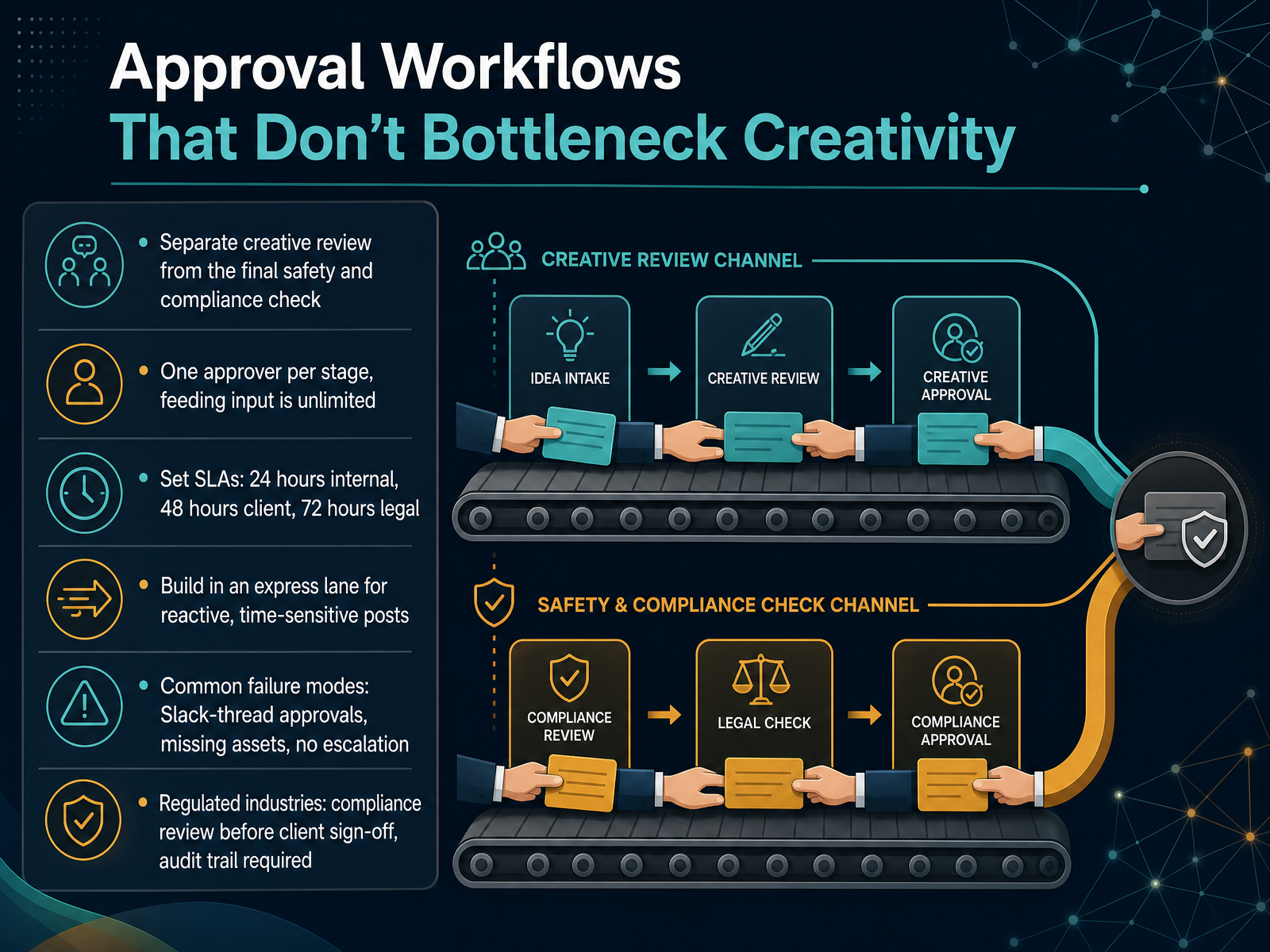
 - 10Approval Workflows That Don't Bottleneck CreativityLet's talk about approvals that don't slow your team down. First, separate creative review from the final safety and compliance check. They catch different problems, so keep them apart. Second, one approver per stage. Many people can feed input, but only one person approves. Third, set clear service level agreements. Twenty-four hours for internal review, forty-eight hours for client review, and seventy-two hours when legal is involved. Fourth, build an express lane for reactive posts. When news breaks, collapse the timeline to two or four hours and use a single approver. Watch these common failure modes. Approvals buried in Slack threads. Missing assets. No escalation path when a deadline passes. And in regulated industries, route compliance before client sign-off, and keep the audit trail. Approvals should be a gate, not a committee. Now let's look at onboarding, training, and enabling the team.
 2 min
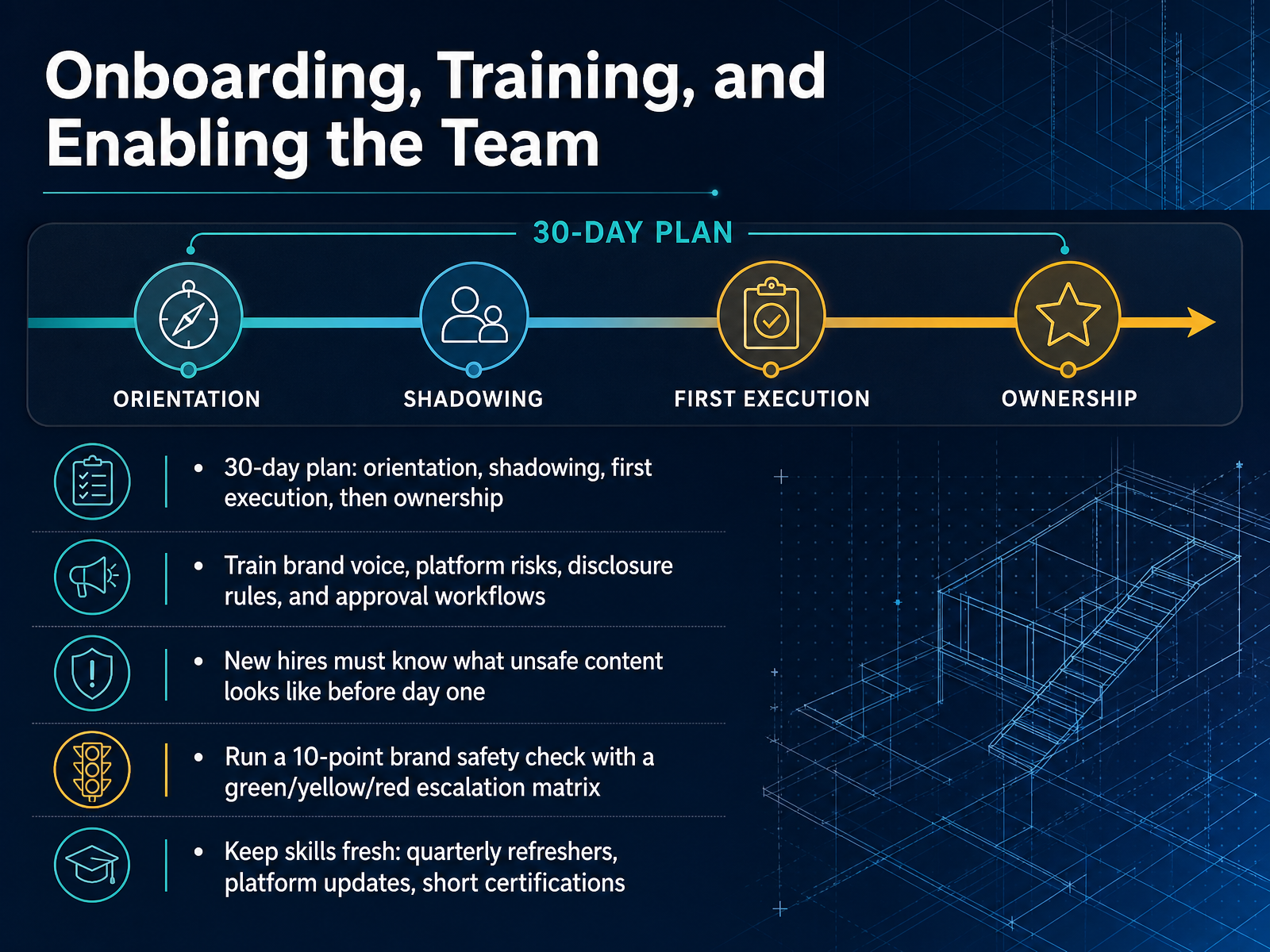
2 min - 11Onboarding, Training, and Enabling the TeamNow let's talk about onboarding, training, and enabling the team. You hired for skill. This is where you build speed, consistency, and accountability. Run a thirty-day plan. Days one to three cover orientation and access. Days four to seven, shadow and audit top posts. Days eight to fourteen, ship a first week of content through approvals. By day thirty, the new hire owns the calendar and the weekly report. Train four things: brand voice, platform risks, disclosure rules, and approval workflows. Critically, new hires must know what unsafe content looks like before day one. Give real examples. Then run a ten-point brand safety check before anything publishes. Cover creative rights, link integrity, the context check, profile accuracy, tagging, caption tone, and a second sign-off from someone who did not write it. Pair that with a green, yellow, red escalation matrix. Green is standard operations. Yellow pauses automated and wacky content. Red stops everything until a twenty-four hour review. Keep skills fresh with quarterly refreshers, platform updates, and short certifications. Build it once, repeat it consistently. Next, we look at choosing tools and managing collaboration.
 socialpilot.coblog.hootsuite.comconstantcontact.com+22 min
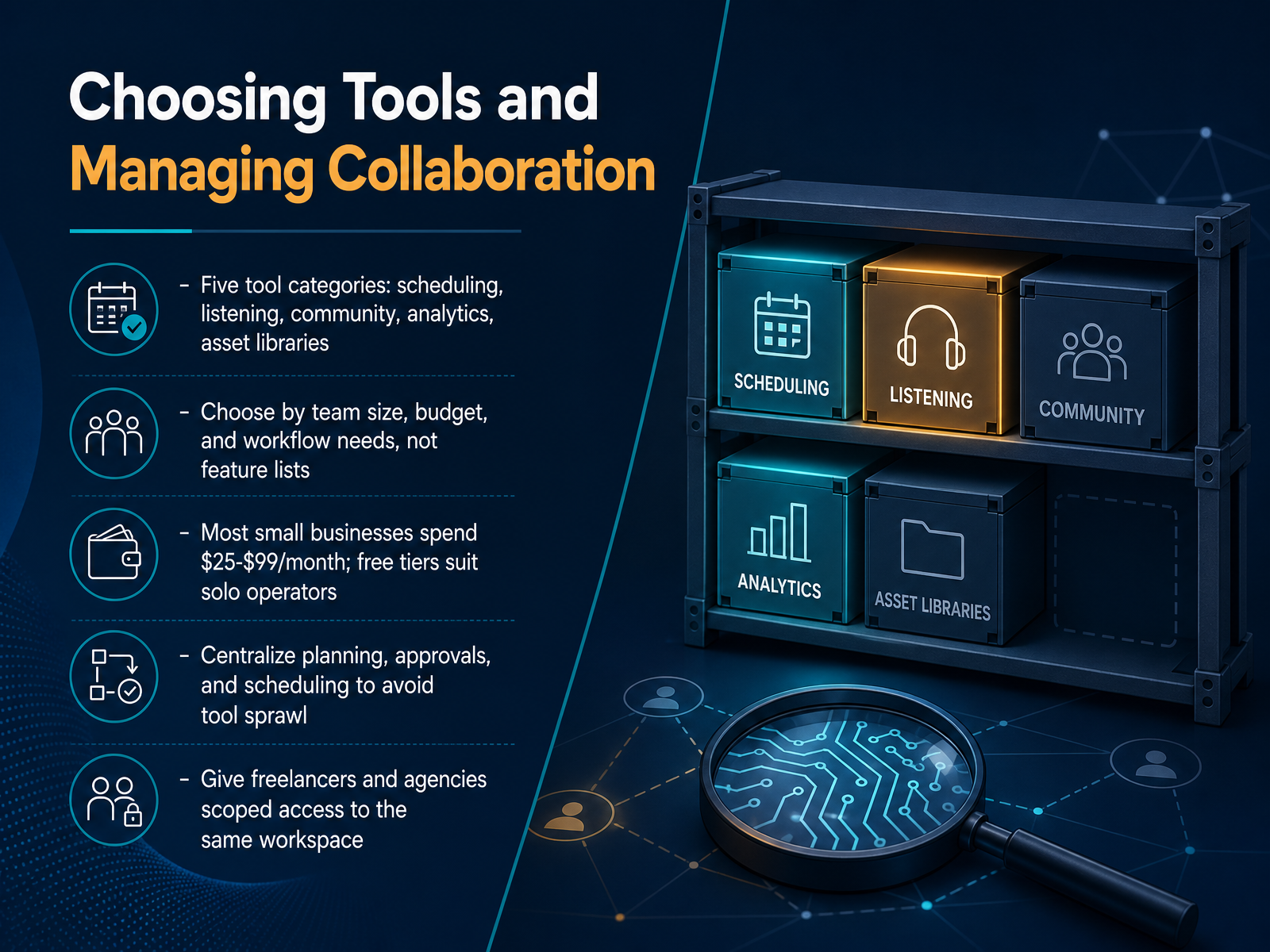
 - 12Choosing Tools and Managing CollaborationLet's talk about tools. Five categories cover almost everything you need: scheduling, listening, community management, analytics, and an asset library. You don't need the fanciest platform. You need the one that fits your team size, your budget, and how your workflow actually runs. Most small businesses land between twenty-five and ninety-nine dollars a month. Free tiers are fine for solo operators running one to three accounts. Two rules keep you out of trouble. First, centralize planning, approvals, and scheduling in one workspace so you don't bleed time switching between five apps. Second, give freelancers and agencies scoped access to that same workspace, with clear permissions. Same calendar, same approvals, no version confusion. Pick tools that match your process, then let the process do the work. Next, we'll look at measuring team performance and iterating.
 1 min
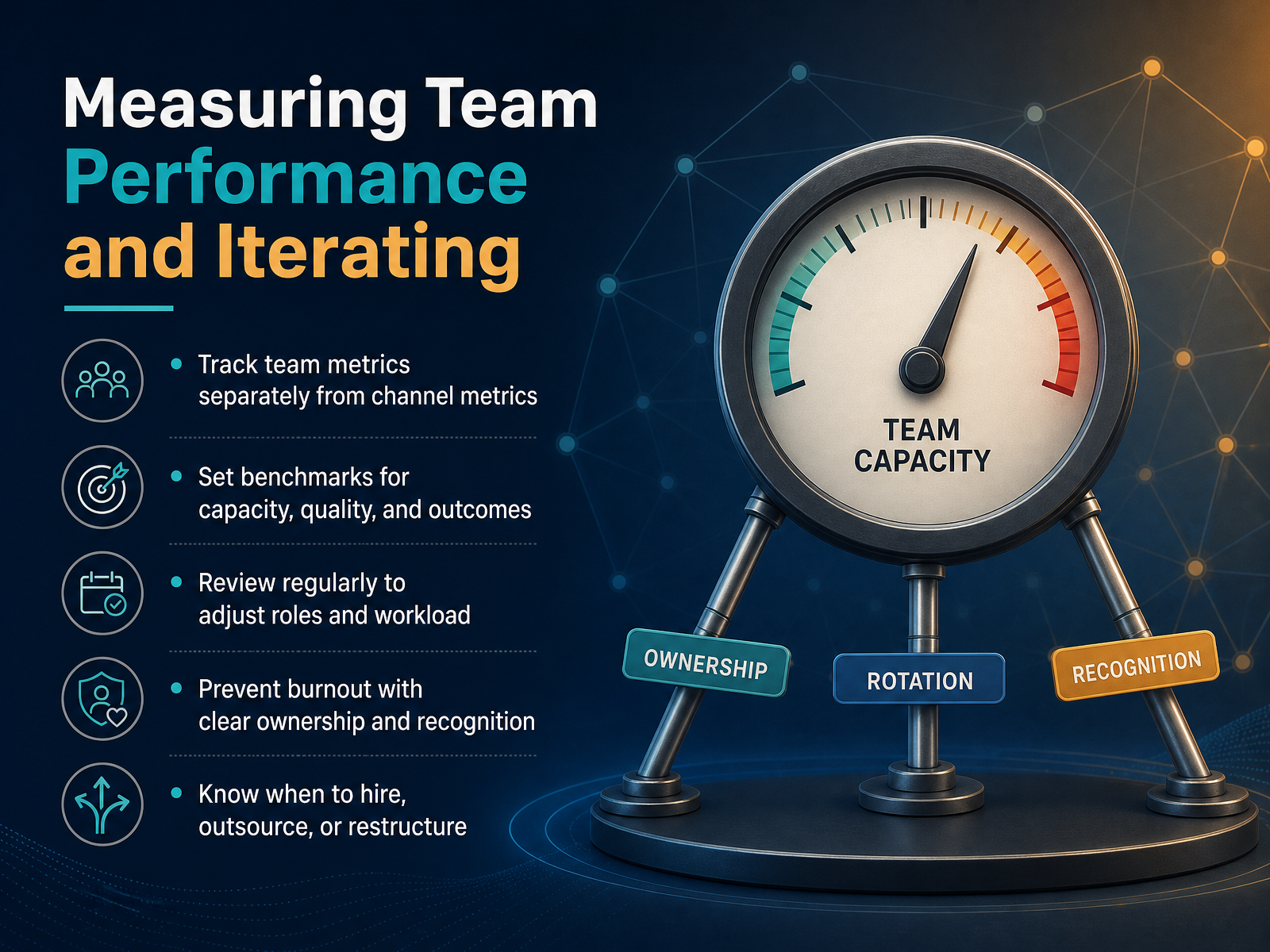
1 min - 13Measuring Team Performance and IteratingNow let's talk about measuring your team, not just your channels. Track team metrics separately from channel metrics. Channel metrics tell you what the audience did. Team metrics tell you whether your people can keep up. So set benchmarks for three things. Capacity, like posts shipped per week per person. Quality, like revision rounds before approval. And outcomes, like engagement or conversions tied to each owner. For example, if your Instagram lead is posting twice the volume but their content keeps missing the engagement benchmark, that's a capacity problem, not a creativity problem. Review this monthly. Look at the data, then adjust roles and workload before people burn out. Clear ownership and quick recognition prevent most of that. Finally, know your trigger points. Hire when one channel consistently exceeds one person's capacity. Outsource production first, not strategy, because strategy is your learning loop. And restructure when decision rights get murky. One accountable owner per outcome beats one person per platform every time. Your ninety day implementation plan comes next.
 socialpilot.coblog.hootsuite.comconstantcontact.com+22 min
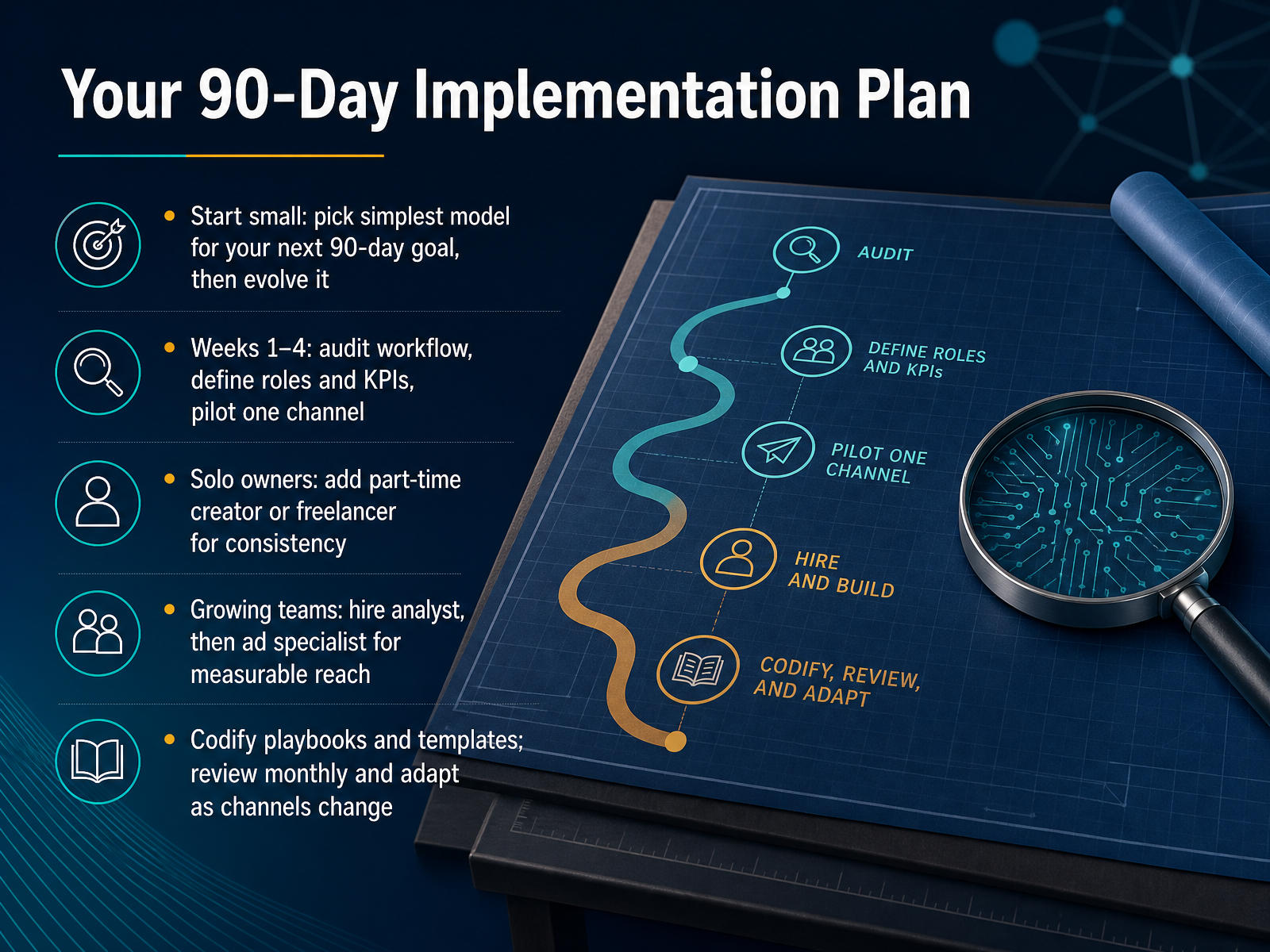
 - 14Your 90-Day Implementation PlanLet's put this into a ninety-day plan you can actually run. Start small. Pick the simplest model that hits your next ninety-day goal, then evolve it. In weeks one through four, audit your workflow, define roles and KPIs, and pilot one channel. If you're a solo owner, add a part-time creator or freelancer to protect consistency. On a growing team, hire an analyst first, then an ad specialist for measurable reach. Then codify your playbooks and templates, and review monthly. Adapt as channels change. That's the whole course. You now have the structure, the roles, and the workflow to build a social team that delivers. Thanks for your time, and go build it.
 socialpilot.coblog.hootsuite.comconstantcontact.com+21 min
Take the deck with you
Download this course as a file — free, no sign-up needed.
- PDF handoutEvery slide page, ready to print or share.15 pages · 4.2 MBDownload
- Narrated PowerPointThe deck that presents itself — every slide carries the digital human's narration video.15 pages · 14.3 MBDownload
- PowerPoint slidesThe full deck as a .pptx — open it in PowerPoint, Keynote, or Google Slides.15 pages · 4.2 MBDownload
Free to use in your own training — please keep the PersonWise credit page at the end.
Have your own deck? Turn it into a course
Sources consulted
Web sources consulted while building this course.
- How to Build a Social Media Management Team (2026 Guide) — socialpilot.co
- Social media hiring in 2026: How to build a high-performing team — blog.hootsuite.com
- How to Build a Social Media Marketing Team in 2026 — constantcontact.com
- Social media team models: Staffing that scales — influencerdb.net
- How to Build a High-Performing Social Media Team - ComboMarketing — combomarketing.eu
- Social media KPIs: how to set and track them in 2026 — blog.hootsuite.com
- Social Media Goals: How to Set Them in 2026 — synthesio.com
- How to Create a Social Media Marketing Strategy in 2026 — buffer.com
- Social Media KPIs That Prove ROI in 2026 and Beyond | Sprinklr — sprinklr.com
- How to set social media goals in 2026 [10 examples] — blog.hootsuite.com
- 10 Social Media Marketing Responsibilities For 2026 | Sugar Pixels, Inc. — sugarpixels.com
- Social Media Manager Job Description [Updated for 2026] — indeed.com
- 10 Social Media Manager Responsibilities for 2026 | MicroPoster Blog — microposter.so
- Social Media Manager Job Description Template - Complete 2026 Hiring Guide — resources.rework.com
- Social media manager salary in 2026: Job description, ... — roberthalf.com
- Cost Models for Scaling Social Publishing: Agency vs In-House vs Hybrid for Enterprise Brands | MydropAI — mydropai.com
- In-House vs Agency for Social Media: The 2026 Break-Even Framework | Aibrify — aibrify.com
- What Social Media Team Structure Do You Need for Scaling? | Conbersa — conbersa.ai
- In-House vs Agency Social Media Management: How to Decide in 2026 | Site Altitude — sitealtitude.com
- #1 Social Media Marketing Skills Test | Workello — workello.com