Begin
14 pages · ~28 min
Content Marketing Roles and Handoffs
This training clarifies content marketing roles, responsibilities, and handoffs, helping marketing teams streamline collaboration and improve workflow efficiency.
A digital instructor presents all 14 pages. Hold “Ask” at any point and ask out loud — the answer comes from this course. No sign-up needed.
What you’ll learn
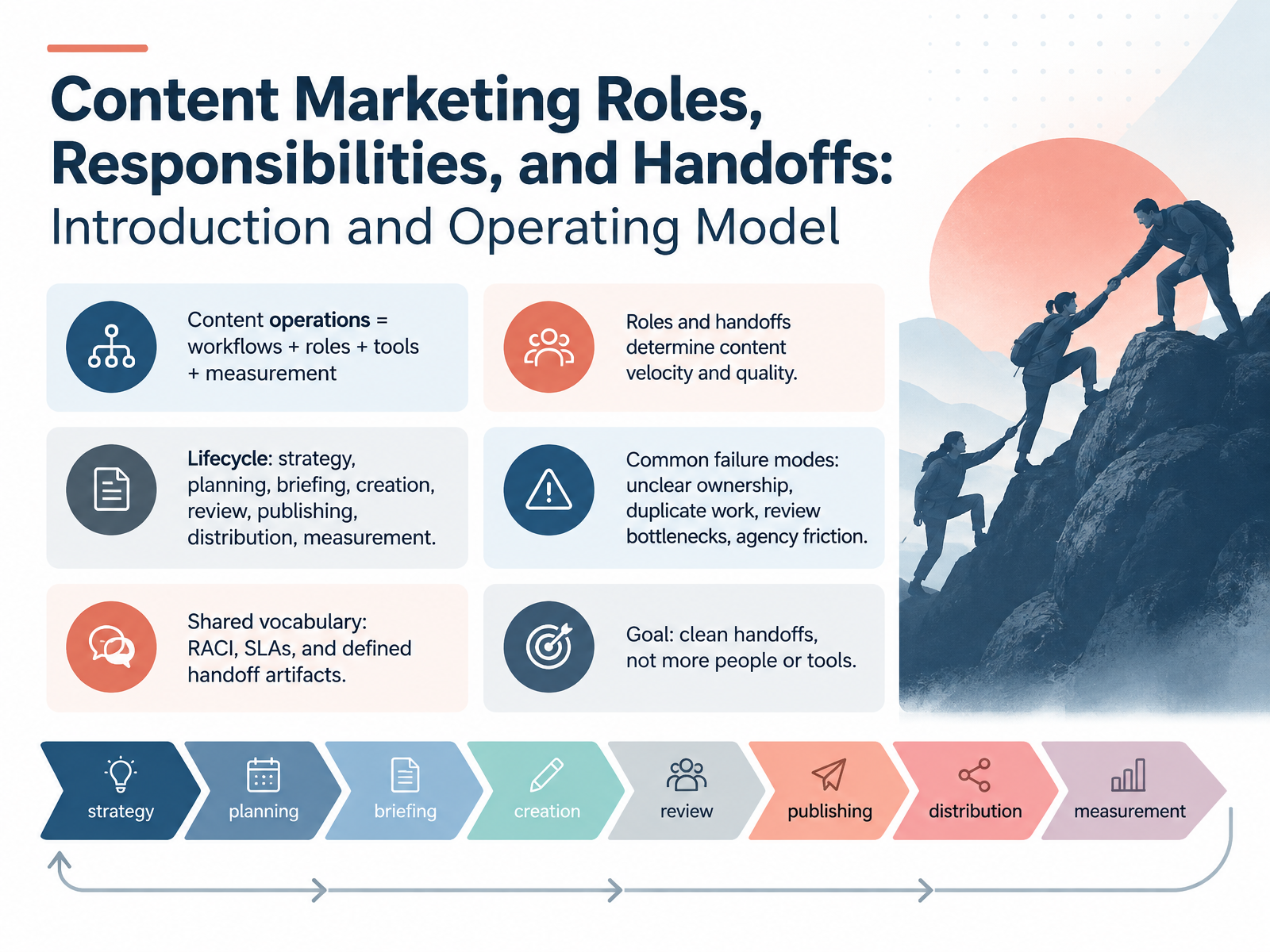
- 01Content Marketing Roles, Responsibilities, and Handoffs: Introduction and Operating ModelWelcome. If you lead content, edit it, write it, design it, or run the operations behind it, this course is for you. Today we look at content marketing roles, responsibilities, and handoffs.
Start with one plain definition. Content operations is four things working together: workflows, roles, tools, and measurement. Your roles and handoffs are what actually set content velocity and quality. Not your headcount, and not your stack.
We will walk the full lifecycle, from strategy, planning, and briefing, through creation, review, publishing, and distribution, to measurement.
You probably recognize the common failure modes. Unclear ownership. Duplicate work. Review bottlenecks. Agency friction. The fix is a shared vocabulary: RACI for decision rights, service level agreements for response times, and defined handoff artifacts, like a locked brief.
Here is our goal. Clean handoffs, not more people or more tools. So as we go, map your own workflow and spot where work stalls.
Next, why handoffs are the real bottleneck.contentoo.compenmo.cochiefcontentmarketer.com+21 min
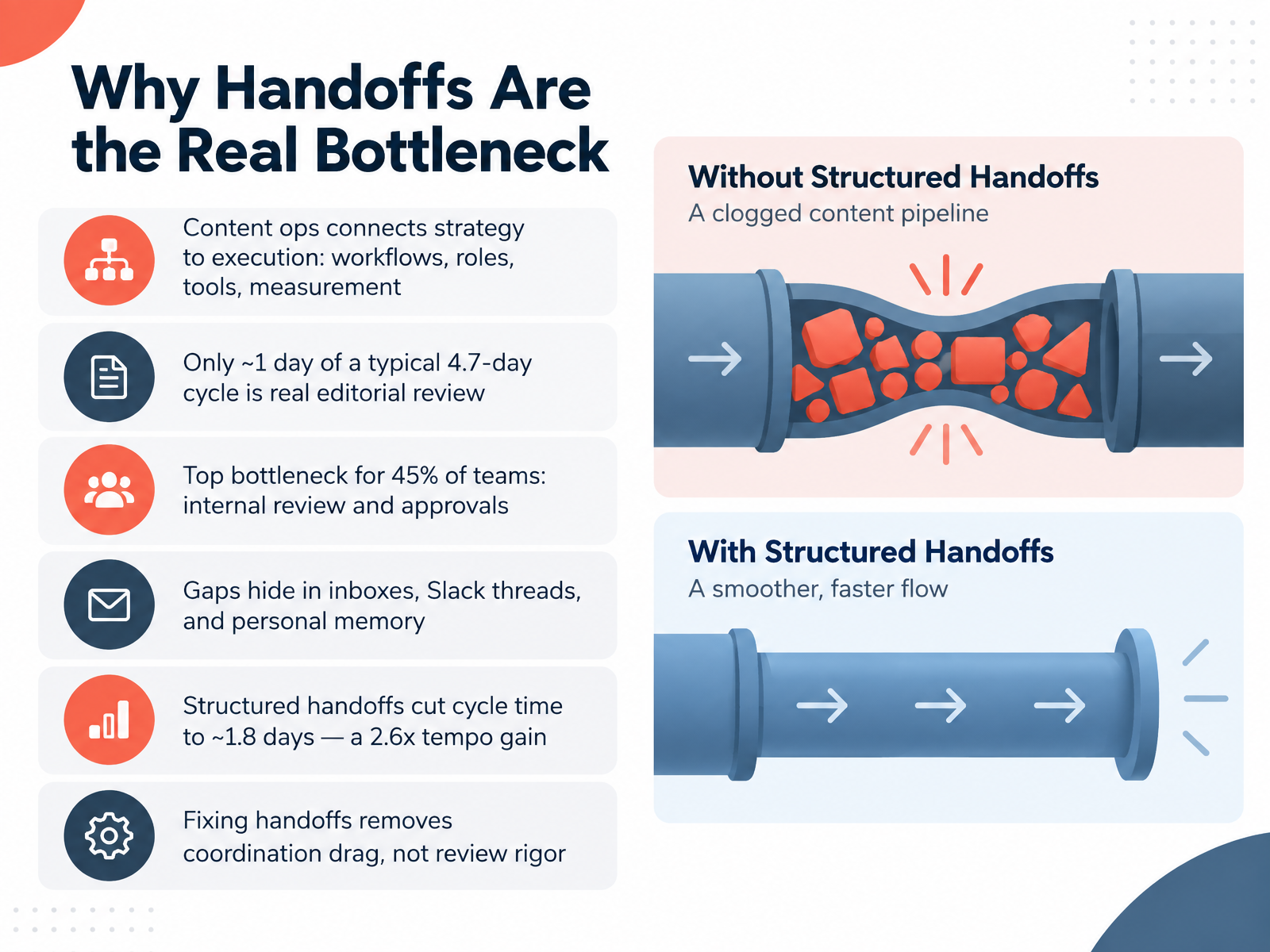
- 02Why Handoffs Are the Real BottleneckLet's talk about why handoffs are the real bottleneck. Content ops connects your strategy to execution through workflows, roles, tools, and measurement. But here is the problem. In a typical four point seven day cycle, only about one day is real editorial review. The rest is waiting. In fact, internal review and approvals are the top bottleneck for forty five percent of teams. And the gaps hide in inboxes, Slack threads, and personal memory. Someone assumes someone else has it. Nobody does. When you fix handoffs with structure, cycle time drops to about one point eight days. That is a two point six times tempo gain. The key point: fixing handoffs removes coordination drag, not review rigor. You still review carefully. You just stop losing days to chasing. Next, let's look at the end to end content lifecycle and its standard handoff points.
 contentoo.compenmo.cochiefcontentmarketer.com+21 min
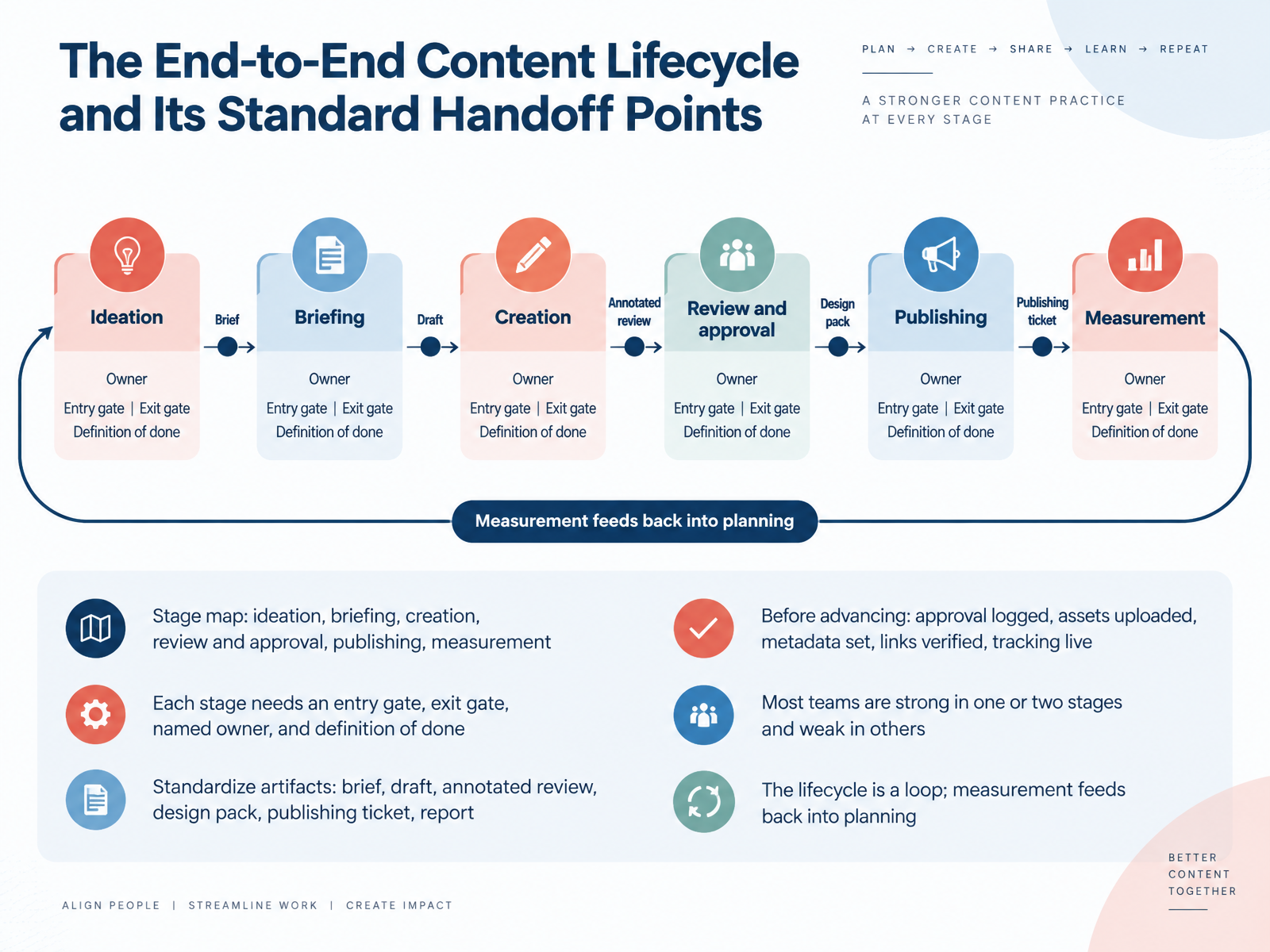
- 03The End-to-End Content Lifecycle and Its Standard Handoff PointsLet's map the full content lifecycle and where work actually changes hands. Six stages: ideation, briefing, creation, review and approval, publishing, and measurement. For each stage, you need four things. An entry gate, so people know when work can start. An exit gate, so it can leave. One named owner. And a written definition of done. Then standardize your artifacts: the brief, the draft, the annotated review, the design pack, the publishing ticket, and the report. Before anything advances, confirm five things. Approval is logged, assets are uploaded, metadata is set, links are verified, and tracking is live. Here's the honest part. Most teams are strong in one or two stages and weak in others. That gap is usually where your reviews stall or your drafts sit. Finally, remember the lifecycle is a loop. Measurement feeds straight back into planning, so what you learn shapes what you make next. Next, let's define who owns what.
 contentoo.compenmo.cochiefcontentmarketer.com+22 min
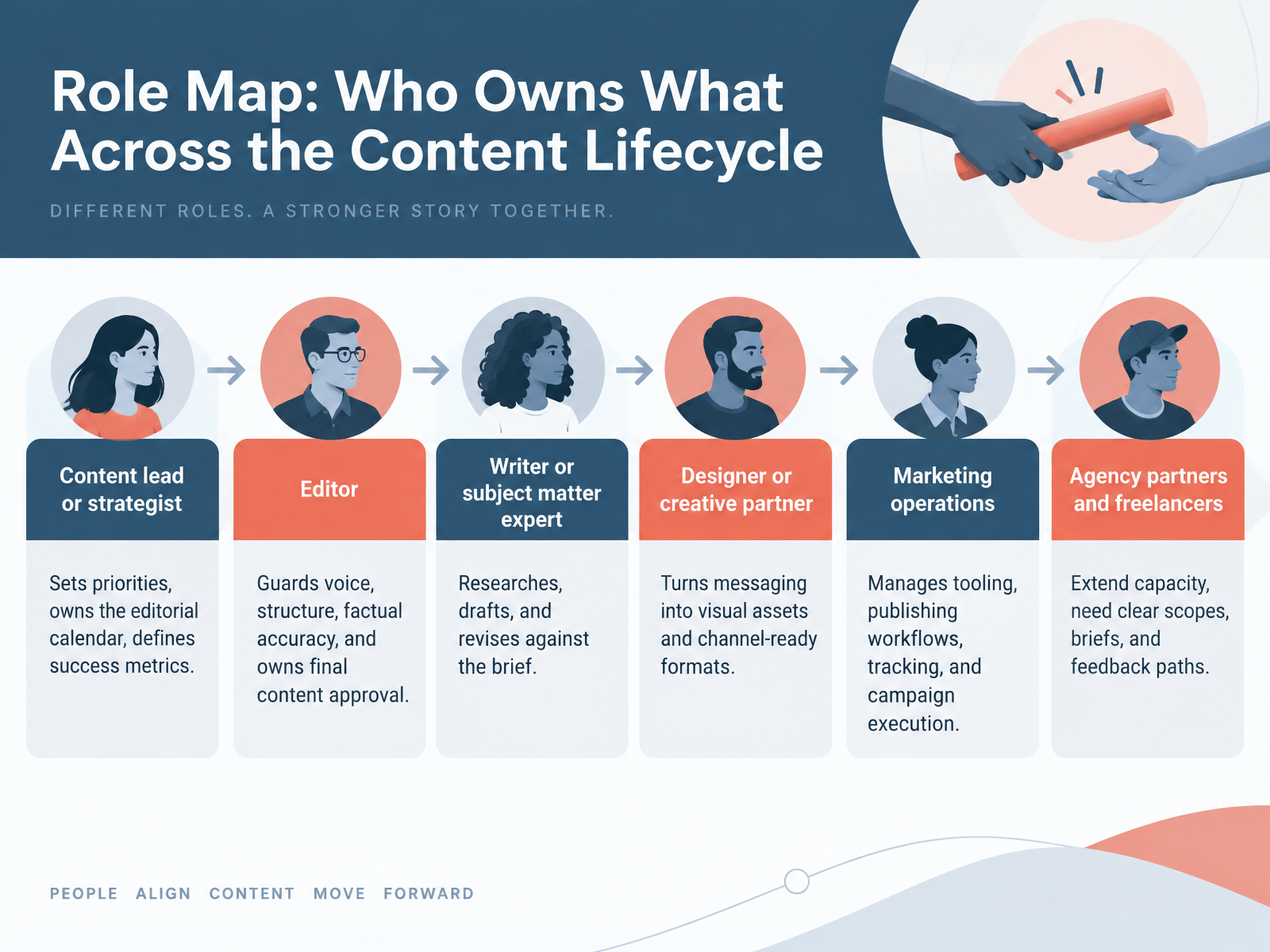
- 04Role Map: Who Owns What Across the Content LifecycleLet's map the roles. Six seats, six clear jobs.
Your content lead or strategist sets the priorities. They own the editorial calendar, and they define what success looks like in numbers. When a topic is contested, they decide.
Your editor guards voice, structure, and factual accuracy. They hold final approval before anything ships. If the draft isn't ready, the editor sends it back.
Your writer or subject matter expert researches, drafts, and revises against the brief. No brief, no draft.
Your designer turns messaging into visual assets and channel-ready formats. They get pulled in early, not the day before publishing.
Marketing operations runs the tooling, publishing workflows, tracking, and campaign execution. They're your answer to "who actually hits publish?"
Agency partners and freelancers extend your capacity. They need three things nailed down before they start: a clear scope, a solid brief, and a defined feedback path.
Here's the takeaway. Each piece of work needs one owner and one decision point. That's how you stop late-stage revisions and dropped handoffs. Next, let's look at matching roles to team size and operating model.
 easycontent.iomarketerhire.comcontently.com+22 min
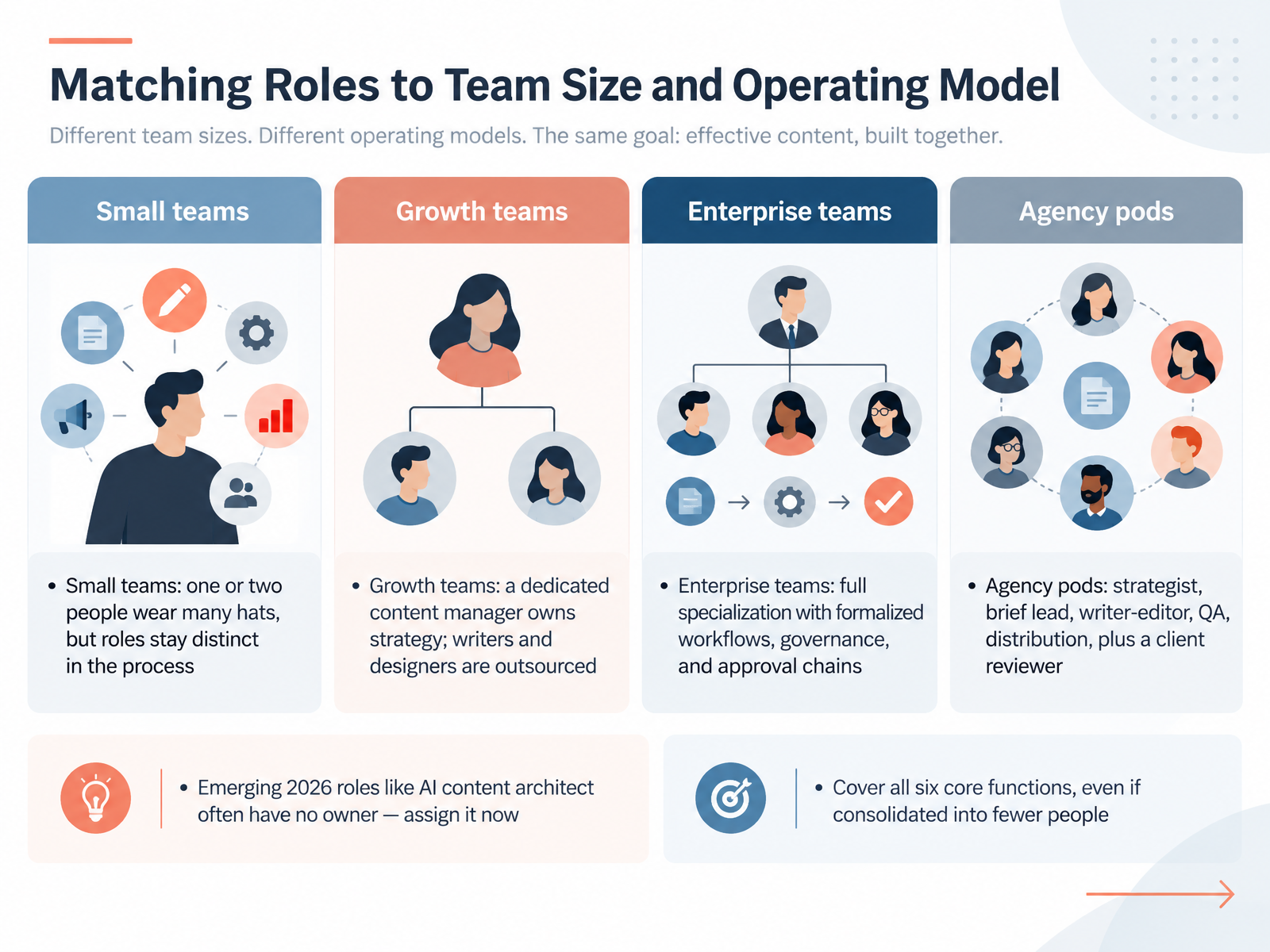
- 05Matching Roles to Team Size and Operating ModelNow let's match roles to your team size and operating model. Your structure changes, but the six core functions never disappear. On a small team, one or two people wear many hats, but keep the roles distinct in your process. Growth teams usually add a dedicated content manager who owns strategy, then outsource writers and designers. Enterprise teams go full specialization, with formalized workflows, governance, and approval chains. Agency pods run strategist, brief lead, writer-editor, QA, distribution, and a client reviewer. Here's the gap to fix now. Emerging roles like AI content architect often have no owner. Assign it this week, even part-time. And cover all six core functions, even if fewer people carry them. Name the action and the decision point for each handoff, so nothing sits unclaimed.
 contentoo.compenmo.cochiefcontentmarketer.com+21 min
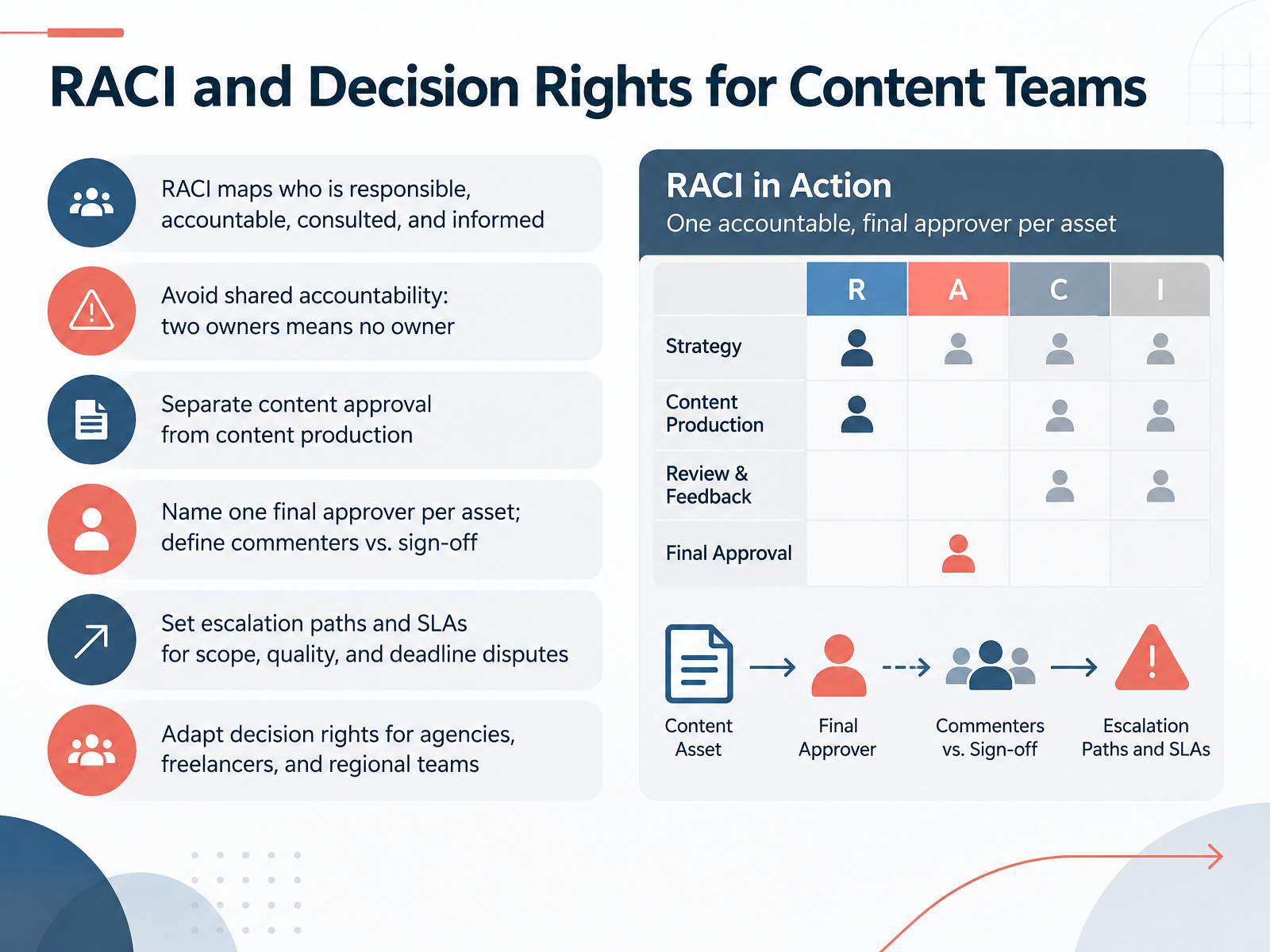
- 06RACI and Decision Rights for Content TeamsLet's talk decision rights, because this is where content workflows quietly fall apart. A RACI chart maps four things. Who is responsible, who is accountable, who gets consulted, and who is simply informed. The trap is shared accountability. If two people own the final call, nobody owns it. Second, separate approval from production. The editor, the writer, and the designer produce the work. One named approver signs it off. And make the distinction between commenters and sign-off real. Commenters suggest. The approver decides. Third, set escalation paths and response times. If a scope, quality, or deadline dispute stalls, everyone should know who breaks the tie and how fast. Finally, adapt decision rights for agencies, freelancers, and regional teams. Name their approver, their feedback window, and their revision limit. Next up, we look at the brief itself, the highest-leverage handoff in the workflow.
 easycontent.iomarketerhire.comcontently.com+21 min
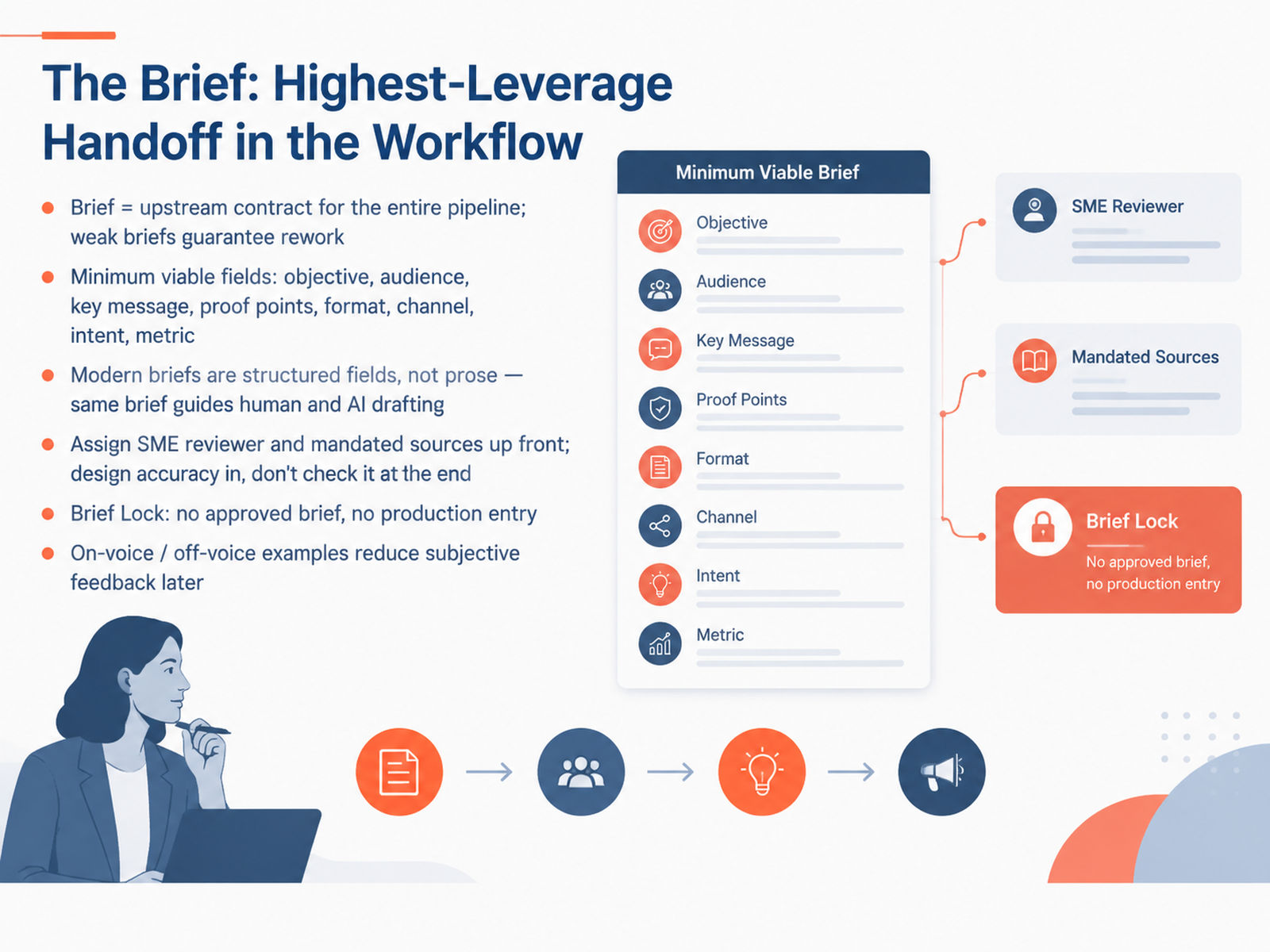
- 07The Brief: Highest-Leverage Handoff in the WorkflowNext, let's talk about the brief, the highest-leverage handoff in your workflow. Think of the brief as the upstream contract for the entire pipeline. A weak brief guarantees rework, and a strong one prevents it. So keep a minimum viable set of fields: objective, audience, key message, proof points, format, channel, intent, and metric. Modern briefs are structured fields, not prose. That way, the same brief guides a human writer and an AI drafting tool. Assign your subject-matter expert reviewer and mandated sources up front. Design accuracy in. Do not check it at the end. This is where Brief Lock helps. No approved brief, no production entry. And add on-voice and off-voice examples, so feedback gets less subjective later. That one page of clarity saves hours of revision. Coming up next, Review Consolidation and Gate Discipline.
 folge.mecheckflow.iopowerful-marketers.com+21 min
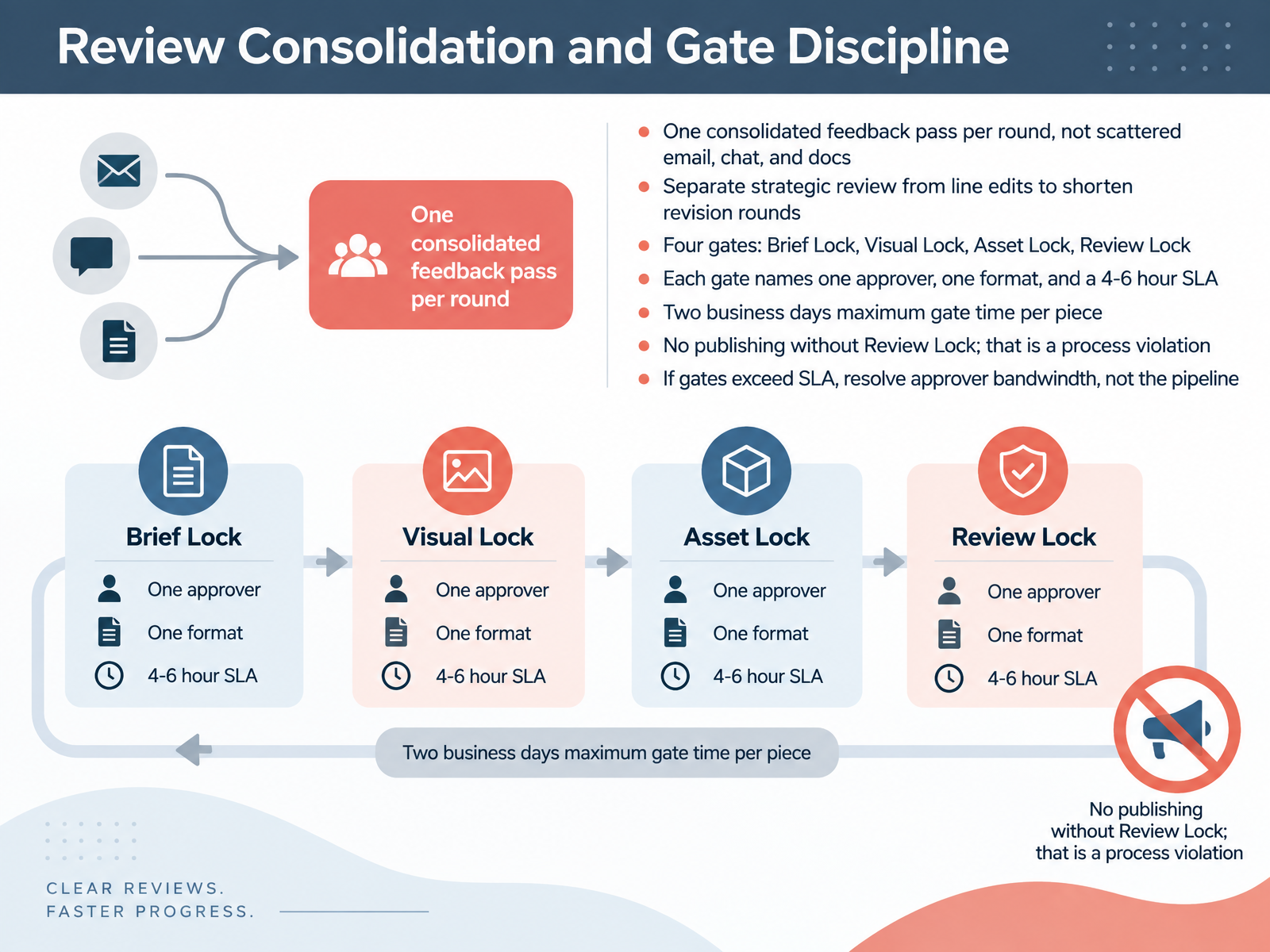
- 08Review Consolidation and Gate DisciplineLet's talk about how you actually close a review round. First rule: one consolidated feedback pass per round. Not comments scattered across email, chat, and three versions of the doc. One pass, one place. Second, separate strategic review from line edits. Let reviewers settle the angle and structure first, then polish the wording. That alone shortens your revision rounds. Now the gates. There are four: Brief Lock, Visual Lock, Asset Lock, and Review Lock. Each gate names one approver, one format, and a four to six hour service window. Cap total gate time at two business days per piece. And no publishing without Review Lock. That's a process violation, full stop. Here's the part people miss. If gates keep blowing their service window, don't redesign the pipeline. Fix approver bandwidth. Give someone a backup. Protect their review time. Finally, if a gate is missed, the piece moves forward on the last approved direction, not into limbo. Next, let's look at how these handoffs change by content type: blog, campaign, social, and sales enablement.
 folge.mecheckflow.iopowerful-marketers.com+22 min
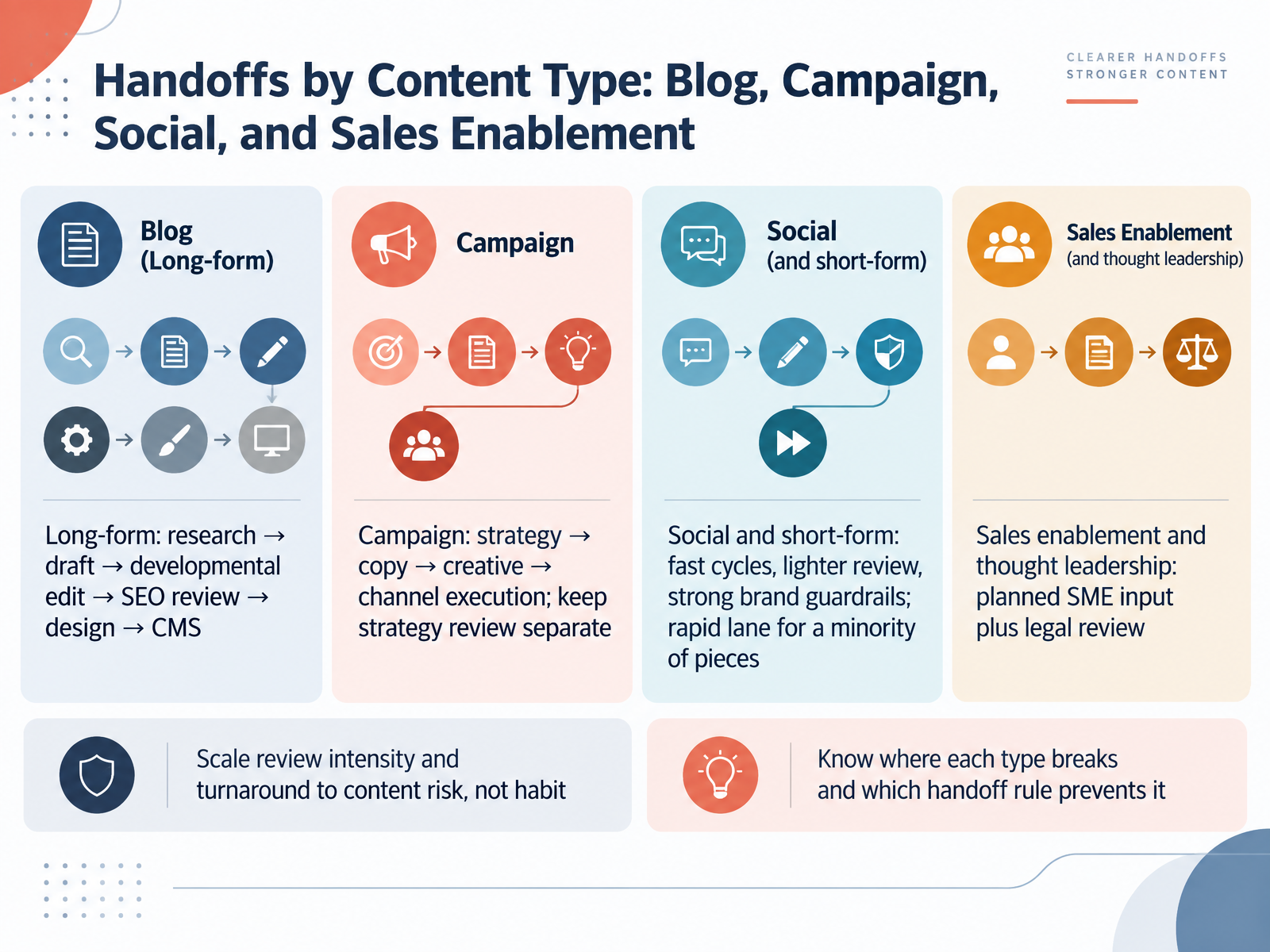
- 09Handoffs by Content Type: Blog, Campaign, Social, and Sales EnablementLet's look at how handoffs change by content type. A long-form article runs a full chain: research, draft, developmental edit, SEO review, design, then CMS upload. Campaign work moves in parallel: strategy, copy, creative, channel execution. Keep the strategy review separate from the copy review so the plan gets locked before anyone starts writing. Social and short-form pieces run fast cycles with lighter review, but strong brand guardrails, plus a rapid lane for a small number of posts. Sales enablement and thought leadership need planned subject-matter expert input and legal review. Here's the rule that ties it together: scale review intensity and turnaround to content risk, not to habit. Know where each type breaks, and assign the handoff rule that prevents it. Long-form breaks at SEO review, so confirm the keyword target before drafting. Campaigns break when strategy shifts mid-production, so freeze the brief first. Social breaks without guardrails, so define them upfront. Next, we move on to working with agencies, freelancers, and external partners.
 folge.mecheckflow.iopowerful-marketers.com+22 min
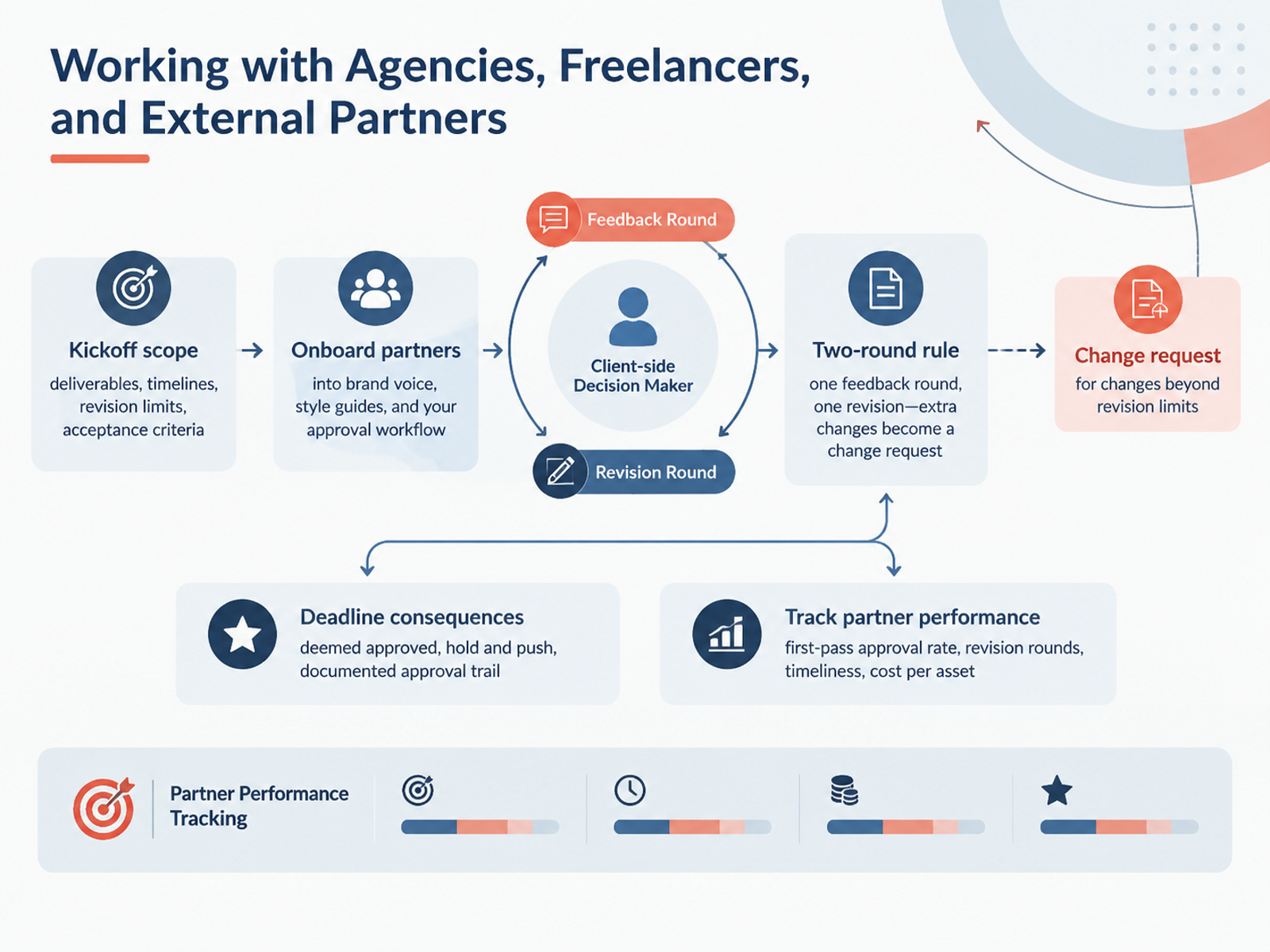
- 10Working with Agencies, Freelancers, and External PartnersLet's talk about working with agencies, freelancers, and external partners. Start at kickoff. Nail down deliverables, timelines, revision limits, and acceptance criteria in writing. Define what done looks like before anyone starts. Then set the two-round rule: one feedback round, one revision. Extra changes become a change request, with new time and cost. Onboard partners into your brand voice, style guides, and approval workflow. Give them real examples of on-voice and off-voice work. On the client side, name one decision maker who consolidates all feedback. Committee feedback causes contradictory edits and wasted rounds. Decide your deadline consequences now. Say it clearly: no feedback by the deadline means content is deemed approved, or it's held and the publish date moves. Keep a documented approval trail with names, dates, and what was submitted. It protects everyone if something goes wrong. Finally, track partner performance: first-pass approval rate, revision rounds, timeliness, and cost per asset. Measure it, and you'll see exactly where the process breaks. Next, we'll look at tools, workflows, and automation for content operations.
 blog.gainapp.comcreativeopsalliance.comsocialk.it+22 min
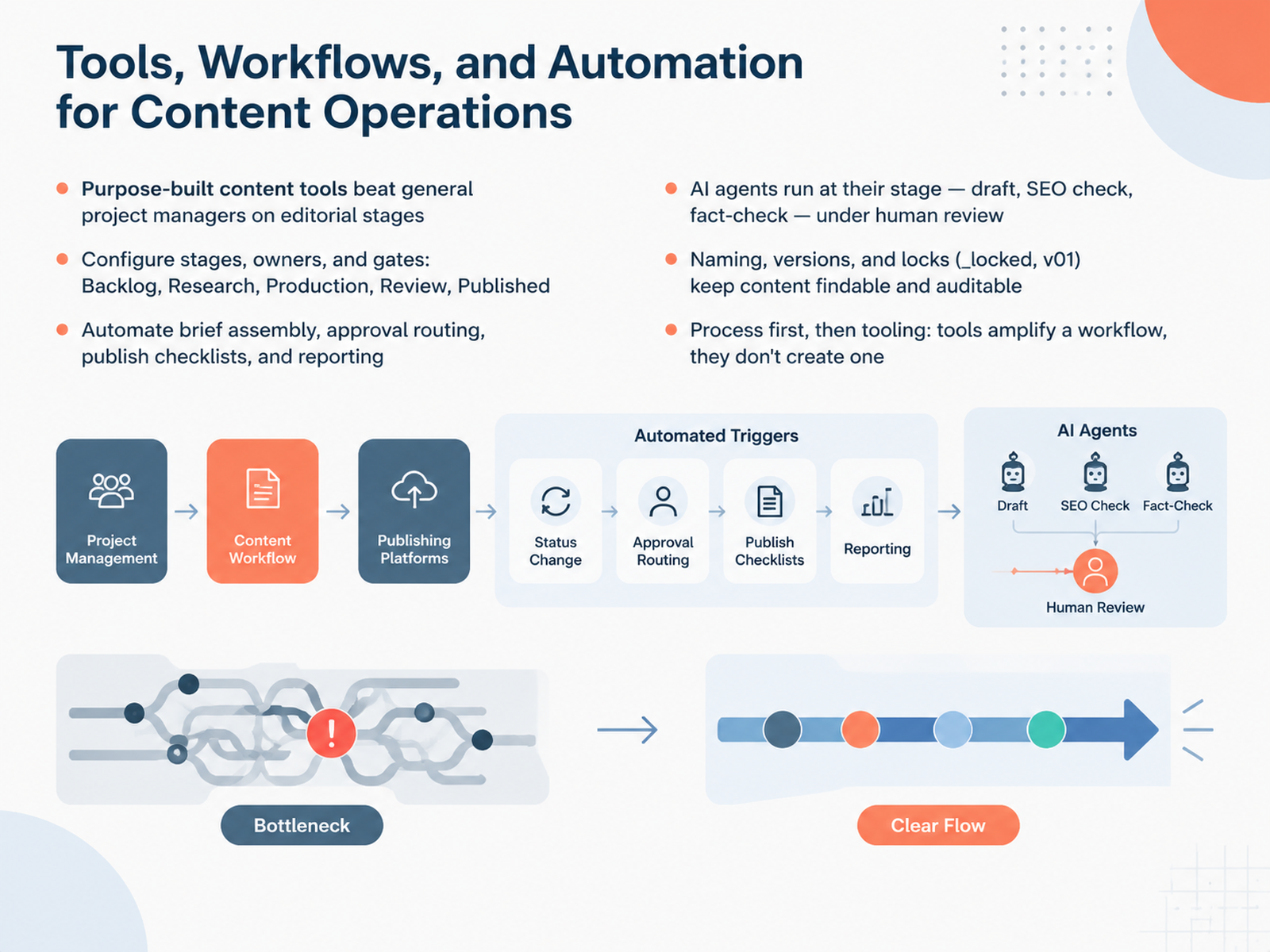
- 11Tools, Workflows, and Automation for Content OperationsNow let's talk about the tools behind your workflow. Here's the first rule. Process first, then tooling. Tools amplify a workflow. They don't create one. So define your stages before you shop. Most teams run five: Backlog, Research, Production, Review, and Published. For each one, name an owner and set a gate. A piece doesn't move forward until that gate is passed. Purpose-built content tools beat general project managers here, because the stages map to editorial work, not generic tasks. Next, automate the repeated middle. Brief assembly, approval routing, publish checklists, and reporting. Those quietly steal twenty to forty minutes from every asset. And yes, AI agents can run at their stage. Draft, SEO check, fact-check. But always under human review. Finally, protect findability. Use a naming convention, two-digit versions like v zero one, roughly, and the underscore locked suffix. Locked files are never edited in place. New version, new file. That keeps everything auditable. Next, we'll look at governance, style guides, approvals, and quality standards.
 2 min
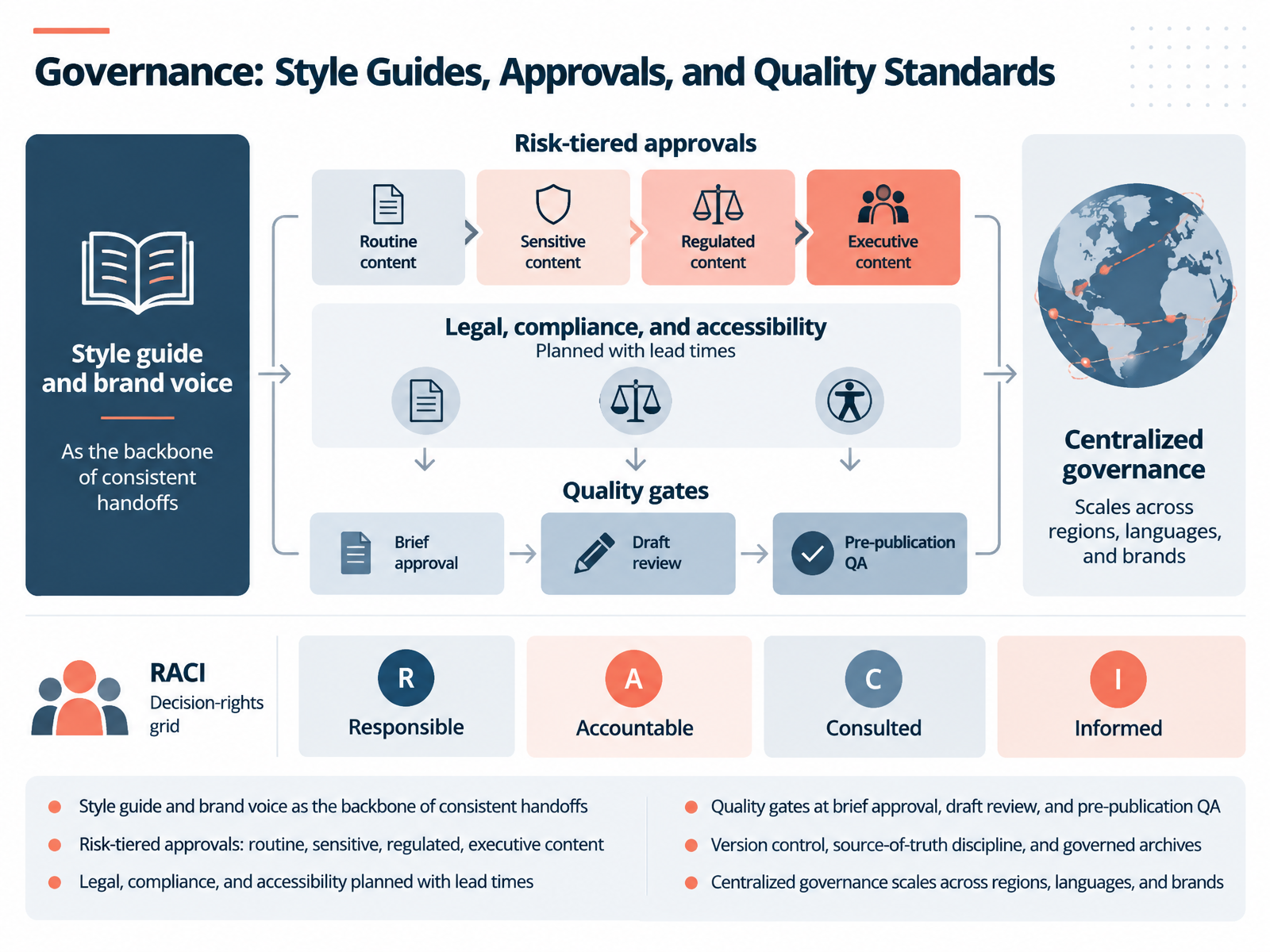
- 12Governance: Style Guides, Approvals, and Quality StandardsNow let's talk governance, where consistency actually gets enforced. Your style guide and brand voice are the backbone of every clean handoff. They are what let a new writer or an outside agency pick up work and sound like you. Next, tier your approvals by risk. Routine posts get a light review. Sensitive or regulated content goes through legal, compliance, and accessibility checks, planned with real lead times, not squeezed in at the last minute. Then place three quality gates. One at brief approval, one at draft review, and one at pre-publication QA. Nothing moves forward until it passes. If someone skips a gate because they were in a hurry, that is a process incident, not a shortcut. Keep version control tight. No file named final. Just clear version numbers, a one-line change log, and a governed archive. That discipline is what lets one governance model scale across regions, languages, and multiple brands without the quality drifting. Next, we look at measuring handoff effectiveness and continuous improvement.
 contentoo.compenmo.cochiefcontentmarketer.com+22 min
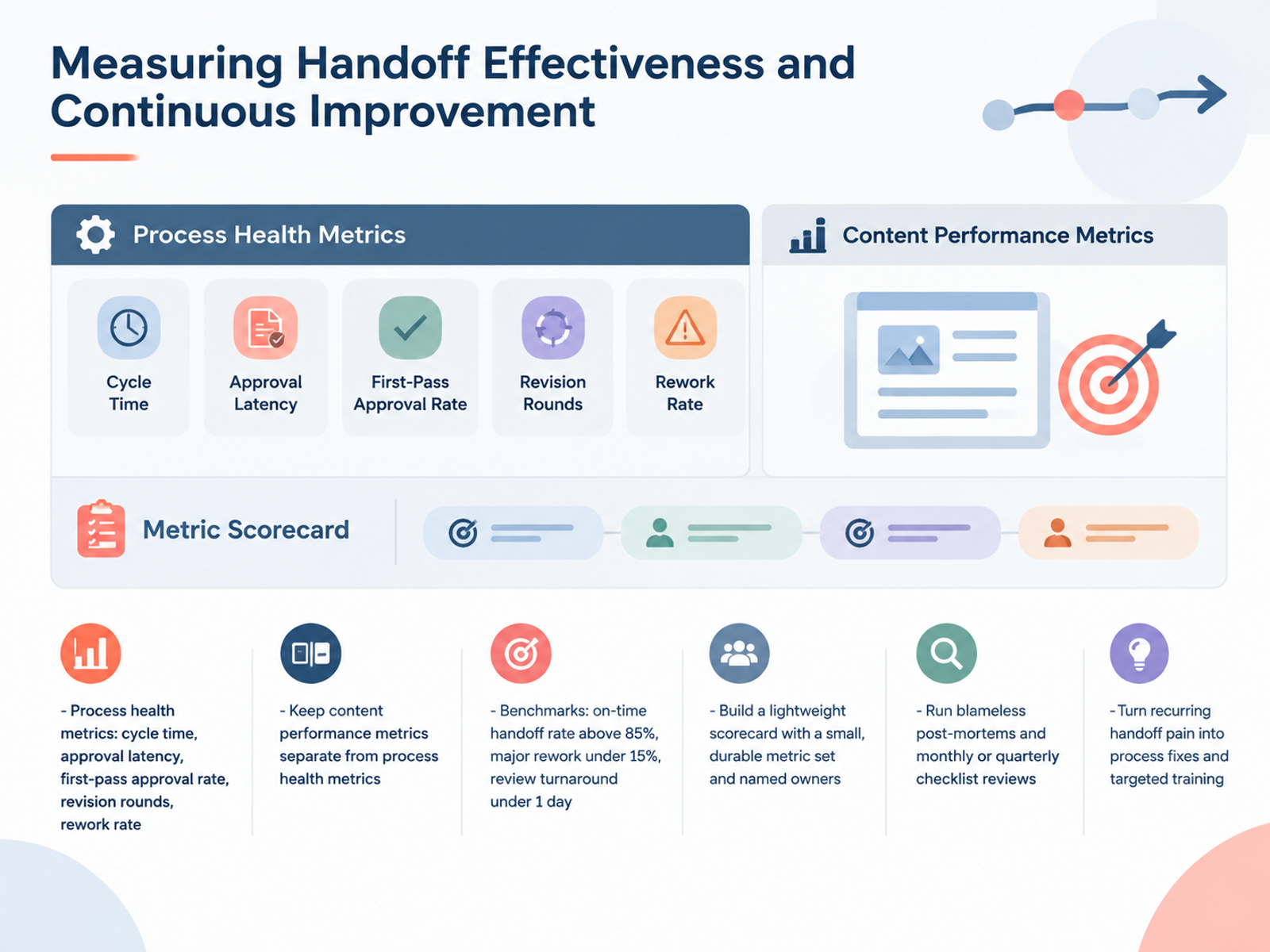
- 13Measuring Handoff Effectiveness and Continuous ImprovementNow let's look at how you actually know your handoffs are getting better. Start with process health, not content performance. Track cycle time, approval latency, first-pass approval rate, revision rounds, and rework rate. Keep those separate from engagement and conversion, because a piece can perform well and still burn your team alive. A few benchmarks to aim for: on-time handoff rate above eighty-five percent, major rework under fifteen percent, and review turnaround under one day. Next, build a lightweight scorecard. Keep the metric set small, durable, and give every metric a named owner. Then make improvement a habit. Run blameless post-mortems, and review your checklist monthly or quarterly. When the same handoff pain keeps showing up, turn it into a process fix or targeted training, not another reminder to try harder. That is how you catch problems early and fix them at the source. Next up, we'll turn all of this into Action Planning: Your Team's Handoff Charter.
 folge.mecheckflow.iopowerful-marketers.com+22 min
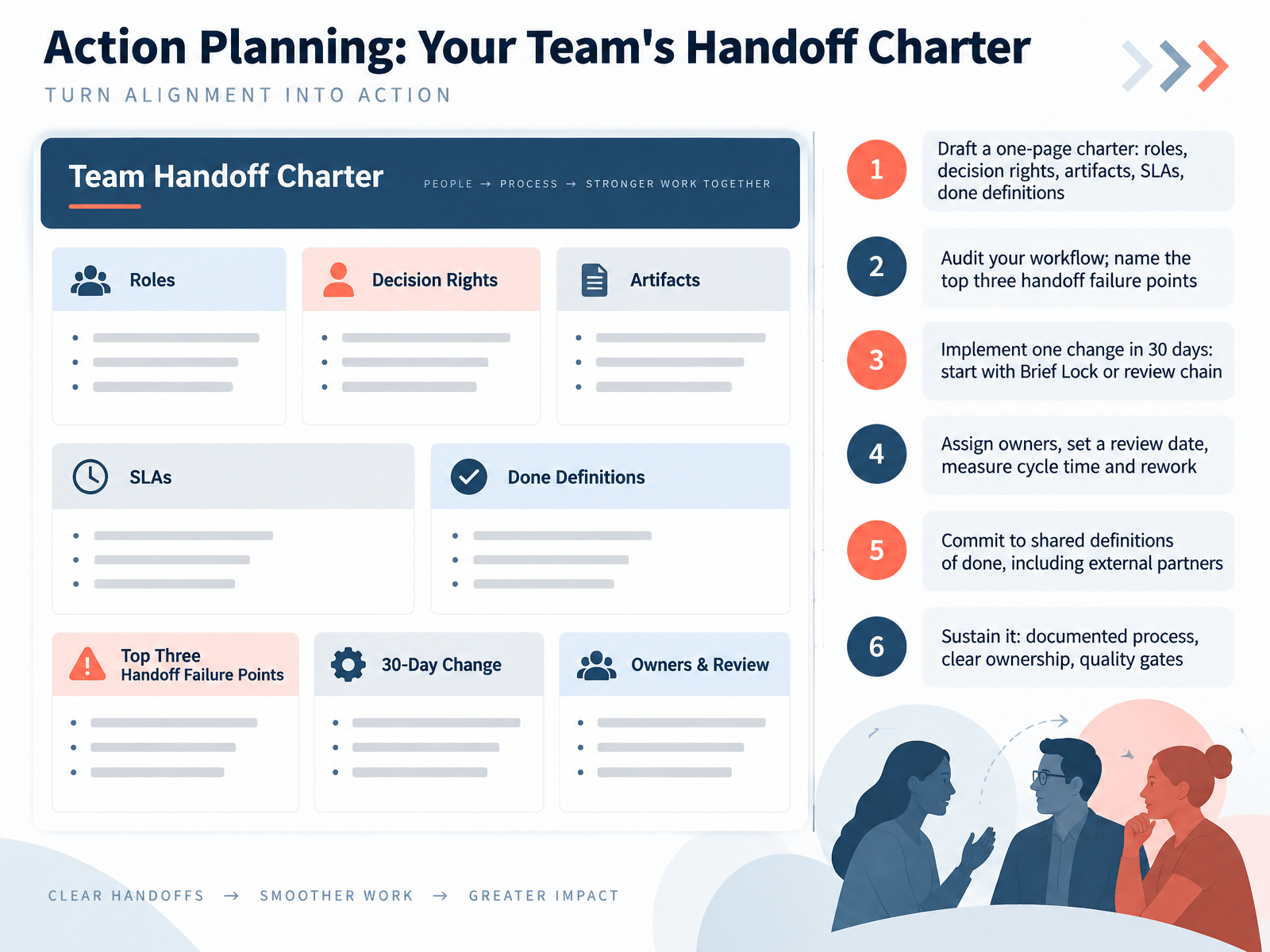
- 14Action Planning: Your Team's Handoff CharterLet's close with a plan you can actually run. Start by drafting a one-page charter: roles, decision rights, artifacts, service levels, and your definition of done. Then audit your workflow and name the top three handoff failure points. Pick one change and ship it within thirty days. Brief Lock is usually the highest-leverage place to start, because a locked brief cuts regeneration cost in half. Or fix the review chain: name one approver per gate and give each gate a response time. Assign an owner to every action, set a review date, and track two numbers, cycle time and rework. Define done together, including your agency or freelance partners, so external work plugs into the same gates. Then sustain it: documented process, clear ownership, quality gates. Remember, content operations is a practice, not a project. You get better one handoff at a time. Thank you for working through this. Pick one change this week, lock that first brief, and let the calmer cycle prove it.
 contentoo.compenmo.cochiefcontentmarketer.com+22 min
Take the deck with you
Download this course as a file — free, no sign-up needed.
- PDF handoutEvery slide page, ready to print or share.15 pages · 3.1 MBDownload
- Narrated PowerPointThe deck that presents itself — every slide carries the digital human's narration video.15 pages · 24.8 MBDownload
- PowerPoint slidesThe full deck as a .pptx — open it in PowerPoint, Keynote, or Google Slides.15 pages · 3.1 MBDownload
Free to use in your own training — please keep the PersonWise credit page at the end.
Have your own deck? Turn it into a course
Sources consulted
Web sources consulted while building this course.
- Content Marketing Operations: The End-to-End Guide for B2B Teams | Contentoo — contentoo.com
- Content Team Structure: Roles, Workflows & Hiring Priorities - Penmo — penmo.co
- Your Content Org Chart Is Broken: The 2026 Roles You Need — chiefcontentmarketer.com
- Content Supply Chain in 2026: The Complete Guide for Marketing Te — marqops.com
- Content Marketing Lead Duties Shift by Team Size | Searcle — searcle.ai
- Roles In Content Team:Who Does What? — easycontent.io
- Ideal Content Marketing Team Structure to Succeed in 2025 — marketerhire.com
- Strategy, Experience, Design: The Roles Redefining Content in 2025 - Contently — contently.com
- Building a Content Marketing Team for SaaS | Surge45 — surge45.com
- How to Build a Content Marketing Team: Key Roles Explained — columnfivemedia.com
- Free Content Publishing SOP Template | Folge — folge.me
- Content Production Workflow Checklist Template | CheckFlow — checkflow.io
- Content Creation Workflow Guide 2025 - Powerful Marketers — powerful-marketers.com
- Content Brief Template: Complete 2025 Guide | InfluenceFlow — influenceflow.io
- Content Brief Template for Google Sheets | FITS — freakinthesheets.net
- 5 Steps to Creating a Client-Friendly Content Review Process - The Gain Blog — blog.gainapp.com
- Intake → Brief → Review: The Loop That Kills 80% of Rework – CreativeOps Alliance — creativeopsalliance.com
- Building a Content Approval Workflow for Clients — socialk.it
- How Agencies Can Cut Content Approval Time in Half - favy.app — favy.app
- Managing Client Feedback and Revisions — getmany.com