Begin
14 pages · ~28 min
Intermolecular Forces: Water's Unusual Behavior
This training explains how intermolecular forces cause water's unusual properties, helping learners understand and predict water's behavior in chemical and biological systems.
A digital instructor presents all 14 pages. Hold “Ask” at any point and ask out loud — the answer comes from this course. No sign-up needed.
What you’ll learn
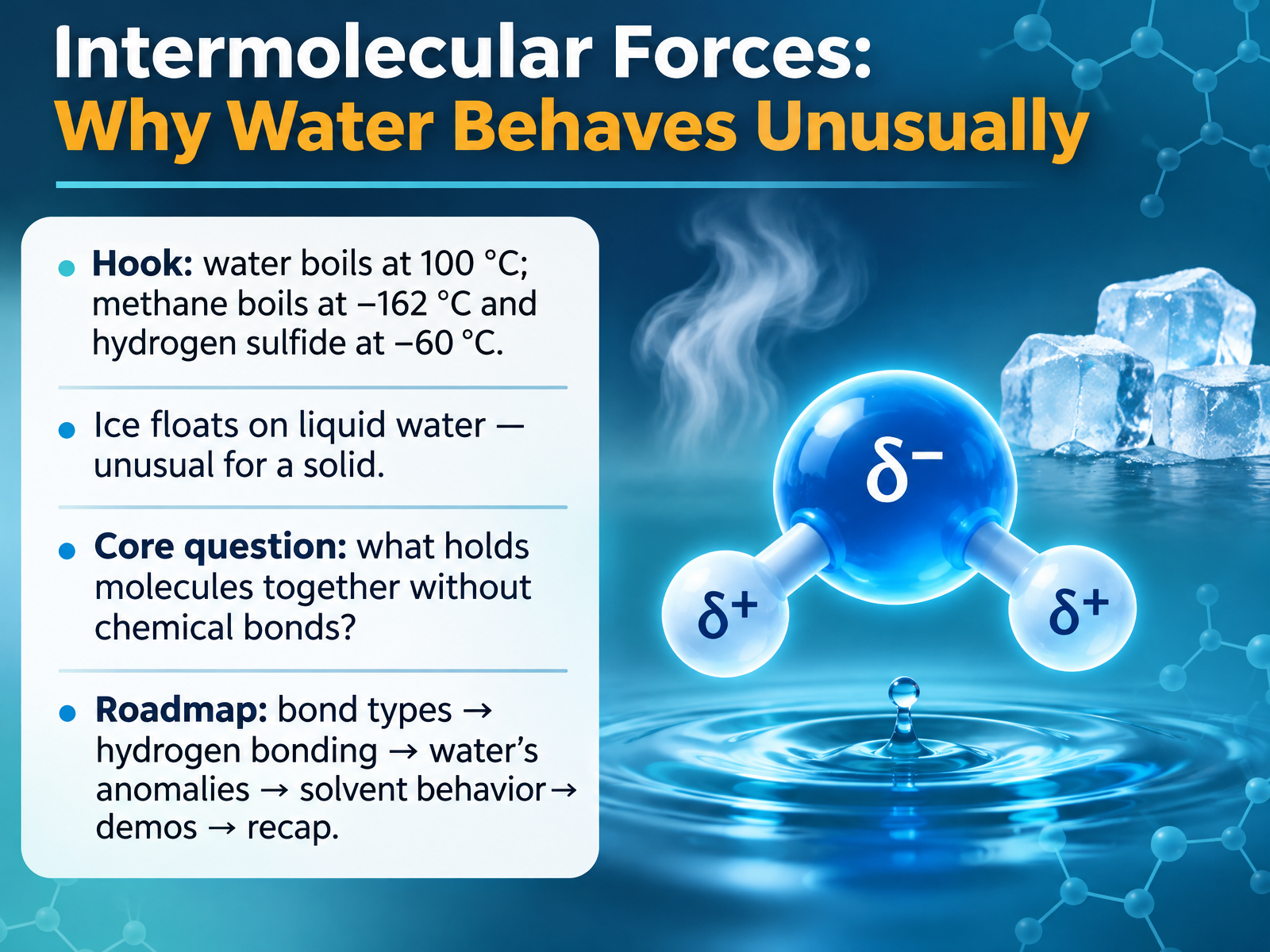
- 01Intermolecular Forces: Why Water Behaves UnusuallyWelcome. I'm glad you're here, because we're about to look at something you've known your whole life without ever really questioning it. Water boils at one hundred degrees Celsius. Methane, a molecule of similar size, boils at about minus one hundred sixty-two. Hydrogen sulfide boils near minus sixty. So why is water so different? And here's a second puzzle. Ice floats. For most solids, the solid sinks in its own liquid, but ice doesn't. Both oddities point to a quiet force between molecules, something that holds them together without being a chemical bond. That's our goal today: to name these forces, see what they do, and understand why water behaves so unusually. We'll move through bond types, then hydrogen bonding, then water's anomalies, then how water acts as a solvent, some demonstrations, and a recap. Let's begin by separating two ideas people often mix up: the bonds inside a molecule, and the forces between molecules.www2.chem.wisc.educhem.libretexts.orgchem.libretexts.org+22 min
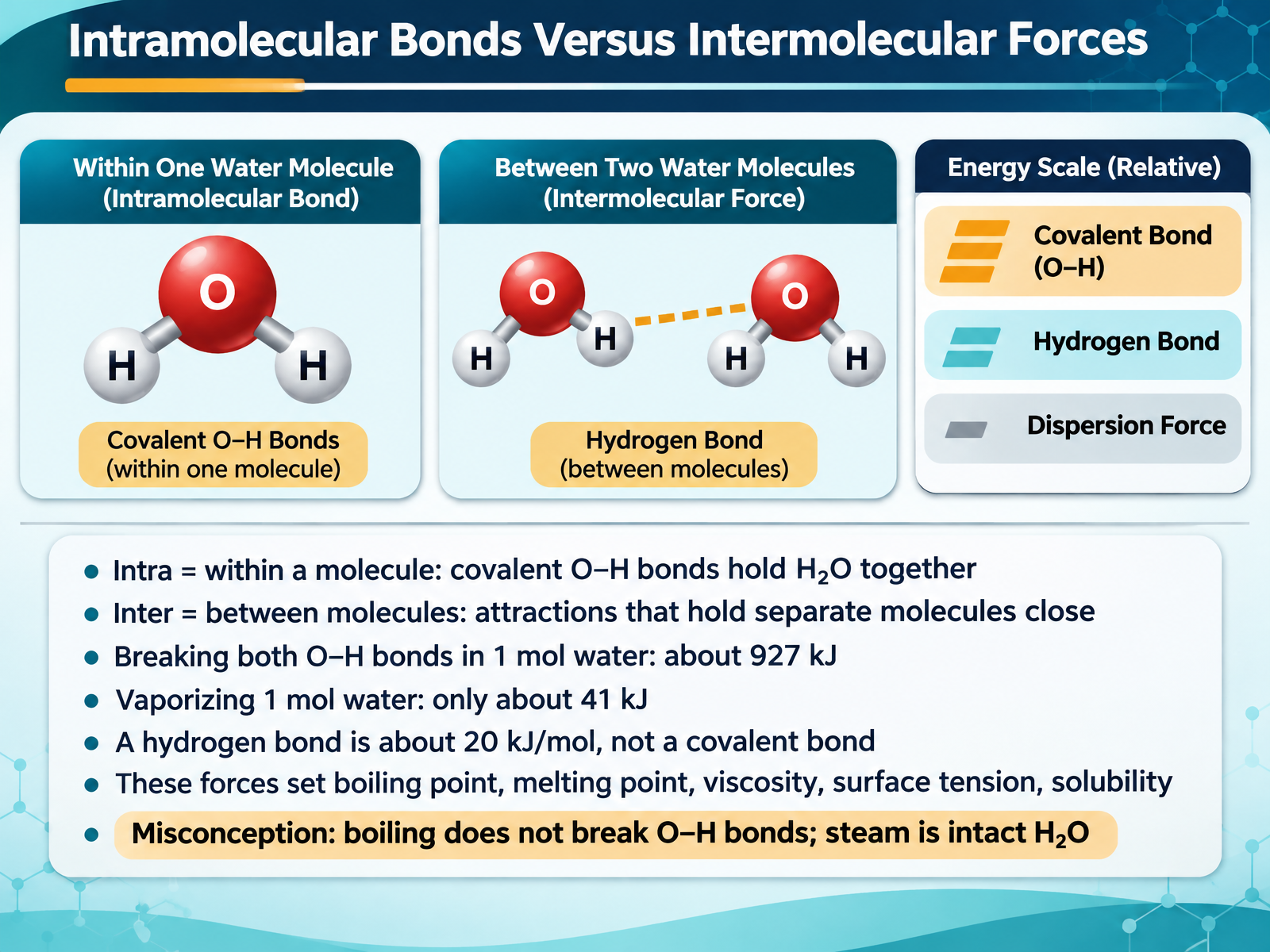
- 02Intramolecular Bonds Versus Intermolecular ForcesLet's make an important distinction. Intra means within. The covalent O–H bonds inside a water molecule hold its three atoms together. Inter means between. Those are the attractions that keep separate molecules close to one another. And the numbers tell the story. Breaking both O–H bonds in one mole of water takes about nine hundred twenty seven kilojoules. But vaporizing one mole of water, at its boiling point, takes only about forty one. A single hydrogen bond is worth roughly twenty kilojoules per mole. It's an attraction, not a covalent bond. These intermolecular forces set boiling point, melting point, viscosity, surface tension, and solubility. Here's a common misconception. Boiling does not break O–H bonds. Steam is intact H two O. Next, we'll look at the main types of intermolecular forces.
 chemed.chem.purdue.edupearson.comapchemscorecalculators.com+22 min
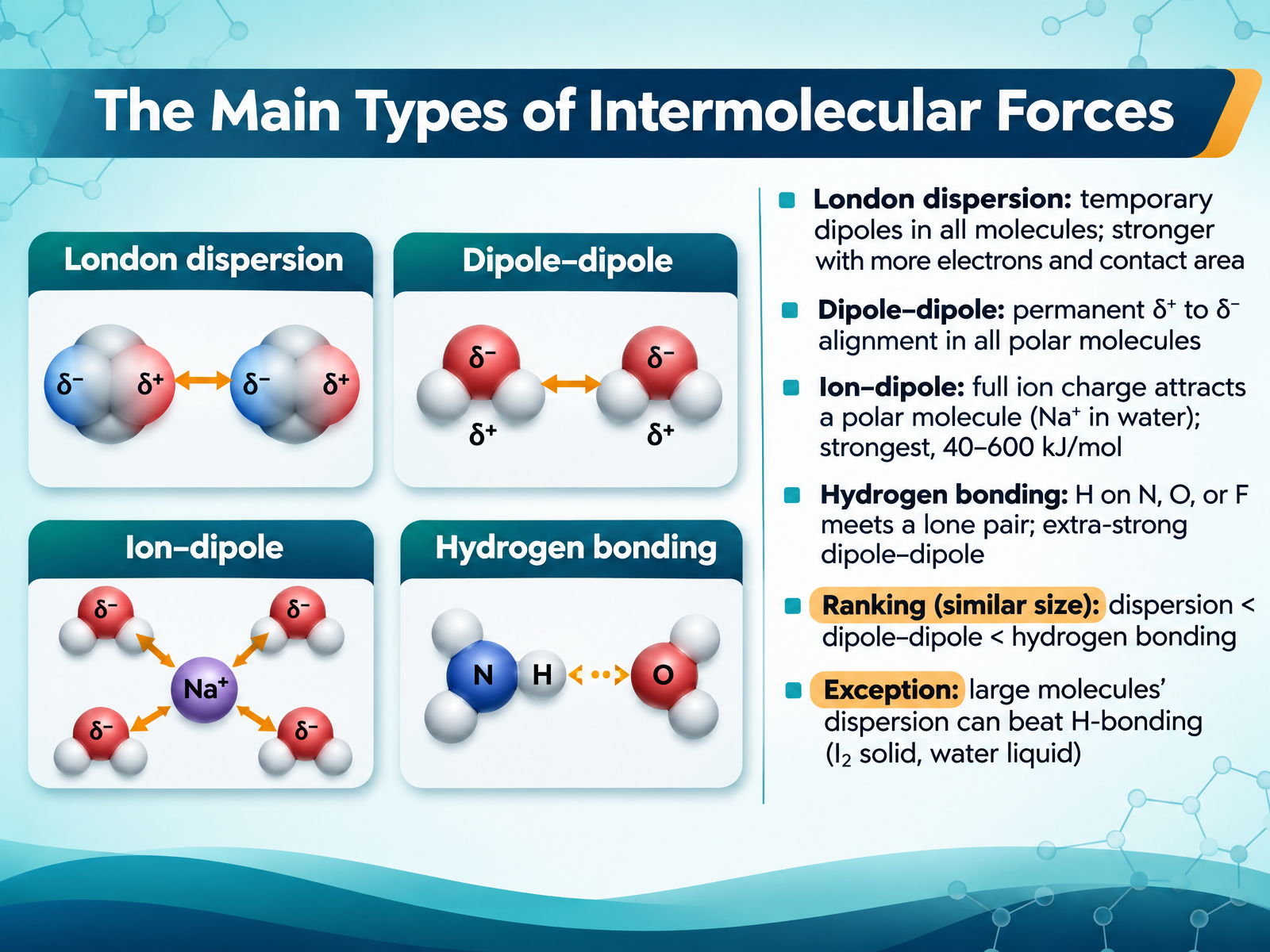
- 03The Main Types of Intermolecular ForcesNow let's sort these attractions into their main types. London dispersion forces come from temporary dipoles, and they exist in every molecule. They get stronger with more electrons and more contact area. Dipole-dipole forces are permanent alignments, where the partial positive end of one polar molecule meets the partial negative end of another. Ion-dipole forces are the strongest, roughly forty to six hundred kilojoules per mole, like a sodium ion surrounded by water. And hydrogen bonding is an extra-strong dipole-dipole interaction, where hydrogen on nitrogen, oxygen, or fluorine meets a lone pair. For molecules of similar size, the ranking runs dispersion, then dipole-dipole, then hydrogen bonding. But there's an exception worth remembering. In large molecules, dispersion can outweigh hydrogen bonding, which is why iodine is a solid while water is a liquid. Next, we'll look at how hydrogen bonds arrange themselves in water.
 en.wikipedia.orgopenstax.orgck12.org+22 min
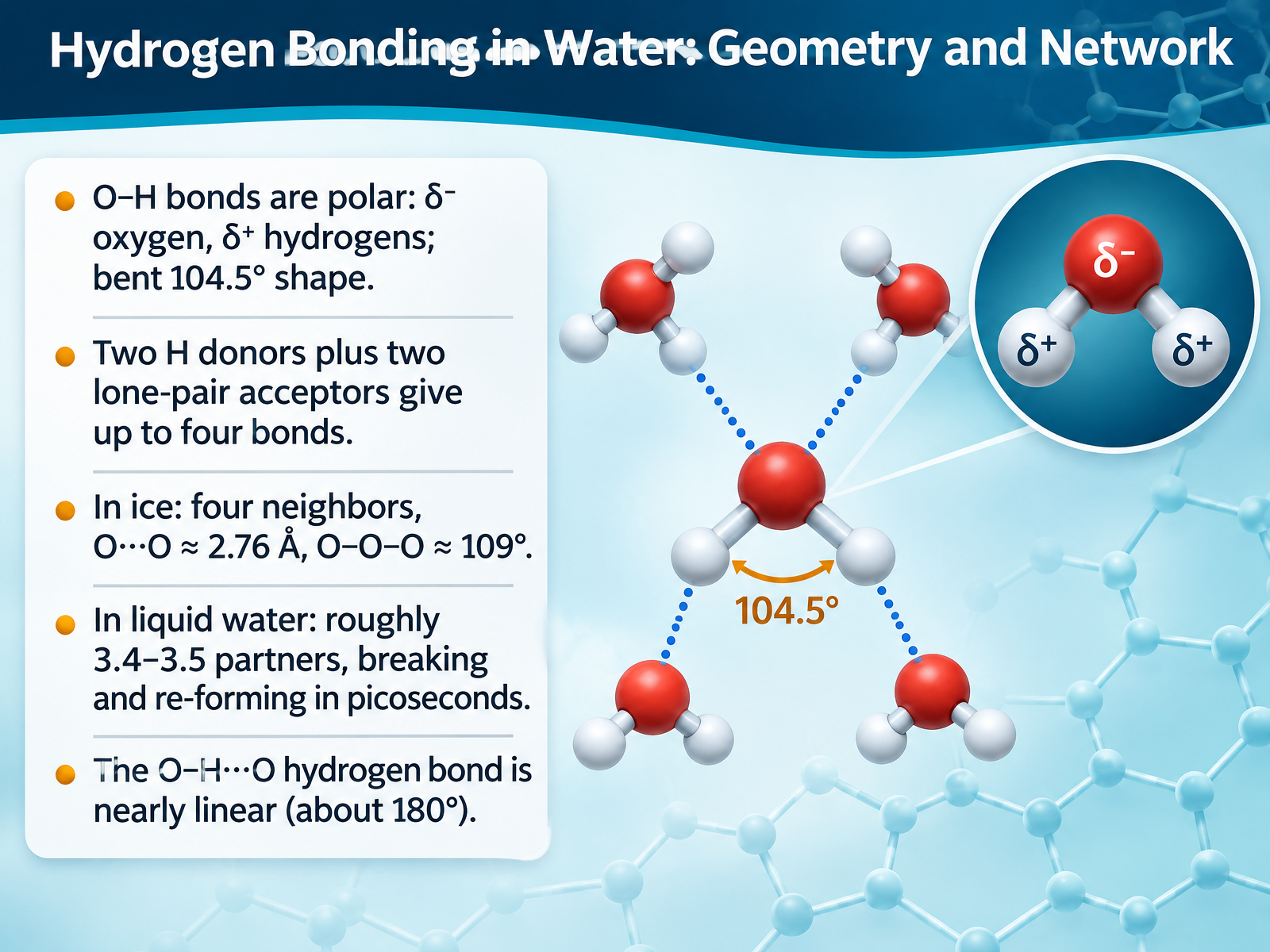
- 04Hydrogen Bonding in Water: Geometry and NetworkLet's look at the geometry of the hydrogen bond itself. Because oxygen pulls electrons toward itself, each O–H bond is polar. The oxygen carries a partial negative charge, and each hydrogen carries a partial positive charge. And the molecule is bent, with an angle of about one hundred four and a half degrees. Now, each water molecule has two hydrogen donors and two lone pairs that can accept. So in principle, it can form up to four hydrogen bonds. In ice, it actually does. Each molecule has four neighbours, with oxygen-to-oxygen distances of about two point seven six angstroms, arranged at about one hundred nine degrees. That gives ice its open, hexagonal structure. In liquid water, the network loosens. Each molecule averages roughly three point four to three point five partners, and those bonds break and re-form on the order of picoseconds. One more detail: the O–H···O hydrogen bond is nearly linear, around one hundred eighty degrees. That straightness is what makes the bond strong and directional. So water is a network, not just a crowd of separate molecules. That network explains some measurements that otherwise look wrong. And it sets up the next slide, where we ask why water's boiling point and heat capacity are so unusual. Anomaly 1: Boiling Point, Melting Point, and Heat Capacity.
 labman.phys.utk.educomptes-rendus.academie-sciences.frarxiv.org+22 min
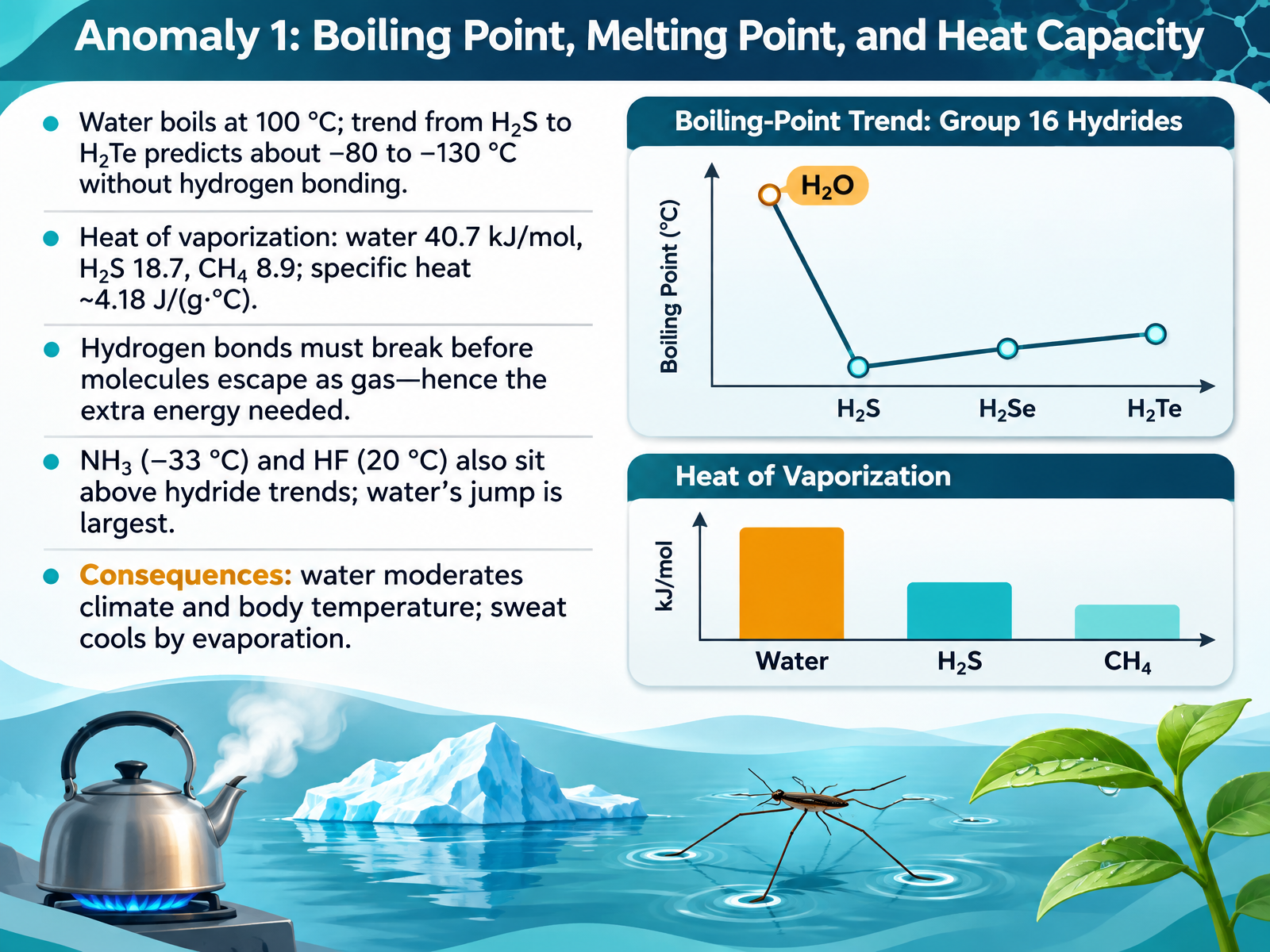
- 05Anomaly 1: Boiling Point, Melting Point, and Heat CapacityHere's the first anomaly. Water boils at one hundred degrees Celsius. Now, look at the trend from hydrogen sulfide to hydrogen telluride. Extend that line back to water, and you'd predict a boiling point somewhere around minus eighty to minus one hundred thirty degrees. Not even close. Why? Hydrogen bonds. Before a water molecule can escape as gas, those bonds have to be broken. That costs energy. Water's heat of vaporization is forty point seven kilojoules per mole, against eighteen point seven for hydrogen sulfide and eight point nine for methane. Its specific heat is about four point one eight joules per gram per degree Celsius. Ammonia and hydrogen fluoride also sit above their hydride trends, but water's jump is the largest. And this matters. Water moderates climate and body temperature, and sweat cools you by evaporation. Next, anomaly two: why ice floats and water peaks at four degrees Celsius.
 www2.chem.wisc.educhem.libretexts.orgchem.libretexts.org+21 min
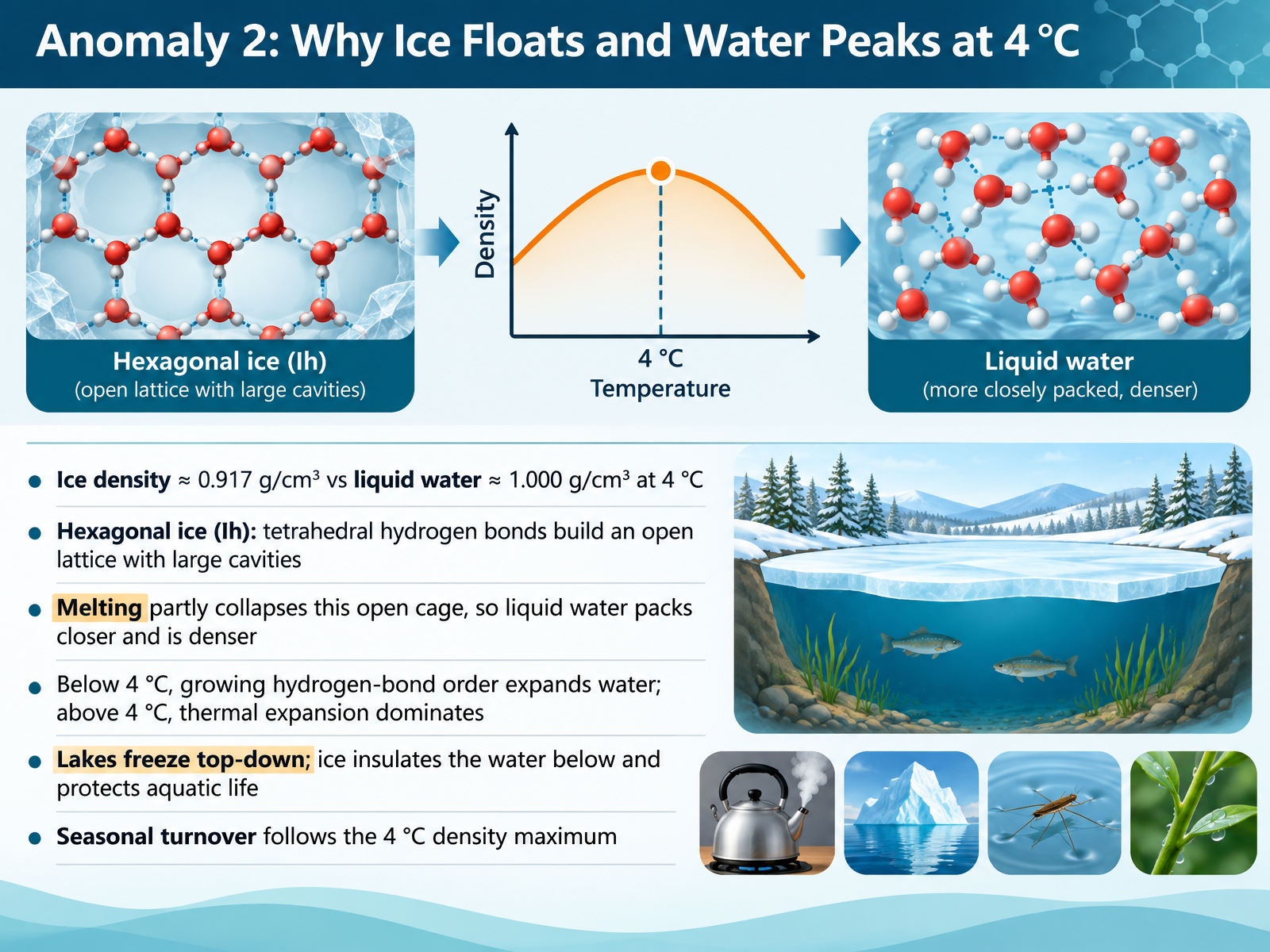
- 06Anomaly 2: Why Ice Floats and Water Peaks at 4 °CNow here's an anomaly you can see with your own eyes. Ice floats. For almost any other substance, the solid sinks in its own liquid. So why does water break the rule? The numbers tell the story. Ice has a density of about zero point nine one seven grams per cubic centimeter, while liquid water at four degrees Celsius is about one point zero zero zero. In everyday terms, ice is roughly nine percent less dense. The reason is the hydrogen bond. Ice, specifically hexagonal ice, has each molecule tethered to four neighbors in a tetrahedral arrangement. That builds an open cage with big empty cavities, a lattice full of holes. When the ice melts, that cage partly collapses. Molecules slide into the gaps, pack closer, and the liquid becomes denser. Now watch what happens with temperature. Below four degrees, cooling lets more hydrogen bonds lock into that open order, so water expands. Above four degrees, ordinary thermal jostling wins, and water expands again. That's why four degrees is the density peak. And it matters outdoors. Lakes cool, and the coldest water stays on top, so they freeze from the surface down. The ice layer insulates the liquid below and protects aquatic life through winter. That same density maximum also drives seasonal turnover in lakes. So remember, water's open hydrogen bonded cage is what lets ice float. That sets up our next anomaly: Anomaly 3: Cohesion, Adhesion, Surface Tension, and Capillarity.
 labman.phys.utk.educomptes-rendus.academie-sciences.frarxiv.org+22 min
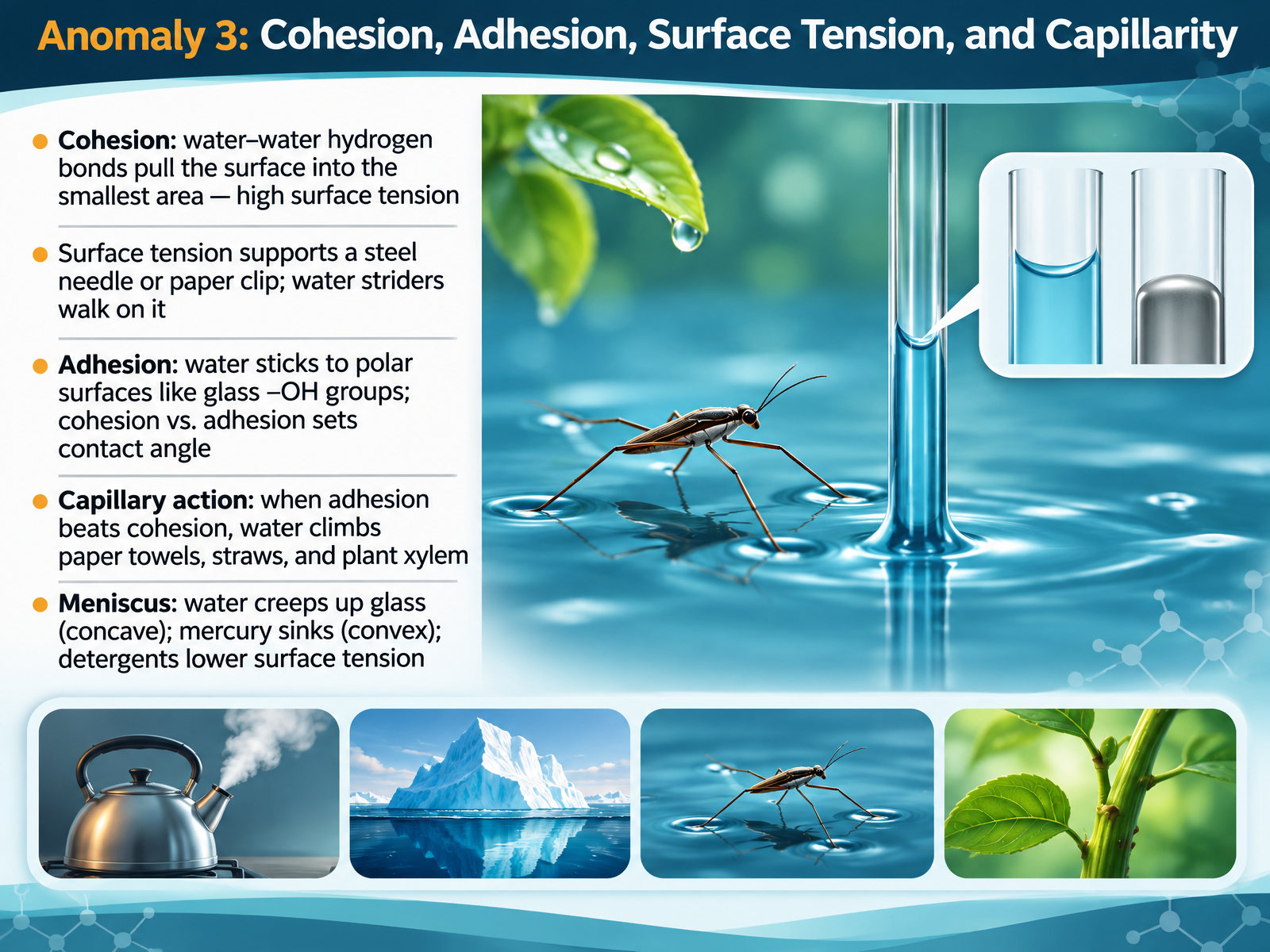
- 07Anomaly 3: Cohesion, Adhesion, Surface Tension, and CapillarityNow let's look at the third anomaly: water's stickiness, and how it plays out in four related behaviors.
First, cohesion. These are the hydrogen bonds pulling water molecules toward each other, water to water. At the surface, molecules have fewer neighbors above them, so they get pulled inward. That contraction into the smallest possible area is surface tension. And water's is unusually high, thanks to strong hydrogen bonding. It's strong enough to support a steel needle or a paper clip resting on the surface, and to let water striders walk across a pond.
Second, adhesion. Water also sticks to other polar surfaces, like the oxygen hydrogen groups on glass. So cohesion versus adhesion sets the contact angle, meaning how much a drop beads up or flattens out.
Third, capillary action. When adhesion beats cohesion, water climbs. You've seen it wick up a paper towel or a straw, and it's how the xylem in plants lifts water from the soil.
Finally, the meniscus. Water creeps up glass, giving a concave curve. Mercury, whose cohesion is far stronger than its adhesion to glass, sinks into a convex curve. And detergents lower water's surface tension, which is why a soapy touch makes a floating clip drop.
So cohesion, adhesion, and their competition explain a lot of water's quiet tricks. Next, we'll look at how water acts as a solvent, in Water as a Solvent: Ion–Dipole Forces and Hydration.
 2 min
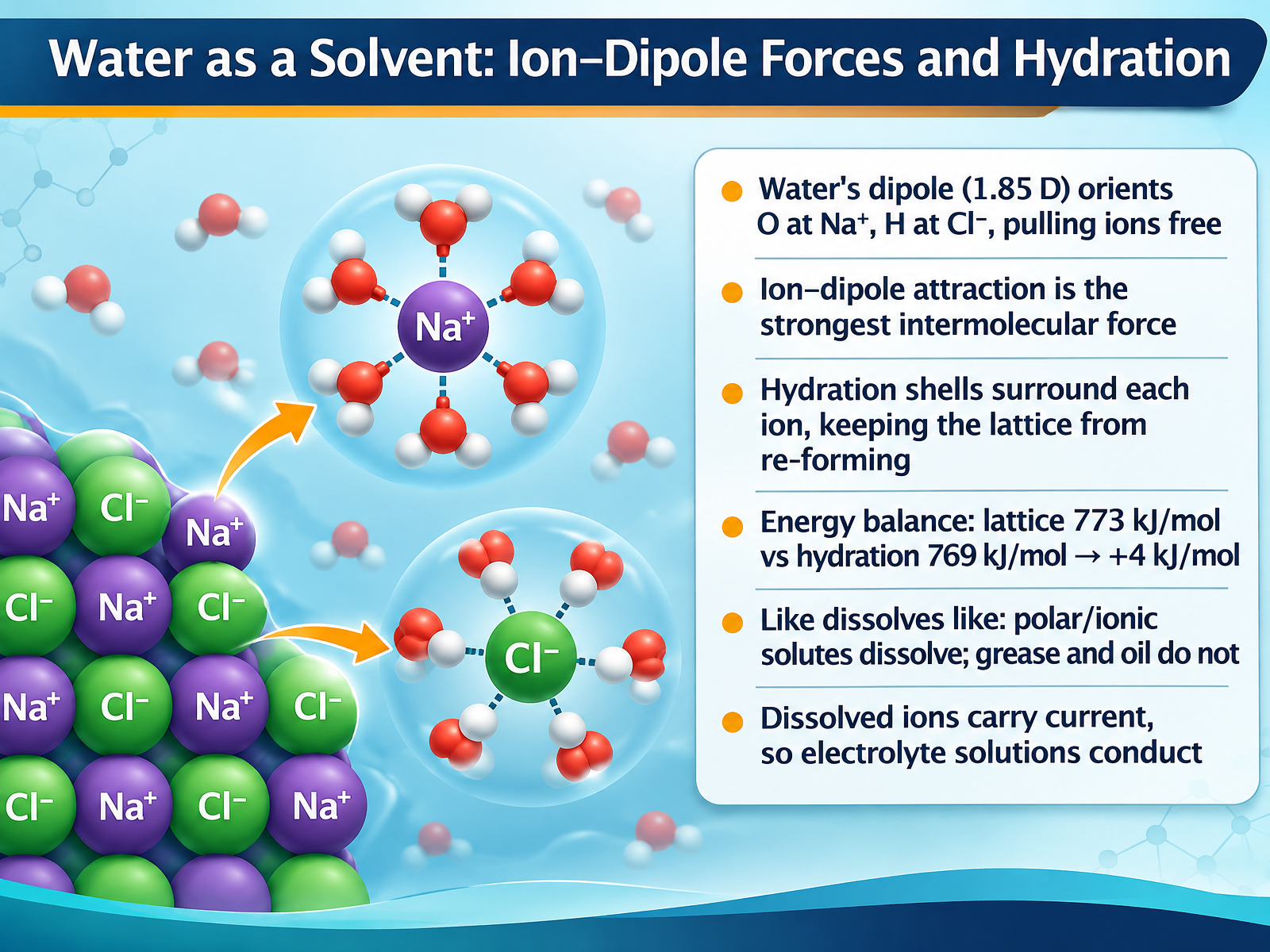
- 08Water as a Solvent: Ion–Dipole Forces and HydrationNow let's see this unusual polarity at work, dissolving a salt. Drop sodium chloride into water, and each water molecule turns like a tiny compass needle. Its slightly negative oxygen end points toward the positive sodium ion, and its slightly positive hydrogen ends point toward the negative chloride ion. That attraction between a full charge and a dipole is called an ion dipole force, and it's the strongest of all the intermolecular forces. Water's dipole moment is one point eight five debyes, which is large, and that helps it do this job so well. As these attractions pull ions off the crystal surface, each ion gathers a hydration shell, a close layer of oriented water molecules. That shell keeps the ions apart, so the lattice can't re form. The energy nearly balances: breaking the lattice costs seven hundred seventy three kilojoules per mole, and hydration gives back seven hundred sixty nine, leaving just plus four. That's why the salt dissolves without any dramatic chilling. This is what like dissolves like means: polar and ionic things dissolve in water, while grease and oil do not. And because dissolved ions can move and carry charge, electrolyte solutions conduct electricity. Next, we'll bring all these forces together in the force to anomaly map.
 en.wikipedia.orgopenstax.orgck12.org+22 min
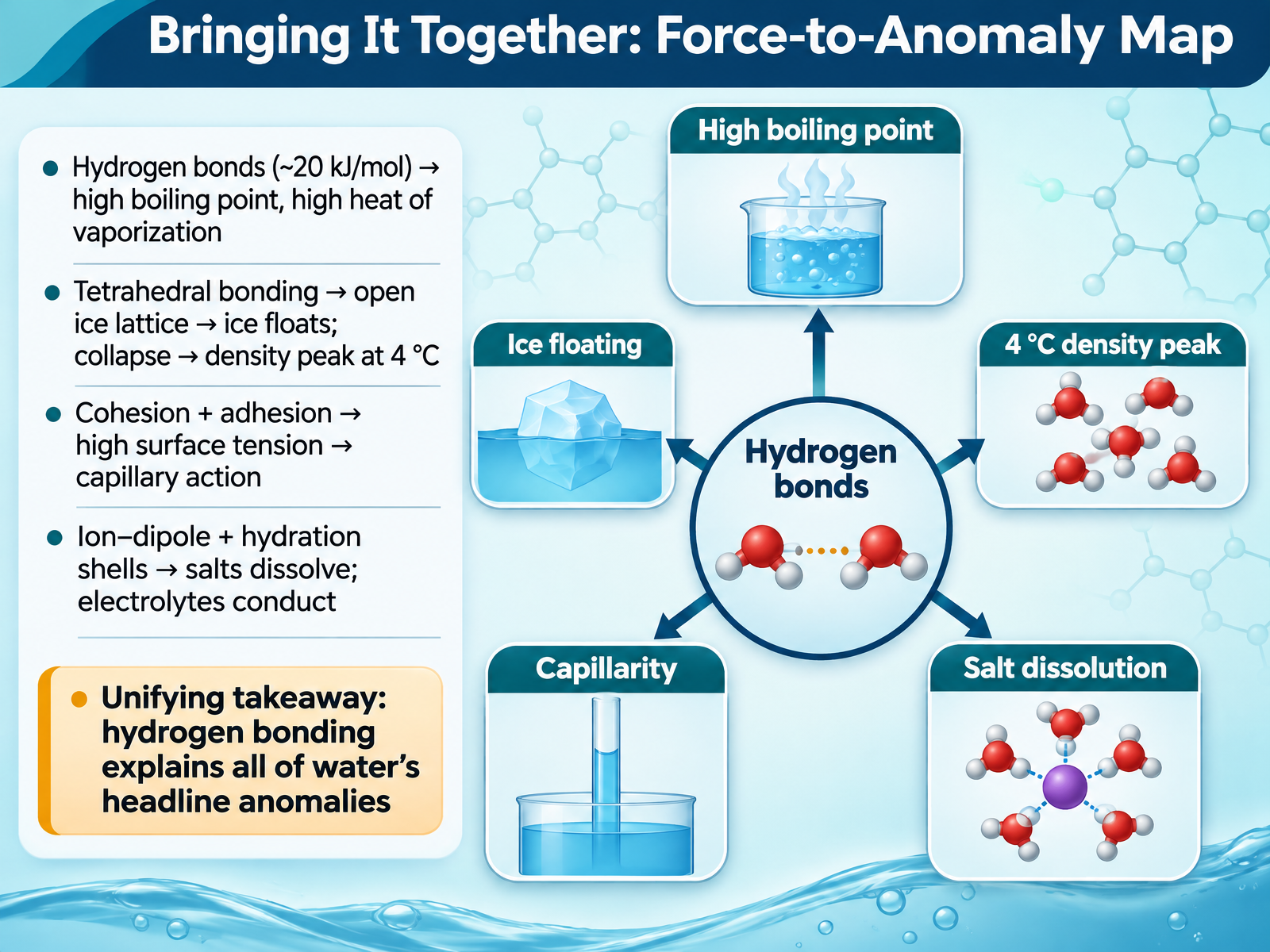
- 09Bringing It Together: Force-to-Anomaly MapSo let's pull it all together into one map. You've met the forces one at a time, and here's how each one explains a headline anomaly of water. Start with hydrogen bonds, worth roughly twenty kilojoules per mole each. Because they must be broken before water can boil, water boils near one hundred degrees Celsius, while hydrogen sulfide, a heavier molecule, boils near minus sixty. The same bonds make water's heat of vaporization unusually high. Next, tetrahedral bonding. Each molecule links to four neighbors, and those angles build an open, hexagonal ice lattice, so ice is less dense than liquid water and floats. As that lattice collapses on heating, molecules crowd in, and density peaks near four degrees Celsius. Next, cohesion and adhesion. Cohesion, water sticking to itself, gives the high surface tension you see in a water strider's feet. Adhesion, water sticking to other materials, helps water climb paper towels and narrow glass tubes, and that climbing is capillary action. Next, ion and dipole forces. When salt dissolves, the oxygen ends of water face the sodium ions, and each ion wraps itself in a hydration shell. The ions then move freely, so the solution conducts electricity. And here's the unifying takeaway. Hydrogen bonding sits underneath every one of these headline anomalies. Next, we put this map to work, beginning with a demo toolkit focused on surface tension and capillarity.
 www2.chem.wisc.educhem.libretexts.orgchem.libretexts.org+22 min
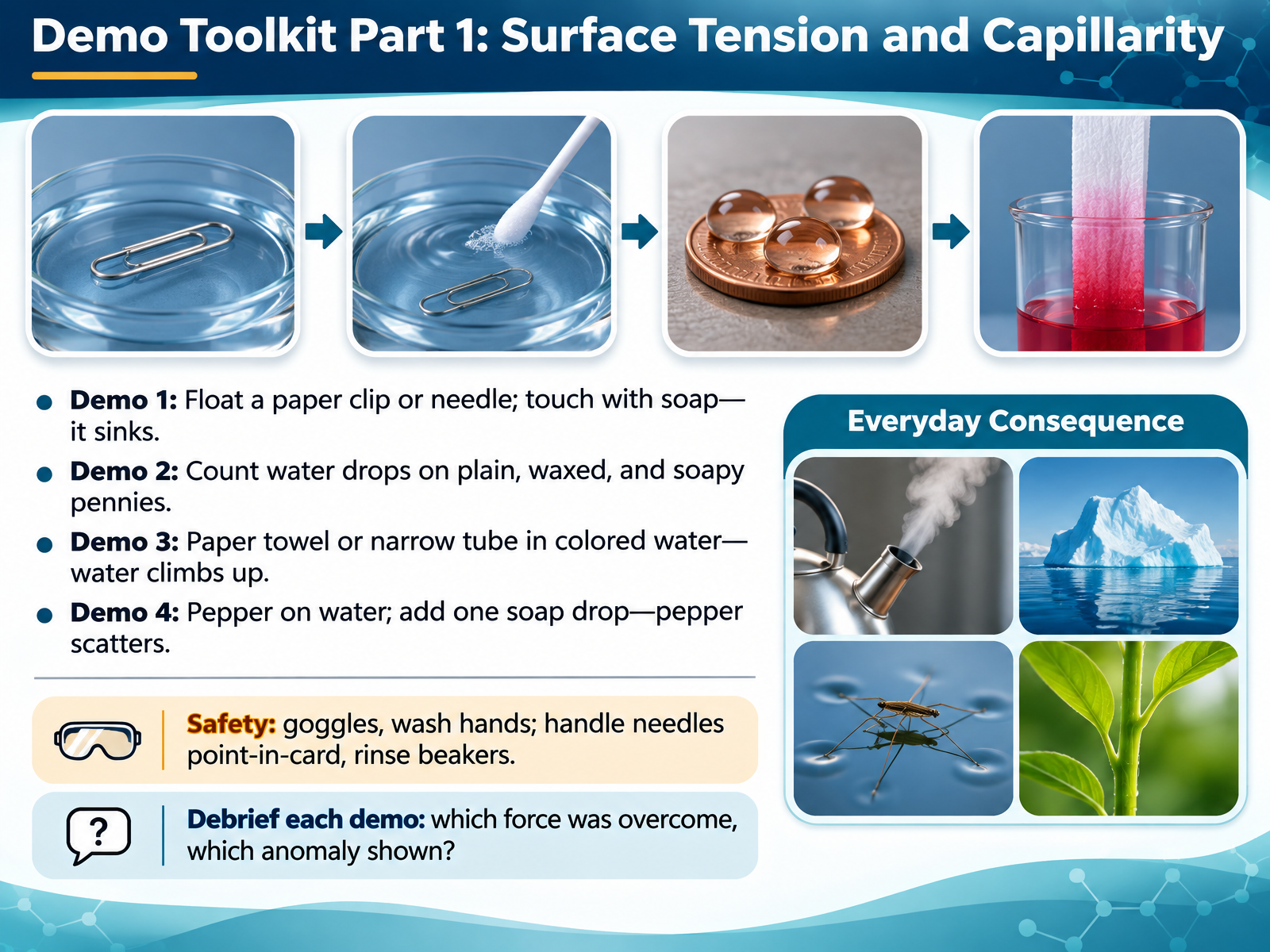
- 10Demo Toolkit Part 1: Surface Tension and CapillarityNow let's put all of this into your hands, with a demo toolkit you can run in almost any classroom. Demo one: float a paper clip or a fine needle on water. Then touch the water with a soapy swab, and it sinks. Soap weakens cohesion at the surface. Demo two: count drops on pennies. Waxy or soapy pennies hold far fewer than a clean one, because wax or soap changes how water sticks to the surface. Demo three: stand a paper towel or a narrow tube in colored water, and watch the water climb. That's capillary action, where adhesion to the material beats gravity. Demo four: sprinkle pepper on water, add a single soap drop, and the pepper scatters as the surface tension pulls away. For safety, wear goggles, wash hands afterward, keep needle points in a card, and rinse beakers between trials. After each demo, ask one question: which force was overcome, and which water anomaly did we just see? Next up, Demo Toolkit Part Two: Density and Dissolving.
 2 min
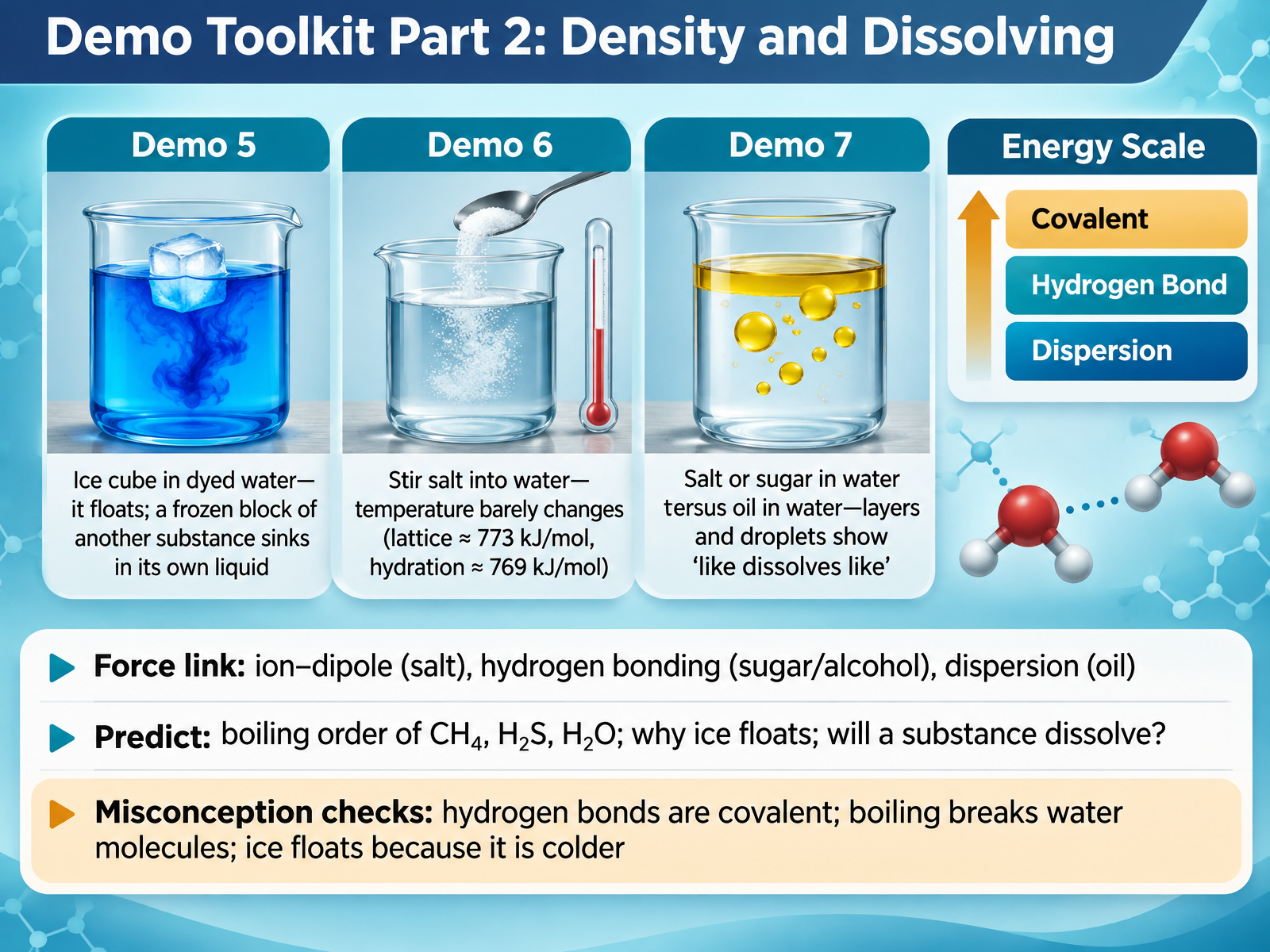
- 11Demo Toolkit Part 2: Density and DissolvingNow let's expand the toolkit with density and dissolving. Drop an ice cube into dyed water and it floats. Do the same with a frozen block of another substance, and it usually sinks in its own liquid. That difference is hydrogen bonding building an open, cage-like structure in ice. Next, stir salt into water and the temperature barely changes. Separating the ions costs about seven hundred seventy-three kilojoules per mole, and hydrating them releases about seven hundred sixty-nine. Nearly a wash. Then compare salt or sugar in water with oil in water. Salt and sugar disappear, while oil forms separate layers and droplets. Like dissolves like: ion-dipole forces hydrate the salt, hydrogen bonding welcomes sugar and alcohols, and oil relies only on weak dispersion forces, so water leaves it out. Use these demos to predict boiling order for methane, hydrogen sulfide, and water, why ice floats, and whether something will dissolve.
 chemed.chem.purdue.edupearson.comapchemscorecalculators.com+22 min
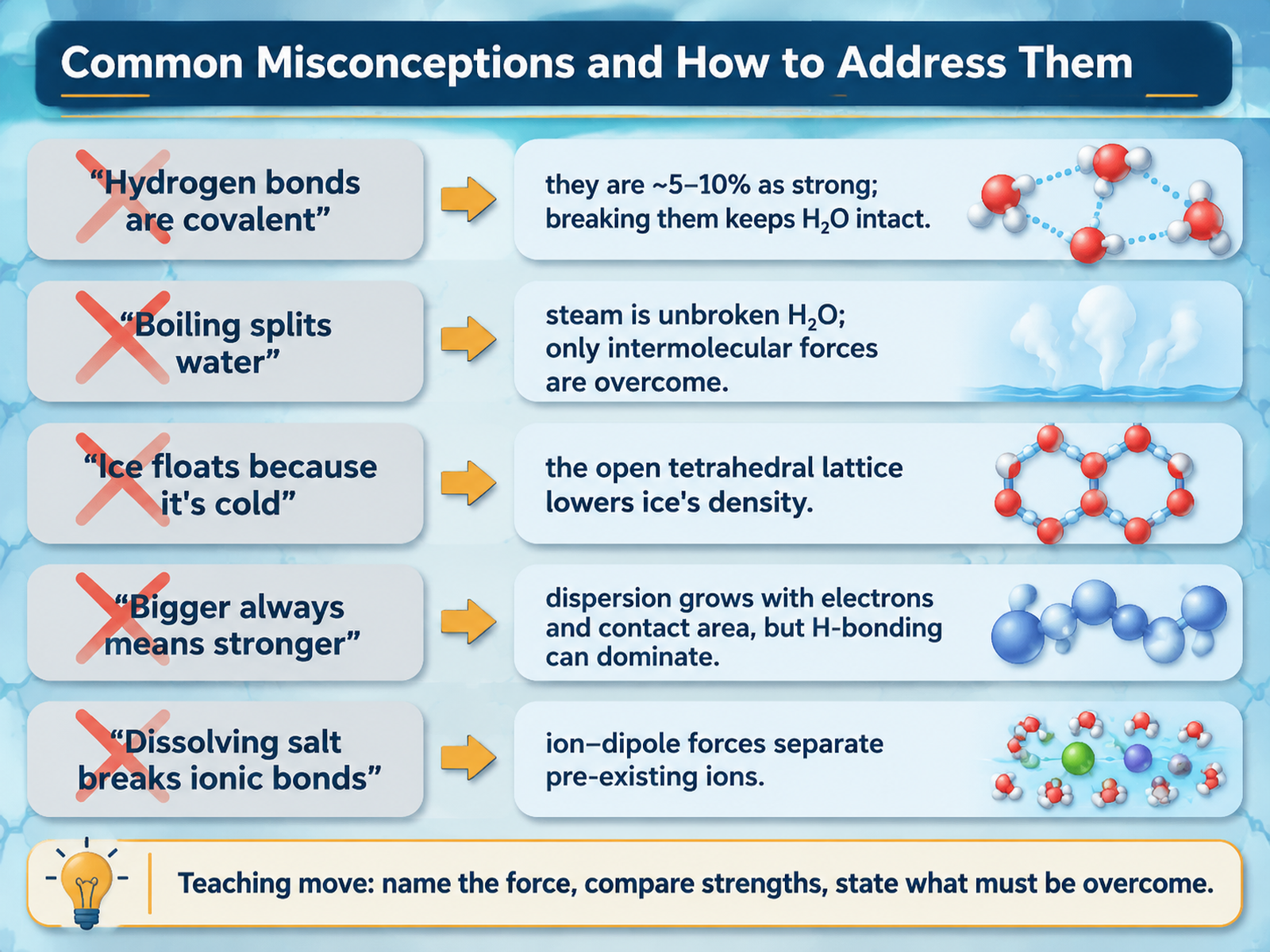
- 12Common Misconceptions and How to Address ThemLet's clear up some common misconceptions. First, hydrogen bonds are not covalent. They're only about five to ten percent as strong, so breaking them leaves water molecules intact. Second, boiling doesn't split water. Steam is unbroken H two O. Boiling only overcomes intermolecular forces. Third, ice floats not because it's cold, but because its open tetrahedral lattice lowers its density. Fourth, bigger doesn't always mean stronger. Dispersion grows with electrons and contact area, but hydrogen bonding can dominate. And fifth, dissolving salt doesn't break ionic bonds. Ion dipole forces separate the ions that were already there. So here's a teaching move. Name the force, compare strengths, and state what must be overcome. Next, let's pull all of this together in our recap of key takeaways.
 chemed.chem.purdue.edupearson.comapchemscorecalculators.com+22 min
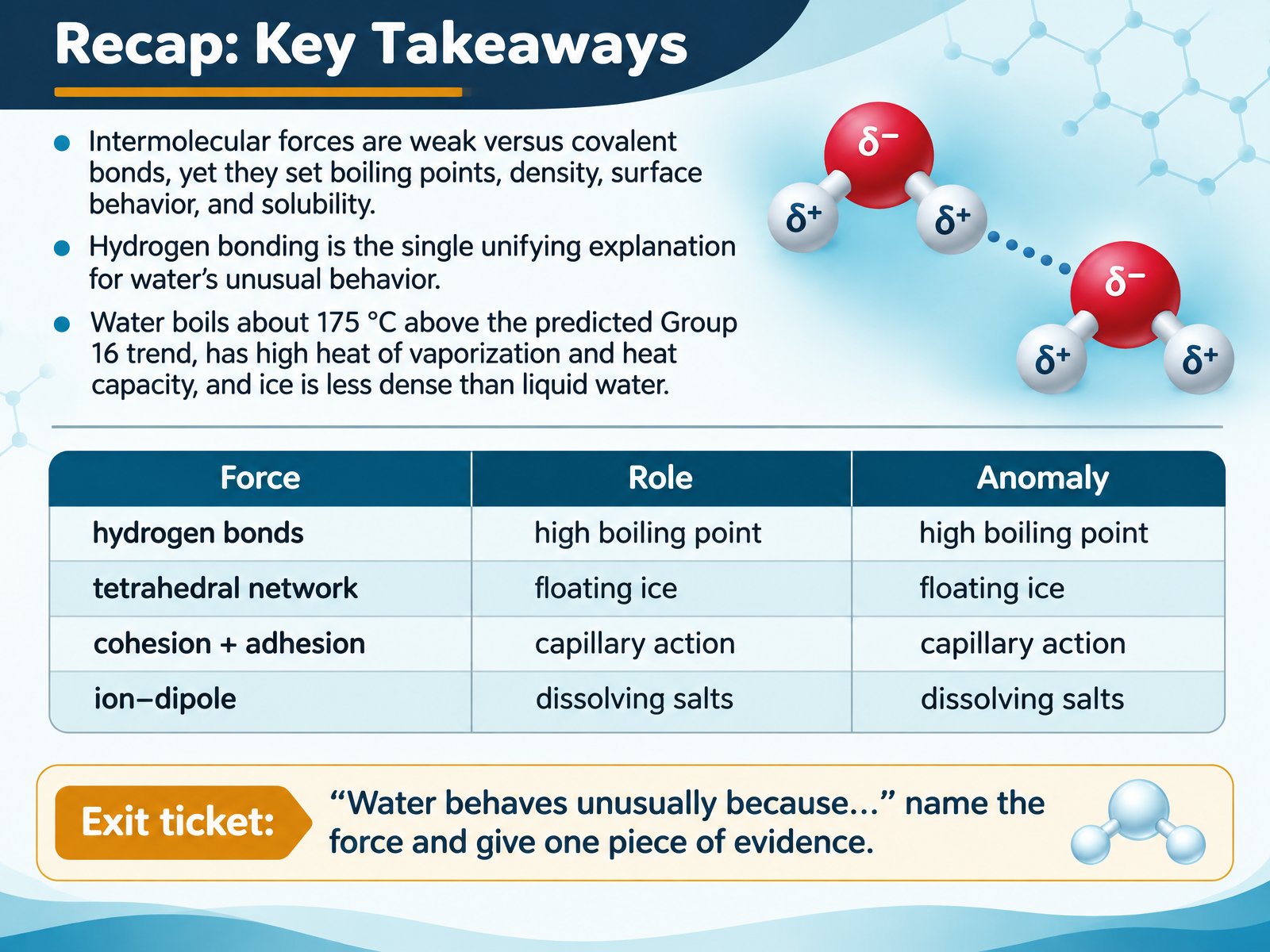
- 13Recap: Key TakeawaysLet's pull this together. Intermolecular forces are weak next to covalent bonds, yet they decide boiling point, density, how a surface behaves, and what dissolves in what. And for water, one idea ties everything together: hydrogen bonding. Water boils about one hundred seventy five degrees Celsius above the predicted Group 16 trend, and it has a high heat of vaporization and a high heat capacity. Ice is less dense than liquid water, which is why it floats. The pattern to remember is force, then role, then anomaly. Hydrogen bonds give the high boiling point. The tetrahedral network gives floating ice. Cohesion plus adhesion gives capillary action. And ion dipole forces let water dissolve salts. So here's your exit ticket. Finish this sentence: water behaves unusually because, then name the force and give one piece of evidence. Take a moment and say it out loud.
 www2.chem.wisc.educhem.libretexts.orgchem.libretexts.org+22 min
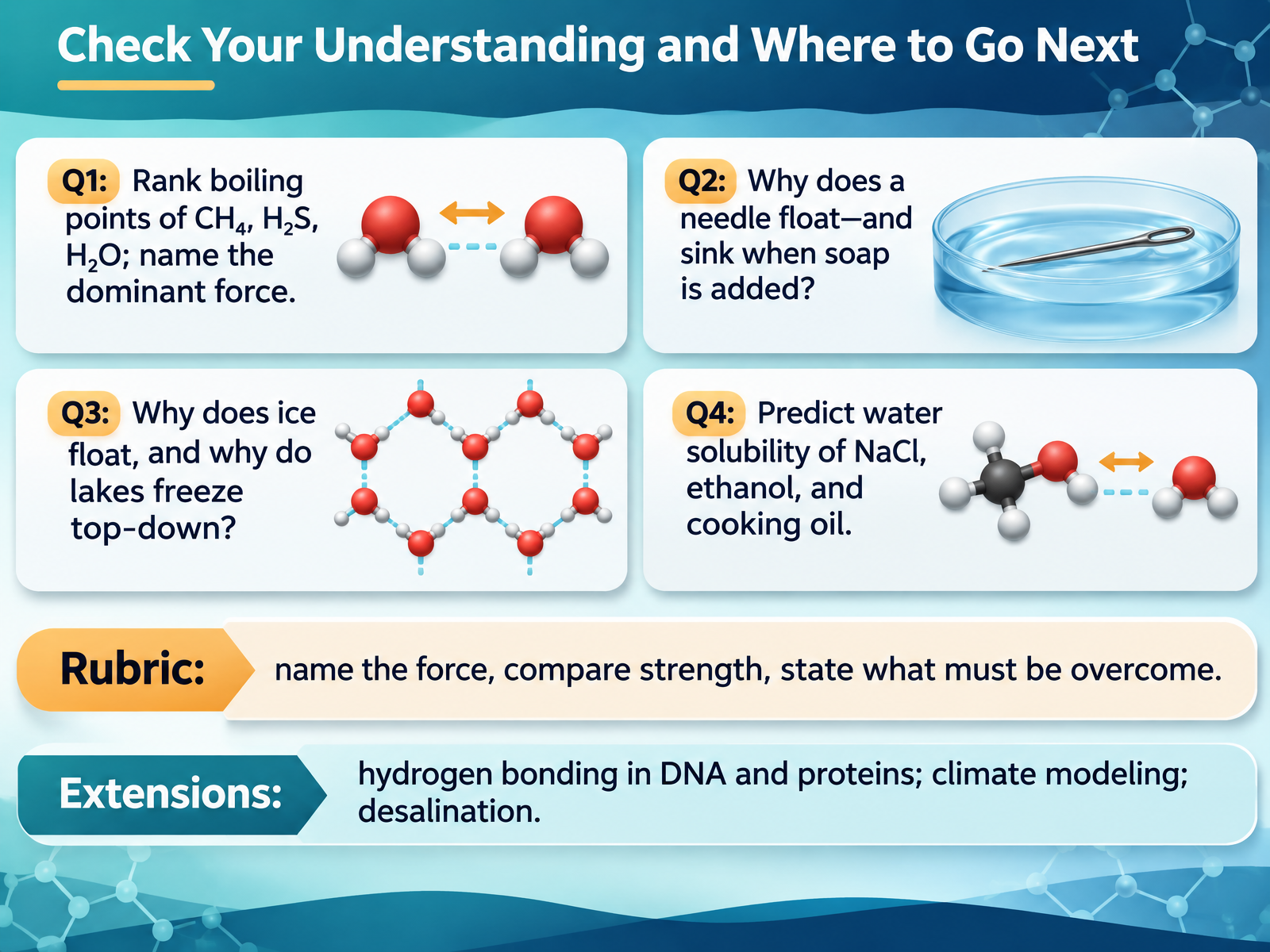
- 14Check Your Understanding and Where to Go NextLet's put it all together. Question one: rank the boiling points of methane, hydrogen sulfide, and water. Water is highest, then hydrogen sulfide, then methane, because you go from hydrogen bonding, to dipole-dipole, to weak London dispersion. Question two: a needle floats on the strength of surface tension, the cohesive pull of hydrogen bonds at the surface. Add soap and those bonds are disrupted, so the surface gives way and the needle sinks. Question three: ice floats because its open hydrogen-bonded lattice is less dense than liquid water, and lakes freeze top-down because that lighter ice insulates the water below. Question four: salt dissolves through ion-dipole attractions, ethanol through hydrogen bonding, and oil stays separate because it can't match water's strong forces. Notice the rubric behind every answer: name the force, compare its strength, and state what must be overcome. From here, you could explore hydrogen bonding in DNA and proteins, climate modeling, or desalination. You've built a real framework today, so thank you for your curiosity, and keep asking why water behaves the way it does.
 www2.chem.wisc.educhem.libretexts.orgchem.libretexts.org+22 min
Take the deck with you
Download this course as a file — free, no sign-up needed.
- PDF handoutEvery slide page, ready to print or share.15 pages · 4.2 MBDownload
- Narrated PowerPointThe deck that presents itself — every slide carries the digital human's narration video.15 pages · 17.5 MBDownload
- PowerPoint slidesThe full deck as a .pptx — open it in PowerPoint, Keynote, or Google Slides.15 pages · 4.1 MBDownload
Free to use in your own training — please keep the PersonWise credit page at the end.
Have your own deck? Turn it into a course
Sources consulted
Web sources consulted while building this course.
- https://www2.chem.wisc.edu/deptfiles/genchem/sstutorial/Text10/Tx106/tx106.html — www2.chem.wisc.edu
- Phase Changes — chem.libretexts.org
- 3.3: Intermolecular Forces in Liquids - Chemistry LibreTexts — chem.libretexts.org
- Water Data (comparative hydride data) — water.lsbu.ac.uk
- Intermolecualr properties — science-revision.co.uk
- Intermolecular Forces — chemed.chem.purdue.edu
- General Chemistry Study Guide: Liquids & Intermolecular Forces | Notes — pearson.com
- Intermolecular vs Intramolecular Forces | AP Chemistry — apchemscorecalculators.com
- Intermolecular force — en.wikipedia.org
- 11.2: Intermolecular Forces — chem.libretexts.org
- Intermolecular force — en.wikipedia.org
- 2.12 Noncovalent Interactions between Molecules - Organic Chemistry | OpenStax — openstax.org
- Polarity and Intermolecular Forces | CK-12 Foundation — ck12.org
- 2.11: Intermolecular Forces — chem.libretexts.org
- Intermolecular Forces | Chemistry: Atoms First — courses.lumenlearning.com
- Phases of water — labman.phys.utk.edu
- The physics of liquid water — comptes-rendus.academie-sciences.fr
- Standard model for liquid water withstands x-ray probe — arxiv.org
- Structure and Properties of Water in its Various States — doi.org
- Structure of liquid water – a dynamical mixture of tetrahedral and ‘ring-and-chain’ like structures — doi.org