Begin
14 pages · ~28 min
Solutions and Solubility: Why Things Dissolve
This training explains the science of solubility and why substances dissolve, helping learners understand core chemistry concepts behind solutions and dissolution.
A digital instructor presents all 14 pages. Hold “Ask” at any point and ask out loud — the answer comes from this course. No sign-up needed.
What you’ll learn
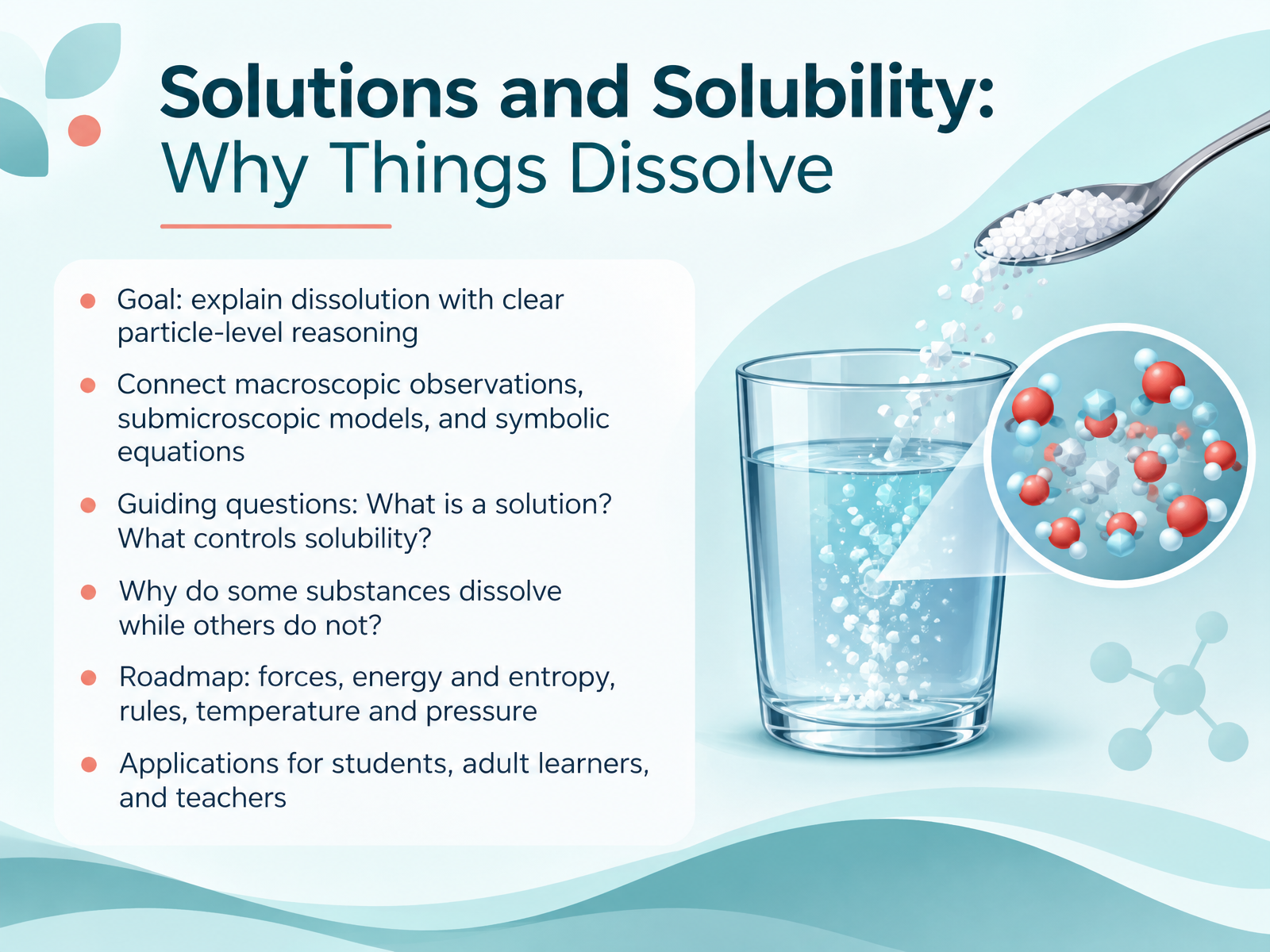
- 01Solutions and Solubility: Why Things DissolveWelcome. Today we're going to talk about solutions and solubility, and answer a question you've probably asked yourself: why do some things dissolve while others don't? Our goal is simple. We want to explain dissolution with clear reasoning at the particle level. Along the way, we'll connect three views of chemistry: what you observe in the beaker, the particle models behind it, and the symbolic equations that represent it. Research shows that students often learn one view but not the others, and that gap creates lasting confusion. So we'll keep all three linked. Here are our guiding questions. What exactly is a solution? What controls solubility? And why do some substances dissolve while others do not? First, we'll look at the forces involved. Next, energy and entropy. Then, practical solubility rules, plus temperature and pressure effects. Throughout, we'll ground each idea in everyday examples, and we'll keep the takeaway practical for students, adult learners, and teachers alike. Let's begin with the basics. What counts as a solution?pubs.acs.orgonlinelibrary.wiley.comlink.springer.com+22 min
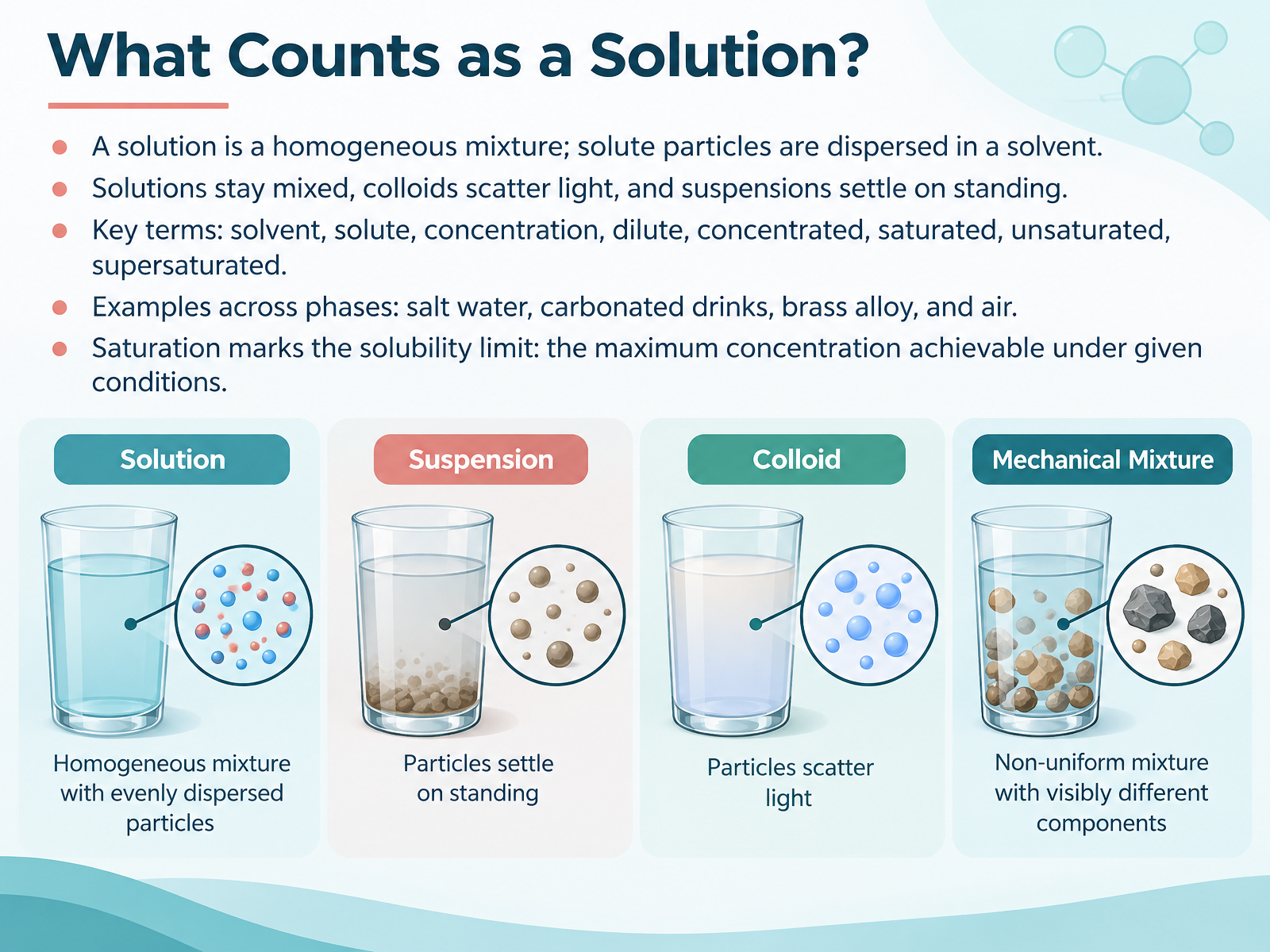
- 02What Counts as a Solution?Let's look at what actually counts as a solution. A solution is a homogeneous mixture, meaning solute particles are evenly dispersed throughout a solvent. Here's a useful distinction. Solutions stay mixed, colloids scatter light, and suspensions settle on standing. Next, the key terms. The solvent is the substance doing the dissolving, and the solute is what gets dissolved. Concentration describes how much solute is present. A dilute solution has little solute, while a concentrated one has a lot. Saturation marks the solubility limit, the maximum concentration achievable under given conditions. Solutions exist across phases too: salt water, carbonated drinks, the brass alloy, and even the air you breathe. Now let's move on to why like dissolves like, examining intermolecular forces at work.
 openstax.orgdepartments.johnabbott.qc.cawp.as.uky.edu+21 min
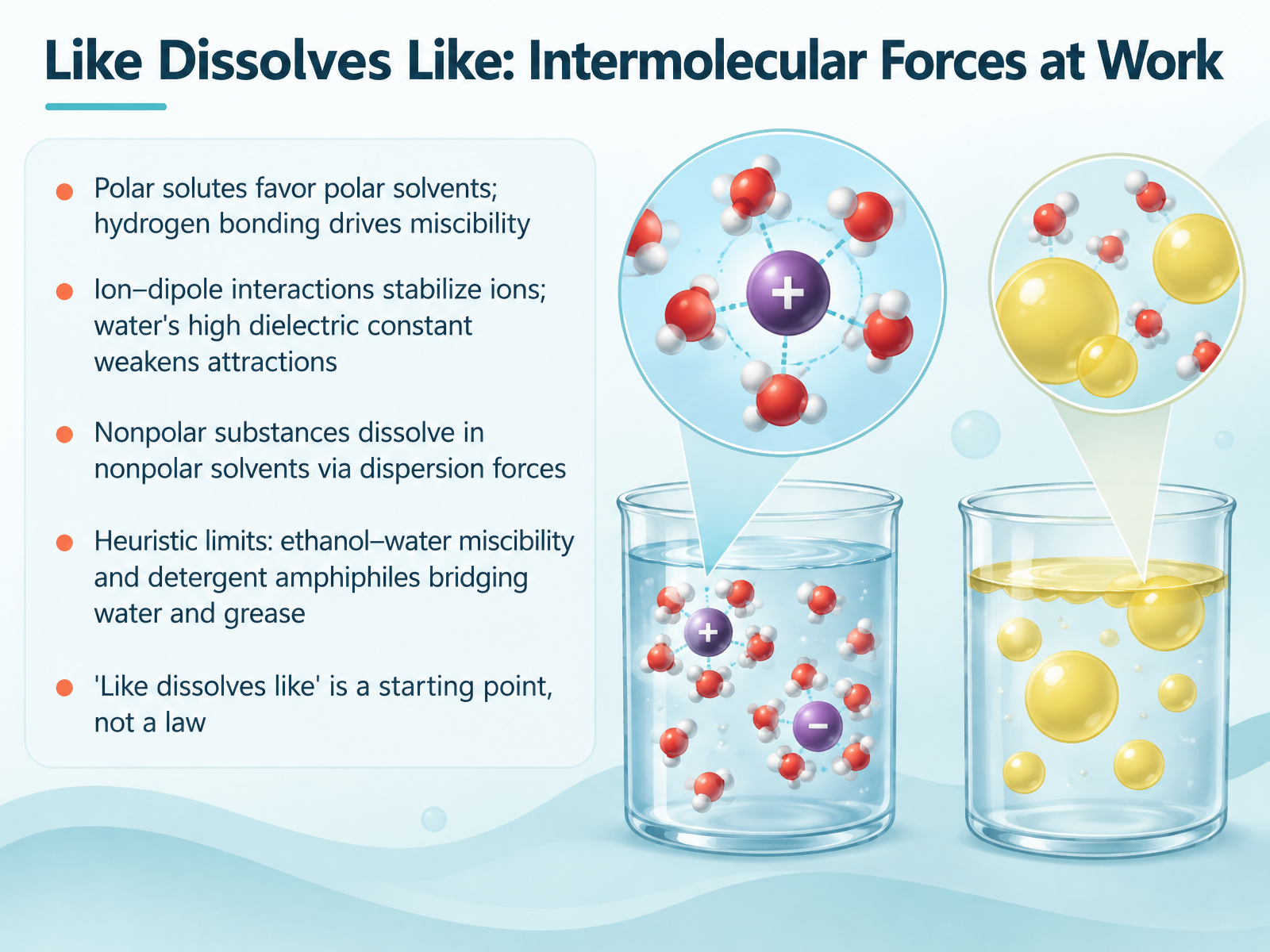
- 03Like Dissolves Like: Intermolecular Forces at WorkLet's take that idea one step further and see what is actually happening between particles. The rule of thumb is simple. Like dissolves like. Polar solutes favor polar solvents. For example, ethanol and water mix in any proportion because hydrogen bonding lets their molecules interact comfortably. Students and adult learners often ask why salt disappears in water. Here's why. Water molecules surround each ion and stabilize it through ion dipole interactions. Water's high dielectric constant weakens the attractions between ions, so the crystal breaks apart. Next, nonpolar substances dissolve in nonpolar solvents through dispersion forces. Detergent amphiphiles show how this heuristic bends. One end is polar, the other nonpolar. So they bridge water and grease. But remember, like dissolves like is a starting point, not a law. It guides predictions while enthalpy and entropy ultimately decide. This brings us to the next slide, The Energy and Entropy of Mixing.
 pubs.acs.orgonlinelibrary.wiley.comlink.springer.com+22 min
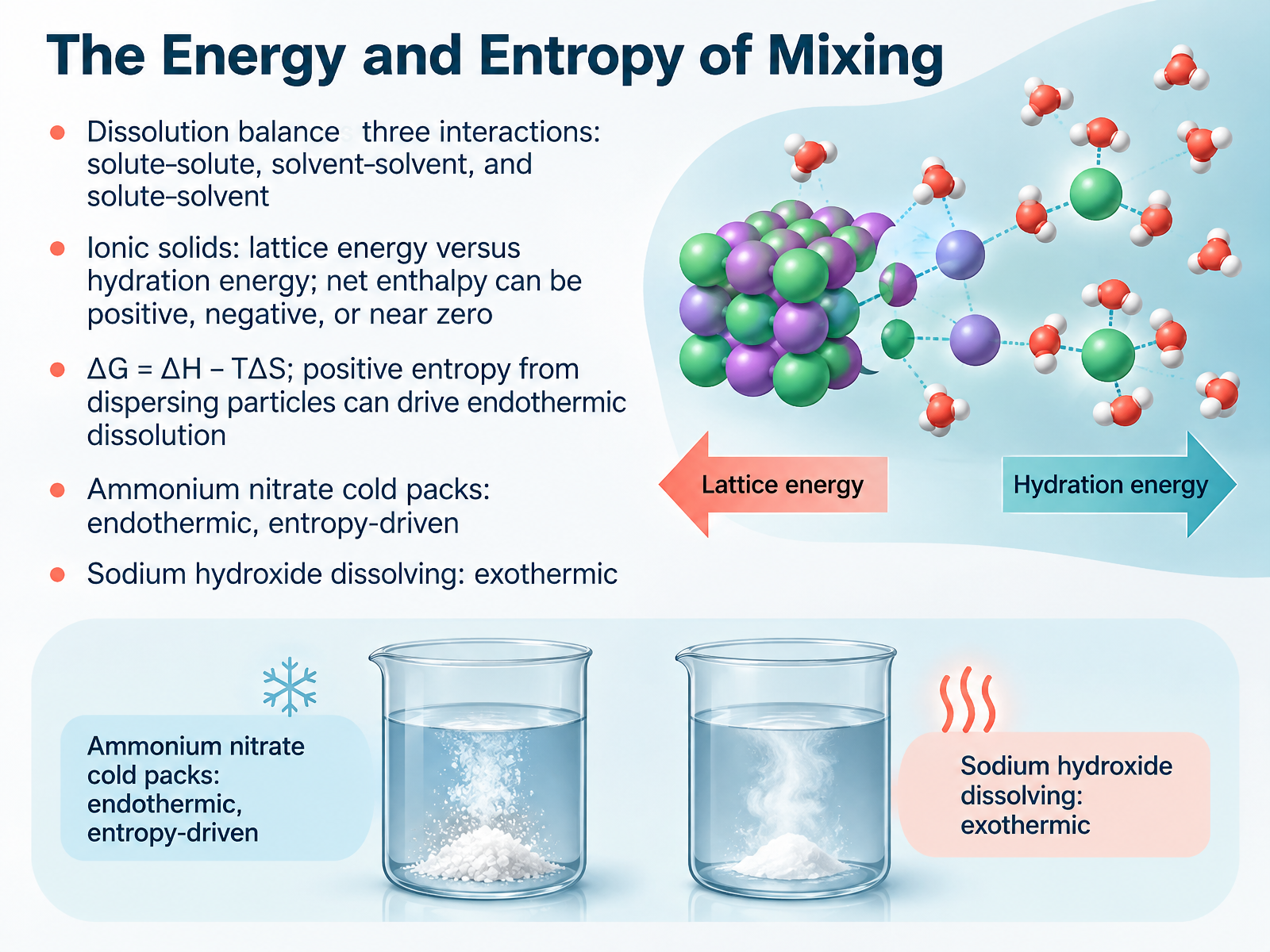
- 04The Energy and Entropy of MixingNext, let's look at the energy and entropy of mixing. Dissolution balances three interactions: solute with solute, solvent with solvent, and solute with solvent. For an ionic solid, lattice energy holds the crystal together, while hydration energy is released as water surrounds the ions. The net enthalpy change can be positive, negative, or close to zero. Here's the key idea: whether a substance dissolves depends on free energy, delta G equals delta H minus T delta S. A positive entropy change, from particles spreading out, can drive an endothermic dissolution even when heat is absorbed. That is exactly what happens in ammonium nitrate cold packs, which feel cold because the process is endothermic and entropy-driven. By contrast, sodium hydroxide dissolving is exothermic and releases heat. So remember, energy alone does not decide. Now let's see why solubility rules work, and where they fail.
 pubs.acs.orgonlinelibrary.wiley.comlink.springer.com+21 min
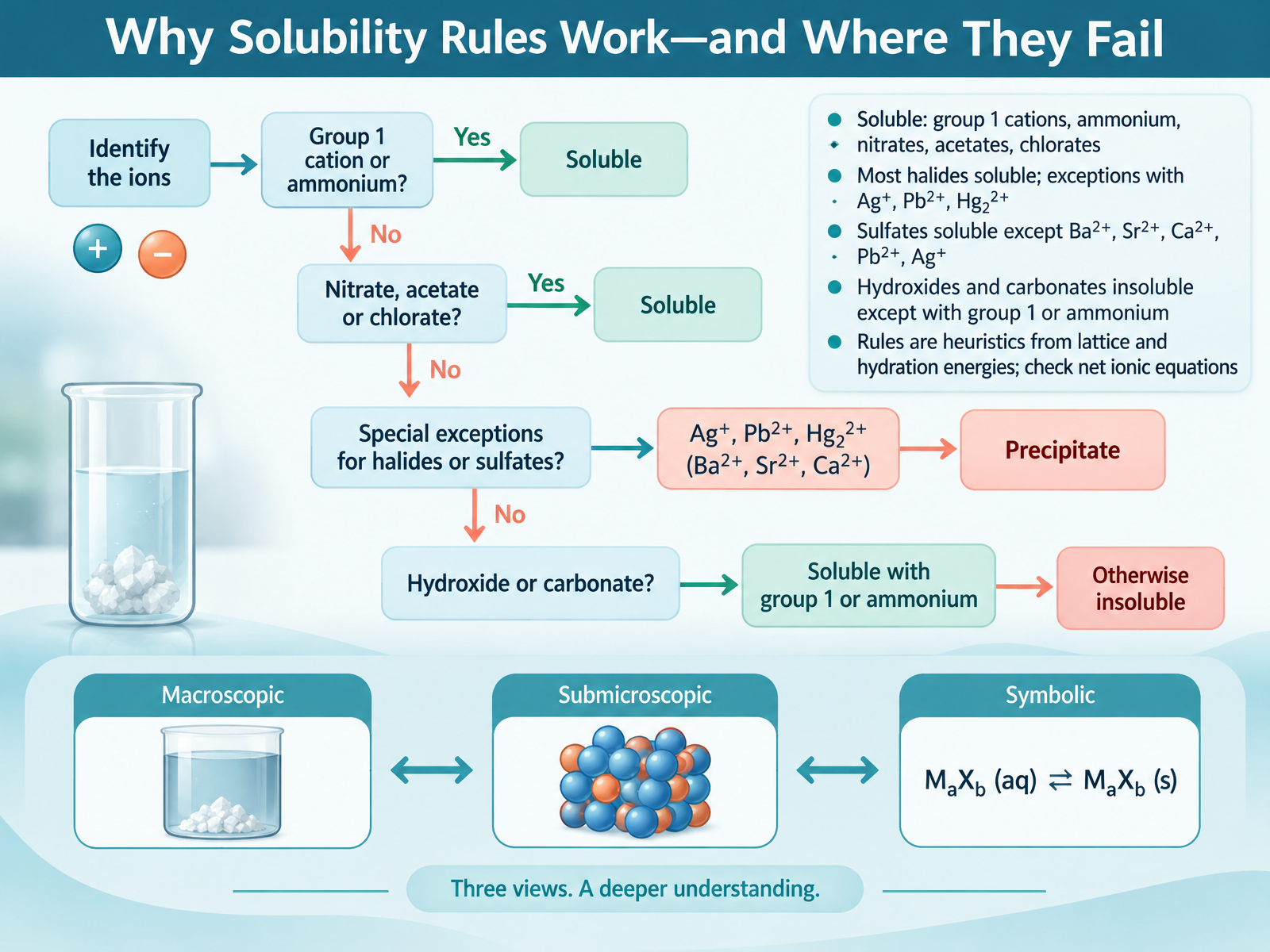
- 05Why Solubility Rules Work—and Where They FailNow let's look at why solubility rules work, and where they fail. First, the reliable ones. Compounds containing group one cations or ammonium are soluble, as are nitrates, acetates, and chlorates. Next, most halides dissolve, except with silver, lead two plus, and mercury two two plus. Sulfates dissolve too, except with barium, strontium, calcium, lead two plus, and silver. Then the insoluble side. Hydroxides and carbonates generally do not dissolve, except with group one cations or ammonium. Here's why these patterns exist. They are heuristics, shortcuts built from a balance of lattice energy, which holds ions together in a solid, and hydration energy, which pulls them apart in water. When those forces are close, a rule can fail, so always confirm with the net ionic equation. Next, we'll see how temperature and pressure shift solubility.
 openstax.orgdepartments.johnabbott.qc.cawp.as.uky.edu+22 min
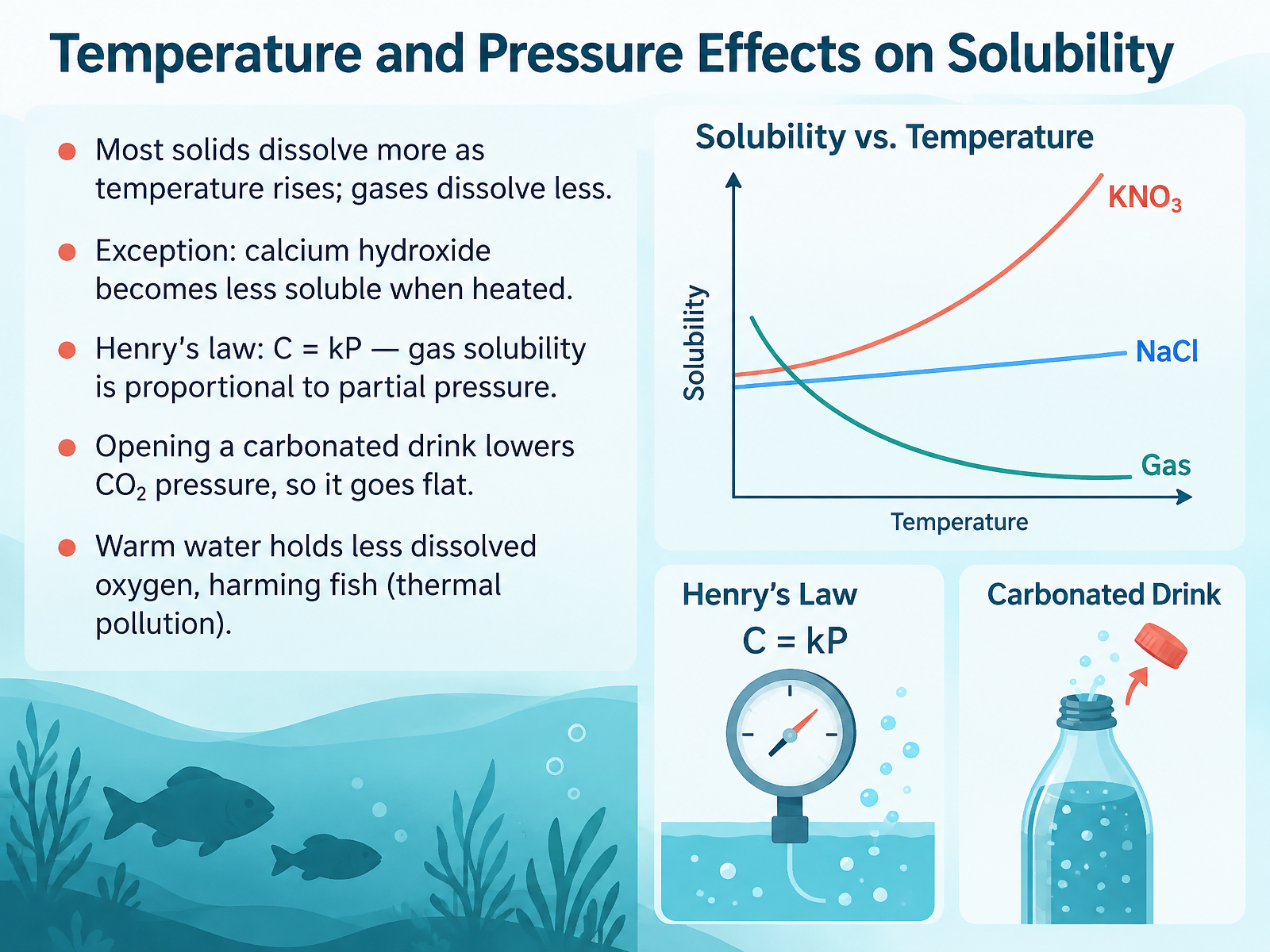
- 06Temperature and Pressure Effects on SolubilityNow let's look at how temperature and pressure change solubility. For most solids, raising the temperature increases solubility. Gases are the opposite. As water warms, dissolved gases become less soluble. There is an exception worth naming. Calcium hydroxide becomes less soluble when heated, so it does not follow the general trend. Pressure mainly affects gases. Henry's law states that C equals k times P. In plain terms, the concentration of dissolved gas is proportional to its partial pressure above the liquid. Here's why that matters. Open a carbonated drink and you release the carbon dioxide pressure. The dissolved gas leaves solution, and the drink goes flat. The same idea explains thermal pollution. Warm water holds less dissolved oxygen, which can harm fish. So remember: heat usually helps solids dissolve but pushes gases out, and higher gas pressure keeps more gas dissolved. Next, we turn to the rate of dissolution versus the amount that dissolves.
 openstax.orgen.wikipedia.orgchem.libretexts.org+22 min
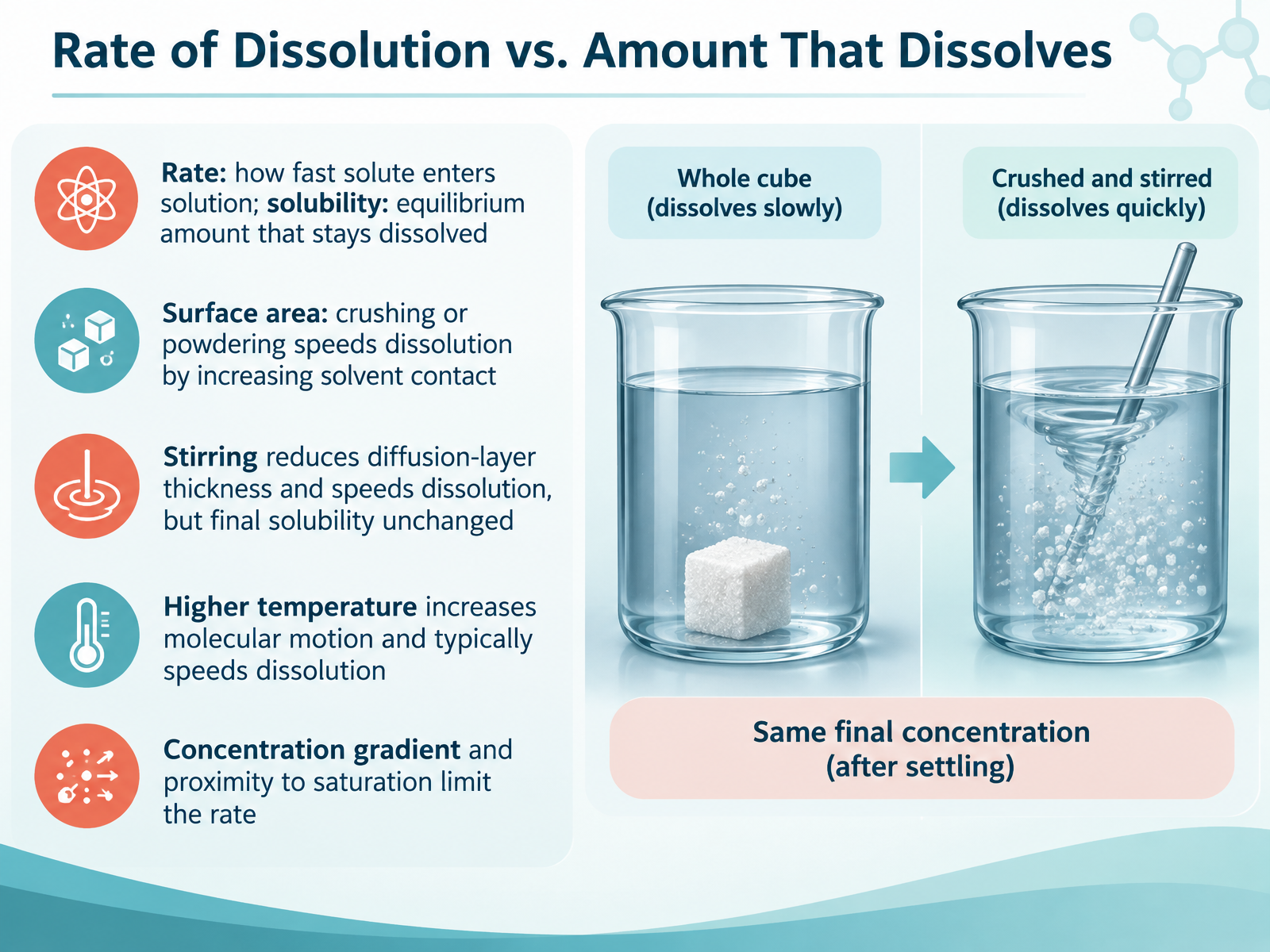
- 07Rate of Dissolution vs. Amount That DissolvesLet's clear up a distinction that often causes confusion. Rate is how fast a solute enters solution. Solubility is the equilibrium amount that stays dissolved once the solution is saturated. These are two different ideas. Now, what speeds up the rate? First, surface area. Crushing or powdering a solid exposes more surface to the solvent, so it dissolves faster. Next, stirring. Stirring reduces the thickness of the diffusion layer around the solid and brings fresh solvent into contact, so dissolution speeds up. But here's the key point. Stirring does not change the final solubility. The same amount ends up dissolved at equilibrium. Higher temperature typically speeds dissolution too, because molecules move faster. And finally, the concentration gradient matters. The farther the solution is from saturation, the faster the rate. As you approach the solubility limit, dissolution slows down. So remember, you can change the rate without changing the solubility. Next, we look at concentration, saturation, and supersaturation.
 openstax.orgen.wikipedia.orgchem.libretexts.org+22 min
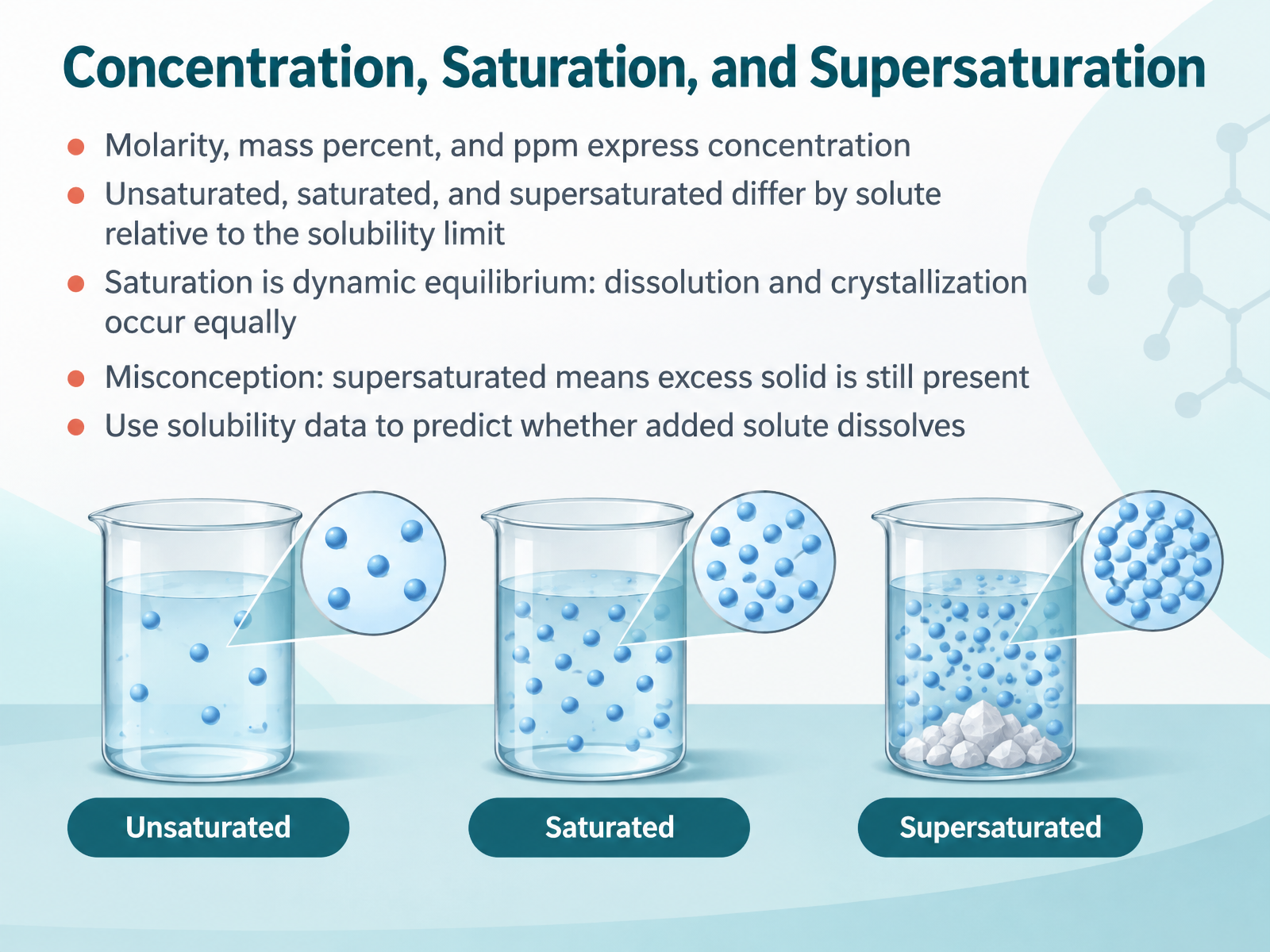
- 08Concentration, Saturation, and SupersaturationNow let's look at how we describe concentration, and what it means for a solution to be saturated. Concentration can be expressed as molarity, mass percent, or parts per million. Each one tells you how much solute is present in a given amount of solution, just using different units. Next, think about the solubility limit. Below that limit, a solution is unsaturated. At the limit, it is saturated. Above the limit, it is supersaturated. Here's a key idea: saturation is a dynamic equilibrium. At the saturated point, dissolution and crystallization happen at equal rates, so the amount of dissolved solute stays constant. One common misconception is that a supersaturated solution still contains excess solid. It does not. It holds more dissolved solute than the solubility limit, with no solid present. Finally, use solubility data to predict whether added solute will dissolve. That is the practical takeaway. Coming up next, Common Misconceptions and Classroom Checks.
 pubs.acs.orgonlinelibrary.wiley.comlink.springer.com+21 min
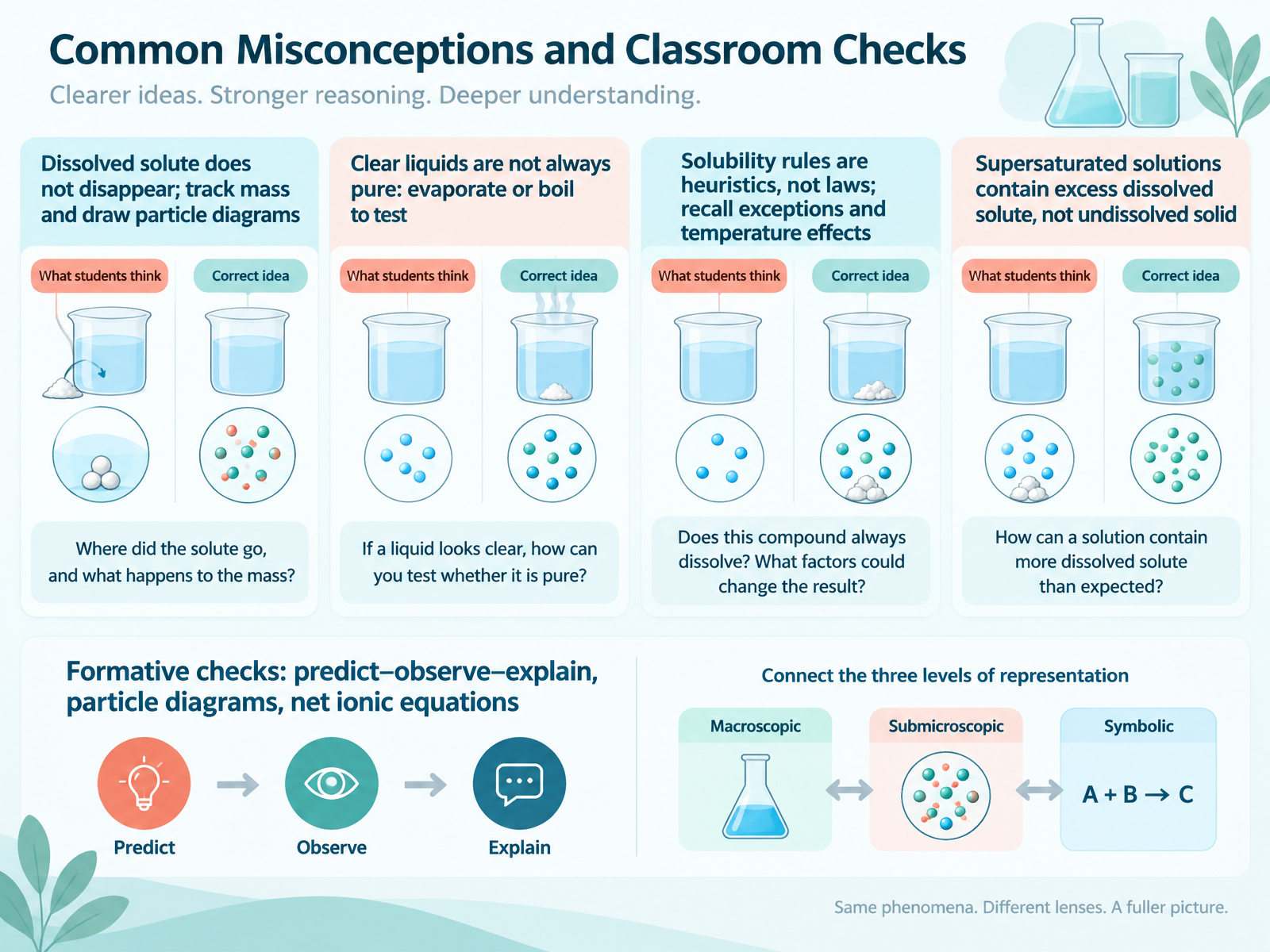
- 09Common Misconceptions and Classroom ChecksLet's turn to some common misconceptions and practical classroom checks. First, dissolved solute does not disappear. It is still there. Track mass before and after, and draw particle diagrams so students can see where the particles went. Next, a clear liquid is not always pure. Clear salt water looks like water, so evaporate or boil a sample to test it. Here's why this matters. Solubility rules are heuristics, not laws. Recall the exceptions and how temperature changes solubility. And be precise about supersaturated solutions. They contain excess dissolved solute, not undissolved solid. For formative checks, try predict, observe, explain. Use particle diagrams. And ask students to write net ionic equations. These checks reveal whether students hold a correct or a faulty mental model. Next, we look at pharmaceutical dissolution and bioavailability.
 pubs.acs.orgonlinelibrary.wiley.comlink.springer.com+21 min
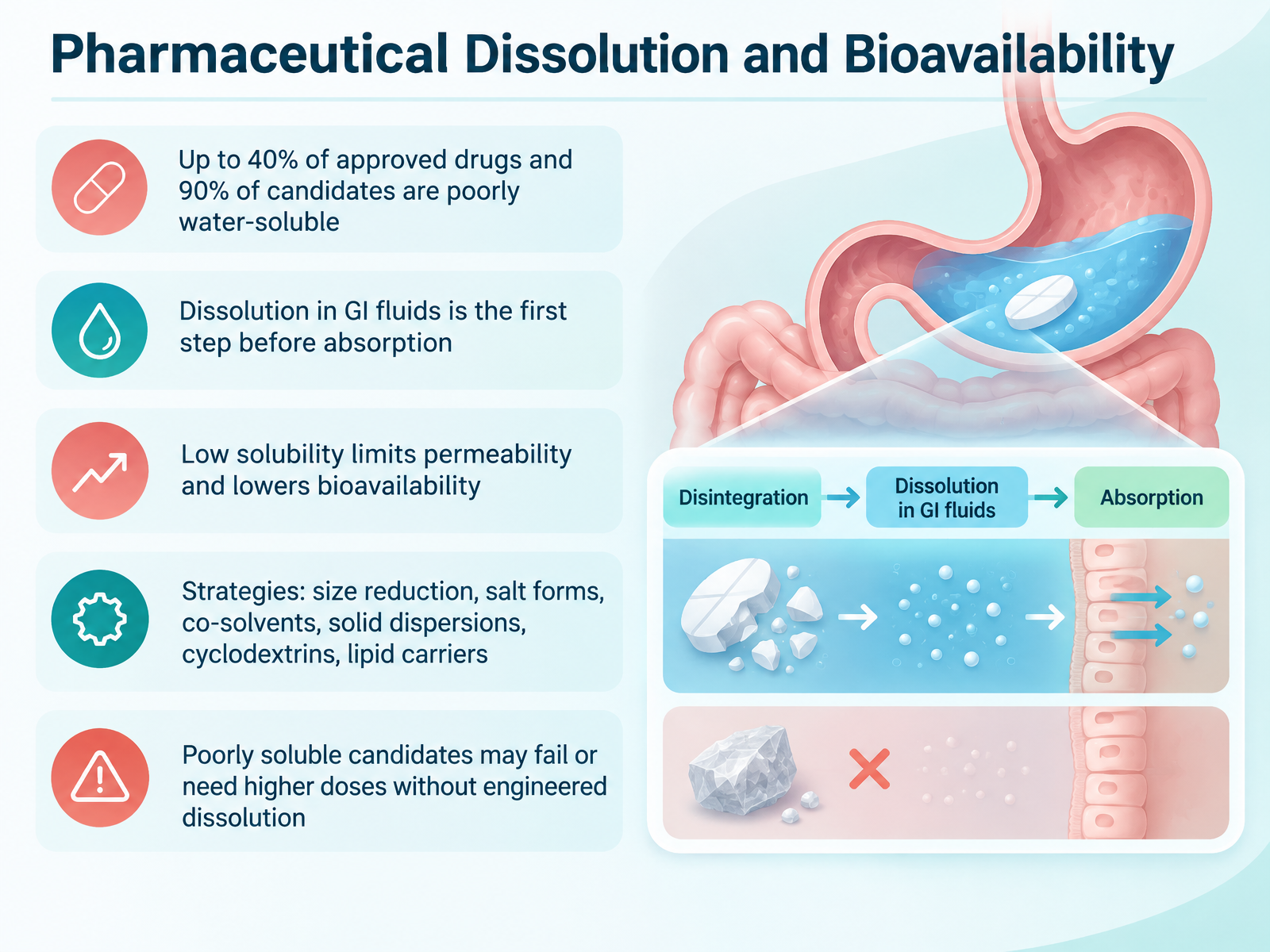
- 10Pharmaceutical Dissolution and BioavailabilityNow let's apply what we've learned to one of the biggest real-world challenges in chemistry and medicine. Poor aqueous solubility is a major obstacle. Up to forty percent of approved drugs, and nearly ninety percent of drug candidates, dissolve poorly in water. Here's why that matters. Before a drug can be absorbed, it must first dissolve in the fluids of the gastrointestinal tract. If it can't dissolve, it can't cross the intestinal barrier, so low solubility limits permeability and lowers bioavailability. To overcome this, formulation scientists use several strategies: reducing particle size, forming salt forms, adding co-solvents, creating solid dispersions, using cyclodextrins, and designing lipid carriers. Without these engineered solutions, poorly soluble candidates may fail in development or require much higher doses to work. The takeaway is simple. For pharmaceuticals, dissolution is not optional. It is the first step toward therapeutic effect. Next, we'll look at water treatment, environmental solubility, and scale.
 wqa.orgsciencedirect.compmc.ncbi.nlm.nih.gov+21 min
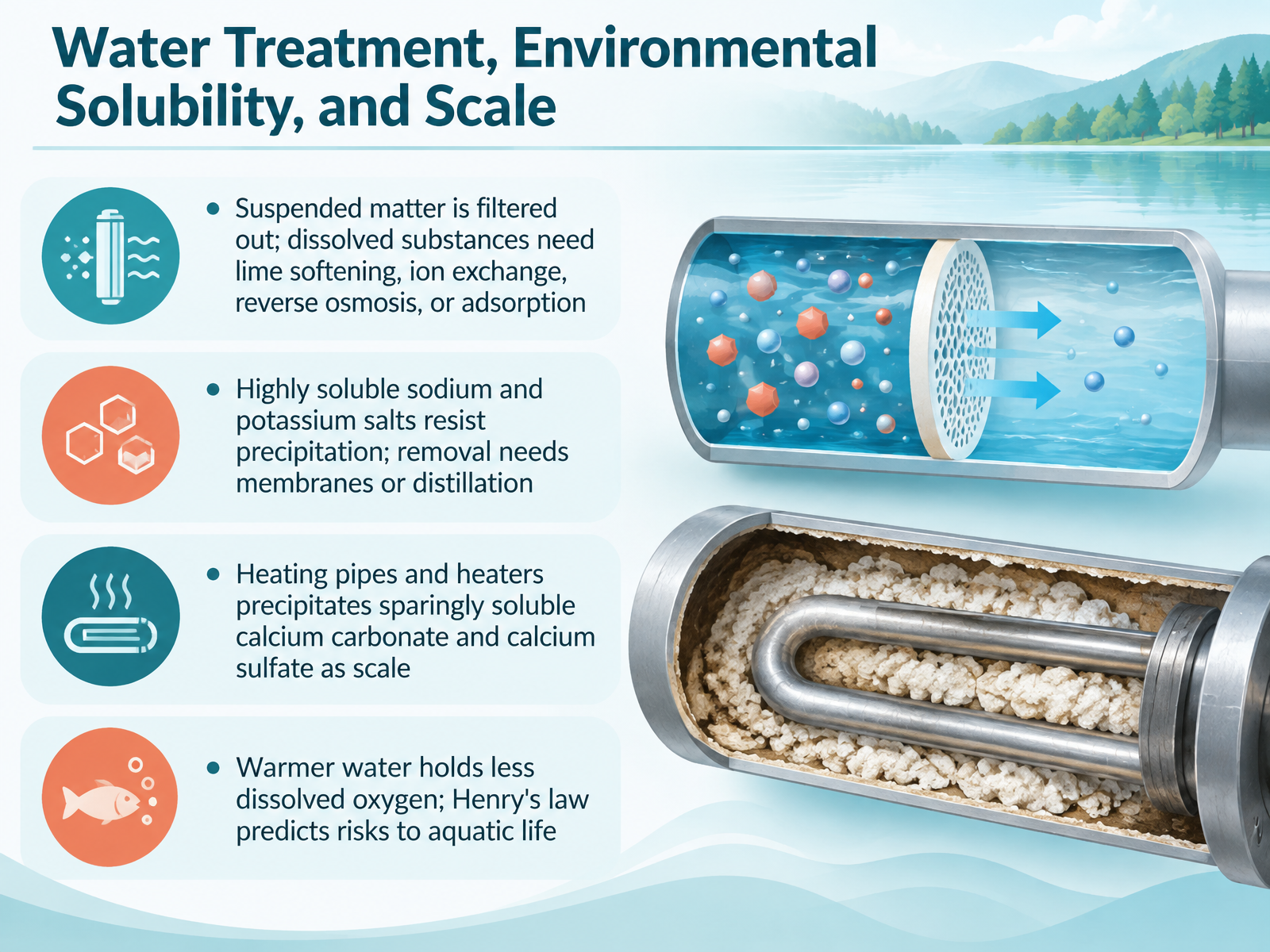
- 11Water Treatment, Environmental Solubility, and ScaleNow let's apply solubility to real water systems. Water treatment separates two problems. Suspended matter is filtered out. Dissolved substances need chemical or membrane methods, such as lime softening, ion exchange, reverse osmosis, or adsorption. Next, some salts resist removal by precipitation. Sodium and potassium salts are highly soluble, so separating them requires membranes or distillation. Here's why scale matters. Heating pipes and heaters precipitates sparingly soluble calcium carbonate and calcium sulfate, forming hard deposits. Finally, warmer water holds less dissolved oxygen, and Henry's law predicts the risk to aquatic life. In short, solubility decides which treatment works and which problems form. Next, we look at food, beverage, and everyday solubility.
 wqa.orgsciencedirect.compmc.ncbi.nlm.nih.gov+21 min
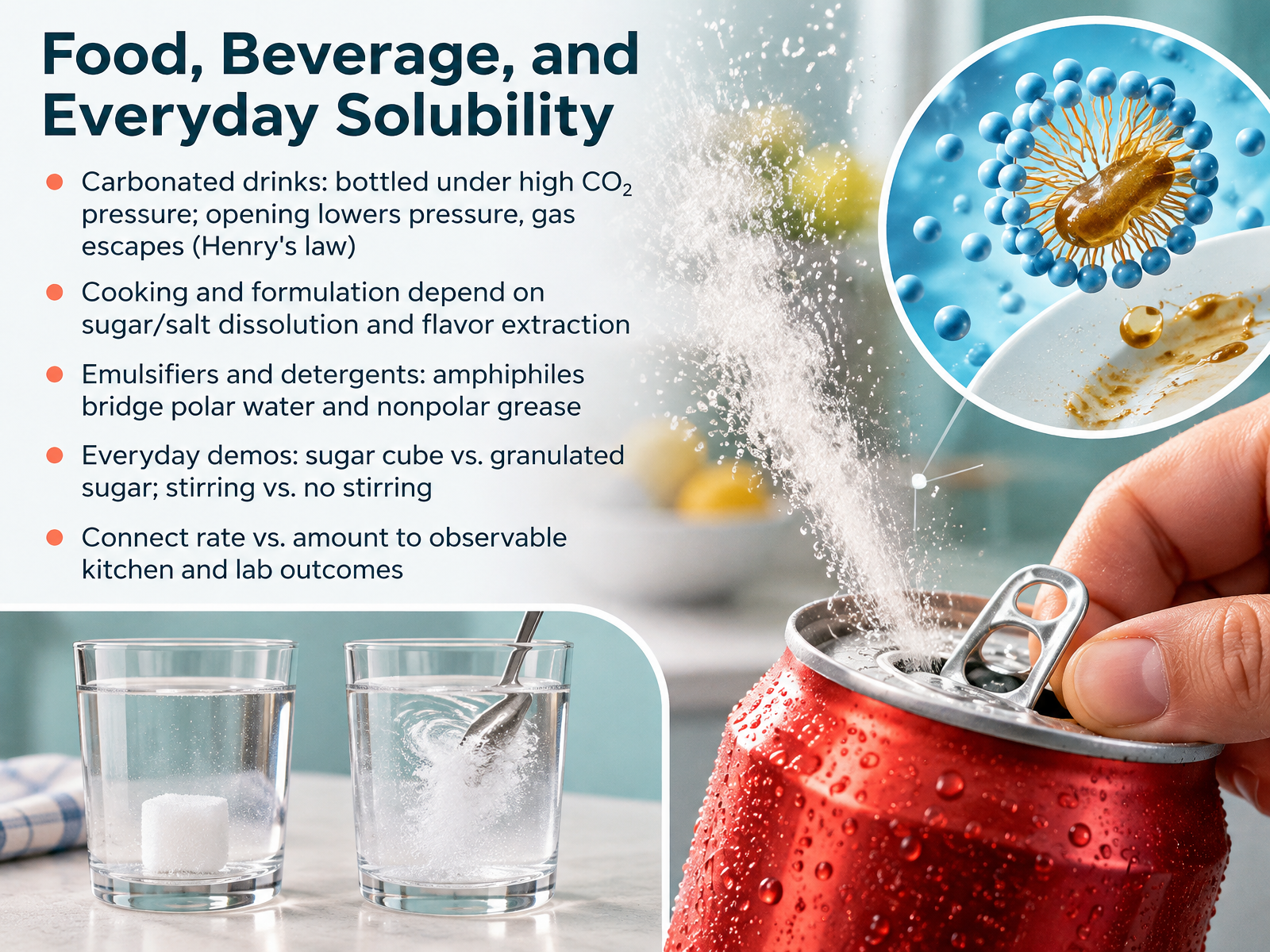
- 12Food, Beverage, and Everyday SolubilityNow let's bring solubility into the everyday world. Think about a carbonated drink. It is bottled under high pressure of carbon dioxide, so a large amount of gas dissolves. When you open the bottle, the pressure above the liquid drops. According to Henry's law, gas solubility is directly proportional to that pressure, so the carbon dioxide escapes and the drink goes flat. Next, cooking and formulation rely on the same ideas. Sugar and salt dissolve, and flavors extract into the liquid. Emulsifiers and detergents act as amphiphiles: they bridge polar water and nonpolar grease, letting oil and water mix. Here's a simple demo. Compare a sugar cube with granulated sugar, and stir one glass but not the other. Stirring and smaller particles change the rate of dissolving, not the total amount that can dissolve. So connect rate versus amount to what you actually observe in the kitchen or the lab. Next, we'll look at teaching sequence and building conceptual understanding.
 openstax.orgen.wikipedia.orgchem.libretexts.org+21 min
- 13Teaching Sequence: Building Conceptual UnderstandingNow let's look at how to turn these ideas into a teaching sequence. First, integrate Johnstone's triangle. Move deliberately between what students observe at the macroscopic level, the particles at the submicroscopic level, and the symbolic level of balanced equations. Next, clarify dissociation versus ionization, and connect each balanced equation to the particle process it represents. Then replace rule memorization with reasoning about charges, lattice energy, and hydration. Use predict, observe, explain cycles, and show static particle diagrams before any animations, because motion can distract learners. Finally, scaffold for your audience, with targeted supports for students, adult learners, and teachers. In the next slide, we will bring the key ideas together.
 pubs.acs.orgonlinelibrary.wiley.comlink.springer.com+22 min
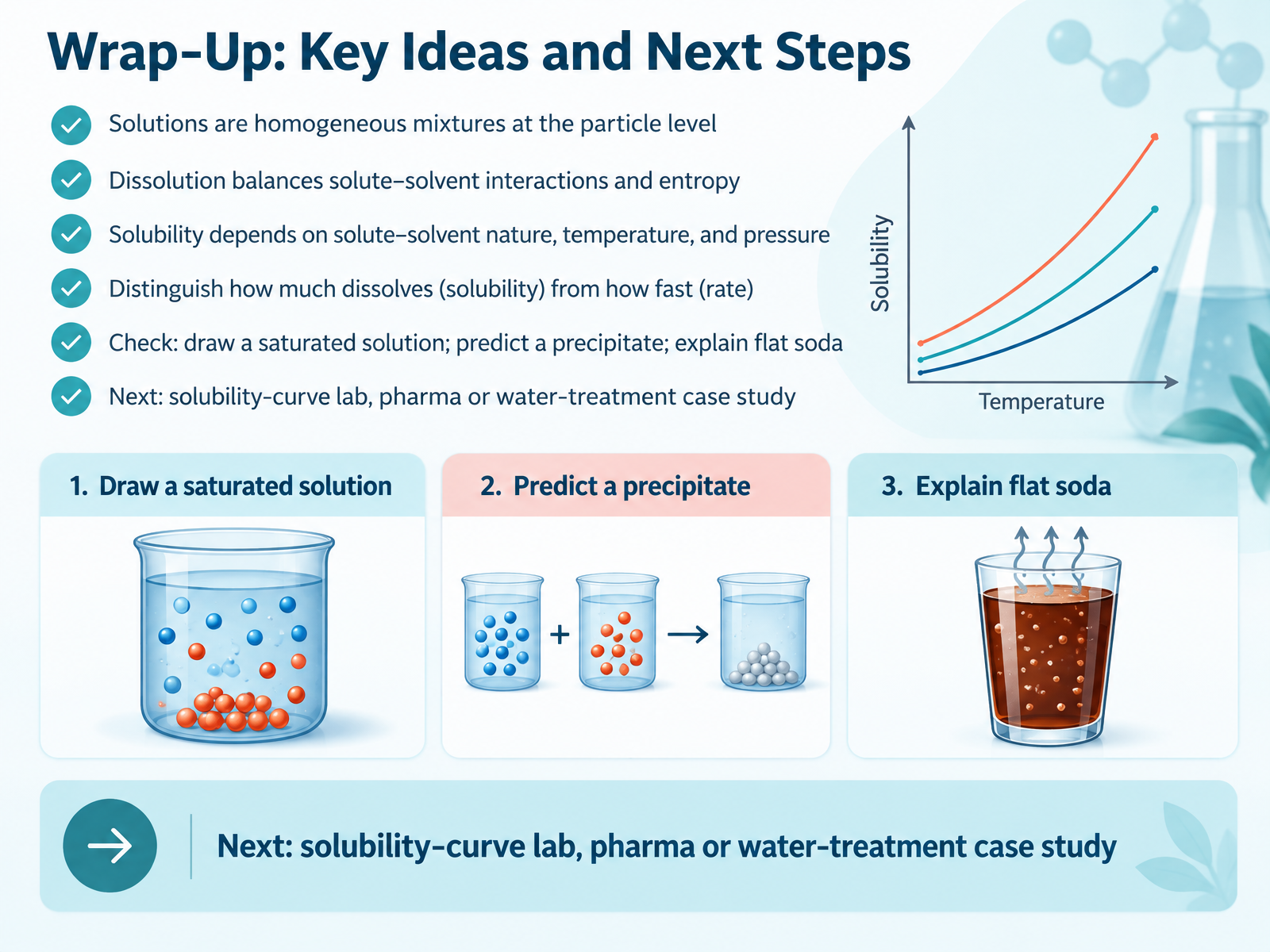
- 14Wrap-Up: Key Ideas and Next StepsLet's bring the key ideas together. First, a solution is a homogeneous mixture at the particle level. Next, dissolution balances solute and solvent interactions with entropy. Keep in mind that solubility depends on the nature of the solute and solvent, on temperature, and for gases, on pressure. And be careful to distinguish how much dissolves, which is solubility, from how fast it dissolves, which is the rate. Before we finish, try these quick checks. Draw a saturated solution at the particle level. Predict whether mixing two solutions will form a precipitate. And explain why a soda goes flat after it is opened. Those three tasks connect the whole topic. For your next step, the solubility curve lab will let you test these ideas, and a case study in pharmaceuticals or water treatment will show why they matter. So remember: think at the particle level, follow the interactions and entropy, and separate solubility from rate. Thank you for working through this topic with me. You now have a solid foundation. Keep asking why things dissolve, and you will keep building your understanding.
 pubs.acs.orgonlinelibrary.wiley.comlink.springer.com+22 min
Take the deck with you
Download this course as a file — free, no sign-up needed.
- PDF handoutEvery slide page, ready to print or share.15 pages · 3.8 MBDownload
- Narrated PowerPointThe deck that presents itself — every slide carries the digital human's narration video.15 pages · 13.1 MBDownload
- PowerPoint slidesThe full deck as a .pptx — open it in PowerPoint, Keynote, or Google Slides.15 pages · 3.8 MBDownload
Free to use in your own training — please keep the PersonWise credit page at the end.
Have your own deck? Turn it into a course
Sources consulted
Web sources consulted while building this course.
- Disentangling the Dissolution of Ionic and Molecular Compounds: Alternative Conceptions and Teaching Considerations in Chemistry | Journal of Chemical Education | ACS Publications — pubs.acs.org
- Chemistry students' conceptions of solubility: A phenomenography — onlinelibrary.wiley.com
- Investigating Students’ Understanding of the Dissolving Process — link.springer.com
- Student Misconception In Chemistry: A Systematic ... — files.eric.ed.gov
- Student misconceptions in writing balanced equations for dissolving ionic compounds in water — pubs.rsc.org
- 7.2 Classifying Chemical Reactions - Chemistry: Atoms First | OpenStax — openstax.org
- SOLUBILITY TABLE — departments.johnabbott.qc.ca
- Group I & II metal hydroxides — wp.as.uky.edu
- General Chemistry Lab Manual — odp.library.tamu.edu
- CHEMISTRY — ccea.org.uk
- 11.3 Solubility - Chemistry 2e | OpenStax — openstax.org
- Henry's law — en.wikipedia.org
- 16.6: Henry's Law - Chemistry LibreTexts — chem.libretexts.org
- Solubility of Gases – Chem.Academy — chem.academy
- 10.5: Henry's Law — chem.libretexts.org
- Solubility Rules Help Avoid Water Treatment Pitfalls — wqa.org
- Solubilization techniques used for poorly water-soluble drugs — sciencedirect.com
- Advancement in Solubilization Approaches: A Step towards Bioavailability Enhancement of Poorly Soluble Drugs — pmc.ncbi.nlm.nih.gov
- REVIEW: AN EFFORTS TO INCREASE THE SOLUBILITY AND DISSOLUTION OF ACTIVE PHARMACEUTICAL INGREDIENTS | International Journal of Applied Pharmaceutics — journals.innovareacademics.in
- Solubility in Chemistry — samaterials.com