Begin
13 pages · ~26 min
Audience Research in Media: Concepts & Purpose
This training introduces media professionals to audience research concepts, purposes, and practical examples, building skills to understand and apply audience insights effectively.
A digital instructor presents all 13 pages. Hold “Ask” at any point and ask out loud — the answer comes from this course. No sign-up needed.
What you’ll learn
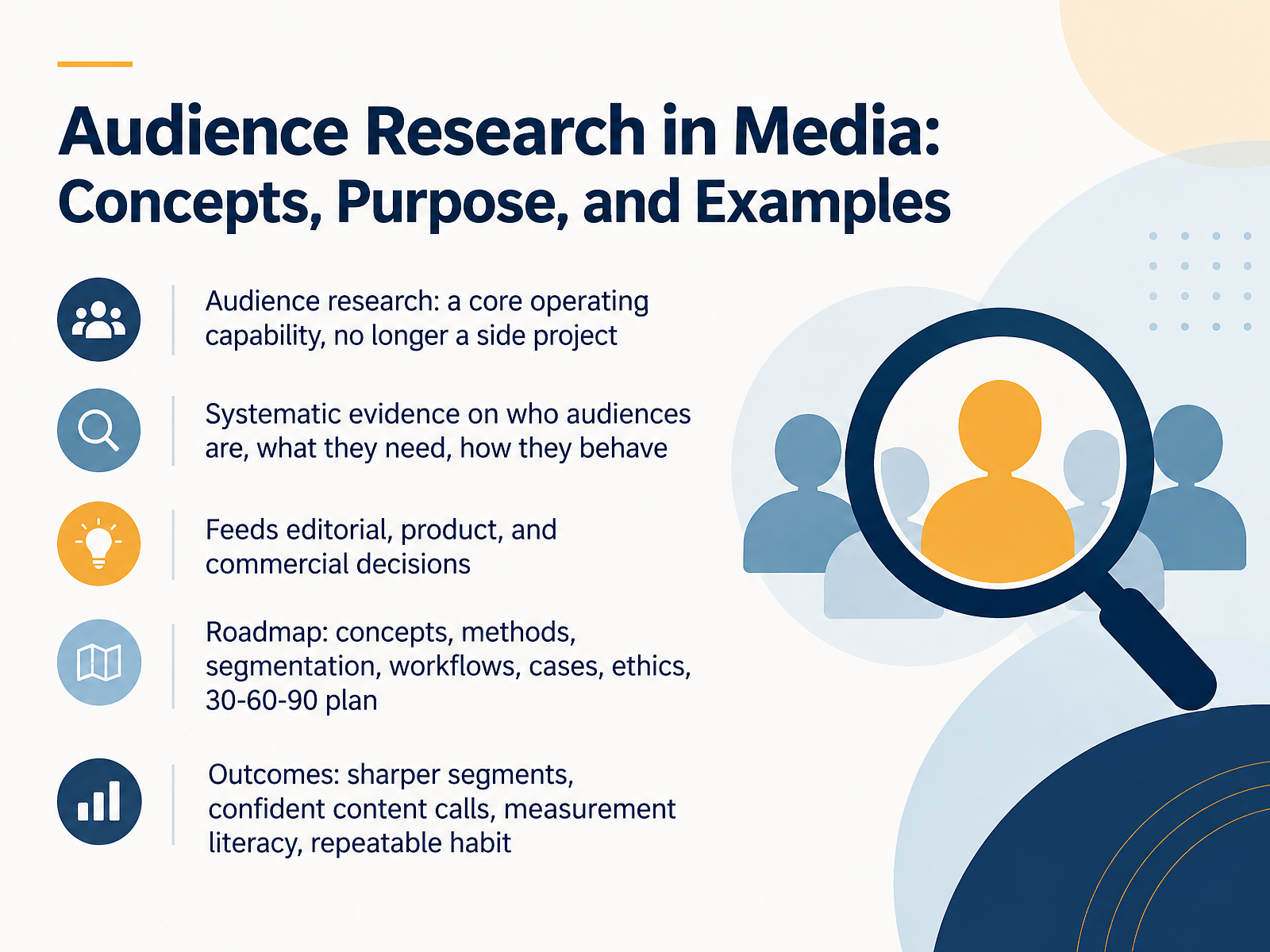
- 01Audience Research in Media: Concepts, Purpose, and ExamplesWelcome. Over the next hour, we're going to treat audience research as a core operating capability, not a side project you get to when the quarter slows down. Here's the purpose in one sentence. Audience research gives us systematic evidence on who our audiences are, what they need, and how they behave, so we can make editorial, product, and commercial decisions with confidence rather than instinct. That means evidence you can point to when you decide what to commission, how to frame a story, or where to place it. Take newsletters. In 2026, most media teams told Omeda that email was their top driver of audience growth and their most effective retention tactic. That's a placement and product decision backed by audience evidence. Here's our roadmap. We'll cover concepts, methods, segmentation, workflows, cases, ethics, and a thirty, sixty, ninety day plan. By the end, you'll have sharper segments, more confident content calls, better measurement literacy, and a repeatable research habit. Next, we look at why this matters right now.reutersinstitute.politics.ox.ac.ukomeda.comdigiday.com+22 min
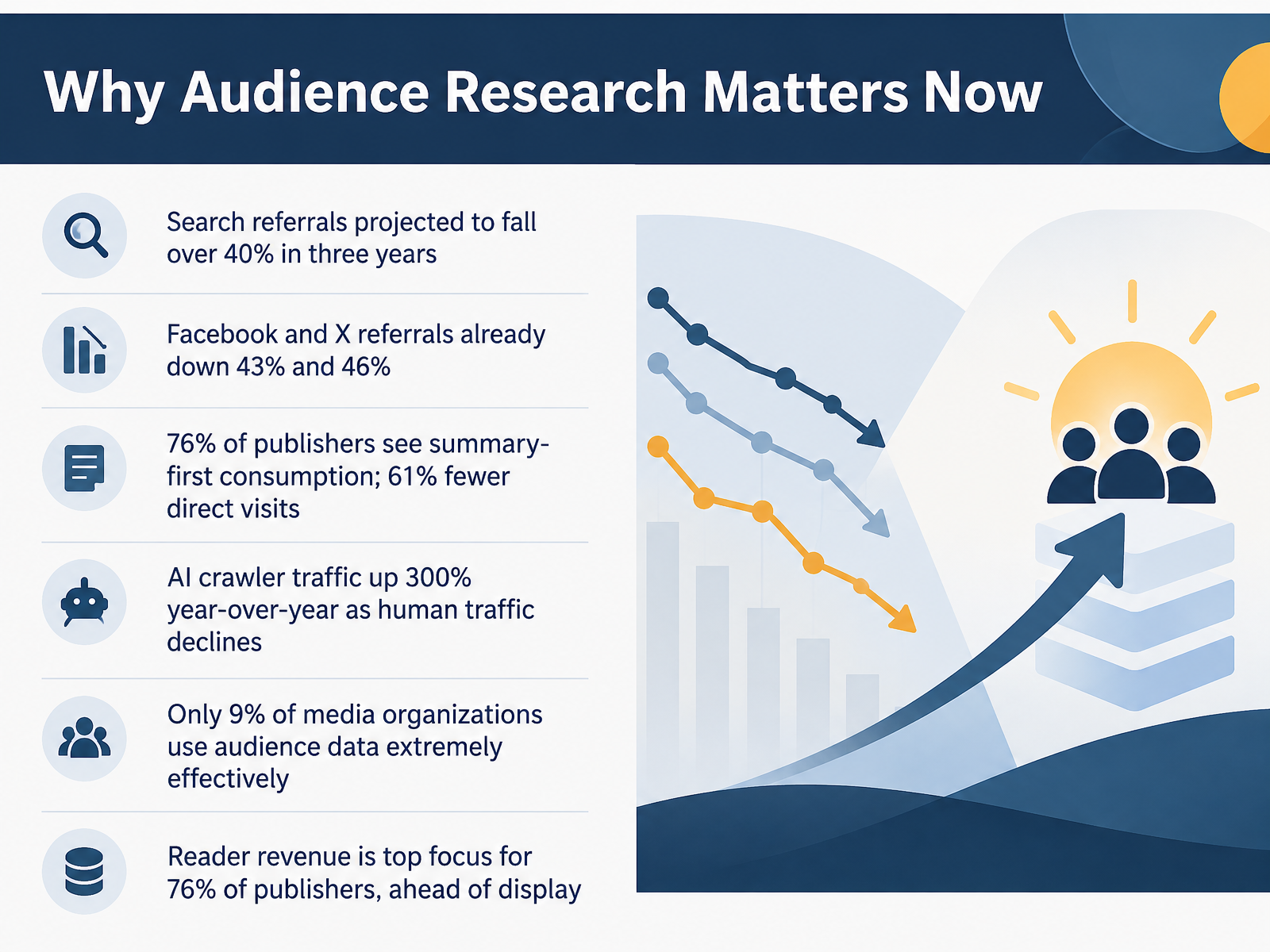
- 02Why Audience Research Matters NowLet's look at why audience research matters right now. The short answer: the traffic you relied on is moving, and audience research is how we read where it's going before we commission, frame, or place a story. Search referrals are projected to fall more than forty percent in three years. Facebook referrals are already down forty-three percent, and X referrals are down forty-six percent. Seventy-six percent of publishers say audiences now prefer summary-first consumption, and sixty-one percent report fewer direct visits. AI crawler traffic is up three hundred percent year over year while human traffic declines. On the response side, reader revenue is the top focus for seventy-six percent of publishers, ahead of display. But only nine percent say they use audience data extremely effectively. That gap is the opportunity. Now let's get into the core concepts and vocabulary.
 reutersinstitute.politics.ox.ac.ukomeda.comdigiday.com+21 min
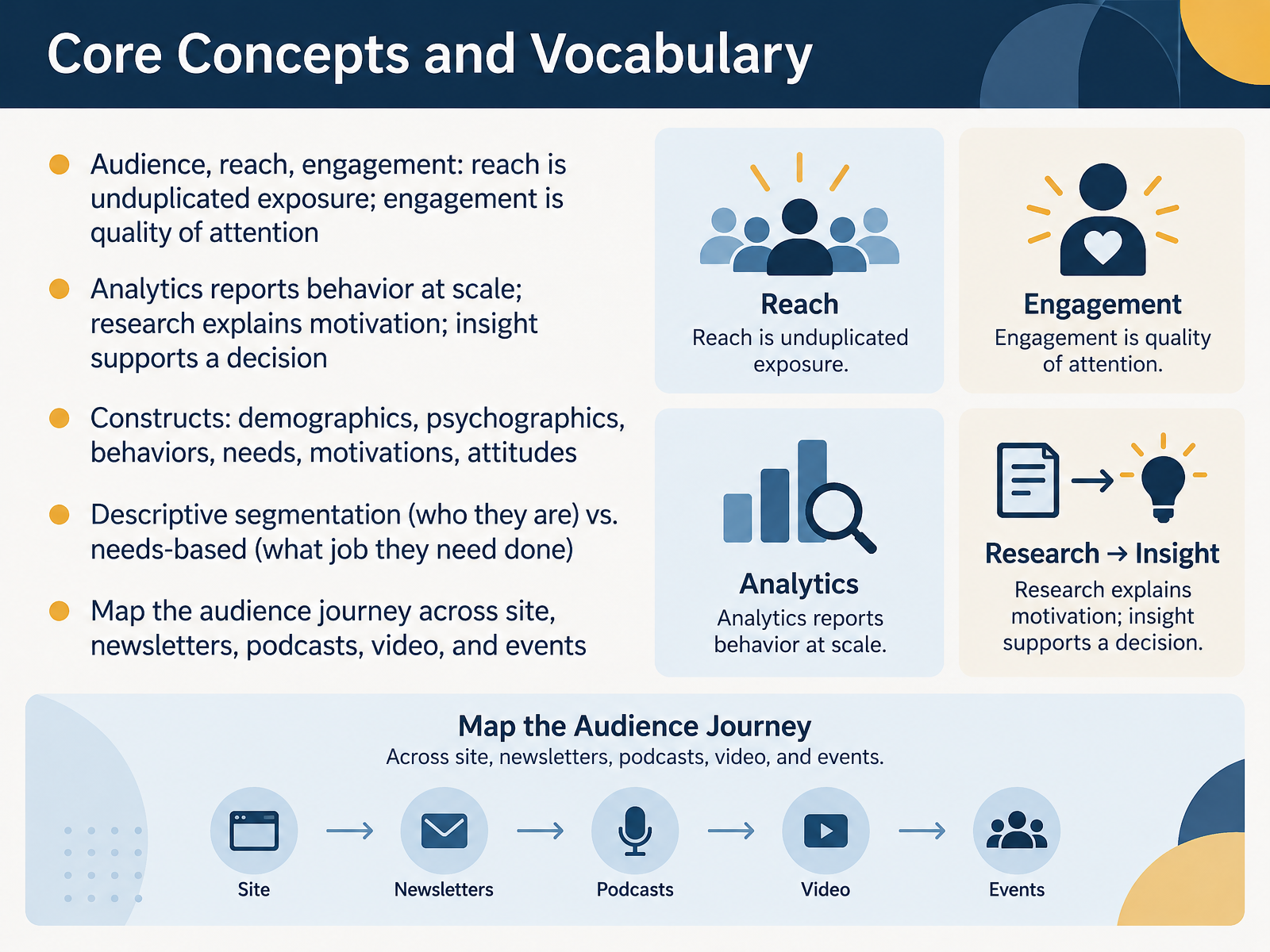
- 03Core Concepts and VocabularyLet's lock down the vocabulary we'll use all the way through. Reach is unduplicated exposure, the number of different people who saw your work. Engagement is the quality of attention they gave it. Analytics report behavior at scale. Research explains motivation. Insight supports a decision. So when a newsletter open rate drops, that's analytics. Asking readers why is research. Changing the subject line or the send day is the decision. Then we have constructs, the building blocks: demographics, psychographics, behaviors, needs, motivations, and attitudes. Descriptive segmentation tells you who they are. Needs-based segmentation tells you what job they need done, like catching up on local news during a commute. Finally, map the audience journey across your site, newsletters, podcasts, video, and events. That map shows where people start and where you lose them. Next, we'll look at purpose and business value.
 publicmediaalliance.orgcdn2.hubspot.netepub.ub.uni-muenchen.de+22 min
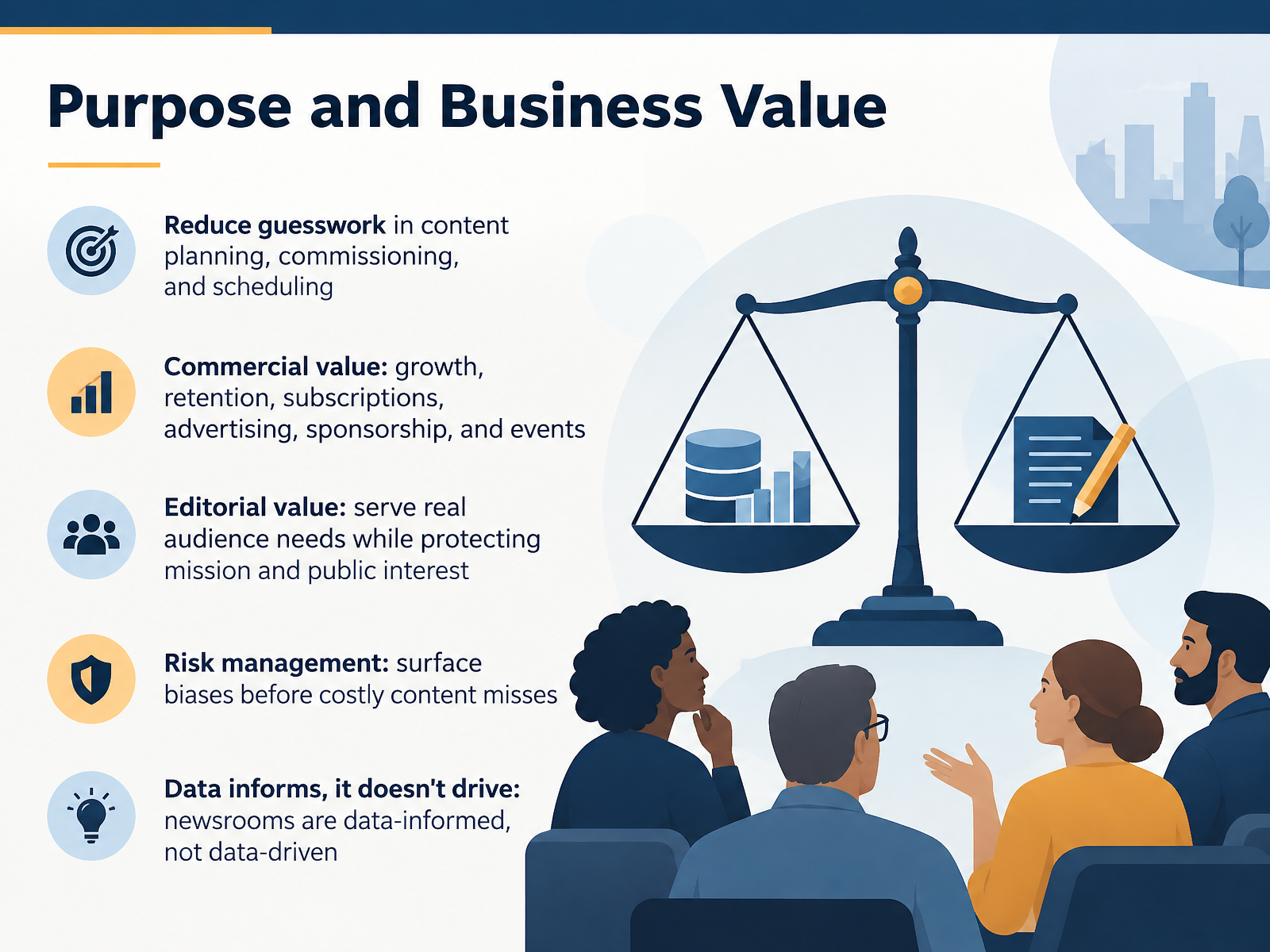
- 04Purpose and Business ValueSo what does audience research actually buy you? Its purpose is simple. It reduces guesswork. That means fewer hunches driving what you commission, how you frame a story, and when you schedule it. Take the Detroit Free Press. They isolated a cohort of Tigers baseball subscribers and learned those readers also wanted politics and education coverage. A small linking change lifted page views per session by seventeen percent. The value shows up on both sides of the house. Commercially, it supports growth, retention, subscriptions, advertising, sponsorship, and events. Editorially, it helps you serve real audience needs while protecting your mission and the public interest. It is also risk management. Research surfaces your biases before a costly content miss. And keep the balance right. Data informs, it does not drive. Newsrooms that last are data-informed, not data-driven. Next, we look at research methods and data sources.
 doi.orgcasestudies.comftstrategies.com+21 min
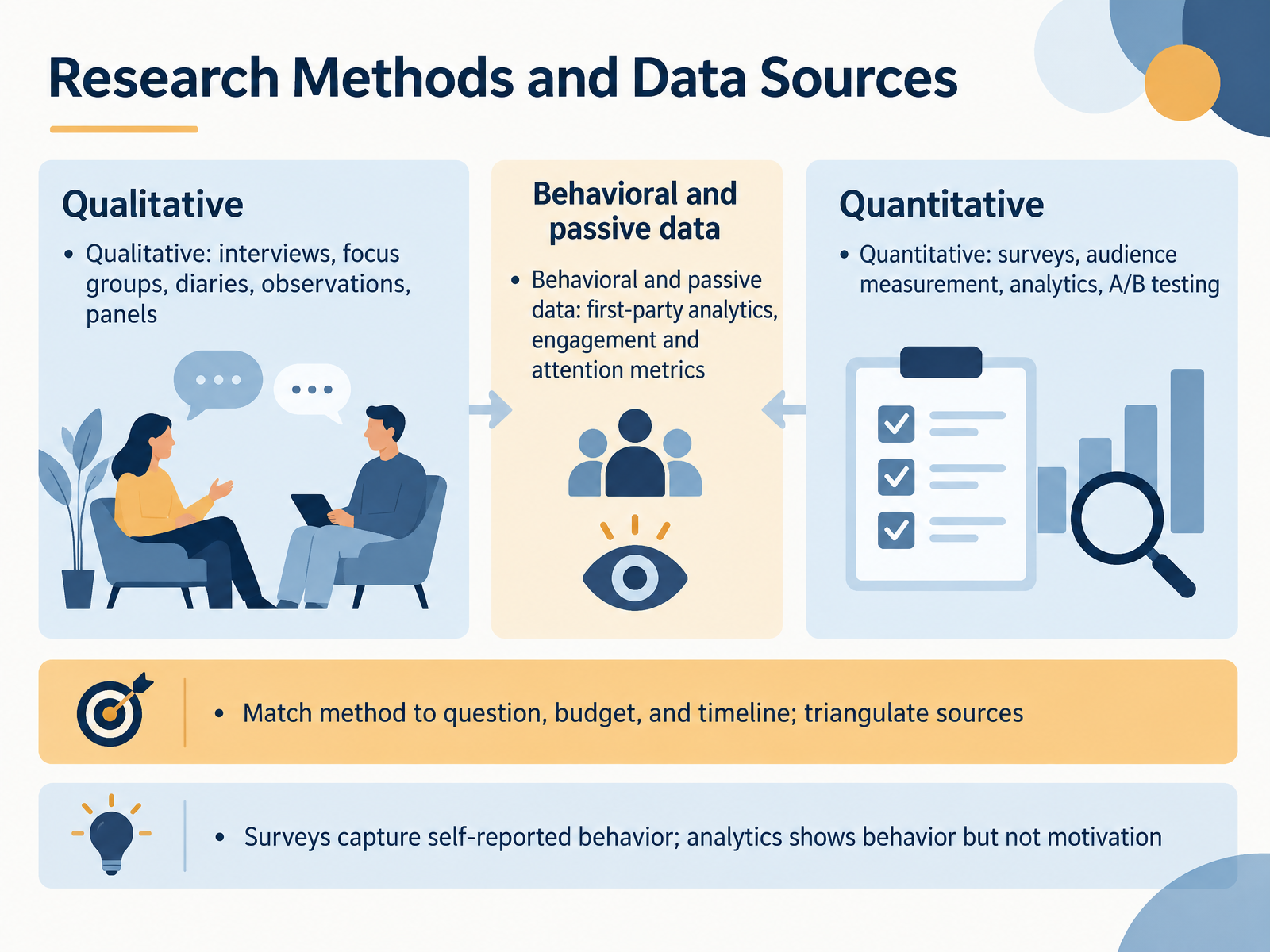
- 05Research Methods and Data SourcesNow let's talk methods and data sources. The purpose here is simple: match the method to your question, your budget, and your timeline, then triangulate, meaning combine multiple sources to check the answer. Qualitative methods like interviews, focus groups, diaries, and observations tell you why. Quantitative methods like surveys, audience measurement, and A B testing tell you how many. Behavioral and passive data, like your first party analytics and attention metrics, show what people actually do. Lightweight inputs, like social listening, comments, and newsletter replies, are cheap and fast. One caution: surveys capture self reported behavior, and people misremember. Analytics shows behavior but not motivation. So use both. If your question is what to commission, start with search and engagement data, then run a short survey. If it's how to frame a story, run a headline A B test. Next, we look at segmentation and personas in practice.
 doi.orgmediasupport.orgreutersinstitute.politics.ox.ac.uk+22 min
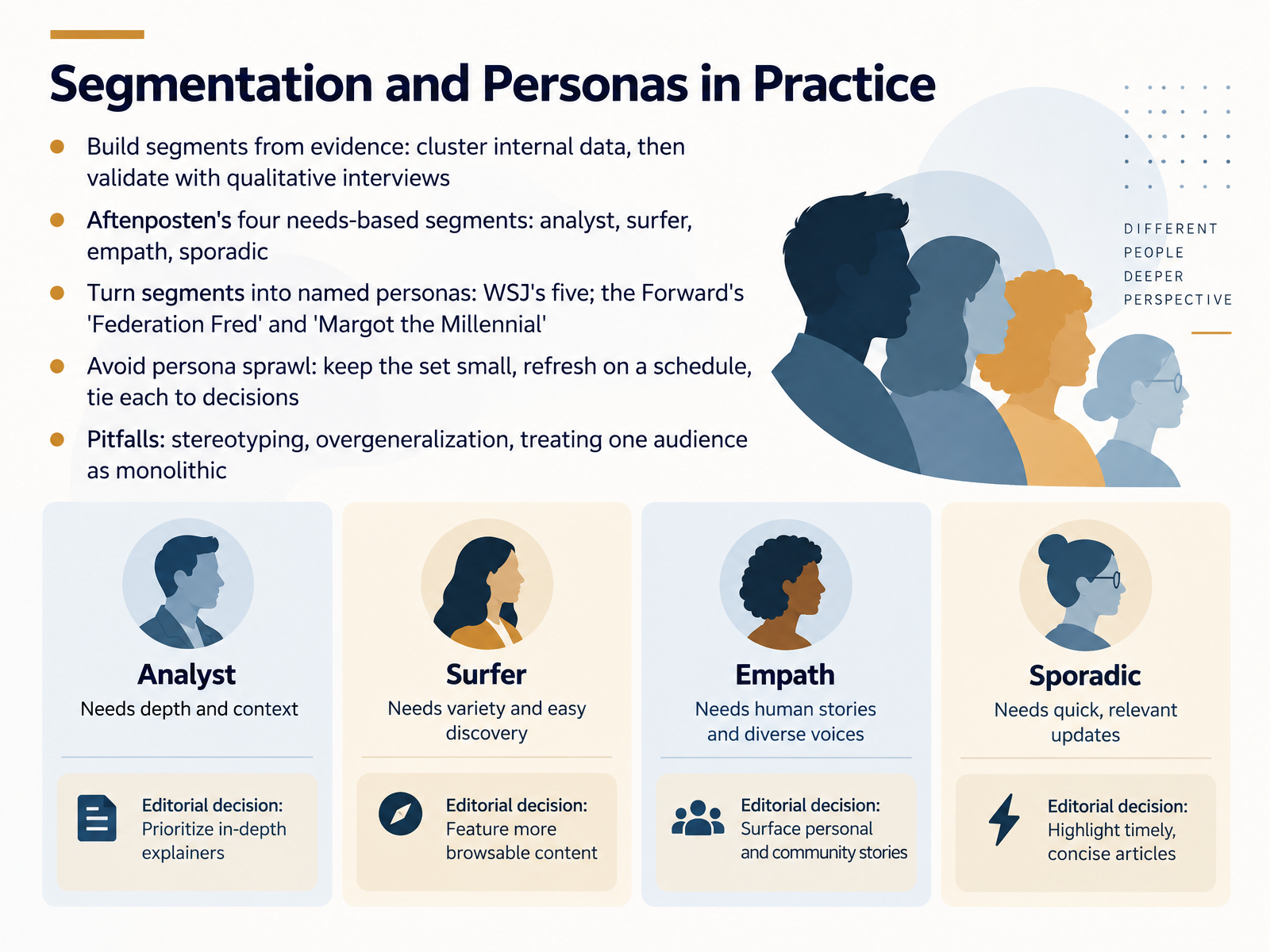
- 06Segmentation and Personas in PracticeLet's talk about putting segments and personas to work. Build your segments from evidence first. Cluster your internal data, then validate those clusters with qualitative interviews. That's what Aftenposten did. They found four needs-based segments: the analyst, the surfer, the empath, and the sporadic. Then turn segments into named personas. The Wall Street Journal has five. The Forward writes for Federation Fred and Margot the Millennial. But avoid persona sprawl. Keep the set small, refresh it on a schedule, and tie every persona to a decision you actually make, like what to commission or where to place a story. Watch the pitfalls too: stereotyping, overgeneralizing, and treating any audience as monolithic. The Wall Street Journal put it plainly: our audience is not a monolith. Next, we move from insight to action, with the workflow and tooling that keep this running.
 doi.orgmediasupport.orgreutersinstitute.politics.ox.ac.uk+21 min
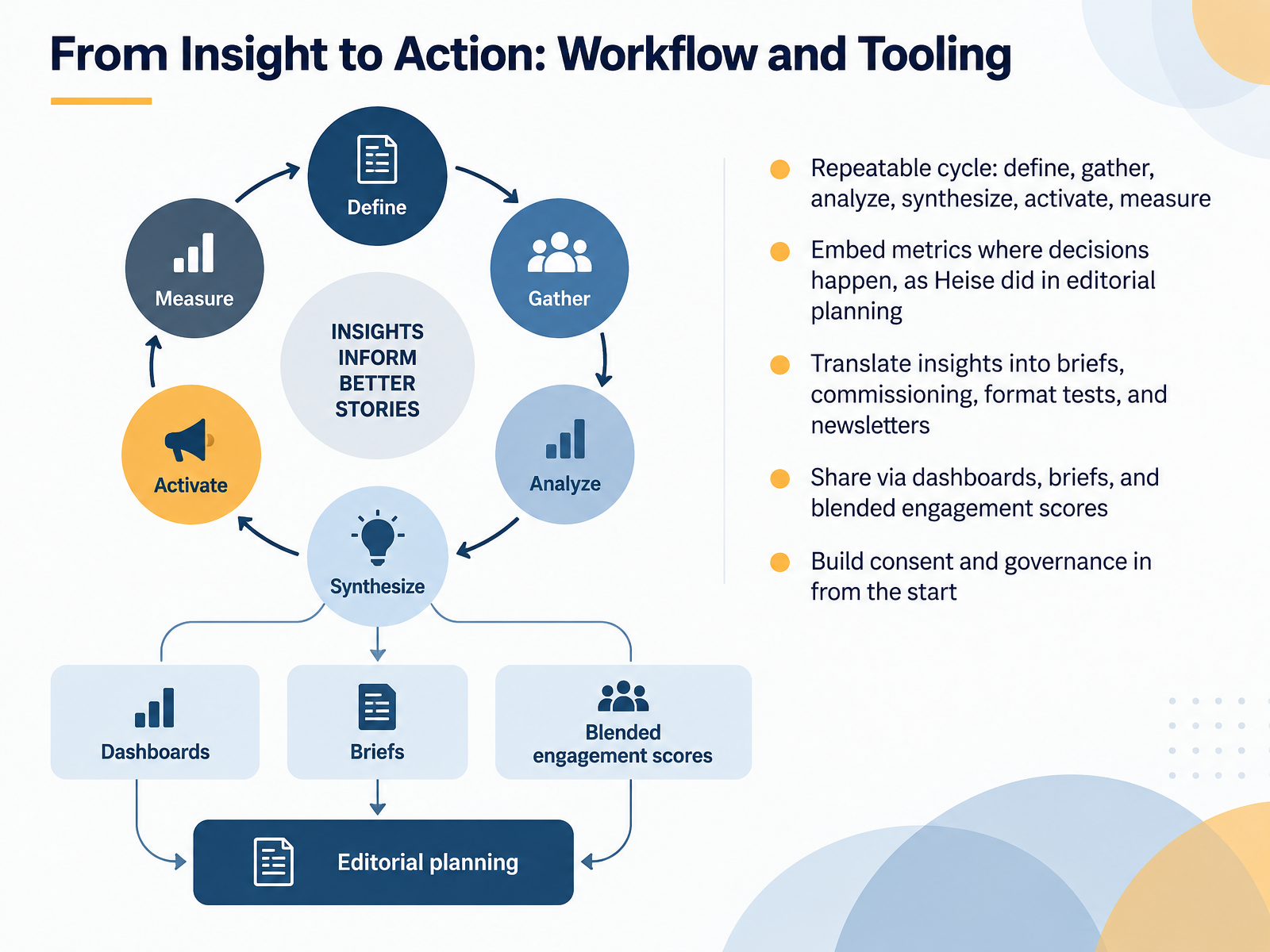
- 07From Insight to Action: Workflow and ToolingSo how do we turn those insights into action? With a repeatable cycle: define, gather, analyze, synthesize, activate, measure. Then run it again. The goal is to embed metrics where decisions actually happen, the way Heise did by bringing performance data into editorial planning so editors see views and conversions without switching tools. From there, translate insights into briefs, commissioning, format tests, and newsletters. Share what you learn through dashboards, short written briefs, and blended engagement scores, which combine several metrics into one number so teams stay aligned. And build consent and governance in from the start, so your data practices earn trust instead of eroding it. Next, we will look at real-world examples in Case Examples: Publishers and Newsrooms.
 1 min
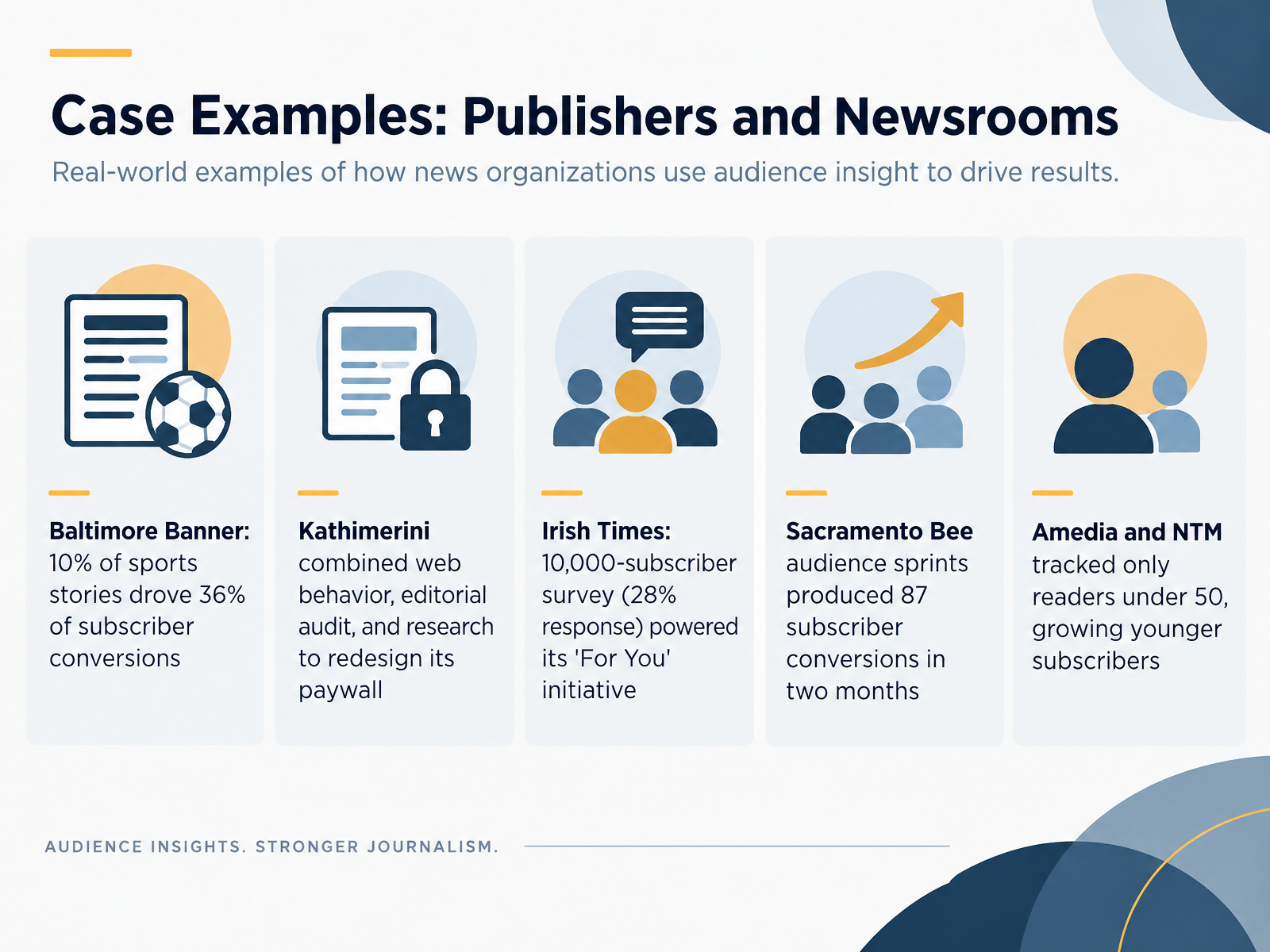
- 08Case Examples: Publishers and NewsroomsNow let's look at how this plays out in real newsrooms. At the Baltimore Banner, first-party data showed that ten percent of sports stories drove thirty-six percent of subscriber conversions. That told editors how to shape the content mix. Kathimerini combined web behavior, an editorial audit, and audience research to redesign its paywall. An editorial audit means reviewing output against what readers actually need. The Irish Times surveyed ten thousand subscribers, got a twenty-eight percent response rate, and used it to power its For You initiative. The Sacramento Bee ran audience sprints, which are short, focused reporting efforts, and produced eighty-seven subscriber conversions in two months. Amedia and NTM tracked only readers under fifty, and grew younger subscribers. Next, we look at creators, community, and formats.
 reutersinstitute.politics.ox.ac.ukomeda.comdigiday.com+22 min
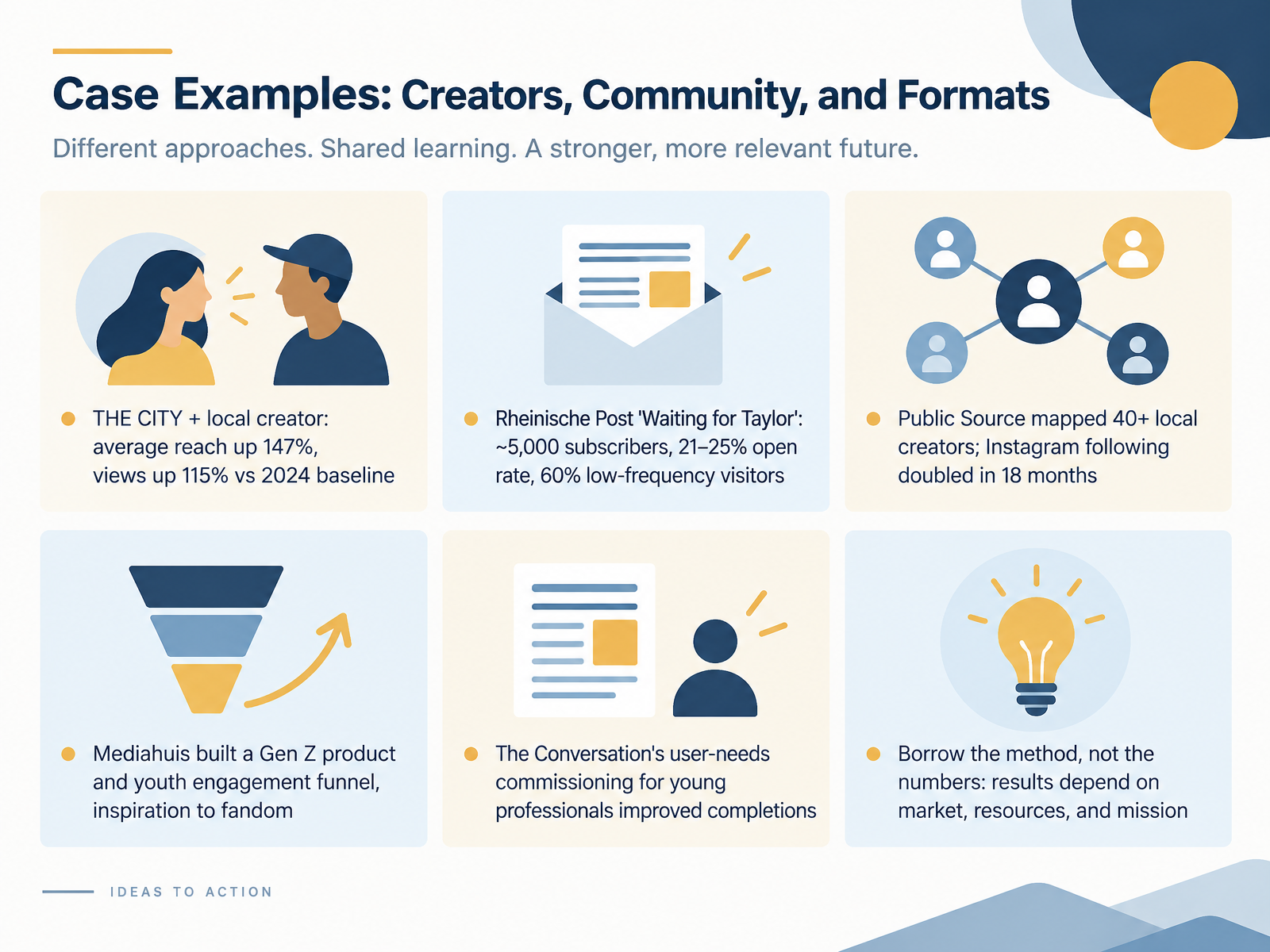
- 09Case Examples: Creators, Community, and FormatsLet's look at what this looks like in practice. THE CITY collaborated with a local creator and saw average reach rise one hundred forty seven percent, and views rise one hundred fifteen percent, against its twenty twenty four baseline. Rheinische Post built a newsletter called Waiting for Taylor. It reached about five thousand subscribers, with a twenty one to twenty five percent open rate, and sixty percent of those readers were low-frequency visitors. That newsletter turned occasional visitors into new contacts for the brand. Public Source mapped more than forty local creators, and its Instagram following more than doubled in eighteen months. Mediahuis built a Gen Z product with a youth engagement funnel that moves young readers from inspiration to fandom. And The Conversation used user-needs commissioning, where audience needs define the assignment, to improve completions for young professionals. Here is the lesson. Borrow the method, not the numbers. Results depend on your market, your resources, and your mission. Next, we look at common pitfalls, misreading the data.
 2 min
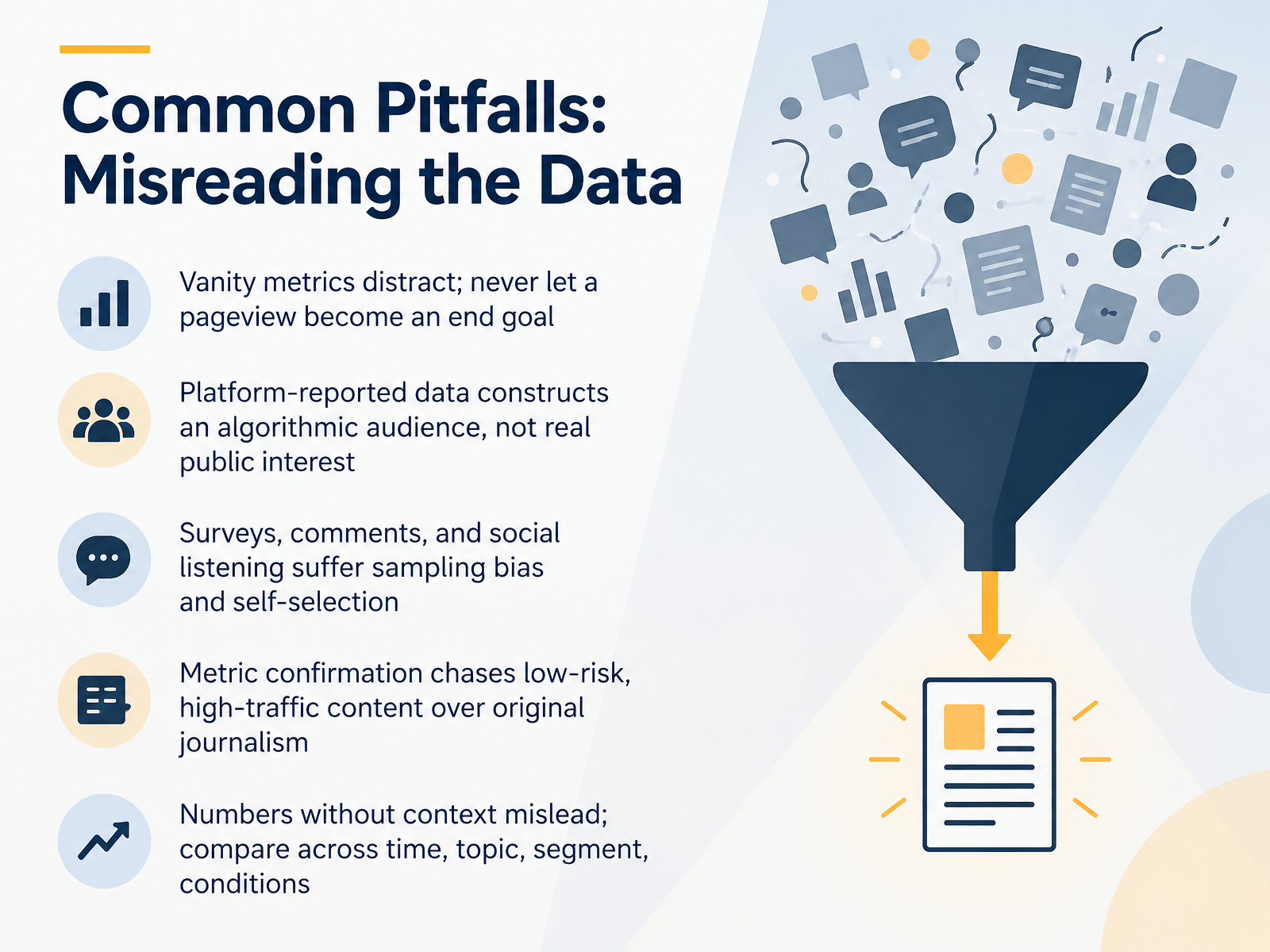
- 10Common Pitfalls: Misreading the DataNow let's look at common pitfalls, because misreading the data is easy to do. First, vanity metrics distract. Never let a pageview become an end goal. A pageview tells you someone clicked; it does not tell you what they did next or whether they valued it. Second, platform-reported data constructs an algorithmic audience, not real public interest. What a feed rewards is not the same as what your community needs. Third, surveys, comments, and social listening suffer sampling bias and self-selection. A survey only reaches the people who see it, and only the vocal few tend to respond, so treat those results as a signal, not the whole picture. Fourth, metric confirmation chases low-risk, high-traffic content over original journalism. When we only commission what the dashboard predicts will perform, original reporting gets squeezed out. Fifth, numbers without context mislead. Compare across time, topic, segment, and conditions before you act. Next, we'll turn to ethics, privacy, and editorial independence.
 doi.orgmediasupport.orgreutersinstitute.politics.ox.ac.uk+22 min
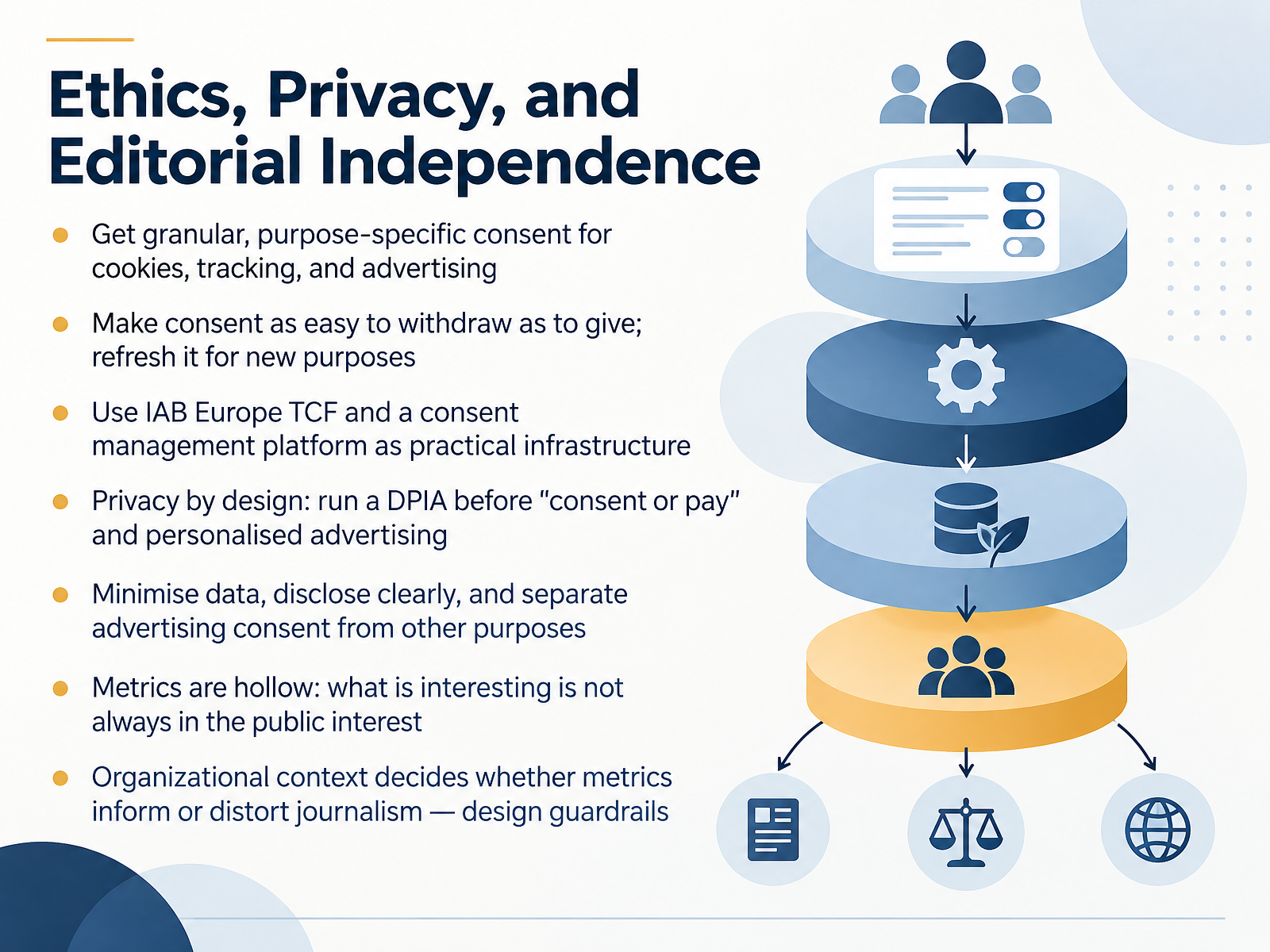
- 11Ethics, Privacy, and Editorial IndependenceNow let's talk about ethics, privacy, and editorial independence. Get granular, purpose-specific consent for cookies, tracking, and advertising. That means separate choices for separate purposes, not one blanket yes. Make consent as easy to withdraw as to give, and refresh it when you add a new purpose. A consent management platform, aligned with the IAB Europe Transparency and Consent Framework, gives you practical infrastructure for this. Practice privacy by design: run a Data Protection Impact Assessment before any consent or pay model or personalised advertising. Minimise data, disclose clearly, and keep advertising consent separate from other purposes. Then there's the editorial side. Metrics are hollow. What is interesting is not always in the public interest. Organisational context decides whether metrics inform or distort journalism, so design guardrails. That's the line between studying your audience and letting it steer your newsroom. Next, we move into building your audience research practice.
 2 min
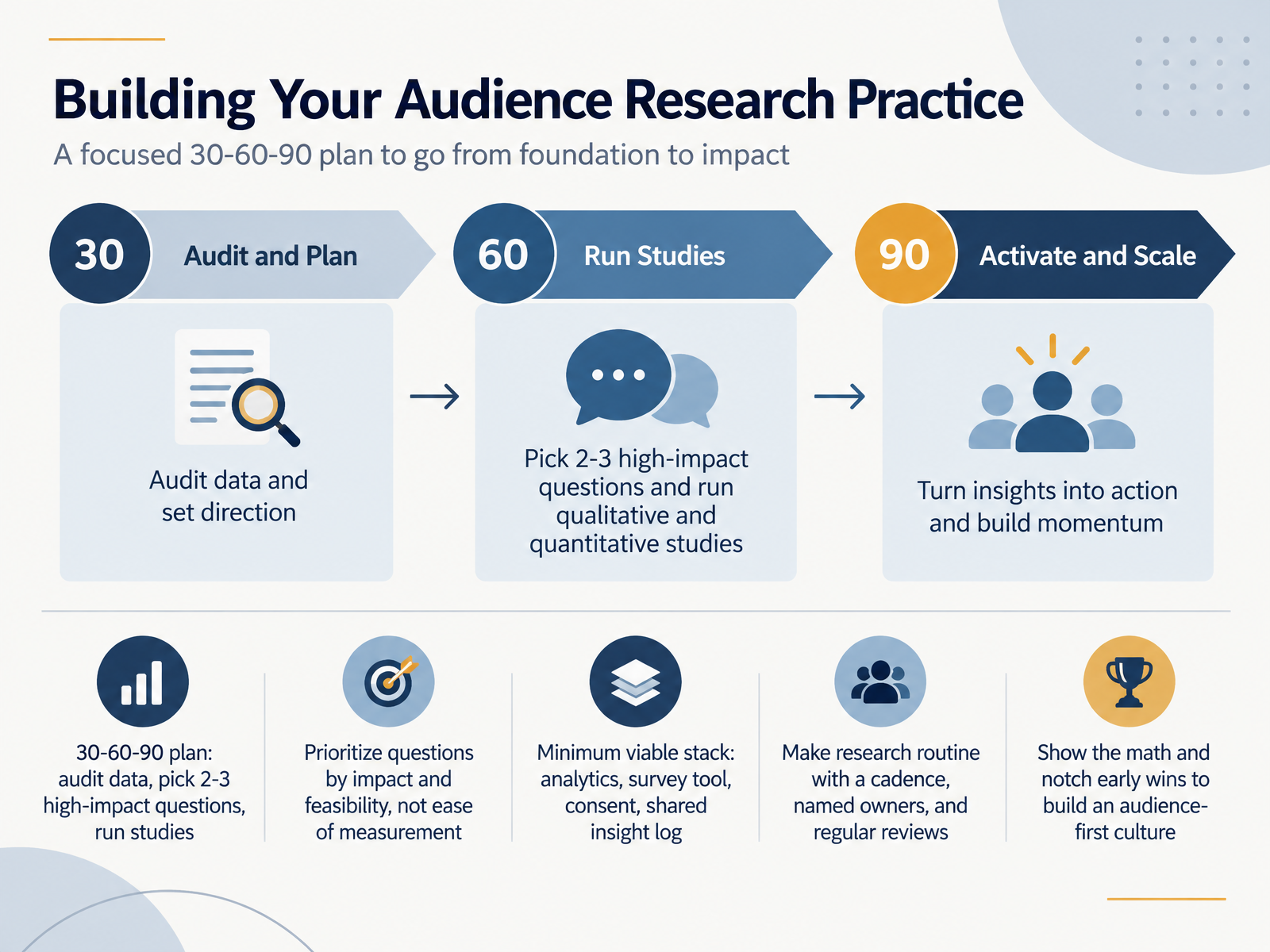
- 12Building Your Audience Research PracticeSo how do you turn all of this into a repeatable practice? Build a thirty, sixty, ninety day plan. In the first month, audit the data you already have. Then pick two or three high impact questions and run studies on them. Prioritize questions by impact and feasibility, not by ease of measurement. Your minimum viable stack is simple: analytics, a survey tool, consent, and a shared insight log. Make research routine with a clear cadence, named owners, and regular reviews. Finally, show the math and notch early wins. That is how you build an audience first culture that lasts. Next, let's pull this together with key takeaways and next steps.
 1 min
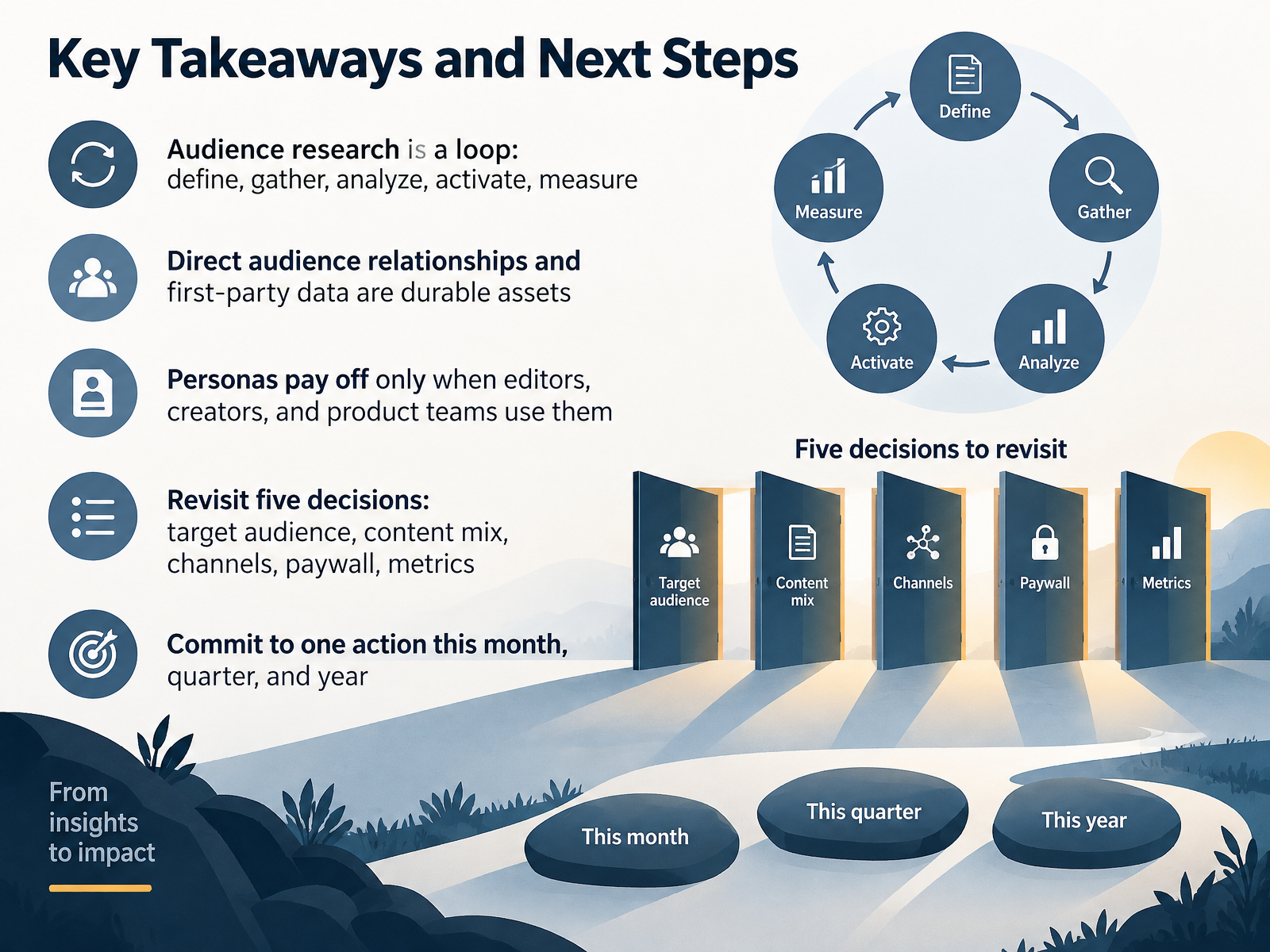
- 13Key Takeaways and Next StepsLet's pull this together. Audience research is a loop: define the question, gather the data, analyze it, activate it in your work, then measure what happened. Direct audience relationships and first-party data are durable assets, especially as search and social referral keep shrinking. Personas pay off only when editors, creators, and product teams actually use them to commission, frame, and place stories. So revisit five decisions regularly: your target audience, your content mix, your channels, your paywall, and your metrics. And commit to one action this month, one this quarter, and one this year. Keep it small enough to finish, and tie it to a decision you already own. Thank you for working through this with us. You now have a practical loop. Put it to work this week.
 reutersinstitute.politics.ox.ac.ukomeda.comdigiday.com+21 min
Take the deck with you
Download this course as a file — free, no sign-up needed.
- PDF handoutEvery slide page, ready to print or share.14 pages · 3.0 MBDownload
- Narrated PowerPointThe deck that presents itself — every slide carries the digital human's narration video.14 pages · 11.3 MBDownload
- PowerPoint slidesThe full deck as a .pptx — open it in PowerPoint, Keynote, or Google Slides.14 pages · 3.0 MBDownload
Free to use in your own training — please keep the PersonWise credit page at the end.
Have your own deck? Turn it into a course
Sources consulted
Web sources consulted while building this course.
- Journalism, media, and technology trends and predictions 2026 | Reuters Institute for the Study of Journalism — reutersinstitute.politics.ox.ac.uk
- State of Audience in Media Report 2026 | Omeda — omeda.com
- The state of publisher audiences in the zero-click era — digiday.com
- 2026 Digital Media Trends | Deloitte Insights — deloitte.com
- Media Briefing: Overheard from publishers at Digiday London Media Strategies Town Hall - Digiday — digiday.com
- Handbook on Radio and Television Audience Research — publicmediaalliance.org
- MRI-Simmons Commonly Used Terms — cdn2.hubspot.net
- The Necessary Evolution of Mass Communication Research in a Fragmenting Media Landscape — epub.ub.uni-muenchen.de
- Audience Media & Measurement Glossary | Numeris — numeris.ca
- of Media, Content & Technology Research Terms Glossary — ipsos.com
- Piano Media profiles visitors and drives conversion — doi.org
- Case Study: Corriere della Sera reaches 384K digital subscribers with Piano | CaseStudies.com — casestudies.com
- Developing a robust subscription funnel for a leading Greek publisher through data-driven insights — ftstrategies.com
- Unveiling Subscription Value: How Le Monde Boosted Engagement and Profitability with Mather’s Analytics - Mather — mathereconomics.com
- Spillovers from Online Engagement: How a Newspaper Subscriber’s Activation of Digital Paywall Access Affects Her Retention and Subscription Revenue — doi.org
- Methods used to study audience experience of screen-based media: A scoping review. — doi.org
- audience research methods: — mediasupport.org
- Methodology | Reuters Institute for the Study of Journalism — reutersinstitute.politics.ox.ac.uk
- BBC Global Impact and Influence Research 2025 — bbc.co.uk
- Step by step guide to audience research — mediasupport.org