Begin
14 pages · ~28 min
Crafting Historical Arguments
This training teaches learners how to construct clear, evidence-based historical arguments, ideal for students and anyone developing analytical writing skills.
A digital instructor presents all 14 pages. Hold “Ask” at any point and ask out loud — the answer comes from this course. No sign-up needed.
What you’ll learn
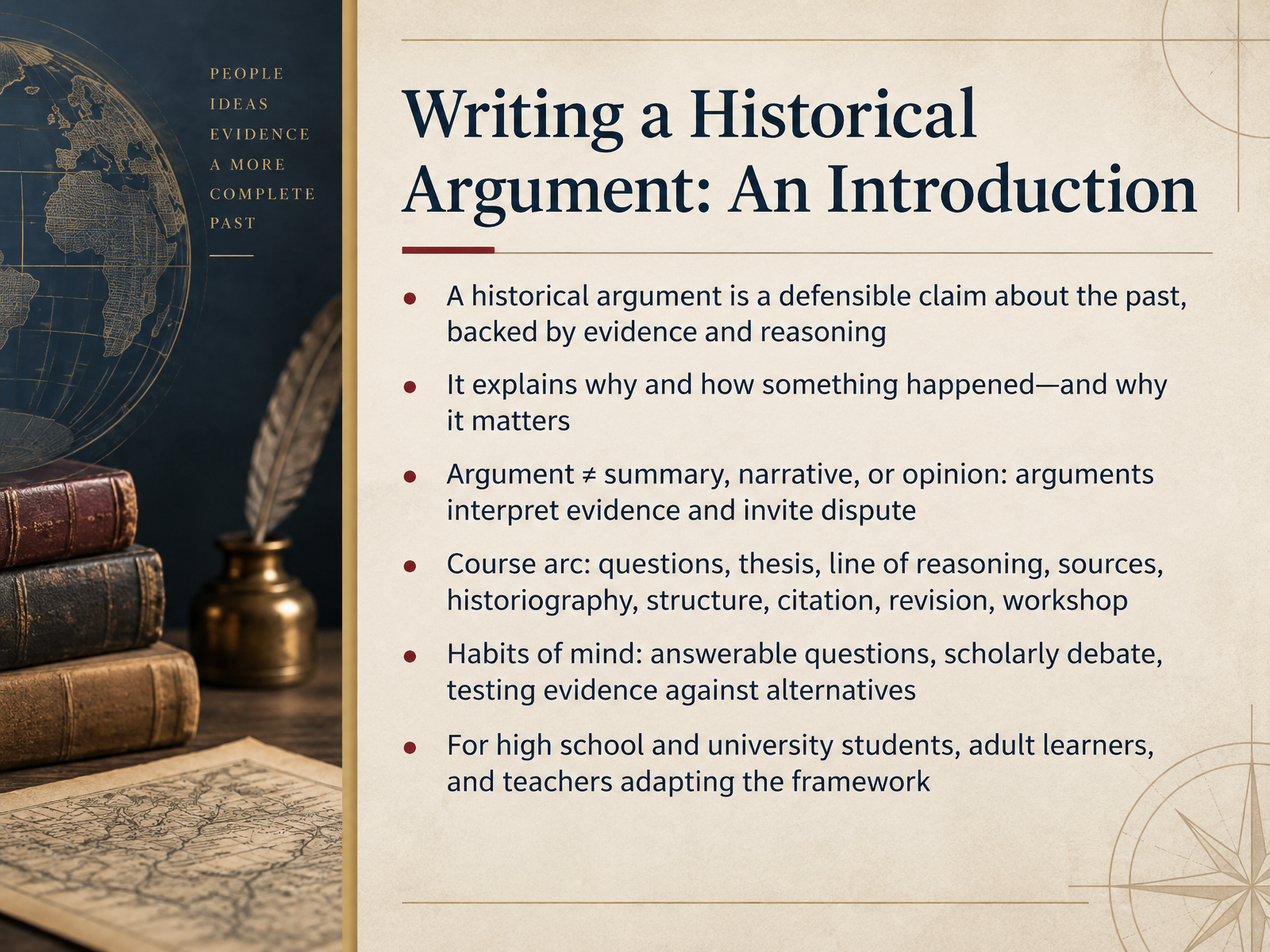
- 01Writing a Historical Argument: An IntroductionWelcome. This course is about writing a historical argument, and my goal is to help you build one you can actually defend. A historical argument is a claim about the past, supported by evidence and reasoning. It explains why and how something happened, and why it matters. Here is the key distinction. An argument is not a summary, a narrative, or an opinion. It interprets evidence, and it invites dispute. For example, saying that the French Revolution led to a series of wars is only a near miss. Saying it led to wars because its republican ideology threatened Europe's monarchs is a thesis, because it says why. Over these slides, we will move through questions, thesis, line of reasoning, sources, historiography, structure, citation, revision, and workshop. Along the way, you will practice habits of mind, like asking answerable questions, engaging scholarly debate, and testing evidence against alternatives. This framework serves high school and university students, adult learners, and teachers adapting it. Next, we turn to what counts as an argument in history.history.idaho.govlearninglink.oup.comhistory.berkeley.edu+22 min
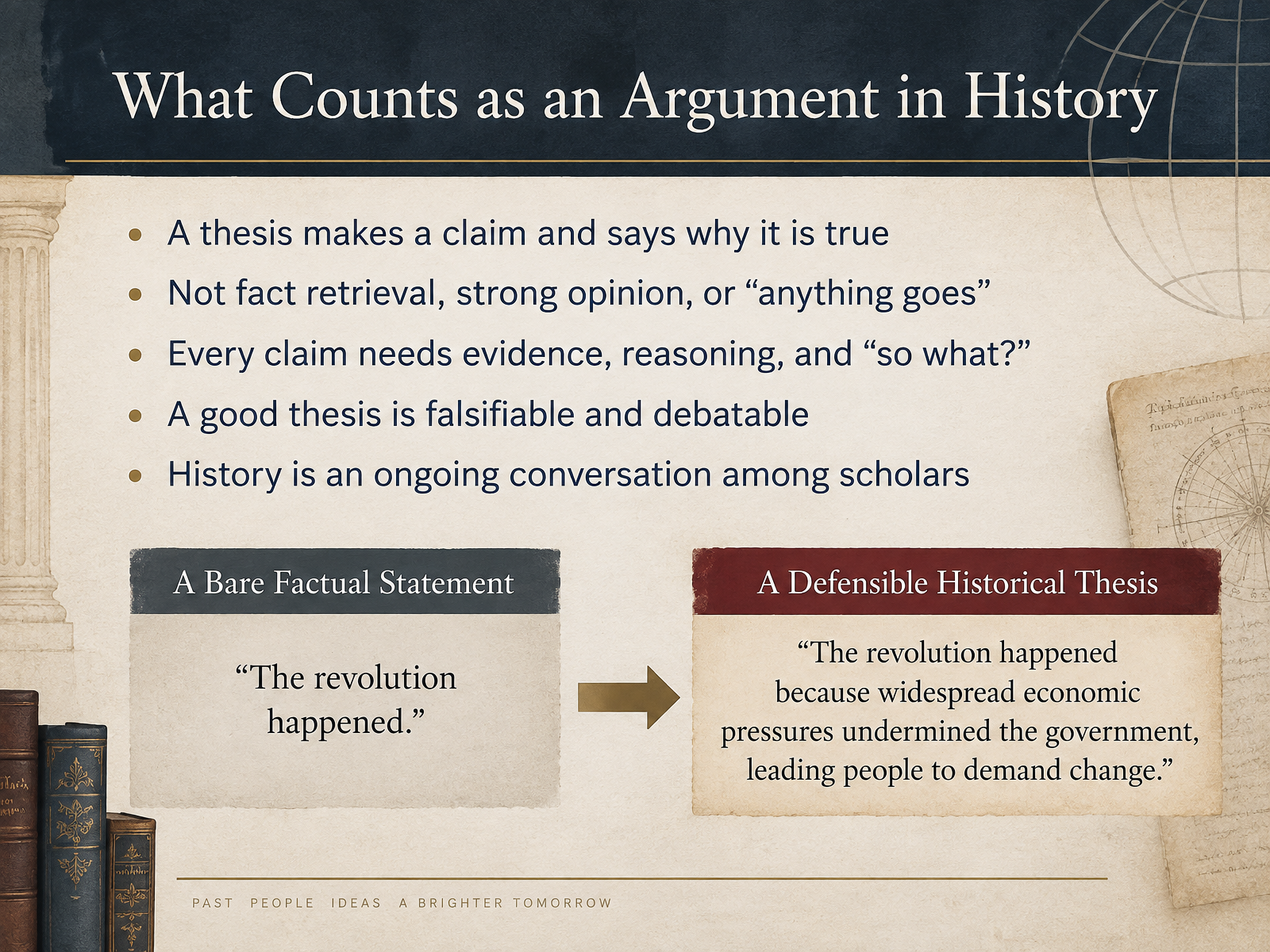
- 02What Counts as an Argument in HistorySo let's be precise about what an argument in history actually is. A thesis makes a claim, and it says why that claim is true. It is not fact retrieval. It is not a strong opinion. And it is not a case of anything goes. Every claim you make needs evidence, reasoning, and a clear answer to the so what question. Think about the difference between saying Martin Luther started the Reformation, which is a fact, and arguing that his ninety five theses sparked a religious revolution and later motivated reform within the Catholic Church. Only the second one is debatable. A good thesis is falsifiable and debatable. Someone could disagree with it and argue back. And that is the point, because history is an ongoing conversation among scholars, not a finished list of facts. So test your own thesis with one question. Could a reasonable person argue the other side? Then move on to turning your topic into a historical question.
 history.idaho.govlearninglink.oup.comhistory.berkeley.edu+22 min
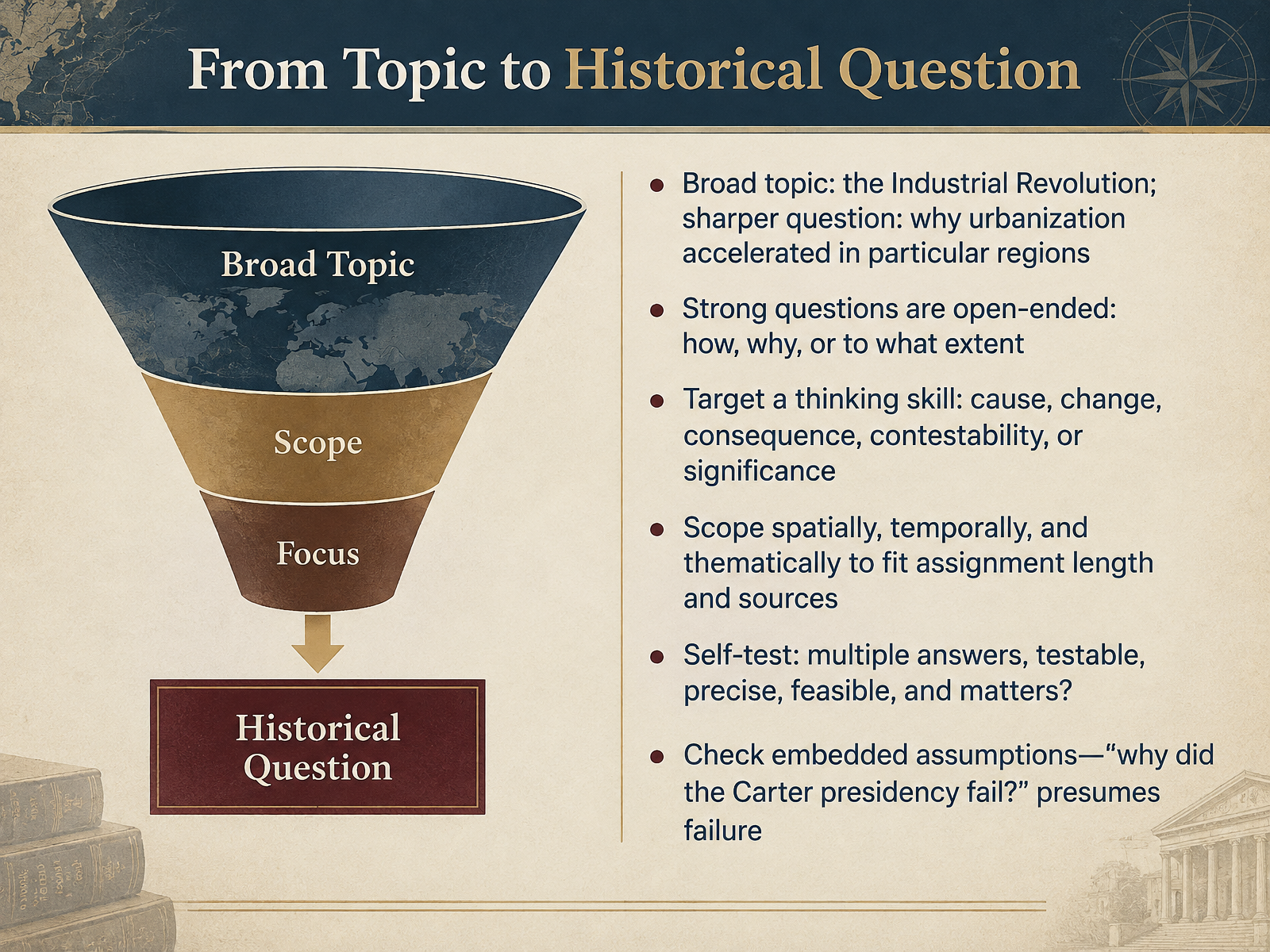
- 03From Topic to Historical QuestionLet's move from a topic to a historical question. A broad topic like the Industrial Revolution gives you a starting point, but it isn't yet a question. To sharpen it, ask why urbanization accelerated in particular regions. Notice the shift. You now have a direction for research.
Strong questions are open-ended. They begin with how, why, or to what extent. Then target a thinking skill: cause, change, consequence, contestability, or significance. And scope the question spatially, temporally, and thematically to fit your assignment length and available sources.
Here's a self-test. Will your question allow multiple answers? Is it testable? Is it precise and feasible? And can you explain why the answer matters? Finally, check embedded assumptions. Asking why the Carter presidency failed presumes it failed. That presumption shapes your evidence before you begin.
Next, we'll look at common question pitfalls: presentism, fiction, and morality.
 guides.library.msstate.eduprojects.iq.harvard.edudg.philhist.unibas.ch+22 min
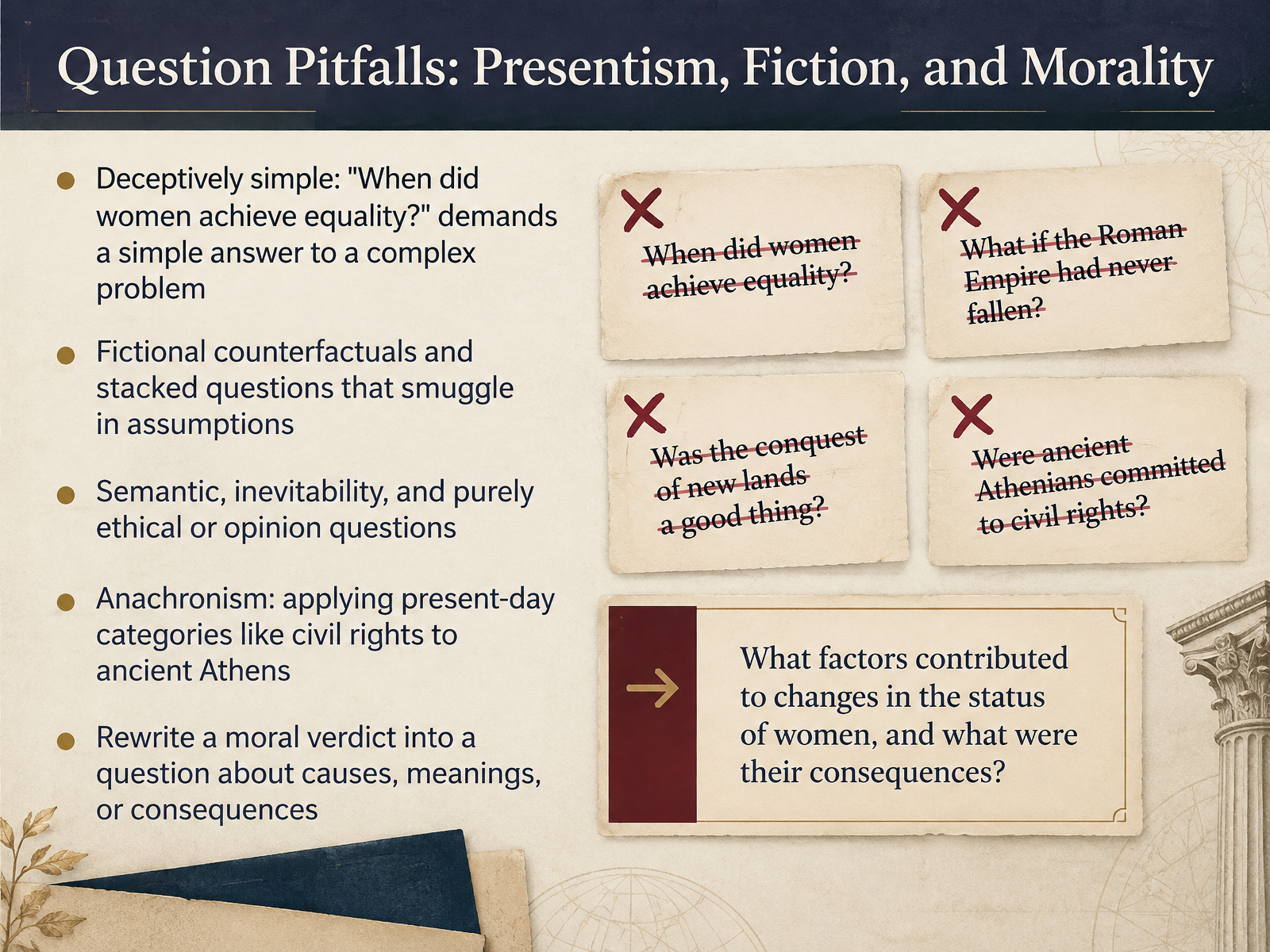
- 04Question Pitfalls: Presentism, Fiction, and MoralityLet's look at the questions that quietly derail good writing. One trap is the deceptively simple question, like, when did women achieve equality? That phrasing demands a short answer to a long, contested problem. Another trap is the fictional question, which asks what would have happened if some event had gone differently. Related to that is the stacked question, which smuggles an assumption into the prompt, as in, why did the Carter presidency fail? The failure is already built in. Other weak questions turn on definition, like, are all radical revolutions violent? Some ask about inevitability. Others are purely ethical, like, was Truman wrong to use the atomic bomb? And watch for anachronism, applying present-day categories to the past. Asking how good ancient Athens was on civil rights imports a modern frame. Your practical move is this: rewrite a moral verdict into a question about causes, meanings, or consequences. That is a question evidence can answer. Building an Arguable Thesis.
 guides.library.msstate.eduprojects.iq.harvard.edudg.philhist.unibas.ch+22 min
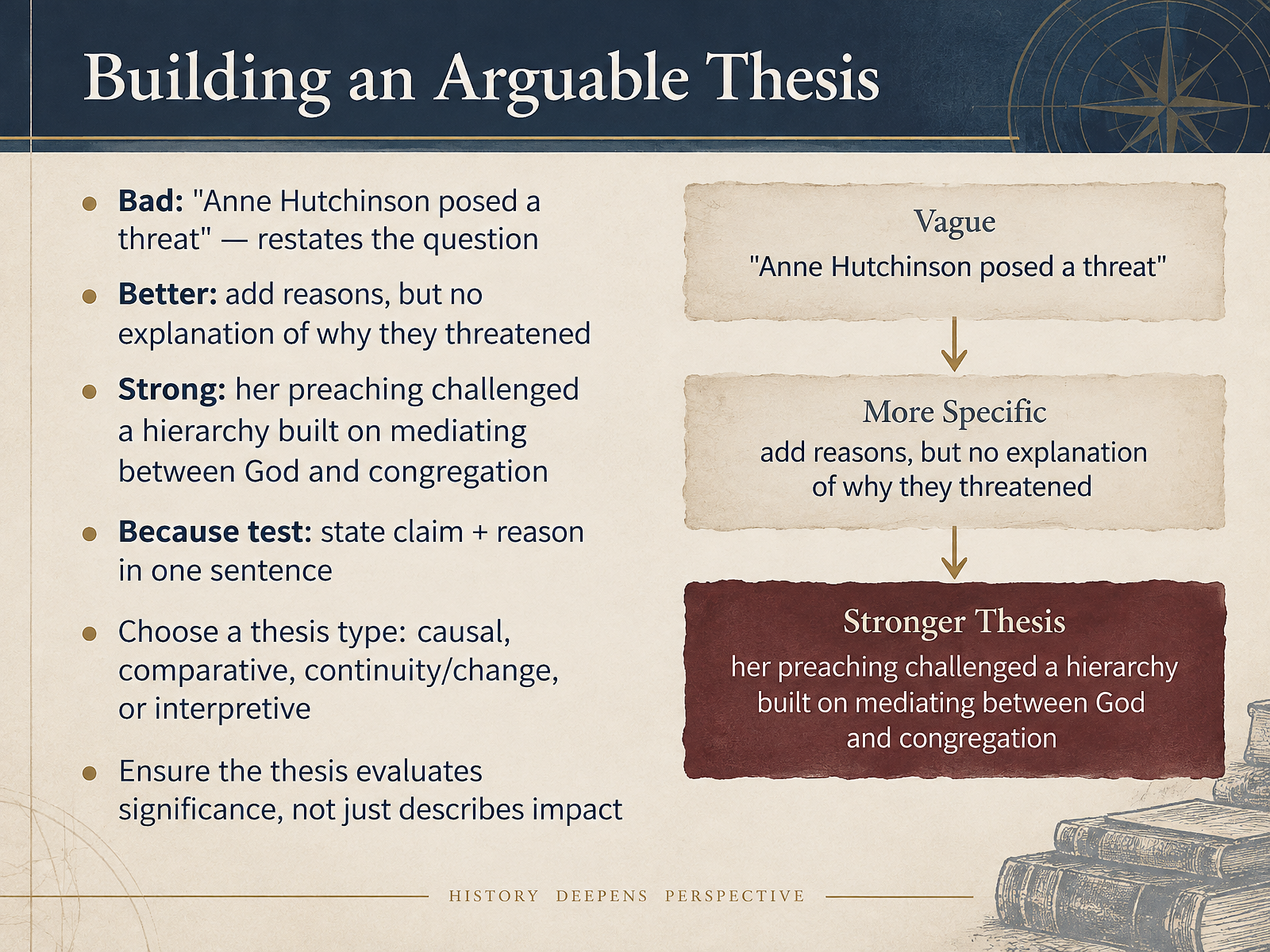
- 05Building an Arguable ThesisLet's move from finding evidence to shaping an arguable thesis, meaning a claim someone could reasonably dispute. Take Anne Hutchinson. 'She posed a threat' just restates the question. A better version adds reasons, but never explains why they threatened anyone. A strong version names the mechanism: her preaching challenged a hierarchy that rested on mediating between God and the congregation. So use the because test. State your claim and your reason in one sentence. Then choose a thesis type: causal, comparative, continuity and change, or interpretive. Finally, make sure your thesis evaluates significance, not just describes impact. Strong theses say why the impact mattered. Next, we will turn to line of reasoning and paragraph level claims.
 history.idaho.govlearninglink.oup.comhistory.berkeley.edu+21 min
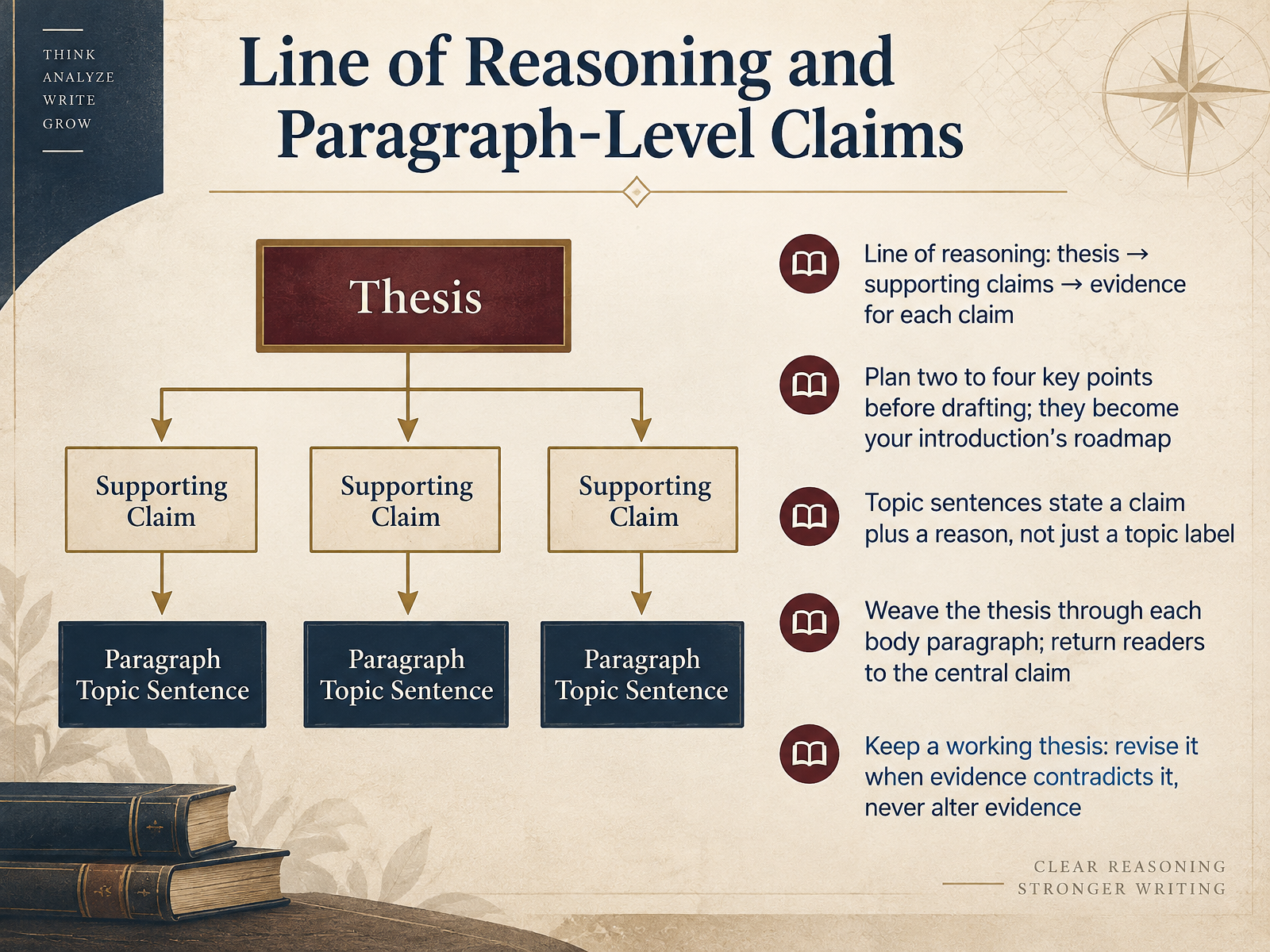
- 06Line of Reasoning and Paragraph-Level ClaimsLet's turn now to building a line of reasoning, and to the claims that carry it at the paragraph level. Your line of reasoning is the path from thesis, to supporting claims, to evidence for each claim. Before drafting, plan two to four key points. Those points become the roadmap your introduction promises the reader. Each body paragraph should open with a topic sentence that states a claim plus a reason, not just a topic label. For example, instead of writing "the alliance system," write "the alliance system turned a regional crisis into a continental war because it obligated signatories to mobilize." Then weave your thesis through every paragraph, so readers return to the central claim. Finally, keep a working thesis. If evidence contradicts it, revise the thesis. Never alter the evidence. Next, we look at sources and historical thinking skills.
 otago.ac.nzhistory.rutgers.eduhistoryskills.com+22 min
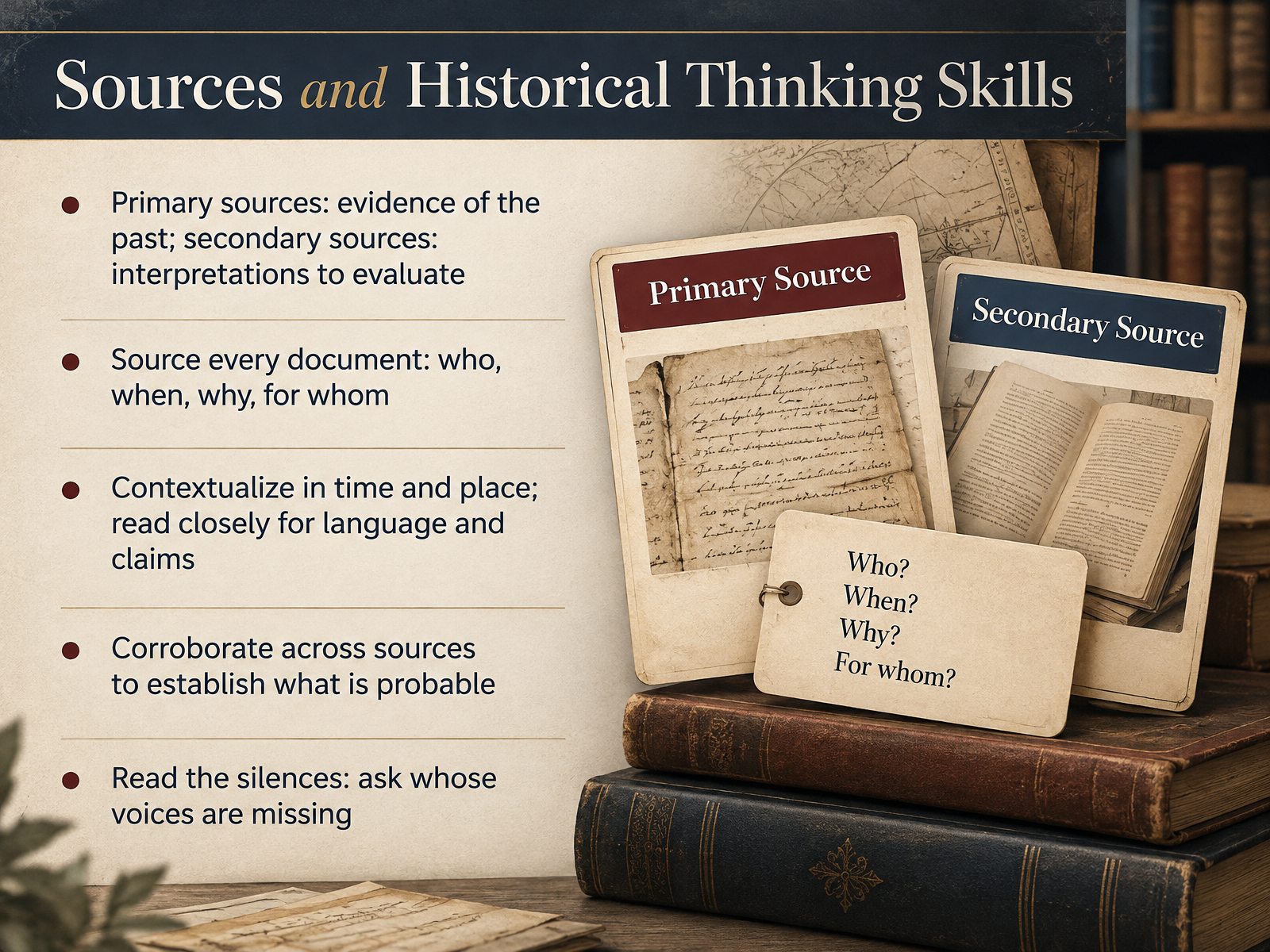
- 07Sources and Historical Thinking SkillsNext, let's look at the thinking skills behind working with sources. Primary sources are evidence from the past, while secondary sources are interpretations you need to evaluate. For every document, source it: ask who created it, when, why, and for whom. Then contextualize it in time and place, and read closely for language and claims. Corroborate across sources to establish what is probable. And read the silences: ask whose voices are missing. These moves turn a document into evidence for your argument. From Evidence to Inference.
 cha-shc.caloc.govmsstatetps.org+21 min
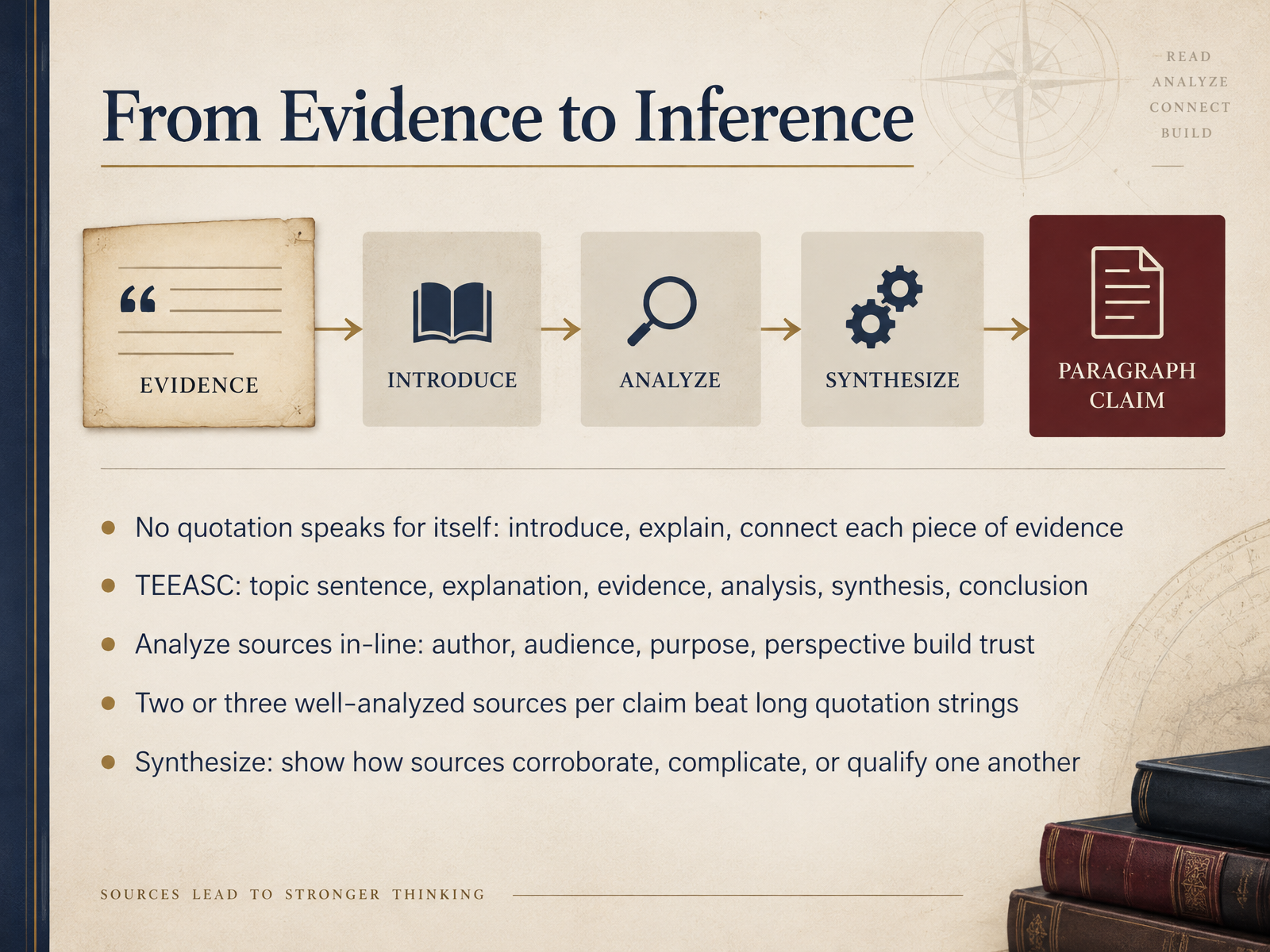
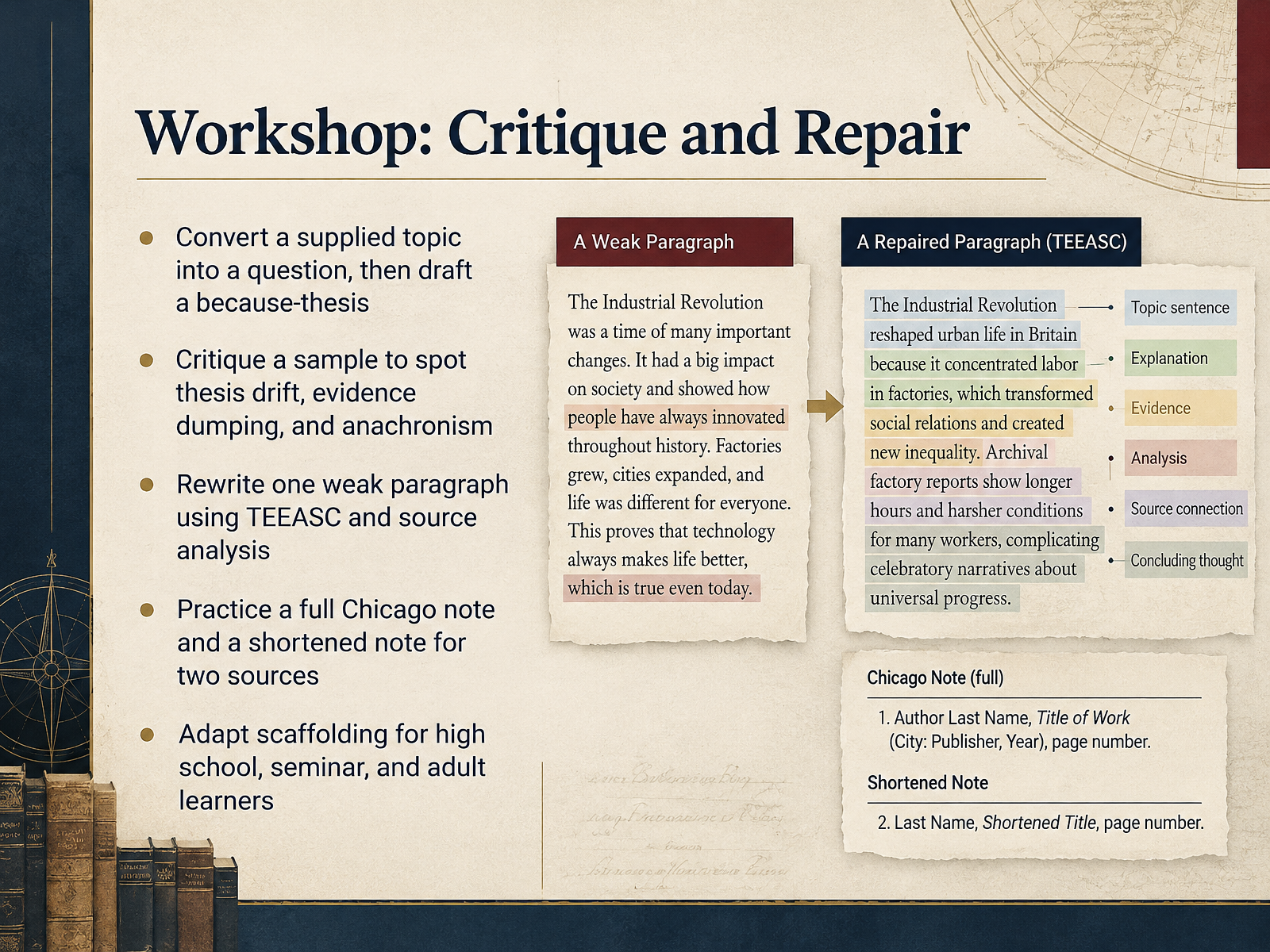
- 08From Evidence to InferenceNow we move from evidence to inference. No quotation speaks for itself. Each piece of evidence needs you to introduce it, explain what it says, and connect it to your claim. One useful structure is TEEASC: topic sentence, explanation, evidence, analysis, synthesis, conclusion. Analyze sources in line by naming the author, audience, purpose, and perspective, which builds your reader's trust. Two or three well-analyzed sources per claim usually beat long strings of quotation. Then synthesize: show how those sources corroborate, complicate, or qualify one another. Next, we turn to engaging historiography and counterarguments.
 cha-shc.caloc.govmsstatetps.org+21 min
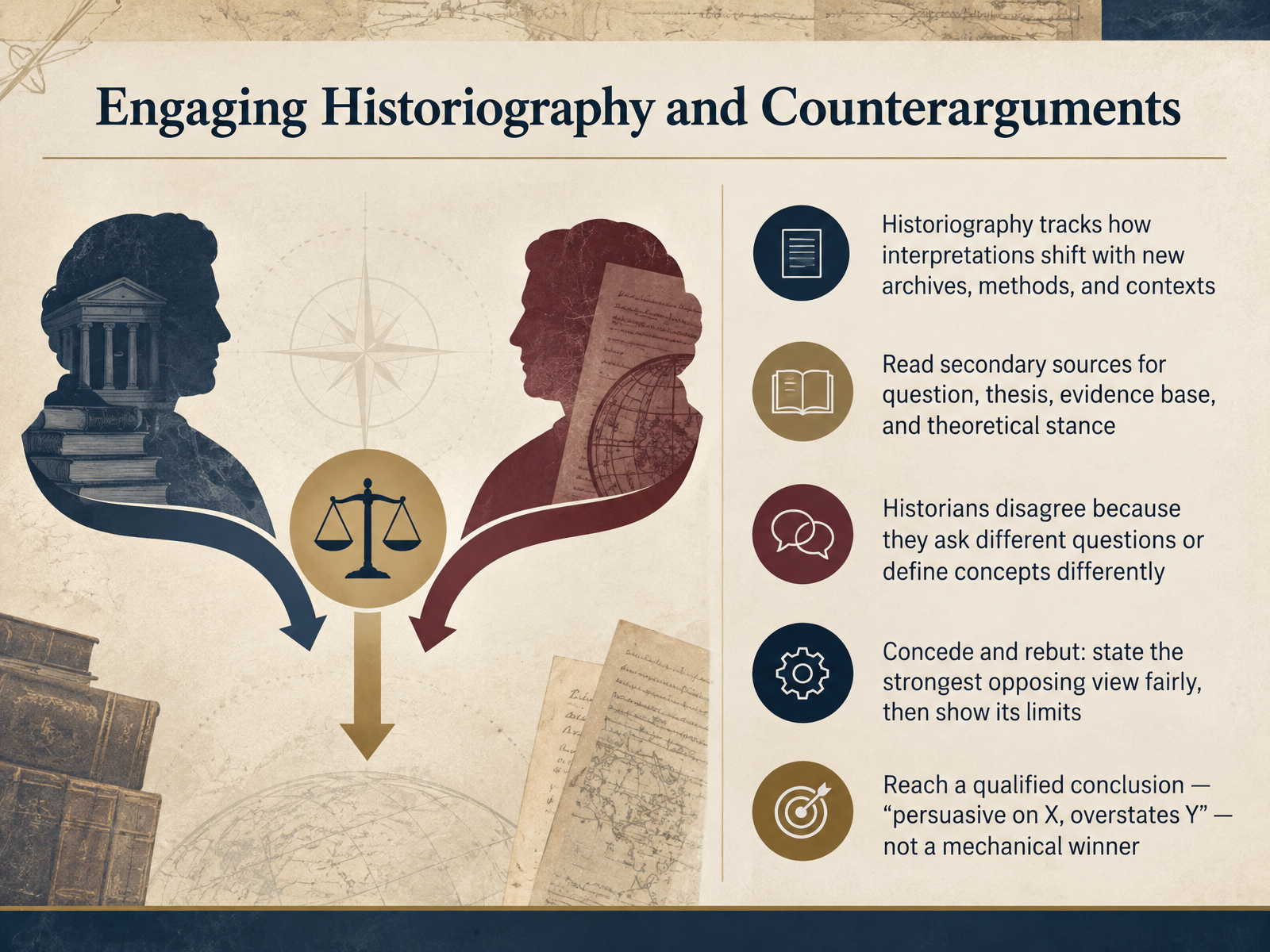
- 09Engaging Historiography and CounterargumentsNow we turn to historiography — the study of how historical interpretations shift. New archives, new methods, new contexts. So when you read a secondary source, read for four things. The question the historian asked. The thesis. The evidence base. And the theoretical stance. This matters because historians often disagree for a simple reason. They ask different questions, or they define concepts differently. Was it a revolution or a revolt? That is a definitional choice, and it changes the argument. Here is your writing move. Concede and rebut. State the strongest opposing view fairly, then show its limits. Do not knock down a weak version. Engage the best one. Then reach a qualified conclusion. Something like, persuasive on X, but overstates Y. Not a mechanical winner. Next, we look at structuring the argument.
 2 min
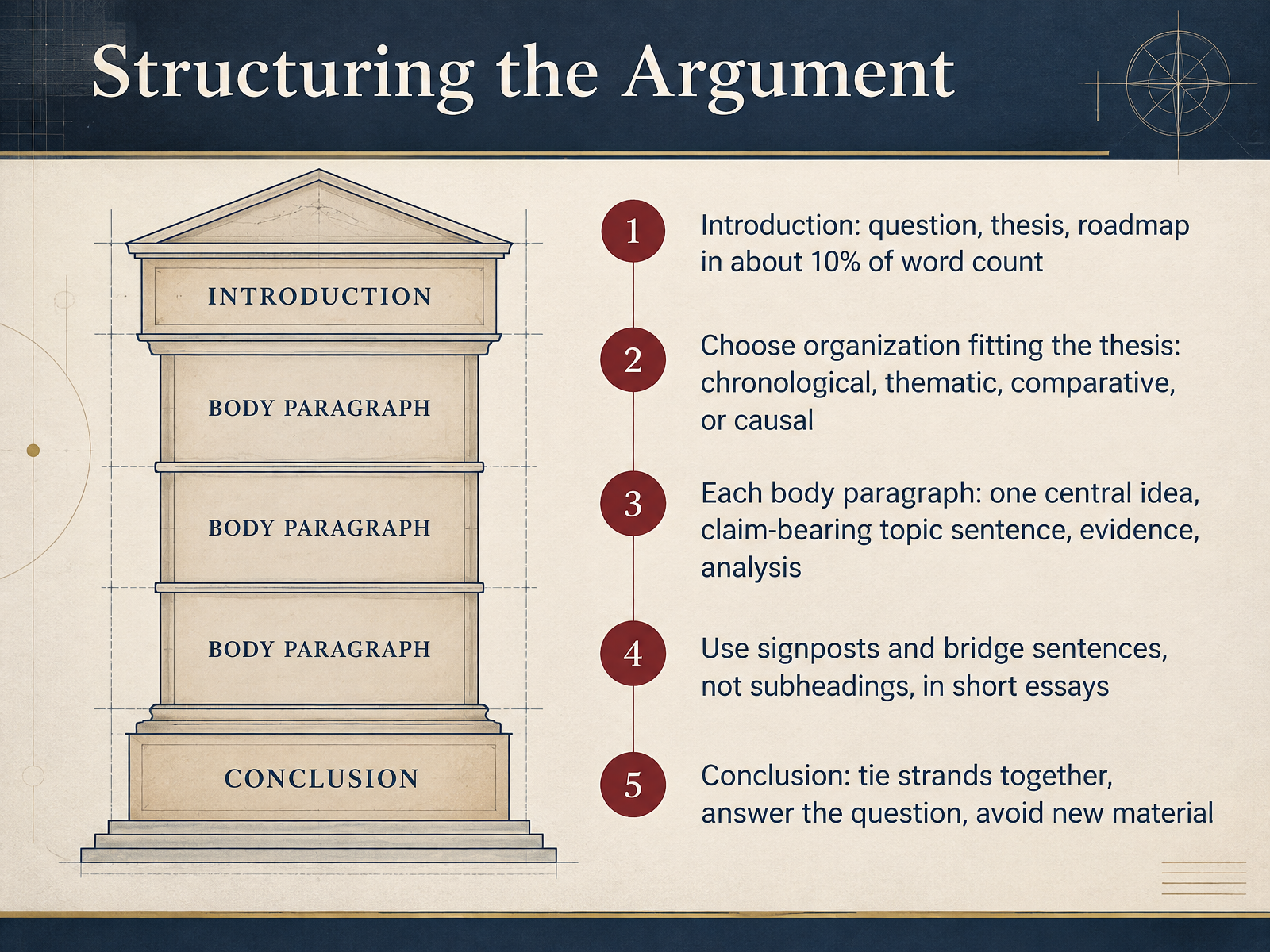
- 10Structuring the ArgumentNow let's look at how to structure the argument itself. Your introduction should do three jobs: pose the question, state your thesis, and give a roadmap of the main points. Keep it short, around ten percent of your total word count. Then choose an organization that fits your thesis: chronological, thematic, comparative, or causal. In each body paragraph, stick to one central idea. Open with a claim-bearing topic sentence, present your evidence, and analyze it. For short essays, use signposts and bridge sentences rather than subheadings. Finally, your conclusion should tie the strands together, answer the question, and avoid introducing new material. Next, we'll turn to style, citation, and academic integrity.
 otago.ac.nzhistory.rutgers.eduhistoryskills.com+22 min
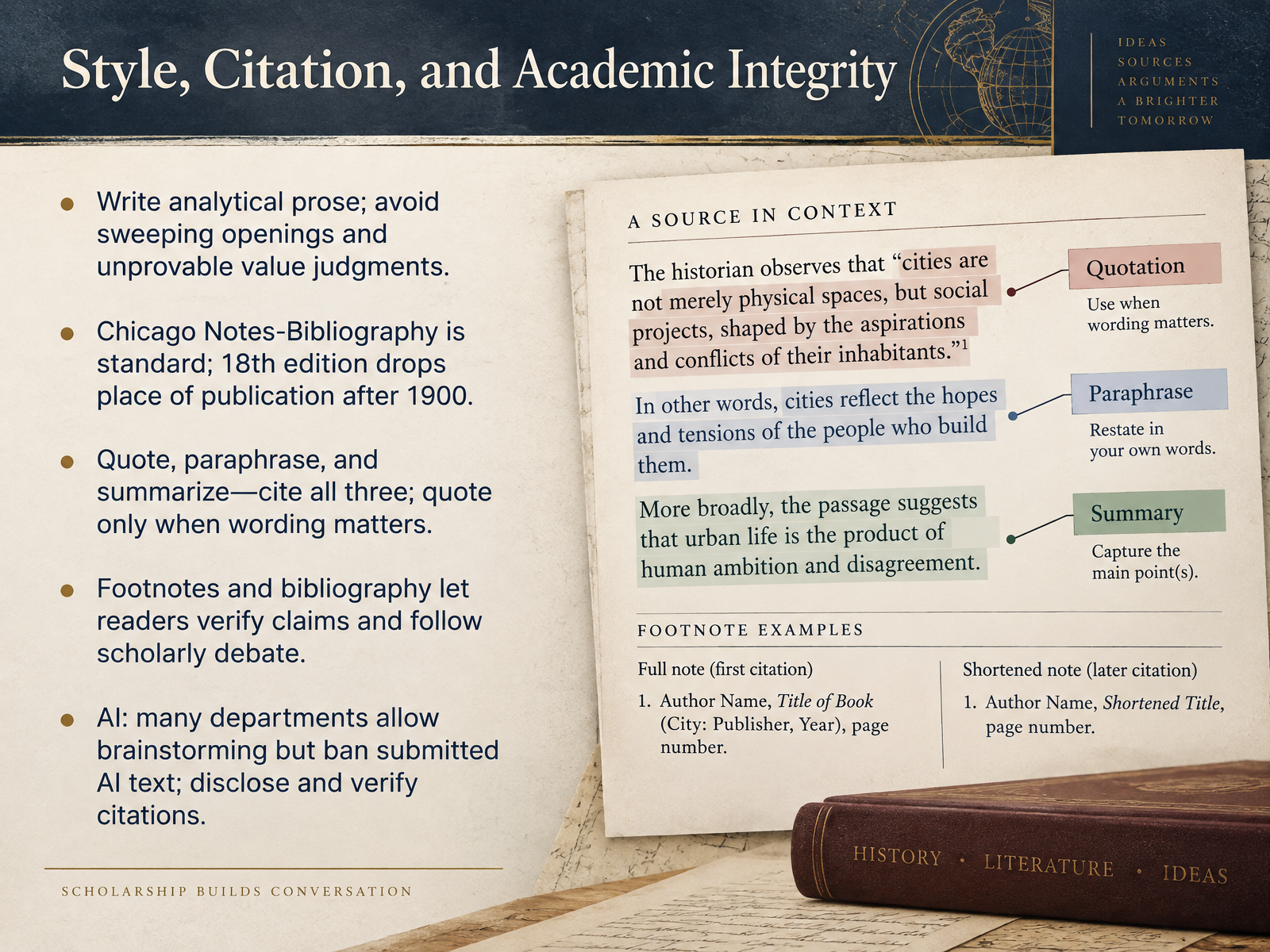
- 11Style, Citation, and Academic IntegrityNow let's talk about style, citation, and academic integrity. Write analytical prose. Skip sweeping openings like "since the dawn of time," and avoid value judgments you cannot prove. For citation, Chicago Notes-Bibliography is the standard in history. Under the eighteenth edition, you no longer include the place of publication for books published after nineteen hundred. You can quote, paraphrase, or summarize, and you must cite all three. Quote only when the exact wording matters, as when a witness's phrasing carries the argument. Footnotes and the bibliography let readers verify your claims and follow the scholarly debate. On AI, many departments allow brainstorming, but ban AI-generated text in what you submit. If you use AI at all, disclose it and verify every citation yourself. The takeaway is simple. Your voice, your evidence, your sources. Next, we turn to revision, feedback, and assessment."
 2 min
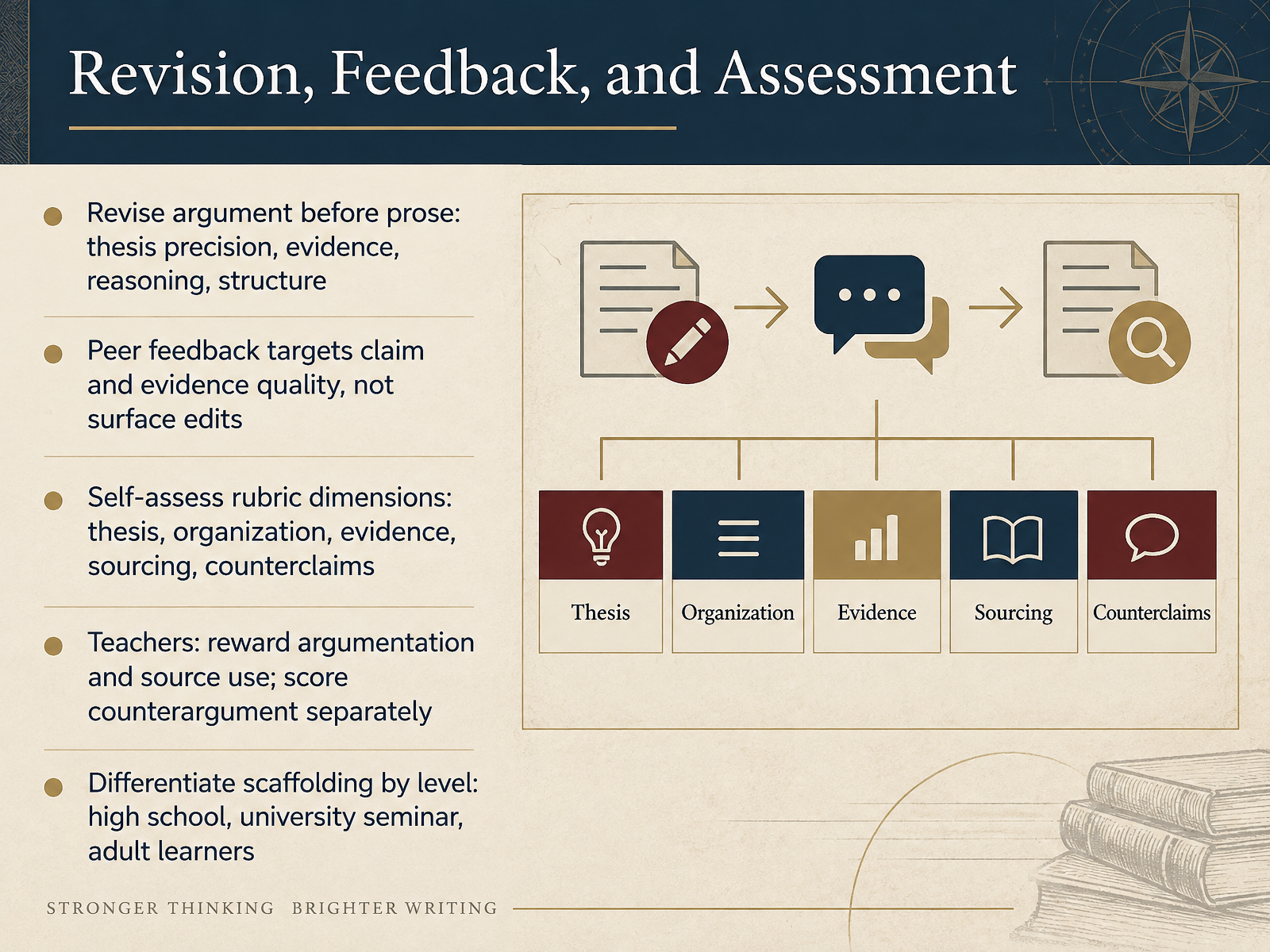
- 12Revision, Feedback, and AssessmentNow let's talk about revision, feedback, and assessment. Here is the key principle. Revise your argument before you polish your prose. Ask first whether your thesis is precise, whether your evidence actually supports it, whether your reasoning connects the two, and whether your structure follows that reasoning. Peer feedback should target the same things, claim and evidence quality, not comma placement. When you self-assess, use rubric dimensions like thesis, organization, evidence, sourcing, and counterclaims. Teachers, reward argumentation and source use, and score the counterargument separately so students see it as a distinct skill. And scaffold by level, from structured templates in high school, to seminar debate at university, to authentic research questions for adult learners. Next, we will put this into practice in the workshop, Critique and Repair.
 2 min
- 13Workshop: Critique and RepairLet us put all of this into practice. In this workshop, you begin by converting a supplied topic into a real question, then drafting a because-thesis, one that states your claim and gives a reason. Next, you critique a sample paragraph and look for three common faults. Thesis drift, where the paragraph wanders from the claim. Evidence dumping, where quotes pile up without analysis. And anachronism, where present-day assumptions explain the past. Then you rewrite one weak paragraph using TEEASC: topic sentence, explanation, evidence, analysis, synthesis, conclusion. For citation, write one full Chicago note and one shortened note for two sources. Full note first, then author, short title, and page. Finally, adapt the scaffolding for high school, seminar, and adult learners. Keep the reasoning constant. Change only the support.
 otago.ac.nzhistory.rutgers.eduhistoryskills.com+22 min
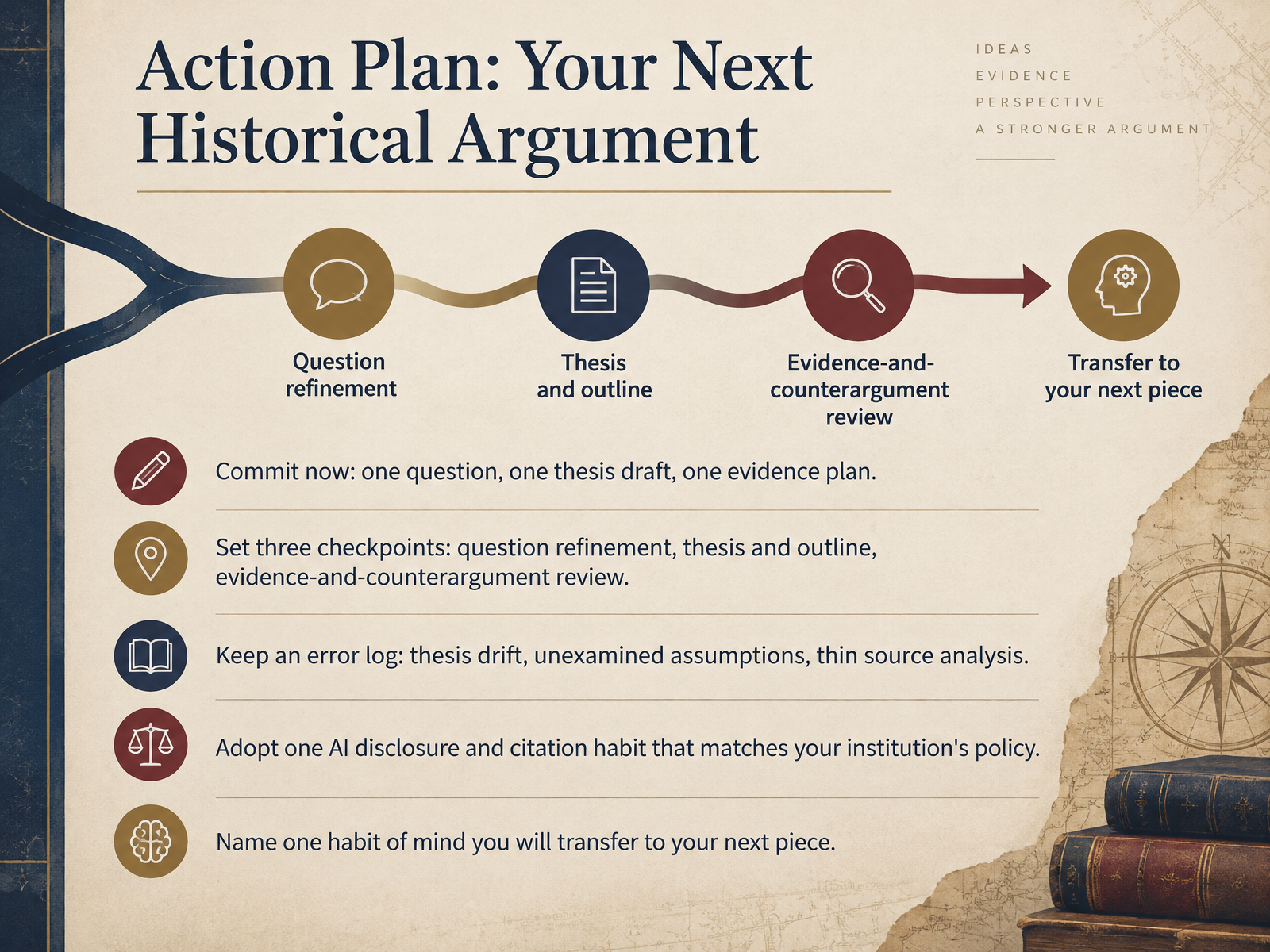
- 14Action Plan: Your Next Historical ArgumentLet's close by turning everything you've learned into a concrete action plan. First, commit now to three things: one research question, one thesis draft, and one evidence plan. Writing them down makes them real.
Second, set three checkpoints. One, refine the question. Two, finish the thesis and outline. Three, review evidence and counterarguments together. Each checkpoint is a moment to pause and check your reasoning before you go further.
Third, keep a short error log. Track thesis drift, unexamined assumptions, and thin source analysis. Naming these habits is how you stop repeating them.
Fourth, adopt one AI disclosure and citation habit that matches your institution's policy. Policies differ, so check yours rather than guessing. Fifth, name one habit of mind you'll carry into your next piece, perhaps testing evidence against a counterclaim before drafting.
That's your plan: a commitment, three checkpoints, an error log, a disclosure habit, and one transferable habit of mind. Thank you for your careful work across this course. You now have a method to build a defensible historical argument, so trust the process and start with your question.
 2 min
Take the deck with you
Download this course as a file — free, no sign-up needed.
- PDF handoutEvery slide page, ready to print or share.15 pages · 5.2 MBDownload
- Narrated PowerPointThe deck that presents itself — every slide carries the digital human's narration video.15 pages · 24.0 MBDownload
- PowerPoint slidesThe full deck as a .pptx — open it in PowerPoint, Keynote, or Google Slides.15 pages · 5.2 MBDownload
Free to use in your own training — please keep the PersonWise credit page at the end.
Have your own deck? Turn it into a course
Sources consulted
Web sources consulted while building this course.
- Good, Bad, and Ugly: Comparing Thesis Statements — history.idaho.gov
- Chapter 03: Thesis Statements - Europe in the Modern World: A New Narrative History 2e Student Resources - Oxford Learning Link — learninglink.oup.com
- Elements of an Effective History Exam Essay — history.berkeley.edu
- Developing a Topic - HISB03: Critical Writing and Research for Historians - Research Guides at University of Toronto — guides.library.utoronto.ca
- Stating Your Case: Writing Thesis Statements Effectively | TeachingHistory.org — teachinghistory.org
- Research Questions - History Research Guide - Research Guides at Mississippi State University — guides.library.msstate.edu
- https://projects.iq.harvard.edu/sites/projects.iq.harvard.edu/files/hist-97/files/formulating_research_questions.pdf — projects.iq.harvard.edu
- Formulating a Research Question | Department of History | University of Basel — dg.philhist.unibas.ch
- How to write a key inquiry question - Research Step 1 - History Skills — historyskills.com
- Asking Good Questions - Learning Historical Research — williamcronon.net
- Guide to writing history essays, Study guide, History | University of Otago — otago.ac.nz
- Writing Historical Essays: A Guide for Undergraduates — history.rutgers.edu
- How to write body paragraphs for history essays - History Skills — historyskills.com
- How to Write History Essays — faculty.chass.ncsu.edu
- The History Student’s Handbook — arts.ucalgary.ca
- What is historical thinking? Part II | Canadian Historical Association | Société historique du Canada — cha-shc.ca
- TPS Quarterly Winter 2010 — loc.gov
- Historical Thinking — msstatetps.org
- Historical Thinking Through Multiple Lenses — socialstudies.org
- Crosswalk between Maryland’s 6.0 Skills and Processes and the Stanford History Education Group (SHEG) Approach — msde.maryland.gov