Begin
14 pages · ~28 min
Content Marketing Case Study Analysis
This training analyzes real content marketing case studies to help marketers identify success patterns and evaluate strategic tradeoffs.
A digital instructor presents all 14 pages. Hold “Ask” at any point and ask out loud — the answer comes from this course. No sign-up needed.
What you’ll learn
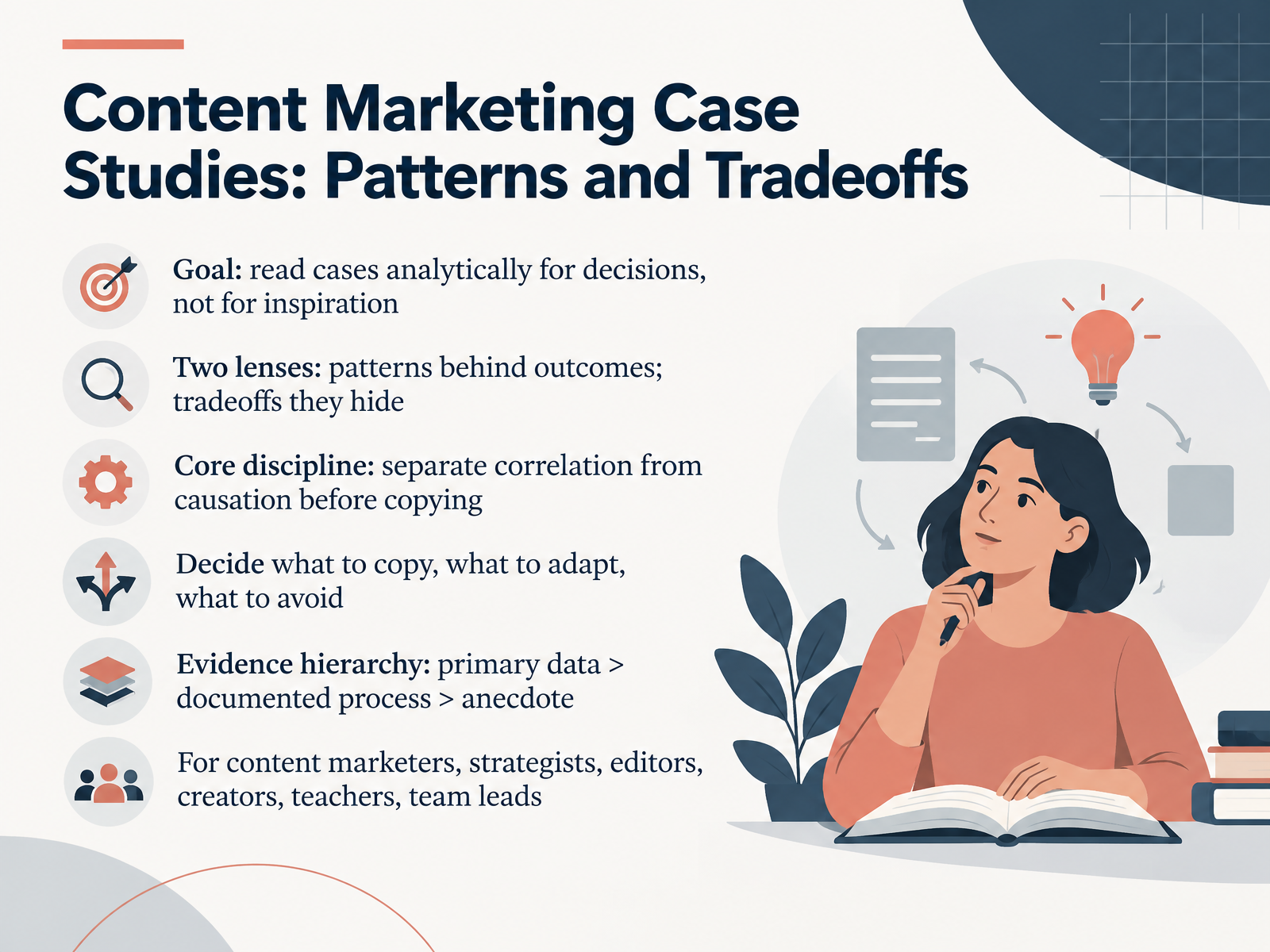
- 01Content Marketing Case Studies: Patterns and TradeoffsWelcome. This course is about reading content marketing case studies analytically, for decisions rather than inspiration. We'll use two lenses. First, patterns behind the outcomes. Second, the tradeoffs those patterns hide. Our core discipline is separating correlation from causation before we copy anything, because a result that happened during a campaign is not automatically a result caused by it. So we'll practice deciding what to copy, what to adapt, and what to avoid. We'll also rank evidence. Primary data beats documented process, and documented process beats anecdote. The goal is not to dismiss case studies, but to read them the way strategists, editors, creators, teachers, and team leads actually need to. Let's start with how to read a content marketing case study critically.contentmarketinginstitute.comtendocom.comcontentmarketinginstitute.com+22 min
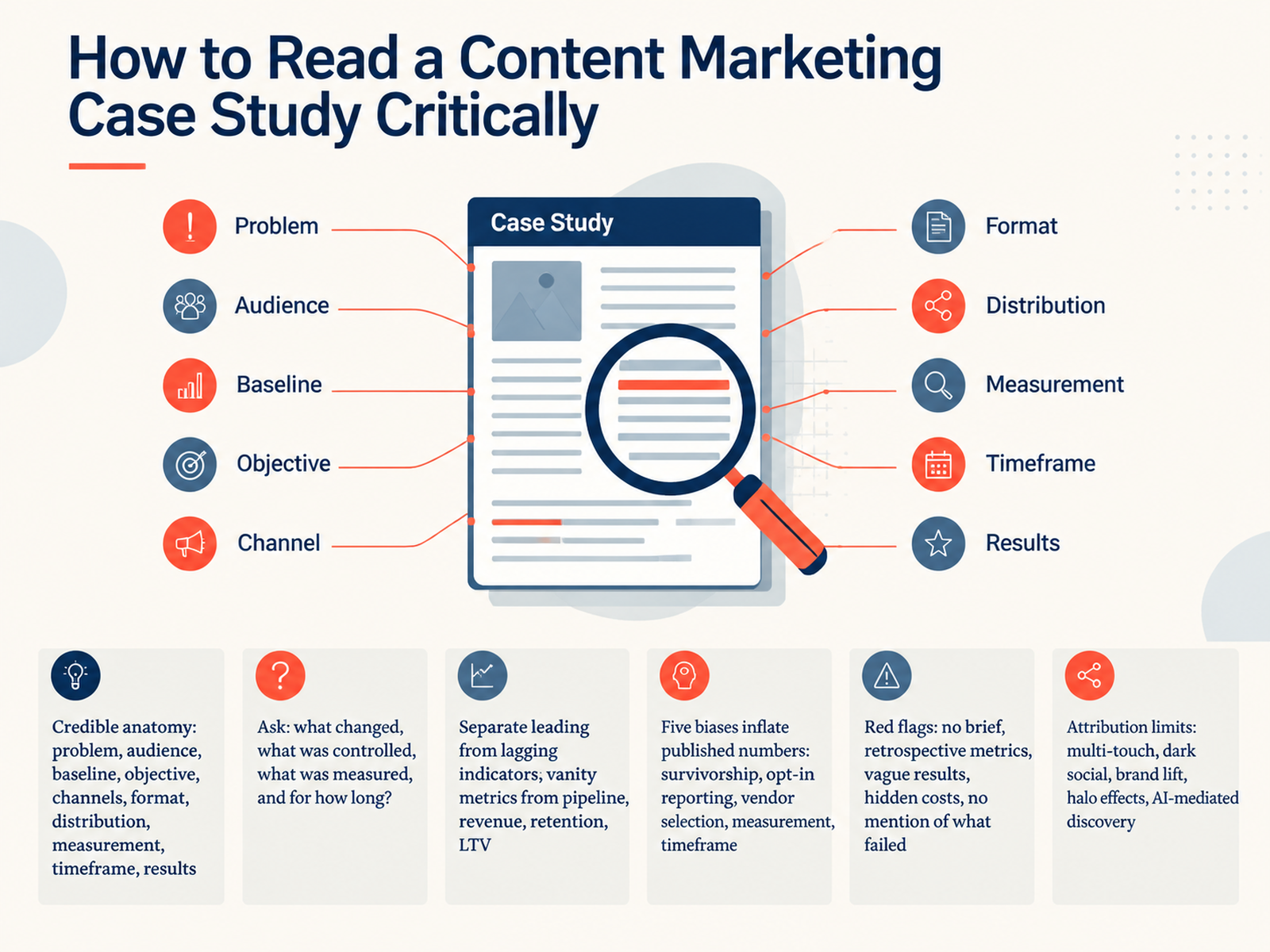
- 02How to Read a Content Marketing Case Study CriticallyLet's talk about how to read a content marketing case study critically. Start with anatomy. A credible study states the problem, audience, baseline, objective, channels, format, distribution, measurement, timeframe, and results. If the brief is missing, treat the whole document with suspicion. Then ask four questions. What changed? What was controlled? What was measured? And for how long? If the study can't answer whether seasonality, pricing changes, or competitor activity were moving at the same time, it has shown you correlation, not causation. Next, separate leading from lagging indicators. Engagement and traffic lead. Pipeline, revenue, retention, and lifetime value lag. Board conversations don't reward raw traffic that never touches sales. Watch for five biases that inflate published numbers: survivorship, opt-in reporting, vendor selection, measurement, and timeframe. And red flags: no brief, retrospective metrics, vague results, hidden costs, and no mention of what failed. Finally, respect attribution limits. Multi-touch journeys, dark social, brand lift, halo effects, and AI-mediated discovery all sit outside your dashboard. Next, we'll look at causality traps and what published case studies usually hide.
 themarketingjuice.comdspace.lboro.ac.ukdoi.org+22 min
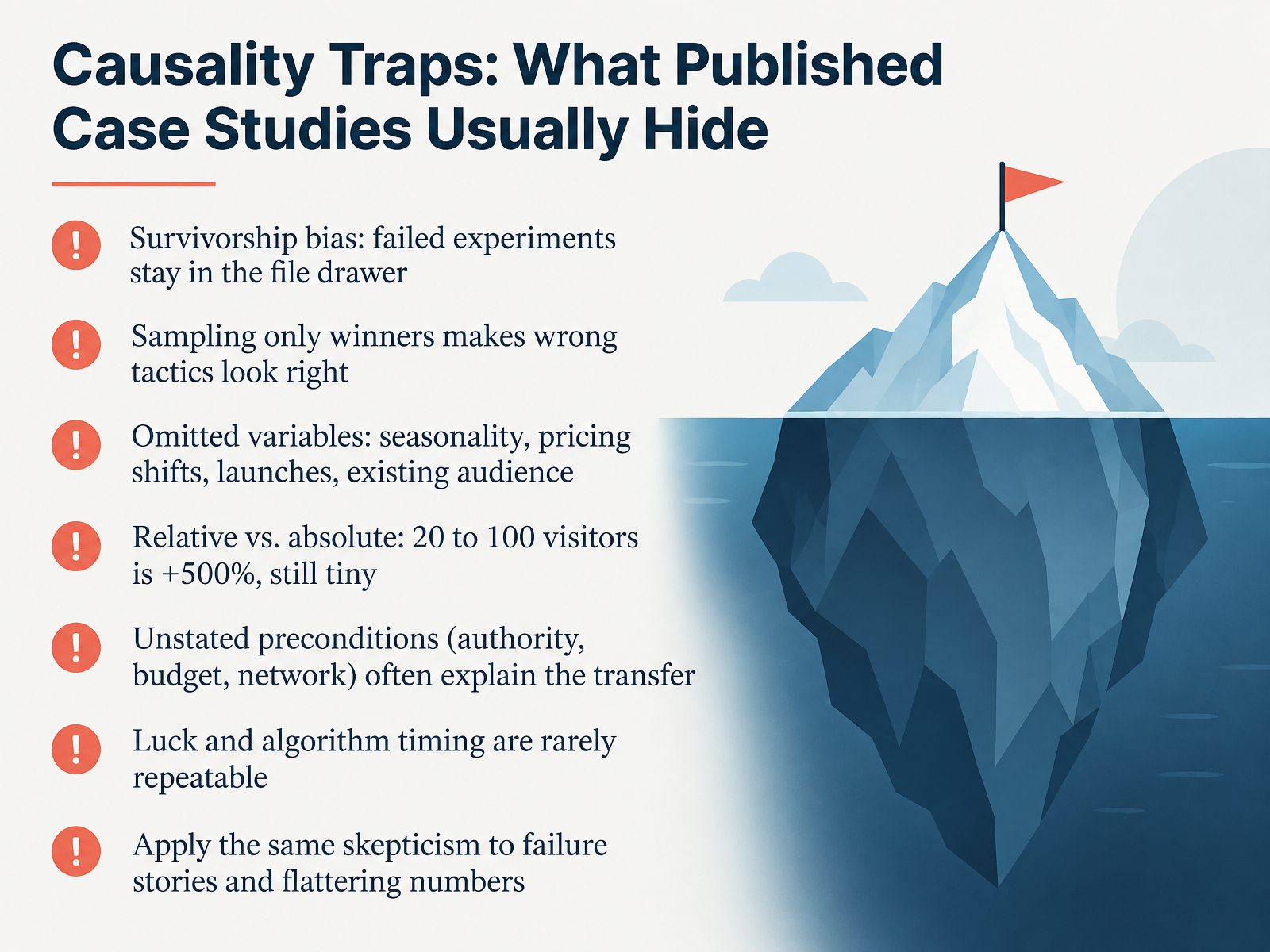
- 03Causality Traps: What Published Case Studies Usually HideLet's talk about causality traps, the things published case studies usually hide. Start with survivorship bias. Failed experiments stay in the file drawer, so we only sample winners. When you sample only winners, wrong tactics look right. Here's the test. Ask what preconditions the author had: existing audience, budget, a network, authority. Those often explain the transfer more than the tactic did. Then check relative versus absolute. Going from twenty visitors to one hundred is a five hundred percent increase, but one hundred visitors is still tiny. Watch for omitted variables too, like seasonality, pricing shifts, product launches, or an audience that already existed. And remember, luck and algorithm timing are rarely repeatable. Apply the same skepticism to failure stories and to flattering numbers. So next time you read a case study, ask why it really worked, then compare the conditions to yours. That habit will save you from copying a tactic that never caused the result. Next, let's look at the measurement realities behind case study numbers.
 themarketingjuice.comdspace.lboro.ac.ukdoi.org+21 min
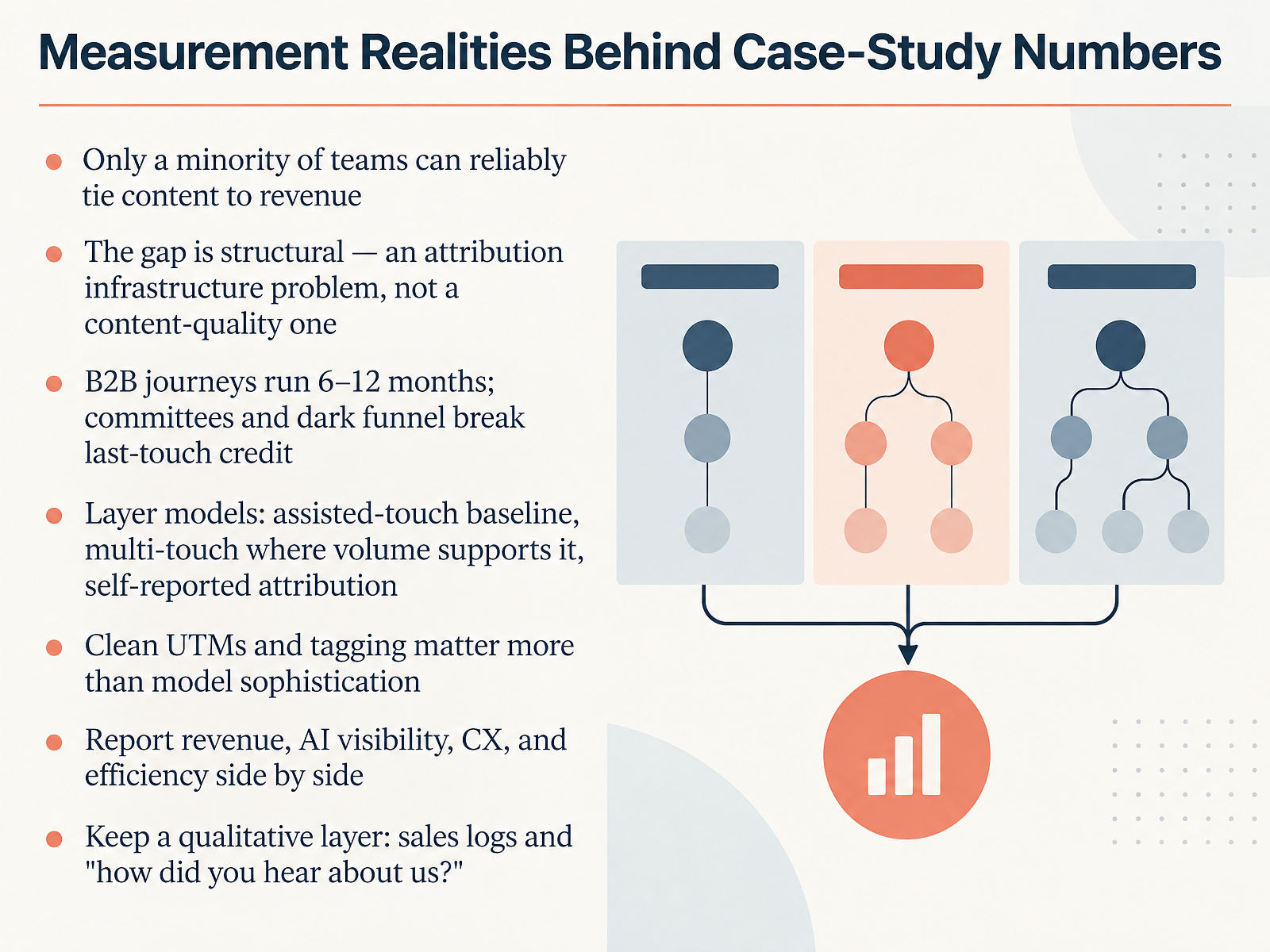
- 04Measurement Realities Behind Case-Study NumbersLet's talk about what sits behind those case-study numbers. Only a minority of teams can reliably tie content to revenue. And here's the key point: that gap is structural. It's an attribution infrastructure problem, not a content-quality one. So pause on that before blaming the work itself. B2B journeys run six to twelve months. Buying committees and the dark funnel break last-touch credit, so a single demo page often absorbs credit it never earned. The practical fix is layering. Start with an assisted-touch baseline. Add multi-touch only where conversion volume actually supports it. And keep a self-reported field asking how buyers first heard about you. One caution: clean UTMs and consistent tagging matter more than model sophistication. Broken inputs just make executives confident in the wrong answer. So report revenue, AI visibility, customer experience, and efficiency side by side. Then keep a qualitative layer through sales logs and that how-did-you-hear question. Numbers show scale. Context explains why. Now let's look at our first pattern: Pattern 1, Niche Authority and Content-Market Fit.
 contentmarketinginstitute.comtendocom.comcontentmarketinginstitute.com+22 min
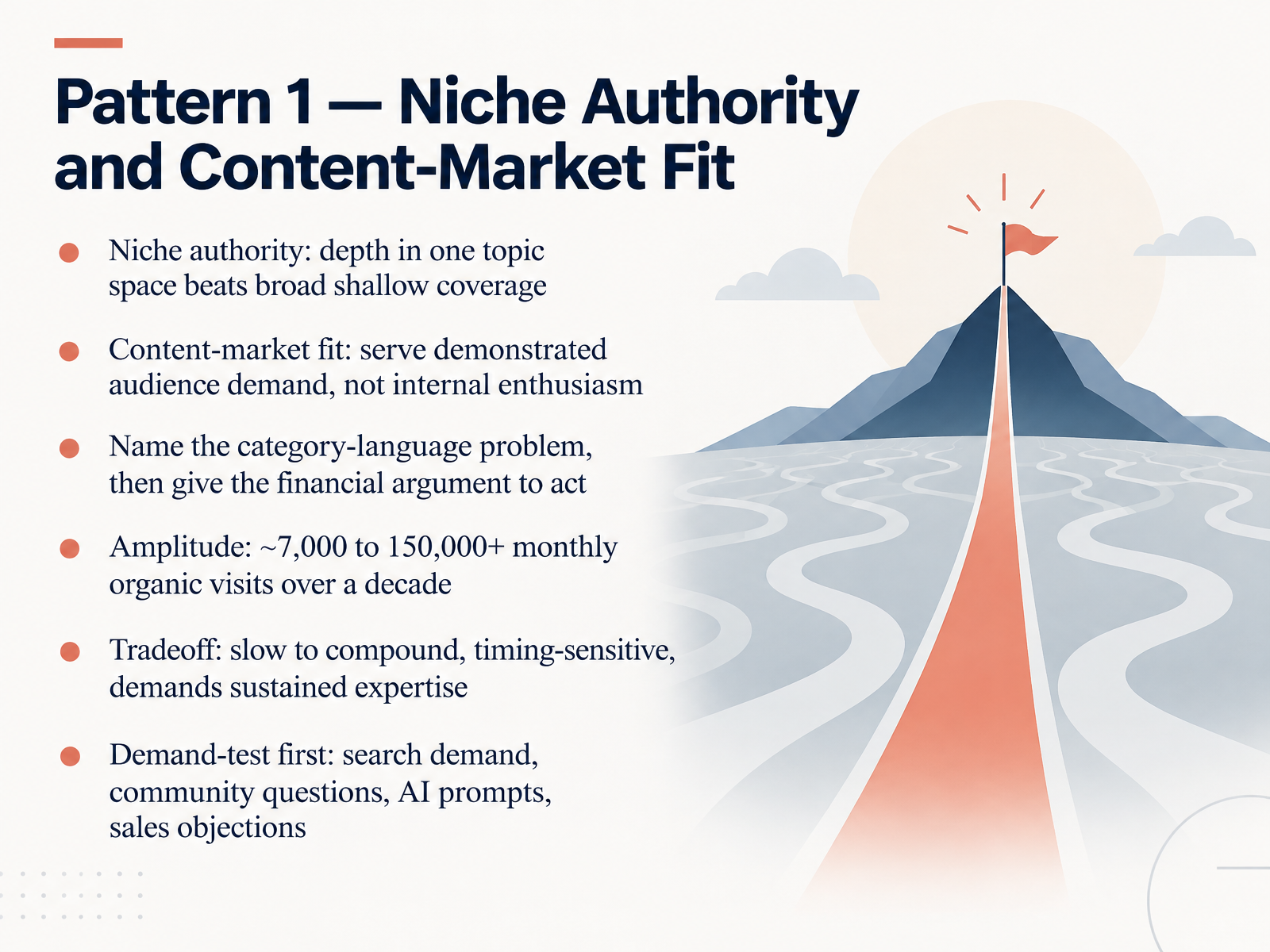
- 05Pattern 1 — Niche Authority and Content-Market FitNow let's look at our first pattern: niche authority and content-market fit. The core idea is simple. Depth in one topic space beats broad, shallow coverage. Amplitude is the proof. Over a decade, their organic traffic grew from roughly seven thousand to over one hundred fifty thousand monthly visits. But here's the catch. They didn't chase volume. They served demonstrated demand, the questions product teams were already asking. So demand-test first. Check search demand, community questions, AI prompts, and real sales objections before you commit. Then name the category-language problem, and make the financial argument to act. That's what gets stakeholders on board. Now, the tradeoff. Niche authority is slow to compound, timing-sensitive, and it demands sustained expertise. You won't see results in a quarter. So ask yourself: do you have the patience and the subject-matter depth to own one space? If yes, the compounding is worth it. That leads us to Pattern 2, repeatable formats, series, and compounding assets.
 thestacc.comvenivicimarketing.codoi.org+21 min
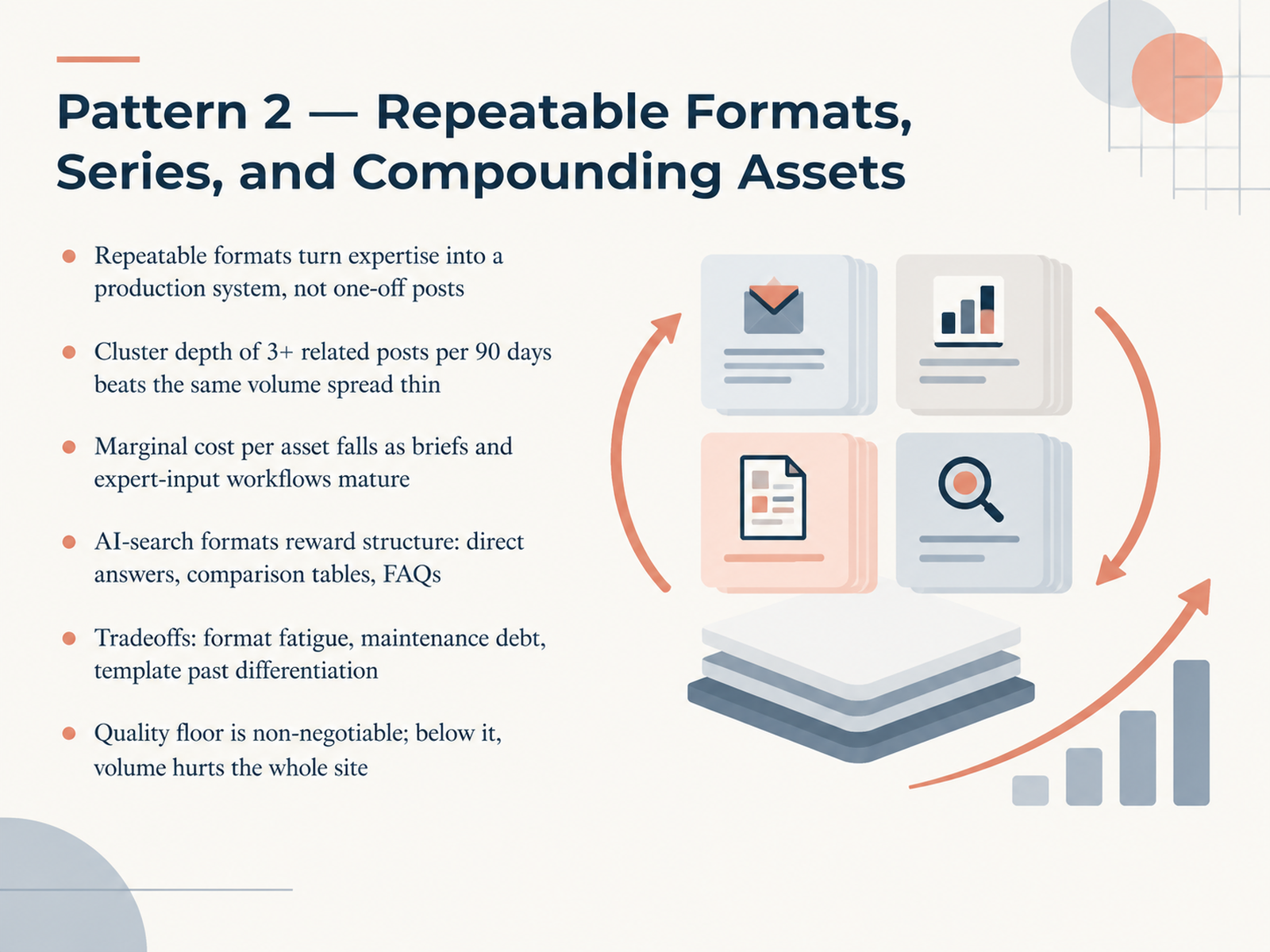
- 06Pattern 2 — Repeatable Formats, Series, and Compounding AssetsNow let's look at repeatable formats. The core idea is simple. A repeatable format turns your expertise into a production system, not a pile of one-off posts. You brief it once, you refine the template, and every new asset gets cheaper to produce. But there is a real tradeoff here. Format fatigue is a risk, and template work can flatten your differentiation if you let it run on autopilot.
The strongest pattern we see is cluster depth. Three or more related posts inside ninety days beats the same volume spread thin across unrelated topics. Depth signals topical authority, both to search engines and to the buyer reading three pieces in one sitting. Spread thin, and each post fights the others for the same ranking.
One more factor. AI search rewards structure. Direct answers up front, comparison tables, and clear FAQ sections get pulled into AI summaries, so build those into the template itself. But hold the quality floor. Below it, volume actively hurts the whole site. Protect that floor before you scale.
 redpointinsights.comtillerdigital.cominbeat.agency+22 min
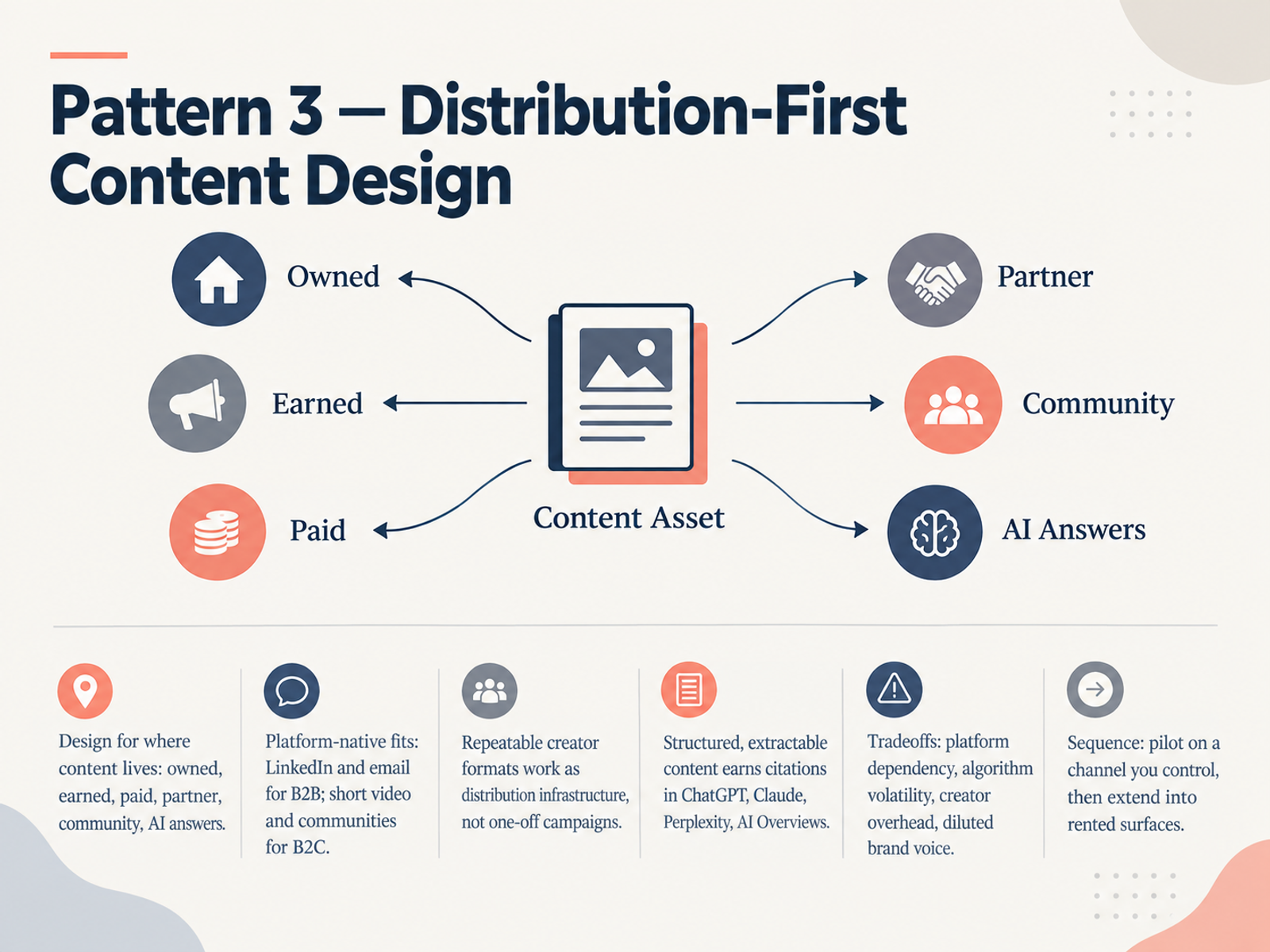
- 07Pattern 3 — Distribution-First Content DesignLet's move to Pattern 3, Distribution-First Content Design. Here's the core shift. Design for where the content actually lives, before you write a word. Which surfaces matter? Owned, earned, paid, partner, community, and increasingly, AI answers. And platform fit isn't universal. LinkedIn and email carry B2B. Short video and communities carry B2C. Now, the repeatable part. Creator formats work as distribution infrastructure, not one-off campaigns. Teams that industrialize a small set of formats test them weekly and scale only the winners. Think of structured, extractable content, clear headings, data points, citations. That's what earns mentions in ChatGPT, Claude, Perplexity, and AI Overviews. But pause here. Every distribution choice carries a tradeoff. Platform dependency, algorithm volatility, creator overhead, diluted brand voice. So sequence it deliberately. Pilot on a channel you control. Prove the format and the conversion path first. Then extend into rented surfaces. That gives you leverage when the platform shifts. Next, Pattern 4, Feedback Loops and Iteration Systems.
 redpointinsights.comtillerdigital.cominbeat.agency+22 min
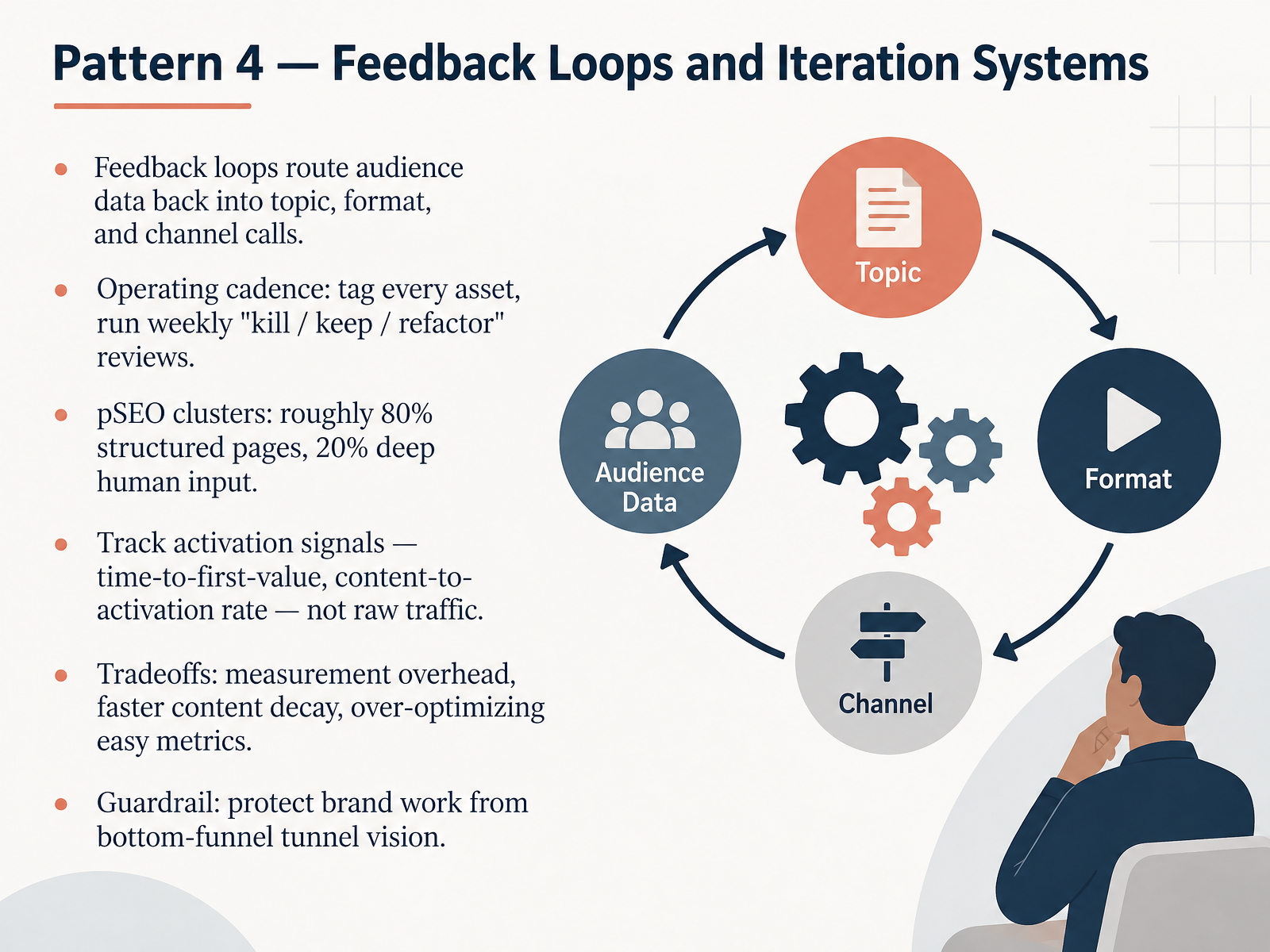
- 08Pattern 4 — Feedback Loops and Iteration SystemsLet's talk about feedback loops and iteration systems. The core idea is simple. Route audience data back into your topic, format, and channel calls. Not annually. Continuously. Establish an operating cadence. Tag every asset, then run weekly kill, keep, or refactor reviews. That one ritual does more for quality than any quarterly planning cycle. For programmatic SEO clusters, a useful benchmark is roughly eighty percent structured pages and twenty percent deep human input. That mix keeps scale without losing credibility. Now, watch which signals you track. Activation signals matter more than raw traffic. Things like time-to-first-value, and content-to-activation rate. Traffic can look healthy while activation stalls. Here's the tradeoff to sit with. Feedback loops add measurement overhead, accelerate content decay, and tempt you to over-optimize the easy metrics. So set a guardrail. Protect brand work from bottom-funnel tunnel vision. Keep asking what the data is actually telling you to build next. Coming up next, we look at how authority content builds pipeline.
 redpointinsights.comtillerdigital.cominbeat.agency+22 min
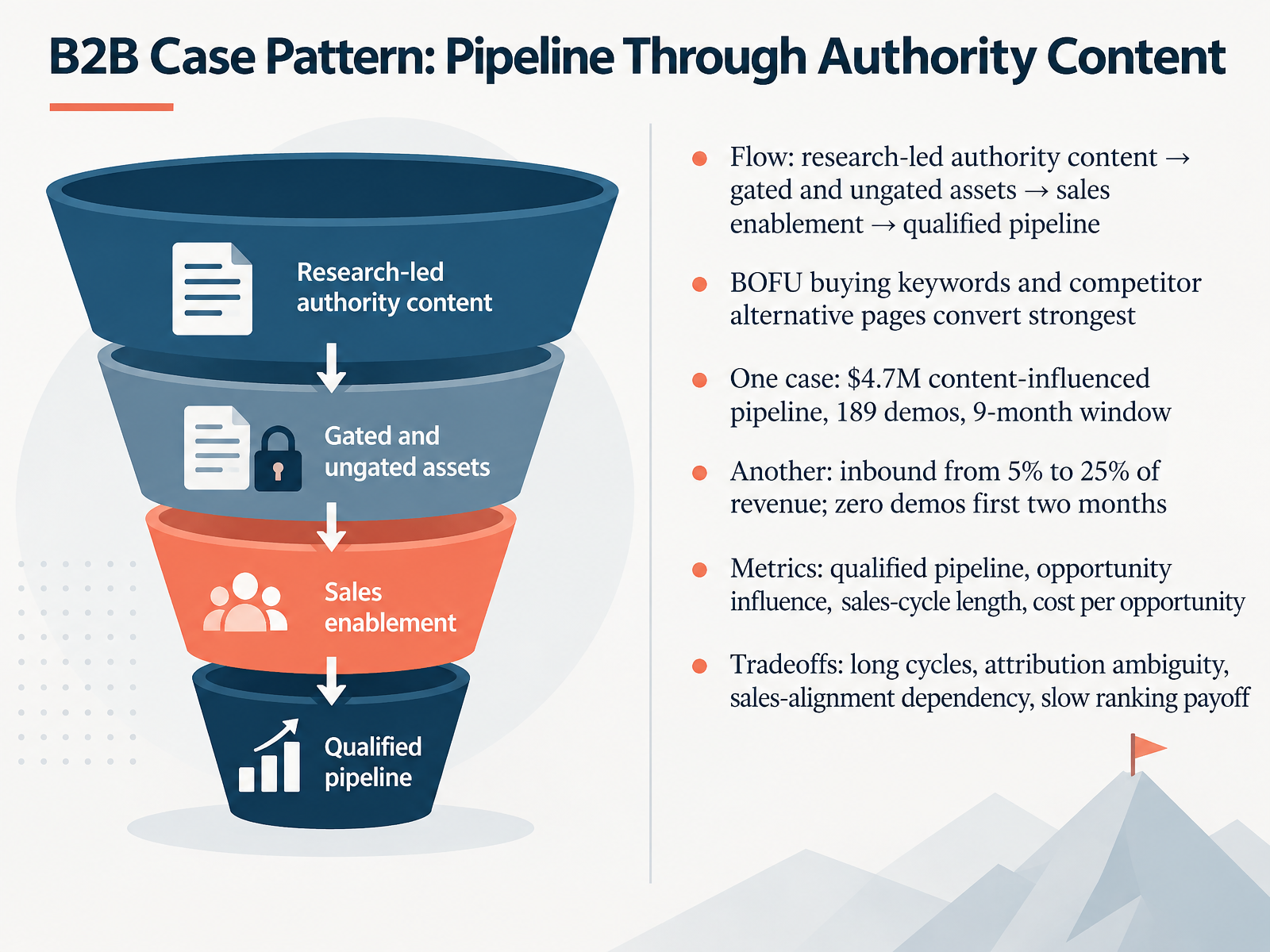
- 09B2B Case Pattern: Pipeline Through Authority ContentLet's look at the B2B pattern now, where content builds pipeline through authority. The flow is familiar: research led authority content feeds both gated and ungated assets, those assets arm sales enablement, and that enablement turns into qualified pipeline. Notice the tradeoff here. BOFU buying keywords and competitor alternative pages convert strongest, but they also depend on your sales team actually using what you publish. One case drove four point seven million dollars in content influenced pipeline, with one hundred eighty nine demos over a nine month window. Another moved inbound from five percent to twenty five percent of revenue, and booked zero demos in the first two months. That early silence is normal, so set expectations with your stakeholders before you launch. Track qualified pipeline, opportunity influence, sales cycle length, and cost per opportunity, not traffic. Then hold the tradeoffs honestly. Long cycles, attribution ambiguity, sales alignment dependency, and slow ranking payoff. Which of those can your team absorb right now? Next, we shift from B2B to the consumer and media side, in B2C and Media Case Pattern: Audience Growth and Monetization.
 contentmarketinginstitute.comtendocom.comcontentmarketinginstitute.com+22 min
- 10B2C and Media Case Pattern: Audience Growth and MonetizationLet's move to the B2C and media pattern, where audience growth and monetization meet. The core sequence is simple: audience-first content drives engagement, and engagement opens monetization through ads, subscriptions, commerce, and partnerships. Here's the first tradeoff to sit with. Owned lists, like a newsletter or direct relationship, tend to beat rented social reach on unit economics. Rented reach can spike fast, but you don't control it. So diversify revenue. Direct brand deals, ad networks, subscriptions, licensing. Platform risk is measurable, not theoretical. A paywall change or an algorithm shift can erase weeks of traffic and revenue overnight. One publisher lost roughly forty percent of search traffic after a platform paywall change. And watch lifetime value against acquisition cost, and payback time. Vanity growth without retention and trust breaks the model. Ask yourself: which revenue line survives if your biggest channel changes tomorrow? Next, we look at SaaS and product-led content. SaaS and Product-Led Case Pattern: Content as a Product Surface.
 themarketingjuice.comdspace.lboro.ac.ukdoi.org+22 min
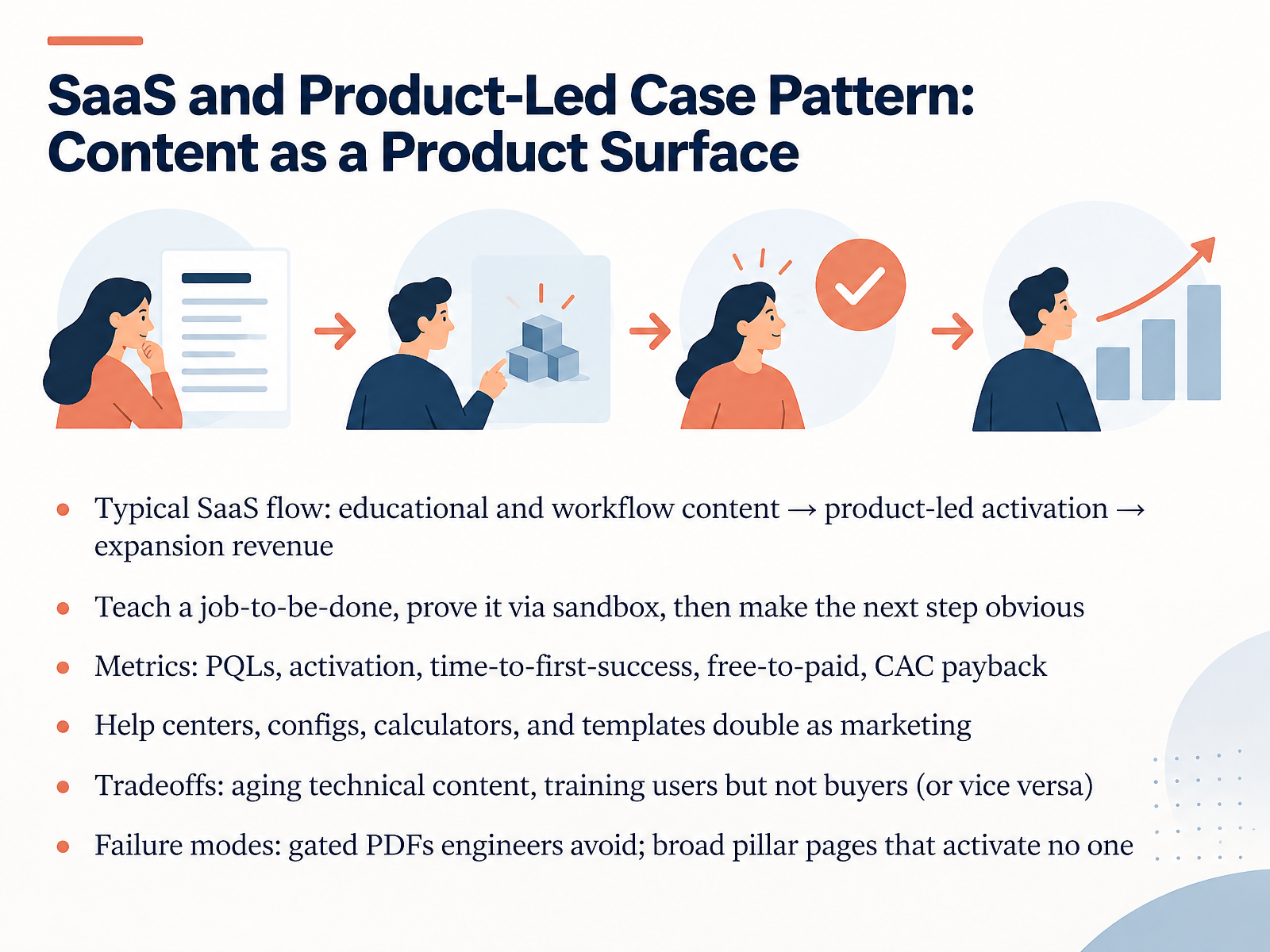
- 11SaaS and Product-Led Case Pattern: Content as a Product SurfaceNext, let's look at SaaS and product-led patterns, where content becomes a product surface. The typical flow runs from educational and workflow content into product-led activation, then into expansion revenue. Your job is to teach a job-to-be-done, prove it in a sandbox, and make the next step obvious. Measure product-qualified leads, activation, time-to-first-success, free-to-paid conversion, and CAC payback. Here's the pattern worth copying. Help centers, configs, calculators, and templates all double as marketing. They answer real questions and quietly move readers toward the product. Now here's the tradeoff, so pause and compare your options. Technical content ages fast, and you can train users without ever reaching buyers, or the reverse. Both happen. Watch for two common failure modes: gated PDFs that engineers simply avoid, and broad pillar pages that attract traffic but activate no one. Ask yourself whether each piece can demonstrate the product and lead to one clear next action. If it can't, it's probably a publication, not a product surface. That tension sets up our next topic, The Volume-Quality-Trust Tradeoff.
 redpointinsights.comtillerdigital.cominbeat.agency+22 min
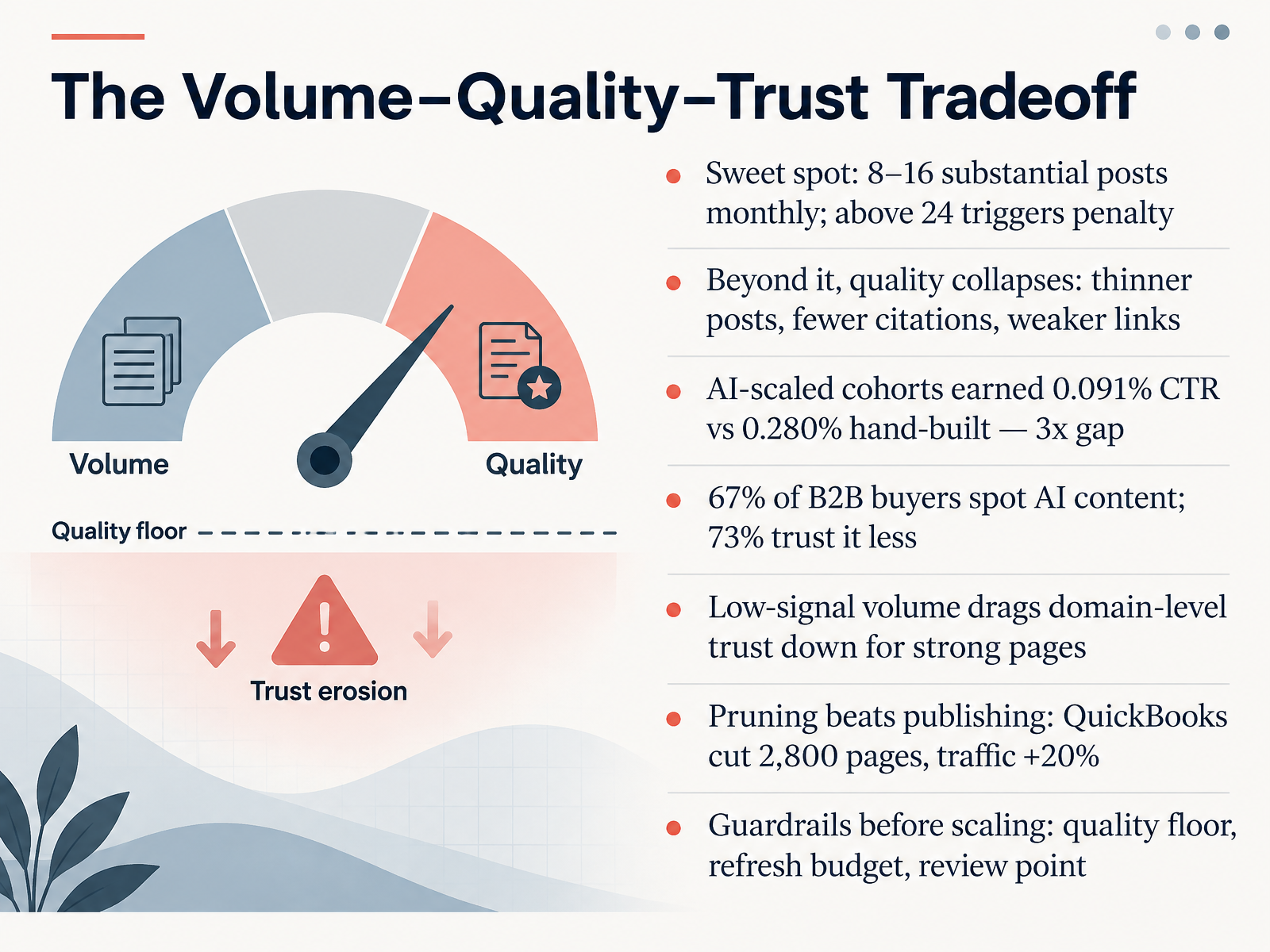
- 12The Volume–Quality–Trust TradeoffLet's talk about the tradeoff that shapes every editorial calendar: volume, quality, and trust. The data points to a sweet spot of eight to sixteen substantial posts per month. Push past twenty-four, and the penalty kicks in. Quality collapses first: thinner posts, fewer citations, weaker internal links. The numbers make it concrete. In one study, AI-scaled cohorts earned a zero point zero nine one percent click-through rate, against zero point two eight zero percent for hand-built content. That's a three times gap on the same domain. And buyers notice. Sixty-seven percent of B2B buyers say they can spot AI content, and seventy-three percent trust it less once they do. Here's the part that should worry you: low-signal volume drags domain-level trust down, including for your strong pages. So pruning often beats publishing. QuickBooks cut two thousand pages and saw traffic rise twenty percent. Before you scale anything, set guardrails: a quality floor, a refresh budget, and a clear review point. Now let's map these patterns across cases in the next section, Cross-Case Pattern Matrix: Mapping Patterns to Tradeoffs.
 animalz.cocontentmarketinginstitute.comtendocom.com+22 min
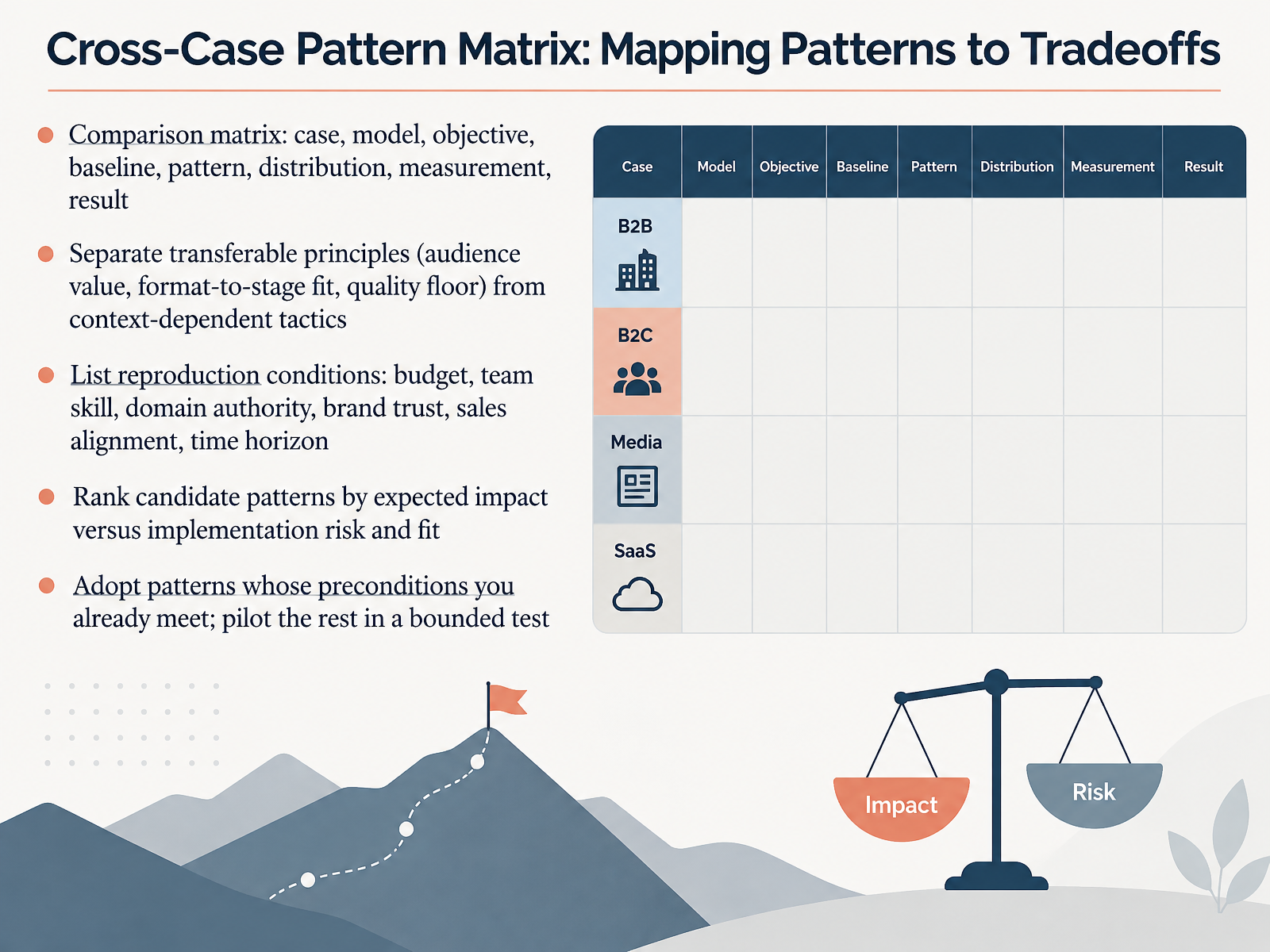
- 13Cross-Case Pattern Matrix: Mapping Patterns to TradeoffsSo let's pull the cases together into a pattern matrix. Eight columns: case, model, objective, baseline, pattern, distribution, measurement, result. Fill it honestly, because the empty cells tell you where your evidence is thin. Then split what you find into two piles. Transferable principles go in one: audience value, format-to-stage fit, and a quality floor. Context-dependent tactics go in the other. Next, list the preconditions for reproducing each pattern: budget, team skill, domain authority, brand trust, sales alignment, and time horizon. Rank candidates by expected impact against implementation risk and fit. Here's the tradeoff to weigh: a high-impact pattern you can't resource is just a distraction. So adopt the patterns whose preconditions you already meet, and pilot the rest in a bounded test. Coming up next, we'll apply these patterns to your program, and talk about teaching with cases.
 thestacc.comvenivicimarketing.codoi.org+22 min
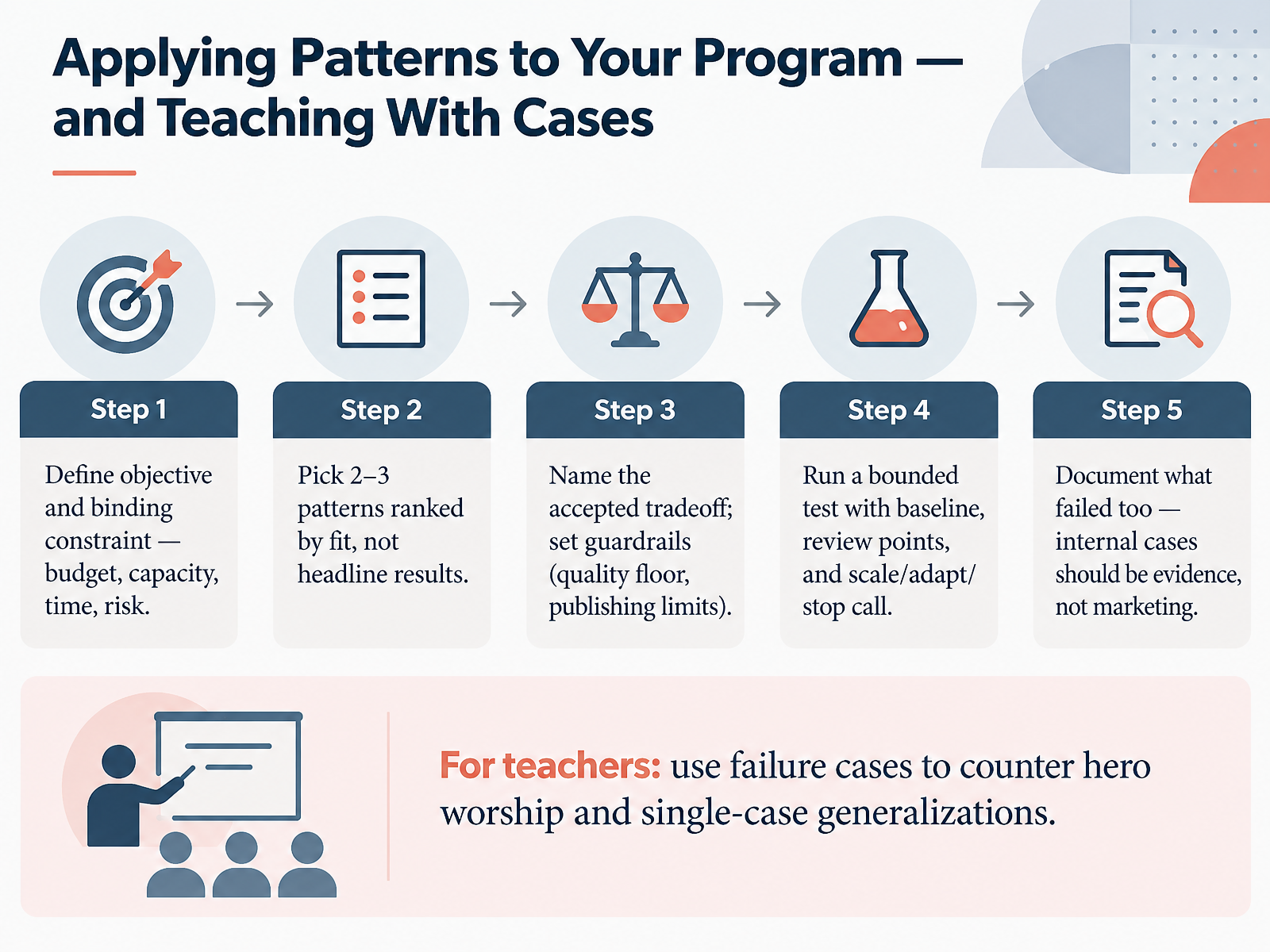
- 14Applying Patterns to Your Program — and Teaching With CasesSo how do you apply all of these patterns to your own program? Think of it as five steps, and notice where the tradeoffs live. Step one, define your objective and your binding constraint, whether that is budget, capacity, time, or risk. Step two, pick two or three patterns ranked by fit, not by headline results. Step three, name the tradeoff you are accepting, and set guardrails, like a quality floor and publishing limits. Step four, run a bounded test, with a baseline, review points, and a clear scale, adapt, or stop call. Then step five, the one most teams skip: document what failed too. Internal cases should be evidence, not marketing. And if you teach, build failure cases into your curriculum. They counter hero worship and single-case generalizations, which is exactly the survivorship problem we started with. So this week, pick one pattern, name its tradeoff, and run a bounded test. Thank you for joining this course. Go apply it carefully, and keep your cases honest.
 themarketingjuice.comdspace.lboro.ac.ukdoi.org+21 min
Take the deck with you
Download this course as a file — free, no sign-up needed.
- PDF handoutEvery slide page, ready to print or share.15 pages · 3.2 MBDownload
- Narrated PowerPointThe deck that presents itself — every slide carries the digital human's narration video.15 pages · 13.8 MBDownload
- PowerPoint slidesThe full deck as a .pptx — open it in PowerPoint, Keynote, or Google Slides.15 pages · 3.2 MBDownload
Free to use in your own training — please keep the PersonWise credit page at the end.
Have your own deck? Turn it into a course
Sources consulted
Web sources consulted while building this course.
- The New Rules of Measuring and Proving Content ROI — contentmarketinginstitute.com
- The Great Content Attribution Debate | Tendo Communications — tendocom.com
- B2B Content and Marketing Trends: Insights for 2026 — contentmarketinginstitute.com
- Content Marketing Attribution: A Framework for B2B Teams | Ten Speed — tenspeed.io
- Content Marketing ROI 2026: Measurement Framework — digitalapplied.com
- Marketing Agency Case Studies: Proof vs. Polish — themarketingjuice.com
- Human capital metrics and analytics: assessing the evidence of the value and impact of people data — dspace.lboro.ac.uk
- Interesting and impactful research: on phenomena, theory, and writing — doi.org
- Surviorship bias and case studies that make everything look ... — alexdenning.com
- How to read an AI case study without getting lied to — drdaveheath.com
- Content Marketing Case Study: Results From 312 Companies — thestacc.com
- Content Marketing Case Study: The Complete Guide — venivicimarketing.co
- What makes branded content campaigns effective: a ten-year analysis — doi.org
- 16 Killer Content Marketing Case Studies (Updated 2026) — yesoptimist.com
- How Amplitude Built a Content Engine That Scaled From Seed to IPO - Animalz — animalz.co
- Content That Converts: — redpointinsights.com
- How to succeed with B2B case studies in the age of AI — tillerdigital.com
- B2B vs. B2C Content Marketing: Key Differences, Strategies, and Goals - inBeat Agency — inbeat.agency
- What Is a Content Marketing Case Study (and Why It Still Works in 2025) ? - — decaseo.com
- B2B Case Studies: How to Write Ones That Win Deals — brixongroup.com