Content Repurposing Across Formats
Begin
13 pages · ~26 min
Content Repurposing Across Formats
Learn to transform a single core idea into engaging content across multiple formats to maximize reach and impact.
What you’ll learn
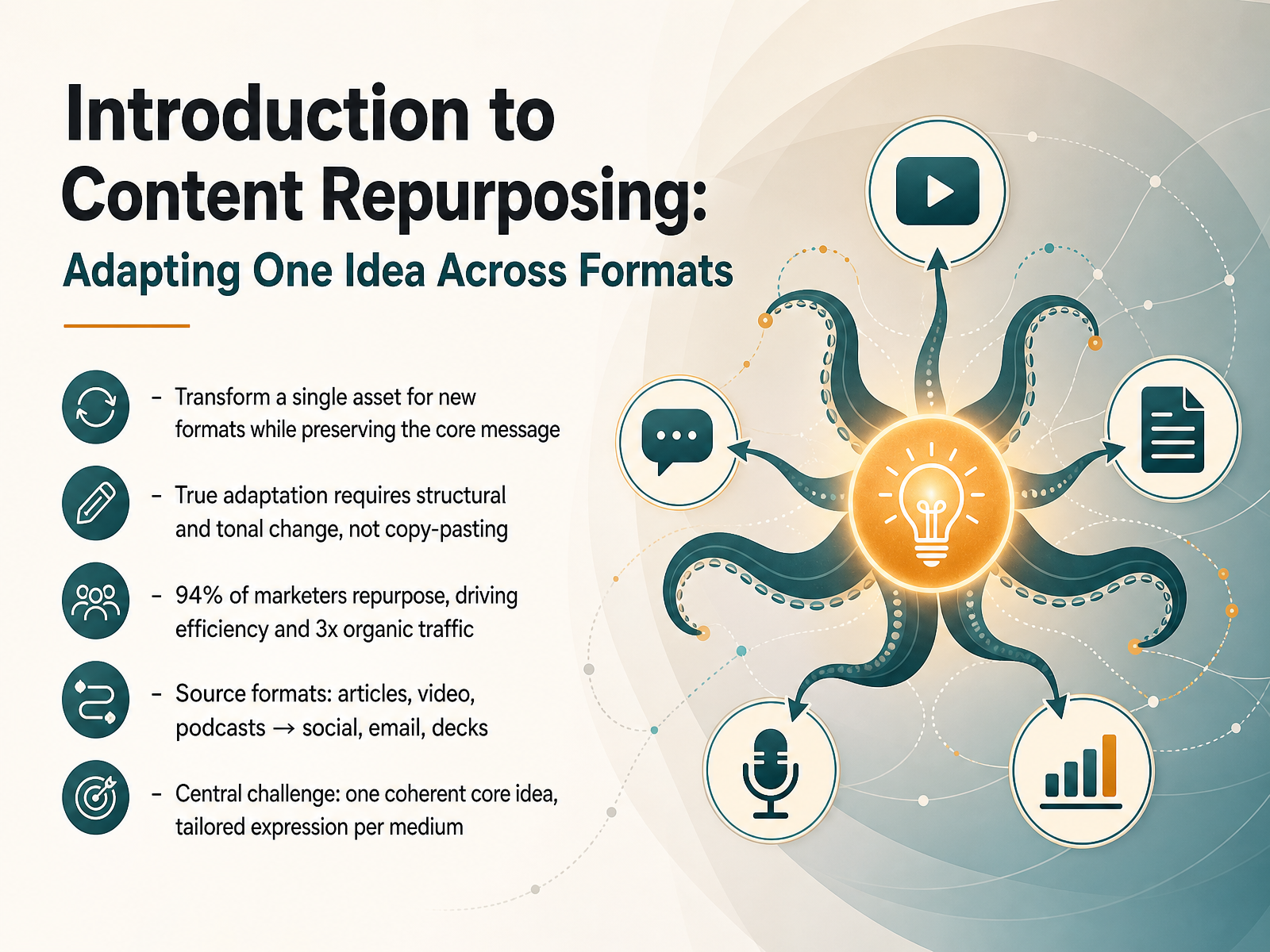
- 01Introduction to Content Repurposing: Adapting One Idea Across FormatsWelcome. I'm glad you're here. Today we're tackling a skill that separates busy content teams from strategic ones: content repurposing. Specifically, how to adapt one strong idea across multiple formats without losing what made it powerful in the first place. Think about the last time you created a solid article, a great podcast, or a webinar that took weeks to produce. Once it was published, did it keep working for you, or did it just sit there? Here's the reality we're working with. Ninety-four percent of marketers now repurpose content regularly. It's not a trend. It's how modern teams survive. But true adaptation isn't copy-pasting a blog post into a LinkedIn update. It requires a structural and tonal change for each medium while preserving one clear, coherent core message. By the end of this session, you'll know exactly how to take a single source asset, extract its central idea, and tailor its expression for social feeds, email, slide decks, and more. Let's get started. Next, we'll anchor everything on the core idea before we adapt.repurposeyourcontent.comtryrepurpose.comkompozy.io+22 min
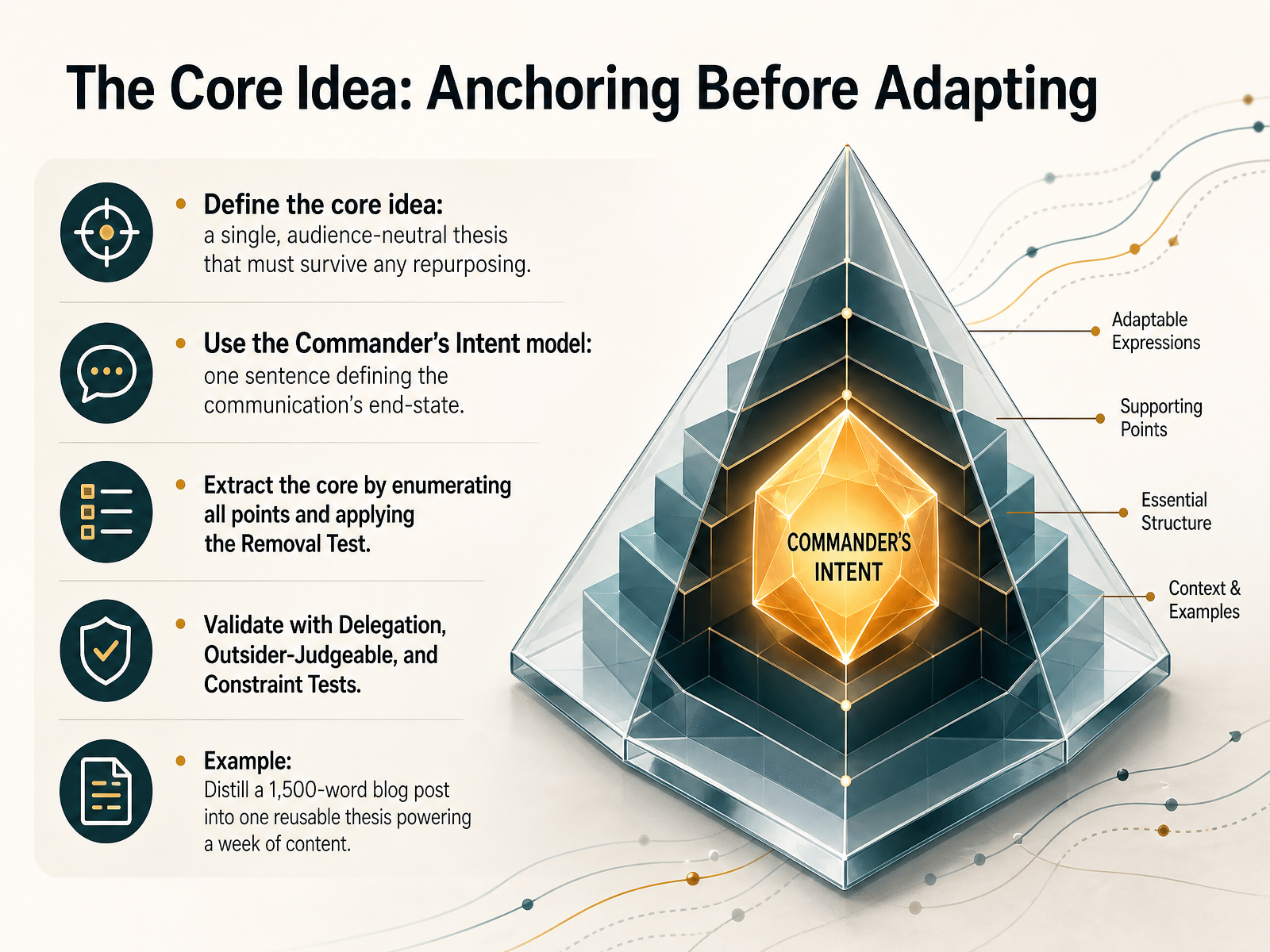
- 02The Core Idea: Anchoring Before AdaptingBefore you can adapt anything, you have to know exactly what you are adapting. That is why we start with the core idea. Think of it as your message's anchor. It is a single, audience-neutral thesis. This is the one sentence that must survive no matter where the content ends up. To find it, we use a framework called Commander's Intent. It comes from the military, where detailed plans often fail on contact. The Commander's Intent is a plain statement of the end state. It tells the team what success looks like, even if the original plan falls apart. To extract your core, list every point you are making. Then apply the Removal Test. Ask yourself: if I delete this point, does the message still work? If the answer is yes, cut it. Keep cutting until only the essential point remains. Then, validate it. Can you delegate a task based on this sentence? Would an outsider know if it was achieved? Or is it just packed with empty adjectives? For example, imagine you have a fifteen-hundred-word blog post. Your goal is to distill it down to one reusable thesis. That one sentence can then power a week of social posts, an email, and a short video. Getting the core right is the hardest part, but it makes every adaptation step that follows much easier. Next, we will move from the core idea to analyzing your audience and channel, so you know exactly how to reshape that sentence for different formats.
 bookforgeai.devgithub.comjonathannott.substack.com+22 min
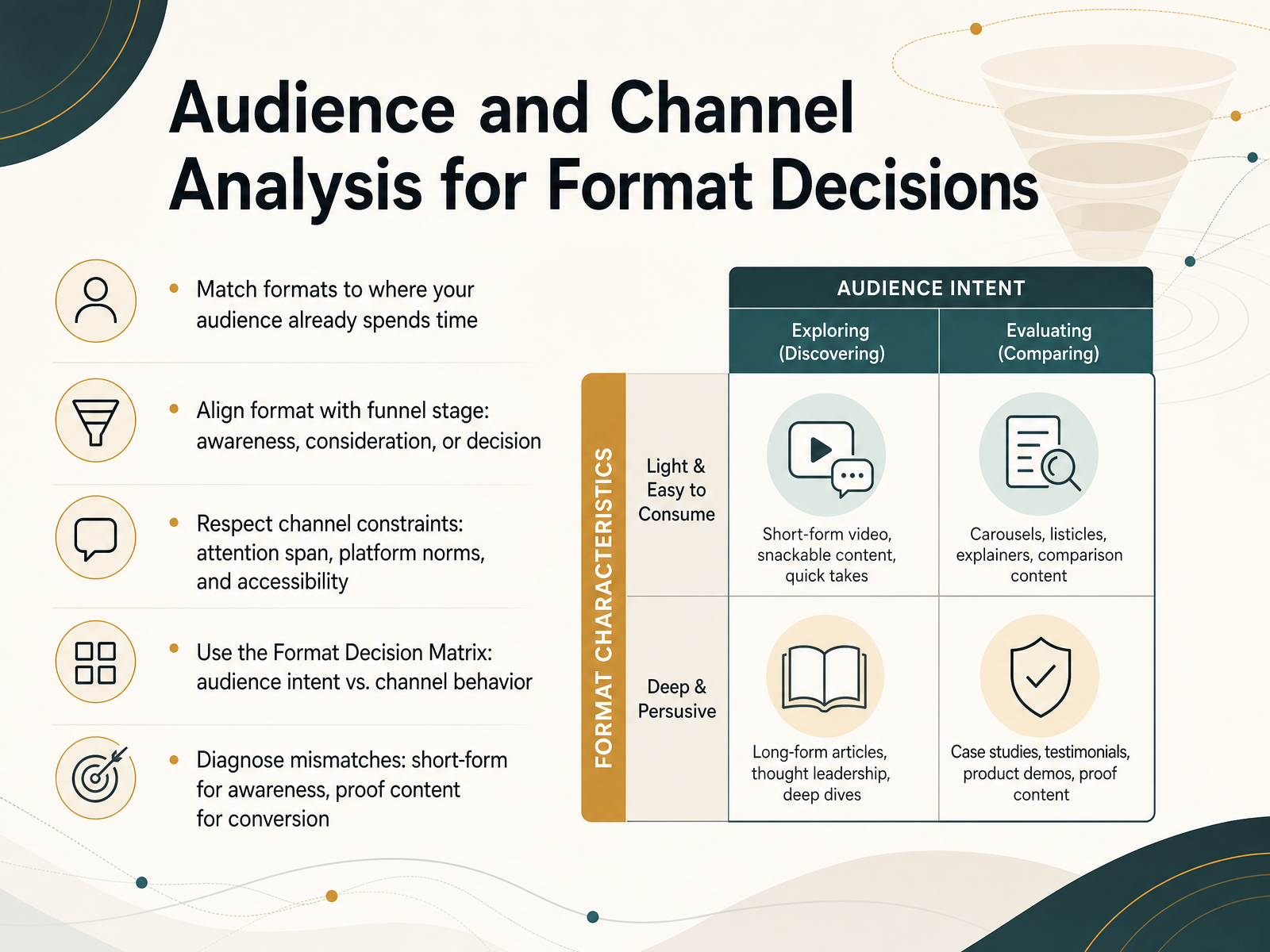
 - 03Audience and Channel Analysis for Format DecisionsNow let's talk about where your content actually meets your audience. Choosing the right format isn't a creative guess. It starts with two questions. Where does your audience already spend time? And what do they need at this exact moment? For awareness, give them short, low-commitment formats like quick tip videos or punchy carousel posts. For consideration, match their research intent with how-to guides, comparison articles, or deeper explainers. When they're ready to decide, that's the moment for proof. Case studies, testimonials, demos. Respect the channel too. Short attention spans on TikTok demand a strong hook in the first two seconds. LinkedIn readers may want a structured document post. Always diagnose mismatches first. A flashy awareness video won't close a skeptical buyer, just like a dense white paper won't stop the scroll for someone who just discovered you. Match the format to the funnel stage and to the platform behavior. Next, we'll go deeper into message translation, specifically voice, tone, and how to adjust the structural depth without losing your core point.
 salesandproductionnetwork.business.bloginfluenceflow.iofanspicy.com+22 min
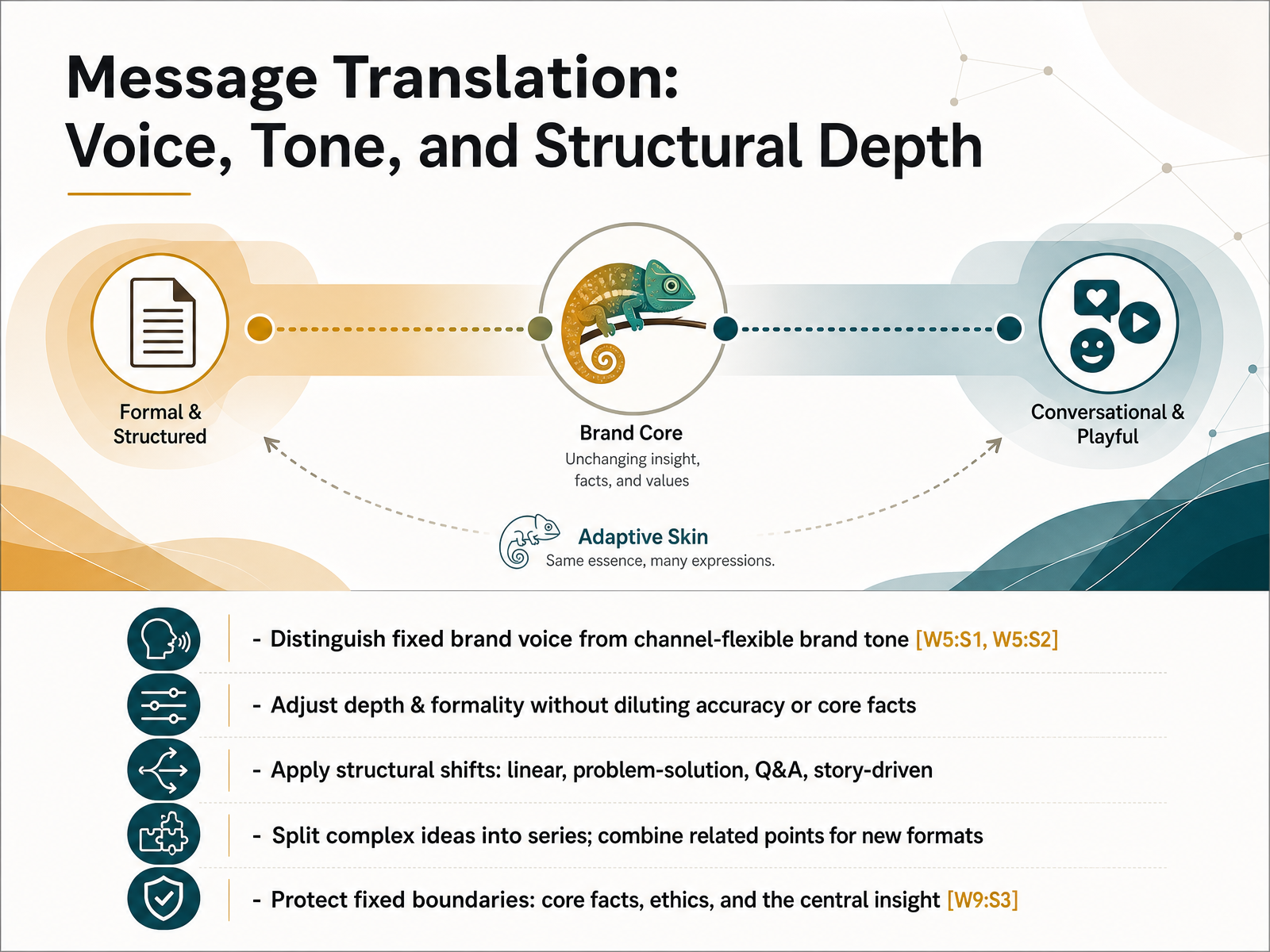
 - 04Message Translation: Voice, Tone, and Structural DepthNow let's talk about translating your message across formats. This is where we separate what stays fixed from what can shift. Think of it this way. Your brand voice is your identity. It never changes. Your brand tone is how that identity flexes to fit a specific room. LinkedIn is a professional conversation. TikTok is a casual, energetic one. Same person. Different outfit. The core facts, the ethics, and your central insight must stay locked down. But the structural depth can absolutely adapt. A dense, linear argument for a white paper might become a tight problem-solution post for social media. Or you might split a complex idea into a three-part video series. Or combine several related points into one tight email. When you adapt structure, you aren't diluting the message. You are giving it the best chance to land natively in a new environment. Just remember the fixed boundaries. The truth and the strategic point of view travel with you. The delivery mechanism changes. That's how you protect message integrity while maximizing reach. Up next, we'll put this into practice with the multi-format workflow. One source. Many assets.
 atomwriter.compostprism.appatomwriter.com+22 min
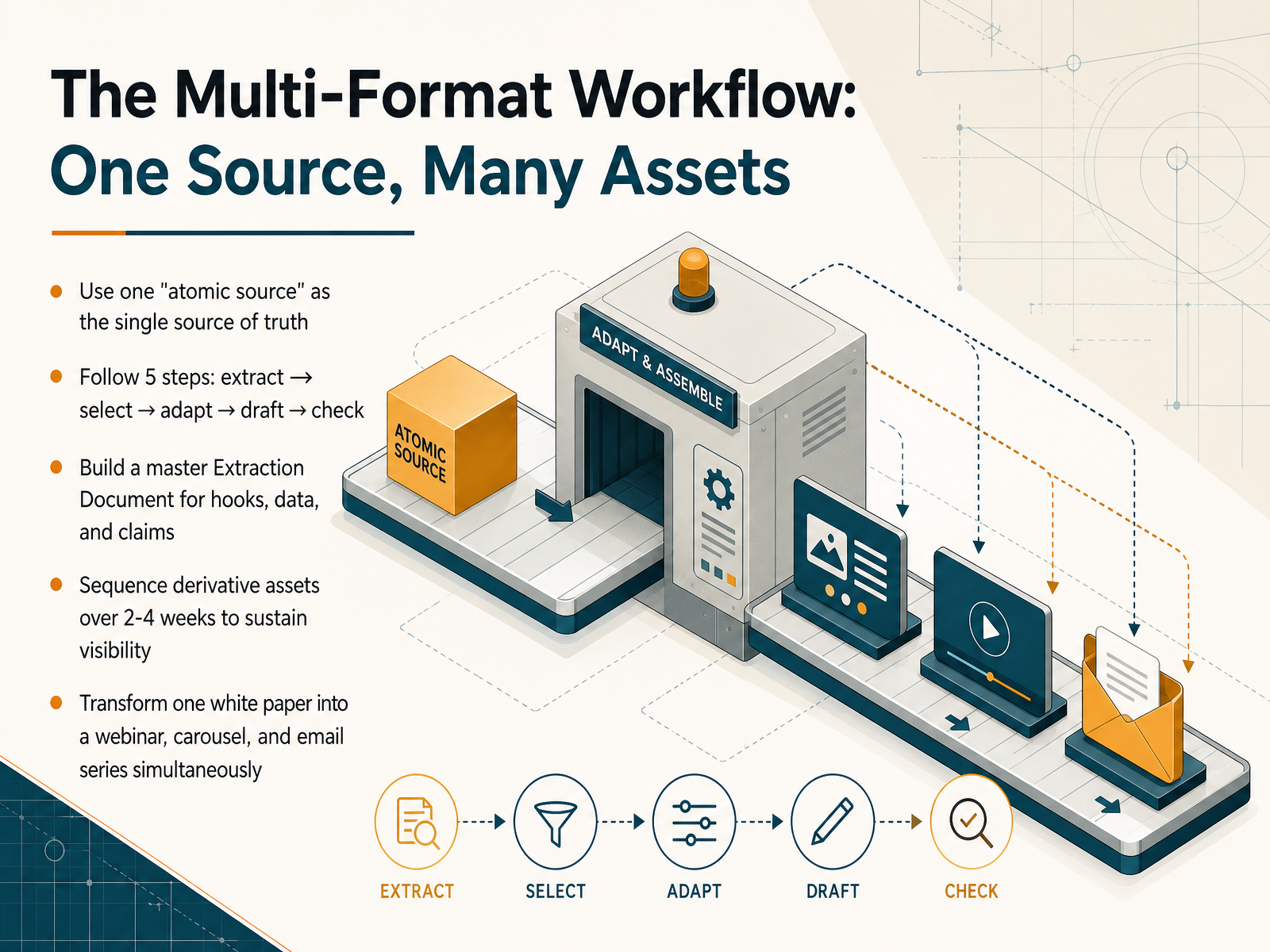
 - 05The Multi-Format Workflow: One Source, Many AssetsLet's walk through the multi-format workflow. The engine behind this is what we call the "atomic source"—one single piece of truth, like a white paper or a keynote, that everything else is built from. Our process runs in five distinct steps: extract, select, adapt, draft, and check. First, you pull out every strong hook, data point, and claim into a master Extraction Document. Think of this document as your parts inventory. Then you select the best pieces for each platform. Once these assets are ready, you spread them out over two to four weeks, not twenty-four hours. This sustained visibility keeps your message alive without fatiguing your audience. For example, from one dense white paper, you can run a live webinar tomorrow, launch a visual carousel next week, and drip an email series the week after. It’s all from the same root, just reframed for the room it’s walking into. Coming up next, we’ll zoom into the exact rewrite in "Format Spotlight: From Long-Form to High-Impact Short-Form".
 atomwriter.compostprism.appatomwriter.com+22 min
 - 06Format Spotlight: From Long-Form to High-Impact Short-FormLet's spotlight the move from long-form to high-impact short-form content. This is extraction, not just trimming. Find the quotable moments, sharp stats, and opinions that can survive on their own. A thirty-second clip must deliver a complete, useful insight, never a fragment. Structure each piece with a strong hook in the first one to three seconds, a clear proof point, and a call to action that feels native to the platform. Many marketers then stack one core idea across five to seven themed posts to build real narrative momentum. But protect your integrity. Avoid distortion, lost context, and hyperbolic hooks that erode trust. Next, we will shift from video to text and apply these same principles in our Format Spotlight on adapting text to visual and audio.
 bookforgeai.devgithub.comjonathannott.substack.com+21 min
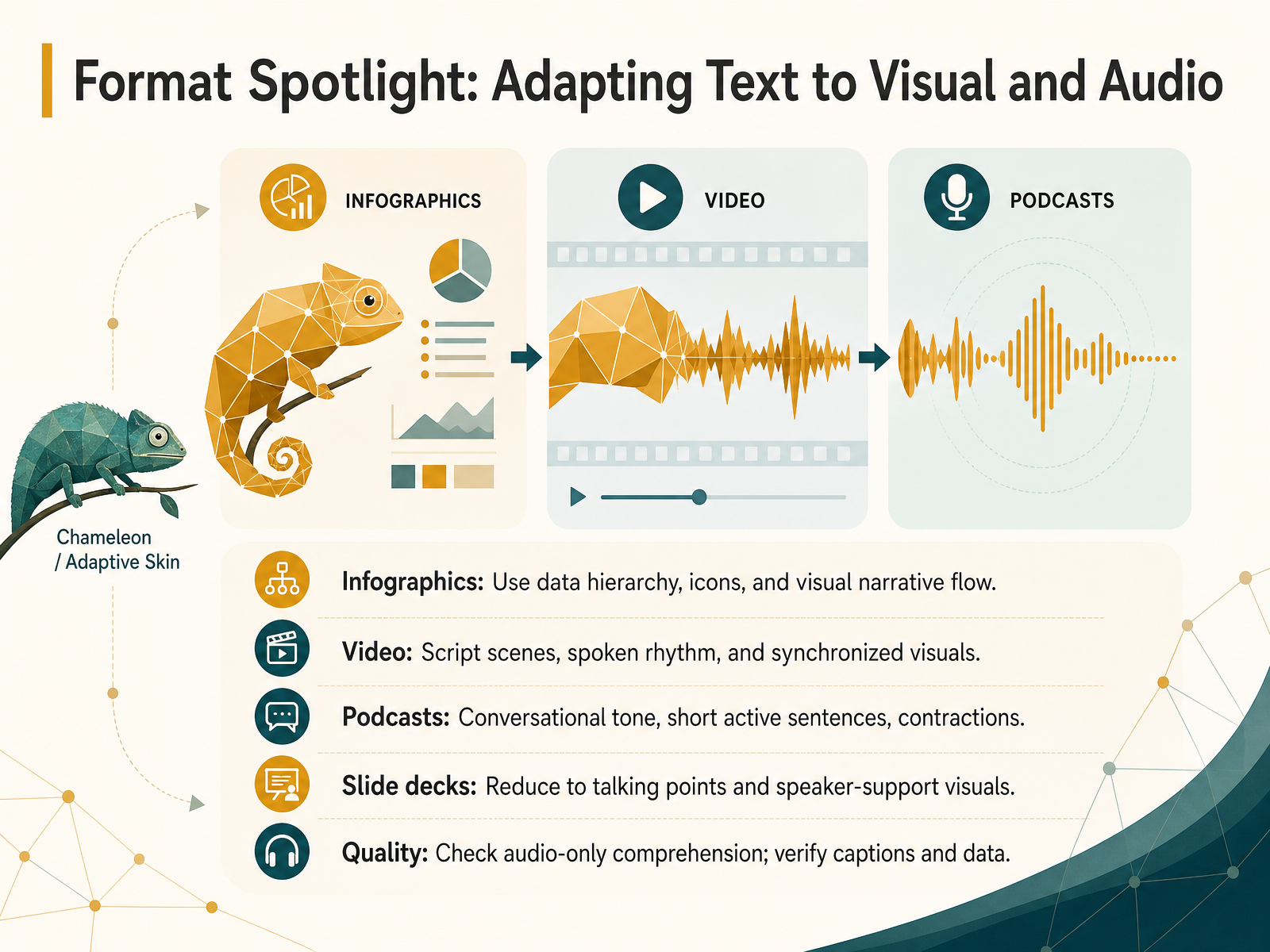
 - 07Format Spotlight: Adapting Text to Visual and AudioNow let's look at how to adapt one strong idea into different formats, specifically from text into visual and audio experiences. Start with infographics. Don't just slap data on a canvas. Build a visual narrative with a clear data hierarchy so the most important number hits first. Use icons to guide the eye and reinforce your points. For video, think in scenes. Write a script with a spoken rhythm, not a written essay. Every line of narration needs a synchronized visual cue, a diagram, a screen shot, or a key phrase on screen. Podcasts are a completely different animal. The tone must be conversational. Cut the long, complex sentences. Use short, active phrases and contractions like "you'll" and "it's" so it sounds like a human talking to another human. For slide decks, resist the urge to paste the full text. Reduce your content to talking points and speaker-support visuals. Let the deck amplify your voice, not replace it. Finally, a crucial quality step. Check for audio-only comprehension. Can someone understand the message by just listening? Also, verify your captions and data are perfectly accurate. These checks ensure your content is accessible and professional. Next, we'll explore the tools that make this adaptation faster, specifically AI-assisted repurposing in twenty-twenty-six.
 atomwriter.compostprism.appatomwriter.com+22 min
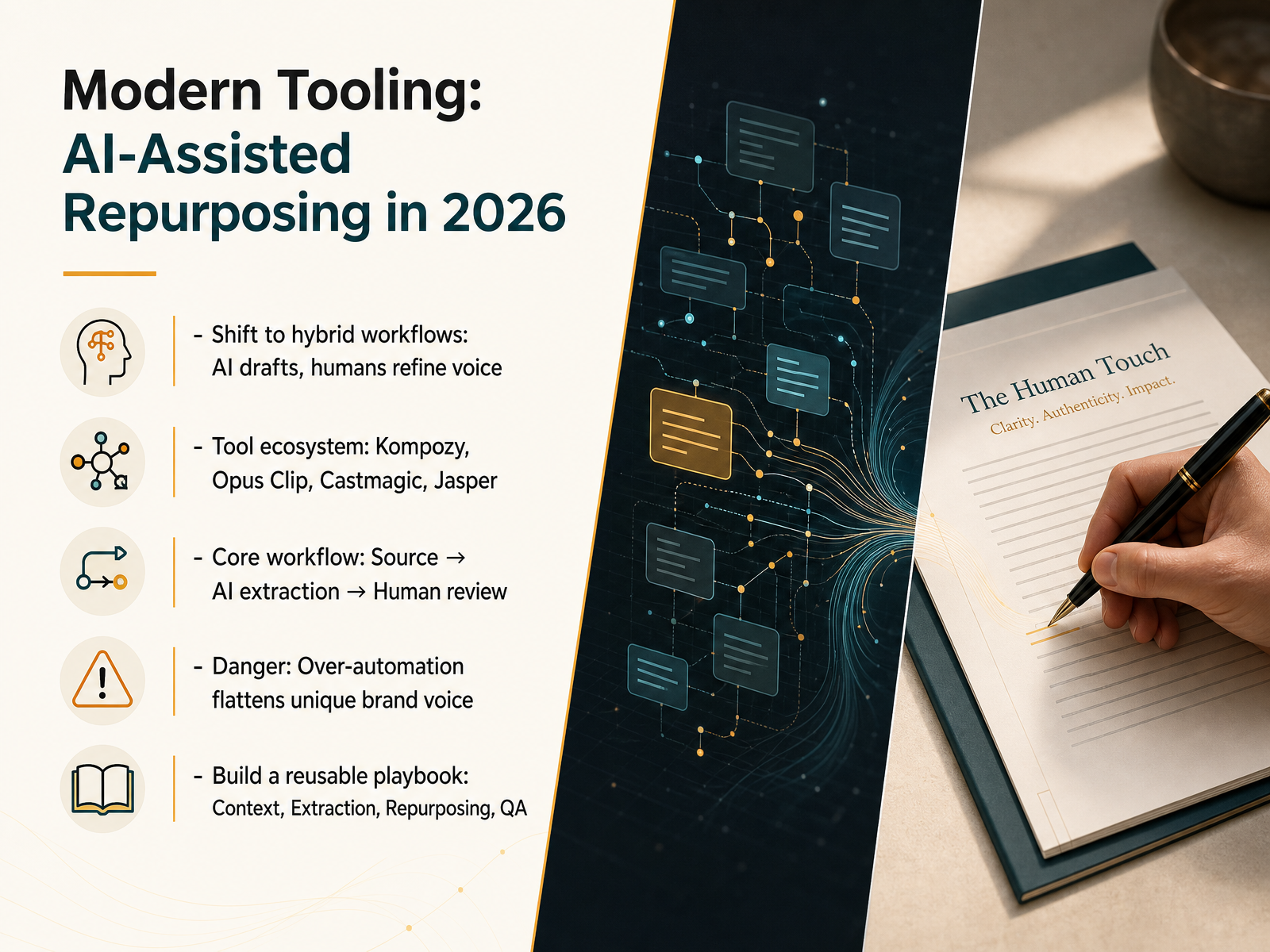
 - 08Modern Tooling: AI-Assisted Repurposing in 2026Now let's talk about the toolbox that makes this workflow possible in twenty twenty-six. The shift we're seeing is toward hybrid workflows. Think of it like this: the AI drafts the first version fast, and then a human refines the voice and sharpens the argument. You don't hand over the keys. You give the machine the heavy lifting and keep the judgment for yourself. The tool ecosystem is maturing fast. Platforms like Kompozy can take one source and generate a month of posts. Opus Clip specializes in pulling the best clips from long videos. Castmagic turns podcasts into text posts. And Jasper helps keep your brand voice consistent across all of it. The core workflow they all follow is the same: Source content goes in, the AI extracts the key ideas, and a human reviews everything before it ships. But here is the danger: over-automation. If you let the machine write and publish without a human check, your unique brand voice flattens out. You start to sound like everyone else using the same tool. That's why you need a reusable playbook. A good one has four stages: Context, Extraction, Repurposing, and Quality Assurance. Let's now take a closer look at that final, critical stage: Quality Control and Ethical Boundaries.
 atomwriter.compostprism.appatomwriter.com+22 min
 - 09Quality Control and Ethical BoundariesNow let’s talk about protecting your work and your reputation. Quality control is not a final checkpoint. It is a built-in discipline. We anchor it on a three-point review. First, core fidelity. Does the new version preserve the central argument, or did we distort it? Second, audience fit. Is the tone and framing right for the platform? Third, compliance. Are we legally and ethically clear to use every element? That third point is critical. Never use misleading headlines or thumbnails to chase clicks. They might win a view, but they break trust. Before you reuse anything, verify copyright, licenses, and likeness rights. Attribution alone is not enough. Saying where you got it does not replace getting permission. To make this stick, keep a repurposing checklist. It should cover rights, attribution, disclosure, and logging. Think of it as your ethical stopgap. Next, we will move from guarding quality to proving impact. Let’s look at measuring success, KPIs, and feedback loops for repurposed content.
 2 min
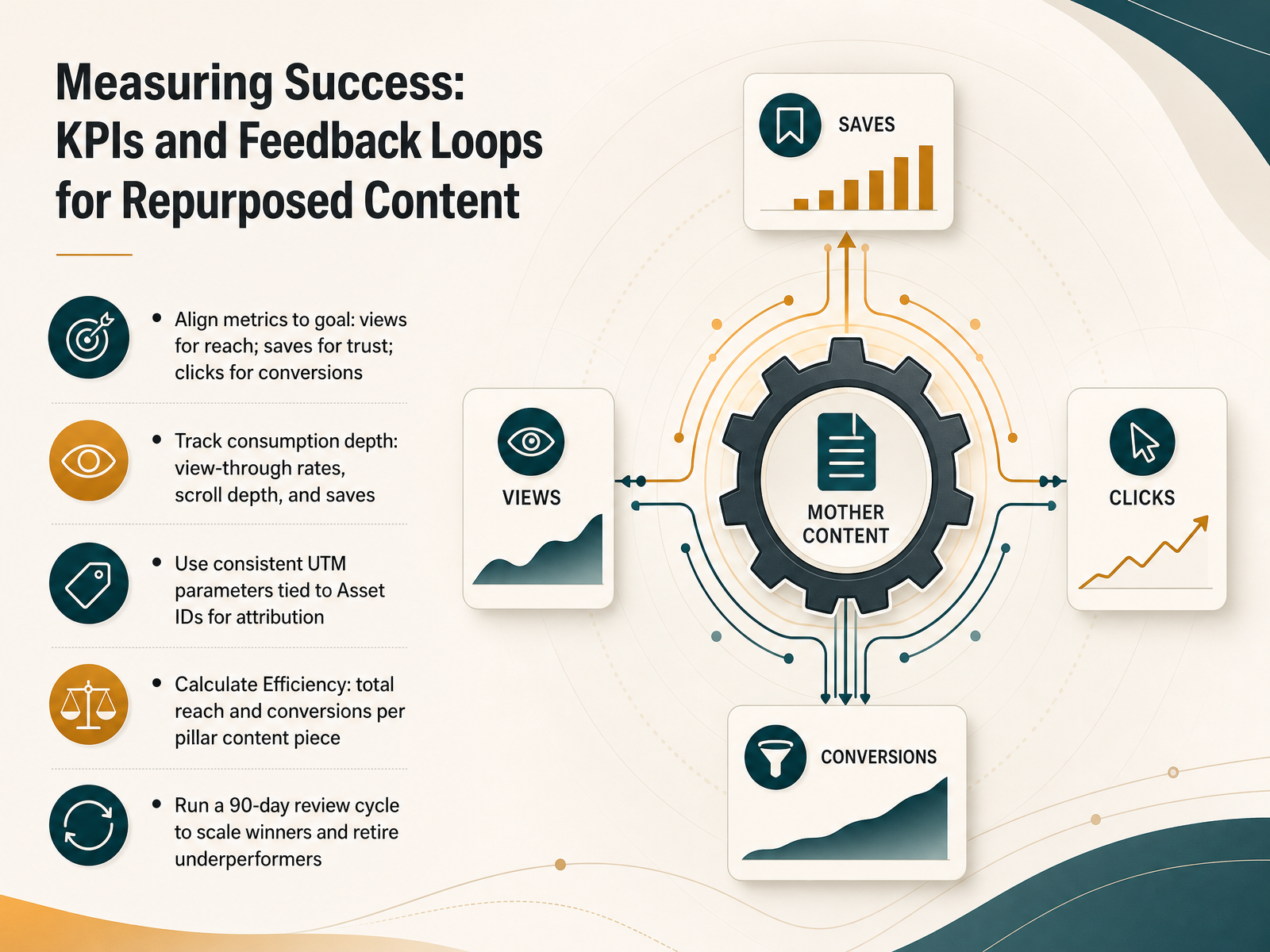
2 min - 10Measuring Success: KPIs and Feedback Loops for Repurposed ContentNow let's talk about measuring success, because repurposing without tracking is just guessing. First, align every metric to a goal. If you want reach, track views. If you want trust, track saves and shares. If you want conversions, track clicks and form fills. Next, look at consumption depth. Don't just count impressions. Measure view-through rates, scroll depth, and time on page to see if people actually engaged. For clean attribution, use consistent UTM parameters tied to unique Asset IDs. That way you know exactly which repurposed piece drove the traffic. Then, calculate your efficiency. Add up the total reach and conversions from all derivatives and compare it to one pillar content piece. Finally, run a 90-day review cycle. Scale the formats that are working and retire the ones that aren't. Let's take this framework and apply it in our next topic, your 30-Day Repurposing Pilot.
 repurposeyourcontent.comtryrepurpose.comkompozy.io+22 min
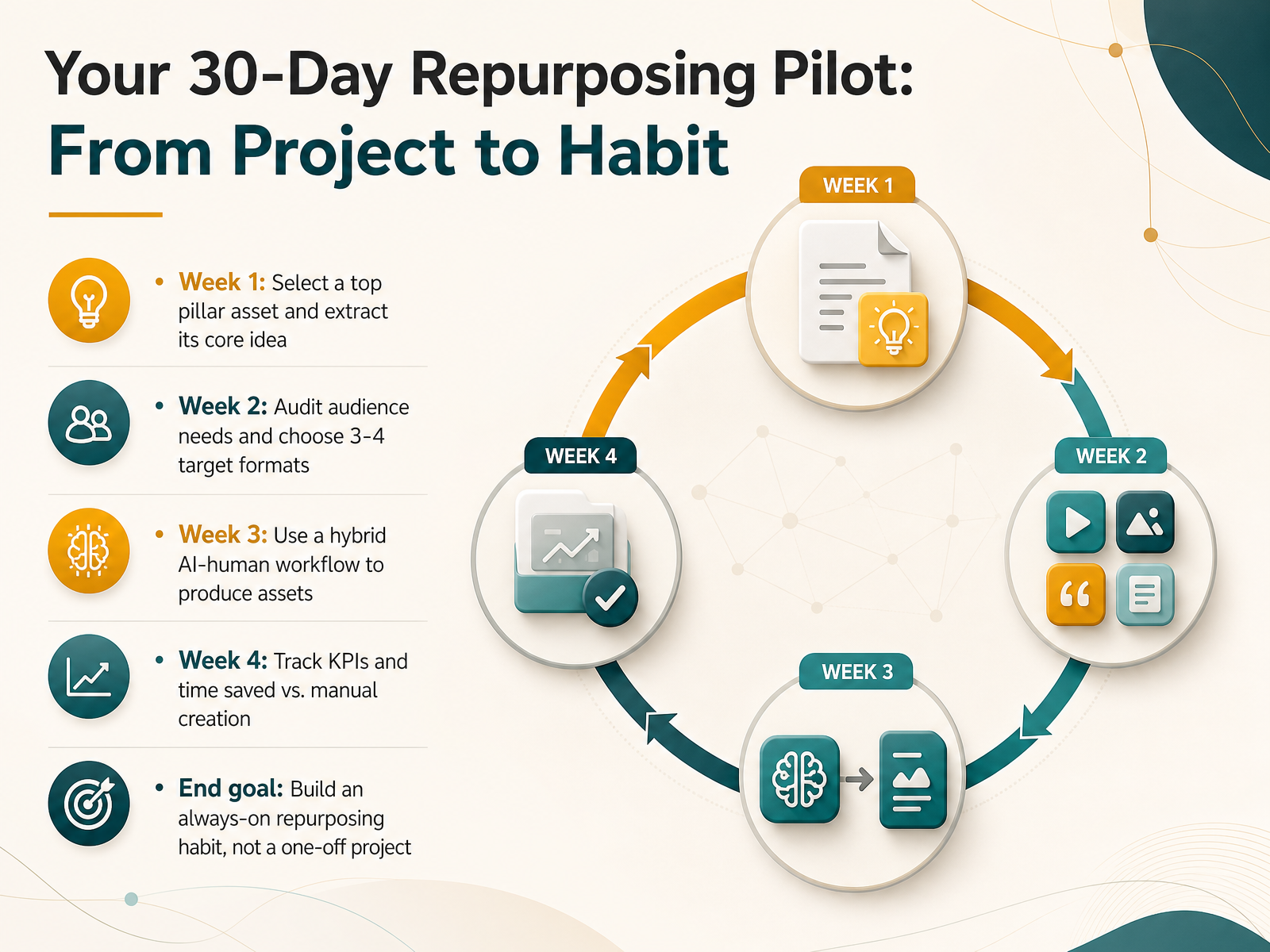
 - 11Your 30-Day Repurposing Pilot: From Project to HabitLet's map out your 30-day repurposing pilot. Week one is about selection. Choose one top pillar asset, something that has already proven itself with your audience, and extract its single core idea. No new content creation yet. Week two is for auditing. Listen to what your audience needs right now. Then pick three or four target formats where that core idea will make the strongest impact, like a carousel, an email sequence, or short-form video. Week three is where the magic happens. Use a hybrid AI-human workflow. Let the AI handle the first production pass, then apply your human judgment to sharpen the voice and preserve message integrity. Week four is all about measurement. Track the KPIs that matter to you and log the time saved compared to manual creation. The end goal here is not a one-off project. We are building an always-on repurposing habit. Next up, let's look at the results in our case study, the webinar-to-ecosystem transformation.
 2 min
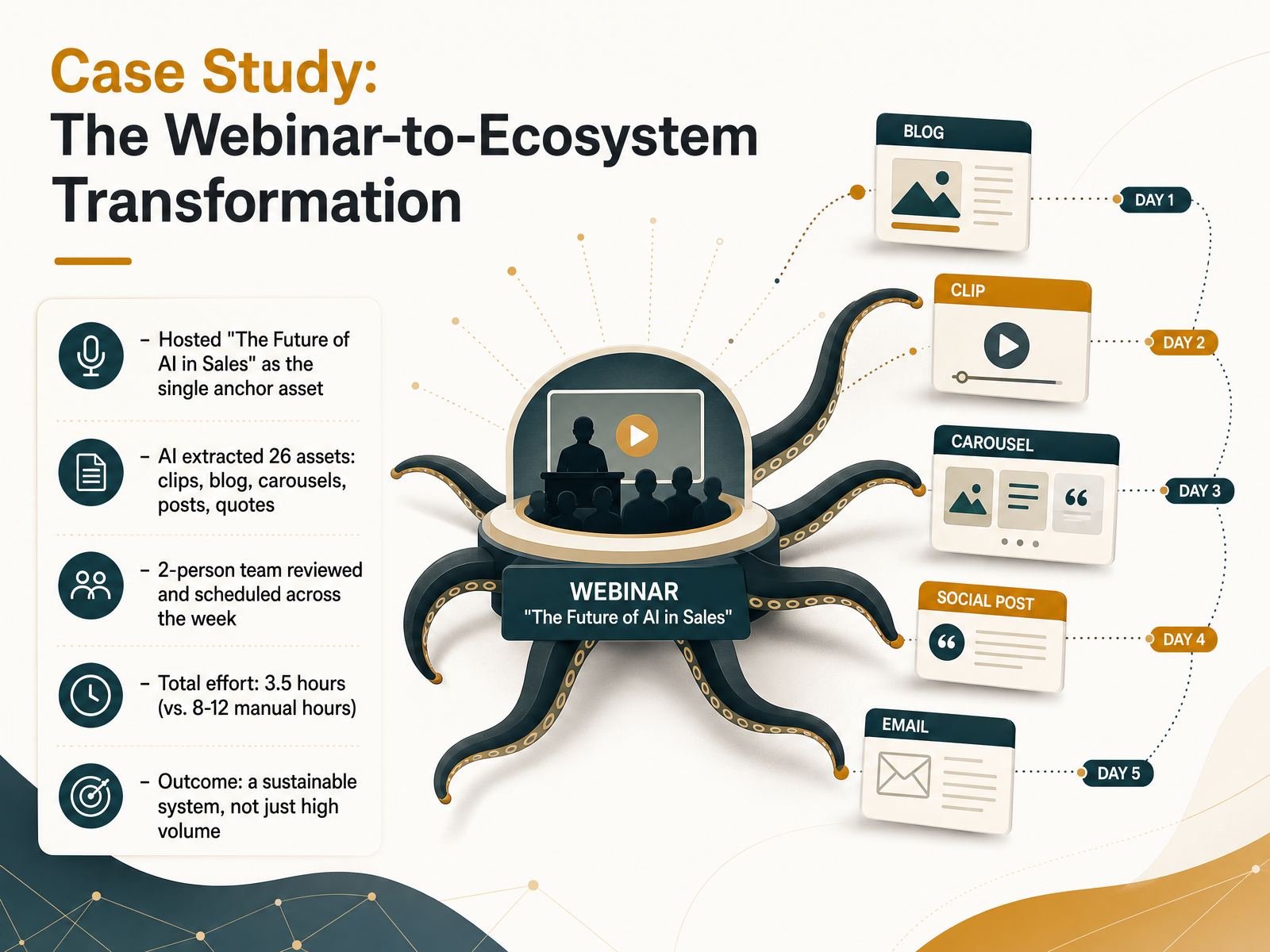
2 min - 12Case Study: The Webinar-to-Ecosystem TransformationLet's see this system in action with a real example. A two-person team hosted a webinar called "The Future of AI in Sales." They recorded it and uploaded it to their AI repurposing tool. The tool automatically extracted twenty-six derivative assets from that one video. It created blog drafts, short video clips, social posts, data-driven carousels, and pull quotes. The team then spent one hour reviewing and polishing everything to match their brand voice. Total effort was just three-and-a-half hours. Doing that work manually would have taken eight to twelve hours. The real win wasn't just volume, it was sustainability. They replaced a brutal weekly grind with a predictable, calm system that reliably fills their content calendar. Next, we'll bring everything together in our final summary: The Three Pillars of Repurposing Mastery.
 2 min
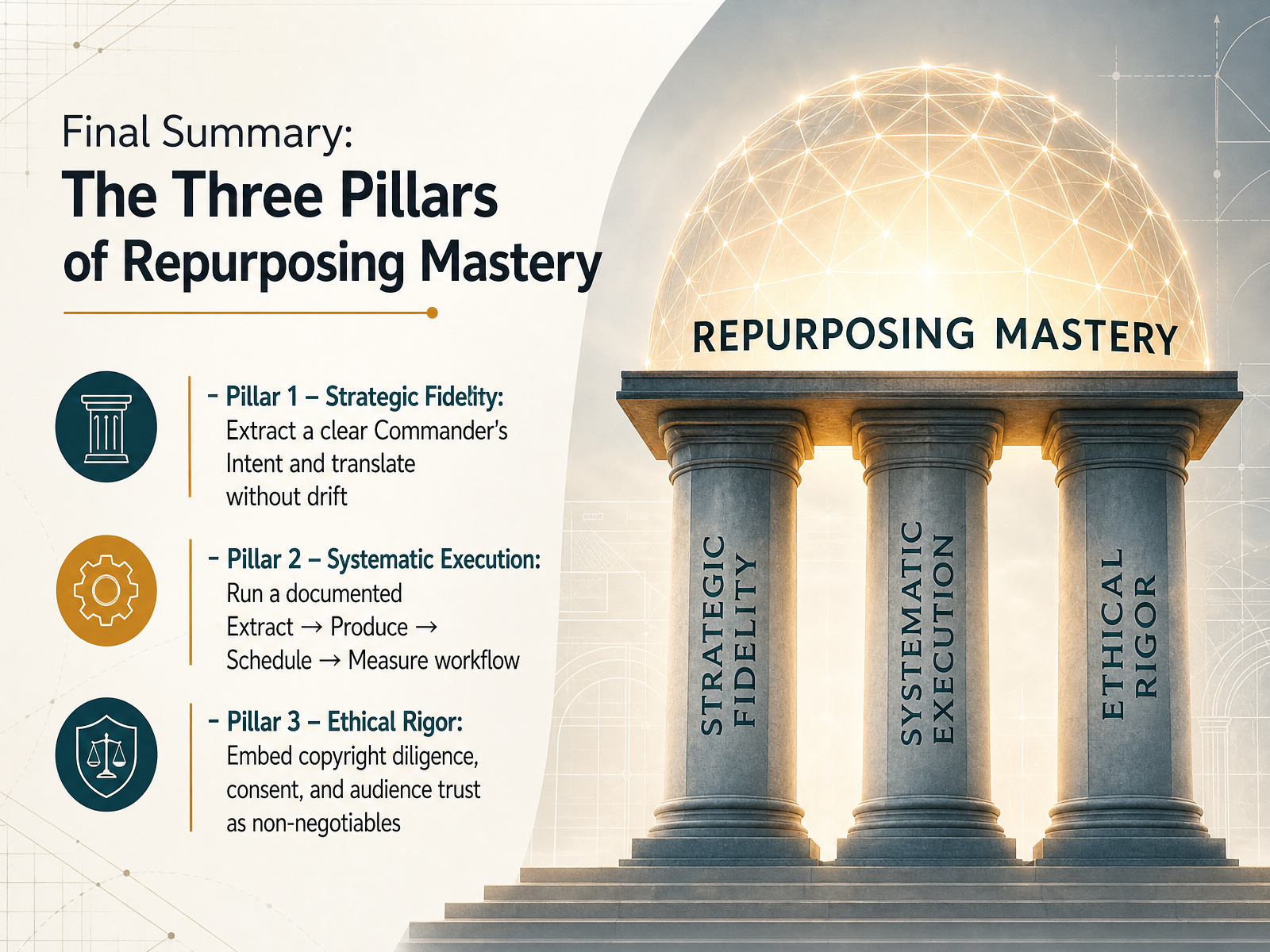
2 min - 13Final Summary: The Three Pillars of Repurposing MasteryLet's quickly lock in the three pillars that make all of this work. First, Strategic Fidelity. This is your Commander's Intent—the one idea that must survive no matter the format. You extract that core, and you translate it without drift. Second, Systematic Execution. This is your documented engine. You follow a clear Extract, Produce, Schedule, and Measure workflow so repurposing becomes a habit, not a heroic effort. And third, Ethical Rigor. This is non-negotiable. It means getting explicit consent before reusing someone's content, giving proper attribution to the original source, and never relying on an assumption. Your audience's trust is built on this transparency. Master these three pillars—fidelity, execution, and ethics—and you have a complete system for adapting ideas without ever losing the message or your credibility. Thank you for joining this session. Now, take one source piece this week and give it the treatment. You'll be amazed at what you can build from what you've already created.
 repurposeyourcontent.comtryrepurpose.comkompozy.io+22 min
Take the deck with you
Download this course as a file — free, no sign-up needed.
- PDF handoutEvery slide page, ready to print or share.14 pages · 3.5 MBDownload
- Narrated PowerPointThe deck that presents itself — every slide carries the digital human's narration video.14 pages · 13.4 MBDownload
- PowerPoint slidesThe full deck as a .pptx — open it in PowerPoint, Keynote, or Google Slides.14 pages · 3.4 MBDownload
Free to use in your own training — please keep the PersonWise credit page at the end.
Have your own deck? Turn it into a course
Sources consulted
Web sources consulted while building this course.
- Content Repurposing Statistics 2026 | RepurposeYourContent.com — repurposeyourcontent.com
- Content Repurposing Statistics & Data: 2026 Research Roundup | Repurpose AI — tryrepurpose.com
- Content repurposing statistics for 2026 (honest data, no AI BS) · Kompozy — kompozy.io
- B2B Content Repurposing Statistics for 2026: Key Data — scopicstudios.com
- 2026 Marketing Statistics, Trends, & Data — hubspot.com
- Core Message Extractor - BookForge — bookforgeai.dev
- books/made-to-stick/skills/core-message-extractor/SKILL.md — github.com
- How to Turn Your Long-Form Into Viral Short-Form — jonathannott.substack.com
- Simple — Made to Stick · Read Stacks — readstacks.com
- Core Message Extractor: Master Commander's Intent with Openclaw Skills — toolify.ai
- Stop Creating Random Content: How to Match Your Format to Your Audience’s Needs – Site Title — salesandproductionnetwork.business.blog
- Targeted Content That Resonates With Your Audience |... — influenceflow.io
- Types of Content Marketing: A 2026 Strategy Guide - FanSpicy — fanspicy.com
- Content Formats 2026: What Converts Across the Funnel — chapters-eg.com
- The most effective types of content on social media in 2026 [new data] — blog.hubspot.com
- AI Content Repurposing Without Brand Voice Drift: Blog to Social, Email, and Video | Atom Writer Blog — atomwriter.com
- How to Adapt the Same Message for LinkedIn, Twitter, and Instagram — Postprism — postprism.app
- AI Social Media Brand Voice Consistency: How to Sound Like You on LinkedIn, Twitter, and TikTok | Atom Writer Blog — atomwriter.com
- Multi-Platform Publishing Without the Copy-Paste - FlyingToast — flyingtoast.ai
- Cross-Platform Voice: Sound Like You Everywhere | AntiSlop — antislop.io