Begin
14 pages · ~28 min
Audience for a Research Paper: Purpose and Examples
This training explains how to identify and address the audience for a research paper, helping writers understand audience concepts, purpose, and examples to communicate effectively.
A digital instructor presents all 14 pages. Hold “Ask” at any point and ask out loud — the answer comes from this course. No sign-up needed.
What you’ll learn
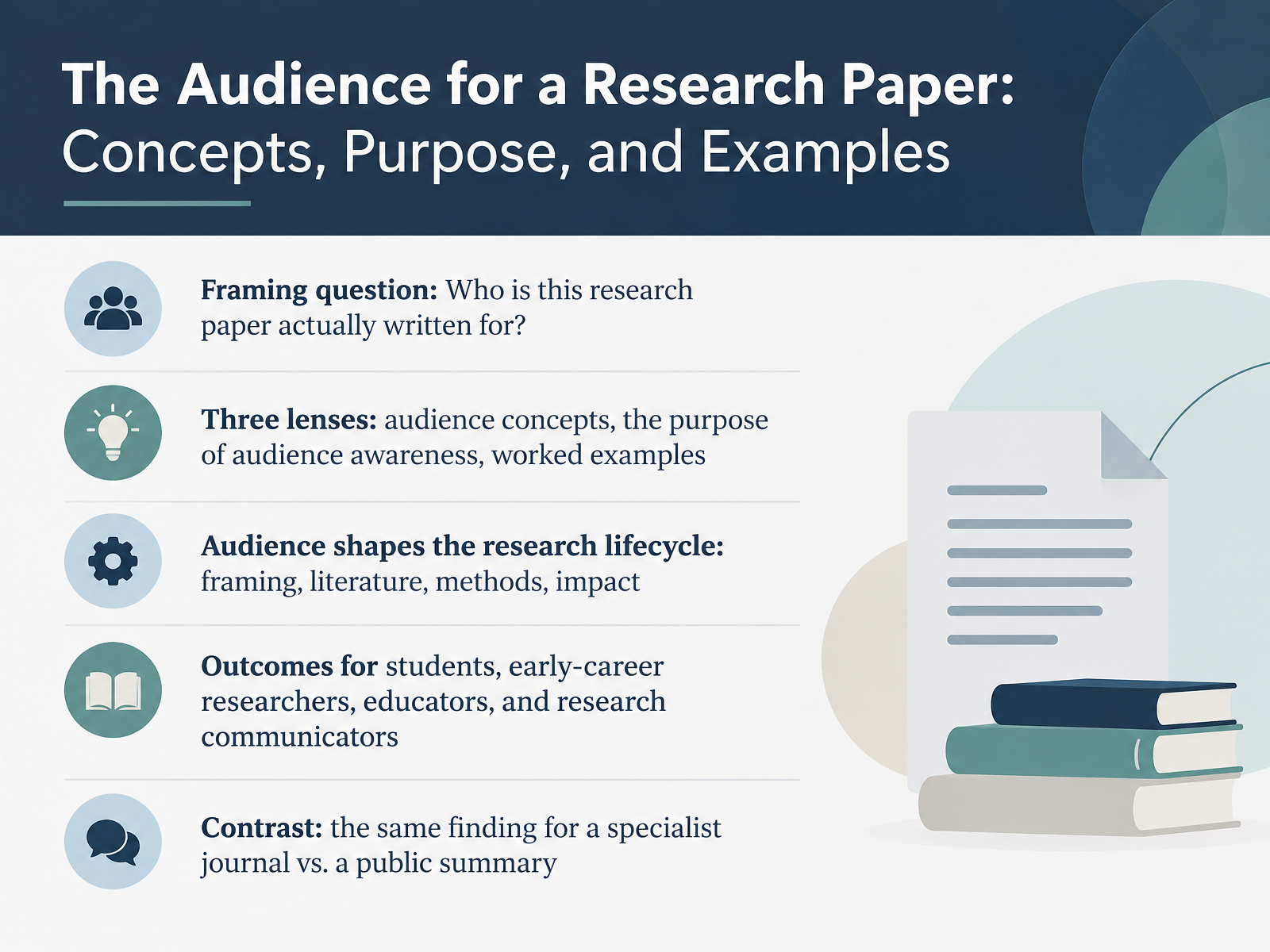
- 01The Audience for a Research Paper: Concepts, Purpose, and ExamplesWelcome. This short course is about a question every writer faces, and one we often answer too quickly. Who is this research paper actually written for? Over the next slides, we will explore that question through three lenses. First, the key concepts behind audience. Second, why audience awareness matters across the research lifecycle, from framing your question, to choosing literature, to methods, to impact. Third, worked examples you can borrow from. Here is a quick contrast to set the scene. A specialist journal and a public summary can report the same finding, yet you would frame it, word it, and support it quite differently for each reader. You will leave with practical next steps for your own writing. Let's begin with why audience awareness sits at the center of research writing.guides.lib.berkeley.eduuq.pressbooks.pubonlinelibrary.wiley.com+22 min
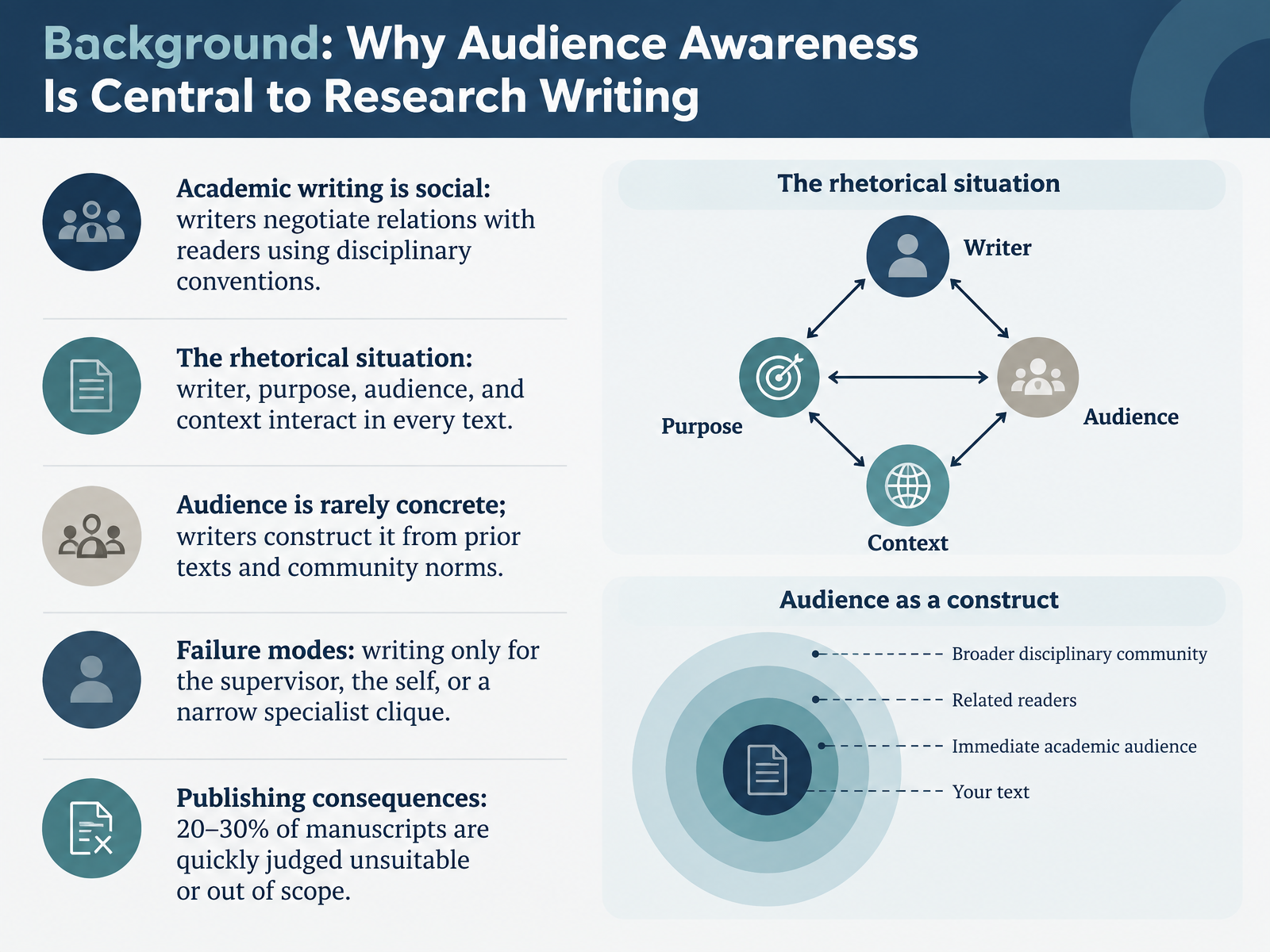
- 02Background: Why Audience Awareness Is Central to Research WritingLet's take a step back and ask why audience matters so much. Academic writing is social. Writers use disciplinary conventions to negotiate a relationship with their readers, not just to report results. Every text involves a rhetorical situation, where writer, purpose, audience, and context interact. Here's a common point of confusion. Audience is rarely a concrete person in front of you. Instead, writers construct it from prior texts and community norms. Picture a first-time author who writes only for their supervisor. The paper reads like an internal memo, and journal editors may quickly judge it out of scope. Similar misfires happen when we write only for ourselves, or only for a narrow specialist clique. And this has real consequences. Roughly twenty to thirty percent of manuscripts are quickly judged unsuitable or out of scope, often before peer review. So keep asking, who is this text really for? Next, let's unpack who counts as your audience. Core Concepts: Who Counts as Your Audience?
 sciencedirect.comdoi.orgdoi.org+22 min
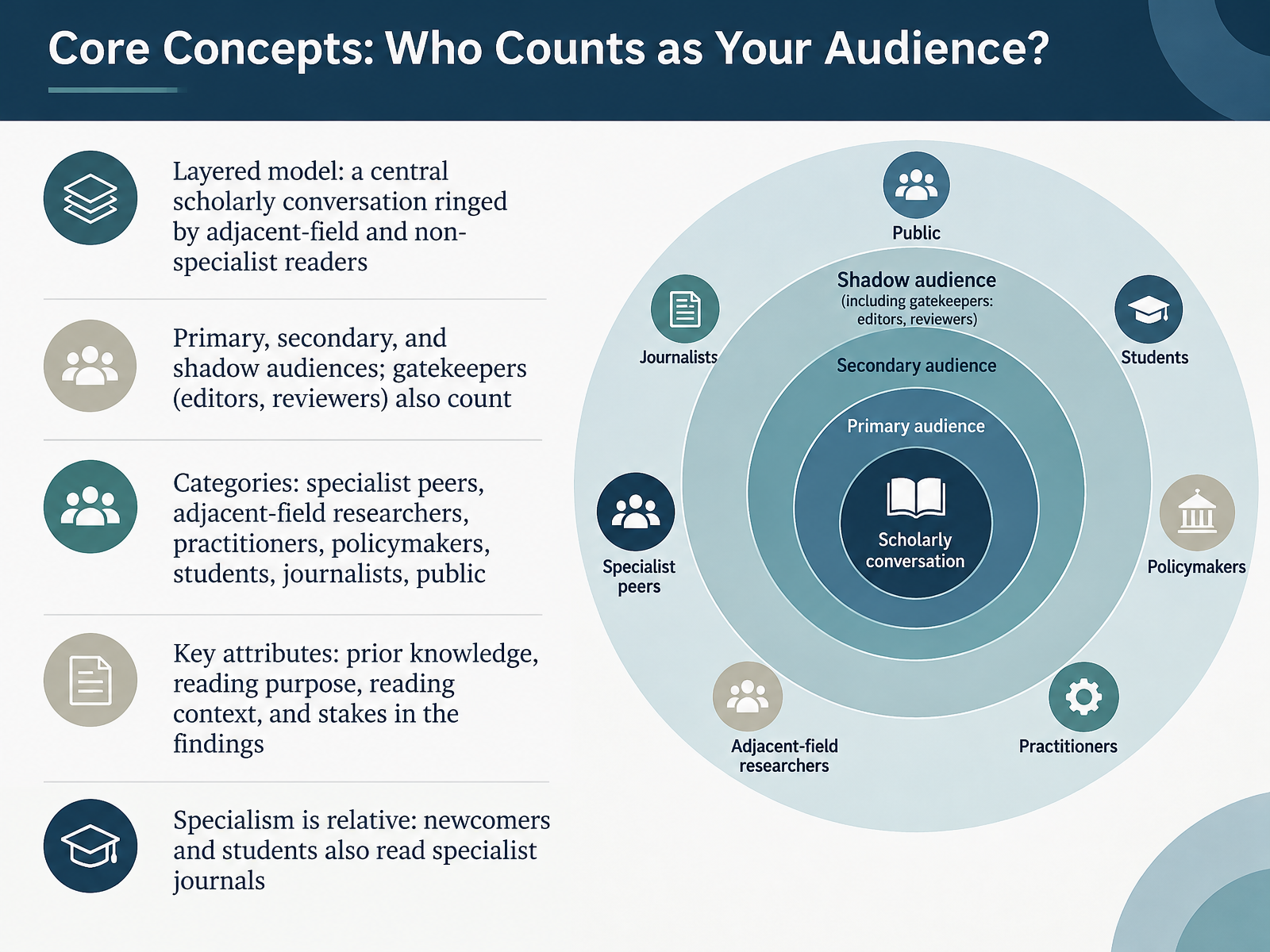
- 03Core Concepts: Who Counts as Your Audience?Let's turn to the core question. Who actually counts as your audience? A useful model is layered. Picture a central scholarly conversation, ringed by adjacent-field researchers, and then by non-specialist readers farther out. Within those layers, you can distinguish primary, secondary, and shadow audiences. Gatekeepers like editors and reviewers also count, because they decide whether your work reaches anyone else. Concretely, an editor is a primary reader even if your ideal reader is a practitioner. So categorize readers by prior knowledge, reading purpose, reading context, and stakes in the findings. And remember that specialism is relative. Newcomers and students also read specialist journals, so do not assume everyone shares your background. That sets up our next concern, the expertise gradient and the curse of knowledge.
 owl.purdue.edulaw.georgetown.eduowl.purdue.edu+22 min
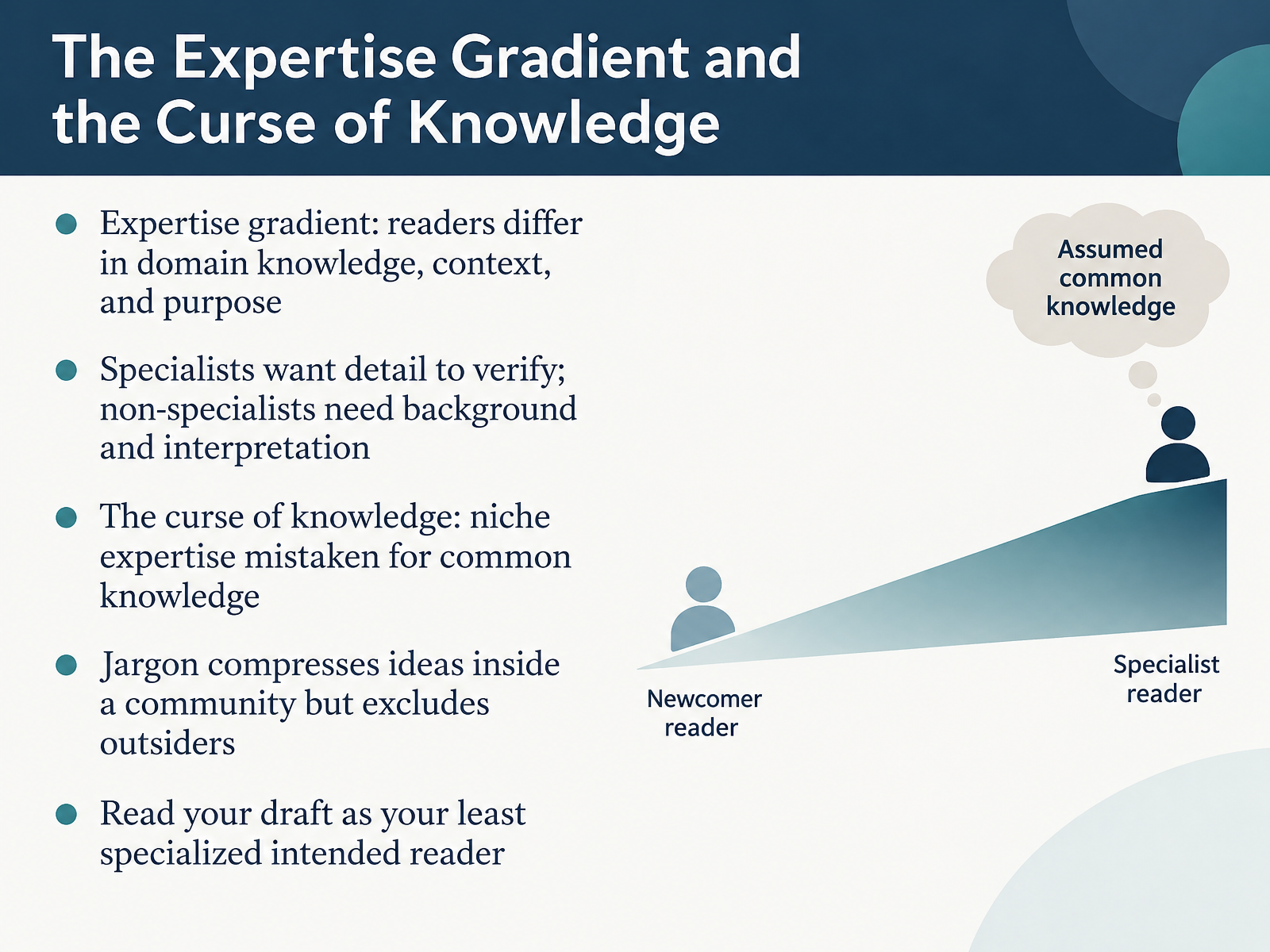
- 04The Expertise Gradient and the Curse of KnowledgeLet's turn now to the expertise gradient and the curse of knowledge. Readers differ in three ways: how much they know about your topic, how familiar they are with the context, and why they are reading. Specialists often want detail so they can verify your claims. Non-specialists need background and interpretation instead. Here is a concrete example. A statistician will check your sampling method closely, while a policymaker may only need a clear statement of what the result means in practice. The curse of knowledge is the habit of mistaking your niche expertise for common knowledge. Jargon compresses ideas inside a community, but it can exclude outsiders. So read your draft as your least specialized intended reader. One practical next step is to mark every technical term and ask whether it needs a short definition. That shift in awareness leads naturally into how audience shapes purpose, structure, evidence, and framing.
 owl.purdue.edulaw.georgetown.eduowl.purdue.edu+22 min
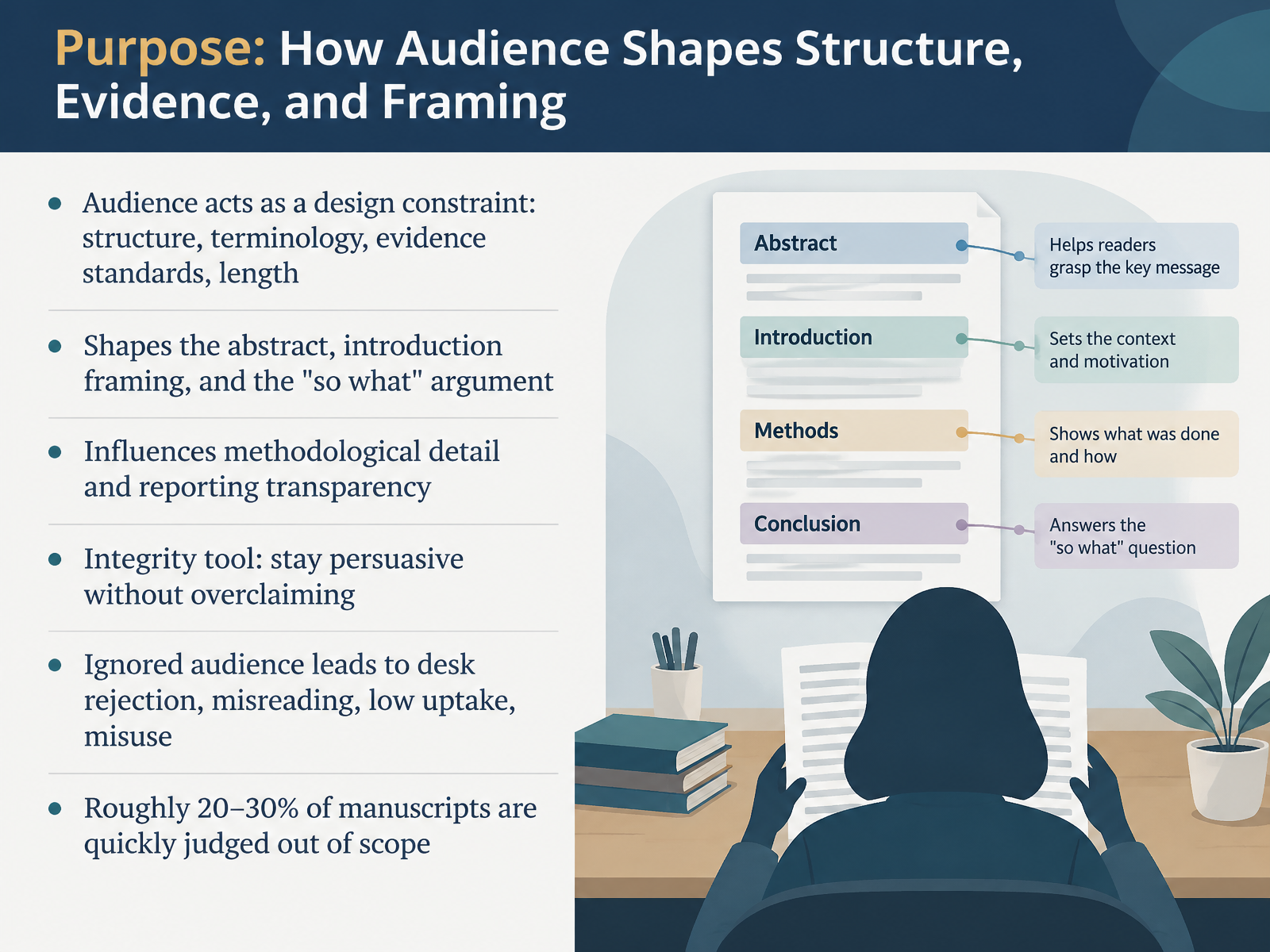
- 05Purpose: How Audience Shapes Structure, Evidence, and FramingNext, let's look at how audience shapes the paper itself. Think of your audience as a design constraint, much like a word limit. It steers your structure, your terminology, your evidence standards, and even your length. For example, a specialist journal expects methodological detail that a general readership does not. Audience also shapes your abstract, how you frame the introduction, and your so what argument. It influences how transparent you are about methods and reporting. And it is an integrity tool. You want to stay persuasive without overclaiming. When you ignore the audience, the costs are real. Desk rejection, misreading, low uptake, or misuse of your findings. In fact, roughly twenty to thirty percent of manuscripts are quickly judged out of scope. Coming up next, we look at audience analysis before you draft.
 guides.lib.berkeley.eduuq.pressbooks.pubonlinelibrary.wiley.com+22 min
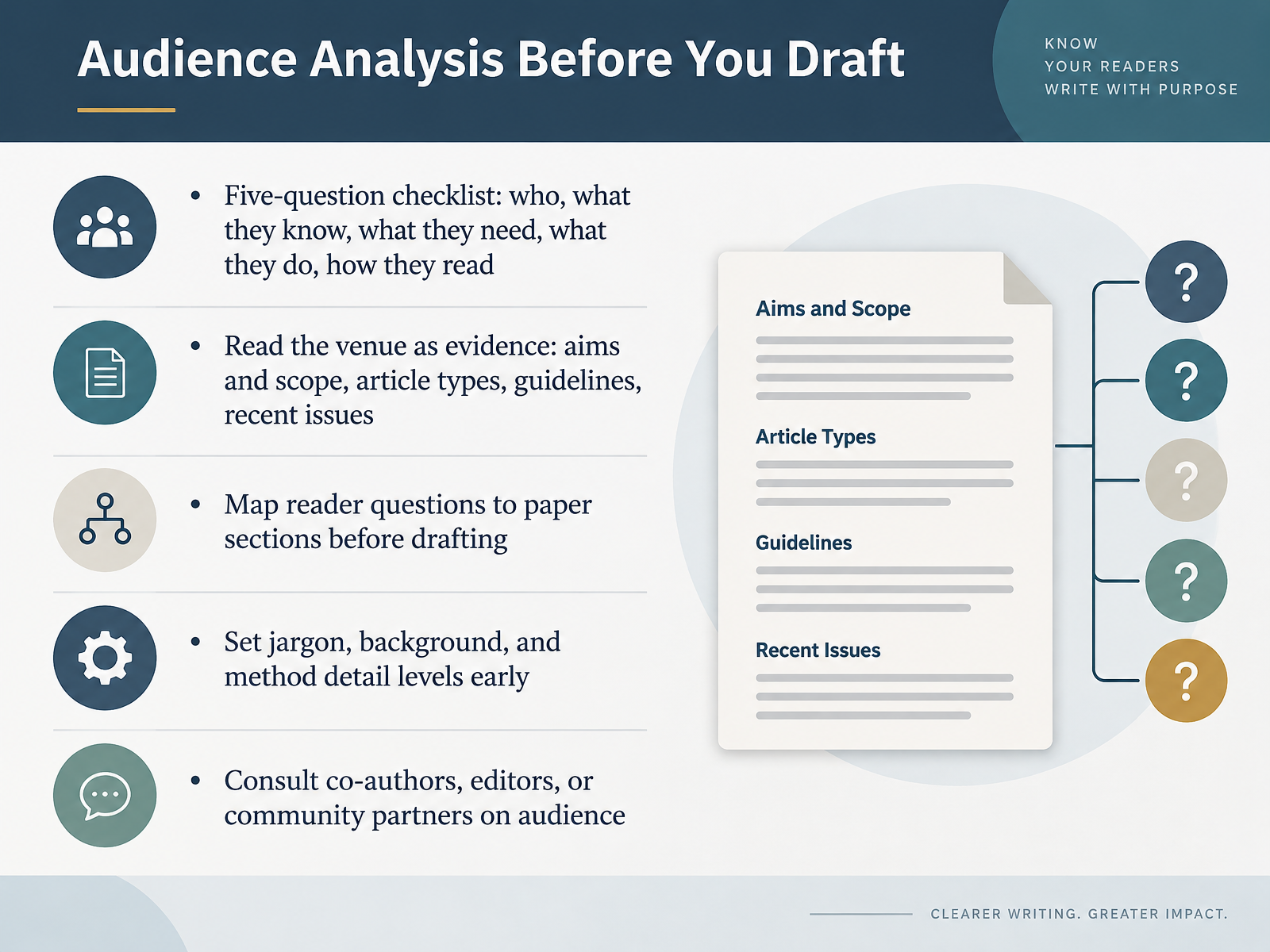
- 06Audience Analysis Before You DraftSo how do you actually analyze your audience before you draft? Start with a short checklist of questions. Who are they? What do they already know? What do they need from you? What should they do after reading? And how will they read, quickly or closely?
Then read the venue itself as evidence. Look at its aims and scope, the article types it accepts, its author guidelines, and a few recent issues. Together, those tell you who the journal serves and what they expect.
Next, map reader questions to your paper sections before you write. If readers will ask, why does this matter, that belongs in your introduction. If they will ask, how did you do it, that belongs in your methods.
Set your jargon, background, and method detail levels early, so you are not adjusting them later. And when you are unsure, ask. Co-authors, editors, and community partners can confirm who you are writing for.
So the takeaway is simple: analyze first, then draft. And as you will see next, choosing a venue is itself an audience decision.
 iup.eduauthorservices.taylorandfrancis.comunimelb.libguides.com+22 min
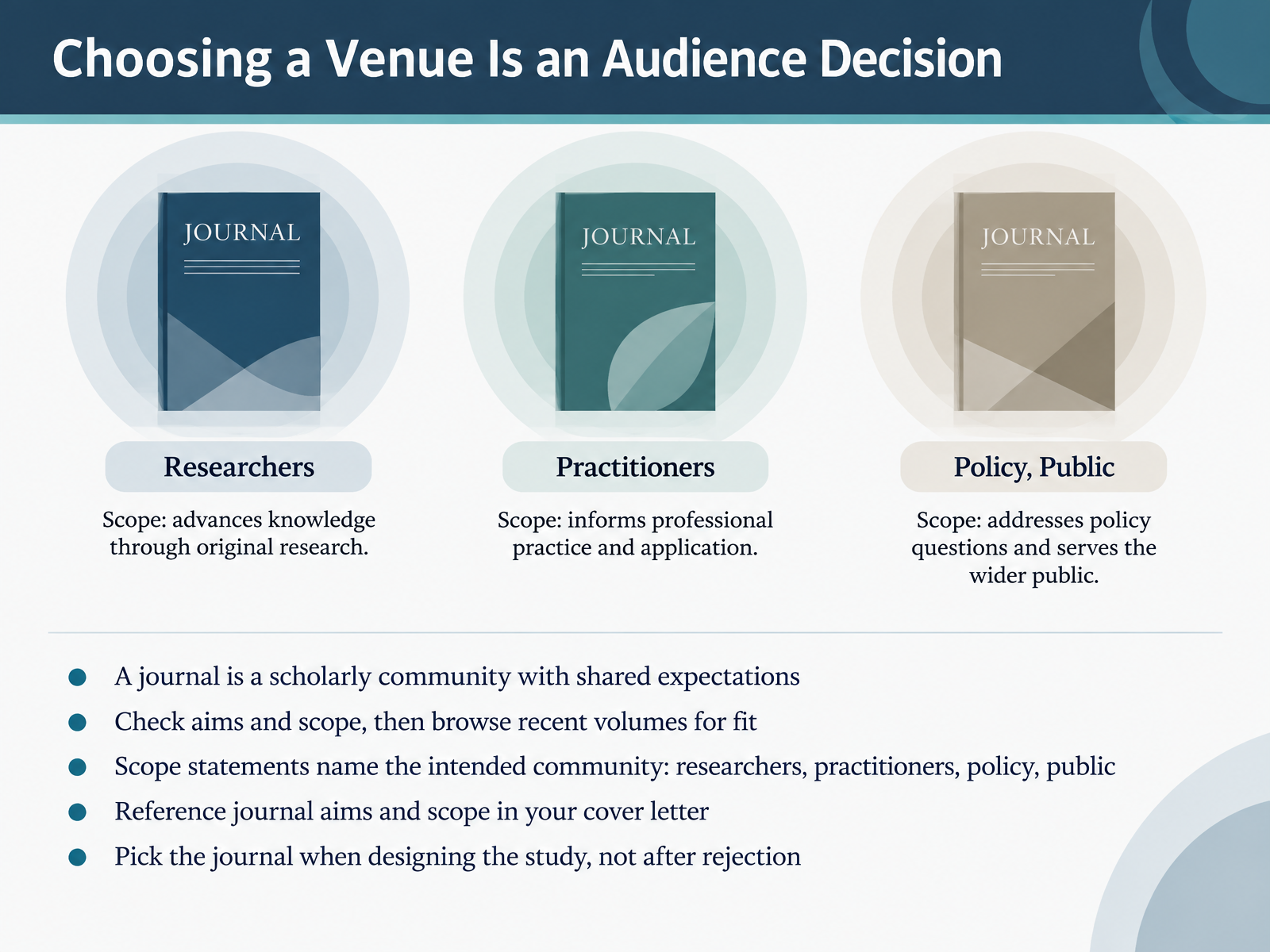
- 07Choosing a Venue Is an Audience DecisionLet's turn to venue choice, because choosing where to publish is really an audience decision. A journal is not a neutral container. It is a scholarly community with shared expectations about research type, methods, and contribution. So before you write, check the aims and scope, that is, the statement of what the journal aims to do and which topics it covers. Then browse a few recent volumes to see whether work like yours actually appears there. The scope statement often names the intended community: researchers, practitioners, policymakers, or the public. If your findings speak mainly to practitioners, a journal aimed at basic researchers may not be the right home. One practical example: when you write your cover letter, refer directly to the journal's aims and scope to show the editor you have considered fit. And here is a habit worth building. Pick the journal while you are designing the study, not after a rejection. It shapes how you frame the problem and how much background you provide. For our next step, we will look at what this means in practice.
 iup.eduauthorservices.taylorandfrancis.comunimelb.libguides.com+22 min
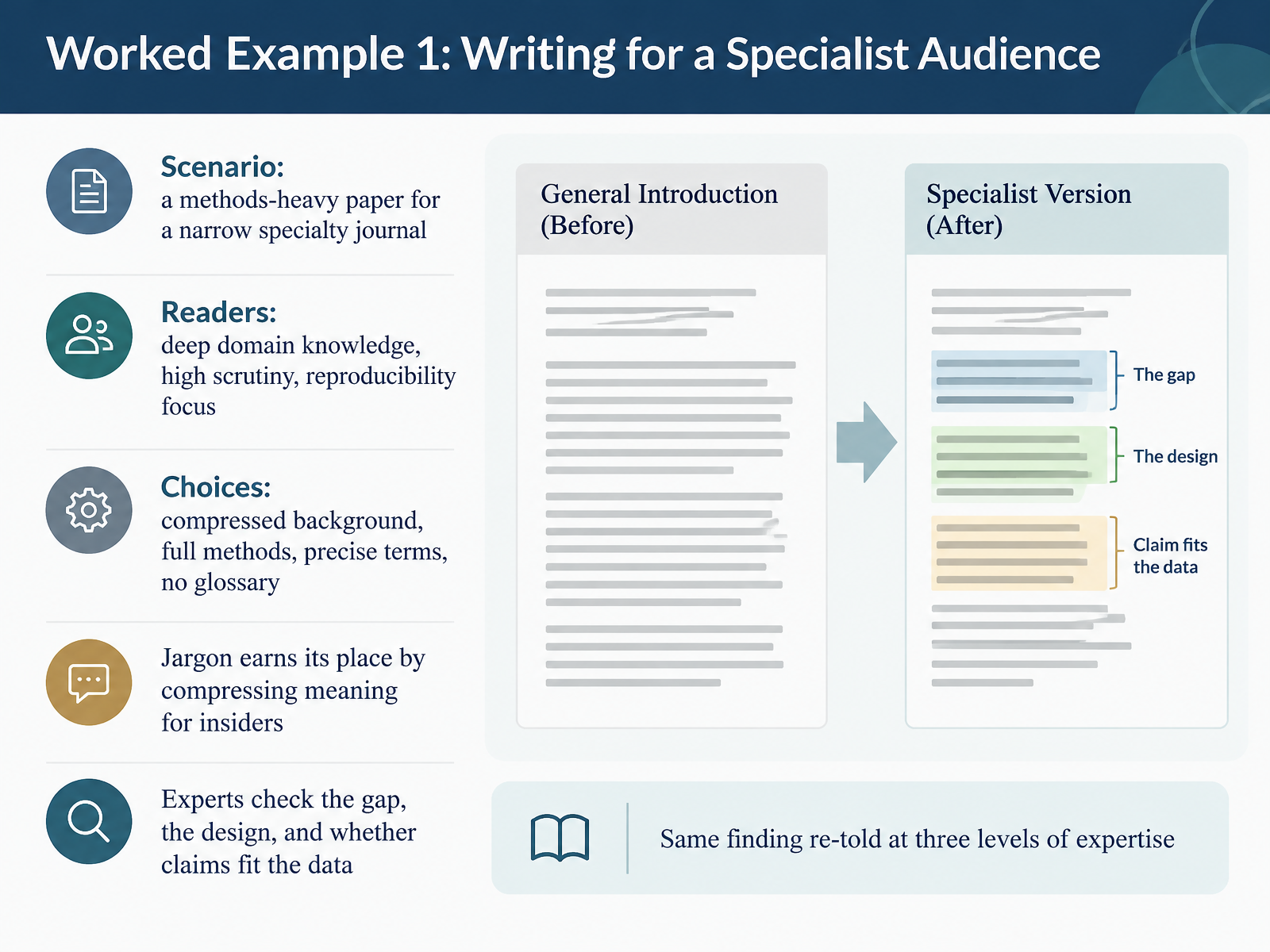
- 08Worked Example 1: Writing for a Specialist AudienceNow let's put this into practice with our first worked example. Imagine you are writing a methods-heavy paper for a narrow specialty journal. Your readers know the field deeply, they will scrutinize every detail, and above all they care about reproducibility, meaning they want to rerun your study exactly as you did it. So you make deliberate choices. Background gets compressed. Methods are reported in full. Terms stay precise, and you skip the glossary. Jargon here earns its place because it compresses meaning for insiders. Think of a technical term as shorthand that saves a long definition. Experts will check three things: the gap you identified, the design of your study, and whether your claims actually fit your data. So let the methods lead. Next, we look at cross-disciplinary and practitioner audiences.
 iup.eduauthorservices.taylorandfrancis.comunimelb.libguides.com+21 min
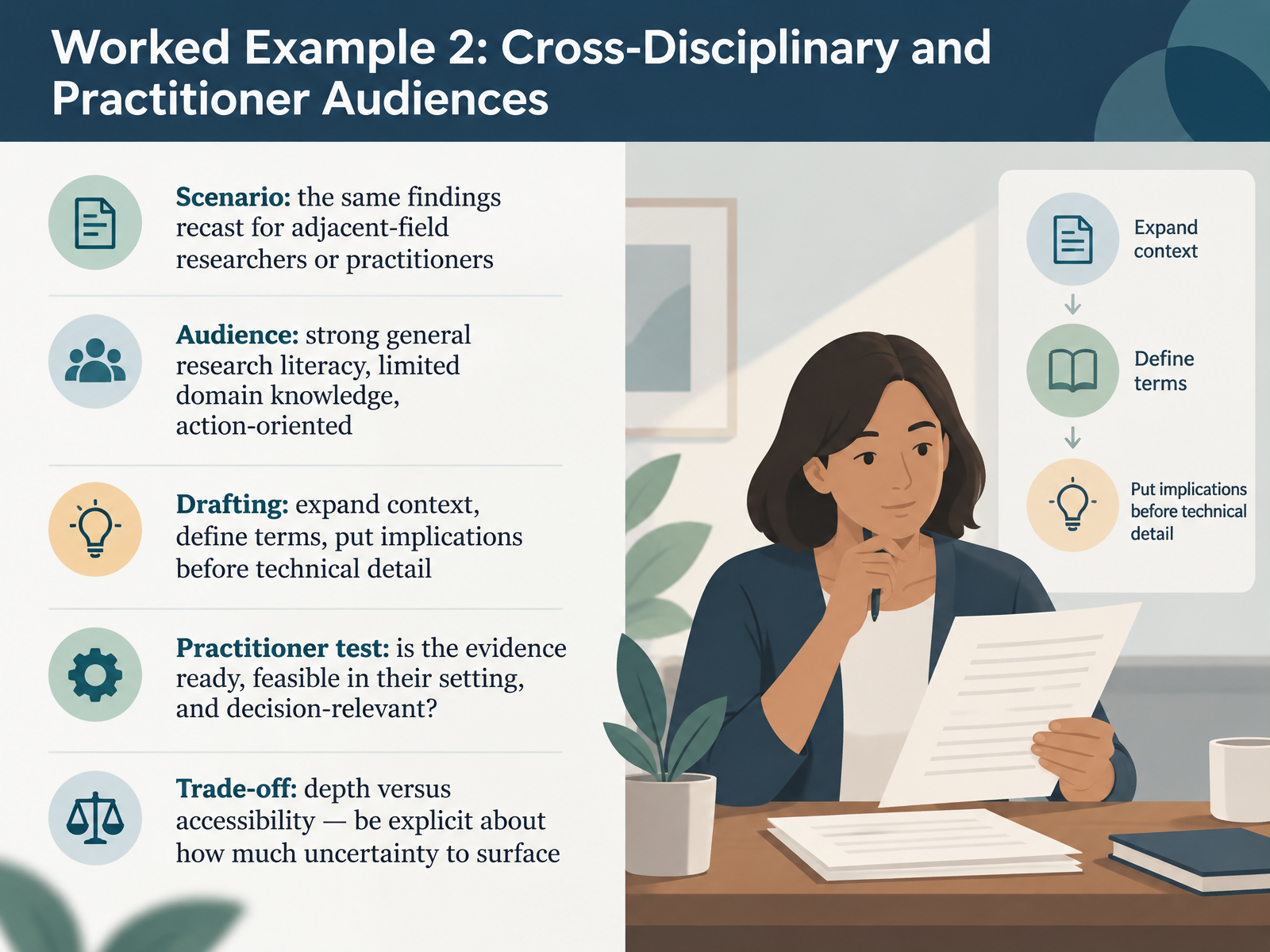
- 09Worked Example 2: Cross-Disciplinary and Practitioner AudiencesLet's walk through our second worked example. Here, the same findings are recast for a different audience: researchers in adjacent fields, or practitioners who will act on the results. Picture a study on teacher turnover, rewritten as a short brief for school district leaders. These readers have strong general research literacy, but limited knowledge of your specific domain. And they are action oriented. So expand the context and define your key terms in plain language at first mention. Then put the implications before the technical detail. Before you share, run a practitioner test. Ask three questions. Is the evidence ready for use? Is it feasible in their setting? And is it decision relevant? Finally, acknowledge the trade-off between depth and accessibility. Be explicit about how much uncertainty to surface. Naming the limits of your evidence builds trust rather than weakening your message. Next, we turn to Worked Example 3: Public and Policy Audiences.
 owl.purdue.edulaw.georgetown.eduowl.purdue.edu+22 min
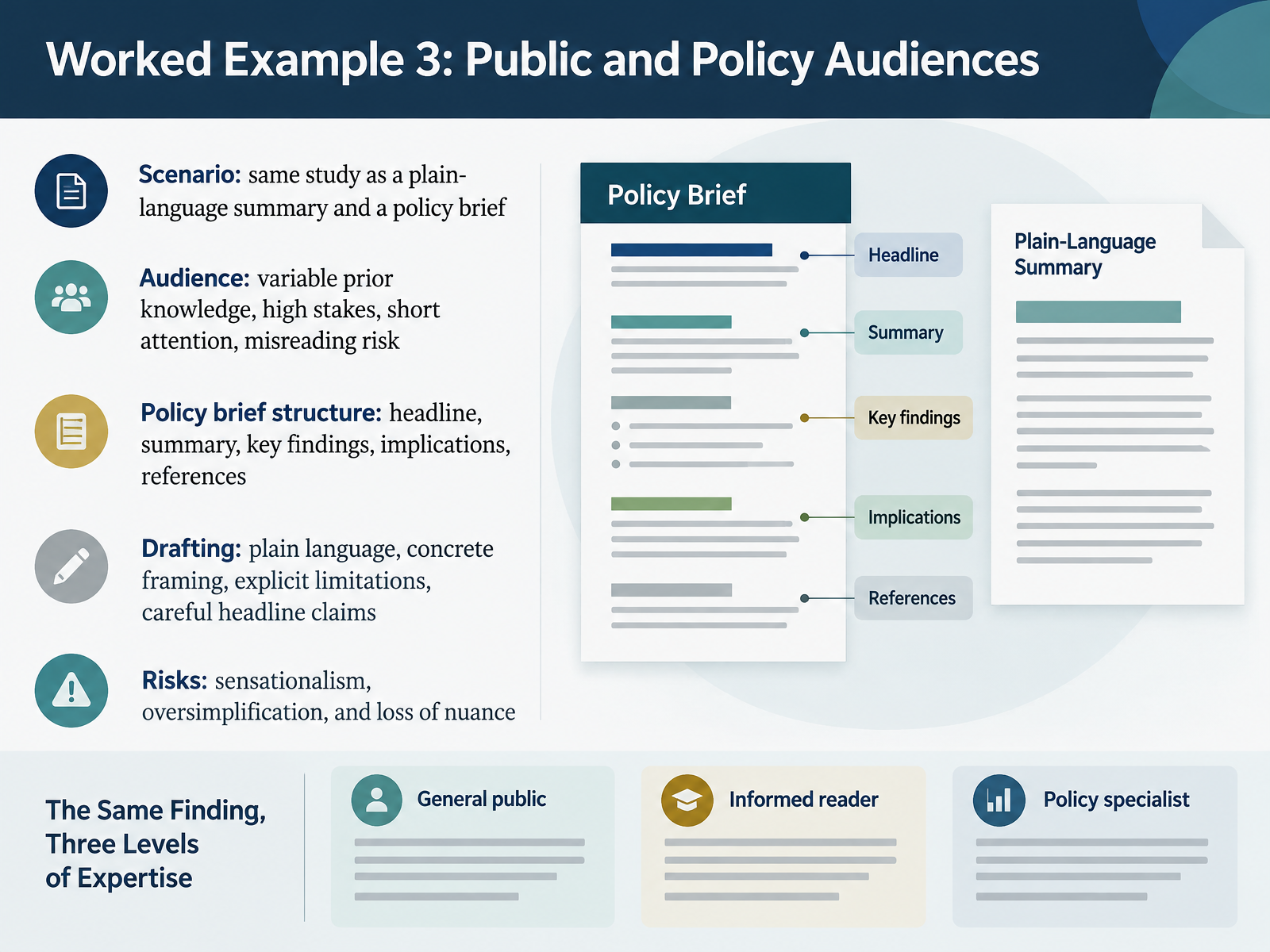
- 10Worked Example 3: Public and Policy AudiencesLet's look at how that plays out with public and policy audiences. Take the same study and turn it into two products: a plain-language summary for the public, and a policy brief for decision makers. Both audiences have variable prior knowledge, short attention, and real risk of misreading. So the brief follows a predictable structure: a headline, a short summary, key findings, implications, and references. When drafting, use plain language and concrete framing. State limitations explicitly, and be careful with headline claims. The main risks are sensationalism, oversimplification, and losing the nuance your evidence actually carries. Next, we'll compare one study across three outputs, and see what stays constant and what changes.
 2 min
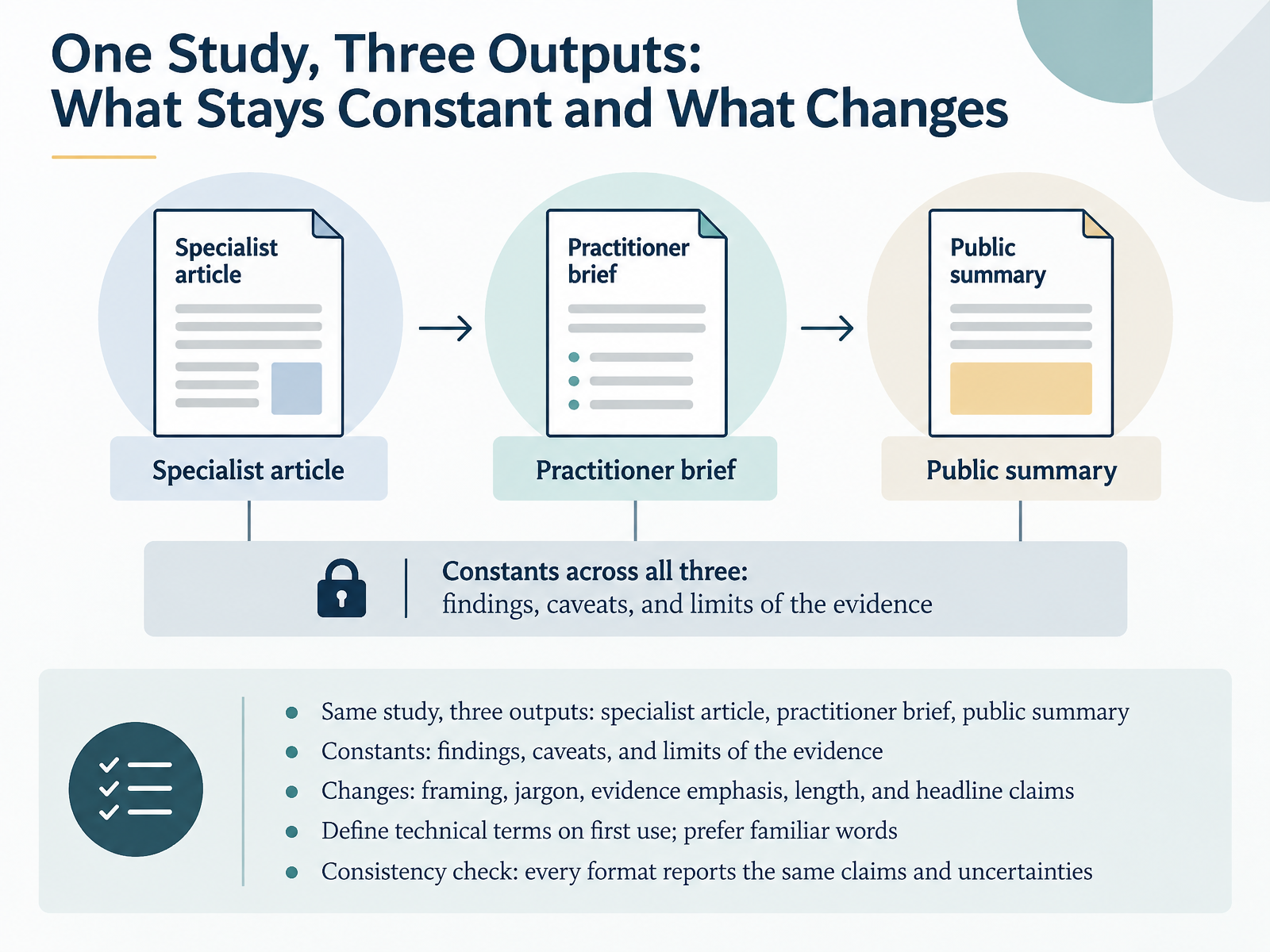
- 11One Study, Three Outputs: What Stays Constant and What ChangesNow let's look at how one study can serve several audiences at once. Picture a single piece of research turned into three outputs: a specialist article, a practitioner brief, and a public summary. What stays constant? The findings, the caveats, and the limits of the evidence. Those never change, whatever the format. What changes is everything around them: the framing, the jargon, how much weight each piece of evidence gets, the length, and the headline claims. Here is a simple rule. Define technical terms the first time you use them, and prefer familiar words wherever you can. Then run a consistency check. Every format should report the same claims and the same uncertainties. If the public summary sounds more certain than the article, something has drifted. Next, we turn to plain language that stays accurate.
 1 min
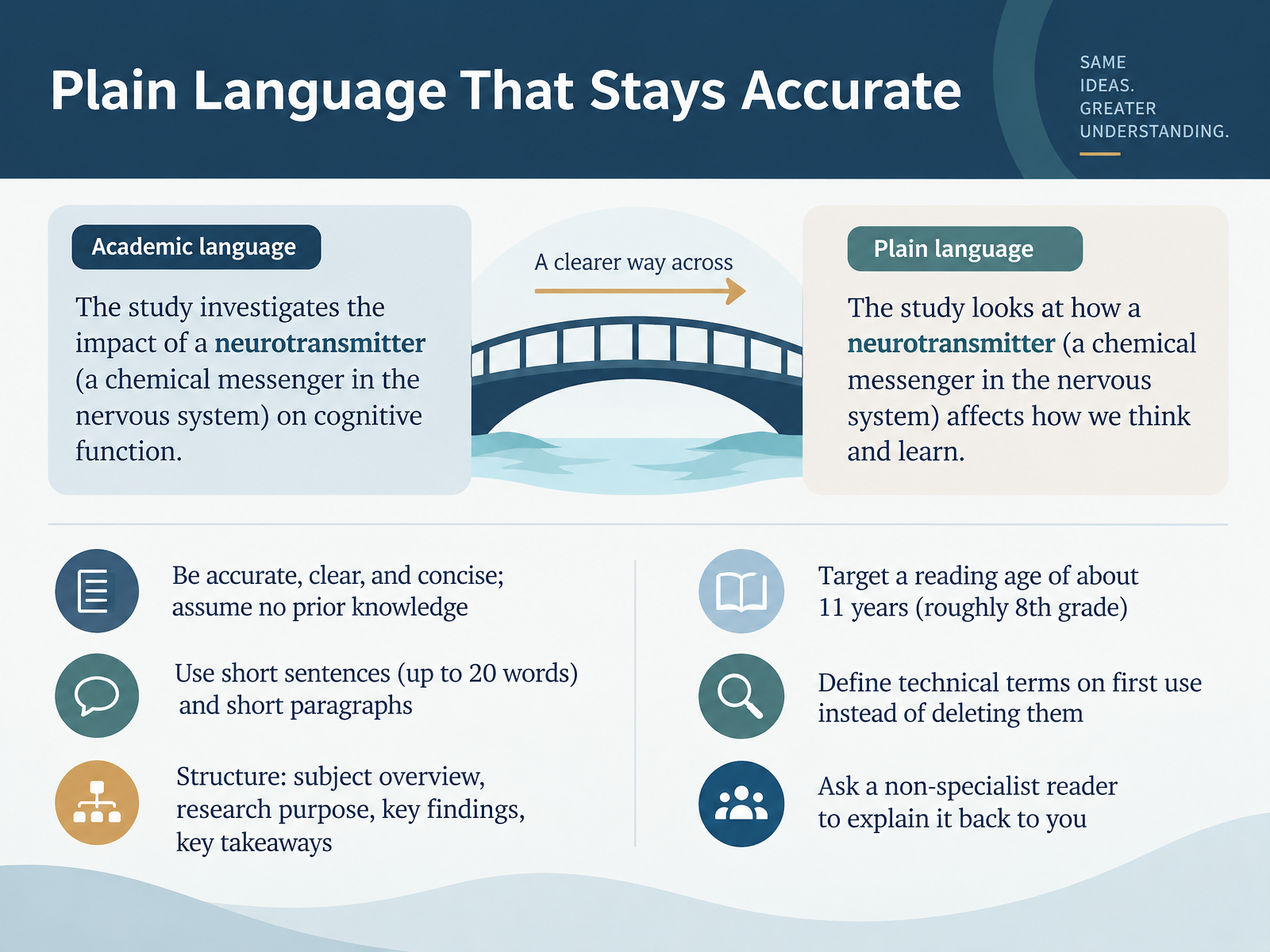
- 12Plain Language That Stays AccurateLet's turn to language. Plain language means writing that is accurate, clear, and concise, while assuming your reader has no prior knowledge. Practically, keep sentences to about twenty words or fewer, and paragraphs to around three sentences. A reliable structure is subject overview, research purpose, key findings, and key takeaways. Aim for a reading age of about eleven years, roughly eighth grade. Here is the important part. Do not delete technical terms to lower the reading level. Define them on first use instead. For example, explain a term once, then use it consistently so your meaning stays precise. Finally, ask a non-specialist to read your summary and explain it back to you. If they can, your language is working. Next, we will look at common pitfalls and practical strategies.
 2 min
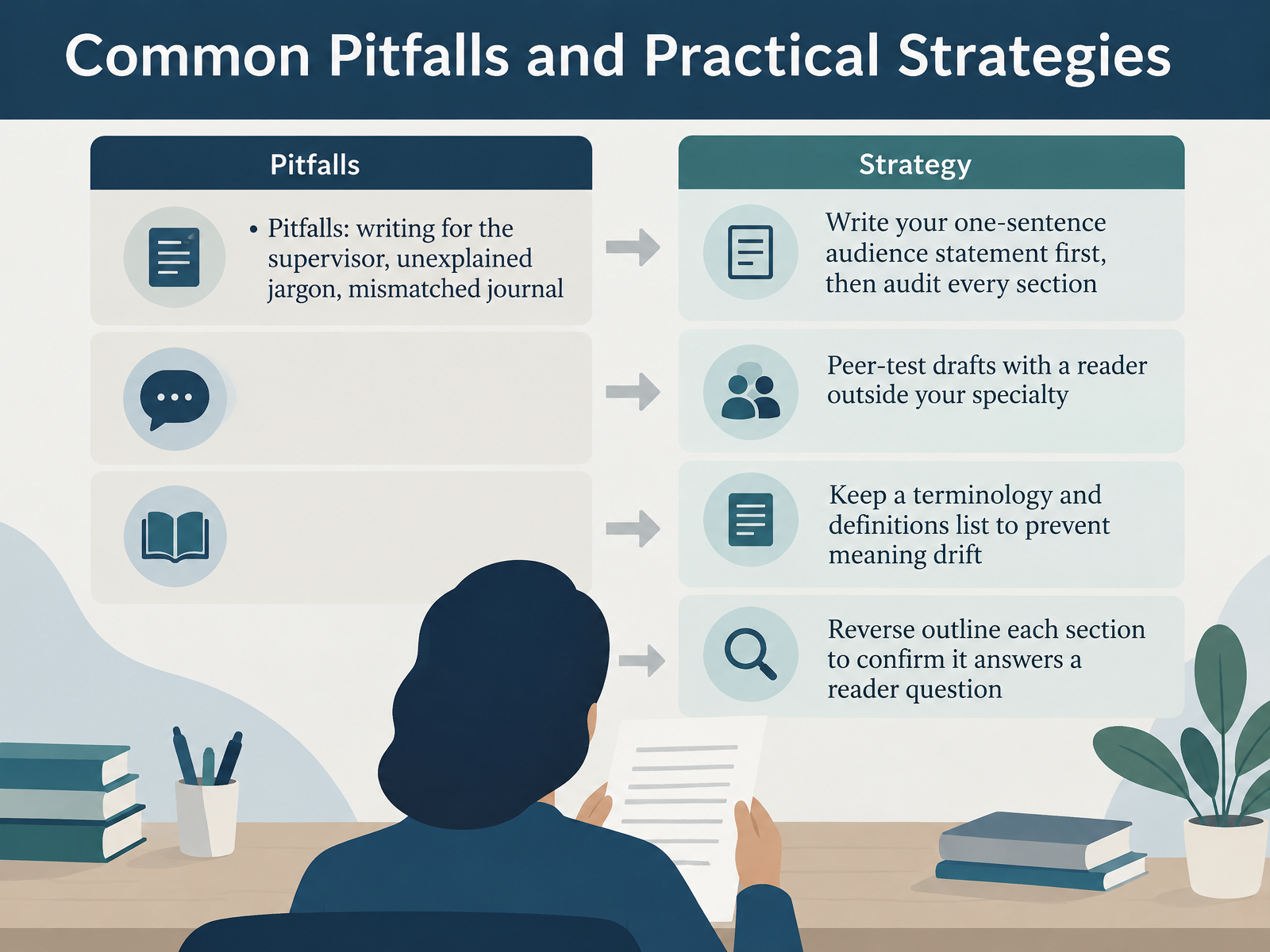
- 13Common Pitfalls and Practical StrategiesLet's turn to common pitfalls and practical strategies. Three pitfalls trip up many writers. First, writing for your supervisor instead of your actual readers. Second, unexplained jargon that only insiders understand. And third, submitting to a journal whose scope does not match your work, which is a frequent reason for immediate rejection. Here are practical fixes. Write your one-sentence audience statement first, then audit every section against it. Ask a peer outside your specialty to read a draft and flag anything unclear. Keep a running terminology and definitions list so a term means the same thing throughout. Finally, reverse outline each section: summarize each paragraph in a sentence and confirm it answers a question your reader actually has. For example, if a paragraph on methods cannot be tied to a reader question, revise or cut it. Treat these as habits you build over repeated drafts, and your writing will get clearer with each pass. Next, we'll put these tools into practice with a checklist and your next steps.
 iup.eduauthorservices.taylorandfrancis.comunimelb.libguides.com+21 min
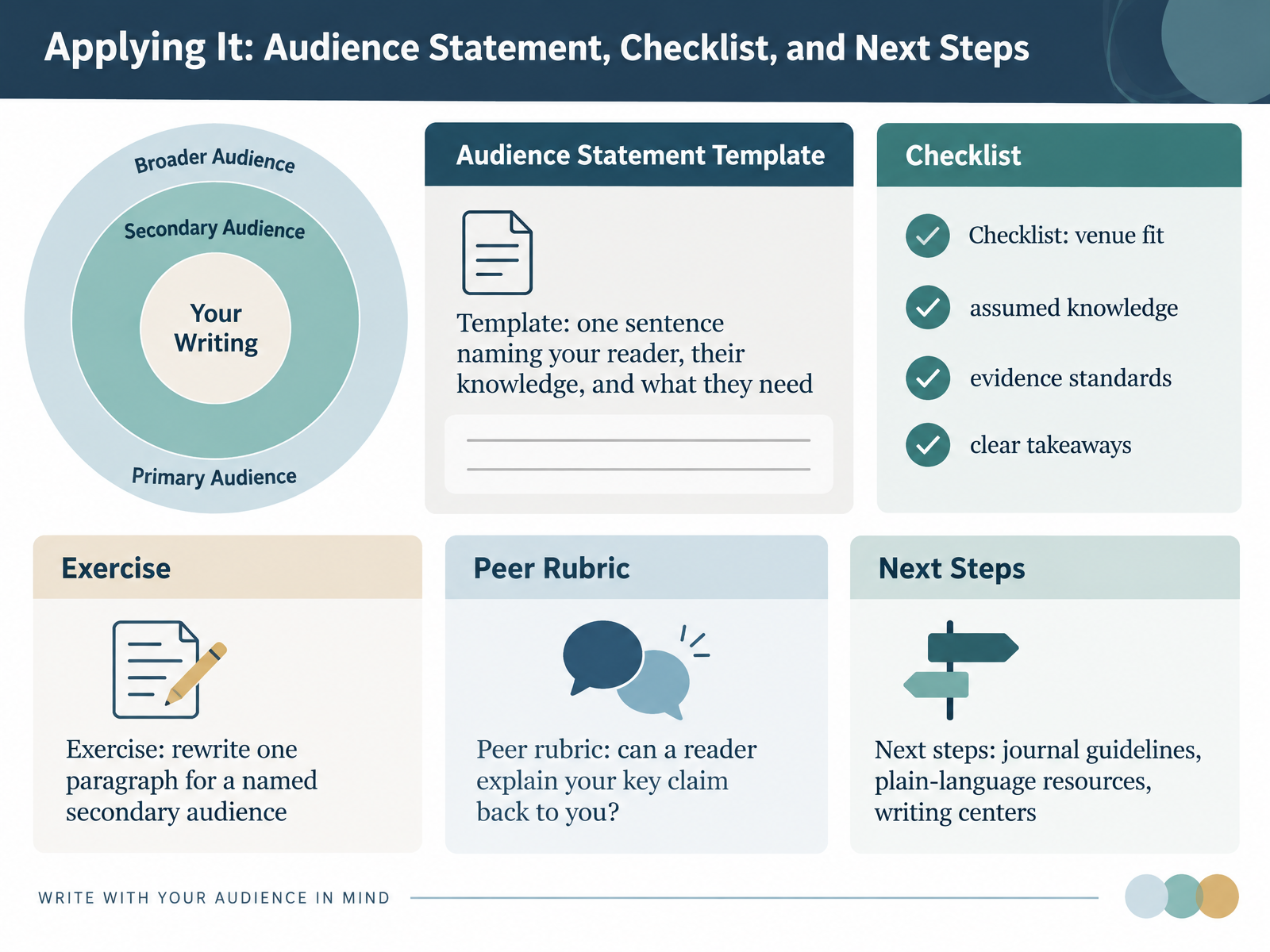
- 14Applying It: Audience Statement, Checklist, and Next StepsLet's bring this together with a practical toolkit. Start with a one-sentence audience statement. Name your reader, what they already know, and what they need from your paper. For example, "Practicing nurses with clinical training but no research background need a clear takeaway they can apply in their next shift." Then run a short checklist: does your paper fit the venue, what knowledge do you assume, what evidence standard does this reader expect, and are your takeaways unmistakable? Now try the exercise. Take one paragraph and rewrite it for a named secondary audience. Then test it with a peer rubric: can that reader explain your key claim back to you? If not, revise. Looking ahead, use journal guidelines and plain-language resources, and visit your writing center. Now, you have a complete approach to identifying your audience. Thank you for joining me. Keep practicing, and you will write with greater clarity and confidence.
 1 min
Take the deck with you
Download this course as a file — free, no sign-up needed.
- PDF handoutEvery slide page, ready to print or share.15 pages · 3.2 MBDownload
- Narrated PowerPointThe deck that presents itself — every slide carries the digital human's narration video.15 pages · 11.8 MBDownload
- PowerPoint slidesThe full deck as a .pptx — open it in PowerPoint, Keynote, or Google Slides.15 pages · 3.1 MBDownload
Free to use in your own training — please keep the PersonWise credit page at the end.
Have your own deck? Turn it into a course
Sources consulted
Web sources consulted while building this course.
- Editorial process - How to publish a scientific paper - Library Guides at UC Berkeley — guides.lib.berkeley.edu
- Assess fit with the journal – Observations of a Journal Editor — uq.pressbooks.pub
- Avoiding Desk Rejection of a Manuscript - Watson - 2019 - Nurse Author & Editor - Wiley Online Library — onlinelibrary.wiley.com
- Which articles get published and why? — onlinelibrary.wiley.com
- Develop your journal's scope — frontiersin.org
- Metadiscourse in academic writing: A systematic review — sciencedirect.com
- “I pictured my little sister when writing” – Teacher and Student Experiences with Training Audience Awareness in a Television Studies Seminar — doi.org
- Setting the stage(s) for English for Research and Publication Purposes: Authors, audiences, and learning the craft — doi.org
- Audience awareness and its role in Chinese engineering doctoral students’ L2 English academic writing — doi.org
- “We must conclude that…”: A diachronic study of academic engagement — doi.org
- Identifying Audiences - Purdue OWL® - Purdue University — owl.purdue.edu
- CREATING A GOOD SCHOLARLY PAPER — law.georgetown.edu
- Analytical Research Projects — owl.purdue.edu
- Example 2 - Purdue OWL® - Purdue University — owl.purdue.edu
- Audience and Purpose | Learn Science at Scitable — nature.com
- Analyzing Journals for Publication - Center for Scholarly Communication - IUP — iup.edu
- Find the right fit for your research | Journal's aims and scope — authorservices.taylorandfrancis.com
- Audience, fit, scope - Scholarly Publishing - Library Guides at University of Melbourne — unimelb.libguides.com
- How to choose a journal and write a cover letter — pmc.ncbi.nlm.nih.gov
- Journal or Conference Paper: Planning Your Paper : EECS Communication Lab — mitcommlab.mit.edu