Customer Education Program Workflow
Begin
14 pages · ~28 min
Customer Education Program Workflow
Learn a practical workflow to design, launch, and scale a customer education program that boosts adoption and loyalty.
What you’ll learn
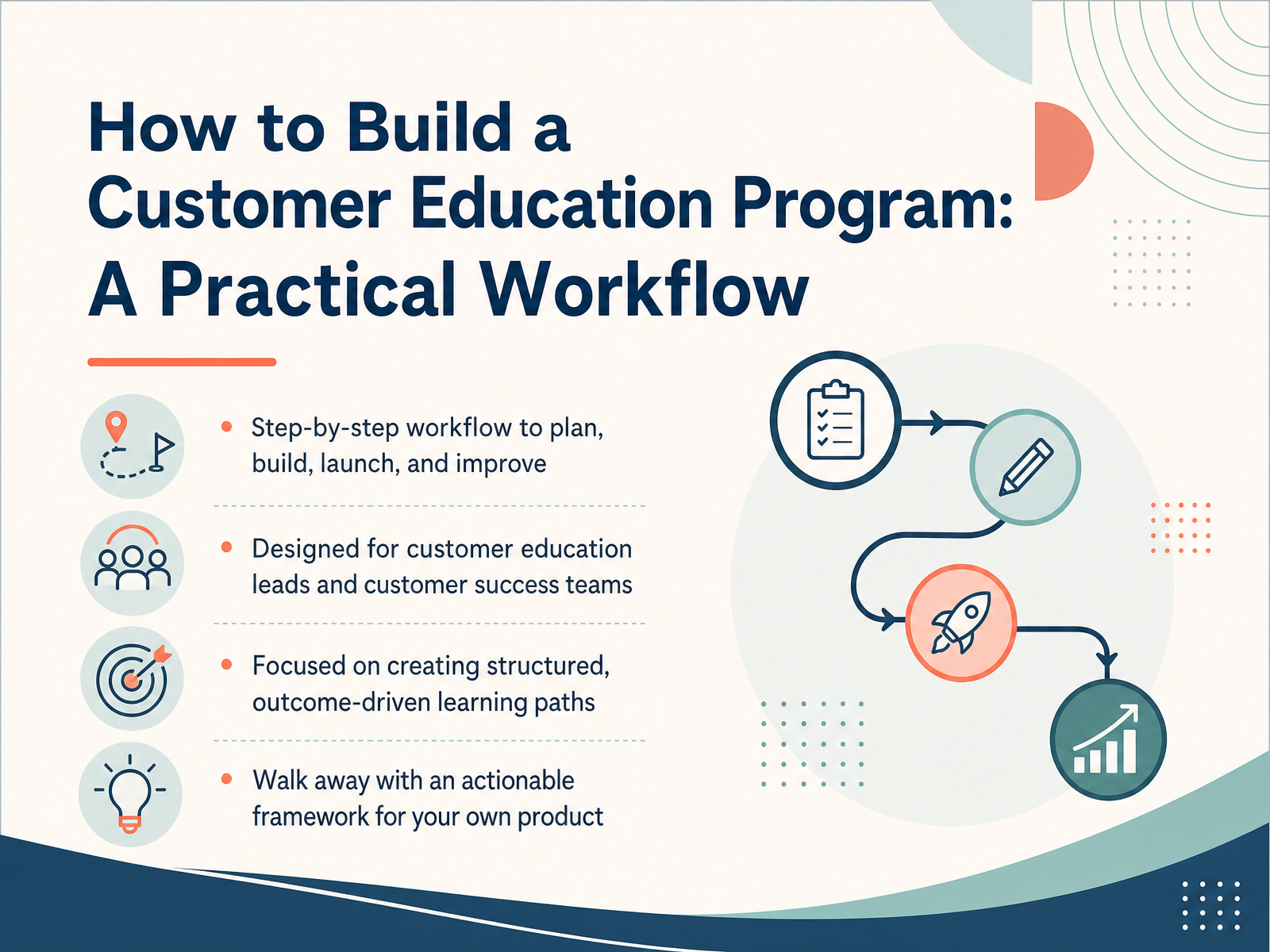
- 01How to Build a Customer Education Program: A Practical WorkflowWelcome. If you are responsible for customer education, you already know the challenge. Every team asks for training, every customer has a different skill level, and your time is limited. This session gives you a practical workflow to plan, build, launch, and improve a customer education program that actually drives outcomes. You will leave with a structured framework you can apply directly to your own product, whether you are starting from zero or restructuring an existing program. We will focus on what works in practice, not theory. Expect concrete steps, clear milestones, and the common pitfalls to avoid along the way. By the end, you will know exactly what to do first, how to measure progress, and how to keep the program relevant as your product evolves. Let us begin with the foundation: why customer education directly impacts retention and growth.1 min
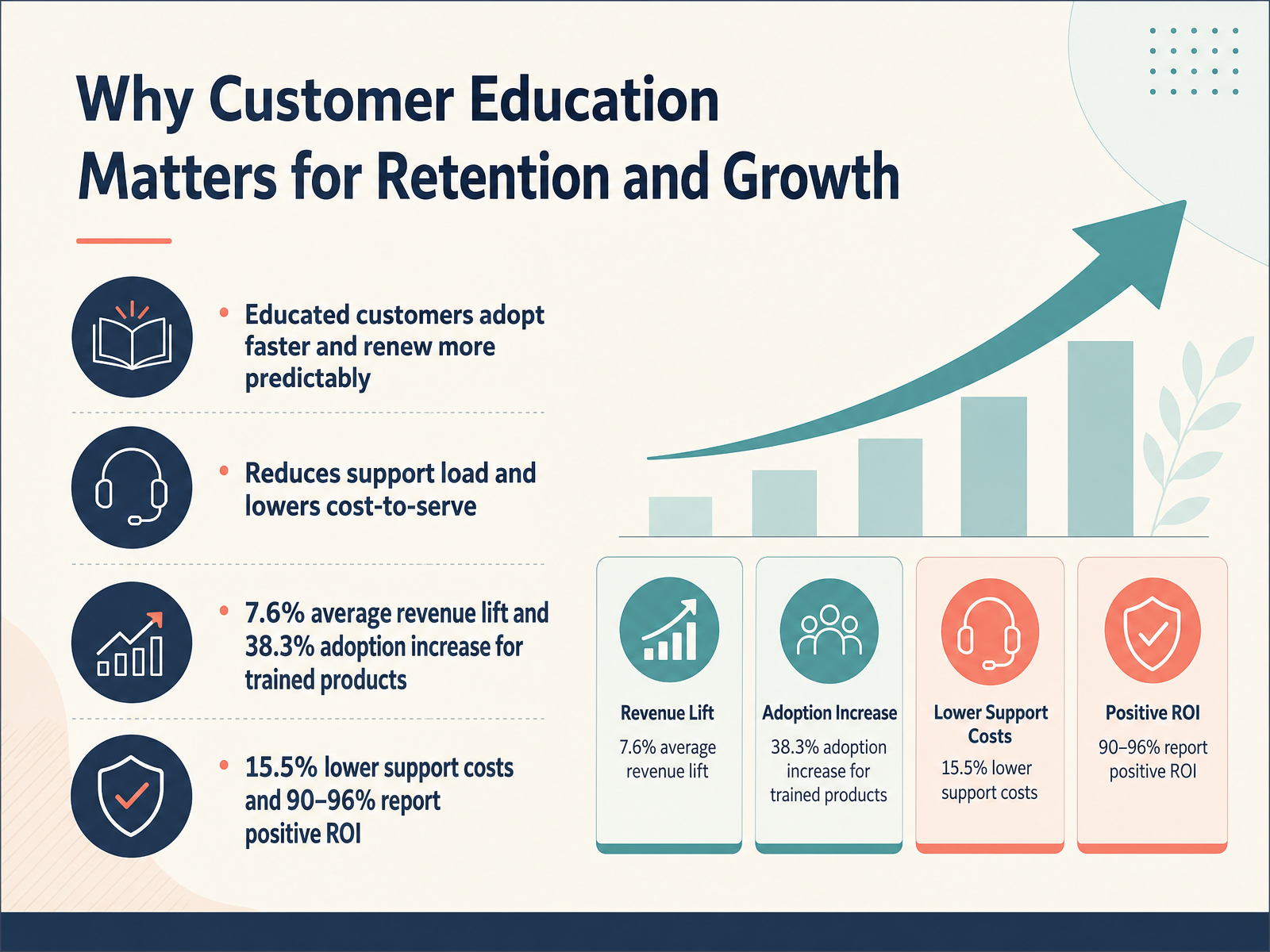
- 02Why Customer Education Matters for Retention and GrowthLet’s start with the business case, because this is the foundation you’ll build everything else on. Customer education isn’t a nice-to-have; it directly drives retention and growth. Educated customers adopt faster, renew more predictably, and cost less to support. The numbers are concrete. A Forrester study commissioned by Intellum found trained products see a 38 percent adoption increase, and top-line revenue lifts by an average of 7.6 percent. Programs also cut support costs by about 15.5 percent, and between 90 and 96 percent of organizations report positive ROI. The mechanism is simple: trained customers file fewer repetitive tickets, they reach value faster, and they expand sooner. That is the core argument you’ll use to get budget and executive buy-in. Keep these benchmarks close, because every future decision in this workflow should tie back to moving one of these metrics. Now, let’s position customer education against what you already do in onboarding and support.
 trainn.cotrainn.coabsorbai.com+22 min
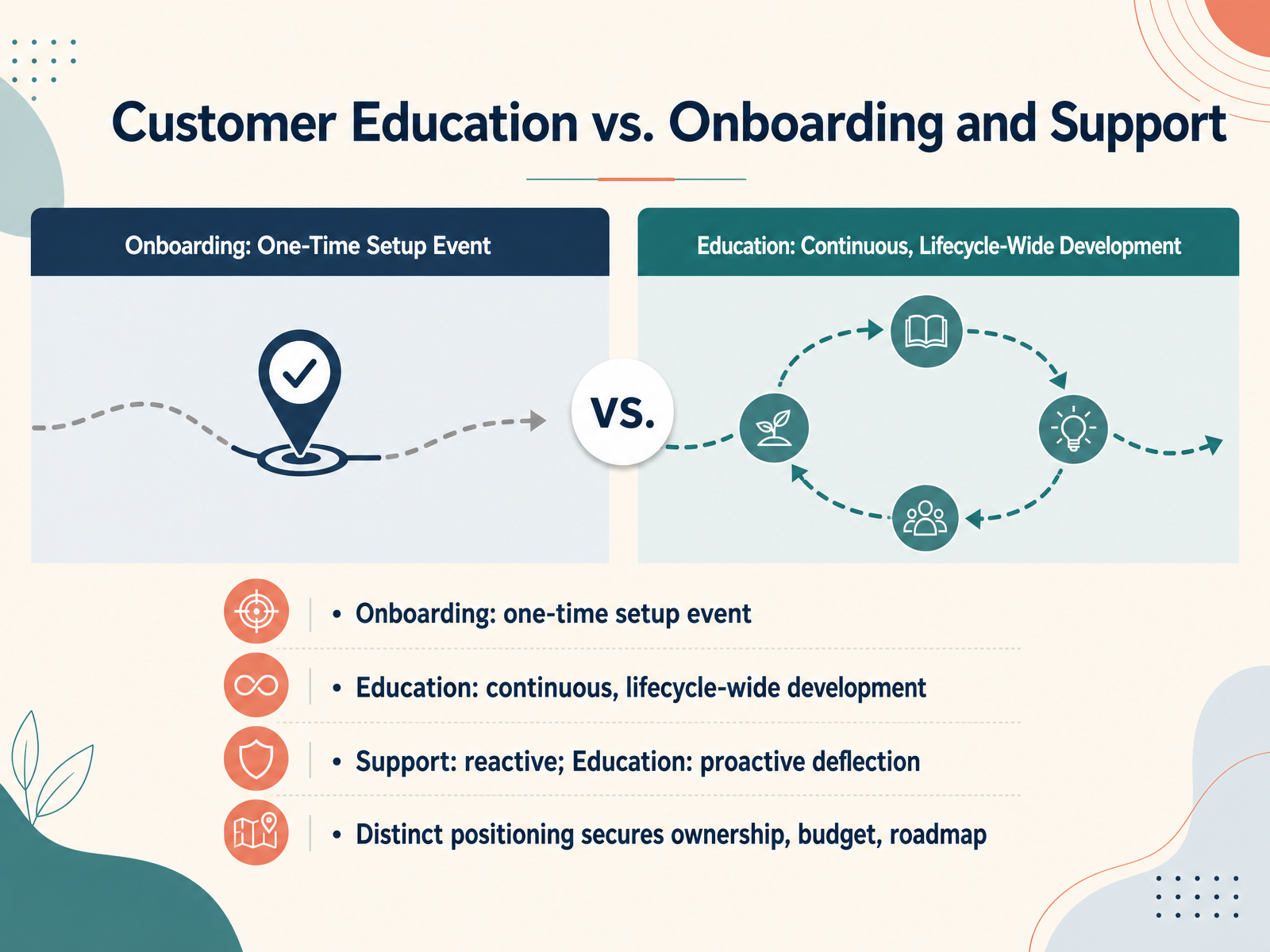
 - 03Customer Education vs. Onboarding and SupportLet's clarify the distinction, because it drives everything you'll do next. Onboarding is a one-time setup event. It gets a customer to first value, often within the first thirty days. Education is different. It's continuous and lifecycle-wide, building capability over months and years. Support is reactive, solving problems after they happen. Education is proactive, preventing those problems before they cost time or churn. You need this positioning, because it secures three things: ownership, budget, and roadmap. If education blurs into support, you'll always fight for headcount. If it blurs into onboarding, you'll never expand beyond the first month. Define it clearly, defend the distinction, and your program earns its own strategic space. Coming up, we'll look at the typical pitfalls and skill gaps to avoid when you're building this out.
 1 min
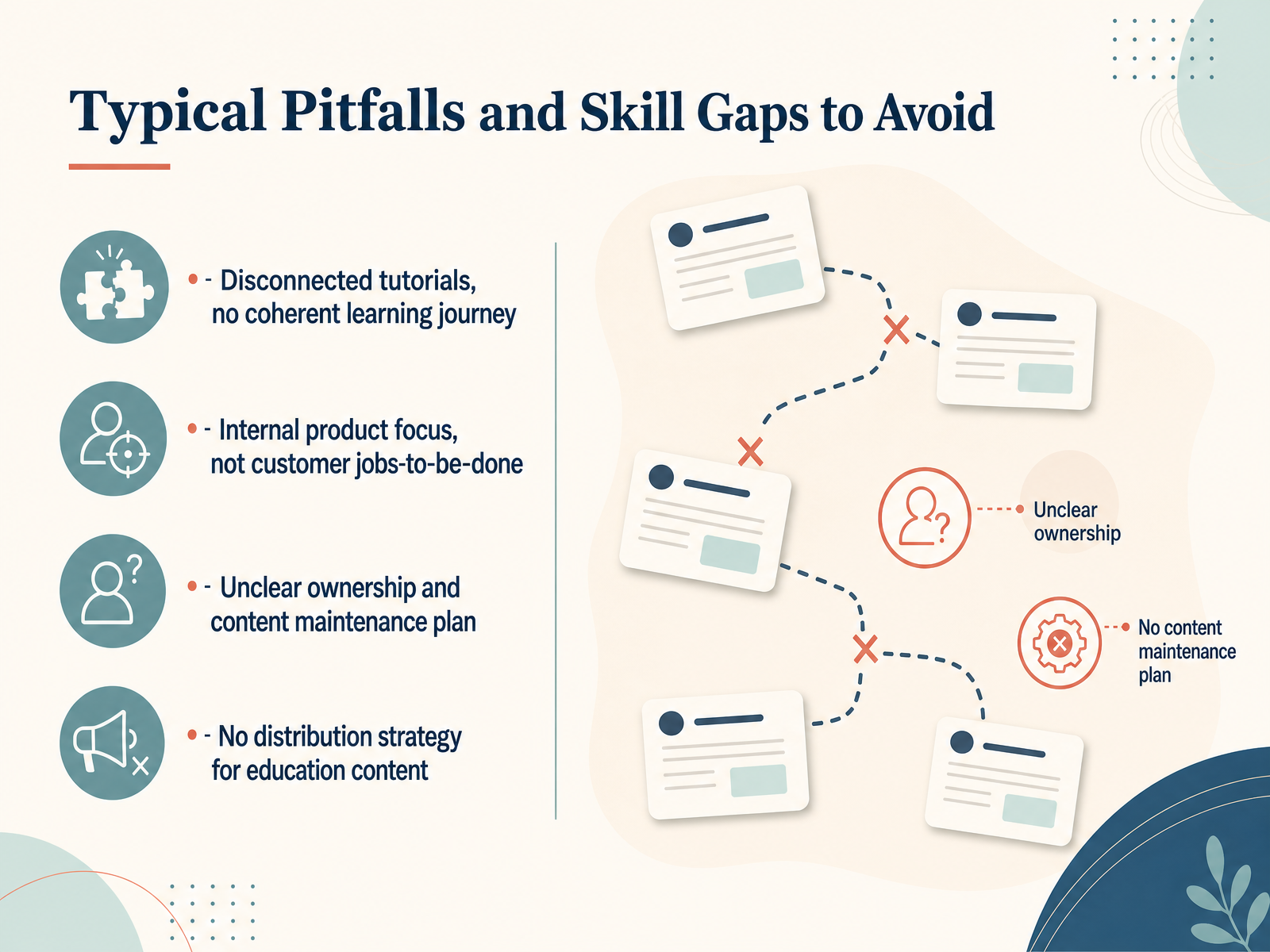
1 min - 04Typical Pitfalls and Skill Gaps to AvoidBefore you build anything, let us look at the four pitfalls that derail most customer education programs. First, disconnected tutorials with no coherent learning journey. A customer who watches a setup video and then a random feature demo is not learning. They are collecting fragments. You need a sequenced path that moves them from first value to mastery. Second, an internal product focus instead of the customer's jobs to be done. Your team knows the features, but the customer only cares about their outcome. Teach the outcome first, and the product becomes the means to get there. Third, unclear ownership and no content maintenance plan. When nobody owns the program, content goes stale, screenshots become outdated, and trust erodes fast. Assign a named owner with a review cadence before you publish anything. Fourth, no distribution strategy. Great content that nobody knows about is a wasted investment. Promote it through onboarding emails, in-app banners, and your customer success team. Avoid these four traps and your program starts from a solid foundation. Next, let us talk about defining your learner segments.
 trainn.coapp-learning.comteachable.com+22 min
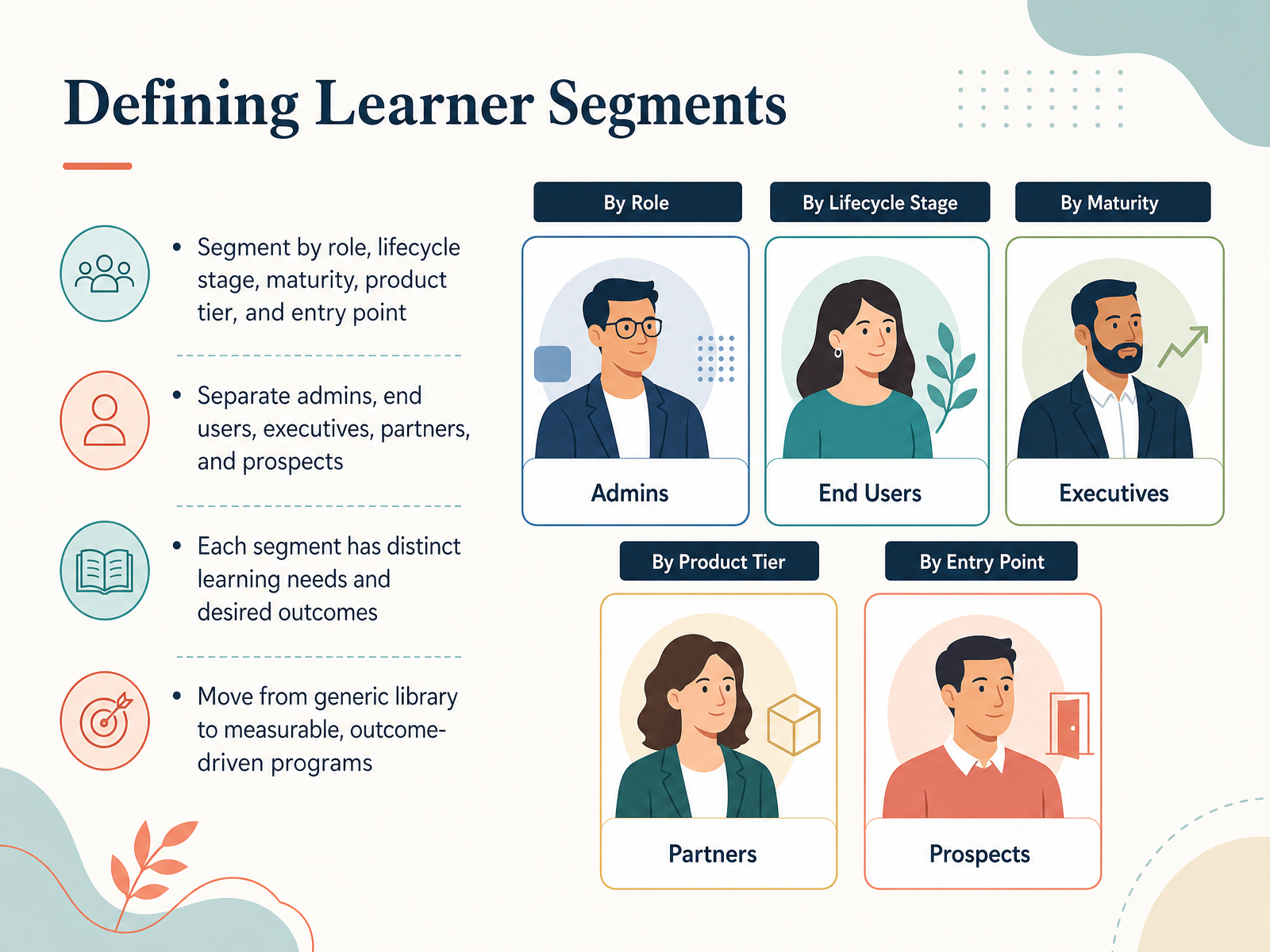
 - 05Defining Learner SegmentsOnce you have your job maps, the next step is translating them into distinct learner segments. Segment by role, lifecycle stage, maturity, product tier, and entry point. This means separating admins from end users, executives from partners, and prospects from active customers. Each of these groups has a different job to be done. An admin needs to configure the system correctly to enable their team. An executive needs to see ROI and strategic value. A partner needs to demonstrate proficiency to sell effectively. The common pitfall here is building one generic library and hoping everyone finds what they need. That approach makes it impossible to measure impact. Instead, design outcome-driven programs for each segment, and you can track whether each group achieves its specific goals. Start this mapping with your cross-functional team to connect each segment to a clear business priority. That alignment turns a content dump into a measurable growth engine. Next, let's look at how to translate these jobs-to-be-done into concrete learning outcomes.
 thoughtindustries.comthoughtindustries.comthoughtindustries.com+22 min
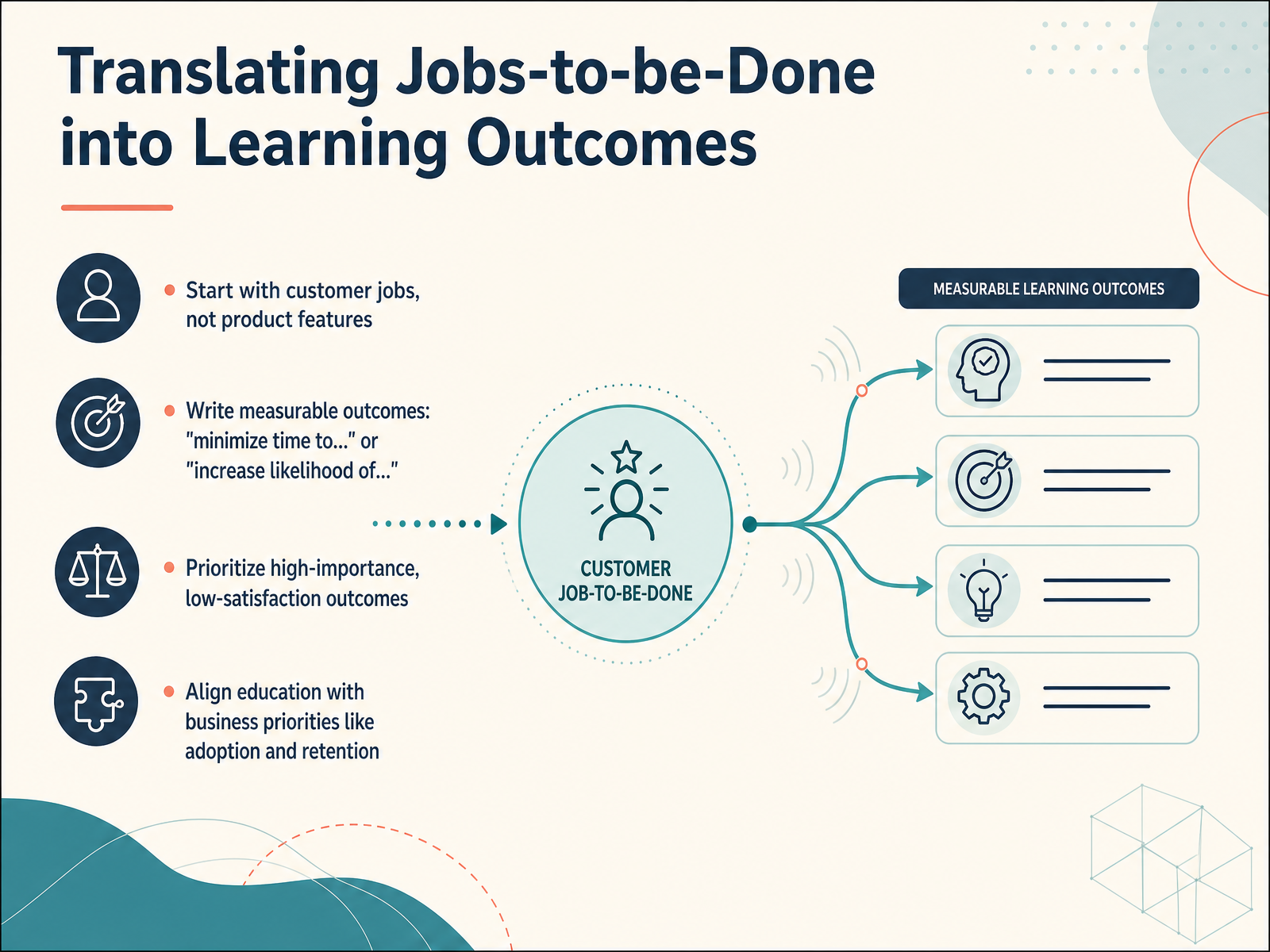
 - 06Translating Jobs-to-be-Done into Learning OutcomesNow let’s turn those customer insights into something you can actually build a curriculum around. Start with the job, not the feature. Your customers aren’t hiring your product because they love its capabilities. They’re hiring it to make progress in a specific situation. So define that job first. Then, write learning outcomes that are measurable. Don’t say customers will understand the dashboard. Say they will minimize the time it takes to generate a weekly report. Or that they will increase the likelihood of completing a contract review in under an hour. Once you have those outcomes, prioritize. Not everything is worth teaching. Focus on the outcomes where importance is high and current satisfaction is low. That’s where education creates the most value and where customers will feel the biggest win. Finally, tie this back to your business. If your priority is adoption, choose outcomes that reflect first-time usage. If it’s retention, focus on outcomes that deepen habits and reduce renewal risk. Measure outcomes, not completions. That’s what makes education a business lever. Now let’s look at how to map these priorities across the entire journey.
 thoughtindustries.comthoughtindustries.comthoughtindustries.com+22 min
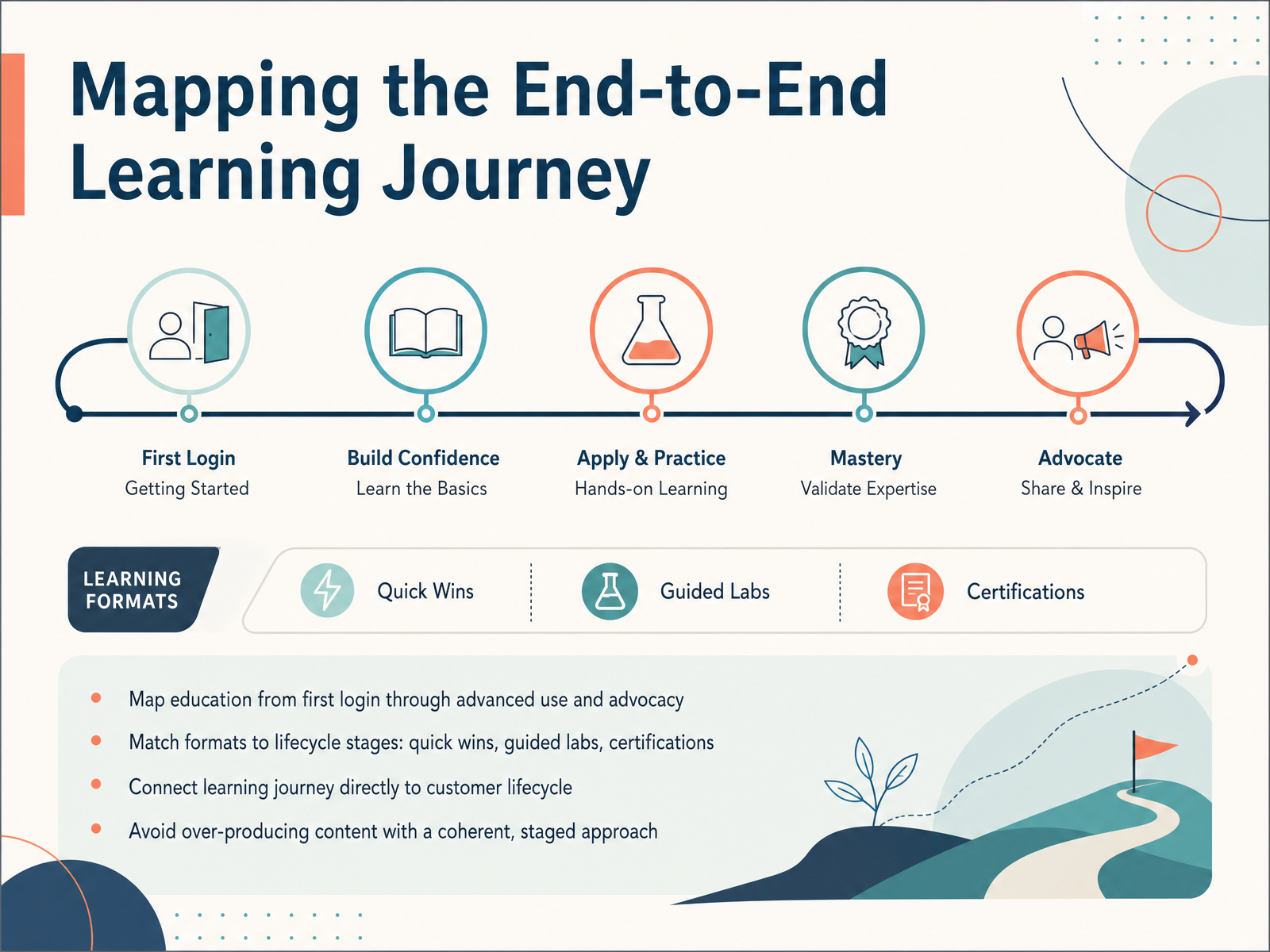
 - 07Mapping the End-to-End Learning JourneyNow let's put the pieces together by mapping the full learning journey. Start by laying out every stage, from first login to advanced use and even advocacy. Your goal is to design a path that guides customers forward. Match the format to each lifecycle stage to keep it relevant. Early on, use quick-win videos that get users to their first success fast. As they build confidence, shift to guided labs that deepen feature adoption. And for your power users, introduce certifications that validate their expertise and turn them into advocates. Connect this learning journey directly to your customer lifecycle so education supports outcomes like activation and retention. One common pitfall is producing too much content too soon. Instead, keep it coherent and staged. Deliver the next lesson only when the customer is ready for it. Build the five lessons that drive first value before you worry about the next forty. Map the journey, match the format, and let the stages guide your content decisions.
 trainn.coapp-learning.comteachable.com+21 min
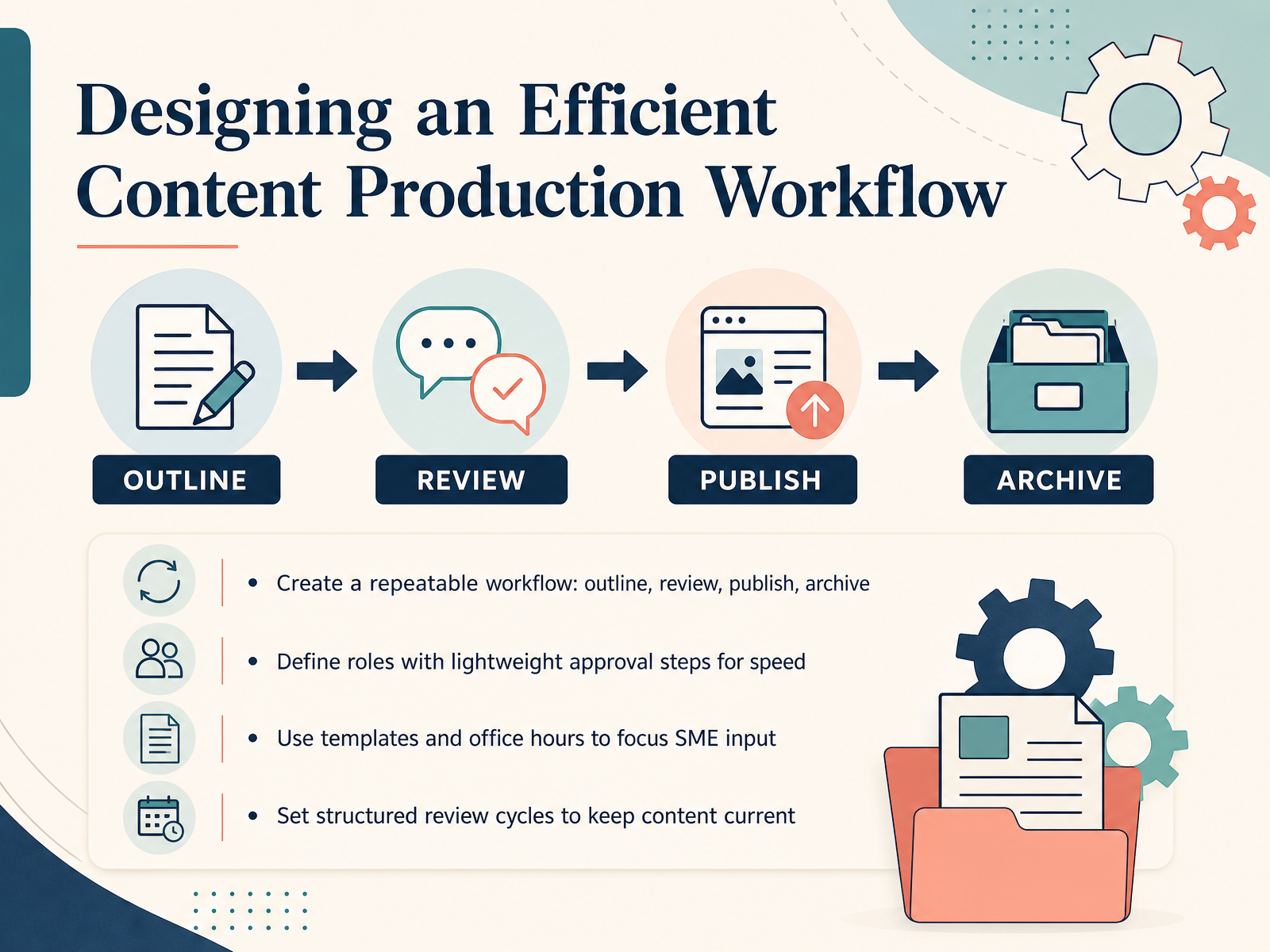
 - 08Designing an Efficient Content Production WorkflowNow let's turn good intentions into a repeatable production line. The goal is simple: get content out efficiently, without sacrificing quality or burning out your team. Start by defining a standard workflow. Outline the lesson, write a first draft, get a light review, publish, and then schedule an archive date. Every asset should have a clear owner and a review cycle. Next, define roles with lightweight approval steps. You want subject matter experts to validate accuracy, not grammar. Give them templates and hold office hours to focus their input, so you are not chasing them for feedback. Set a structured review cadence, quarterly or after every product release, to keep everything current. The common pitfall here is creating heavy workflows that slow you down. Remember, a module that ships today is worth more than a perfect one that ships next month. Start simple, then refine as you scale.
 trainn.coapp-learning.comteachable.com+21 min
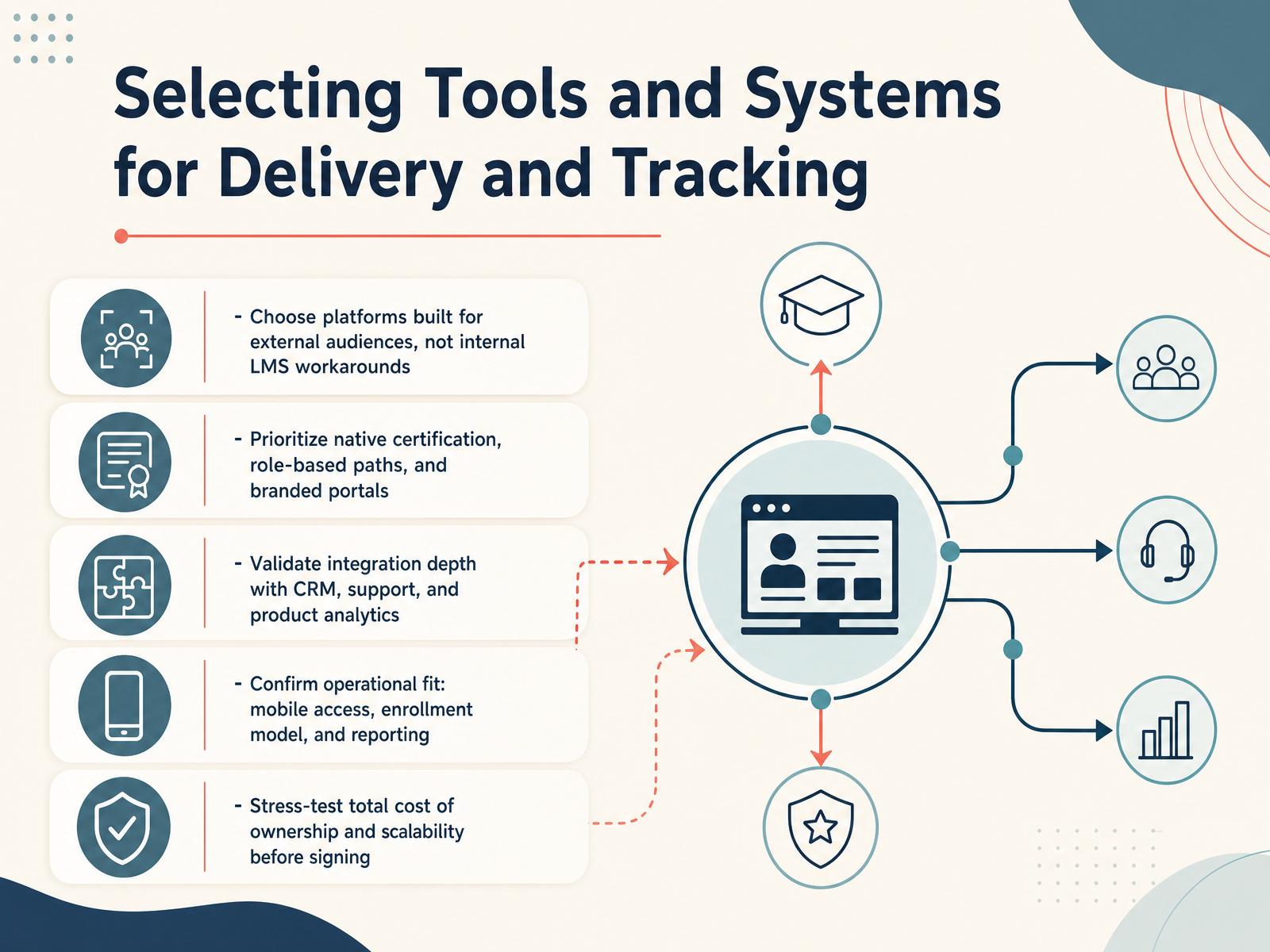
 - 09Selecting Tools and Systems for Delivery and TrackingNow let's talk about the tools. The platform you choose will either accelerate your program or become its biggest bottleneck. Start with platforms built for external audiences. Internal LMS workarounds will fail you on enrollment, branding, and access. Look for native certification, role-based learning paths, and branded portals as core capabilities, not add-ons. Next, validate integration depth before you sign. Your education data needs to flow both ways with your CRM, your support platform, and your product analytics. A platform that can't feed completion data back into your customer health score is a liability. Then, confirm operational fit. Test mobile access on a personal device, check the enrollment model for external users, and ask to see a real location-level report, not a mockup. Finally, stress-test the total cost of ownership. Ask for a written cost projection at one hundred thirty percent and two hundred percent of your current headcount. Per-seat pricing will quietly punish you as your program scales. Get those numbers in writing before you commit. Once you have the platform locked down, the next step is making sure your education data works alongside your business systems. That's where the real ROI shows up.
 teachable.comfirmwater.comzendikt.com+21 min
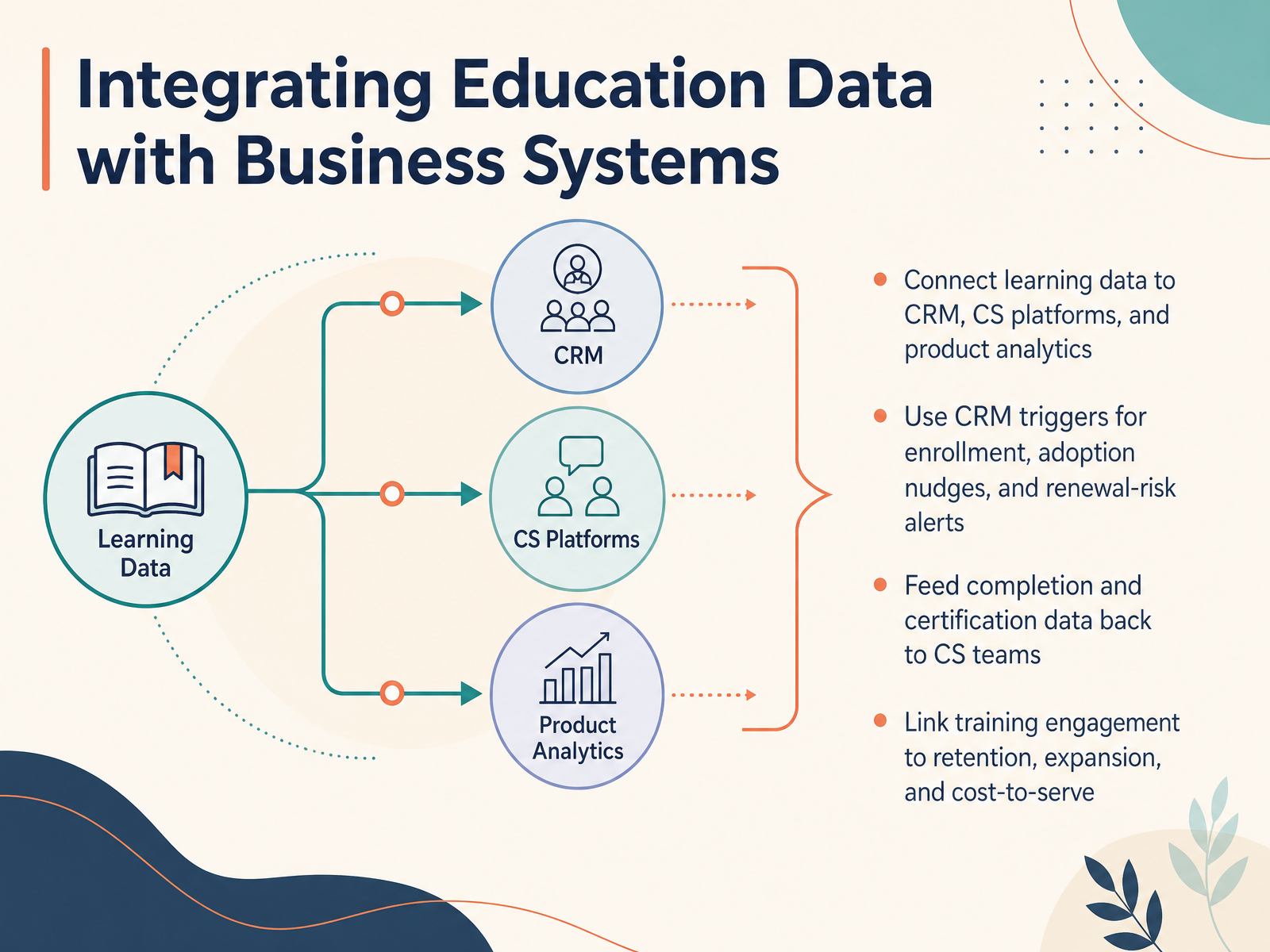
 - 10Integrating Education Data with Business SystemsNow let's talk about where customer education proves its business value: integrating learning data with your business systems. Your education platform shouldn't sit in a silo. Connect it to your CRM, your customer success platform, and your product analytics. A classic example: when a deal closes in your CRM, trigger automatic enrollment in your onboarding path. That removes the manual lift for your team and gets the customer learning immediately. You can also use CRM events to trigger adoption nudges when a user hasn't engaged, or renewal-risk alerts when a key account falls below a training completion threshold. Don't just push data out, though. Feed completion and certification records back to your customer success managers so they have the full picture in their daily workflow. The bigger goal is to link training engagement directly to retention, expansion, and cost-to-serve. When you can show a correlation between completing certification and a higher renewal rate, your program stops being a cost center and becomes a revenue lever. Next, we'll talk about how to launch the program and drive adoption across your customer base.
 teachable.comfirmwater.comzendikt.com+21 min
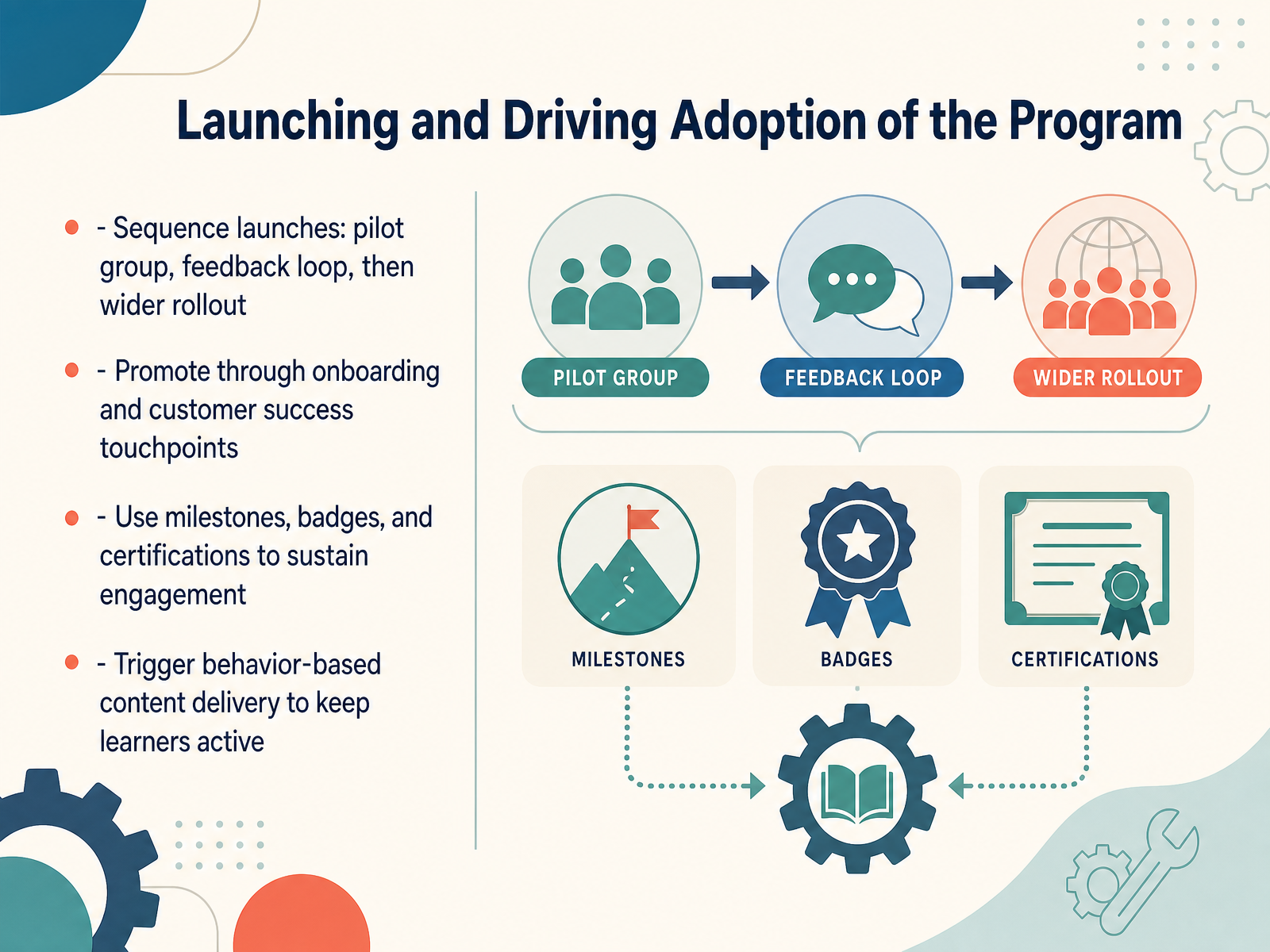
 - 11Launching and Driving Adoption of the ProgramNow let's talk about launching the program and driving adoption. Start with a pilot group, not the entire customer base. Run the program with a small segment, collect feedback, refine the content, and then roll it out wider. Promote the program through onboarding and every customer success touchpoint you already have. Don't expect customers to find it on their own. To sustain engagement, use milestones, badges, and certifications. These create tangible progress and give learners a reason to come back. Finally, trigger content delivery based on behavior. If a user hasn't logged in for two weeks, send a nudge with a relevant lesson. If they complete a module, immediately offer the next one. That keeps the learning loop active without being pushy. Remember, adoption is built through consistent, timely, and relevant engagement. Next, we'll look at how to measure impact across three tiers.
 1 min
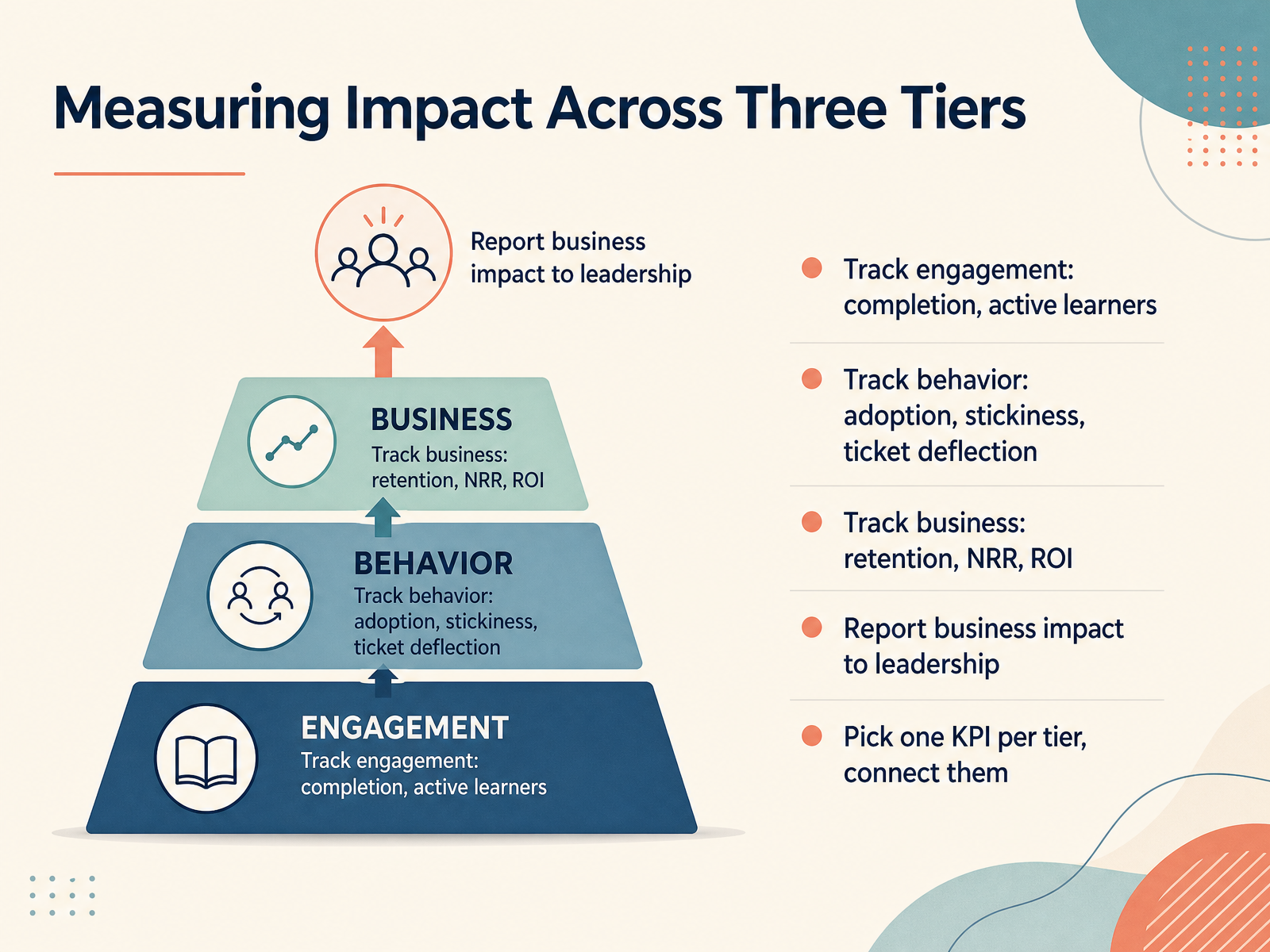
1 min - 12Measuring Impact Across Three TiersNow let's talk about measuring impact across three tiers. The first tier is engagement: are learners actually showing up and finishing? Track completion rate and active learners. But engagement alone won't convince anyone. The second tier is behavior change. Did learning change what customers do in your product? Track adoption, stickiness, and ticket deflection. The third tier is business impact. This is what leadership funds. Track retention, net revenue retention, and ROI. Here's the practical move: pick one KPI from each tier, and connect them. For example, if your objective is cutting support costs, track course completion for engagement, ticket deflection for behavior, and support cost per customer for business impact. Then report the business number to leadership, and use the other two to explain it. The common pitfall is reporting all three tiers to everyone. Executives only need tier three. Your team uses tiers one and two to diagnose. Keep it simple: one KPI per tier, connected in a clear story. That's how you prove value and keep your program funded. Next, let's look at iterating the program with data.
 trainn.cotrainn.cocheck-n-click.com1 min
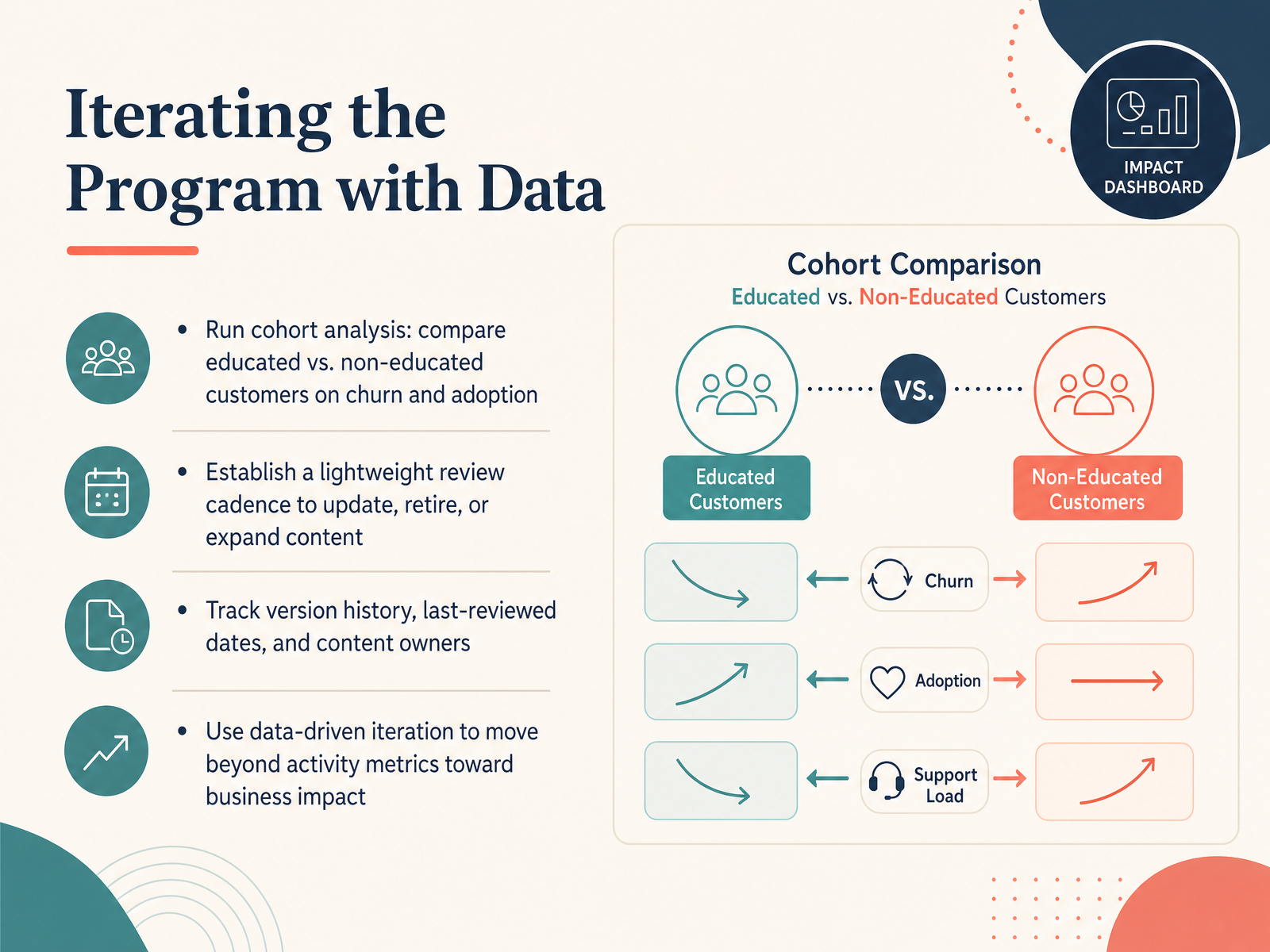
 - 13Iterating the Program with DataNow let's talk about iterating with data. This is where you move from reporting activity to proving impact. Start by running cohort analysis. Compare customers who completed your training against those who didn't, on the metrics leadership actually cares about: churn, adoption, and ticket deflection. You want to see a measurable gap, like educated customers showing a seven percent higher retention rate or opening twenty percent fewer tickets. That gap is your business case. Next, establish a lightweight review cadence. Every quarter, review your content library and decide what to update, retire, or expand based on that data. For each piece of content, track version history, the last-reviewed date, and who owns it. If a video hasn't been touched in six months, flag it. This keeps your library from becoming stale. The shift here is important. You're moving beyond activity metrics like completions and views, toward business impact. A high completion rate means nothing if churn stays flat. Tie your education data to retention, expansion, and support cost reduction. That's what earns the next round of budget. Keep it simple: one engagement metric, one behavior metric, and one impact metric, all connected. That's your iteration loop. Next, let's turn this into your ninety-day action plan.
 trainn.cotrainn.cocheck-n-click.com1 min
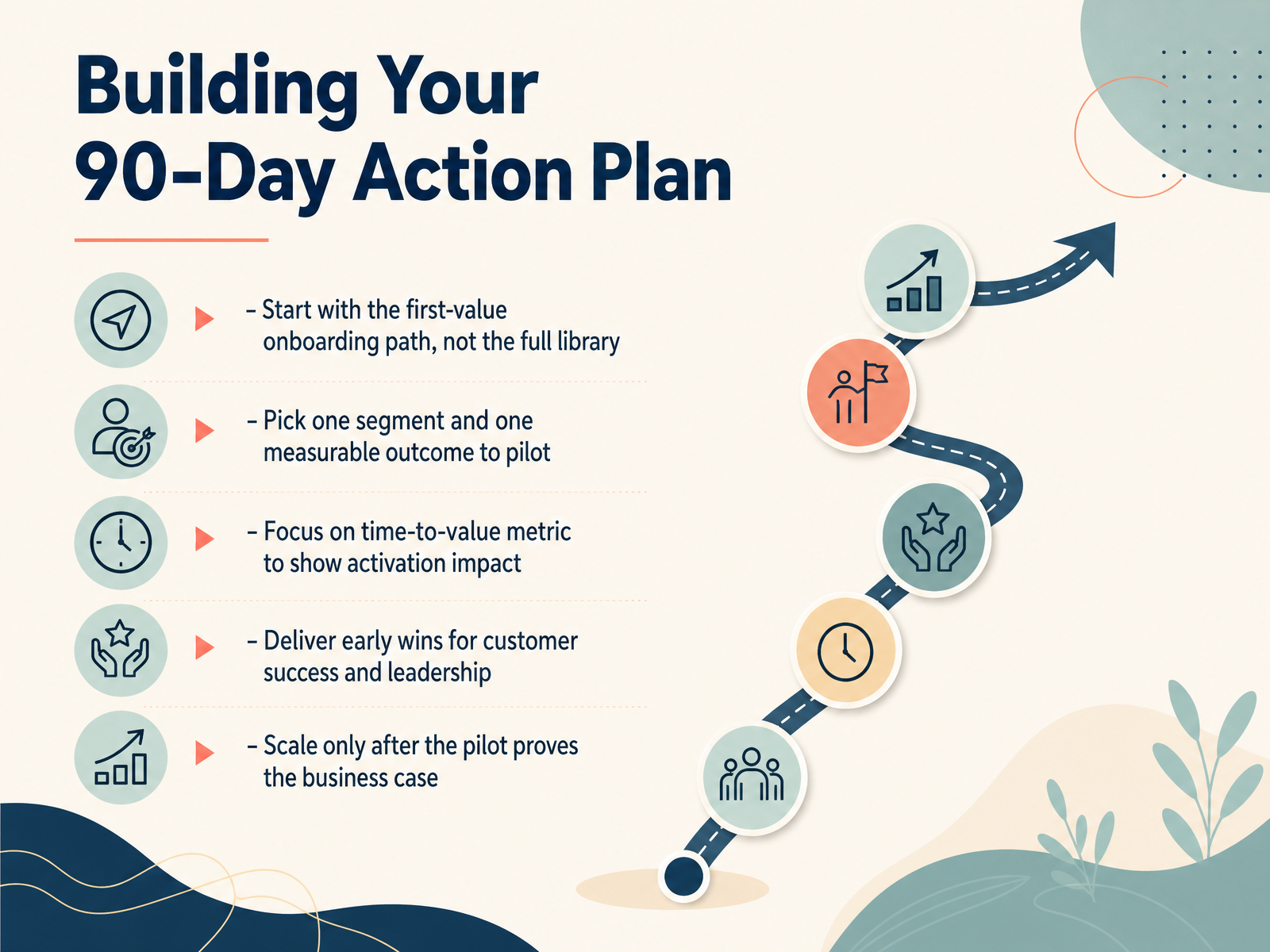
 - 14Building Your 90-Day Action PlanYou've now got the framework, the metrics, and the playbook. This last slide is about turning that into action. Don't try to build the entire library at once. Start with the first-value onboarding path. Pick one customer segment and one measurable outcome to pilot. Focus on time-to-value, because faster activation is the clearest early signal that education works. Customers who reach value in under seven days retain at nearly double the rate of those who take thirty days or more. Deliver those early wins to customer success and leadership, so the program has visible momentum. Only after the pilot proves the business case should you scale. Remember the maturity curve: start with content, move to engagement, then prove business impact. Track one metric from each tier, and connect them. You're not chasing completion rates; you're driving adoption, retention, and revenue. Start small, measure what matters, and let the results speak. Thank you for your focus. Now go build the program that turns education into growth.
 trainn.cotrainn.cocheck-n-click.com1 min
Take the deck with you
Download this course as a file — free, no sign-up needed.
- PDF handoutEvery slide page, ready to print or share.15 pages · 3.0 MBDownload
- Narrated PowerPointThe deck that presents itself — every slide carries the digital human's narration video.15 pages · 15.4 MBDownload
- PowerPoint slidesThe full deck as a .pptx — open it in PowerPoint, Keynote, or Google Slides.15 pages · 2.9 MBDownload
Free to use in your own training — please keep the PersonWise credit page at the end.
Have your own deck? Turn it into a course
Sources consulted
Web sources consulted while building this course.
- Customer Education Metrics: 14 to Track (2026) | Trainn — trainn.co
- 7 Data-Backed Benefits of Customer Education (2026) | Trainn — trainn.co
- The state of customer education in 2026 | Absorb LMS Software — absorbai.com
- Customer Education Statistics 2026: Sourced and Dated Data — minicoursegenerator.com
- Customer Education Metrics Guide: Proving ROI (2026) — check-n-click.com
- Customer Education Best Practices: 12 Proven (2026) | Trainn — trainn.co
- How to Build a Customer Education Strategy That Scales — app-learning.com
- How to build a customer education program → Teachable — teachable.com
- Building a Customer Academy for Education-Led Growth — talentedlearning.com
- Customer Education in SaaS: The Complete Guide | LearnWorlds — learnworlds.com
- Accelerate Product Adoption with Targeted Learning — thoughtindustries.com
- Education Without Segmentation Is Strategy Without ROI - Thought Industries — thoughtindustries.com
- Product Adoption: A Growth Engine for Success — thoughtindustries.com
- #26 Your CE Team Should Be Leading Your Use Case Framework — learningbydesign.beehiiv.com
- Influencers vs. buyers: Customer education strategy 101 | Absorb LMS Software — absorblms.com
- How to choose a customer education platform → Teachable — teachable.com
- Choosing a Customer Training LMS That Drives Adoption — firmwater.com
- Top 10 Customer Education Software for 2026 — zendikt.com
- Best LMS for Customer Training in 2026 — intellum.com
- Customer LMS Statistics: 42 Benchmarks For Business Buyers — talentedlearning.com