Begin
14 pages · ~28 min
Corroborating Sources and Resolving Conflicting Accounts
This training teaches professionals how to corroborate sources and resolve conflicting accounts, building the verification skills needed to assess information reliability.
A digital instructor presents all 14 pages. Hold “Ask” at any point and ask out loud — the answer comes from this course. No sign-up needed.
What you’ll learn
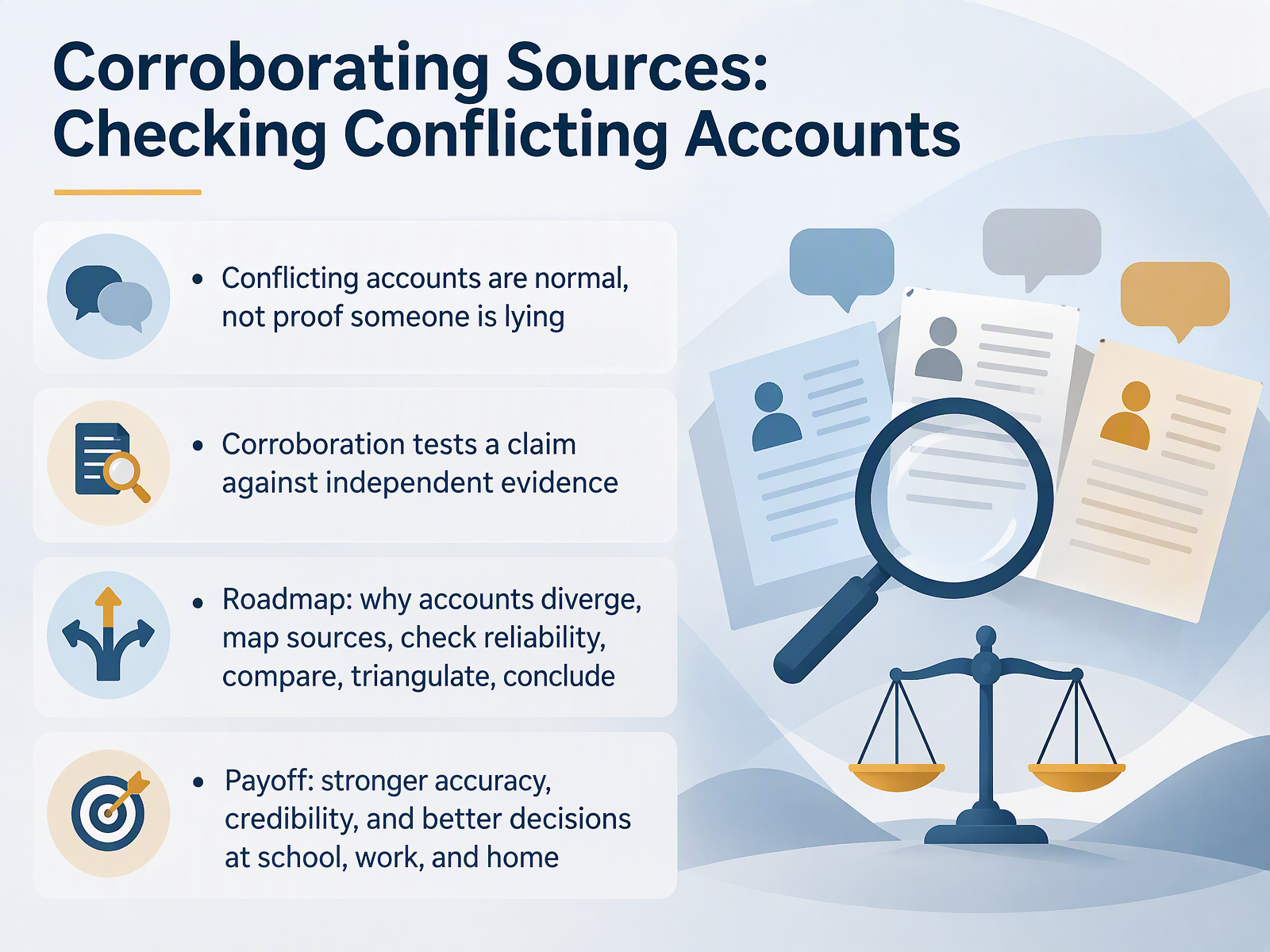
- 01Corroborating Sources: Checking Conflicting AccountsWelcome. Today we're going to talk about corroborating sources, and specifically how to check conflicting accounts. Here's the goal for our time together: to help you sort through information with confidence, at school, at work, and at home. Let's start with one idea that matters. Conflicting accounts are normal. They are not proof that someone is lying. People see events from different angles, remember different details, and describe things in different words. Corroboration is the skill of testing a claim against independent evidence, so you can see what actually holds up. Over the next few slides, we'll follow a roadmap. First, why honest accounts diverge. Then we'll map our sources, check their reliability, compare what they say, triangulate the evidence, and reach a reasoned conclusion. The payoff is real. Stronger accuracy, better credibility, and better decisions. In the next slide, we'll look at why honest accounts diverge in the first place.libguides.princeton.edusocialsci.libretexts.orgguides.library.uwm.edu+21 min
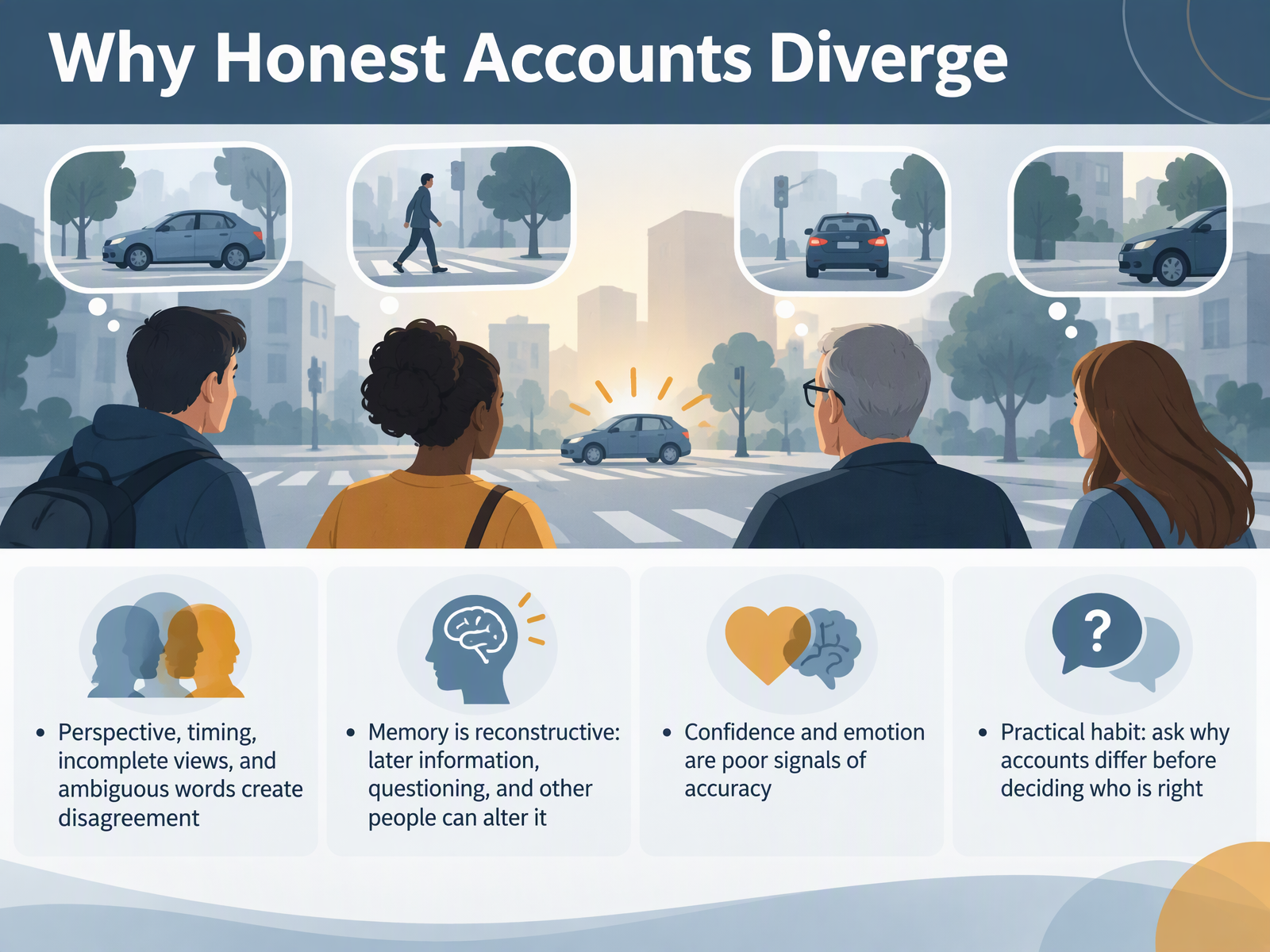
- 02Why Honest Accounts DivergeLet's look at why honest accounts diverge. Four things often cause it: perspective, timing, incomplete views, and ambiguous words. Two people can stand in different places, see the event at different moments, and still each describe it truthfully. Words matter too. If no one defines "late" or "near," people may disagree without truly disagreeing. Memory also works this way. It is reconstructive, not a recording. Later details, new questions, and other people's accounts can blend into what someone remembers. And confidence and emotion are poor signals of accuracy. A person can be certain and moved, and still be wrong. So before deciding who is right, ask why the accounts differ. Did they see the same thing from the same place? Did their memories get shaped afterward? That habit keeps you fair and careful. When the Divergence Is Deliberate.
 pnas.orgjournals.sagepub.comcell.com+21 min
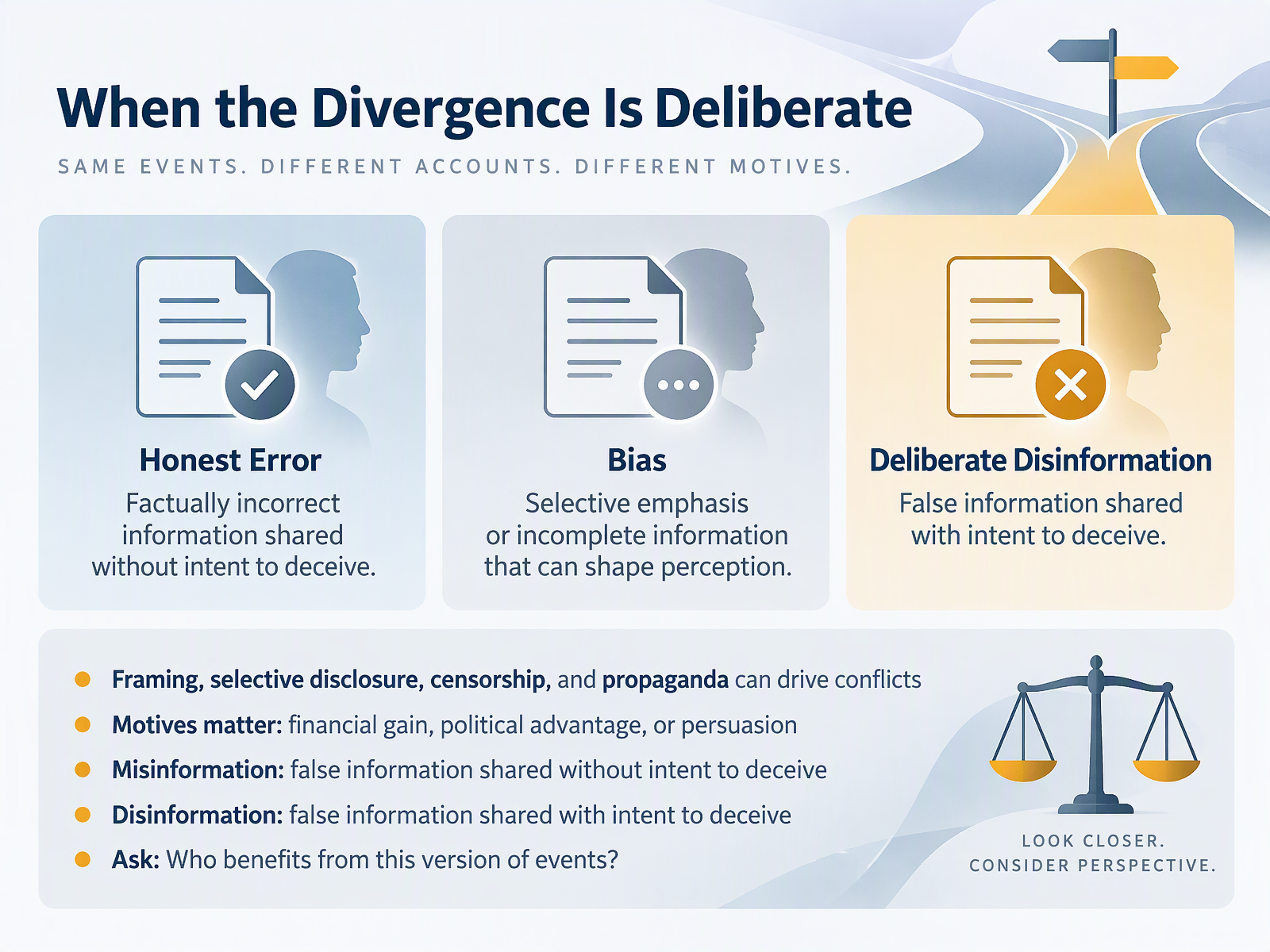
- 03When the Divergence Is DeliberateSo far we have looked at why accounts can differ. Now let's look at what happens when the difference is deliberate. Sometimes the conflict is created on purpose. Framing, selective disclosure, censorship, and propaganda can all push different versions of the same event. Motives matter here. Ask whether someone stands to gain money, political advantage, or simply the power to persuade you. There is also an important distinction to keep straight. Misinformation is false information shared without intent to deceive. Disinformation is false information shared with intent to deceive. Same false claim, different intent behind it. So when versions of a story conflict, end with one practical question. Who benefits from this version of events? That question will help you judge what you are reading. Next, we will look at Primary, Secondary, and Tertiary Sources.
 unesco.orglibrary.gov.aulibguides.palni.edu+21 min
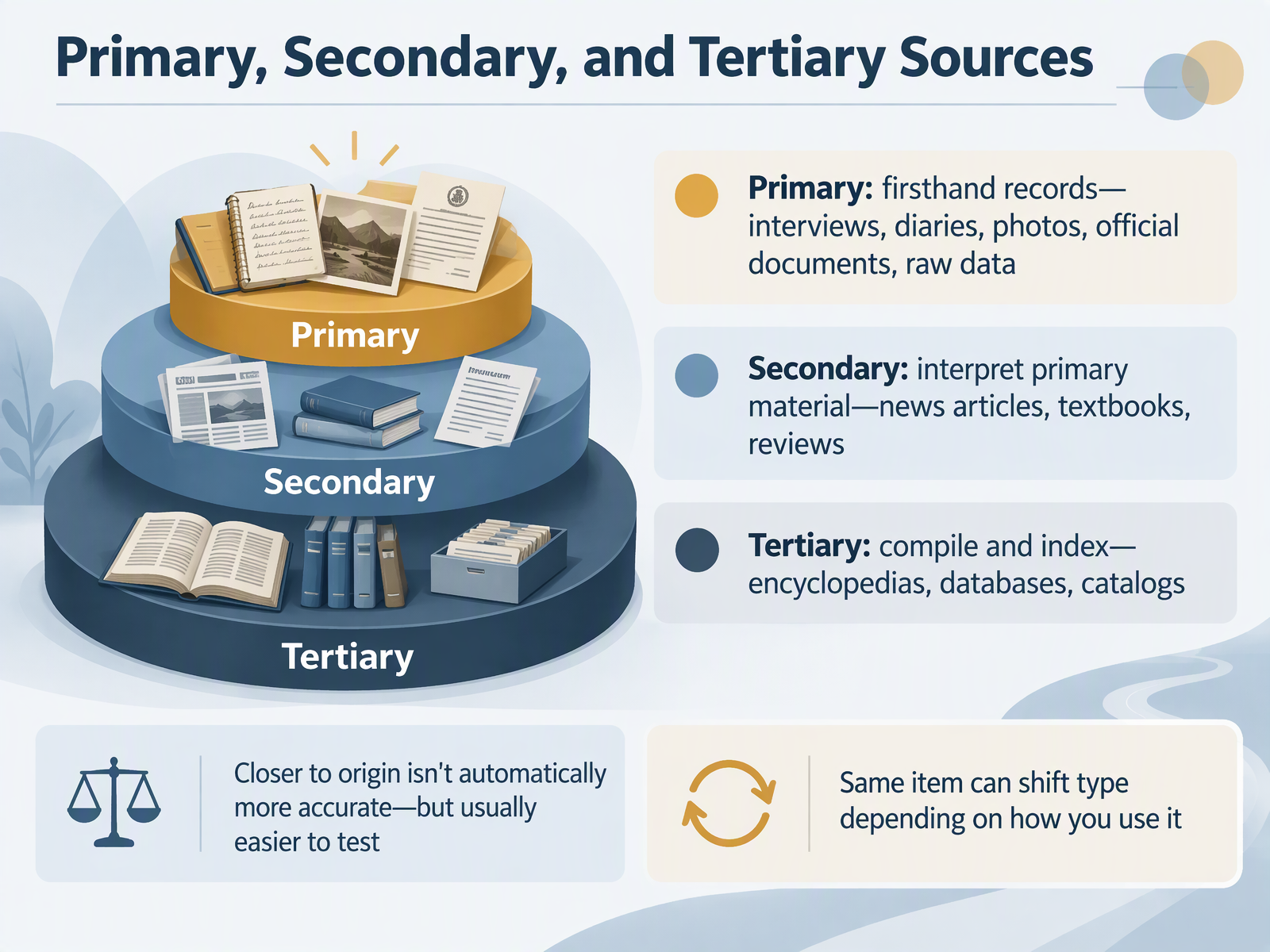
- 04Primary, Secondary, and Tertiary SourcesLet's talk about the three main types of sources you'll encounter. Primary sources are firsthand records. Think interviews, diaries, photographs, official documents, or raw data from a study. Secondary sources interpret primary material. News articles, textbooks, and reviews are good examples. Tertiary sources compile and index information, like encyclopedias, databases, and library catalogs. Here's a key point. Being closer to the origin doesn't automatically make a source more accurate. But it usually makes the information easier to test. Also, the same item can shift type depending on how you use it. A textbook is normally secondary, but if you're studying how textbooks are written, it becomes a primary source. So always ask what role a source is playing for your question. Building a Simple Source Map.
 unesco.orglibrary.gov.aulibguides.palni.edu+21 min
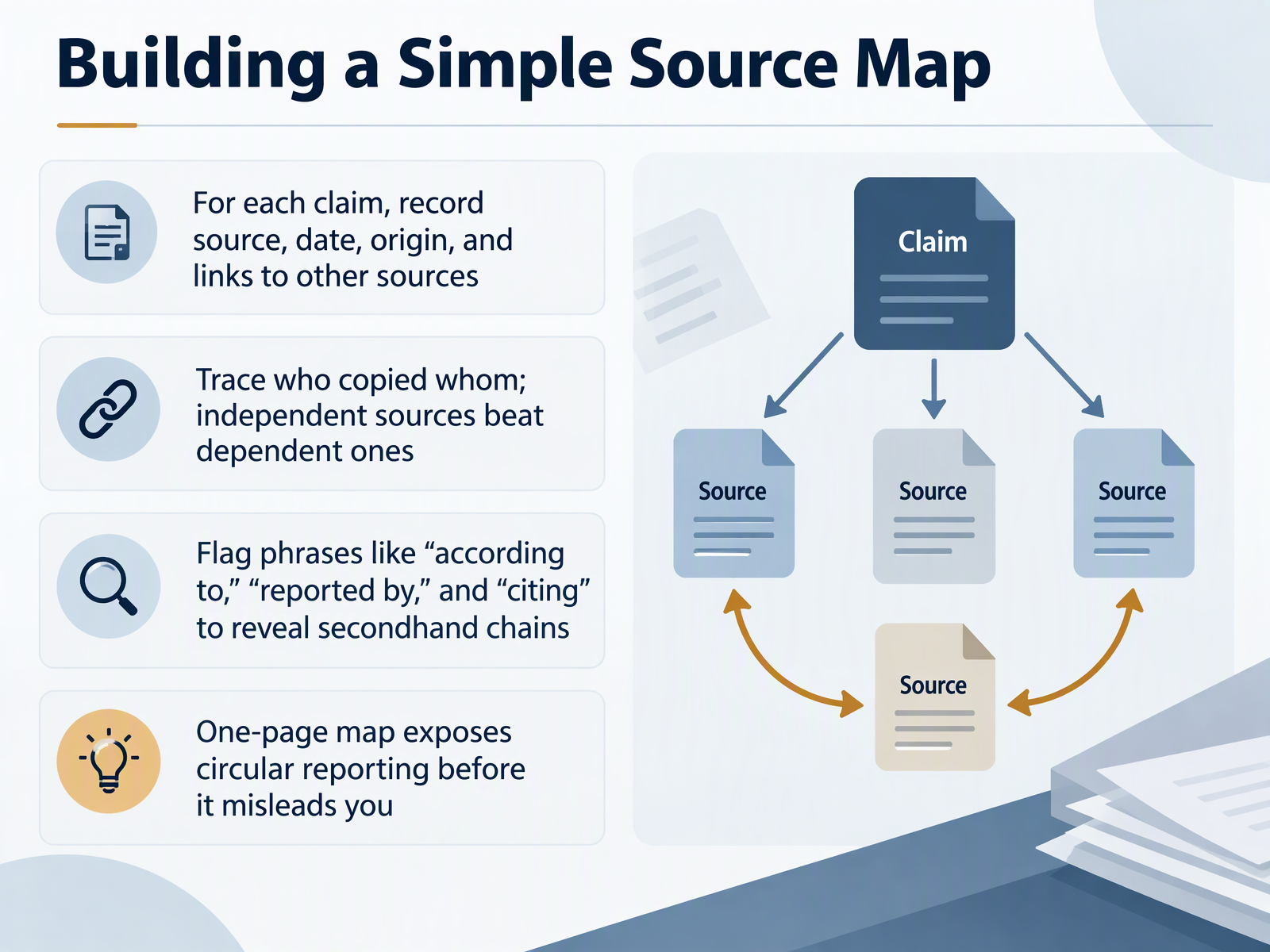
- 05Building a Simple Source MapNow let's turn that checking into something you can see: a simple source map. For each claim, record four things: the source, the date, the origin, and any links to other sources. Then trace who copied whom. Independent sources beat dependent ones, because dependent sources are really the same voice repeated. Watch for phrases like according to, reported by, and citing. They often reveal a secondhand chain. Keep the whole map to one page, so patterns stand out. When several outlets trace back to a single origin, you have circular reporting, and the map shows it before it can mislead you. Put that one-page habit to work with four quick reliability checks.
 en.wikipedia.orgmediahelpingmedia.orgcambridge.org+21 min
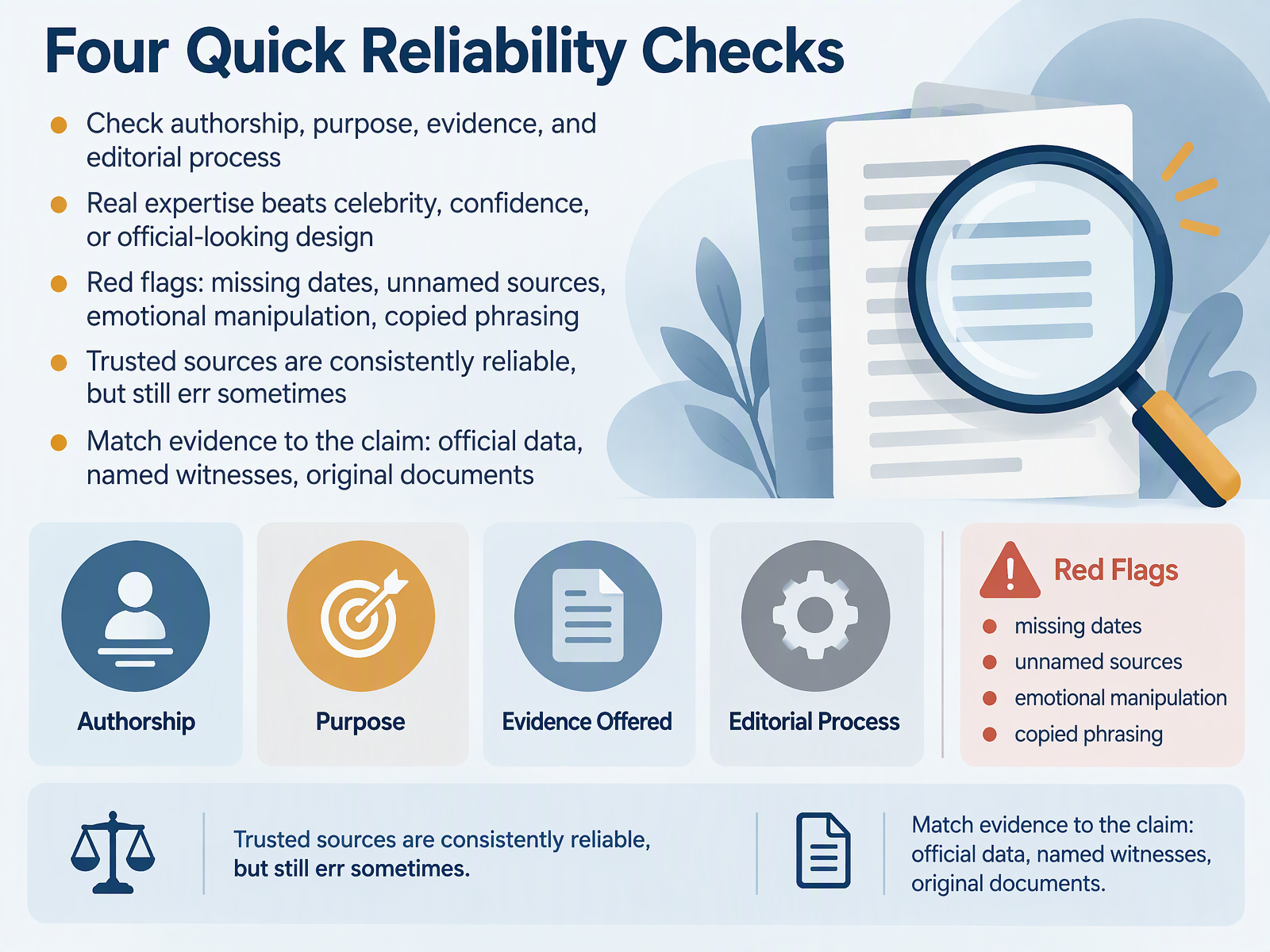
- 06Four Quick Reliability ChecksLet's move on to four quick reliability checks you can run on any source. First, check authorship, purpose, evidence, and editorial process. Real expertise beats celebrity, confidence, or an official-looking design. Second, watch for red flags. Missing dates, unnamed sources, emotional manipulation, and copied phrasing all deserve a closer look. Third, remember that trusted sources are consistently reliable, but they still err sometimes. A good outlet can get something wrong. Fourth, match the evidence to the claim. Official data for statistics, named witnesses for events, and original documents for quotes or records. And if several reports trace back to one origin, that is repetition, not confirmation. Keep these checks in your routine. Next, we'll look at lateral reading and click restraint.
 unesco.orglibrary.gov.aulibguides.palni.edu+22 min
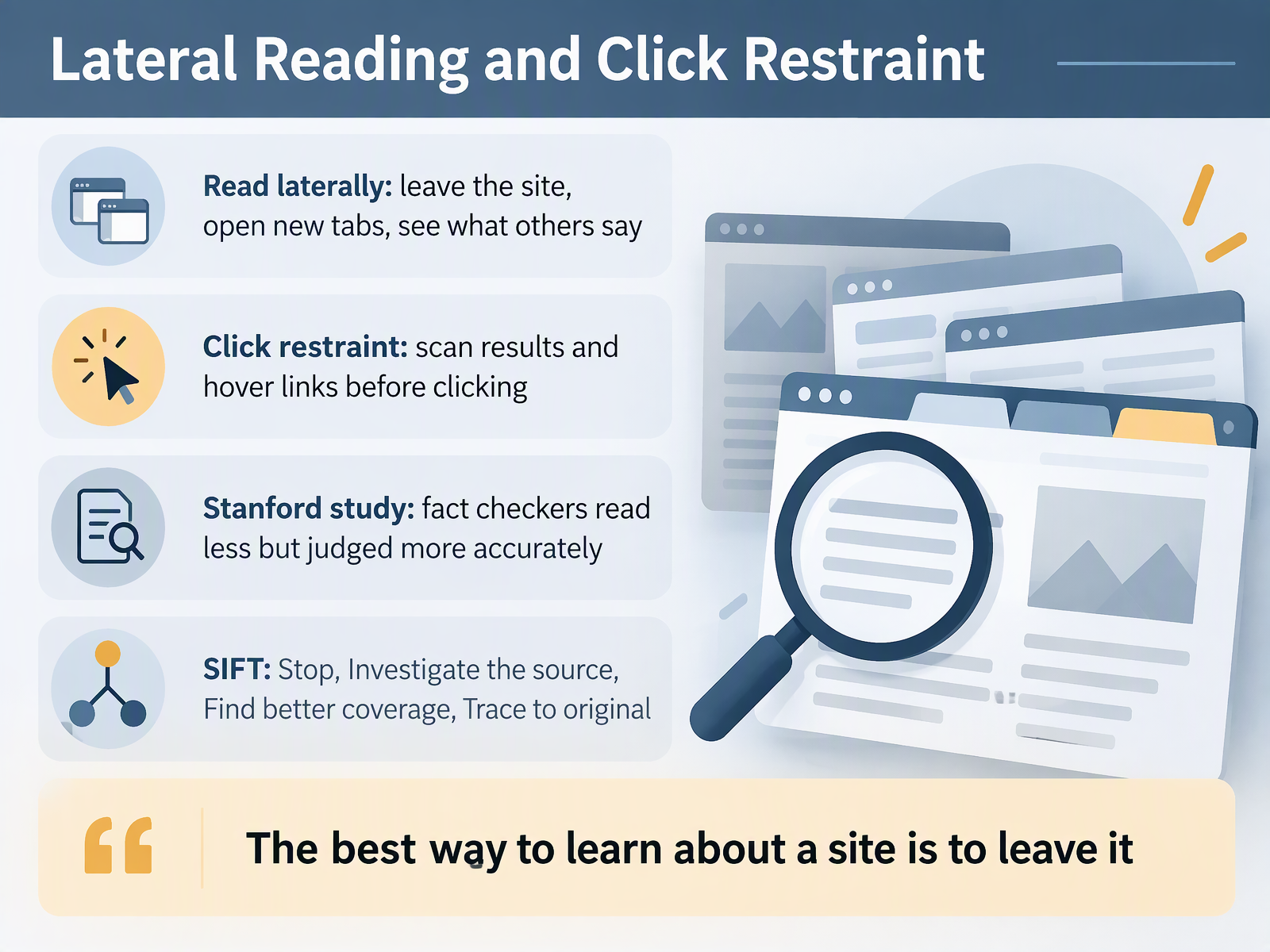
- 07Lateral Reading and Click RestraintNow let's look at two habits that professional fact checkers use. The first is lateral reading. Instead of staying on one site and reading it closely, you leave. You open new tabs and see what other sources say about that site. The second habit is click restraint. Before you click a search result, pause. Scan the list and hover over the links to see where they lead. A Stanford study found that fact checkers read less than other groups, yet judged accuracy more often. They reached better conclusions in a fraction of the time. A simple way to remember this approach is SIFT. Stop. Investigate the source. Find better coverage. Trace claims back to the original. Here is the key idea. The best way to learn about a site is to leave it. So when a source feels unfamiliar, step away and check what others say. Next, we'll look at separating claims from evidence.
 libguides.princeton.edusocialsci.libretexts.orgguides.library.uwm.edu+21 min
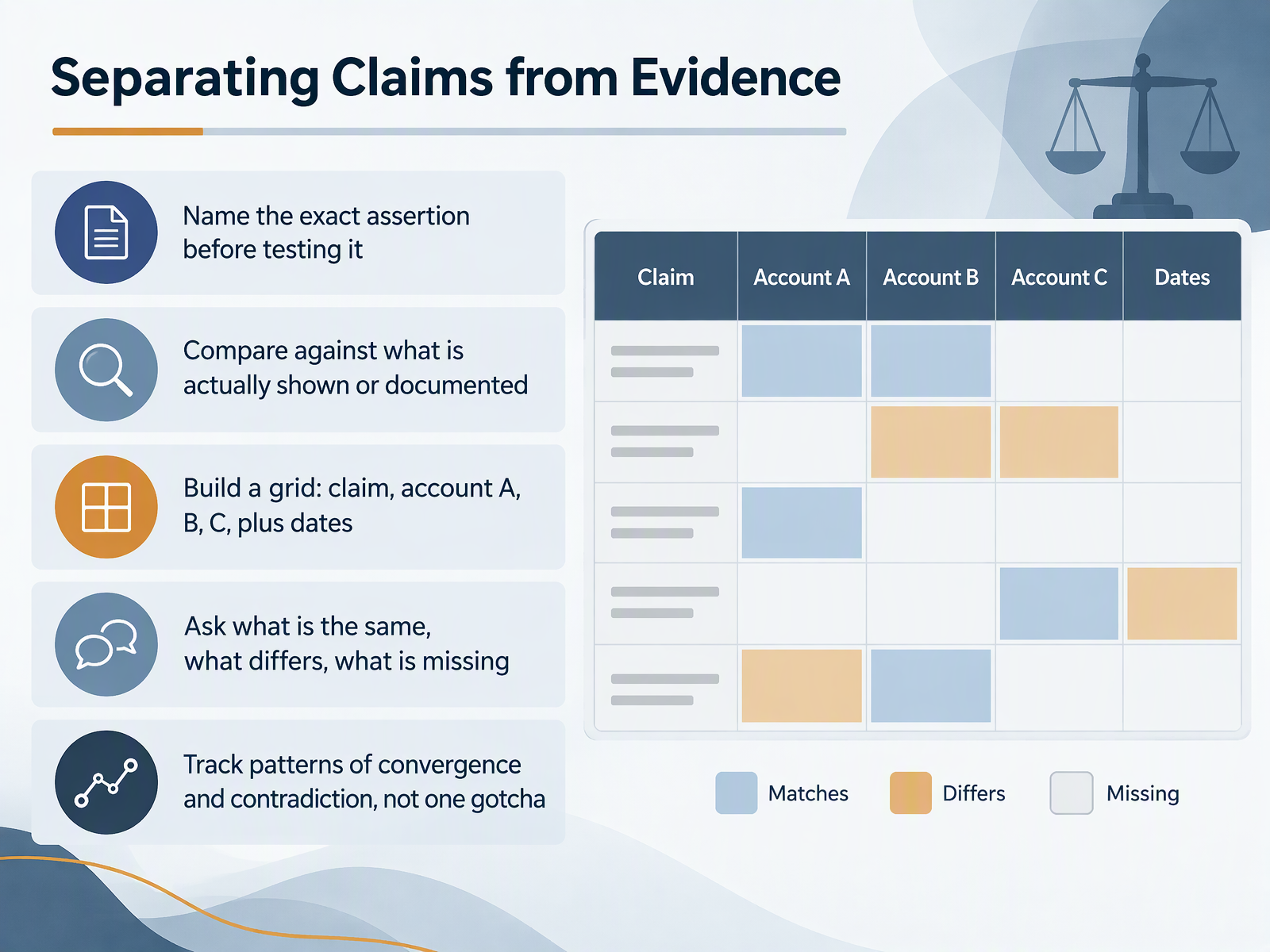
- 08Separating Claims from EvidenceNow let's separate claims from evidence. Before you test any claim, say the exact assertion out loud, in plain words. A vague worry is hard to check. A specific statement is not. Next, compare that statement against what is actually shown or documented. A claim is what someone says happened. Evidence is the document, the recording, the data, or the direct witness account. Then build a simple grid. Put the claim in one column, and each account in its own column after it. Label each account, A, B, and C, and add the date for every one. With the grid in front of you, ask three questions. What is the same? What differs? What is missing? Remember, the goal is not to catch one gotcha. It is to track patterns of convergence and contradiction over time. Take a school event, for example. Two accounts agree on the date. They disagree on who spoke first. And neither mentions the schedule change posted later that day. That pattern tells you more than any single detail. So name the claim, compare it to the evidence, and watch the patterns. Next, we will look at triangulating independent evidence.
 libguides.princeton.edusocialsci.libretexts.orgguides.library.uwm.edu+22 min
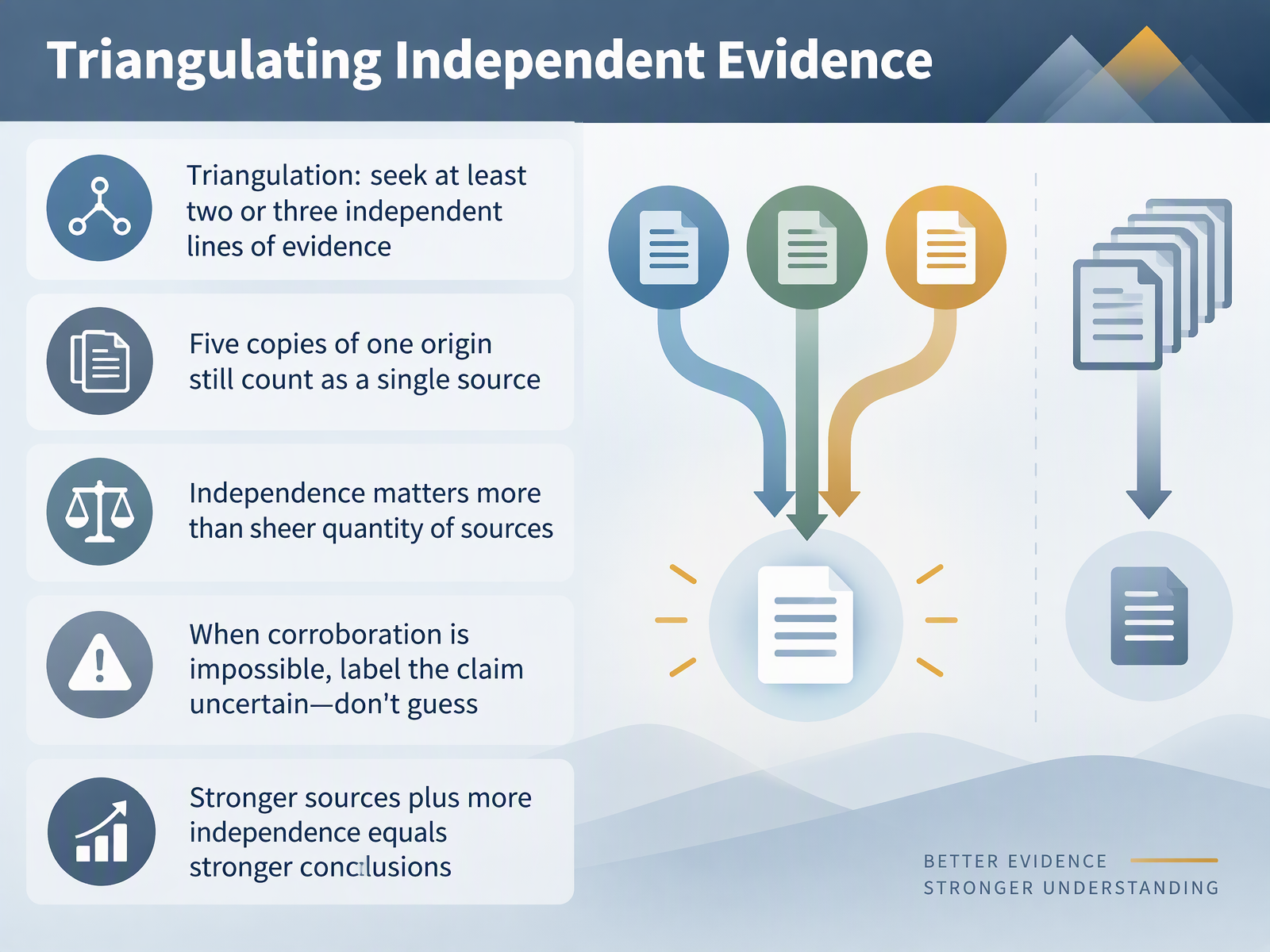
- 09Triangulating Independent EvidenceNext, let's talk about triangulating independent evidence. Triangulation means seeking at least two or three independent lines of evidence before you settle on a conclusion. Here's the catch. Five copies of one original report still count as a single source. Repetition is not confirmation. Independence matters more than sheer quantity. For example, ten articles that all trace back to one press release give you one source, not ten. So when corroboration is impossible, label the claim uncertain. Don't guess. And remember the formula: stronger sources plus more independence equals stronger conclusions. Next, we'll look at common traps, including false balance and circular reporting.
 en.wikipedia.orgmediahelpingmedia.orgcambridge.org+21 min
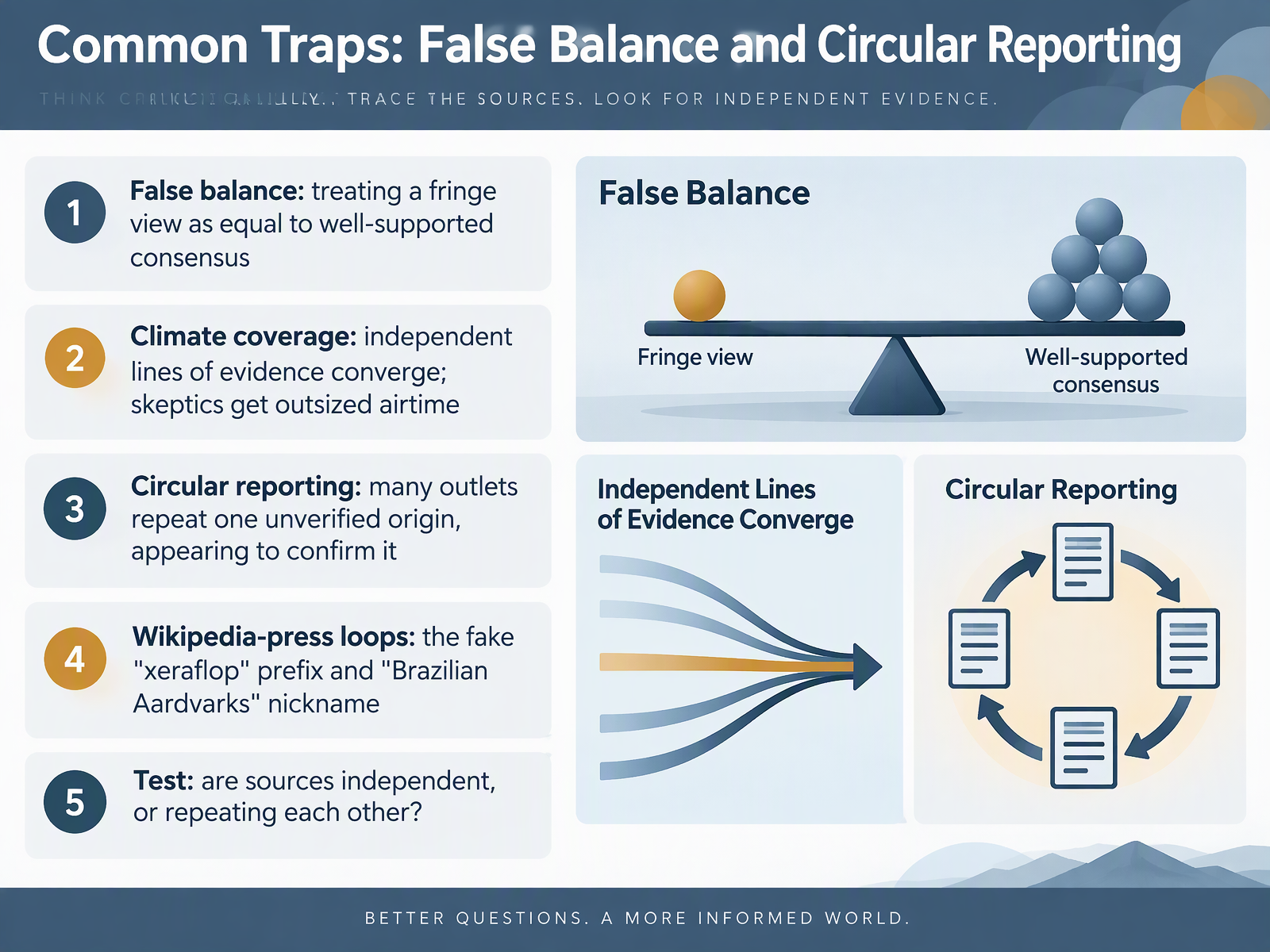
- 10Common Traps: False Balance and Circular ReportingNow let's look at two traps that can make weak sources look strong. The first is false balance. That means treating a fringe view as equal to a well-supported consensus. In climate coverage, independent lines of evidence converge on the same conclusion, yet skeptics sometimes get outsized airtime. That makes a settled question look like an open debate. The second trap is circular reporting. Many outlets repeat one unverified origin, so it appears confirmed. A classic case involves Wikipedia and the press. A user added a fake xeraflop prefix to a Wikipedia page, and a major newspaper repeated it. And a made-up Brazilian Aardvarks nickname for the coati spread into many outlets. So here is your test. Ask whether your sources are independent, or just repeating each other. That question will serve you well as we turn to biases in ourselves and our sources.
 en.wikipedia.orgmediahelpingmedia.orgcambridge.org+21 min
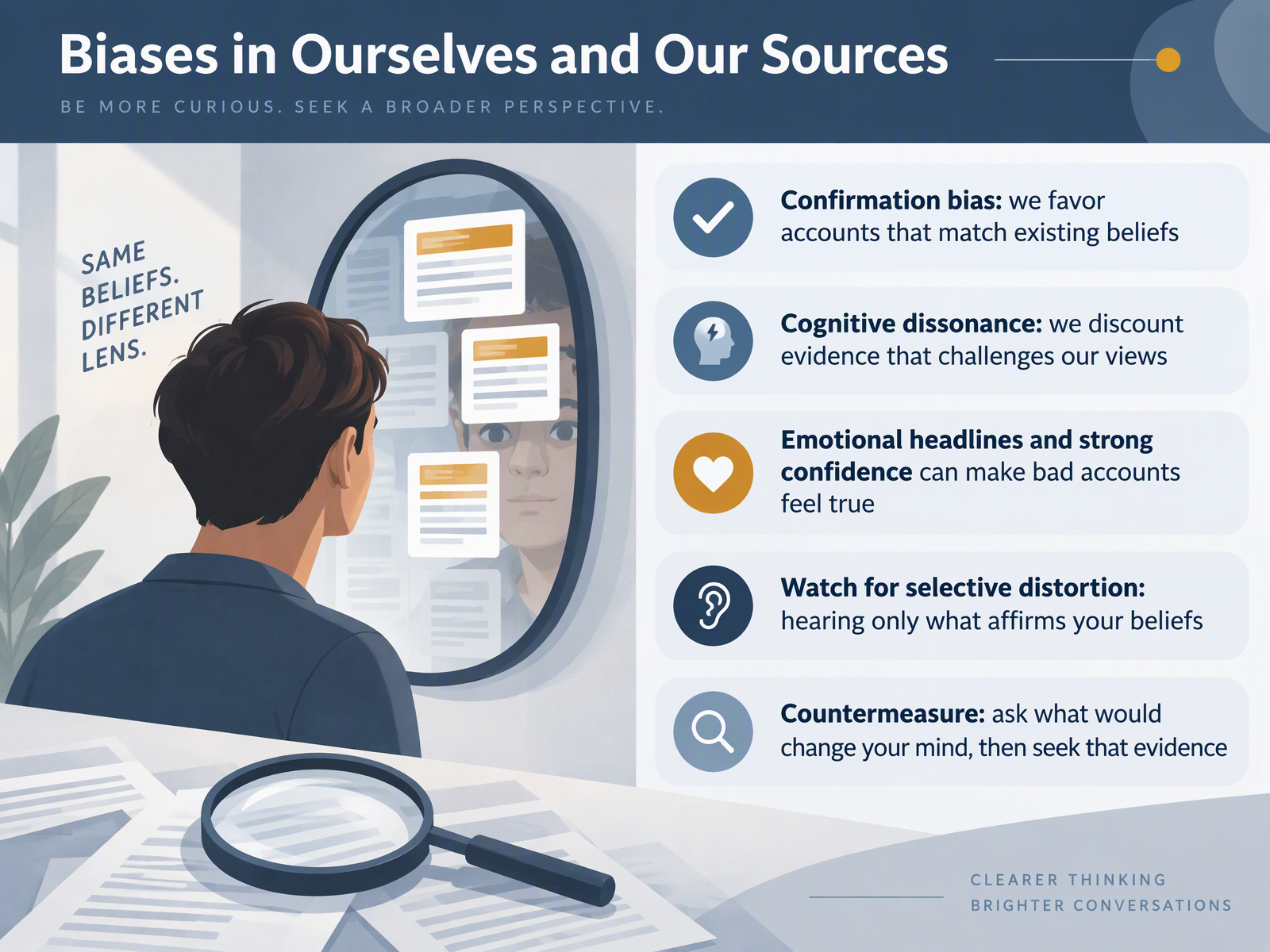
- 11Biases in Ourselves and Our SourcesNow let's turn the lens on ourselves, because bias works on both sides of a source. Confirmation bias means we favor accounts that match what we already believe. Cognitive dissonance is the discomfort we feel when evidence challenges our views, and we often ease it by discounting that evidence. Emotional headlines and confident-sounding claims can make a weak account feel true. Watch for selective distortion too, where you hear only what affirms your beliefs. Here is a simple countermeasure. Ask yourself what evidence would change your mind, then go look for exactly that. That question keeps your checking honest. Next, we'll walk through a five-step workflow, from conflict to conclusion.
 libguides.princeton.edusocialsci.libretexts.orgguides.library.uwm.edu+21 min
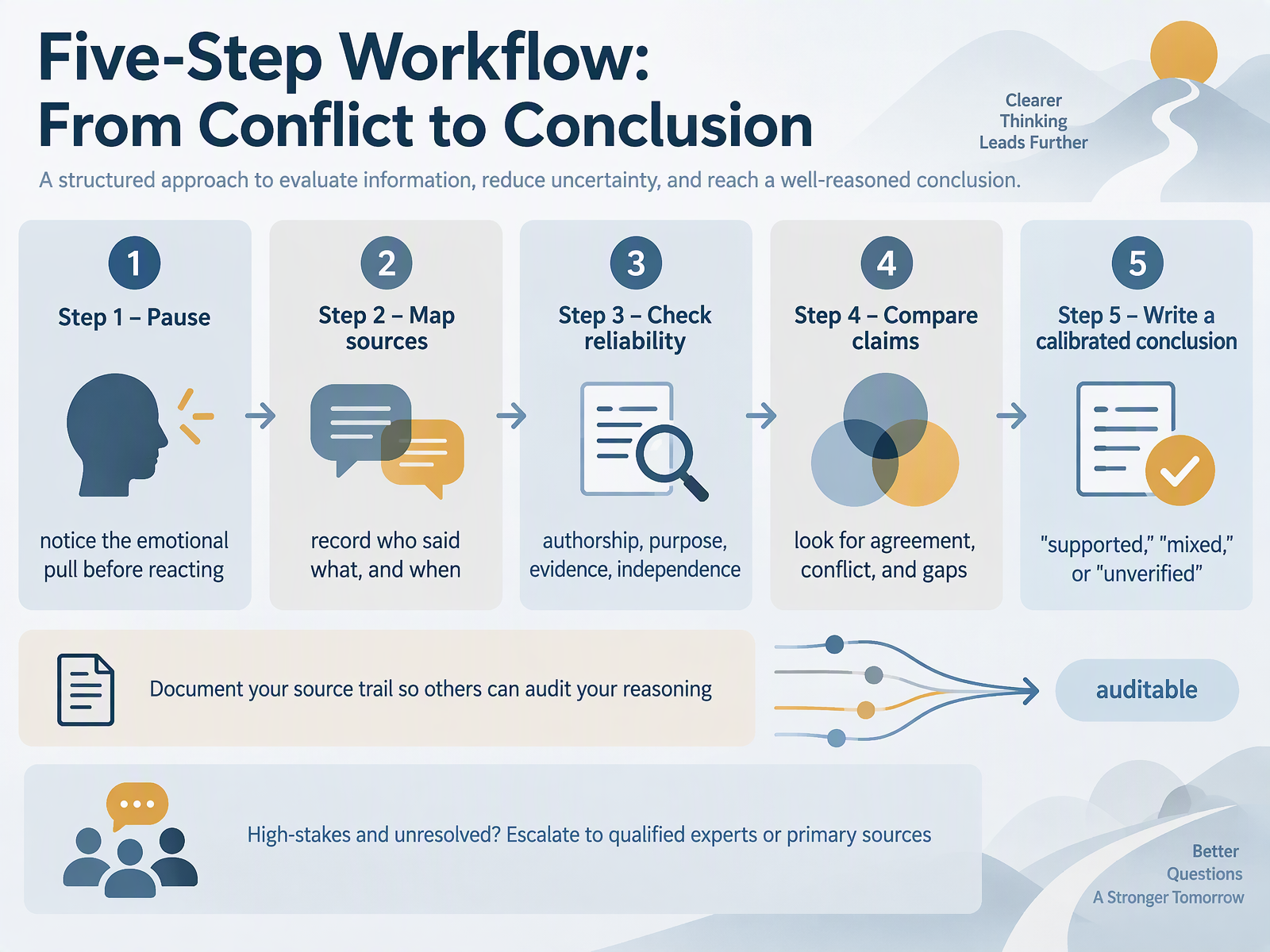
- 12Five-Step Workflow: From Conflict to ConclusionHere is a practical workflow you can use when sources conflict. Think of it as five steps, from conflict to conclusion. Step one, pause. Notice the emotional pull before you react. A strong feeling is a signal to slow down, not a reason to share. Step two, map your sources. Write down who said what, and when. A simple table works well. Step three, check reliability. Ask about authorship, purpose, evidence, and independence. Remember, repetition is not independent confirmation. If three sites all copy the same original report, that is still one source. Step four, compare the claims. Look for agreement, conflict, and gaps. Step five, write a calibrated conclusion. Label the claim as supported, mixed, or unverified. Then document your source trail, so others can audit your reasoning. If the stakes are high and the conflict stays unresolved, escalate to qualified experts or go to primary sources. That keeps your conclusion honest and proportionate to the evidence. Now let us practice. Practice: Resolving a Conflicting Account.
 libguides.princeton.edusocialsci.libretexts.orgguides.library.uwm.edu+22 min
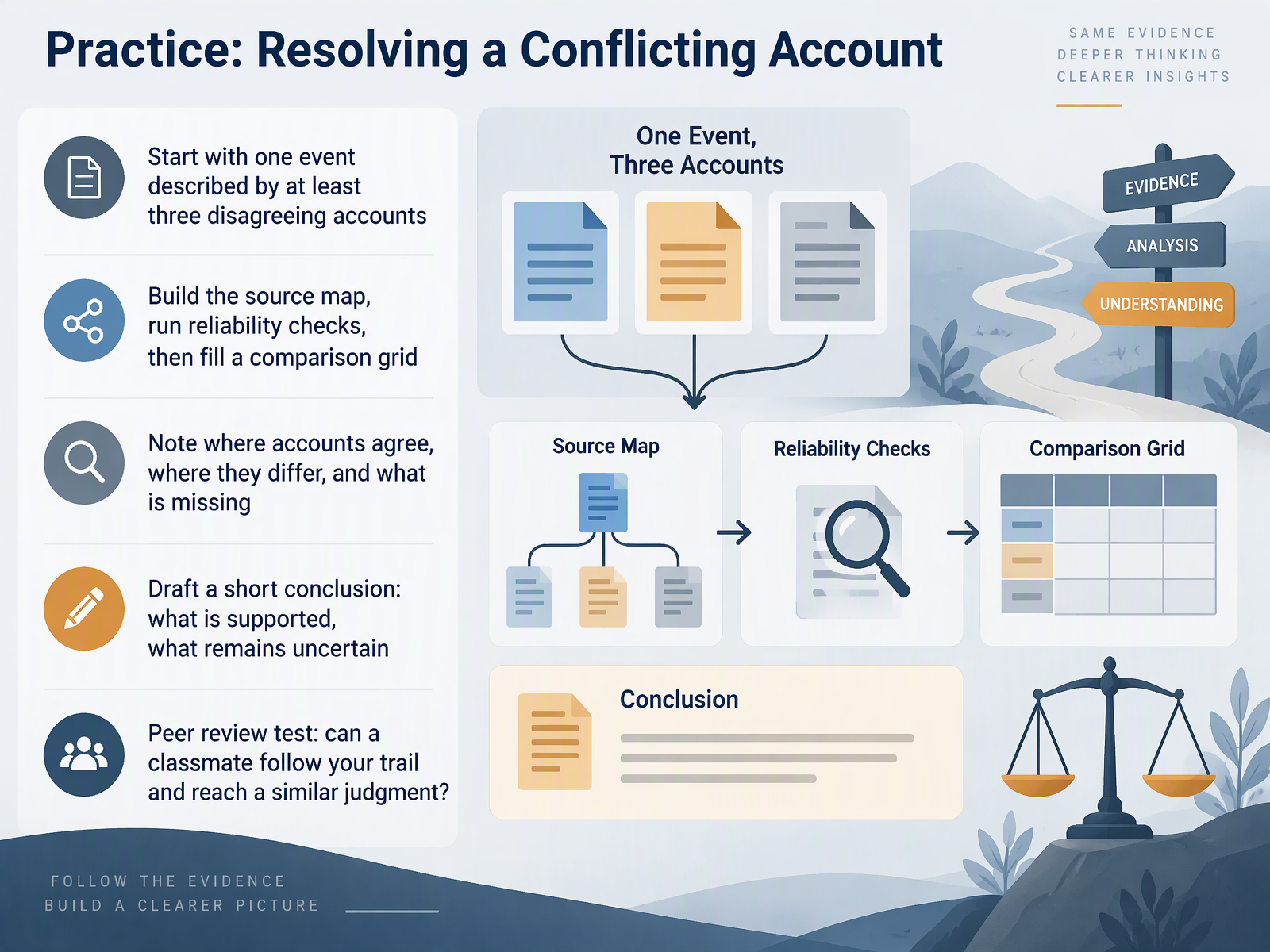
- 13Practice: Resolving a Conflicting AccountNow let's put everything into practice. Pick one event that at least three accounts describe differently. Build your source map, run your reliability checks, then fill in a comparison grid. Note where the accounts agree, where they differ, and what is missing. Then draft a short conclusion: what the evidence supports, and what remains uncertain. Here is the real test. Can a classmate follow your trail and reach a similar judgment? If not, your reasoning needs one more pass. Next, we will bring it together with tools, a checklist, and key takeaways.
 1 min
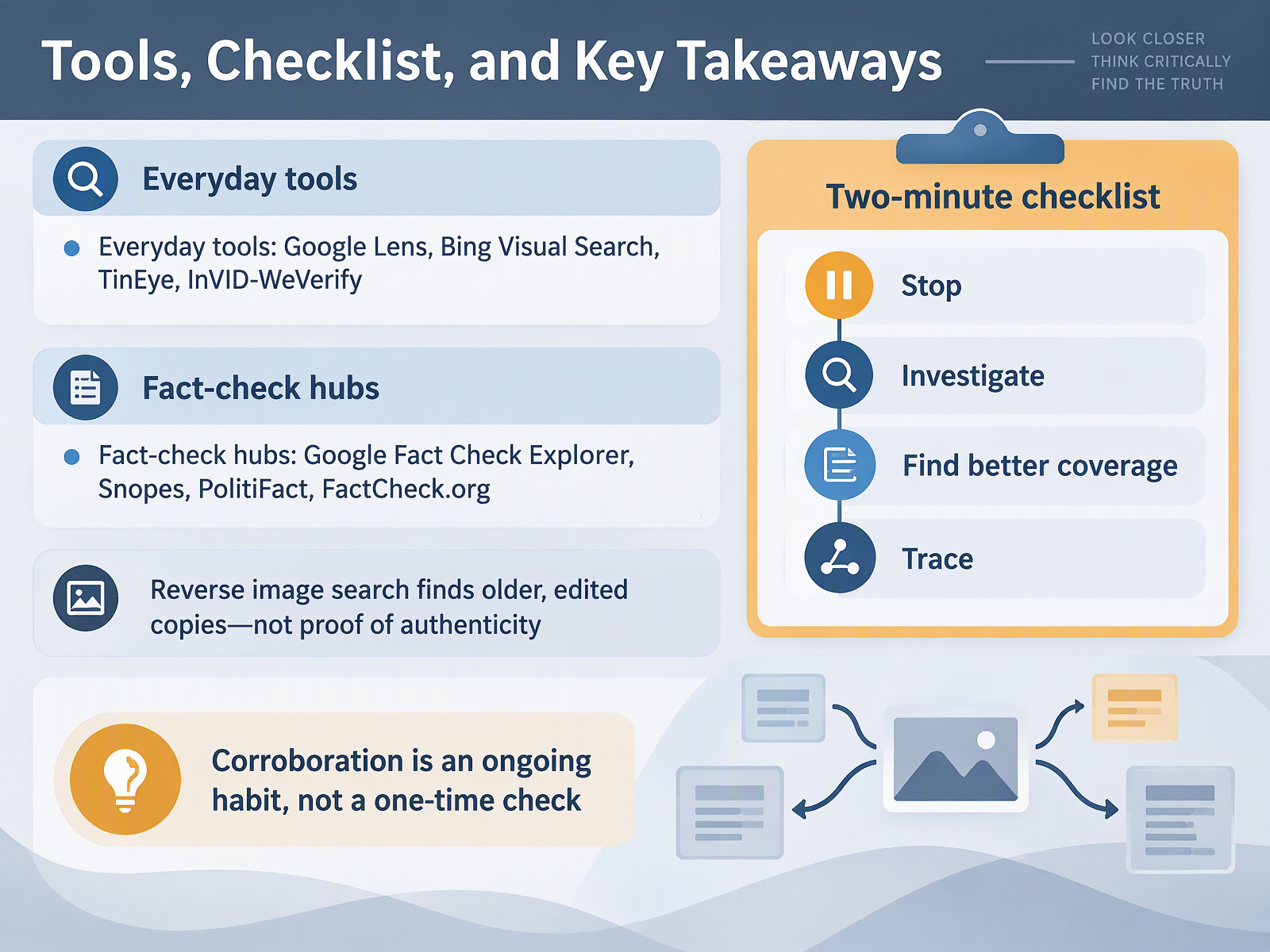
- 14Tools, Checklist, and Key TakeawaysLet's bring everything together. Here are the tools worth keeping close. For images, try Google Lens, Bing Visual Search, and TinEye. InVID-WeVerify runs your image through several engines at once. For claims, check the Google Fact Check Explorer, plus Snopes, PolitiFact, and FactCheck.org. One caution: reverse image search finds older and edited copies. That gives you context, not proof the image is authentic, and no results means nothing either way. So keep a two-minute checklist in mind. Stop. Investigate the source. Find better coverage. Trace the claim back to its origin. And remember the main point. Corroboration is an ongoing habit, not a one-time check. Thank you for working through this course with me. Keep asking good questions, and trust the habit you're building.
 2 min
Take the deck with you
Download this course as a file — free, no sign-up needed.
- PDF handoutEvery slide page, ready to print or share.15 pages · 3.2 MBDownload
- Narrated PowerPointThe deck that presents itself — every slide carries the digital human's narration video.15 pages · 13.1 MBDownload
- PowerPoint slidesThe full deck as a .pptx — open it in PowerPoint, Keynote, or Google Slides.15 pages · 3.1 MBDownload
Free to use in your own training — please keep the PersonWise credit page at the end.
Have your own deck? Turn it into a course
Sources consulted
Web sources consulted while building this course.
- Triangulation - Media Literacy - Research Guides at Princeton University — libguides.princeton.edu
- 9.6: Verifying Information - Social Sci LibreTexts — socialsci.libretexts.org
- 3. Where and how can I verify this? - Media Literacy Tutorial: Evaluating Sources - UWM Libraries Research and Course Guides at University of Wisconsin-Milwaukee — guides.library.uwm.edu
- How to Verify Something You See Online - DigitalCap — digitalcap.org
- Finding Credible News | Common Sense Education — commonsense.org
- Why eyewitnesses fail — pnas.org
- Eyewitness Evidence: Improving Its Probative Value — journals.sagepub.com
- The cognitive science of eyewitness memory: Trends in Cognitive Sciences — cell.com
- Eavesdropping on Memory | Annual Reviews — annualreviews.org
- Why eyewitnesses fail - PMC — pmc.ncbi.nlm.nih.gov
- Unit 3: Evaluation of Academic and Scientific Information | International Media and Information Literacy e-Platform — unesco.org
- Information sources | National Library of Australia (NLA) — library.gov.au
- Module 5: Primary, Secondary, and Tertiary Sources - PALNI Information Literacy Modules - LibGuides at PALNI consortium — libguides.palni.edu
- Understanding mis- and disinformation — better-internet-for-kids.europa.eu
- Short circuits in the information cycle: An approach to information literacy instruction — doi.org
- Circular reporting — en.wikipedia.org
- False equivalence and false balance - Media Helping Media — mediahelpingmedia.org
- The epistemic dangers of journalistic balance | Episteme | Cambridge Core — cambridge.org
- A dangerous balancing act — pmc.ncbi.nlm.nih.gov
- Beware of false balance: Are the views of the scientific community accurately portrayed? — undsci.berkeley.edu