Begin
13 pages · ~26 min
Radiometric Dating: Measuring Earth's Age
This training explains radiometric dating methods and how scientists use them to measure Earth's age, designed for students and science learners.
A digital instructor presents all 13 pages. Hold “Ask” at any point and ask out loud — the answer comes from this course. No sign-up needed.
What you’ll learn
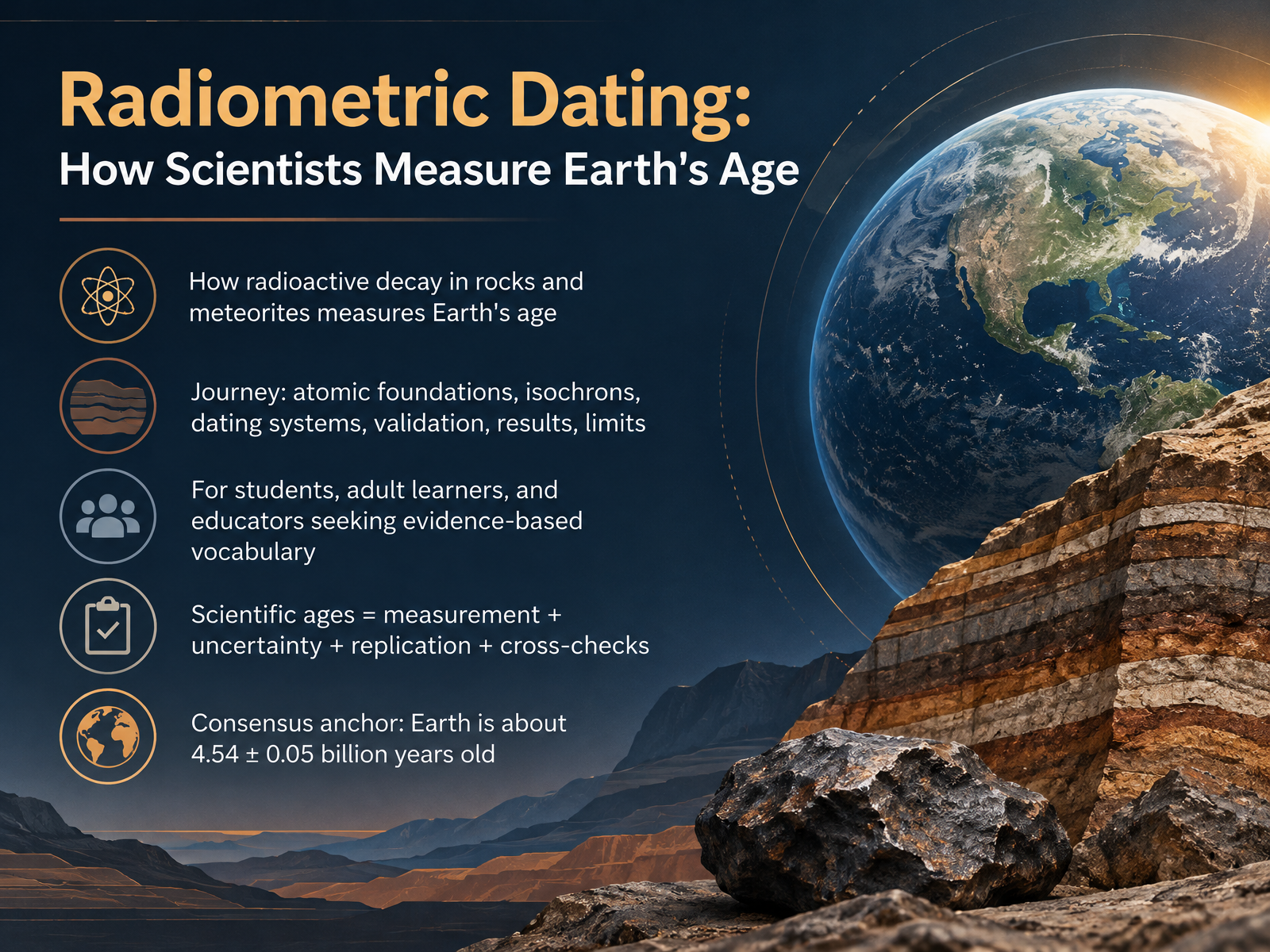
- 01Radiometric Dating: How Scientists Measure Earth's AgeWelcome. I'm glad you're here. Over the next several slides, we're going to answer one of the biggest questions in science: how do we know the age of the Earth? The short answer is radiometric dating. That means measuring the radioactive decay of elements inside rocks and meteorites, and using those measurements like a clock. Here's our journey. We'll start with atoms and isotopes, move into a tool called the isochron, then look at real dating systems, how scientists validate them, what the results show, and where the limits lie. A key idea for you: a scientific age is not a single number. It's a measurement, plus an uncertainty, plus replication, plus cross-checks. And here's our anchor. The Earth is about four point five four billion years old, with an uncertainty of about fifty million years. Notice the plus or minus. That's not a weakness. That's honesty built into the science. Keep that in mind as we go. Now, let's begin with atoms, isotopes, and why radioactive clocks work at all.doi.orgnara.accu.or.jpaustralian.museum+22 min
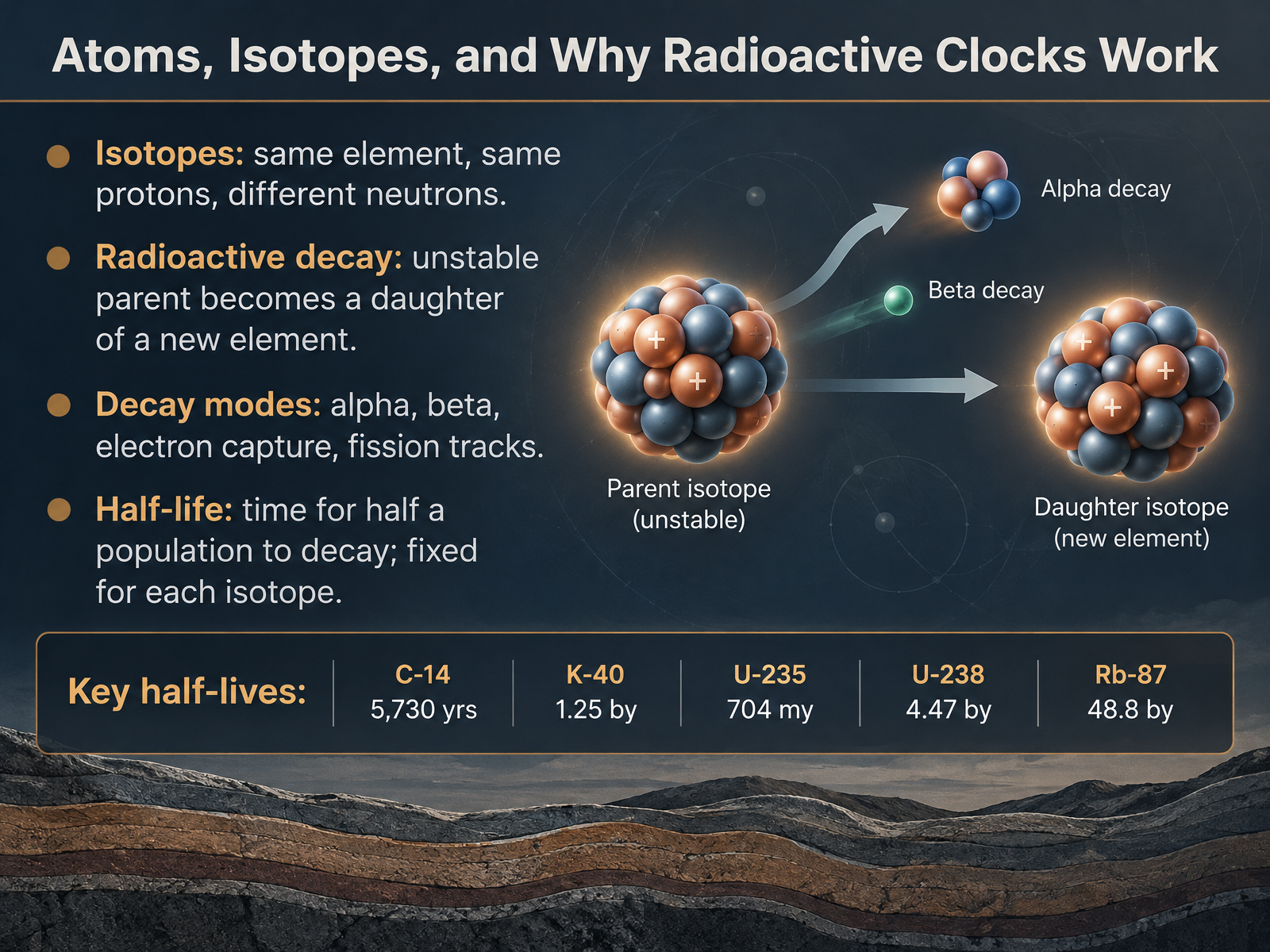
- 02Atoms, Isotopes, and Why Radioactive Clocks WorkNow, let's look at what actually makes a radioactive clock tick. Start with isotopes. Every atom of an element has the same number of protons. Isotopes of that element have different numbers of neutrons, so they differ in mass. Some isotopes are stable, and some are radioactive. A radioactive isotope, called the parent, is unstable. Over time, it emits particles and transforms into a daughter, an isotope of a different element. That can happen through alpha decay, beta decay, electron capture, or fission tracks. Each parent decays at its own fixed rate, described by its half-life: the time for half of the atoms in a sample to decay. For carbon-14, that's five thousand seven hundred thirty years. For potassium-40, one point two five billion years. Uranium-235, seven hundred four million years. Uranium-238, four point four seven billion years. And rubidium-87, forty-eight point eight billion years. Because these rates are fixed, the parent-to-daughter ratio becomes a clock. Next, we'll see how that ratio is turned into an age.
 pubs.usgs.govdoeic.science.energy.govdoi.org+22 min
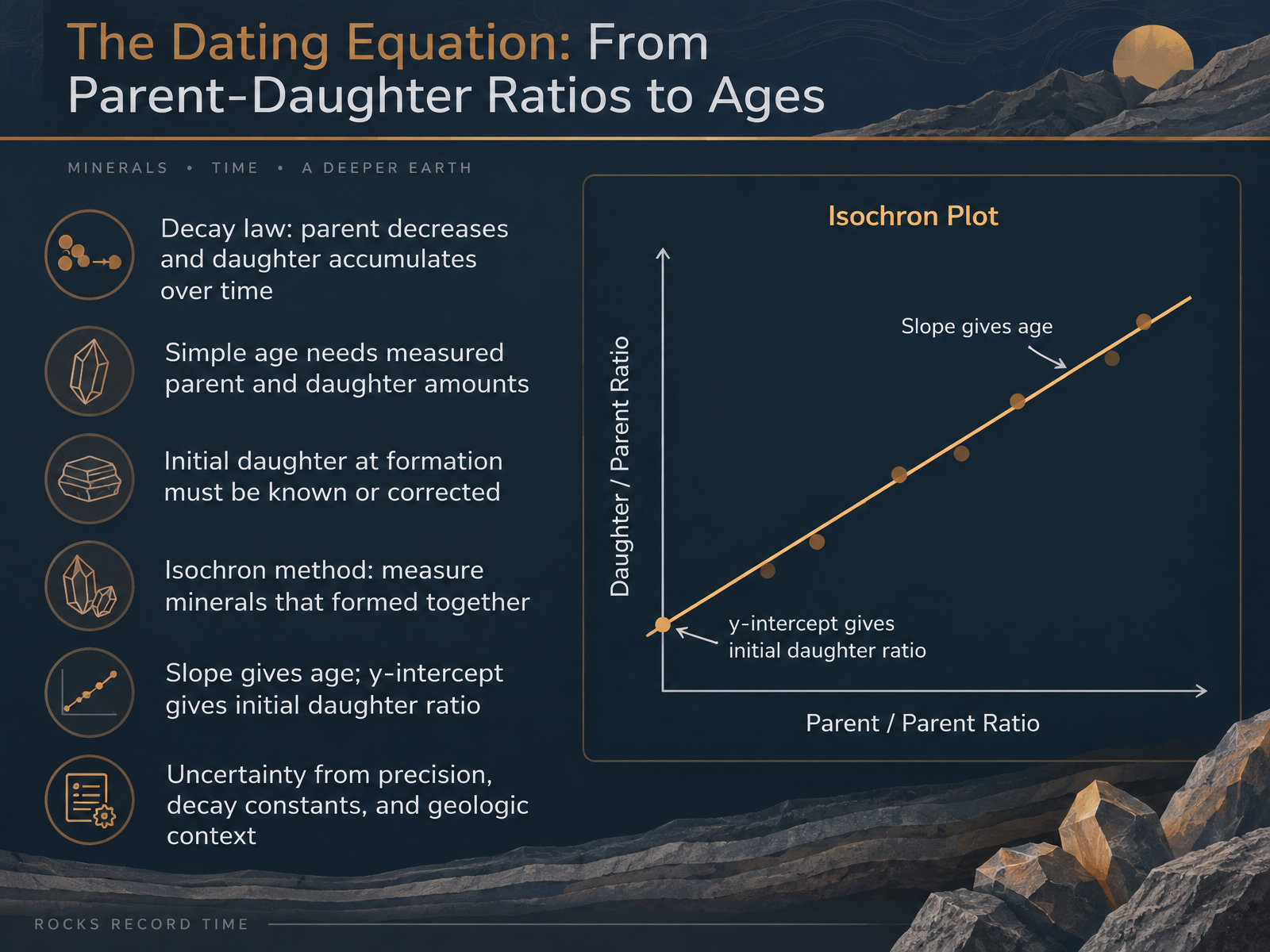
- 03The Dating Equation: From Parent-Daughter Ratios to AgesNow let's build the equation that turns parent and daughter amounts into an age. As a radioactive parent decays, it decreases, and the daughter it produces accumulates. That change is predictable and tied directly to time. If you could measure both amounts, a simple calculation would give you an age. The catch is that some daughter atoms were already present when the mineral formed, so a simple ratio can mislead you. The isochron method solves this by analyzing several minerals that formed together from the same source. They share an initial daughter ratio, but have different parent-to-daughter ratios. When you plot those measured ratios, the points define a line. Its slope gives the age, and its y-intercept gives the initial daughter ratio. The result is still an estimate, limited by measurement precision, the decay constant, and whether the rock stayed a closed system. Keep that image in mind as we move to major dating systems and what each one dates.
 britannica.comasa3.orgen.wikipedia.org+21 min
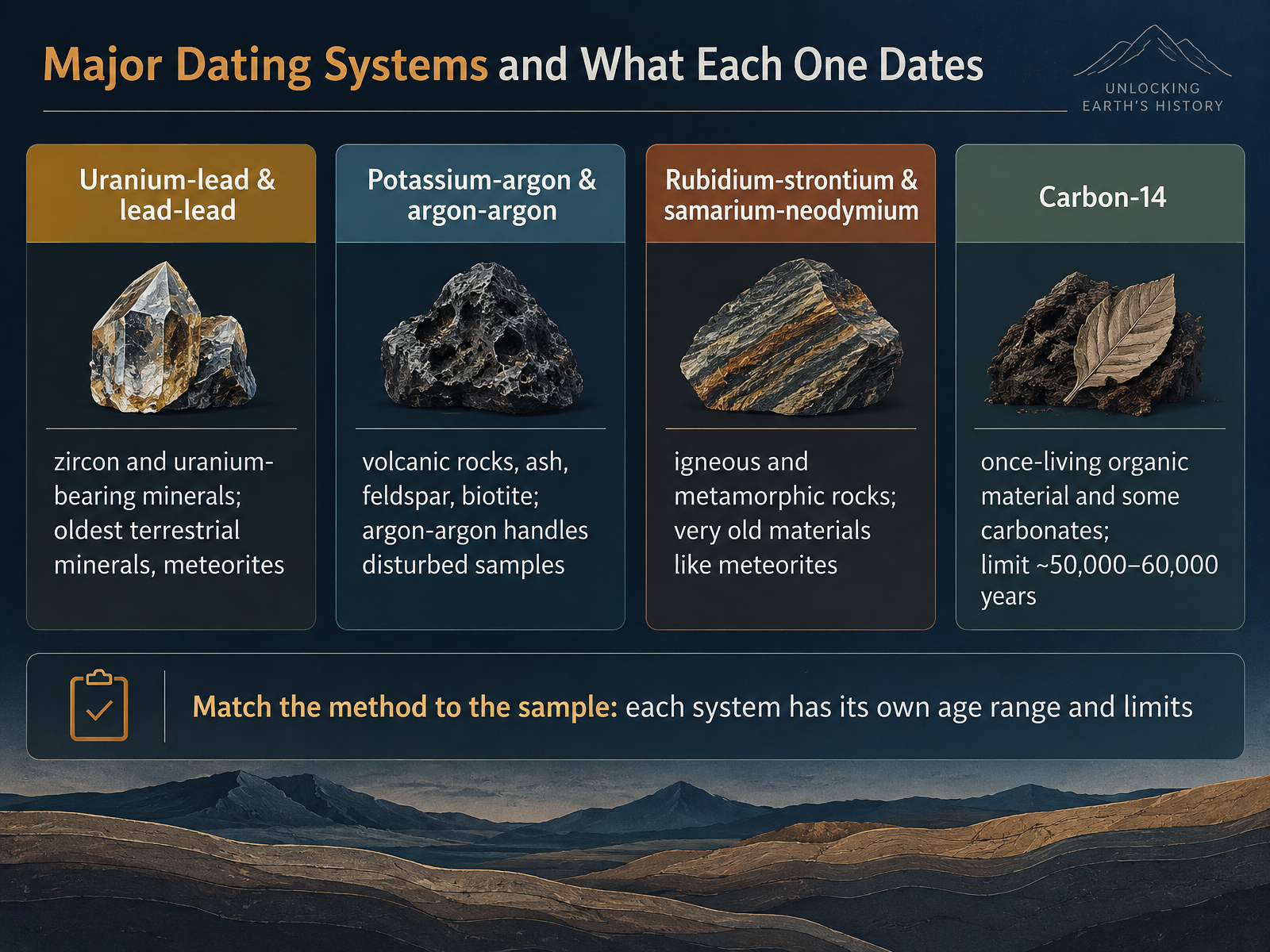
- 04Major Dating Systems and What Each One DatesSo how do you actually choose a dating method? It comes down to matching the method to the sample, because each system has its own age range and limits. Uranium-lead and lead-lead are often used on zircon and uranium-bearing minerals. Zircon is prized because it forms containing uranium but almost no lead, giving these methods access to the oldest terrestrial minerals and meteorites. Potassium-argon and argon-argon date volcanic rocks, ash, and minerals like feldspar and biotite. Argon-argon can handle disturbed samples better by stepping through the gas release. Rubidium-strontium and samarium-neodymium work on igneous and metamorphic rocks, and they are especially useful for very old materials such as meteorites. Carbon-14 is the odd one out. It applies to once-living organic material and some carbonates, and it reaches back only about fifty thousand to sixty thousand years. Remember, the sample itself decides which clock you can use.
 doi.orgnara.accu.or.jpaustralian.museum+21 min
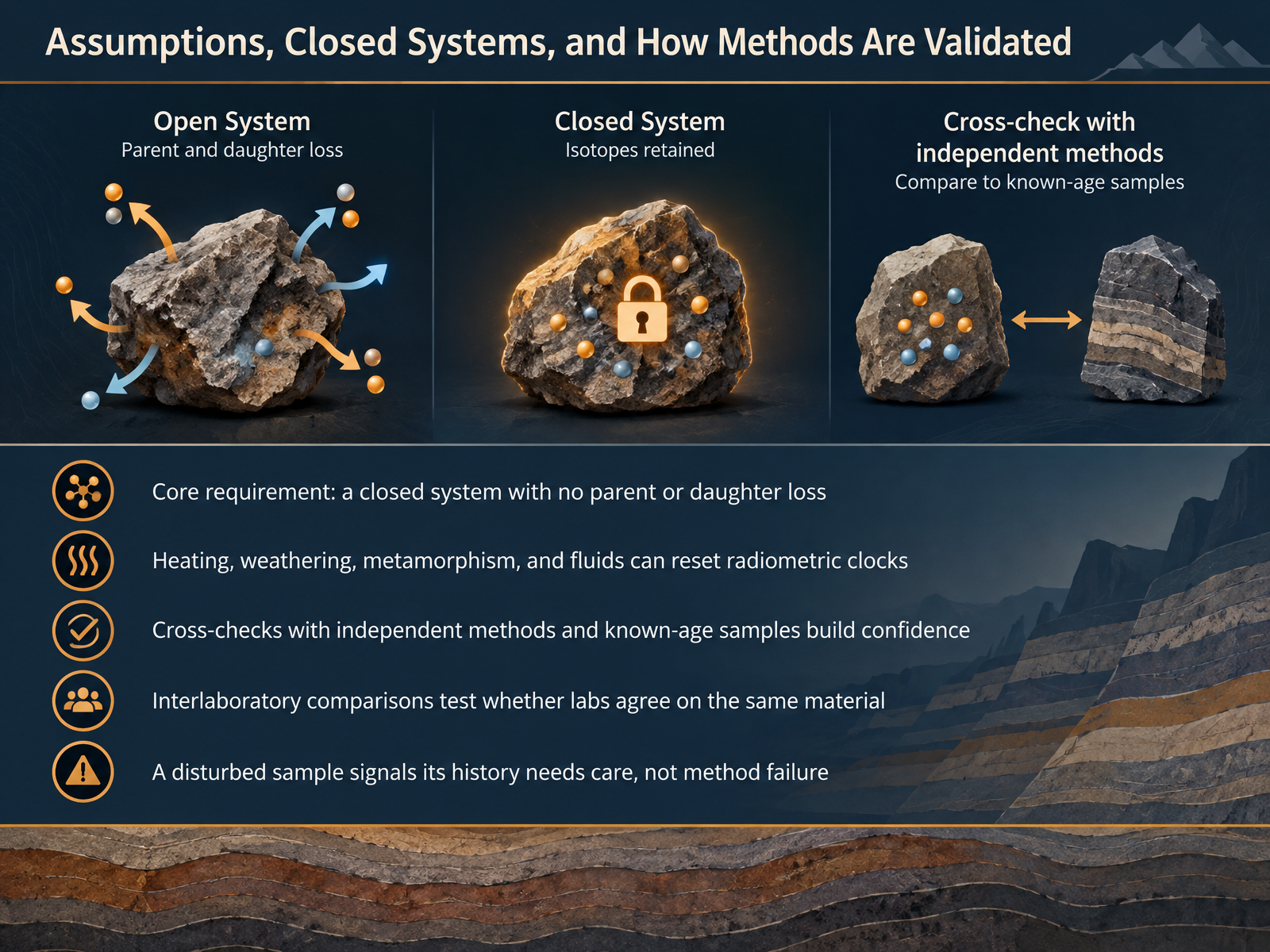
- 05Assumptions, Closed Systems, and How Methods Are ValidatedNow, every radiometric date rests on one core requirement. The sample must have stayed a closed system. That means no parent atoms and no daughter atoms were added or lost since the clock started.
In nature, that condition can break down. Heating, weathering, metamorphism, or flowing fluids can all reset a radiometric clock, effectively restarting the timer. So when a sample looks disturbed, treat that as useful information about its history, not as a failure of the method.
This is why scientists validate their work. They cross-check results using independent dating methods, and they test known-age samples, such as rocks from dated volcanic eruptions. Laboratories also compare results on the same material to see whether they agree. In one interlaboratory study of U-Pb zircon dating, eleven institutions matched ages to within about five hundredths of a percent. That kind of agreement is what builds real confidence.
So keep this takeaway in mind. A closed system gives you a reliable age, and disturbance is a signal to investigate further, not a reason to dismiss the method. Next, we will look at how disturbed data are actually read, in Reading Disturbed Data: Concordia, Discordia, and Open Systems.
 doi.orggsa.confex.comdoi.org+22 min
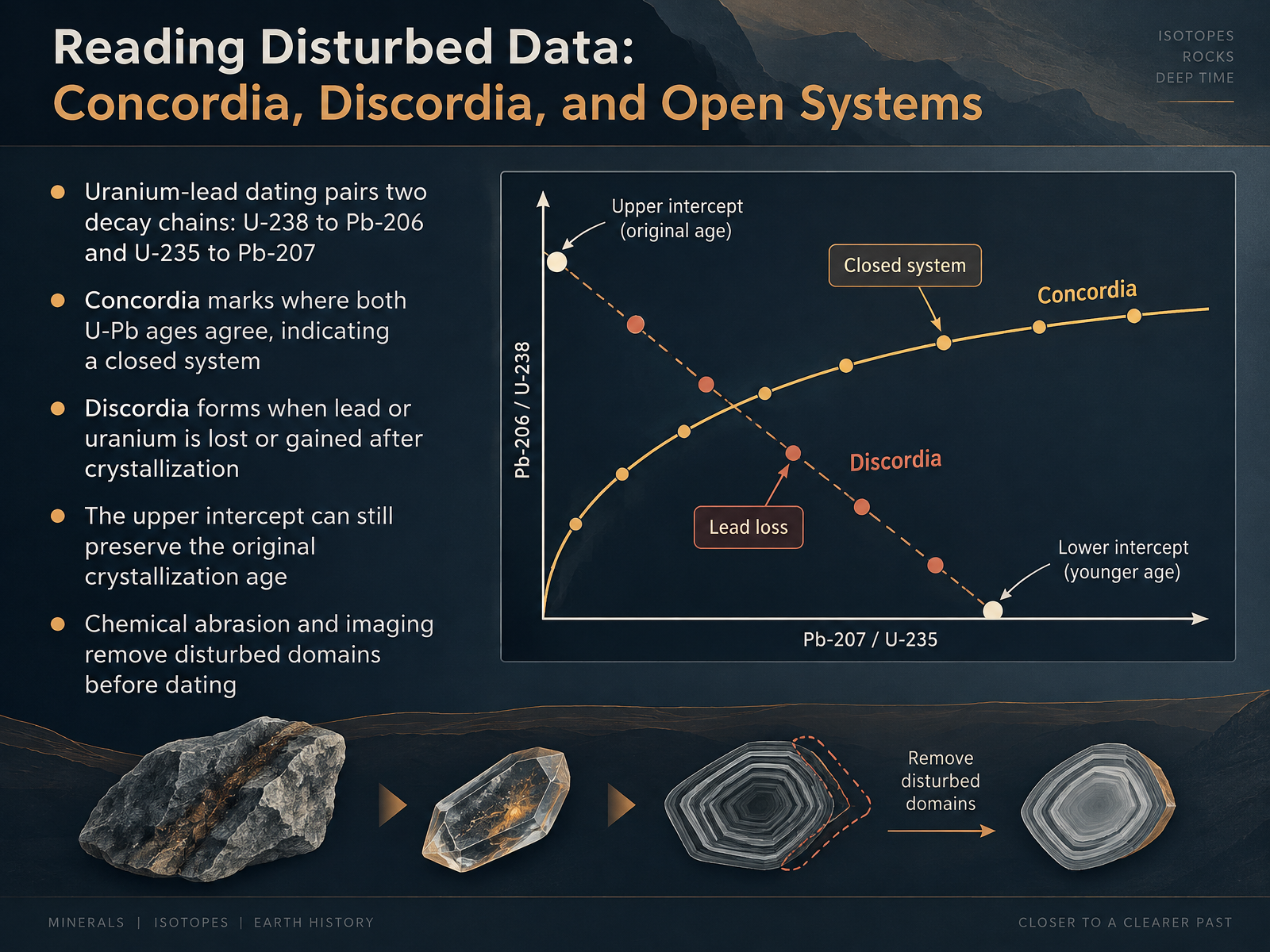
- 06Reading Disturbed Data: Concordia, Discordia, and Open SystemsNow let's look at what happens when the uranium-lead clock is disturbed. Uranium-lead dating actually pairs two decay chains: uranium-238 decays to lead-206, and uranium-235 decays to lead-207. Each chain gives its own age. When those two ages agree, the sample plots on a curve called concordia, and that tells you the system stayed closed since crystallization. But if lead or uranium was lost or gained later, the two ages disagree, and the data fall off concordia along a line called a discordia. Here is the useful part. If you plot several grains from the same rock, the upper intercept of that discordia with concordia can still preserve the original crystallization age. The lower intercept often marks the later disturbance. Because of this, labs now image and chemically treat samples, removing disturbed domains with methods like chemical abrasion before dating, so the remaining data reflect a closed system. The key takeaway is that even disturbed data can still give you a reliable original age when you read the pattern carefully. Next, we'll move on to measuring Earth's age, from early estimates to Patterson's breakthrough.
 doi.org2 min
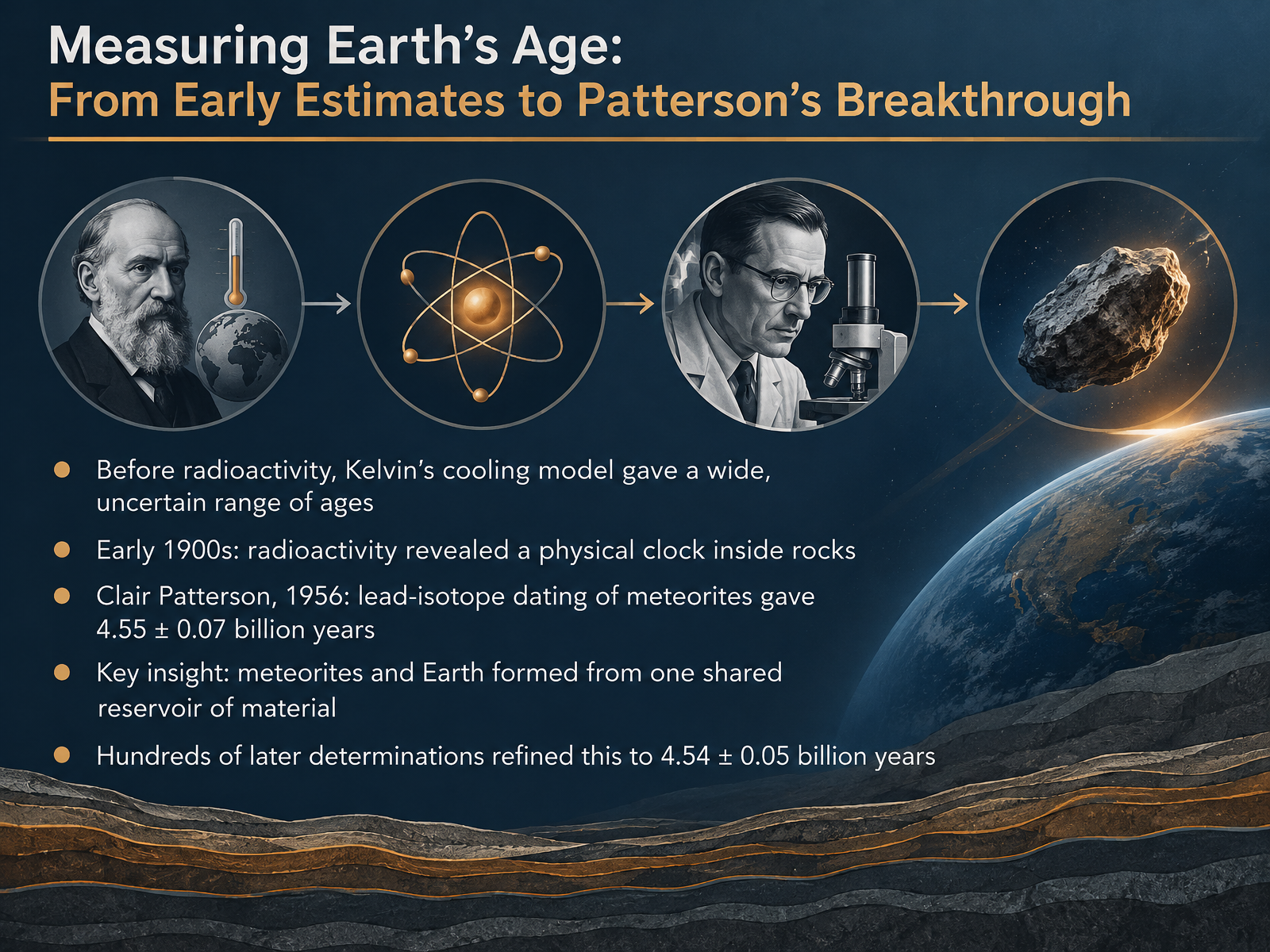
- 07Measuring Earth's Age: From Early Estimates to Patterson's BreakthroughSo how did scientists finally pin down Earth's age? Before radioactivity was understood, the physicist Lord Kelvin estimated Earth's age by how fast a hot sphere would cool. His method was reasonable for its time, but it gave a wide, uncertain range, and it assumed Earth had no internal heat source. In the early nineteen hundreds, radioactivity changed everything. Rocks were found to contain a physical clock. Radioactive uranium decays into lead at a steady, measurable rate. That let scientists read ages directly from the rock record. The breakthrough came in nineteen fifty-six, when Clair Patterson used lead isotope dating on meteorites. He reported an age of four point five five billion years, plus or minus zero point zero seven billion. His key insight was that meteorites and Earth formed from one shared reservoir of material, so they should share the same age. Hundreds of later determinations refined this value to four point five four billion years, plus or minus zero point zero five billion. Next, let's look at why four point five four billion years is the accepted value.
 2 min
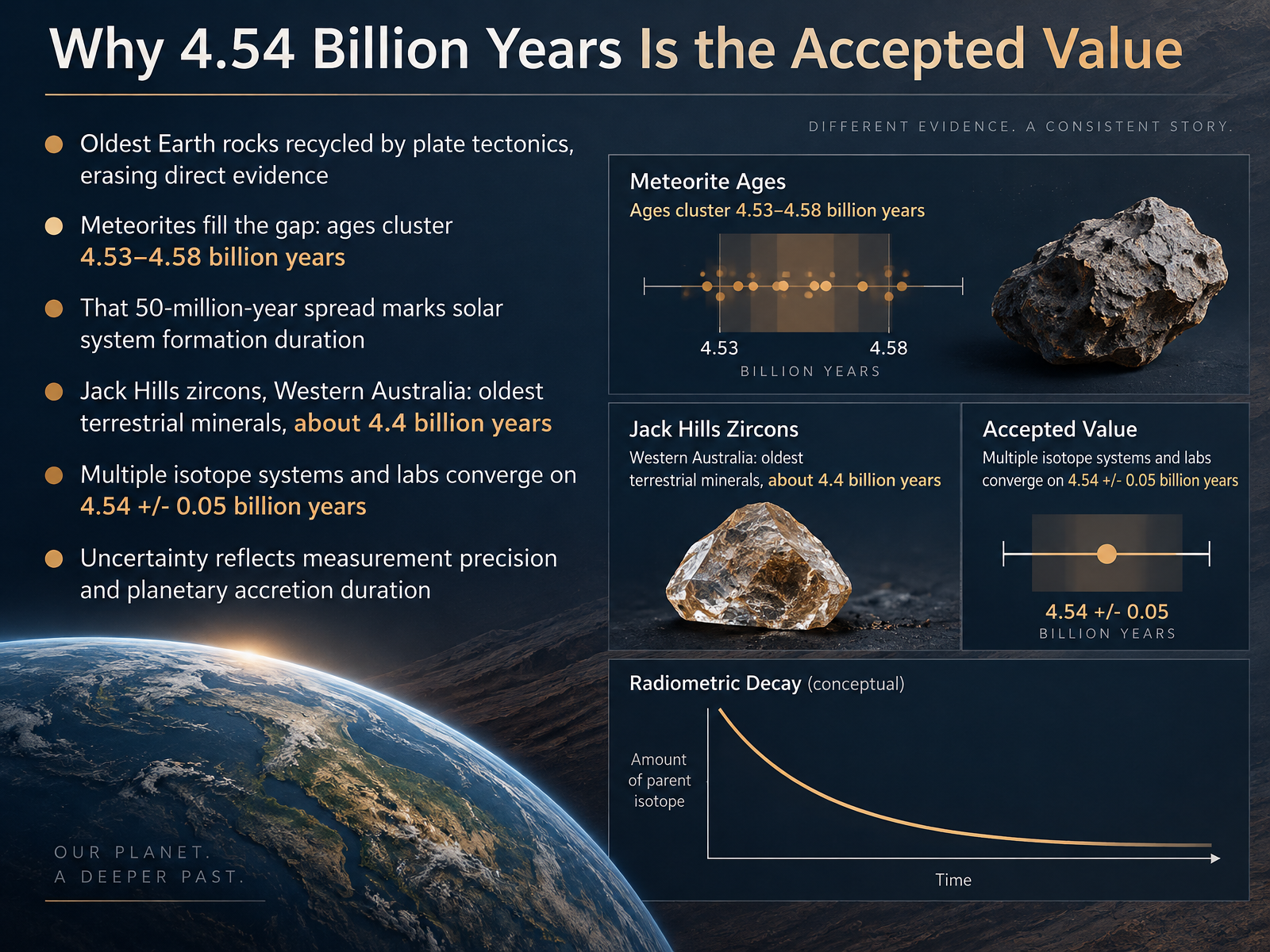
- 08Why 4.54 Billion Years Is the Accepted ValueSo why do scientists settle on four point five four billion years? It helps to see how the evidence fits together. Earth's oldest rocks have mostly been recycled by plate tectonics, so the direct record of our planet's birth has been erased. That leaves a gap. Meteorites fill it. In more than seventy meteorites, radiometric ages cluster between four point five three and four point five eight billion years. That fifty million year spread likely marks how long the solar system took to assemble, from dust cloud to planets. On Earth, the oldest surviving minerals are tiny zircons from the Jack Hills in Western Australia, dated to about four point four billion years. They don't give the full age, but they confirm the planet existed by then. And when many isotope systems in many laboratories are combined, they converge on four point five four billion years, plus or minus zero point zero five billion. That uncertainty reflects measurement precision and the time Earth spent accreting, not a guess. Next, we look at a case study dating volcanic ash to calibrate the human fossil record.
 2 min
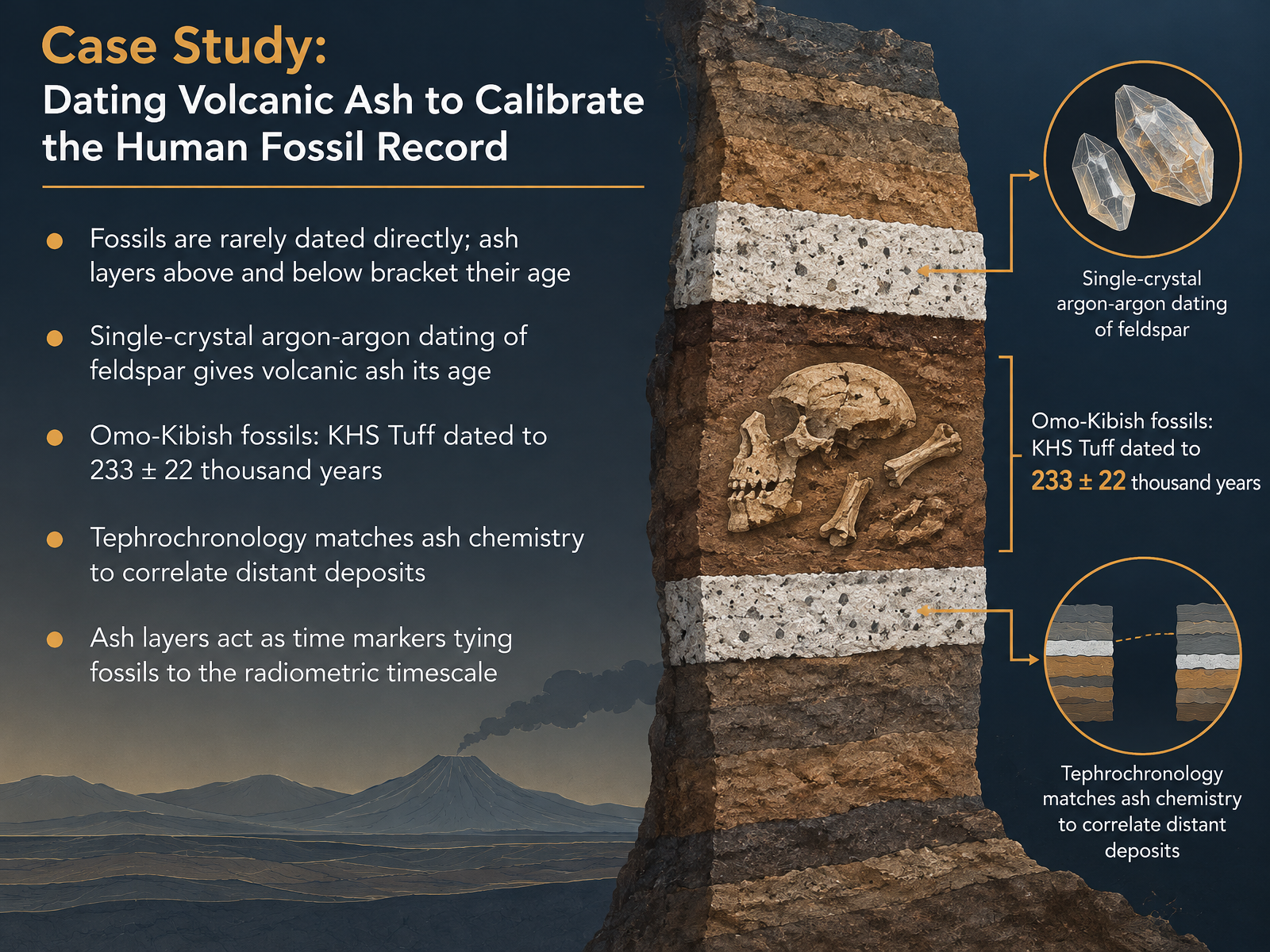
- 09Case Study: Dating Volcanic Ash to Calibrate the Human Fossil RecordLet's look at a real case study that shows how volcanic ash calibrates the human fossil record. Fossils themselves are rarely dated directly. Instead, scientists date ash layers above and below them, which bracket the fossil's age. One powerful method is single-crystal argon-argon dating. Here, individual feldspar crystals from the ash are heated with a laser, and the ratio of argon isotopes reveals when that ash erupted. Consider the Omo-Kibish fossils in Ethiopia. The KHS Tuff, an ash layer sitting above the fossil-bearing sediment, was dated to two hundred thirty-three thousand years, plus or minus twenty-two thousand. That makes it a minimum age for the fossils. But what if the ash layer is too fine to date directly? That's where tephrochronology comes in. Every volcanic eruption has a unique chemical fingerprint. Scientists match that fingerprint to a distant ash layer that has already been dated. You can think of it like matching a key to a lock. Finally, ash layers act as time markers. They tie fossils scattered across a region to the same radiometric timescale. So even without dating a fossil itself, we can confidently place it in time. Next, we'll explore how a single rock records multiple events.
 2 min
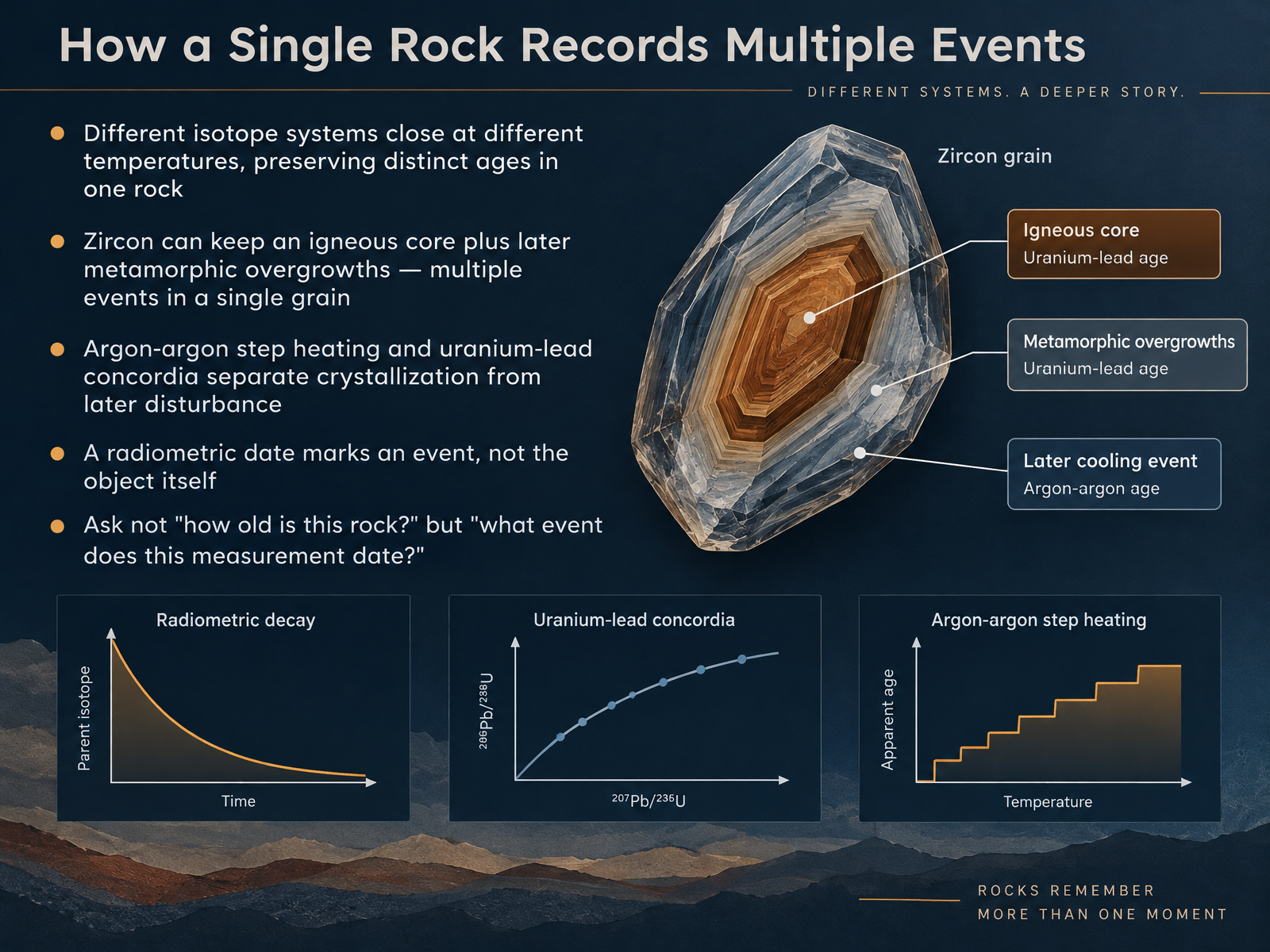
- 10How a Single Rock Records Multiple EventsSo far, we have treated each date as if it belongs to the rock. Here is a more accurate way to think about it. Different isotope systems close at different temperatures, so one rock can preserve several distinct ages. Zircon is a great example. It can keep an igneous core from its original crystallization, then grow a metamorphic overgrowth later, so a single grain records two separate events. To separate them, scientists use methods like argon argon step heating, or uranium lead concordia analysis, which compare two decay schemes of uranium and can distinguish crystallization from later disturbance. One practical point of confusion is worth stating plainly. A radiometric date marks an event, not the object itself. So instead of asking how old is this rock, ask what event does this measurement date. That question is the key to reading any age with confidence. Next, let us look at what radiometric dating cannot do and why that matters.
 doi.org2 min
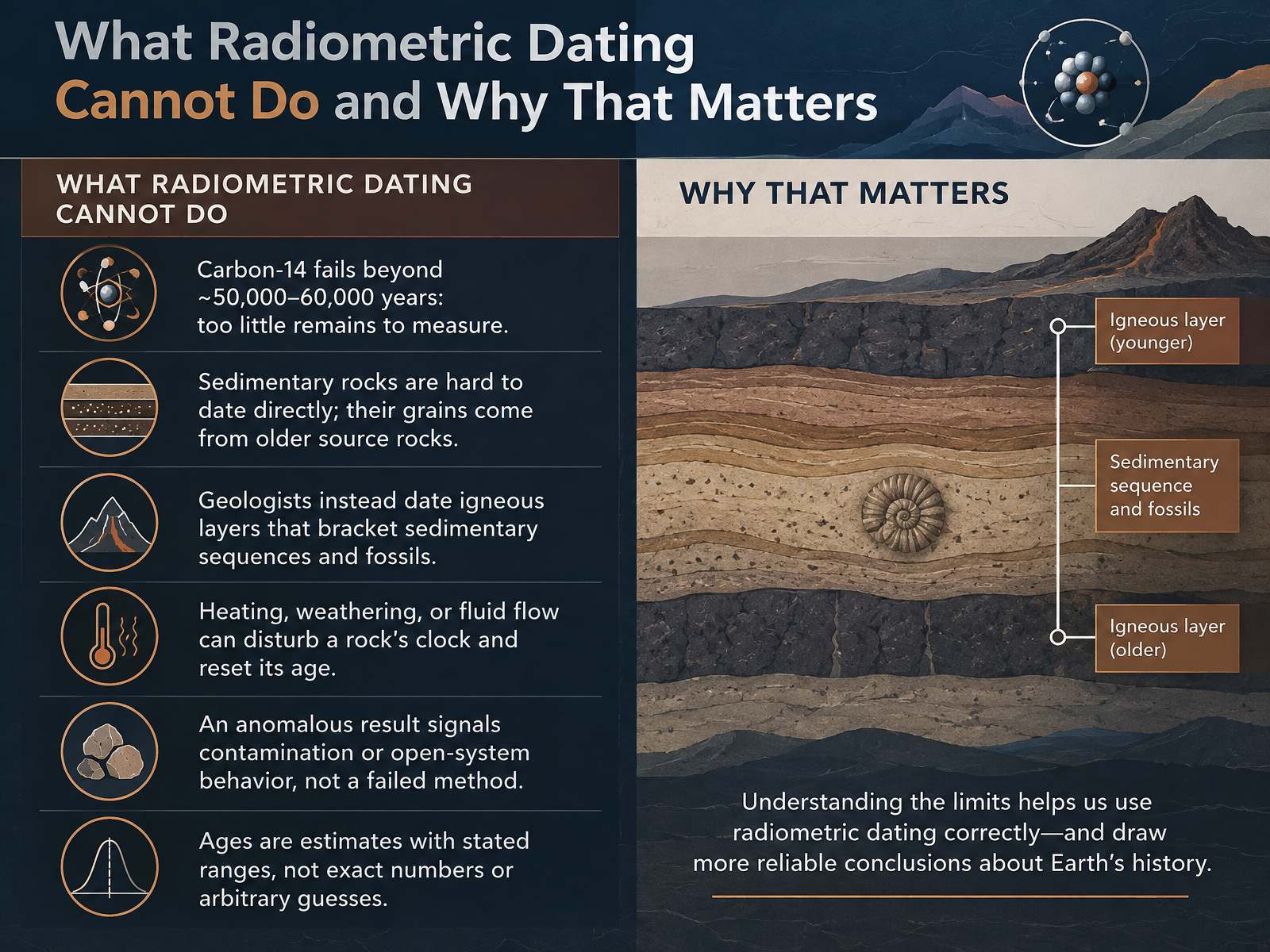
- 11What Radiometric Dating Cannot Do and Why That MattersNow let us be honest about the limits. Radiometric dating is powerful, but it is not magic. Carbon-14 is the clearest example. Its half-life is only five thousand seven hundred thirty years, so after roughly fifty thousand to sixty thousand years, too little carbon-14 remains to measure reliably. That is why it cannot date dinosaur fossils. Sedimentary rocks are also hard to date directly, because their grains came from older source rocks. Dating those grains gives you the age of the source, not the time of deposition. Instead, geologists date igneous layers, such as lava flows or ash beds, that bracket a sedimentary sequence. The fossils between them are then older than the layer above and younger than the layer below. Heating, weathering, or fluid flow can also disturb a rock's clock, resetting it or letting parent or daughter atoms escape. When a result looks anomalous, that usually signals contamination or open-system behavior, not a failed method. Finally, remember that ages are estimates with stated ranges, not exact numbers or arbitrary guesses. That is why careful sampling and cross-checking matter. Let's move on to practical takeaways for learners and educators.
 pressbooks.ccconline.orgaustralian.museumdoi.org+22 min
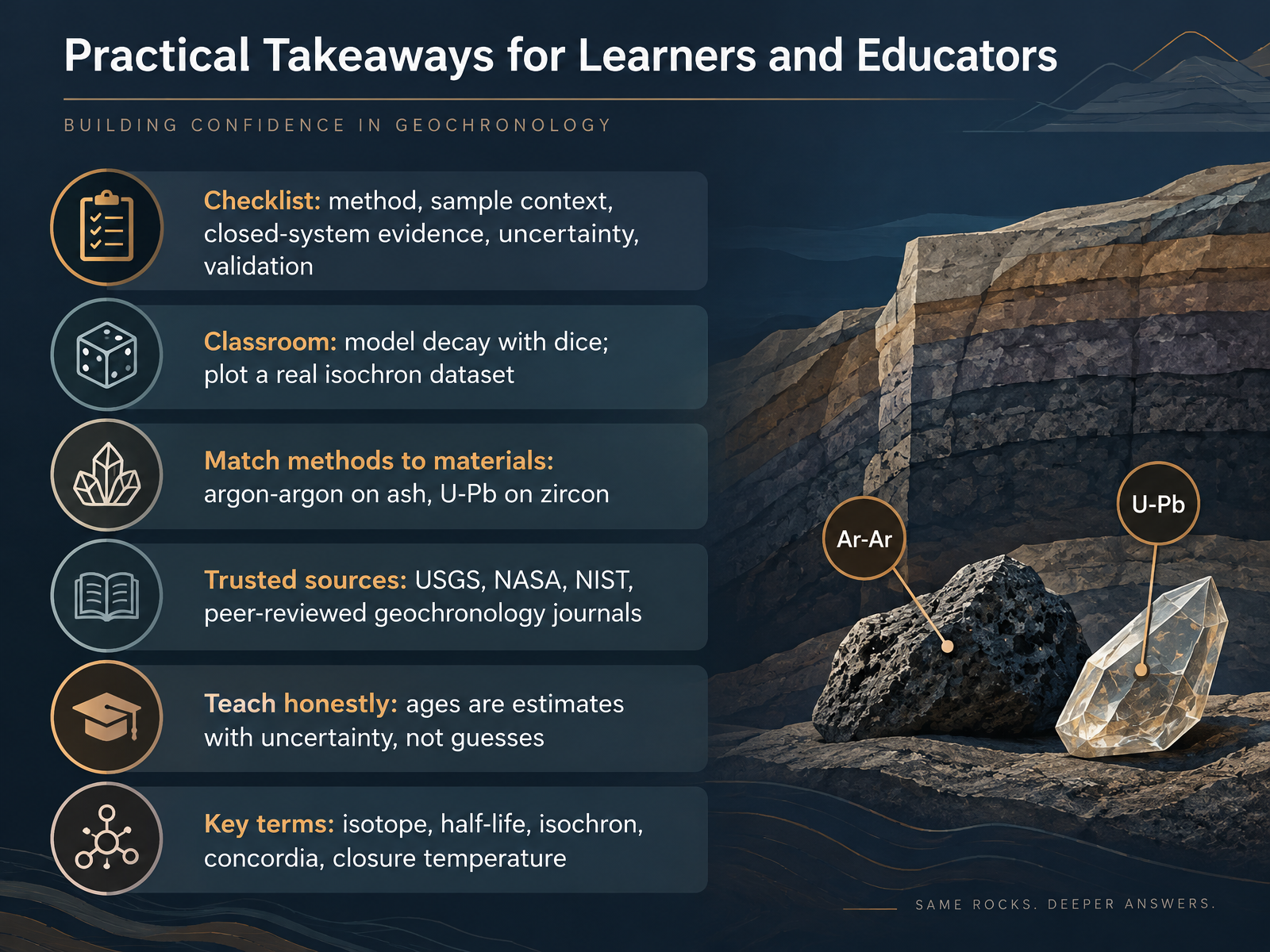
- 12Practical Takeaways for Learners and EducatorsNow let's pull all of this together into practical takeaways for learners and educators. First, a checklist. For any date, ask five things. Which method was used? What is the sample's geologic context? What evidence supports a closed system, meaning no parent or daughter atoms leaked in or out? What is the stated uncertainty? And has the result been validated against independent data? Then, take it into the classroom. A simple and effective model is to roll dice to simulate decay. Each roll, remove the dice showing a chosen number, and watch the pattern of exponential decline emerge. You can also have students plot a real isochron dataset and read the age from the slope themselves. Next, match methods to materials. Argon-argon dating works well on volcanic ash. Uranium-lead dating is ideal for zircon crystals. For trusted sources, look to the U S Geological Survey, NASA, NIST, and peer-reviewed geochronology journals. And teach honestly. A radiometric age is an estimate with a quantified uncertainty, not a guess. Those are very different things. Keep these key terms close: isotope, half-life, isochron, concordia, and closure temperature. In the next section, let's consolidate the summary and the key numbers to remember.
 pressbooks.ccconline.orgaustralian.museum2 min
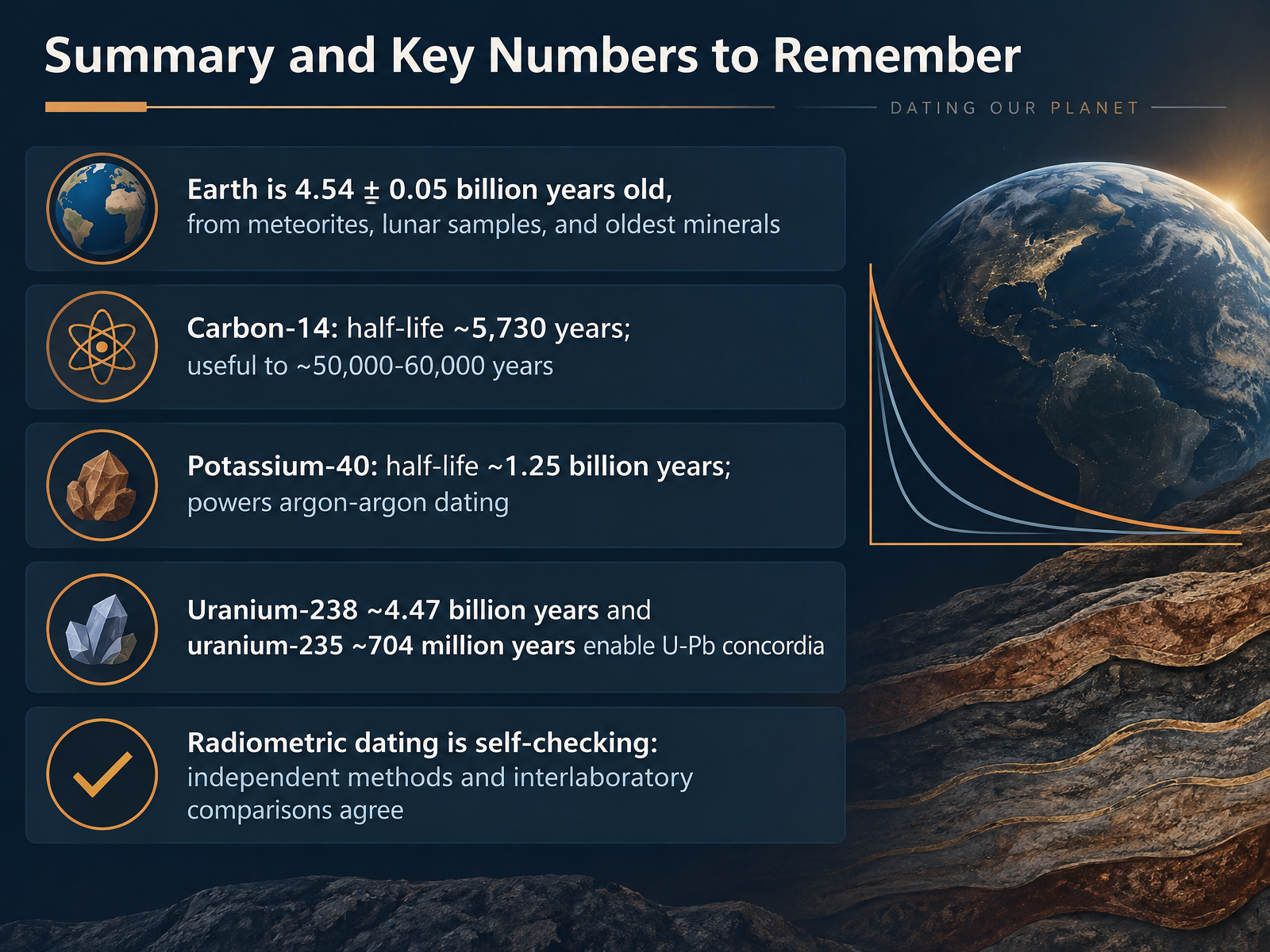
- 13Summary and Key Numbers to RememberLet's bring it all together. Earth is four point five four billion years old, plus or minus fifty million years. That number comes from meteorites, lunar samples, and the oldest minerals found on Earth. Keep a few half-lives in mind. Carbon fourteen has a half-life of about five thousand seven hundred thirty years, so it is useful back to roughly fifty thousand or sixty thousand years. Potassium forty has a half-life of about one point two five billion years, and it powers argon-argon dating. Uranium two thirty-eight, at about four point four seven billion years, and uranium two thirty-five, at about seven hundred four million years, together enable uranium-lead concordia dating. And here is the key reassurance: radiometric dating is self-checking. Independent methods and interlaboratory comparisons agree, which is why the results are trusted. Thank you for working through this with me. You now have a solid foundation in how scientists measure Earth's age, so keep asking good questions and keep exploring.
 pubs.usgs.govdoeic.science.energy.govdoi.org+22 min
Take the deck with you
Download this course as a file — free, no sign-up needed.
- PDF handoutEvery slide page, ready to print or share.14 pages · 4.5 MBDownload
- Narrated PowerPointThe deck that presents itself — every slide carries the digital human's narration video.14 pages · 15.3 MBDownload
- PowerPoint slidesThe full deck as a .pptx — open it in PowerPoint, Keynote, or Google Slides.14 pages · 4.4 MBDownload
Free to use in your own training — please keep the PersonWise credit page at the end.
Have your own deck? Turn it into a course
Sources consulted
Web sources consulted while building this course.
- Science‐based Dating in Archaeology — doi.org
- SCIENTIFIC DATING IN ARCHAEOLOGY — nara.accu.or.jp
- Dating dinosaurs and other fossils - The Australian Museum — australian.museum
- 8.4 Isotopic Dating Methods — Physical Geology – 2nd Edition – Physical Geology — pressbooks.ccconline.org
- Geologic Time: Radiometric Time Scale — pubs.usgs.gov
- Appendix F: Radiation — doeic.science.energy.gov
- Total Half-Lives for Selected Nuclides — doi.org
- Appendix: Half-Lives for Several Radioactive Isotopes - UCalgary Chemistry Textbook — chem-textbook.ucalgary.ca
- IUGS–IUPAC recommendations and status reports on the half-lives of 87Rb, 146Sm, 147Sm, 234U, 235U, and 238U (IUPAC Technical Report) — doi.org
- Dating - Isochron, Geochronology, Radiometric — britannica.com
- How Old Is It? How Do We Know? — asa3.org
- Isochron dating — en.wikipedia.org
- RadiogenicIsotopeandDeepMantleHeterogeneity — seismo.berkeley.edu
- Isochron Dating — TalkOrigins Archive — talkorigins.org
- Intercalibration of 40Ar/39Ar laboratories in China, the USA and Russia for Emeishan volcanism and the Guadalupian–Lopingian boundary — doi.org
- Abstract: INTERCALIBRATION OF THE SERVICIO NACIONAL DE GEOLOGÍA Y MINERÍA (SERNAGEOMIN), CHILE AND WISCAR <sup>40</sup>AR/<sup>39</sup>AR LABORATORIES FOR QUATERNARY DATING (GSA 2020 Connects Online) — gsa.confex.com
- A laboratory inter-comparison of AMS 14C dating of bones of the Miesenheim IV elk (Rhineland, Germany) and its implications for the date of the Laacher See eruption — doi.org
- Wiggle-match radiocarbon dating of the Taupo eruption — doi.org
- The INTAV intercomparison of electron-beam microanalysis of glass by tephrochronology laboratories: Results and recommendations — sciencedirect.com
- Strategies towards statistically robust interpretations of in situ U–Pb zircon geochronology — doi.org