Introduction to Art History
Begin
15 pages · ~30 min
Introduction to Art History
An introductory course guiding learners through the foundational skills of visual analysis, historical context, and interpreting meaning in art.
What you’ll learn
- 01Introduction to Art History: Looking, Context, and MeaningWelcome to Introduction to Art History: Looking, Context, and Meaning. In this course, we will move beyond simply memorizing a list of styles and famous masterpieces. Our goal is to build a different kind of skill set, one that treats art not as a static fact to recall, but as a primary source to investigate. We will practice close looking, a method of sustained observation that asks you to describe what you truly see before jumping to conclusions. From there, we will integrate historical context and evidence to build well-supported interpretations. This process challenges the habits of style-based or canon-based thinking, where some works automatically get labeled important. Instead, I want you to trust your own careful observations and questions. By learning to observe deeply, ask analytical questions, and argue from visual evidence, you will be equipped to interpret any work of art you encounter. Let's begin this exploration together. In our next session, we will specifically unpack why style and masterpiece lists are not enough.about.jstor.orgasia.si.edumuseum.cornell.edu+22 min
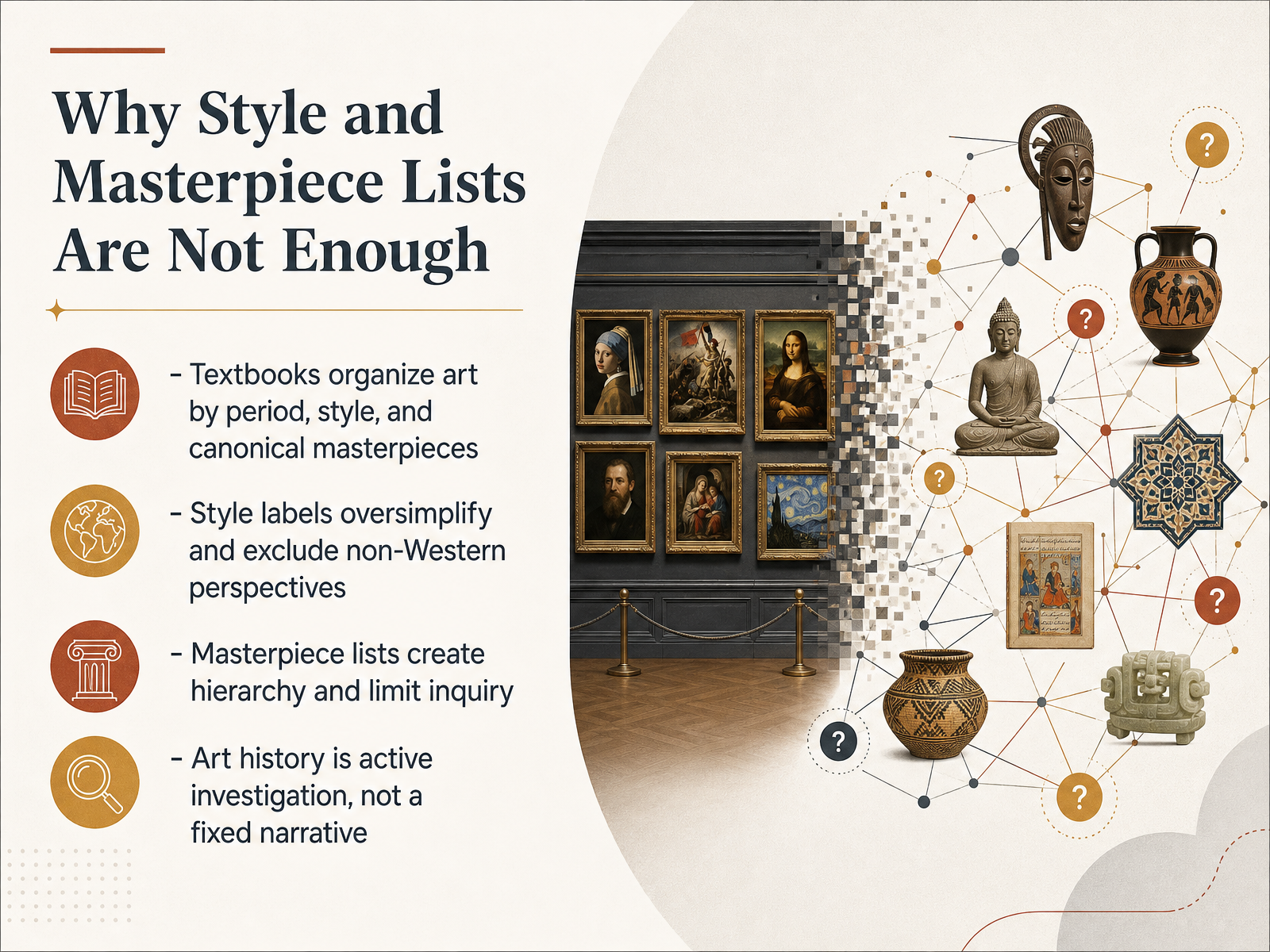
- 02Why Style and Masterpiece Lists Are Not EnoughSo why isn't starting with style labels and a fixed list of masterpieces enough? Think about what happens when you open a standard art history textbook. It organizes art into periods, styles, and a select group of canonical works, all arranged in a linear timeline. That structure can be useful, but it also creates real problems. Style labels oversimplify. They can flatten complex objects into a single word, like Baroque or Impressionist, and often exclude non-Western and Indigenous visual traditions entirely. Masterpiece lists build a quiet hierarchy. They signal that only certain objects, from certain places, are worth serious study, which limits inquiry before you even begin to look. We're aiming for something different here. Art history is not a fixed story you memorize. It's an active investigation. That means we'll practice building interpretations from visual evidence and historical context, not from assumed categories. Next, we'll put that investigative mindset directly into practice with our first core skill: looking deeply, how to see, not just recognize.
 doi.orgdocs.lib.purdue.eduacademicworks.cuny.edu+22 min
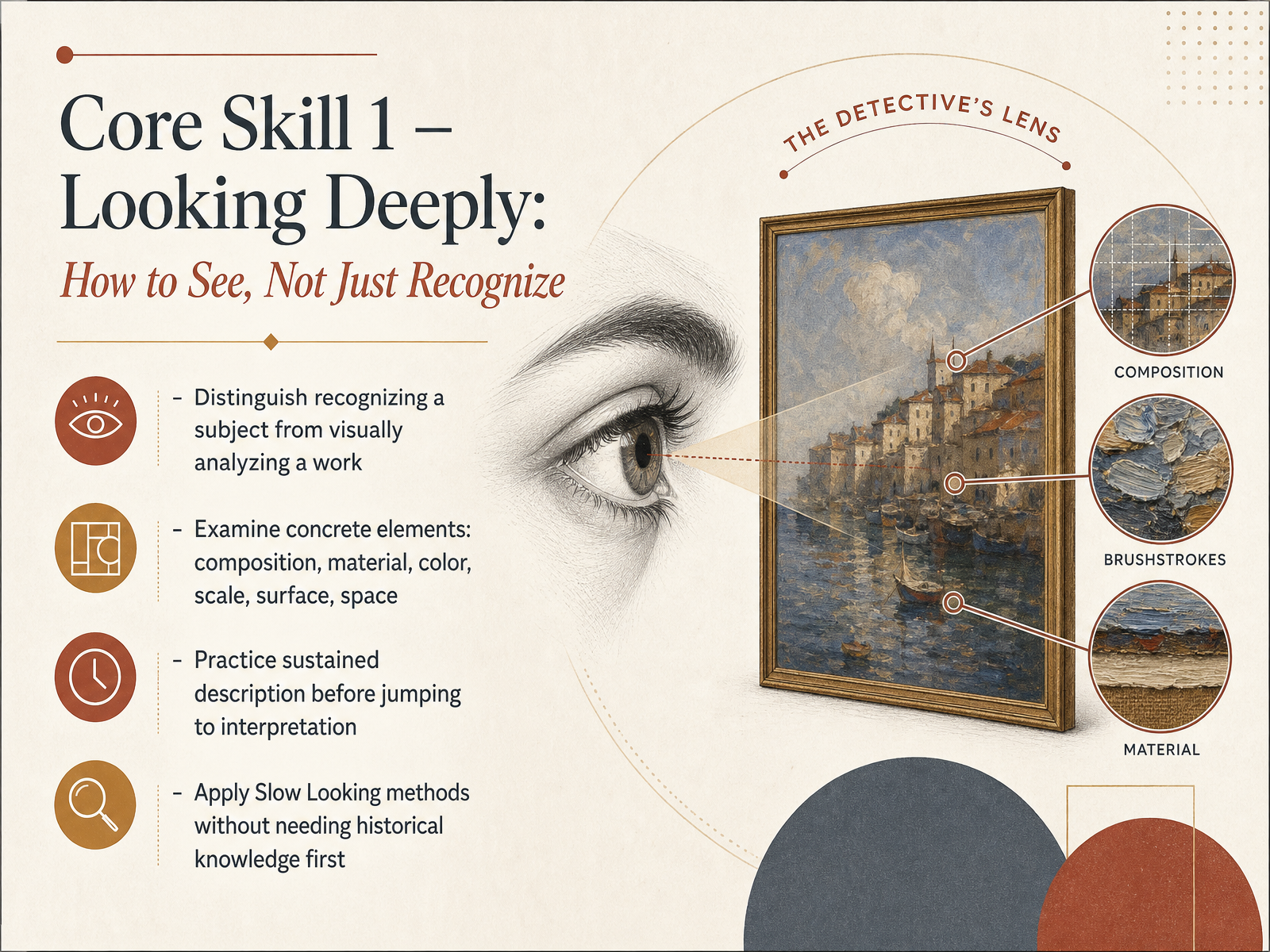
 - 03Core Skill 1 – Looking Deeply: How to See, Not Just RecognizeNow, let's focus on our first core skill: learning to look deeply. This isn't about quickly recognizing a subject and moving on. It's about distinguishing that flash of recognition from true visual analysis. Think of it this way: recognizing a figure in a painting as a person is basic. Seeing how the artist used thick, diagonal brushstrokes to make your eye rush toward that figure, or noticing that the figure's scale is deliberately small against an immense, empty background, that is analysis. We need to slow down and examine concrete elements. Notice the composition, the materials used, the specific colors and their relationships, the scale, the surface texture, and how space is constructed. Your goal is sustained, precise description first. Let me give you a common classroom exercise: imagine you are describing the work to a friend over the phone who has never seen it. You cannot say the word 'soldier' just because a figure wears a uniform. You have to describe the blue coat, the brass buttons, the rigid posture. You have to build the image with factual language before you layer on interpretation. The real advantage here is that you do not need any historical knowledge to start. The evidence is right in front of you. This practice is often called 'slow looking,' and next, we will walk through practical methods and exercises that make it a habit.
 about.jstor.orgasia.si.edumuseum.cornell.edu+22 min
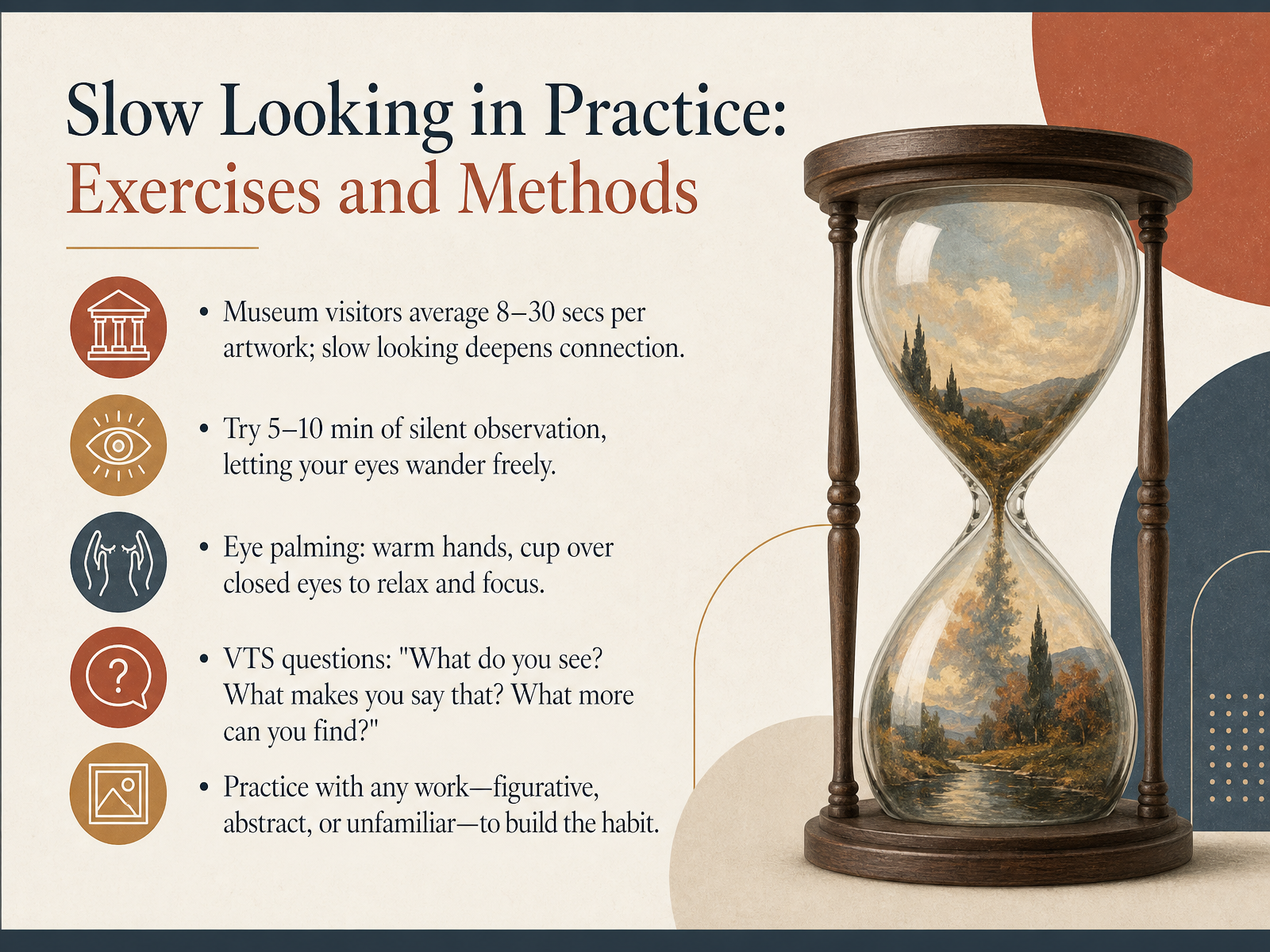
 - 04Slow Looking in Practice: Exercises and MethodsNow, let’s translate slow looking into a practice you can use immediately. Research shows that museum visitors spend an average of only eight to thirty seconds with a single work of art. Often, we feel we must see everything. But what if you chose just one or two pieces and gave them your full attention? Start with a silent, five- to ten-minute session. Sit comfortably and simply allow your eyes to wander across the surface without forcing an opinion. If your mind feels cluttered, you might first try a technique called eye palming. Warm your hands by rubbing them together, then cup them gently over your closed eyes and breathe for a minute or two. This relaxes your gaze and sharpens your focus before you begin looking. As you observe, guide your thinking with three open-ended questions from the Visual Thinking Strategies method. Ask yourself: What do you see? What makes you say that? And, what more can you find? These questions shift your brain from quick judgment to evidence-based observation. You can apply this method to any artwork, whether it is a detailed narrative painting, an abstract canvas, or a sculpture you have never encountered before. Building this habit trains you to see more and assume less, turning a gallery visit into a genuine dialogue. Next, we will build on these observational skills and explore Core Skill Two: Reading Context by asking the right questions.
 tate.org.ukpages.thinkingmuseum.comslowartday.com+22 min
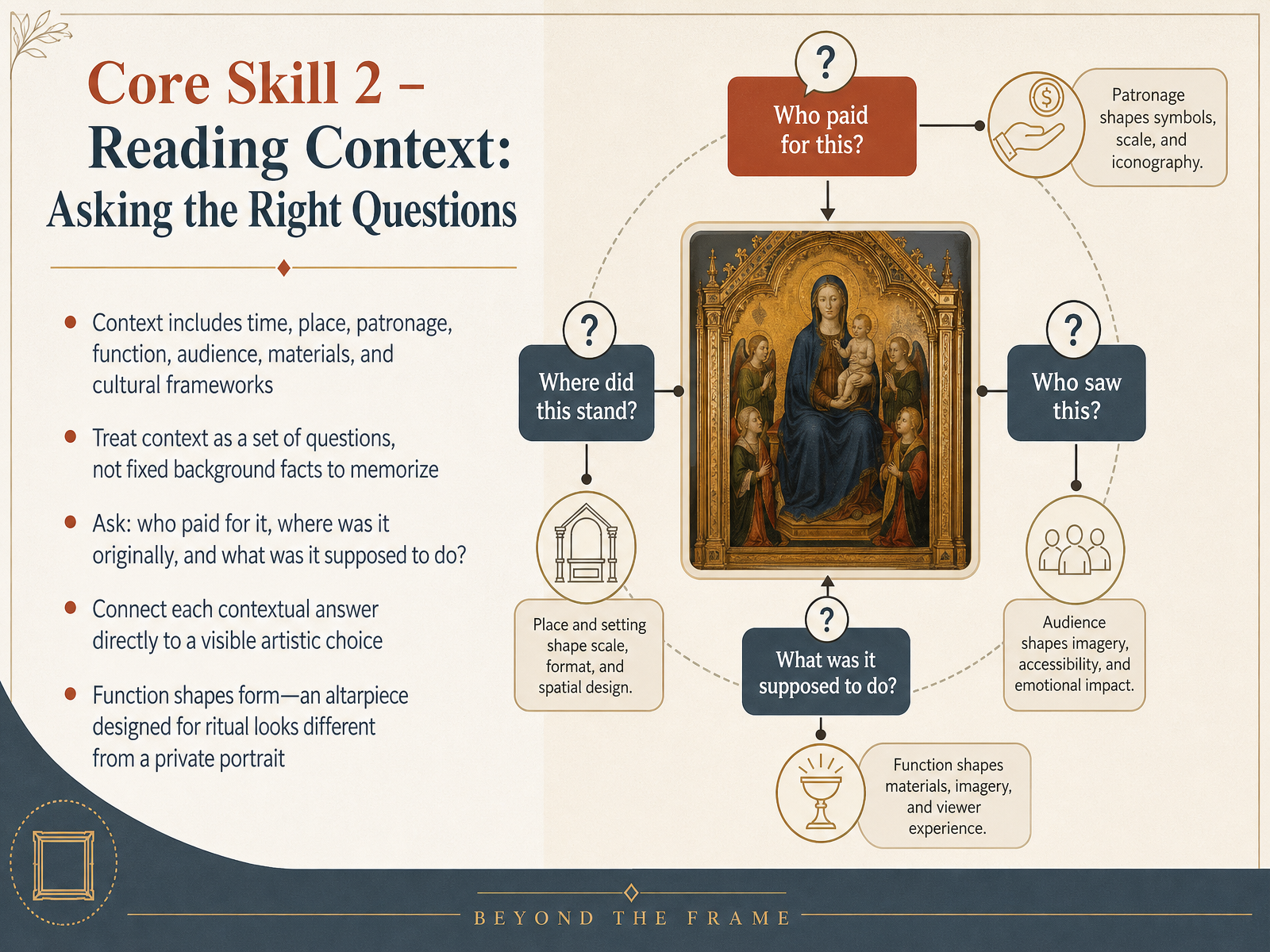
 - 05Core Skill 2 – Reading Context: Asking the Right QuestionsWe just explored how close, slow looking forms the foundation of our analysis. Now, let's build on that with our second core skill: reading context. Think of context not as a fixed list of facts to memorize, like a date or a name, but as a set of investigative questions you ask of an artwork. These questions probe the time, the place, the patronage, the function, the audience, and the materials. Who paid for this work? Where was it originally meant to be seen? And what was it supposed to do? The crucial next step is to connect each contextual answer directly back to a specific, visible artistic choice you can see. Because here’s a key principle: function shapes form. An altarpiece designed for a church ritual, for instance, looks fundamentally different from a private portrait made for a home. The context drives the visual decisions. So, keep these questions ready. Next, we will put them into action by examining how patronage, original location, and audience directly shape an artwork's meaning.
 fiveable.mesmarthistory.orgarthistoryrules.wordpress.com+22 min
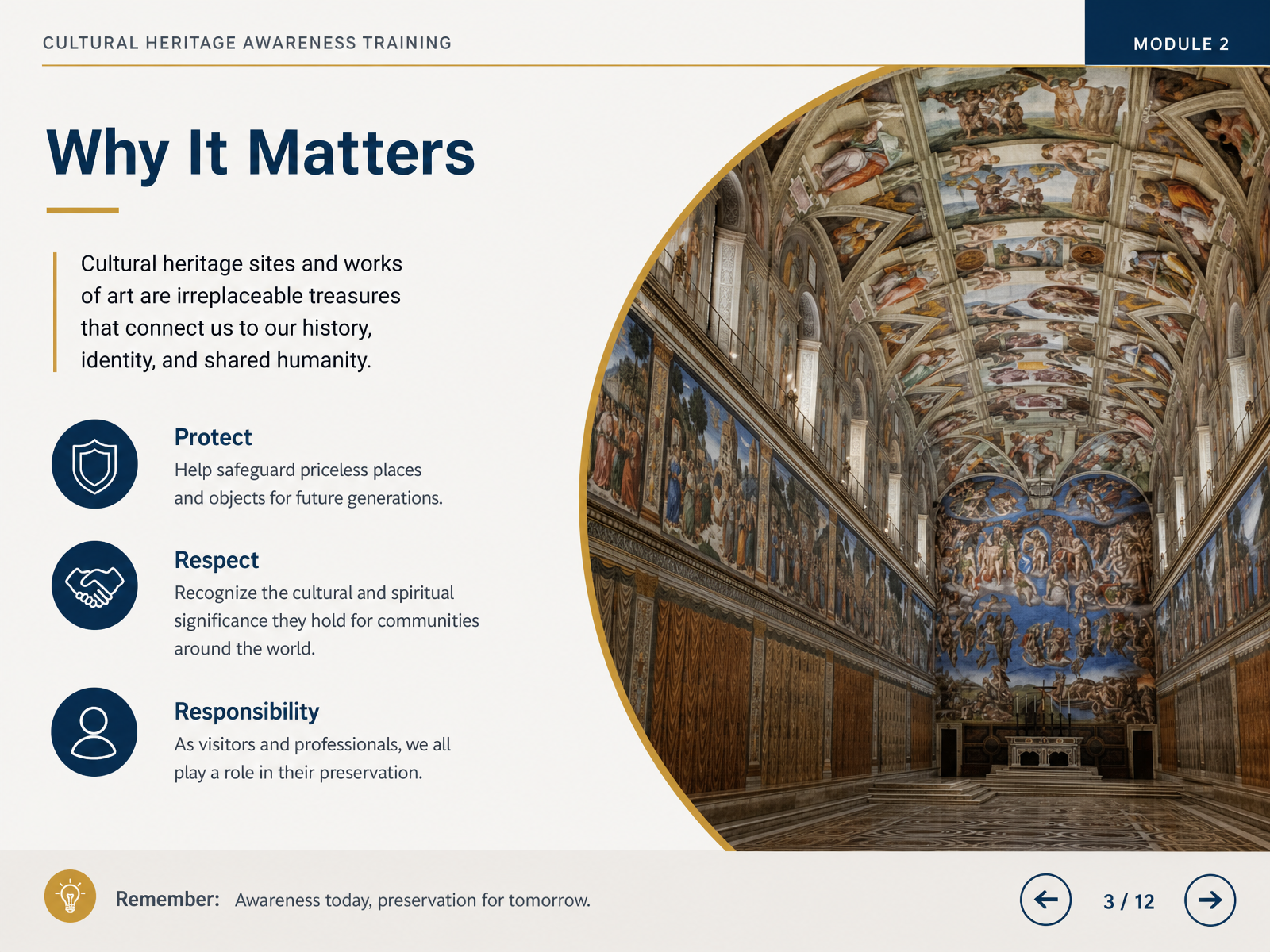
 - 06Context in Action: Patronage, Original Location, and AudienceNow let’s watch that contextual reasoning in action, with three clear examples of how patronage, location, and audience shape what we see. First, consider the Portinari Altarpiece by Hugo van der Goes. Tommaso Portinari commissioned it for a church connected to the hospital of Santa Maria Nuova in Florence. That patronage and setting directly explain two visual details: the albarello vase, an apothecary jar holding herbs and ointments, and the presence of Saint Anthony, a plague saint invoked by the sick. The painting’s function and audience are built right into its imagery. Second, think about the Sistine Chapel ceiling. The chapel was a key papal ritual site. Its function as a space for major ceremonies helps explain the entire fresco program’s monumental scale and layered iconography—it wasn’t just decoration, it served the specific rituals performed there. Third, in Siena, Pandolfo Petrucci commissioned a series of frescoes for his palace to celebrate his son’s wedding. The primary audience was wedding guests, so the scenes—like Coriolanus choosing family over politics—were chosen to model marital and civic virtues. In all three cases, a specific context drives an equally specific visual choice. That’s the habit we’re building. Next, we’ll move into Core Skill Three: Building Arguments from Evidence.
 fiveable.mesmarthistory.orgarthistoryrules.wordpress.com+22 min
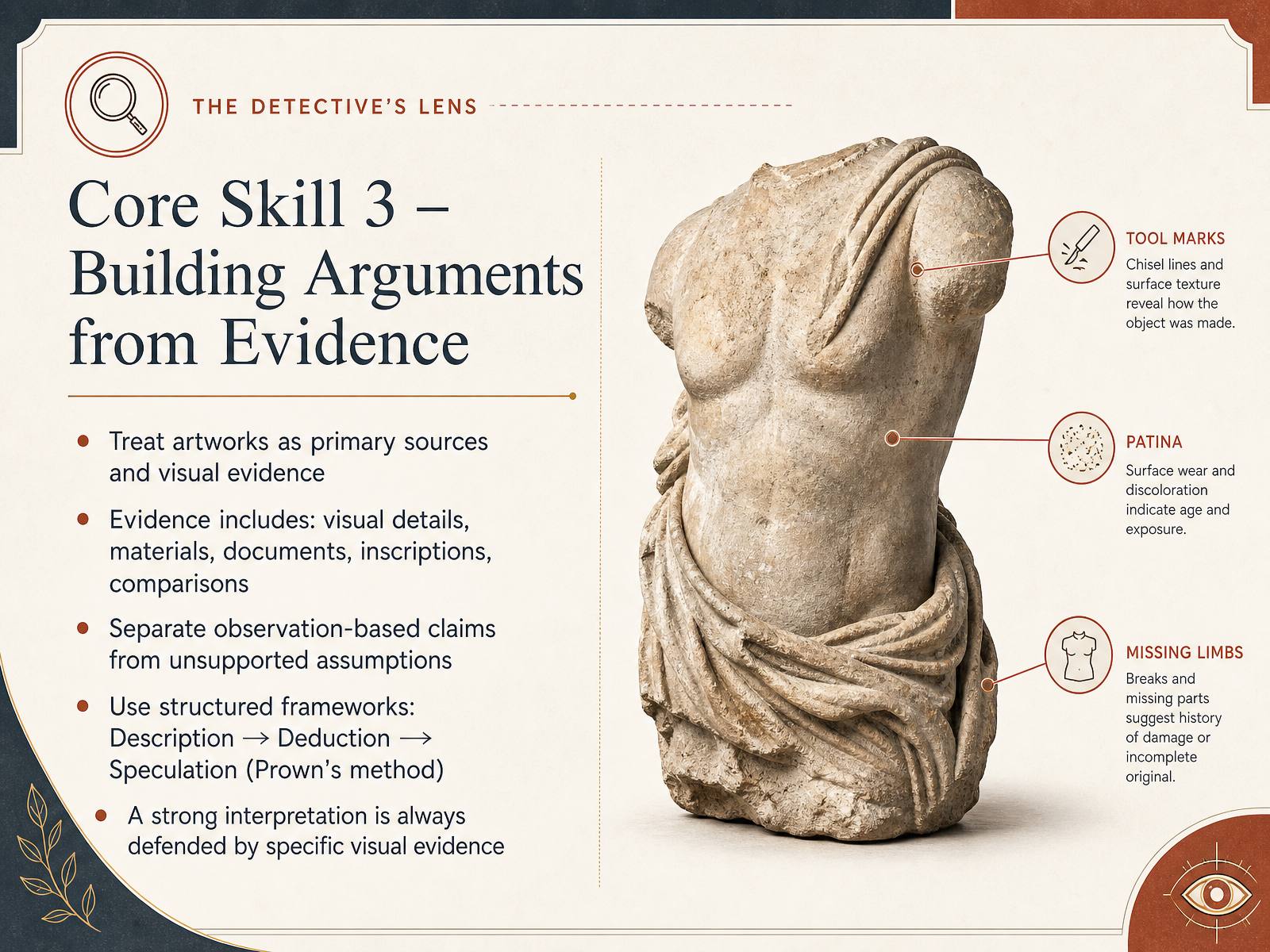
 - 07Core Skill 3 – Building Arguments from EvidenceBefore this, we explored looking closely and then placing what we see into context. Now we need to combine those skills into a single, defensible argument. Think of an artwork as a primary source, a piece of visual evidence from its own time. Our job is to examine every detail as a decision the artist made. Evidence does not only come from visual details like color, line, and composition. It also includes the physical materials, any documents or inscriptions linked to the work, or even careful comparisons with other objects. As you build an argument, you must separate claims grounded in observation from assumptions not yet supported. A helpful framework for this is Jules Prown’s method: begin with pure description, recording only what you see. Then move to deduction, asking what the sensory experience suggests. Finally, you can speculate, asking bigger cultural questions. A strong interpretation is never just a feeling; it is always defended by specific visual evidence you can point to. Next, we will walk through exactly how to move from observation to interpretation and construct a visual argument.
 about.jstor.org2 min
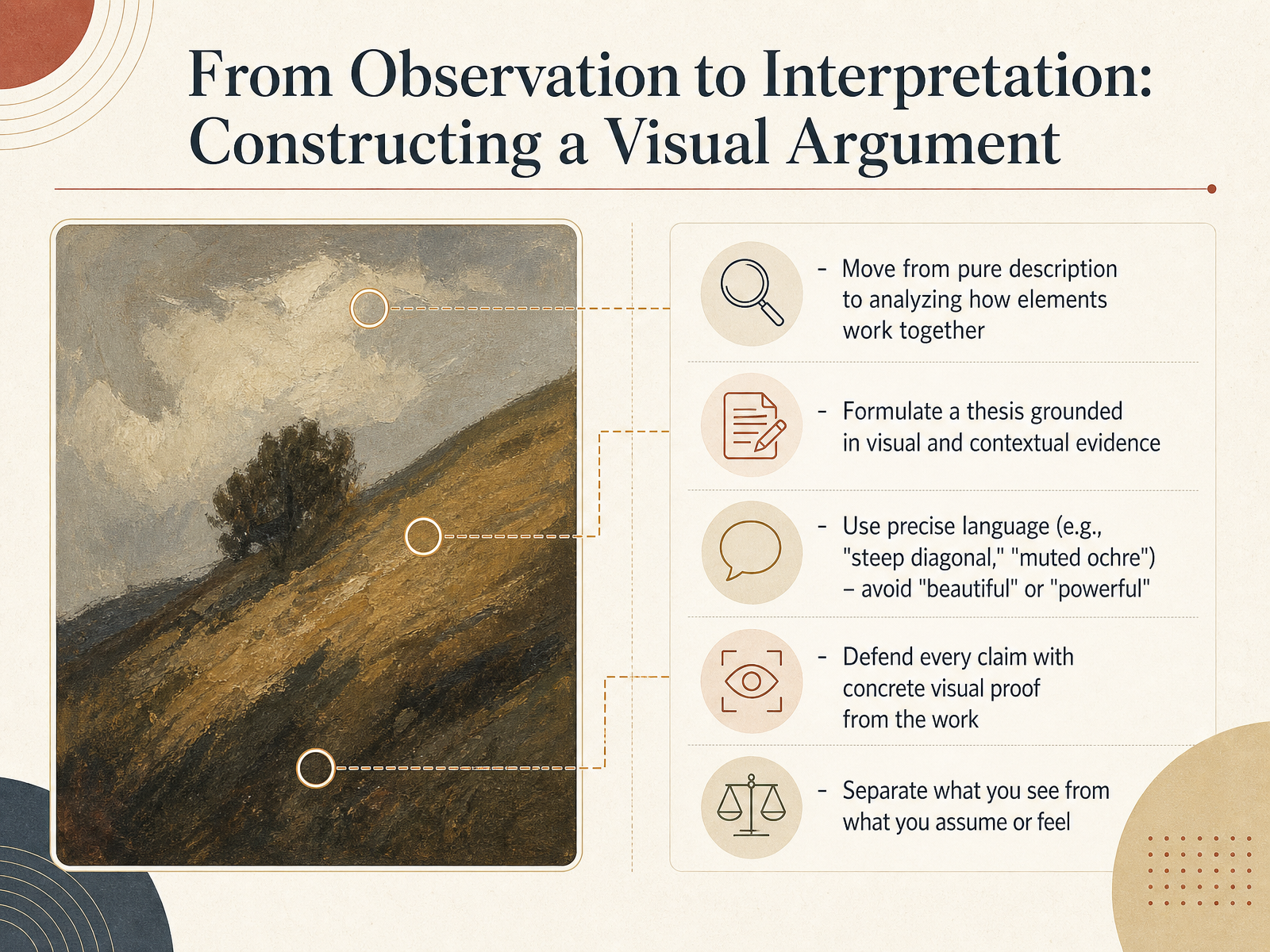
 - 08From Observation to Interpretation: Constructing a Visual ArgumentWe have spent focused time describing what we see, and now we shift from pure description to analyzing how those visual elements work together. This is where observation becomes a visual argument. Begin by looking at your list of observations and asking: how does one formal choice affect another? For example, if you noted a steep diagonal line cutting across the composition and a muted ochre dominating the lower half, consider how that diagonal directs your eye and whether the ochre stabilizes or intensifies the movement. Formulate a tentative thesis grounded in that visual evidence. Instead of saying a work is powerful, say the skewed perspective and compressed space create a sense of instability. Defend every claim with concrete proof from the work. If you argue the composition evokes tension, point to the steep diagonal. Crucially, separate what you see from what you assume or feel. You might feel serene, but the visual evidence may show asymmetrical balance and cool tones. Verbally bracket your assumptions and test them against the visible facts. An excellent interpretation is one supported by evidence, not a guessing game. Next, we will put these skills together using a practice-based method.
 about.jstor.orgasia.si.edumuseum.cornell.edu+22 min
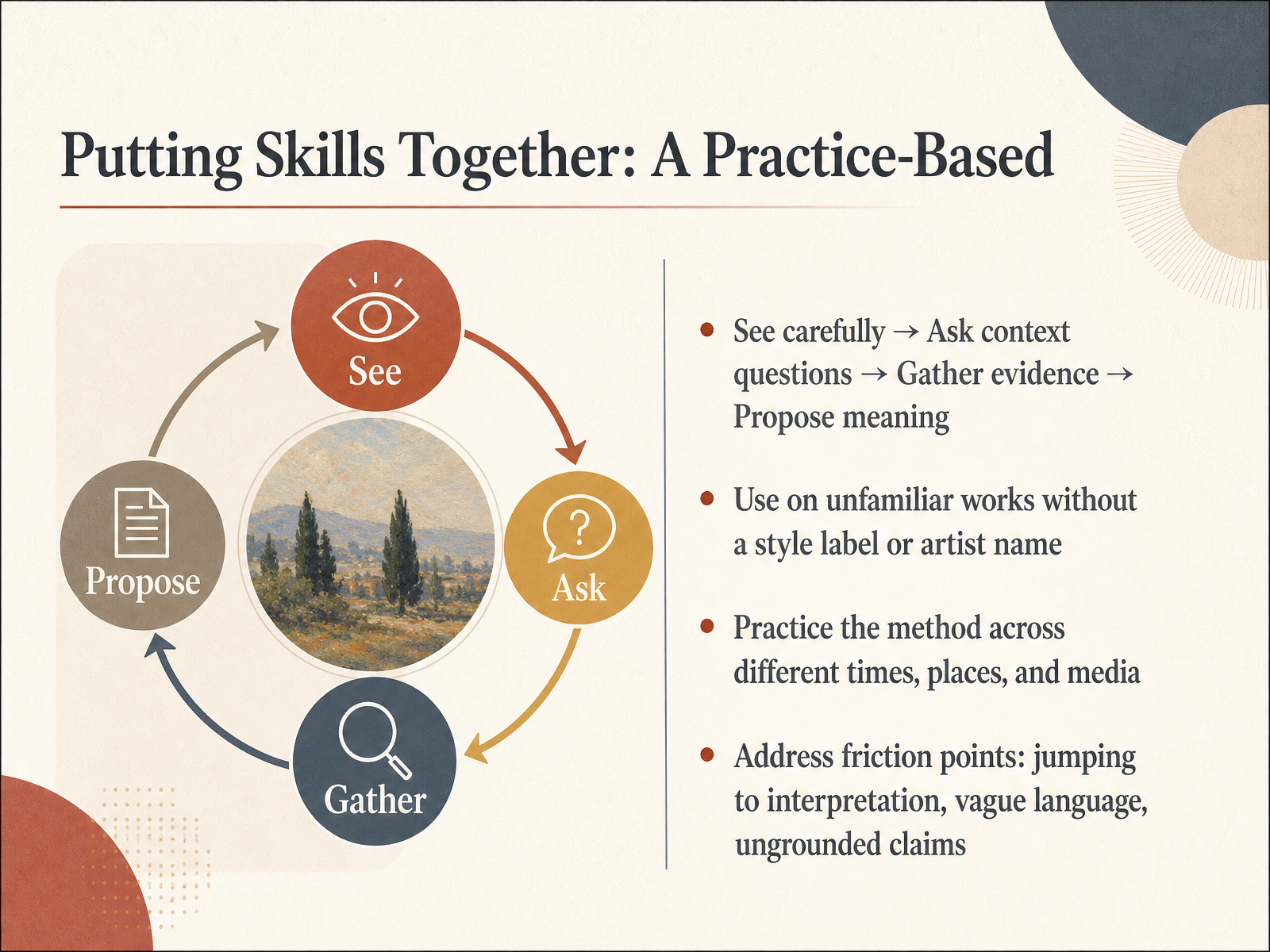
 - 09Putting Skills Together: A Practice-Based MethodWe have spent time looking carefully, describing what we see, and asking context questions. Now, let's bring all these moves together into a single, repeatable method. Think of it as a four-step cycle. First, see carefully. Before you ask anything, spend a few minutes simply observing: record surface textures, color relationships, where your eye travels, and what feels out of place. Second, ask context questions. What materials were used, who might have paid for this, and where was it originally meant to be seen? Third, gather evidence. Treat your visual notes and contextual clues like data, not just impressions. Finally, propose meaning. State your interpretation in a way that can be supported by the evidence you gathered. You should feel comfortable applying this method to works you have never seen before—objects without a handy style label or famous name beside them. Practice it across different times, places, and media, from a sixteenth-century altarpiece to a contemporary installation. Watch out for three friction points we all face: jumping straight to interpretation before you have gathered enough visual evidence, using vague language like 'powerful' or 'interesting' without pinpointing what creates that effect, and making claims that cannot be traced back to something specific in the work. When you catch yourself doing any of these, pause and return to the object itself. Coming up, we will test this method with a real case study: seeing beyond the first impression.
 about.jstor.orgasia.si.edumuseum.cornell.edu+22 min
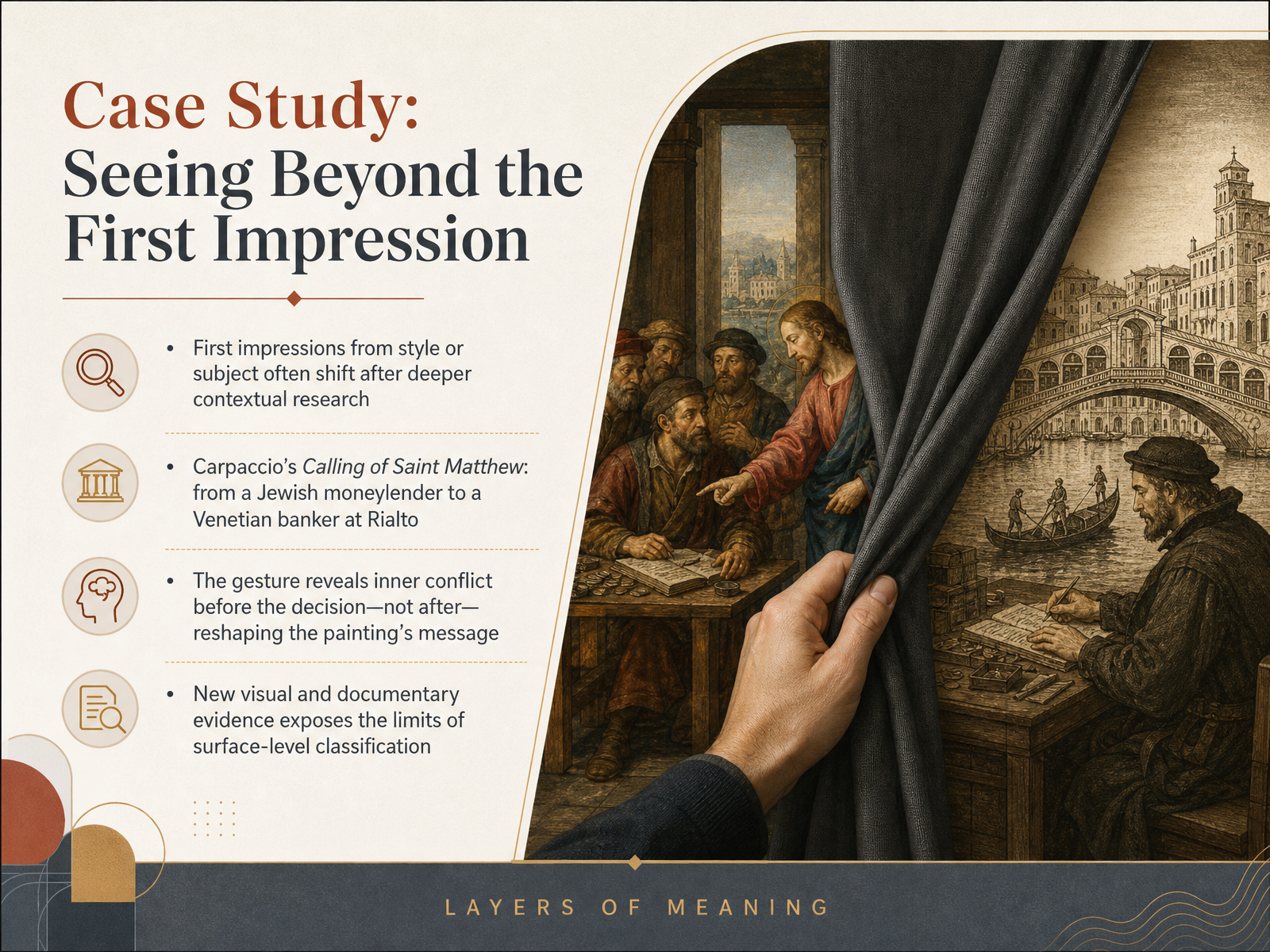
 - 10Case Study: Seeing Beyond the First ImpressionLet's apply our tools of looking and context to a specific case study that shows why first impressions can be deceptive. Consider Vittore Carpaccio's painting, The Calling of Saint Matthew, made around 1502. On first glance, many viewers, even experts, classified the main figure as a Jewish moneylender due to his style of dress. But deeper research into the original location changed that reading entirely. New documentary evidence showed that Carpaccio was actually painting a Venetian banker inside a banco de tapeto, a specific type of booth that once faced the Campo San Giacomo at the Rialto market. Now, examine Matthew's gesture. He isn't rising with firm resolve, but is caught in a moment of intense inner conflict, his fingers lingering on a pile of coins even as he takes Christ's hand. This isn't the moment after his decision, but the moment before it. This careful visual detail shifts the painting's message from one of swift obedience to a psychological struggle with material attachment. This case shows us how visual and documentary evidence can expose the limits of surface-level classification. The process of seeing beyond the first impression builds a richer, more accurate story. Next, we'll build on this by talking about common traps and how to avoid them.
 fiveable.mesmarthistory.orgarthistoryrules.wordpress.com+22 min
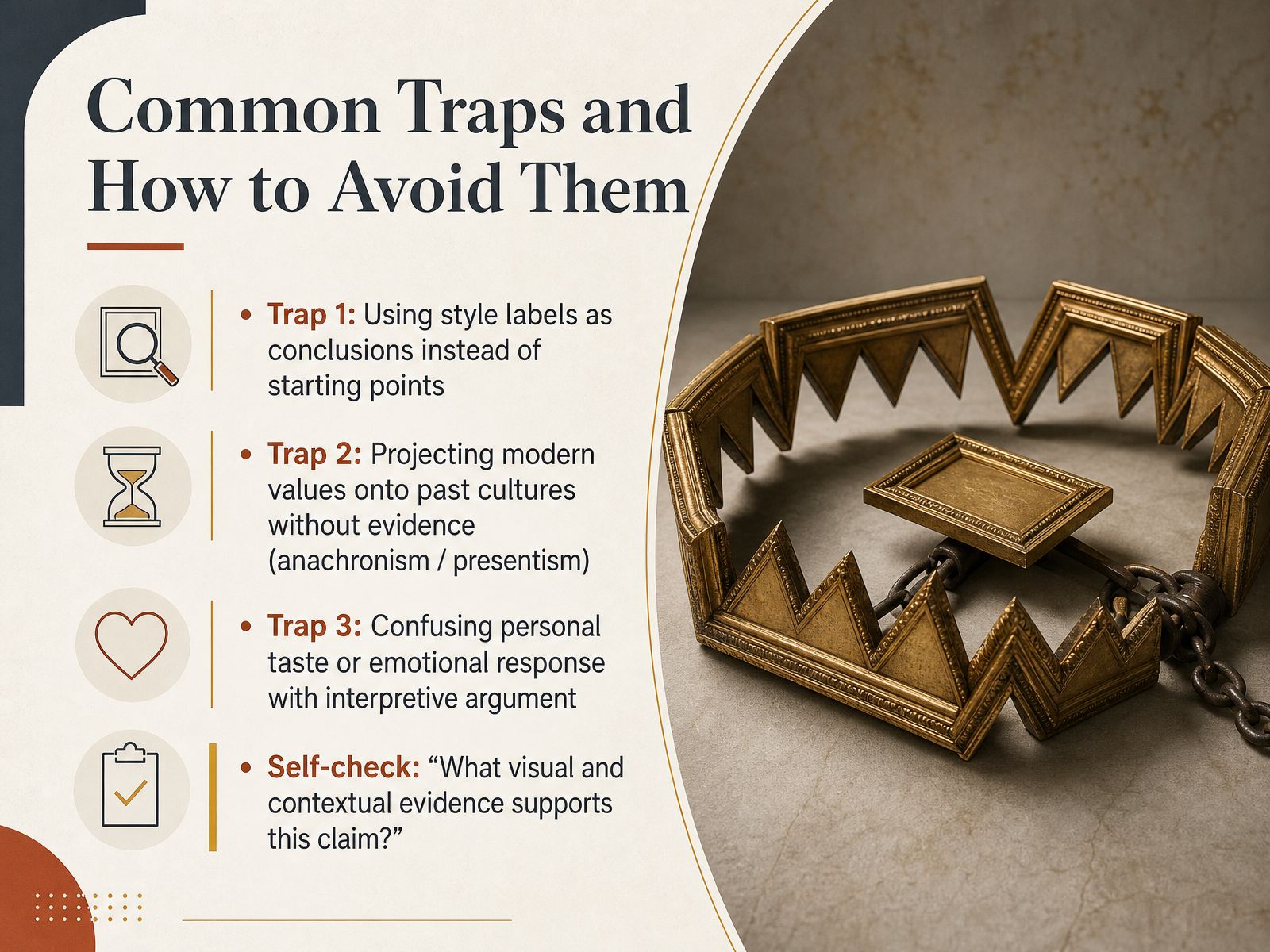
 - 11Common Traps and How to Avoid ThemLet’s pause and look at three common traps that can slip into an analysis, and how to step around them. The first trap is using a style label as a conclusion rather than a starting point. Saying “this is Baroque” can accidentally stop the conversation. Instead, let the label open a question: what specific visual traits make that label useful here, and what historical conditions shaped those traits? The second trap is projecting today’s values onto past cultures without evidence, what historians call anachronism or presentism. A gesture that reads as casual to a modern eye may have carried formal ritual weight in its own time, so ask what the visual and contextual record actually supports before deciding what a detail means. The third trap is mistaking personal taste or an emotional reaction for an interpretive argument. A strong feeling is a great starting cue, but it needs to be grounded. What visual and contextual evidence supports this claim? Make that question a quick self-check whenever you reach a firm judgment, so your reading stays tethered to what you can see and document. Next, we’ll explore applying this lens in the museum and online.
 doi.orgdocs.lib.purdue.eduacademicworks.cuny.edu+22 min
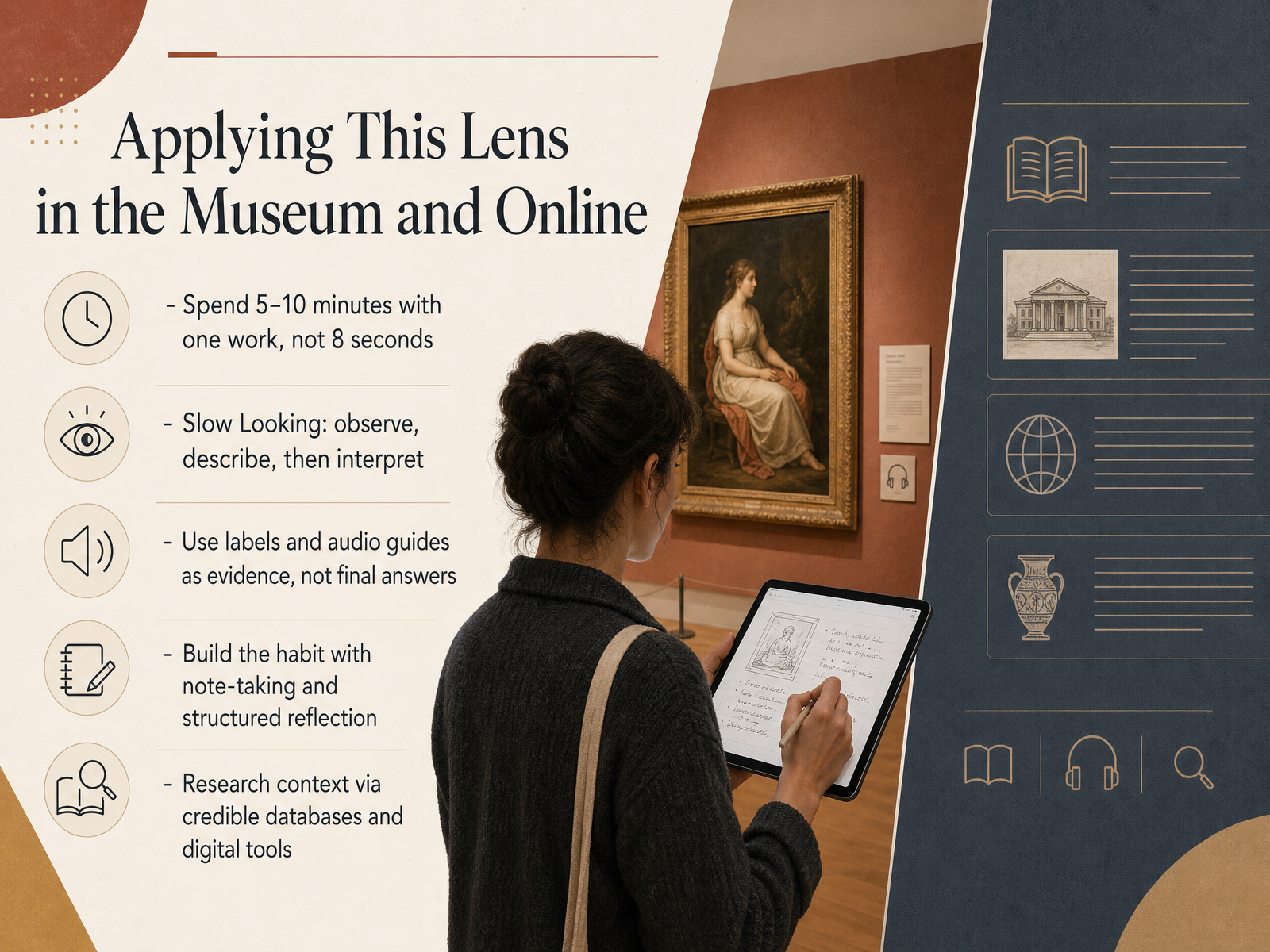
 - 12Applying This Lens in the Museum and OnlineLet's take all these skills and put them into practice, whether you are standing in a museum or scrolling through a digital collection. The first step is the simplest and the hardest: spend five to ten minutes with a single work instead of the average eight seconds. Choose something that sparks your curiosity or even frustrates you. Try 'Slow Looking' by silently observing the formal elements first. Let your eyes wander through the textures, colors, and shapes. Describe what you see before you try to interpret what it means. As you form your ideas, remember to treat the wall labels and audio guides as sources of evidence, not as final answers. They give you a starting point for your own analysis. Build this into a solid habit by taking notes during your looking process. After you leave, do a bit of structured reflection. What surprised you? What questions do you still have? Then, take those questions to credible databases and digital tools to research the context deeper. Each time you do this, you turn a quick glance into a real historical investigation. Next, we will put this method to work in a case study on stylistic and technical analysis, using art directly as evidence.
 tate.org.ukpages.thinkingmuseum.comslowartday.com+22 min
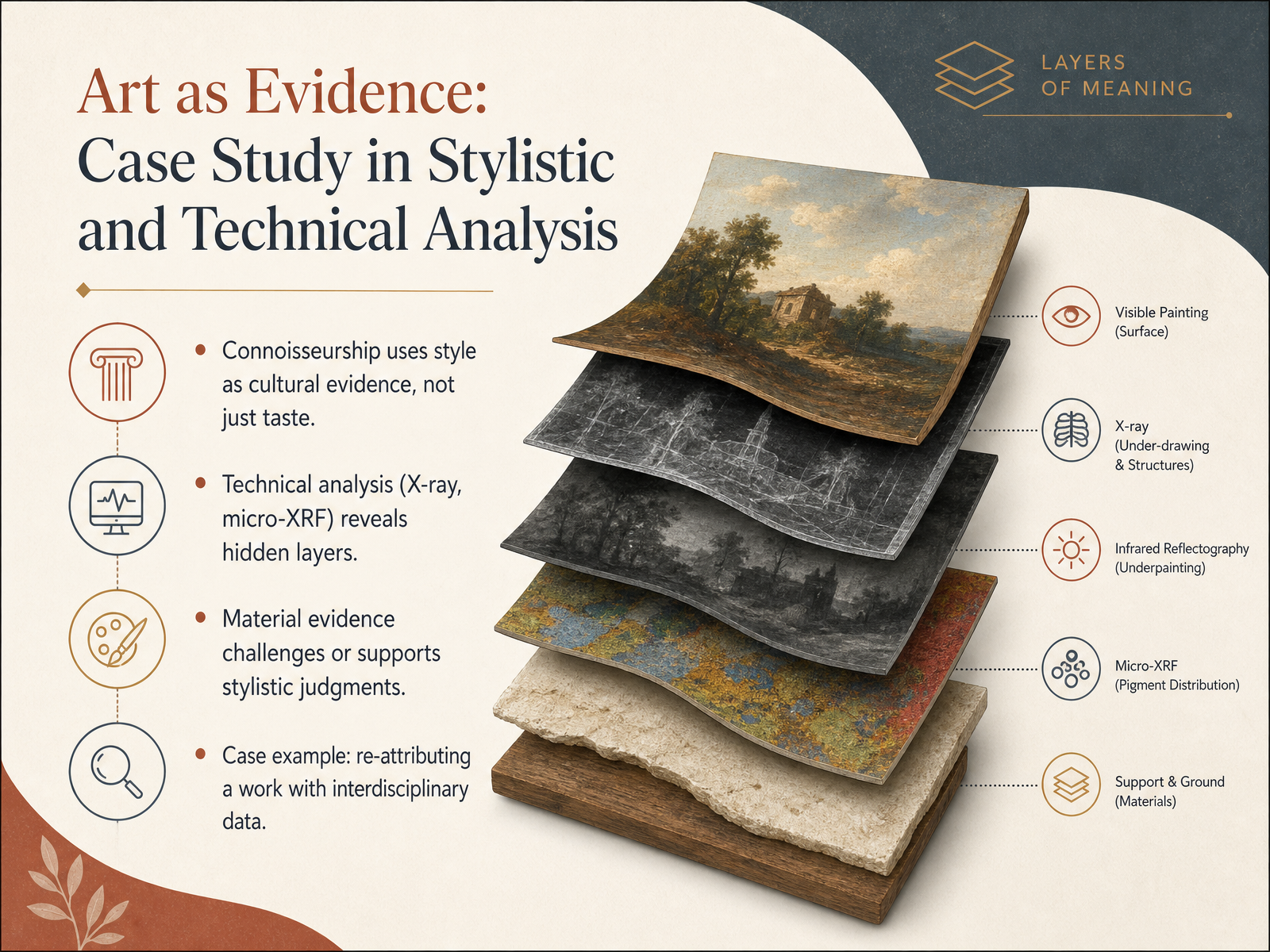
 - 13Art as Evidence: Case Study in Stylistic and Technical AnalysisNow let's move from the broader tools of looking to a specific challenge: using art as hard evidence. We often think of stylistic judgments as matters of taste, but connoisseurship treats style as cultural evidence. It asks, 'what makes this work consistent with a particular hand, workshop, or time?' Suddenly, a quick brushstroke or a way of rendering an ear becomes a data point. But style alone can fool us. That's where technical analysis comes in. Tools like X-ray and micro-XRF let us peer through paint layers and see changes the artist made, or materials that shouldn't be there. Imagine a pentimento, a hidden revision, revealed beneath a finished surface. That material evidence can challenge a long-held stylistic attribution. A great case is the re-attribution of an Adoration of the Shepherds to Jordaens: dendrochronology, panel marks, and a painted-over head found via X-ray combined to prove it wasn't a copy, but an original. The lesson is clear: visual judgment and material science strengthen each other. They turn 'I think' into a testable, evidence-based argument. Now let's take these analytical habits beyond the gallery in our next part, 'Visual Literacy Beyond the Gallery: Transferring Skills.'
 about.jstor.org2 min
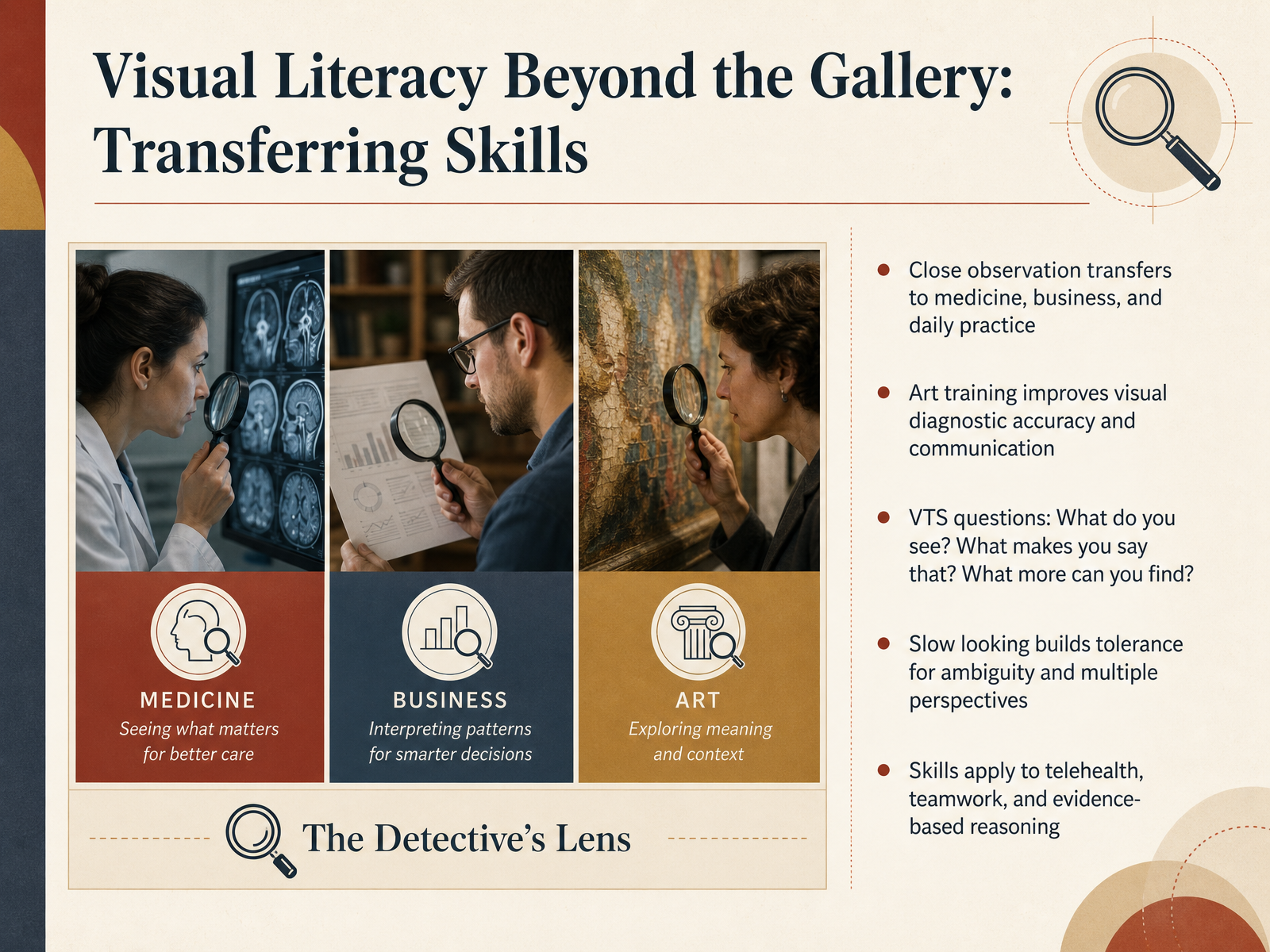
 - 14Visual Literacy Beyond the Gallery: Transferring SkillsNow let’s take these observation skills beyond the artwork. Close observation transfers directly into medicine, business, and daily practice. For example, a medical student who practices describing what she sees in a painting, before jumping to interpretation, builds the same disciplined looking she will use to read a patient’s symptoms or a clinical image. Art training has been shown to improve visual diagnostic accuracy and communication among healthcare teams. The three questions from Visual Thinking Strategies give us a portable toolkit: What do you see? What makes you say that? And what more can you find? They keep you grounded in evidence and open to noticing what you missed. Slow looking builds something else too: a tolerance for ambiguity and for multiple perspectives. That matters in telehealth, where you have to gather clues from a screen, in teamwork, where you combine different viewpoints, and in evidence-based reasoning, where you hold off on a conclusion until you have enough data. So the next time you face a dense image, a complex case, or a team debate, try borrowing the art historian’s pause. Next we’ll close the course by framing art history as active investigation.
 about.jstor.orgasia.si.edumuseum.cornell.edu+22 min
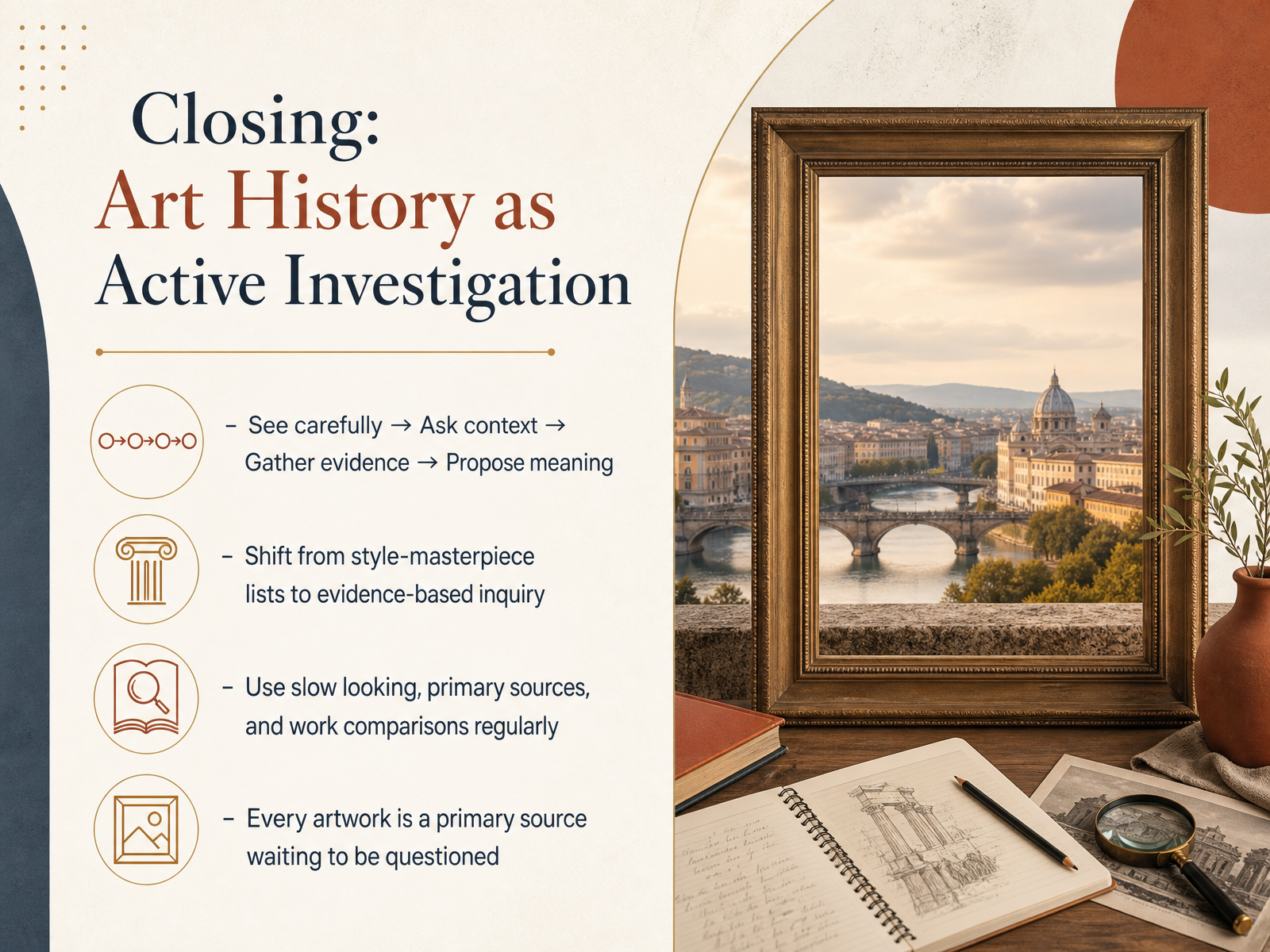
 - 15Closing: Art History as Active InvestigationWe have arrived at a simple but powerful cycle for making art history an active investigation. The framework is: see carefully, ask context, gather evidence, propose meaning. When you approach an artwork, step one is slow, descriptive looking. Ask yourself what you can objectively observe about form, composition, material, and scale before jumping to a label. Step two is to turn outward and ask contextual questions: who made this, for whom, and under what circumstances? Step three is to gather evidence. Look for primary sources such as artist letters, contracts, exhibition records, or contemporaneous prints that can ground your thinking. Only then do you step into the fourth phase: proposing an evidence-based interpretation. This practice replaces memorizing a fixed list of styles and masterpieces with a method you can apply to any object, from any era. Every artwork is a primary source waiting to be questioned. Use slow looking, work regularly with primary sources, and compare artworks as a habit. Those three routines will build your confidence as a visual thinker. Thank you for joining me in this introduction to art history as active investigation. The images are out there, so stay curious, trust the evidence, and keep looking closely.
 about.jstor.org2 min
Take the deck with you
Download this course as a file — free, no sign-up needed.
- PDF handoutEvery slide page, ready to print or share.16 pages · 5.3 MBDownload
- Narrated PowerPointThe deck that presents itself — every slide carries the digital human's narration video.16 pages · 18.8 MBDownload
- PowerPoint slidesThe full deck as a .pptx — open it in PowerPoint, Keynote, or Google Slides.16 pages · 5.2 MBDownload
Free to use in your own training — please keep the PersonWise credit page at the end.
Have your own deck? Turn it into a course
Sources consulted
Web sources consulted while building this course.
- Slow Art Project | Teaching Visual Analysis with JSTOR — about.jstor.org
- Hokusai and Slow Looking — asia.si.edu
- VISUAL ANALYSIS 101 — museum.cornell.edu
- https://www.mfah.org/learn/practice-looking-art — mfah.org
- A "Slow-Looking" Assignment - USC Center for Excellence in Teaching — cet.usc.edu
- What Comes after World Art? — doi.org
- Style, Nonetheless. Eight Good Reasons to Reject the Notion of Style — docs.lib.purdue.edu
- De-Centering “The” Survey: The Value of Multiple Introductory Surveys to Art History — academicworks.cuny.edu
- Beyond Style: A Decision-History Framework for a Global Art History — doi.org
- Manifest Orientalism: Roots of the Teacher Centered Approach in Canonical Art History Texts — rah.thebrpi.org
- A guide to slow looking - Tate — tate.org.uk
- SLOW ART GUIDE — pages.thinkingmuseum.com
- Slow Looking Worksheet — slowartday.com
- 17 NOV 2024 — 16 FEB 2025 — cms.ipswichartgallery.qld.gov.au
- A Slow Art Day Guide — slowartday.com
- AP Art History Contextual Analysis Skill Guide | Fiveable — fiveable.me
- Understanding art, an introduction — smarthistory.org
- Contextual Analysis | Art History Rules - WordPress.com — arthistoryrules.wordpress.com
- Art historical analysis with Goya’s Third of May, 1808 — smarthistory.org
- Luca Signorelli | Coriolanus persuaded by his Family to spare Rome | NG3929 | National Gallery, London — nationalgallery.org.uk