Begin
15 pages · ~30 min
Content Marketing Skills and Practice
This training builds core content marketing skills for professionals, covering strategy, creation, and distribution to help trainees plan and execute effective content that engages audiences and drives results.
A digital instructor presents all 15 pages. Hold “Ask” at any point and ask out loud — the answer comes from this course. No sign-up needed.
What you’ll learn
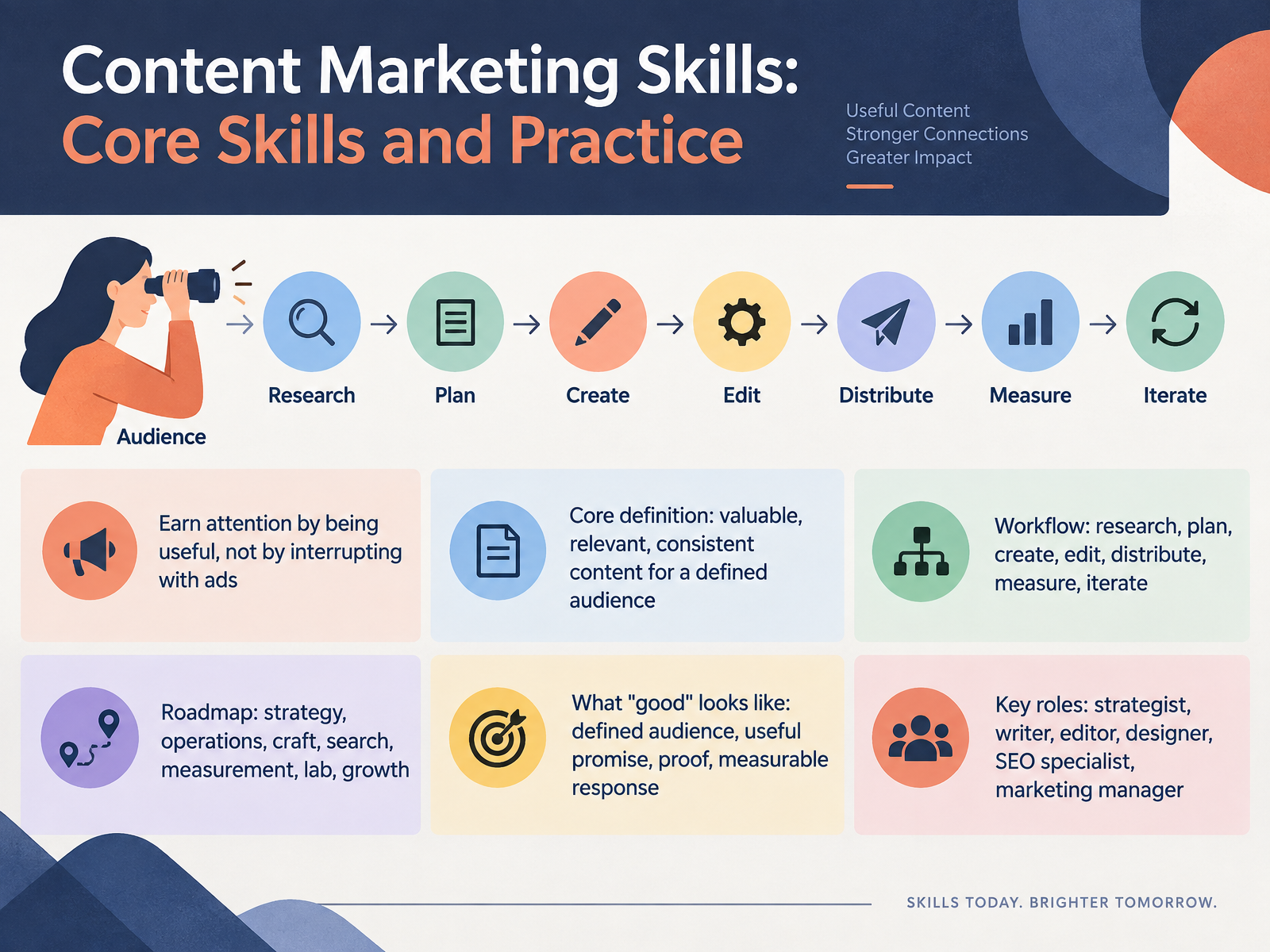
- 01Content Marketing Skills: Core Skills and PracticeWelcome. I'm glad you're here. Over the next fifteen slides, we're building one practical skill set: content marketing. This is for newcomers, writers, editors, creators, students, teachers, and marketing managers. Start here. Content marketing means earning attention by being useful, not by interrupting people with ads. The core definition is simple: valuable, relevant, and consistent content for a clearly defined audience. Notice that phrase, relevant and valuable. That's the line between helpful content and spam. The workflow looks like this: research, plan, create, edit, distribute, measure, then iterate. Repeat that loop. Our roadmap covers strategy, operations, craft, search, measurement, a lab, and growth. So what does good look like? A defined audience, a useful promise, proof, and a measurable response. One example: a how-to guide that answers a real question and ends with a clear next step. That's good. Key roles include strategist, writer, editor, designer, search specialist, and marketing manager. You may wear several hats at once. Here's your takeaway for today: before you write anything, name your audience and the useful promise. Watch for this mistake, creating content that sells first instead of helps first. Next, let's look at the background: how content marketing works today.contentmarketinginstitute.comimages.contentinstitute.comama.org+22 min
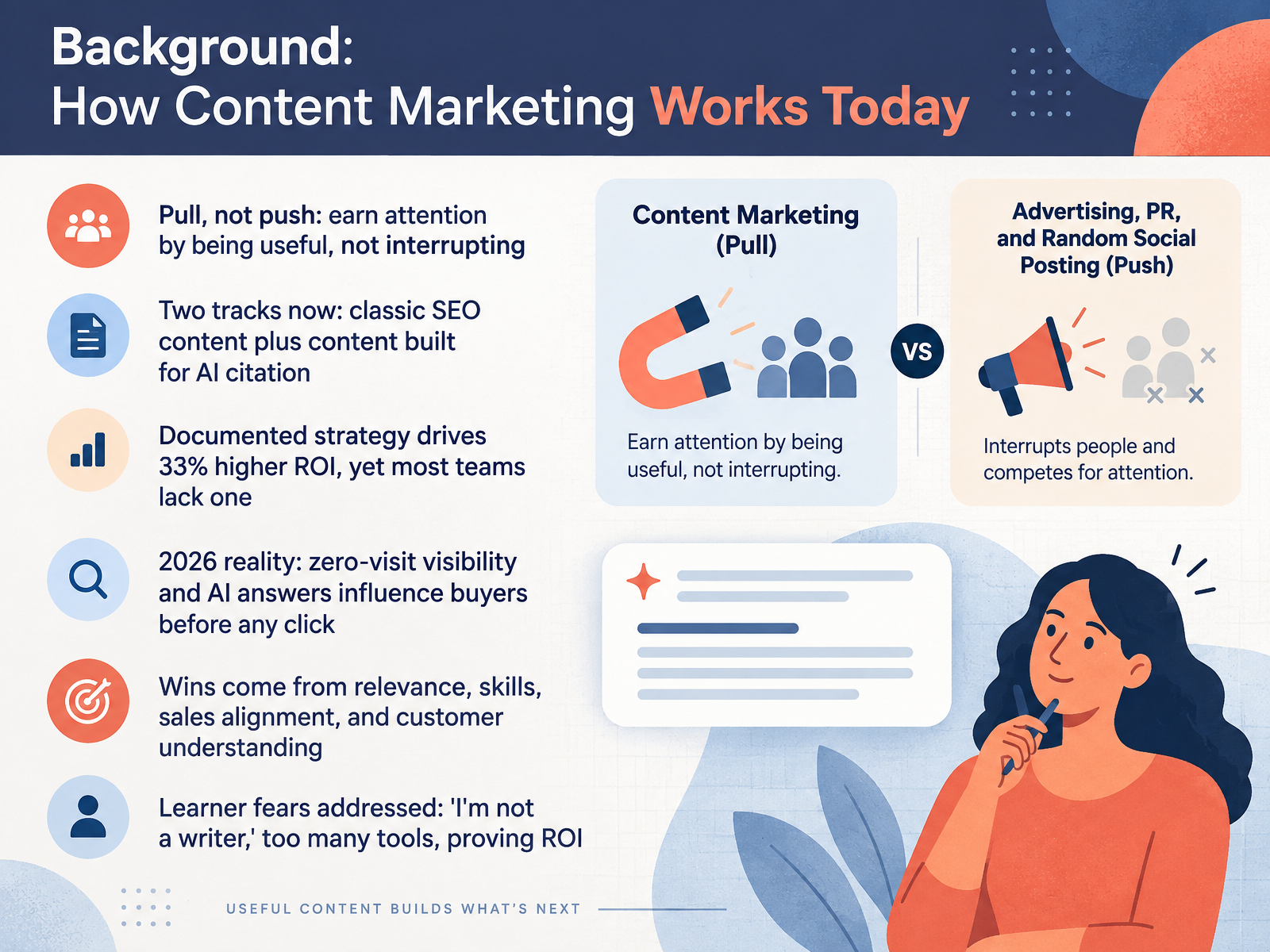
- 02Background: How Content Marketing Works TodayLet's zoom out and look at how content marketing actually works today. Start here. The core idea is pull, not push. Instead of interrupting people with ads, you earn attention by being genuinely useful. That is the difference between strategic content and spam. Now, there are two tracks. Classic search engine optimization content still matters. Alongside it, you now create content designed to be cited by AI tools, because buyers often get answers before they ever click. Here is a number worth remembering. Teams with a documented strategy see thirty-three percent higher return on investment. Yet most teams still do not have one. That is a huge, free opportunity. The twenty twenty-six reality is zero-visit visibility. Your buyer may read an AI summary, form an opinion, and never visit your site. So wins come from relevance, real skills, alignment with sales, and deep customer understanding. If you are worried, I am not a writer, or there are too many tools, or how do I prove return on investment, take a breath. You do not need to do everything. Pick one audience, one channel, and one measurable outcome. That is your starting point. Next, we will look at audience, positioning, and content strategy foundations.
 contentmarketinginstitute.comimages.contentinstitute.comama.org+22 min
 - 03Audience, Positioning, and Content Strategy FoundationsNow let's ground your whole content plan in three foundations. Audience, positioning, and content strategy.
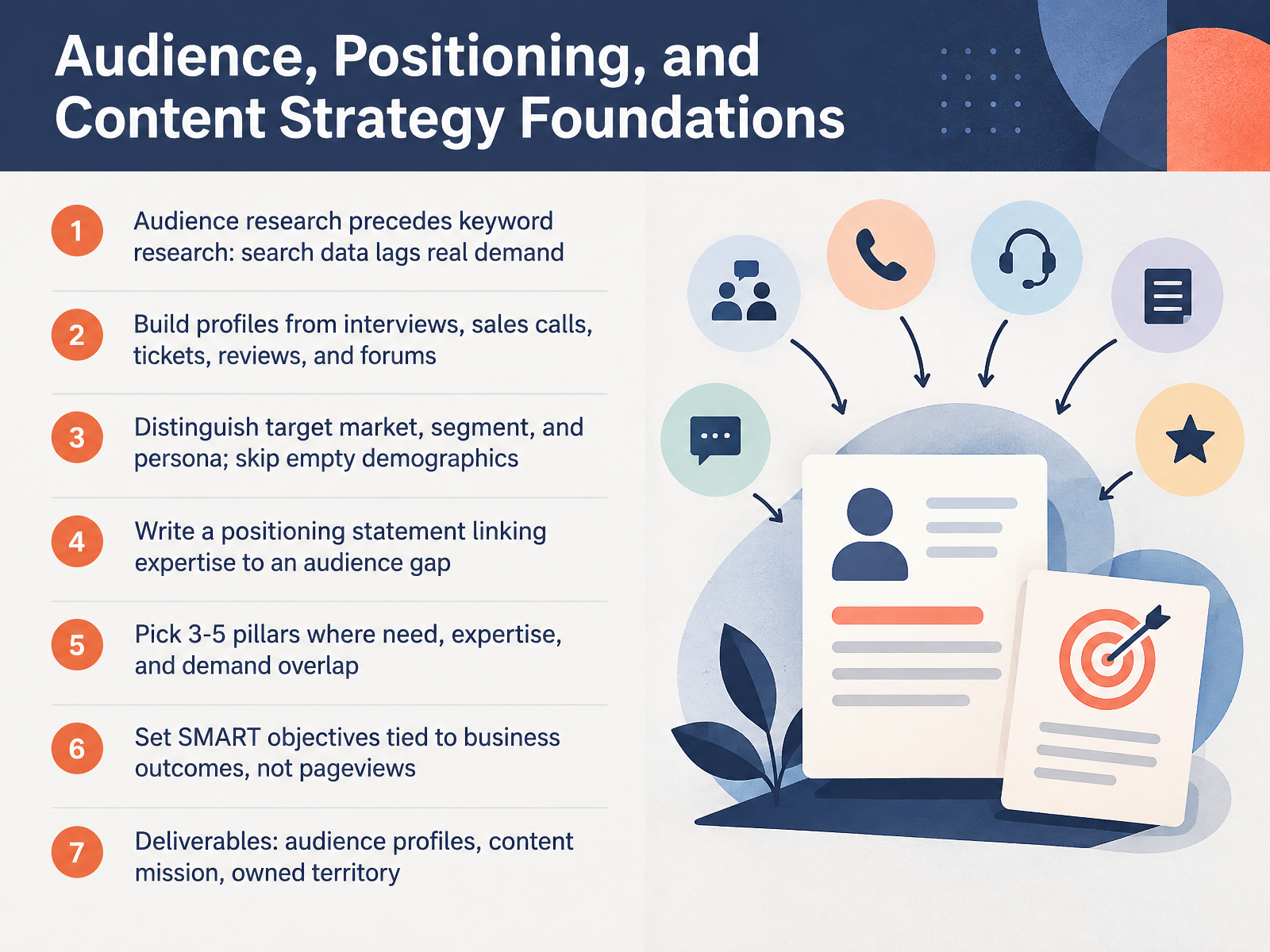
Start here. Audience research comes before keyword research. Search data lags real demand. People search for what they already know to ask. So build your profiles from interviews, sales calls, support tickets, reviews, and forums. That's where you hear the words your buyers actually use.
Next, keep your terms straight. Your target market is the broad group you serve. A segment is a slice of that market. A persona is one realistic person inside that segment. Skip empty demographics like age and city unless they change the buying decision.
Then write a positioning statement. Link your expertise to a real gap in your audience's world. For example, we help first time managers run clear one on ones, because most advice assumes years of experience.
Now pick three to five content pillars. These are the places where audience need, your expertise, and actual demand overlap. And set SMART objectives tied to business outcomes, not pageviews. Watch for this mistake. Chasing traffic that never converts.
Your deliverables for this step are audience profiles, a content mission, and your owned territory. Keep them short and usable.
Next, we'll map those pillars into funnels and topic clusters. Funnel Mapping and Topic Clusters.
 2 min
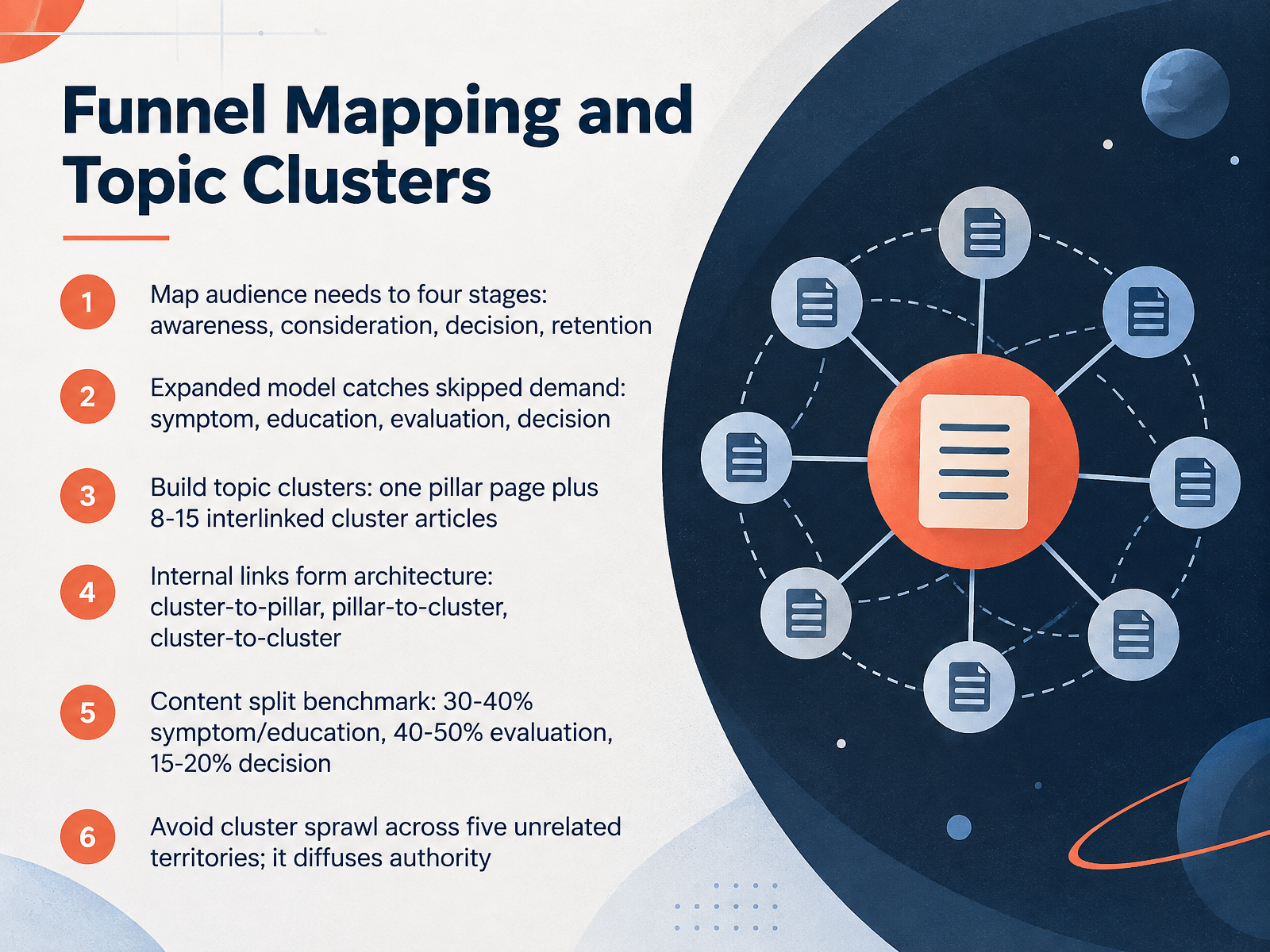
2 min - 04Funnel Mapping and Topic ClustersNow that you know your audience, it is time to map what they need and where they are in the journey. Start with four stages: awareness, consideration, decision, and retention. But real buying behavior often skips a step. So try the expanded model: symptom, education, evaluation, decision. For example, a reader might search "why is my website slow" before they even know a solution exists. That is symptom content. Next, build topic clusters. One pillar page, supported by eight to fifteen interlinked cluster articles. The internal links are your architecture: cluster to pillar, pillar to cluster, and cluster to cluster. Watch for this mistake: spreading clusters across five unrelated territories. It diffuses authority. A healthy content split looks like this: thirty to forty percent on symptom and education, forty to fifty percent on evaluation, and fifteen to twenty percent on decision. Takeaway for today: pick one territory and link every piece back to a single pillar. Next, we will look at editorial planning and content operations.
 1 min
1 min - 05Editorial Planning and Content OperationsNow let's talk about editorial planning and content operations. This is the system that keeps your calendar from stalling. Plan across four horizons: annual themes, quarterly pillars, monthly briefs, and a weekly execution window. Your calendar needs minimum fields: status, owner, keyword, cluster, channel, call to action, dates, and success metric. Each brief should specify the audience, angle, sections, proof sources, internal links, call to action, and what to exclude. Here's the key mistake to avoid. Don't conflate ideation, briefing, drafting, review, and QA. When you merge these stages, your calendar stalls by week six. Keep a buffer of ten to twenty percent, and lock the next seven to fourteen days against reactive requests. Also, allocate fifteen to twenty-five percent of weekly capacity to refreshing existing content. Start by reviewing your calendar today. If you can't answer who owns the next move and when it ships, you have a list, not a system. That structure sets up our next topic: content briefs and workflow handoffs.
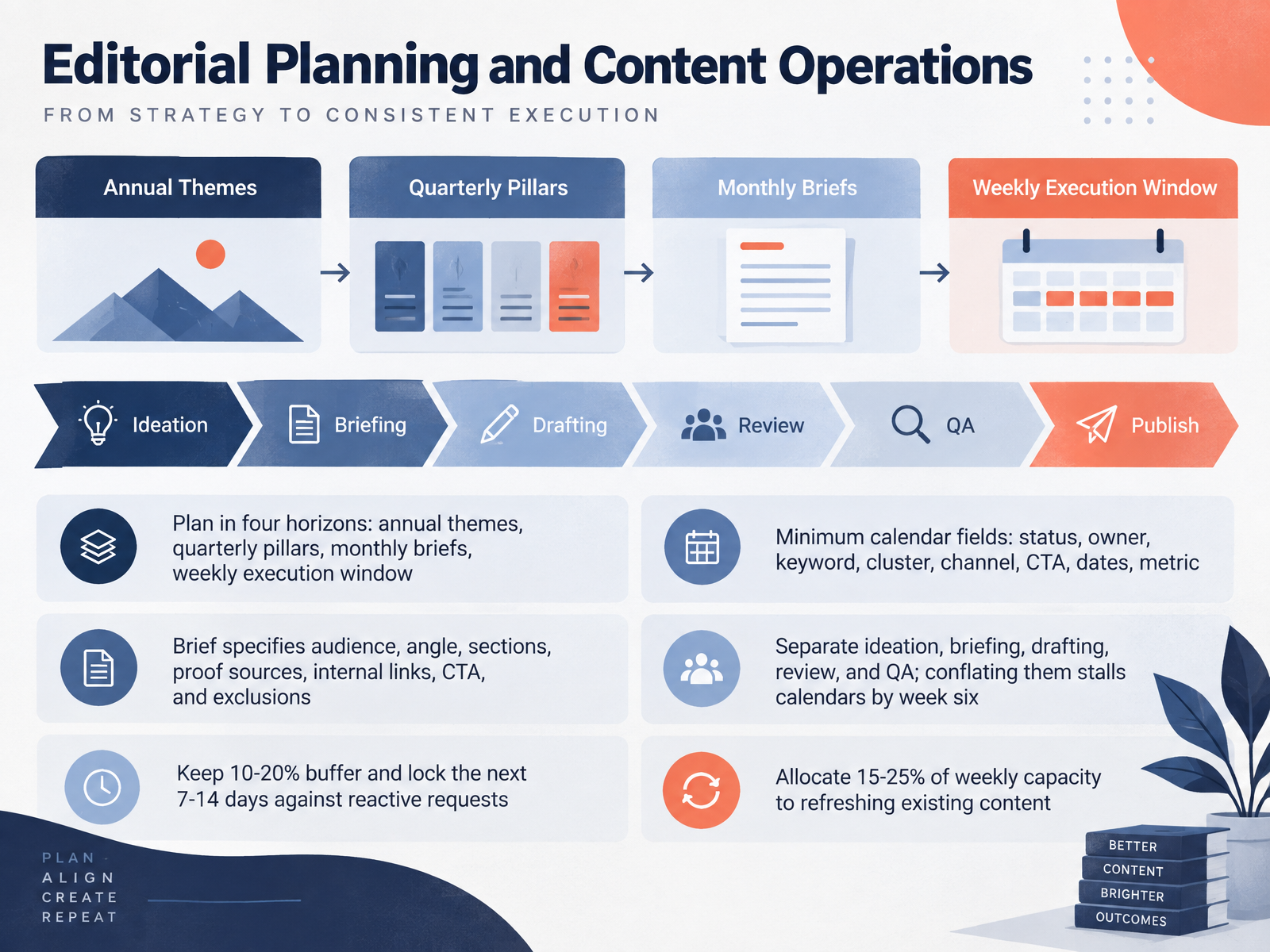 digitalapplied.comdigitalapplied.comcreaitor.ai+22 min
 - 06Content Briefs and Workflow HandoffsLet's talk about the brief, and the handoffs that follow it. Here's the thing to remember. The brief decides whether your pipeline ships clean drafts or burns weeks in revision loops. So start here. Split search intent from answer intent. Search intent is the ranking job: the query you want to appear for. Answer intent is the extractable answer you lead with, the one that wins the snippet or the AI citation. They drive different decisions, so keep them in separate fields. Watch for this mistake: merging entity coverage and structural targets into one field. Entity coverage is topical breadth. Structural targets are word and heading counts. Conflate them, and writers hit the countable numbers while missing the actual topic. Next, encode Google's Who, How, and Why. Who is a named author with credentials. How is the disclosed method and your proof sources. Why is the reader payoff and business outcome. Then the pipeline itself, seven stages: ideation, brief, draft, developmental edit, copy edit, SEO and accessibility, then publish. Realistic lead time is fourteen to twenty-one days. Compressing that to seven every single week quietly erodes quality. Finally, track weekly leading indicators, not just rankings. Briefs shipped on time, drafts delivered, and average time-to-publish. Takeaway: the brief is a contract, not a wishlist. Next, we look at how to make the writing itself land. Writing for the Web: Clarity, Structure, and Persuasion.
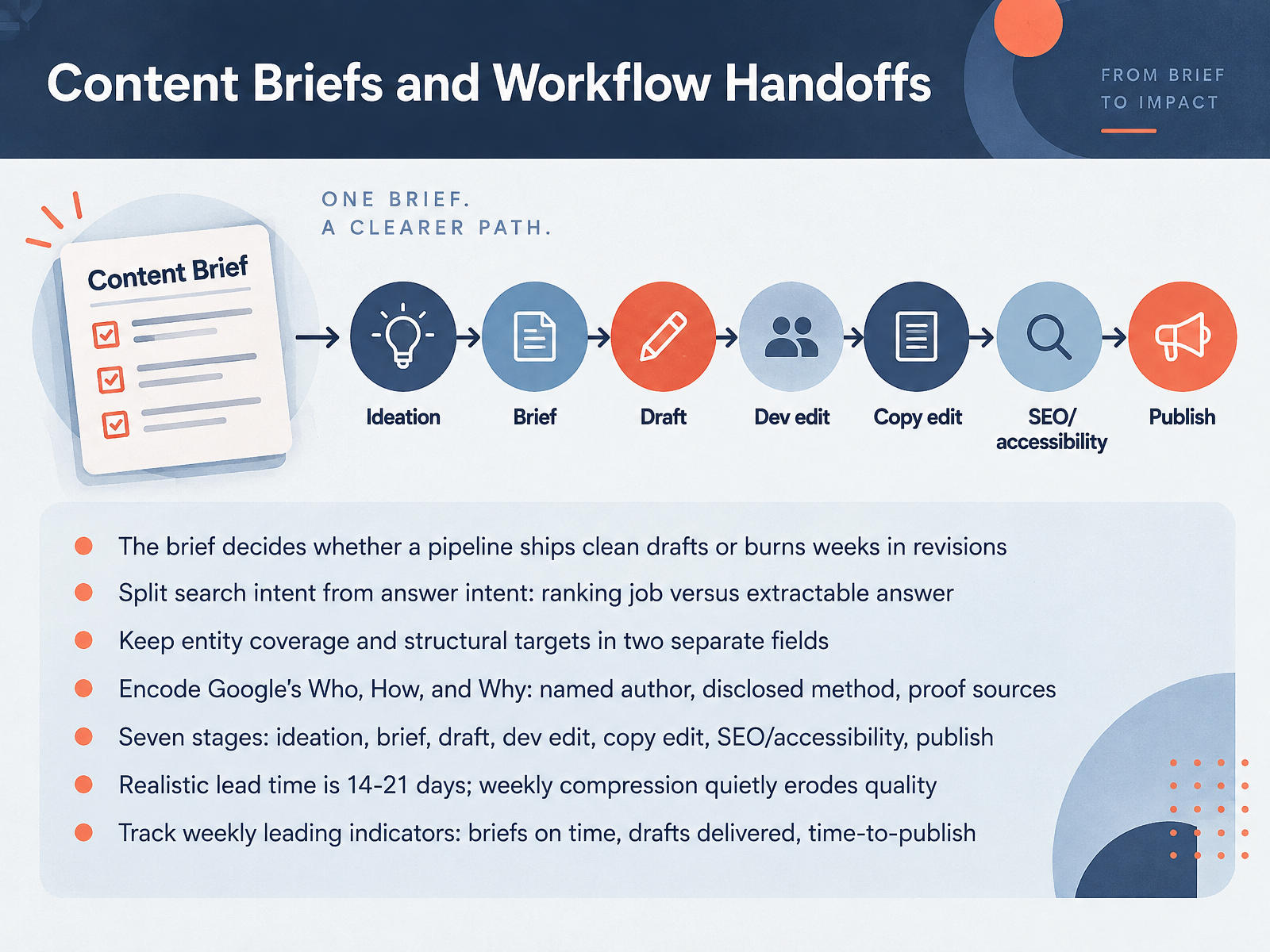 digitalapplied.comdigitalapplied.comcreaitor.ai+22 min
 - 07Writing for the Web: Clarity, Structure, and PersuasionNow let's talk about writing for the web, where clarity, structure, and persuasion all have to work together.
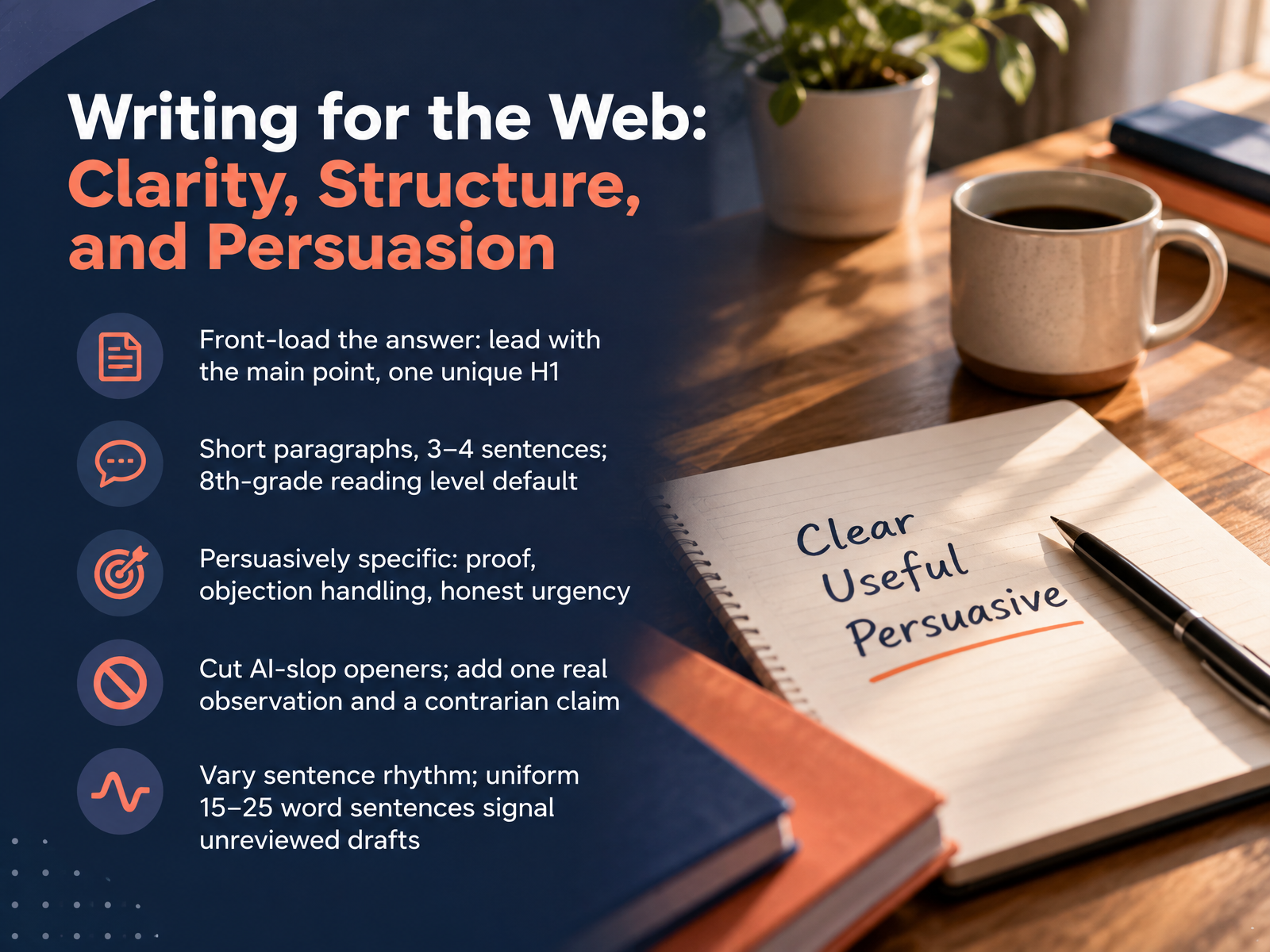
Start here: front-load the answer. Lead with your main point in the very first sentence, and use one unique H1 that matches the page's core purpose. Your reader decides in seconds whether to stay.
Next, keep paragraphs short, about three to four sentences, and aim for an eighth-grade reading level by default. Short sentences, one idea at a time, and familiar words. This isn't dumbing content down. It reduces processing effort so more people actually finish reading.
Be persuasively specific. Back your claims with proof, handle the obvious objection before your reader raises it, and if you use urgency, keep it honest. Fake countdown timers destroy trust.
Watch for this mistake: cut the AI-slop openers, things like "in today's fast-paced world." Replace them with one real observation from your own experience, plus one contrarian claim that makes people think.
Finally, vary your sentence rhythm. If every sentence lands between fifteen and twenty-five words, that reads like an unreviewed draft. Mix short punches with longer explanations.
So today's takeaway: front-load the answer, keep paragraphs short, earn trust with specifics, and vary your rhythm. Next, we look at editing and quality control.
 adacompliancepros.comwebability.iomadegooddesigns.com+22 min
 - 08Editing and Quality ControlNow let's talk about editing and quality control. Start here: split your editing into two separate jobs. Macro editing fixes structure and argument. Does the piece answer one clear question? Micro editing fixes grammar and style. Do them in separate passes, never at once. Watch for this mistake: fact-check before you polish voice. Fabricated stats get deleted anyway, and you lose the polish you just spent time on. Use the source sandwich. Copy the exact claim plus its source into a search engine. Real citations appear independently in multiple credible places. Try this six-step routine: log provenance, extract claims, verify sources, check quotes, and only then move on. Score drafts against a rubric with defined pass thresholds. So if a draft must hit eight out of ten on accuracy, say that out loud before anyone edits. And when a check fails, name the failed check and what's missing. Don't request full rewrites. Saying check one failed, add a source produces a faster fix than saying add more depth. That's your same-day takeaway: verify substance first, then polish voice on top. Next, we'll look at editing AI-assisted drafts with the seven-pass workflow.
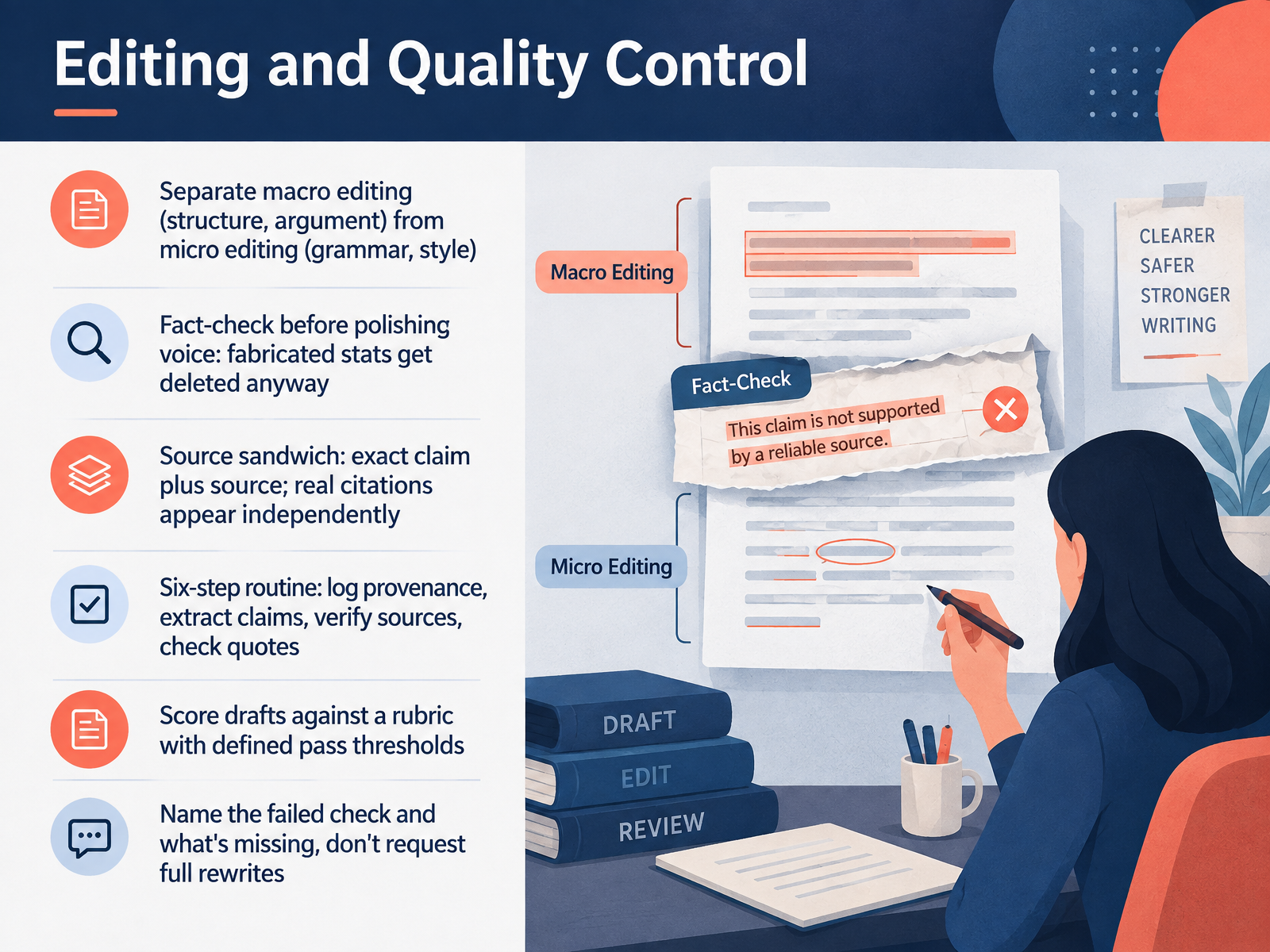 rankai.aiatomwriter.comthestacc.com+22 min
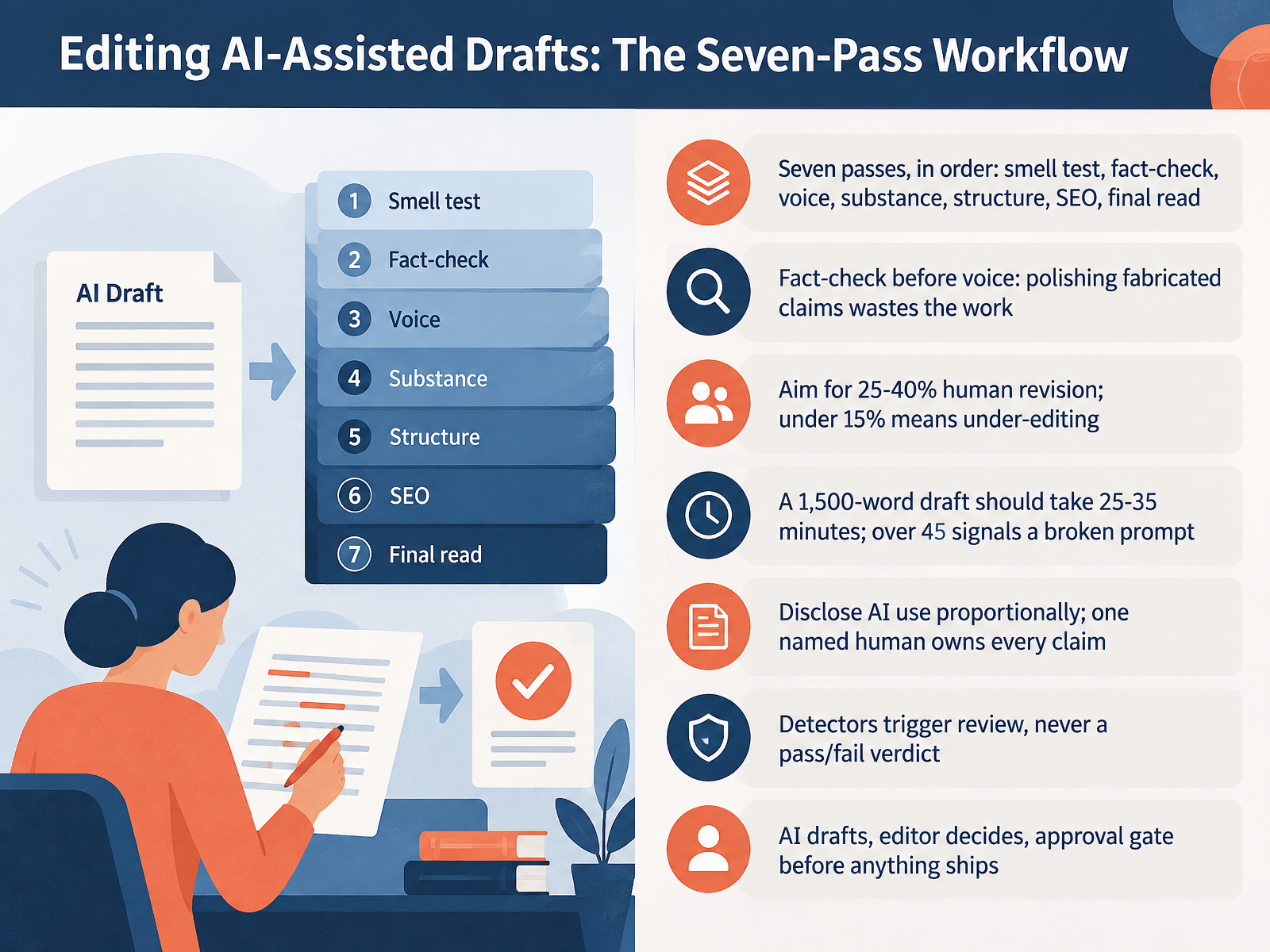
 - 09Editing AI-Assisted Drafts: The Seven-Pass WorkflowNow let's talk about editing AI-assisted drafts. Start here: use a seven-pass workflow, run in order. Smell test, fact-check, voice, substance, structure, SEO, and a final read. Doing them one at a time is faster than mixing them, because each pass primes your attention for one kind of problem.
Watch for this mistake. Fact-check before you polish voice. If you spend ten minutes refining a paragraph that contains a fabricated statistic, you have to delete it and lose the polish. Verify substance first, then refine voice on top.
Aim for twenty-five to forty percent human revision. Under fifteen percent means you are under-editing. A fifteen-hundred-word draft should take twenty-five to thirty-five minutes. Over forty-five minutes signals a broken prompt, so fix the prompt instead of rebuilding every draft.
Disclose AI use proportionally. One named human owns every claim. And treat detectors as a trigger for review, never a pass or fail verdict.
Here is your takeaway. AI drafts, the editor decides, and nothing ships without an approval gate. Next, we move into accessibility and readability in practice.
 rankai.aiatomwriter.comthestacc.com+22 min
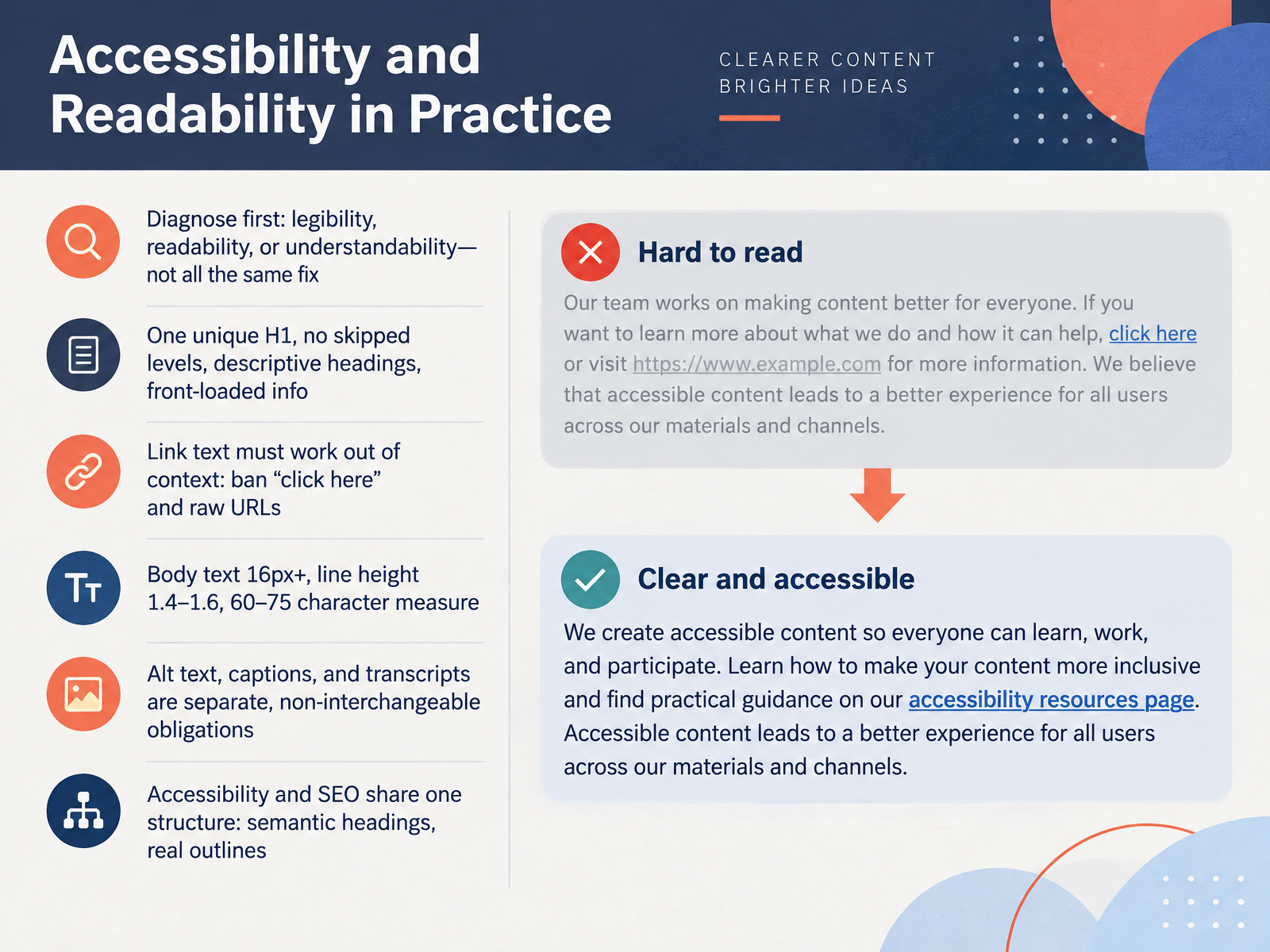
 - 10Accessibility and Readability in PracticeLet's talk about accessibility and readability in practice. Start here: diagnose the problem first. Is it legibility, like thin fonts or weak contrast? Is it readability, like lines running too wide? Or is it understandability, where the copy uses insider jargon? These need different fixes. One common mistake is rewriting copy when the real problem is typography. So try this. Keep one unique H1, never skip heading levels, and make every heading descriptive. Front-load the point so readers get it fast. For links, ban click here and raw web addresses. Link text must work out of context, so describe the destination. For body text, aim for sixteen pixels or larger, line height around one point five, and a measure of sixty to seventy-five characters per line. Now watch for this mistake: alt text, captions, and transcripts are separate obligations. One cannot replace another. And here is the good news. Accessibility and search engine optimization share one structure. Semantic headings and real outlines help both. Your takeaway: fix structure and presentation together. Next, we move into SEO, Search Intent, and AI Discoverability.
 adacompliancepros.comwebability.iomadegooddesigns.com+22 min
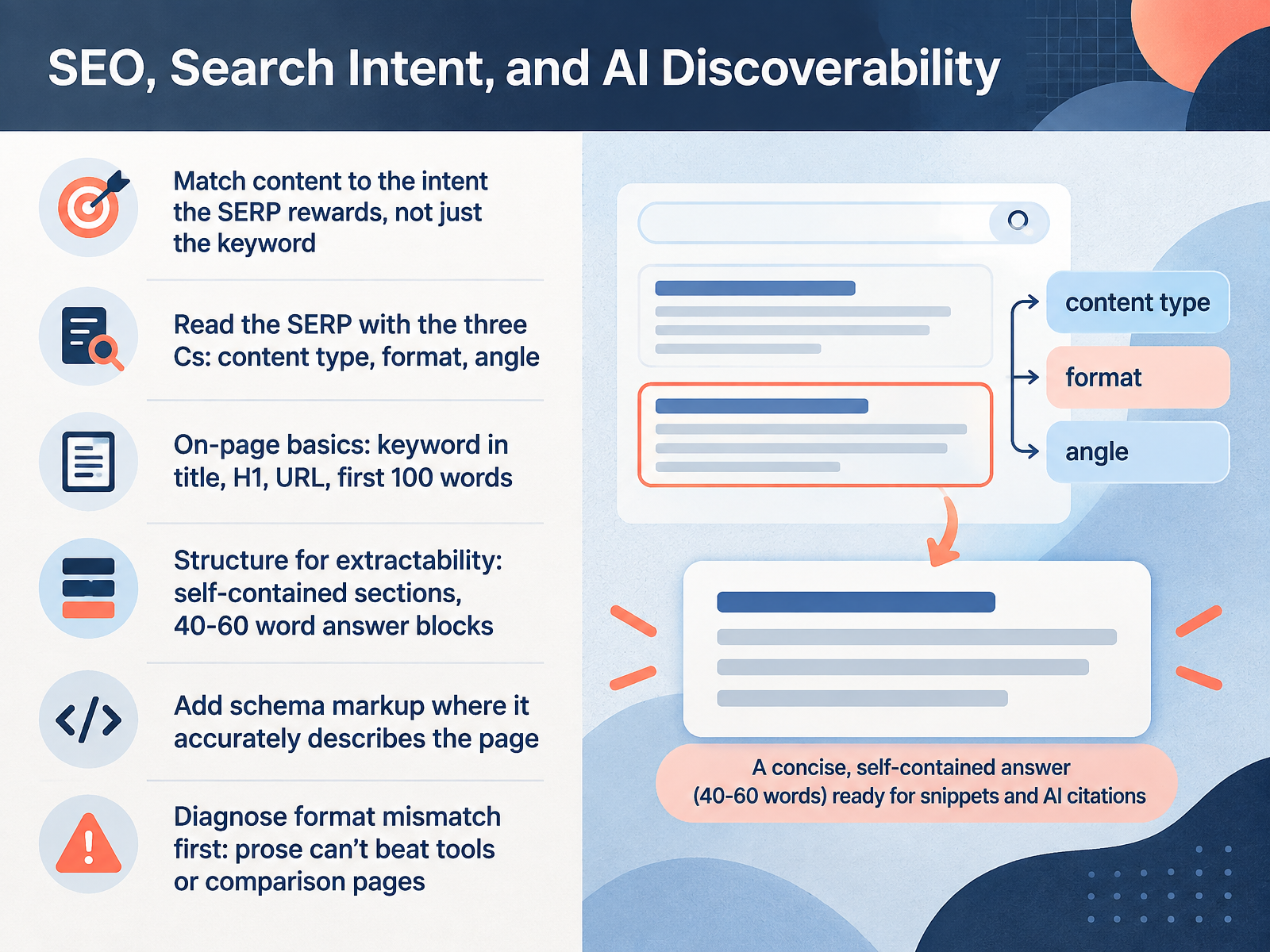
 - 11SEO, Search Intent, and AI DiscoverabilityNow let's talk about search. Here's the mistake I see most often. People pick a keyword, write a nice article, and wonder why it never ranks. The problem is usually intent, not writing quality. So start here. Before you write anything, look at the search results page, and ask what it is actually rewarding. Read it with three Cs: content type, format, and angle. If the top results are all free tools or comparison tables, prose cannot beat them. Fix that mismatch first. Then handle the basics. Put your keyword in the title, the H1, the URL, and the first hundred words. Next, structure for extractability. Keep each section self-contained, and answer the main question in a short block of forty to sixty words. That is the chunk both search engines and AI systems can lift and cite. And add schema markup, but only where it accurately describes the page. Watch for this mistake: a wrong schema tag hurts more than no tag at all. Try this today. Open one page you own, check its SERP, and see whether your format matches. That single check is your fastest win. Next, we move into distribution and content repurposing.
 2 min
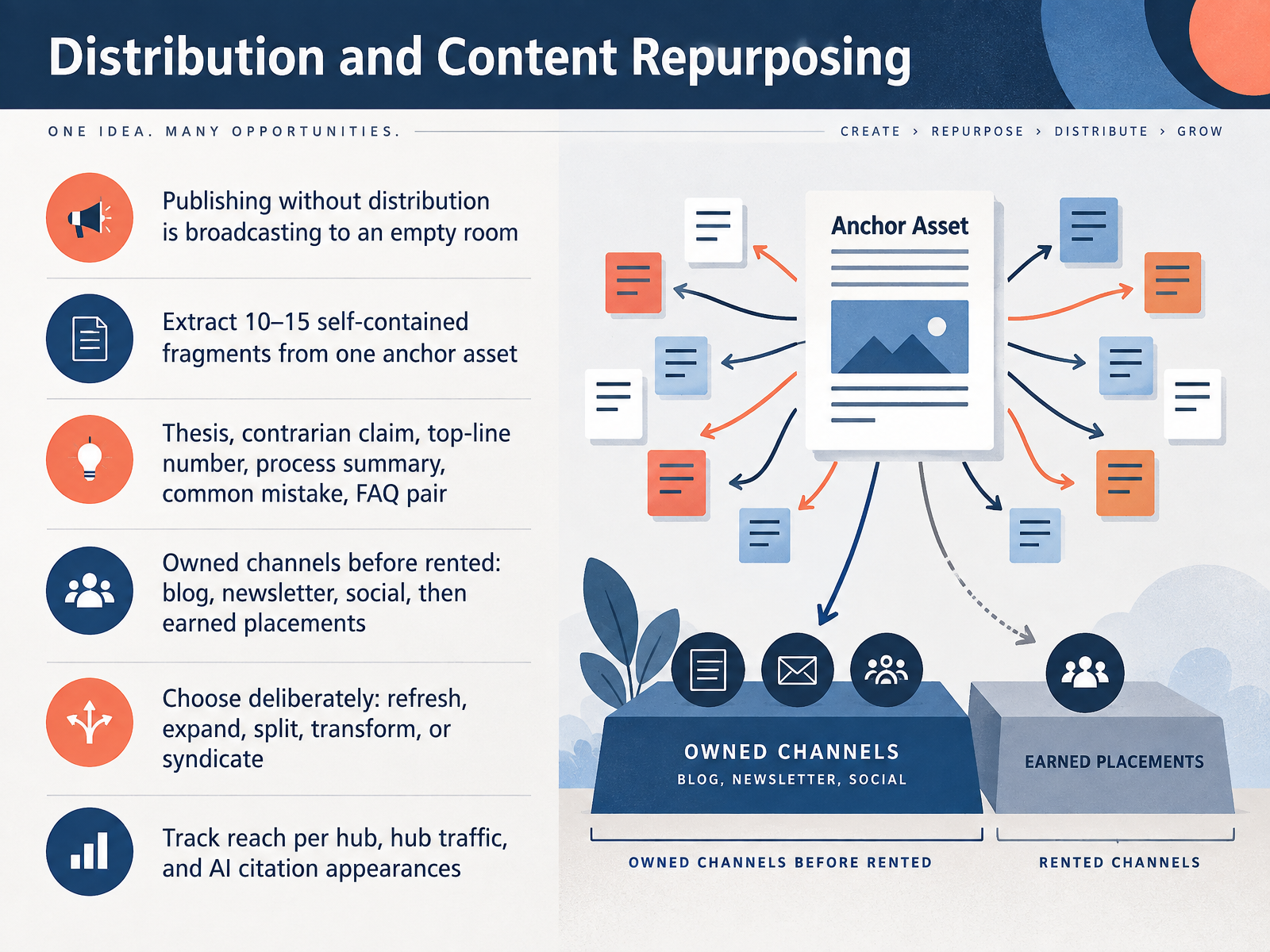
2 min - 12Distribution and Content RepurposingLet's talk about distribution and content repurposing. Here's the hard truth: publishing without distribution is broadcasting to an empty room. So start with one strong anchor asset, then pull ten to fifteen self-contained fragments from it. Think of them like this: the thesis, a contrarian claim, your top-line number, a short process summary, a common mistake, and one FAQ pair. Each fragment should make sense on its own, without needing the original.
Now, order matters. Go owned channels before rented. That means your blog, then your newsletter, then social. Only after that should you chase earned placements, like guest posts or podcasts. When you decide what to do with an existing piece, choose deliberately. You can refresh it, expand it, split it, transform it for another channel, or syndicate it. Try this: pick one hub and pull ten fragments this week. Then track three things: reach per hub, traffic back to the hub, and how often your content shows up in AI citations. That tells you whether your repurposing is actually working.
Next, we'll look at measurement, analytics, and continuous improvement.
 2 min
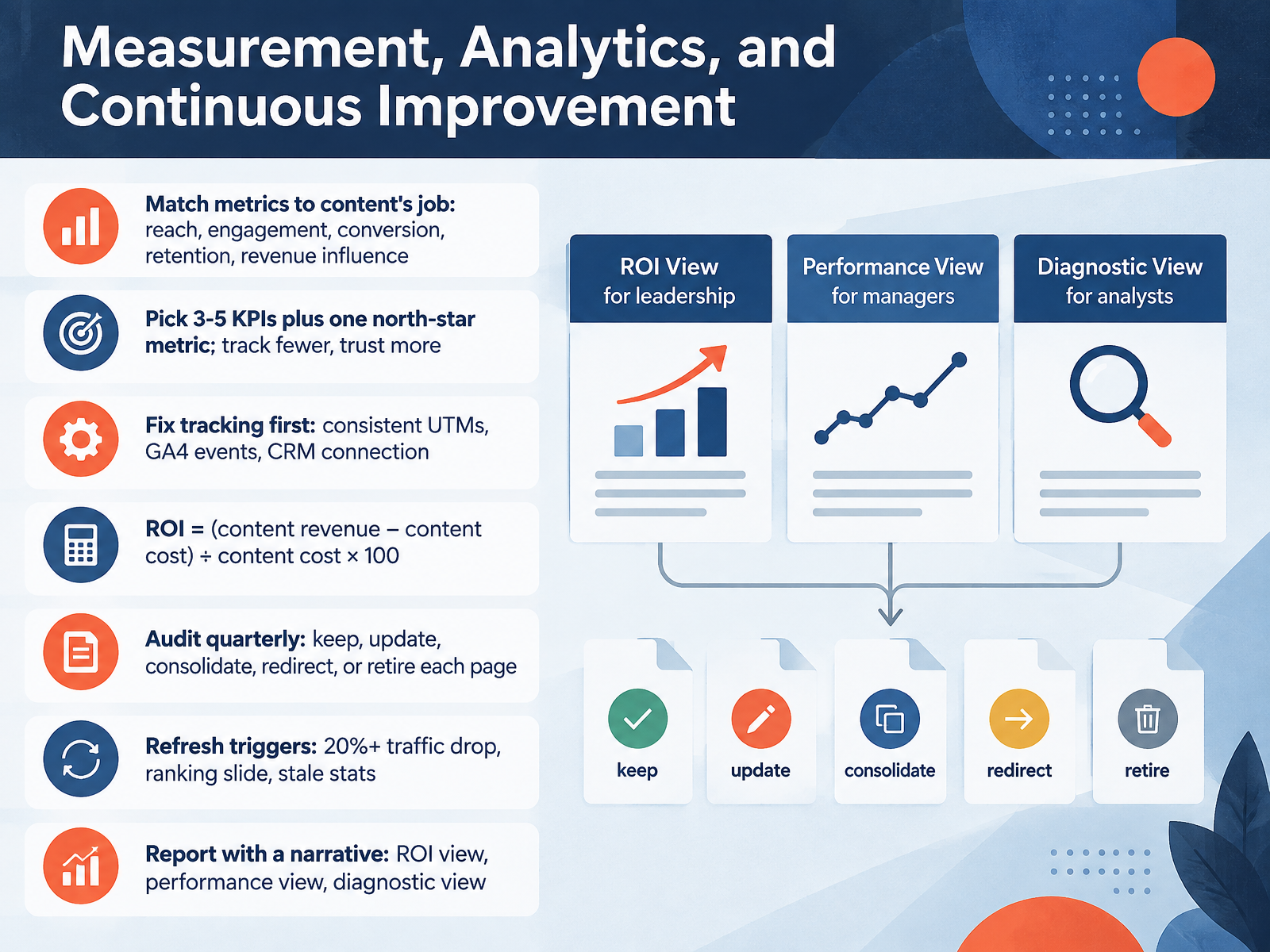
2 min - 13Measurement, Analytics, and Continuous ImprovementNow let's talk about measurement, analytics, and continuous improvement. Start here: match metrics to your content's job. Reach, engagement, conversion, retention, and revenue influence are five different jobs. Next, pick three to five K P Is plus one north-star metric. Track fewer, trust more. Before you report anything, fix your tracking. Consistent U T Ms, clear G A four events, and a C R M connection. Here's the formula for ROI. Content revenue minus content cost, divided by content cost, times one hundred. Watch for this mistake: skipping the cost side. Now, audit quarterly. For each page, choose keep, update, consolidate, redirect, or retire. Refresh when you see a twenty percent or greater traffic drop, a ranking slide, or stale statistics. Finally, report with a narrative. Give leaders an R O I view, managers a performance view, and analysts a diagnostic view. Your takeaway: connect every metric to a decision. Next, let's move into the Practice Lab: From Brief to Published Piece.
 2 min
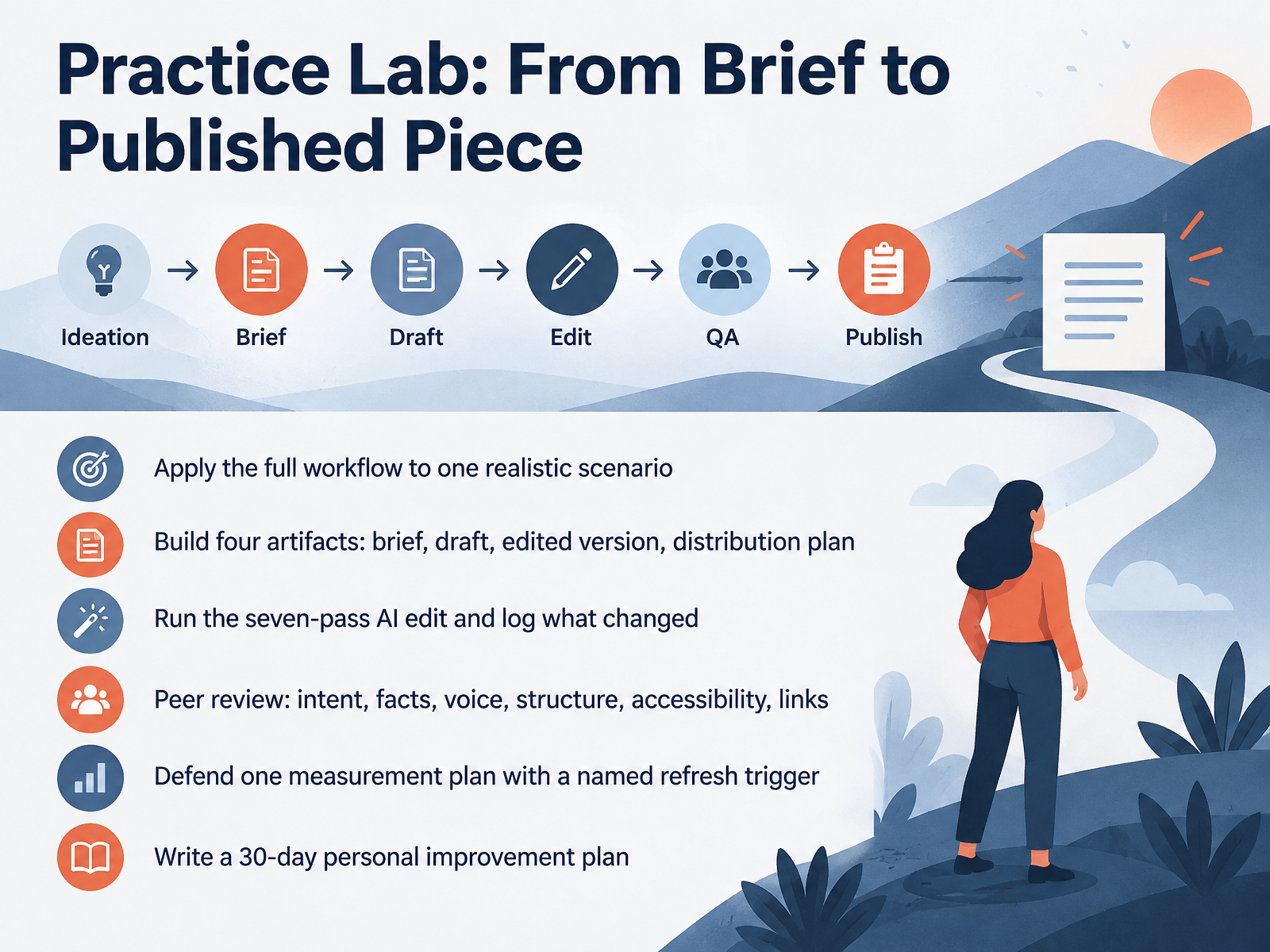
2 min - 14Practice Lab: From Brief to Published PieceNow let's put everything into practice. In this lab, you'll take one realistic scenario and run the full workflow from brief to published piece.
You'll build four artifacts: a content brief, a first draft, an edited version, and a distribution plan. Start here. Run the seven-pass A I edit on your draft, and keep a simple log of what changed and why. That log is how you learn.
Then swap work with a peer. Review six things: intent, facts, voice, structure, accessibility, and links. Facts come first, before you polish anything. A wrong statistic is worse than plain writing.
Next, defend one measurement plan. Name the metric and the refresh trigger, like a twenty percent drop in traffic. That turns opinion into a decision.
Finally, write a thirty-day personal improvement plan. Pick one skill from today and practice it deliberately.
Takeaway: the workflow only sticks when you run it on real work. Next, we move to professional growth, ethics, and team collaboration.
 rankai.aiatomwriter.comthestacc.com+22 min
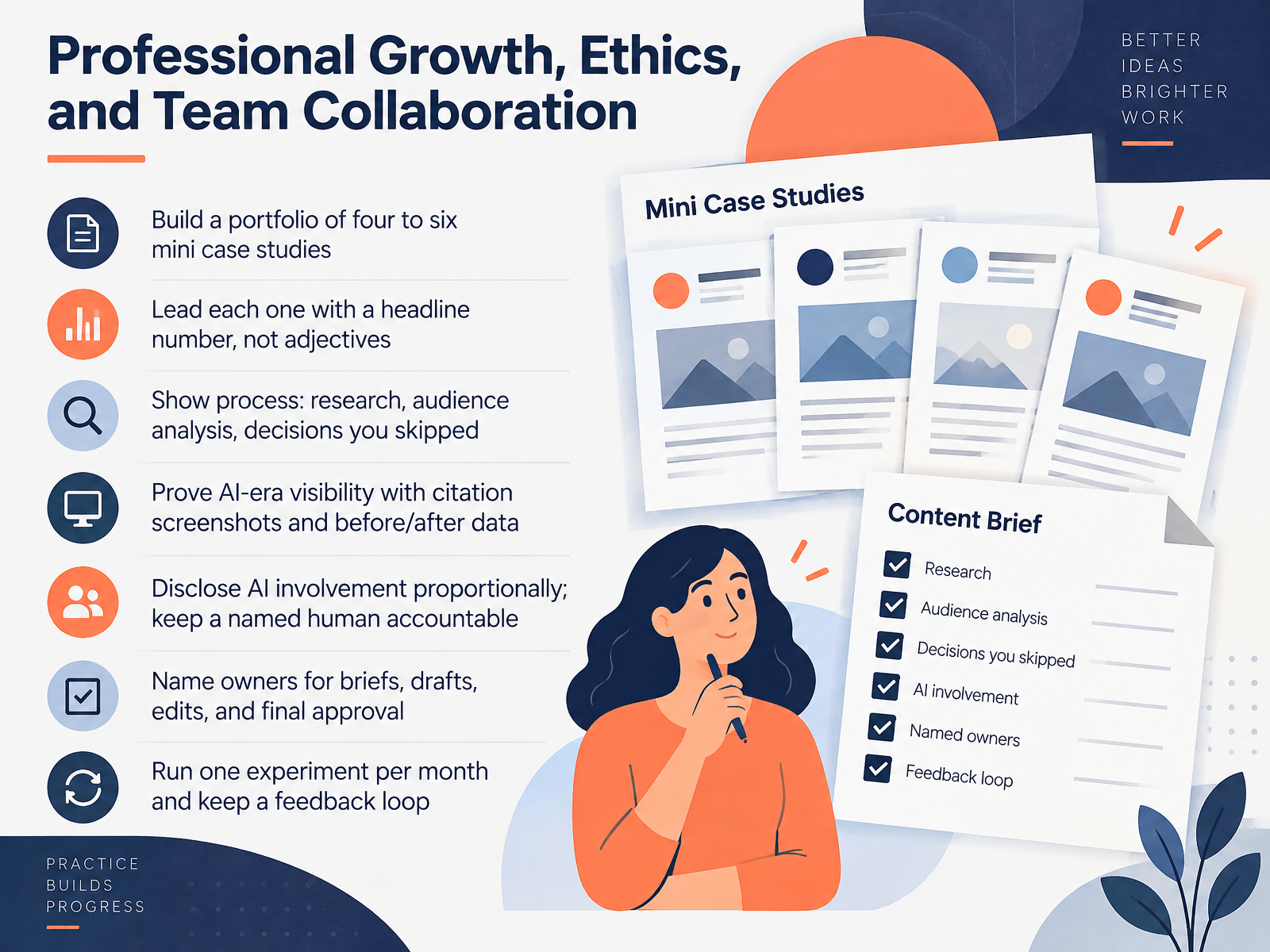
 - 15Professional Growth, Ethics, and Team CollaborationAs we close, let's talk about how you grow, stay ethical, and work well on a team. Start with your portfolio. Build four to six mini case studies, and lead each one with a headline number, not adjectives. For example, write grew organic traffic by three hundred and forty percent in six months, instead of saying strong SEO results. Then show your process: how you researched, how you analyzed the audience, even the decisions you skipped. Try this. Add one line on what you chose not to do, and why. That proves strategic judgment. In the AI era, prove visibility with citation screenshots and before and after data, not just a ranking screenshot. Be transparent about AI. Disclose its involvement proportionally, and always keep a named human accountable for final approval. On teams, name owners for the brief, the draft, the edit, and the final sign off. Watch for this mistake: shared ownership becomes no ownership. Finally, run one experiment per month and keep a feedback loop. So here is your takeaway. Build proof, not adjectives. Stay honest about AI. Make ownership explicit. And keep testing every month. Thank you for learning with me. You are ready to put this to work. Start this week with one case study.
 2 min
2 min
Take the deck with you
Download this course as a file — free, no sign-up needed.
- PDF handoutEvery slide page, ready to print or share.16 pages · 4.2 MBDownload
- Narrated PowerPointThe deck that presents itself — every slide carries the digital human's narration video.16 pages · 32.4 MBDownload
- PowerPoint slidesThe full deck as a .pptx — open it in PowerPoint, Keynote, or Google Slides.16 pages · 4.2 MBDownload
Free to use in your own training — please keep the PersonWise credit page at the end.
Have your own deck? Turn it into a course
Sources consulted
Web sources consulted while building this course.
- What Is Content Marketing? — contentmarketinginstitute.com
- CONTENT &B2B — images.contentinstitute.com
- What is Content Marketing? A Beginners Guide — ama.org
- The ultimate guide to creating a content marketing strategy — semrush.com
- What is Content Marketing and does it still work in 2026? — mailchimp.com
- Content Calendar Template 2026: Strategy and Planning — digitalapplied.com
- The 2026 SEO Content Brief Template & Handoff Framework — digitalapplied.com
- Content Planning with AI: A Practical Guide for 2026 — creaitor.ai
- What is a Content Calendar? The Complete Guide (2026) | Storyflow — storyflow.so
- Editorial Calendar Workflow for Consistent Publishing — swipe.cloud
- Accessible Content Writing: A WCAG Guide for 2026 | ADA Compliance Pros — adacompliancepros.com
- The Definition of Readability: A Guide for 2026 — webability.io
- Web Typography: A Complete Guide for 2026 — madegooddesigns.com
- Accessible Website Design in 2026: How to Build It In From the Start — logoswebdesigns.com
- A practical guide to readable type on the modern web - Wux Webtools — wuxwebtools.com
- Editorial QA Checklist for AI-Assisted Articles: 2026 — rankai.ai
- The Complete Guide to Editing AI-Generated Content | Atom Writer Blog — atomwriter.com
- How to Edit AI Content for Quality (8-Step System) — thestacc.com
- AI Editorial Workflows in 2026 — laioutr.com
- What should be on an AI editing checklist for publishers in 2026? | storywriter.pro — storywriter.pro