Begin
14 pages · ~28 min
User Research Plan Essentials
This training teaches product and UX professionals how to create and execute user research plans, from defining goals to delivering actionable insights.
A digital instructor presents all 14 pages. Hold “Ask” at any point and ask out loud — the answer comes from this course. No sign-up needed.
What you’ll learn
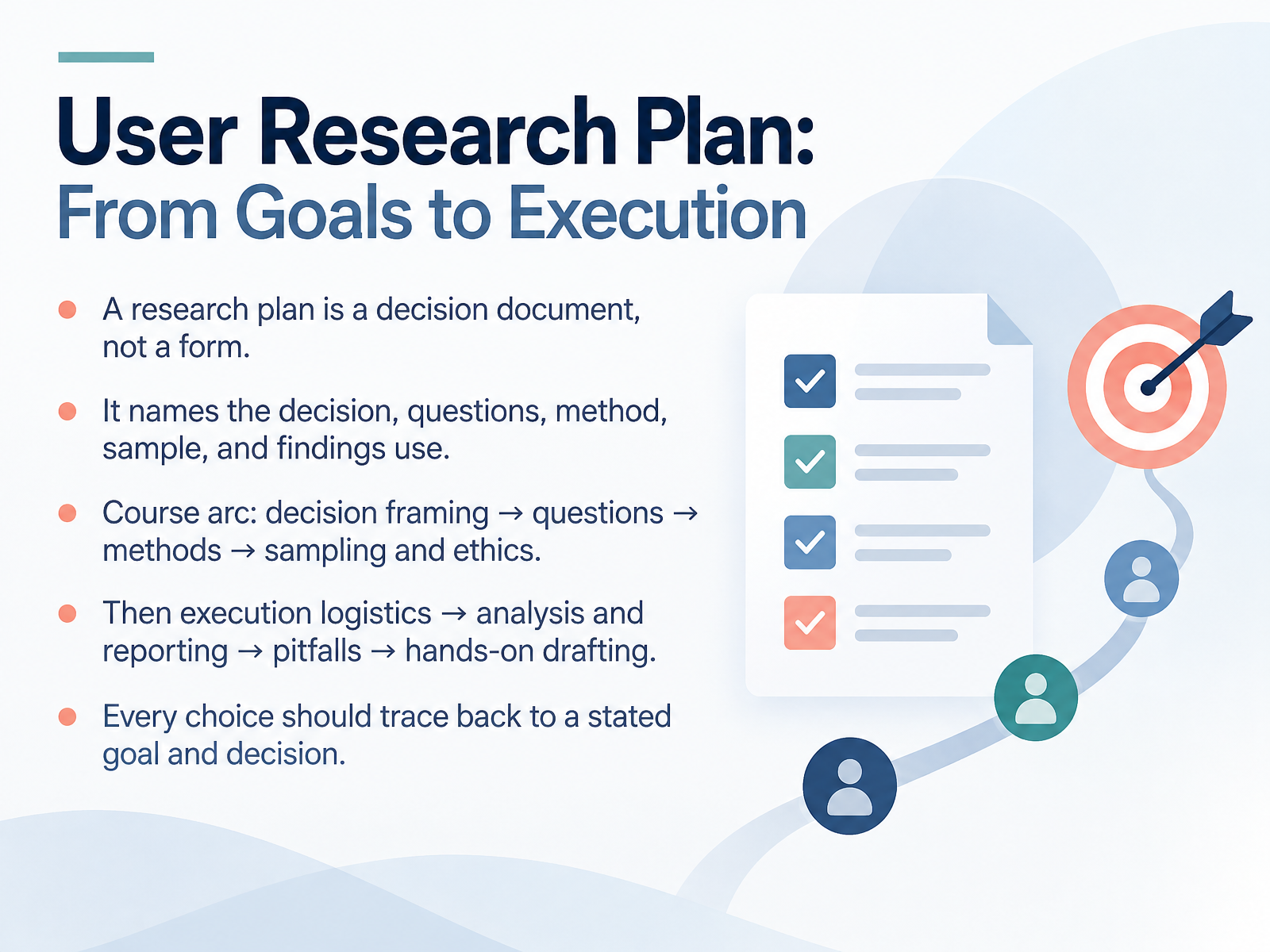
- 01User Research Plan: From Goals to ExecutionWelcome. If you're planning a research study right now, this course is for you. Here's the idea we'll build on. A research plan is not a form you fill in to satisfy a process. It's a decision document. It names the decision you're trying to inform, the questions you need answered, the method, the people you'll talk to, and how the findings will actually be used. Every choice should trace back to a stated goal and decision. So as we go, keep asking yourself, what will this choice change? Across the course, we'll move from decision framing to questions, then methods, then sampling and ethics. From there, execution logistics, analysis and reporting, common pitfalls, and finally hands-on drafting. But before any method, start with the decision, not the method.1 min
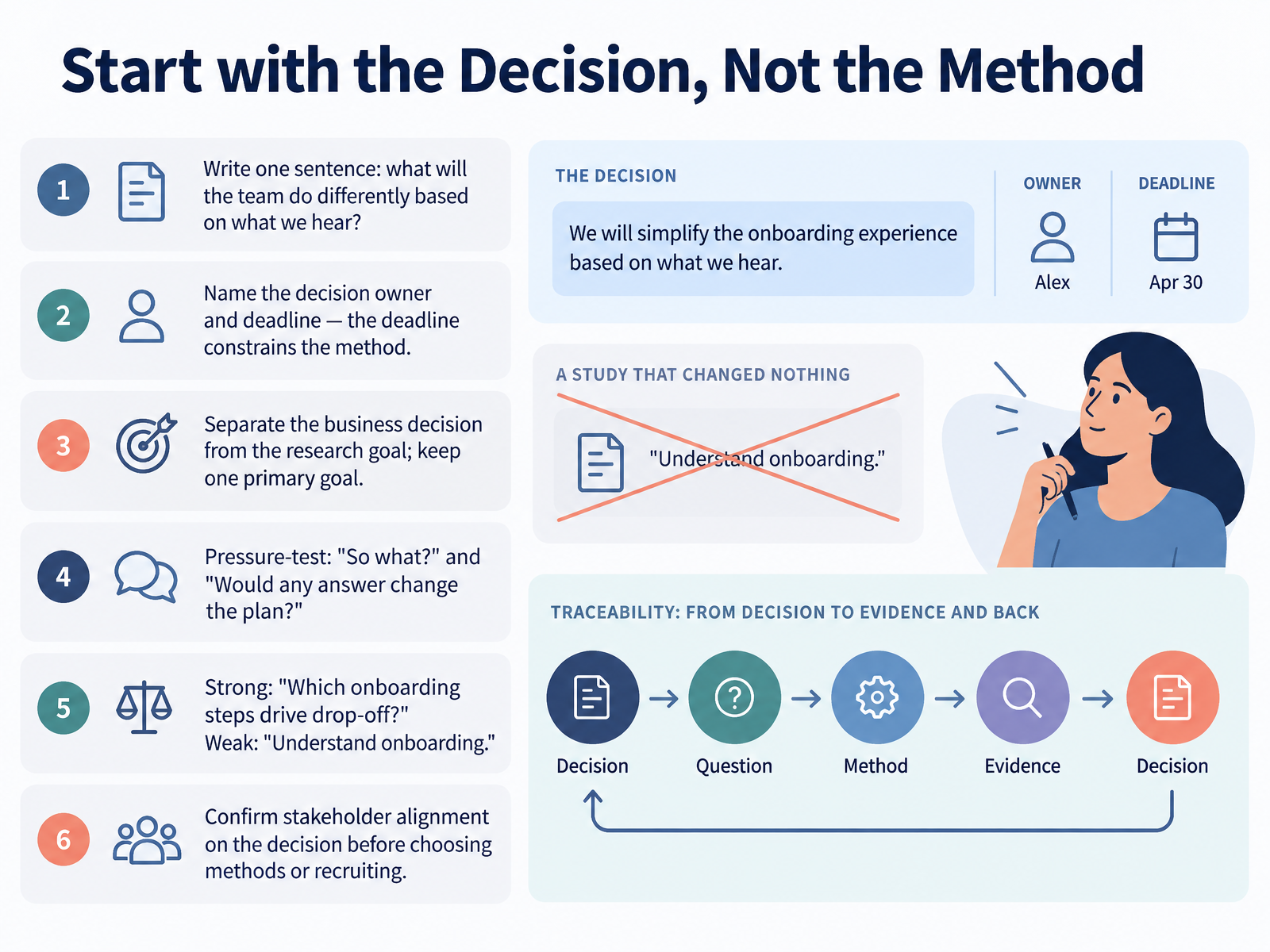
- 02Start with the Decision, Not the MethodLet's talk about where a research plan really begins. Not with a method. With a decision. Before you pick interviews or a survey, write one sentence: what will the team do differently based on what we hear? That sentence is your anchor. Then name the decision owner and the deadline. Why does that matter? Because the deadline constrains the method. If the call happens next week, a three week diary study is off the table. Next, separate the business decision from the research goal, and keep one primary goal. It's tempting to chase five questions at once. Resist that. Pressure test your goal with two questions. So what? And would any answer actually change the plan? If every possible answer leads to the same action, you're not planning research, you're confirming a hunch. Here's a comparison. Strong: which onboarding steps drive drop off? Weak: understand onboarding. See the difference? One points to a decision. The other just points at a topic. Finally, confirm with your stakeholders that you agree on the decision before you choose methods or start recruiting. That alignment saves weeks later on. Turning goals into research questions and hypotheses is where we go next.
 2 min
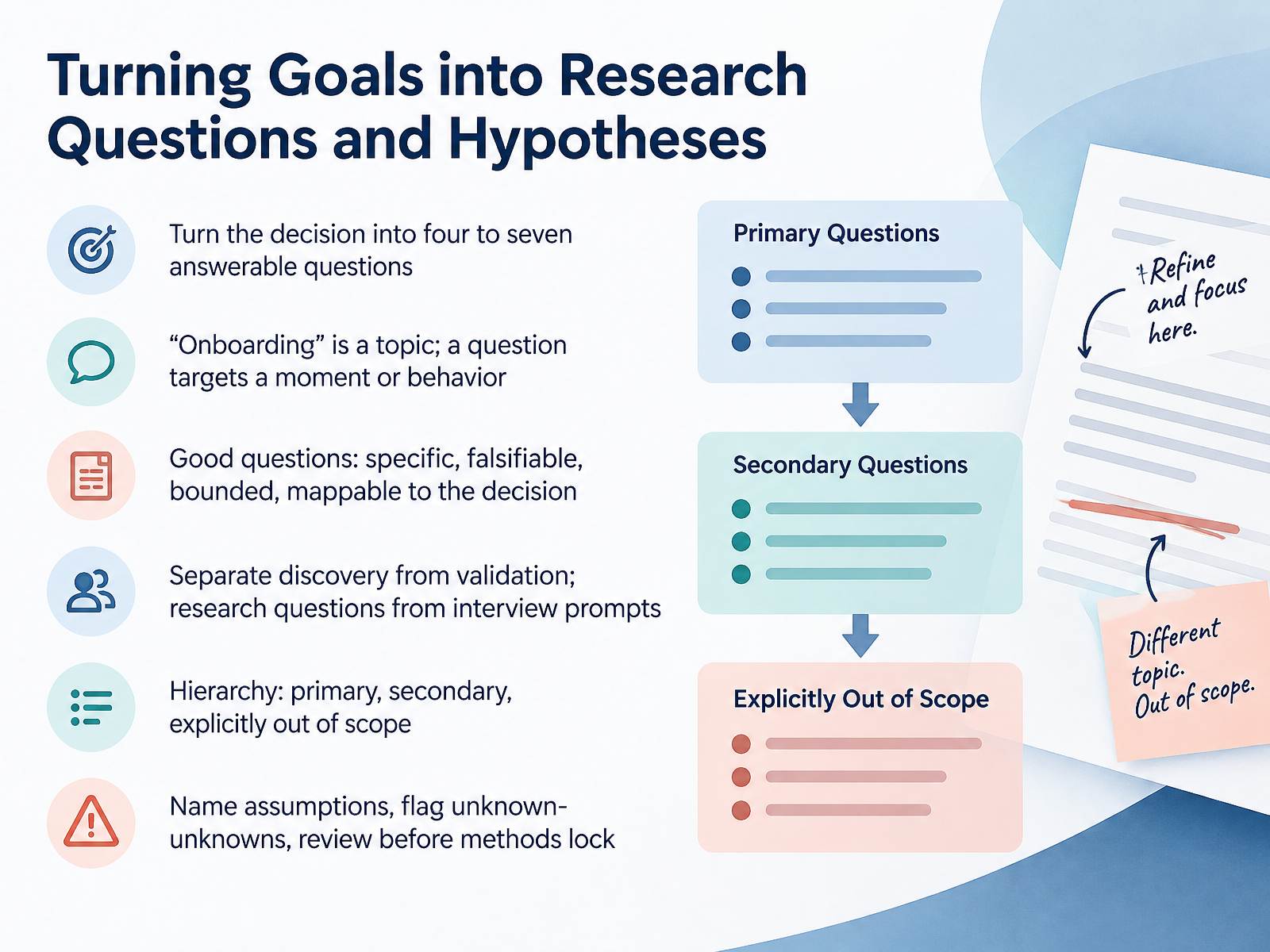
2 min - 03Turning Goals into Research Questions and HypothesesLet's turn your goal into questions you can actually answer. Aim for four to seven research questions that map directly to the decision you're supporting. Here's the key shift. "Onboarding" is just a topic. A real question targets a specific moment or behavior. For example, what do users do in their first ten minutes, and where do they hesitate? Good questions are specific, falsifiable, and bounded. You should be able to map each one back to your decision. Separate discovery from validation, and keep your research questions distinct from your interview prompts. Rank them. What's primary, what's secondary, and what's explicitly out of scope? Name your assumptions and flag the unknown-unknowns. Then review the whole set with your stakeholders before you lock methods. That review is cheap. Changing course later is not. Next, we'll look at selecting methods that match these questions.
 1 min
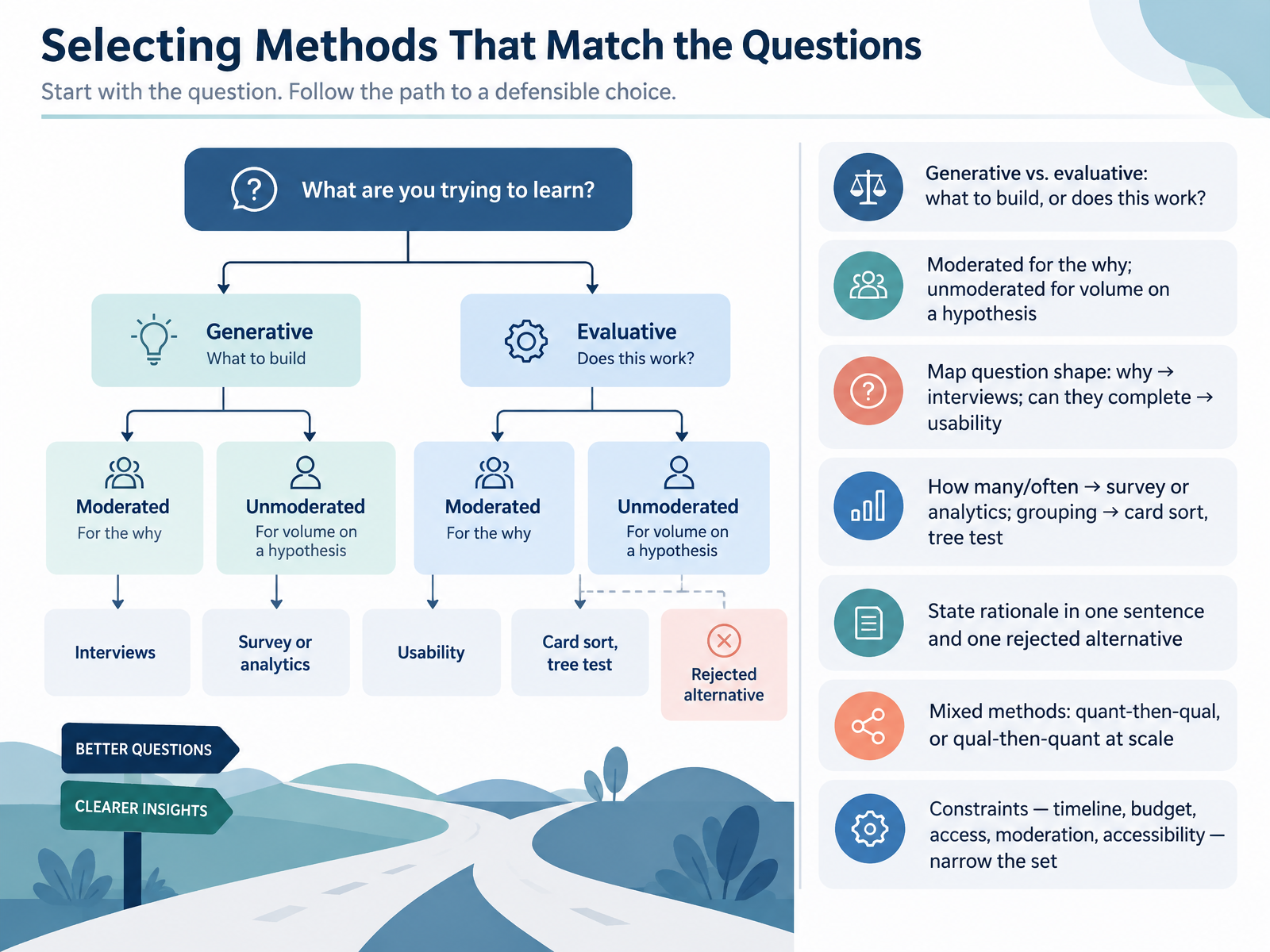
1 min - 04Selecting Methods That Match the QuestionsNow let's talk about methods. This is where your question shape starts driving real choices. First, ask yourself: are we generative or evaluative? Are we figuring out what to build, or checking whether this thing works? That distinction alone rules a lot in and out. Next, think about depth versus volume. Moderated sessions give you the why. Unmoderated works when you have a hypothesis and need signal from more people. Then map the question itself. Why questions point to interviews. Can they complete this task points to usability testing. How many, how often points to a survey or analytics. And grouping or findability points to a card sort or tree test. Here is a habit worth building. Write your rationale in one sentence, then name one alternative you rejected and why. That forces clarity. You might also mix methods, running quant first to find the pattern, then qual to explain it, or the reverse to test findings at scale. Finally, let constraints narrow the set. Timeline, budget, access to users, moderation capacity, accessibility needs. These are not afterthoughts. They shape what is actually feasible. So choose the method that best answers your question within your real constraints, and be ready to say why. Next, we'll look at sampling, screening, and sample size rationale.
 2 min
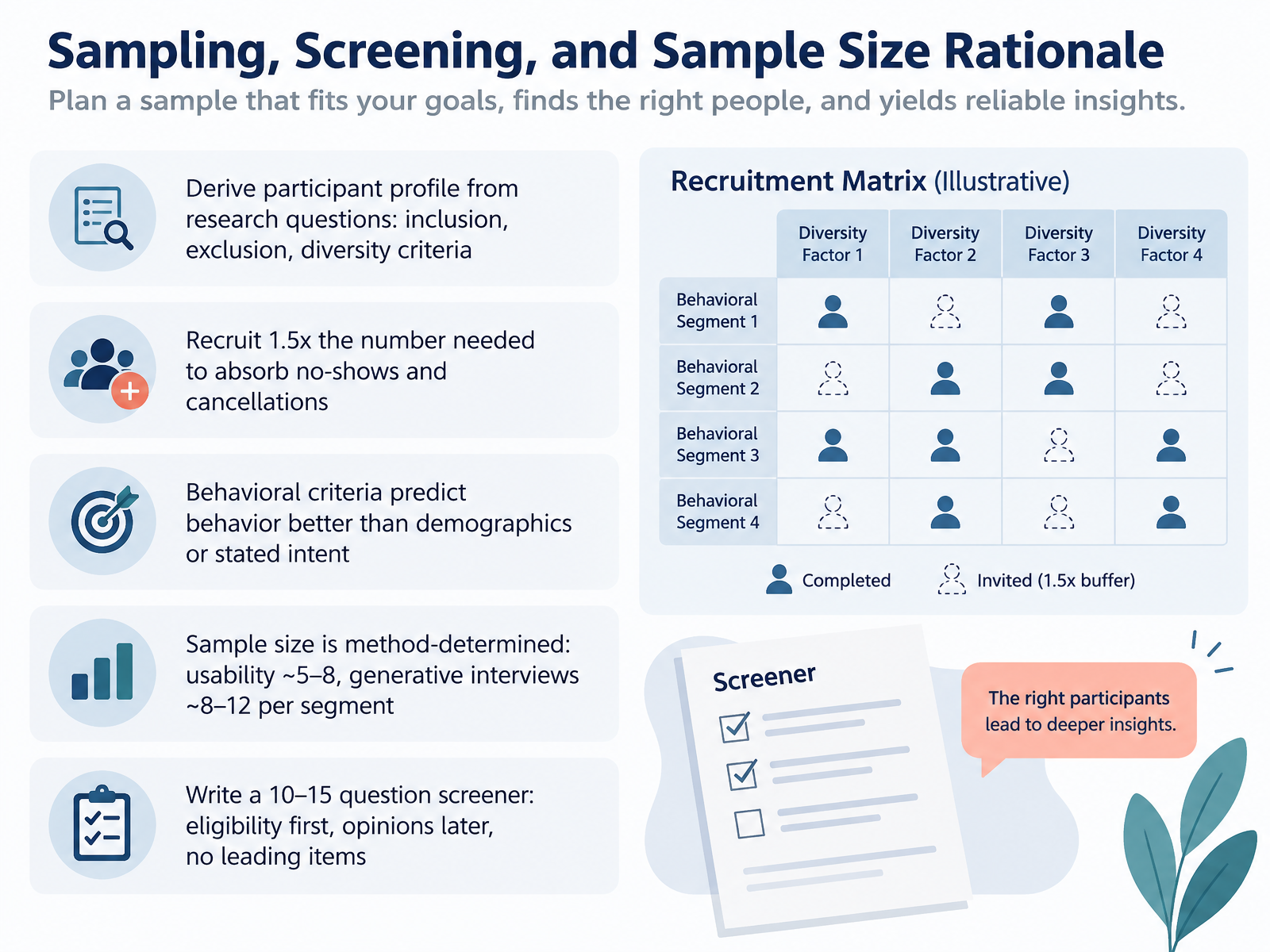
2 min - 05Sampling, Screening, and Sample Size RationaleLet's talk about who you actually recruit, and how many. Start with your research questions. They define your participant profile, and that means writing down inclusion criteria, exclusion criteria, and the diversity you need across your sample. Then, build in a buffer. Recruit about one and a half times the number you need. People cancel, people no-show, and you don't want to reschedule the whole study. On criteria, lean behavioral. How someone actually behaves predicts their behavior far better than demographics or what they say they intend to do. Here's a quick example. If you're studying onboarding drop-off, find people who abandoned setup in the last week, not people who say they usually finish setup. Sample size is method-determined. Usability testing often needs around five to eight participants. Generative interviews usually need eight to twelve per segment. Finally, write a short screener, roughly ten to fifteen questions. Ask eligibility questions first, opinions later, and never lead the participant toward the answer you want. Next, we'll look at recruiting operations, incentives, and inclusive participation.
 2 min
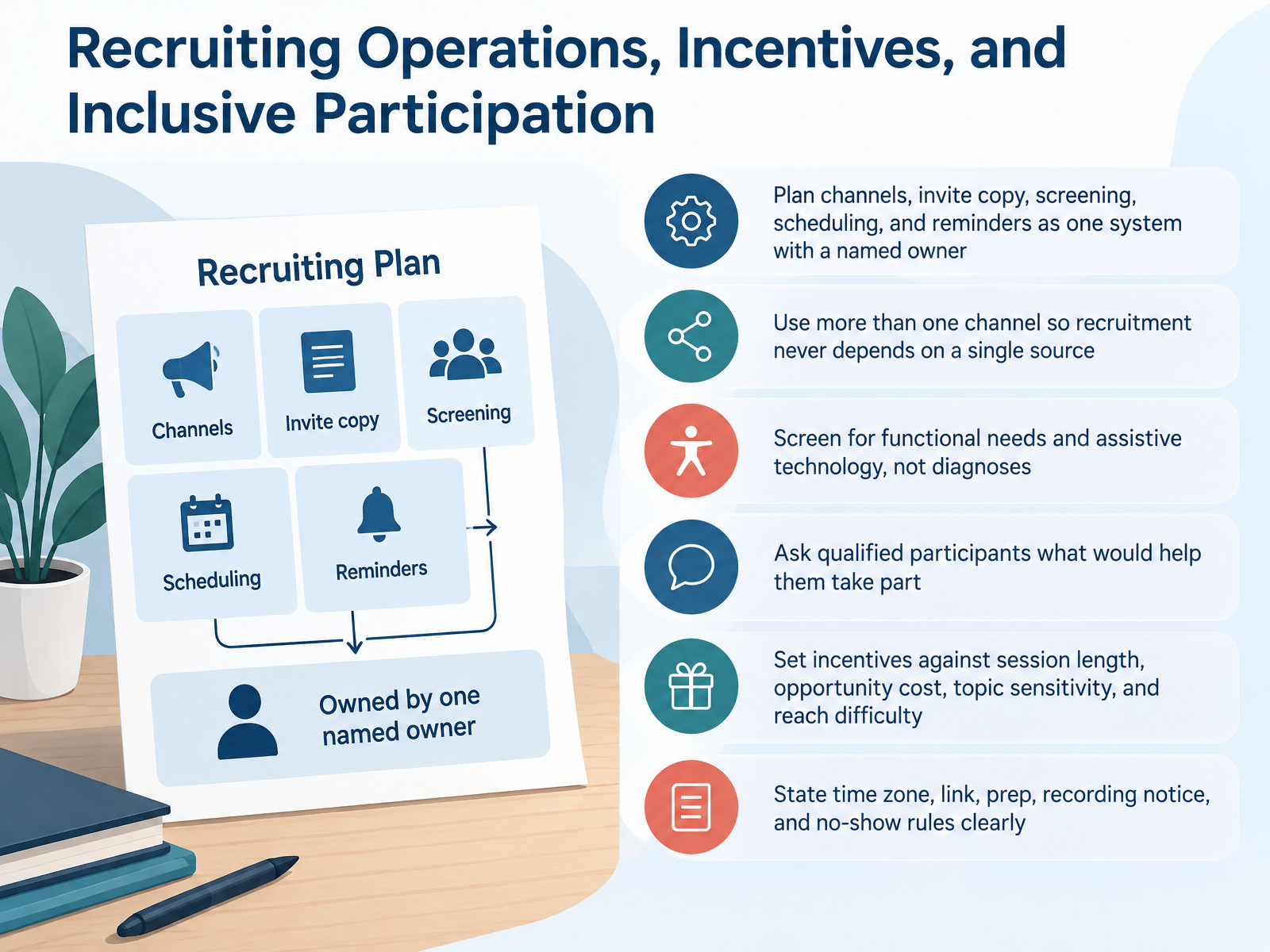
2 min - 06Recruiting Operations, Incentives, and Inclusive ParticipationNow let's talk about recruiting operations. Treat recruitment as one system: channels, invite copy, screening, scheduling, and reminders. Give that system a named owner, so nothing falls through the cracks. Use more than one channel. If all your participants come from a single community or panel, your study inherits that community's blind spots. For screening, ask about functional needs and the assistive technology people already use, not diagnoses. A simple question works: what would help you take part comfortably? Then ask qualified participants directly. They know their needs better than we do. Incentives deserve real thought. Weigh session length, opportunity cost, topic sensitivity, and how hard people are to reach. A ninety minute session on a sensitive topic is not the same as a fifteen minute survey. Finally, be explicit about logistics. State the time zone, the meeting link, any prep work, the recording notice, and your no-show rules. Clear expectations reduce drop-offs and respect people's time. Next, we'll look at consent, privacy, and data handling.
 2 min
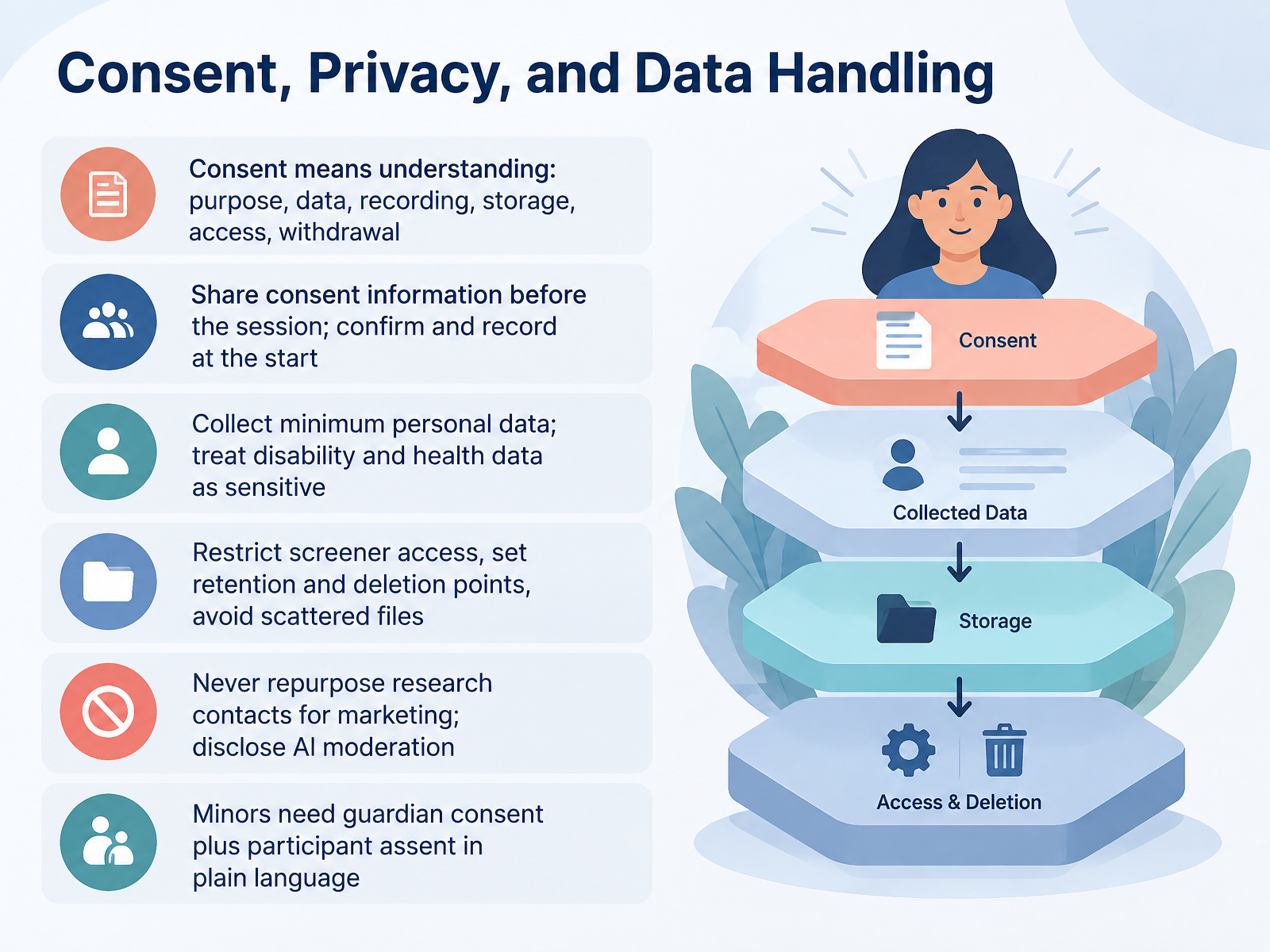
2 min - 07Consent, Privacy, and Data HandlingNext, let's talk about consent, privacy, and data handling. This is where good intentions meet real obligations, and it's worth getting right before you recruit anyone. Consent means people truly understand the purpose, what data you'll collect, whether you're recording, where it's stored, who can access it, and how they can withdraw. Share that information before the session, then confirm and record consent at the start. Keep it conversational, not a wall of legalese. Collect the minimum personal data you need. Treat disability and health data as sensitive, because it is. Restrict screener access. Set retention and deletion points. Avoid scattered files across drives and inboxes. And never repurpose research contacts for marketing. If AI tools help moderate or analyze sessions, disclose that. For minors, you need guardian consent plus the participant's own assent, in plain language they can understand. The takeaway: consent is a process, not a checkbox. Now let's move to the execution plan: timeline, roles, and logistics.
 2 min
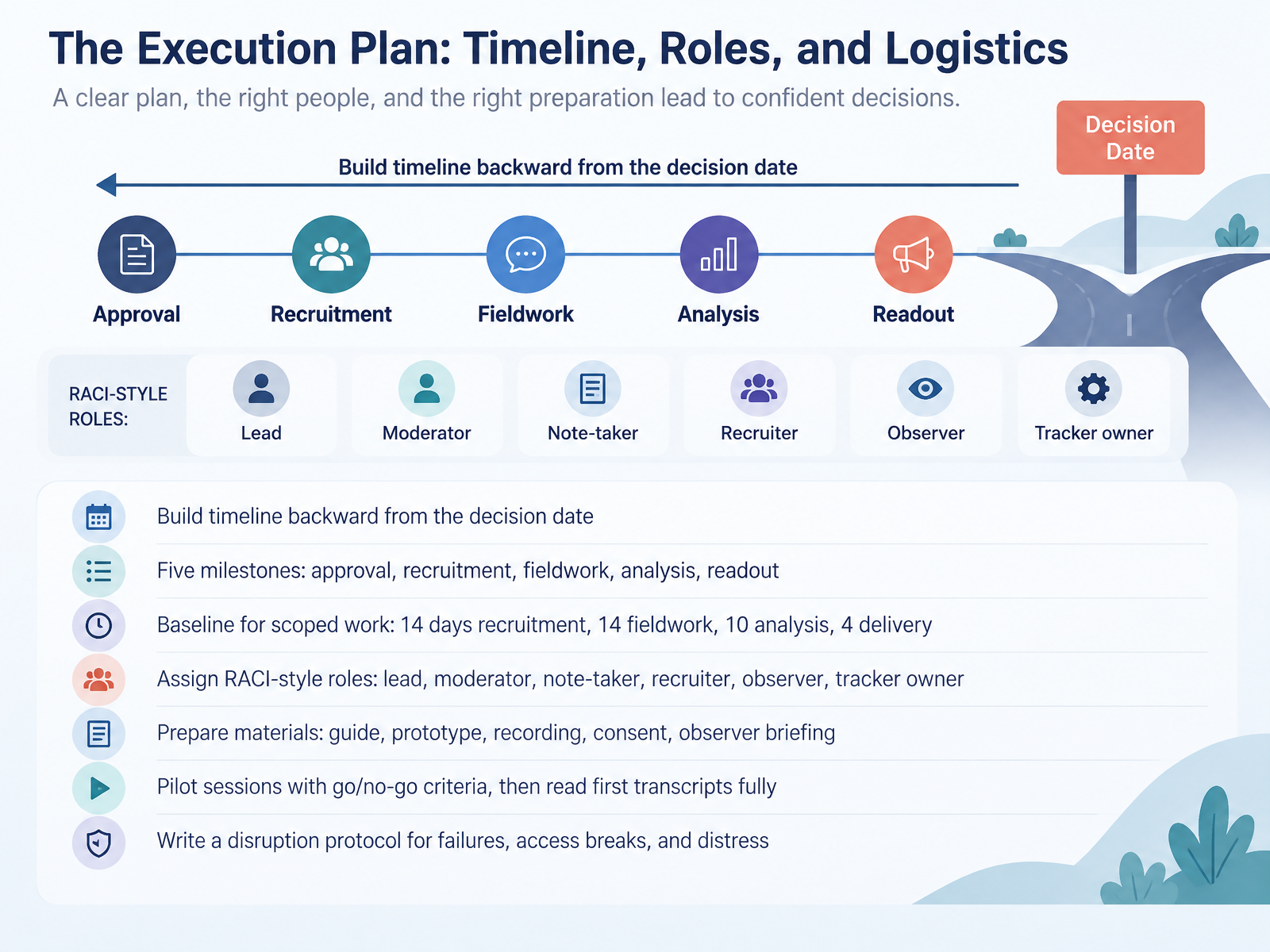
2 min - 08The Execution Plan: Timeline, Roles, and LogisticsNow let's make it real. The execution plan. Start with your decision date, then build the timeline backward. Five milestones keep you honest: approval, recruitment, fieldwork, analysis, and readout. For scoped work, a solid baseline is fourteen days recruitment, fourteen days fieldwork, ten days analysis, and four days delivery. Then assign roles, RACI-style. One lead. One moderator. A note-taker. A recruiter. An observer. And a tracker owner. Prepare your materials early: the guide, the prototype, recording setup, consent forms, and an observer briefing. Run a pilot session with clear go or no-go criteria. After that, read your first transcripts fully. And write a disruption protocol for failures, access breaks, or participant distress. Before you go, ask yourself: does the schedule leave room for a bad week? Next, we'll look at drafting the guide and predefining analysis.
 2 min
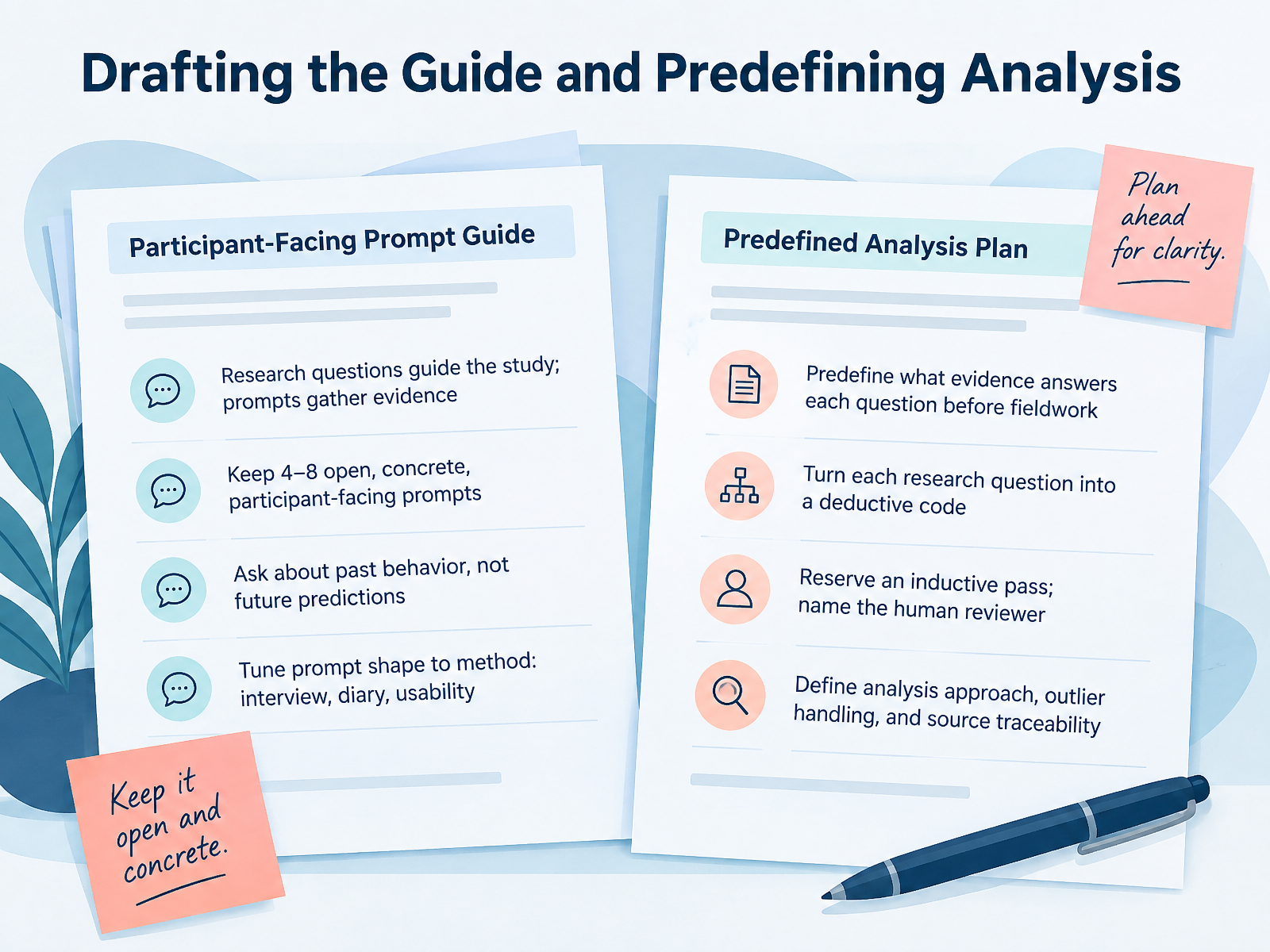
2 min - 09Drafting the Guide and Predefining AnalysisSo let's talk about drafting the guide and predefining analysis. Your research questions guide the study. The prompts gather the evidence. Keep it to four to eight open, concrete prompts written for participants. Ask about past behavior, not future predictions. "Tell me about the last time you did this" beats "Would you use this?" every time. Tune the shape to your method. Interviews get narrative prompts. A diary study gets short, repeatable ones. Usability tests get task-based prompts. Before fieldwork, predefine what evidence answers each question. Turn each research question into a deductive code. Then reserve an inductive pass, and name the human reviewer who owns it. Decide now how you'll handle outliers and keep sources traceable. That gives you a plan you can defend. And it leads naturally into the next step, traceability from insights to decision.
 1 min
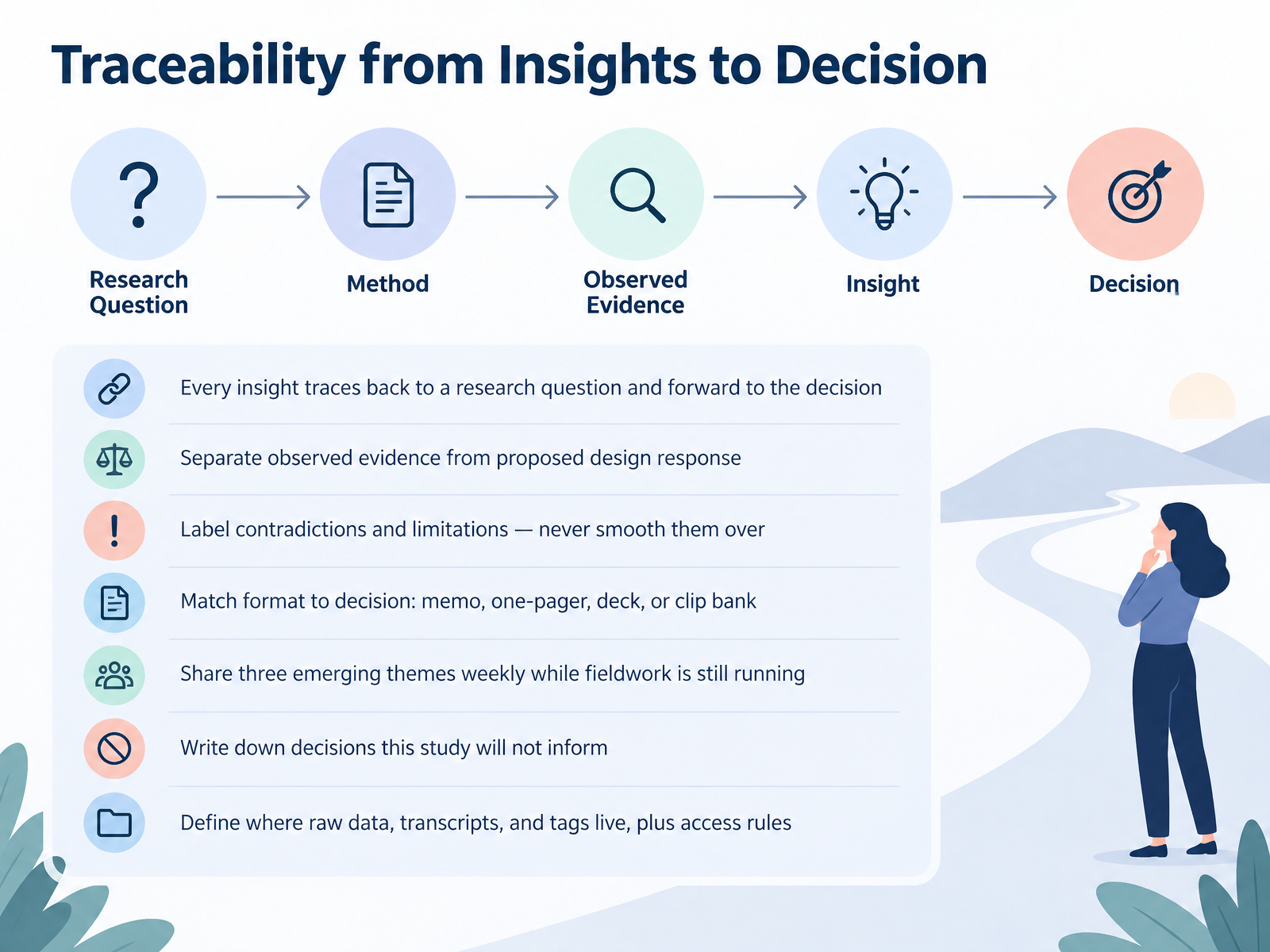
1 min - 10Traceability from Insights to DecisionLet's talk about traceability. Every insight should trace back to a research question, and forward to a decision. If it does neither, ask why it's in the report. Keep observed evidence separate from your proposed design response. Here's what we saw, is different from, here's what we recommend. Label contradictions and limitations. Never smooth them over. If two participants said opposite things, say so. Then, match the format to the decision. A pricing choice may need a memo. A concept test may need a clip bank. While fieldwork is still running, share three emerging themes weekly. It keeps stakeholders close and surfaces issues early. Also, write down the decisions this study will not inform. That protects scope. And define where raw data, transcripts, and tags live, plus who can access them. Document those access rules early. Good traceability makes your study easier to trust and easier to act on. Next, let's look at common pitfalls and course corrections.
 1 min
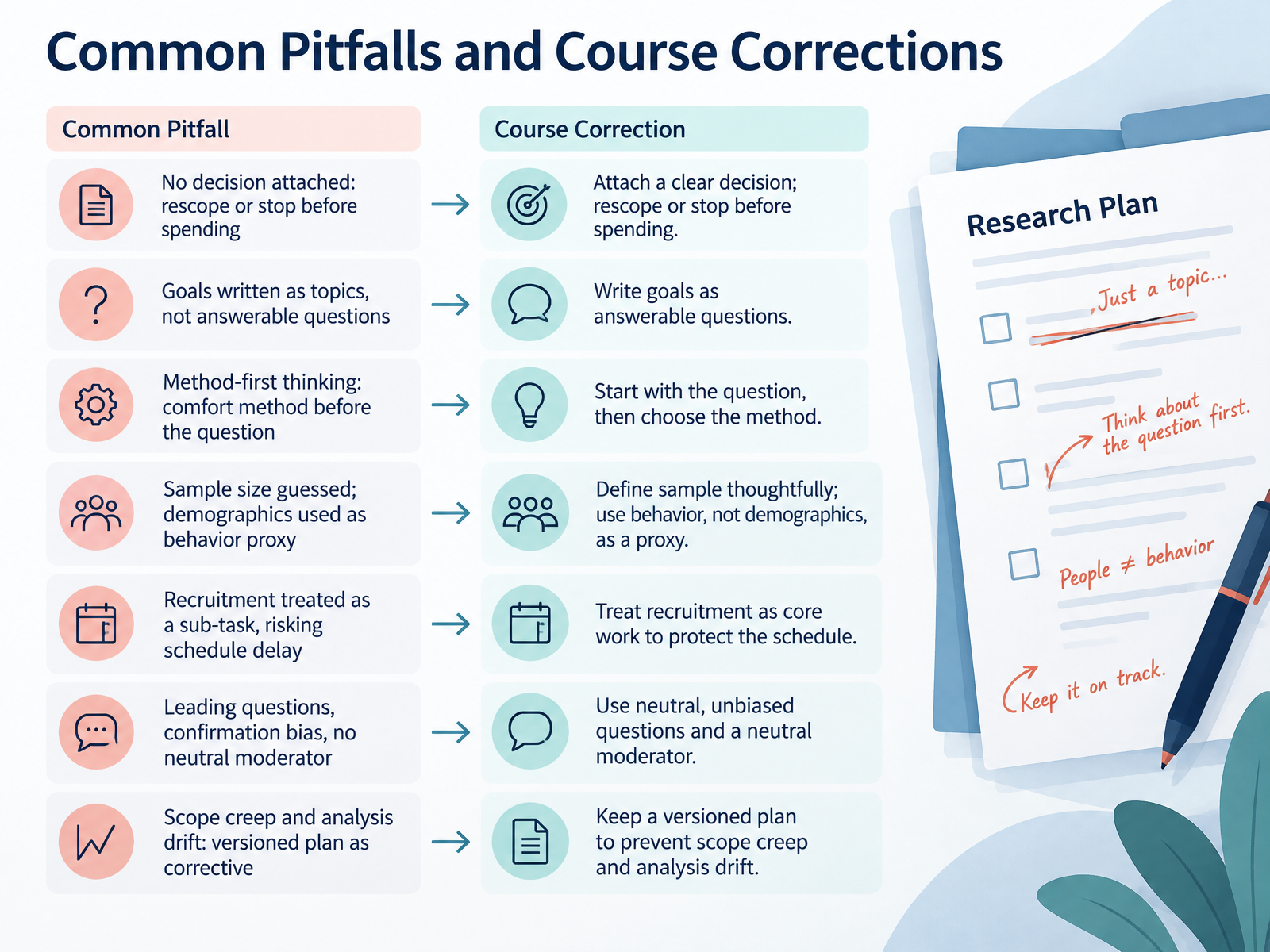
1 min - 11Common Pitfalls and Course CorrectionsLet's talk about common pitfalls, and how to correct course before they cost you time or trust. First, no decision attached. If nothing changes based on the findings, rescope or stop. Don't spend budget to learn something no one will act on. Second, goals written as topics rather than answerable questions. "Onboarding" is a topic. "Where do new users get stuck in their first session?" is answerable. Third, method-first thinking. If you reach for the method you're comfortable with before the question is clear, you'll get tidy data that misses the point. Fourth, sample size guessed, and demographics used as a behavior proxy. The number of participants should follow the decision and the question, not a habit. Fifth, recruitment treated as a sub-task. It delays schedules more than almost anything else. Treat it as a workstream with its own owner and dates. Sixth, leading questions and confirmation bias, with no neutral moderator. Even a small wording change can push the answer. Finally, scope creep and analysis drift. Keep a versioned plan, and when the study changes, name the change. That one habit keeps everyone aligned and makes the findings defensible.
Next, let's score your plan before you launch.
 2 min
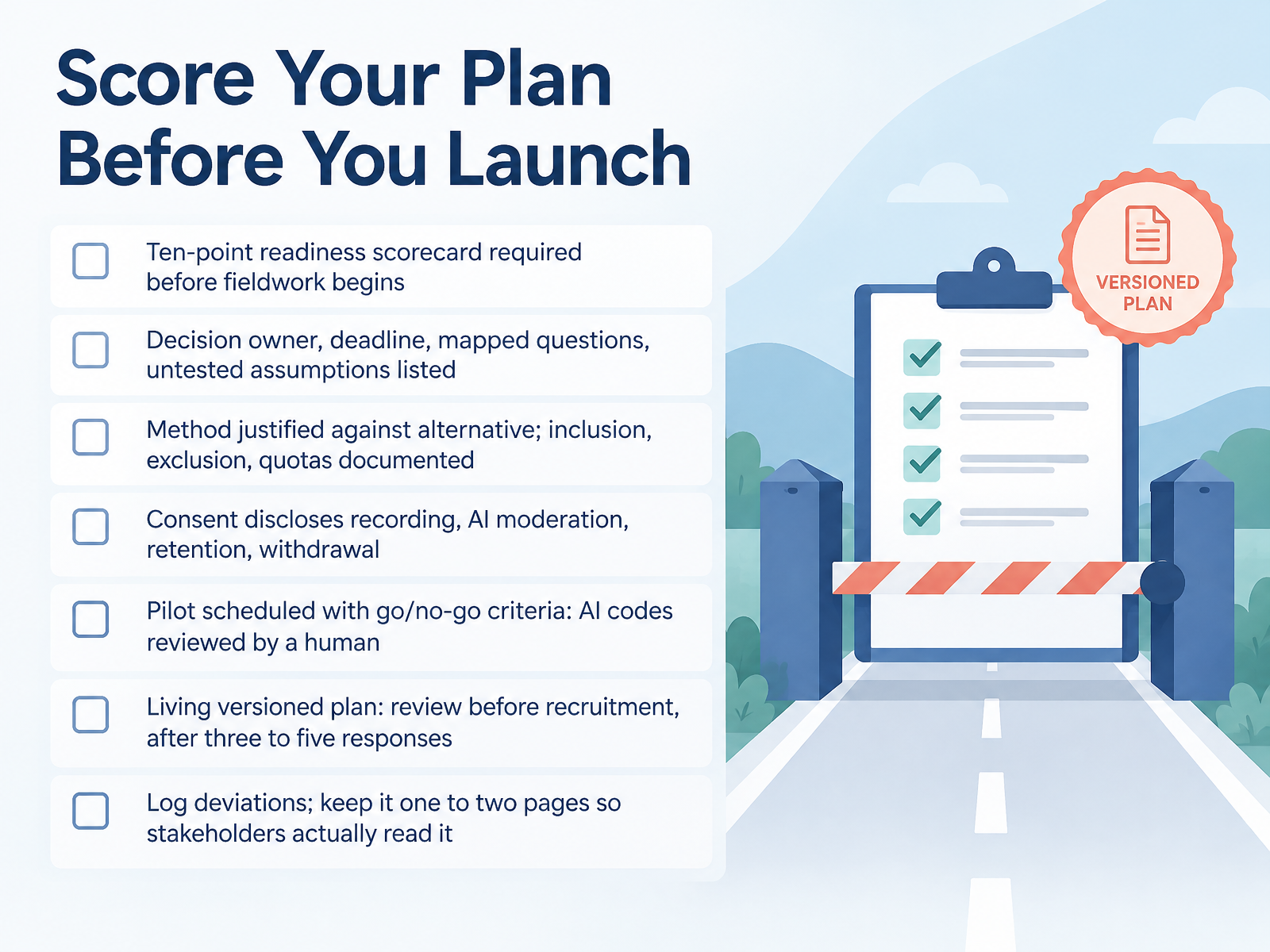
2 min - 12Score Your Plan Before You LaunchBefore you launch, score your plan. Not to satisfy a process, but to protect your decision. Run a ten-point readiness check. If you can't answer a point, that's your next task. Start with the decision owner and the deadline. Name them. Then list the questions you've mapped, and any untested assumptions still in play. Justify your method against at least one real alternative. And document inclusion, exclusion, and quotas. On consent, be specific: recording, AI moderation, retention, withdrawal. For the pilot, set clear go/no-go criteria. And any AI-generated codes get human review. Keep the plan living and versioned. Review it before recruitment, and again after three to five responses. Log deviations as they happen. Keep the whole thing to one or two pages, so stakeholders actually read it. That's the takeaway: a short, scored plan beats a long, unread one. Next, let's draft yours in the hands-on workshop: Draft Your One-Page Plan.
 2 min
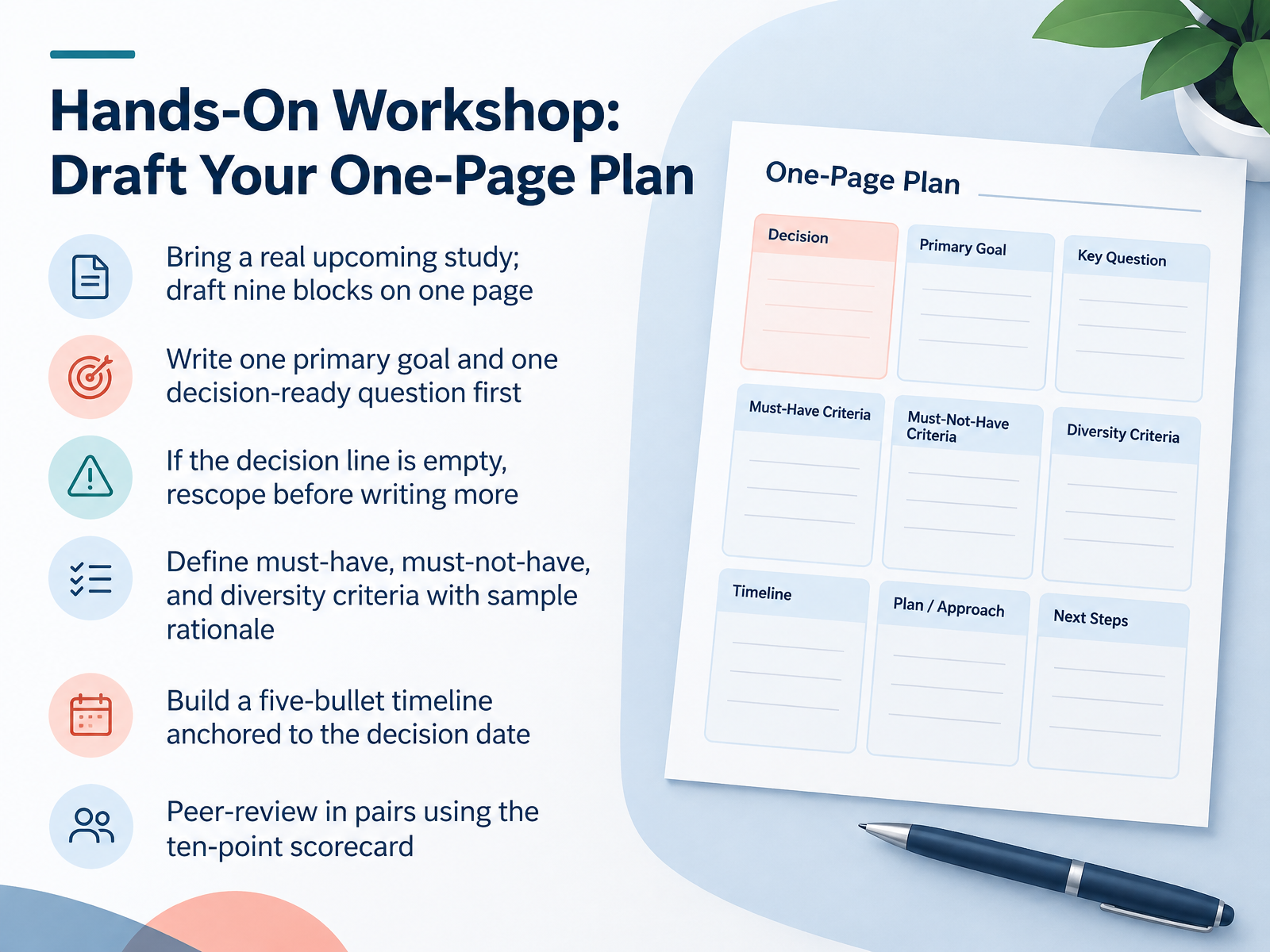
2 min - 13Hands-On Workshop: Draft Your One-Page PlanNow let's put all of this to work. For this workshop, bring a real study you have coming up. You will draft nine blocks on one page. Start with one primary goal and one decision-ready question. That is the foundation. Here is the test. If the decision line is empty, stop. Rescope before you write anything else. Ask yourself, what will we do differently based on this study? If you cannot answer that, the study is not ready to plan.
Next, define your must-have, must-not-have, and diversity criteria. Include a short rationale for each. For example, must-have, used our product in the last thirty days. Must-not-have, works for a competitor. Diversity, a mix of team sizes and roles. Then build a five-bullet timeline anchored to your decision date. Work backward from when the decision needs to be made.
Once your page is drafted, pair up and peer-review using the ten-point scorecard. Be specific and kind. You have about twenty minutes.
Next, we will cover commitments, templates, and next steps.
 2 min
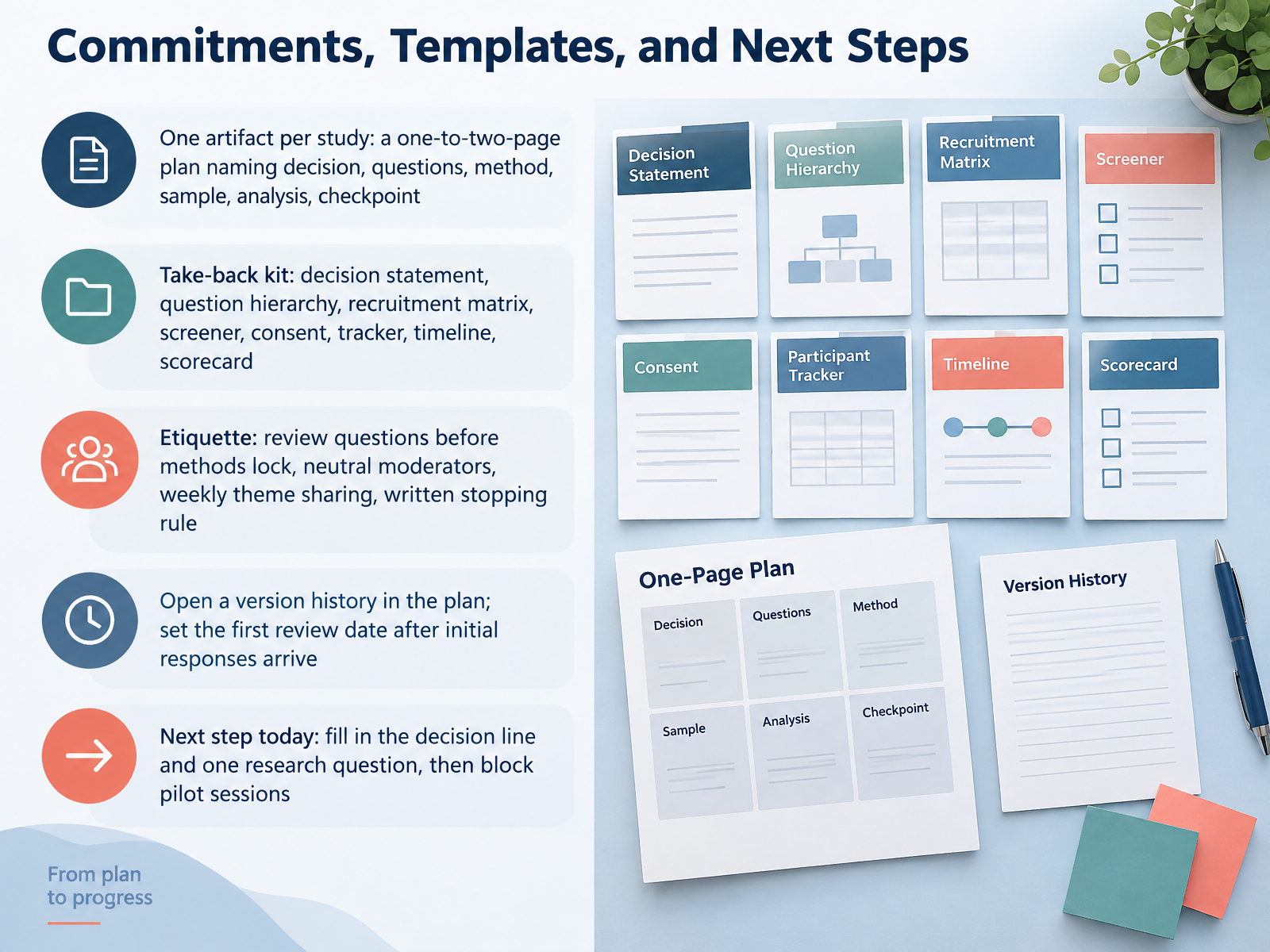
2 min - 14Commitments, Templates, and Next StepsLet's close with what you actually commit to. First, one artifact per study. Not a deck. A one to two page plan that names the decision, your research questions, the method, the sample, how you'll analyze, and your checkpoint. If it doesn't fit, it isn't scoped yet.
Your take-back kit is the practical layer: a decision statement, a question hierarchy, a recruitment matrix, a screener, consent language, a tracker, a timeline, and a scorecard. That sounds like a lot, but you build it once and reuse the bones.
Etiquette matters here. Review questions before methods lock. Use neutral moderators. Share themes weekly, and write your stopping rule down before you need it. Then open a version history in the plan, and set the first review date for after the initial responses arrive, not before.
Your next step today is small on purpose: fill in the decision line and one research question. Then block your pilot sessions. That's how a plan becomes a study. Thanks for working through this with me. Start with the decision line, and build from there.
 2 min
2 min
Take the deck with you
Download this course as a file — free, no sign-up needed.
- PDF handoutEvery slide page, ready to print or share.15 pages · 3.4 MBDownload
- Narrated PowerPointThe deck that presents itself — every slide carries the digital human's narration video.15 pages · 25.6 MBDownload
- PowerPoint slidesThe full deck as a .pptx — open it in PowerPoint, Keynote, or Google Slides.15 pages · 3.3 MBDownload
Free to use in your own training — please keep the PersonWise credit page at the end.
Have your own deck? Turn it into a course