Begin
14 pages · ~28 min
Electron Configuration Fundamentals
This training explains electron shells, subshells, and orbitals, helping chemistry students master electron configuration and predict atomic behavior.
A digital instructor presents all 14 pages. Hold “Ask” at any point and ask out loud — the answer comes from this course. No sign-up needed.
What you’ll learn
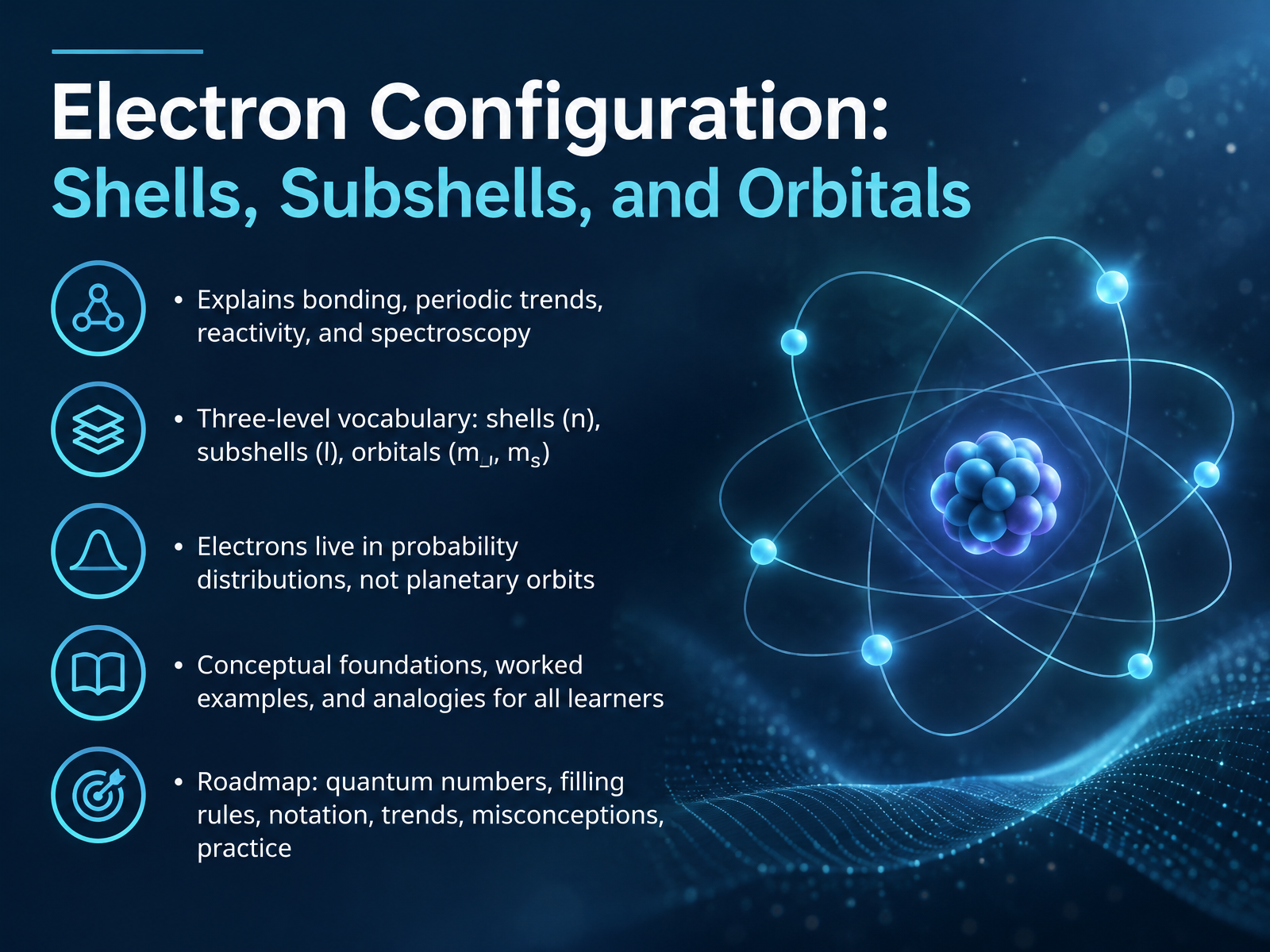
- 01Electron Configuration: Shells, Subshells, and OrbitalsWelcome. In this course, we'll build a clear, working understanding of electron configuration, the way electrons are arranged around a nucleus. Why does it matter? This arrangement helps explain bonding, periodic trends, reactivity, and even spectroscopy. We'll use a three-level vocabulary: shells, labeled n, subshells, labeled l, and orbitals, described by the quantum numbers m sub l and m sub s. One important idea up front: electrons live in probability distributions, not neat planetary orbits. We'll cover conceptual foundations, worked examples, and analogies, so the ideas stay accessible whether you're a student, an adult learner, or an educator. Our roadmap includes quantum numbers, filling rules, notation, trends, common misconceptions, and practice. You may already know a simple configuration like two, eight, one for sodium, so we'll connect each new term to that prior knowledge before moving on. Let's begin by leaving the old planetary picture behind, and turning to quantum mechanical orbitals.edu.rsc.orgedu.rsc.orgopenstax.org+22 min
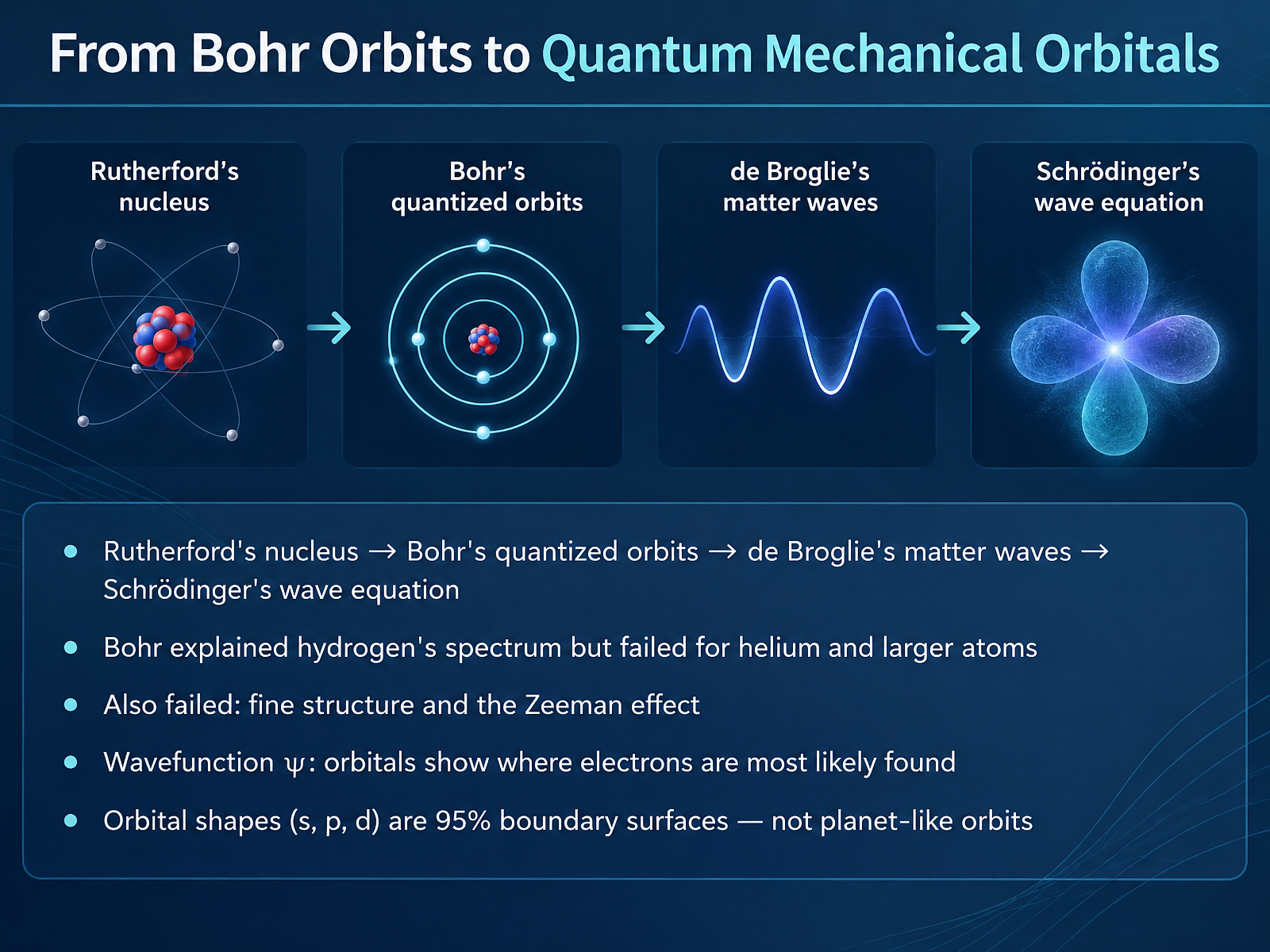
- 02From Bohr Orbits to Quantum Mechanical OrbitalsLet's look at how our picture of the atom changed, and why it had to. Rutherford gave us a tiny, dense nucleus. Bohr then placed electrons in quantized orbits around it. De Broglie proposed that electrons behave as waves. And Schrödinger turned that idea into his wave equation. Bohr's model was a real triumph: it explained hydrogen's spectrum. But it could not correctly predict helium or any larger atom. It also missed details, like fine structure and the Zeeman effect, where spectral lines split in a magnetic field. So the orbit gave way to the orbital. We describe an orbital with a wavefunction, written as psi, which tells us where an electron is most likely to be found. The s, p, and d shapes you'll see are boundary surfaces: about ninety-five percent probability. An electron is not a little planet circling the nucleus. So keep asking yourself: where is the electron likely to be? Next, we'll make that question precise with quantum numbers.
 openstax.orgopenstax.orgdoi.org+22 min
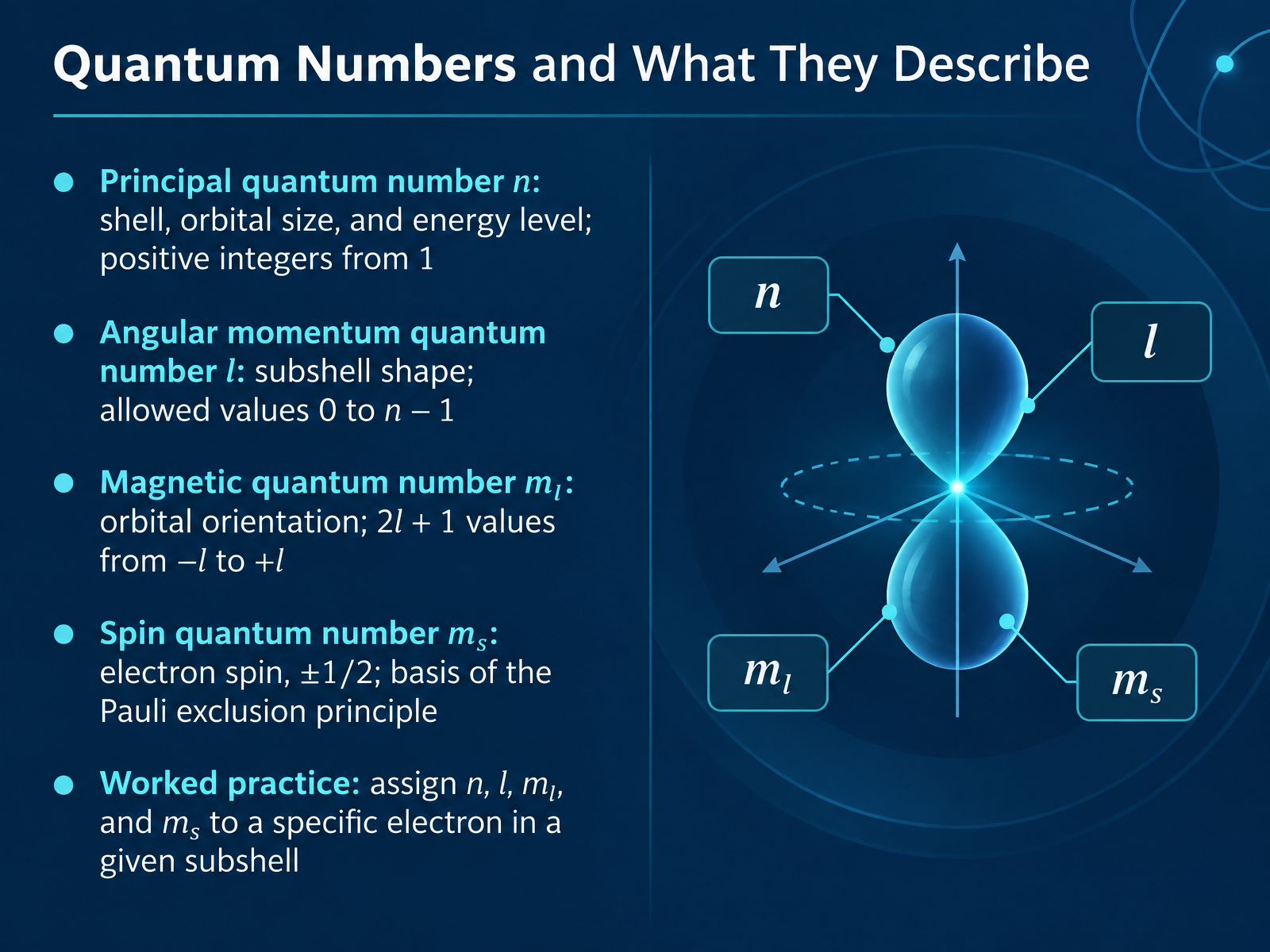
- 03Quantum Numbers and What They DescribeNow let's look at the four quantum numbers and what each one describes. The principal quantum number, n, tells you the shell, the orbital size, and the energy level. It takes positive integers starting at one. The angular momentum quantum number, l, describes the subshell shape. Its allowed values run from zero up to n minus one. The magnetic quantum number, m sub l, gives the orbital orientation. It has two l plus one values, ranging from negative l to positive l. For example, if l equals two, m sub l can be negative two, negative one, zero, one, or two. The spin quantum number, m sub s, is either plus one half or minus one half. It underlies the Pauli exclusion principle, which says no two electrons in an atom share all four quantum numbers. Let's practice. For an electron in the three p subshell, n equals three, l equals one, m sub l can be negative one, zero, or one, and m sub s is plus one half or minus one half. Take a moment to check that against the rules. Next, we'll turn to shells and subshells, their capacities, and energy ordering.
 openstax.orgphysics.nist.govopenstax.org+22 min
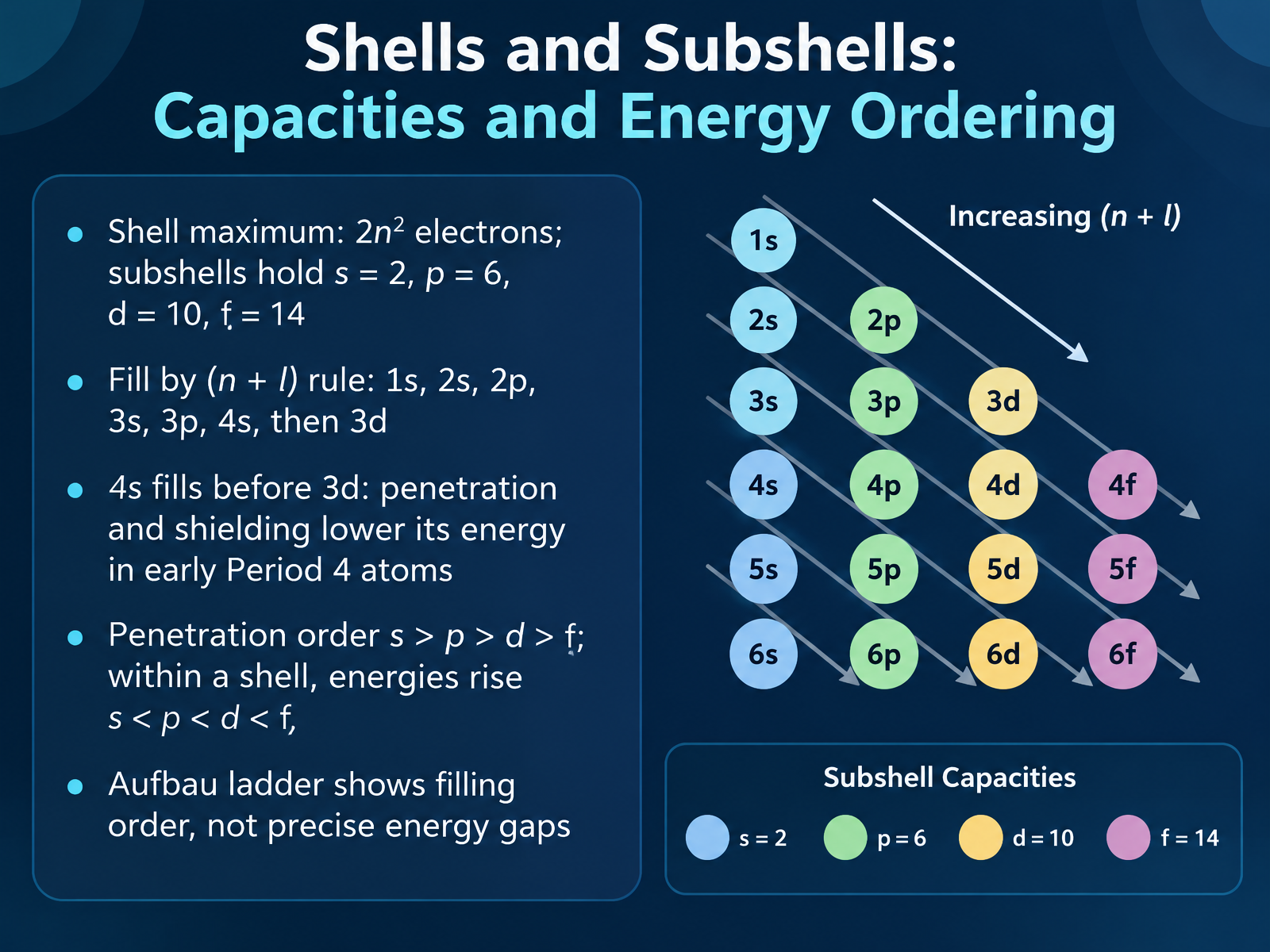
- 04Shells and Subshells: Capacities and Energy OrderingNow let's look at how many electrons each shell and subshell can hold, and the order in which they fill. A shell with principal quantum number n holds a maximum of two n squared electrons, so the second shell holds a maximum of eight. Within any subshell, s holds two electrons, p holds six, d holds ten, and f holds fourteen. The filling order follows the n plus l rule. You can read it as one s, two s, two p, three s, three p, four s, then three d. Notice that four s fills before three d. That happens because the four s orbital penetrates closer to the nucleus and is less shielded, so in early Period four atoms its energy is lower. More generally, penetration follows s greater than p greater than d greater than f, and within a shell energies rise s, then p, then d, then f. One caution, as you can see with chromium and copper, the aufbau ladder shows filling order, not precise energy gaps. Quick check, why does four s come before three d? Now let's move on to filling rules and standard notation.
 doi.orgchem.libretexts.orgphysicsclassroom.com+21 min
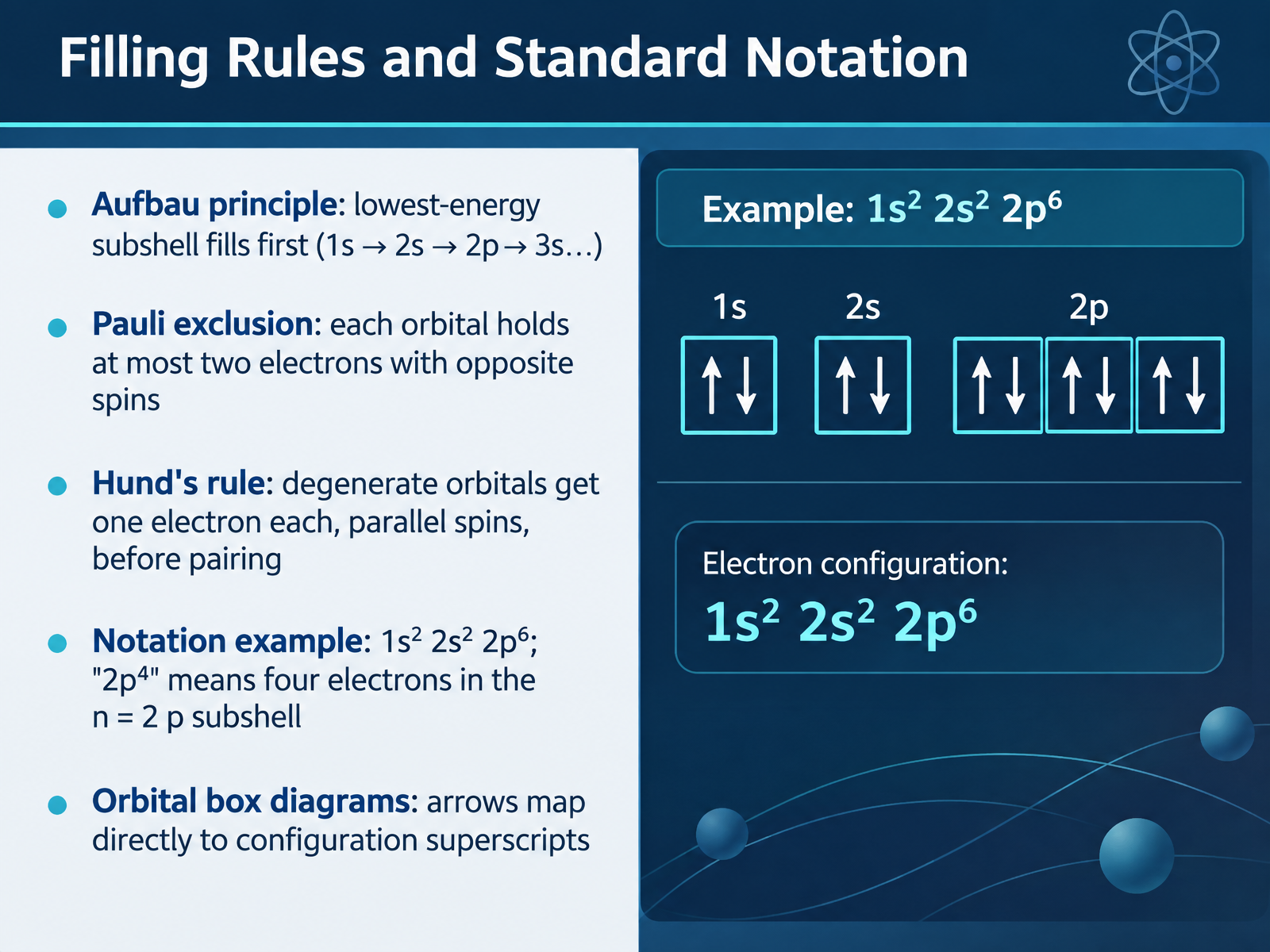
- 05Filling Rules and Standard NotationNow let's turn those ideas into rules you can actually apply. Three rules guide how electrons fill orbitals. First, the Aufbau principle. Electrons fill the lowest-energy subshell first, in the order 1s, then 2s, then 2p, then 3s, and so on. Second, the Pauli exclusion principle. Each orbital holds at most two electrons, and those two must have opposite spins. Third, Hund's rule. When several orbitals have the same energy, electrons go in one at a time, with parallel spins, before any pairing begins. In standard notation, we write the subshell and a superscript for its electron count, like 1s squared, 2s squared, 2p to the sixth. So 2p to the fourth means four electrons in the n equals 2 p subshell. Orbital box diagrams show the same information: each arrow is one electron, and the arrows map directly to those superscripts. Next, we'll put these rules to work with some worked examples.
 physics.nist.govopenstax.orgopenstax.org+22 min
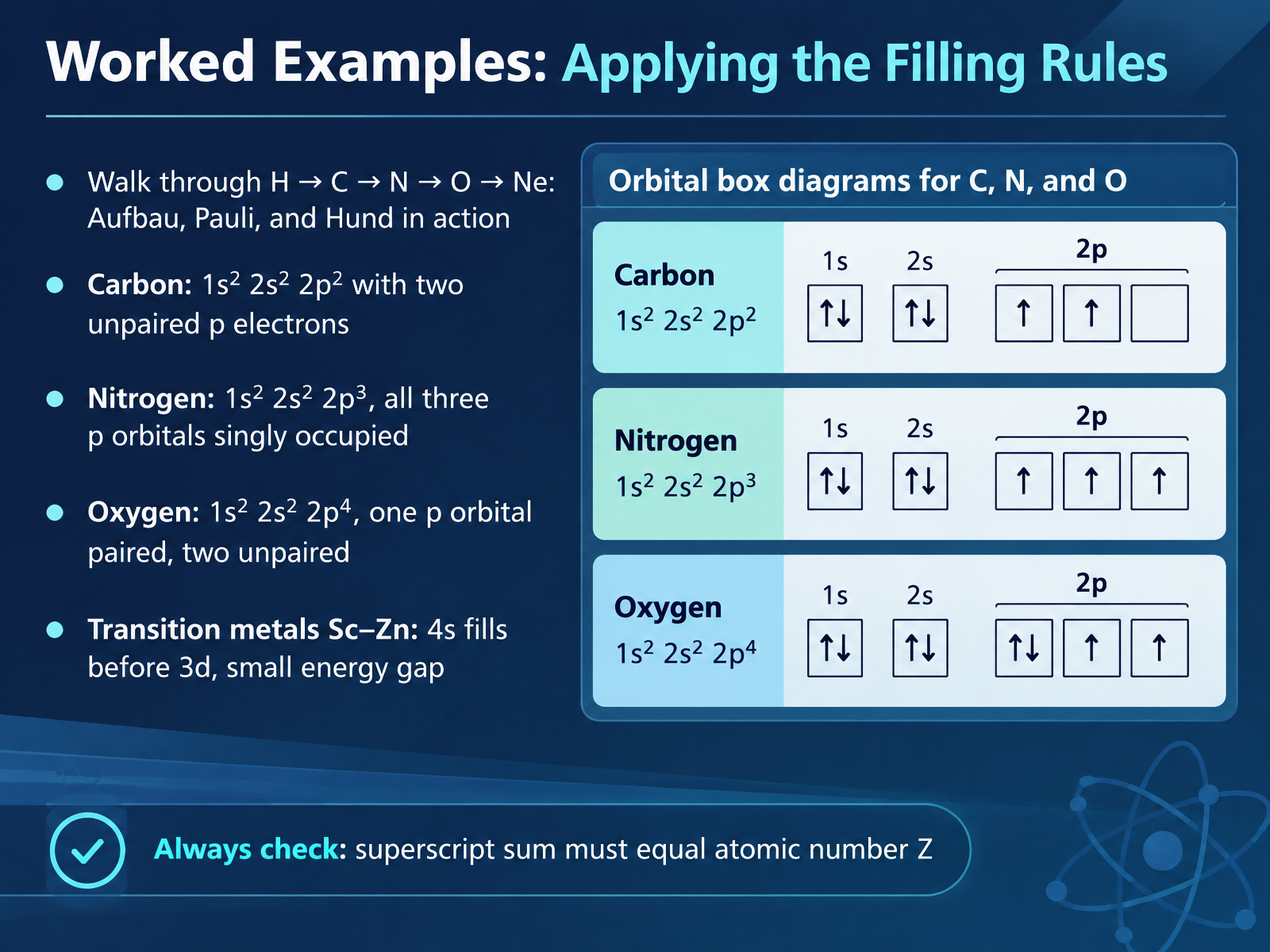
- 06Worked Examples: Applying the Filling RulesNow let's put the rules to work. We'll walk through hydrogen, carbon, nitrogen, oxygen, and neon, and watch the Aufbau principle, the Pauli exclusion principle, and Hund's rule act together. Aufbau fills the lowest energy orbitals first. Pauli allows at most two electrons per orbital, with opposite spins. Hund keeps electrons in separate orbitals, with parallel spins, until those orbitals are half full. Carbon has six electrons, so we get one s two, two s two, two p two. The two p electrons sit unpaired in separate orbitals. Nitrogen, with seven, is one s two, two s two, two p three, with all three p orbitals singly occupied. Oxygen adds one more, so two p four leaves one p orbital paired and two unpaired. For the transition metals scandium through zinc, the four s subshell fills before three d, because the two are very close in energy. Here's your check: add the superscripts, and the total must equal the atomic number. That quick sum catches most mistakes. Next, we look at exceptions to the predicted filling order.
 physics.nist.govdoi.orgchem.libretexts.org+22 min
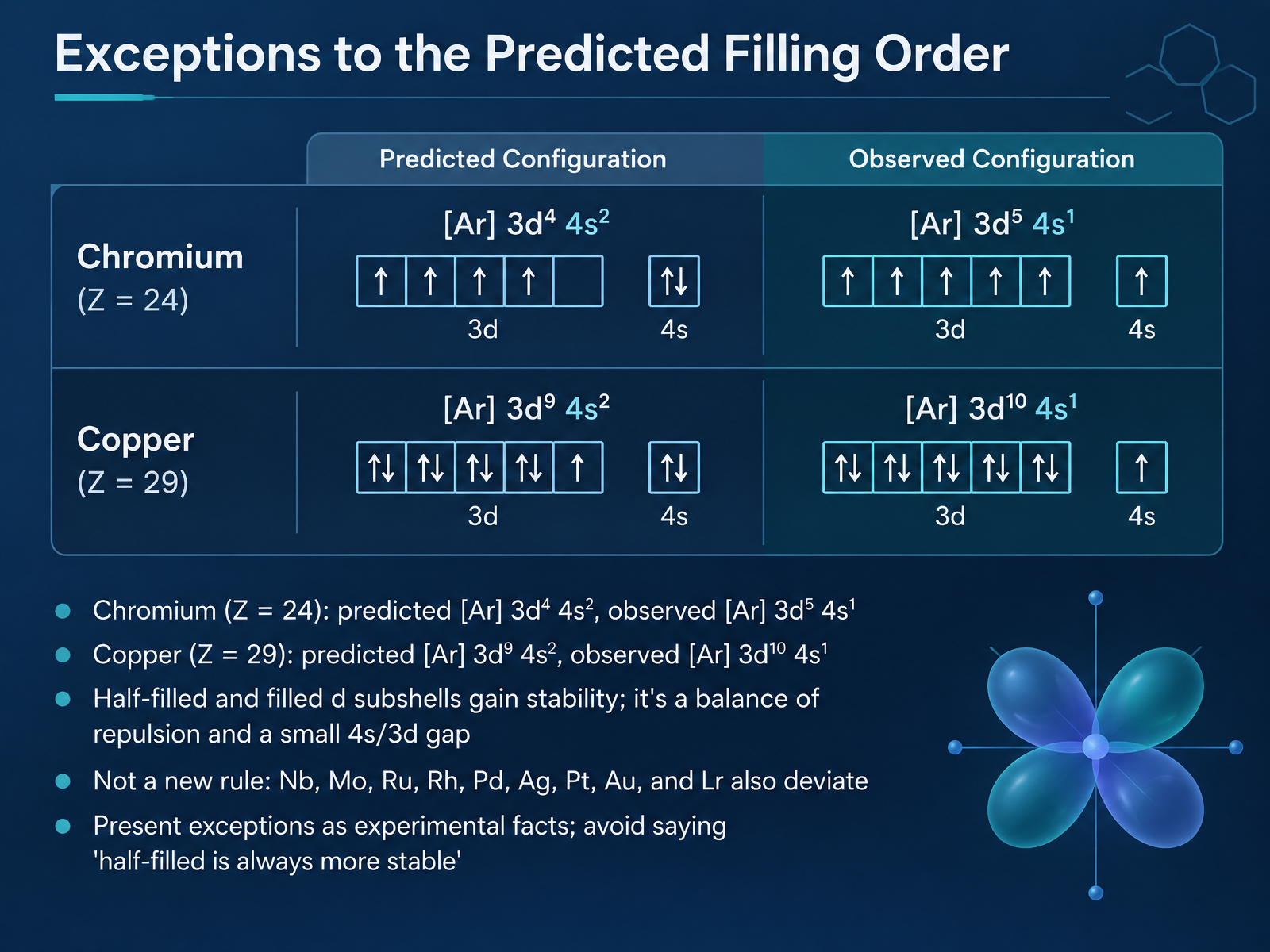
- 07Exceptions to the Predicted Filling OrderNow that we have the predicted filling order, let's look at the exceptions. Chromium, with atomic number twenty four, is predicted to be argon core, three d four, four s two. But experiment shows argon core, three d five, four s one. Copper, atomic number twenty nine, is predicted as argon core, three d nine, four s two. Experimentally, it is argon core, three d ten, four s one. In both cases, a half filled or filled d subshell gains stability. The balance of electron repulsion and the small gap between the four s and three d levels decides the outcome. These are not a new rule. Niobium, molybdenum, ruthenium, rhodium, palladium, silver, platinum, gold, and lawrencium also deviate. Treat these as experimental facts. Avoid saying half filled is always more stable. Let's move on to see how electron configuration connects to the periodic table.
 doi.orgchem.libretexts.orgphysicsclassroom.com+22 min
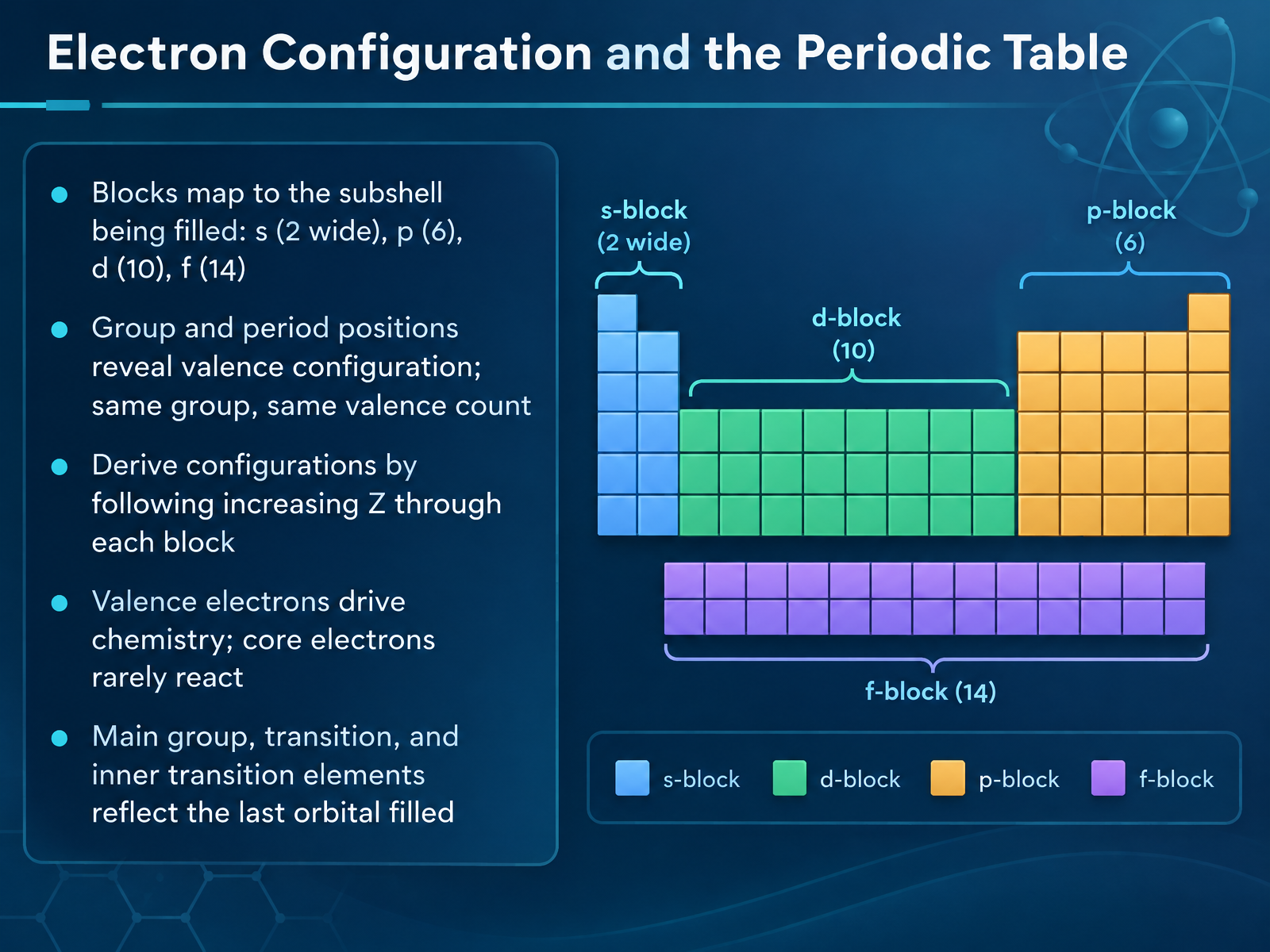
- 08Electron Configuration and the Periodic TableNow let's connect electron configuration to the periodic table itself. The table is divided into blocks, and each block matches the subshell being filled. The s block is two columns wide. The p block is six. The d block is ten. And the f block is fourteen. These widths reflect the number of electrons each subshell can hold. Group and period positions tell you the valence configuration. Elements in the same group share the same valence electron count, which is why they behave similarly. To derive a configuration, follow increasing atomic number through each block in filling order. Valence electrons drive chemistry, while core electrons rarely react. For example, sodium's single valence electron makes it highly reactive. Main group, transition, and inner transition elements simply reflect the last orbital filled. Take a moment to check: can you find an element's block from its position? Next, we'll look at noble gas shorthand and ion configurations.
 edu.rsc.orgedu.rsc.orgopenstax.org+22 min
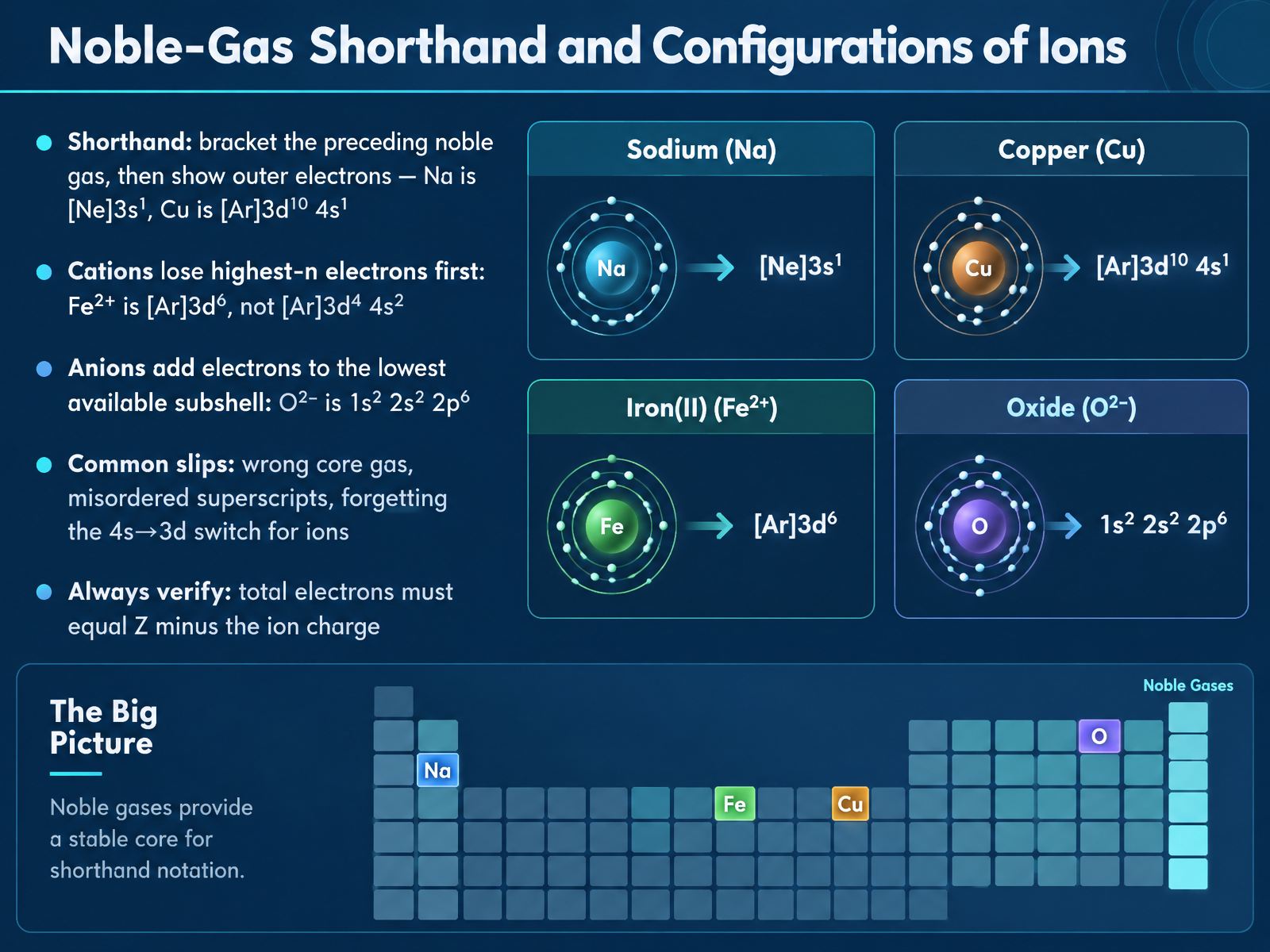
- 09Noble-Gas Shorthand and Configurations of IonsNext, let's cover noble-gas shorthand and the configurations of ions. Shorthand works like a shortcut. Put the preceding noble gas in brackets, then write only the outer electrons. Sodium becomes [Ne]3s1. Copper is written [Ar]3d10 4s1. Now for ions. Cations lose their highest-n electrons first. So Fe2+ is [Ar]3d6, not [Ar]3d4 4s2. That 4s to 3d switch trips up many learners, so expect it and plan for it. Anions gain electrons, and they fill the lowest available subshell. Oxide, O2-, is 1s2 2s2 2p6. Watch three common slips: the wrong core gas, misordered superscripts, and forgetting the 4s to 3d switch for ions. Here is one simple check. Add up the superscripts. The total must equal Z minus the ion charge. Pause here and try one ion yourself. Next, we will connect configuration to periodic trends.
 physics.nist.govdoi.orgchem.libretexts.org+22 min
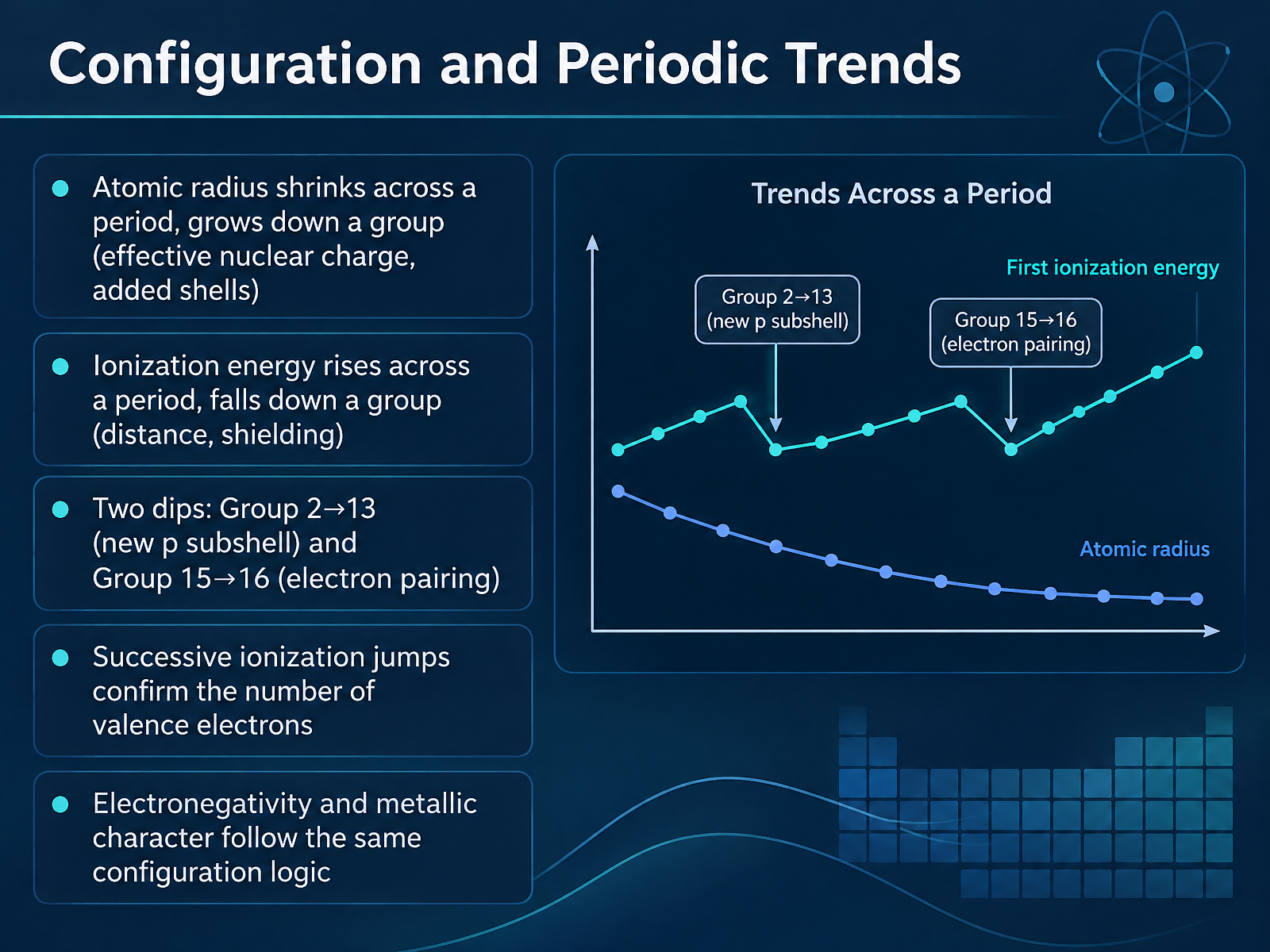
- 10Configuration and Periodic TrendsNow let's connect configuration to periodic trends. Across a period, atomic radius shrinks, because added protons pull the outer electrons inward. Down a group, radius grows, because new shells sit farther from the nucleus. Ionization energy shows the same logic in reverse. It rises across a period and falls down a group, since outer electrons are farther away and more shielded. There are two dips worth expecting. From Group 2 to Group 13, the electron removed comes from a new p subshell. From Group 15 to Group 16, pairing in a p orbital adds repulsion, so removal is easier. For example, oxygen's first ionization energy is slightly lower than nitrogen's. Successive ionization jumps confirm how many valence electrons an atom has, because a large jump means core electrons are being removed. Electronegativity and metallic character follow this same configuration logic. Metals, on the left, lose electrons easily. Nonmetals, on the right, attract them strongly. Pause here and test yourself. If radius grows down a group, what should happen to ionization energy? Next, we'll put this into practice with reading and writing configurations step by step, in Reading and Writing Configurations: Guided Practice.
 openstax.orgphysics.nist.govopenstax.org+22 min
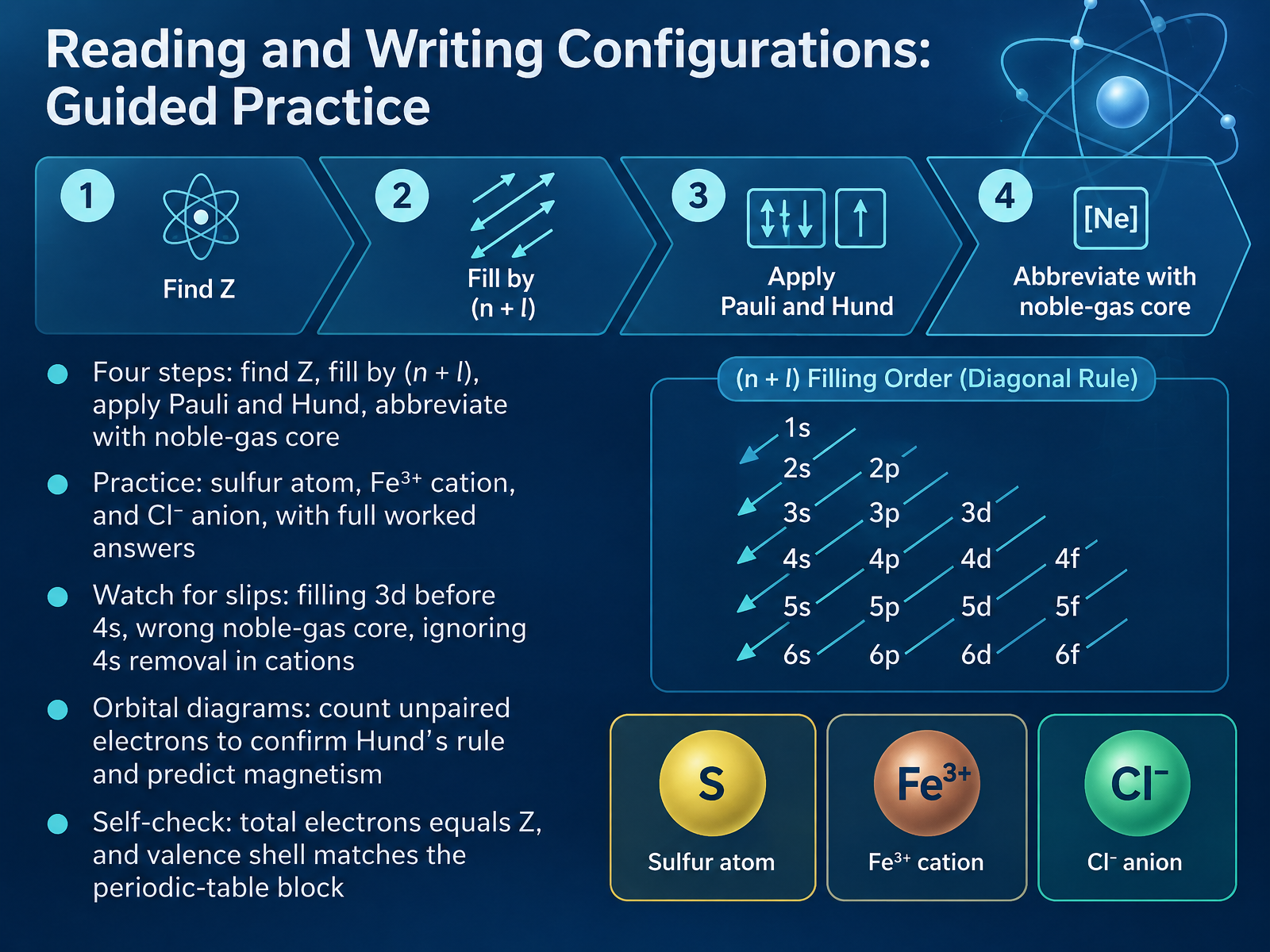
- 11Reading and Writing Configurations: Guided PracticeNow let's put these rules into practice. Use four steps. First, find Z, the number of electrons. Second, fill by increasing n plus l. Third, apply Pauli and Hund. Fourth, abbreviate with the noble-gas core. Try sulfur, with sixteen electrons. That gives one s two, two s two, two p six, three s two, three p four, or neon bracket, three s two, three p four. It has two unpaired p electrons. Now iron three plus. Remove the 4s electrons first, giving argon bracket, three d five. Finally, chloride gains one electron, giving argon bracket, three s two, three p six. Watch for slips: filling 3d before 4s, choosing the wrong noble-gas core, and forgetting to remove 4s first in cations. Orbital diagrams help you count unpaired electrons and predict magnetism. Self-check: total electrons equal Z, and the valence shell matches the block. Next, we turn to common misconceptions about electrons and orbitals.
 physics.nist.govdoi.orgchem.libretexts.org+22 min
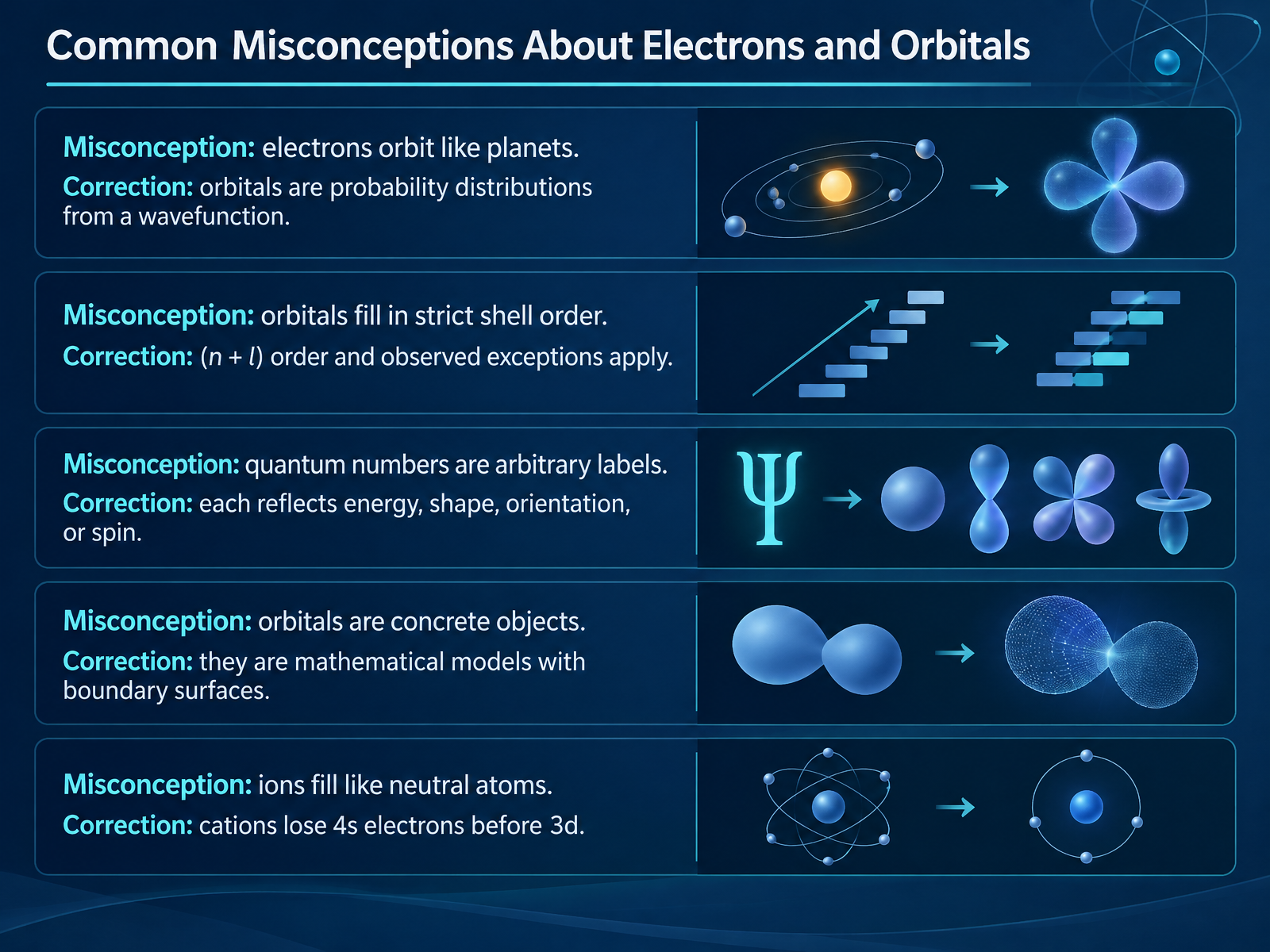
- 12Common Misconceptions About Electrons and OrbitalsLet's clear up some common misconceptions about electrons and orbitals. First, electrons don't orbit like planets. That was the older Bohr model. In modern quantum mechanics, an orbital is a probability distribution derived from a wavefunction. Second, orbitals don't always fill in strict shell order. The n plus l rule gives a better guide, and real elements show exceptions. Third, quantum numbers are not arbitrary labels. Each one carries meaning about energy, shape, orientation, or spin. Fourth, orbitals are not concrete objects. They are mathematical models, and the shapes you see are boundary surfaces. Finally, ions do not fill like neutral atoms. When forming a cation, electrons are lost from the 4s subshell before the 3d subshell. Take a moment to check each of these against your own understanding. Next, we'll look at teaching strategies and analogies that support learning.
 openstax.orgopenstax.orgdoi.org+21 min
- 13Teaching Strategies and Analogies That Support LearningNow let's look at teaching strategies and analogies that support learning. A useful analogy is a hotel with floors and rooms. Floors are shells, and rooms within a floor are subshells and orbitals. But always state where the model breaks down. Electrons are not in fixed rooms, and orbitals are probability regions, not physical spaces. Sequence ideas deliberately: shells and subshells, then quantum numbers, then filling rules, then notation, then periodic trends. For formative assessment, ask learners to explain why the 4s subshell fills before 3d. Their answer reveals whether they understand energy and shielding or are only memorizing a chart. For adult learners, connect to prior real-world knowledge and scale worked examples so confidence builds. For degree-track students, add formal quantum-number problem sets. And scaffold readiness for formal thinking with concrete examples and visual models first, since research shows many learners confuse shells, subshells, and orbitals. Next, we will move to a recap, self-assessment, and next steps.
 edu.rsc.orgedu.rsc.orgopenstax.org+22 min
- 14Recap, Self-Assessment, and Next StepsLet's bring everything together. Quantum numbers define orbitals. The filling rules, Aufbau, Pauli, and Hund, define configurations. And those configurations explain periodic trends like atomic radius and ionization energy. Take a moment to check your understanding with the self-check quiz. It covers notation, ions, exceptions, and trends, and every question comes with a worked answer. When you're ready, the next topics are molecular orbital theory, hybridization, and spectroscopy. For further study, OpenStax Chemistry, second edition, the Royal Society of Chemistry education guides, and NIST atomic spectroscopy data are all reliable resources. Educators, this sequence is ready to use, moving from shells to periodic trends. Thank you for your attention, and keep exploring. You now have a solid foundation to build on.
 edu.rsc.orgedu.rsc.orgopenstax.org+21 min
Take the deck with you
Download this course as a file — free, no sign-up needed.
- PDF handoutEvery slide page, ready to print or share.15 pages · 3.6 MBDownload
- Narrated PowerPointThe deck that presents itself — every slide carries the digital human's narration video.15 pages · 13.6 MBDownload
- PowerPoint slidesThe full deck as a .pptx — open it in PowerPoint, Keynote, or Google Slides.15 pages · 3.5 MBDownload
Free to use in your own training — please keep the PersonWise credit page at the end.
Have your own deck? Turn it into a course
Sources consulted
Web sources consulted while building this course.
- How to teach electron configurations | Poster | RSC Education — edu.rsc.org
- Electron configuration fact sheet — edu.rsc.org
- 6.4 Electronic Structure of Atoms (Electron Configurations) - Chemistry 2e | OpenStax — openstax.org
- Classroom Resources | Electrons and Orbitals | AACT — teachchemistry.org
- Shells, subshells, and orbitals (video) — khanacademy.org
- 6.3 Development of Quantum Theory - Chemistry 2e | OpenStax — openstax.org
- 30.3 Bohr’s Theory of the Hydrogen Atom - College Physics 2e | OpenStax — openstax.org
- Crisis: The End of the Bohr Model — doi.org
- Introducing quantum mechanics through its historical roots: The hydrogen Rydberg atom viewed through the lens of the old quantum theory | American Journal of Physics | AIP Publishing — pubs.aip.org
- Bohr model — en.wikipedia.org
- 30.8 Quantum Numbers and Rules - College Physics 2e | OpenStax — openstax.org
- NIST: Atomic Spectros. - Atomic States, Shells, Configs — physics.nist.gov
- 8.4 The Exclusion Principle and the Periodic Table - University Physics Volume 3 | OpenStax — openstax.org
- Quantum Numbers for Atoms — chem.libretexts.org
- CHAPTER 8 Atomic Physics — sibor.physics.tamu.edu
- Transition Metals and the Aufbau Principle — doi.org
- 6.4: Electronic Structure of Atoms (Electron Configurations) - Chemistry LibreTexts — chem.libretexts.org
- Chemistry Tutorial - Modern Atomic Model - Electrons - Exceptions to the Rules — physicsclassroom.com
- The 4s and 3d subshells: Which one fills first in progressing through the periodic table and which one fills first in any particular atom? — doi.org
- Chapter 17 Many-Electron Atoms and Chemical Bonding — cc.columbia.edu