Begin
14 pages · ~28 min
Understanding Sculpture: Materials and Methods
This training explores sculpture's materials, methods, and viewing practices, helping learners analyze and interpret sculptural works with confidence.
A digital instructor presents all 14 pages. Hold “Ask” at any point and ask out loud — the answer comes from this course. No sign-up needed.
What you’ll learn
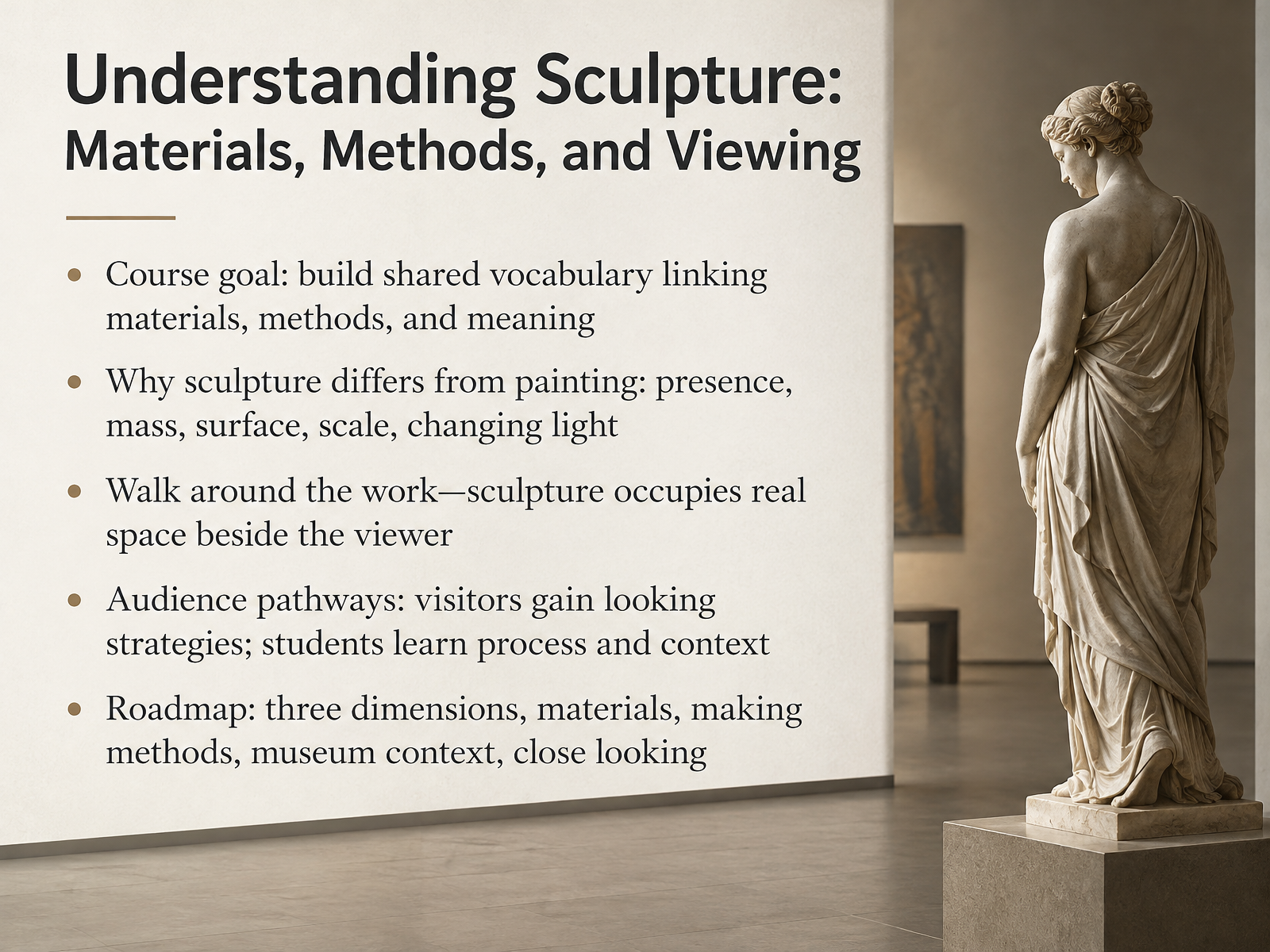
- 01Understanding Sculpture: Materials, Methods, and ViewingWelcome. Over the next several slides, we'll build a shared vocabulary for understanding sculpture, one that links materials, methods, and meaning. So why treat sculpture differently from painting? A painting meets you on a flat surface. A sculpture has presence, mass, and scale. It casts shadows, and it changes as the light shifts. Notice, too, that a sculpture occupies real space beside you, so to see it fully, you'll want to walk around it. Think of a carved stone figure: the front may be calm and still, while the back reveals rougher, unfinished marks. Now consider what this gives each of you. Visitors gain practical looking strategies. Students learn about process and context. Along the way, we'll explore three dimensions, materials, making methods, museum context, and the practice of close looking. Let's begin by reading three dimensions: form, mass, surface, and space.sites.nasher.duke.eduartmuseum.princeton.edunew.artsmia.org+22 min
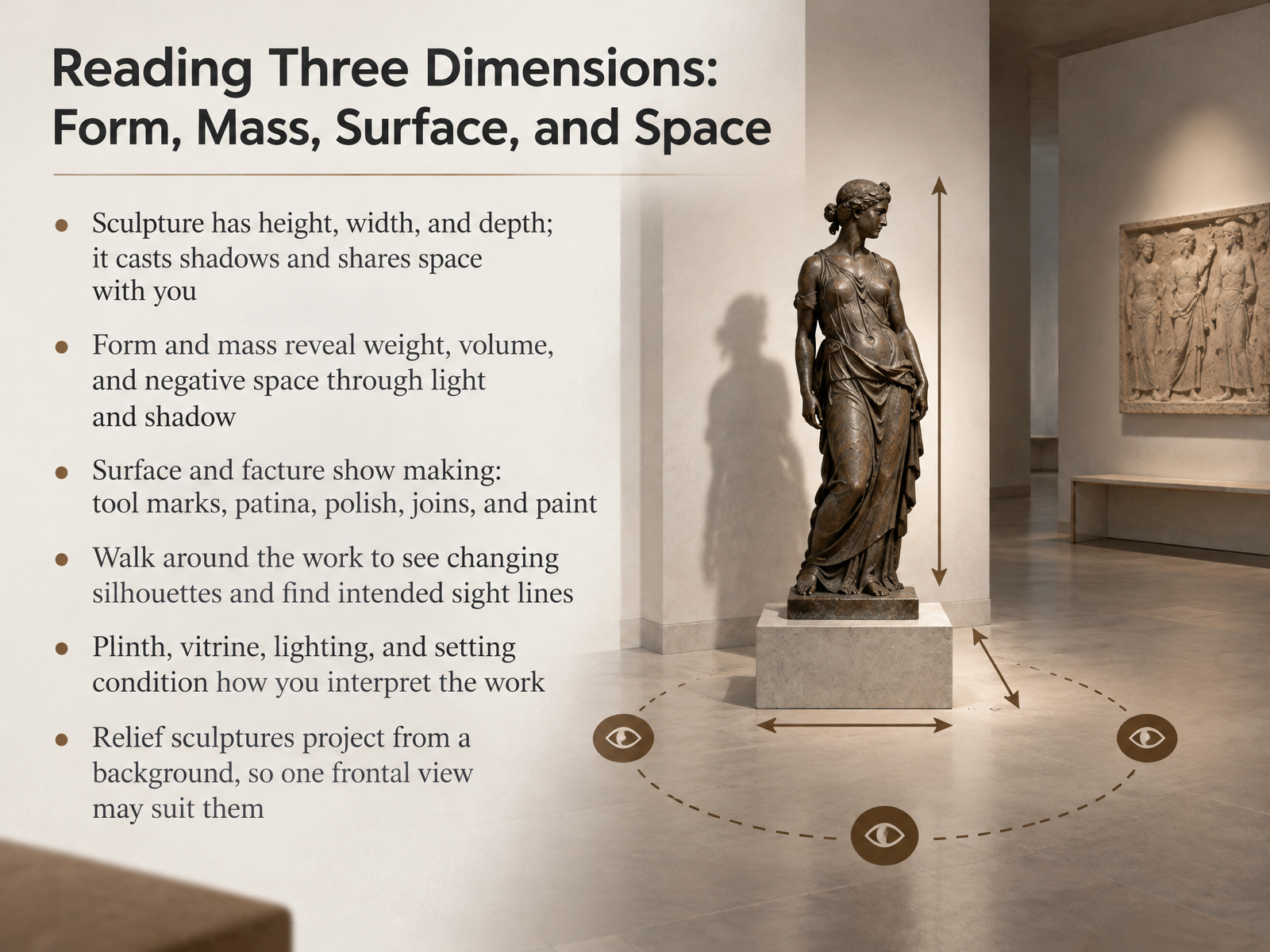
- 02Reading Three Dimensions: Form, Mass, Surface, and SpaceLet's begin by learning how to read a sculpture as a three-dimensional object. Unlike a painting, a sculpture has height, width, and depth. It casts shadows, and it shares real space with you. Notice how light and shadow reveal its form and mass, that is, its weight and volume, including the empty negative space around and within it. Now consider the surface, what we call facture. Tool marks, patina, polish, joins, and traces of paint all show how the work was made. Walk slowly around the sculpture and watch the silhouette change. See whether the artist intended a particular viewing angle. And pay attention to the plinth, the vitrine, the lighting, and the setting, because these shape how you interpret the work. One exception is relief sculpture, which projects from a background, so a single frontal view may suit it best. Next, we turn to materials and meaning: stone, wood, metal, clay, and new media.
 sites.nasher.duke.eduartmuseum.princeton.edunew.artsmia.org+22 min
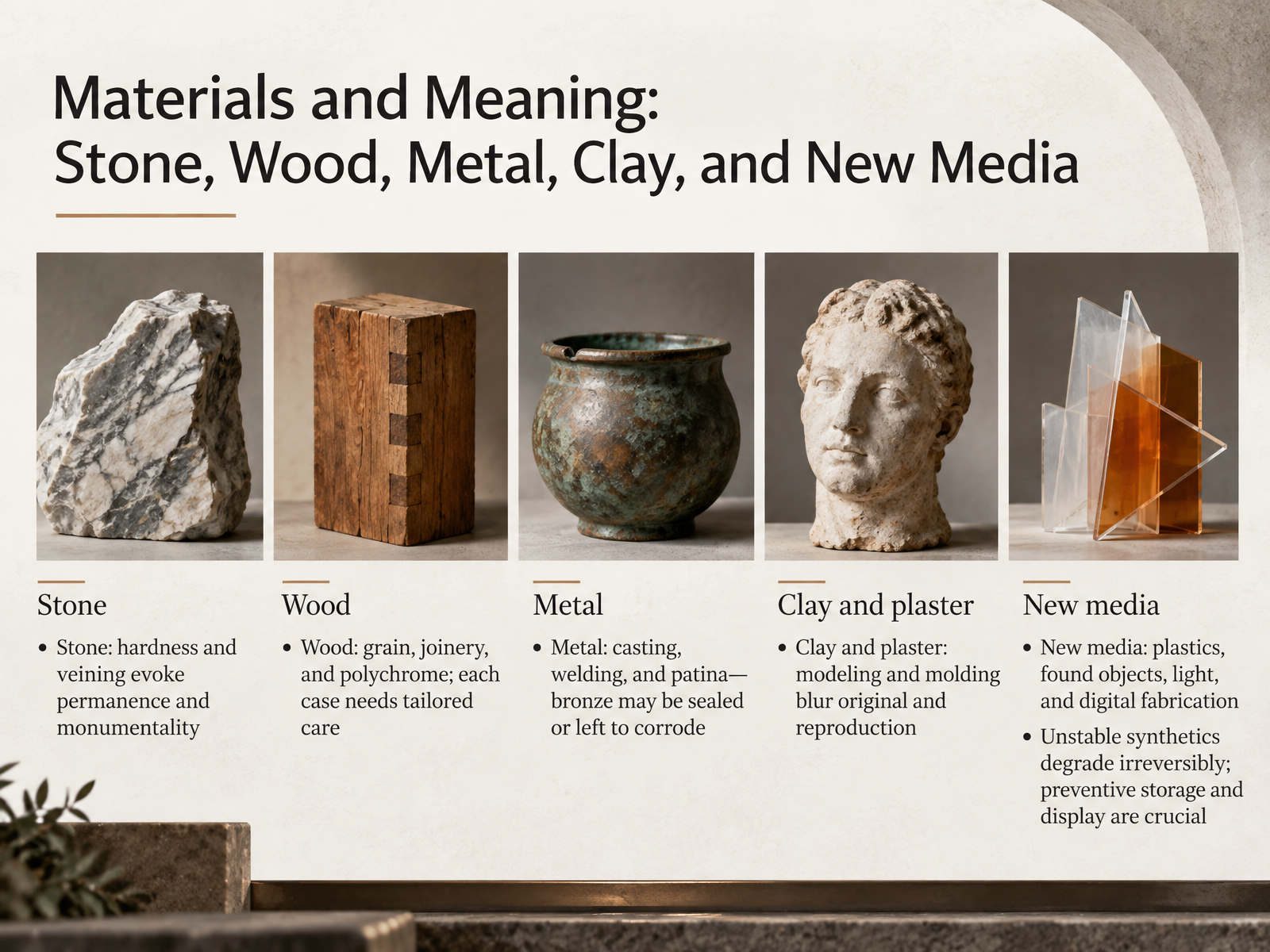
- 03Materials and Meaning: Stone, Wood, Metal, Clay, and New MediaNow let's look closely at what a sculpture is made of, because material shapes meaning. Stone, with its hardness and veining, suggests permanence and monumentality. Wood shows grain and joinery, and often carries traces of paint, called polychrome, so each wooden work needs tailored care. Metal opens up casting and welding, and its patina may be deliberately sealed or left to corrode. Clay and plaster involve modeling and molding, which can blur the line between an original and a reproduction. New media bring plastics, found objects, light, and digital fabrication. And notice this: unstable synthetics degrade irreversibly, so preventive storage and display are crucial. Next, we turn to methods of making, carving, modeling, casting, and construction.
 doi.orgmnk.plarthist.net+22 min
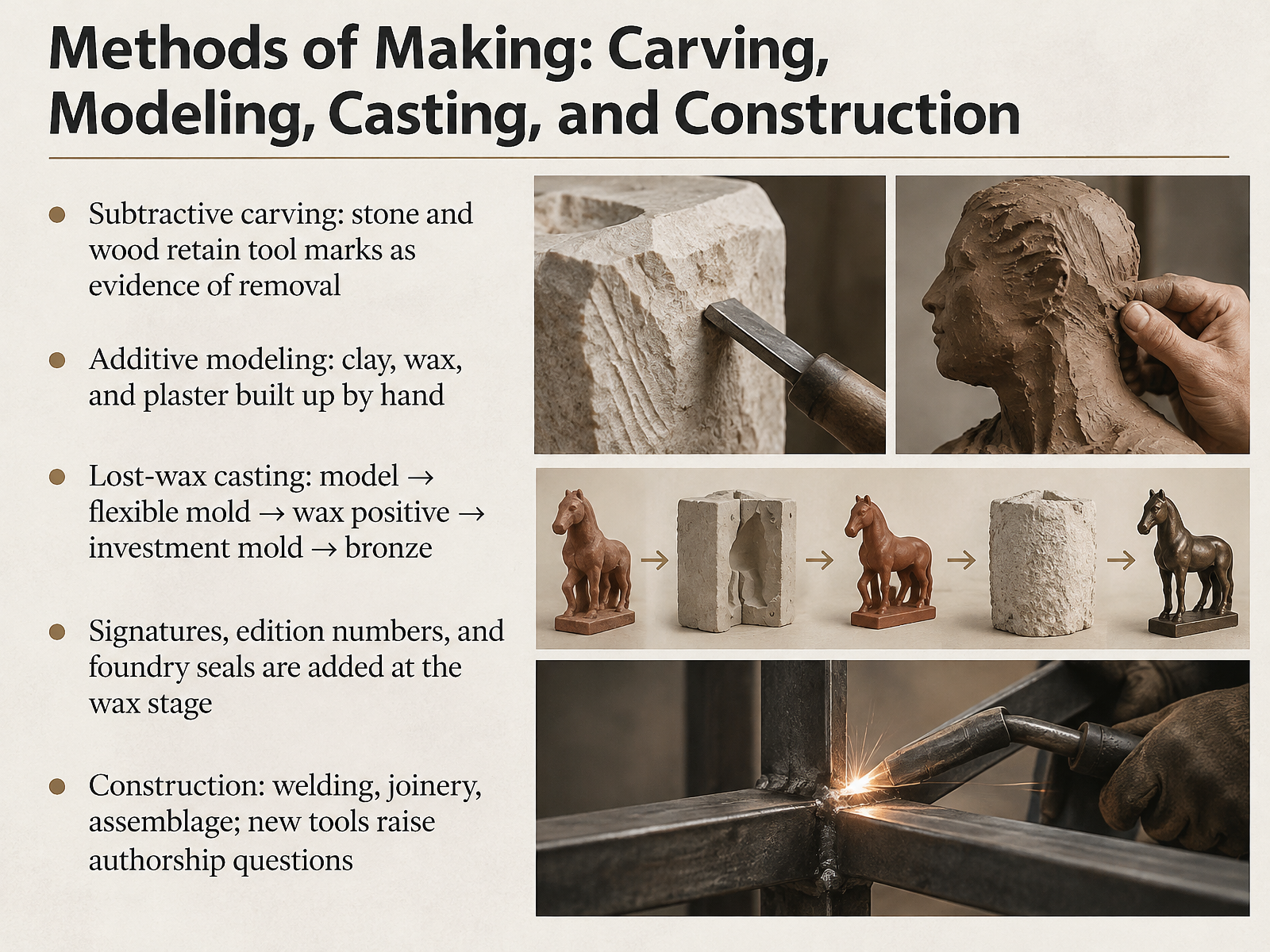
- 04Methods of Making: Carving, Modeling, Casting, and ConstructionNow let's look at how a sculpture actually comes into being, because the method of making shapes what we see. There are four broad approaches. First, subtractive carving. Here the sculptor removes material from stone or wood. Notice that tool marks often remain, and they are evidence of that removal, a visible record of the maker's hand. Second, additive modeling. Clay, wax, or plaster is built up by hand, so the surface grows outward. Third, lost-wax casting, a process in five basic stages. A model is made, a flexible mold is taken from it, a hollow wax positive is cast, that wax is encased in an investment mold, and finally molten bronze replaces the wax. Here is a detail worth remembering: the artist's signature, the edition number, and the foundry seal are added at the wax stage, before the bronze is poured. Fourth, construction. Welding, joinery, and assemblage join separate parts, and these newer tools raise questions about authorship, especially when fabrication is done by others. So as you look, ask how the work was made. The marks of making are part of its meaning. Next, we move from workshop to museum, and consider the contexts of production and display.
 okcmoa.commusee-rodin.fryoutube.com+22 min
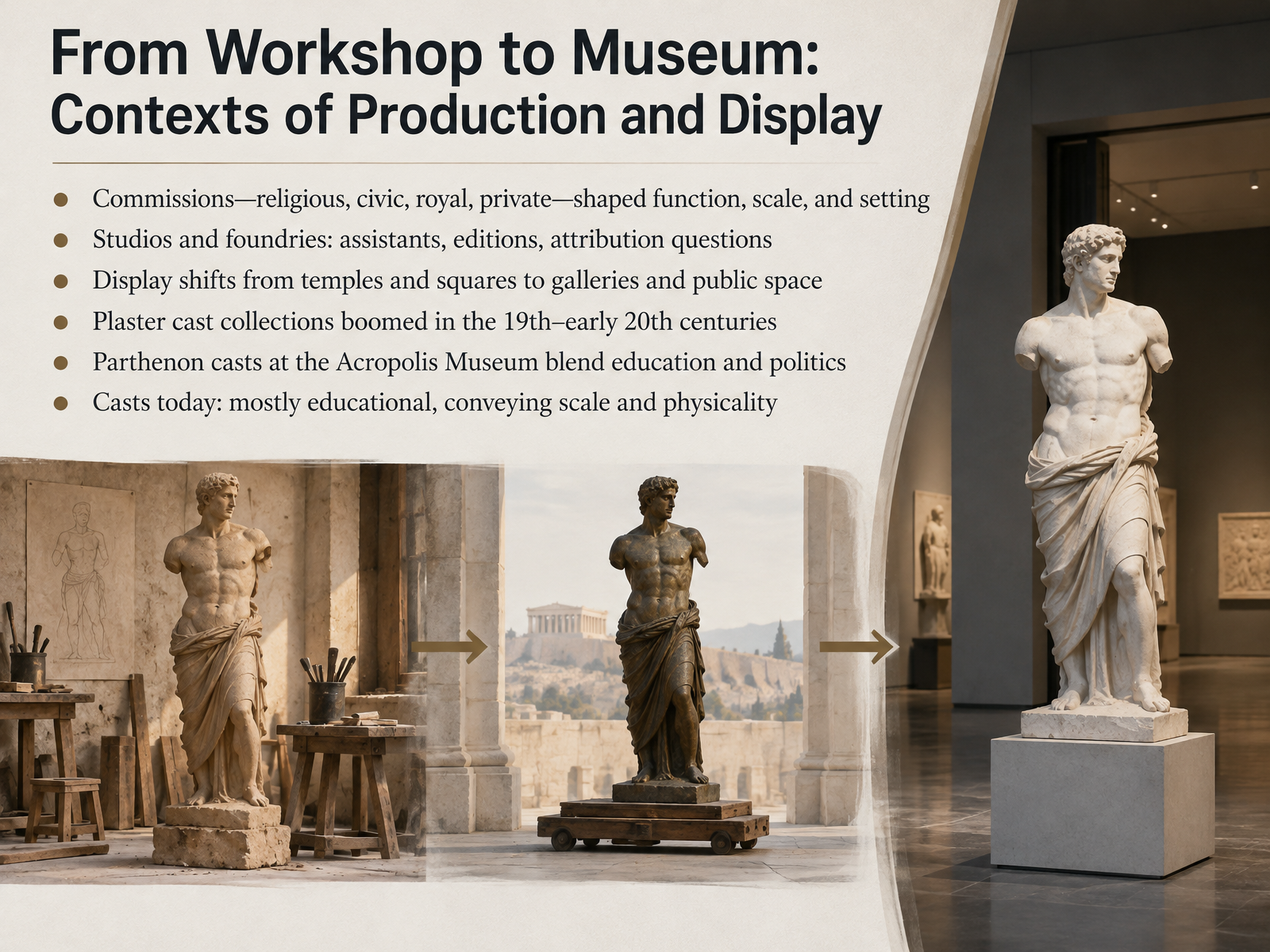
- 05From Workshop to Museum: Contexts of Production and DisplayNow let's step back and ask who made these sculptures, and where we encounter them. Every commission, whether religious, civic, royal, or private, shaped a work's function, its scale, and the setting it was made for. In the studio or foundry, assistants often produced cast editions under a master's name, and that is exactly why questions of attribution arise. Notice, too, how display has shifted. Sculpture once lived in temples and public squares; now much of it sits in galleries and public spaces, changing how we read it. Plaster cast collections boomed across the nineteenth and early twentieth centuries, gathering masterpieces in one place for study. At the Acropolis Museum, casts of the Parthenon sculptures blend education with politics. Today casts are mostly educational, conveying scale and physicality. Next, we look closely, with a step-by-step viewing strategy.
 doi.orgescholarship.orgpersee.fr+21 min
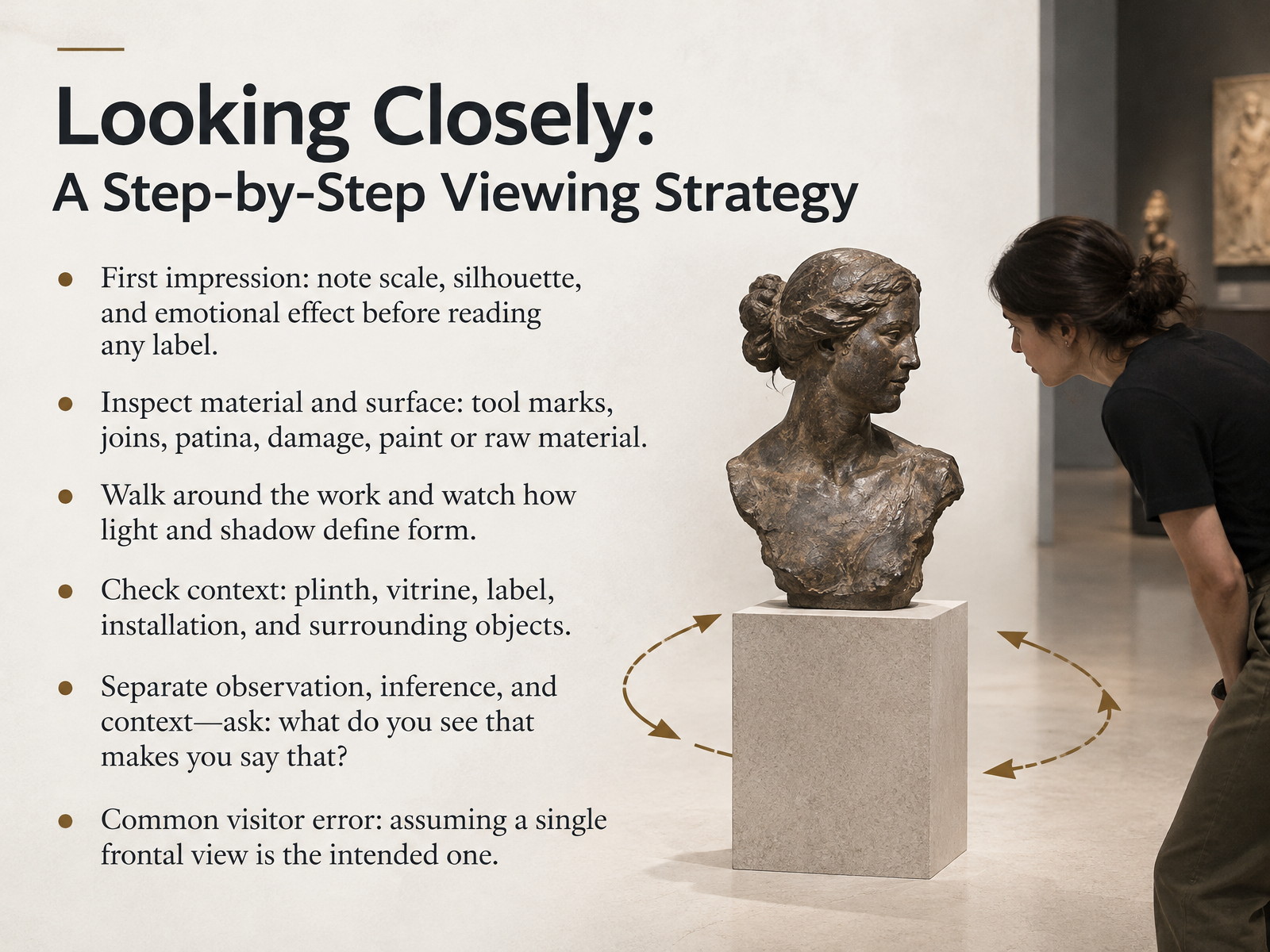
- 06Looking Closely: A Step-by-Step Viewing StrategyLet's put all of this into a step-by-step viewing strategy. First, pause before reading the label. Notice the scale, the silhouette, and the emotional effect the work has on you right away. Next, inspect the material and surface. Look for tool marks, joins, patina, damage, traces of paint, or the raw material itself. Then walk around the sculpture. Sculpture is three-dimensional, so light and shadow shift as you move, and the form changes with each angle. Now consider context: the plinth, the vitrine, the label, the installation, and the objects nearby all shape what you see. Finally, separate observation from inference. A useful question from Visual Thinking Strategies is: what do you see that makes you say that? It asks you to support your interpretation with visual evidence. And watch for a common error, assuming a single frontal view is the intended one. Often, the sculptor imagined the work to be seen in the round. Next, we'll turn to interpreting sculpture through style, subject, and historical context.
 sites.nasher.duke.eduartmuseum.princeton.edunew.artsmia.org+22 min
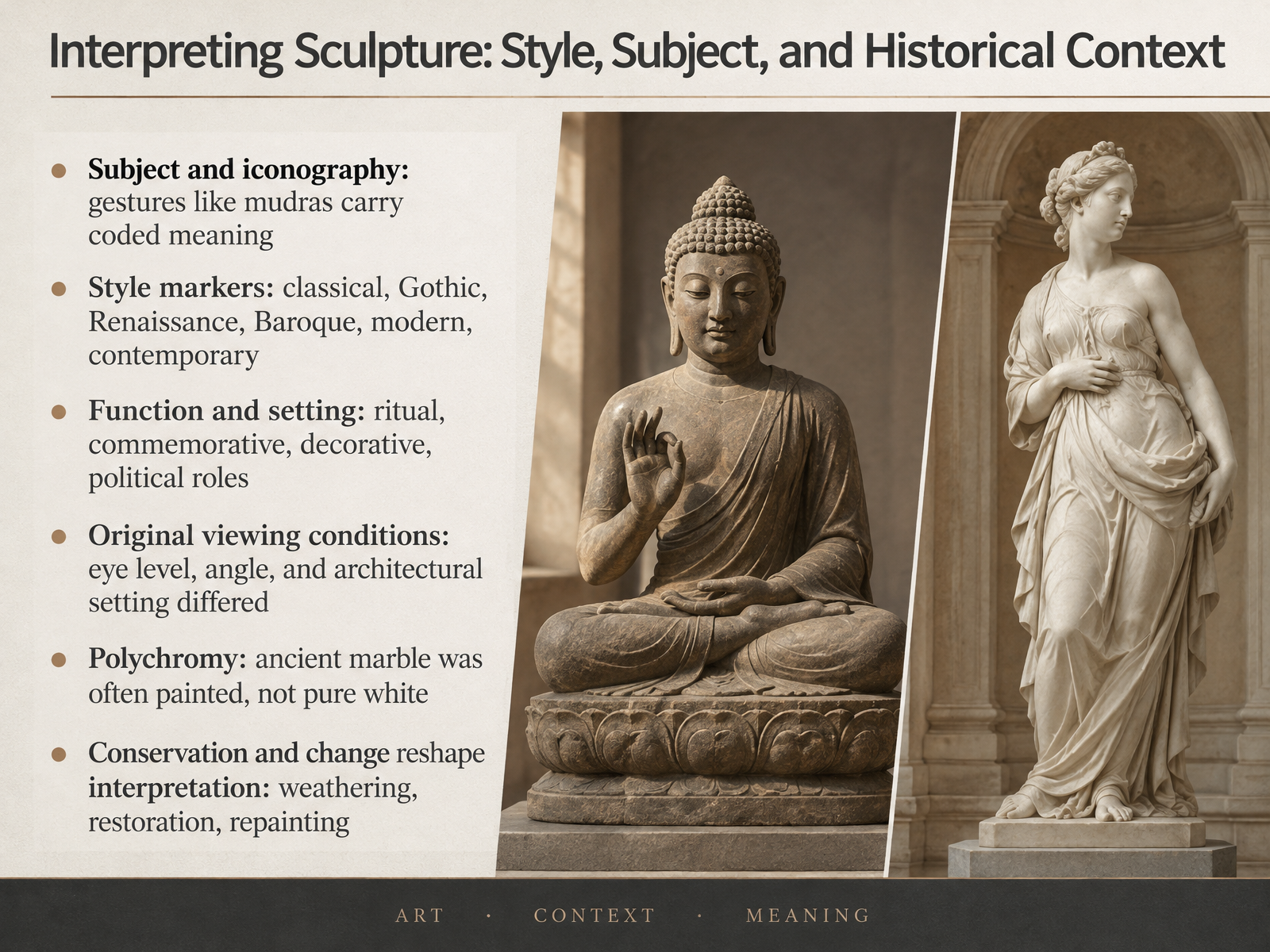
- 07Interpreting Sculpture: Style, Subject, and Historical ContextNow let's talk about how we interpret a sculpture. Start with the subject and its iconography, meaning the coded symbols and gestures. For example, in Hindu art, hand gestures called mudras communicate specific ideas. Notice the pose before you read the label. Next, consider style markers, from classical and Gothic to Renaissance, Baroque, and modern. Ask what the form itself tells you. Function and setting matter too: was a work made for ritual, commemoration, decoration, or politics? Then think about original viewing conditions. A figure once seen at eye level in a temple may now sit on a museum pedestal, changing the angle entirely. And remember polychromy. Many ancient marbles were painted, not pure white. Conservation and change reshape interpretation as well. Weathering, restoration, and later repainting all add layers of meaning. So when you look, ask what is original and what has been altered over time. Next, we'll explore why surface and color change what we see.
 sites.nasher.duke.eduartmuseum.princeton.edunew.artsmia.org+22 min
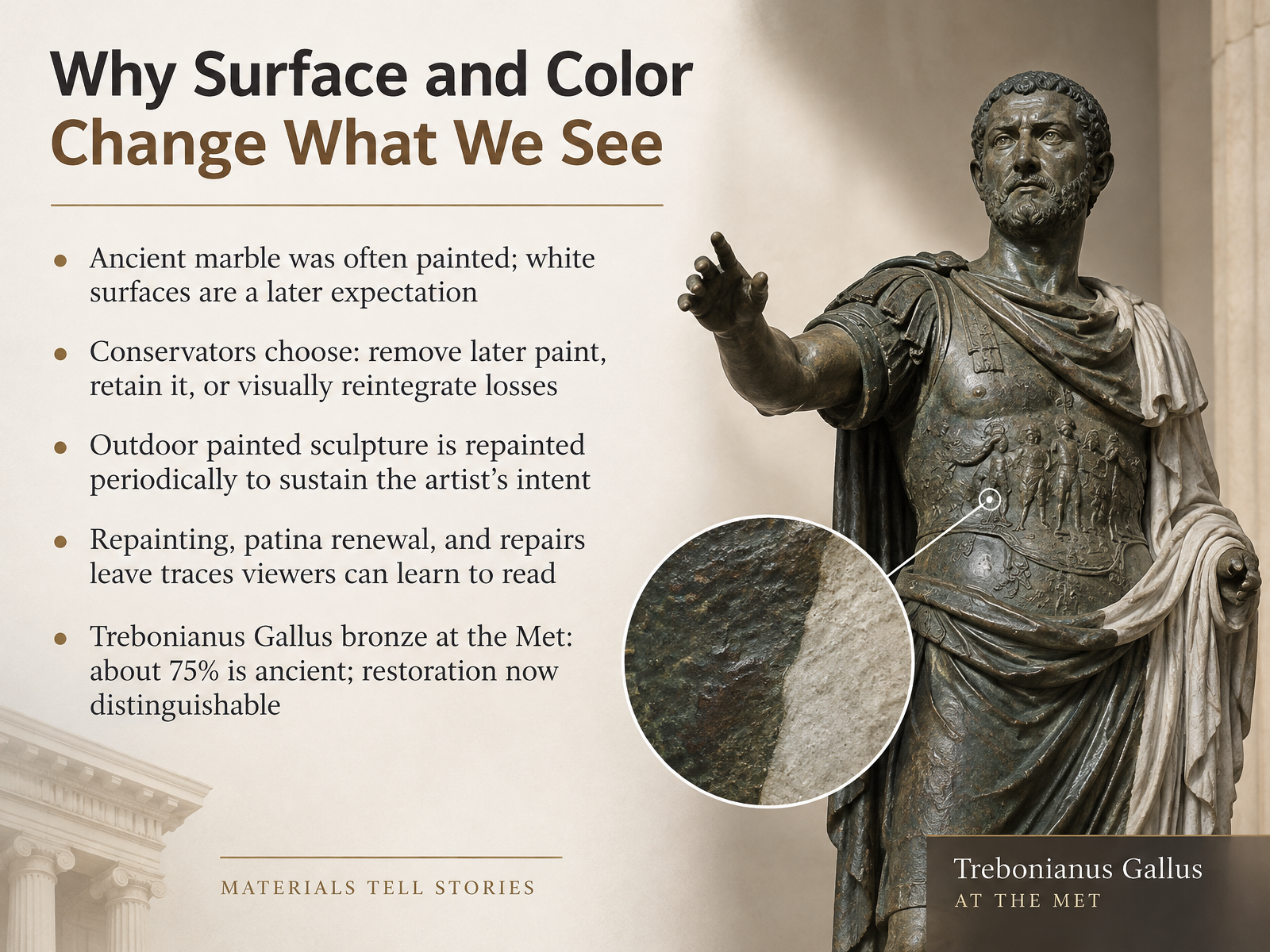
- 08Why Surface and Color Change What We SeeNow let's consider how surface and color change what we see. A common assumption is that ancient marble was pure white. In fact, much of it was originally painted, and the white surface we expect today is largely a later taste. Conservators, the specialists who care for artworks, must then choose: remove later paint, retain it, or visually reintegrate losses so the surface reads as whole. Outdoor painted sculpture is different. There, repainting is repeated periodically to sustain the artist's intent, because the original coating simply cannot last. Notice, too, that repainting, patina renewal, and repairs leave traces. With practice, viewers can learn to read them. A fine example is the bronze of the emperor Trebonianus Gallus at the Metropolitan Museum. Technical study showed that about seventy five percent of the statue is ancient, and today its restorations are distinguishable. Next, we turn to Museum Practice: Questions, Activities, and Inclusive Access.
 2 min
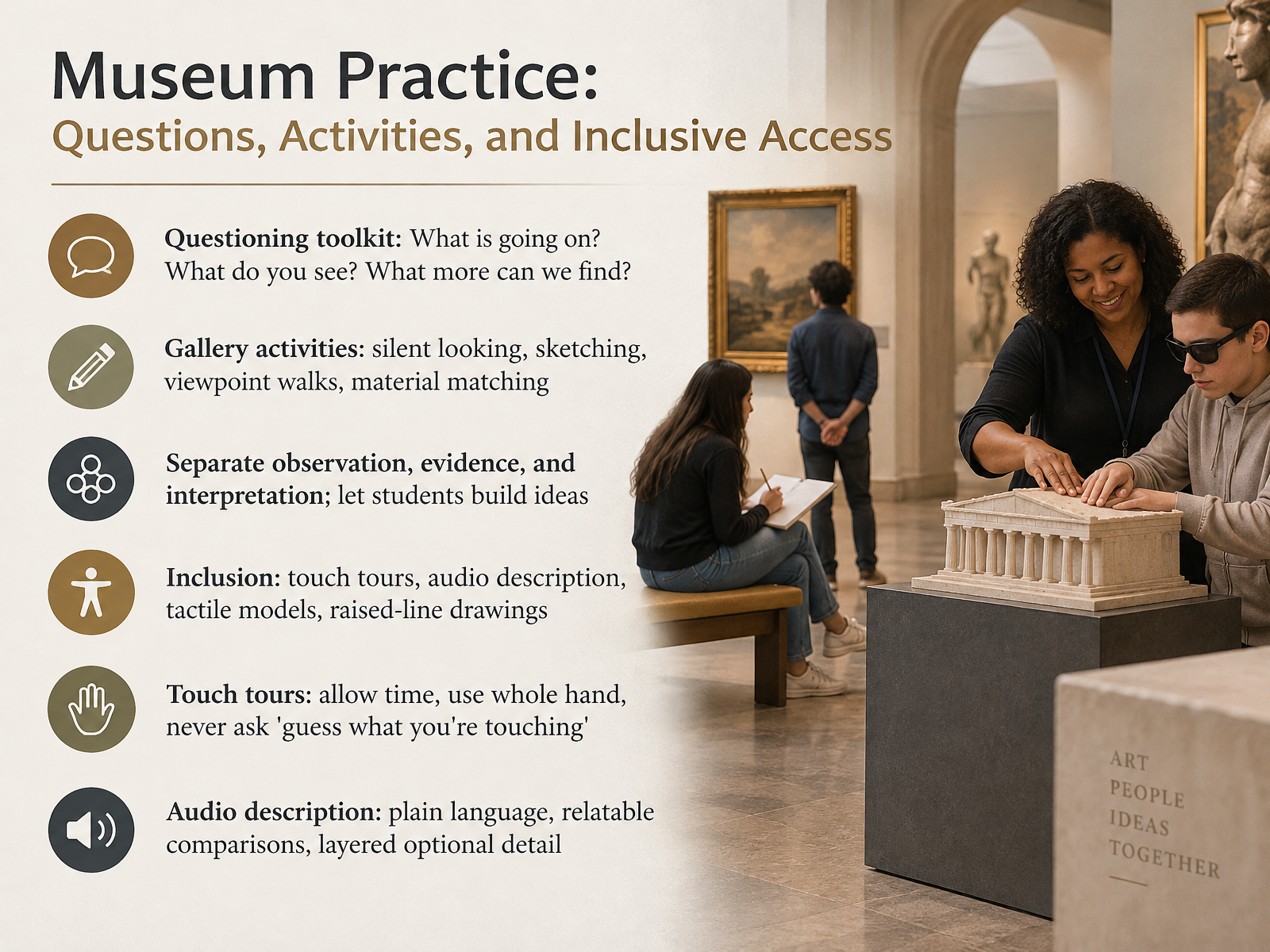
- 09Museum Practice: Questions, Activities, and Inclusive AccessNow let's turn to practice, and to the question of who gets to take part. A simple questioning toolkit can carry a whole gallery conversation. Ask, what is going on? Then, what do you see that makes you say that? And finally, what more can we find? Notice how the middle question asks for evidence. Keep observation, evidence, and interpretation distinct, and let students build the ideas themselves. Gallery activities might include silent looking, sketching, viewpoint walks, or matching materials by touch. For inclusion, offer touch tours, audio description, tactile models, and raised-line drawings. On a touch tour, allow extra time, encourage the whole hand, and never ask a visitor to guess what they are touching. Good audio description uses plain language and relatable comparisons, such as the size of a football, with extra detail layered so listeners can choose more. Next, we'll look at questioning protocols that work in the gallery.
 sites.nasher.duke.eduartmuseum.princeton.edunew.artsmia.org+22 min
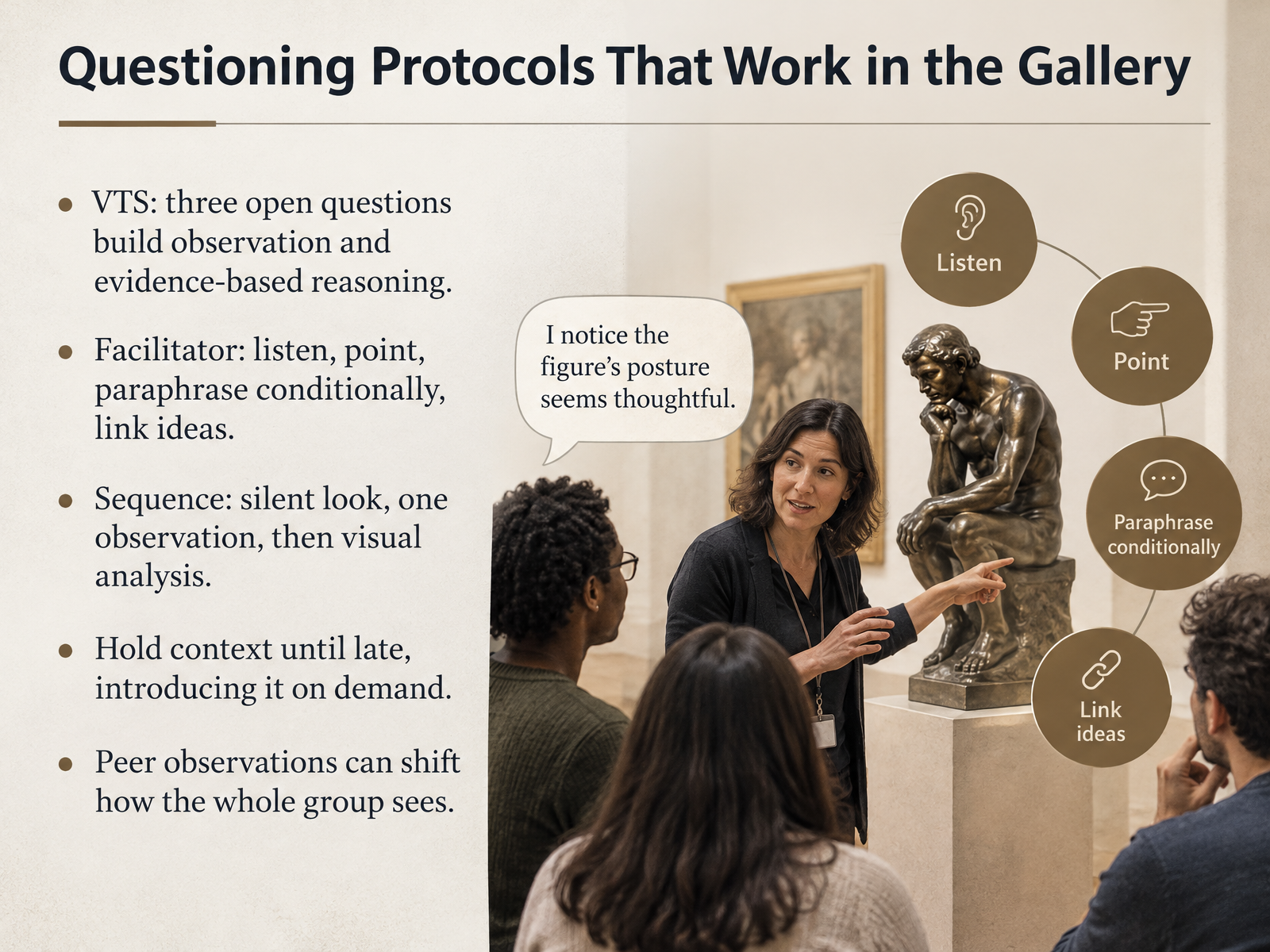
- 10Questioning Protocols That Work in the GalleryLet's look at questioning protocols that actually work in the gallery. Many educators use Visual Thinking Strategies, or V T S. It rests on three open questions. First, what is going on in this piece? Then, what do you see that makes you say that? And finally, what more can we find? That second question is the key. It asks viewers to support an interpretation with visual evidence. As facilitator, your job is to listen closely, point to what someone mentions, paraphrase each comment in conditional language, and link one idea to another. A good sequence is a silent look first, then a single observation from each person, then visual analysis of form, material, and composition. Hold the historical context until late, and bring it in on demand. And remember, one peer's observation can shift how the whole group sees the sculpture. Next, we turn to classroom and gallery connections for students and educators.
 sites.nasher.duke.eduartmuseum.princeton.edunew.artsmia.org+22 min
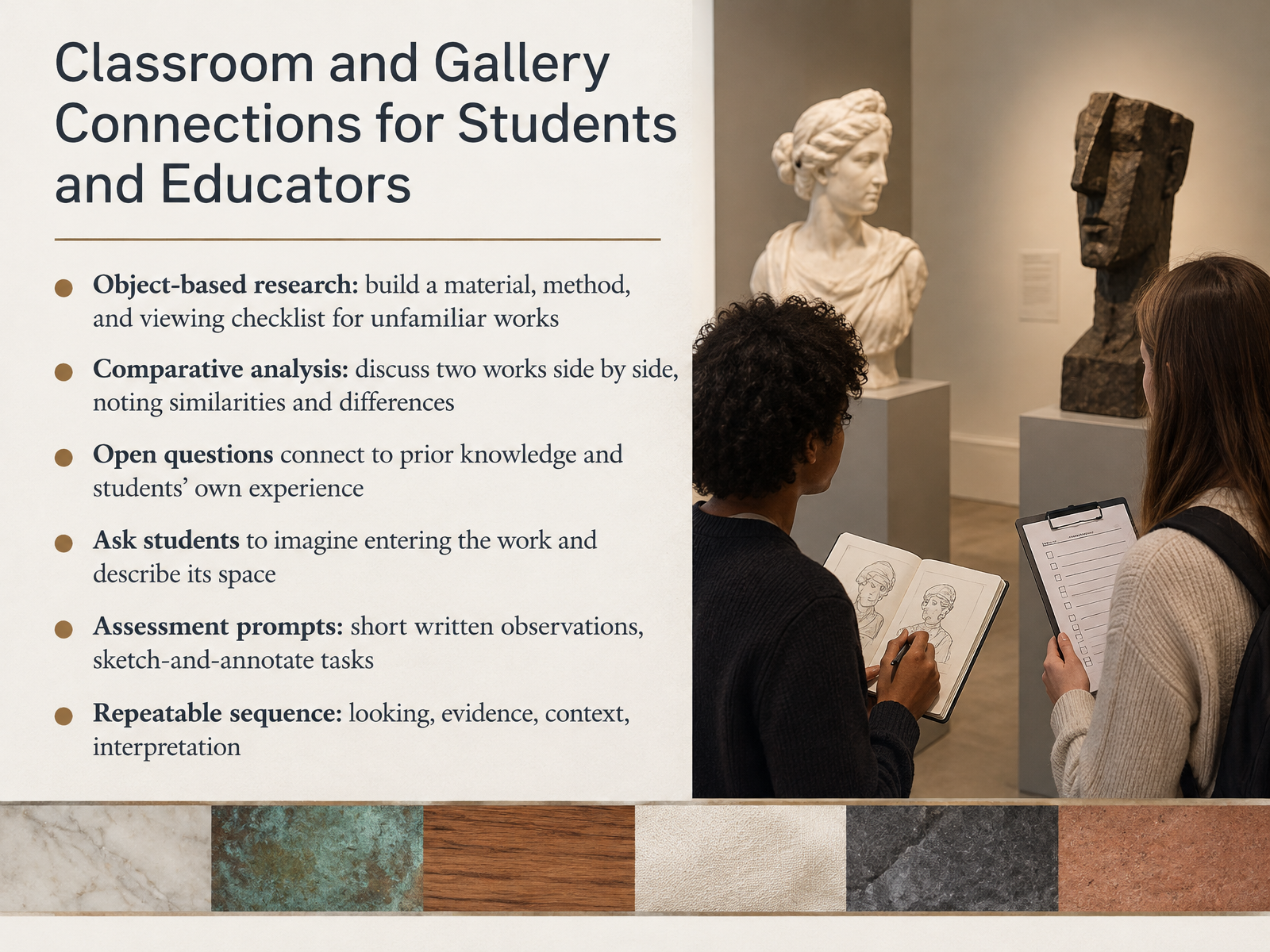
- 11Classroom and Gallery Connections for Students and EducatorsLet's turn now to how all of this carries into the classroom and the gallery. A simple, repeatable sequence keeps lessons grounded. Looking, then evidence, then context, then interpretation. For unfamiliar works, invite students to build a checklist of material, method, and viewing questions they can ask again and again. Comparative analysis works beautifully for sculpture. Place two works side by side and ask, what is similar, and what is different? Open questions should connect to prior knowledge and to students' own experience. And try this: ask students to imagine entering the work and describe its space. A few minutes of silent looking, followed by open questions like what is going on, what do you see that makes you say that, and what more can we find, builds observation and evidence. For assessment, keep it light and observational. Short written observations, or a sketch with brief annotations, reveal what students actually noticed. Next, we will bring all of this together by analyzing an unfamiliar sculpture step by step.
 sites.nasher.duke.eduartmuseum.princeton.edunew.artsmia.org+22 min
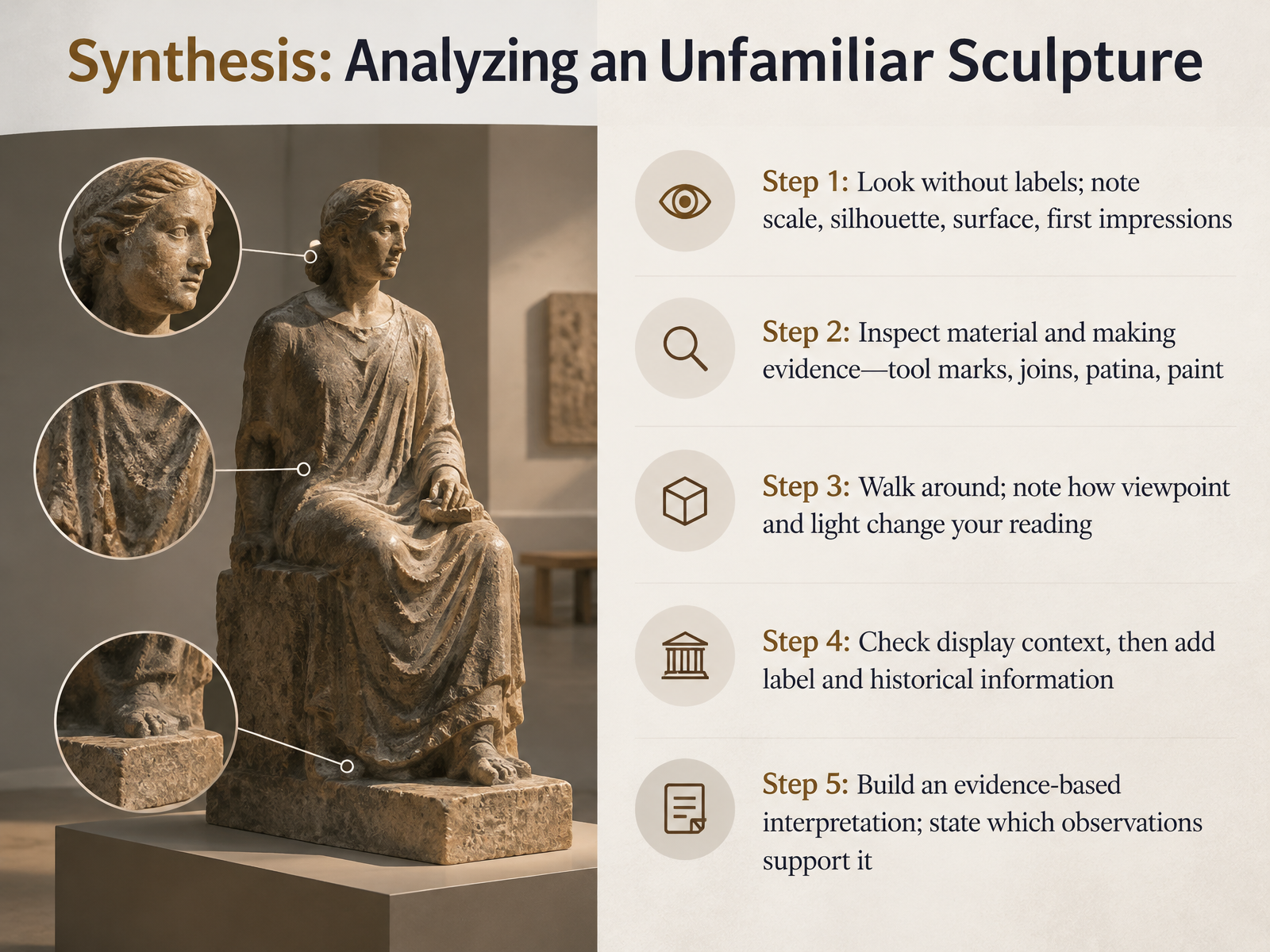
- 12Synthesis: Analyzing an Unfamiliar SculptureNow let's pull everything together into a practical method you can carry into any gallery. When you meet an unfamiliar sculpture, begin with looking, before any labels. Notice its scale, its silhouette, its surface, and your own first impressions. Next, inspect the evidence of material and making. Look for tool marks, joins, patina, and traces of paint. Then walk around the work. Notice how your viewpoint and the light change what you see. Only then check the display context, and finally add the label and historical information. The last step is interpretation. Build your reading from the observations you have gathered, and say clearly which details support it. That habit turns looking into real understanding. Next, we'll compare two works made by different methods.
 sites.nasher.duke.eduartmuseum.princeton.edunew.artsmia.org+21 min
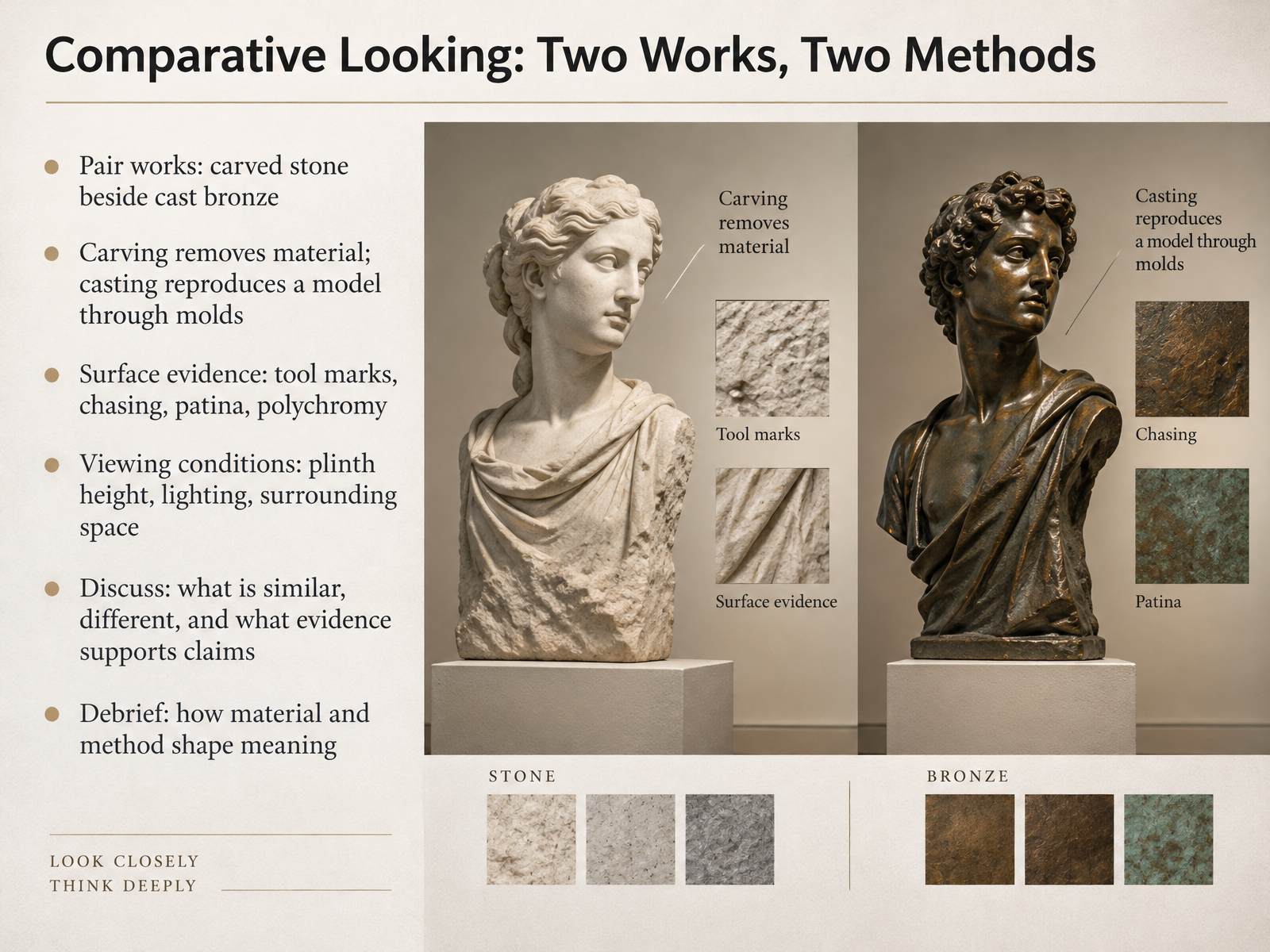
- 13Comparative Looking: Two Works, Two MethodsLet's put two sculptures side by side and compare what we see. On one side, a work carved from stone. On the other, a bronze made by casting. Carving is subtractive. The sculptor removes material, cutting away until the figure emerges, and that cut can never be put back. Casting works differently. The artist builds a model, and a foundry reproduces it through molds, often using the lost-wax method, in which molten bronze fills the space once occupied by wax. Now look at the surfaces. On stone, you may find chisel and tool marks. On bronze, look for chasing, the hand finishing that removes seams, and for patina, the colored surface layer that protects the metal. Either material may once have been painted, a trace called polychromy. And notice the viewing conditions too. Plinth height, lighting, and surrounding space all shape how the work meets you. As you discuss, ask what is similar, what is different, and what visible evidence supports each claim. That last question matters most, because material and method quietly shape meaning. Next, we'll gather takeaways for visitors, students, and educators.
 sites.nasher.duke.eduartmuseum.princeton.edunew.artsmia.org+22 min
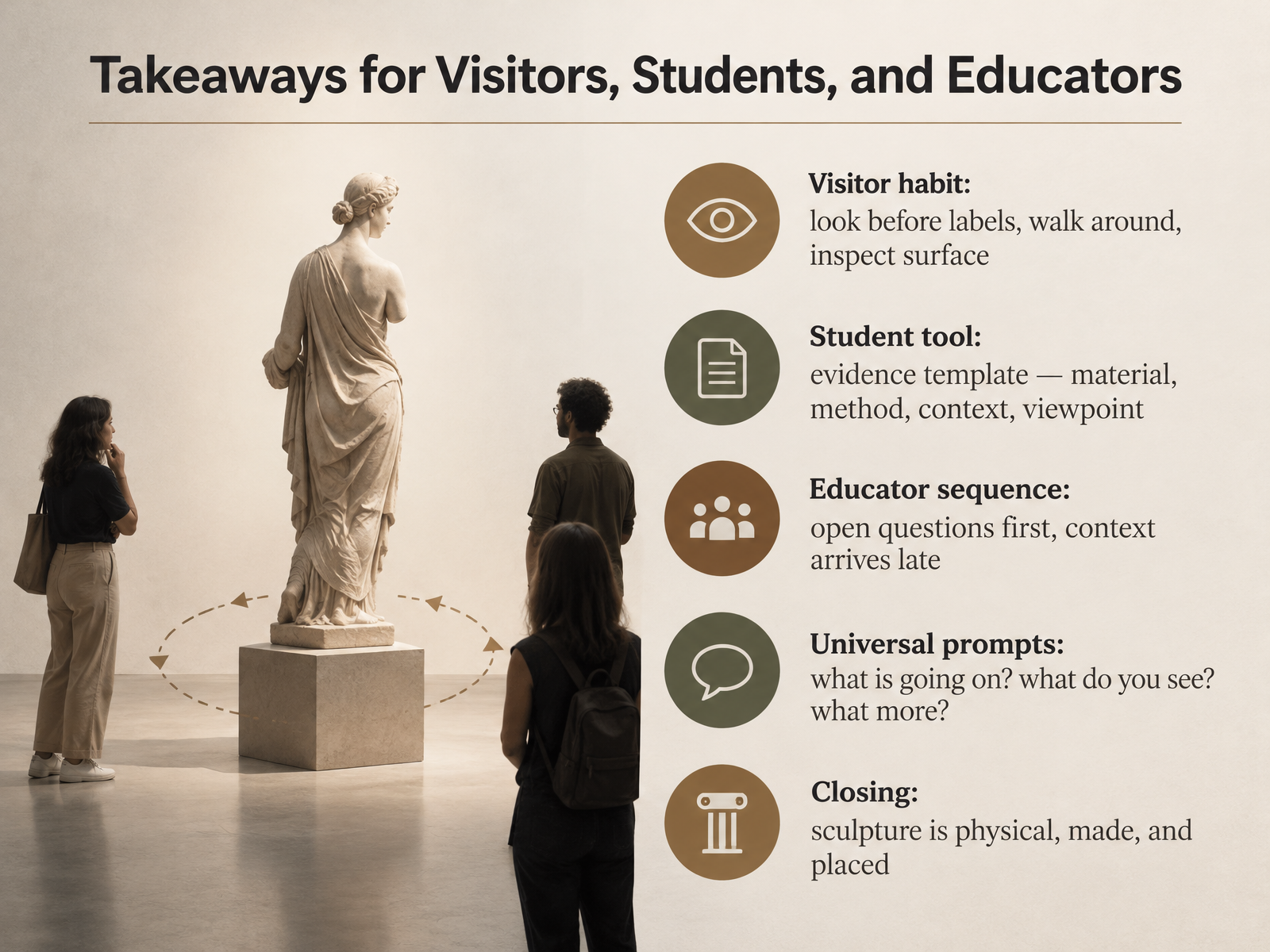
- 14Takeaways for Visitors, Students, and EducatorsLet's bring everything together with a few practical takeaways. For visitors, build one simple habit. Look before you read the label. Then walk around the sculpture, and inspect its surface up close. For students, use an evidence template. Note the material, the method, the context, and your own viewpoint. Four prompts, and every claim needs support. For educators, open with questions first, and let context arrive late. A sequence like what is going on, what do you see, and what more, gives learners permission to be puzzled and to reason for themselves. Underneath all of this is one idea worth carrying home. Sculpture is physical, it is made, and it is placed. Thank you for joining me. Keep looking closely, and trust what your eyes can teach you.
 sites.nasher.duke.eduartmuseum.princeton.edunew.artsmia.org+21 min
Take the deck with you
Download this course as a file — free, no sign-up needed.
- PDF handoutEvery slide page, ready to print or share.15 pages · 4.4 MBDownload
- Narrated PowerPointThe deck that presents itself — every slide carries the digital human's narration video.15 pages · 14.5 MBDownload
- PowerPoint slidesThe full deck as a .pptx — open it in PowerPoint, Keynote, or Google Slides.15 pages · 4.3 MBDownload
Free to use in your own training — please keep the PersonWise credit page at the end.
Have your own deck? Turn it into a course
Sources consulted
Web sources consulted while building this course.
- How Do You Look » Sculpture — sites.nasher.duke.edu
- Formal Analysis Questions: Sculpture — artmuseum.princeton.edu
- Learning from Looking –– Minneapolis Institute of Art — new.artsmia.org
- 3. Observation: What is happening in the work? Did hearing others’ observations change the way you saw the subject? How? — stanleymuseum.uiowa.edu
- Visual Thinking Strategies | Daum Museum of Contemporary Art — daummuseum.org
- Material Matters: The Conservation of Modern Sculpture — doi.org
- Sculpture Conservation Studio - Muzeum Narodowe w Krakowie — mnk.pl
- Contemporary Sculpture Conservation: Materials and Issues — arthist.net
- Advanced Materials in Cultural Heritage Conservation — pmc.ncbi.nlm.nih.gov
- Conserving OutdoorPainted Sculpture: Proceedings from the interim meeting of the Modern Materials and ContemporaryArt Working Group of ICOM-CC, Kröller-Müller Museum, Otterlo,The Netherlands, June 4–5, 2013 — nacca.eu
- Step III: Bronze Casting | Oklahoma City Museum of Art | OKCMOA — okcmoa.com
- Lost-wax bronze casting — musee-rodin.fr
- How was it made? Lost-wax bronze casting | V&A — youtube.com
- Rodin’s Lost-Wax Casting Process – NCMALearn — learn.ncartmuseum.org
- Lost Wax Casting Process — nashersculpturecenter.org
- Between Art Historical Representation and Didactic Functionality: The Cast Collection of the Royal Academy of Fine Arts of Antwerp — doi.org
- The Multifaceted Role of Plaster Casts in Contemporary Museums — escholarship.org
- Collect, draw and study. The use and benefit of large and small plaster replicas in the Allard Pierson Museum - Persée — persee.fr
- Plaster Casts, Augmented. Architecture in the Museum and the Impact of Digital Media — doi.org
- Once at Mia: The lost world of plaster casts –– Minneapolis Institute of Art — new.artsmia.org