Reading Primary Sources
Begin
14 pages · ~28 min
Reading Primary Sources
Learn to analyze primary sources by identifying author, purpose, and historical context.
What you’ll learn
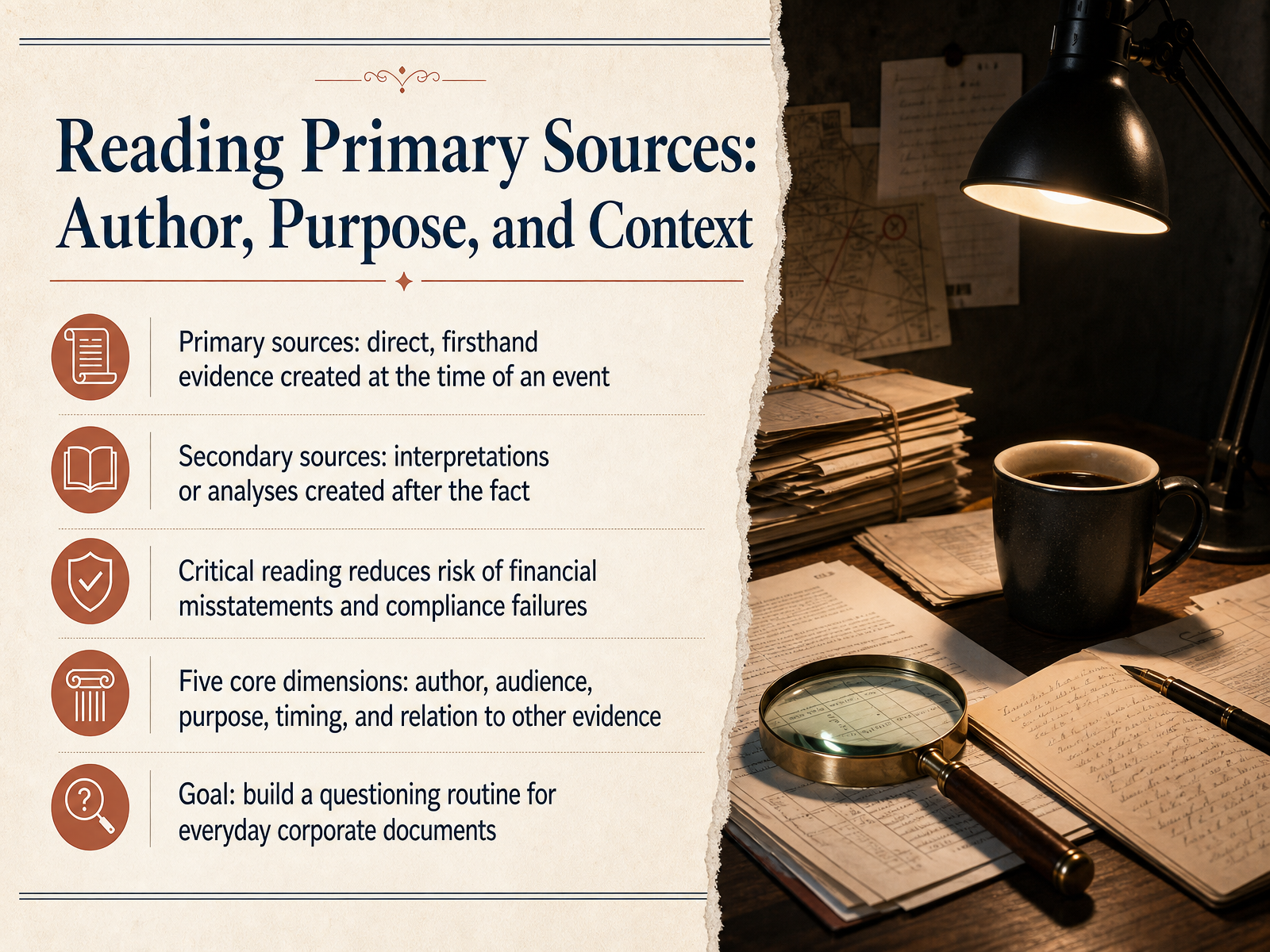
- 01Reading Primary Sources: Author, Purpose, and ContextWelcome. In this course we will build a questioning routine for reading primary sources, the foundation for accurate corporate reporting and compliance. Let us start by clarifying what primary sources are. They are direct, firsthand evidence created at the time of an event. Emails, internal memos, meeting minutes, quarterly financial data, or signed contracts are all examples. Secondary sources, by contrast, are interpretations or analyses created after the fact, like an industry report or a news summary. Why does this distinction matter? Relying on secondary descriptions without checking the original document can lead to financial misstatements or compliance failures. Our goal is to prevent those risks by equipping you to cut through secondhand opinions and examine original evidence with precision. To do that, we will investigate five dimensions every time: the author, the audience, the purpose, the timing, and how a document relates to other evidence. Let's begin by sharpening how we separate primary from secondary sources.libguides.lmu.eduguides.franklin.edulinnbenton.libguides.com+22 min
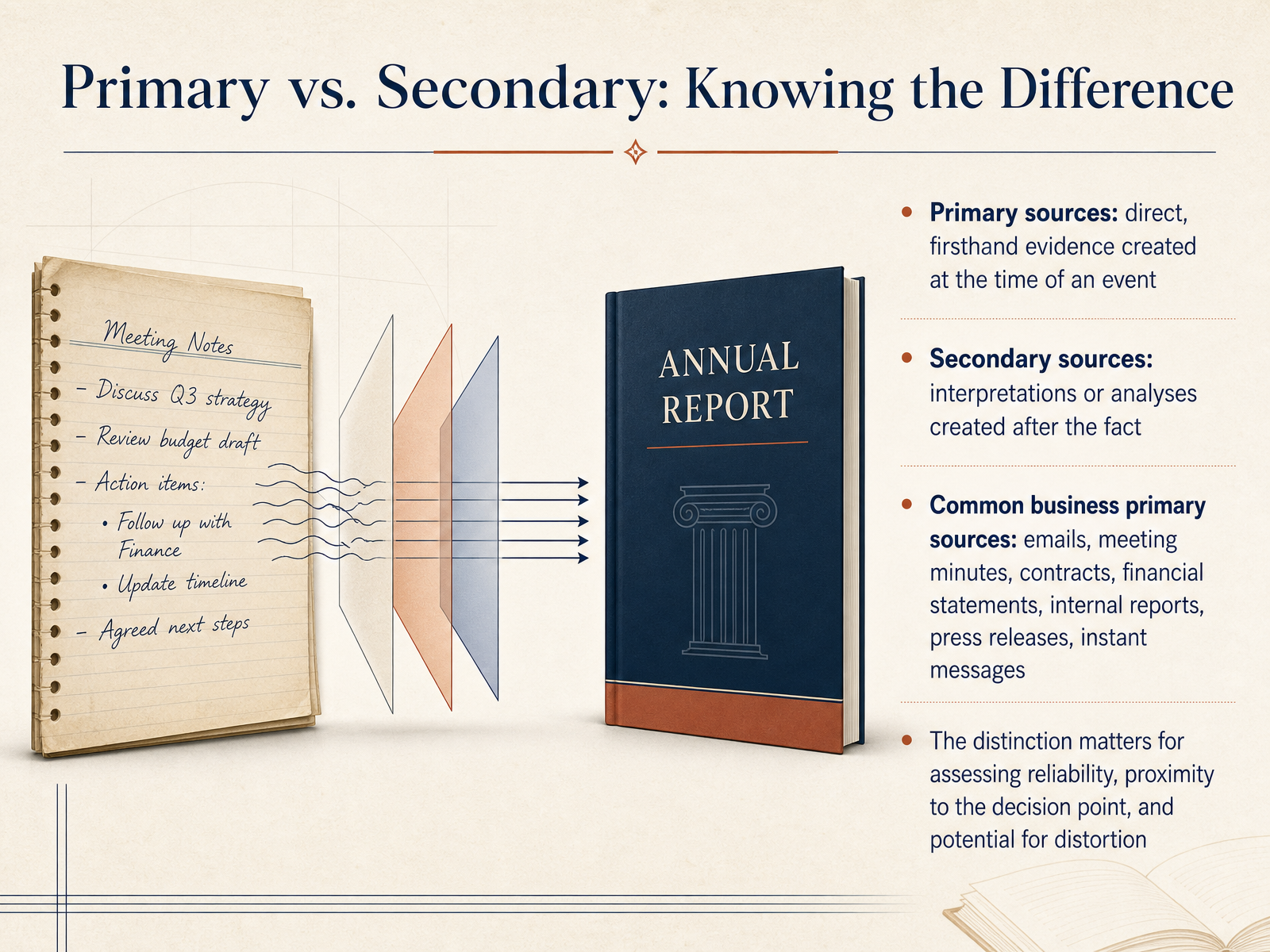
- 02Primary vs. Secondary: Knowing the DifferenceLet's start by drawing a clear line between primary and secondary sources, because knowing the difference is the foundation of everything that follows. A primary source is direct, firsthand evidence. It was created at the time of an event by someone with direct involvement. Think of the email you send to confirm a decision, the minutes taken during a meeting, or a signed contract. Other common business examples include financial statements, internal reports, press releases, and even instant messages. In contrast, a secondary source is an interpretation or analysis created after the fact. It comments on, summarizes, or draws conclusions from primary evidence. This distinction matters because it directly impacts reliability. A primary source puts you closer to the decision point, reducing the risk of distortion that can creep in when someone later retells the story. As you move forward, ask yourself: is this the original evidence, or is this someone else's analysis of that evidence? Up next, we'll explore why this critical reading skill has such a tangible payoff in the corporate world.
 docs.lib.purdue.edudocs.lib.purdue.edudoi.org+22 min
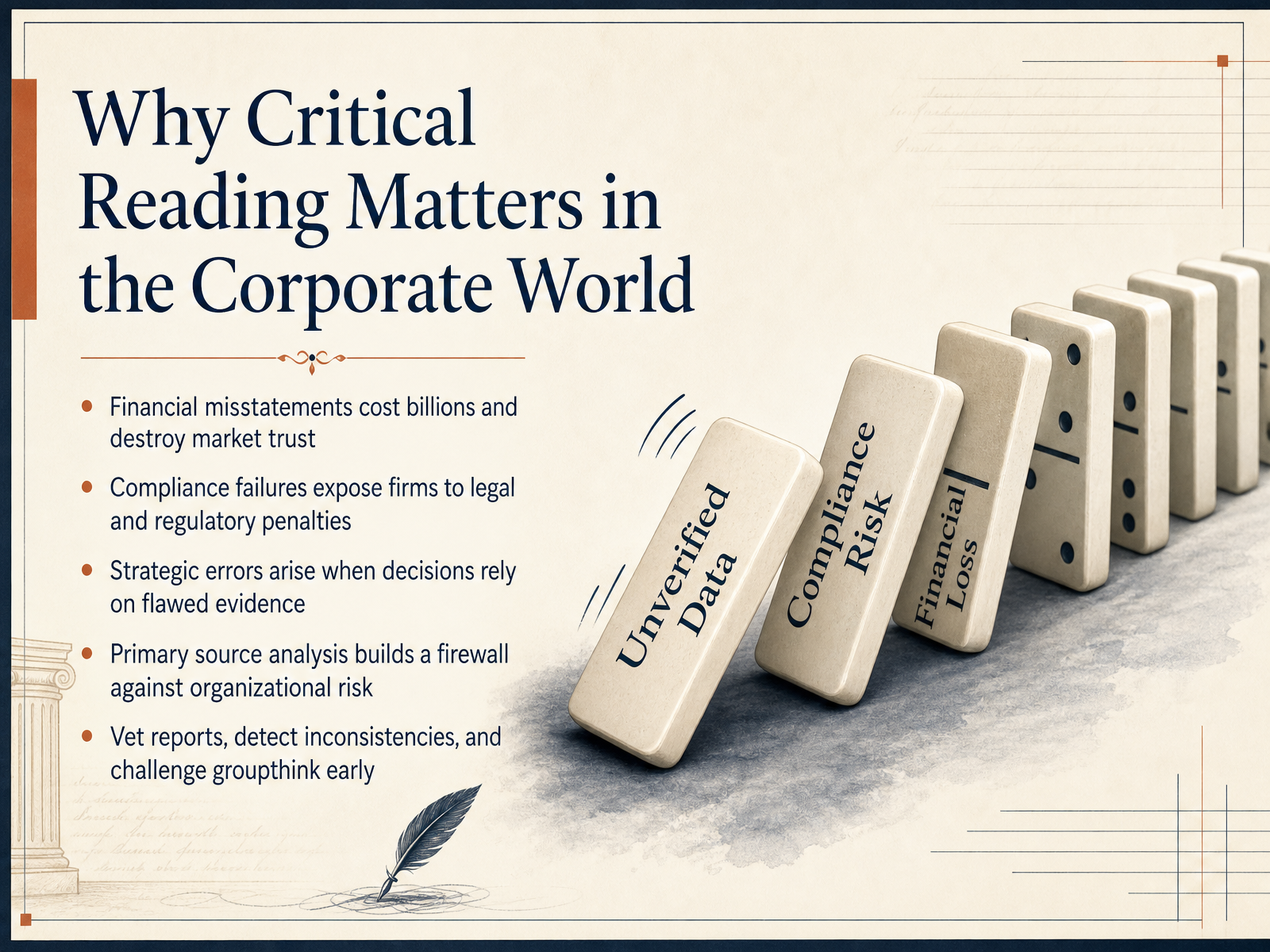
 - 03Why Critical Reading Matters in the Corporate WorldNow we turn to why these skills are so critical in the corporate world. Financial misstatements have cost organizations billions of dollars and destroyed market trust overnight. Compliance failures expose firms to serious legal and regulatory penalties. And strategic errors often happen when decisions rely on flawed or unchecked evidence. Think of primary source analysis as building a firewall against these organizational risks. When you vet reports carefully, detect inconsistencies in the data, and challenge groupthink early, you protect your team from making costly mistakes. Every document that crosses your desk carries an author, a purpose, and a context. Your job is to read critically before you act. Let's start with the first dimension: identifying the author.
 libguides.lmu.eduguides.franklin.edulinnbenton.libguides.com+21 min
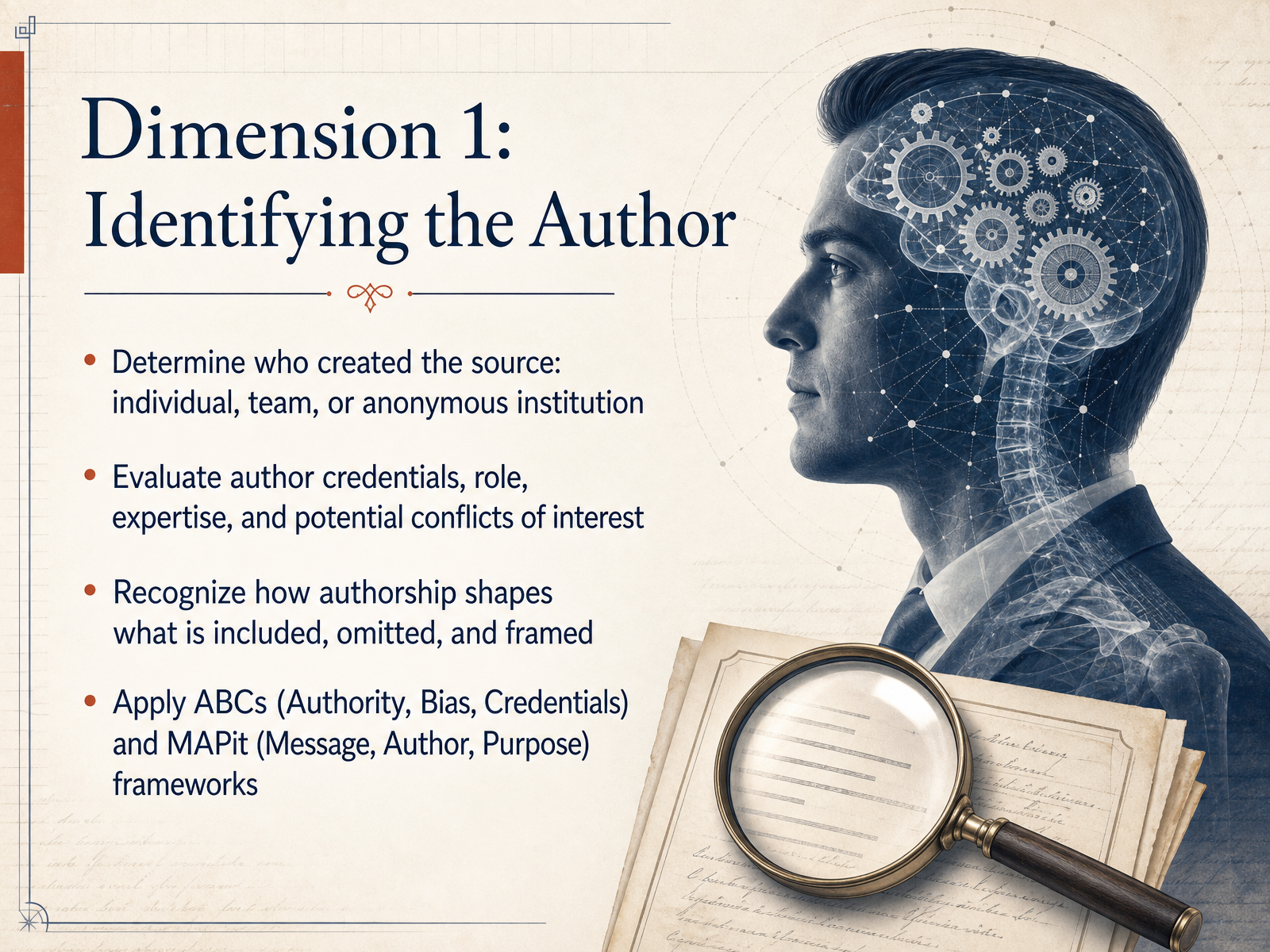
 - 04Dimension 1: Identifying the AuthorNow we turn to our first dimension, identifying the author. Start with a simple question: who actually created this source? Was it a specific individual, a collaborative team, or an anonymous institution? The answer matters. Once you have a name or an organization, evaluate their credentials. What is their role, their area of expertise, and do they have any potential conflicts of interest? For example, a financial report drafted by a company insider carries different weight than an independent audit. Authorship directly shapes what information is included, what is omitted, and how the evidence is framed. We can apply two practical frameworks here. The ABCs remind us to check Authority, Bias, and Credentials. The MAPit approach prompts us to look at the Message, the Author, and the Purpose. Both tools help you move past the surface and judge how the creator’s position influences the entire document. Next, we will build on this by spotting author bias and perspective.
 libguides.lmu.eduguides.franklin.edulinnbenton.libguides.com+22 min
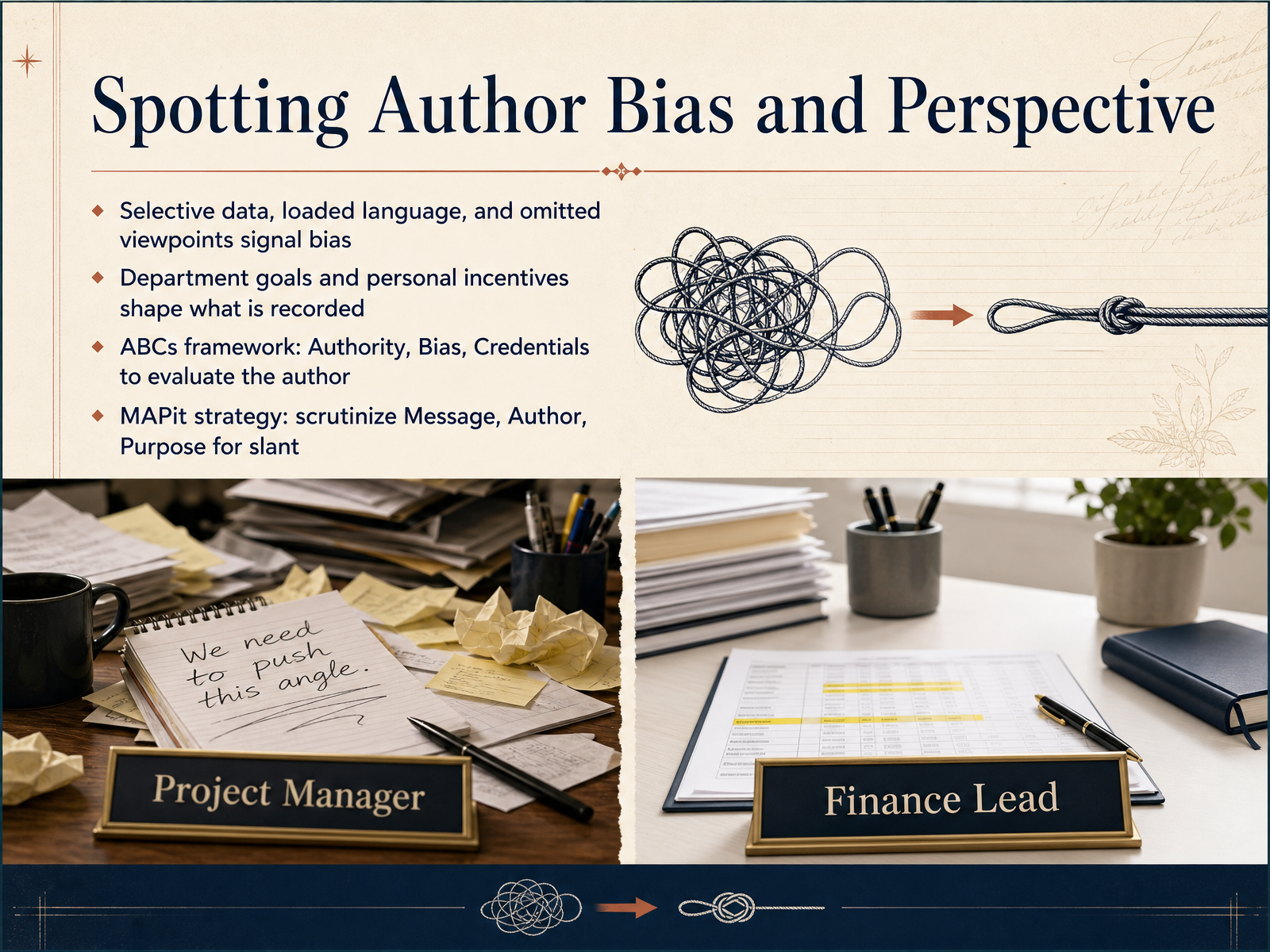
 - 05Spotting Author Bias and PerspectiveLet's turn now to spotting author bias and perspective within a source. Even in business documents, no author is perfectly neutral. We look for signals like selective data, where only favorable statistics are highlighted, or loaded language that carries an emotional charge. Also, ask yourself what viewpoints might have been omitted entirely. Often, a department's goals or personal incentives shape what gets recorded in the first place. To systematically evaluate the author, we can use the ABCs framework. ABCs stands for Authority, Bias, and Credentials. For authority, check the author's relevant experience and education. For bias, examine whether the language is objective or purely persuasive. For credentials, consider their institutional affiliation and the publication's reputation. Another tool is the MAPit strategy, which prompts you to scrutinize the Message, the Author, and the Purpose for potential slant. For instance, if a report from a trade association uses one-sided, unverified claims, that purpose tells you something about its reliability. These methods help you move from simple detection to a structured evaluation of any source's perspective. Next, we'll apply a similar level of scrutiny to Dimension 2: Understanding Audience and Purpose.
 libguides.lmu.eduguides.franklin.edulinnbenton.libguides.com+22 min
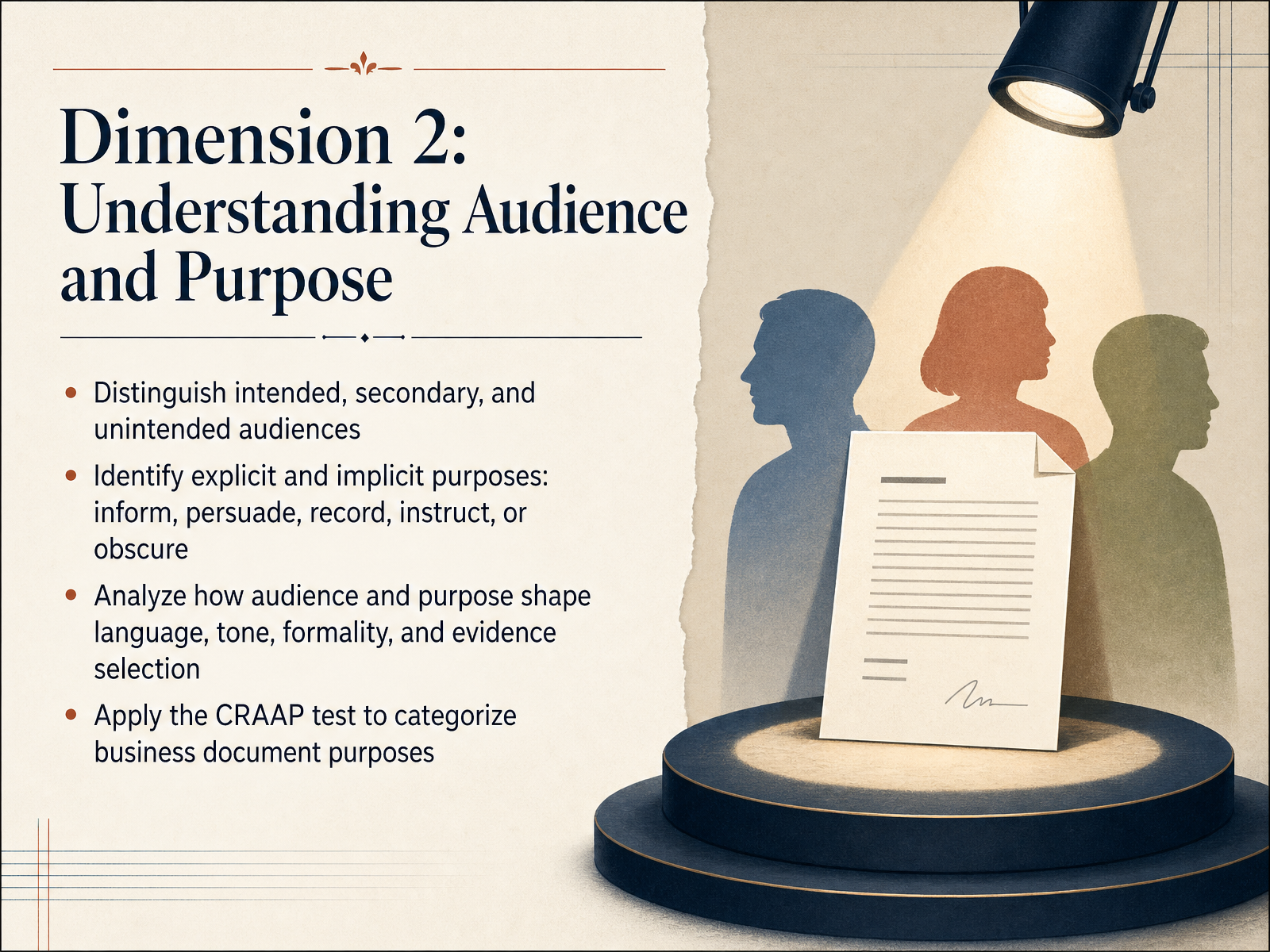
 - 06Dimension 2: Understanding Audience and PurposeNow, let's move from the author's identity to the document's direction by examining audience and purpose. Understanding audience means distinguishing three groups. First, the intended audience—the people the author directly wants to reach, like a board of directors. Second, secondary audiences who may read it later, such as regulators or journalists. Third, unintended audiences who might discover the document without the author's knowledge. This shapes everything. Next, we identify purpose by looking for explicit statements, as well as implicit goals. A document might officially inform, but its real aim could be to persuade investors, record a meeting for legal protection, instruct employees, or even obscure uncomfortable facts. Ask yourself: why was this really written? Audience and purpose directly shape language. A document for experts uses technical terms; one for the public simplifies. Tone can be formal or urgent, and evidence is selected to support a specific goal. We can apply the CRAAP test to categorize these purposes. In CRAAP, 'P' stands for Purpose. Ask whether the information is meant to inform, persuade, sell, or entertain, and check if the author's motive is clear. This step turns your reading from passive absorption into active investigation. Up next, we will see audience and purpose in action through a worked example.
 libguides.lmu.eduguides.franklin.edulinnbenton.libguides.com+22 min
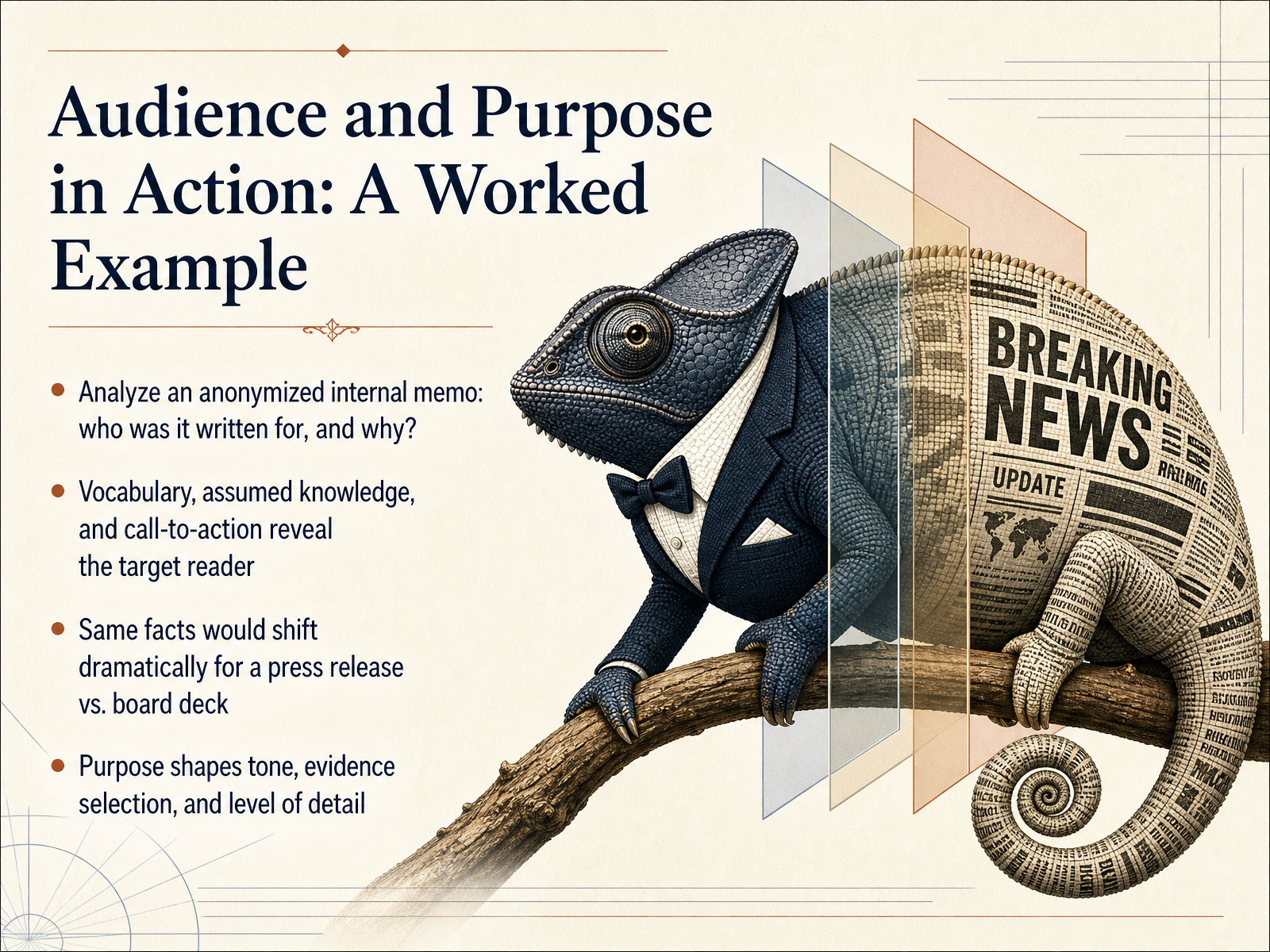
 - 07Audience and Purpose in Action: A Worked ExampleNow, let's put these concepts into practice with a worked example. Imagine you have an anonymized internal memo. Your first question is: who was it written for, and why? Look closely at the vocabulary. Is it full of technical jargon that only a department head would understand? Also, consider the assumed knowledge. The author doesn't define basic terms, which tells you exactly who they expected the reader to be. The call to action is the loudest signal of purpose. A direct request for a budget decision reveals a completely different purpose than a general company announcement. Now, take that same set of facts. How would they shift if the format changed to a press release or a board deck? The purpose of the document directly shapes the tone, the evidence selected, and the level of detail. A board deck distills complexity for a strategic decision, while a press release builds public trust. By examining vocabulary, audience cues, and the call to action, you can trace the document's entire intent. Next, we'll explore the third dimension of context by placing the source in time.
 libguides.lmu.eduguides.franklin.edulinnbenton.libguides.com+22 min
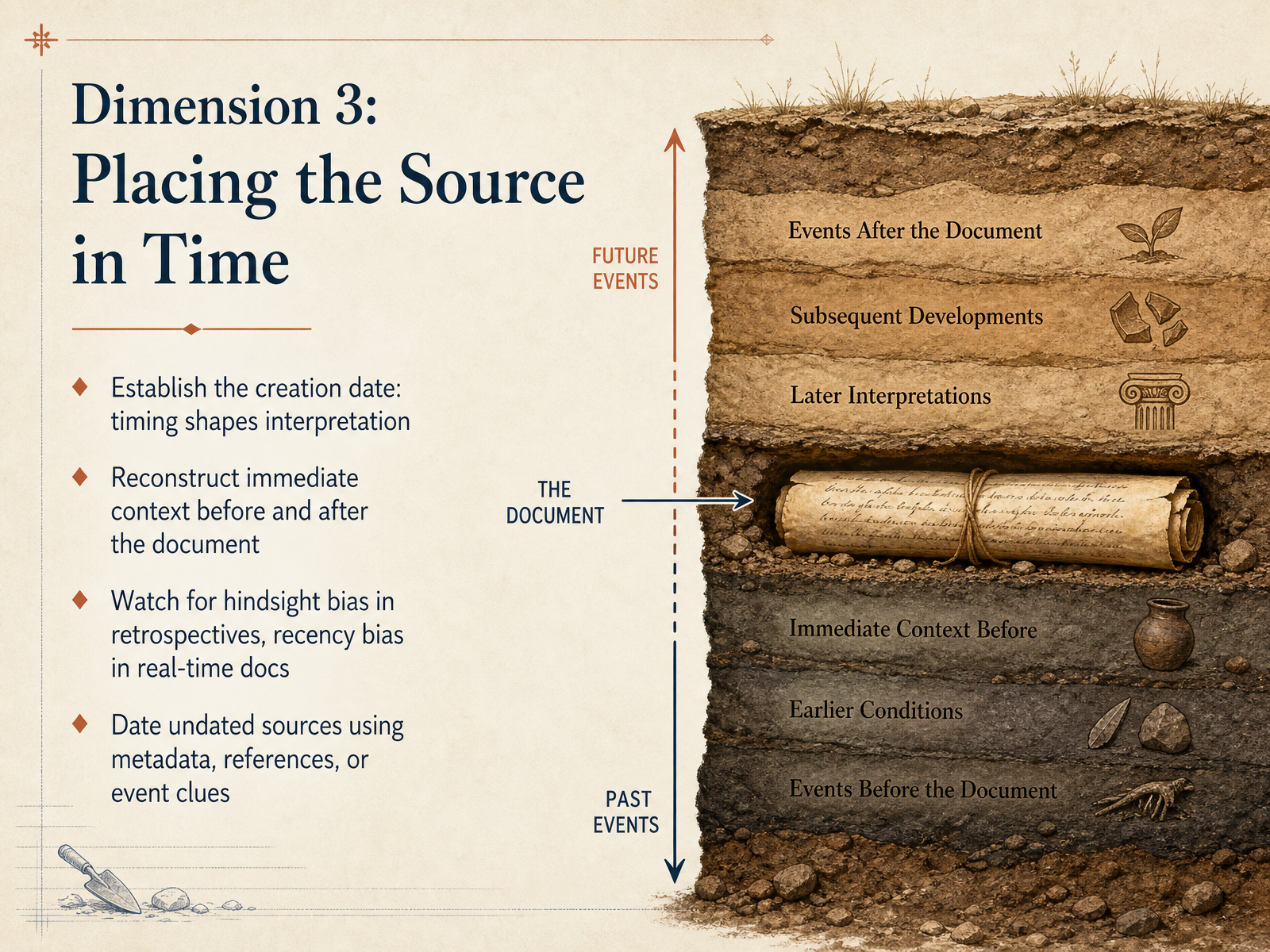
 - 08Dimension 3: Placing the Source in TimeNow, let’s add the third dimension: placing the source in time. Establishing the creation date is critical because timing shapes interpretation. A memo written during a market crash will read very differently from one written a year later. To use a source effectively, you need to reconstruct the immediate context. Ask yourself: What happened just before this document was created? And what happened right after? This helps you see if the author was reacting to an unfolding crisis or a predictable quarterly result. We also have to watch for temporal traps. For retrospectives, like annual reports, look for hindsight bias, where the author frames past events as more predictable than they were. For real-time documents, like board meeting minutes, watch for recency bias, where the latest events are given too much weight. Finally, what if a source is undated? Don’t give up. Investigate the metadata, look for internal references to specific events, or use format clues to date it. Let’s continue to the next slide: Temporal Traps and How to Avoid Them.
 libguides.lmu.eduguides.franklin.edulinnbenton.libguides.com+22 min
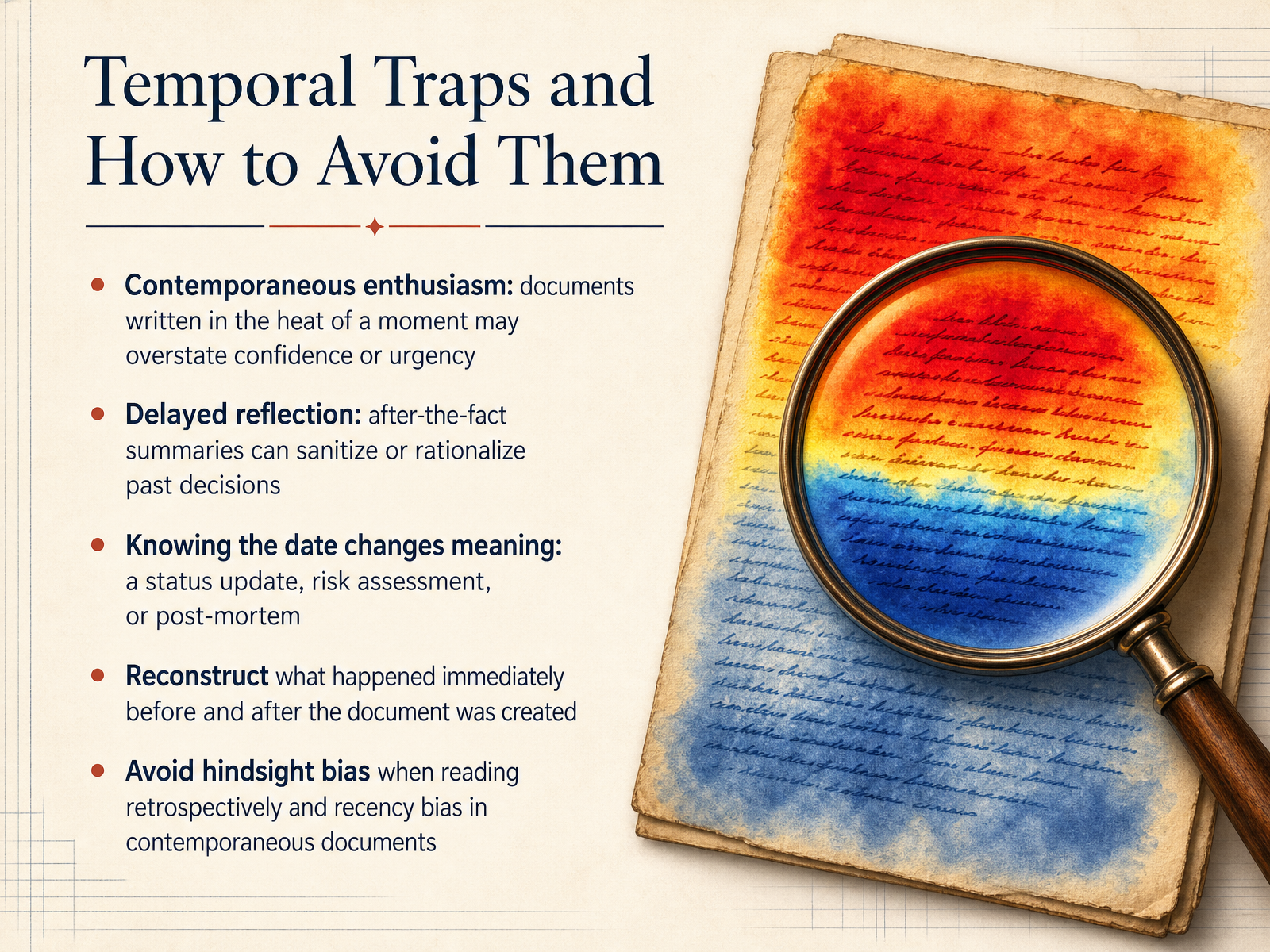
 - 09Temporal Traps and How to Avoid ThemNow, let's look at how timing can affect a document's meaning. We call these temporal traps. First, consider contemporaneous enthusiasm. A status report written in the heat of a project launch may overstate confidence. It's a snapshot of a specific moment, not a final verdict. Second, delayed reflection works the opposite way. A post-mortem summary, written later, might sanitize or rationalize what really happened. Knowing the date is key to understanding if you are reading a risk assessment, a real-time update, or an after-the-fact justification. To avoid these traps, reconstruct the immediate context. Ask yourself, what happened right before and after this document was created. Also, actively guard against hindsight bias when reading old documents, and recency bias when reading new ones. Let's carry this contextual thinking forward as we connect sources to other evidence in our next dimension.
 libguides.lmu.eduguides.franklin.edulinnbenton.libguides.com+21 min
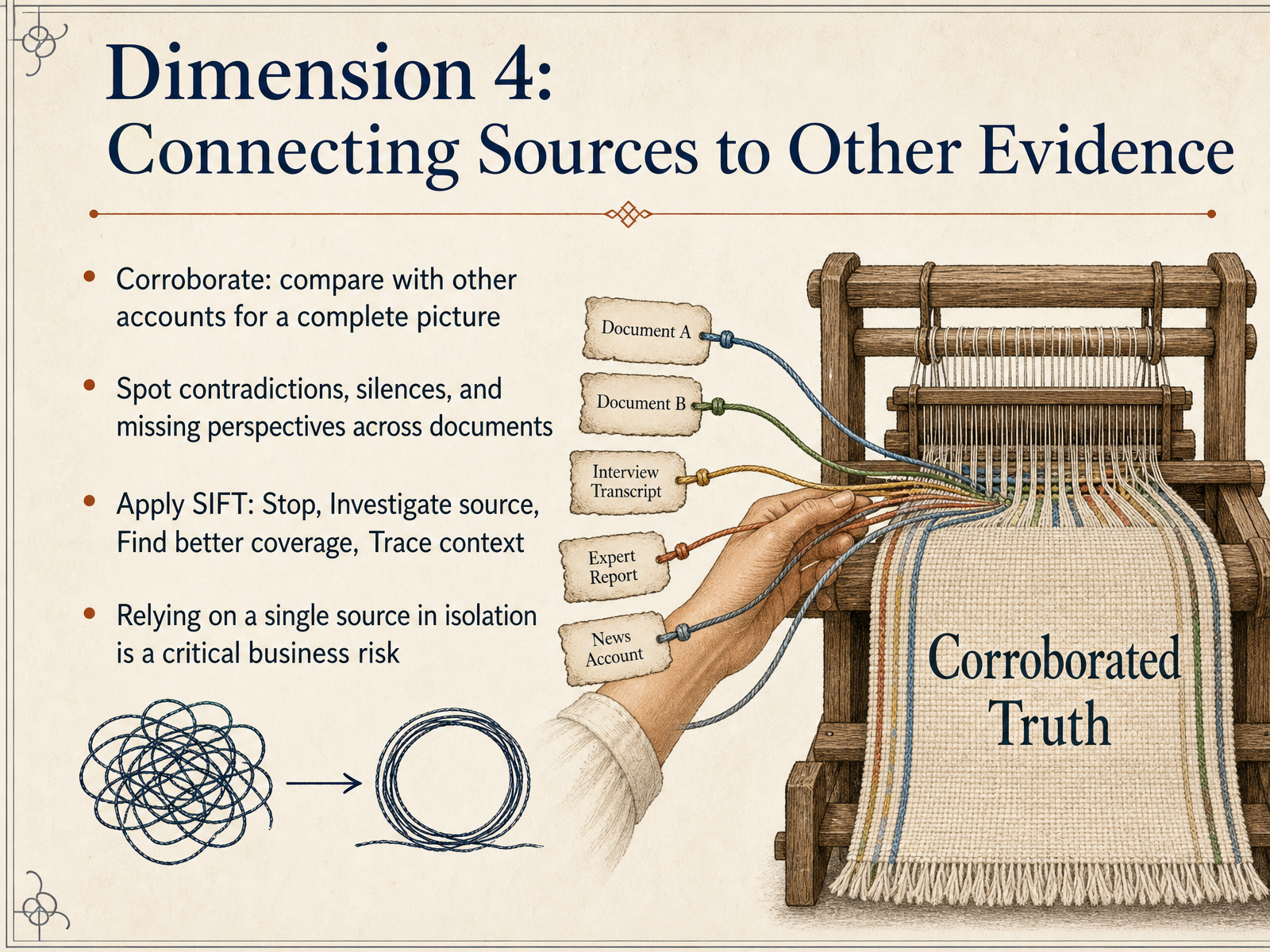
 - 10Dimension 4: Connecting Sources to Other EvidenceNow we turn to the fourth and final dimension: connecting sources to other evidence. A single document, no matter how credible it seems, can never give you the complete picture. To uncover that, you must corroborate. This means actively comparing the account in front of you against other reports, data, and perspectives. As you do this, be a deliberate detective. Look for contradictions, significant silences, and whose voice is missing from the narrative. A practical tool for this is the SIFT method. That stands for Stop, Investigate the source, Find better coverage, and Trace claims back to their original context. It is a quick, powerful habit for digital information. Remember, in a business setting, relying on an isolated source is not just an academic misstep; it is a critical risk that can lead directly to flawed strategy. Next, we will put this into practice with a look at triangulating the truth through a cross-referencing case study.
 libguides.lmu.eduguides.franklin.edulinnbenton.libguides.com+22 min
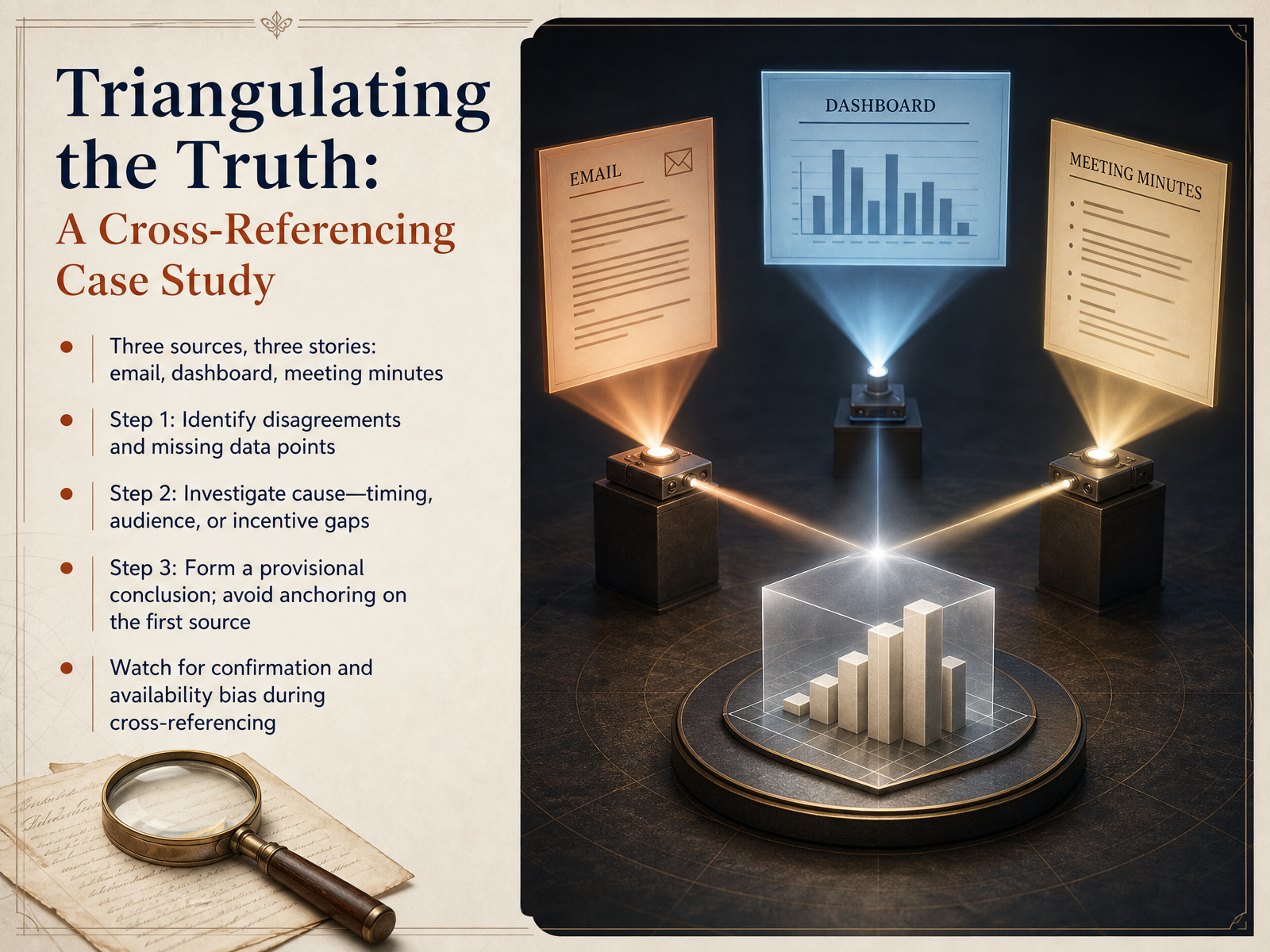
 - 11Triangulating the Truth: A Cross-Referencing Case StudyLet's put these skills into practice with a cross-referencing case study. Imagine we have three corporate records: a manager's internal email, a live sales dashboard, and the formal meeting minutes. All three describe the same quarter, but they tell different stories. Step one is to identify the disagreements. Pinpoint exactly where the numbers clash or where one source omits data entirely. Step two asks us to investigate the cause. Look at the timing of each record, the intended audience, and the author's incentives. For example, the dashboard might show real-time losses, while the minutes—written later for the board—frame them as a strategic investment. Step three calls for a provisional conclusion. Avoid anchoring on the first source you read, regardless of how authoritative it looks. As you cross-reference, actively watch for confirmation bias. Don't just search for evidence that supports your initial hunch. The goal is not to find one true story, but to triangulate a more complete picture. Now let's apply this critical lens to a final dimension: fact, interpretation, and misinformation.
 libguides.lmu.eduguides.franklin.edulinnbenton.libguides.com+22 min
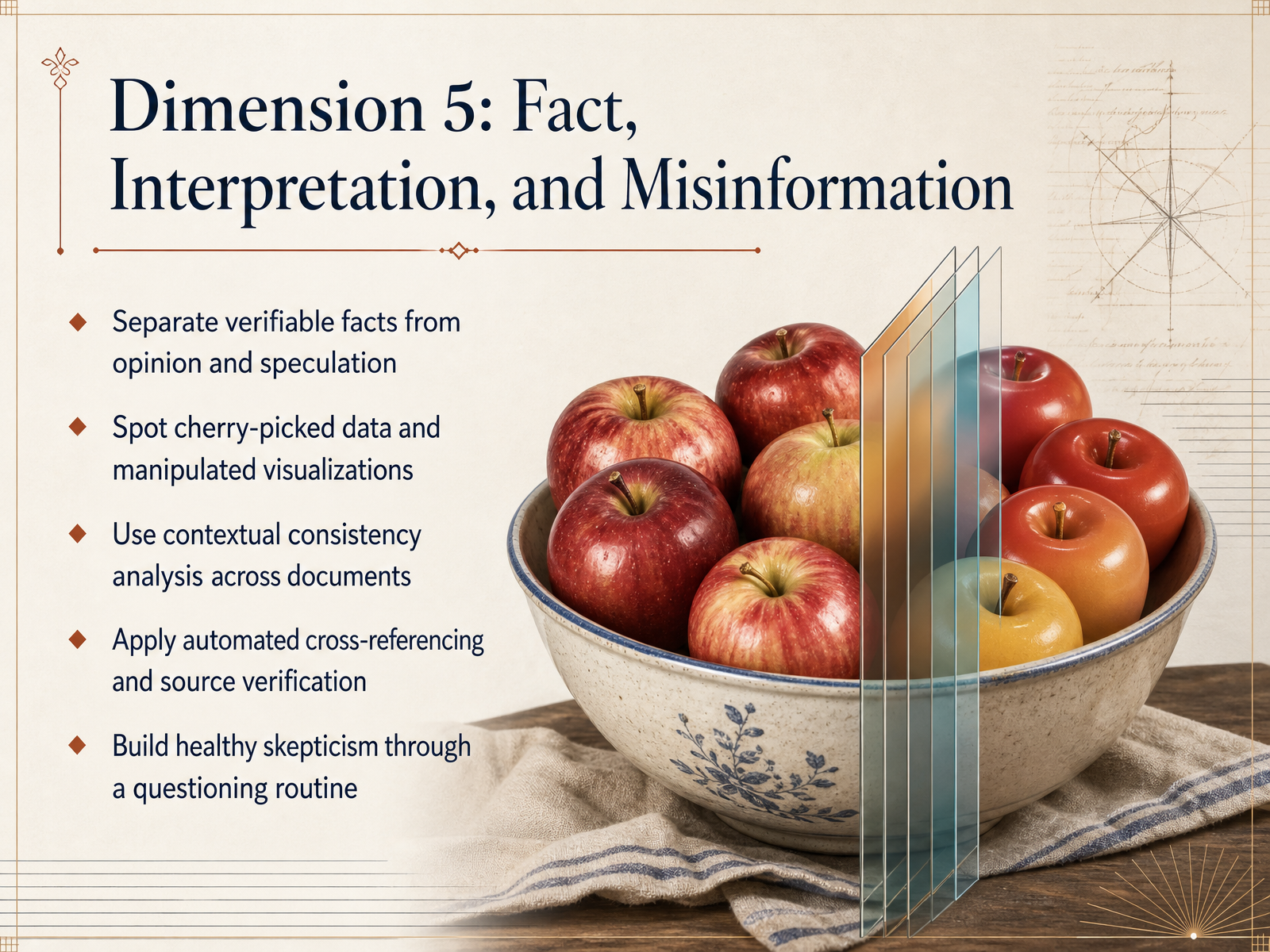
 - 12Dimension 5: Fact, Interpretation, and MisinformationNow we turn to the fifth and final dimension: separating fact from interpretation, and spotting misinformation. This is where the other four dimensions come together to help you protect your analysis. The first step is to separate verifiable facts from opinion and speculation. Ask yourself: what can be independently confirmed, and what relies on the author's judgment? Next, watch for cherry-picked data and manipulated visualizations. A chart might look convincing but selectively exclude years, scale axes to exaggerate trends, or remove context that would tell a different story. Contextual consistency analysis is your best defense here. Compare what one document claims against what others show. If a company's financial statement reports fifteen million dollars in revenue but operates from a residential address, that inconsistency demands investigation. Today's tools also bring automated cross-referencing and source verification into reach. You can check entity registrations against official databases, verify contact details independently, and match IP addresses to claimed business locations, all in real time. Finally, build a questioning routine as a permanent habit. When you encounter any piece of evidence, pause and ask: what would need to be true for this to be accurate? And what motive might exist to misrepresent it? That structured skepticism turns document analysis from passive reading into active verification. Let's pull all five dimensions together into a complete questioning routine.
 link.springer.comarxiv.orgaclanthology.org+22 min
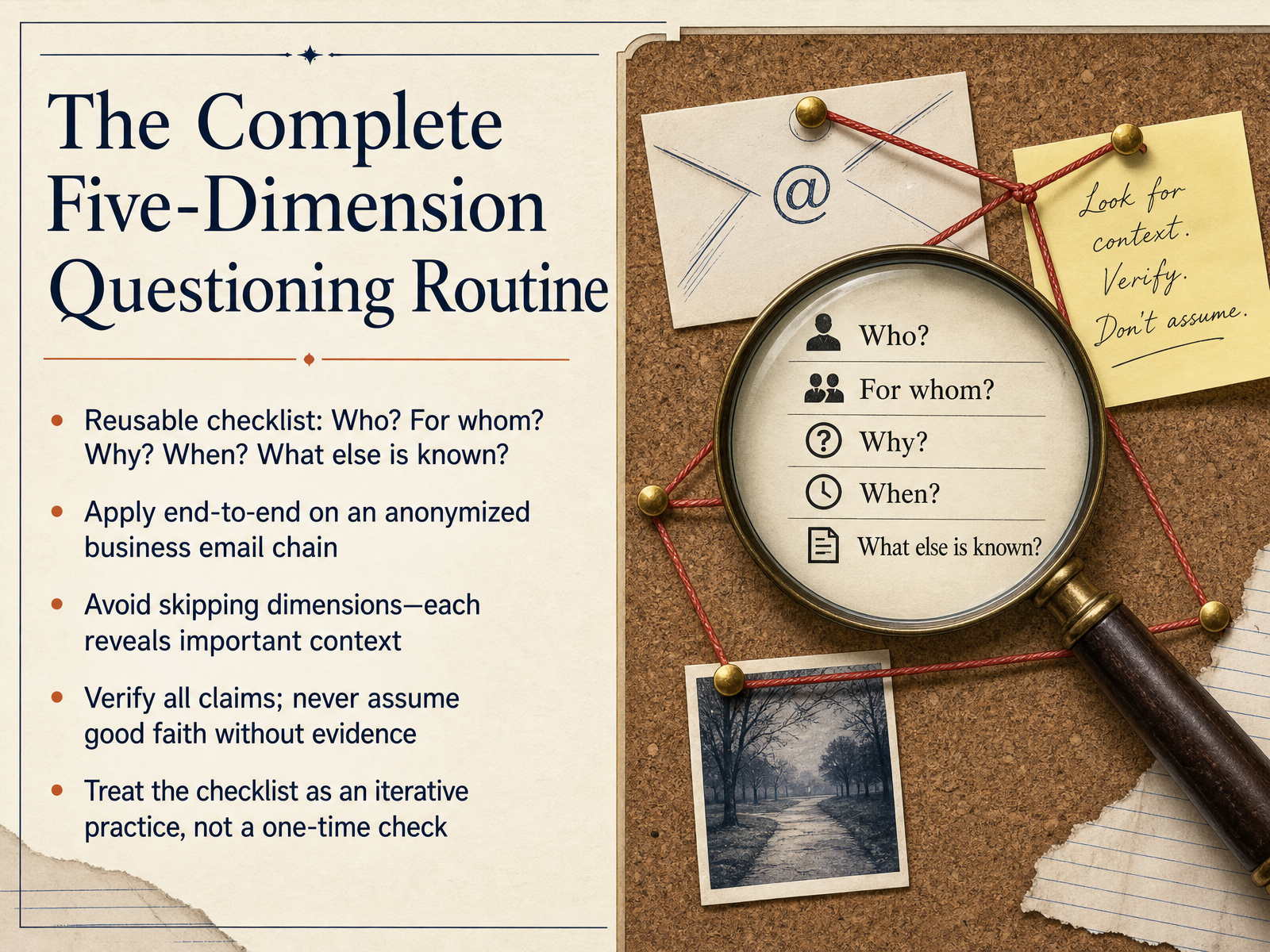
 - 13The Complete Five-Dimension Questioning RoutineNow we bring all five dimensions together into a single, reusable routine. The checklist is Who created it, For whom, Why was it created, When, and What else is known. Apply this end to end on any business document, for example an anonymized email chain where you question the sender's authority, the recipient's expectations, the hidden purpose, the timestamp, and what separate sources confirm. Avoid skipping dimensions. Each one reveals a layer of context the others might miss. Verify every claim and never assume good faith without external evidence. Treat the checklist as iterative practice, not a one-time safety check, because your own understanding sharpens each time you work through the questions. Up next, we move from the framework to applying it in the Practice and Self-Assessment slide.
 libguides.lmu.eduguides.franklin.edulinnbenton.libguides.com+21 min
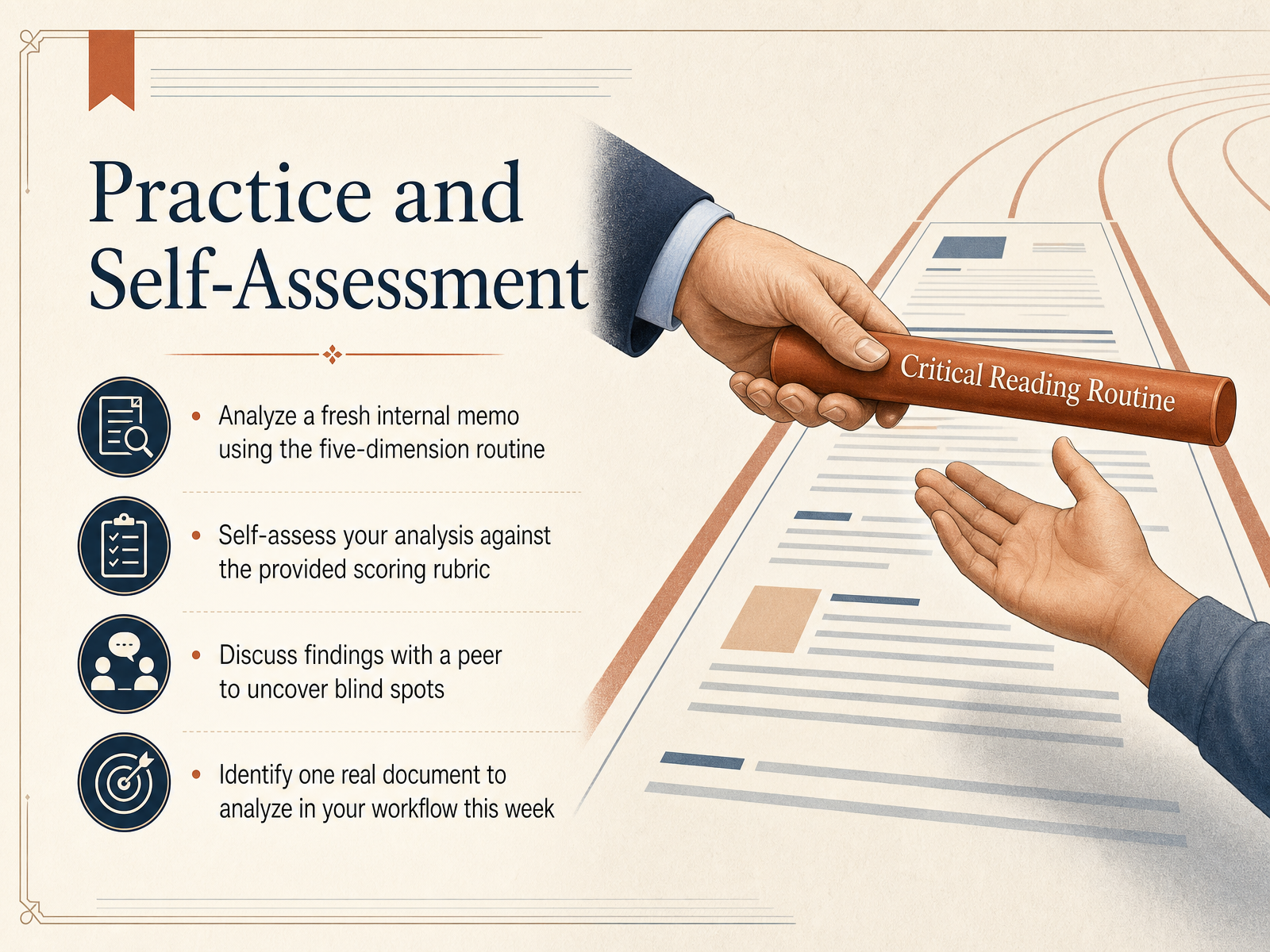
 - 14Practice and Self-AssessmentWe have reached the final, and arguably most important, part of this course: putting your skills into practice. You will now analyze a fresh internal memo using the five-dimension routine we have covered. After your analysis, take a moment to self-assess your work against the provided scoring rubric. Consider where your evaluation of the author’s background or the document’s purpose may need strengthening. Next, discuss your findings with a peer. This collaborative step is vital for uncovering blind spots in your own reasoning that you might otherwise miss. Finally, and most critically, identify one real document from your actual workflow this week to analyze. This action transfers the skill from the classroom directly to your professional life. Thank you for your focused effort today. The ability to read a document and immediately assess its credibility and intent is a powerful career asset, and it is now yours to build upon.
 libguides.lmu.eduguides.franklin.edulinnbenton.libguides.com+21 min
Take the deck with you
Download this course as a file — free, no sign-up needed.
- PDF handoutEvery slide page, ready to print or share.15 pages · 5.3 MBDownload
- Narrated PowerPointThe deck that presents itself — every slide carries the digital human's narration video.15 pages · 15.7 MBDownload
- PowerPoint slidesThe full deck as a .pptx — open it in PowerPoint, Keynote, or Google Slides.15 pages · 5.3 MBDownload
Free to use in your own training — please keep the PersonWise credit page at the end.
Have your own deck? Turn it into a course
Sources consulted
Web sources consulted while building this course.
- Evaluating Business Sources (ABCs) - International Business Research - LibGuides at Loyola Marymount University — libguides.lmu.edu
- Evaluating Sources: Identifying Bias — guides.franklin.edu
- Evaluating Sources: How Credible is the Author? - Research Guides — linnbenton.libguides.com
- Evaluating Sources - MBAB 5P21: Business Strategy - Research Guides at Brock University — researchguides.library.brocku.ca
- Guide to Selecting Credible Sources for Business Writing — instructionalsolutions.com
- Developing and implementing a primary source literacy case scenario for the undergraduate business classroom — docs.lib.purdue.edu
- Reviewing the Use of Primary Sources in the Undergraduate Business Classroom — docs.lib.purdue.edu
- Developing and implementing a primary source literacy case scenario for the undergraduate business classroom — doi.org
- Reviewing the Use of Primary Sources in the Undergraduate Business Classroom: Business Librarian Use of Primary Sources in Instruction | SCIENCE@home — sah.borca.ai
- Critical Thinking in Business Studies using Gale Primary Sources — review.gale.com
- Detection of false financial statements in enterprises based on dual-layer knowledge graph and graph-driven approach | Discover Artificial Intelligence | Springer Nature Link — link.springer.com
- Financial Audit Assistance using Misinformation Detection and Explanation — arxiv.org
- Are Large Language Models Reliable Reviewers? A Benchmark for Error Detection in Financial Documents — aclanthology.org
- All That Glisters Is Not Gold: A Benchmark for Reference-Free Counterfactual Financial Misinformation Detection — aclanthology.org
- A Hybrid Neuro-Symbolic Framework for Corporate Fraud Detection Using Large Language Models, Graph Neural Networks, and Automata-Based Reasoning — cureusjournals.com