Change Management Strategy: Goals and Tradeoffs
Begin
14 pages · ~28 min
Change Management Strategy: Goals and Tradeoffs
Learn to align change management goals with strategic choices and navigate tradeoffs to drive successful organizational transitions.
What you’ll learn
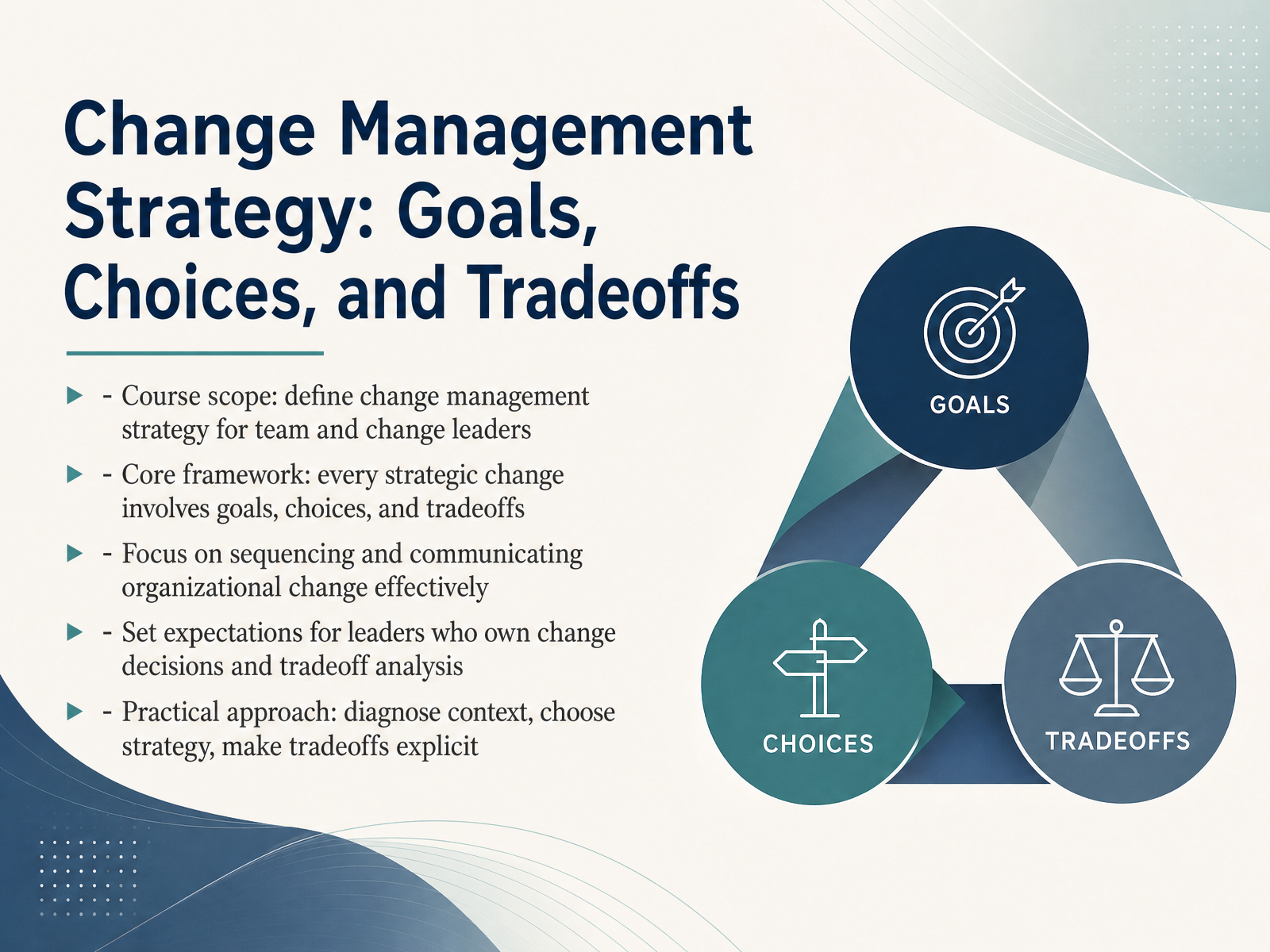
- 01Change Management Strategy: Goals, Choices, and TradeoffsWelcome. If you're responsible for shaping and sequencing organizational change, you know the pressure is real. Every change you lead comes with competing priorities, limited resources, and stakeholders who don't always see eye to eye. This course is built for you. We'll focus on one core idea: every strategic change involves goals, choices, and tradeoffs. Get those three right, and you can navigate even the most complex transformation. Get them wrong, and even well-intentioned efforts stall. We'll work through a practical approach. First, diagnose your context. Then, choose a change strategy that fits. And finally, make tradeoffs explicit so decisions are transparent and defensible. Along the way, we'll look at real scenarios and give you tools to sequence and communicate change effectively. By the end, you'll be better equipped to own change decisions with confidence. Next, let's look at why change strategies often fail when goals aren't clear.iiba.orgcdn.ymaws.combcg.com+21 min
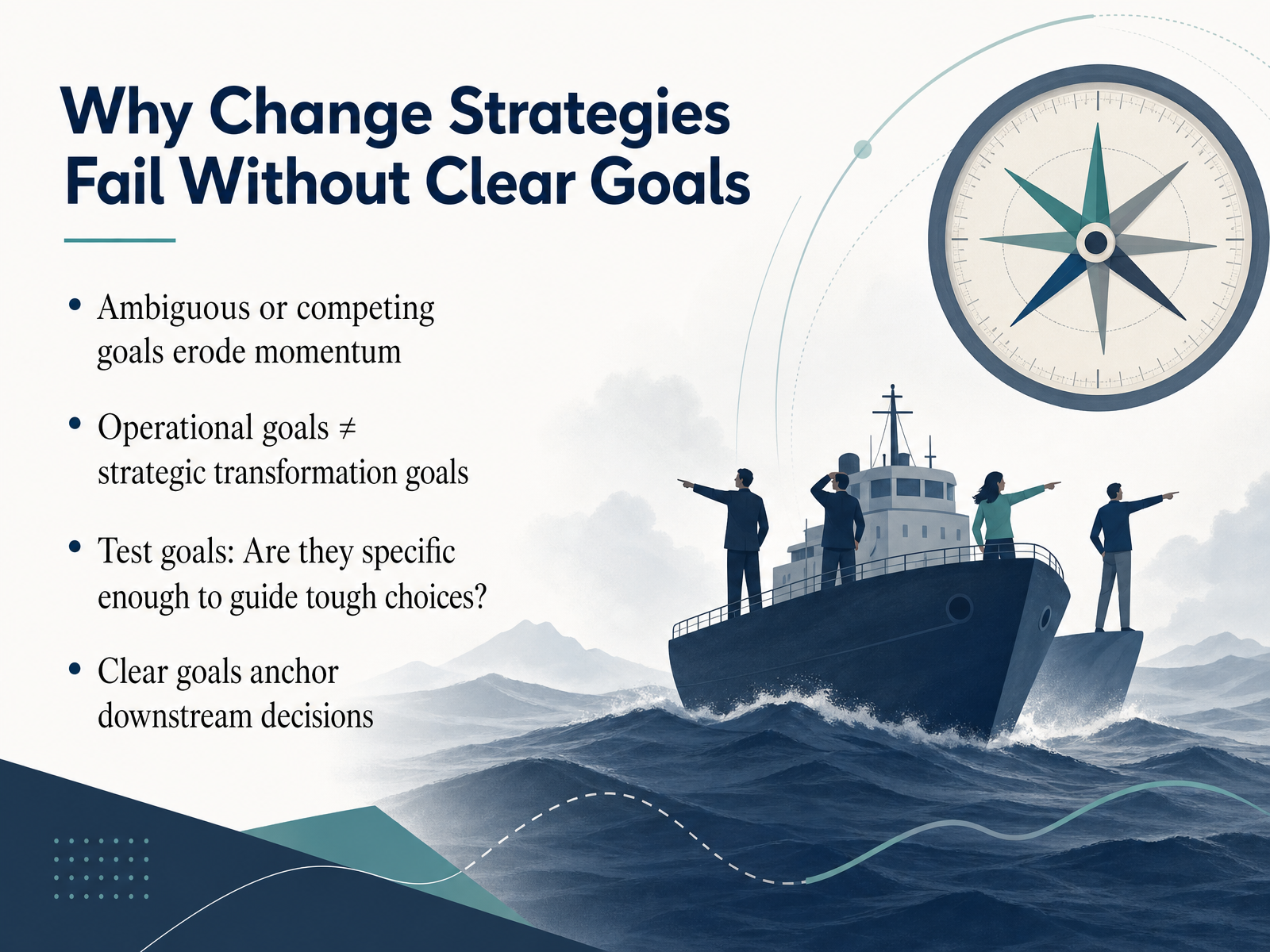
- 02Why Change Strategies Fail Without Clear GoalsLet’s start with a hard truth: most change strategies don’t fail because the plan is weak. They fail because the goals are unclear or pulling in different directions. When your team can’t answer “what exactly are we trying to achieve and why,” momentum dies quickly. Here’s another trap—confusing operational goals with strategic transformation goals. Cutting costs by ten percent is operational. Shifting your business model to compete in a new market is strategic. They need different metrics, different timelines, and different tolerance for risk. Mixing them up will derail even the best portfolio. So here’s a practical test for your goals: are they specific enough to guide the tough choices you’ll face in month two or month six? For example, if a supplier relationship is failing and a key initiative depends on it, does your goal tell you whether to fix it, swap it, or drop the initiative entirely? If not, the goal is too vague. Clear goals anchor every downstream decision—what you fund, what you pause, what you kill. Get that clarity locked in early, and everything else gets easier. Now let’s look at the core concepts for designing your change strategy.
 2 min
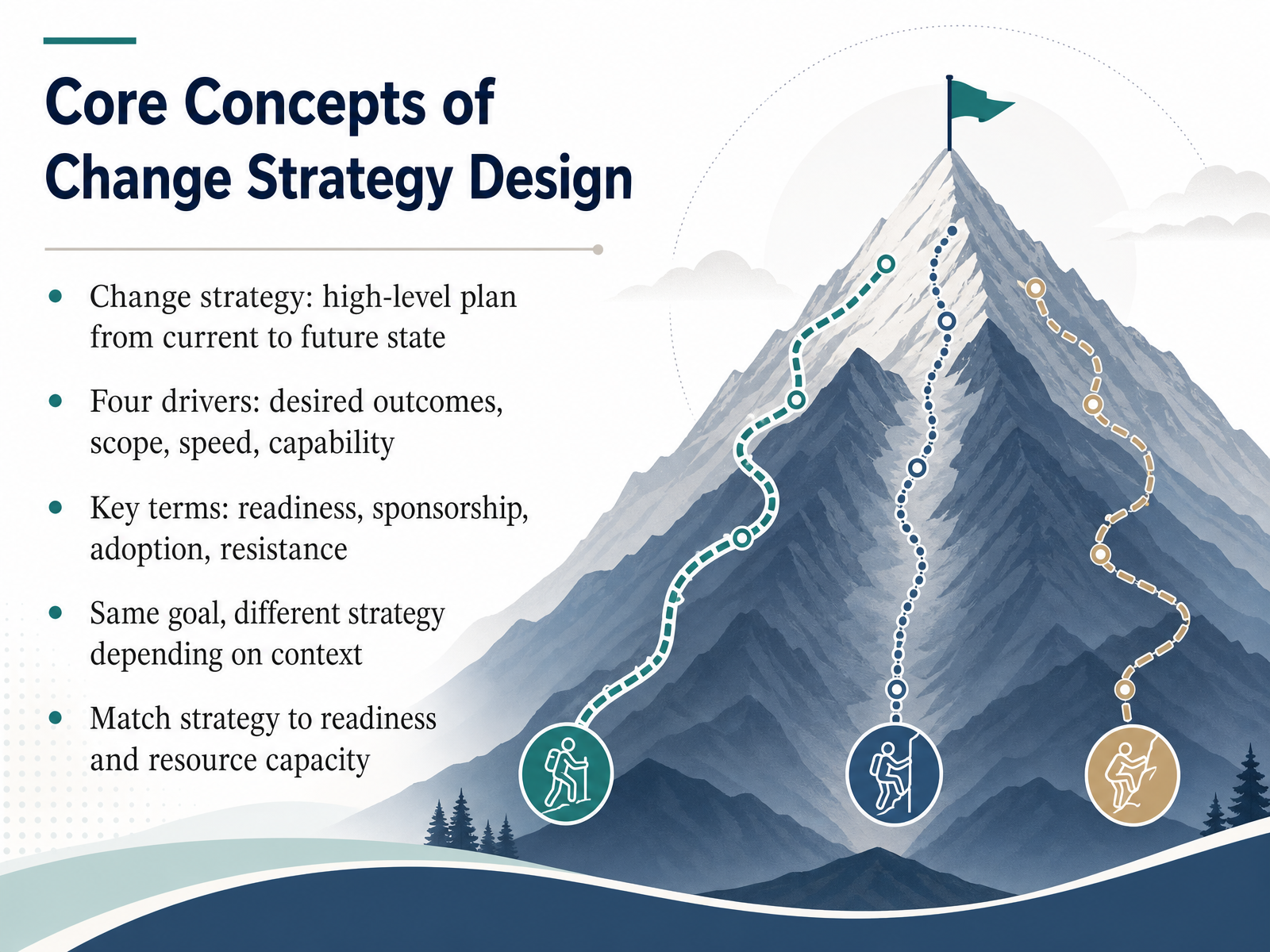
2 min - 03Core Concepts of Change Strategy DesignNow let’s anchor our thinking in the core concepts of change strategy design. At its simplest, a change strategy is the high-level plan that moves your organization from the current state to the future state. But building that plan isn’t a one-size-fits-all exercise. It’s shaped by four key drivers: the outcomes you want, the scope of the change, the speed required, and your organization’s capability to absorb it. As you design, you’ll also be working with terms like readiness, sponsorship, adoption, and resistance. These aren’t just labels—they’re the levers you’ll pull. Here’s the important part: two organizations can have the same goal yet need completely different strategies. The difference comes down to context—how ready your people are, and how much capacity you have in terms of resources and attention. The best strategy isn’t the most ambitious one; it’s the one that matches your readiness and resource capacity. It acknowledges the tradeoffs and still moves you forward. So as we go deeper, keep these drivers in mind—next, we’ll look at how to diagnose your specific change context.
 iiba.orgcdn.ymaws.combcg.com+22 min
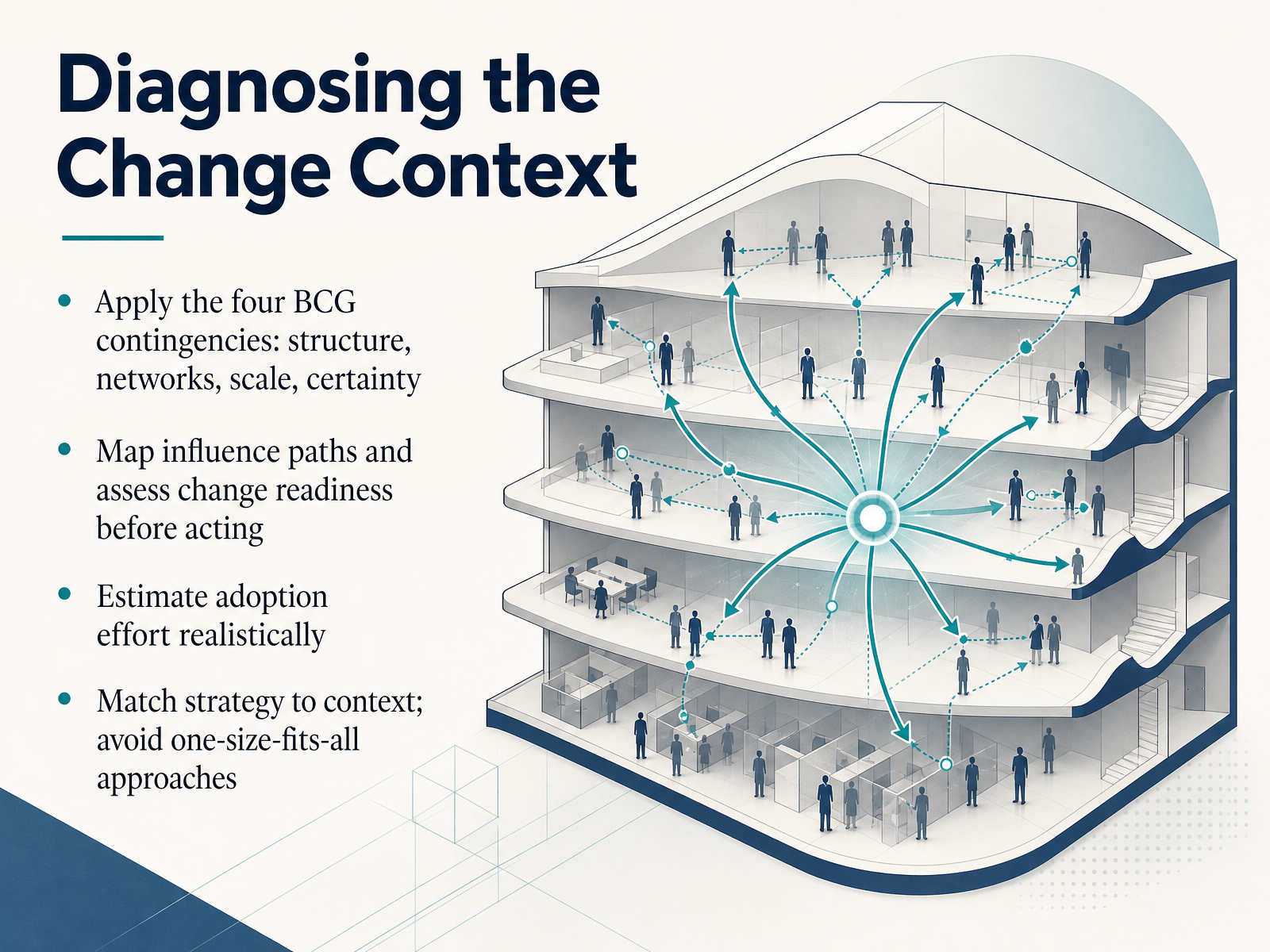
 - 04Diagnosing the Change ContextNow let's turn to diagnosis. Before you commit to any change strategy, you need a clear read on your context. The BCG framework gives us four contingencies to work through: structure, networks, scale, and certainty. Structure means who holds power and how decisions flow. Networks are the informal relationships that can accelerate or block your initiatives. Scale asks how big the change is relative to the organization. And certainty measures how confident you are in your assumptions about the future. Once you've mapped these, trace your influence paths. Who are the connectors, the skeptics, the early adopters? Assess readiness before you act, not after. And be realistic about adoption effort. It's tempting to underestimate learning curves, resistance, and rework. Finally, match your strategy to what you find. A one-size-fits-all approach fails precisely because it ignores these variables. For example, a low-certainty initiative in a siloed structure demands a very different playbook than a high-certainty change in a networked team. Take ten minutes with your team to score your context on each contingency. That clarity will set the stage for the strategic choices we're about to explore.
 2 min
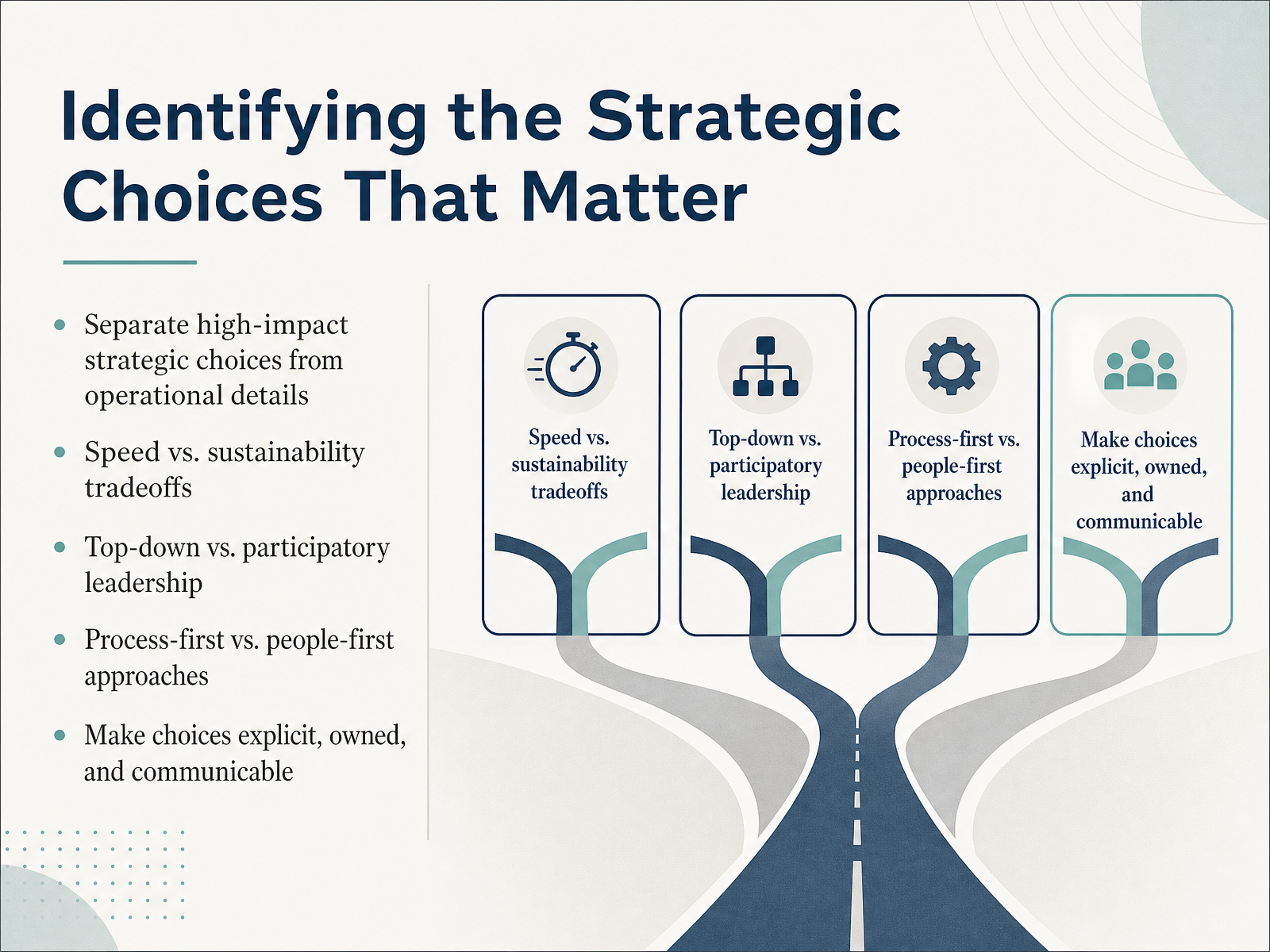
2 min - 05Identifying the Strategic Choices That MatterThe real work begins when you separate the few decisions that will define your transformation from the many operational details that will consume your calendar. The choices that matter tend to cluster around four enduring tradeoffs. First, speed versus sustainability. Move fast and you risk burning out your people; move too slow and you lose momentum and credibility. Second, top-down versus participatory leadership. Direction from the top gives clarity and speed, but it can create passive resistance; broad participation builds ownership, but it is time-consuming and can dilute the message. Third, process-first versus people-first approaches. You can perfect your workflows and systems, but if your people are not on board, adoption will stall; focus only on people and you may miss the structural changes that make new behaviors stick. There is no universally correct answer on any of these dimensions. The right call depends on your context, your organization's readiness, and the scale of the change. What matters most is that you make these choices explicit, that someone owns each of them, and that you can communicate them clearly. Ambiguity here gets filled with rumors. Clarity becomes your anchor. Now let's look at how these choices combine into distinct strategy archetypes. We will walk through five proven approaches in the next section.
 iiba.orgcdn.ymaws.combcg.com+21 min
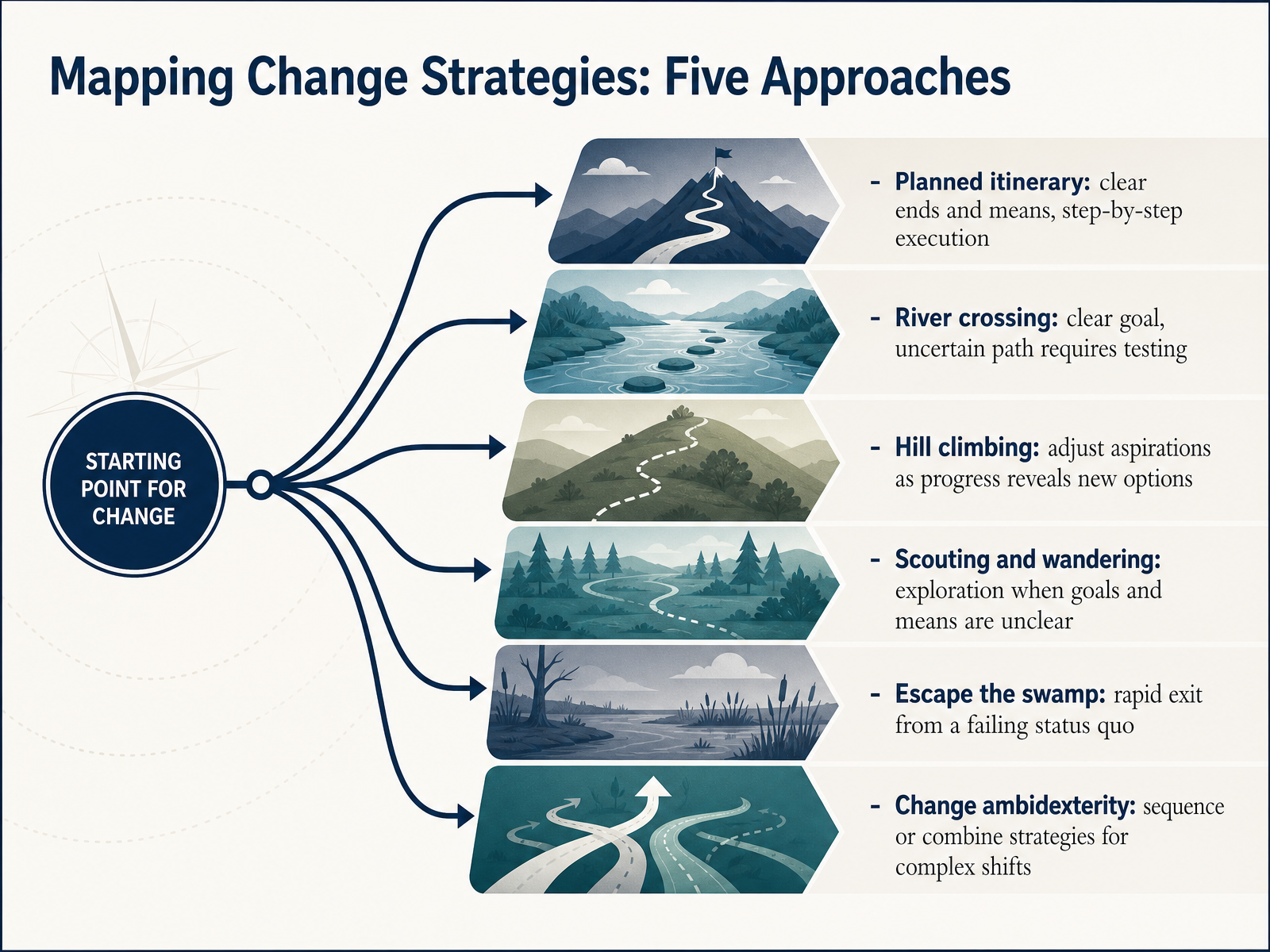
 - 06Mapping Change Strategies: Five ApproachesNow let’s map the terrain. Think of the five change strategies as different routes you might take. First, the planned itinerary: you know the destination and the path, so you execute step by step — like a product launch with a fixed timeline. Second, river crossing: the goal is clear, but the path is not. You test the water, adjust, and move forward — for example, entering a new market where the regulatory landscape keeps shifting. Third, hill climbing: you set an aspiration, but as you climb, you see new peaks and valleys, so you adjust your goal. This fits long-term digital transformation where the end state evolves. Fourth, scouting and wandering: both goals and means are fuzzy. You explore, gather insights, and let patterns emerge — useful in early-stage innovation. Finally, escape the swamp: you’re in a failing status quo, and you need a rapid exit, even if the next step isn’t perfect — like pulling the plug on a legacy system that’s draining resources. For complex shifts, you may need change ambidexterity: sequence or combine these strategies. That’s the real art. Now, let’s make the tradeoffs explicit.
 2 min
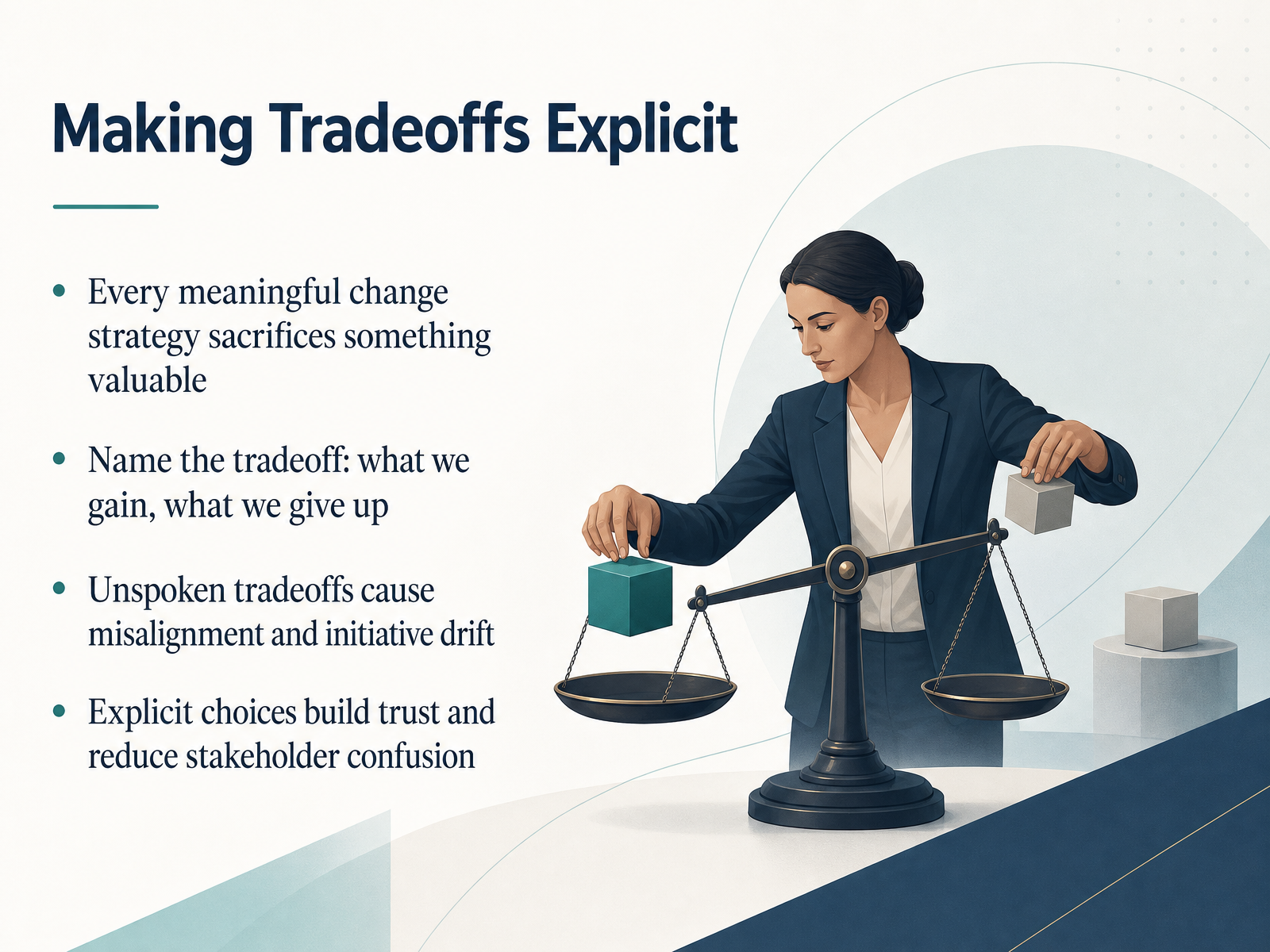
2 min - 07Making Tradeoffs ExplicitLet's be honest about what change really costs. Every meaningful strategy demands a sacrifice. You gain speed, but you give up stability. You get innovation, but you lose some control. The question is not whether you sacrifice, but whether you admit it. Name the tradeoff clearly. State what you gain and what you give up. When you stay silent, your teams fill the gap with their own guesses. That is how misalignment starts and momentum dies. Make the choice explicit, and you build trust. Stakeholders may not love the answer, but they will respect the clarity. So write it down: what are we choosing, and what are we consciously letting go? If you cannot explain the tradeoff in two sentences, you are not ready to move forward. Now let's look at a practical framework for making these decisions. A framework for tradeoff decisions.
 hbr.orghbr.orgexecutive.mit.edu+21 min
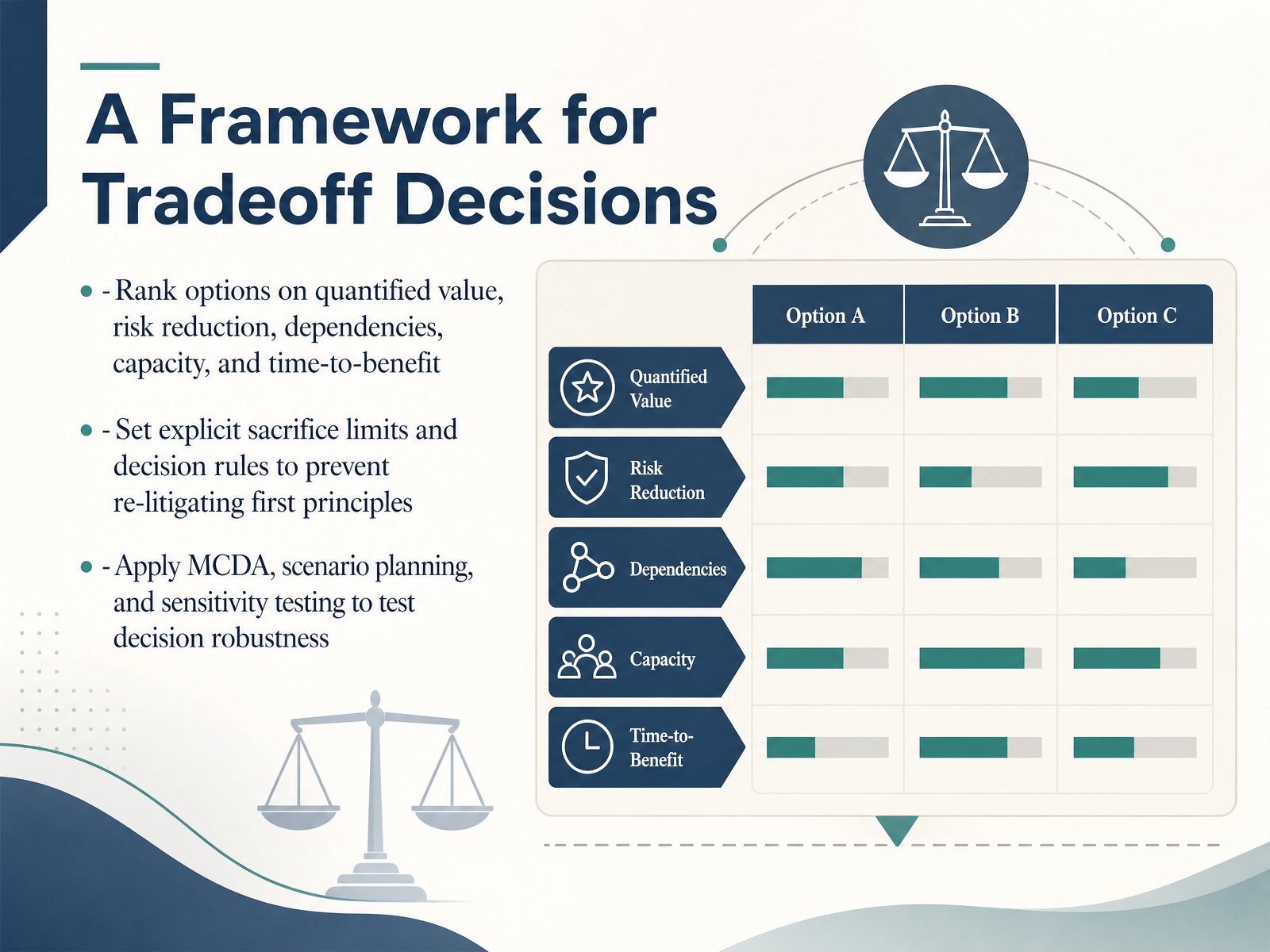
 - 08A Framework for Tradeoff DecisionsSo how do we actually make trade-off decisions without re-opening the same debate every quarter? Start by ranking your options on a consistent set of criteria: quantified value, risk reduction, dependencies, capacity impact, and time to benefit. This gives you a common language and prevents the loudest voice from carrying the day. Next, set explicit sacrifice limits in advance. Decide what you are not willing to give up, whether that is operational resilience, customer stability, or a minimum control standard. When those limits are clear and documented, you stop re-litigating first principles and start moving. And finally, pressure-test your choices. Use multi-criteria decision analysis to weight what matters most, run scenario planning to see if the decision still holds under different conditions, and apply sensitivity testing. If a modest change in priority weight flips your preferred option, that decision is fragile. Treat it with extra scrutiny. Remember, the goal is not to eliminate judgment, but to make it repeatable and defensible. Prioritizing and sequencing change initiatives comes next.
 hbr.orghbr.orgexecutive.mit.edu+21 min
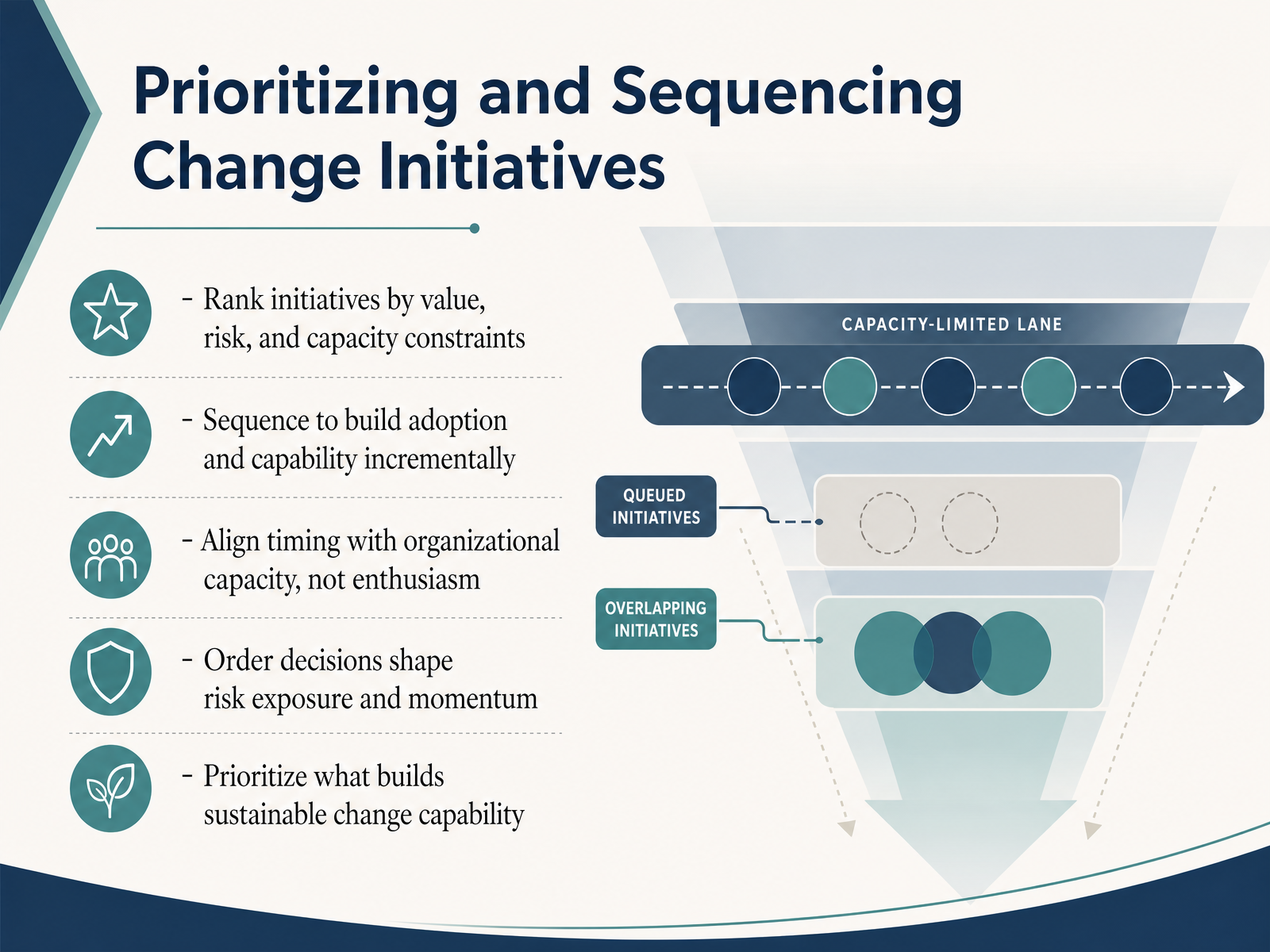
 - 09Prioritizing and Sequencing Change InitiativesNow let’s talk about prioritizing and sequencing your change initiatives. The goal is not to do everything at once, but to make deliberate choices about what to do first, what to do later, and what to hold off on completely. Start by ranking every initiative against three factors: the value it delivers, the risk it carries, and the capacity your organization actually has to absorb it. High value and low risk might be an obvious early win, but even that needs to be sequenced carefully. Think about building adoption in increments. If you roll out too much too soon, you’ll overwhelm your teams and erode the very momentum you need. Align your timing with organizational capacity, not with enthusiasm. Just because leadership is excited about a change doesn’t mean the organization is ready for it. Every sequencing decision changes your risk exposure and your momentum. A poorly timed rollout can stall progress for months. So prioritize what builds sustainable change capability, not just what’s easiest to check off. In practice, this often means starting with a pilot that proves value, then scaling lessons learned. As you finalize your sequence, start preparing how you’ll communicate these choices and tradeoffs to stakeholders. That’s where transparency turns a good plan into a credible one.
 2 min
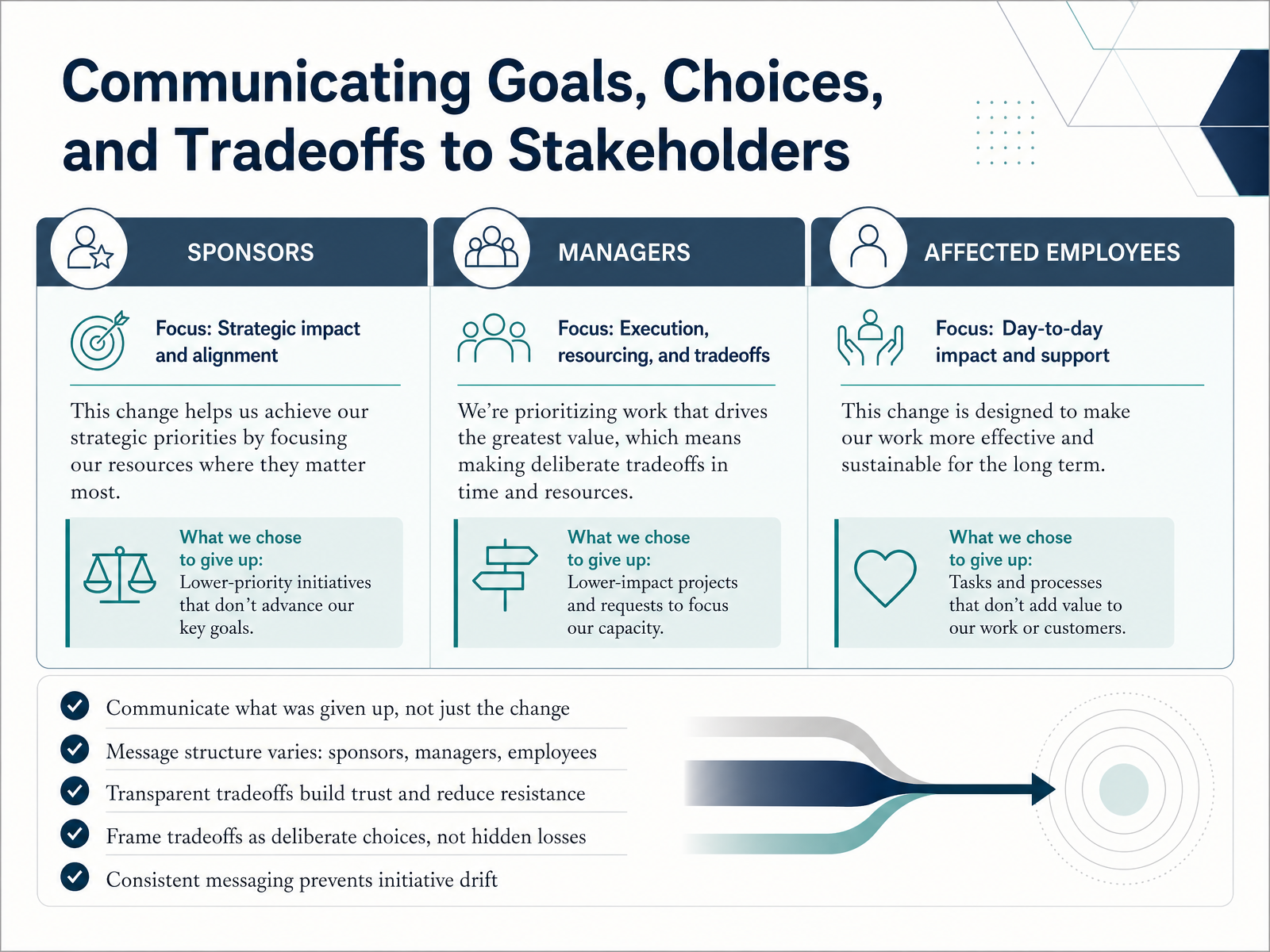
2 min - 10Communicating Goals, Choices, and Tradeoffs to StakeholdersNow let's talk about how we communicate these tradeoffs. The key is to be transparent about what was given up, not just what we're gaining. When people understand the full picture, they're more likely to trust the process. The message structure needs to vary by audience. Sponsors want the strategic rationale, managers need to know how it impacts their teams, and employees want to know what it means for their day-to-day work. One example: if we're shifting budget from a legacy system to a new platform, we should say that explicitly rather than let rumors fill the gap. Transparent tradeoffs build trust and reduce resistance. Frame them as deliberate choices, not hidden losses or failures. This keeps the narrative positive and forward-looking. Finally, consistent messaging across all levels prevents initiative drift. When everyone hears the same story, alignment follows. This brings us to our next topic: building a shared tradeoff language.
 2 min
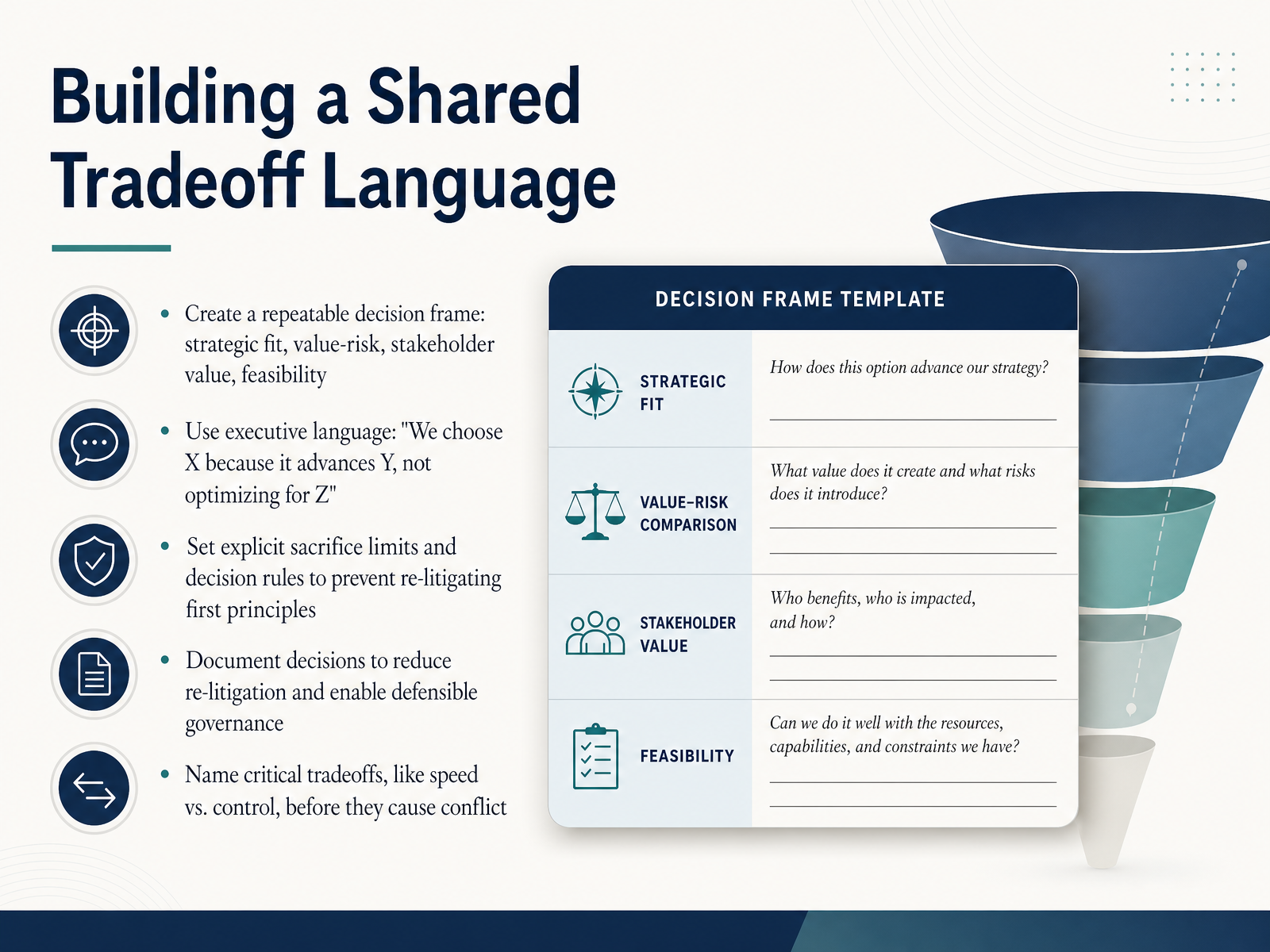
2 min - 11Building a Shared Tradeoff LanguageA shared tradeoff language prevents the same debate from happening three times. First, create a repeatable decision frame: strategic fit, value versus risk, stakeholder value, and feasibility. Use these four consistently and people stop arguing from gut feel. Second, speak in executive terms. Not 'we should do this because it's important,' but 'we choose X because it advances Y, and we are consciously not optimizing for Z.' That sentence alone eliminates most ambiguity. Third, set explicit sacrifice limits. Decide in advance what you will not give up, even under pressure. Whether it's a maximum acceptable risk exposure or a minimum quality gate, bounding judgment makes it auditable. Fourth, document your decisions. Write down what was chosen, why, and what was sacrificed. This prevents re-litigating first principles and creates defensible governance. Finally, name the recurring tensions before they become conflict: speed versus control, standardization versus local optimization. When these are on the table openly, your team can make judgment calls without waiting for escalation. A common language turns tradeoffs from a source of friction into a strategic discipline. Next, let's look at how you lead the execution phase with a Step Up, Step Back approach.
 hbr.orghbr.orgexecutive.mit.edu+22 min
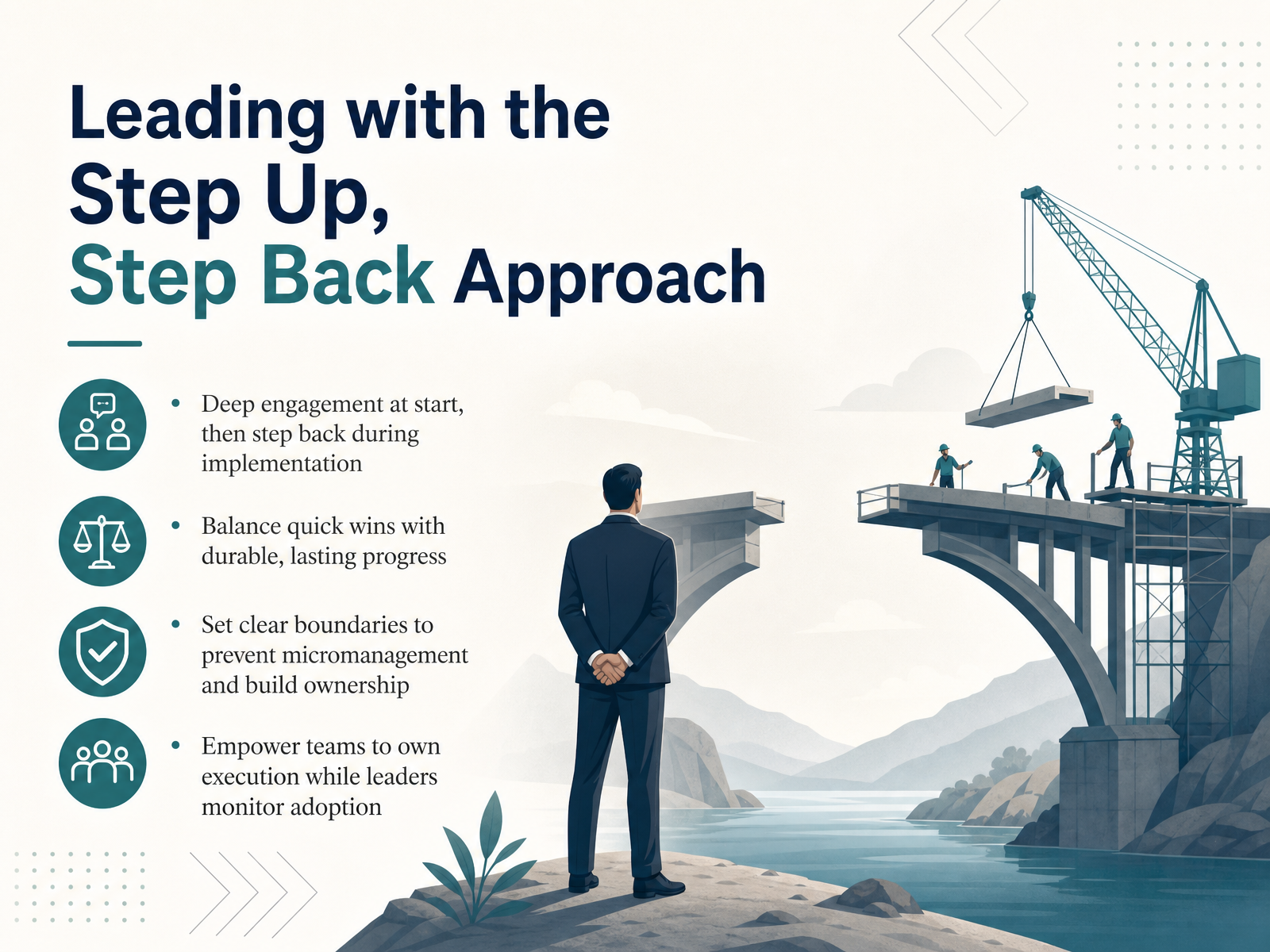
 - 12Leading with the Step Up, Step Back ApproachNow let's talk about the Step Up, Step Back approach. This is where leadership gets delicate. You need to be deeply involved at the start—setting the vision, defining the parameters, and aligning stakeholders. But once implementation begins, your role shifts. You step back and let the teams own the work. That doesn't mean you disappear. It means you stay visible but not intrusive. You monitor adoption, you review the data, and you intervene only when something meaningful goes off course. The balance to strike is between quick wins and lasting progress. Quick wins build momentum and credibility early. But if you only chase those, you risk burning out the organization on short-term fixes. So pair them. Use early successes to fund the energy for the harder, structural changes that will actually stick. And here's the key discipline: set clear boundaries at the start. Define what decisions belong to the team and what decisions stay with you. That prevents micromanagement before it starts, and it builds genuine ownership. People deliver differently when they know the outcome is theirs to own. So in practice, you're present early, you pull back purposefully, and you stay alert throughout. That's how you lead without getting in the way. Up next, we'll look at the common pitfalls that can derail this balance and how to avoid them.
 2 min
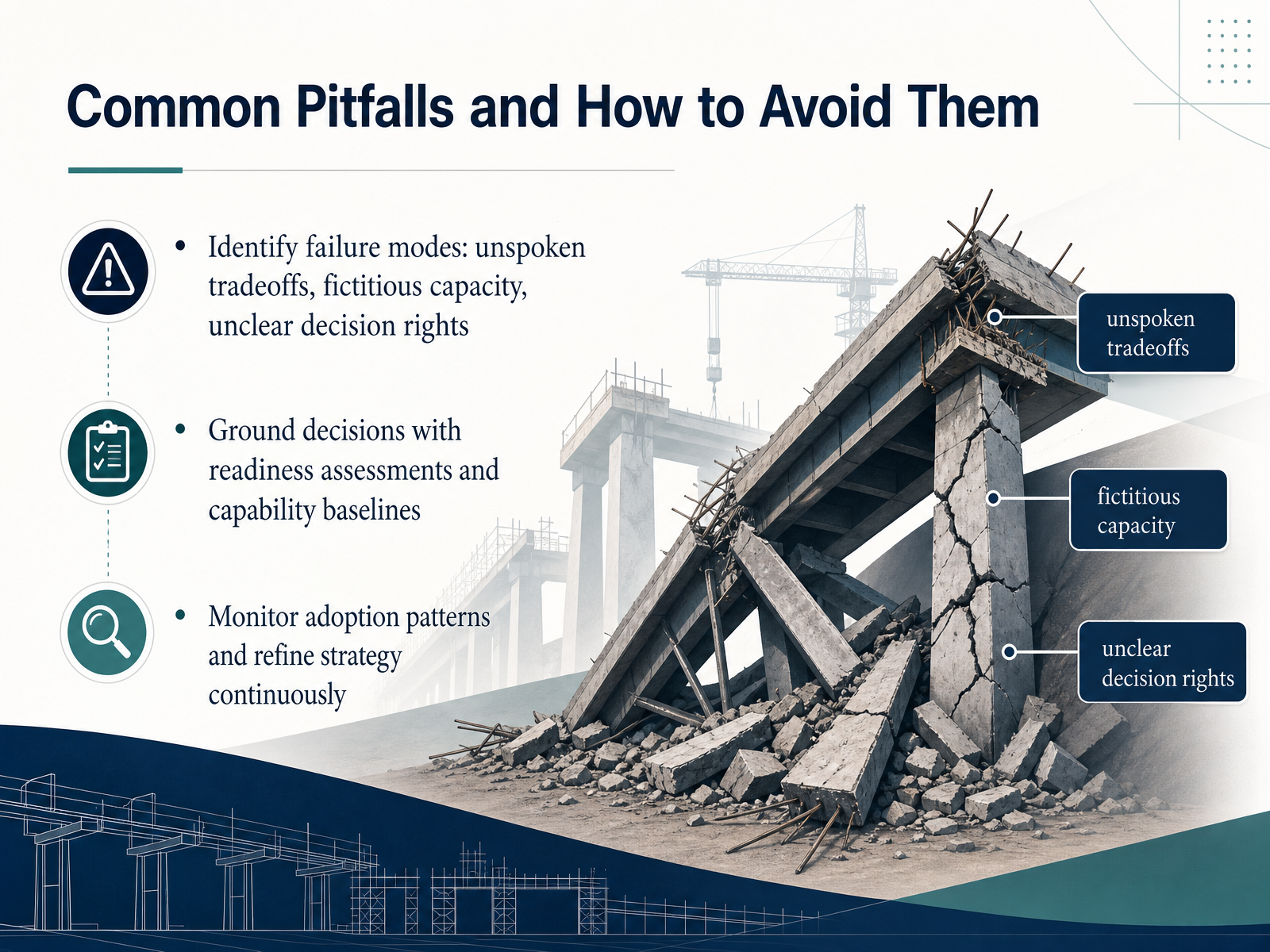
2 min - 13Common Pitfalls and How to Avoid ThemNow let's talk about the pitfalls that trip up most change strategies. You'll see three of them again and again. First, unspoken tradeoffs. When you prioritize one initiative, you're implicitly deprioritizing another. If that choice isn't explicit, people fill the gap with their own assumptions. Second, fictitious capacity. You plan for seven out of ten hours per person, but day-to-day work never goes away. The result is a plan that quietly fails within two weeks. Third, unclear decision rights. Everyone approves, so no one owns the outcome. So how do you avoid these? Ground every decision in readiness assessments and capability baselines. That gives you real data on what the organization can absorb, not what you hope it can. And monitor adoption patterns continuously. Adjust your strategy based on what you observe, not what you predicted. The goal is a living plan, not a static document. Remember, the core discipline is this: name the tradeoff, verify the capacity, and make the decision rights explicit. We'll now move into a workshop where you'll apply this framework to a real change decision.
 1 min
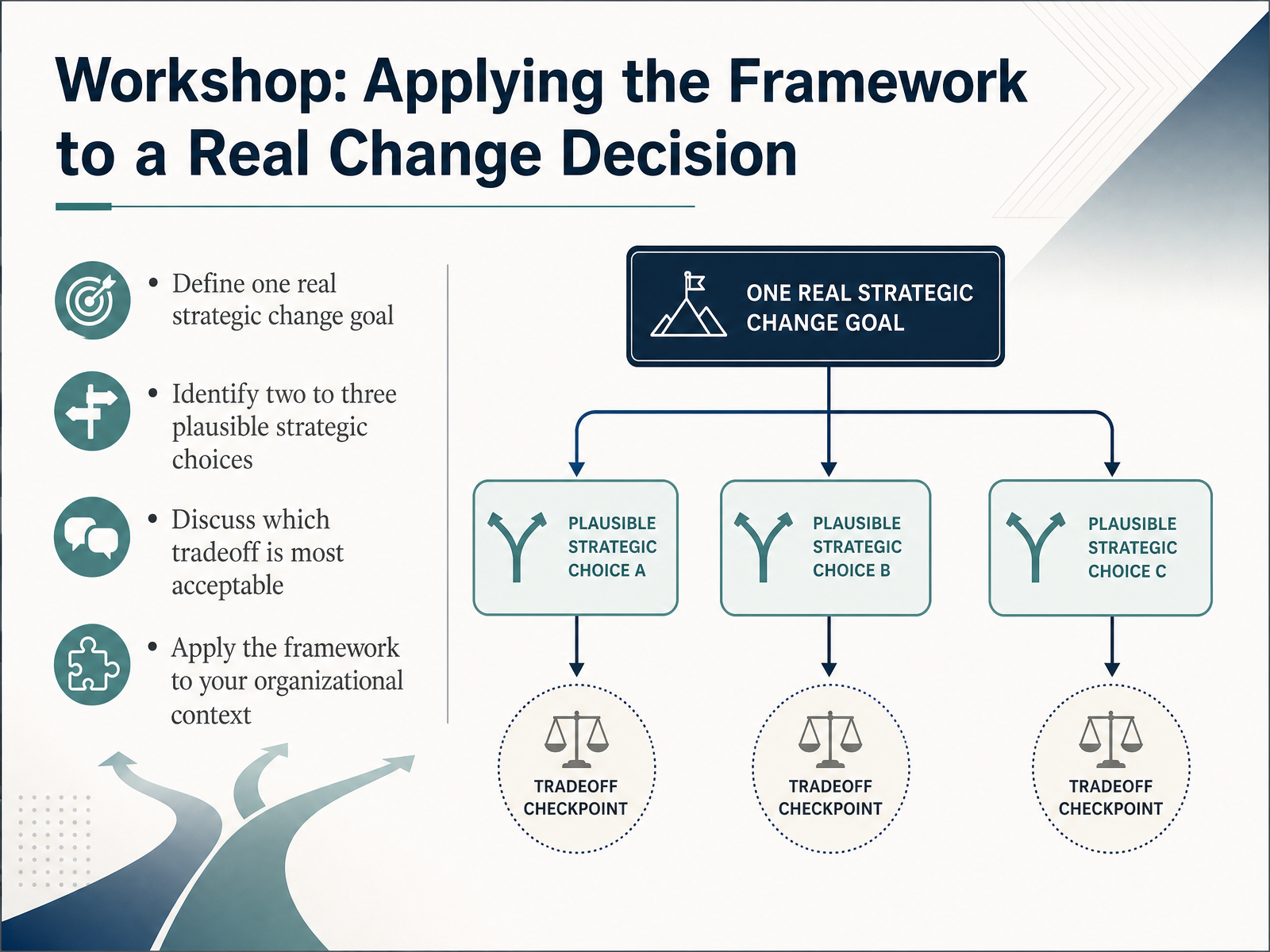
1 min - 14Workshop: Applying the Framework to a Real Change DecisionLet's put this framework to work. Pick a real change you're facing—not a hypothetical one. Define one clear strategic goal. Then, identify two or three plausible choices to reach it. Don't rush to the obvious answer; consider what else could work. For each option, discuss the tradeoffs honestly. Which sacrifice is most acceptable for your organization? Which one aligns with your readiness, your resources, your culture? Apply the framework we've covered today to your own context, and be specific about the opportunity costs. Remember, every strategy gives something up. The key is making that tradeoff deliberate, not accidental. As you work through this, keep the four contingencies in mind: organizational structure, social networks, scale of change, and how certain employees feel about the impact. Use these to pressure-test your choice. You've got a strong foundation now. The real work is applying it to your situation. Thank you for your time and attention today. Go make a deliberate choice—and lead your change with confidence.
 iiba.orgcdn.ymaws.combcg.com+21 min
Take the deck with you
Download this course as a file — free, no sign-up needed.
- PDF handoutEvery slide page, ready to print or share.15 pages · 3.6 MBDownload
- Narrated PowerPointThe deck that presents itself — every slide carries the digital human's narration video.15 pages · 15.0 MBDownload
- PowerPoint slidesThe full deck as a .pptx — open it in PowerPoint, Keynote, or Google Slides.15 pages · 3.5 MBDownload
Free to use in your own training — please keep the PersonWise credit page at the end.
Have your own deck? Turn it into a course
Sources consulted
Web sources consulted while building this course.
- 6.4 Define Change Strategy | IIBA® — iiba.org
- ACMP_Standard_2023_10_18.pdf — cdn.ymaws.com
- From Change Management to Change Strategy | BCG — bcg.com
- Evidence-based change management — cebma.org
- Your Change Needs a Strategy — bcg.com
- How to Make Strategic Trade-Offs — hbr.org
- How One Company Achieved a Bold Transformation—Despite Major Unknowns — hbr.org
- Leadership, Change, and Organizational Impact — executive.mit.edu
- The upside of trade-offs — strategy-business.com
- The road to successful change is lined with trade-offs — strategy-business.com