Era Division in World History
Begin
14 pages · ~28 min
Era Division in World History
Learn how historians categorize world history into distinct eras and understand the criteria behind these chronological divisions. Ideal for students and history enthusiasts seeking a clearer framework for global historical periods.
What you’ll learn
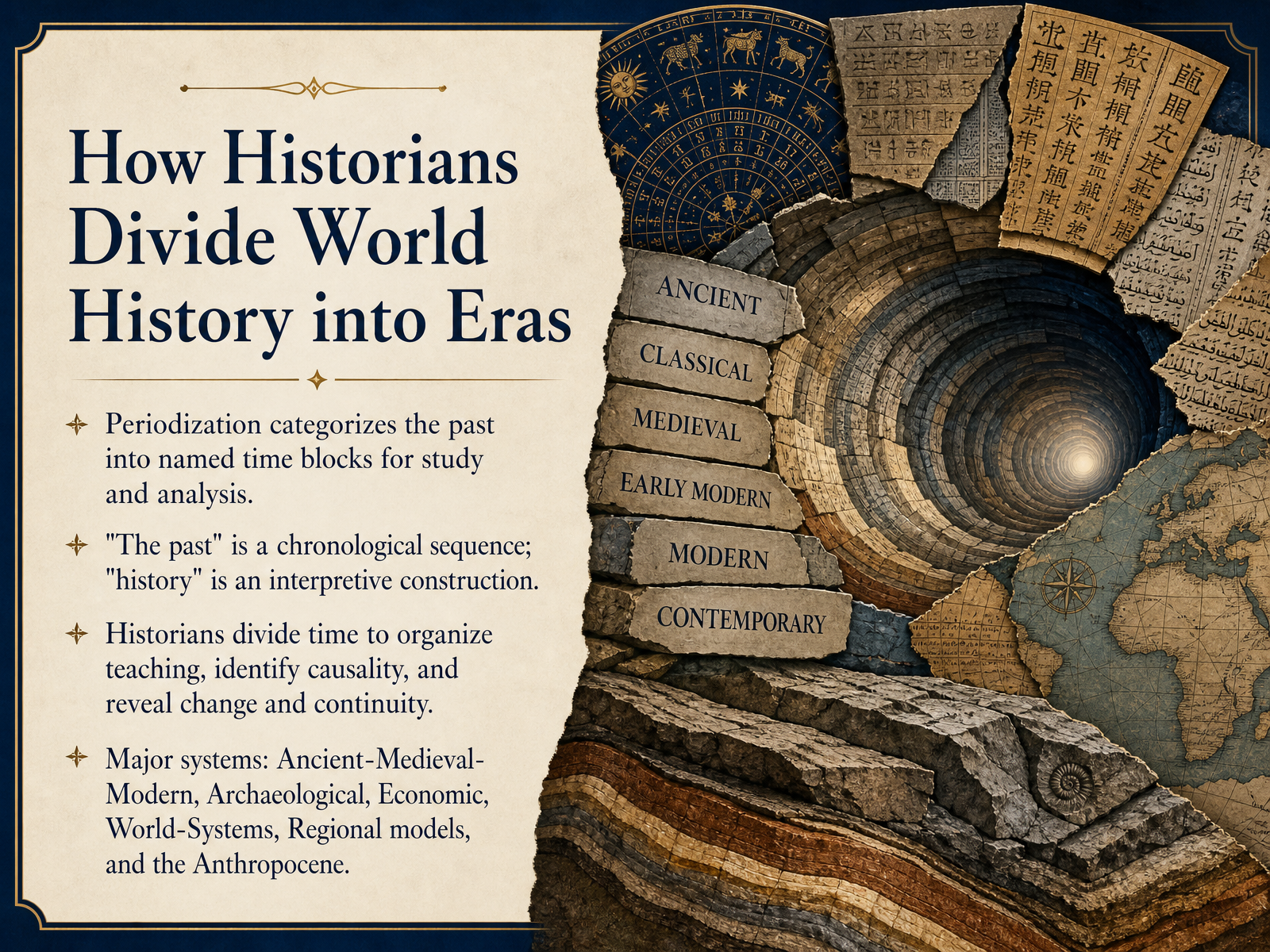
- 01How Historians Divide World History into ErasWelcome. Today we are asking a simple question that has a surprisingly complex answer: how do historians divide world history into eras? We are going to explore a practice called periodization. That long word simply means categorizing the past into named blocks of time to make it easier to study and analyze. Here is an important idea to hold onto: the past is just a chronological sequence of events, but history is an interpretive story we build from those events. Historians don’t just memorize dates. They organize time to see patterns of cause and effect, and to trace what changes and what stays the same. Over the centuries, scholars have created many different systems to do this. You may have heard of the ancient-medieval-modern framework, but there are also models based on archaeology, economics, world systems, specific regions, and even our current proposed era, the Anthropocene. As we go forward, remember that these eras are helpful lenses, not rigid boxes. Historians are still debating where the boundaries truly lie. Let's start with the foundation. Next, we'll answer the question: what is periodization really?press.uchicago.eduirl.umsl.edudataspace.princeton.edu+22 min
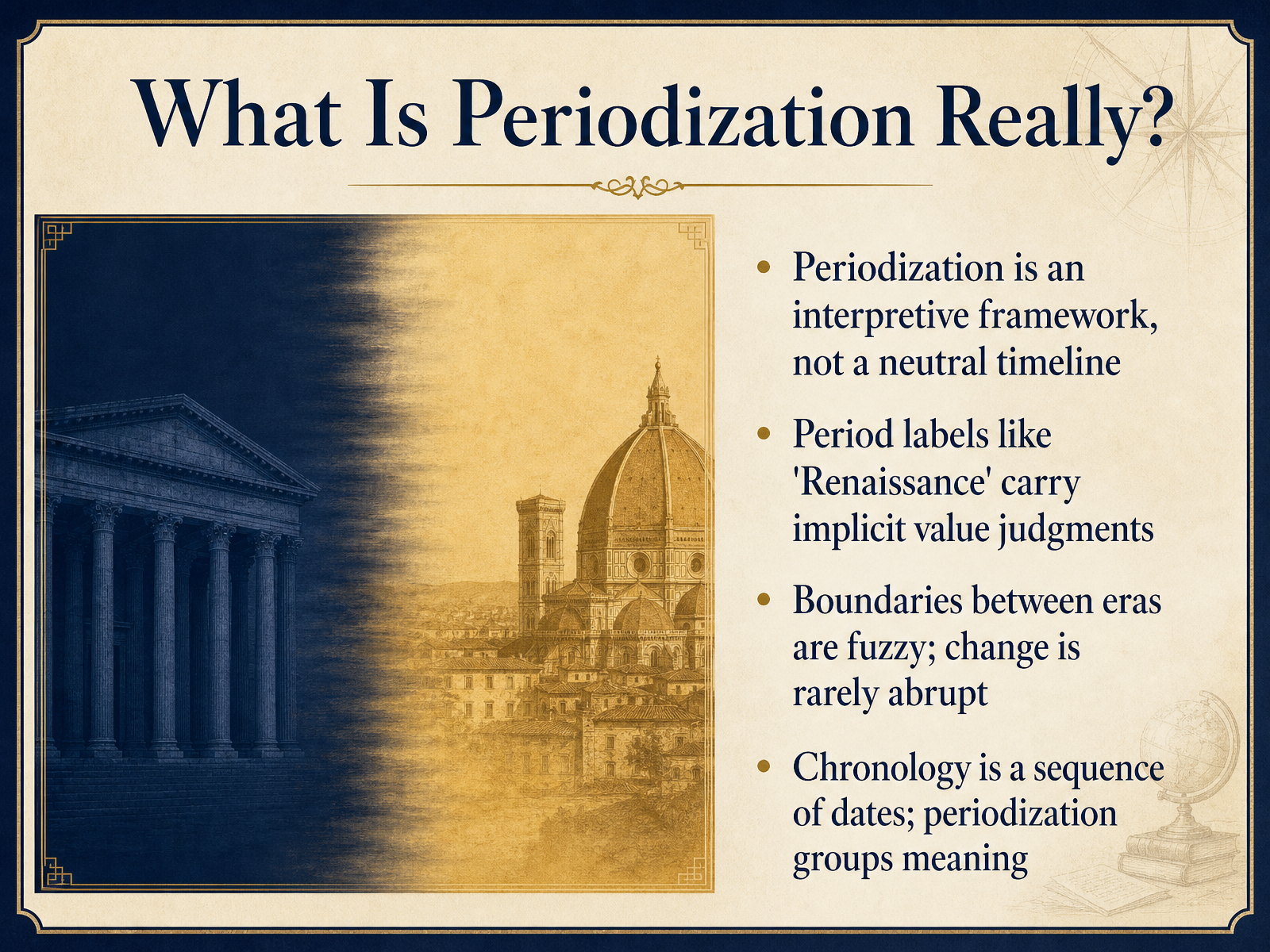
- 02What Is Periodization Really?Let's talk about what periodization really is. Think of it as a framework historians use to make sense of the past, not a neutral timeline set in stone. The labels we use, like 'Renaissance,' carry built-in judgments. Calling one era a rebirth suggests the time before it was somehow darker or less worthy, which isn't the whole truth. Boundaries between eras are also fuzzy. Change rarely happens overnight. For example, we often point to the fall of Rome in 476 CE as a sharp break, but for most people living at that time, daily life didn't just instantly transform. It's also helpful to separate chronology from periodization. Chronology is just a sequence of dates; periodization groups those dates into meaningful stories. So as we explore these eras, try to see them as helpful lenses that bring certain patterns into focus, not rigid boxes that trap the past. Next, we'll look at the most famous lens of them all: the tripartite model that divides history into ancient, medieval, and modern.
 press.uchicago.eduirl.umsl.edudataspace.princeton.edu+22 min
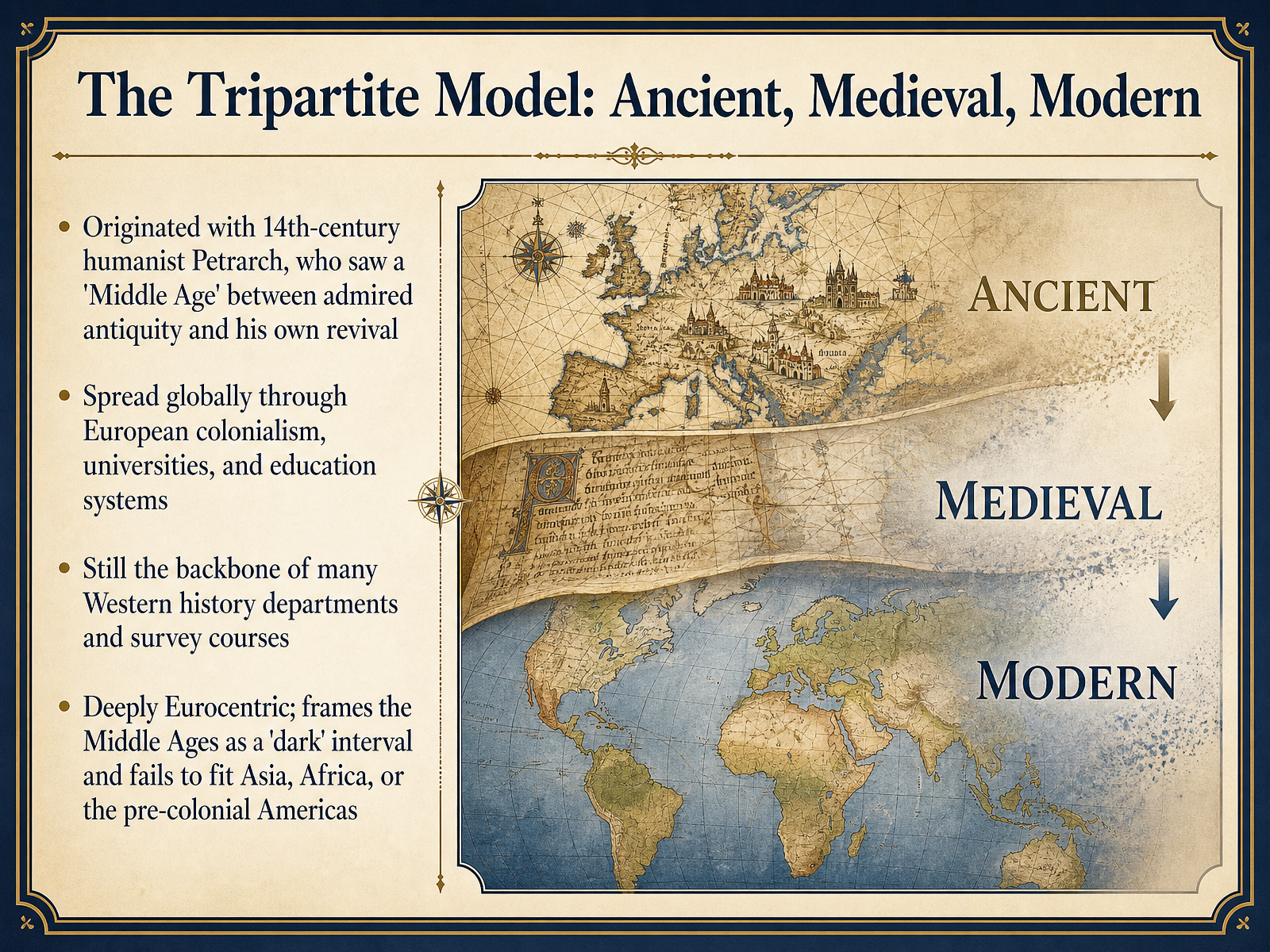
 - 03The Tripartite Model: Ancient, Medieval, ModernNow let's look at one of the most familiar frameworks: the ancient, medieval, and modern split. This idea got its start back in the fourteenth century with an Italian scholar named Petrarch. He looked back at Greece and Rome as a brilliant, admired antiquity, and he felt his own time was a revival of that greatness. So everything in between? He saw it as a forgettable 'Middle Age' between two peaks. Over centuries, European colonialism, universities, and education systems spread this three-part model around the world. It is still the backbone of many Western history departments and survey courses today. But here is the problem: it is deeply Eurocentric. It often frames the Middle Ages as a dark or empty interval, and it simply does not work for the histories of Asia, Africa, or the pre-colonial Americas. Think of it less as a universal timeline and more as one particular lens. Next, we will explore how another framework emerged from technology rather than culture: the three-age system.
 press.uchicago.eduirl.umsl.edudataspace.princeton.edu+21 min
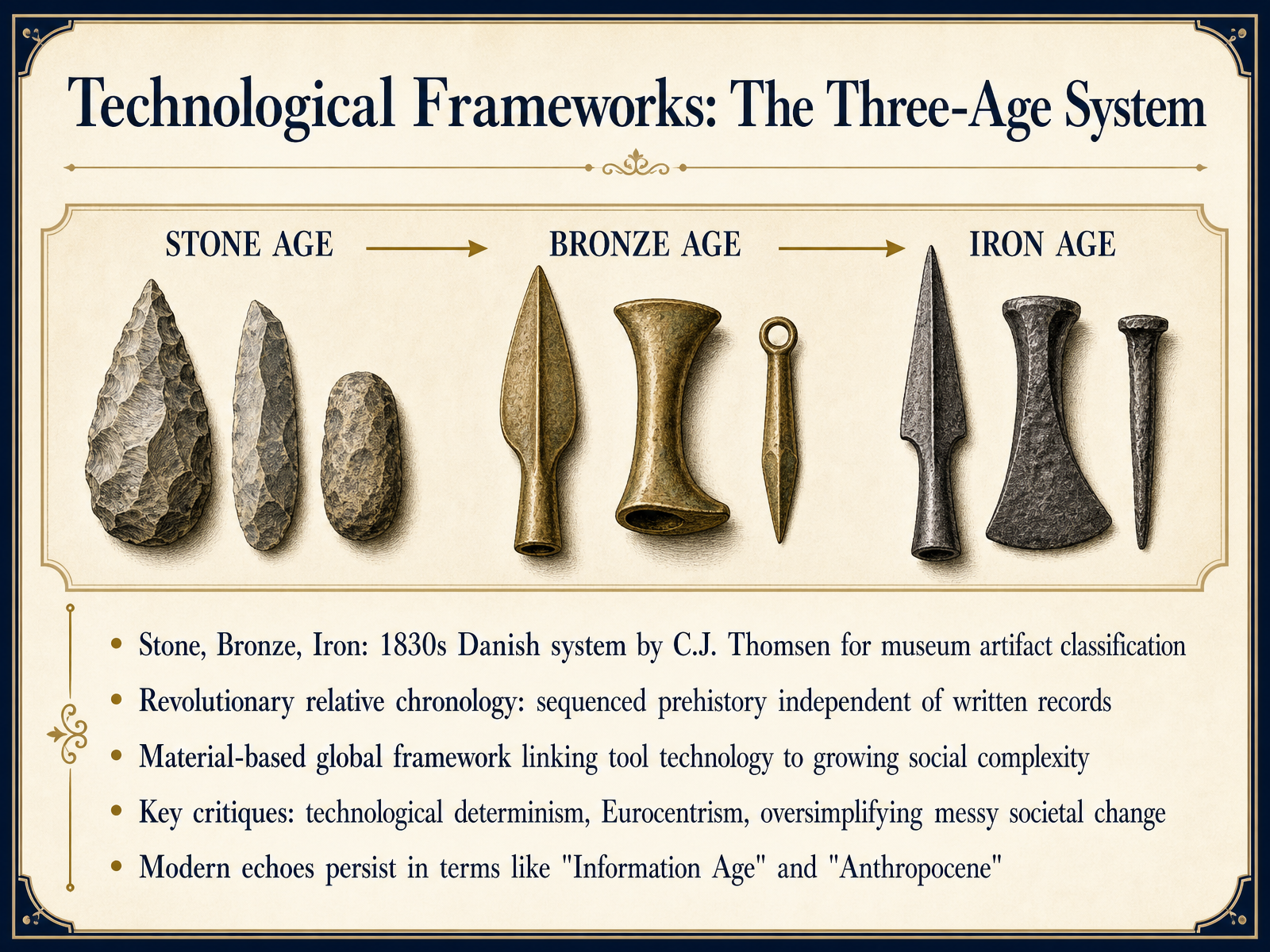
 - 04Technological Frameworks: The Three-Age SystemNow let’s shift from written records to a framework built entirely on tools and materials. This is often called the Three-Age System. Picture a Danish museum curator in the 1830s named Christian Jürgensen Thomsen. He faced a huge collection of artifacts and needed a way to organize them for display. Instead of guessing, he grouped objects that were found together. He noticed a pattern. Stone tools appeared in the earliest deposits. Bronze came later and rarely showed up with stone. Iron appeared last and almost never with bronze. So he proposed three ages: Stone, Bronze, and Iron. This was revolutionary because it created a relative chronology for prehistory that didn’t need any written records at all. It was a material-based, global way of linking tool technology to growing social complexity. But it’s not a perfect lens. Critics point out it can be technologically determinist, implying that a new metal simply drives all change. It’s also been called Eurocentric and can oversimplify messy, overlapping societal shifts. Still, its echoes are everywhere. Think about how casually we use terms like the Information Age or even the Anthropocene today. That’s the Three-Age logic, repurposed for our own time. Up next, we’ll contrast this with another powerful lens: Economic and Materialist Models, often called the Marxist Lens.
 durham-repository.worktribe.comarchaeologybulletin.orgcambridge.org+22 min
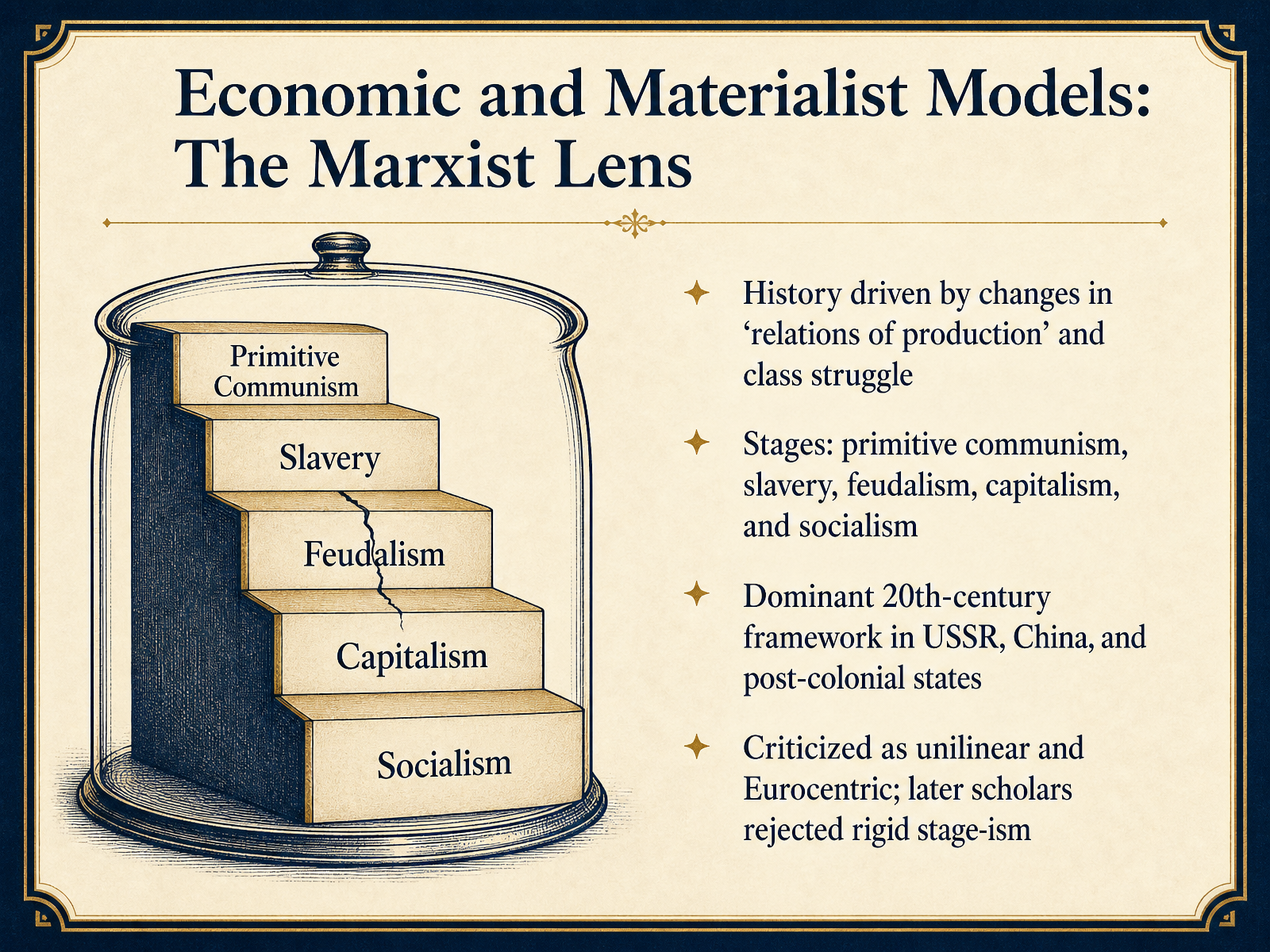
 - 05Economic and Materialist Models: The Marxist LensNow let's explore a different lens: the Marxist or materialist model of history. Karl Marx proposed that history is driven by something called the "relations of production." In plain language, that means who owns the tools and resources, and who does the work. According to Marx, tension between these groups sparks class struggle, and that conflict pushes history through a series of stages. You'll often see this laid out as a sequence: primitive communism, followed by slavery, then feudalism, then capitalism, and ultimately leading to socialism. This became a dominant framework during the 20th century, especially in the Soviet Union, China, and many post-colonial states. It offered a powerful story of progress and a roadmap for change. But here's the debate: many historians now criticize this model as too rigid and unilinear, meaning it assumes every society must follow the exact same path. It's also been called Eurocentric, because the stages often don't fit the complex histories of Africa, Asia, or the Americas. Later thinkers, including some Marxists, rejected this strict "stage-ism," arguing that history is messier and more multi-layered than a single straight line. Next, we'll shift our focus from economic systems to global connections as we look at world-systems analysis.
 journals.sagepub.comnewleftreview.orgdialnet.unirioja.es+22 min
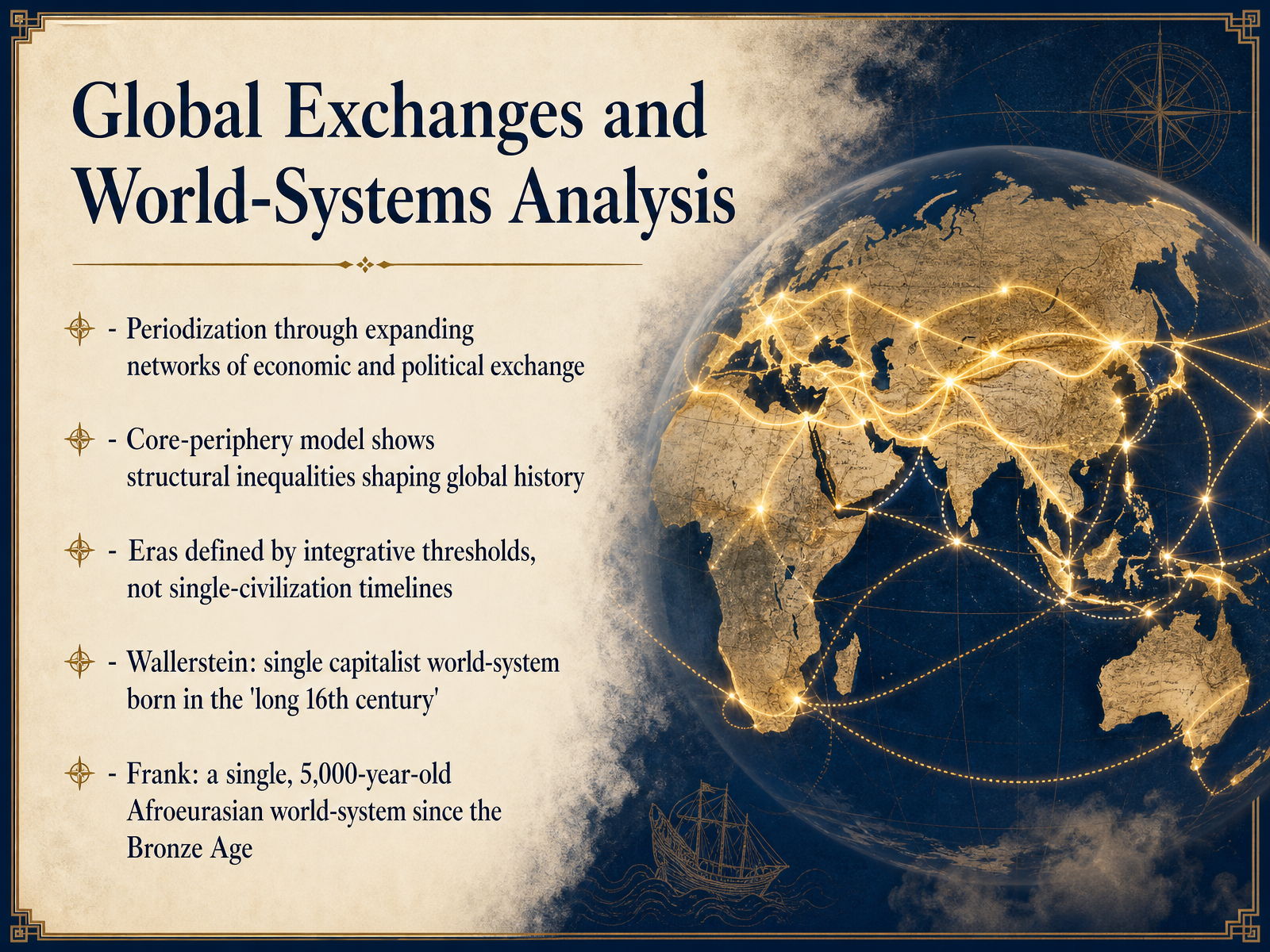
 - 06Global Exchanges and World-Systems AnalysisNow let's step back from eras centered on single civilizations and see global history through a different lens—the lens of connection. World-systems analysis shifts the focus to expanding networks of economic and political exchange. It asks: when did different parts of the world become linked enough to function as a single system? A key idea here is the core-periphery model. Think of it like a hub and spokes. Core regions accumulate wealth and power, while peripheral areas supply resources and labor. This model reveals structural inequalities that have shaped global history over centuries. Instead of using rise-and-fall dates for one empire, world-systems thinkers define eras by integrative thresholds—moments when connections deepened across large regions. Two major voices disagree on when that first threshold was crossed. Immanuel Wallerstein argues a single capitalist world-system was born in the 'long sixteenth century,' roughly 1450 to 1650, driven by European expansion. Andre Gunder Frank pushes the clock much further back. He sees one continuous world-system centered in Afroeurasia that has been operating for about five thousand years, since the Bronze Age linked the Near East with parts of Asia and Africa. These aren't just academic debates—they invite us to see eras not as boxes, but as conversations about when the world truly became interconnected. Next, we'll explore how those conversations look when we move beyond the West and examine regional, thematic alternatives.
 socialsciencelibrary.orgonlinelibrary.wiley.comlink.springer.com+22 min
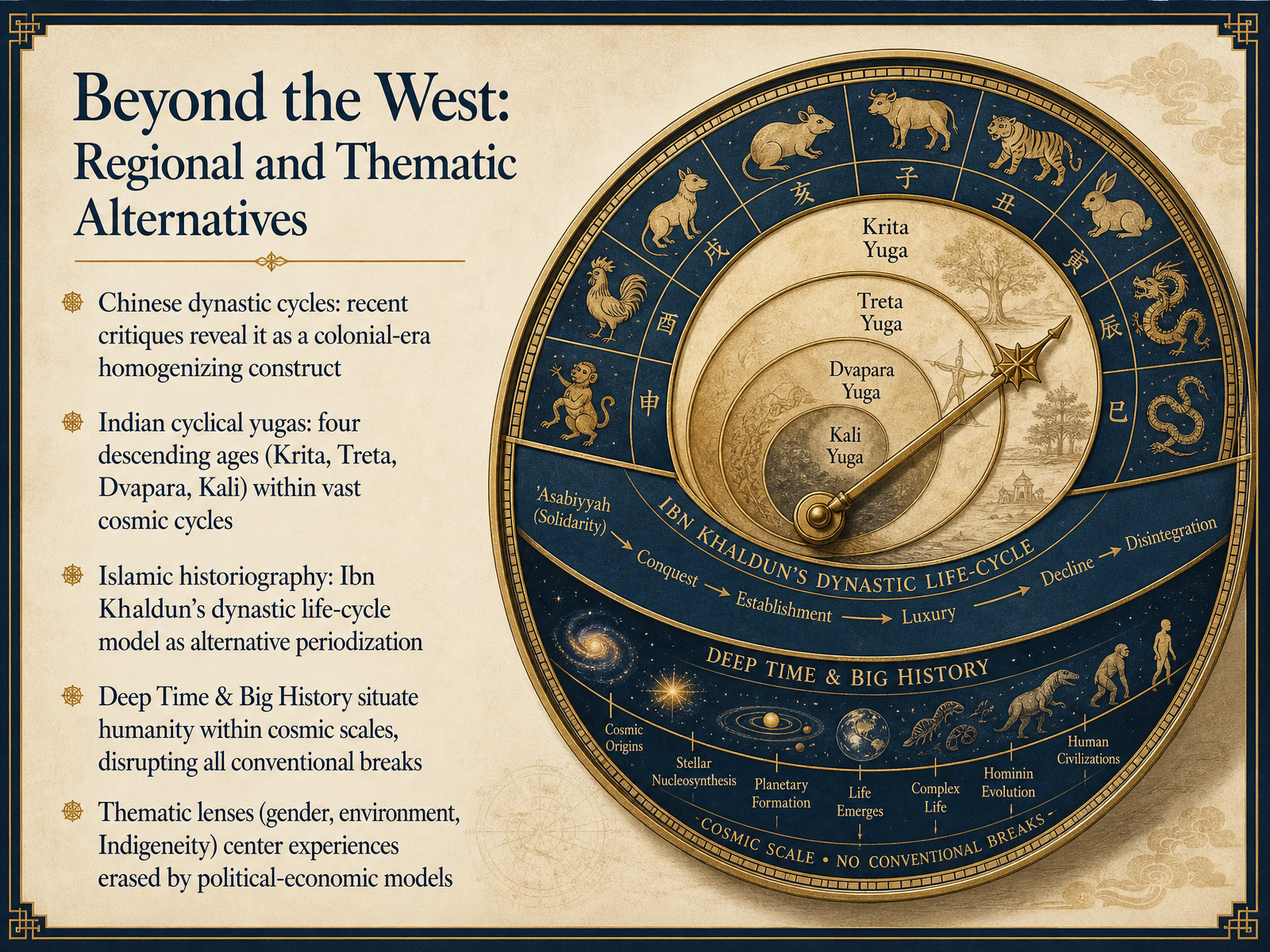
 - 07Beyond the West: Regional and Thematic AlternativesThe eras we have discussed so far come mainly from a Western, European tradition. But if we step back, we see that different civilizations carved up time in their own ways. Take the Chinese dynastic cycle. Recent scholarship criticizes this model as a colonial-era construct that made diverse states and non-Sinitic peoples disappear into a single, continuous story. In South Asia, historians developed a completely different lens: the cyclical yugas. Think of four descending ages—Krita, Treta, Dvapara, and Kali—unfolding across billions of years within vast cosmic cycles. Islamic historiography offers yet another path. The fourteenth-century scholar Ibn Khaldun proposed a life-cycle model for dynasties, where each ruling power rises, matures, and declines over about three generations. Beyond these regional models, we have deeper challenges to conventional breaks. Deep Time and Big History place humanity within cosmic and geological scales, disrupting every political or economic marker. And thematic lenses—like gender history, environmental history, or Indigenous perspectives—center experiences that political timelines often erase. Each of these alternatives reminds us that periodization is a choice, not a universal truth. On the next slide, we will examine one of the most debated choices of our own time: The Great Debate: The Anthropocene as a New Epoch.
 durham-repository.worktribe.comarchaeologybulletin.orgcambridge.org+22 min
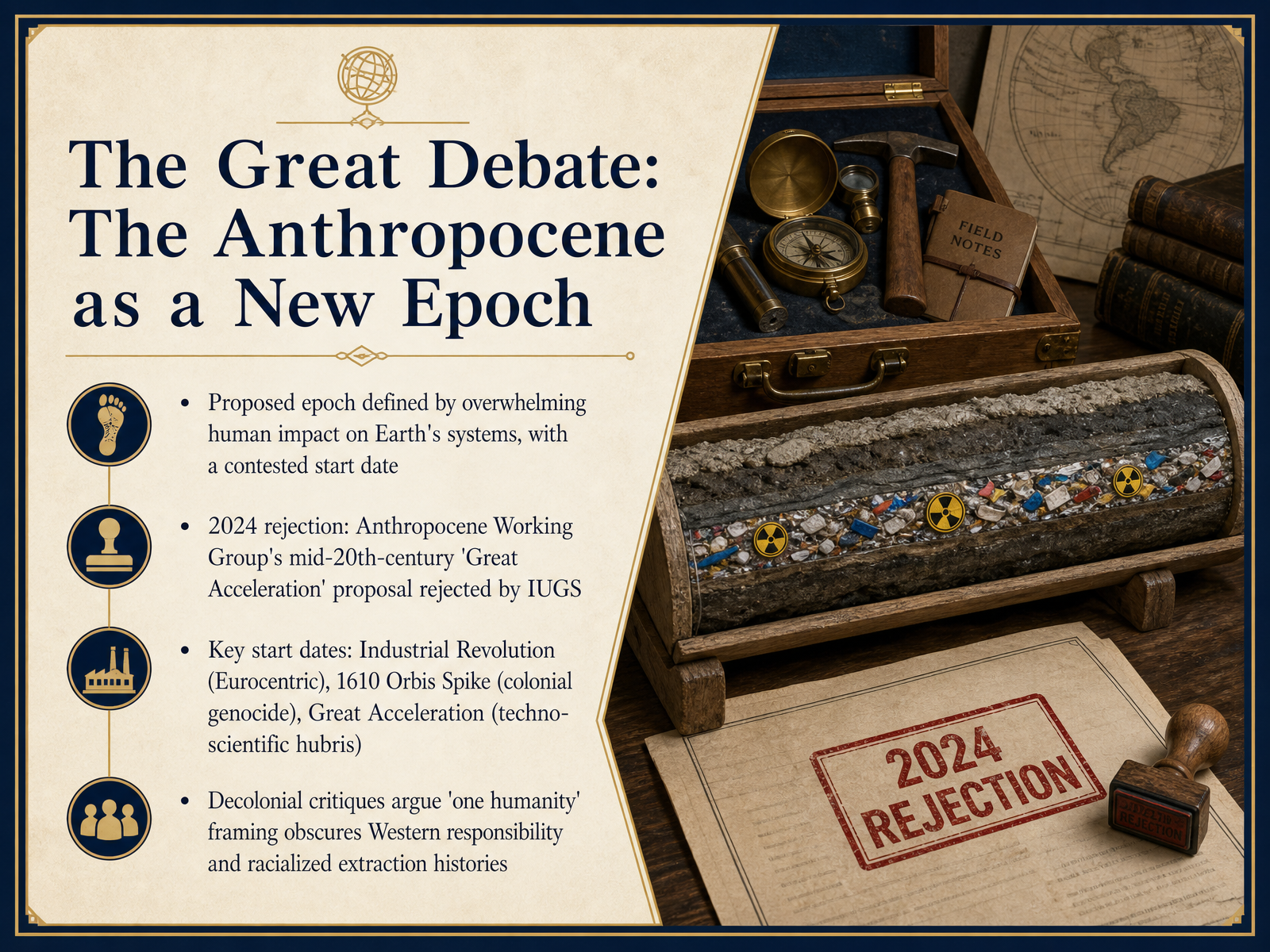
 - 08The Great Debate: The Anthropocene as a New EpochNow let's look at a proposal that has sparked enormous debate: the Anthropocene, a potential new epoch defined by overwhelming human impact on Earth's systems. The challenge is choosing when it started. In twenty twenty-four, a formal proposal to anchor the Anthropocene's start in the mid-twentieth century Great Acceleration was rejected by the geological body in charge. But the idea remains powerful. Some scientists point to the Industrial Revolution, though critics note that centers Europe's story. Others propose the year 1610, when the arrival of Europeans in the Americas triggered a massive population decline, changing land use on a planetary scale. This is sometimes called the Orbis Spike. Still others argue for the Great Acceleration itself, tied to atomic testing and a postwar boom in consumption and industry. Underpinning this debate is a deeper concern. Decolonial scholars warn that the umbrella term 'one humanity' can hide a harsh reality: global environmental change was driven disproportionately by Western powers through colonialism and racialized extraction. So the question isn't just when the Anthropocene started, but whose history gets told, and who bears the responsibility. Next, we'll explore how to make these shifting periods visible in the classroom.
 2 min
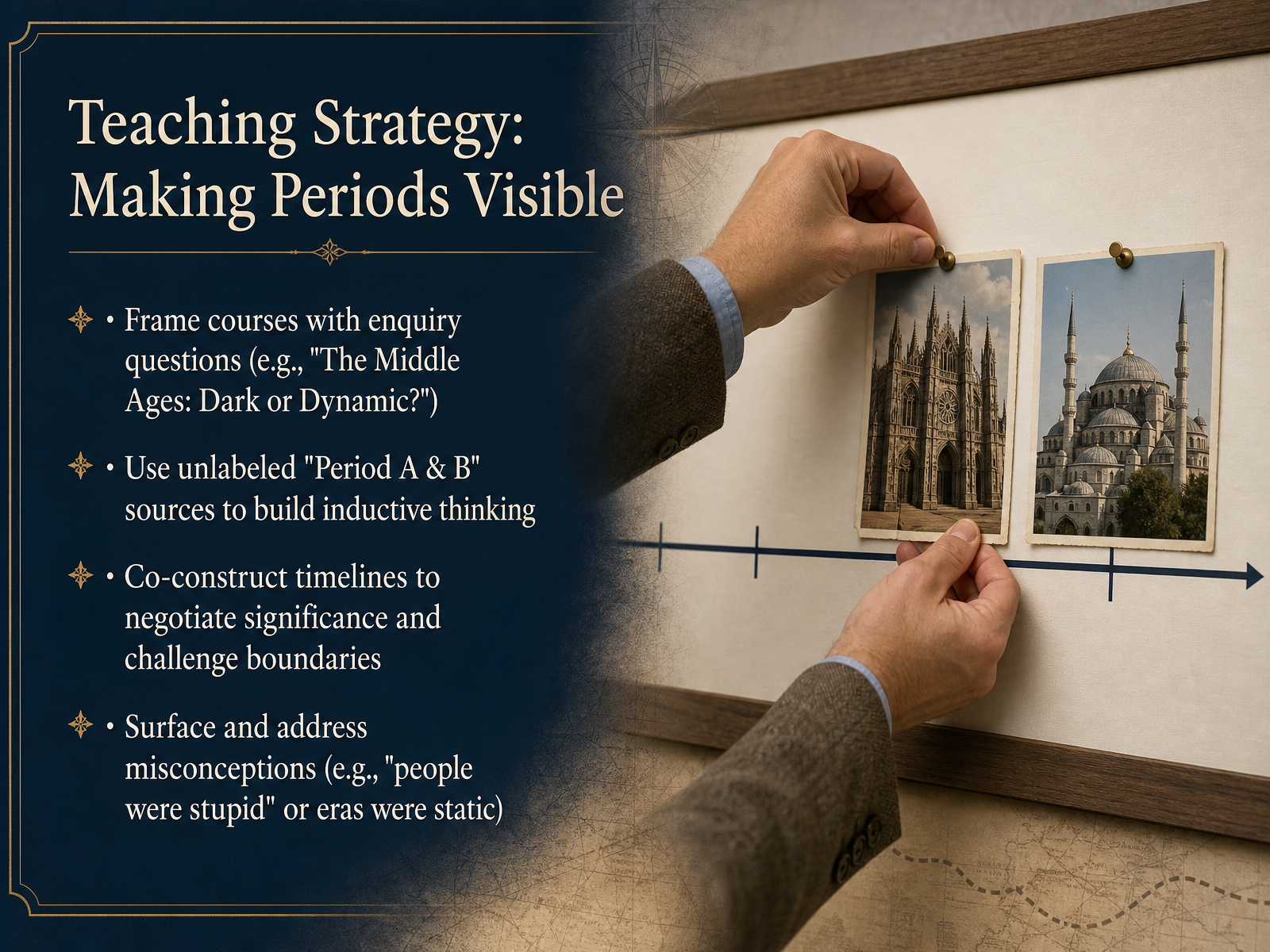
2 min - 09Teaching Strategy: Making Periods VisibleSo how do we turn this from an abstract idea into something students can actually see and touch? A really powerful starting point is to frame your entire course with a big enquiry question. Something like, 'The Middle Ages: Dark or Dynamic?' That one question immediately signals that a period is a debate, not a fixed label. Another strategy is to present sources from two different eras, but simply label them 'Period A' and 'Period B'. By removing the familiar names, you remove the preconceptions. Suddenly, students have to build their own generalizations based purely on the evidence in front of them. Then, you can take it a step further and co-construct a timeline together as a class. Let them negotiate which events really mark a turning point and where the boundaries should be drawn. This naturally surfaces and lets you address common misconceptions, like the idea that everyone in the past was 'stupid' or that an entire era was just static and unchanging. Next, we'll look at a specific interactive method for doing this: the Timeline Game and how it helps students synthesize eras.
 2 min
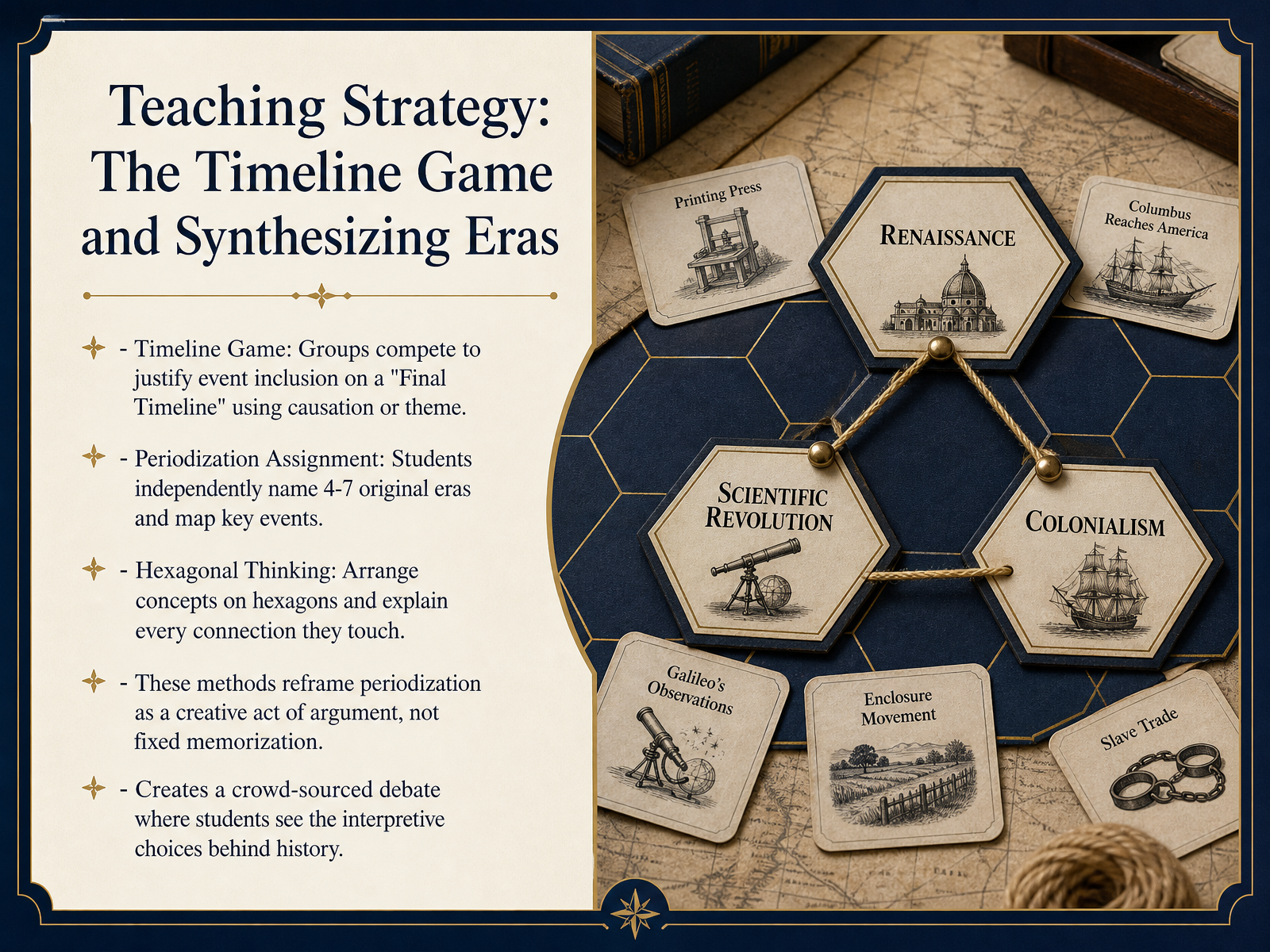
2 min - 10Teaching Strategy: The Timeline Game and Synthesizing ErasNow let's look at three practical ways to turn periodization into a creative classroom activity. The first is the Timeline Game. Groups compete to get their chosen events onto a single class timeline. But here's the key: they must justify each event using causation or a course theme. This isn't about guessing right answers; it's about building historical arguments. The second method is a periodization assignment. Students work independently to name four to seven original eras and map key events to them. They become the historians, deciding where one era ends and another begins. The third is Hexagonal Thinking. You write concepts on hexagon tiles and ask students to arrange them, explaining every connection where two tiles touch. This turns abstract ideas into a visual web of relationships. All three methods reframe periodization as a creative act of argument, not fixed memorization. They create a crowd-sourced debate where students see the interpretive choices behind every historical label. Up next, we'll explore critical questions and conceptual tools that push this thinking even further.
 2 min
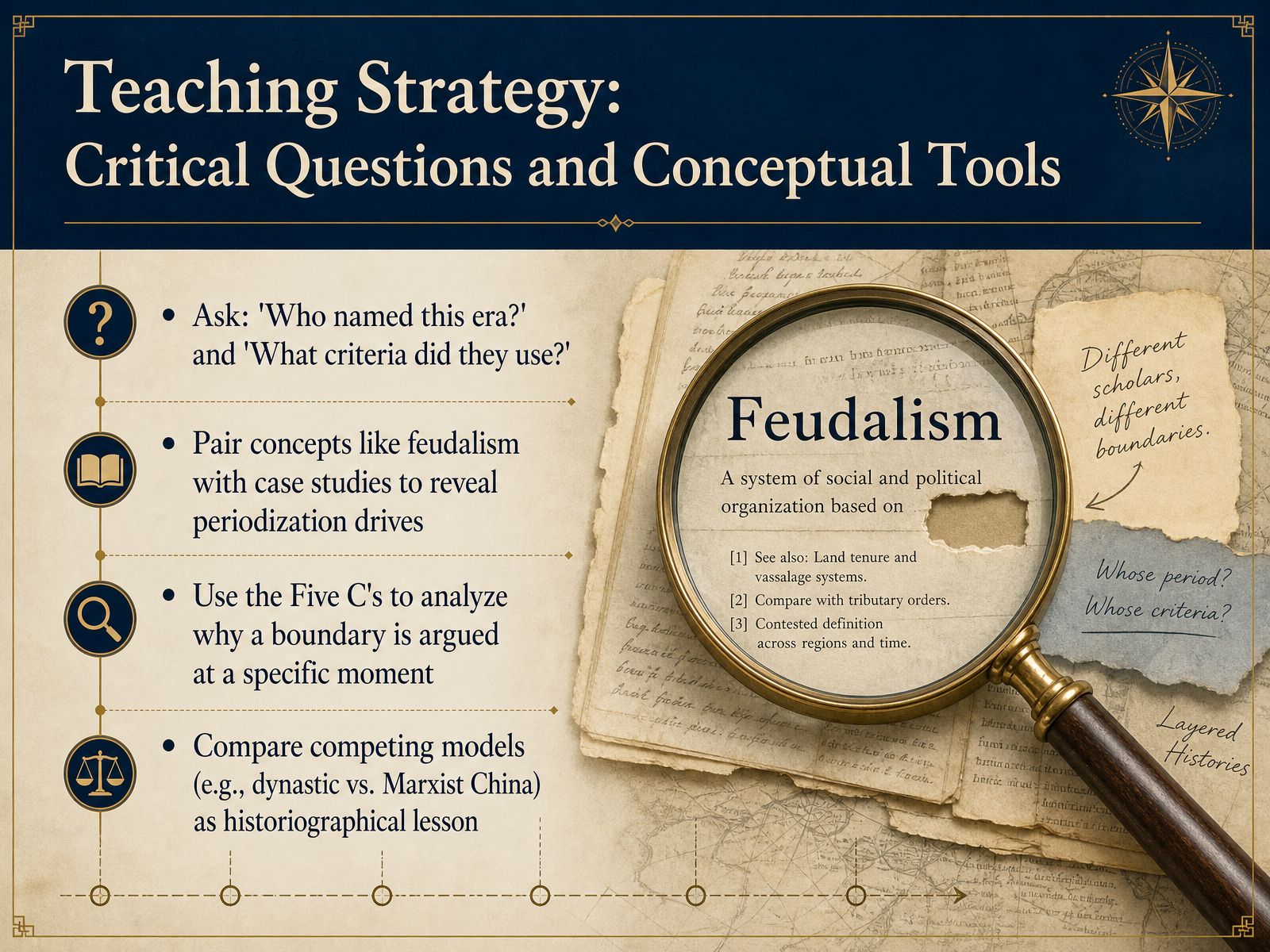
2 min - 11Teaching Strategy: Critical Questions and Conceptual ToolsNow let’s turn this idea into a practical classroom strategy. When we teach periodization, we don’t just hand students a timeline and ask them to memorize it. We start with critical questions. Two of the most powerful ones are: “Who named this era?” and “What criteria did they use?” Those simple questions immediately turn a static label into a decision that can be debated. Next, pair big concepts—like feudalism—with a real case study. If students see how the concept of feudalism drives where we draw the boundary of the Middle Ages, they start to detect the engine behind periodization. We can also use the Five C’s of historical thinking: Change over Time, Context, Causality, Contingency, and Complexity. Walk through a single turning point and ask: which of the Five C’s best explains why a historian argues the boundary belongs here, not there? Finally, compare competing models. For Chinese history, put the traditional dynastic model side by side with a Marxist model. Students see that the same past can be sliced into completely different eras, depending on the lens you choose. That realization is a rich historiographical lesson in itself. Up next, we’ll look at the challenges and pitfalls of periodization.
 2 min
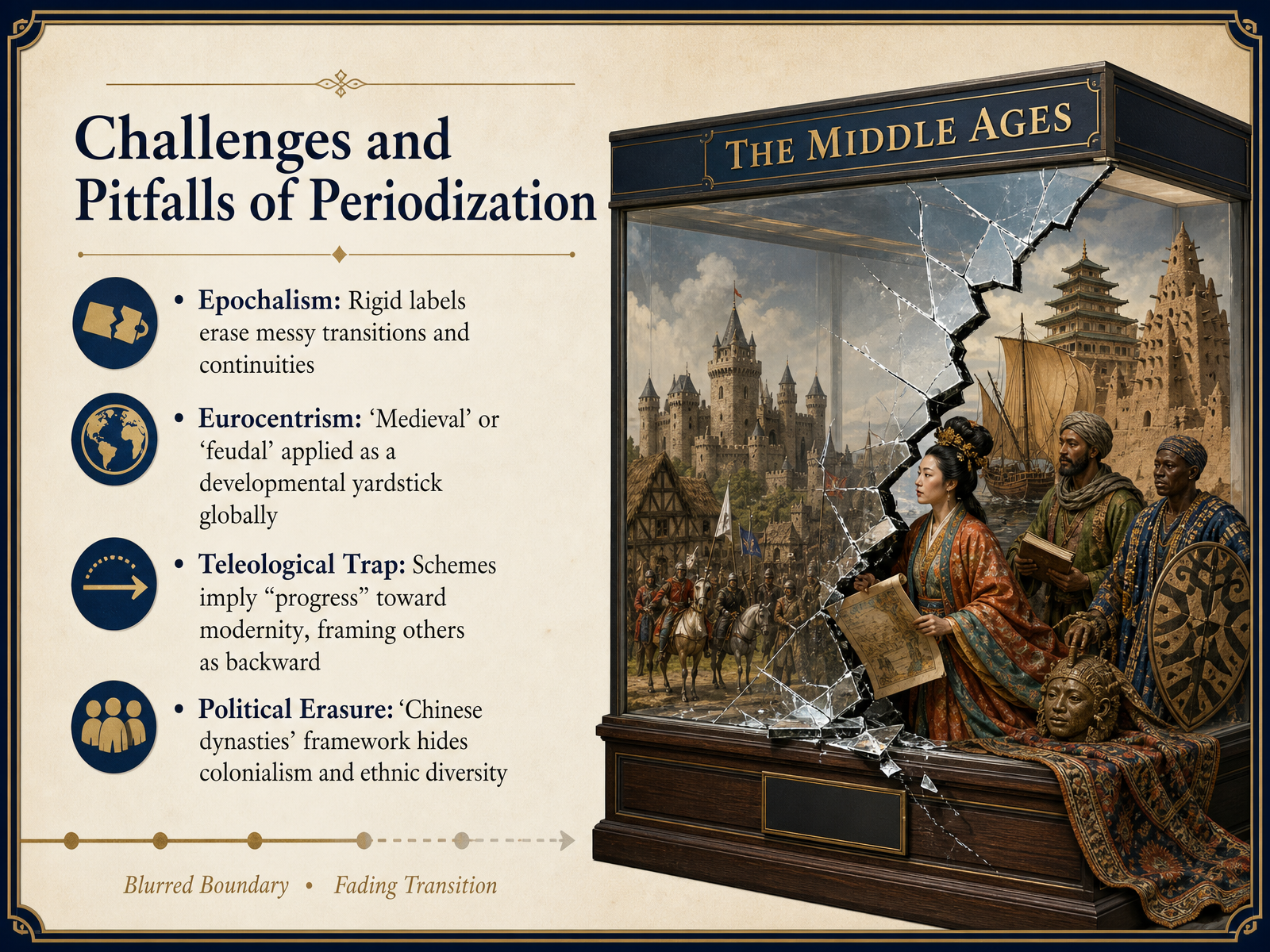
2 min - 12Challenges and Pitfalls of PeriodizationAs we settle into these ideas, let's flip the lens and look at the pitfalls that hide inside periodization. The first is what scholars call epochalism. That's the habit of drawing sharp lines and then treating a rigid label like 'the Middle Ages' as the full story. Real life doesn't switch overnight, and those messy transitions and continuities often get erased. Another major trap is Eurocentrism. Historically, terms like 'medieval' or 'feudal' have been used as a global developmental yardstick. When we apply them to places like India or China, we sometimes end up measuring other civilizations against a European timeline, which can frame them unfairly as backward. We also need to watch out for a teleological trap. Many schemes secretly point toward 'modernity' as the goal of history, implying that any society not on that path is somehow stalled. Finally, be cautious of political erasure. For a long time, the framework of 'Chinese dynasties' has projected an image of smooth, unified succession, but that image can hide centuries of military colonialism and the rich ethnic diversity of non-Sinitic peoples who were governed within those borders. These lenses aren't just academic exercises; they're choices that shape who belongs in the story. Now that we've seen the challenges, let's step back and focus on a solution in the next slide: Choosing A Framework: Transparency and Purpose.
 2 min
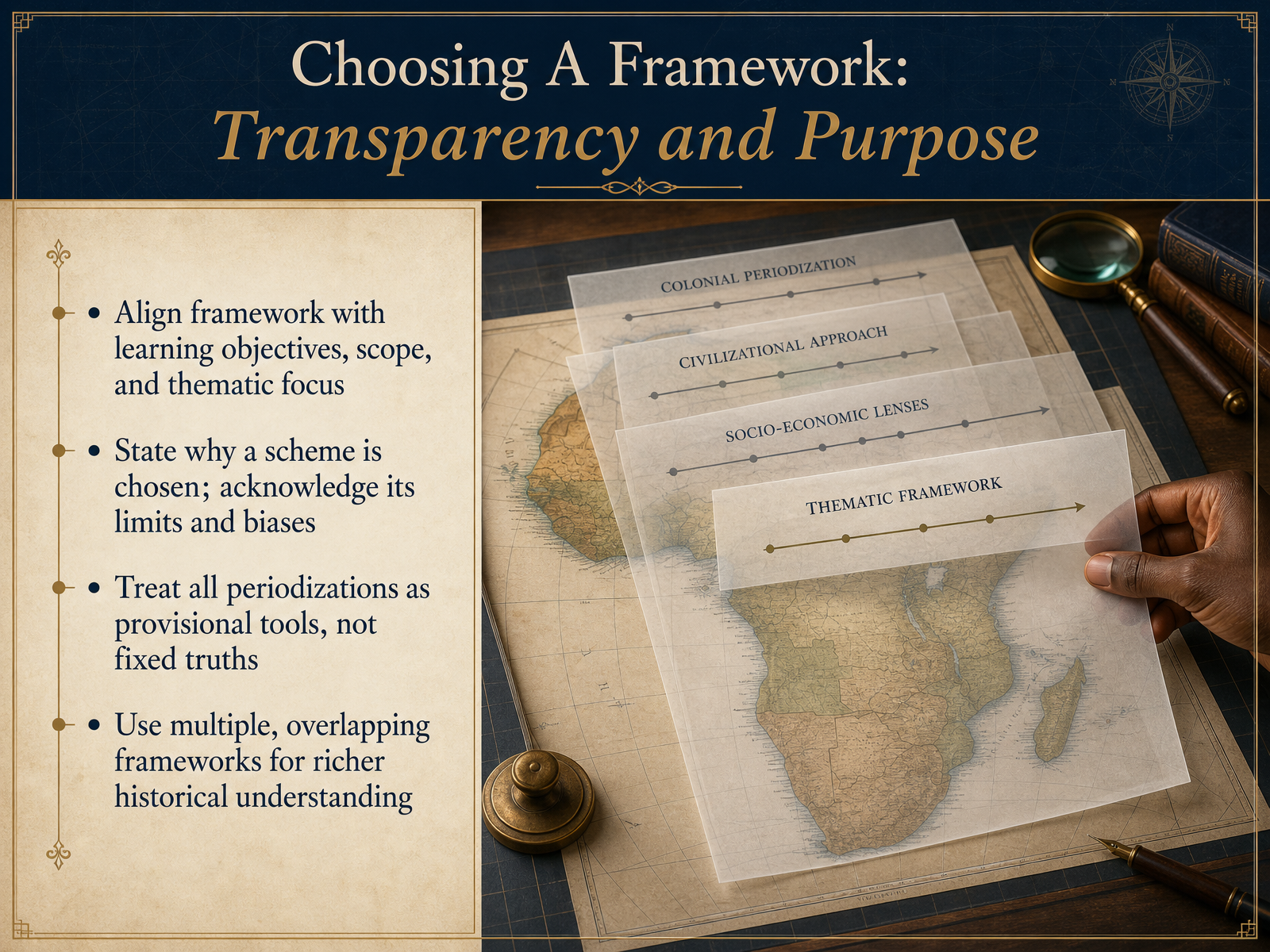
2 min - 13Choosing A Framework: Transparency and PurposeSo, with all these options, how do we actually choose a framework to use? This slide gives us a clear and honest path forward. First, align the framework with what you are trying to teach or learn. Your learning objectives, the scope, and your thematic focus should guide your choice. If you are studying economic history, your turning points might look very different from a course on cultural movements. Second, state your reasons clearly. Tell your students or your audience, 'We are using this scheme because it highlights X, but it does mean we are downplaying Y.' Acknowledge its limits and its biases right from the start. And that leads to the third point, which is really the heart of this approach. Treat every periodization as a provisional tool, not a fixed truth. Think of it like a pair of glasses that helps you see certain details, but you can always swap them for a different pair. Finally, the most powerful strategy is to use multiple, overlapping frameworks. Layering a political periodization on top of an economic one, for example, creates a much richer, more complex understanding of the past. Ultimately, the goal is transparency. Being honest about why we draw the lines where we do makes history more honest, and far more interesting. Next, we will bring everything together in our final slide: 'Conclusion: Thinking Historically Through Periods.'
 cup.columbia.edu2 min
 - 14Conclusion: Thinking Historically Through PeriodsAs we reach the end, let's pull back and think about what this all means. Periodization is an inescapable tool. It shapes how we understand history, but it's also deeply interpretive. Every single system you encounter, whether it's ancient, medieval, modern, or another framework, embeds value judgments. No scheme is neutral or universally applicable. The 2024 vote on the Anthropocene, and the constant debate around terms like 'dynastic cycle', prove these are not just academic questions. They are live, political debates happening right now. So, what's our takeaway? Approach all eras as provisional hypotheses, not rigid boxes. Interrogate who built them, and for what purpose, and embrace a sense of productive uncertainty. History isn't a sealed record. It's a living, breathing conversation we are all a part of. Thank you for joining me on this exploration, and keep questioning the maps of time you encounter.
 press.uchicago.eduirl.umsl.edudataspace.princeton.edu+22 min
Take the deck with you
Download this course as a file — free, no sign-up needed.
- PDF handoutEvery slide page, ready to print or share.15 pages · 6.2 MBDownload
- Narrated PowerPointThe deck that presents itself — every slide carries the digital human's narration video.15 pages · 17.9 MBDownload
- PowerPoint slidesThe full deck as a .pptx — open it in PowerPoint, Keynote, or Google Slides.15 pages · 6.2 MBDownload
Free to use in your own training — please keep the PersonWise credit page at the end.
Have your own deck? Turn it into a course
Sources consulted
Web sources consulted while building this course.
- Dividing Time: The Invention of Historical Periods in Early Modern Europe, Clark — press.uchicago.edu
- The End of the Middle Ages and the Problem of Periodization — irl.umsl.edu
- DataSpace: Dividing Time: The Making of Historical Periodization in Early Modern Europe — dataspace.princeton.edu
- Must We Divide History Into Periods? | Columbia University Press — cup.columbia.edu
- From Ancient to Medieval Historical Thinking (Chapter 4) - Turning Points in Historiography — cambridge.org
- From Genesis to Prehistory. The archaeological Three Age System and its contested reception in Denmark, Britain and Ireland — durham-repository.worktribe.com
- The Three Age System in English: new translations of the founding documents | Bulletin of the History of Archaeology — archaeologybulletin.org
- Craniology and the Adoption of the Three-Age System in Britain — cambridge.org
- Project MUSE - The Background of Thomsen’s Three-Age System — muse.jhu.edu
- Peter Rowley-Conwy, From Genesis to Prehistory. The Archaeological Three Age System and its Contested Reception in Denmark, Britain, and Ireland. (Oxford: Oxford University Press [Oxford Studies in the History of Archaeology], 2007, 362pp., 55 figs., hbk, ISBN 987 0 19 922774 7). — cambridge.org
- A Marxist Critique of Marx's Theory of History: Beyond the Dichotomy between Scientific and Critical Marxism — journals.sagepub.com
- Problems of Marxist History — newleftreview.org
- Main Interpretations of Marx's Notion of Development:: A Critical Review - Dialnet — dialnet.unirioja.es
- Universality, Necessity, and Progress: Marx and the Problem of History — scholarsjunction.msstate.edu
- Accumulation and time: Marx’s historiography from the Grundrisse to Capital — journals.sagepub.com
- The Social Science Library » Periodizing World History — socialsciencelibrary.org
- The Historical Evolution of World-Systems * — onlinelibrary.wiley.com
- The Globalization of World-Systems: Time-Mapping Systemic Boundaries | Springer Nature Link — link.springer.com
- The ‘Age’ of Globalization. How Old is the Global World? — sociostudies.org
- Periodizing Globalization: Histories of Globalization — ideas.repec.org