Oral History: Memory & Interpretation
Begin
9 pages · ~18 min
Oral History: Memory & Interpretation
An introductory training for learners on the fundamentals of oral history, focusing on memory, crafting effective questions, and interpreting personal narratives.
What you’ll learn
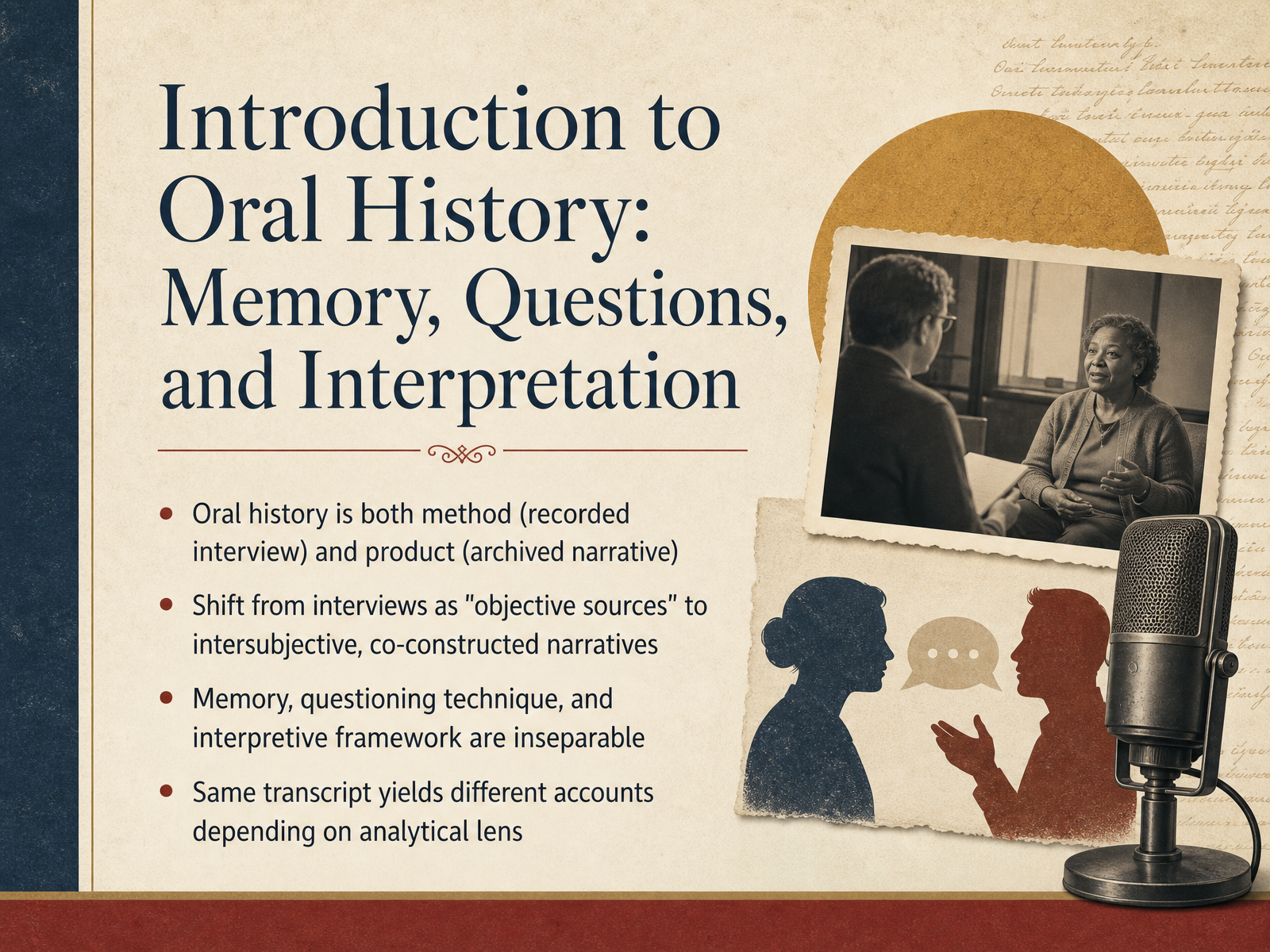
- 01Introduction to Oral History: Memory, Questions, and InterpretationWelcome to this exploration of oral history. Our goal today is not simply to learn what oral history is, but to approach it as critical analysts. We will treat interviews and oral materials as historical sources shaped by perspective and context, and we will practice reading and questioning them through that lens. This first session starts with a foundational question: what exactly is oral history? The term refers to two inseparable things. It is both a method, the recorded interview itself, and a product, the archived narrative that results from that process. Understanding this dual identity is crucial. In scholarly practice, we have moved away from treating interviews as objective sources that simply extract fixed facts. Instead, we now understand them as intersubjective narratives, co-constructed by the interviewer and the narrator in a specific moment. Now consider what that means. Memory, questioning technique, and the interpretive framework we bring are not separate concerns. They are inseparable. For instance, how a question is asked, what the narrator chooses to recall, and the social context of the telling all merge to create the account we hear. This leads to a provocative challenge. If you take a single interview transcript and examine it through different analytical lenses, you will often find it yields different historical accounts. An economic historian, a scholar of trauma, and a linguist might each draw distinctly different yet valid evidence from the very same words. So as we proceed, think of every interview as a site where meaning is actively constructed, not simply retrieved. Let us move now to our next slide, 'The Interview as a Constructed Scene,' where we begin to unpack that very construction.oralhistory.orgoralhistory.orgoralhistory.org+22 min
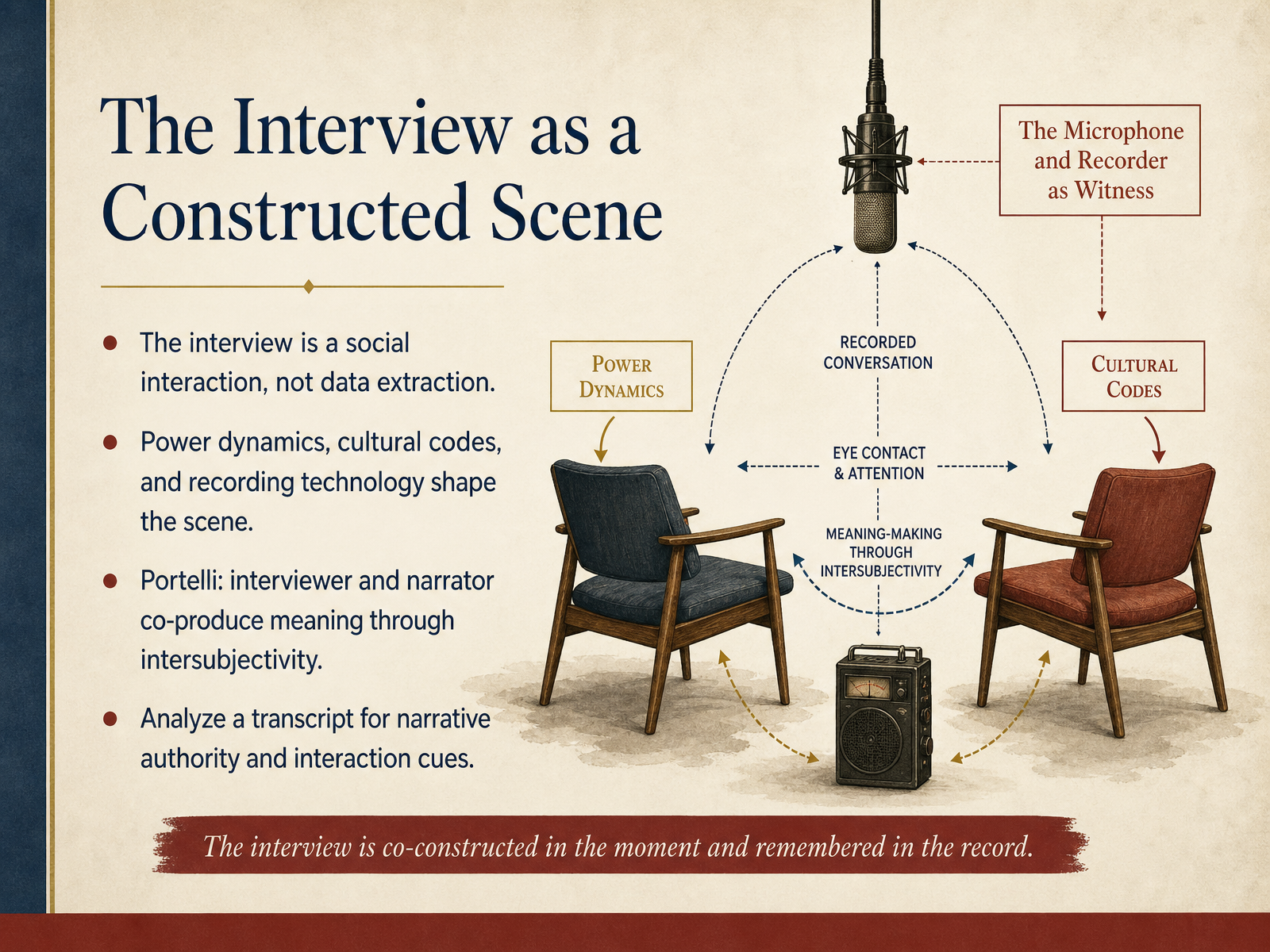
- 02The Interview as a Constructed SceneNow let us consider the interview not as a neutral data extraction, but as a constructed social scene. What happens when two people, a recorder, and a set of shared cultural codes meet in one room? The interview becomes a performance shaped by power dynamics and unspoken rules. Who holds the authority to ask, and who consents to tell? Alessandro Portelli argues that meaning is not simply collected by the interviewer. Rather, both participants co-produce it through what he calls intersubjectivity, a mutual exchange of gazes and expectations. So, when you analyze a transcript, look beyond the facts. Ask where narrative authority is claimed, resisted, or shared. Notice the subtle interaction cues: an interruption, a pause, a shift in tone. These moments reveal how the story was negotiated. This leads us directly to our next topic: Memory as Meaning-Making, Not Retrieval.
 doi.orgdoi.orgarchive.eclass.uth.gr+22 min
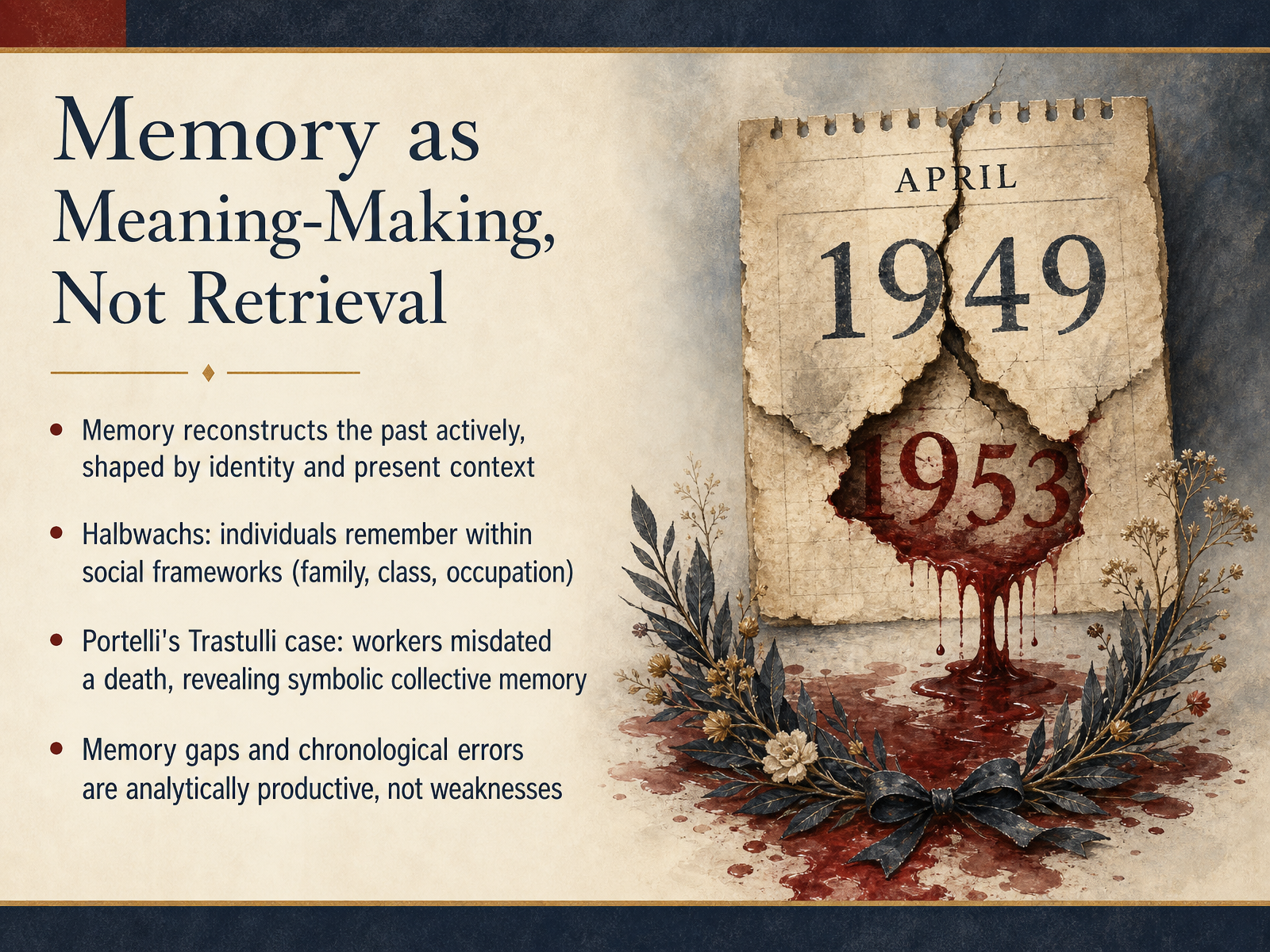
 - 03Memory as Meaning-Making, Not RetrievalLet's now consider memory not as a fixed record, but as an active process of meaning-making. Rather than simply retrieving the past, we continually reconstruct it, shaped by our present identity and context. The sociologist Maurice Halbwachs argued that individuals always remember within social frameworks: families, classes, and occupational groups. For Halbwachs, memory gains coherence and durability through this collective dimension. This insight transforms how we read interviews. A powerful example is Alessandro Portelli's work on the death of Luigi Trastulli, a young steelworker killed in Terni, Italy, in 1949. Decades later, many narrators insisted his death occurred during 1953 layoff protests. On the surface, this is a factual error. Yet Portelli asks: what does this chronological shift mean? By moving the event, narrators connected Trastulli's death to a more meaningful struggle over jobs and working-class identity, not a distant NATO treaty. The misdating reveals a symbolic collective memory, not a simple mistake. For us, this means that memory gaps, silences, and chronological errors are not weaknesses in our sources. They are analytically productive. They invite us to ask what present concerns and group loyalties are reshaping the story. In our next session, we will examine how narrative structure and linguistic choices become evidence in their own right.
 sunypress.edunytimes.comsup.org+22 min
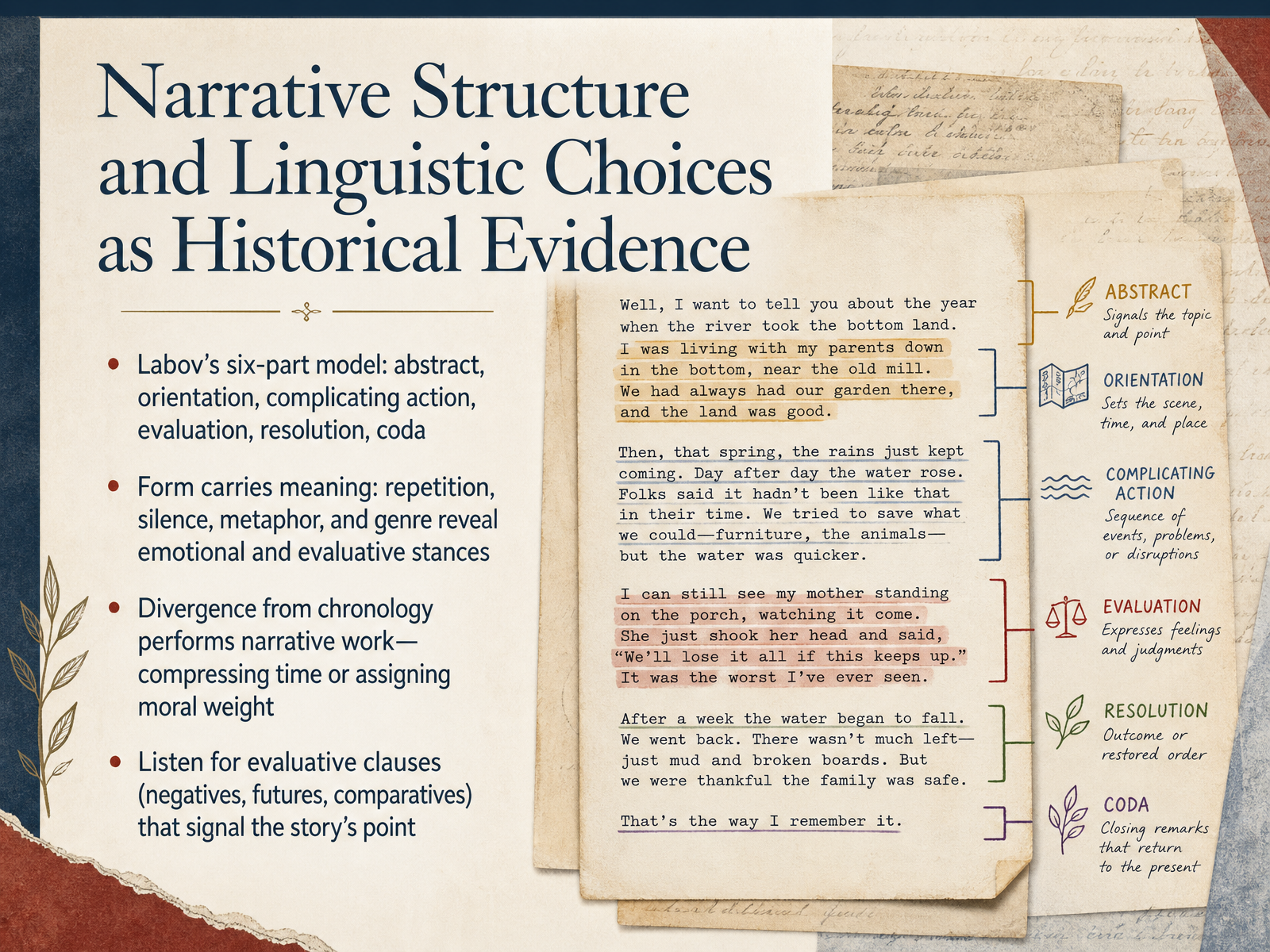
 - 04Narrative Structure and Linguistic Choices as Historical EvidenceHere we move from what is said to how it is structured. A story’s form carries its own historical evidence. Consider Labov’s six-part model: abstract, orientation, complicating action, evaluation, resolution, and coda. Where does the narrator place the evaluation? That decision signals what the event meant. Now listen for linguistic choices. Repetition, a strategic silence, or a sudden metaphor can reveal an emotional or judgmental stance that a transcript alone might hide. What work is a metaphor performing when a witness calls an uprising a festering wound? Also, track where the story diverges from strict chronology. When a narrator compresses a decade into a single sentence, or dwells on one moment, they assign moral weight and meaning. Finally, sharpen your ear for evaluative clauses. Sentences built on negatives, futures, or comparatives often expose the story’s core argument. Why is the narrator telling you what did not happen, or what almost was? That is where the interpretive challenge lives. Let’s take that focus on meaning into the next step: Question Design as Framing the Interpretive Horizon.
 oralhistoryaustralia.org.aujbe-platform.cometheses.whiterose.ac.uk+22 min
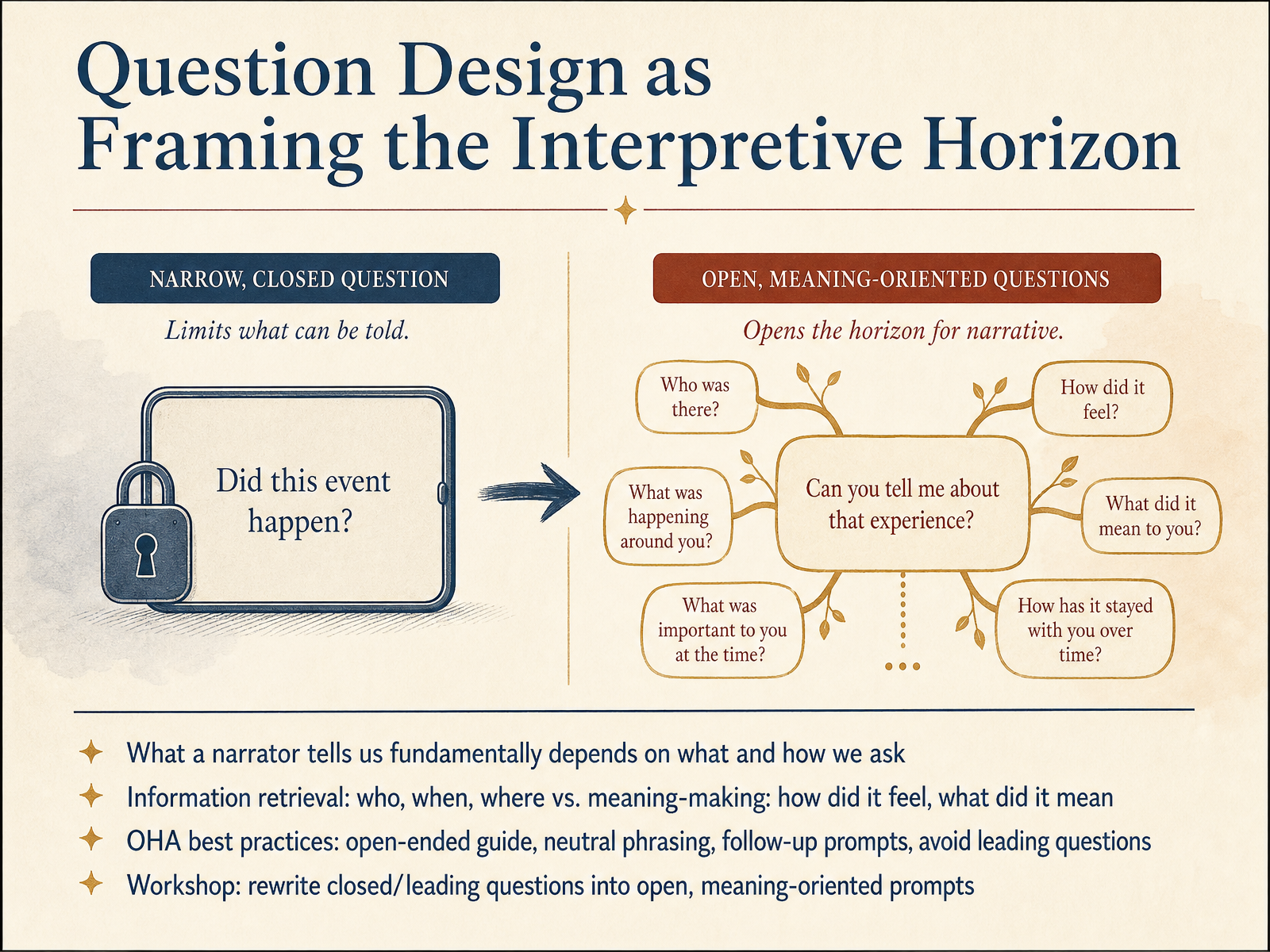
 - 05Question Design as Framing the Interpretive HorizonConsider this central idea: what a narrator tells us rests almost entirely on what we ask, and how we ask it. There is a real difference between questions designed for information retrieval—the who, when, and where—and those designed for meaning-making: how did it feel? What did it signify in your life at the time? One gives you a timeline; the other opens a window into memory’s interpretive work. Best practice from the Oral History Association therefore emphasizes an open-ended guide, neutral phrasing, and follow-up prompts that pursue clarification. Leading questions, on the other hand, can implant the interviewer’s assumptions into the narrator’s recall, reshaping the memory itself. Here is a workshop challenge for you: take a closed or leading question—for instance, “Wasn’t that a frightening experience?”—and rewrite it as an open, meaning-oriented prompt, such as, “Tell me what that experience was like for you.” Practice this shift in your own note-taking. Next, we will turn to the interpretive challenges of what goes unsaid: Silence, Omission, and the Ethics of Interpretation.
 oralhistory.orgoralhistory.orgoralhistory.org+22 min
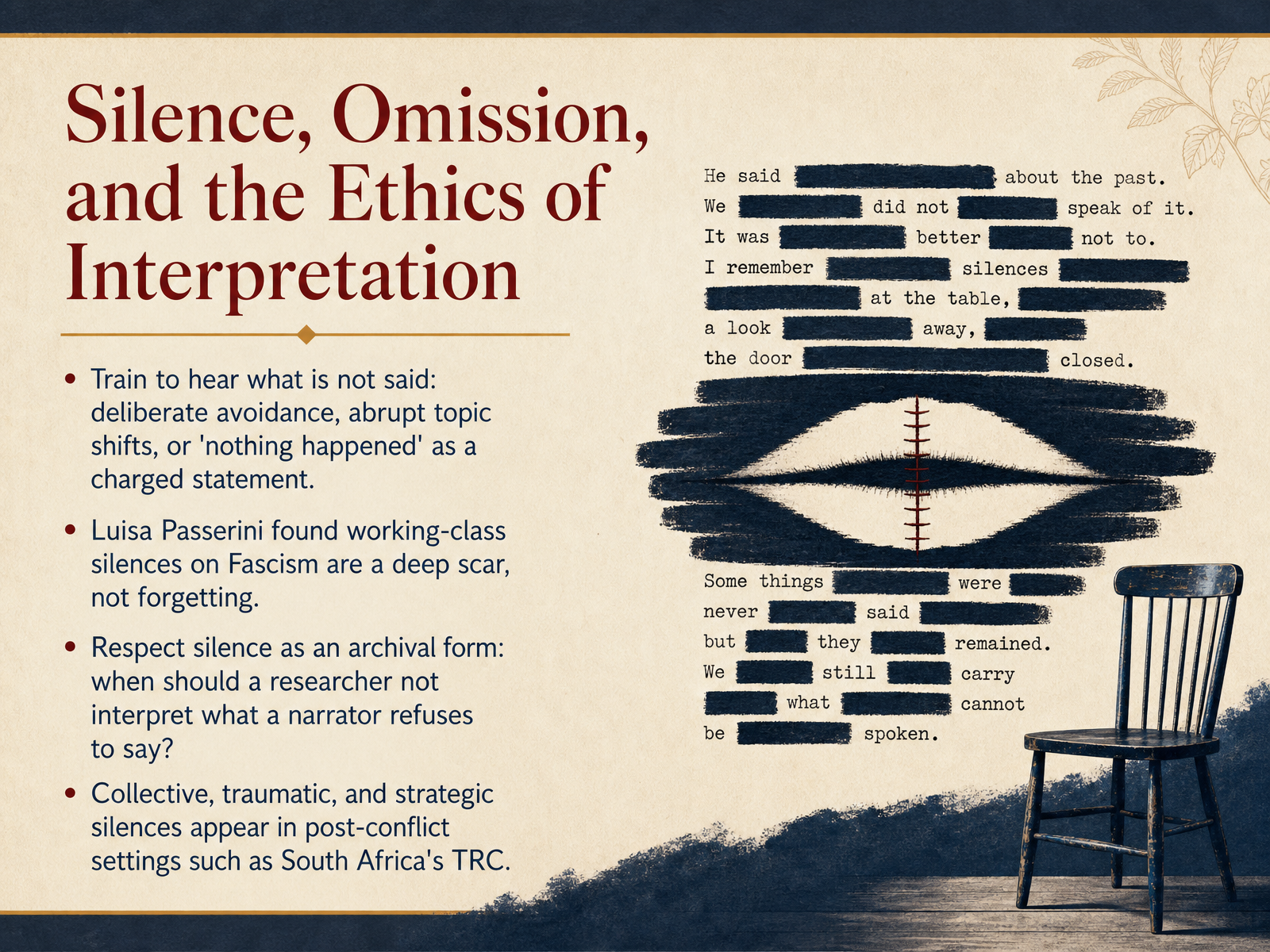
 - 06Silence, Omission, and the Ethics of InterpretationLet's turn now to silence, omission, and the ethics of interpretation. As critical analysts, how do we train ourselves to hear what is not being said? Consider the deliberate avoidance of a topic, an abrupt shift in conversation, or a flat statement that nothing happened. Each of these can be a charged statement in its own right. Think about the work of Luisa Passerini. In her classic study of working-class memory in Turin, she found that narrators often skipped entirely over the years of Fascism. They jumped from the nineteen-twenties straight to World War Two. Passerini did not treat this as simple forgetting. She interpreted it as a deep scar, a violent annihilation of memory that signals a profound wound. Now, a harder question: when should a researcher respect silence as an archival form? If a narrator refuses to go to a certain place, where does our duty to interpret end and our duty to protect begin? Silence itself can be an act of agency, a refusal to let you define their story. This ethical tension becomes acute in post-conflict settings, like the testimonies heard by South Africa's Truth and Reconciliation Commission. There, we encounter collective, traumatic, and strategic silences. Something is withheld for public record, for protection, or because the language to express it does not yet exist. Think of silence not as an absence to fill, but as a meaning to sit with. Next, we will build on this by examining positionality and the reflexive reading of oral sources.
 oralhistoryaustralia.org.aujbe-platform.cometheses.whiterose.ac.uk+22 min
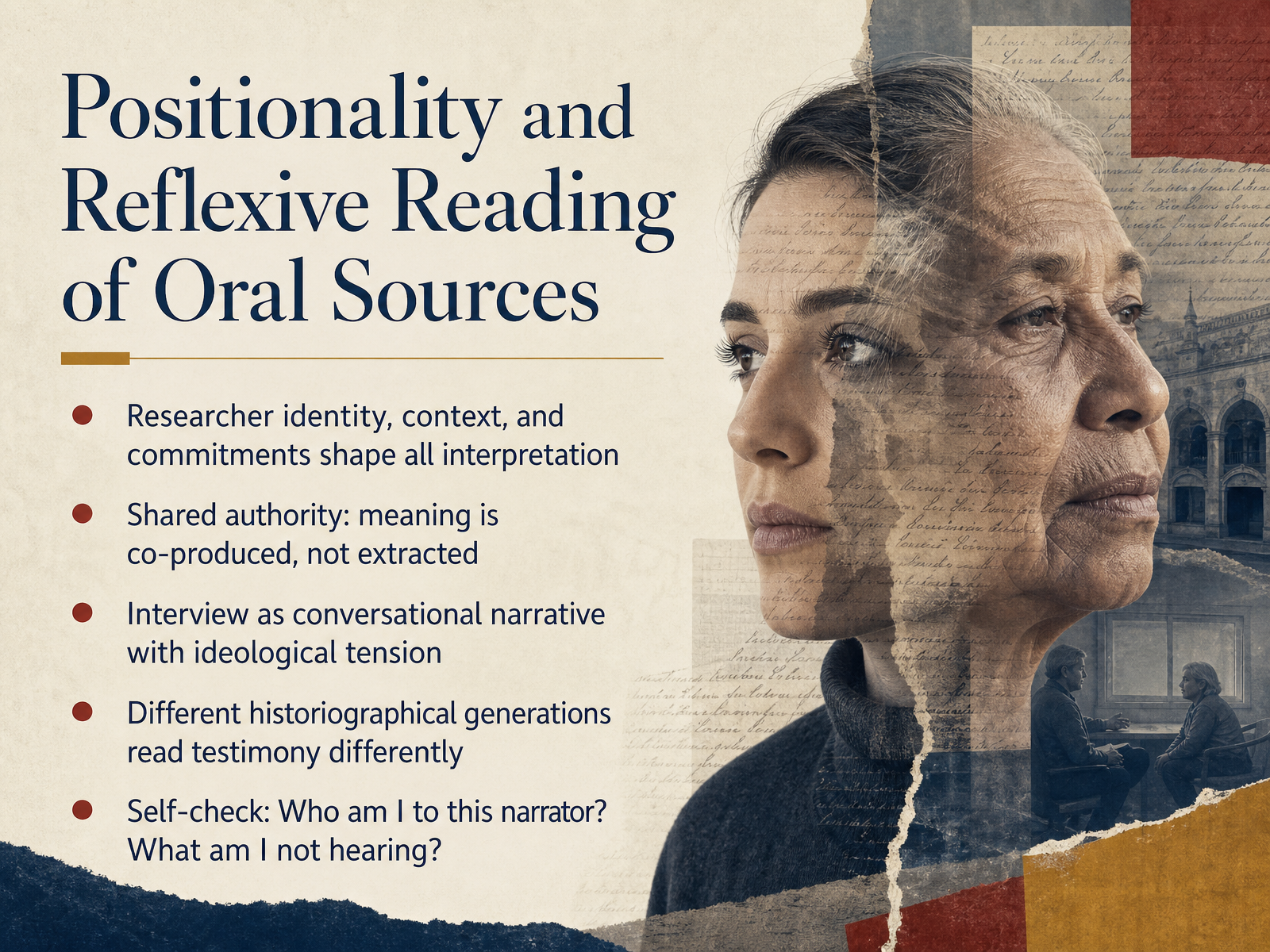
 - 07Positionality and Reflexive Reading of Oral SourcesLet’s move to a concept that reframes how we read every oral history source: positionality and reflexive reading. This starts with a plain recognition. Researcher identity, context, and commitments shape all interpretation. The questions you bring, the silences you accept, and the meanings you assign are never neutral. They come from your own historical location. Think of Michael Frisch’s idea of shared authority. Meaning is not extracted from a narrator like raw data. It is co-produced in the conversational space between you. When we treat the interview as a conversational narrative, as Ronald Grele framed it, we also face its ideological tension. The narrator tells a story while you, the interviewer, break that story with analysis. That back-and-forth does not ruin the source. It is the source. Now add a harder layer. Different historiographical generations read the same testimony differently. A Cold War ear hears not what a postcolonial ear hears. So the reflexive move is not a onetime gesture. It is a disciplined self-check you must repeat. Who am I to this narrator? And what am I not hearing? Hold those questions as we turn next to moving from transcript to analysis, where we begin building interpretive arguments.
 oralhistory.org2 min
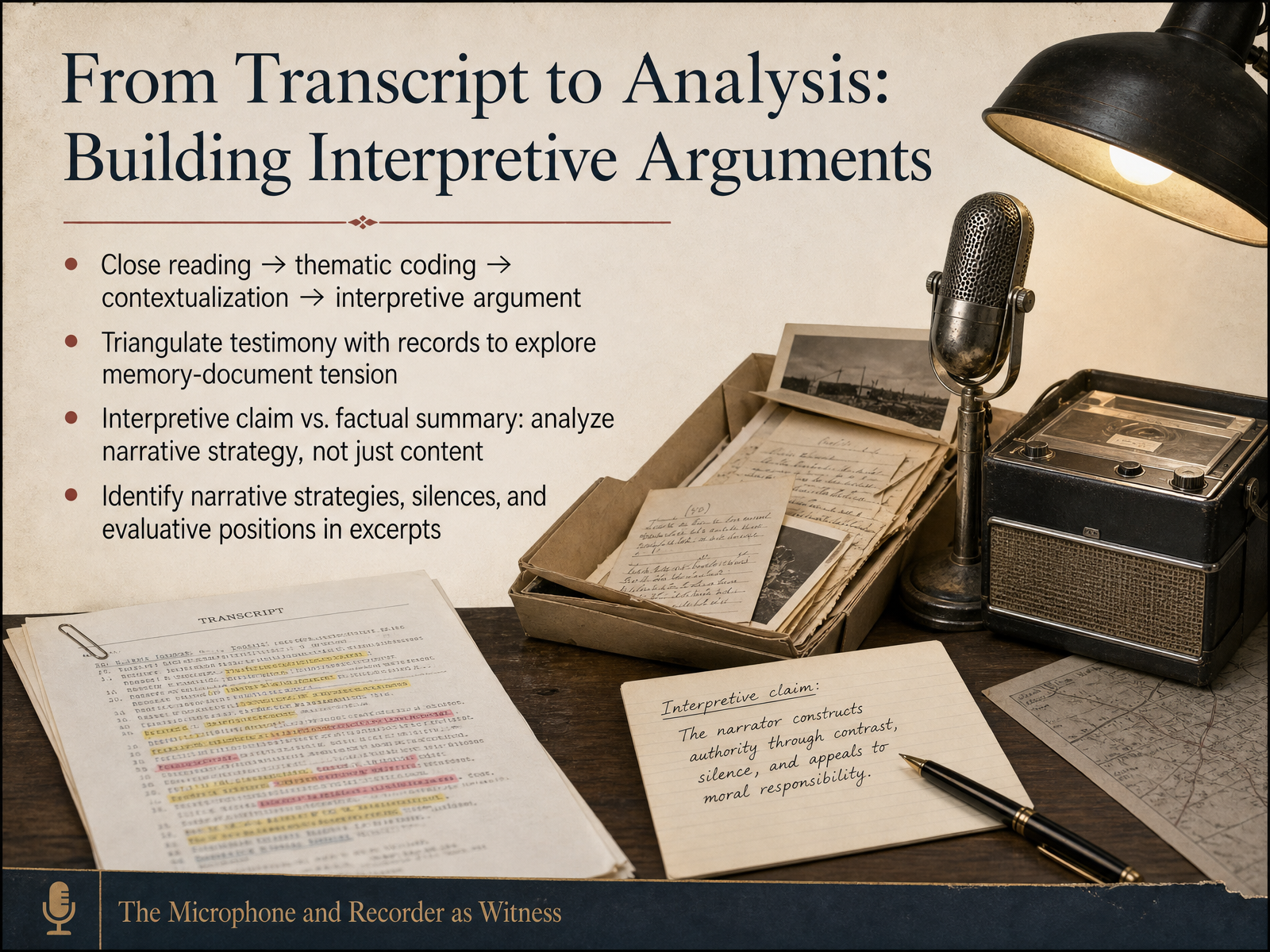
 - 08From Transcript to Analysis: Building Interpretive ArgumentsNow we move from the interview itself to the work of building an interpretive argument. How do you organize a single transcript into a rigorous historical claim? The path moves through four stages: close reading, thematic coding, contextualization, and finally, the interpretive argument itself. But what does each stage ask of you? Close reading means examining word choice, repetition, and metaphor. Thematic coding groups these patterns across the interview. Contextualization then tests those patterns against other sources. The result is not a factual summary of what happened, but an argument about how the narrator constructs meaning. In this process, triangulation becomes essential. Placing testimony alongside written records reveals a tension between memory and document. The question is not which is true. The question is what that gap illuminates. Why does the narrator remember it this way? What does the silence or error tell us about experience itself? So your focus shifts from content alone to narrative strategy. Look for how the story is emplotted. Where does the turning point fall? What evaluative phrases reveal judgment? Where do silences occur, and what might they protect? Your claim should address those strategies, not just the facts recited. Let's put these skills into practice in our final slide, Applied Practicum: Reading an Interview with Multiple Lenses.
 oralhistory.orgoralhistoryaustralia.org.aujbe-platform.com+22 min
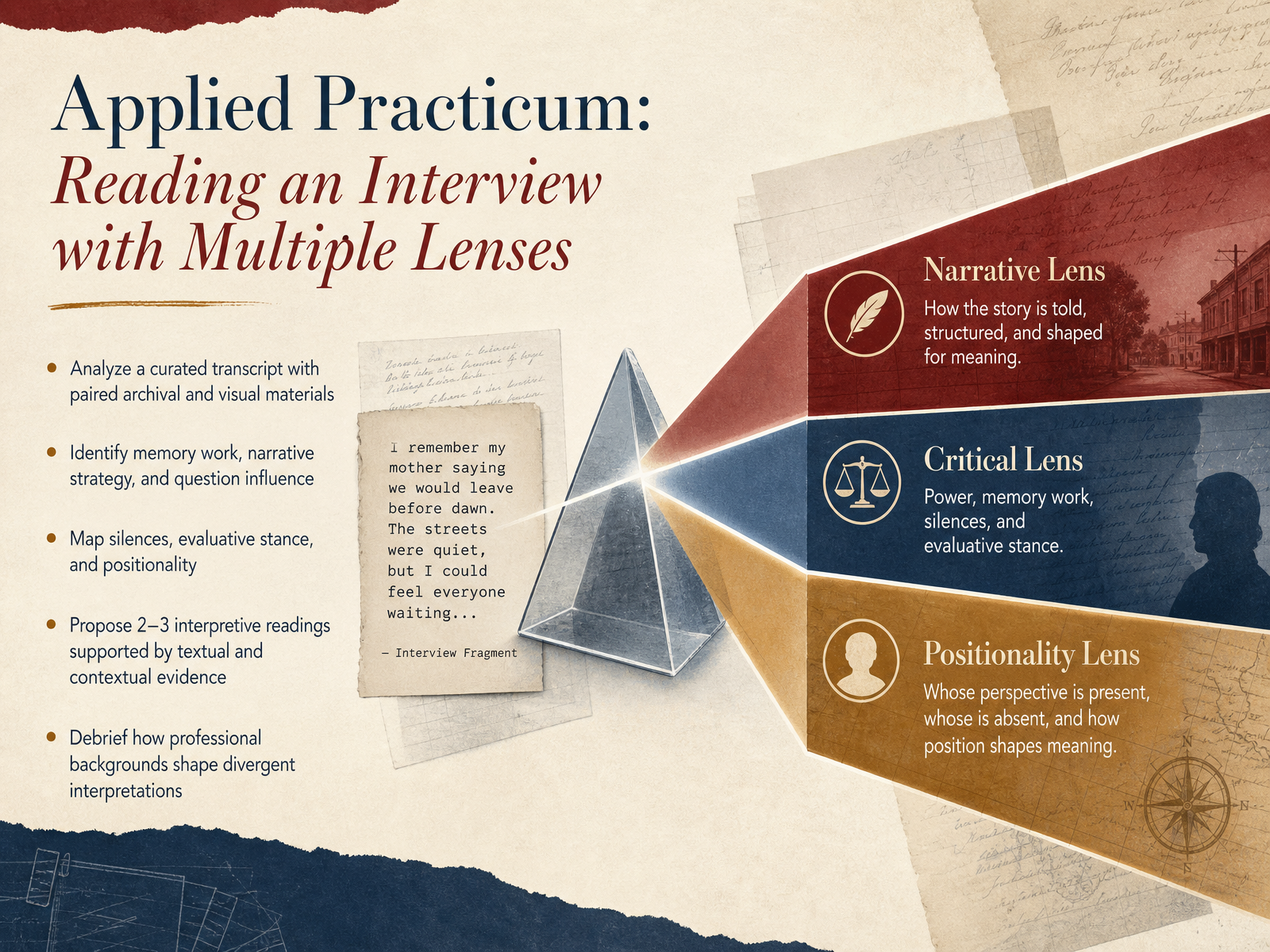
 - 09Applied Practicum: Reading an Interview with Multiple LensesAnd now we arrive at the practicum. This is your opportunity to work directly with a curated transcript, paired with archival and visual materials. Your first task is to identify how memory work and narrative strategy operate in the text. Ask yourself: where does the narrator’s story follow a structure of orientation, complication, evaluation, and resolution, and what does that structure reveal about the meaning they are constructing? Then, map the influence of the interview questions. Where did a question open up a memory, and where might it have closed down another line of thought? Next, pay close attention to what is not said. Identify moments of silence, evasion, or deflection, and consider the narrator’s evaluative stance and positionality. Finally, you will propose two or three interpretive readings, each supported by textual and contextual evidence. In our debrief, we will compare how a journalist, a social worker, and an archivist might read the same transcript. What different truths do their professional backgrounds lead them to see? The goal here is not to find one correct interpretation, but to understand how meaning is co-constructed, and why that process matters for historical analysis. Thank you for engaging with these questions so rigorously. Go now and read against the grain.
 oralhistory.org2 min
Take the deck with you
Download this course as a file — free, no sign-up needed.
- PDF handoutEvery slide page, ready to print or share.10 pages · 3.7 MBDownload
- Narrated PowerPointThe deck that presents itself — every slide carries the digital human's narration video.10 pages · 11.7 MBDownload
- PowerPoint slidesThe full deck as a .pptx — open it in PowerPoint, Keynote, or Google Slides.10 pages · 3.6 MBDownload
Free to use in your own training — please keep the PersonWise credit page at the end.
Have your own deck? Turn it into a course
Sources consulted
Web sources consulted while building this course.
- OHA Core Principles — oralhistory.org
- Oral History: Defined — oralhistory.org
- OHA Principles and Best — oralhistory.org
- OHA Principles and Best Practices — oralhistory.org
- What is an oral history? - Ask a Librarian — ask.loc.gov
- Living Voices: The Oral History Interview as Dialogue and Experience — doi.org
- Oral History As Genre — doi.org
- Alessandro Portelli - What Makes Oral History Different — archive.eclass.uth.gr
- The Peculiarities of Oral History — historymuse.net
- The Oral History Interview - Alessandro Portelli — archive.org
- The Death of Luigi Trastulli and Other Stories | State University of New York Press — sunypress.edu
- Prospecting For Truth In the Ore Of Memory — nytimes.com
- Nothing Happened: Excerpt from Introduction — sup.org
- CEEOL - Article Detail — ceeol.com
- The Death of Luigi Trastulli and Other Stories... — degruyterbrill.com
- Oral History and Linguistics: — oralhistoryaustralia.org.au
- Story alteration in oral history retellings | John Benjamins — jbe-platform.com
- Spinning New Yarns: an oral history and dialect study of the West Yorkshire textiles industry — etheses.whiterose.ac.uk
- They Go Along Singing: Reconstructing the Hopi Past from Ritual Metaphors in Song and Image — doi.org
- OF ORALITY IN TRANSLATION: — fjrs.eu