Begin
14 pages · ~28 min
Artwork Ownership History
This training teaches art professionals how to trace an artwork's ownership history, covering provenance research methods and documentation standards.
A digital instructor presents all 14 pages. Hold “Ask” at any point and ask out loud — the answer comes from this course. No sign-up needed.
What you’ll learn
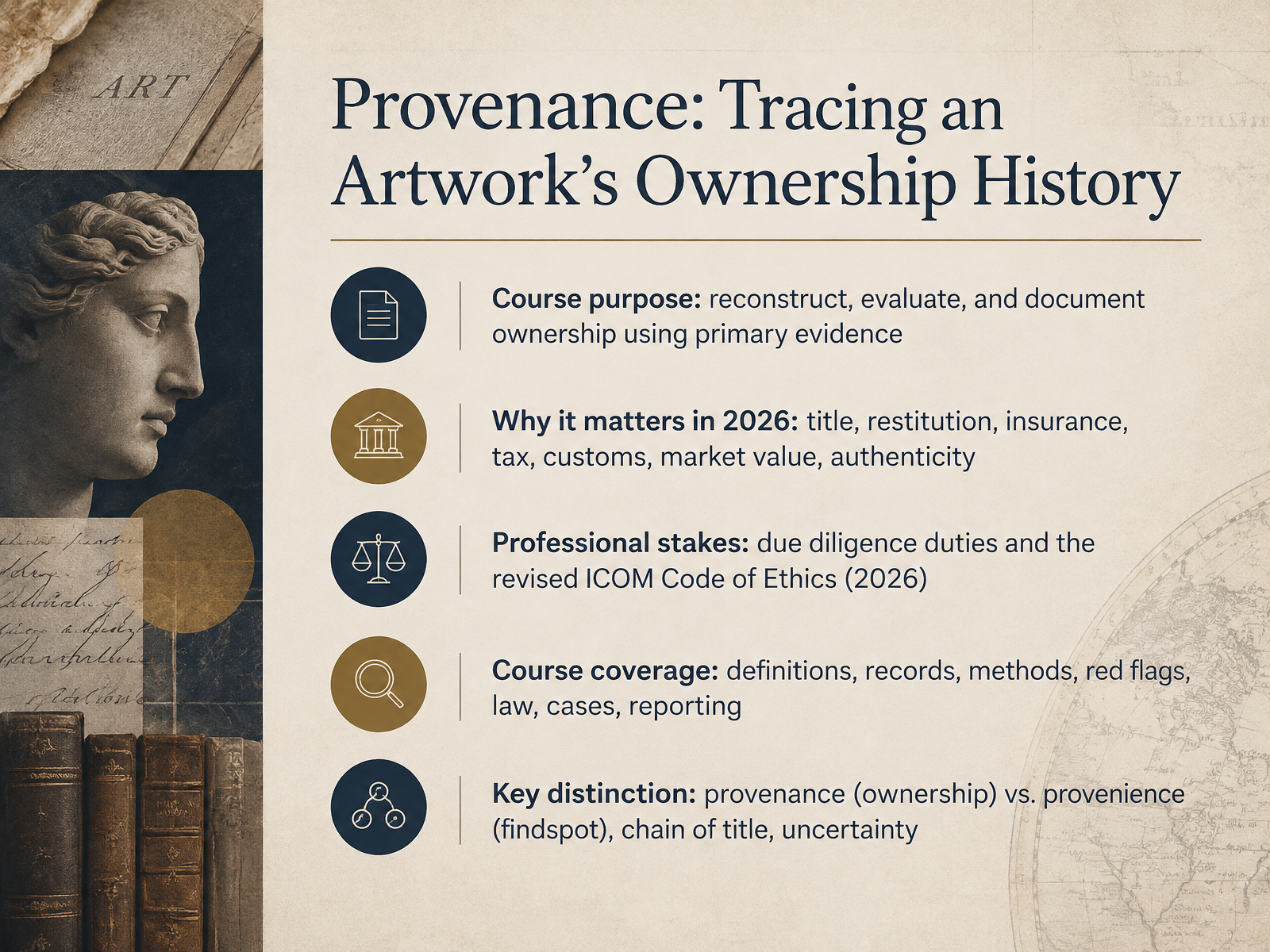
- 01Provenance: Tracing an Artwork's Ownership HistoryWelcome. This course is about provenance, which means the documented history of an object's ownership and custody. Our goal is practical: to reconstruct, evaluate, and document that history using primary evidence such as inventories, sales records, correspondence, and dealer archives. Let's begin. Provenance matters for title and legal ownership, for restitution and repatriation claims, for insurance, tax, customs, market value, and authenticity. Our professional stakes are clear: due diligence duties and the revised ICOM Code of Ethics, adopted in 2026, which asks museums to conduct provenance research on all collections they hold. Over these slides we'll cover definitions, records, methods, red flags, law, cases, and reporting. One key distinction to hold onto: provenance concerns ownership history, while provenience refers to an archaeological findspot. We'll also work with chain of title and, crucially, uncertainty. I hope you'll finish able to trace, evaluate, and clearly document an artwork's ownership history, and to be candid when records are incomplete. Next, we'll look at Key Terms and Concepts.culture.gouv.frmuseumprovenance.orgenglish.cultureelerfgoed.nl+22 min
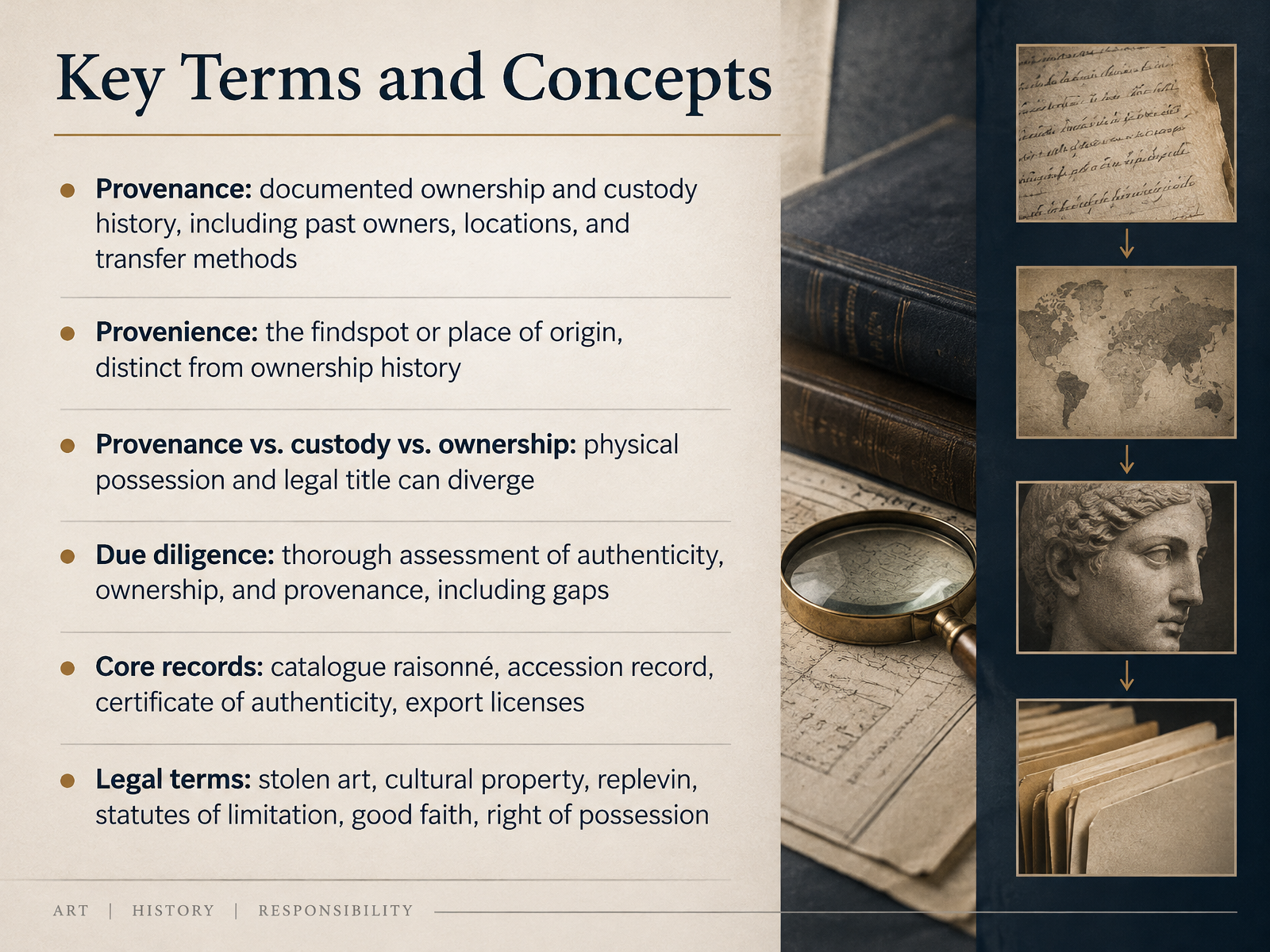
- 02Key Terms and ConceptsLet's ground our vocabulary before we start tracing records. Provenance is the documented history of ownership and custody: who held the work, where it was, and how it changed hands. Provenience, spelled with an i-e-n-c-e, is different. It means the findspot or place of origin, most often for archaeological material. Next, keep custody separate from ownership. The party physically holding an object is not always the party with legal title, as with a loan or a consignment. Due diligence is the thorough assessment of authenticity, ownership, and provenance, and it includes identifying gaps in the record. Several core documents support this work: the catalogue raisonne, the accession record, the certificate of authenticity, and export licenses. Finally, legal terms matter. Stolen art, cultural property, replevin, statutes of limitation, good faith, and right of possession each shape how a claim is evaluated. Where records are incomplete, document the gaps rather than filling them with assumption. Next, we look at where provenance records live: source types.
 ifar.orgresearch.slam.orgdoi.gov+22 min
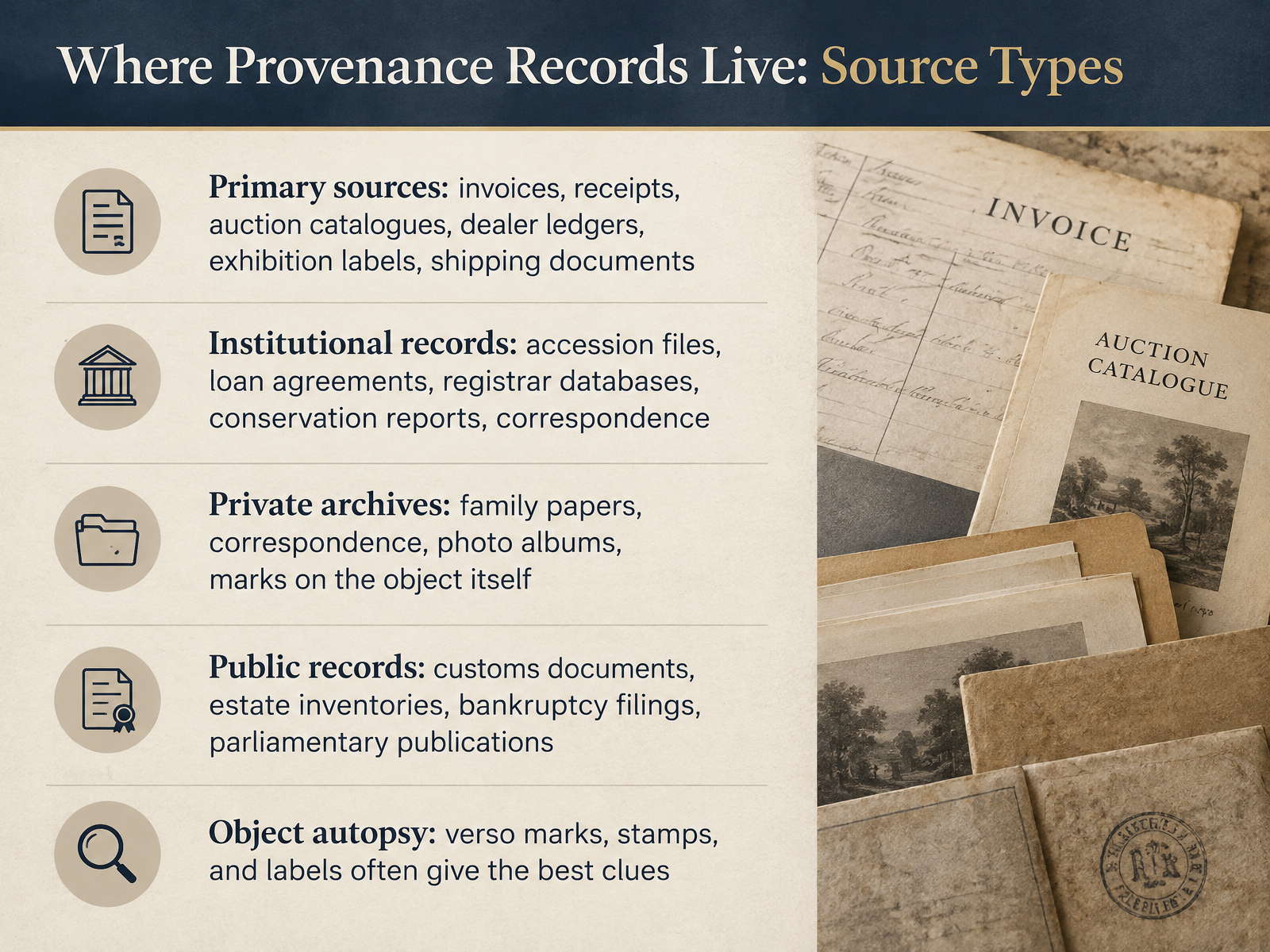
- 03Where Provenance Records Live: Source TypesNow let's look at where provenance records actually live. Think of these as source types, and expect to search across all of them. Primary sources come first: invoices, receipts, auction catalogues, dealer ledgers, exhibition labels, and shipping documents. These record a transaction as it happened. Institutional records are your internal evidence: accession files, loan agreements, registrar databases, conservation reports, and correspondence. Private archives add context that institutions rarely hold, such as family papers, letters, photo albums, and marks on the object itself. Public records are equally valuable: customs documents, estate inventories, bankruptcy filings, and parliamentary publications. Then there is object autopsy. Verso marks, stamps, and labels often give the best clues, because they were applied at a specific moment by a specific owner or dealer. Cross-reference every source, ask who created it and why, and document the gaps as carefully as the findings. Next, we turn to key databases and digital resources in two thousand twenty-six.
 guides.library.yale.eduspcrintranet.wyo.govjournals.ub.uni-heidelberg.de+22 min
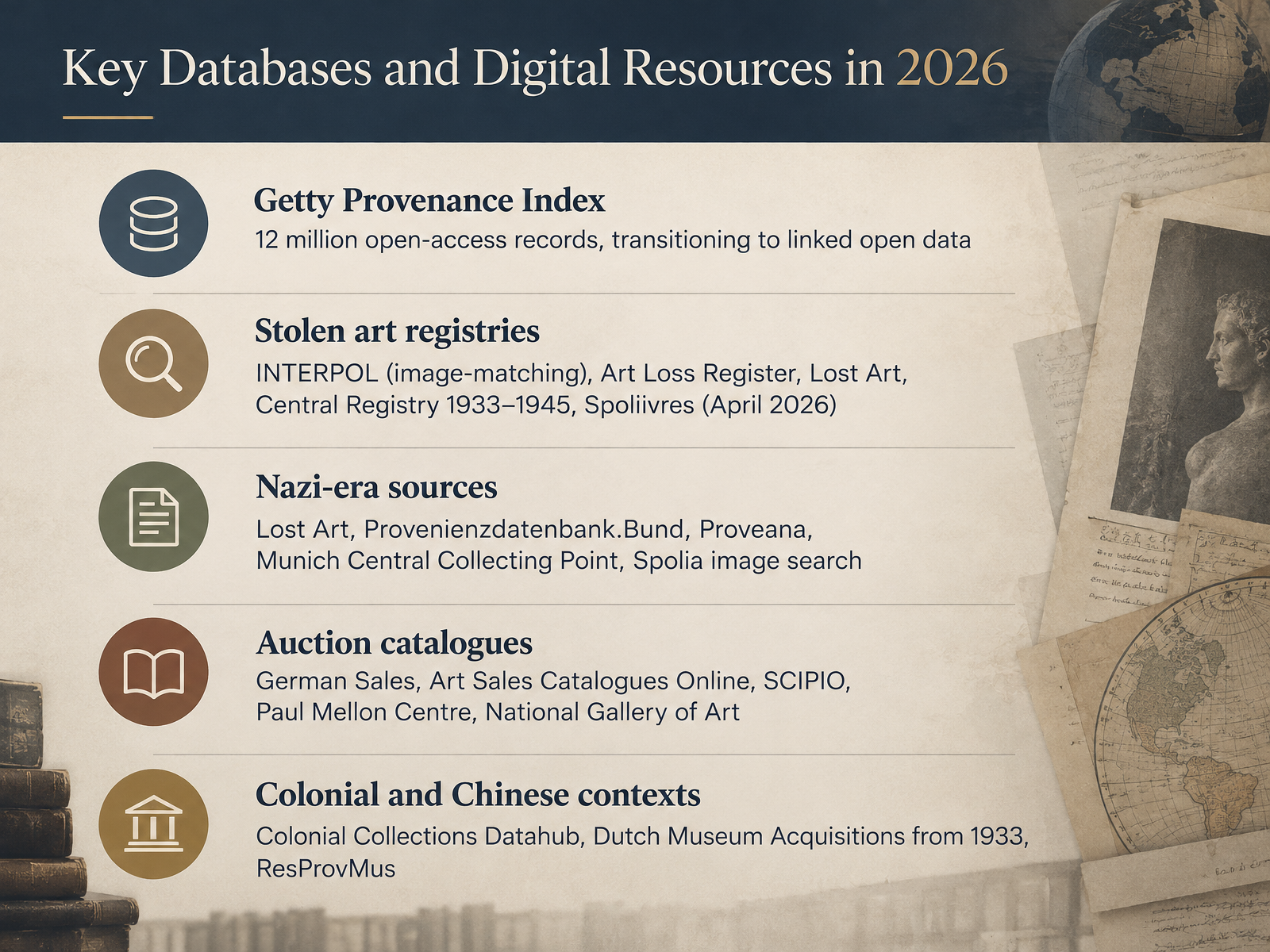
- 04Key Databases and Digital Resources in 2026Now let's map the digital landscape you'll actually search. Provenance work in 2026 means knowing which databases to consult, and in what order. Start with the Getty Provenance Index. It holds over twelve million open-access records, drawn from inventories, auction catalogues, and dealer stock books, and it is transitioning to linked open data, which allows cross-database analysis through the Arches platform. Next, stolen art registries, which any acquisition check should include. INTERPOL's Stolen Works of Art Database, with image-matching software, contains only certified police information. The Art Loss Register is the largest private database. The Central Registry 1933 to 1945 covers over twenty-five thousand objects. And Spolivres, launched in April 2026, lists looted books found in French public libraries. For Nazi-era sources, consult Lost Art, the Provenienzdatenbank Bund, Proveana, the Munich Central Collecting Point records, and the Spolia image search. For the art trade, German Sales, Art Sales Catalogues Online, SCIPIO, the Paul Mellon Centre, and the National Gallery of Art hold catalogues from the eighteenth century onward. Finally, colonial and Chinese contexts are served by the Colonial Collections Datahub, the Dutch Museum Acquisitions from 1933 database, and ResProvMus. The practical point: document which databases you searched, and on what date, because that record itself becomes part of your provenance file. Let's turn now to Research Methods and Tools: Building a Chronology.
 interpol.intcollectionstrust.org.ukartloss.com+22 min
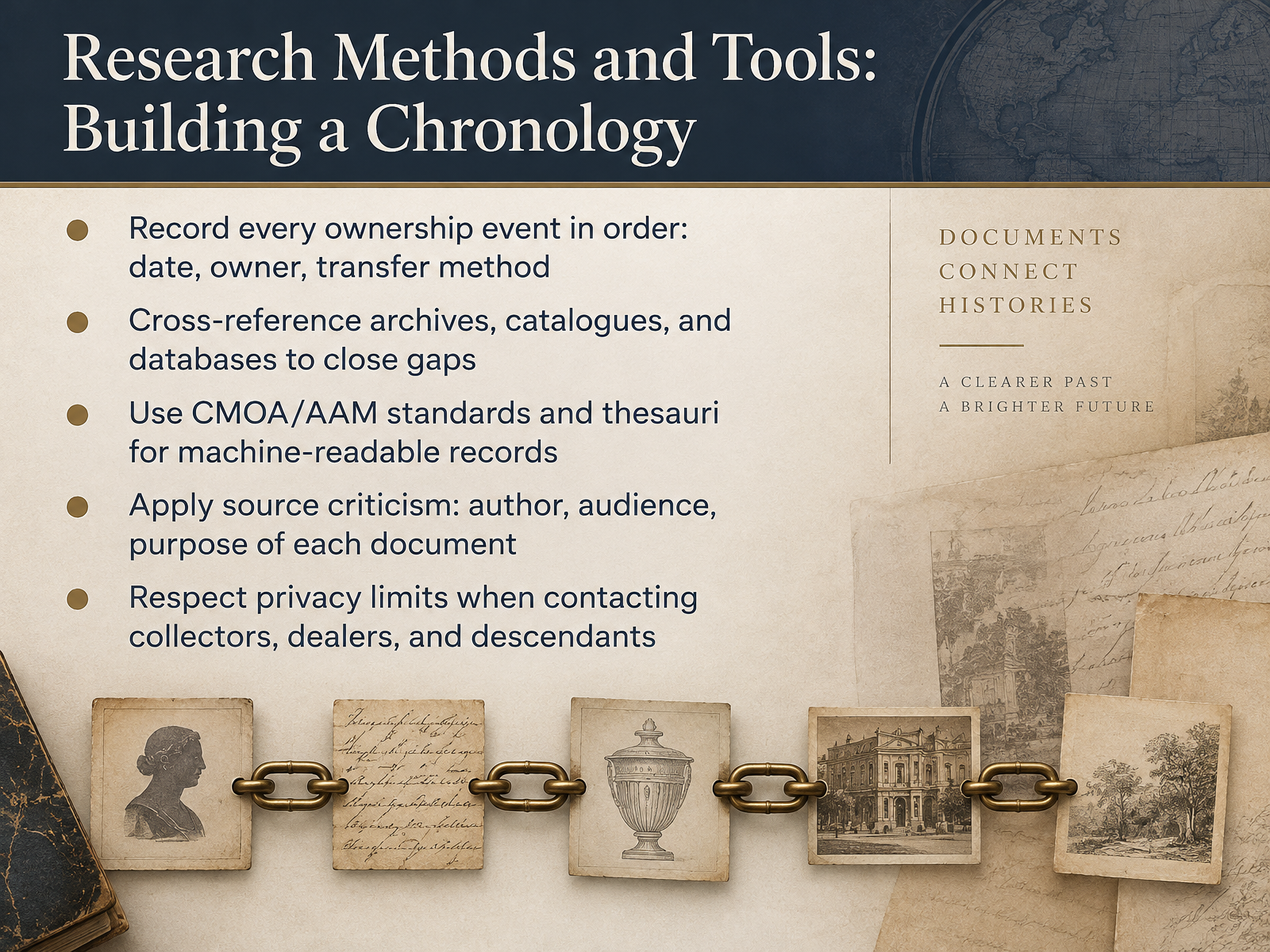
- 05Research Methods and Tools: Building a ChronologyLet's turn to research methods and tools, and how we build a chronology. Start by recording every ownership event in order: the date, the owner, and the transfer method. Transfer method is simply how the object changed hands, such as a sale, gift, bequest, or inheritance. Then cross-reference archives, catalogues, and databases to close gaps. No single source is complete, so corroboration is what gives a chronology real weight. Use CMOA and AAM standards and controlled thesauri so your records are machine-readable. That matters because it makes provenance searchable and shareable across institutions. Next, apply source criticism to every document you rely on. Ask who wrote it, for whom, and why. A dealer's invoice and a family letter serve very different purposes. And respect privacy limits when contacting collectors, dealers, and descendants. Sensitive names, addresses, and prices may need redaction. In short, a defensible chronology is ordered, corroborated, standardized, and ethically gathered. That foundation leads us to Prioritization and Risk Assessment.
 guides.library.yale.eduspcrintranet.wyo.govjournals.ub.uni-heidelberg.de+22 min
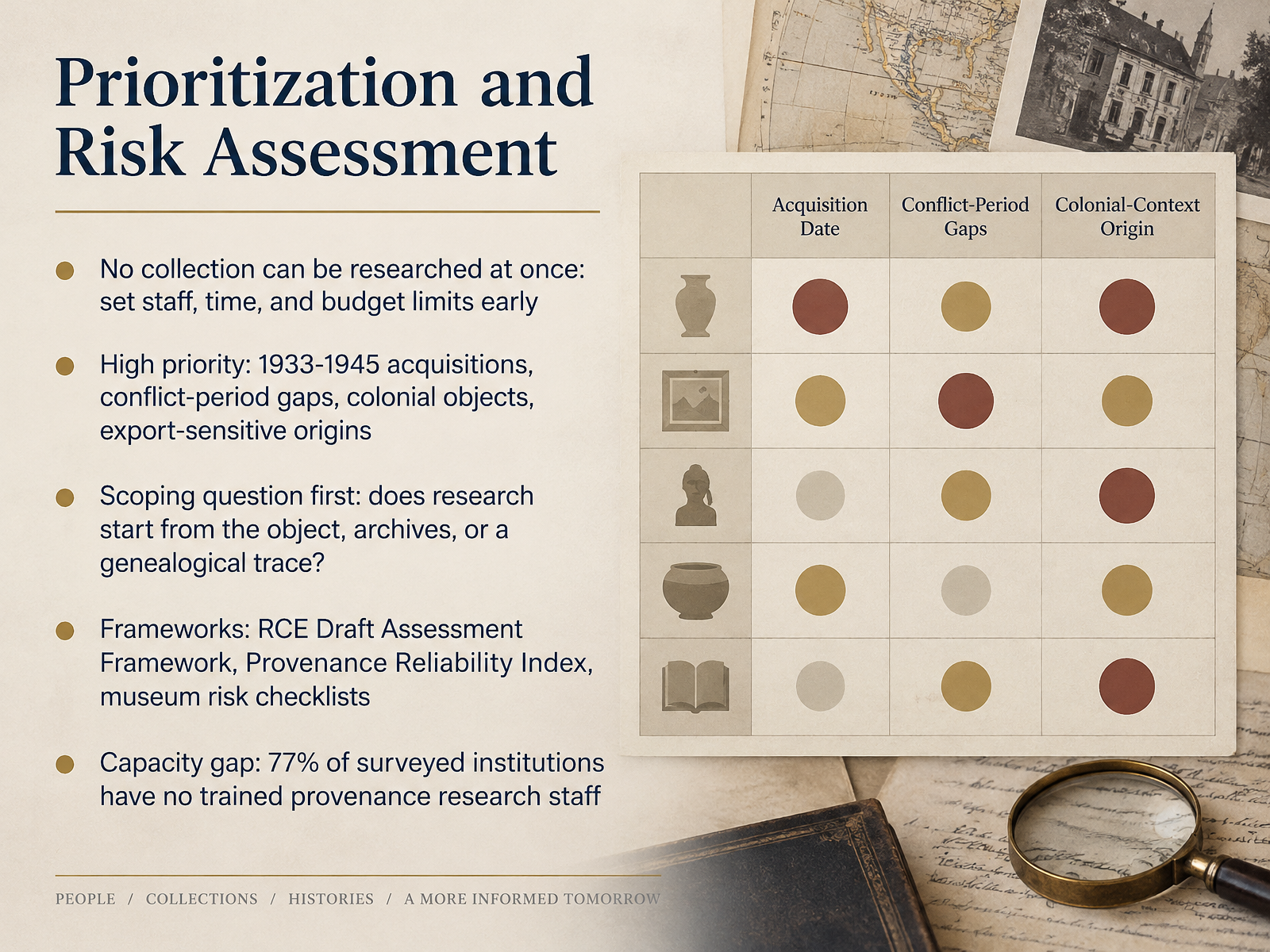
- 06Prioritization and Risk AssessmentLet us turn to prioritization and risk assessment. No collection can be researched all at once, so set your staff, time, and budget limits early. Then rank the work. High priority goes to acquisitions from 1933 to 1945, gaps in conflict periods, colonial objects, and export-sensitive origins. Before any search begins, ask a scoping question. Does the research start from the object, from archival documents, or from a genealogical trace? Several frameworks can guide you, including the R C E Draft Assessment Framework, the Provenance Reliability Index, and museum risk checklists. Here is the hard part. A 2026 survey found that seventy-seven percent of institutions have no trained provenance research staff. So be realistic, document what you can, and record where the search was done. That missing information is itself a result. Next, we look at red flags and risk indicators.
 culture.gouv.frmuseumprovenance.orgenglish.cultureelerfgoed.nl+21 min
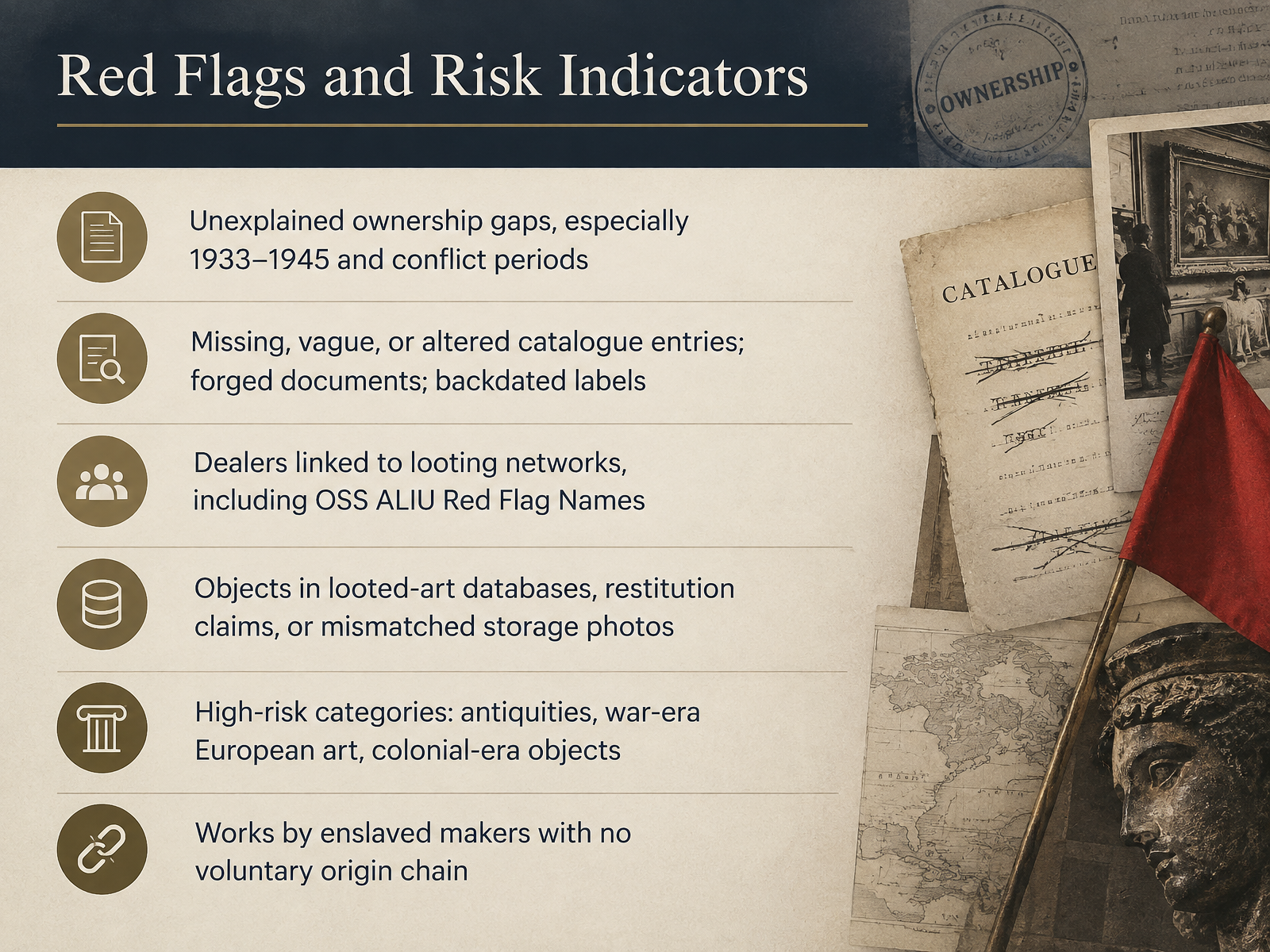
- 07Red Flags and Risk IndicatorsWith provenance methods in place, let us look at red flags and risk indicators. These are signals that warrant deeper research, not automatic proof of wrongdoing. First, unexplained ownership gaps, especially between 1933 and 1945 or during conflict periods. Ask whether the record explains the transfer or simply skips it. Second, missing, vague, or altered catalogue entries, forged documents, and backdated labels. Compare the object file against dealer stock books, like those in the Getty Provenance Index, and against auction catalogues. Third, dealers linked to looting networks, including the OSS Art Looting Intelligence Unit Red Flag Names, the alphabetical index published in 1945 and 1946. Fourth, check objects against looted-art databases, such as the Lost Art Internet Database, the Central Registry for 1933 to 1945, and Interpol's Stolen Works of Art Database, and watch for restitution claims or mismatched storage photographs. Fifth, some categories carry elevated risk: antiquities, war-era European art, colonial-era objects, and works by enslaved makers with no voluntary origin chain, as in the ongoing Dave the Potter returns, where the chain of provenance never truly began. Document each concern, cite the source, and escalate for review. Next, we turn to ethical and legal frameworks.
 interpol.intcollectionstrust.org.ukartloss.com+22 min
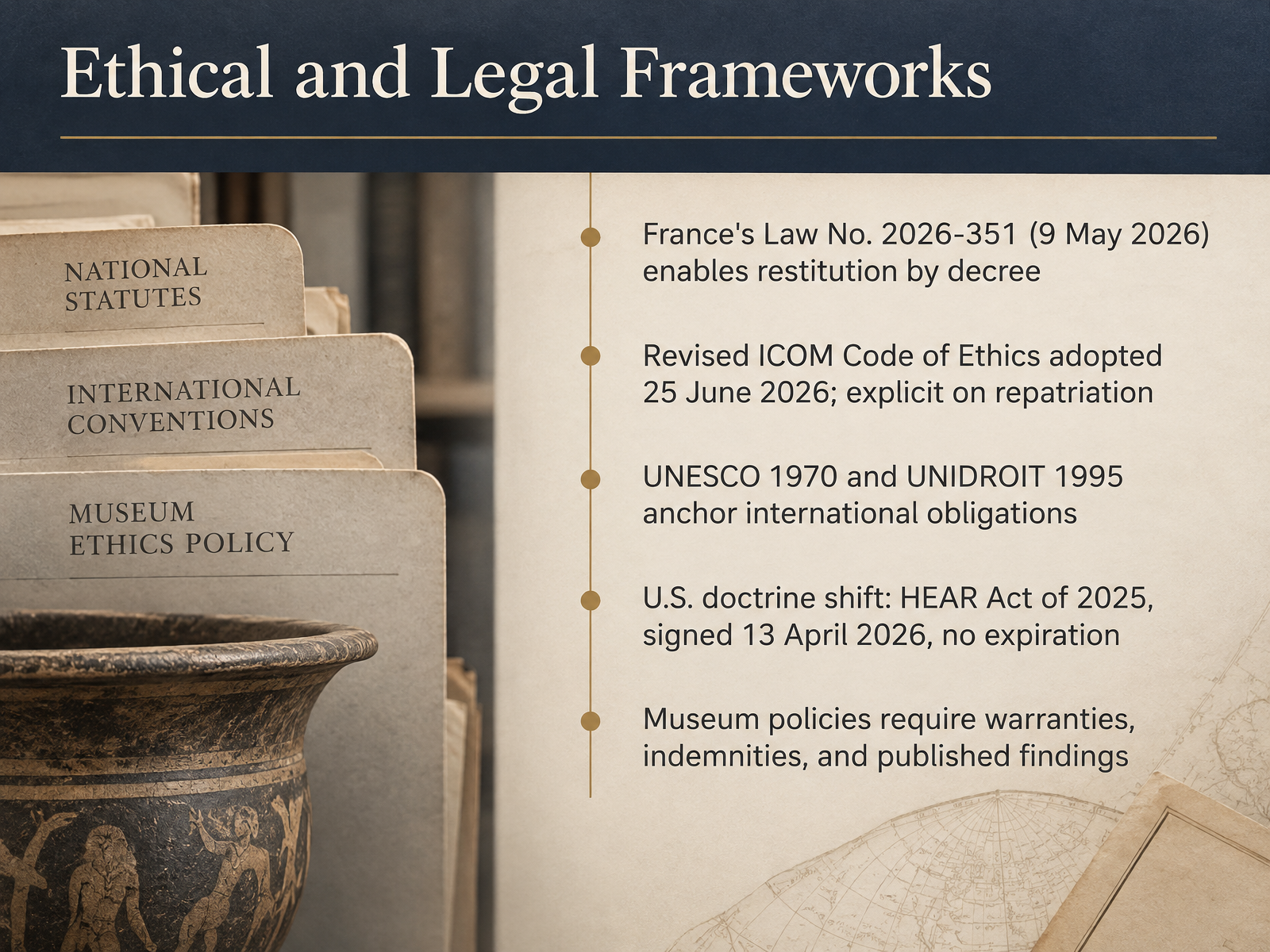
- 08Ethical and Legal FrameworksNow let's look at the ethical and legal frameworks that shape provenance work today. In France, Law number 2026-351, dated 9 May 2026, enables restitution by decree, meaning a decision can be made without a new parliamentary vote for each object. The revised ICOM Code of Ethics, adopted on 25 June 2026, is explicit about repatriation and calls on museums to respond to restitution requests. Internationally, the UNESCO Convention of 1970 and the UNIDROIT Convention of 1995 anchor obligations. In the United States, the HEAR Act of 2025, signed 13 April 2026, removed the prior expiration, so claims can be brought without that time limit. Museum policies typically require warranties and indemnities from sellers or donors, and many now publish provenance findings. Now we'll move into the practical side: Restitution and Repatriation in Practice.
 ifar.orgresearch.slam.orgdoi.gov+21 min
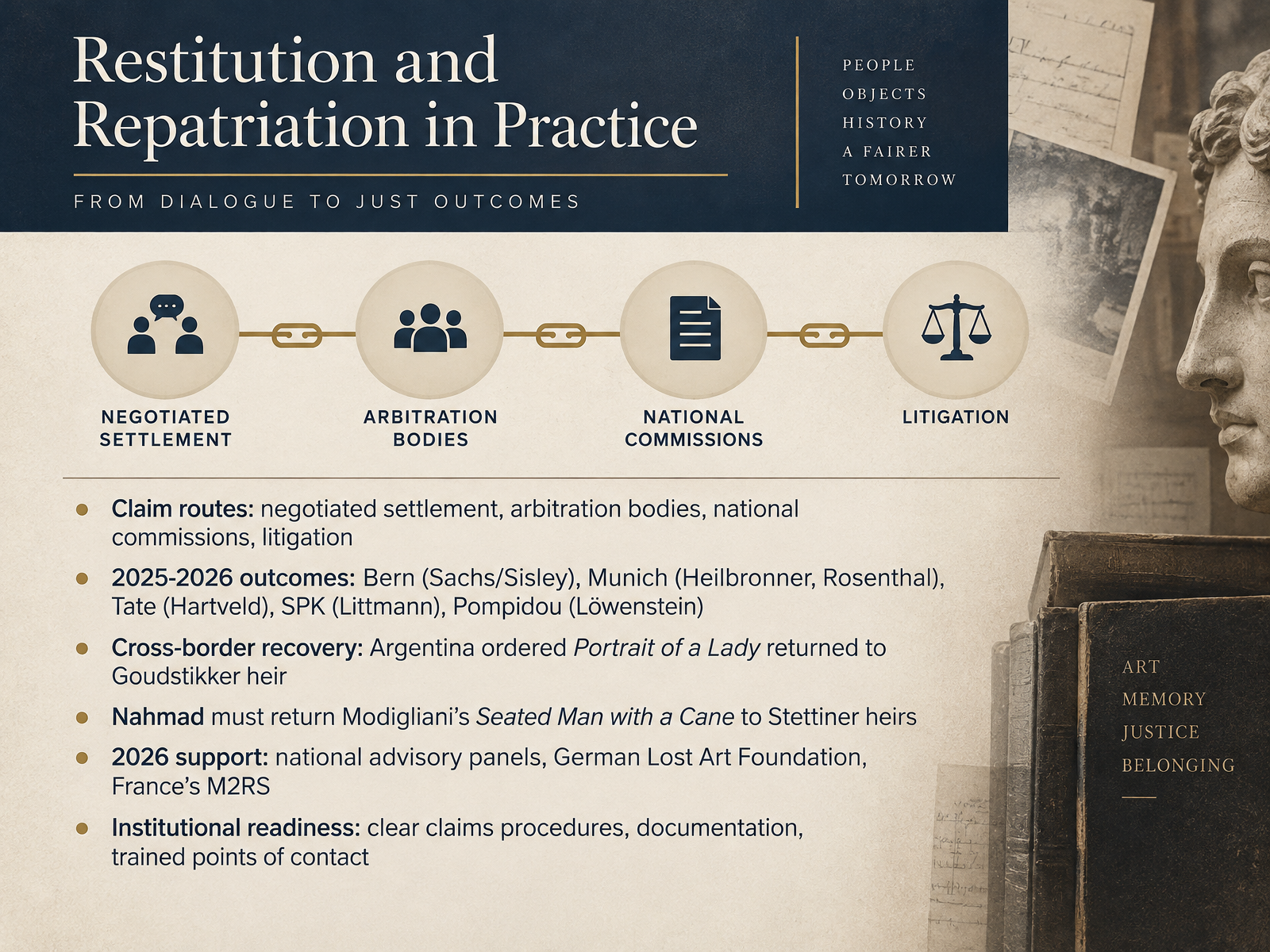
- 09Restitution and Repatriation in PracticeLet's turn now from tracing provenance to acting on it, through restitution and repatriation in practice. A claim can travel several routes: negotiated settlement, arbitration bodies, national commissions, or litigation. The recent record is instructive. The Kunstmuseum Bern relinquished an Alfred Sisley to the heirs of Carl Sachs. Munich returned works to the heirs of Sofie Heilbronner and Jacques Rosenthal. Tate restituted a Henry Gibbs to the family of Samuel Hartveld. The Stiftung Preussischer Kulturbesitz returned a Lovis Corinth from the Littmann collection, which the heirs then donated back. And the Centre Pompidou returned three Fédor Löwenstein paintings. Beyond Europe, an Argentine court ordered the return of Portrait of a Lady to the heir of Jacques Goudstikker, and a New York court ordered David Nahmad to return Modigliani's Seated Man with a Cane to the Stettiner heirs. Support exists: national advisory panels, Germany's Lost Art Foundation, and France's M2RS mission. Institutional readiness means clear claims procedures, thorough documentation, and a trained point of contact. Now, let's see how provenance research actually works.
 2 min
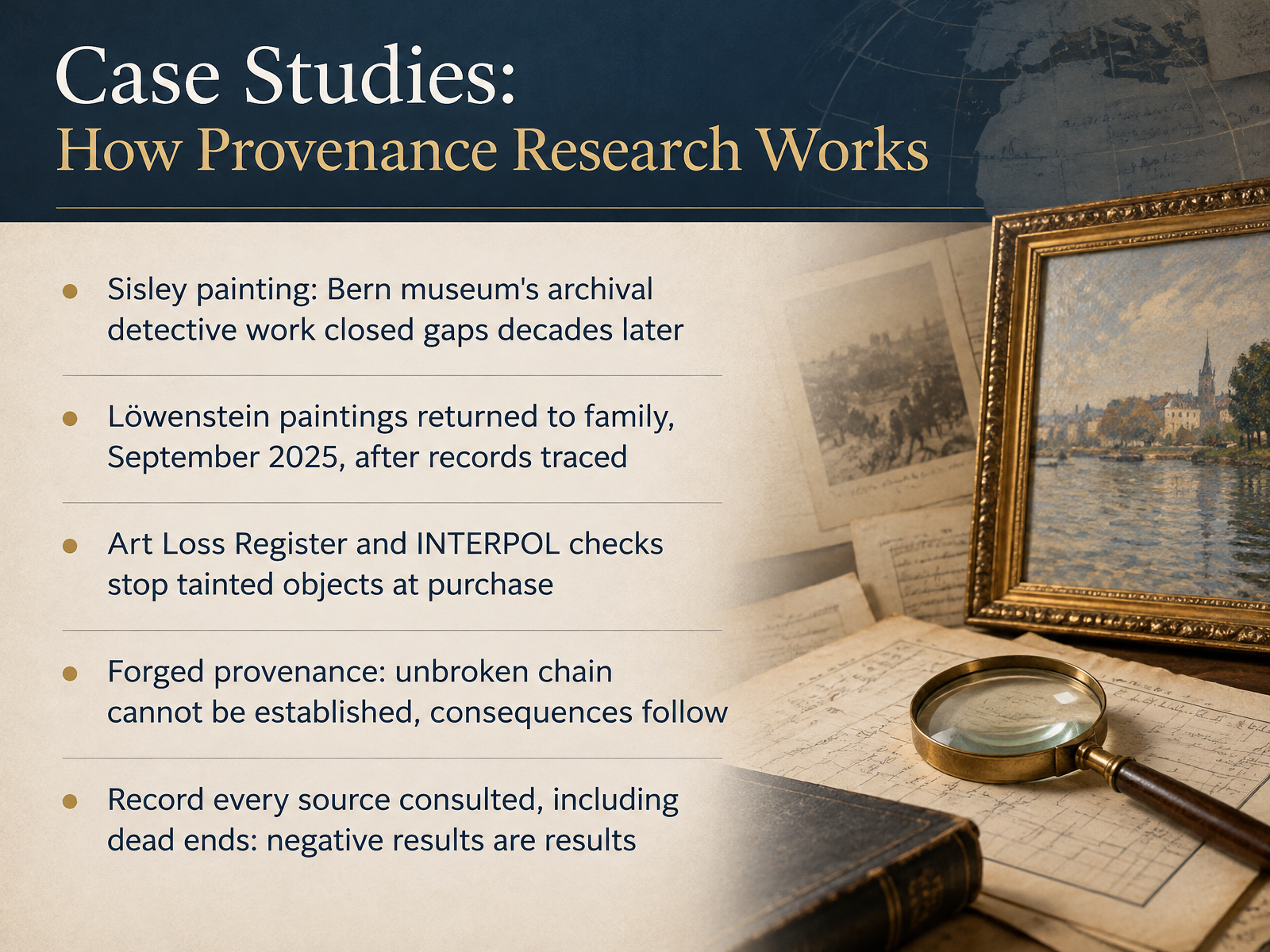
- 10Case Studies: How Provenance Research WorksLet's look at how provenance research actually plays out. Start with the Sisley painting at the Kunstmuseum Bern. The work entered the collection as a bequest in nineteen ninety-four. Years of archival detective work later, researchers traced it back to Carl Sachs, a persecuted collector who sold it in Switzerland in nineteen forty. In April twenty twenty-five, the museum decided to relinquish ownership. Now the Löwenstein paintings, returned to the artist's family in September twenty twenty-five. Records from the German looting unit known as the E R R, plus Rose Valland's list, were essential. Third, checks against the Art Loss Register and INTERPOL's stolen works database stop tainted objects before purchase. Then forged provenance: when an unbroken chain cannot be established, consequences follow, including legal exposure. Finally, record every source you consult, including dead ends. Negative results are results, and they prevent redundant work later. Next, Documenting Findings: The Provenance Report.
 guides.library.yale.eduspcrintranet.wyo.govjournals.ub.uni-heidelberg.de+22 min
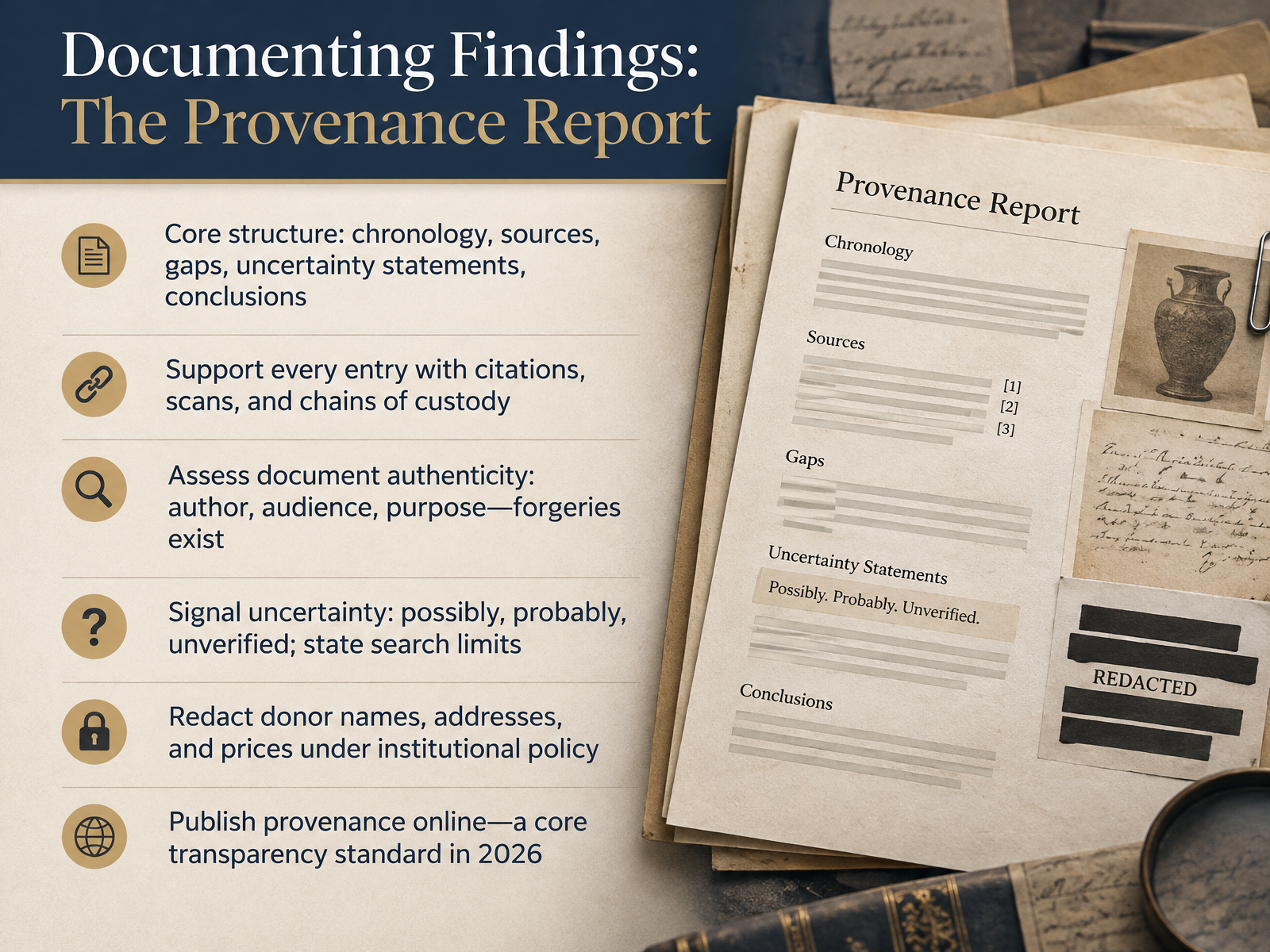
- 11Documenting Findings: The Provenance ReportLet's turn now to documenting your findings in a provenance report. The core structure is a chronology of ownership, a list of sources, a clear statement of gaps, uncertainty statements, and your conclusions. Support every entry with citations, scans, and chains of custody. Assess each document's authenticity by asking who wrote it, for whom, and why; forged documentation does exist, so cross reference wherever possible. Signal uncertainty honestly with words like possibly, probably, or unverified, and state the limits of your search. Under institutional policy, redact donor names, addresses, and prices. Finally, publish the provenance online, which is a core transparency standard in 2026. Next, we will practice with Practical Exercise: Trace a Sample Provenance File.
 guides.library.yale.eduspcrintranet.wyo.govjournals.ub.uni-heidelberg.de+21 min
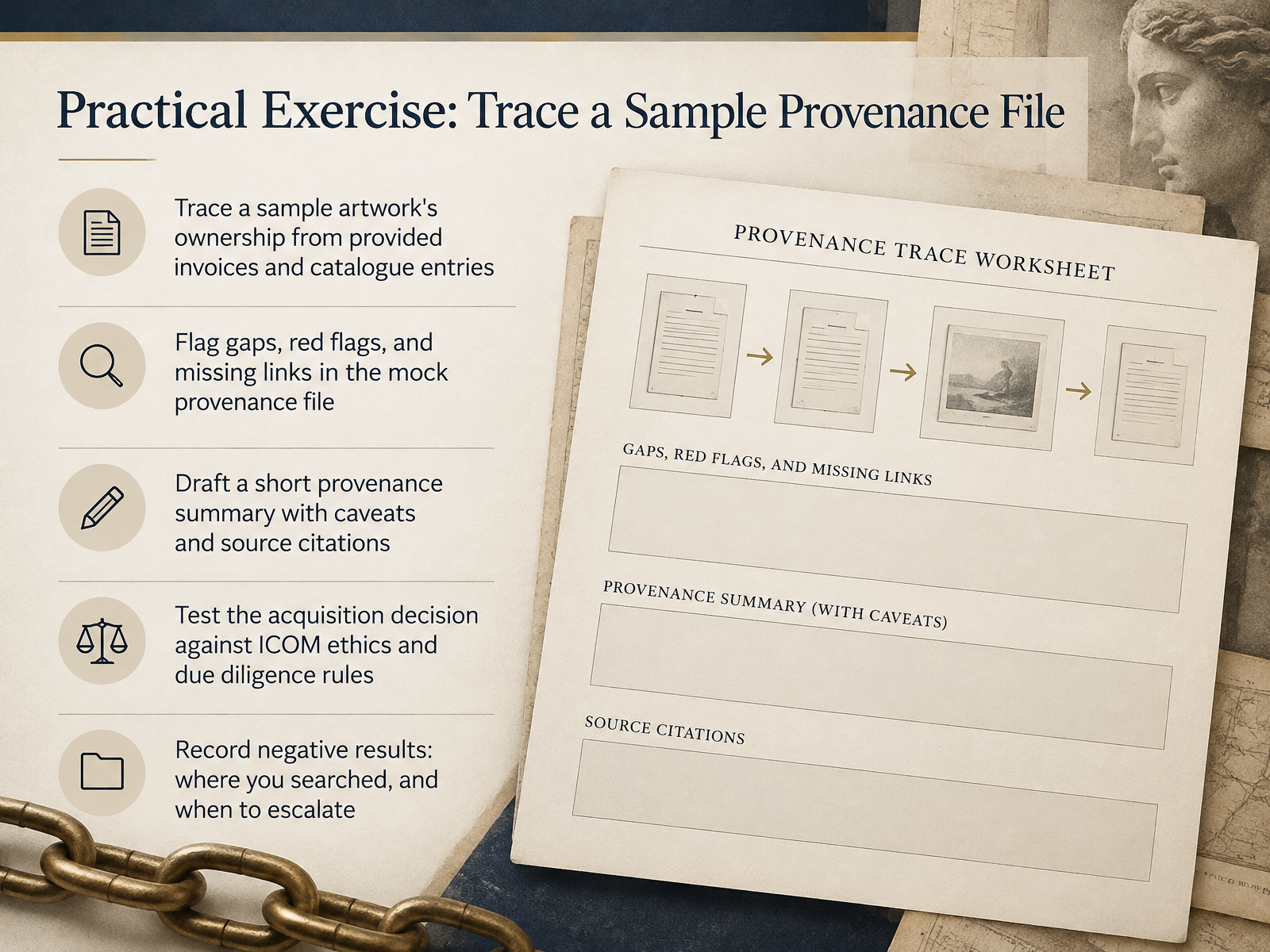
- 12Practical Exercise: Trace a Sample Provenance FileNow let's put method into practice with a sample provenance file. Working from the provided invoices and catalogue entries, you'll trace the artwork's ownership step by step. Then flag gaps and red flags: a missing invoice, a sale dated during a period of conflict, a dealer's name that appears and vanishes. Next, draft a short provenance summary. State your caveats plainly and cite your sources, so a reader can verify each claim. Test the acquisition decision against the ICOM Code of Ethics and your due diligence rules. Ask whether legal title can reasonably be established, and whether any gap gives cause for suspicion. Finally, record your negative results. Note where you searched, what you did not find, and when to escalate to a curator, registrar, or legal counsel. Documenting a dead end is a result, and it prevents redundant research later. In the next section, we look at Tools, Training, and Staying Current.
 guides.library.yale.eduspcrintranet.wyo.govjournals.ub.uni-heidelberg.de+22 min
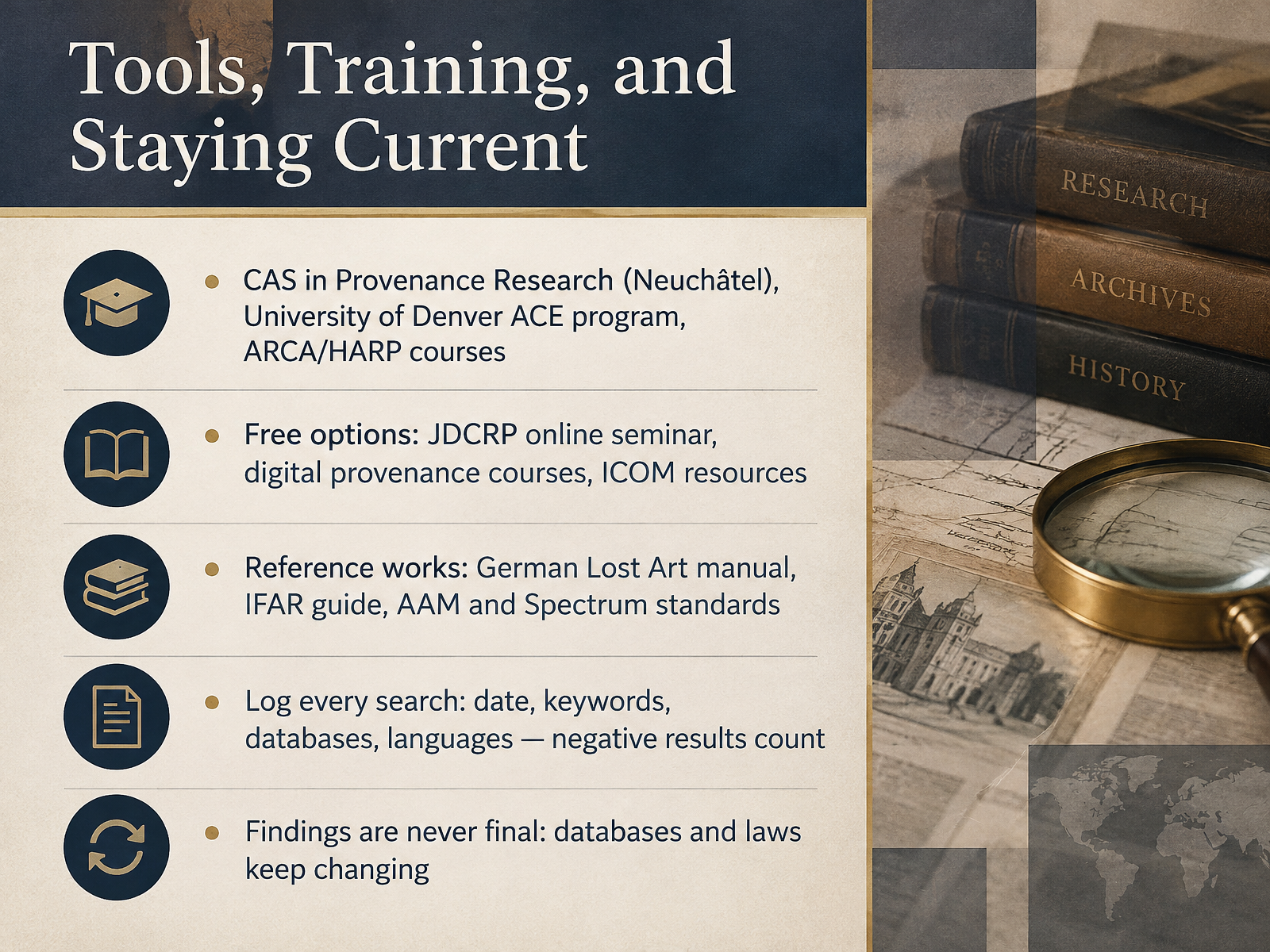
- 13Tools, Training, and Staying CurrentNow let's look at the tools and training that keep your provenance work current. For formal credentials, consider the Certificate of Advanced Studies in Provenance Research at the University of Neuchâtel, the Center for Art Collection Ethics program at the University of Denver, and ARCA courses with HARP. Free options include the Jewish Digital Cultural Recovery Project's online seminar, digital provenance courses, and ICOM resources. For reference, keep the German Lost Art manual, the IFAR guide, and American Alliance of Museums and Spectrum standards close at hand. Critically, log every search: the date, keywords, databases, and languages, because negative results count as evidence. And remember, findings are never final. Databases and laws keep changing, so revisit your conclusions. That mindset prepares you for the practical exercise and assessment ahead.
 guides.library.yale.eduspcrintranet.wyo.govjournals.ub.uni-heidelberg.de+22 min
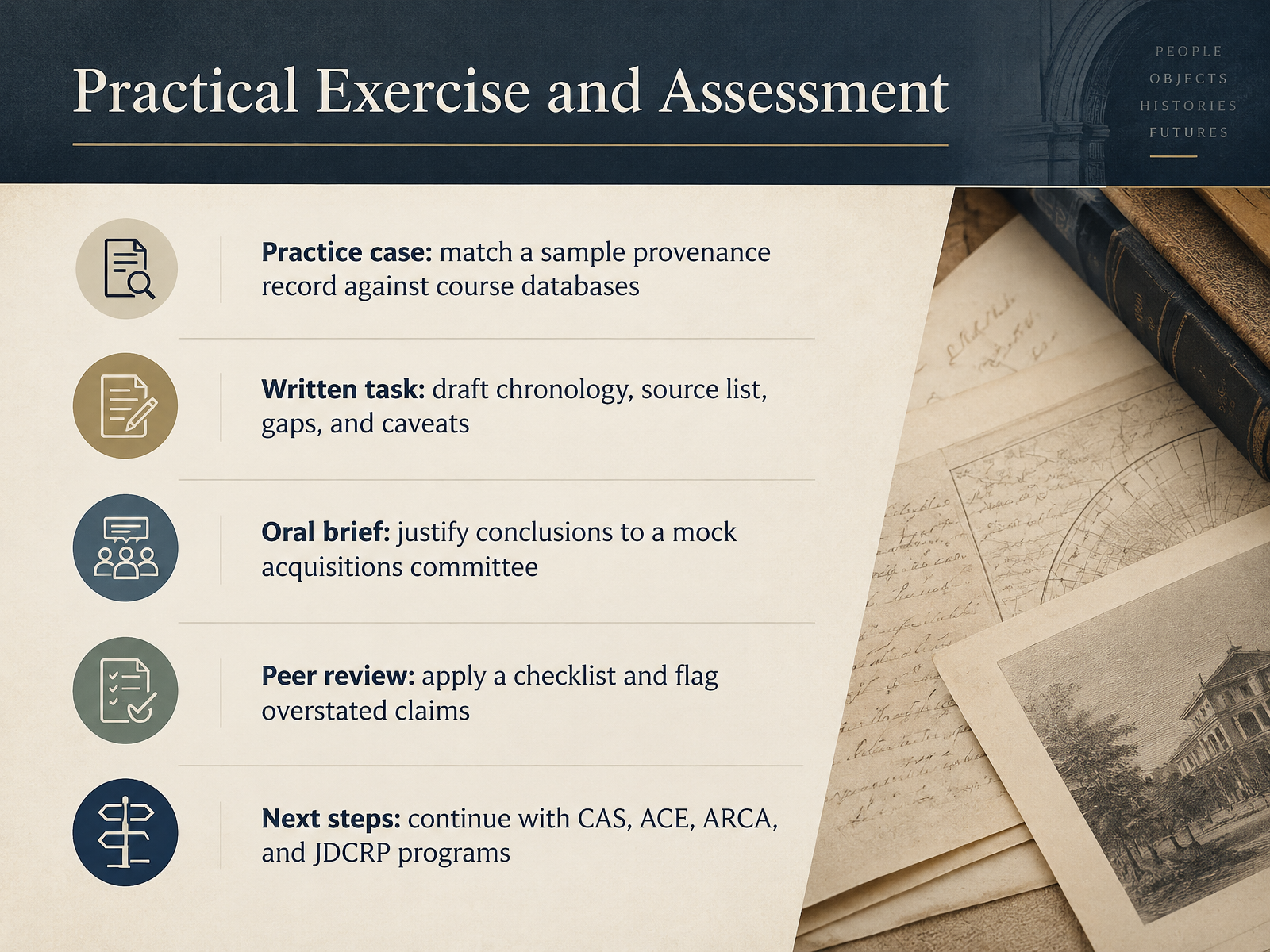
- 14Practical Exercise and AssessmentLet us close with practice. First, take a sample provenance record and match it against course databases such as the Getty Provenance Index or the Lost Art database. Then draft a short written chronology with your source list, gaps, and caveats, using terms like possibly or probably where records are uncertain. Next, present an oral brief to a mock acquisitions committee, justifying each conclusion by its source. In peer review, apply a checklist and flag any overstated claims. For next steps, continue with the CAS, ACE, ARCA, and JDCRP programs. Thank you for your careful work, and keep tracing those ownership chains.
 guides.library.yale.eduspcrintranet.wyo.govjournals.ub.uni-heidelberg.de+21 min
Take the deck with you
Download this course as a file — free, no sign-up needed.
- PDF handoutEvery slide page, ready to print or share.15 pages · 5.1 MBDownload
- Narrated PowerPointThe deck that presents itself — every slide carries the digital human's narration video.15 pages · 27.9 MBDownload
- PowerPoint slidesThe full deck as a .pptx — open it in PowerPoint, Keynote, or Google Slides.15 pages · 5.1 MBDownload
Free to use in your own training — please keep the PersonWise credit page at the end.
Have your own deck? Turn it into a course
Sources consulted
Web sources consulted while building this course.
- Vadémécum des recherches de provenance | Ministère de la Culture — culture.gouv.fr
- Art Tracks | Art Tracks — museumprovenance.org
- Provenance research into collections from a colonial context — english.cultureelerfgoed.nl
- Provenienzforschung für Museen "Und dann haben wir noch das hier ..." — museumsberatung-bayern.de
- Full article: Provenance Research in Museums: Principles, Practices and Possibilities — tandfonline.com
- International Foundation for Art Research (IFAR)-Art Law Glossary — ifar.org
- Keywords & Terminology - Art Provenance Research - LibGuides at Saint Louis Art Museum — research.slam.org
- DOI Museum Property Directives — doi.gov
- Provenance and due diligence research policy | Art Gallery of NSW — artgallery.nsw.gov.au
- Provenance & Due Diligence Research Policy | Tasmanian Museum and Art Gallery — tmag.tas.gov.au
- Collecting and Provenance Research: Methodology — guides.library.yale.edu
- REGISTRAR'S MANUAL for WYOMING STATE MUSEUM & STATE PARKS & HISTORIC SITES Cheyenne, Wyoming 82002 — spcrintranet.wyo.gov
- https://journals.ub.uni-heidelberg.de/index.php/transfer/article/view/91515/99496 — journals.ub.uni-heidelberg.de
- Provenance Research for Mediterranean Antiquities | Methods and Resources — getty.edu
- PROVENANCE — bibliotheksverband.de
- Stolen Works of Art Database — interpol.int
- Non-commercial databases of stolen cultural property - Collections Trust — collectionstrust.org.uk
- Art Loss Register – The world's largest private database of stolen art — artloss.com
- Welcome to lootedart.com — lootedart.com
- Selected Museum Provenance Research Projects in the US and Abroad | The Metropolitan Museum of Art — metmuseum.org