Begin
14 pages · ~28 min
Change Management Impact Assessment
This training teaches change leaders to assess change impacts on people, processes, and systems, enabling targeted, effective change management planning.
A digital instructor presents all 14 pages. Hold “Ask” at any point and ask out loud — the answer comes from this course. No sign-up needed.
What you’ll learn
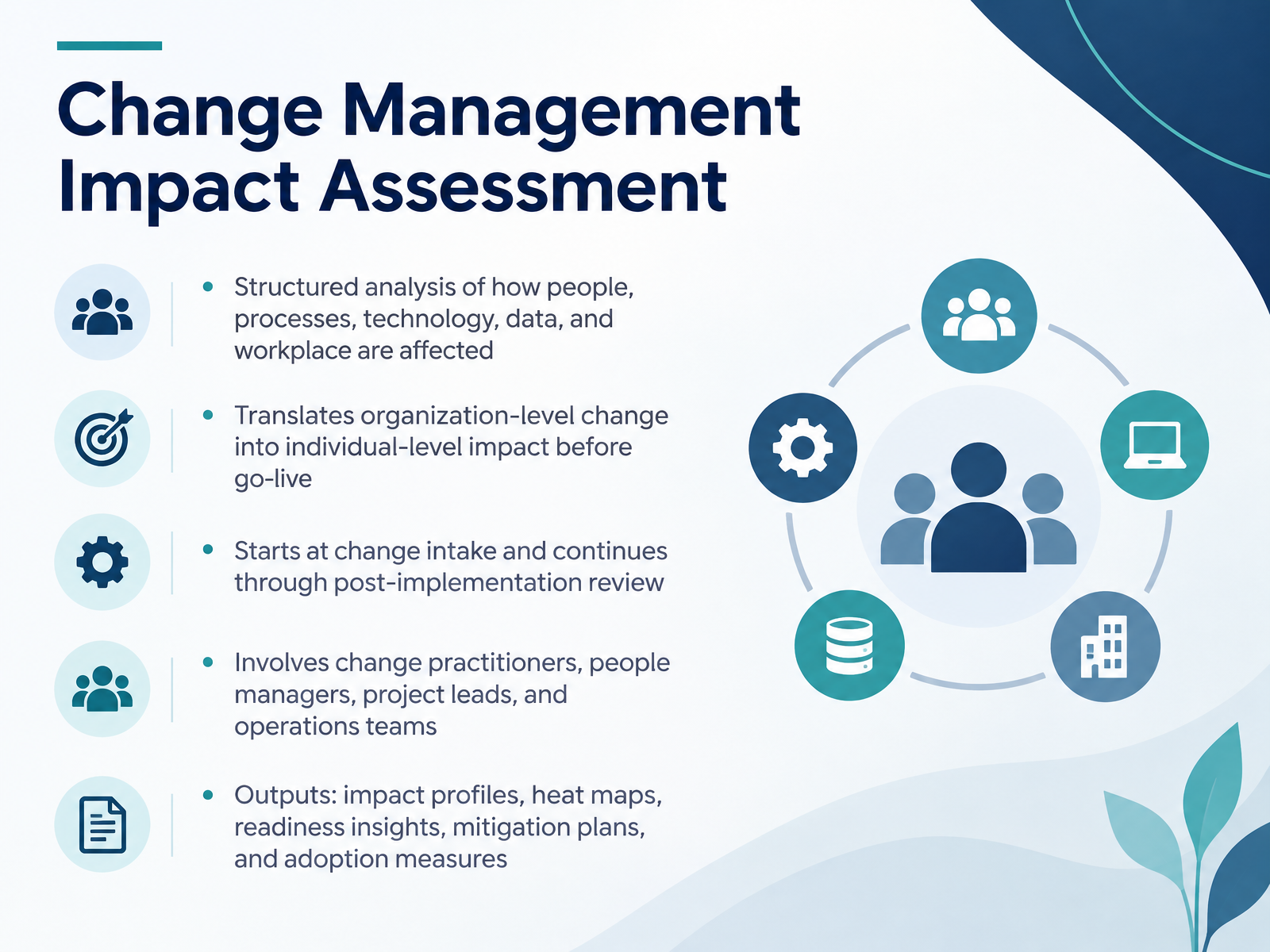
- 01Change Management Impact AssessmentWelcome. This course is about the Change Management Impact Assessment. It is one of those practices we all know matters, yet it often gets squeezed when delivery pressure builds. Our goal here is practical. By the end, you should be able to run a structured assessment and use its outputs to plan real adoption work. So what is it? At its core, it is a structured analysis of how people, processes, technology, data, and the workplace are affected by a change. Its real value is translation. It takes an organization-level change, say a new enterprise system, and turns it into individual-level impact before go-live. Think about Andre, Becky, Carlos, and Dhara, and what actually shifts in their day. The assessment starts at change intake and continues through post-implementation review. It is a shared effort across change practitioners, people managers, project leads, and operations teams. And it produces concrete outputs: impact profiles, heat maps, readiness insights, mitigation plans, and adoption measures. Next, we look at why skipped or superficial assessments cost so much.acmpmexico.orgprosci.comprosci.com+22 min
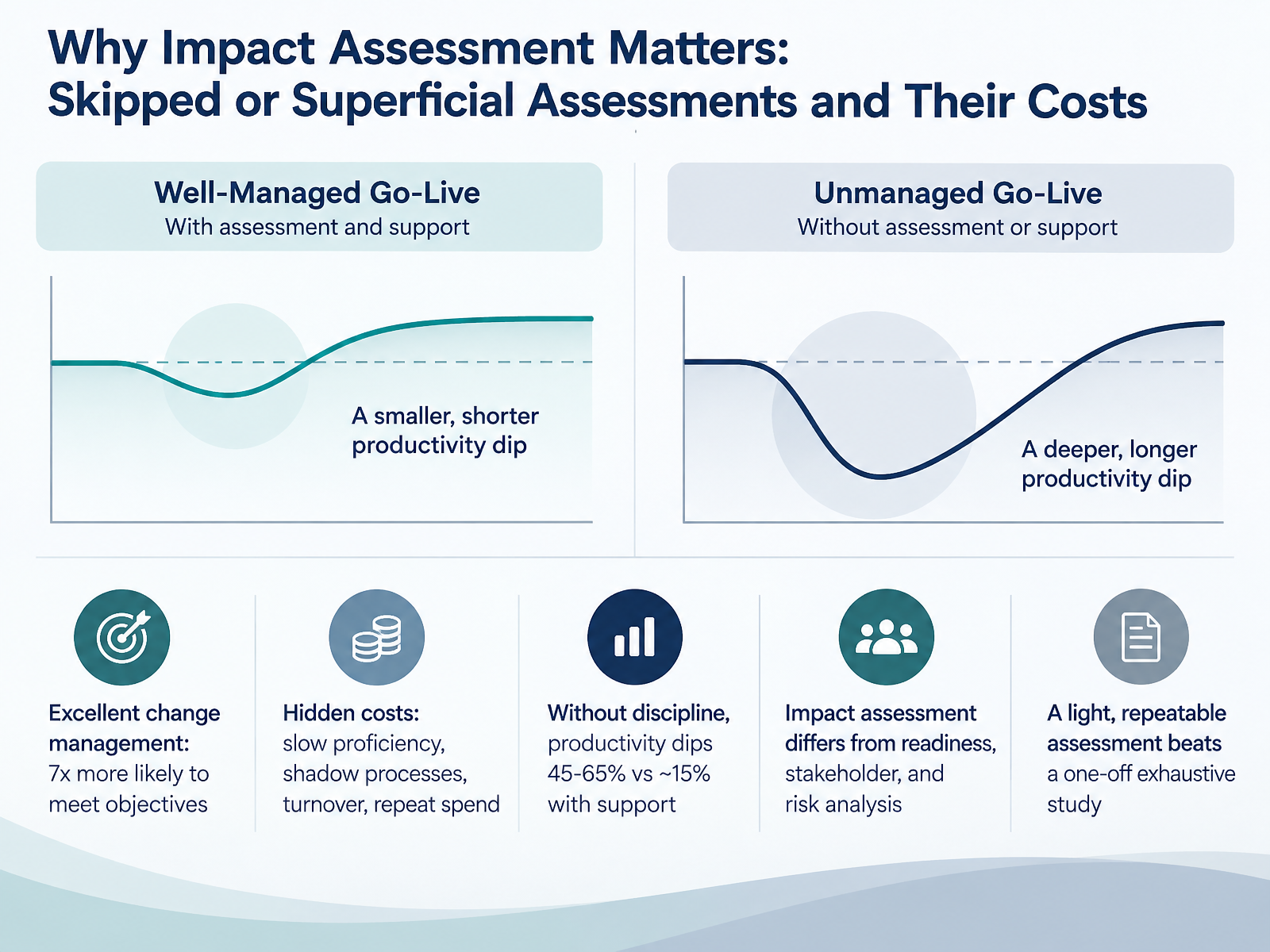
- 02Why Impact Assessment Matters: Skipped or Superficial Assessments and Their CostsSo why does impact assessment matter? Here is the evidence. Projects with excellent change management are seven times more likely to meet their objectives. Skip that discipline, and the costs hide. Proficiency slows, shadow processes creep in, good people leave, and you end up paying twice for the same rollout. Productivity tells the story: without structured support, it can drop by forty five to sixty five percent. With support, closer to fifteen. Now, one distinction worth holding onto. Impact assessment is not readiness, stakeholder, or risk analysis. Those matter, but impact asks a different question: what actually changes for which groups, and how much? And here is the practical point. A light, repeatable assessment beats a one off exhaustive study every time. So what belongs inside one? That is where we go next: fixing scope, business drivers, boundaries, and assessment objectives.
 prosci.comchangefolio.comjudge.com+21 min
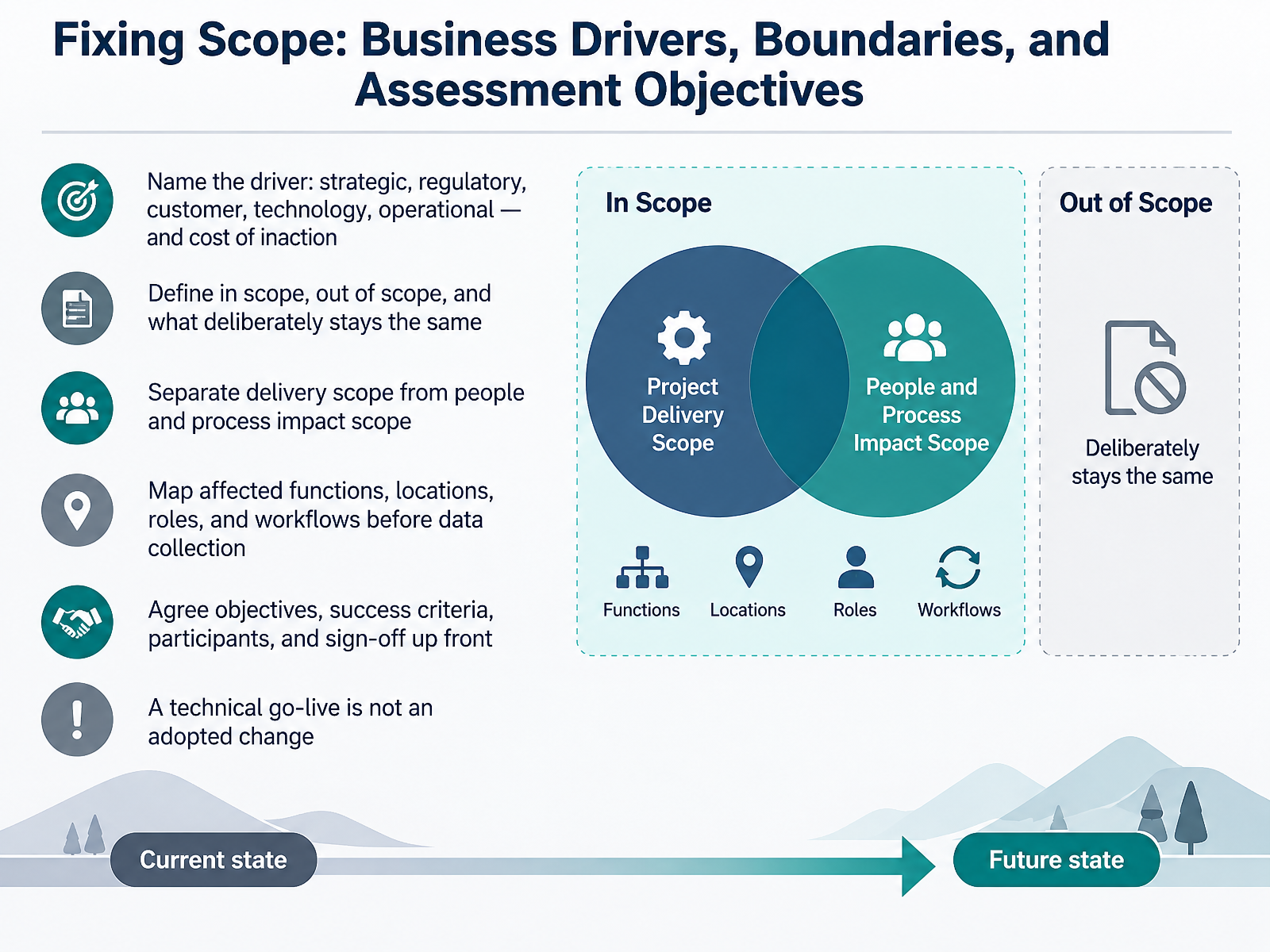
- 03Fixing Scope: Business Drivers, Boundaries, and Assessment ObjectivesLet's talk about fixing scope before you collect a single data point. Start by naming the business driver. Is it strategic, regulatory, customer, technology, or operational? And say out loud what inaction will cost. Next, draw three lines: what is in scope, what is out, and what deliberately stays the same. That third line matters most. Then separate delivery scope from people and process impact scope. They are not the same thing. Before data collection, map affected functions, locations, roles, and workflows. Agree your objectives, success criteria, participants, and sign-off up front. Here's the test: a technical go-live is not an adopted change. Fix the scope now, or the assessment will drift later. Now let's break impact into its dimensions: the Dimensions of Impact: People, Process, Technology, Data, and Organization.
 acmpmexico.orglearn.microsoft.comprojectmanager.com+21 min
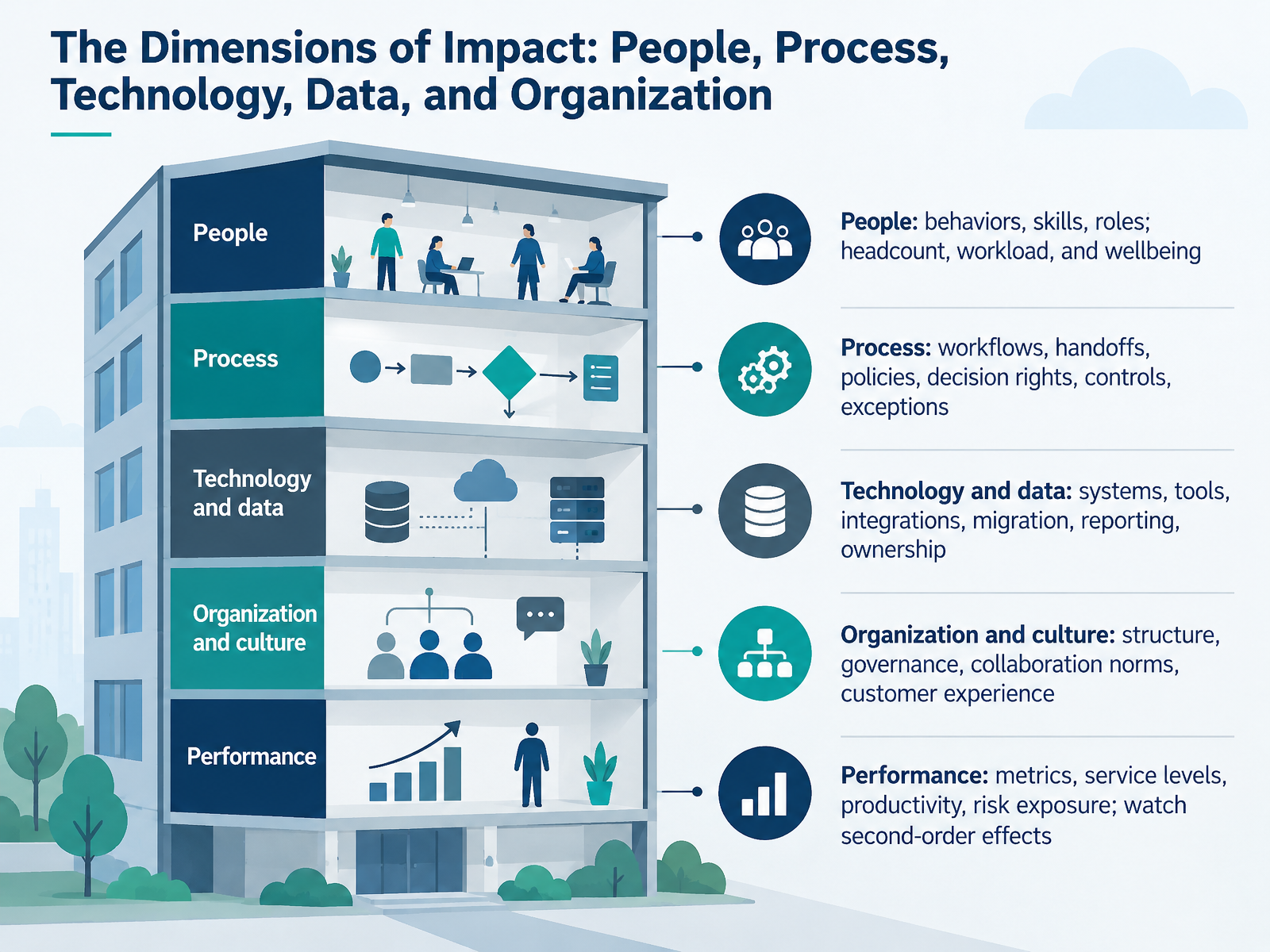
- 04The Dimensions of Impact: People, Process, Technology, Data, and OrganizationLet's break impact down into five dimensions you can assess separately, then connect.
Start with people. Behaviors, skills, roles, headcount, workload, and wellbeing. Ask which roles change most, and what that does to stress during transition.
Next, process. Workflows, handoffs, policies, decision rights, controls, and exceptions. A new approval step can slow everything downstream.
Then technology and data. Systems, tools, integrations, migration, reporting, and ownership. Data is often overlooked, and it can derail a rollout.
Organization and culture covers structure, governance, collaboration norms, and the customer experience. What behaviors and decision rights shift?
Finally, performance. Metrics, service levels, productivity, and risk exposure. Watch for second-order effects, like a faster process creating a backlog somewhere else.
Rate each dimension high, medium, or low, and you'll see where to focus first.
Next, we'll make these dimensions concrete using Prosci's 10 Aspects of Change Impact.
 exeter.ac.ukacmpmexico.orgprosci.com+22 min
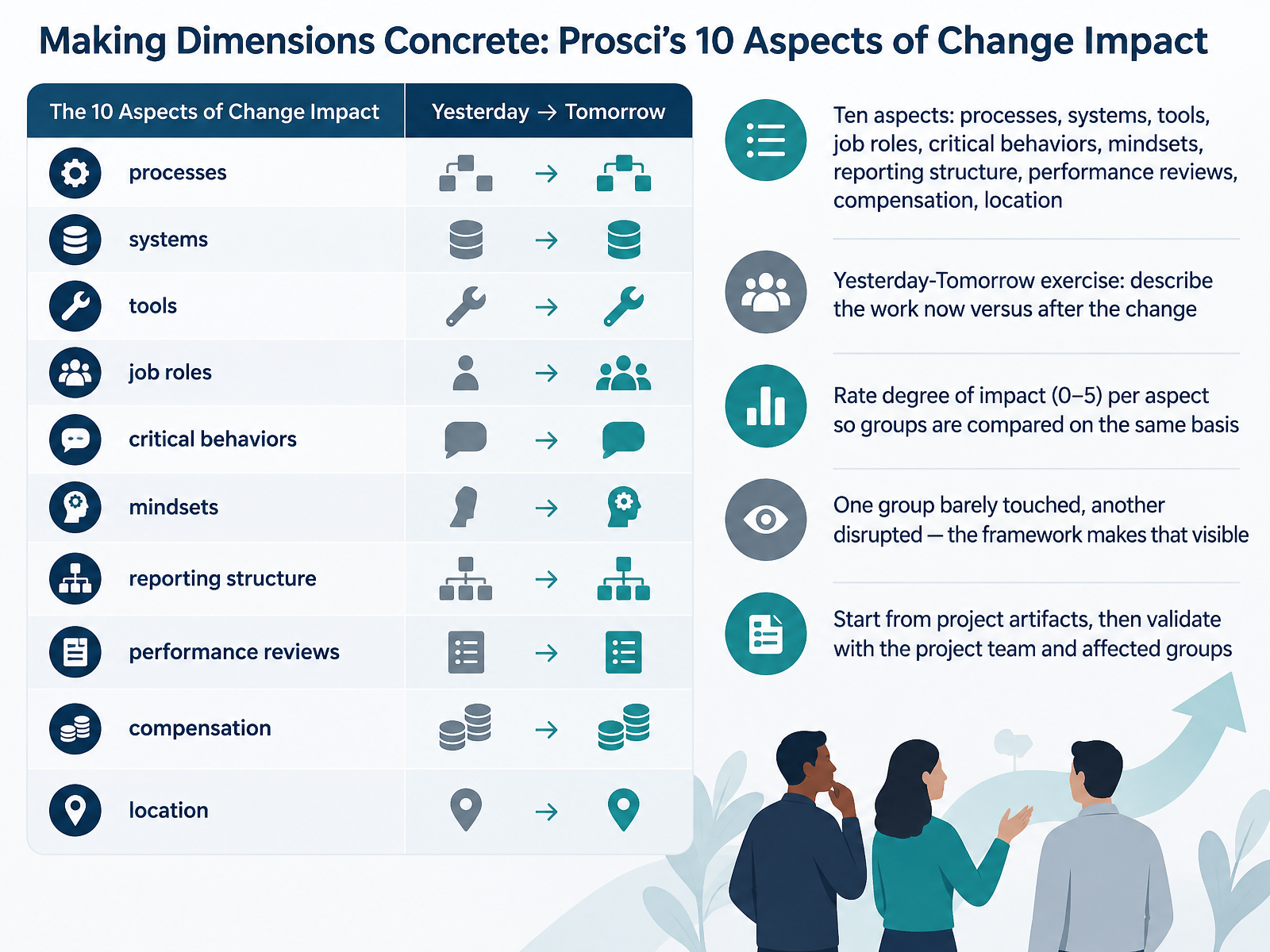
- 05Making Dimensions Concrete: Prosci's 10 Aspects of Change ImpactNow let's make those dimensions concrete. Prosci gives us ten aspects of change impact: processes, systems, tools, job roles, critical behaviors, mindsets, reporting structure, performance reviews, compensation, and location. Here's how to use them. Run a Yesterday-Tomorrow exercise with each affected group. Describe the work as it happens today, then as it will happen after the change. Then rate the degree of impact for each aspect on a zero to five scale, so every group is compared on the same basis. That consistency matters. One group may be barely touched while another is genuinely disrupted, and this framework makes that visible instead of leaving it to opinion. Start from your project artifacts, then validate the picture with the project team and the affected groups. Next, we'll look at selecting assessment methods and data sources.
 acmpmexico.orgprosci.comprosci.com+21 min
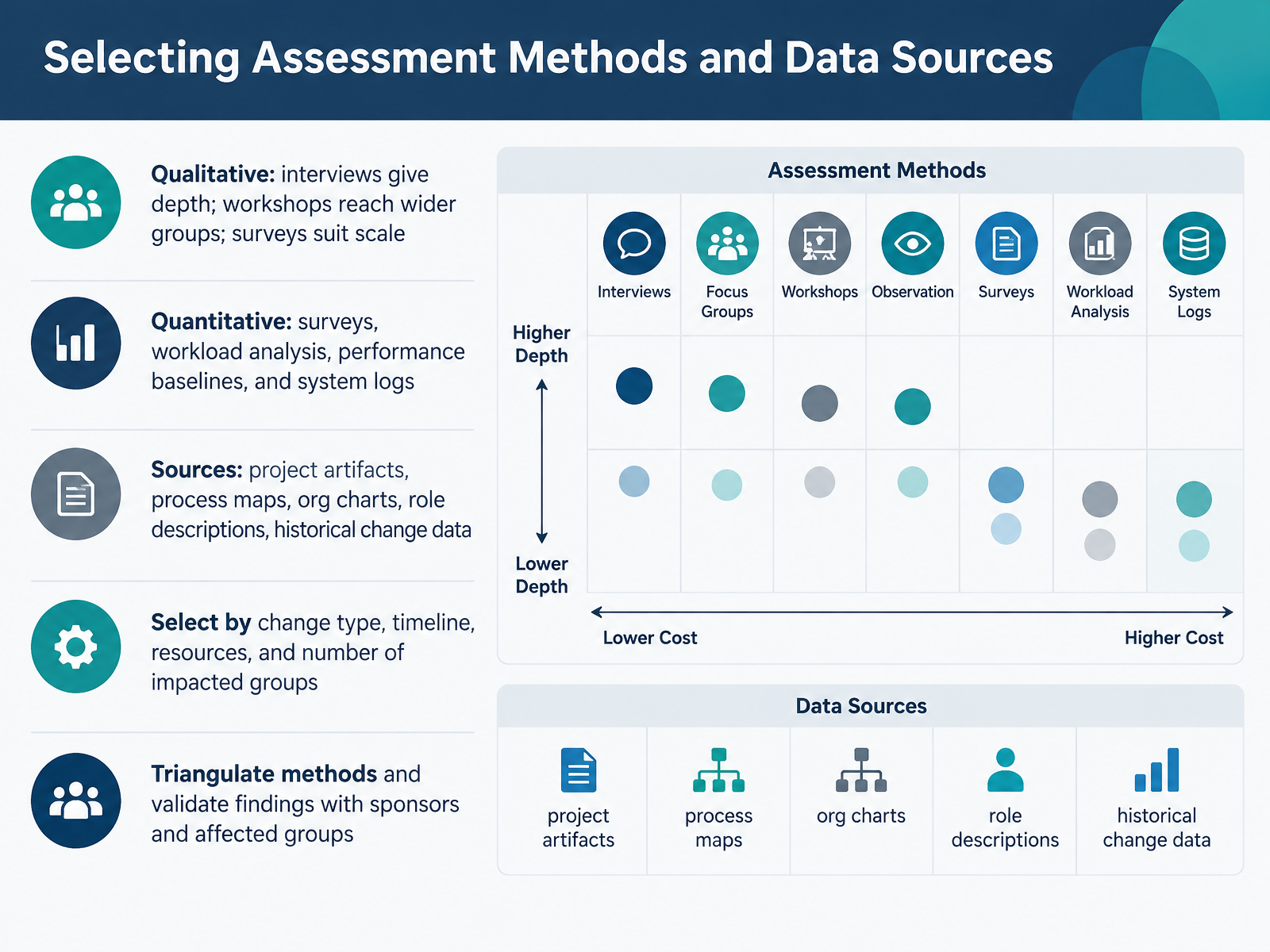
- 06Selecting Assessment Methods and Data SourcesNext, let's talk about choosing your assessment methods and data sources. Start with interviews when you need depth from a small number of impacted groups. They are resource intensive, but they surface the detail surveys miss. Workshops reach a wider group and let you test impacts together, though getting the right representation takes effort. Surveys scale to very large populations, but response quality can be low, so use them to supplement what you learn elsewhere. Then add quantitative evidence: performance baselines, workload analysis, and system logs. Pull from project artifacts, process maps, org charts, and historical change data. Select methods by change type, timeline, resources, and how many groups are affected. And triangulate. Compare findings across methods, then validate them with sponsors and the affected groups themselves. That is how you keep the assessment credible. Next, we will look at impact grids and heat maps for rating, calibration, and prioritization.
 exeter.ac.uktransformation.gov.jmdoi.org+12 min
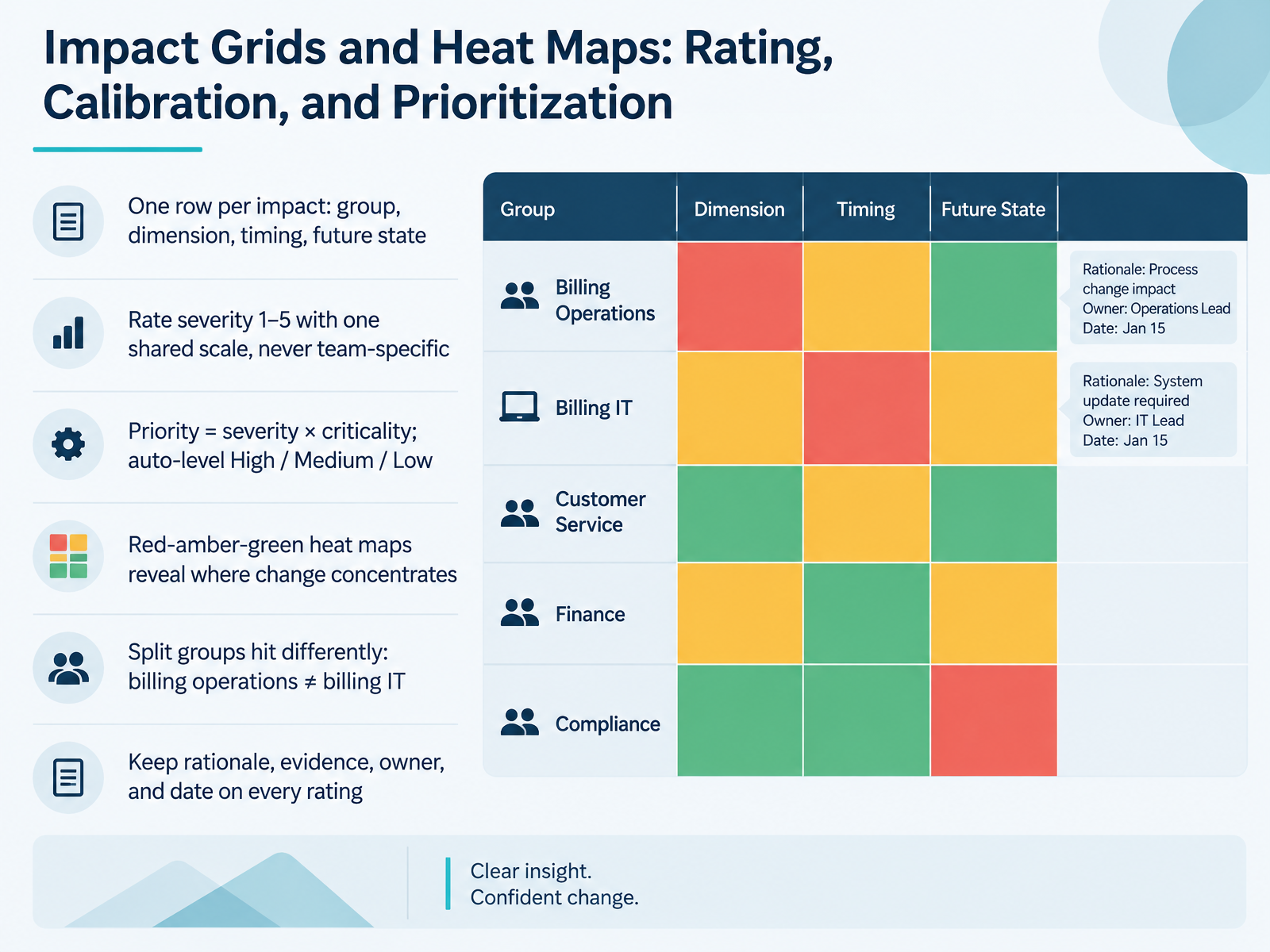
- 07Impact Grids and Heat Maps: Rating, Calibration, and PrioritizationNow let's talk about turning ratings into a picture people can act on. Build the impact grid with one row per impact, capturing the group, the dimension, the timing, and the future state. Rate severity from one to five on one shared scale. Not team-specific. The moment each team invents its own definition of high, your comparison is dead. Priority comes from severity times criticality, and that level, high, medium, or low, fills in automatically. Then a red, amber, green heat map shows where change concentrates. That is where you aim your support. One caution. Split groups that get hit differently. Billing operations and billing IT are not the same thing. And keep the rationale, evidence, owner, and date on every rating. Otherwise, in a month, nobody remembers why the number is a four. Next, we look at stakeholder and people impact, including segments, personas, and manager readiness.
 prosci.com2 min
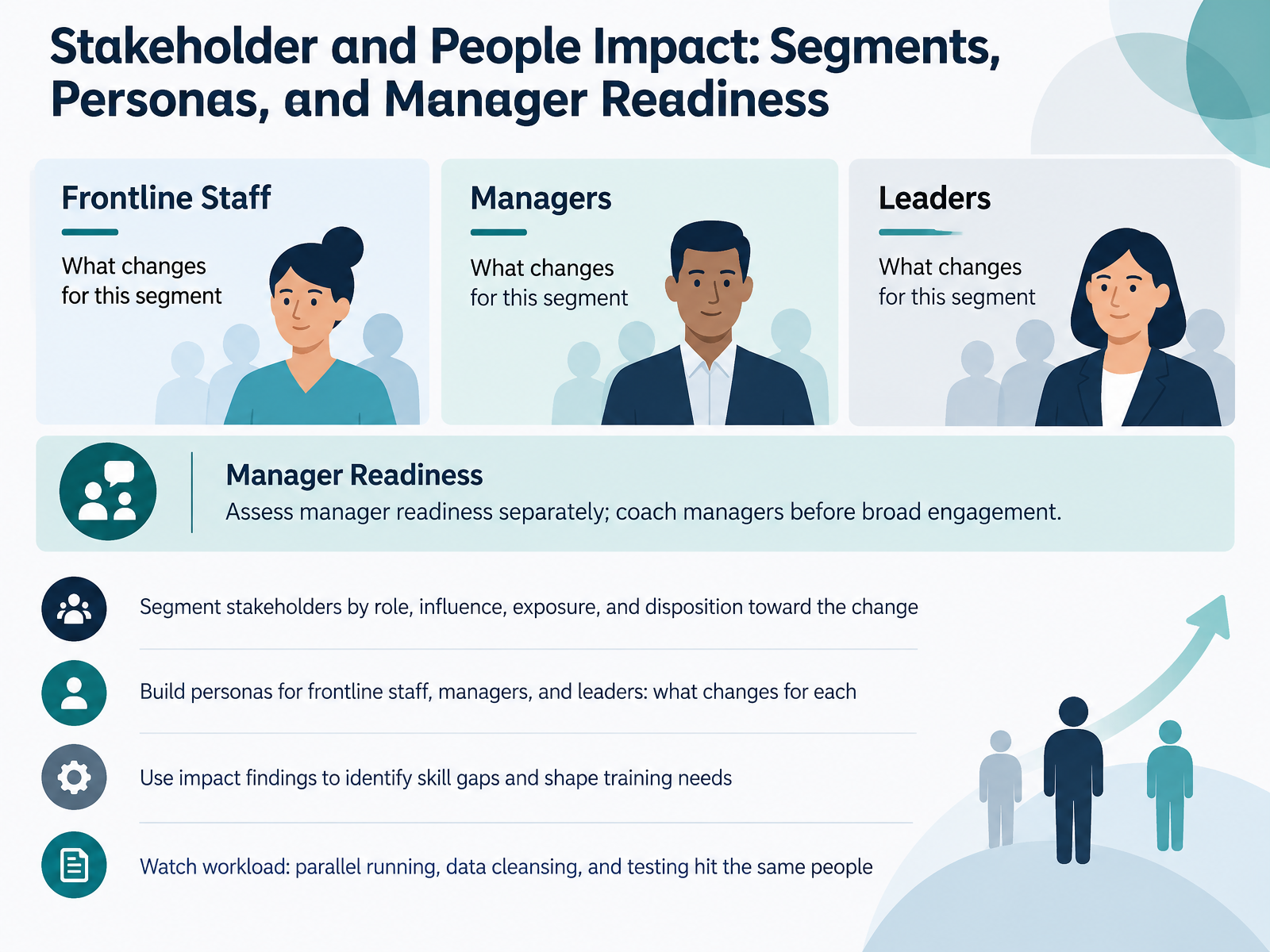
- 08Stakeholder and People Impact: Segments, Personas, and Manager ReadinessNow let's look at people impact, because that's where change actually lands. Segment stakeholders by role, influence, exposure, and disposition toward the change. Then build simple personas for frontline staff, managers, and leaders, and be specific about what changes for each. Assess manager readiness separately. Coach managers before broad engagement, so they can answer questions instead of absorbing them cold. Use your impact findings to identify skill gaps and shape training needs. And watch workload carefully. Parallel running, data cleansing, and testing often hit the same small group of people. Protect that capacity, or adoption will stall. Next, we move into risk, readiness, and gap analysis with ADKAR.
 acmpmexico.org1 min
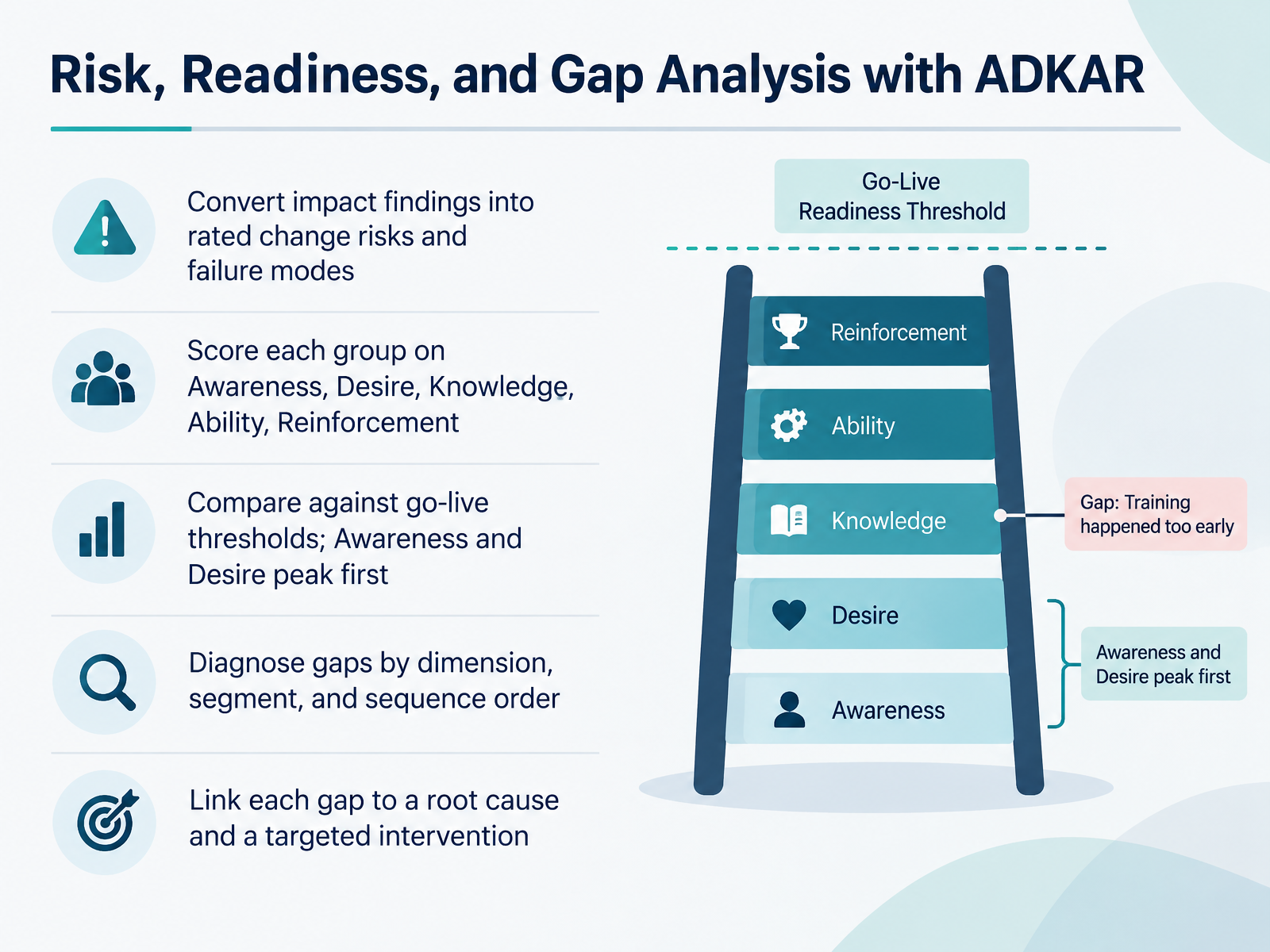
- 09Risk, Readiness, and Gap Analysis with ADKARNow let's turn those impact findings into a risk picture you can act on. First, convert them into rated change risks and failure modes, so each concern has a severity and a name. Then score each impacted group across the five A D K A R elements: Awareness, Desire, Knowledge, Ability, and Reinforcement. Compare those scores against your go-live thresholds. Here's the pattern to watch: Awareness and Desire tend to peak first, and if either sits low, later dimensions can't carry the change. Diagnose gaps by dimension, by segment, and by sequence, so you catch a group that knows how but doesn't want to, or was trained before it understood why. Finally, link every gap to a root cause and one targeted intervention. That's what makes the plan defensible. Next, we move into quantifying impact: productivity, cost, and the business case.
 prosci.com1 min
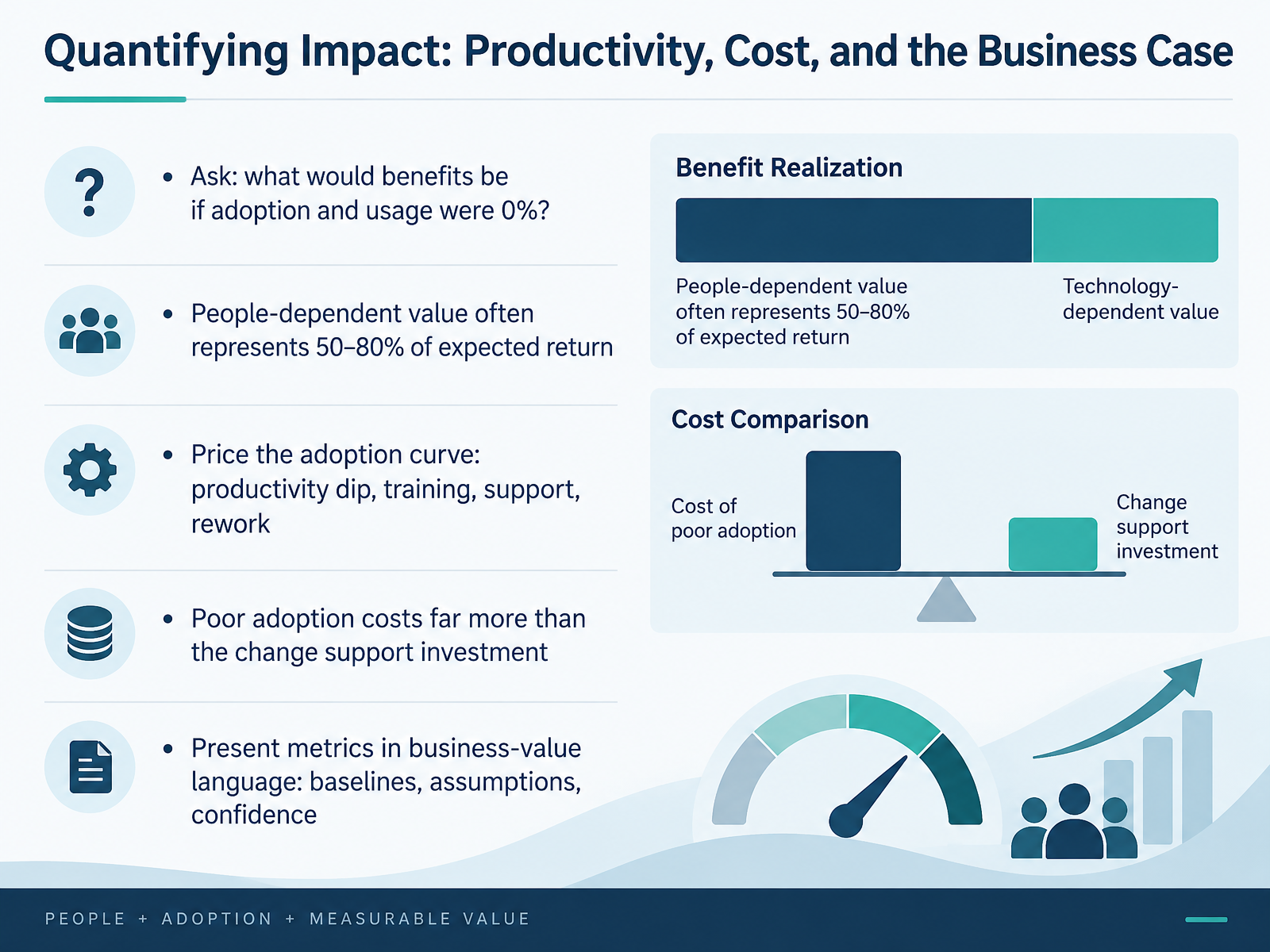
- 10Quantifying Impact: Productivity, Cost, and the Business CaseNow let's put numbers behind the impact. Start with one question: what would the benefits be if adoption and usage were zero? For most technology and process changes, the people-dependent share is fifty to eighty percent of expected return. So price the adoption curve. Budget for the productivity dip, training, support, and rework. A stalled rollout usually costs far more than the change support you were asked to fund. Present it in business-value language. Show your baseline, your assumptions, and your confidence level. One example: if adoption stalls, help desk tickets rise, tasks take longer, and go-live savings arrive months late. That is a cost you can defend in front of finance. Next, we move from assessment to action: tailored interventions and governance.
 prosci.comchangefolio.comjudge.com+21 min
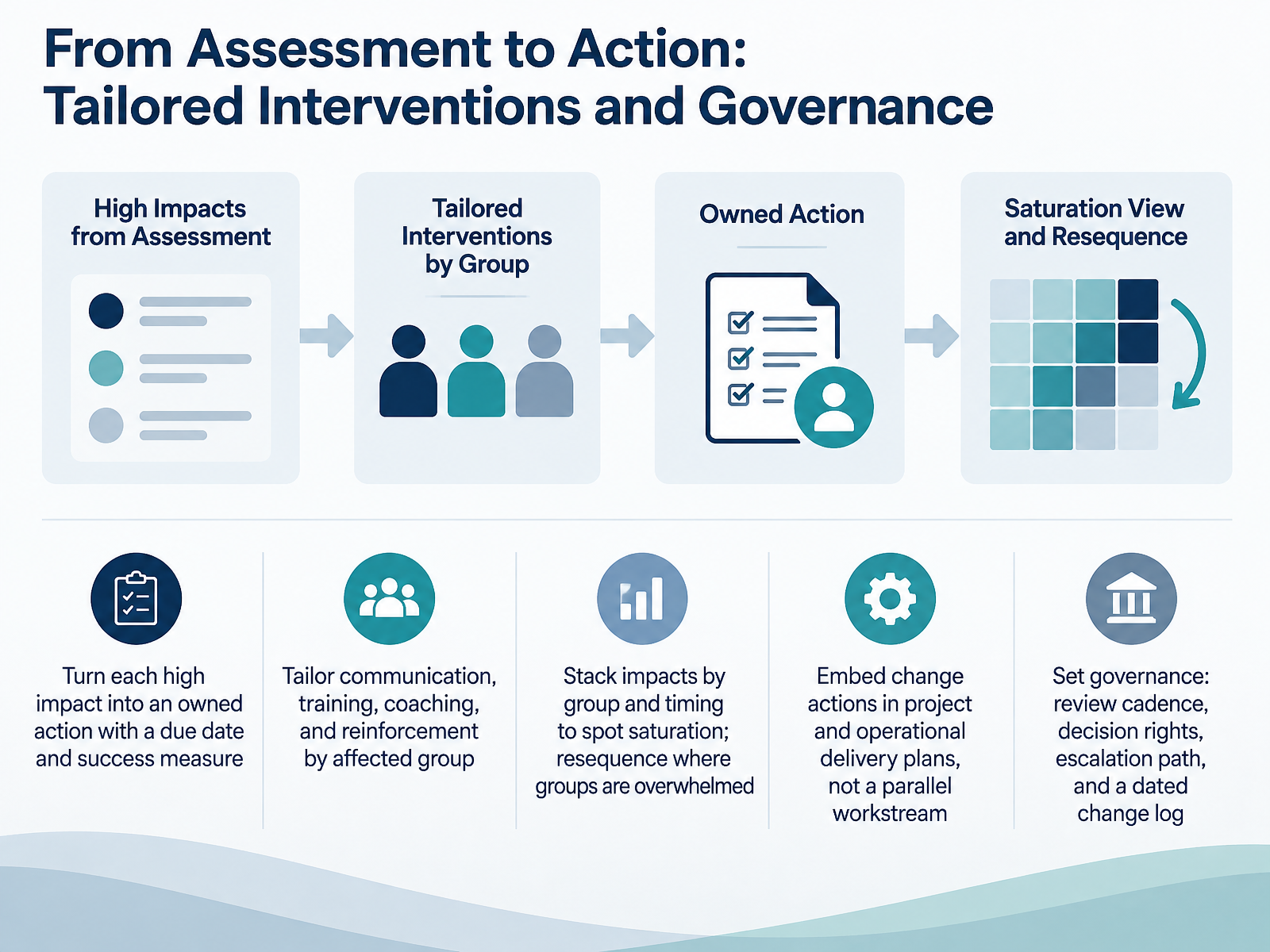
- 11From Assessment to Action: Tailored Interventions and GovernanceNow let's turn your assessment into action. Start by converting each high impact into an owned action, with a due date and a clear success measure. Next, tailor your interventions by group. A team facing a new system needs hands-on training. A team facing a role change may need coaching and reinforcement instead. Here's where it gets practical. Stack impacts by group and timing. Look for the weeks where one group carries three changes at once. That's saturation. Resequence where you can. Then embed change actions inside project and operational delivery plans. Not a parallel workstream people can quietly drop. And set governance: review cadence, decision rights, an escalation path, and a dated change log. Write it down, keep it current. One rule of thumb: if an action has no owner and no date, it isn't a plan, it's a wish. Next, we'll look at tracking adoption after go live, and the measures and reassessment triggers you'll need.
 2 min
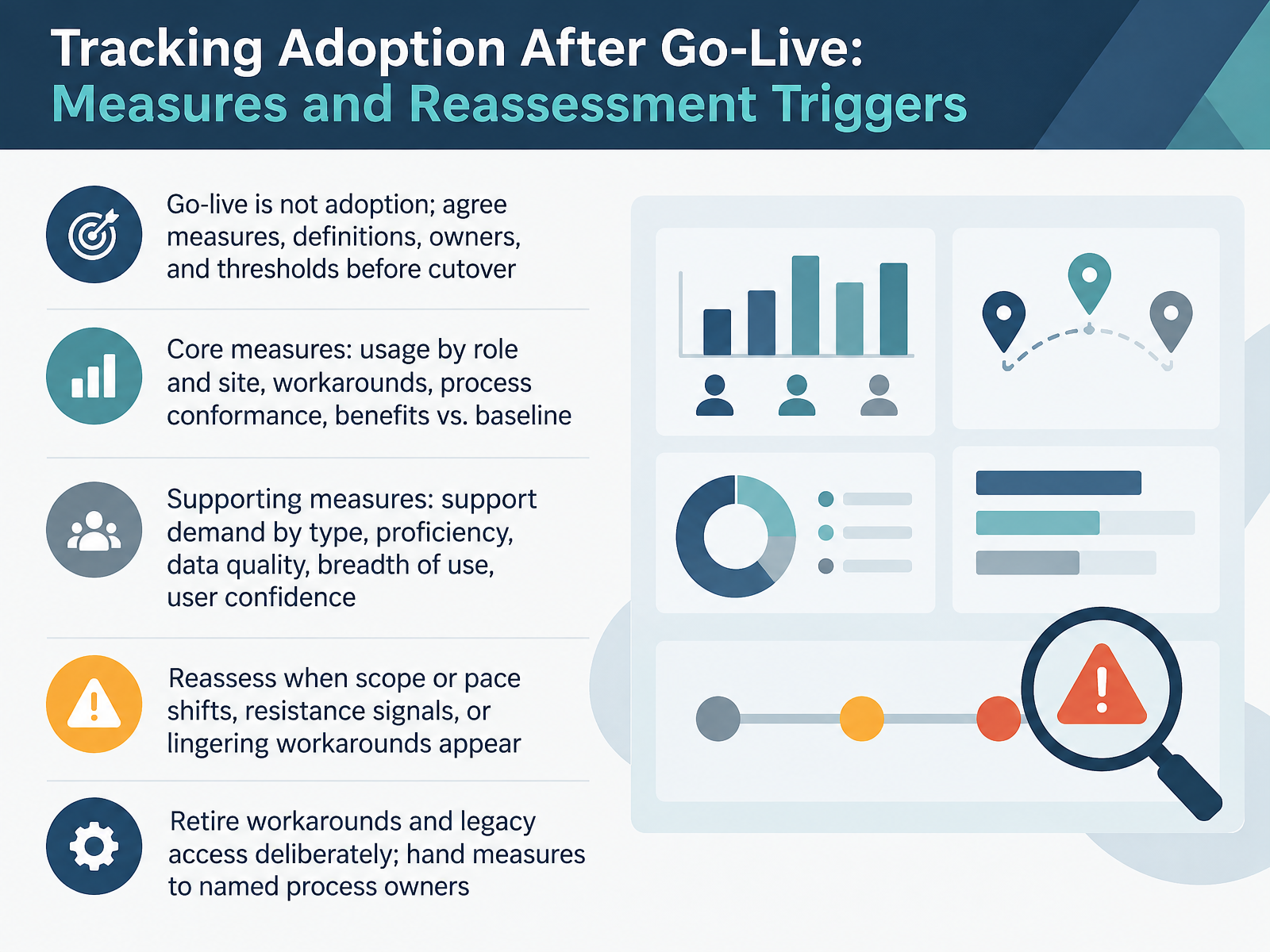
- 12Tracking Adoption After Go-Live: Measures and Reassessment TriggersNow let's look at what happens after go-live. Go-live is not adoption. Before cutover, agree your measures, definitions, owners, and thresholds so nobody argues about the numbers later. Four core measures carry the weight: usage by role and site, workarounds, process conformance, and benefits against the baseline. Supporting measures explain why those move: support demand by type, proficiency, data quality, breadth of use, and user confidence. Reassess when scope or pace shifts, when resistance signals appear, or when workarounds linger. And retire workarounds and legacy access deliberately. Hand each measure to a named process owner, so it survives after the project team leaves. Next, we move into the post-implementation review and lessons learned.
 2 min
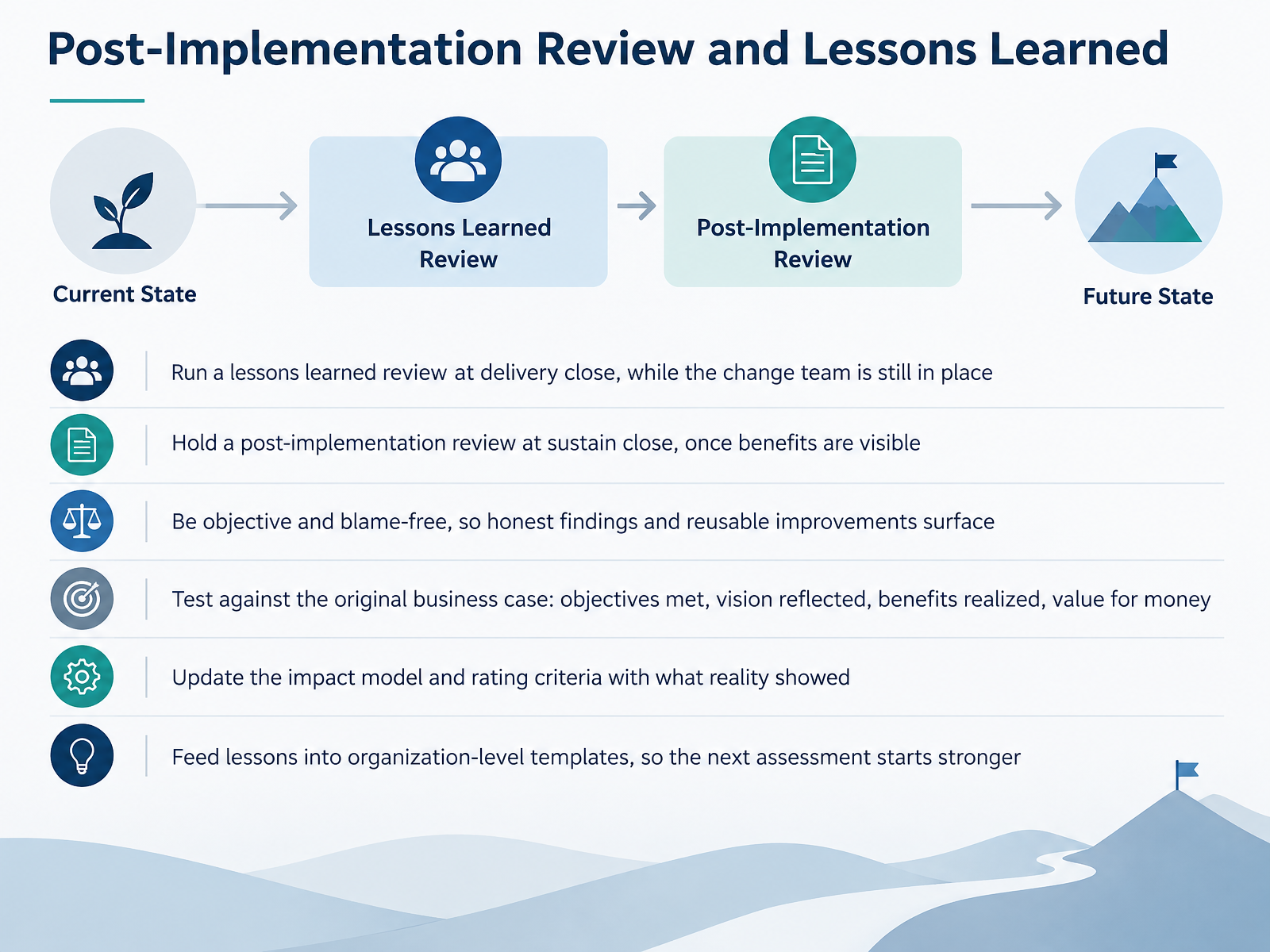
- 13Post-Implementation Review and Lessons LearnedNow let's close the loop with reviews and lessons learned. Run a lessons learned review at delivery close, while the change team is still in place and issues are fresh. Then hold a post-implementation review at sustain close, once benefits are visible. Keep both blame-free. People share honest findings only when they aren't punished for them. Test against the original business case: objectives met, vision reflected, benefits realized, and value for money. Then update your impact model and rating criteria with what reality showed. Finally, feed lessons into organization-level templates, so the next assessment starts stronger. Building a Repeatable Impact Assessment Practice: Your 30-60-90 Day Plan.
 1 min
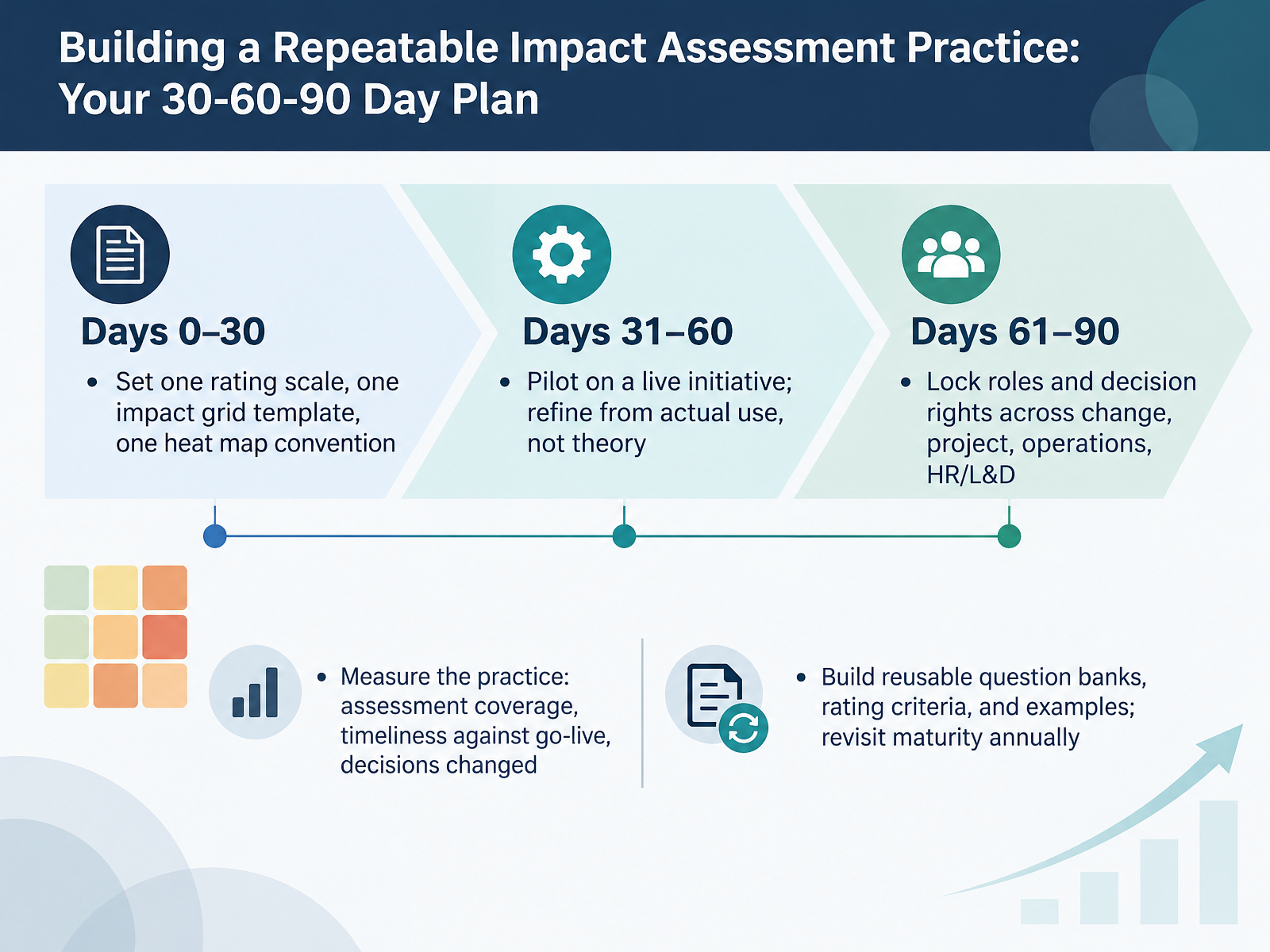
- 14Building a Repeatable Impact Assessment Practice: Your 30-60-90 Day PlanLet's close by turning good assessment habits into a repeatable practice. In the first thirty days, standardize. Choose one rating scale, one impact grid template, one heat map convention. Consistency beats sophistication here. From day thirty one to sixty, pilot it on a live initiative. Refine the template from actual use, not theory, because real assessments expose the gaps. Between day sixty one and ninety, lock roles and decision rights across change, project, operations, and HR or L and D. Who rates impact? Who signs off? Who acts on it? Then measure the practice itself: assessment coverage, timeliness against go live, and decisions actually changed. And keep building reusable question banks, rating criteria, and examples, revisiting maturity once a year. That is how impact assessment moves from a one-off exercise to a dependable capability. Thank you for working through this with me. Start small, stay consistent, and let the practice earn its credibility.
 exeter.ac.ukacmpmexico.orgprosci.com+22 min
Take the deck with you
Download this course as a file — free, no sign-up needed.
- PDF handoutEvery slide page, ready to print or share.15 pages · 3.3 MBDownload
- Narrated PowerPointThe deck that presents itself — every slide carries the digital human's narration video.15 pages · 11.2 MBDownload
- PowerPoint slidesThe full deck as a .pptx — open it in PowerPoint, Keynote, or Google Slides.15 pages · 3.2 MBDownload
Free to use in your own training — please keep the PersonWise credit page at the end.
Have your own deck? Turn it into a course
Sources consulted
Web sources consulted while building this course.
- Standard for Change Management — acmpmexico.org
- https://www.prosci.com/blog/defining-change-impact — prosci.com
- Impacted Groups Assessments [Change Impact, ADKAR, Risk by Group] — prosci.com
- Change Impact Assessment Worksheet — empower.prosci.com
- How to Assess and Address Change Impacts Quickly — prosci.com
- Calculating the ROI of change management — prosci.com
- Change Metrics that Matter the Most | ChangeFolio — changefolio.com
- The Real Cost of Skipping Change Management: A Framework for Calculating OCM ROI | Judge Group — judge.com
- Can OCM Really Move the Needle on EBITDA? Measuring the Impact of Change on Business Performance – Lampkin Brown — lampkinbrown.com
- Change Management ROI: Measuring Financial Returns and Business Impact - Culture Partners — culturepartners.com
- https://learn.microsoft.com/en-us/dynamics365/guidance/implementation-guide/change-management-assessing-business-process-change — learn.microsoft.com
- Change Impact Assessment & Analysis (Example & Template Included) — projectmanager.com
- Chapter 22. Change control - Government Project Delivery — projectdelivery.gov.uk
- Managing Change in Organizations — pmi.org
- 3. Change Impact | Change Blueprint | University of Exeter — exeter.ac.uk
- MOSAIC: A Structured Multidisciplinary Analysis for Managing the Integration of Inter-Organizational Changes — doi.org
- Organizational impact assessment | Framework for Leading Change — change-leadership.github.io
- Chapter 3 – Change impact analysis – TIU Change Management Playbook — transformation.gov.jm
- Identifying and promoting qualitative methods for impact assessment — doi.org
- INTRODUCTION TO IMPACT EVALUATION — interaction.org